Skip to content

GeMarkt Art History Atlas

A world of art.
A way through it.

Learn how to look, research, compare, and connect art histories across regions and time.

Six transferable methods and a complete 48-chapter global atlas built around objects, evidence, material, institutions, and movement.

Vincent van Gogh’s 1889 painting The Bedroom, with a yellow bed and chairs in a sharply angled blue room.
Opening studyHow to analyse a work of art: from observation to argumentVincent van Gogh, The Bedroom, 1889. Oil on canvas, 73.6 × 92.3 cm. The Art Institute of Chicago, Helen Birch Bartlett Memorial Collection.Image record · CC0 Public Domain Designation · Preview crop only.

Choose your entrance

Start where you are

The Atlas has an order, not a gate. Learn one transferable method, enter the chronology at its beginning, or explore Atlas I through place and time.

New to close lookingLearn a method firstHow to analyse a work of art: from observation to argumentBegin the method Follow the syllabusEnter Atlas IPrehistoric art: image, object, place, and the limits of the archiveOpen the first chapter Explore by place and timeOpen the Atlas I mapSee fifty sourced records on a map or follow the same works in chronological order.Open Space & Time

The connected chronology

Five volumes.
No single centre.

Move across time through objects, cities, rituals, materials, and institutions. The sequence makes comparison possible without forcing every culture onto one European clock.

Open chapter Published syllabus

This line organises the syllabus; it does not claim that one culture simply follows another. All 54 chapters are published links; the route creates no empty pages.

Atlas I · Space & Time

Atlas I in space and time

Fifty sourced object and site records connect the ten open Atlas I chapters without inventing modern borders, exact findspots, or a single universal clock.

Choose Map to explore reviewed locations, or Timeline to follow the same records in chronological order.

50
sourced records
39
mapped records
11
records without reviewed coordinates

Space · evidence-led locations

Where the route touches ground

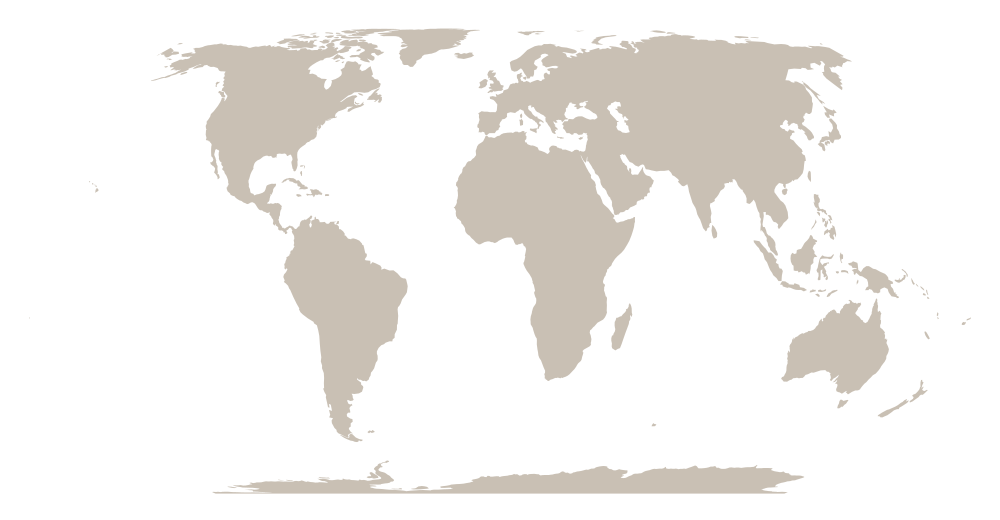
Only source-supported locations are plotted. The borderless basemap is an orientation aid, not a reconstruction of historical territory.

Selected map cluster · 5 records

5 records share this map area

Choose any record in this projected cluster. The grouping describes screen proximity only.

  1. San Lorenzo Colossal Head 2

    before about 900 BCE

    Historical locator
    San Lorenzo’s major Gulf Coast florescence
    Present-day locator
    San Lorenzo Tenochtitlán archaeological site, Veracruz, Mexico
    Place relation
    Found at
    Open chapter
  2. Puma Mural

    probably Classic period, approximately 200–550 CE

    Historical locator
    Classic-period Teotihuacan metropolis and painted city
    Present-day locator
    Northern Avenue of the Dead, Teotihuacan, State of Mexico, Mexico
    Place relation
    Site
    Open chapter
  3. Altar Q

    776 CE

    Historical locator
    Copán Maya kingdom under Yax Pasaj Chan Yopaat
    Present-day locator
    Original setting before Structure 16, Copán Acropolis, Copán Ruinas, Honduras
    Place relation
    Commissioned for
    Open chapter
  4. Tonindeye (Zouche-Nuttall) Codex, page 57

    fifteenth century

    Historical locator
    Ñuu Dzavui manuscript and dynastic tradition
    Present-day locator
    La Mixteca cultural region across parts of present-day Oaxaca, Puebla and Guerrero, Mexico
    Place relation
    Made at
    Open chapter
  5. Piedra del Sol (Sun Stone)

    probably late fifteenth–early sixteenth century

    Historical locator
    Mexica Mexico-Tenochtitlan in the Late Postclassic period
    Present-day locator
    Plaza Mayor/Zócalo, Mexico City, Mexico
    Place relation
    Found at
    Open chapter

Selected map cluster · 2 records

2 records share this map area

Choose any record in this projected cluster. The grouping describes screen proximity only.

  1. Lanzón

    probably first millennium BCE

    Historical locator
    Chavín de Huántar ceremonial and pilgrimage centre
    Present-day locator
    Lanzón Gallery, Chavín de Huántar archaeological site, Ancash, Peru
    Place relation
    Site
    Open chapter
  2. Hummingbird geoglyph

    probably about 100 BCE–650 CE; exact date unknown

    Historical locator
    Nasca-period geoglyph landscape
    Present-day locator
    Hummingbird figure, Nasca Pampa, Ica, Peru
    Place relation
    Site
    Open chapter

Selected map record

Cueva de las Manos: one hand, many times

  1. Cueva de las Manos: one hand, many times

    about 9,300–1,300 years ago

    Historical locator
    Cueva de las Manos, Río Pinturas
    Present-day locator
    Pinturas River Canyon, Santa Cruz Province, Argentina
    Place relation
    Site
    Open chapter

Selected map cluster · 5 records

5 records share this map area

Choose any record in this projected cluster. The grouping describes screen proximity only.

  1. Monteleone chariot

    second quarter of the sixth century BCE

    Historical locator
    Archaic Etruscan world of central Italy
    Present-day locator
    Near Monteleone di Spoleto, Umbria, Italy
    Place relation
    Found at
    Open chapter
  2. Hohlenstein-Stadel: a body that joins unlike beings

    about 40,000 years ago

    Historical locator
    Hohlenstein-Stadel cave, Lone Valley
    Present-day locator
    Lone Valley near Herbrechtingen, Baden-Württemberg, Germany
    Place relation
    Found at
    Open chapter
  3. Poseidonia: a Greek temple outside modern Greece

    around 460 BCE

    Historical locator
    Great Doric temple, Poseidonia; dedication uncertain
    Present-day locator
    Paestum archaeological park, Campania, Italy
    Place relation
    Site
    Open chapter
  4. Cubiculum from the Villa of P. Fannius Synistor at Boscoreale

    ca. 50–40 BCE

    Historical locator
    Late Republican Campanian villa landscape
    Present-day locator
    Villa of P. Fannius Synistor, Boscoreale, Campania, Italy
    Place relation
    Site
    Open chapter
  5. Trajan's Column

    dedicated 113 CE

    Historical locator
    Trajanic Rome and its imperial forum
    Present-day locator
    Forum of Trajan, Rome, Italy
    Place relation
    Site
    Open chapter

Selected map record

Blombos Cave: an intentional mark without a surviving key

  1. Blombos Cave: an intentional mark without a surviving key

    about 77,000 years ago

    Historical locator
    Blombos Cave, Middle Stone Age context
    Present-day locator
    Blombosfontein coast, Western Cape, South Africa
    Place relation
    Found at
    Open chapter

Selected map cluster · 8 records

8 records share this map area

Choose any record in this projected cluster. The grouping describes screen proximity only.

  1. A Cycladic figure: the modern whiteness of an ancient body

    2700–2500 BCE

    Historical locator
    Early Cycladic II, Cycladic archipelago; exact island and site unrecorded
    Present-day locator
    Cyclades, Aegean Sea, Greece (regional locator only)
    Place relation
    Made at
    Open chapter
  2. A kouros: the body as an aristocratic monument

    ca. 590–580 BCE

    Historical locator
    Archaic Attica; exact workshop and grave unrecorded
    Present-day locator
    Attica, Greece (regional locator only)
    Place relation
    Made at
    Open chapter
  3. Knossos: when preservation becomes a picture of the past

    about 1900 BCE onward

    Historical locator
    Knossos palace, North Entrance
    Present-day locator
    Knossos archaeological site, Crete, Greece
    Place relation
    Site
    Open chapter
  4. A prize amphora: the polis carried in oil and image

    ca. 530 BCE

    Historical locator
    Athens, Panathenaic festival commission
    Present-day locator
    Athens, Greece
    Place relation
    Commissioned for
    Open chapter
  5. Akrotiri: a local vessel looks toward land and sea

    beginning of the sixteenth century BCE

    Historical locator
    House of the Ladies, Room 7, Akrotiri on Thera
    Present-day locator
    Akrotiri archaeological site, Santorini, Greece
    Place relation
    Found at
    Open chapter
  6. A bull's-head rhyton: ritual through an assembled face

    1600–1450 BCE

    Historical locator
    Little Palace at Knossos
    Present-day locator
    Knossos archaeological site, Crete, Greece
    Place relation
    Found at
    Open chapter
  7. Epidaurus: theatre inside a healing sanctuary

    late fourth century BCE

    Historical locator
    Theatre within the Sanctuary of Asklepios, Epidaurus
    Present-day locator
    Epidaurus archaeological site, Argolis, Greece
    Place relation
    Site
    Open chapter
  8. Mycenae: a gateway before it became an epic image

    around 1250 BCE

    Historical locator
    Lion Gate, Mycenae citadel
    Present-day locator
    Mycenae archaeological site, Argolis, Greece
    Place relation
    Site
    Open chapter

Selected map cluster · 7 records

7 records share this map area

Choose any record in this projected cluster. The grouping describes screen proximity only.

  1. Raemkai: a chapel made presence maintainable

    ca. 2446–2389 BCE

    Historical locator
    Raemkai tomb chapel, Saqqara necropolis
    Present-day locator
    Saqqara archaeological zone, Giza Governorate, Egypt
    Place relation
    Used at
    Open chapter
  2. Meketre: the afterlife required administration

    ca. 1981–1975 BCE

    Historical locator
    Meketre’s tomb (TT280), Southern Asasif
    Present-day locator
    Southern Asasif in the Theban necropolis, Luxor, Egypt
    Place relation
    Found at
    Open chapter
  3. Hatshepsut: a body for the office of kingship

    ca. 1473–1458 BCE

    Historical locator
    Hatshepsut’s mortuary temple, Deir el-Bahri, middle terrace
    Present-day locator
    Deir el-Bahri, Luxor, Egypt
    Place relation
    Commissioned for
    Open chapter
  4. Göbekli Tepe: when an image is also a gathering place

    9600–8200 BCE

    Historical locator
    Göbekli Tepe, Pre-Pottery Neolithic Upper Mesopotamia
    Present-day locator
    Germuş Mountains near Şanlıurfa, Türkiye
    Place relation
    Site
    Open chapter
  5. Nefertiti: reform rebuilt the wall

    1353–1347 BCE

    Historical locator
    Aten temple complex at Karnak (Gem-pa-Aten context)
    Present-day locator
    Karnak Temple Complex, Luxor, Egypt
    Place relation
    Commissioned for
    Open chapter
  6. Nauny: judgment made visible and repeatable

    ca. 1050 BCE

    Historical locator
    Nauny’s burial in TT358 (Tomb of Meritamun), Deir el-Bahri
    Present-day locator
    Deir el-Bahri in the Theban necropolis, Luxor, Egypt
    Place relation
    Found at
    Open chapter
  7. Funerary relief of a man

    ca. 125–150 CE

    Historical locator
    Roman-ruled Palmyra and its local funerary culture
    Present-day locator
    Palmyra archaeological site, Homs Governorate, Syria
    Place relation
    Found at
    Open chapter

Selected map cluster · 4 records

4 records share this map area

Choose any record in this projected cluster. The grouping describes screen proximity only.

  1. Eshnunna: a body that could keep praying

    ca. 2900–2600 BCE

    Historical locator
    Eshnunna, Square Temple
    Present-day locator
    Tell Asmar archaeological site near Baqubah, Diyala Governorate, Iraq
    Place relation
    Used at
    Open chapter
  2. Puzrish-Dagan: administration pressed into clay

    ca. 2039 BCE

    Historical locator
    Puzrish-Dagan (Drehem), Ur III administrative centre
    Present-day locator
    Tell Drehem, Al-Qadisiyyah Governorate, Iraq
    Place relation
    Made at
    Open chapter
  3. Kalhu: the palace meets its visitor

    ca. 883–859 BCE

    Historical locator
    Kalhu, Northwest Palace
    Present-day locator
    Nimrud archaeological site, Nineveh Governorate, Iraq
    Place relation
    Commissioned for
    Open chapter
  4. Babylon: colour turns a street into ceremony

    ca. 604–562 BCE

    Historical locator
    Babylon, Processional Way
    Present-day locator
    Babylon archaeological site near Hillah, Babil Governorate, Iraq
    Place relation
    Commissioned for
    Open chapter

Selected map cluster · 4 records

4 records share this map area

Choose any record in this projected cluster. The grouping describes screen proximity only.

  1. Stupa 1 and its east gateway at Sanchi

    begun in the third century BCE and enlarged and ornamented across later centuries

    Historical locator
    Mauryan and post-Mauryan Buddhist pilgrimage and monastic landscape
    Present-day locator
    Stupa 1, Sanchi, Madhya Pradesh, India
    Place relation
    Site
    Open chapter
  2. Head of a Buddha or a Jain Tirthankara

    about second century CE

    Historical locator
    Mathura’s multi-religious sculptural environment in the Kushan period
    Present-day locator
    Mathura, Uttar Pradesh, India
    Place relation
    Made at
    Open chapter
  3. Vishnu as Varaha rescuing the earth

    early fifth century CE

    Historical locator
    Gupta court and Vaishnava sacred landscape at Udayagiri
    Present-day locator
    Cave 5, Udayagiri Caves near Vidisha, Madhya Pradesh, India
    Place relation
    Site
    Open chapter
  4. Bodhisattva Padmapani and attendants

    late fifth century CE

    Historical locator
    Vakataka-period Buddhist monastic landscape at Ajanta
    Present-day locator
    Cave 1, Ajanta Caves, Maharashtra, India
    Place relation
    Site
    Open chapter

Selected map cluster · 2 records

2 records share this map area

Choose any record in this projected cluster. The grouping describes screen proximity only.

  1. Wine-pouring vessel (gong)

    13th–11th century BCE

    Historical locator
    Late Shang bronze ritual world; Anyang attribution possible
    Present-day locator
    Yinxu near Anyang, Henan, China, used only as a possible locality proxy
    Place relation
    Made at
    Open chapter
  2. Terracotta warriors in Pit 1, Mausoleum of the First Qin Emperor

    late third century BCE

    Historical locator
    Qin imperial mausoleum complex
    Present-day locator
    Pit 1, Mausoleum of the First Qin Emperor, Lintong District, Xi’an, Shaanxi, China
    Place relation
    Site
    Open chapter
39 of 50 records mapped; 11 records remain unmapped because reviewed coordinate evidence is insufficientAn absent marker does not remove a record from the Atlas. Nearby projected points are clustered for legibility; clusters do not describe territories or cultural groups.Basemap: Natural Earth 1:110m land · public domain terms · Projection: Equal Earth (PROJ) .
How this map works

Coordinates are published only when the reviewed record supports them. Controls within a fixed distance in the Equal Earth viewbox are grouped deterministically; no location is inferred from a modern country or from a neighbouring record. Below 1080px, the same controls form a touch-safe map-area index beneath the basemap. Land and coastline come from the credited Natural Earth public-domain basemap; modern political borders are intentionally omitted.

Complete map alternativeExplore all 50 records and sources

Complete map alternative

Every record, with place and sources

39 of 50 records mapped; 11 records remain unmapped because reviewed coordinate evidence is insufficient. This list remains complete with or without the visual map.

  1. Engraved ochre from dated cave layers supports deliberate mark-making, but the surviving pattern has no recoverable translation.

    Place relation
    Found at · Blombos Cave, Middle Stone Age context
    Present-day locator
    Blombosfontein coast, Western Cape, South Africa
    Map status
    site coordinate · -34.4144, 21.2225
    Location note
    The site coordinate does not identify the engraved ochre’s excavation square.

    Evidence records

  2. The mammoth-ivory hybrid was recovered in the cave, while its long reconstruction remains part of the object’s modern biography.

    Place relation
    Found at · Hohlenstein-Stadel cave, Lone Valley
    Present-day locator
    Lone Valley near Herbrechtingen, Baden-Württemberg, Germany
    Map status
    site coordinate · 48.5493, 10.1724
    Location note
    The cave coordinate does not locate the individual fragments within its deposits.

    Evidence records

  3. Cueva de las Manos: one hand, many times

    about 9,300–1,300 years ago

    Overlapping hand stencils, animals, and hunting scenes form a long multi-phase sequence rather than one pictured event.

    Place relation
    Site · Cueva de las Manos, Río Pinturas
    Present-day locator
    Pinturas River Canyon, Santa Cruz Province, Argentina
    Map status
    site coordinate · -47.1500, -70.6667
    Location note
    The coordinate locates the rock-art site, not an individual painted concentration.

    Evidence records

  4. Carved pillars and enclosures bind image to communal architecture across a long sequence of construction, use, and rebuilding.

    Place relation
    Site · Göbekli Tepe, Pre-Pottery Neolithic Upper Mesopotamia
    Present-day locator
    Germuş Mountains near Şanlıurfa, Türkiye
    Map status
    site coordinate · 37.2231, 38.9225
    Location note
    The coordinate locates the archaeological site rather than a single enclosure.

    Evidence records

  5. The flame-style cooking vessel joins use and visual excess, but its exact findspot is unrecorded and its displayed base belongs to another vessel.

    Place relation
    Made at · Jōmon-period Japanese archipelago; exact production and findspot unrecorded
    Present-day locator
    Japan (museum geography only; no verified object-level origin)
    Map status
    Location not mapped — no reviewed coordinate is published
    Location note
    No point is plotted because the museum record does not publish a findspot or workshop.

    Evidence records

  6. A standing worshiper placed in the Square Temple maintained votive attention beyond the duration of a visitor’s prayer.

    Place relation
    Used at · Eshnunna, Square Temple
    Present-day locator
    Tell Asmar archaeological site near Baqubah, Diyala Governorate, Iraq
    Map status
    locality coordinate · 33.7500, 44.7500
    Location note
    The structured coordinate is low precision and does not locate the Square Temple doorway.

    Evidence records

  7. A named official’s small carved seal made an image and inscription reproducible without preserving a verified workshop or findspot.

    Place relation
    Made at · Akkadian-period Mesopotamia; workshop and findspot unrecorded
    Present-day locator
    Mesopotamia (collection geography only; no verified object-level point)
    Map status
    Location not mapped — no reviewed coordinate is published
    Location note
    No imperial or regional centroid substitutes for an unrecorded object origin.

    Evidence records

  8. A dated livestock account written at Puzrish-Dagan binds animals, named responsibility, calculation, and calendar in clay.

    Place relation
    Made at · Puzrish-Dagan (Drehem), Ur III administrative centre
    Present-day locator
    Tell Drehem, Al-Qadisiyyah Governorate, Iraq
    Map status
    site coordinate · 32.0582, 45.2890
    Location note
    The archaeological-site point does not identify the tablet’s original administrative room.

    Evidence records

  9. A colossal lamassu made for the Northwest Palace joined image, inscription, and threshold to choreograph an imperial encounter.

    Place relation
    Commissioned for · Kalhu, Northwest Palace
    Present-day locator
    Nimrud archaeological site, Nineveh Governorate, Iraq
    Map status
    site coordinate · 36.0981, 43.3289
    Location note
    The site point does not identify the sculpture’s original doorway within the palace.

    Evidence records

  10. The glazed lion panel belonged to a repeated Processional Way programme whose colour and scale organised a ceremonial urban route.

    Place relation
    Commissioned for · Babylon, Processional Way
    Present-day locator
    Babylon archaeological site near Hillah, Babil Governorate, Iraq
    Map status
    site coordinate · 32.5418, 44.4316
    Location note
    The point anchors Babylon’s archaeological site, not the panel’s exact wall position.

    Evidence records

  11. A chapel first made for Neferiretnes was reassigned to Raemkai, where images, text, and offerings sustained a named funerary presence.

    Place relation
    Used at · Raemkai tomb chapel, Saqqara necropolis
    Present-day locator
    Saqqara archaeological zone, Giza Governorate, Egypt
    Map status
    locality coordinate · 29.8500, 31.2333
    Location note
    The Saqqara coordinate is locality-scale, not the chapel’s excavated footprint.

    Evidence records

  12. The granary model came from a hidden tomb chamber and turns stored grain, labour, and accounting into lasting funerary provision.

    Place relation
    Found at · Meketre’s tomb (TT280), Southern Asasif
    Present-day locator
    Southern Asasif in the Theban necropolis, Luxor, Egypt
    Map status
    locality coordinate · 25.7333, 32.6000
    Location note
    The structured tomb coordinate is coarse and does not locate the hidden chamber.

    Evidence records

  13. A colossal kneeling statue was made for the temple processional route, using established royal signs to enact Hatshepsut’s office.

    Place relation
    Commissioned for · Hatshepsut’s mortuary temple, Deir el-Bahri, middle terrace
    Present-day locator
    Deir el-Bahri, Luxor, Egypt
    Map status
    site coordinate · 25.7381, 32.6069
    Location note
    The monument point locates the temple, not the statue’s reconstructed original position.

    Evidence records

  14. A small talatat block belonged to the early Aten building programme at Karnak, where reform changed image, ritual space, and construction together.

    Place relation
    Commissioned for · Aten temple complex at Karnak (Gem-pa-Aten context)
    Present-day locator
    Karnak Temple Complex, Luxor, Egypt
    Map status
    locality coordinate · 25.7182, 32.6582
    Location note
    The temple-complex point does not reconstruct the talatat’s original wall position.

    Evidence records

  15. Nauny’s papyrus combines named text and image to prepare her for judgment, and its find context is her burial inside TT358.

    Place relation
    Found at · Nauny’s burial in TT358 (Tomb of Meritamun), Deir el-Bahri
    Present-day locator
    Deir el-Bahri in the Theban necropolis, Luxor, Egypt
    Map status
    locality coordinate · 25.7375, 32.6075
    Location note
    No reliable structured point for TT358 was found; the plotted coordinate is explicitly Deir el-Bahri complex-level.

    Evidence records

  16. The marble figure’s Early Cycladic identity is stronger than its undocumented exact findspot, while lost surface treatment complicates modern whiteness.

    Place relation
    Made at · Early Cycladic II, Cycladic archipelago; exact island and site unrecorded
    Present-day locator
    Cyclades, Aegean Sea, Greece (regional locator only)
    Map status
    region coordinate · 37.0000, 25.1667
    Location note
    The plotted point is a regional Cyclades locator, not an object origin or findspot.

    Evidence records

  17. At the North Entrance, ancient remains, twentieth-century restoration, and a modern fresco copy make preservation visibly part of the image.

    Place relation
    Site · Knossos palace, North Entrance
    Present-day locator
    Knossos archaeological site, Crete, Greece
    Map status
    site coordinate · 35.2980, 25.1632
    Location note
    The site coordinate anchors Knossos, not the precise centre of the restored North Entrance.

    Evidence records

  18. Akrotiri: a local vessel looks toward land and sea

    beginning of the sixteenth century BCE

    The locally distinctive kymbe came from Room 7 of the House of the Ladies, joining marine and terrestrial imagery in one vessel.

    Place relation
    Found at · House of the Ladies, Room 7, Akrotiri on Thera
    Present-day locator
    Akrotiri archaeological site, Santorini, Greece
    Map status
    site coordinate · 36.3514, 25.4036
    Location note
    The site point does not identify Room 7 within the settlement.

    Evidence records

  19. The rhyton was found in the Little Palace at Knossos, but only one steatite side survives and the horns and other half are modern reconstruction.

    Place relation
    Found at · Little Palace at Knossos
    Present-day locator
    Knossos archaeological site, Crete, Greece
    Map status
    exact coordinate · 35.2993, 25.1601
    Location note
    The building coordinate does not identify the object’s position within the Little Palace.

    Evidence records

  20. The Lion Gate joined massive fortification, controlled approach, and relief imagery long before later epic names shaped its reception.

    Place relation
    Site · Lion Gate, Mycenae citadel
    Present-day locator
    Mycenae archaeological site, Argolis, Greece
    Map status
    exact coordinate · 37.7308, 22.7564
    Location note
    Structured monument coordinate for the gate itself.

    Evidence records

  21. An Attic kouros marked an aristocratic grave through a formal standing body, while its exact workshop and grave remain unrecorded.

    Place relation
    Made at · Archaic Attica; exact workshop and grave unrecorded
    Present-day locator
    Attica, Greece (regional locator only)
    Map status
    region coordinate · 38.0000, 23.8000
    Location note
    The plotted Attica point is regional and must not be read as the statue’s workshop or grave.

    Evidence records

  22. An official Panathenaic prize vessel carried valuable oil and a regulated civic image beyond the festival that commissioned it.

    Place relation
    Commissioned for · Athens, Panathenaic festival commission
    Present-day locator
    Athens, Greece
    Map status
    locality coordinate · 37.9842, 23.7281
    Location note
    The city point anchors the festival commission, not an identified pottery workshop.

    Evidence records

  23. The great Doric temple at Poseidonia was completed around 460 BCE, while its familiar Neptune and Hera names do not settle its dedication.

    Place relation
    Site · Great Doric temple, Poseidonia; dedication uncertain
    Present-day locator
    Paestum archaeological park, Campania, Italy
    Map status
    site coordinate · 40.4200, 15.0056
    Location note
    The structured item’s modern label uses a Hera attribution; the coordinate is used without treating that dedication as certain.

    Evidence records

  24. The theatre belonged to the Asklepios sanctuary, where performance formed part of festivals within a wider healing and pilgrimage system.

    Place relation
    Site · Theatre within the Sanctuary of Asklepios, Epidaurus
    Present-day locator
    Epidaurus archaeological site, Argolis, Greece
    Map status
    site coordinate · 37.5961, 23.0792
    Location note
    Structured monument coordinate for the theatre.

    Evidence records

  25. The surviving marble is a Roman-period copy whose body, material, and setting cannot be collapsed into the lost Hellenistic model.

    Place relation
    Made at · Roman imperial copy after a second-century BCE Greek model; workshop and first setting unrecorded
    Present-day locator
    No verified production or findspot; collection culture is not a coordinate
    Map status
    Location not mapped — no reviewed coordinate is published
    Location note
    No point is plotted because the museum record publishes no workshop or findspot.

    Evidence records

  26. Monteleone chariot

    second quarter of the sixth century BCE

    Ancient fittings from an elite ceremonial vehicle survive on a modern support; the map marks the discovery locality, not the exact tomb.

    Place relation
    Found at · Archaic Etruscan world of central Italy
    Present-day locator
    Near Monteleone di Spoleto, Umbria, Italy
    Map status
    locality coordinate · 42.6516, 12.9518
    Location note
    The Met records a tomb near Monteleone; this is the locality coordinate, not a tomb pin.

    Evidence records

  27. Marble portrait of a man

    late first century BCE

    An unnamed sitter uses an aged, politically charged portrait language; the original setting and findspot remain unpublished.

    Place relation
    Found at · Late Republican or Early Augustan Roman world; original context unknown
    Present-day locator
    Unknown; the collection record gives no findspot or original setting
    Map status
    Location not mapped — no reviewed coordinate is published
    Location note
    No coordinate may be inferred from the broad Roman culture label or the present museum location.

    Evidence records

  28. A painted bedroom opens into imaginary architecture while its modern reconstruction and the estate labour outside the image remain visible limits.

    Place relation
    Site · Late Republican Campanian villa landscape
    Present-day locator
    Villa of P. Fannius Synistor, Boscoreale, Campania, Italy
    Map status
    site coordinate · 40.7684, 14.4733
    Location note
    The coordinate identifies the excavated villa site, not the cubiculum wall panels in their present museum installation.
  29. Funerary relief of a man

    ca. 125–150 CE

    Local limestone, Palmyrene dress and Aramaic naming frame mourning within Roman rule; the exact family tomb is unknown.

    Place relation
    Found at · Roman-ruled Palmyra and its local funerary culture
    Present-day locator
    Palmyra archaeological site, Homs Governorate, Syria
    Map status
    site coordinate · 34.5504, 38.2698
    Location note
    Palmyra is secure at site level, but the collection record does not identify the relief’s precise family tomb.

    Evidence records

  30. A small seal joins animal, signs and administration; both the “incense burner” reading and the exact findspot remain uncertain.

    Place relation
    Found at · Mature Harappan urban networks of the Indus civilisation
    Present-day locator
    Unknown; the collection record gives only “Indus Valley”
    Map status
    Location not mapped — no reviewed coordinate is published
    Location note
    “Indus Valley” is a broad study region, not an excavated site; Dholavira or another city must not be invented as the findspot.

    Evidence records

  31. Stupa 1 and its east gateway at Sanchi

    begun in the third century BCE and enlarged and ornamented across later centuries

    A relic mound accumulated Mauryan beginnings, later enlargements and gateway sculpture; this route stop is explicitly multi-phase.

    Place relation
    Site · Mauryan and post-Mauryan Buddhist pilgrimage and monastic landscape
    Present-day locator
    Stupa 1, Sanchi, Madhya Pradesh, India
    Map status
    site coordinate · 23.4792, 77.7397
    Location note
    The coordinate locates Stupa 1; it does not collapse the monument’s successive ancient and modern phases into one moment.

    Evidence records

  32. A fragmentary sacred head remains between Buddha and Jain Tirthankara identifications; Mathura is an attribution, not an excavated workshop.

    Place relation
    Made at · Mathura’s multi-religious sculptural environment in the Kushan period
    Present-day locator
    Mathura, Uttar Pradesh, India
    Map status
    locality coordinate · 27.4924, 77.6737
    Location note
    The coordinate is a locality proxy for the Met’s Mathura attribution, not a known workshop or findspot.

    Evidence records

  33. The Cave 5 relief binds deity, rock-cut route and Gupta court landscape without making every surrounding figure equally certain.

    Place relation
    Site · Gupta court and Vaishnava sacred landscape at Udayagiri
    Present-day locator
    Cave 5, Udayagiri Caves near Vidisha, Madhya Pradesh, India
    Map status
    site coordinate · 23.5387, 77.7721
    Location note
    The structured coordinate locates the cave complex; Cave 5 remains the authored on-site locator.
  34. The Cave 1 painting builds bodhisattva presence through prepared plaster, dim space and a viewer’s approach.

    Place relation
    Site · Vakataka-period Buddhist monastic landscape at Ajanta
    Present-day locator
    Cave 1, Ajanta Caves, Maharashtra, India
    Map status
    site coordinate · 20.5534, 75.7005
    Location note
    The coordinate locates the Ajanta cave complex; Cave 1 is the authored locator within it.
  35. Oracle bone fragment

    Shang dynasty; no object-specific date published

    Inscribed bone makes divination durable, but this fragment has no published findspot, translation or object-specific date beyond a Shang-period attribution.

    Place relation
    Found at · Shang royal-divination world; this fragment’s archaeological context is unknown
    Present-day locator
    Unknown; the collection record gives no findspot
    Map status
    Location not mapped — no reviewed coordinate is published
    Location note
    Yinxu must not be assigned merely because the better-documented late Shang oracle-bone corpus was excavated there.

    Evidence records

  36. Wine-pouring vessel (gong)

    13th–11th century BCE

    An animal-shaped bronze coordinated casting, pouring and ancestral ritual; Anyang remains only a possible museum attribution.

    Place relation
    Made at · Late Shang bronze ritual world; Anyang attribution possible
    Present-day locator
    Yinxu near Anyang, Henan, China, used only as a possible locality proxy
    Map status
    locality coordinate · 36.1225, 114.3186
    Location note
    The Met says “possibly Anyang”; this coordinate is not an excavated findspot or confirmed workshop.

    Evidence records

  37. Grain-serving vessel (gui)

    early ninth century BCE

    The same twelve-character inscription inside vessel and lid turns a gift into lineage memory; the excavated findspot is unknown.

    Place relation
    Found at · Western Zhou gift and lineage ritual world; original context unknown
    Present-day locator
    Unknown; the collection record gives no excavated findspot
    Map status
    Location not mapped — no reviewed coordinate is published
    Location note
    Neither a modern national centroid nor a Western Zhou capital can stand in for the missing findspot.

    Evidence records

  38. Thousands of differentiated clay figures make standardisation and imperial hierarchy visible within a still-incompletely excavated mausoleum.

    Place relation
    Site · Qin imperial mausoleum complex
    Present-day locator
    Pit 1, Mausoleum of the First Qin Emperor, Lintong District, Xi’an, Shaanxi, China
    Map status
    site coordinate · 34.3850, 109.2731
    Location note
    The structured coordinate identifies the terracotta-army site; it is not a survey-grade pin for every point within Pit 1.
  39. Central Watchtower

    first–early third century CE

    A glazed earthenware tower equipped a tomb with an estate-like world; its excavated tomb and region are unrecorded.

    Place relation
    Found at · Eastern Han funerary mingqi tradition; original tomb unknown
    Present-day locator
    Unknown; the collection record gives no tomb or regional findspot
    Map status
    Location not mapped — no reviewed coordinate is published
    Location note
    A dynasty or modern country label is not a findspot, so the record remains unplotted.

    Evidence records

  40. San Lorenzo Colossal Head 2

    before about 900 BCE

    A basalt throne was recarved as an individual monumental face; the site’s major florescence bounds an object dated only before about 900 BCE.

    Place relation
    Found at · San Lorenzo’s major Gulf Coast florescence
    Present-day locator
    San Lorenzo Tenochtitlán archaeological site, Veracruz, Mexico
    Map status
    site coordinate · 17.7333, -94.8000
    Location note
    The coordinate identifies the three-part archaeological-site area, not the 1945 discovery trench.

    Evidence records

  41. Puma Mural

    probably Classic period, approximately 200–550 CE

    A monumental feline turns painted architecture and viewer movement into one urban experience; its mural-specific date remains approximate.

    Place relation
    Site · Classic-period Teotihuacan metropolis and painted city
    Present-day locator
    Northern Avenue of the Dead, Teotihuacan, State of Mexico, Mexico
    Map status
    site coordinate · 19.6925, -98.8439
    Location note
    The coordinate locates the archaeological city, not the mural’s precise platform on the northern Avenue of the Dead.

    Evidence records

  42. Altar Q

    776 CE

    Sixteen rulers encircle stone to legitimise Yax Pasaj through the founder; the inscriptional dedication fixes the monument in 776 CE.

    Place relation
    Commissioned for · Copán Maya kingdom under Yax Pasaj Chan Yopaat
    Present-day locator
    Original setting before Structure 16, Copán Acropolis, Copán Ruinas, Honduras
    Map status
    exact coordinate · 14.8385, -89.1469
    Location note
    The original is now protected in the Copán Sculpture Museum; the coordinate represents its ancient acropolis setting.
  43. A folded deerskin history maps names, rites and dynasties; its route pin is only a regional production proxy, never a workshop claim.

    Place relation
    Made at · Ñuu Dzavui manuscript and dynastic tradition
    Present-day locator
    La Mixteca cultural region across parts of present-day Oaxaca, Puebla and Guerrero, Mexico
    Map status
    region coordinate · 17.8000, -97.7667
    Location note
    The British Museum gives La Mixteca as production place; this representative regional coordinate has roughly 200 km uncertainty and is not a workshop.

    Evidence records

  44. Piedra del Sol (Sun Stone)

    probably late fifteenth–early sixteenth century

    A monumental Mexica time-and-power relief was excavated in 1790; its proposed date, patron, orientation and use remain disputed.

    Place relation
    Found at · Mexica Mexico-Tenochtitlan in the Late Postclassic period
    Present-day locator
    Plaza Mayor/Zócalo, Mexico City, Mexico
    Map status
    site coordinate · 19.4328, -99.1333
    Location note
    The Zócalo coordinate represents the 1790 Plaza Mayor discovery context, not a measured excavation trench or proven original installation.

    Evidence records

  45. Lanzón

    probably first millennium BCE

    An in-situ granite figure joins body, gallery architecture and pilgrimage; its first-millennium date is deliberately broad.

    Place relation
    Site · Chavín de Huántar ceremonial and pilgrimage centre
    Present-day locator
    Lanzón Gallery, Chavín de Huántar archaeological site, Ancash, Peru
    Map status
    exact coordinate · -9.5937, -77.1783
    Location note
    The sculpture remains in situ; the coordinate identifies its gallery location within the monument.

    Evidence records

  46. Embroidered backbent figures animate a mantle border, but the excavated bundle, named wearer and exact findspot are unknown.

    Place relation
    Found at · Paracas textile tradition of the South Coast; burial context unknown
    Present-day locator
    Unknown; the collection record gives Peru but no excavated bundle or site
    Map status
    Location not mapped — no reviewed coordinate is published
    Location note
    The Paracas Peninsula or Wari Kayan cannot be assigned to this fragment without an object-specific excavation record.

    Evidence records

  47. Hummingbird geoglyph

    probably about 100 BCE–650 CE; exact date unknown

    A line-type hummingbird is terrain rather than a portable image; its exact date is unknown within a broad Nasca-period envelope.

    Place relation
    Site · Nasca-period geoglyph landscape
    Present-day locator
    Hummingbird figure, Nasca Pampa, Ica, Peru
    Map status
    exact coordinate · -14.6921, -75.1489

    Evidence records

  48. A mould-made vessel materialises an individual-looking face for ritual use; its original valley, settlement and tomb are unrecorded.

    Place relation
    Found at · Moche North Coast ceramic tradition; original valley and tomb unknown
    Present-day locator
    Unknown; the collection record gives only Peru’s North Coast
    Map status
    Location not mapped — no reviewed coordinate is published
    Location note
    The broad North Coast attribution cannot support a valley centroid or tomb marker.

    Evidence records

  49. Tunic (unku)

    1400–1535 CE

    Checkerboard cumbi cloth links body, state reward and controlled weaving; possible modern countries cannot locate its workshop or wearer.

    Place relation
    Found at · Tawantinsuyu state textile system; workshop and use-place unknown
    Present-day locator
    Unknown; the collection record lists Argentina, Bolivia, Chile or Peru
    Map status
    Location not mapped — no reviewed coordinate is published
    Location note
    Four present-day countries are a catalogue geography, not evidence for one ancient workshop, storehouse, battlefield or wearer.

    Evidence records

Time · authored chronology

A route through many clocks

Dates remain in the convention supported by each record. Prehistoric BP ranges are not silently converted into falsely precise calendar years.

01–10about 77,000 years ago ca. 2250–2150 BCE10 records
  1. about 77,000 years agoChapter 1 · stop 1Blombos Cave: an intentional mark without a surviving keyFound at Blombos Cave, Middle Stone Age context

    Engraved ochre from dated cave layers supports deliberate mark-making, but the surviving pattern has no recoverable translation.

    Present-day locator: Blombosfontein coast, Western Cape, South Africa

    Date note: The museum’s “about” wording is retained as an approximate BP value.

    Place note: The site coordinate does not identify the engraved ochre’s excavation square.

    Reviewed evidence

    Open chapter
  2. about 40,000 years agoChapter 1 · stop 2Hohlenstein-Stadel: a body that joins unlike beingsFound at Hohlenstein-Stadel cave, Lone Valley

    The mammoth-ivory hybrid was recovered in the cave, while its long reconstruction remains part of the object’s modern biography.

    Present-day locator: Lone Valley near Herbrechtingen, Baden-Württemberg, Germany

    Date note: The museum’s “about” wording is retained as an approximate BP value.

    Place note: The cave coordinate does not locate the individual fragments within its deposits.

    Reviewed evidence

    Open chapter
  3. 9600–8200 BCEChapter 1 · stop 4Göbekli Tepe: when an image is also a gathering placeSite Göbekli Tepe, Pre-Pottery Neolithic Upper Mesopotamia

    Carved pillars and enclosures bind image to communal architecture across a long sequence of construction, use, and rebuilding.

    Present-day locator: Germuş Mountains near Şanlıurfa, Türkiye

    Date note: UNESCO supplies a site-wide range rather than a date for one enclosure.

    Place note: The coordinate locates the archaeological site rather than a single enclosure.

    Reviewed evidence

    Open chapter
  4. about 9,300–1,300 years agoChapter 1 · stop 3Cueva de las Manos: one hand, many timesSite Cueva de las Manos, Río Pinturas

    Overlapping hand stencils, animals, and hunting scenes form a long multi-phase sequence rather than one pictured event.

    Present-day locator: Pinturas River Canyon, Santa Cruz Province, Argentina

    Date note: The UNESCO sequence spans many phases; its bounds are not dates for every image.

    Place note: The coordinate locates the rock-art site, not an individual painted concentration.

    Reviewed evidence

    Open chapter
  5. ca. 2900–2600 BCEChapter 2 · stop 1Eshnunna: a body that could keep prayingUsed at Eshnunna, Square Temple

    A standing worshiper placed in the Square Temple maintained votive attention beyond the duration of a visitor’s prayer.

    Present-day locator: Tell Asmar archaeological site near Baqubah, Diyala Governorate, Iraq

    Date note: The collection record’s approximate range is retained without added precision.

    Place note: The structured coordinate is low precision and does not locate the Square Temple doorway.

    Reviewed evidence

    Open chapter
  6. 2700–2500 BCEChapter 4 · stop 1A Cycladic figure: the modern whiteness of an ancient bodyMade at Early Cycladic II, Cycladic archipelago; exact island and site unrecorded

    The marble figure’s Early Cycladic identity is stronger than its undocumented exact findspot, while lost surface treatment complicates modern whiteness.

    Present-day locator: Cyclades, Aegean Sea, Greece (regional locator only)

    Date note: The collection record supplies a period range rather than an exact production year.

    Place note: The plotted point is a regional Cyclades locator, not an object origin or findspot.

    Reviewed evidence

    Open chapter
  7. about 2600–1900 BCEChapter 7 · stop 1Stamp seal and modern impression: unicorn and incense burner (?)Found at Mature Harappan urban networks of the Indus civilisation

    A small seal joins animal, signs and administration; both the “incense burner” reading and the exact findspot remain uncertain.

    Present-day locator: Unknown; the collection record gives only “Indus Valley”

    Date note: The interval follows the Met’s broad Mature Harappan catalogue attribution, not an object-specific excavated date.

    Place note: “Indus Valley” is a broad study region, not an excavated site; Dholavira or another city must not be invented as the findspot.

    Reviewed evidence

    Open chapter
  8. about 2500 BCEChapter 1 · stop 5A Jōmon vessel: use and visual excess belong togetherMade at Jōmon-period Japanese archipelago; exact production and findspot unrecorded

    The flame-style cooking vessel joins use and visual excess, but its exact findspot is unrecorded and its displayed base belongs to another vessel.

    Present-day locator: Japan (museum geography only; no verified object-level origin)

    Date note: The museum gives an approximate date without a narrower production year.

    Place note: No point is plotted because the museum record does not publish a findspot or workshop.

    Reviewed evidence

    Open chapter
  9. ca. 2446–2389 BCEChapter 3 · stop 1Raemkai: a chapel made presence maintainableUsed at Raemkai tomb chapel, Saqqara necropolis

    A chapel first made for Neferiretnes was reassigned to Raemkai, where images, text, and offerings sustained a named funerary presence.

    Present-day locator: Saqqara archaeological zone, Giza Governorate, Egypt

    Date note: The collection record’s approximate range is retained without added precision.

    Place note: The Saqqara coordinate is locality-scale, not the chapel’s excavated footprint.

    Reviewed evidence

    Open chapter
  10. ca. 2250–2150 BCEChapter 2 · stop 2An Akkadian seal: authority in the pocketMade at Akkadian-period Mesopotamia; workshop and findspot unrecorded

    A named official’s small carved seal made an image and inscription reproducible without preserving a verified workshop or findspot.

    Present-day locator: Mesopotamia (collection geography only; no verified object-level point)

    Date note: The collection record’s approximate range is retained without added precision.

    Place note: No imperial or regional centroid substitutes for an unrecorded object origin.

    Reviewed evidence

    Open chapter
11–20ca. 2039 BCE around 1250 BCE10 records
  1. ca. 2039 BCEChapter 2 · stop 3Puzrish-Dagan: administration pressed into clayMade at Puzrish-Dagan (Drehem), Ur III administrative centre

    A dated livestock account written at Puzrish-Dagan binds animals, named responsibility, calculation, and calendar in clay.

    Present-day locator: Tell Drehem, Al-Qadisiyyah Governorate, Iraq

    Date note: The Met’s approximate calendar conversion is retained as a circa year.

    Place note: The archaeological-site point does not identify the tablet’s original administrative room.

    Reviewed evidence

    Open chapter
  2. ca. 1981–1975 BCEChapter 3 · stop 2Meketre: the afterlife required administrationFound at Meketre’s tomb (TT280), Southern Asasif

    The granary model came from a hidden tomb chamber and turns stored grain, labour, and accounting into lasting funerary provision.

    Present-day locator: Southern Asasif in the Theban necropolis, Luxor, Egypt

    Date note: The collection record’s approximate range is retained without added precision.

    Place note: The structured tomb coordinate is coarse and does not locate the hidden chamber.

    Reviewed evidence

    Open chapter
  3. about 1900 BCE onwardChapter 4 · stop 2Knossos: when preservation becomes a picture of the pastSite Knossos palace, North Entrance

    At the North Entrance, ancient remains, twentieth-century restoration, and a modern fresco copy make preservation visibly part of the image.

    Present-day locator: Knossos archaeological site, Crete, Greece

    Date note: The authored open-ended label is retained; machine bounds encode the Ministry’s 19th–14th-century BCE palace phases, not every visible intervention.

    Place note: The site coordinate anchors Knossos, not the precise centre of the restored North Entrance.

    Reviewed evidence

    Open chapter
  4. beginning of the sixteenth century BCEChapter 4 · stop 3Akrotiri: a local vessel looks toward land and seaFound at House of the Ladies, Room 7, Akrotiri on Thera

    The locally distinctive kymbe came from Room 7 of the House of the Ladies, joining marine and terrestrial imagery in one vessel.

    Present-day locator: Akrotiri archaeological site, Santorini, Greece

    Date note: The machine interval conservatively encodes the whole sixteenth century; the authored word “beginning” is not converted into an invented decade.

    Place note: The site point does not identify Room 7 within the settlement.

    Reviewed evidence

    Open chapter
  5. 1600–1450 BCEChapter 4 · stop 4A bull's-head rhyton: ritual through an assembled faceFound at Little Palace at Knossos

    The rhyton was found in the Little Palace at Knossos, but only one steatite side survives and the horns and other half are modern reconstruction.

    Present-day locator: Knossos archaeological site, Crete, Greece

    Date note: The museum supplies a production range rather than an exact year.

    Place note: The building coordinate does not identify the object’s position within the Little Palace.

    Reviewed evidence

    Open chapter
  6. Shang dynasty; no object-specific date publishedChapter 8 · stop 1Oracle bone fragmentFound at Shang royal-divination world; this fragment’s archaeological context is unknown

    Inscribed bone makes divination durable, but this fragment has no published findspot, translation or object-specific date beyond a Shang-period attribution.

    Present-day locator: Unknown; the collection record gives no findspot

    Date note: This is the museum’s broad period attribution, not an object-specific archaeological date.

    Place note: Yinxu must not be assigned merely because the better-documented late Shang oracle-bone corpus was excavated there.

    Reviewed evidence

    Open chapter
  7. ca. 1473–1458 BCEChapter 3 · stop 3Hatshepsut: a body for the office of kingshipCommissioned for Hatshepsut’s mortuary temple, Deir el-Bahri, middle terrace

    A colossal kneeling statue was made for the temple processional route, using established royal signs to enact Hatshepsut’s office.

    Present-day locator: Deir el-Bahri, Luxor, Egypt

    Date note: The interval follows the current Met object record and remains approximate.

    Place note: The monument point locates the temple, not the statue’s reconstructed original position.

    Reviewed evidence

    Open chapter
  8. 1353–1347 BCEChapter 3 · stop 4Nefertiti: reform rebuilt the wallCommissioned for Aten temple complex at Karnak (Gem-pa-Aten context)

    A small talatat block belonged to the early Aten building programme at Karnak, where reform changed image, ritual space, and construction together.

    Present-day locator: Karnak Temple Complex, Luxor, Egypt

    Date note: The collection record supplies an object date range rather than an exact year.

    Place note: The temple-complex point does not reconstruct the talatat’s original wall position.

    Reviewed evidence

    Open chapter
  9. 13th–11th century BCEChapter 8 · stop 2Wine-pouring vessel (gong)Made at Late Shang bronze ritual world; Anyang attribution possible

    An animal-shaped bronze coordinated casting, pouring and ancestral ritual; Anyang remains only a possible museum attribution.

    Present-day locator: Yinxu near Anyang, Henan, China, used only as a possible locality proxy

    Date note: The machine bounds expand the Met’s 13th–11th-century BCE catalogue wording; no exact production year is asserted.

    Place note: The Met says “possibly Anyang”; this coordinate is not an excavated findspot or confirmed workshop.

    Reviewed evidence

    Open chapter
  10. around 1250 BCEChapter 4 · stop 5Mycenae: a gateway before it became an epic imageSite Lion Gate, Mycenae citadel

    The Lion Gate joined massive fortification, controlled approach, and relief imagery long before later epic names shaped its reception.

    Present-day locator: Mycenae archaeological site, Argolis, Greece

    Date note: The Ministry’s “around” wording is retained as an approximate year.

    Place note: Structured monument coordinate for the gate itself.

    Reviewed evidence

    Open chapter
21–30before about 900 BCE around 460 BCE10 records
  1. before about 900 BCEChapter 9 · stop 1San Lorenzo Colossal Head 2Found at San Lorenzo’s major Gulf Coast florescence

    A basalt throne was recarved as an individual monumental face; the site’s major florescence bounds an object dated only before about 900 BCE.

    Present-day locator: San Lorenzo Tenochtitlán archaeological site, Veracruz, Mexico

    Date note: The bounded machine interval uses INAH’s 1200–900 BCE San Lorenzo florescence; the authored object date remains only a terminus.

    Place note: The coordinate identifies the three-part archaeological-site area, not the 1945 discovery trench.

    Reviewed evidence

    Open chapter
  2. ca. 1050 BCEChapter 3 · stop 5Nauny: judgment made visible and repeatableFound at Nauny’s burial in TT358 (Tomb of Meritamun), Deir el-Bahri

    Nauny’s papyrus combines named text and image to prepare her for judgment, and its find context is her burial inside TT358.

    Present-day locator: Deir el-Bahri in the Theban necropolis, Luxor, Egypt

    Date note: The collection record gives an approximate year and no narrower date.

    Place note: No reliable structured point for TT358 was found; the plotted coordinate is explicitly Deir el-Bahri complex-level.

    Reviewed evidence

    Open chapter
  3. probably first millennium BCEChapter 10 · stop 1LanzónSite Chavín de Huántar ceremonial and pilgrimage centre

    An in-situ granite figure joins body, gallery architecture and pilgrimage; its first-millennium date is deliberately broad.

    Present-day locator: Lanzón Gallery, Chavín de Huántar archaeological site, Ancash, Peru

    Date note: Stanford dates Chavín broadly to around 1000–200 BCE; the authored object wording intentionally avoids false precision.

    Place note: The sculpture remains in situ; the coordinate identifies its gallery location within the monument.

    Reviewed evidence

    Open chapter
  4. early ninth century BCEChapter 8 · stop 3Grain-serving vessel (gui)Found at Western Zhou gift and lineage ritual world; original context unknown

    The same twelve-character inscription inside vessel and lid turns a gift into lineage memory; the excavated findspot is unknown.

    Present-day locator: Unknown; the collection record gives no excavated findspot

    Date note: The early-ninth-century envelope is an approximate expansion of the Met catalogue date.

    Place note: Neither a modern national centroid nor a Western Zhou capital can stand in for the missing findspot.

    Reviewed evidence

    Open chapter
  5. ca. 883–859 BCEChapter 2 · stop 4Kalhu: the palace meets its visitorCommissioned for Kalhu, Northwest Palace

    A colossal lamassu made for the Northwest Palace joined image, inscription, and threshold to choreograph an imperial encounter.

    Present-day locator: Nimrud archaeological site, Nineveh Governorate, Iraq

    Date note: The reign-based approximate range is retained without a single inferred year.

    Place note: The site point does not identify the sculpture’s original doorway within the palace.

    Reviewed evidence

    Open chapter
  6. ca. 604–562 BCEChapter 2 · stop 5Babylon: colour turns a street into ceremonyCommissioned for Babylon, Processional Way

    The glazed lion panel belonged to a repeated Processional Way programme whose colour and scale organised a ceremonial urban route.

    Present-day locator: Babylon archaeological site near Hillah, Babil Governorate, Iraq

    Date note: The reign-based approximate range is retained without a single inferred year.

    Place note: The point anchors Babylon’s archaeological site, not the panel’s exact wall position.

    Reviewed evidence

    Open chapter
  7. ca. 590–580 BCEChapter 5 · stop 1A kouros: the body as an aristocratic monumentMade at Archaic Attica; exact workshop and grave unrecorded

    An Attic kouros marked an aristocratic grave through a formal standing body, while its exact workshop and grave remain unrecorded.

    Present-day locator: Attica, Greece (regional locator only)

    Date note: The collection record’s approximate range is retained without added precision.

    Place note: The plotted Attica point is regional and must not be read as the statue’s workshop or grave.

    Reviewed evidence

    Open chapter
  8. second quarter of the sixth century BCEChapter 6 · stop 1Monteleone chariotFound at Archaic Etruscan world of central Italy

    Ancient fittings from an elite ceremonial vehicle survive on a modern support; the map marks the discovery locality, not the exact tomb.

    Present-day locator: Near Monteleone di Spoleto, Umbria, Italy

    Date note: The machine bounds express the Met’s quarter-century catalogue wording and do not claim an exact production year.

    Place note: The Met records a tomb near Monteleone; this is the locality coordinate, not a tomb pin.

    Reviewed evidence

    Open chapter
  9. ca. 530 BCEChapter 5 · stop 2A prize amphora: the polis carried in oil and imageCommissioned for Athens, Panathenaic festival commission

    An official Panathenaic prize vessel carried valuable oil and a regulated civic image beyond the festival that commissioned it.

    Present-day locator: Athens, Greece

    Date note: The collection record gives an approximate year and no narrower date.

    Place note: The city point anchors the festival commission, not an identified pottery workshop.

    Reviewed evidence

    Open chapter
  10. around 460 BCEChapter 5 · stop 3Poseidonia: a Greek temple outside modern GreeceSite Great Doric temple, Poseidonia; dedication uncertain

    The great Doric temple at Poseidonia was completed around 460 BCE, while its familiar Neptune and Hera names do not settle its dedication.

    Present-day locator: Paestum archaeological park, Campania, Italy

    Date note: The park’s “around” wording is retained as an approximate completion year.

    Place note: The structured item’s modern label uses a Hera attribution; the coordinate is used without treating that dedication as certain.

    Reviewed evidence

    Open chapter
31–40450–175 BCE about second century CE10 records
  1. 450–175 BCEChapter 10 · stop 2Border fragment with backbent figuresFound at Paracas textile tradition of the South Coast; burial context unknown

    Embroidered backbent figures animate a mantle border, but the excavated bundle, named wearer and exact findspot are unknown.

    Present-day locator: Unknown; the collection record gives Peru but no excavated bundle or site

    Date note: The machine bounds reproduce the Met’s published 450–175 BCE catalogue range.

    Place note: The Paracas Peninsula or Wari Kayan cannot be assigned to this fragment without an object-specific excavation record.

    Reviewed evidence

    Open chapter
  2. late fourth century BCEChapter 5 · stop 4Epidaurus: theatre inside a healing sanctuarySite Theatre within the Sanctuary of Asklepios, Epidaurus

    The theatre belonged to the Asklepios sanctuary, where performance formed part of festivals within a wider healing and pilgrimage system.

    Present-day locator: Epidaurus archaeological site, Argolis, Greece

    Date note: The machine interval conservatively encodes the whole fourth century; the authored qualifier “late” is not converted into an invented decade.

    Place note: Structured monument coordinate for the theatre.

    Reviewed evidence

    Open chapter
  3. begun in the third century BCE and enlarged and ornamented across later centuriesChapter 7 · stop 2Stupa 1 and its east gateway at SanchiSite Mauryan and post-Mauryan Buddhist pilgrimage and monastic landscape

    A relic mound accumulated Mauryan beginnings, later enlargements and gateway sculpture; this route stop is explicitly multi-phase.

    Present-day locator: Stupa 1, Sanchi, Madhya Pradesh, India

    Date note: The bounded interval covers the early brick stupa, later enlargement and the gateway campaign around the first century CE.

    Place note: The coordinate locates Stupa 1; it does not collapse the monument’s successive ancient and modern phases into one moment.

    Reviewed evidence

    Open chapter
  4. late third century BCEChapter 8 · stop 4Terracotta warriors in Pit 1, Mausoleum of the First Qin EmperorSite Qin imperial mausoleum complex

    Thousands of differentiated clay figures make standardisation and imperial hierarchy visible within a still-incompletely excavated mausoleum.

    Present-day locator: Pit 1, Mausoleum of the First Qin Emperor, Lintong District, Xi’an, Shaanxi, China

    Date note: UNESCO dates work on the mausoleum from 246 BCE until the emperor’s death in 210 BCE.

    Place note: The structured coordinate identifies the terracotta-army site; it is not a survey-grade pin for every point within Pit 1.

    Open chapter
  5. probably about 100 BCE–650 CE; exact date unknownChapter 10 · stop 3Hummingbird geoglyphSite Nasca-period geoglyph landscape

    A line-type hummingbird is terrain rather than a portable image; its exact date is unknown within a broad Nasca-period envelope.

    Present-day locator: Hummingbird figure, Nasca Pampa, Ica, Peru

    Date note: The interval follows line-type figurative geoglyph chronology; it is not a direct date for the Hummingbird.

    Reviewed evidence

    Open chapter
  6. late first century BCEChapter 6 · stop 2Marble portrait of a manFound at Late Republican or Early Augustan Roman world; original context unknown

    An unnamed sitter uses an aged, politically charged portrait language; the original setting and findspot remain unpublished.

    Present-day locator: Unknown; the collection record gives no findspot or original setting

    Date note: The bounded interval expands the Met’s stylistic “late first century BCE” attribution; no exact year is published.

    Place note: No coordinate may be inferred from the broad Roman culture label or the present museum location.

    Reviewed evidence

    Open chapter
  7. ca. 50–40 BCEChapter 6 · stop 3Cubiculum from the Villa of P. Fannius Synistor at BoscorealeSite Late Republican Campanian villa landscape

    A painted bedroom opens into imaginary architecture while its modern reconstruction and the estate labour outside the image remain visible limits.

    Present-day locator: Villa of P. Fannius Synistor, Boscoreale, Campania, Italy

    Date note: The bounds reproduce the Met’s approximate 50–40 BCE catalogue range.

    Place note: The coordinate identifies the excavated villa site, not the cubiculum wall panels in their present museum installation.

    Open chapter
  8. second century BCE / 14–68 CEChapter 5 · stop 5An old woman: Hellenistic difference through a Roman copyMade at Roman imperial copy after a second-century BCE Greek model; workshop and first setting unrecorded

    The surviving marble is a Roman-period copy whose body, material, and setting cannot be collapsed into the lost Hellenistic model.

    Present-day locator: No verified production or findspot; collection culture is not a coordinate

    Date note: Machine bounds date the surviving Roman marble; the authored label separately preserves the lost model’s second-century BCE attribution.

    Place note: No point is plotted because the museum record publishes no workshop or findspot.

    Reviewed evidence

    Open chapter
  9. first–early third century CEChapter 8 · stop 5Central WatchtowerFound at Eastern Han funerary mingqi tradition; original tomb unknown

    A glazed earthenware tower equipped a tomb with an estate-like world; its excavated tomb and region are unrecorded.

    Present-day locator: Unknown; the collection record gives no tomb or regional findspot

    Date note: The Met’s Eastern Han period range supplies the bounded interval for the authored broader wording.

    Place note: A dynasty or modern country label is not a findspot, so the record remains unplotted.

    Reviewed evidence

    Open chapter
  10. about second century CEChapter 7 · stop 3Head of a Buddha or a Jain TirthankaraMade at Mathura’s multi-religious sculptural environment in the Kushan period

    A fragmentary sacred head remains between Buddha and Jain Tirthankara identifications; Mathura is an attribution, not an excavated workshop.

    Present-day locator: Mathura, Uttar Pradesh, India

    Date note: The century envelope represents the Met’s “about second century CE” attribution, not a dated archaeological context.

    Place note: The coordinate is a locality proxy for the Met’s Mathura attribution, not a known workshop or findspot.

    Reviewed evidence

    Open chapter
41–50dedicated 113 CE probably late fifteenth–early sixteenth century10 records
  1. ca. 125–150 CEChapter 6 · stop 5Funerary relief of a manFound at Roman-ruled Palmyra and its local funerary culture

    Local limestone, Palmyrene dress and Aramaic naming frame mourning within Roman rule; the exact family tomb is unknown.

    Present-day locator: Palmyra archaeological site, Homs Governorate, Syria

    Date note: The bounds reproduce the Met’s approximate 125–150 CE catalogue range.

    Place note: Palmyra is secure at site level, but the collection record does not identify the relief’s precise family tomb.

    Reviewed evidence

    Open chapter
  2. probably Classic period, approximately 200–550 CEChapter 9 · stop 2Puma MuralSite Classic-period Teotihuacan metropolis and painted city

    A monumental feline turns painted architecture and viewer movement into one urban experience; its mural-specific date remains approximate.

    Present-day locator: Northern Avenue of the Dead, Teotihuacan, State of Mexico, Mexico

    Date note: The interval is an editorial synthesis within the city’s documented architectural and mural-painting phases, not a direct laboratory date.

    Place note: The coordinate locates the archaeological city, not the mural’s precise platform on the northern Avenue of the Dead.

    Reviewed evidence

    Open chapter
  3. early fifth century CEChapter 7 · stop 4Vishnu as Varaha rescuing the earthSite Gupta court and Vaishnava sacred landscape at Udayagiri

    The Cave 5 relief binds deity, rock-cut route and Gupta court landscape without making every surrounding figure equally certain.

    Present-day locator: Cave 5, Udayagiri Caves near Vidisha, Madhya Pradesh, India

    Date note: The source supports an early-fifth-century Gupta setting at Udayagiri; a finer date for the relief remains a scholarly reconstruction.

    Place note: The structured coordinate locates the cave complex; Cave 5 remains the authored on-site locator.

    Open chapter
  4. late fifth century CEChapter 7 · stop 5Bodhisattva Padmapani and attendantsSite Vakataka-period Buddhist monastic landscape at Ajanta

    The Cave 1 painting builds bodhisattva presence through prepared plaster, dim space and a viewer’s approach.

    Present-day locator: Cave 1, Ajanta Caves, Maharashtra, India

    Date note: The late-fifth-century envelope is bounded by the institutional cave chronology, not a direct date for this painted surface.

    Place note: The coordinate locates the Ajanta cave complex; Cave 1 is the authored locator within it.

    Open chapter
  5. 500–800 CEChapter 10 · stop 4Bottle with portrait headFound at Moche North Coast ceramic tradition; original valley and tomb unknown

    A mould-made vessel materialises an individual-looking face for ritual use; its original valley, settlement and tomb are unrecorded.

    Present-day locator: Unknown; the collection record gives only Peru’s North Coast

    Date note: The machine bounds reproduce the Met’s published 500–800 CE catalogue range.

    Place note: The broad North Coast attribution cannot support a valley centroid or tomb marker.

    Reviewed evidence

    Open chapter
  6. 776 CEChapter 9 · stop 3Altar QCommissioned for Copán Maya kingdom under Yax Pasaj Chan Yopaat

    Sixteen rulers encircle stone to legitimise Yax Pasaj through the founder; the inscriptional dedication fixes the monument in 776 CE.

    Present-day locator: Original setting before Structure 16, Copán Acropolis, Copán Ruinas, Honduras

    Place note: The original is now protected in the Copán Sculpture Museum; the coordinate represents its ancient acropolis setting.

    Open chapter
  7. 1400–1535 CEChapter 10 · stop 5Tunic (unku)Found at Tawantinsuyu state textile system; workshop and use-place unknown

    Checkerboard cumbi cloth links body, state reward and controlled weaving; possible modern countries cannot locate its workshop or wearer.

    Present-day locator: Unknown; the collection record lists Argentina, Bolivia, Chile or Peru

    Date note: The machine bounds reproduce the Met’s published 1400–1535 CE catalogue range.

    Place note: Four present-day countries are a catalogue geography, not evidence for one ancient workshop, storehouse, battlefield or wearer.

    Reviewed evidence

    Open chapter
  8. fifteenth centuryChapter 9 · stop 4Tonindeye (Zouche-Nuttall) Codex, page 57Made at Ñuu Dzavui manuscript and dynastic tradition

    A folded deerskin history maps names, rites and dynasties; its route pin is only a regional production proxy, never a workshop claim.

    Present-day locator: La Mixteca cultural region across parts of present-day Oaxaca, Puebla and Guerrero, Mexico

    Date note: The NEH identifies it as a fifteenth-century manuscript; the British Museum collection record uses a broader 1200–1521 catalogue range.

    Place note: The British Museum gives La Mixteca as production place; this representative regional coordinate has roughly 200 km uncertainty and is not a workshop.

    Reviewed evidence

    Open chapter
  9. probably late fifteenth–early sixteenth centuryChapter 9 · stop 5Piedra del Sol (Sun Stone)Found at Mexica Mexico-Tenochtitlan in the Late Postclassic period

    A monumental Mexica time-and-power relief was excavated in 1790; its proposed date, patron, orientation and use remain disputed.

    Present-day locator: Plaza Mayor/Zócalo, Mexico City, Mexico

    Date note: Institutional proposals include 1479, but the chapter preserves a broader range because date and patron remain debated.

    Place note: The Zócalo coordinate represents the 1790 Plaza Mayor discovery context, not a measured excavation trench or proven original installation.

    Reviewed evidence

    Open chapter

Dataset reviewed 2026-08-09. Every record stays available in HTML; JavaScript only changes which complete view is shown at one time.

The methods room · before chronology

Build your looking toolkit

Transferable ways to look, research, compare, argue, and cite.

  1. Vincent van Gogh’s 1889 painting The Bedroom, with a yellow bed and chairs in a sharply angled blue room.
    Vincent van Gogh, The Bedroom, 1889. Oil on canvas, 73.6 × 92.3 cm. The Art Institute of Chicago, Helen Birch Bartlett Memorial Collection.Image record · CC0 Public Domain Designation · Preview crop only.

    Open method

    How to analyse a work of art: from observation to argument

    A practical method for turning close observation into an art-historical argument, tested step by step on Vincent van Gogh’s The Bedroom.

    A transferable method, demonstrated with Van Gogh’s The Bedroom

  2. Hokusai’s horizontal woodblock print The Great Wave, showing three narrow boats beneath a curling blue wave with Mount Fuji in the distance.
    Katsushika Hokusai, Under the Wave off Kanagawa (The Great Wave), ca. 1830–32. Woodblock print, 25.7 × 37.9 cm. The Metropolitan Museum of Art, JP1847.Image record · Public Domain, Open Access (CC0) · Preview crop only.

    Open method

    How to compare two artworks without writing two separate descriptions

    Learn how to build a comparative art-history argument in which every paragraph analyses both works, using Hokusai and Hiroshige as a worked example.

    A transferable comparison method, demonstrated with Hokusai and Hiroshige

  3. The open Mérode Triptych, with the Annunciation in a furnished domestic interior at centre, its donors at left, and Joseph working in a carpentry shop at right.
    Workshop of Robert Campin, Annunciation Triptych (Mérode Altarpiece), ca. 1427–32. Oil on oak, 64.5 × 117.8 cm open. The Metropolitan Museum of Art, 56.70a–c.Image record · Public Domain, Open Access (CC0) · Preview crop only.

    Open method

    Who makes an art period? Chronology, labels, and survival bias

    Learn how art-historical periods are built, dated, and revised—and how survival, collecting, and cataloguing shape the histories we inherit.

    Cross-period method; examples c. 1961 BCE–1832 CE · Selected examples from Egypt, the Central Andes, the Low Countries, and Japan

  4. Marie Denise Villers’s portrait of Charlotte du Val d'Ognes, seated with a drawing board beside a tall window and looking directly at the viewer.
    Marie Denise Villers, Marie Joséphine Charlotte du Val d'Ognes (1786–1868), 1801. Oil on canvas, 161.3 × 128.6 cm. The Metropolitan Museum of Art, 17.120.204.Image record · Public Domain, Open Access (CC0) · Preview crop only.

    Open method

    How to research an artwork: from object record to source map

    A practical method for moving from a museum object record to a transparent source map, claim ledger, and defensible art-historical argument.

    Cross-period method; examples c. 1550 BCE–1801 CE · Examples from Egypt, Aotearoa New Zealand, and France

  5. A cast-brass plaque from the Court of Benin showing an oba on horseback surrounded by attendants arranged by rank.
    Ìgùn Ẹ́rọ̀nwwọ̀n (brass-casting guild) artists, Plaque with equestrian ọ́bà (king) and attendants, ca. 1540–70. Brass, 49.5 × 41.9 × 11.4 cm. The Metropolitan Museum of Art, 1978.412.309.Image record · Public Domain, Open Access (CC0) · Preview crop only.

    Open method

    Provenance, attribution, and restitution: how an object's story changes

    A practical method for separating ownership history, authorship, legal title, ethical claims, and return when an artwork's public story changes.

    Cross-period method; cases c. 1540–1984 · Cases from Nigeria, France, Germany, the Netherlands, and the United States

  6. A densely worked horizontal print in which Christ stands in light at the centre while groups of listeners, children, sick people, and animals gather from brighter and darker sides.
    Rembrandt van Rijn, The Hundred Guilder Print, 1648. Etching, engraving, and drypoint, second state of two; plate 28 × 39.3 cm. The Metropolitan Museum of Art, 29.107.35.Image record · Public Domain, Open Access (CC0) · Preview crop only.

    Open method

    How to cite art and images: captions, editions, rights, and digital files

    A practical method for identifying artworks, editions, pages, and digital files while keeping captions, citations, credits, rights, and alt text distinct.

    Cross-period method; worked examples ca. 1525–1860 · Transferable method; worked examples from Iran, the Netherlands, and the United States

Before c. 500 CE

Many beginnings · object, image, ritual, city, body

Atlas volume 01

Foundations and ancient worlds

Connected visual cultures before about 500 CE, without one universal clock.

Published syllabus10 open · 0 planned
  1. Open: Prehistoric art: image, object, place, and the limits of the archive
  2. Open: Ancient Mesopotamian art: image, writing, ritual, and urban power
  3. Open: Ancient Egyptian art: image, ritual, labour, and eternal presence
  4. Open: Bronze Age Aegean art: palace, sea, ritual, and archaeological reconstruction
  5. Open: Ancient Greek worlds: body, polis, temple, theatre, and painted pottery
  6. Open: Etruscan and Roman worlds: tomb, home, forum, portrait, and empire
  7. Open: Early South Asian art: cities, relics, bodies, and sacred space
  8. Open: Early Chinese art: from Shang ritual bronze to Han tomb worlds
  9. Open: Ancient Mesoamerican art: city, calendar, rulership, and living material
  10. Open: Ancient Andean art: textile, vessel, body, landscape, and pilgrimage
A rock wall covered with overlapping red, black, white, and ochre negative hand stencils.Featured open chapterPrehistoric art: image, object, place, and the limits of the archive
Hand stencils at Cueva de las Manos, Patagonia, made across a long sequence between about 9,300 and 1,300 years ago.Image record · Pablo A. Gimenez · CC BY-SA 2.0; resized and converted to WebP, no crop · Preview crop only.
  1. Prehistoric art: image, object, place, and the limits of the archive

    Selected archaeological sites in Africa, Europe, South America, Anatolia, and Japan

    Read
  2. Ancient Mesopotamian art: image, writing, ritual, and urban power

    c. 2900–562 BCE · Selected cities and institutions around the Tigris and Euphrates

    Read
  3. Ancient Egyptian art: image, ritual, labour, and eternal presence

    c. 2446–1050 BCE · The Memphite region, Thebes, and Karnak

    Read
  4. Bronze Age Aegean art: palace, sea, ritual, and archaeological reconstruction

    c. 2700–1200 BCE · The Cyclades, Crete, Thera, and mainland Greece

    Read
  5. Ancient Greek worlds: body, polis, temple, theatre, and painted pottery

    c. 590 BCE–1st century CE · Attica, Poseidonia in southern Italy, and Epidaurus

    Read
  6. Etruscan and Roman worlds: tomb, home, forum, portrait, and empire

    c. 575 BCE–150 CE · Central Italy, Rome, the Bay of Naples, and Roman Syria

    Read
  7. Early South Asian art: cities, relics, bodies, and sacred space

    c. 2600 BCE–late 5th century CE · Harappan networks and selected sites in present-day Pakistan and India

    Read
  8. Early Chinese art: from Shang ritual bronze to Han tomb worlds

    Late 2nd millennium BCE–early 3rd century CE · Selected political centres in present-day Henan and Shaanxi

    Read
  9. Ancient Mesoamerican art: city, calendar, rulership, and living material

    Selected Olmec, Teotihuacan, Maya, Mixtec, and Mexica works in Mesoamerica

    Read
  10. Ancient Andean art: textile, vessel, body, landscape, and pilgrimage

    Selected Chavín, Paracas, Nasca, Moche, and Inka works across the Andes

    Read

c. 300–1500

Routes and exchange · courts, faith, material movement

Atlas volume 02

Connected worlds

Regional histories and routes of exchange from about 300 to 1500.

Published syllabus10 open · 0 planned
  1. Open: Late Antique art: remaking Roman, Christian, Jewish, and West Asian visual worlds
  2. Open: Byzantine worlds: icon, mosaic, liturgy, court, and contested visibility
  3. Open: Islamic worlds, c. 650–1250: word, geometry, object, building, and patronage
  4. Open: Medieval European art, c. 900–1400: monastery, cathedral, court, city, and devotion
  5. Open: West African and Sahelian art, c. 800–1600: court, trade, sacred authority, and material
  6. Open: South Asian temple worlds, c. 600–1400: image, movement, patronage, and ritual presence
  7. Open: Southeast Asian temple and court worlds, c. 600–1400: water, mountain, merit, and power
  8. Open: Tang, Song, and Yuan China: court, monastery, landscape, ceramic, and scholar culture
  9. Open: Korean and Japanese art, c. 600–1400: monastery, court, ceramic, narrative, and local change
  10. Open: Art on the Silk Roads: objects, beliefs, materials, and movement
Four red-purple porphyry rulers stand in two embracing pairs, wearing similar military dress and holding swords against the wall of St Mark's Basilica.Featured open chapterLate Antique art: remaking Roman, Christian, Jewish, and West Asian visual worlds
The so-called Portraits of the Four Tetrarchs, about 300 CE, Egyptian red porphyry, now set into the exterior of St Mark's Basilica, Venice.Image record · Photograph by Archaeodontosaurus · CC BY-SA 4.0; resized and converted to WebP, no crop · Preview crop only.
  1. Late Antique art: remaking Roman, Christian, Jewish, and West Asian visual worlds

    244/45–c. 600 CE · Selected Roman, Christian, Jewish, Egyptian, and West Asian settings

    Read
  2. Byzantine worlds: icon, mosaic, liturgy, court, and contested visibility

    6th century–c. 1400 · Ravenna, Sinai, and Constantinople

    Read
  3. Islamic worlds, c. 650–1250: word, geometry, object, building, and patronage

    c. 650–1250 · Selected works from Jerusalem, North Africa, al-Andalus, Samarqand, and Khurasan

    Read
  4. Medieval European art, c. 900–1400: monastery, cathedral, court, city, and devotion

    c. 900–1400 · Selected Latin Christian and Jewish settings in present-day France, England, Spain, and Italy

    Read
  5. Read
  6. South Asian temple worlds, c. 600–1400: image, movement, patronage, and ritual presence

    c. 600–1400 · Selected temple and image worlds in present-day India and Bangladesh

    Read
  7. Southeast Asian temple and court worlds, c. 600–1400: water, mountain, merit, and power

    c. 600–1400 · Selected sites in present-day Indonesia, Cambodia, Myanmar, and Vietnam

    Read
  8. Tang, Song, and Yuan China: court, monastery, landscape, ceramic, and scholar culture

    618–1368 · Selected sites and objects associated with Tang, Song, and Yuan regimes and networks in present-day China

    Read
  9. Korean and Japanese art, c. 600–1400: monastery, court, ceramic, narrative, and local change

    c. 600–1400 · Selected sites and objects associated with the Korean Peninsula and Japanese archipelago

    Read
  10. Art on the Silk Roads: objects, beliefs, materials, and movement

    Selected objects linked to Sweden, Sogdiana, Xinjiang, Tang China, and Dunhuang

    Read

c. 1400–1750

Courts and workshops · cities, empires, circulation

Atlas volume 03

Early-modern worlds

Courts, workshops, cities, empires, and movement from about 1400 to 1750.

Published syllabus11 open · 0 planned
  1. Open: Renaissance art: patronage, perspective, workshops, and competing centres
  2. Open: Northern Renaissance art: oil, devotion, print, Reformation, and mercantile cities
  3. Open: Ottoman visual worlds, c. 1450–1700: architecture, book, ceramic, textile, and imperial space
  4. Open: Persianate arts across Safavid and Mughal courts: manuscript, workshop, portrait, and transfer
  5. Open: Ming and early Qing art: court, literati, workshop, porcelain, and global trade
  6. Open: Joseon Korean art: court ritual, Confucian space, painting, and ceramic
  7. Open: Edo Japanese art: city, print, theatre, painting school, and regulated status
  8. Open: African kingdoms and Atlantic encounter, c. 1450–1750: court, diplomacy, trade, and violence
  9. Open: Indigenous and colonial American visual worlds, c. 1492–1750: survival, translation, and rule
  10. Open: Baroque worlds: Rome, Madrid, Antwerp, Amsterdam, and colonial circulation
  11. Open: Rococo and global luxury, c. 1700–1789: court, interior, porcelain, extraction, and taste
A circular Renaissance painting crowded with travellers approaching Mary and the infant Jesus through a rocky landscape and ruined architecture.Featured open chapterRenaissance art: patronage, perspective, workshops, and competing centres
Fra Angelico and Fra Filippo Lippi, The Adoration of the Magi, c. 1440/1460. Tempera on poplar panel, diameter 137.3 cm. National Gallery of Art, Washington, 1952.2.2.Image record · Public domain, National Gallery of Art Open Access · Preview crop only.
  1. Renaissance art: patronage, perspective, workshops, and competing centres

    c. 1400–1527 · Florence, Urbino, Venice, and Rome

    Read
  2. Northern Renaissance art: oil, devotion, print, Reformation, and mercantile cities

    c. 1400–1600 · Burgundian-Habsburg Netherlands, German-speaking Europe, and mobile networks including London

    Read
  3. Ottoman visual worlds, c. 1450–1700: architecture, book, ceramic, textile, and imperial space

    c. 1450–1700 · Selected Ottoman court, urban, and provincial networks across Istanbul, Anatolia, the Balkans, and connected imperial territories

    Read
  4. Persianate arts across Safavid and Mughal courts: manuscript, workshop, portrait, and transfer

    c. 1500–1700 · Selected Safavid Iranian and Mughal South Asian courts, workshops, cities, and connected routes

    Read
  5. Ming and early Qing art: court, literati, workshop, porcelain, and global trade

    1368–early eighteenth century · Selected Ming and early Qing courts, Suzhou and Jiangnan networks, Jingdezhen workshops, and connected maritime routes

    Read
  6. Joseon Korean art: court ritual, Confucian space, painting, and ceramic

    1392–1910, with emphasis on the fifteenth through eighteenth centuries · Selected Joseon court, shrine, painting, Buddhist, and kiln networks on the Korean Peninsula and connected routes

    Read
  7. Edo Japanese art: city, print, theatre, painting school, and regulated status

    c. 1603/1615–1868 · Selected Edo, Kyoto, Osaka, Ise, and Nagasaki institutions and routes within Tokugawa Japan

    Read
  8. African kingdoms and Atlantic encounter, c. 1450–1750: court, diplomacy, trade, and violence

    c. 1450–1750 · Selected Kongo, Benin, Sierra Leonean, and Akan institutions and Atlantic routes

    Read
  9. Indigenous and colonial American visual worlds, c. 1492–1750: survival, translation, and rule

    c. 1492–1750 · Selected Nahua and central Mexican, Tupinambá and eastern Brazilian, and Quechua and Peruvian routes

    Read
  10. Baroque worlds: Rome, Madrid, Antwerp, Amsterdam, and colonial circulation

    c. 1580–1750 · Rome, Madrid, Antwerp, Amsterdam, and Quito

    Read
  11. Rococo and global luxury, c. 1700–1789: court, interior, porcelain, extraction, and taste

    c. 1700–1789 · Selected French, Saxon, Chinese, Coromandel, Sri Lankan, Indian Ocean, and Atlantic routes

    Read

c. 1750–1900

Public modernity · industry, exhibition, new media

Atlas volume 04

The long nineteenth century

Public history, industrial modernity, new media, and competing modernisms from about 1750 to 1900.

Published syllabus7 open · 0 planned
  1. Open: Revolutions, academies, and empire, c. 1750–1850: who authorised public history?
  2. Open: Romanticisms: landscape, nation, ruin, resistance, and the colonial sublime
  3. Open: Realism, labour, industry, and the modern city
  4. Open: Photography: evidence, art, reproduction, science, and colonial instrument
  5. Open: Impressionism: exhibition, leisure, labour, colour, and the rebuilt city
  6. Open: Post-Impressionisms: Cézanne, Van Gogh, Seurat, and competing futures for painting
  7. Open: Posters and Art Nouveau: print technology, advertising, nightlife, travel, and the mass viewer
At night, a man in a white shirt raises his arms before a French firing squad while executed bodies lie beside him in Goya's painting of 3 May 1808.Featured open chapterRevolutions, academies, and empire, c. 1750–1850: who authorised public history?
Francisco de Goya, The 3rd of May 1808 in Madrid, or The Executions, 1814. Painted six years after the event, the work asks how violence becomes national memory rather than offering an unmediated record.Image record · Public Domain Mark 1.0 via Wikimedia Commons; source credits Museo del Prado; resized to WebP, no crop · Preview crop only.
  1. Revolutions, academies, and empire, c. 1750–1850: who authorised public history?

    c. 1750–1850 · Selected French, Haitian, Spanish, Mysorean, British, and United States institutions and objects

    Read
  2. Romanticisms: landscape, nation, ruin, resistance, and the colonial sublime

    c. 1790–1850 · Selected German, French, Greek, British Atlantic, and United States objects, institutions, and colonial histories

    Read
  3. Realism, labour, industry, and the modern city

    c. 1848–1886 · Selected French, British, and Prussian-German works and labour systems; Paris, Hampstead, Ornans, and Upper Silesia

    Read
  4. Photography: evidence, art, reproduction, science, and colonial instrument

    c. 1838–1875 · Paris; Britain; Crimea; Dagu in present-day Tianjin; Tséyi’ in the Navajo Nation; and United States survey archives

    Read
  5. Impressionism: exhibition, leisure, labour, colour, and the rebuilt city

    Selected works, 1869–c. 1880; independent exhibitions, 1874–1886 · Paris and its suburbs

    Read
  6. Post-Impressionisms: Cézanne, Van Gogh, Seurat, and competing futures for painting

    1882–c. 1893 · Paintings by Cézanne, Van Gogh, and Seurat

    Read
  7. Read

From c. 1900

Plural modernisms · institutions, bodies, networks

Atlas volume 05

Modernisms and contemporary practices

Plural modernisms, decolonisation, institutions, bodies, networks, and global practice from about 1900.

Published syllabus10 open · 0 planned
  1. Open: European avant-gardes, c. 1900–1939: manifesto, machine, abstraction, war, and mass politics
  2. Open: Modernism and colonial appropriation: the problem of ‘primitivism’
  3. Open: Latin American modernisms: city, indigeneity, revolution, mural, and abstraction
  4. Open: African modernisms: school, independence, city, photography, and transnational exhibition
  5. Open: Asian modernisms: empire, nation, ink, print, design, and competing modernities
  6. Open: Art after 1945: abstraction, realism, institution, and the cultural Cold War
  7. Open: Pop, Minimal, Conceptual, and Performance art: object, system, instruction, and spectacle
  8. Open: Feminist, queer, and body-based practices: who is allowed to appear and speak?
  9. Open: Decolonisation, museums, provenance, and restitution
  10. Open: Contemporary global art: biennials, migration, ecology, networks, and digital practice
The complete front page of Le Figaro dated 20 February 1909, with Marinetti's Futurist manifesto printed in three narrow columns on the left half.Featured open chapterEuropean avant-gardes, c. 1900–1939: manifesto, machine, abstraction, war, and mass politics
Front page of Le Figaro, 20 February 1909, carrying Filippo Tommaso Marinetti's Founding and Manifesto of Futurism. The movement entered public life through an established mass newspaper—not through an isolated studio revelation.Image record · Public domain; historical newspaper scan supplied through Wikimedia Commons, resized to WebP without cropping · Preview crop only.
  1. European avant-gardes, c. 1900–1939: manifesto, machine, abstraction, war, and mass politics

    c. 1909–1939 · Paris, Milan, Petrograd, Moscow, Vitebsk, Zurich, Berlin, Leipzig, and connected European networks

    Read
  2. Modernism and colonial appropriation: the problem of ‘primitivism’

    c. 1880–1984, with present-day provenance research · Gabon or Equatorial Guinea, Tahiti, the Kuba Kingdom, Paris, and connected colonial and museum networks

    Read
  3. Latin American modernisms: city, indigeneity, revolution, mural, and abstraction

    c. 1911–1943, with postwar institutional legacies · Mexico City, São Paulo, Lima, Montevideo, Madrid, Havana, and connected transatlantic and inter-American networks

    Read
  4. African modernisms: school, independence, city, photography, and transnational exhibition

    c. 1890–1966, with later institutional afterlives · Freetown, Johannesburg and the Transvaal, Kampala, Lagos, Zaria, Nsukka, Kumasi, Accra, Khartoum, Bamako, Dakar, and connected African and diasporic networks

    Read
  5. Asian modernisms: empire, nation, ink, print, design, and competing modernities

    c. 1900–1945, with selected institutional afterlives · Kolkata, Santiniketan, Tokyo, colonial Korea, Shanghai, Guangzhou, Hanoi, Batavia, and connected routes through Paris and other Asian cities

    Read
  6. Art after 1945: abstraction, realism, institution, and the cultural Cold War

    1945–1965, with selected institutional afterlives · United States, Soviet Union, divided Germany, Western and Eastern Europe, Brazil, India, Japan, Singapore and connected transnational exhibition routes

    Read
  7. Pop, Minimal, Conceptual, and Performance art: object, system, instruction, and spectacle

    c. 1955–1975, with selected later historiographic corrections · Britain, United States, Brazil, Japan, the Philippines, continental Europe and connected transnational exhibition and correspondence networks

    Read
  8. Feminist, queer, and body-based practices: who is allowed to appear and speak?

    1964–1985, with selected earlier movement history and later archival interpretation · Japan, United States, Cuba, Brazil, and connected feminist, queer, Black, Chicana/o, performance, video, and exhibition networks

    Read
  9. Decolonisation, museums, provenance, and restitution

    1945–2024, with case objects removed from their communities and polities in 1765, 1892, and 1897 · Sri Lanka, Netherlands, Nigeria, Benin, France, United States, Aotearoa New Zealand, and connected museum and community networks

    Read
  10. Contemporary global art: biennials, migration, ecology, networks, and digital practice

    c. 1982–2026, with the main frame beginning around 1989 · Gwangju, Kassel, Vienna, Berlin, New Delhi, St Lucia, Lagos, the Mediterranean, Skye and Raasay, New York, and distributed physical and digital networks

    Read

A completed public syllabus

The route is visible.
The scholarship stays careful.

Every chapter in the finite Atlas sequence is published. Any future curriculum change still requires complete source, image, rights, and Reader-record review before publication.

Explore the complete JournalRead our editorial standards