Art History · Learning chapter
Atlas V — Modernisms and contemporary practices · 10 of 10
Contemporary global art: biennials, migration, ecology, networks, and digital practice
Five visual studies trace how exhibitions, borders, ecological systems, artist networks, platforms, and preservation infrastructures make contemporary art global.

What we’ll look at
How do biennials, borders, labour, technology, and energy make contemporary art appear global?
The phrase “global contemporary art” can sound like a map finally opened: more cities, artists, languages, and media entering one shared present. The map is real, but it is not self-explanatory. An artist may be invited yet denied a visa. An artwork may travel when its maker cannot. A biennial may centre histories outside Europe while concentrating attention in a destination city. A web artwork may appear everywhere and still depend on one domain, browser, cloud account, licence, and maintenance team.
This final Atlas chapter therefore does not catalogue trends. It studies systems that make some practices visible as global: biennials, migration routes, artist networks, ecological relations, digital protocols, and archives. The unit of analysis is not only an object. It may be an exhibition platform, a narrated journey, a menu, an independent partnership, or a software environment.
Contemporary global art is an infrastructure problem
Infrastructure usually disappears when it works. Viewers encounter a film, installation, performance, website, or exhibition, not the invitation, contract, visa, translation, freight, insurance, electricity, content-management system, server, technician, cleaner, community relationship, archive, or funder that made the encounter possible. Contemporary practice repeatedly turns these supporting relations into material and subject.
“Infrastructure problem” does not mean art is reducible to administration. It means form and meaning operate through conditions. An eight-channel video requires synchronized screens and sound; a site-responsive project requires negotiation with a place; a biennial requires a city-scale temporary workforce; net art performs through protocols. Ask what the work enables viewers to perceive, then ask which system enables the work to appear.
Scope: 1989–present, five visual studies, and deliberate non-reproductions
The frame begins around 1989, a conventional but useful marker for intensified post–Cold War globalisation, proliferating biennials, new transnational curatorial models, expanding migration debates, and the public web. It reaches August 2026 without pretending that a changing present has settled into a period. The Triangle Network begins earlier, in 1982, because it shows how artist-led infrastructure can precede the later “global art” label.
Five original diagrams structure the chapter. Copyrighted works by Bouchra Khalili, Cooking Sections, Olia Lialina, and other contemporary artists are discussed but not reproduced. Institutional pages are evidence and routes for further viewing, not automatic image licences. The cases cannot represent every region, ecology, or digital culture. They test a method readers can apply elsewhere.
The global map is not the global art world
A world map treats geographic points as equally available. The art world is made of routes with different costs and permissions. Direct flights, shipping hubs, passport regimes, currencies, languages, art schools, foundations, galleries, residency networks, bandwidth, and press attention make some connections fast and others fragile. “International” participation may still depend on a small group of gatekeeping cities.
Counted nationalities do not reveal these relations. A checklist can be diverse while commissions, fees, interpretation, and long-term benefit remain unequal. Conversely, a locally embedded institution can produce transnational knowledge without maximizing geographic variety. Replace the question “How many countries?” with “Which routes, resources, and authorities connect these practices, and what happens when the event ends?”
A biennial is a temporary institution
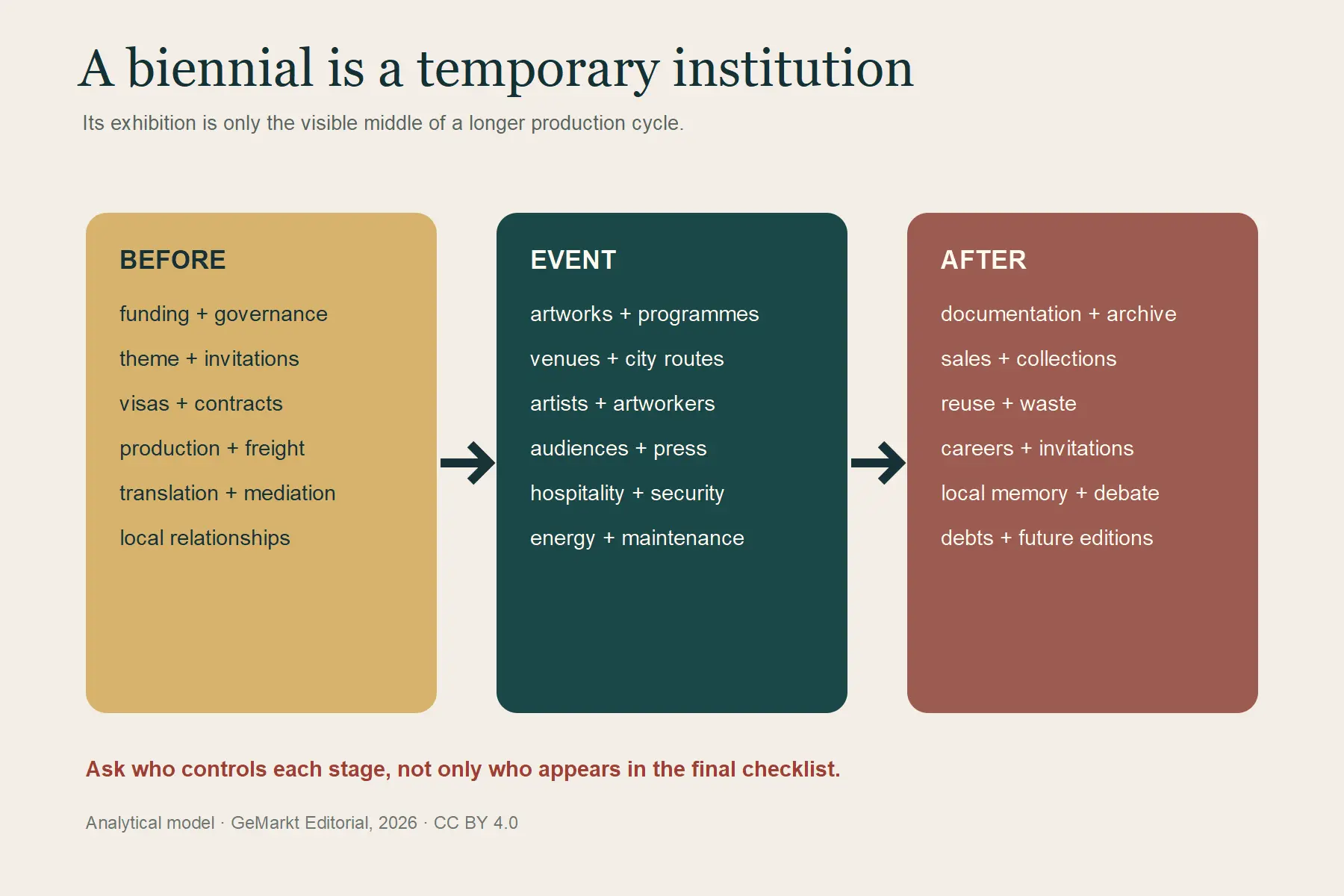
“Biennial” describes a recurring interval, not one curatorial form. Such exhibitions may be municipal foundations, state projects, artist-led initiatives, tourist strategies, memorial institutions, market-adjacent events, or combinations. Their visible duration may be weeks or months; production and afterlife last years.
The diagram separates the invitation from the exhibition and the exhibition from its consequences. Before opening come governance, fundraising, selection, contracts, visas, production, translation, and local work. During the event, venues, hospitality, security, maintenance, mediation, and audiences matter. Afterward remain archives, debts, sales, careers, waste, reused materials, relationships, and the promise of another edition. Analyse the whole cycle.
Gwangju joins memorial and city strategy
The first Gwangju Biennale opened in 1995 under the title Beyond the Borders. The Gwangju Biennale Foundation connects its founding to the city’s May 18 Democratic Uprising of 1980, when citizens resisted military rule and were violently suppressed. Official accounts also identify an ambition to position Gwangju as a cultural hub. Memorial commitment and city strategy coexist.
That double history prevents a simple judgement. International visibility can extend the “Gwangju spirit” of democracy and community while producing cultural branding, tourism, buildings, and institutional power. Rather than decide that commemoration is authentic and promotion corrupt—or the reverse—ask how each edition activates local histories, who governs the narrative, where programmes occur, and what resources remain in the city.
Beyond the Borders named a contradiction
The inaugural title announced movement beyond national and cultural boundaries. Yet a biennial needs borders to organise participation: citizenship affects visas; customs govern artworks; national labels enter publicity; city and state funding establish accountability. The title is valuable because it names an aspiration whose material limits can be studied.
“Borderless” should not mean that historical difference dissolves into a universal contemporary language. Gwangju’s local political memory gives the event a position rather than a neutral platform above geography. The strongest transnational exchange does not erase location. It connects situated histories while exposing who crosses easily, who must be represented at a distance, and which institutions translate the encounter.
Biennials redistribute attention but not evenly
Recurring exhibitions outside older Euro-American centres have challenged the assumption that contemporary art must become visible through New York, London, Paris, or Venice. Gwangju, Havana, Dakar, Istanbul, Sharjah, São Paulo, and Kochi are not interchangeable “alternatives”; each emerges from distinct political, funding, urban, and artistic histories. Their importance lies partly in creating routes among regions rather than adding peripheral stops to one centre.
Attention remains scarce. Curators and artists circulate through overlapping events, sponsors influence capacity, press travel follows existing prestige, and temporary commissions can strain local labour. A biennial can redistribute recognition while reproducing precarity. Evidence should include artist fees, contracts, translation, accessibility, local partnerships, archives, and long-term facilities—not only attendance and famous names.
Documenta11 multiplied the exhibition into platforms
Okwui Enwezor and a curatorial team organised Documenta11 through five platforms. Four preceded the Kassel exhibition: discussions of unfinished democracy in Vienna and Berlin; truth and reconciliation in New Delhi; creolisation in St Lucia; and African cities under siege in Lagos. The exhibition in Kassel became Platform 5, not the container from which the other locations radiated.
The form changed the institution’s geography and temporality. Debate, legal inquiry, urban analysis, and publication were not educational supplements to a finished display. They constituted the project. The official documenta archive records named contributors across political theory, law, architecture, cultural studies, and art. This was a curatorial claim that knowledge production could be an artistic public form.
Kassel was the fifth platform, not the whole event
Documenta remained headquartered, financed, archived, and finally visited at scale in Kassel. Calling the exhibition the fifth platform did not eliminate this institutional centre. It did make the centre answer to conversations that had already occurred elsewhere and resisted presenting a German exhibition as the natural place where global knowledge begins.
The distinction helps analyse distributed projects today. Count locations, but also trace decision rights, budgets, editorial control, documentation, audience reach, and archive custody. A panel held in Lagos is not decentralisation if its questions, participants, and afterlife are controlled elsewhere. Nor is a central archive automatically illegitimate. The historical claim depends on the relation among nodes.
Okwui Enwezor treated art as knowledge production
The documenta archive describes Enwezor as the first non-European artistic director of documenta and records 117 artists in the 2002 exhibition. More important than either milestone is the project’s method. Documentary work, archives, collectives, urban research, moving image, and extended readers challenged the expectation that political and theoretical content merely surrounds autonomous visual objects.
“Art as knowledge” does not make artworks illustrations of correct ideas. Images, testimonies, spatial arrangements, montage, duration, and gaps can produce forms of understanding unavailable to a policy paper. But the phrase also creates responsibilities: whose knowledge, translated by whom, under which conditions, and open to what disagreement? A reading-heavy exhibition can widen evidence while building new barriers of language and time.
Curatorial globalism can still recentre the host
Large institutions can absorb critique as prestige. A European exhibition that includes anticolonial, diasporic, and Global South practices may still own the archive, attract the international visitor, define the retrospective narrative, and convert distributed labour into its brand. Inclusion changes representation without necessarily changing infrastructure.
This does not invalidate Documenta11 or later global exhibitions. It supplies a test. Did participating nodes shape questions or deliver content? Were local audiences addressed? Were contributors credited and paid? Can knowledge circulate independently after the host closes? Did partnerships build durable capacity? The answers can be mixed. Institutional critique becomes stronger when it measures redistribution rather than assuming geography proves it.
Network is a material form
Networks are often drawn as lines between equal dots. Real artist networks require hosts, studios, meals, travel, translation, childcare, visas, communication tools, fundraising, mediation, conflict resolution, and memory. A connection survives because people perform maintenance. “Informal” does not mean labour-free.
Network form can distribute authority more flexibly than a single headquarters. It can also hide accountability: nobody appears responsible for unequal fees, extraction of local knowledge, or relationships that vanish after a residency. Analyse who convenes, who can initiate a project, how funds move, which language dominates, how partners leave, and where records live. The social form is part of the artistic condition.
Triangle grew through independent partners
Triangle began with an artists’ workshop in New York State in 1982. Its current official account describes a network of independent projects and organisations that develop activities in response to local needs while sharing support, knowledge, and international identity. Workshops and residencies privilege working alongside one another over a conventional exhibition as the sole outcome.
The structure offers a counterexample to franchise globalism. A partner is not simply a branch delivering a central programme. Independence can allow methods to change across contexts and relationships to grow laterally. Yet the network’s origin, funding access, and reputation still matter. Treat its self-description as evidence of organisational intent, then compare local partner histories rather than assuming the model operates identically everywhere.
Exchange requires more than connection
An email introduction or social-media follow does not create the same exchange as funded time, workspace, translation, material access, critique, and repeated contact. Triangle’s workshop model makes duration and co-presence part of infrastructure. Digital contact can extend those relations, but it does not remove differences in time zones, bandwidth, care duties, safety, or income.
Evaluate exchange by what participants can actually do. Can they develop work without producing an immediate commodity? Are accommodation, travel, food, and fees covered? Do local artists gain access to visiting networks? Does knowledge return to a community, or does the visitor collect experience? “Connection” is a beginning; conditions determine whether it becomes reciprocity.
Mobility is not equally available
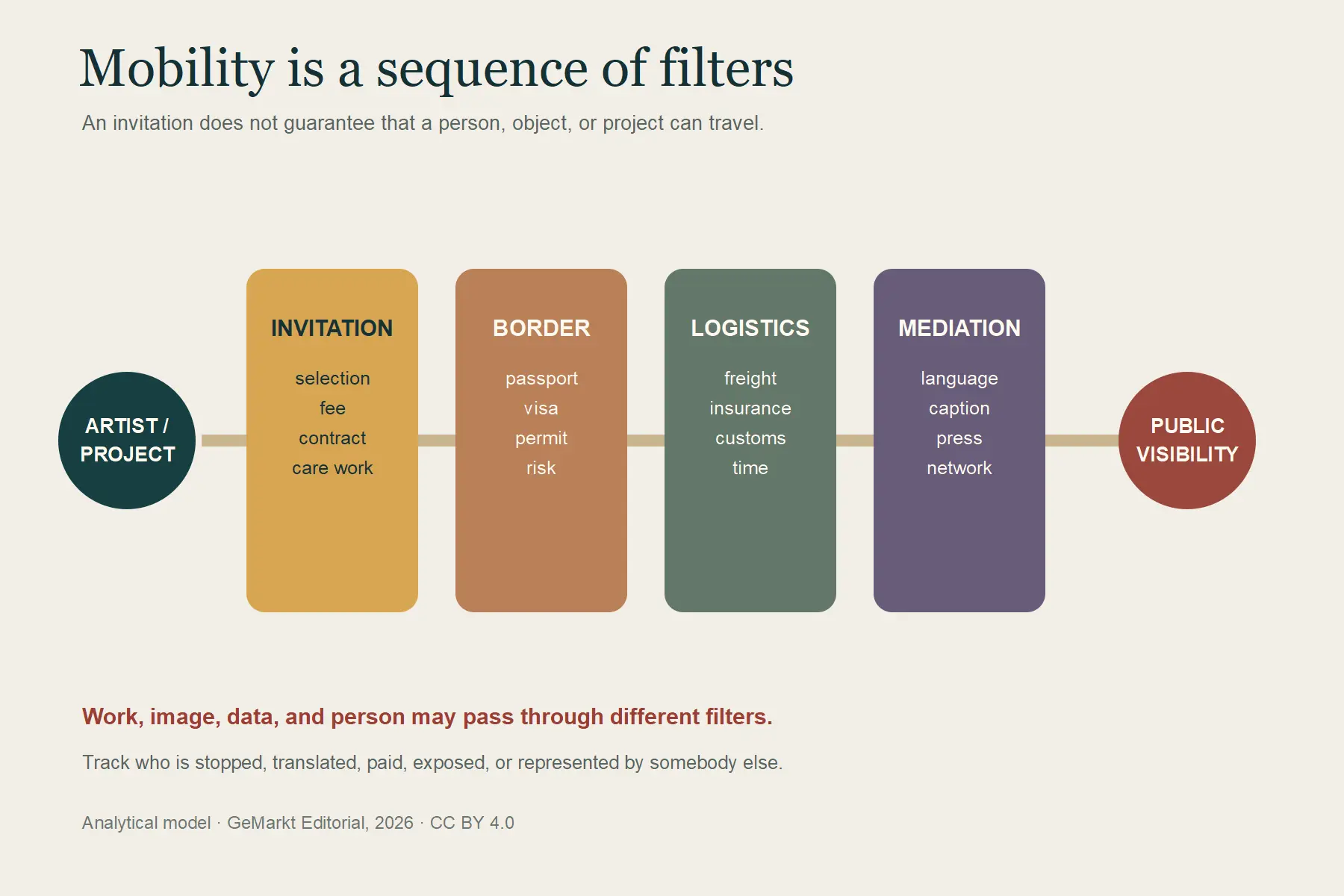
“Travelling artist” can sound like a voluntary cosmopolitan identity. Passports, visa policy, sanctions, asylum status, disability, health, family responsibility, income, and political risk distribute movement unequally. Institutions may move files or objects when a person cannot attend, but representation by proxy changes agency and public encounter.
The filters are separate. An artist may pass selection but fail a visa deadline; a performance may travel while its materials are stopped by customs; a video may stream but lose language and context; a press image may circulate farther than the work. Record which element moves and who bears the cost of substitution.
The Mapping Journey Project redraws border cartography
Bouchra Khalili’s The Mapping Journey Project (2008–11) comprises eight videos. MoMA describes individuals compelled by political and economic circumstances to take clandestine routes across the Mediterranean. Each narrates a journey while drawing it in permanent marker on a geopolitical map. The route appears through lived movement rather than state-approved passage.
The map does not disappear. Coastlines and national borders remain beneath the ink, allowing the speaker’s path to cross, double back, pause, and expose the distance between official geography and embodied travel. Eight screens resist compressing distinct journeys into one representative migrant story. Serial form makes comparison possible without claiming sameness.
A hand and voice can refuse surveillance visibility
The videos show speakers’ hands and hear their voices while withholding faces. MoMA interprets this as refusing representational forms demanded by surveillance, border control, and news media. Anonymity is not absence. Gesture, pace, hesitation, accent, route, and narration establish presence without supplying the facial image through which an institution might classify a person.
This formal decision joins ethics and politics. The work does not merely tell viewers that borders are violent; it changes the terms of looking. Still, a museum display creates another apparatus of visibility. Ask how consent, editing, translation, screen arrangement, sound spill, and later circulation shape the speaker’s agency. Ethical representation is a designed relation, not a claim of perfect access.
Migration is not an artist biography alone
Art history often turns migration into a biographical explanation: an artist moved from country A to B, so the work is about hybridity, exile, or identity. Biography may be relevant, but it cannot substitute for formal and institutional analysis. Migration can structure routes, materials, language, documents, labour, memory, audience, and law without becoming the only meaning of every work by a migrant artist.
Conversely, artists who travel easily also participate in border systems. Cosmopolitan mobility should not remain an invisible neutral condition while forced movement becomes a marked identity. Compare who is called international, expatriate, diasporic, refugee, or migrant; who chooses the label; and what each term makes institutions expect from the work.
Ecology enters through systems, not landscape alone
Contemporary ecological practice is not defined by depicting forests, oceans, or climate disasters. Artists work with food systems, extraction, land rights, toxic materials, species relations, energy, law, agriculture, maintenance, and institutional behaviour. A project may be visually modest yet reorganise a supply chain or public routine.
This expanded field requires evidence from beyond conventional object analysis: scientific collaboration, community knowledge, procurement, menus, transport records, land access, policy, and duration. Art remains important because it can stage new relations and perceptions. But an ecological subject does not automatically make production sustainable or its politics just.
CLIMAVORE changes the museum menu
Cooking Sections, the duo of Daniel Fernández Pascual and Alon Schwabe, began CLIMAVORE in 2015. Serpentine’s account describes site-responsive work on Skye that examines polluting salmon farming and develops relations with filter feeders, seaweeds, restaurants, farmers, scientists, and local stakeholders. At low tide, an oyster table became a place for workshops and meals; at high tide, a multispecies habitat.
The project does not end at representation. “Becoming CLIMAVORE” has asked participating museum restaurants to remove farmed salmon and introduce ingredients connected to healthier marine habitats. The cultural institution’s café becomes part of the artwork’s field. Interpretation therefore includes procurement, recipes, staff training, suppliers, price, taste, and whether change continues.
A project can operate as an institution
CLIMAVORE includes commissions and installations, but it also develops apprenticeships, research, menus, partnerships, and plans for regenerative aquaculture. These functions resemble an institution: convening expertise, maintaining relationships, producing knowledge, supporting participants, and changing rules. The artist is not necessarily a lone maker delivering an object to a museum.
Calling a project institutional should not exaggerate its permanence or public mandate. Funding cycles, artist authority, local disagreement, and maintenance remain questions. The useful point is structural: a contemporary artwork may consist partly of capacities and protocols. Document who does the work and how decisions persist, not only the photogenic moment of activation.
An ecological claim needs two ledgers
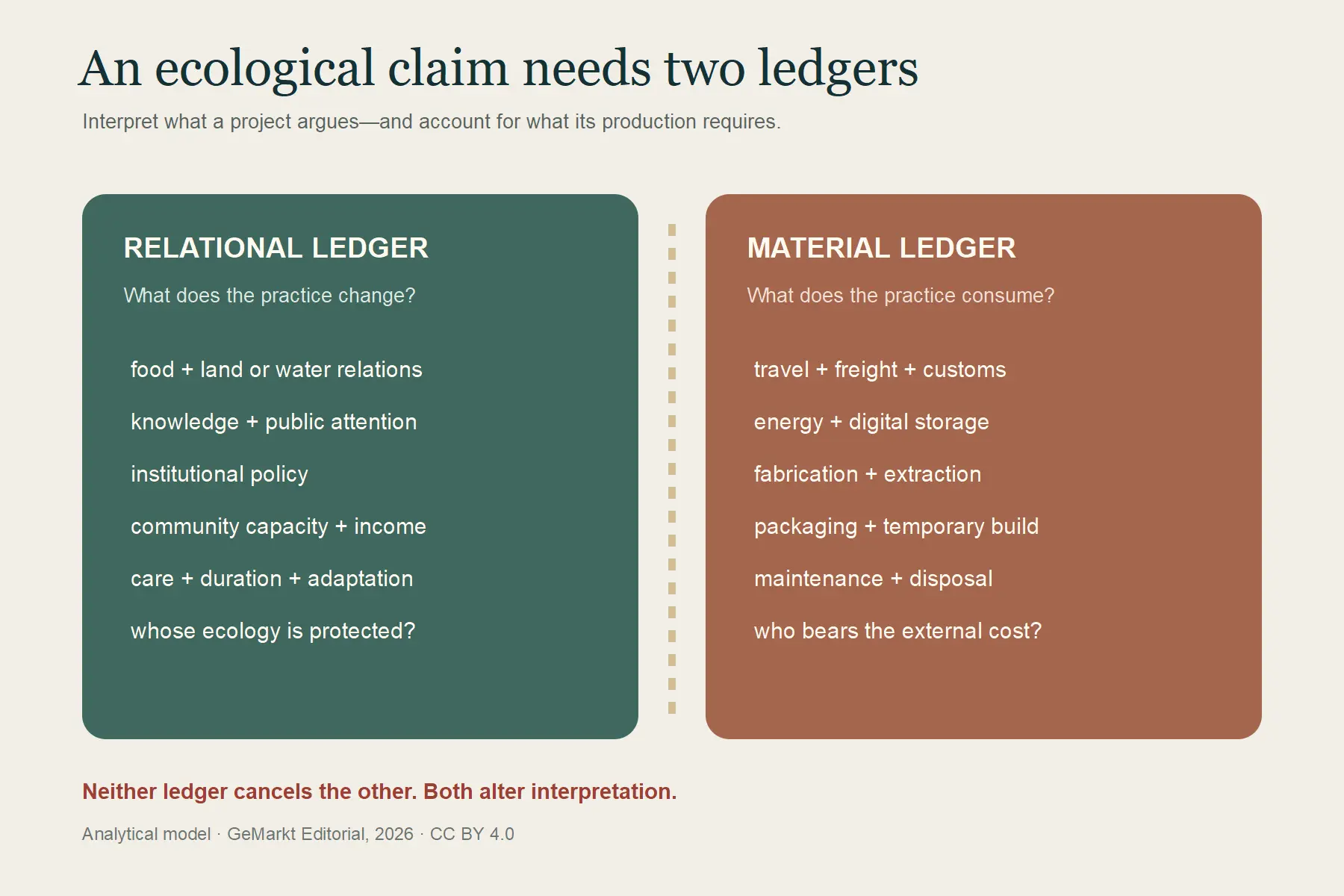
The relational ledger asks what a practice changes: food and land relations, knowledge, institutional policy, community capacity, care, or income. The material ledger asks what it consumes: travel, freight, energy, fabrication, extracted materials, packaging, temporary building, storage, servers, maintenance, and disposal. Neither cancels the other.
A high-impact exhibition might still produce valuable political relations; a low-carbon project can reproduce social inequality. Transparent accounting changes interpretation and design. State the boundary—one venue, tour, artwork life cycle, or organisation—rather than attaching an unsupported “sustainable” label.
Ecological art has a footprint
Gallery Climate Coalition guidance identifies shipping, travel, building energy, climate control, packaging, waste, capital projects, and digital systems as art-sector impacts. These categories reveal the ecological cost of global speed: urgent air freight, one-use crates, repeated flights, short exhibitions, newly fabricated walls, and tightly controlled interiors.
Artists do not control every decision. Commissioners, insurers, conservators, collectors, galleries, shippers, architects, and lenders shape requirements. Responsibility is therefore distributed but not absent. Ask whether schedules permit lower-impact transport, works can be fabricated or borrowed locally, materials can be reused, couriers can attend virtually, and records allow later audit. An exhibition about climate should not be exempt from its own material history.
The digital is not placeless
Digital practice depends on mines, factories, cables, data centres, devices, electricity grids, cooling, software companies, standards, domain registrars, content moderators, and maintenance labour. A browser window hides much of this geography. “Online” describes an interface condition, not immateriality.
Location still matters. Network latency, censorship, payment systems, language support, disability access, device cost, and data plans shape who can encounter a work. Cloud infrastructure can centralise technical control even while distribution appears global. Analyse the digital site as carefully as a gallery: entrance, permissions, navigation, surveillance, failure, ownership, and exit all have designed forms.
Net art makes protocol visible
Early net art used links, frames, browser windows, source code, refresh behaviour, email, and distributed files as material. Olia Lialina’s My Boyfriend Came Back from the War (1996), included in Rhizome’s Net Art Anthology, fractures monochrome images and dialogue across clickable frames. Navigation produces sequence; delay and choice enter the work’s emotional rhythm.
The work is not a film placed online. Its browser structure matters. A screenshot preserves appearance but removes behaviour; a screen recording fixes one path; migrated code may alter timing or typography. Close looking must include interaction: what becomes clickable, what reloads, what the user cannot reverse, and how the historical browser differs from today’s environment.
Rhizome preserves environments, not only files
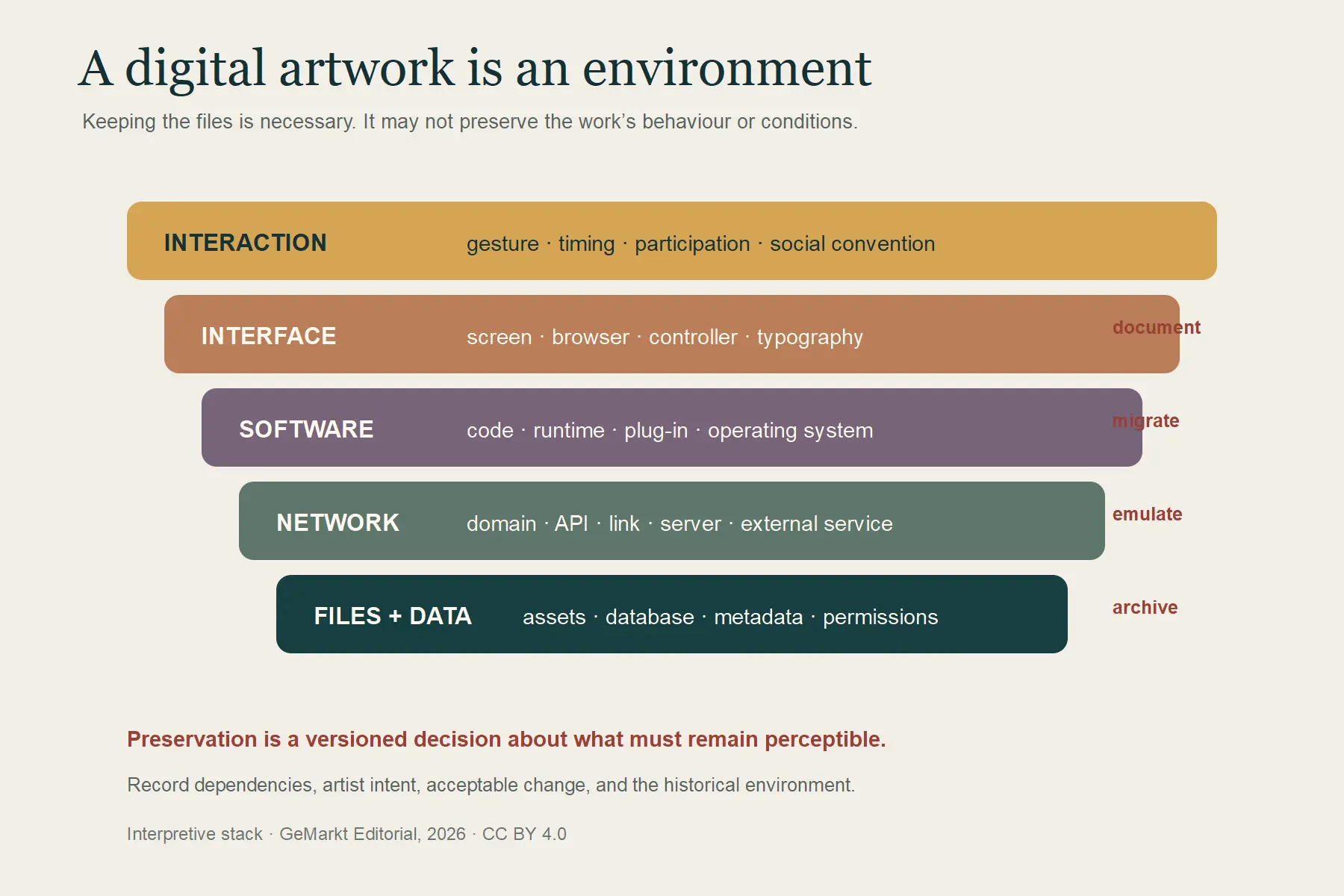
Rhizome established the ArtBase in 1999 and now describes a collection of more than two thousand net-art and new-media works. Its historical model distinguished “cloned” works stored on Rhizome infrastructure from “linked” works remaining with artists. Later preservation uses documentation, emulation, web archiving, and structured metadata.
The stack shows why a file copy is insufficient. Files call software; software expects an operating system, browser, plug-in, database, API, domain, or server; interfaces assume screen sizes and input devices; interaction carries learned conventions. Preservation decides which dependencies must remain functional, simulated, documented, or visibly historical.
Obsolescence is historical evidence
A broken plug-in or dead link can appear to be a conservation failure. Repair may restore access, yet seamless updating can erase the work’s historical conditions. A tiny window, slow connection, warning dialogue, or obsolete navigation convention may have shaped how the work first felt. Rhizome’s preservation writing insists that digital art be historicised rather than treated as perpetually new.
There is no universal choice between original technology and migration. Original hardware may be scarce; emulation introduces another layer; network services disappear; security rules change. Record artist intent, dependencies, acceptable variation, and decisions. A preserved version should tell viewers what they are encountering rather than pretending time has not passed.
Platform access is not public ownership
Social platforms can give artists distribution without a gallery, but access depends on private terms, recommendation systems, moderation, interfaces, identity rules, advertising, and business continuity. A large audience does not grant the artist ownership of the infrastructure or reliable access to followers. Removal, ranking changes, compression, or account loss can alter a practice overnight.
Archives face similar risks when tools change. Rhizome’s announced transition from its hosted Conifer service in 2026 is a useful reminder: responsible infrastructure includes export, open formats, migration plans, and communication. Change is not automatically abandonment. The question is whether users can retain records and understand what replaces the service.
AI enters an existing infrastructure
Generative AI did not arrive outside art history. It intensifies questions already visible in digital practice: training data, authorship, labour, platform power, cultural difference, energy, interfaces, versioning, and preservation. A prompt and output hide dataset construction, model access, moderation, compute, licences, and human review.
UNESCO’s 2025 expert report on AI and culture frames opportunity alongside risks to cultural rights, diversity, sovereignty, remuneration, and environmental sustainability. Its date and institutional scope matter; law and technology continue to change. Do not classify every AI-assisted work by tool alone. Establish what the system contributes, what the artist controls, whose work or knowledge enters training, what is disclosed, and how the output circulates.
A global art infrastructure map
The hero diagram places an artwork amid exhibition, mobility, ecology, digital systems, and networks. It is not a causal wheel in which every case uses every node equally. A hand-drawn object may depend heavily on biennial freight and lightly on software; a web artwork reverses that balance; a community project may centre relationships and land.
Use the map to choose evidence. Exhibition claims need governance and programme records. Mobility claims need contracts, visas, routes, and testimony. Ecological claims need relational and material ledgers. Digital claims need dependencies, rights, and preservation. Network claims need partner histories, funding, and maintenance. Formal analysis remains central because these systems become perceptible through form.
Temporary exhibitions leave permanent effects
A biennial closes, but buildings, catalogues, databases, debts, altered careers, commissioned works, municipal expectations, and environmental impacts persist. Temporary form can allow experimentation and avoid permanent bureaucracy. It can also make accountability difficult when teams dissolve before evaluation or care.
Afterlife should be designed before opening. Who owns a commission? Will a local partner maintain it? Where do recordings and contracts go? Can the public access the archive? Are temporary materials reused? Do participants receive documentation? What happens to personal data? The answer distinguishes an event that extracts attention from one that builds memory and capacity.
What moves and what stays
Contemporary projects separate elements that older object histories often join. An artwork can travel without its maker; code can copy while a server stays; a recipe can spread while local ingredients change; a performance score can move while embodied knowledge remains with people; an exhibition title can circulate while community relationships cannot.
Make an element ledger: person, object, material, instruction, file, licence, data, knowledge, money, carbon, risk, and credit. For each, ask origin, destination, authority, transformation, and residue. “The project travelled” is usually too broad. Movement can distribute opportunity, displacement, extraction, pollution, or care at the same time.
What survives a contemporary project
Contemporary work may survive as an object, installation instructions, source code, artist interview, contract, menu, mailing list, participant memory, oral testimony, conservation record, social post, press image, dataset, or institutional policy. These traces are not interchangeable. A photograph can document appearance but not interaction; code can preserve logic but not a vanished API; a report can record outcomes while smoothing conflict.
Decide survival during production. Obtain consent, name contributors, export data, record versions, document dependencies, archive translations, and state access limits. Over-documentation can also expose vulnerable participants or restricted knowledge. Preservation is a relation of care and authority, not an automatic demand to save everything.
A comparison matrix
| Case | Primary infrastructure | Form produced through it | Unequal condition to track | Main afterlife |
|---|---|---|---|---|
| Gwangju Biennale | recurring city institution | exhibitions joined to democratic memory and cultural strategy | local governance, labour, city branding, international attention | archives, buildings, future editions, civic debate |
| Documenta11 | five transcontinental platforms | exhibition, discourse, readers, documentary and archive practices | host-centre authority, translation, node participation | publications, institutional precedent, curatorial histories |
| Triangle Network | independent partner organisations | workshops, residencies, peer exchange | funding, travel, maintenance, local autonomy | relationships, organisations, practices, repeat exchange |
| Mapping Journey Project | border maps, encounter, video installation | narrated routes drawn by hands and voices | consent, anonymity, translation, museum framing | eight-channel work, recordings, collection and exhibition histories |
| CLIMAVORE | food and ecological partnerships | meals, installations, procurement change, training | local ecology, labour, duration, institutional commitment | menus, apprenticeships, relationships, aquaculture plans |
| Rhizome ArtBase | archive and preservation tooling | accessible, versioned born-digital works and metadata | platform dependence, artist rights, maintenance resources | files, emulations, web archives, structured records |
Common survey traps
- Global as a style: globality describes relations of circulation and power, not one visual language.
- Nationality counting as equality: representation says little about fees, visas, commissioning power, translation, or afterlife.
- Biennial as exhibition only: production begins before opening and persists through archives, careers, waste, and local memory.
- Migration as biography: movement can structure form and institutions, but no artist owes an identity narrative.
- Ecological subject equals sustainable practice: interpret the claim and audit production in separate ledgers.
- Network equals decentralisation: trace funding, decision rights, maintenance, and archive custody.
- Digital equals accessible: devices, bandwidth, disability, language, platforms, and permissions shape access.
- File equals preserved work: behaviour may depend on software, networks, interfaces, hardware, and social convention.
- AI as an isolated new medium: examine datasets, models, labour, rights, energy, platforms, and artistic decisions.
Questions for systems analysis
- What does the viewer encounter, and which infrastructure makes that encounter possible?
- Who invited, funded, contracted, translated, fabricated, installed, maintained, mediated, cleaned, and documented it?
- Which people, objects, files, materials, money, risks, and credits move—and which stay?
- What border, platform, or institutional gate can stop or reshape the project?
- Does “global” describe geography, audience, circulation, subject, funding, or self-identification?
- Which local history and public does the project address beyond international visitors?
- What does an ecological claim change, and what material footprint does production create?
- Which technical dependencies make a digital work function, and who controls them?
- What survives after the event, who owns it, and who must maintain or restrict it?
- Which formal decision makes the underlying system perceptible rather than merely described?
Terms for contemporary global art
- Biennial: a recurring exhibition or cultural programme, usually every two years; governance and format vary widely.
- Contemporary: a changing relation to the present, not a neutral synonym for art made now or a universally agreed start date.
- Digital preservation: managed documentation, migration, emulation, archiving, and access decisions that keep born-digital work interpretable.
- Infrastructure: technical, material, legal, social, financial, and institutional systems that enable and constrain practice.
- Migration: movement across or within borders under varied conditions, distinct from the celebratory mobility often called cosmopolitanism.
- Network: maintained relations among people and organisations; a social and material form, not merely a diagram of connections.
- Platform: a technical, curatorial, organisational, or discursive structure that enables participation while setting rules.
- Site-responsive: developed through relations with a specific place; not a guarantee of local authority, consent, or low impact.
A working timeline, 1989–2026
- 1989: the geopolitical marker later used for post–Cold War global-art narratives also risks making longer anticolonial and transnational histories seem newly born.
- 1995: the first Gwangju Biennale, Beyond the Borders, opens in relation to the city’s democratic memory and international cultural ambition.
- 1996: Olia Lialina makes My Boyfriend Came Back from the War; Rhizome begins as an online community for new-media art.
- 1999: Rhizome establishes the ArtBase.
- 2001–02: Documenta11 platforms convene in Vienna/Berlin, New Delhi, St Lucia, Lagos, and Kassel.
- 2008–11: Bouchra Khalili produces The Mapping Journey Project.
- 2015: Cooking Sections initiates CLIMAVORE.
- 2016–18: Rhizome’s Net Art Anthology restages one hundred works and expands public preservation research.
- 2020: Serpentine launches Future Art Ecosystems; Gallery Climate Coalition begins sector-focused environmental work.
- 2024–26: cultural institutions publish more explicit guidance on AI, digital sustainability, art-sector emissions, rights, and infrastructure; all remain developing fields.
Source guide
The Gwangju Biennale Foundation’s history of its founding spirit and account of the biennial as memorial and cultural strategy establish the 1995 opening, May 18 relation, and city context. The Biennial Foundation’s network and open collection Making Biennials in Contemporary Times provide practitioner-led comparative context rather than a universal ranking.
Documenta’s Documenta11 retrospective establishes artistic direction, dates, venues, artists, and the five-platform concept. Its Documenta11 readers name sites and contributors, making distributed knowledge work citable. Triangle Arts Association’s network account, workshop history, and participant archive distinguish organisational claims from situated testimony.
MoMA’s Mapping Journey Project exhibition record establishes the work’s eight videos, 2008–11 dates, encounter method, display, and curatorial interpretation; the copyrighted installation images are linked but not reproduced here. Serpentine’s CLIMAVORE project account identifies Cooking Sections, sites, collaborators, oyster table, menus, and continuing institutional programme. Gallery Climate Coalition’s best-practice categories and artist shipping guidance support material-footprint questions without assigning an uncalculated number to a case.
Rhizome’s ArtBase history and licensing statement establishes scope, linked and cloned works, preservation tools, artist rights, and metadata infrastructure. Its preservation framework, Net Art Anthology, and 2025 Conifer transition notice support the distinction among files, environments, historical versions, platforms, and migration. Serpentine’s Future Art Ecosystems frames art and advanced technology through cultural infrastructure. UNESCO’s dated 2025 AI and culture expert report supplies a current international-policy source while remaining distinct from an art-historical verdict.
Complete the Atlas route
The Atlas began by asking what survives from prehistoric visual worlds and has ended with systems whose survival must be actively designed. Across the route, no single centre, medium, religion, empire, nation, or movement supplied art’s universal timeline. Objects gathered relations among makers, materials, bodies, patrons, environments, viewers, institutions, and later records.
Return now to the Methods volume. Use How to analyse a work of art for formal and relational looking, How to compare two artworks for controlled comparison, and How to research an artwork to build a source map. The Atlas is complete as a route, not as a total history. Its purpose is to make new routes more precise, plural, and answerable to evidence.
Editorial record
About this article
- Author
- Publisher
- GeMarkt
- Published
- Updated
- Reviewed
- Internal source & rights check. Conducted by GeMarkt Research Review. This is an internal editorial check—not independent peer review.
- Source standard
- Art history source standardPrioritises object records and research sources, distinguishes evidence from interpretation, and states material uncertainty.
Found a claim that needs checking? Report a factual error.