Art History · Learning chapter
Atlas III — Early-modern worlds · 7 of 11
Edo Japanese art: city, print, theatre, painting school, and regulated status
A critical guide to Edo art through Tokugawa rule, city life, painting schools, kabuki, collaborative printmaking, pilgrimage, status, and managed exchange.

What we’ll look at
How did cities, markets, theatre, travel, and regulation shape art in Edo Japan?
No traveller crosses the bridge above. Ogata Kōrin gives us only a zigzag of dark planks, clusters of blue irises, green leaves, and an expanse of gold. For viewers who knew The Tales of Ise, absence was enough. A remembered episode supplied the exiled courtier, the journey, the sight of flowers, and a poem whose lines begin with the Japanese syllables for iris.
The pair of screens was made after 1709, nearly nine centuries after the literary world it recalls. This is not antiquarian escape. Kōrin transformed courtly knowledge into a monumental, movable interior object for Edo-period patrons. Gold, mineral colour, paper, hinges, carpentry, folding, cultivated memory, and access to earlier designs all made the old story present.
That transformation is a useful entrance to the Edo period. The era was governed by Tokugawa shoguns and regional domains, organised through inherited status distinctions, and shaped by censorship and controlled mobility. It was also urban, commercial, literate, performative, and connected to foreign goods and knowledge through supervised routes. Regulation and creativity were not opposites. They acted on one another.
This chapter ranges from the early seventeenth century to 1868, with attention to Edo, Kyoto, Osaka, Ise, and Nagasaki. It cannot represent every domain or the distinct histories of the Ryukyu Kingdom, Ezo and Ainu communities, rural regions, temples, shrines, craft centres, or overseas Japanese descendants. Its narrower question is how institutions made images move.
Edo is a city, a regime, and a period label
Edo was the Tokugawa shoguns’ political city and became modern Tokyo. “Edo period” commonly names the era from Tokugawa Ieyasu’s appointment as shogun in 1603, or the final defeat of the Toyotomi house in 1615, to the political transformations of 1868. This Atlas uses 1615–1868 as a working range; individual objects require narrower dates.
The label can hide geography. Kyoto remained the imperial and major cultural centre; Osaka was a commercial and publishing city; castle towns structured domains; ports and post stations connected regions. Edo’s growth mattered without making all Japan an extension of one metropolis.
Use the period name as a political frame, not an aesthetic cause. A Kōrin screen, a Kano palace painting, a kabuki actor print, a rural shrine object, and a Nagasaki map could all be Edo-period works while answering different institutions.
Tokugawa order was stable, not motionless
Tokugawa rule followed more than a century of warfare and unification. The shogunate governed through relations with domains under daimyo lords rather than replacing them with one uniform bureaucracy. Land, taxation, military obligation, inheritance, and castle regulation distributed power unevenly.
Alternating attendance required many daimyo to maintain residences in Edo and move on prescribed schedules. Their households, retainers, processions, purchases, and construction helped feed the city’s expansion and road system. Political obligation generated mobility as well as control.
“Peace” describes the absence of large-scale internal war after the seventeenth century. It must not erase punishment, peasant protest, famine, domain conflict, coerced labour, urban fire, or frontier violence. Stability was produced and repeatedly repaired.
Status was a political technology
Survey texts often present four fixed classes: samurai, farmers, artisans, and merchants. Tokugawa discourse did rank occupations and regulate dress, residence, work, names, weapons, and consumption. But the four-part model was an idealising shorthand, not a complete census.
Court nobles, clergy, performers, physicians, officials, servants, sex workers, and many other groups did not fit neatly. Discriminated communities assigned outcaste statuses carried essential work while facing hereditary restrictions. Ainu and Ryukyuan peoples were governed through unequal frontier and tributary relationships, not simply inserted into a metropolitan class ladder.
David Howell’s Geographies of Identity treats status as a malleable institution made visible through clothing, hair, names, occupation, place, and law. Images could reinforce those marks, parody them, or make their instability obvious.
Cities grew through obligation and labour
Edo contained shogunal compounds, daimyo estates, samurai neighbourhoods, merchant and artisan districts, temples, shrines, waterways, warehouses, licensed entertainment zones, and expanding suburbs. It was supplied through coastal shipping, roads, markets, and huge labour networks.
The Great Meireki Fire of 1657 destroyed much of the city and killed many inhabitants. Reconstruction changed streets, estates, firebreaks, bridges, storage, and the geography of theatres and licensed quarters. Urban form was a history of disaster management as well as planned authority.
Timon Screech’s Tokyo Before Tokyo reconstructs the shogun’s city through bridges, castle, temples, bars, theatres, guidebooks, and prints. A “floating world” image depended on carpenters, boatmen, porters, paper makers, publishers, food sellers, domestic workers, and fire risk beyond its elegant surface.
Begin with a bridge that never shows its traveller
Kōrin’s screens refer to the Yatsuhashi episode in The Tales of Ise. The travelling protagonist sees irises near eight bridges and composes an acrostic poem remembering the wife he left behind. A knowledgeable viewer could reconstruct narrative from bridge and flower alone.
This device is sometimes called rusu moyō, a pattern of absence. Missing figures open the scene to memory and imaginative projection. The absence is legible only because literary education supplies what is missing.
The screen therefore sorts viewers. A person may enjoy colour and rhythm without recognising the poem; another can perform cultivation by identifying it. Visual pleasure and social distinction occupy the same gold field.
Kōrin’s irises make literature spatial
The Met dates the pair after 1709. Each six-panel screen measures more than three and a half metres wide. Repeated flowers establish pulses rather than botanical inventory. The bridge cuts across folds and continues from one screen to the other.
Gold is surface, atmosphere, and reflected interior light. It refuses ordinary depth while making blue and green intense. The bridge’s angular movement competes with the plants’ vertical rise; empty intervals allow each cluster to register.
Kōrin did not illustrate every event. He compressed narrative into a recognition problem and rebuilt an old journey for an early eighteenth-century room. Reuse is the work’s invention.
A folding screen is movable architecture
A byōbu screen divides space, blocks drafts, creates privacy, controls movement, and provides a large image surface. Hinged panels can stand at changing angles, so the image shifts with the room and viewer. Folding also protects and stores the work.
Museum display often flattens screens into long pictures against a wall. That supports comparison but removes their architectural work. Gold that once caught changing lamplight may become an evenly lit background; painted paths no longer redirect bodies in a room.
Screen construction required paper layers, lattice frames, hinges, borders, metal fittings, painting, mounting, and repair. Naming Kōrin should not erase the makers who turned sheets into functioning furniture.
Rinpa was not one family school
“Rinpa” was coined later from the name Kōrin. It gathers artists and craftspeople connected through admiration, copying, publication, patronage, and workshop practice rather than one continuous academy. Tawaraya Sōtatsu worked before Kōrin; Sakai Hōitsu revived and codified Kōrin’s reputation a century later.
Rinpa practices moved across screens, fans, lacquer, ceramics, textiles, and printed books. Bold seasonal motifs, courtly literature, pooled pigment, gold and silver, and patterned repetition recur, but no feature defines every work.
The Met’s open catalogue Designing Nature follows intergenerational reinvention rather than a biological line. “School” here is a history of chosen predecessors and media transfer.
The Kano school made authority repeatable
Kano painters served warrior governments, daimyo, temples, and elite patrons from before Tokugawa rule through the nineteenth century. Branch workshops trained painters through copying, inherited models, rank, marriage, adoption, and commissions. Large palace interiors demanded coordinated labour.
Ink landscapes could invoke Chinese painting authority; gold screens with animals, trees, figures, or ceremonies could command architectural space. Kano painters were not stylistically frozen. Their institutional advantage lay partly in making quality and appropriate iconography repeatable across generations.
Calling Kano “official” and Rinpa “decorative” creates a false quality hierarchy. Both relied on patronage, workshop knowledge, copying, expensive surfaces, and social networks. Their differences require specific commission and site.
Painting schools were institutions, not boxes
Edo painting also included Tosa, Sumiyoshi, Maruyama-Shijō, Nanga or Bunjinga, Zen, ukiyo-e painting, temple workshops, independent painters, and regional lineages. Artists could learn from more than one source and change practice for patrons.
A school label may name genealogy, workshop, retrospective category, shared models, market branding, or critical alliance. It does not guarantee one brush appearance. Women such as Kiyohara Yukinobu trained through Kano networks while building careers constrained by gender and documentation.
Before assigning a work to a school, ask what the evidence is: signature, seal, inscription, lineage record, copied model, workshop document, technical study, or later attribution.
Kabuki joined performance, fashion, and regulation
Kabuki emerged in the early seventeenth century and is associated with performances by Izumo no Okuni and women-led troupes. Authorities banned women from licensed kabuki in 1629; adolescent male performance was subsequently restricted, and adult male actors became the sanctioned norm. Gender performance did not disappear—it was reorganised through onnagata roles and theatrical convention.
Theatres were licensed, geographically controlled, vulnerable to fire, and subject to censorship. Actors nevertheless became celebrities whose names, lineages, costumes, gestures, and roles circulated through prints, books, gossip, poetry, and fashion.
Kyoto–Osaka and Edo performance cultures developed different repertoires and acting styles. “Kabuki” is not one frozen national theatre but an industry continually negotiating regulation and appetite.
An actor print performs after the curtain falls
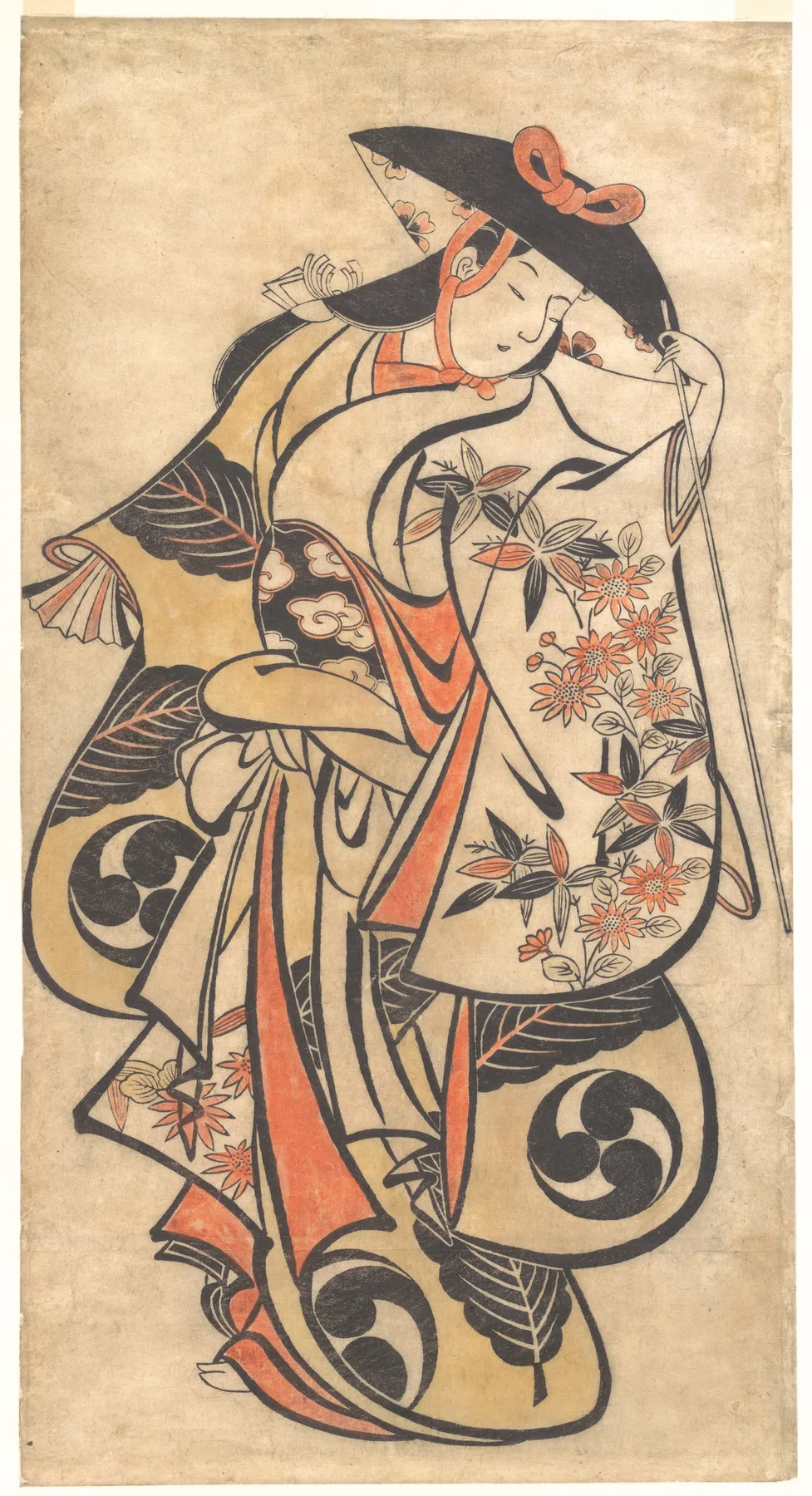
The dancer twists inside a narrow sheet. Thick swelling lines enlarge the sleeves and carry movement; repeated curves in the robe make costume perform with the body. The image is not a neutral record of one stage moment.
The Met attributes the work to Torii Kiyonobu I, whose line specialised in theatre signs, posters, and actor imagery. The bold contours were legible from a distance and transferred well to woodblock printing.
The print extended theatre into possession. A buyer could keep a performance identity, follow a favourite actor, or recognise a role beyond the licensed district. Celebrity depended on reproduction.
Early prints were finished by hand
This impression began with black printed lines and received colour by brush. Early ukiyo-e did not move immediately from monochrome to fully colour-separated block printing. Hand colouring, limited colour blocks, and later nishiki-e multi-block techniques formed a changing technical history.
Printed outline and brushed colour distribute agency. Variations between impressions may reflect different hands, pigments, fading, or later intervention. “Same design” does not mean identical object.
Paper quality, registration, block wear, trimming, backing, album mounting, and exposure now distinguish impressions. A digital image can represent the design while hiding edition history.
Ukiyo-e was a publishing system
Commercial prints required a design, publisher, block-ready drawing, skilled carving, paper, pigments, printing, registration, drying, inspection, distribution, and retail. The artist whose signature appears on the sheet was one participant in a coordinated enterprise.
Publishers selected subjects, commissioned designers, financed blocks and paper, managed censorship, judged audience demand, reused successful formats, and bore commercial penalties. Carvers translated drawn lines into relief; printers controlled pressure, moisture, colour order, gradients, and alignment.
Julie Nelson Davis’s study of Utamaro reconstructs the named artist inside the commercial print market and Edo’s “spectacle of beauty.” The method applies broadly: recover the system around the signature.
The publisher took risk and shaped celebrity
Print series could build recognisable actors, courtesans, beauties, places, heroes, and designers. A publisher coordinated title cartouches, formats, sequels, advertisements, and distribution. Success made repetition profitable; censorship or poor sales made inventory costly.
The market was not anonymous mass demand. Poetry groups commissioned deluxe surimono; theatre fans followed lineages; guidebook readers sought named destinations; buyers differed by income and access. Some impressions were affordable, others technically elaborate and restricted.
“Popular art” should therefore specify public, price, format, and route. Commercial does not mean socially universal.
Censorship belonged inside the image economy
Tokugawa authorities regulated political comment, luxury, erotic material, actor and courtesan display, historical subjects, and publisher practice at different moments. Enforcement changed by reform, magistrate, city, and medium. Censor seals and publisher marks can help date impressions.
Artists and writers used parody, historical displacement, visual puzzles, altered names, and allusion. These devices do not prove that every joke was organised resistance. They show an audience trained to read around boundaries.
Katsuya Hirano’s The Politics of Dialogic Imagination asks why government repeatedly intervened in fashion, leisure, prints, fiction, and theatre. Regulation recognised that representation could reorganise social desire.
The floating world rested on constrained labour
Ukiyo shifted from a Buddhist sense of the sorrowful transient world toward a punning “floating world” of current pleasures. Prints made kabuki, teahouses, licensed quarters, fashion, and seasonal outings available as purchasable images.
The licensed Yoshiwara district concentrated sex work under surveillance. Courtesan imagery marketed beauty, rank, costume, and wit while obscuring debt, contracts, health risk, service work, and restricted exit. A named beauty can be both celebrity and a person working under coercive conditions.
The “floating” surface depended on fixed gates, night-soil collectors, cooks, laundresses, attendants, paper workers, servants, and money. Pleasure was an institution, not free urban air.
Women appear everywhere and sign too few works
Women appear as courtesans, teahouse workers, lovers, travellers, readers, mothers, servants, and fashion models. Representation does not recover their voices automatically. Gesture, dress, and name were selected for a buyer within gendered conventions.
Women also made art and objects, worked in family businesses, participated in publishing and textile production, wrote poetry and fiction, and formed audiences. Workshop organisation and household records often placed output under male masters or family names.
Named painters including Kiyohara Yukinobu show that absence from standard canons is archival and historiographic, not evidence of no production. Each recovery still needs documented attribution rather than compensatory invention.
The road was also a medium
Tokugawa roads carried daimyo processions, messengers, pilgrims, merchants, performers, workers, porters, officials, and goods. Post stations supplied horses, lodging, food, guides, souvenirs, and information. Checkpoints controlled weapons, people, and travel documents.
Guidebooks, maps, pilgrimage associations, travel diaries, and print series prepared travellers to recognise places. A route could be experienced first on paper, then on foot, then remembered through another image.
Landscape art therefore belongs to infrastructure. View, inn, bridge, checkpoint, publisher, and series made place reproducible.
Ise pilgrims turn mobility into an image
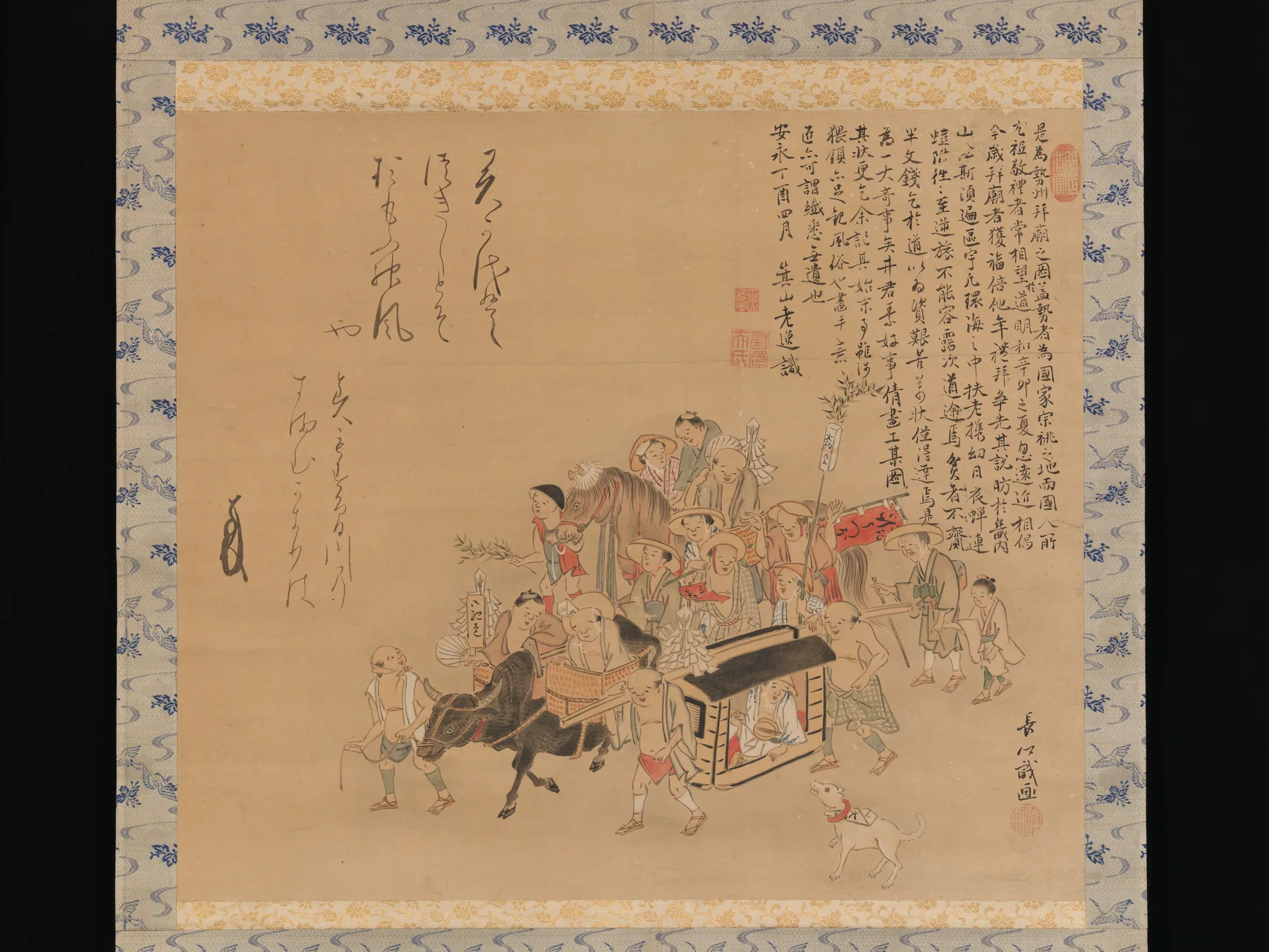
Chōgō’s travellers form a compressed social body. Hats, bundles, staffs, profiles, and overlapping legs create collective motion rather than heroic destination. Inscription and mounting frame the moving crowd as an object for later viewers.
Ise Shrine attracted organised pilgrimage across the period, including extraordinary mass movements. Local associations could pool money so members travelled in rotation. Pilgrimage combined devotion with sightseeing, consumption, licensed absence, storytelling, and souvenir culture.
The painting cannot tell us that every depicted person completed the route or shared one motive. It demonstrates that collective travel was recognisable enough to picture and value.
Travel was permitted unequally
Mobility depended on status, gender, occupation, domain, money, paperwork, health, and household permission. Roads enabled inspection and tax while offering work and encounter. A daimyo procession and a pilgrim group used the same route under radically different obligations.
Women travelled, but checkpoints and permit systems scrutinised them in distinctive ways, partly to control daimyo families and unauthorised movement. Porters and inn workers travelled through labour rather than leisure. People assigned outcaste status faced local restrictions.
Celebrating Edo tourism without these differences converts infrastructure into freedom. Ask who could leave, who carried whom, who paid, and who was stopped.
Hokusai’s wave is one impression, not an original image
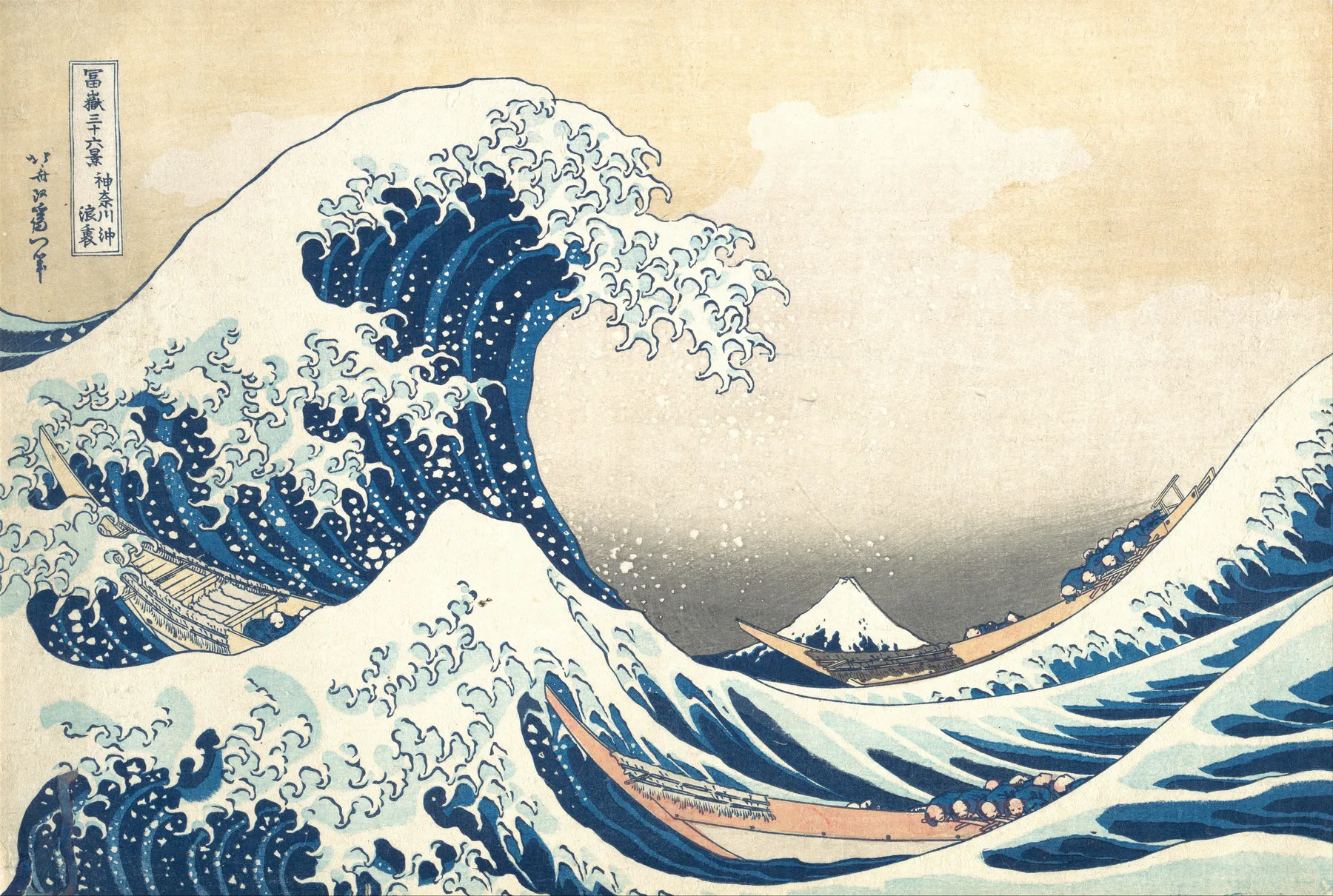
The design positions three fast cargo boats beneath a cresting wave and reduces Mount Fuji to a stable triangle in the distance. The wave’s foam breaks into hooked fragments; the boats follow diagonals into danger. It is often called a tsunami, but the image itself does not establish that modern scientific category.
The Met sheet is one surviving impression of a reproducible design. Earlier and later impressions differ through block wear, colour, printing, paper, trimming, and preservation. Hokusai designed the image; carvers and printers made the sheet; publisher and buyers made the series economically possible.
Fame has further changed it. Museum acquisition, European and American collecting, modern reproduction, tourism, branding, and screens have made one impression stand for “Japanese art.” That reception is history, not the design’s original total meaning.
Prussian blue makes the sea global
Hokusai’s series used imported synthetic Prussian blue, valued for depth and resistance to fading compared with some earlier blues. The pigment entered Japanese markets through managed foreign trade and was then handled by domestic publishers, colour suppliers, printers, and buyers.
Blue was therefore not merely Hokusai’s expressive choice. Chemistry developed in Europe, maritime commerce, shogunal regulation, Nagasaki distribution, price, and print technique met in the wave.
“Japanese blue” can describe later visual identity. Material analysis reveals a global route inside that identity. Imported substance did not diminish Japanese authorship; printers made it behave in a local multi-block system.
Landscape prints sold routes and recognition
Early ukiyo-e concentrated strongly on actors, courtesans, and urban pleasures. By the nineteenth century, named-place and travel series expanded. Road use, guidebooks, pilgrimage, publisher competition, and new pigments helped make landscape commercially attractive.
Hokusai’s Thirty-six Views presents Fuji through working coast, city, bridge, field, weather, and varied viewpoint. Hiroshige’s road and city series developed other rhythms of season and travel. “Nature” arrives through labour and infrastructure.
A print could serve memory for a traveller, fantasy for someone who stayed home, or a collection unit in a series. Place was both geographic and marketable.
Sakoku did not mean a sealed country
The word sakoku, “closed country,” became common after the policies it claims to summarise. Tokugawa authorities prohibited Christianity, restricted Japanese overseas travel and return, expelled Portuguese traders, concentrated foreign contact, and supervised imports. These were severe controls.
They did not stop all foreign relations. Chinese and Dutch ships traded at Nagasaki; Korean embassies came through Tsushima; the Satsuma domain controlled an unequal relationship with the Ryukyu Kingdom; the Matsumae domain mediated and expanded coercive trade with Ainu communities in Ezo.
The National Diet Library’s Japan–Netherlands exhibition documents trade, interpreters, books, court journeys, maps, medicine, natural history, and instruments. “Managed gateways” is more accurate than total isolation, while still recognising confinement and exclusion.
Four gateways made foreign relations manageable
Historians often describe Nagasaki, Tsushima, Satsuma–Ryukyu, and Matsumae–Ezo as four gateways. Each involved different peoples, goods, diplomatic scripts, officials, and degrees of coercion. The system separated relationships rather than opening one free border.
Nagasaki handled Dutch and Chinese trade under detailed controls. Tsushima framed Korean diplomacy. Satsuma concealed and exploited its domination of Ryukyu while using the kingdom’s separate diplomatic position. Matsumae’s trade and territorial pressure harmed Ainu autonomy and livelihoods.
Calling these “windows” can sound benign. A gateway has guards, tolls, interpreters, warehouses, records, unequal access, and people forced to pass through categories imposed by others.
Nagasaki pictures made distance visible
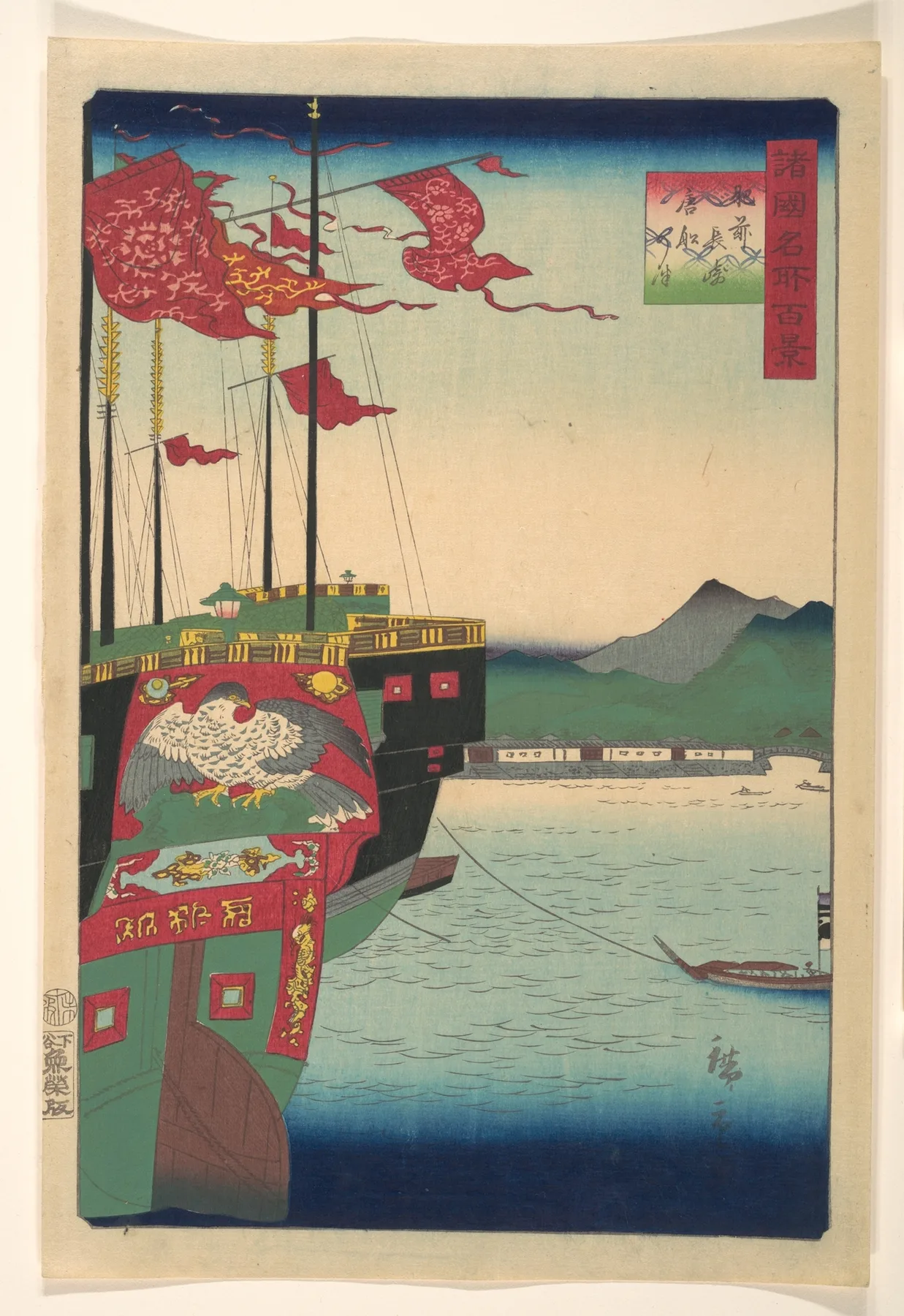
Hiroshige II’s print belongs to the final Tokugawa decade, after treaty ports had begun transforming foreign relations. A large foreground figure, patterned ships, flags, harbour water, and distant shore turn Nagasaki into a recognisable provincial view.
The title distinguishes Dutch and Chinese ships, the two foreign commercial presences long authorised there. Yet this is not a shipping ledger or topographic survey. Scale, colour, cropping, series format, and publisher expectation make foreignness legible to print buyers.
The image records a boundary under change. It should not be projected unchanged back across two centuries of policy.
Knowledge crossed the water under supervision
Dutch-language books and objects supported rangaku, or Dutch studies, especially after restrictions on non-Christian books eased in 1720. Hereditary interpreters in Nagasaki translated trade documents and became crucial mediators of medicine, astronomy, botany, optics, cartography, and other knowledge.
The National Diet Library traces imported books, official interest, translators, and public publications. Chinese books, monks, merchants, and diplomatic routes were at least as important and should not disappear behind a Europe-centred story of opening.
Information moved because institutions selected it. Translation changed terms; illustrations were copied; instruments were demonstrated; prohibitions excluded Christian material. Supervision shaped knowledge rather than preventing it.
1868 did not end Edo images overnight
The fall of the Tokugawa shogunate, restoration of imperial government, renaming of Edo as Tokyo, domain abolition, and new international institutions transformed art production. Workshops, blocks, actor lineages, painting repertoires, publishers, collectors, and skills did not vanish in one year.
Meiji categories later recast Edo objects as national heritage, craft, fine art, or outdated popular culture. Foreign demand altered print and decorative-arts markets. Japonisme selected particular formats as evidence of Japanese difference.
Period boundaries are strongest when they identify institutional change and weakest when treated as instant visual replacement. An impression printed after 1868 from an older block can belong to more than one chronology.
A comparison matrix
| Work | Format and action | Production institution | Regulation or status | What the image cannot prove alone |
|---|---|---|---|---|
| Kōrin, Irises at Yatsuhashi | folding screens dividing and reflecting interior space | Rinpa patronage, painting and mounting workshops | courtly literacy marks cultivation | exact first room, viewers, and full workshop roles |
| Kiyonobu, Kabuki Actor | hand-coloured print carried beyond theatre | Torii design, block printing, colouring, publishing | licensed theatre, gendered performance, celebrity control | one exact live gesture or audience response |
| Chōgō, Ise Pilgrims | hanging scroll picturing collective travel | painting and inscription networks | permits, associations, roads, checkpoints | motives and identities of every depicted pilgrim |
| Hokusai, Under the Wave | one impression in a commercial series | designer, publisher, carver, printer, suppliers | censor review and managed imported pigment | a tsunami diagnosis or one definitive colour state |
| Hiroshige II, Nagasaki Ships | commercial named-place print | Utagawa and publisher network | supervised gateways during treaty-era change | complete trade volume or an unchanged “sakoku” system |
The matrix prevents one familiar word—decorative, popular, travel, nature, foreign—from becoming the explanation. Format and institution decide what the theme can do.
Common survey traps
Edo art means ukiyo-e. Kano, Tosa, Rinpa, Nanga, Maruyama-Shijō, Zen, court, temple, craft, architecture, ceramics, lacquer, textile, and regional production all matter.
Japan was completely closed. The shogunate severely restricted mobility and Christianity while maintaining differentiated gateways for trade, diplomacy, and knowledge.
The four-class system describes everyone. It was an ideological hierarchy with real regulations, but many people and unequal frontier relations did not fit it.
A print was made by its named artist. Publisher, carver, printer, suppliers, censors, sellers, and buyers were constitutive, and each impression has its own material history.
The floating world was urban freedom. Licensed pleasures rested on gates, debt, gendered labour, surveillance, service work, and status distinction.
Rinpa is decorative nature. Kōrin’s irises are material, literary, architectural, historical, and socially selective before they become a modern design icon.
The Great Wave is a timeless national symbol. It is a dated commercial design using imported pigment, preserved through particular impressions and amplified by later global reproduction.
Questions for close looking
- Is the object a screen, hanging scroll, book page, single print, album, sign, costume, or architectural surface? What action did it require?
- Which producer is named, and which publisher, carver, printer, mounter, actor, assistant, or supplier remains outside the title?
- What mark identifies status—dress, hair, name cartouche, badge, place, gate, or permitted activity?
- Does the work quote a poem, story, stage role, famous place, earlier painter, or imported diagram? Who could recognise it?
- Which regulation shaped production or circulation? Is there direct evidence of censorship rather than a guessed hidden protest?
- How does travel enter: pilgrimage, domain obligation, trade, forced movement, publisher fantasy, or later collecting?
- Are you analysing a design or a particular impression with block wear, colour, trimming, backing, and provenance?
Compare Kōrin’s screen and Hokusai’s print at their physical scales. One pair spans more than seven metres; the other sheet is smaller than many laptop screens. Digital thumbnails can make them peers, but their original actions, prices, rooms, and audiences were radically different.
Terms for Edo Japanese art
Bakufu: The shogunal government. “Bakuhan” describes the linked shogunate-and-domain order, though control varied.
Sankin kōtai: Alternating attendance system requiring many daimyo to maintain residences and spend prescribed time in Edo, generating political control, processions, consumption, and road use.
Byōbu: Folding screen; a movable architectural furnishing as well as a painting support.
Kano school: Long-lived painting lineages and workshops serving warrior, temple, and elite patrons; not one unchanging style.
Rinpa: A later label for practices linked through chosen predecessors including Sōtatsu, Kōrin, and Hōitsu across painting and craft media.
Kabuki: Commercial theatre shaped by actor lineages, licensed spaces, gender regulation, censorship, print culture, and changing regional performance.
Ukiyo-e: Paintings and prints associated with the “floating world,” including actors, courtesans, beauties, erotica, stories, places, heroes, and landscapes.
Nishiki-e: Multi-colour woodblock prints made through separately carved and registered colour blocks, prominent from the 1760s.
Surimono: Privately commissioned, often technically elaborate prints made for poetry groups, gifts, and special occasions rather than ordinary retail alone.
Sakoku: A retrospective “closed country” label for Tokugawa restrictions; useful only when distinguished from the period’s managed foreign gateways.
Rangaku: “Dutch studies,” knowledge developed through Dutch-language materials and Nagasaki interpreters within wider Chinese and other intellectual routes.
Source guide
The five object records from the Metropolitan Museum of Art establish current titles, dates, media, dimensions, attributions, and Open Access status: Kōrin’s screens, Kiyonobu’s actor, Chōgō’s pilgrims, Hokusai’s wave, and Hiroshige II’s Nagasaki harbour. A museum record is revisable; formal student work should note its access date.
For Japanese institutional sources, the Tokyo National Museum’s ukiyo-e gallery guide outlines the movement from hand painting and monochrome impressions toward multi-colour print production. The National Diet Library’s Japan–Netherlands Exchange in the Edo Period uses collection materials to document trade, Deshima, court journeys, interpreters, books, maps, natural history, and Dutch studies. Its own reproduction conditions apply to NDL images; this chapter links the research but uses Met CC0 media.
For named scholarship, Julie Nelson Davis’s Utamaro and the Spectacle of Beauty reconstructs artist, publisher, gendered spectacle, and commercial market; Katsuya Hirano’s The Politics of Dialogic Imagination connects popular representation to regulation; David Howell’s Geographies of Identity analyses status and its visible markers; Timon Screech’s Tokyo Before Tokyo reads Edo through urban sites and images.
For painting schools and format, consult the Met’s open Designing Nature: The Rinpa Aesthetic in Japanese Art, its Rinpa close look, and Twelve Japanese Screens. Older overview sources sometimes describe “self-imposed isolation” or a simple four-class system too literally; this chapter uses them only where specific object research remains sound.
The surviving archive overrepresents collectable screens, prints, named urban designers, elite commissions, and objects acquired by later foreign museums. Theatre buildings burned; paper faded or was discarded; labour records are uneven; rural, female, lower-status, Ainu, Ryukyuan, and discriminated-community histories require dedicated local sources and Japanese-language scholarship.
Continue the Atlas route
This chapter follows Joseon Korean art, where court ritual, painting offices, imported books, kiln labour, invasion, and managed diplomacy also complicated the idea of a sealed national style. The comparison should preserve unequal routes: Korean potters were forcibly carried to Japan during war, while later diplomatic and commercial systems moved objects under other conditions.
The next Atlas chapter turns to African kingdoms and Atlantic encounter, c. 1450–1750. It will distinguish specific courts, guilds, ports, diplomatic gifts, materials, and violent trade rather than use “Africa” as a single style or make European arrival the beginning of every history.
Editorial record
About this article
- Author
- Publisher
- GeMarkt
- Published
- Updated
- Reviewed
- Internal source & rights check. Conducted by GeMarkt Research Review. This is an internal editorial check—not independent peer review.
- Source standard
- Art history source standardPrioritises object records and research sources, distinguishes evidence from interpretation, and states material uncertainty.
Found a claim that needs checking? Report a factual error.