Art History · Learning chapter
Atlas V — Modernisms and contemporary practices · 3 of 10
Latin American modernisms: city, indigeneity, revolution, mural, and abstraction
Five object-led studies compare how modern art was made through print, ritual, migration, manifesto, public walls, schools, and contested national projects.

What we’ll look at
How did Latin American artists build different modernisms around cities, revolution, Indigeneity, and abstraction?
The boat is full but not chaotic. Bodies of different ages form a slow procession across the canvas; orange marigolds bind passengers, water, and destination into one dense current. Saturnino Herrán painted La ofrenda in 1913, while armed revolution was transforming Mexico. Yet the picture does not illustrate a battle. It makes a Day of the Dead journey through Xochimilco carry ideas about ancestry, survival, labour, and a national future.
That combination is a useful entrance to Latin American modernisms. Artists did not choose between becoming modern and remaining local. They argued about who could define the nation, which pasts could enter the present, how art should reach a public, and whether foreign forms were models, raw material, rivals, or companions. Their answers travelled through newspapers, schools, manifestos, murals, magazines, exhibitions, studios, cafés, ports, and exile. They were neither one style nor a delayed copy of Paris.
“Latin American modernisms” is a working frame, not one style
“Latin American art” joins more than twenty modern states, the Caribbean, diasporas, hundreds of Indigenous nations, African-descendant cultures, and different colonial and postcolonial histories. It is useful for tracing connections, but dangerous when it promises a shared essence. Puerto Rican curator Mari Carmen Ramírez showed how exhibitions repeatedly reduced that complexity to a “fantastic” and irrational regional other, excluding work—especially muralism, geometric abstraction, and activist print—that did not fit the stereotype.
This chapter therefore uses Latin American modernisms in the plural. The term names overlapping debates and routes, not a visual identity visible in every work. A Mexican broadsheet, a Brazilian literary manifesto, a Uruguayan painting made in Madrid, a Peruvian magazine network, and an Afro-Cuban painting do not become equivalent because a survey places them together. Comparison should preserve their differences while testing the problems they shared.
Scope: five evidence objects and three deliberate absences
Five reproduced objects anchor the route: Herrán’s La ofrenda; a José Guadalupe Posada and Antonio Vanegas Arroyo broadsheet about Francisco Madero; Rafael Barradas’s Atocha; the first page of Oswald de Andrade’s Manifesto antropófago; and Joaquín Torres-García’s Pintura constructiva. Each image has a public-domain or open-license file tied to an institutional record.
Three famous works are discussed but not reproduced: Diego Rivera’s and David Alfaro Siqueiros’s murals, Tarsila do Amaral’s Abaporu, and Wifredo Lam’s La jungla. Their institutional records support the analysis, but access to a web image is not permission to republish it. The boundary is methodological as well as legal: a chapter can study an important object without treating every visible file as free material.
Modernism moved through cities and South–South networks
The familiar map sends innovation from Paris outward. The actual routes were more complicated. Barradas moved from Montevideo through Italy to Barcelona and Madrid; Torres-García worked in Barcelona, New York, Paris, and Madrid before returning to Montevideo. Mexican muralists travelled through the United States and the Soviet Union. Peruvian, Mexican, Argentine, and Cuban writers exchanged magazines and arguments without waiting for European approval.
Harper Montgomery’s research on the mobility of modernism follows magazines among Buenos Aires, Mexico City, Havana, and Lima and treats those exchanges as intellectual production, not peripheral reception. The Peruvian journal Amauta, the Cuban revista de avance, and Mexican publications carried images and disputes across a multilingual field. A route can pass through Paris without beginning or ending there.
La ofrenda pictures continuity during rupture
The Instituto Nacional de Bellas Artes y Literatura identifies Herrán’s passengers as a group carrying marigolds by trajinera for the dead. A young man seen from behind steadies an enormous armful; an older woman bends inward; a child and other figures compress the shallow boat. Their ages allow the scene to suggest a human cycle, but the figures are also people undertaking work and ritual in a recognisable place.
Herrán trained within the academic system and absorbed Symbolism, international modernisms, Spanish painting, illustration, and Mexican subjects. The 2018 MUNAL exhibition framework placed his practice between academic formation, social realism, international avant-gardes, and later national painting. That sequence complicates the tempting label “precursor”: he was not valuable only because muralism came after him.
The boat turns ritual into national allegory
Herrán uses a low horizon and nearly edge-to-edge boat to deny the viewer an easy landscape panorama. Repeated backs, bent shoulders, profiles, and marigold clusters form a horizontal procession. Water appears as a narrow support rather than a destination. The boat becomes both an actual vehicle through Xochimilco and an allegorical vessel carrying generations between life and death.
The flowers do more than supply local colour. Their mass occupies the canvas like material labour: cultivated, cut, gathered, transported, purchased, arranged, and offered. Reading them only as a national emblem removes the workers and markets that made the ritual possible. A close reading holds symbolism and political economy together.
Indigeneity is representation, not Indigenous authorship
INBAL describes Herrán’s practice as including exalted images of the Indigenous world. That description records a central modernist project: artists and states sought national distinction in pre-Hispanic histories, rural communities, popular ritual, and the figure of “the Indian.” Yet the represented passengers are not identified as makers of the canvas, authors of its title, or speakers in its museum record.
This difference separates Indigenismo from Indigenous modernism. Indigenismo includes cultural and political projects in which intellectuals, artists, educators, and governments represented Indigenous peoples as national foundation, social problem, revolutionary subject, or aesthetic resource. It could oppose oligarchic contempt and demand reform. It could also speak over living communities, generalise difference, and convert people into evidence for someone else’s nation.
Posada printed politics before muralism
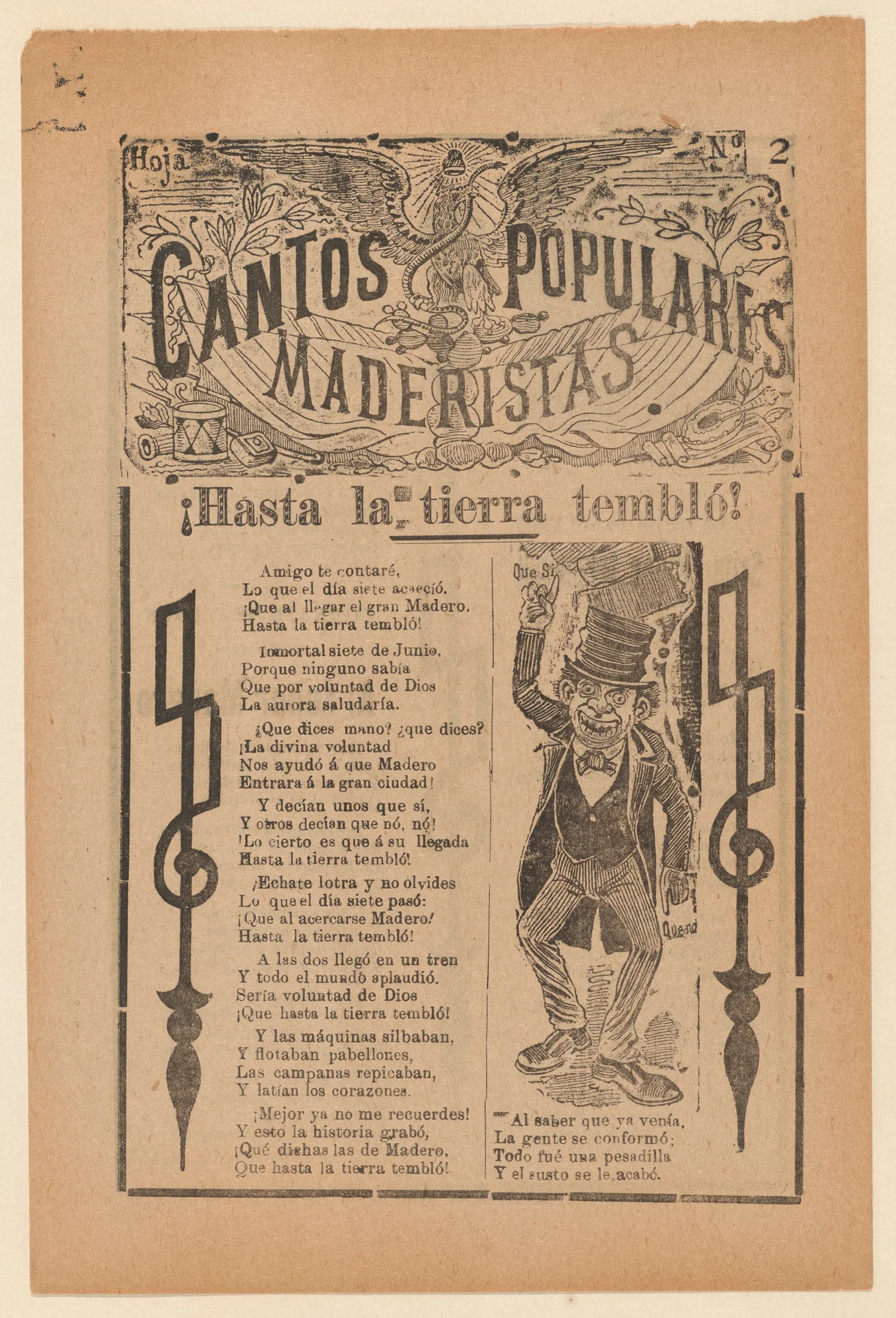

Posada’s Madero stands inside a page rather than above a crowd. “Que Sí” and “Que No” turn political uncertainty into graphic opposition. Large display type, small explanatory text, image, music, and the publisher’s distribution system work together. The object is not simply an illustration by one artist; it is a commercial print collaboration designed to move through Mexico City.
The Met’s survey of Mexican print places Posada within late nineteenth-century political caricature, press censorship, mechanised printing, and the first years of revolution. Denise Hellion’s INAH study likewise stresses competition among newspapers for readers and advertisers. Modern image-making here depended on reproducibility, price, headlines, workshops, and streets.
A broadsheet is an argument made for circulation
Oil painting asks what happens within a unique surface; a broadsheet adds what happens among copies. Its relatively cheap paper, relief process, and letterpress text allowed an image to circulate beyond an academy or elite salon. Readers could buy, read aloud, sing, pin up, pass on, discard, or reprint it. The public was made through distribution rather than merely depicted.
The sheet is visually hierarchical. Madero’s suit and top hat identify a modern political actor; his body bridges the verbal alternatives; the smaller scene below supplies popular animation. Text occupies most of the page, so visual literacy and spoken performance could overlap. “Popular” should not be romanticised as unmediated popular voice: Vanegas Arroyo decided what to publish, and market demand shaped production.
Revolution changed Posada’s afterlife
Posada died in 1913. In the 1920s and 1930s, artists and writers reconstructed him as an ancestor of national and revolutionary art. Jean Charlot’s 1925 essay presented him as a precursor; Diego Rivera’s 1930 text called him a worker and fighter of the printed sheet. Those tributes preserved and enlarged his reputation, but they also selected a usable Posada for a new cultural project.
Hellion notes that post-revolutionary intellectuals emphasised social criticism and the calaveras as national identity. That process is evidence, not a reason to dismiss the prints. It reveals that canons are made after an artist’s death through archives, editions, exhibitions, prefaces, and political need. The “people’s artist” is both historical producer and later institutional construction.
Muralism made walls into public media
Modern Mexican mural painting began in public and educational buildings after the armed phase of revolution. UNAM’s centenary account dates Roberto Montenegro’s Tree of Life to 1921–22 and Rivera’s Creation to 1922–23. Rita Eder and Renato González Mello stress that muralism was not simply enlarged easel painting: architecture, material, teamwork, and a moving public changed the work.
Rivera’s Ministry of Public Education cycle organised labour, festivals, and social movements across courtyards. Orozco, Siqueiros, Fermín Revueltas, Fernando Leal, Xavier Guerrero, and others developed conflicting approaches to history, class, race, technology, and revolutionary power. “The three greats” is a useful shorthand for Rivera, Orozco, and Siqueiros, but it hides other artists, assistants, craft labour, women, photographers, restorers, and institutions.
Public art was commissioned and contested
The state was not a single patron with one coherent ideology. Ministers, university authorities, artists’ unions, parties, students, administrators, and later governments disagreed. A 1923 manifesto by the Syndicate of Technical Workers, Painters, and Sculptors—signed by Siqueiros, Rivera, Guerrero, Revueltas, Orozco, and others—joined workers’ interests, public education, and collective art. It was later printed in El Machete, itself a political medium.
Commissions provided walls, materials, wages, visibility, and institutional power. They did not guarantee obedience. Gaceta UNAM’s political history traces Rivera’s labour panels and Siqueiros’s funeral for a sacrificed worker as departures from José Vasconcelos’s early cosmic and educational programme. The same public project contained different revolutionary claims.
A censored wall exposes the limit of patronage
Siqueiros painted América Tropical on an exterior wall in Los Angeles in 1932. The Getty Conservation Institute records an Indigenous figure crucified beneath an American eagle and armed figures aiming at it. The mural was partially whitewashed soon after completion and fully covered within a decade. Patronage enabled the work; censorship changed its visibility.
Its later conservation did not restore a pristine political message. The remaining material had endured covering, weather, pollution, and forgetting. Getty scientists analysed pigments, binders, plaster, ultraviolet exposure, wind, rain, and structural conditions before a shelter and viewing platform were built. Conservation became another chapter of public authorship, involving the City of Los Angeles, community advocates, historians, scientists, architects, and funders.
Barradas makes the modern city vibrate
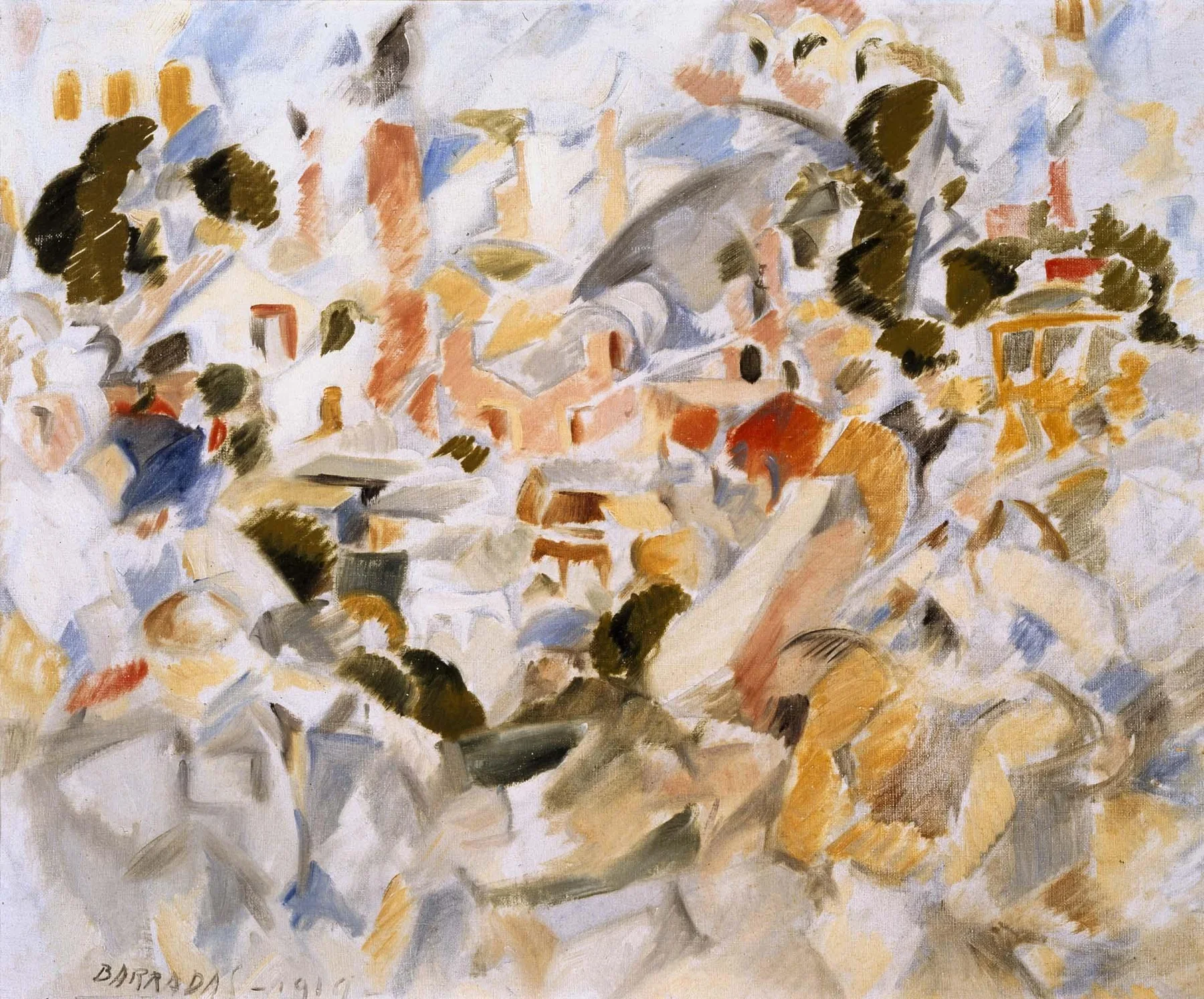

Barradas fractures Atocha into simultaneous signals. Lettering, faces, wheels, awnings, façades, and coloured planes refuse a stable foreground. The painting does not erase the city into pure abstraction; it makes recognition flicker. We assemble a station district from partial signs just as a pedestrian registers movement, sound, traffic, and advertising.
The Reina Sofía connects Barradas’s “Vibrationism” to encounters with Futurism and Cubism while emphasising the reality of Madrid’s urban life. That account is stronger than saying he imported European avant-garde style to Uruguay or exported a Latin American essence to Spain. His practice grew through migration, conversation, magazines, theatre, illustration, and friendship with Torres-García.
Migration unsettles centre and periphery
Migration is sometimes narrated as a student journey from periphery to centre: the artist travels to Europe, learns the advanced language, and brings it home. Barradas’s movement does not fit that hierarchy. He contributed to the formation of Spanish avant-garde culture, influenced peers, designed theatre, illustrated publications, and developed his own term for pictorial experience.
The MNAV’s 2025 Barradas exhibition describes an itinerant artist moving from Montevideo through Milan, Paris, Barcelona, Zaragoza, and Madrid. Reina Sofía’s research further restores the experimental music of his sister Carmen Barradas and her role in the idea of vibration. The network was familial and interdisciplinary, not a lone painter receiving styles.
Café modernity includes sound, transit, and labour
Barradas later recalled a café encounter in which a passing military band, tram bells, and a piano seemed to vibrate together. Reina Sofía’s Vibrationism research treats sound, electromagnetic theories, poetry, painting, and Carmen Barradas’s music as connected experiments. Atocha can therefore be read as more than a Futurist effect applied to Madrid.
The café was a social machine: customers, waiters, musicians, writers, soldiers, printers, and transit passengers occupied different positions within it. Barradas’s compressed signs reproduce attention under those conditions. The viewer cannot possess the whole city at once. Modernity appears as simultaneous but unequal access to movement and leisure.
Antropofagia turns import into digestion
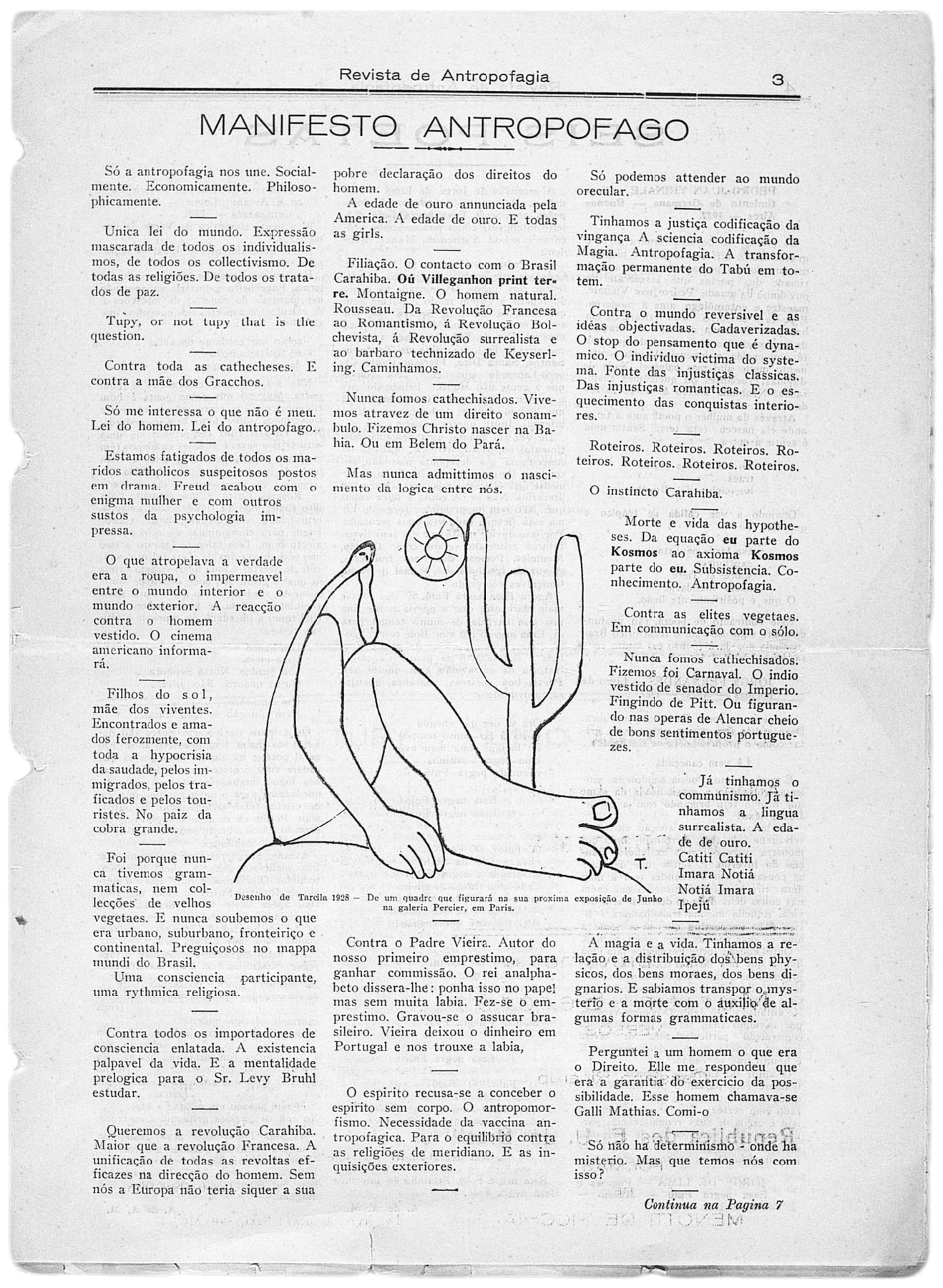

Oswald de Andrade’s 1928 manifesto proposed antropofagia—anthropophagy or cultural cannibalism—as an active way to consume and transform foreign culture. The page’s most famous wordplay, “Tupy, or not tupy,” folds Shakespeare into a modernist claim about Brazil. Its short declarations, historical jumps, jokes, and reversals perform digestion rather than present a systematic theory.
The text was not isolated. The ICAA record, researched with the University of São Paulo team, places it in the first issue of Revista de Antropofagia, directed by Antônio de Alcântara Machado and managed by Raul Bopp. Tarsila do Amaral’s Abaporu helped catalyse the movement. Magazine, painting, literary circle, patronage, travel, and polemic formed a modernist programme together.
A manifesto can resist dependency and repeat primitivism
The manifesto attacks catechism, colonial inheritance, and deference to Europe. It converts consumption from evidence of dependency into a tactic of power. The Biblioteca Brasiliana Guita e José Mindlin situates the text after the 1924 Pau-Brasil manifesto and reads its tone as more radical and politically confrontational.
Yet de Andrade also invokes a “natural” or pre-logical person. That language participates in the primitivist vocabulary examined in the previous Atlas chapter. Indigenous identity becomes philosophical energy for an urban, largely non-Indigenous modernist circle. A colonial stereotype can be reversed without fully returning historical specificity or voice to the people used as its figure.
Tarsila’s national bodies demand a double reading
Tarsila’s Abaporu of 1928 gave the movement its catalytic image: an enormous foot and hand, small head, cactus, and sun reorganise the human figure. The Museu de Arte de São Paulo explains how she studied in Paris and transformed Cubism, local landscapes, Afro-Brazilian and Indigenous references, and travel through Brazil. Her modernism was made through mobility and elite resources, not despite them.
MAM Rio’s recent research adds a necessary counterpoint. Its account of race and portraiture argues that modernist images could value Black and Indigenous culture while still making racialised people symbols of the nation without self-agency. Tarsila came from a wealthy landowning family; memories of women enslaved on family estates entered her image-world through a position of class power.
Amauta built a South–South avant-garde network
José Carlos Mariátegui founded and directed Amauta in Lima from 1926 to 1930. The Museo de Arte de Lima reconstructs it as a network linking Peru, Mexico, Argentina, and Europe through more than painting: prints, photography, sculpture, popular art, textiles, ceramics, poetry, and political documents circulated across its pages.
The magazine debated Indigenismo, international avant-gardes, left politics, and the relation between art and action. It did not merely report separate national scenes. Its editors, agents, correspondents, contributors, and readers made a continental field through publication. The Blanton Museum notes a print run of roughly three to four thousand—small beside mass newspapers, but substantial enough to sustain an intellectual network.
Indigenismo cannot substitute for Indigenous agency
Mariátegui opposed the picturesque reduction of Indigenous life and connected its vindication to land, labour, oligarchy, and socialist politics. His 1927 writing, archived by ICAA, argued that literary Indigenismo should not remain sentimental representation. This was a material political claim, not merely a search for national motifs.
At the same time, Indigenista painters and intellectuals often remained non-Indigenous mediators. José Sabogal valued carved gourds and Andean makers, taught at the national art school, and promoted a Peruvian national art. MALI’s permanent-collection guide notes both the movement’s break with nineteenth-century academicism and its idealisation of an Indigenous rural world. Advocacy and simplification could coexist.
Torres-García constructs a portable visual order
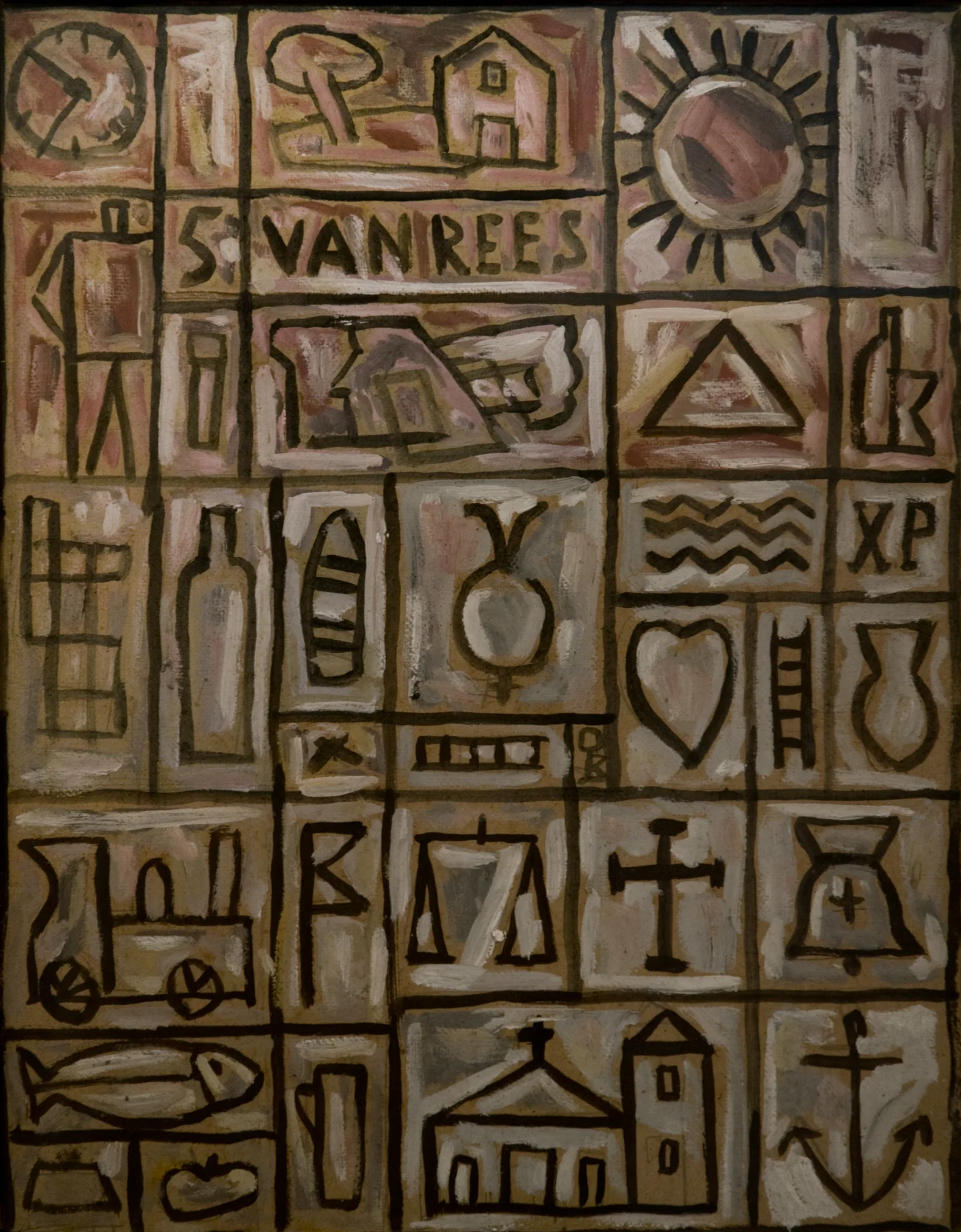

Black lines divide Torres-García’s cardboard into unequal cells. Within them, a fish, vessel, clock, house, anchor, human figure, numbers, and abstract shapes operate as both things and signs. The grid stabilises difference without forcing every cell to match. Ochre, black, white, and muted red make the structure feel excavated and modern at once.
The MNAV record dates the painting to about 1929, when Torres-García was developing the constructive language later associated with Universal Constructivism. The museum identifies references ranging from classical proportion and early Christianity to alchemy, Freemasonry, pre-Columbian cultures, modern technology, and ordinary utensils. “Universal” here means an attempted visual order assembled from particular archives.
Symbols refuse the split between abstraction and reference
Geometric abstraction is often narrated as the elimination of subject matter. Torres-García’s cells refuse that purity. A fish remains recognisable while functioning as contour and proportion; a clock names measured time inside a field whose signs suggest different temporal traditions. The grid is neither window nor decoration. It is an organising device for relations.
This mixture also challenges the stereotype that Latin American art must choose between international abstraction and local identity. The painting does not illustrate Uruguay, yet its maker later proposed a “School of the South” from Montevideo. Nor do pre-Columbian signs make the work automatically Indigenous. They are selected and recontextualised by Torres-García inside his synthetic system.
School and workshop are part of the artwork’s history
Torres-García returned to Montevideo in 1934, founded the Asociación de Arte Constructivo in 1935, lectured extensively, published, and later organised the Taller Torres García. The MNAV biography treats this educational activity as central to his practice. Constructive art became a method transmitted, debated, and changed by students rather than the property of one canvas.
A school shapes modernism through exercises, critiques, exhibitions, friendships, ceramics, murals, furniture, publishing, and access to materials. Students do not simply copy a master; they make the movement survive and diverge. The Taller’s history also warns against equating influence with stylistic resemblance. Documentation of teaching establishes a social route that formal comparison alone cannot.
An inverted map changes orientation, not geography
Torres-García’s later América invertida of 1943 places South America with south at the top. The drawing is often treated as a complete decolonial reversal. Its force is real: orientation conventions stop looking natural, and the viewer experiences geographic order as a designed choice. Montevideo can become a point from which the world is thought rather than a location beneath Europe and North America.
But rotating a map does not redistribute museum money, publishing, visas, land, or political power by itself. Nor does “the South” become culturally uniform. The image is a proposition for intellectual orientation, not proof that centre–periphery relations have ended. Its later iconic status came through reproduction, exhibition, teaching, and institutions.
Lam returns Afro-Cuban worlds to the modern frame
Wifredo Lam’s route crossed Cuba, Spain, Paris, Marseille, Martinique, and return. He fought on the Republican side during the Spanish Civil War, encountered Surrealist and Cubist networks, met Aimé Césaire, and reconnected in Havana with Afro-Cuban histories and religious knowledge. Migration did not dilute a Cuban essence; it changed which relations his work could hold together.
In La jungla of 1942–43, elongated human, plant, mask-like, and animal forms crowd a field of sugar cane. The MoMA object record documents oil and charcoal on joined kraft paper mounted to canvas. The material and scale matter: the work is a constructed surface, not a transparent record of ritual.
La jungla is neither European derivation nor ethnographic illustration
Lam learned from Picasso and Surrealism, but influence does not make La jungla a derivative European picture. After returning to Cuba in 1941, he redirected formal strategies toward a colonial and neocolonial society shaped by slavery, sugar, anti-Black regulation, migration, and Afro-Cuban religious life. The work speaks back to primitivism from a position formed within the African diaspora.
Nor should its figures be decoded as an ethnographic chart of orishas. Tsang cautions that participation in Afro-Cuban religion does not establish initiation and that visual presences should not be assigned fixed identities casually. Campos-Pons describes Lam’s transformative force for later Cuban artists; Ferrer places exile within Cuban history. Local and diasporic knowledge enlarge formal analysis without turning the painting into documentary evidence for a single ritual.
Modernisms were made by media systems
The five objects organise different publics. La ofrenda entered academy, exhibition, and national museum; Posada’s sheet circulated through print commerce; Barradas’s canvas condensed café, transit, sound, and magazine culture; the manifesto used serial publication to recruit argument; Torres-García’s painting became part of a teaching and workshop system. Murals fixed images to civic architecture, while Amauta moved them between cities.
Medium is not a container added after an idea. Reproducibility allowed a broadsheet to respond to events; architectural scale made mural viewers move; a journal placed unlike voices side by side; a workshop extended a method beyond an individual. Censorship also took medium-specific forms: confiscation, whitewash, restricted building access, withdrawn patronage, or exclusion from exhibition.
A comparison matrix
| Object or network | Modern problem | Medium and public | Institutional condition | Necessary caution |
|---|---|---|---|---|
| Herrán, La ofrenda, 1913 | Ritual continuity and national synthesis during revolution | Unique oil painting; academy, exhibition, museum | MUNAL/INBAL canon and later national circulation | Indigeneity is represented by a named non-Indigenous painter; the passengers remain unnamed |
| Posada and Vanegas Arroyo, Madero broadsheet, c. 1911 | Political uncertainty, leadership, and popular address | Reproducible zincograph and letterpress sold through print commerce | Publisher, workshop, later revolutionary canon | Do not make every print a prophecy of the post-1920 state |
| Barradas, Atocha, 1919 | Sensory city, migration, simultaneity | Canvas shaped by café, transit, sound, theatre, and magazines | Transatlantic career; now Reina Sofía collection | National labels cannot contain the route; European encounter was not passive reception |
| De Andrade, Manifesto antropófago, 1928 | Cultural dependency transformed into active digestion | Serial manifesto in a São Paulo journal network | Elite modernist circle, USP/ICAA archive, global afterlife | Anti-colonial reversal can still turn Indigenous histories into metaphor |
| Torres-García, Pintura constructiva, c. 1929 | Structure joining abstraction, sign, object, and claimed universality | Portable painting extended through lectures, publications, school, and workshop | Paris phase, Montevideo return, Asociación and Taller | “Universal” is constructed from selected archives; pre-Columbian signs do not equal Indigenous authorship |
What the five objects show about national culture
National culture was neither an ancient substance discovered by artists nor a pure invention imposed from above. It was made through choices about medium, subject, ancestry, labour, audience, and institution. Herrán selected a ritual procession; post-revolutionary artists selected Posada as ancestor; Anthropophagy selected digestion as method; Torres-García selected and reordered signs; Lam returned diasporic and Afro-Cuban worlds to modern painting.
Those selections could resist dependency while centralising elite artists and state institutions. The nation often appeared through Indigenous and Black bodies, labour, ritual, and visual knowledge while authorship and collection remained elsewhere. Plural modernisms therefore describe connected, contested systems—not a contest for who became modern first.
Common survey traps
- Do not call Latin American modernism a colourful, magical, irrational, or politically unified alternative to European reason.
- Do not use “influenced by Europe” as a complete explanation; identify the city, teacher, object, publication, journey, and transformation.
- Do not treat the Mexican Revolution, the post-revolutionary state, muralism, and every artist’s politics as interchangeable.
- Do not equate a public commission with unrestricted public access or political agreement.
- Do not call every representation of Indigenous people Indigenous art. Name the represented community and the maker’s position when evidence allows.
- Do not describe Anthropophagy as pure cultural liberation without examining its primitivist metaphors and elite authorship.
- Do not divide figurative national art from apolitical abstraction; test what institutions and signs each work organised.
- Do not make travel a one-way lesson from European centre to Latin American periphery.
- Do not treat “Latin America” as if Brazil, Mexico, Peru, Uruguay, Cuba, Argentina, the Caribbean, and Indigenous nations shared one history.
- Do not reproduce a modern artwork merely because a museum displays it online; verify object copyright and image licence separately.
Questions for close looking
- In La ofrenda, how do bodies, flowers, boat, water, and horizon turn one journey into a claim about generations and nation?
- Which parts of Posada’s broadsheet require reading, viewing, or oral performance? How does the publisher’s role alter individual authorship?
- In Atocha, what remains identifiable after the city is fragmented? Which visual devices suggest sound or movement without depicting either literally?
- How does the Manifesto antropófago transform the relation between import and invention? Where does its Indigenous metaphor lose specificity?
- In Torres-García’s painting, which signs remain objects and which become geometric units? Who defines their “universal” meaning?
- What makes a mural public: scale, ownership, location, audience, political claim, or continued access?
- For any work in the chapter, separate subject, maker, patron, institution, audience, and later canon. Where does power change hands?
Terms for plural modernisms
- Latin American modernisms: a comparative frame for multiple, connected projects in Latin America and its diasporas; not one style or civilisational essence.
- Indigenismo: cultural and political representation of Indigenous peoples, histories, and claims, often by non-Indigenous intellectuals, artists, or states; distinct from Indigenous authorship.
- Muralism: practices of making images through architectural walls, public or institutional commissions, collective labour, and site-specific address; in Mexico the term includes competing post-revolutionary programmes.
- Antropofagia: Brazilian modernist strategy of culturally “digesting” and transforming foreign sources, formulated most famously by Oswald de Andrade in 1928.
- Vibrationism: Barradas’s term for an art that translated simultaneous sensory, urban, and energetic experience through fragmented form and colour.
- Universal Constructivism: Torres-García’s synthesis of geometric structure, proportion, sign, material, teaching, and selected symbolic traditions.
- South–South network: movement of ideas, objects, and people among locations outside the usual European–North American centre, without implying equal power or cultural sameness.
- Publicness: the historically produced conditions under which people can encounter, use, contest, or be excluded from an image.
- National allegory: a representation in which a person, ritual, landscape, or event is made to carry a larger claim about the nation.
- Canonisation: the process through which archives, museums, textbooks, markets, exhibitions, and criticism make selected artists or works exemplary.
A working timeline, c. 1911–1943
- c. 1911: Posada and Vanegas Arroyo publish the reproduced broadsheet about Francisco Madero as Porfirio Díaz’s rule ends and revolution remains unsettled.
- 1913: Herrán paints La ofrenda during the Mexican Revolution; Posada dies the same year.
- 1913–1919: Barradas leaves Montevideo, encounters Italian and French avant-gardes, works in Barcelona and Madrid, and develops Vibrationism; Atocha dates to 1919.
- 1921–1923: early modern mural commissions occupy Mexican educational and university buildings.
- 1923–1924: the Mexican artists’ syndicate circulates its manifesto; El Machete becomes a vehicle for revolutionary visual politics.
- 1925: Jean Charlot’s essay helps remake Posada as precursor of modern Mexican art.
- 1926–1930: Mariátegui directs Amauta in Lima, linking Indigenismo, left politics, avant-garde debate, and networks among Peru, Mexico, Argentina, and Europe.
- 1928: Tarsila paints Abaporu; de Andrade publishes the Manifesto antropófago in São Paulo.
- c. 1929: Torres-García makes the reproduced Pintura constructiva while developing his constructive language in Paris.
- 1930: Rivera’s tribute and a major compilation strengthen Posada’s posthumous revolutionary canon.
- 1932: Siqueiros paints América Tropical in Los Angeles; patrons soon begin covering the mural.
- 1934–1935: Torres-García returns to Montevideo and founds the Asociación de Arte Constructivo, followed later by the Taller Torres García.
- 1937–1938: the Taller de Gráfica Popular develops a collective print practice connected to union, agrarian, educational, and anti-fascist politics.
- 1941–1943: Lam returns to Cuba and makes La jungla; Torres-García draws América invertida in 1943.
Source guide
Object records and image rights. The MUNAL collection record, INBAL account, and public-domain file establish La ofrenda’s title, date, medium, collection, dimensions, subject, image provenance, and rights. The Met record supplies Posada and Vanegas Arroyo’s object data and CC0 image. Reina Sofía’s Atocha record and the public-domain file support the Barradas caption. The Manifesto page is tied to the ICAA/USP record, BBM complete issue, and public-domain file. The MNAV object record and MNAV-supplied public-domain image document Torres-García’s painting. All local derivatives preserve complete compositions and intrinsic dimensions.

Local and institutional histories. Denise Hellion’s INAH study of Posada distinguishes commercial print practice from the posthumous national myth. Rita Eder and Renato González Mello’s UNAM muralism account grounds public walls in architecture, material, teamwork, and audience movement. MAM Rio’s Tarsila research and critical account of race hold innovation and unequal representation together. Natalia Majluf and Beverly Adams’s MALI–Blanton Amauta project reconstructs the magazine through local archives and transnational correspondence. MNAV supplies the Torres-García object history and biography.
Named scholarship and primary documents. Mari Carmen Ramírez’s “Beyond ‘The Fantastic’” establishes the critique of regional stereotypes. Harper Montgomery’s The Mobility of Modernism maps South–South magazine networks. The ICAA archive supplies de Andrade’s manifesto, Rivera’s 1930 Posada tribute, and Mariátegui’s 1927 argument on Indigenismo. Recent MoMA research on Wifredo Lam brings named Cuban, diasporic, historical, anthropological, ecological, and artistic perspectives into the account rather than treating La jungla as a European-style case study.
Evidence boundary. This chapter does not claim that national representation equals community self-representation, that every Posada print supported one revolutionary faction, or that mural commissions shared one state ideology. It does not call the reproduced Torres-García symbols Indigenous authorship, decode Lam’s forms as a fixed catalogue of deities, or use formal resemblance alone to prove influence. “GeMarkt Research Review” records an internal source-and-rights check, not independent academic peer review. Corrections can be submitted through the site’s editorial standards page.
Continue the Atlas route
The previous chapter reconstructed modernism and colonial appropriation as a chain of source community, transfer, encounter, transformation, credit, and museum afterlife. This chapter followed several artists who turned modernism into contested projects of nation, migration, public address, and decolonial orientation—without treating Latin America as one style. The next Atlas chapter moves to African modernisms, asking how schools, independence movements, cities, photography, workshops, and transnational exhibitions created multiple modernities rather than a late echo of Europe.
Editorial record
About this article
- Author
- Publisher
- GeMarkt
- Published
- Updated
- Reviewed
- Internal source & rights check. Conducted by GeMarkt Research Review. This is an internal editorial check—not independent peer review.
- Source standard
- Art history source standardPrioritises object records and research sources, distinguishes evidence from interpretation, and states material uncertainty.
Found a claim that needs checking? Report a factual error.