Art History · Learning chapter
Atlas V — Modernisms and contemporary practices · 4 of 10
African modernisms: school, independence, city, photography, and transnational exhibition
Five visual studies trace how African modernisms were made through photography, schools, landscape, independence, studios, and transnational exhibitions.


What we’ll look at
How did African artists build different modernisms through schools, cities, studios, and independence movements?
Ten people occupy a shallow outdoor stage. Chief William Brown sits at the centre while nine family members stand or sit around him; a child kneels in front and wooden boards close the space behind them. The photograph is attributed to Jonathan Adagogo Green, an Ibani Ijo professional in Bonny. Museum Rietberg dates the albumen print to 1890—decades before the political independences with which surveys often begin African modern art.
The portrait joins form to infrastructure. Camera, materials, patronage, dress, kinship, pose, circulation, collection, and later attribution shape what it can mean. The same applies to a landscape, classroom, ink drawing, public square, or exhibition. Modernism happened through relations among objects, people, and institutions—not through one continent discovering one style.
“African modernisms” is a plural, historically specific frame
Africa is not one art-historical region. More than fifty modern states, thousands of languages, distinct empires and colonial regimes, Islamic and Christian intellectual histories, Indigenous knowledge systems, port cities, inland trade routes, diasporas, and unequal economies cannot be compressed into a continental style. The phrase African modernisms is useful only when the plural remains active.
Here, modernism names deliberate experiments within changing conditions of modernity: urbanisation, wage labour, colonial education, print capitalism, mission and government schools, new media, migration, racial segregation, nationalism, independence, and international exhibition. Artists could study European academic drawing, work with inherited visual practices, use imported paint, quote Arabic script, organise workshops, run commercial studios, or reject official culture. None of those actions alone makes a work derivative or authentic. The historical question is what makers did with the materials, institutions, and arguments available to them.
Scope: five visual studies and five deliberate non-reproductions
Five rights-reviewed visuals anchor the chapter: Green’s Bonny family portrait; a Lisk-Carew Brothers postcard of Madam Hamonyah; Makerere University’s main building; Thomas Askew’s photograph from W. E. B. Du Bois’s Paris albums; and a GeMarkt diagram of FESMAN’s institutional structure. The diagram interprets cited records; it is not presented as an archival object.
Works by Moses Tladi, Gerard Sekoto, Uche Okeke, Ibrahim El-Salahi, and Seydou Keïta are discussed but not reproduced because available files lack a secure international rights chain or remain restricted. Black Star Square and the Museum of Black Civilisations are also studied without site photographs: a photographer’s free licence does not automatically clear depicted architecture under source-country law. Links allow study without treating a downloadable image as permission.
Modernisms began before political independence
If the story begins with flags raised in the late 1950s and 1960s, it misses decades of artistic and institutional work. Green and other African photographers operated professional businesses along the Atlantic coast in the nineteenth century. Aina Onabolu exhibited portraits and wrote on art in colonial Lagos before 1920. Moses Tladi painted and exhibited South African landscapes in the 1920s and 1930s. Makerere’s art school began in 1937. Gerard Sekoto made urban paintings in Sophiatown, District Six, and Eastwood during segregation before leaving for Paris in 1947.
Independence changed patronage, curricula, mobility, symbols, and expectations, but it did not create modern artistic agency from nothing. A better chronology follows overlapping formations: colonial institutions and their critics; African-owned studios and publications; artists excluded from academies but active in cities; independence-era schools, ministries, museums, and festivals; and later challenges to national canons. Political sovereignty is a decisive event inside that history, not its first page.
J. A. Green makes the photographic profession visible
In brief: This 1890 family portrait shows Chief William Brown and his family in Bonny, present-day Nigeria, and is attributed to Jonathan Adagogo Green. It reveals both the family’s self-presentation and how an African photographer’s name could disappear from the archive.
Green’s authorship was obscured by the initials “J. A.” and an English surname. Researchers including Martha G. Anderson, Lisa Aronson, Ebiegberi Joe Alagoa, Tam Fiofori, and Christraud M. Geary reassembled a practice dispersed across archives. Green emerges as an African professional who photographed Ibani Ijo leaders, families, commerce, ritual, colonial officials, and political encounter in the Niger Delta.
The Bonny portrait retains a qualified attribution. Museum Rietberg identifies Brown and his family, dates the print to 1890, and records Green as maker; scholarship preserves “attributed to.” Modernism here includes professional self-fashioning and technical command, but also the archival labour required to name a photographer whom catalogues had rendered anonymous.
A family portrait turns modernity into a public claim
Robes, wrappers, beads, hats, stance, and the two-row seated–standing hierarchy organise relation. The camera records authority but does not create it alone. Sitters contribute kinship, status, bodily composure, textiles, and decisions about how the group should face a future audience.
Olubukola A. Gbadegesin shows how Black West African photographers used businesses, networks, and reputations for projects of their own. Colonial rule structured the archive and photographic economy, but “colonial photograph” cannot explain every image made within them. Ask who operated the studio, commissioned the picture, supplied its visual knowledge, and altered its attribution after collection.
Moses Tladi paints a landscape without emptying its history
Wits Art Museum’s 2017 retrospective, Moses Tladi Unearthed, returned attention to a South African landscape painter working within severe racial restrictions. Tladi’s exhibition history begins in the 1920s; in 1931 he became the first Black artist recorded as exhibiting at the South African National Gallery. He entered landscape professionally before formal apartheid while segregation already structured labour, land, mobility, patronage, and institutions.
An online reproduction associated with the retrospective supplies no secure title, date, dimensions, collection, or object-level provenance, and its licence does not establish the painting’s international rights chain. It is not reproduced. Wits records can establish Tladi’s career without our renaming an object, inventing a site, or treating an uploader as the rights holder.
Landscape is not politically innocent
Tladi worked as a gardener on Herbert Read’s Johannesburg property; Read encouraged his painting and introduced patrons. Wits frames the landscapes through their social, economic, and political conditions. Under segregation, access to land, training, galleries, transport, and leisure was racialised. Yet Tladi cannot be reduced to oppression: observation, tonal construction, ambition, and attachment to place remain artistic decisions. The task is to connect form to conditions without letting conditions consume the painting.
Madam Hamonyah meets a camera and a postcard market
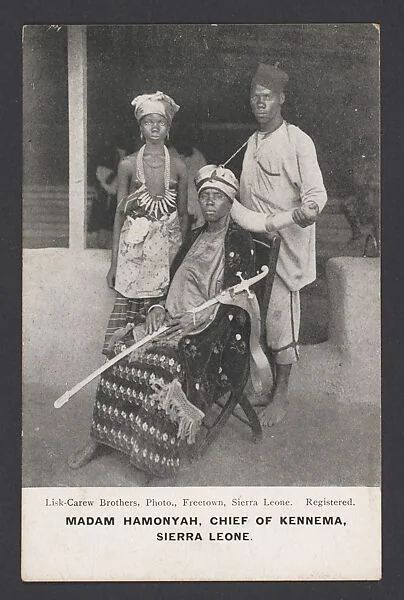

Madam Hamonyah sits at the picture’s centre, holding a sword across patterned cloth. Two standing figures create a triangular group; the shallow architectural setting and direct poses resist picturesque depth. Printed text below identifies her as a chief of Kennema, Sierra Leone. The card turns a photographic encounter into a named, portable image.
The Met records the Lisk-Carew Brothers as publisher but does not name the photographer. That distinction should remain visible. Alphonso and Arthur Lisk-Carew ran a major Freetown photographic business, yet a company imprint is not automatic proof of which person operated the camera in every case. Accurate attribution is more valuable than filling a gap with a familiar name.
The postcard changes the audience
A portrait can be commissioned for a sitter, family, political circle, or local community. A postcard adds reproduction, sale, inscription, postal movement, collecting, and an audience the sitter may never meet. The same photograph can signify chiefly authority in Kennema, commercial skill in Freetown, colonial “type” to a foreign buyer, family memory, or museum evidence after accession.
The Met’s research on early West African photography describes African, European, Asian, and African American practitioners opening studios along the coast, and emphasises that African clients were consumers, producers, and patrons within a global visual economy. It also notes the ambiguity of postcard circulation, including cases where commissioned portraits entered wider markets with or without a sitter’s permission. Reproducibility expands reach while complicating consent.
Makerere made schooling into an art-historical force
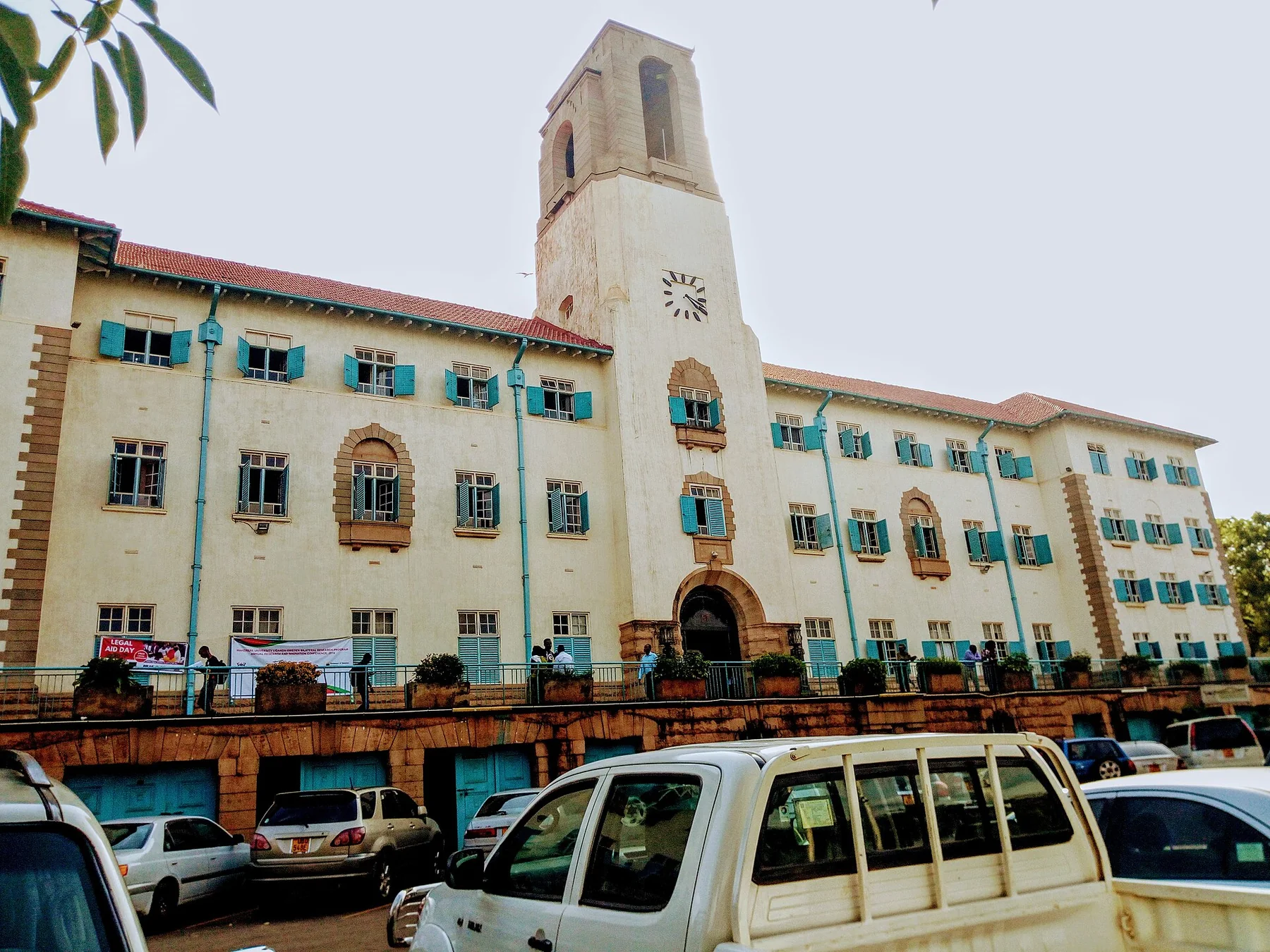

Makerere’s official timeline dates the beginning of its art school to 1937, initially on the veranda of Margaret Trowell’s residence. The school trained artists including Gregory Maloba, Sam Ntiro, Elimo Njau, Noor Kaddu, and John Kisaka. It became an unusually important node because formal art education was scarce in colonial East Africa and because graduates moved through teaching, diplomacy, workshops, galleries, and cultural organisations across the region.
The main building is reproduced as institutional landscape, not as a surviving view of the first classroom. That distinction prevents a common visual shortcut in which any photograph of a university becomes evidence for every event on its campus. The history rests on Makerere’s timeline, art-gallery archive, and school records; the photograph helps us ask how monumental university identity frames smaller, less visible histories of teaching.
A colonial curriculum could be used and contested
Trowell advocated study of local subjects, materials, and practices against an education limited to European copying. That intervention opened space while carrying a paternal colonial idea of an “African aesthetic” that a British teacher could define. The problem is not resolved by choosing between benevolent founder and colonial agent. Both authority and opportunity were present.
Makerere’s repository records disagreement from within the school. Gregory Maloba argued that modernisation made it unnecessary to remain bound to a mythologised past; Sam Ntiro was more aligned with Trowell. A Slade-supervised diploma introduced stronger technical and academic structures in the 1950s. Around Ugandan independence, arguments about indigenisation intensified. Curriculum was therefore not a package passively received. It was a contested field in which African teachers and students debated technique, heritage, professionalism, and the future.
Onabolu made writing and teaching into infrastructure
Aina Onabolu’s 1920 A Short Discourse on Art is a primary document of modern Nigerian art education. Written in Lagos before he travelled to Europe for further study, it argued for art’s intellectual and educational standing in a colonial system that denied African achievement. The document matters not because European academic naturalism was the inevitable definition of progress, but because Onabolu strategically claimed professional competence within a racial hierarchy.
He later taught and advocated formal art education in Nigerian schools. That work made syllabi, demonstrations, exhibitions, essays, and institutional negotiation part of artistic practice. Chika Okeke-Agulu places Onabolu within a longer prehistory of postcolonial modernism: educated Africans contested colonial representations before the independence generation. A portrait, an essay, and a curriculum could operate together as a political claim about who was qualified to represent modern life.
Zaria’s natural synthesis was an argument, not a recipe
Students at the Nigerian College of Arts, Science and Technology in Zaria formed the Art Society in 1958. Uche Okeke, Demas Nwoko, Bruce Onobrakpeya, Yusuf Grillo, Simon Okeke, and others challenged the assumption that a British-designed curriculum should define modern Nigerian art. “Natural synthesis” named an approach to selecting and transforming multiple resources rather than a house style.
Okeke-Agulu’s Postcolonial Modernism reconstructs the group through manifestos, artworks, criticism, correspondence, magazines, cities, and the politics surrounding Nigerian independence in 1960. Members did not produce visually interchangeable work. Their synthesis could involve Igbo uli, Yoruba forms, Hausa architecture, Christian and Islamic sources, European modernisms, print technology, theatre, or literature. What united them was a claim to intellectual agency over selection—not a formula of one local motif plus one foreign technique.
Uli cannot be reduced to a modernist pattern bank
Uche Okeke’s line developed through study of uli, a set of Igbo practices historically made largely by women as body and wall painting. His mother’s knowledge was a direct source. In works such as the Smithsonian’s Ana Mmuo of 1961, attenuated figures, open lines, signs, and spatial rhythms connect modern drawing to Igbo cosmology and performance without illustrating a fixed dictionary.
Calling every curved line “uli influence” empties the practice of makers, occasions, gender, place, and change. It also risks crediting only the male modernist who transferred it to paper. The Smithsonian object record and scholarship gathered in The Triumph of a Vision support a relational account: Okeke transformed sources through modern media and institutions, while those sources had histories and authors beyond his studio.
Independence did not settle who could speak for the nation
Nigerian independence generated optimism, commissions, exhibitions, and arguments about national culture. It also preceded political crisis and civil war. Artists participated through state projects, universities, private clubs, magazines, churches, workshops, and commercial networks. None possessed the single visual language of Nigeria, a country structured by many nations, religions, languages, and regional histories.
The Mbari Artists and Writers Club in Ibadan and later networks in Osogbo connected visual artists, writers, performers, publishers, and international visitors. Black Orpheus circulated criticism and reproductions. Nsukka developed a major pedagogical lineage around Okeke and later artists. Independence redirected infrastructure but did not eliminate colonial categories, regional competition, unequal funding, or the power of foreign museums and markets. Postcolonial modernism remained a debate over institutions as much as a celebration of sovereignty.
Ghana linked art school, museum, and public culture
KNUST’s Department of Painting and Sculpture traces its institutional history to Achimota in 1927, its reorganisation as a School of Arts and Crafts in 1937, and its move to Kumasi in 1952. Its own account is unusually candid: independence-era Africanist narrative and official sculpture coexisted with European media, genres, British degree structures, and external moderation. Later Nigerian artists served as assessors, making the curriculum an inter-African route as well as a colonial inheritance.
The National Museum in Accra opened on 5 March 1957, the eve of independence. Four years later, Black Star Square and Independence Arch gave the republic a ceremonial ground. School, museum, and square joined education, collection, public ritual, architecture, and broadcasting—while raising the question of who classified some living practices as “tradition” and others as “modern art.”
V&A research connects Nkrumah’s architecture to nation-building and Pan-African ideology. A square can materialise freedom while organising bodies, officials, performers, and spectators. The photographer’s free licence found during research was insufficient for reproduction: Ghana’s statute names cinema, television, and broadcast uses of publicly visible architecture, not an equivalent still publication. The site remains central without becoming an unlicensed illustration.
Khartoum joined writing, image, and postcolonial debate
Sudan’s School of Design at Gordon Memorial College, later the School of Fine and Applied Art, trained artists who made Khartoum a major centre of African and Arab modernism. Osman Waqialla experimented with Arabic script and taught a generation including Ibrahim El-Salahi and Ahmed Mohammed Shibrain. Independence in 1956 intensified questions about Sudan’s African, Arab, Islamic, regional, and national identities.
The Smithsonian record for El-Salahi’s 1962 untitled drawing describes ink forms that stretch calligraphy toward human, animal, and plant presences. Its date connects the work to intellectual exchange among newly independent African states. Yet the drawing should not be made to stand for Sudan. Kamala Ibrahim Ishag, the Crystalists, and other artists later challenged the aesthetic and political assumptions associated with the Khartoum School.
Calligraphy became a field of transformation
Arabic script carries language, religious education, administration, decoration, memory, and graphic form. In El-Salahi’s practice, letters may remain legible, fracture, repeat, or become figures; this is not a formula of “Islamic tradition” plus “Western abstraction.” Salah M. Hassan instead follows the artist through Sudan, study abroad, cultural work, prison, Qatar, and Britain. Mobility multiplied the situations in which calligraphy, African exchange, European art history, political experience, and drawing carried meaning.
The Khartoum School label remains contested
“Khartoum School” helps trace teachers, exhibitions, institutions, and shared questions but misleads when it promises stylistic unity. Cornell’s account of the Sharjah survey notes that the term was coined in the early 1960s, later disavowed by some artists, and challenged by new groups. Treat it as a question: who used the label, at what date, through which schools and exhibitions, and whom did its calligraphic narrative exclude? A movement name creates visibility and an edge beyond which practices disappear.
Bamako studios made modern selves
Seydou Keïta’s Bamako studio attracted a broad clientele from the late 1940s. The Met describes politicians, civil servants, shop owners, and ordinary residents commissioning portraits during rapid urban growth. Patterned backdrops, textiles, jewellery, watches, radios, bicycles, scooters, chairs, flowers, and carefully arranged poses made the studio a place where people could compose how they wished to appear.
Keïta’s 1956–57 portrait in the Met collection sets a sitter’s patterned clothing against a contrasting cloth backdrop and blanket. The image is not reproduced here because the object page does not grant republishing rights. Its institutional record can still support study of date, medium, composition, and urban context. Rights restraint does not erase the work; it changes how this chapter directs attention to it.
Clients brought fashion, property, and aspiration into the image
A prop is not proof of ownership, and fashion is not simply Westernisation. Watches, radios, scooters, handbags, or clothing could stage aspiration, work, mobility, pleasure, or cosmopolitan knowledge. Keïta controlled lighting, pattern, negative format, and studio rhythm; sitters contributed clothes, relationships, possessions, and desired selves. Malick Sidibé’s later photographs of youth, dance, and nightlife formed a distinct post-independence archive. Both studios helped make modern urban identities visible rather than merely recording them.
The Paris albums made photography into counter-evidence
_(LOC)_(4483938173).jpg)
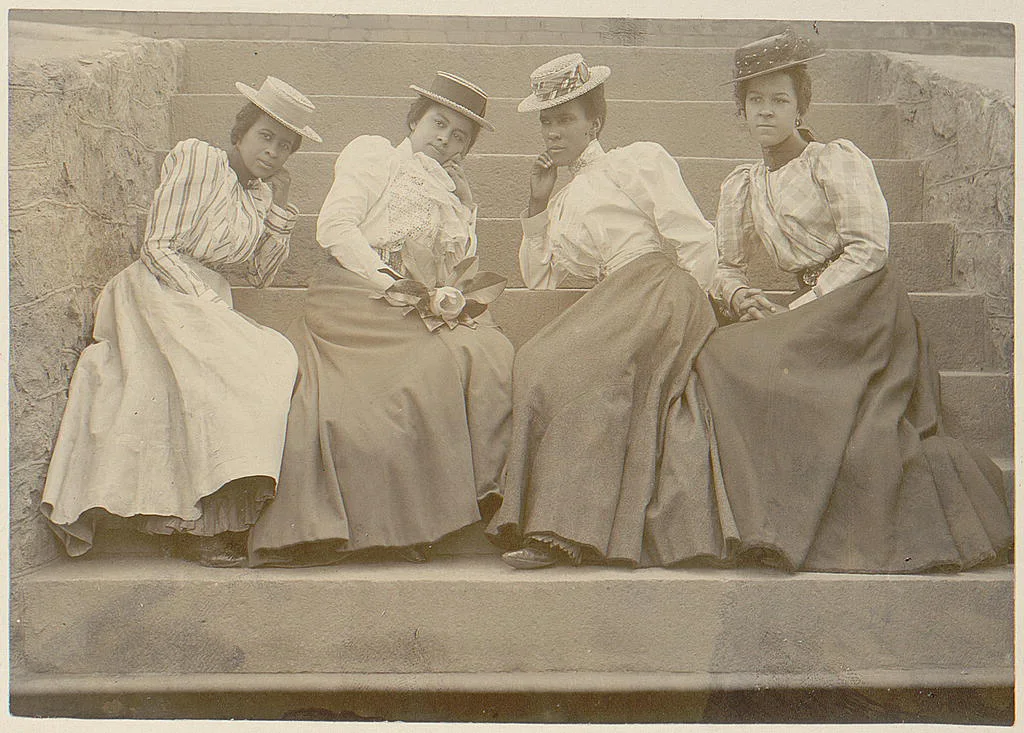
Askew brings four students near the camera; horizontal wall lines, flanking masonry, and stair edges hold the group together. Their clothing varies within a shared formal register, while crossed hands and angled shoulders resist a neutral catalogue. The Library of Congress title does not preserve their names. Visual dignity cannot repair that loss, but an unnamed sitter is not a person without history.
Du Bois assembled this and hundreds of other photographs for the 1900 Paris Exposition, countering racist representations with evidence of education, work, family, institutions, and change. The albums belong to a U.S. struggle, not an African national modernism. Their transnational relevance is precise: before Dakar 1966, a Black intellectual and photographic network used international exhibition to contest who could represent modernity.
Askew died in 1914, the photograph predates 1901, and the Library records no known publication restrictions. By contrast, central works by Okeke, El-Salahi, Sekoto, Keïta, and Tladi are not reproduced. A rights-clean image set is not a neutral sample of importance; explicit absences show how law, policy, digitisation, and survival shape visibility.
Dakar 1966 turned exhibition-making into cultural diplomacy
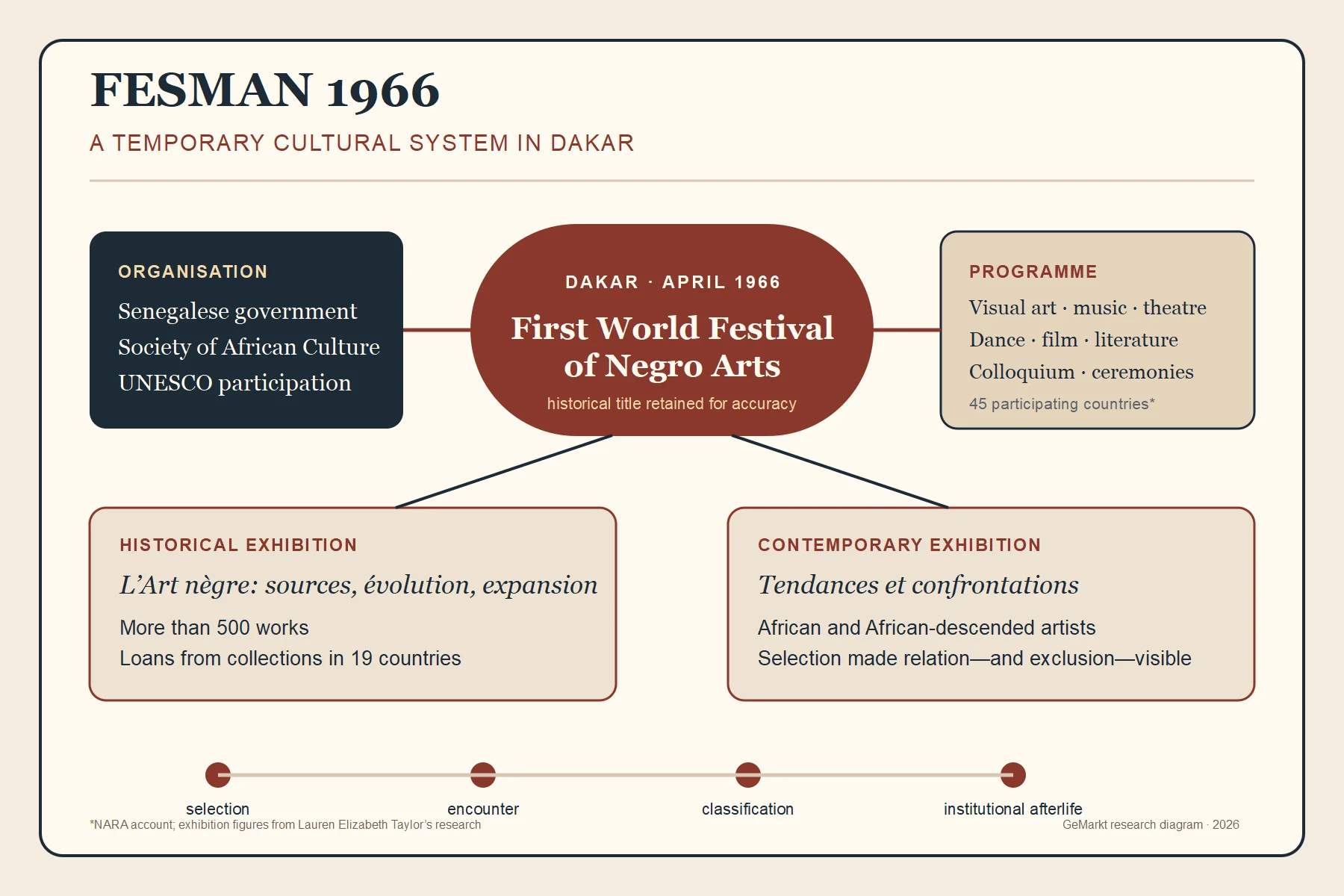
The First World Festival of Negro Arts—using the historical English title, often shortened to FESMAN—took place in Dakar in 1966 under Léopold Sédar Senghor’s government with the Society of African Culture and UNESCO. Music, theatre, dance, film, literature, a colloquium, and visual art brought participants from Africa and its diasporas into an international programme. UNESCO’s surviving radio interview with Duke Ellington is one primary trace of the event.
Lauren Elizabeth Taylor’s research identifies two major visual-art exhibitions. L’Art nègre: sources, évolution, expansion assembled more than five hundred historical works loaned from collections in nineteen countries. Tendances et confrontations presented contemporary work by African and African-descended artists. The festival did not simply display a pre-existing unity. Through selection, sequence, venue, loans, translation, prizes, and protocol, it produced a temporary model of Black cultural relation.
A festival can connect and classify at once
FESMAN created encounters that no national exhibition could duplicate. Artists, writers, performers, scholars, officials, journalists, and audiences entered the same city and programme. It affirmed African and diasporic cultural authority on an international stage during decolonisation. It also placed enormous classificatory power in committees and states: who represented a country, which works counted as historical or contemporary, and how “Black art” related to nation, race, Africa, and diaspora.
Elizabeth Harney’s study of Senegalese art shows how Senghor built a well-funded system of schools and exhibitions around Negritude and the École de Dakar. Artists gained support and international routes while later avant-gardists challenged the official aesthetic. Connection and classification were not opposites. The same infrastructure that enabled artists to travel could define the terms under which they became legible.
The Museum of Black Civilisations is an institutional afterlife
UNESCO records that Senghor conceived the museum after the 1966 festival and that planning continued across decades before the building opened in 2018. Its completion turns an ephemeral event into a long institutional timeline: a temporary festival’s ambition acquired a permanent collection, staff, programme, building, and public address.
Yet a building does not settle the questions FESMAN raised. Collection ownership, restitution, conservation, language, national funding, curatorial authority, and relations among Africa and its diasporas remain active. The museum is best understood as an afterlife of cultural diplomacy: evidence that modernist projects can survive as unrealised plans, return under new governments and partnerships, and acquire meanings their first advocates could not control.
Modernisms were made by systems
The five visual studies lead to different systems. Green’s family portrait joins sitter, photographer, cloth, patronage, professional reputation, attribution, and museum. Madam Hamonyah’s postcard joins sitter, publisher, camera, caption, reproduction, postal market, collector, and museum. Makerere joins curriculum, diploma, classroom, archive, and graduate network. Askew’s photograph joins students, university, photographer, Du Bois’s counter-archive, Paris exhibition, and Library collection. The FESMAN diagram joins government, society, UNESCO, loans, delegates, audiences, archives, and museum afterlife.
No system eliminates individual judgement. Instead, it makes judgement consequential. Artists select, transform, comply, negotiate, refuse, teach, and organise within conditions they did not wholly choose. Modernism becomes easier to compare when style is joined to the infrastructure that allowed a form to reach others.
A comparison matrix
| Visual record or case | Medium and site | Principal infrastructure | Modern public | Central tension |
|---|---|---|---|---|
| Green’s Bonny family portrait | albumen photograph and professional commission | sitters, studio practice, materials, patronage, later attribution | family, local networks, later archives and museums | self-presentation within an archive that obscured African authorship |
| Tladi landscape, discussed but not reproduced | easel painting and exhibition | private patronage, materials, juries, museums | gallery visitors and later retrospective audiences | artistic agency within racial gatekeeping |
| Madam Hamonyah postcard | photograph reproduced as postcard | studio or field photography, publisher, postal and collecting markets | local patrons, distant buyers, later museum users | self-presentation and unstable consent in circulation |
| Makerere | school and university network | curriculum, teachers, diploma, gallery, archive, graduates | students, regional art worlds, research communities | access and the colonial authority to define an “African aesthetic” |
| Askew and Du Bois’s Paris albums | photographic counter-archive and international exhibition | photographer, sitters, university, compiler, fair, library | Paris fairgoers and later researchers | counter-representation and loss of sitters’ names |
| Ghana’s public culture, discussed without site photography | school, museum, ceremonial architecture | education, collection, state commission, broadcasting, national ritual | students, museum visitors, citizens, international delegations | emancipation symbol and state choreography |
| Dakar 1966 diagram and museum afterlife | festival, exhibition, archive, diagram, and museum | state patronage, UNESCO, loans, committees, long-term planning | African and diasporic participants and international audiences | Pan-African connection and institutional classification |
The matrix is an analytical tool, not a ranking. It keeps visible how the same word—modernism—describes different material arrangements and forms of agency.
Common survey traps
- One African style: visual resemblance cannot stand in for a continent’s history.
- Tradition plus Europe equals modernism: this arithmetic treats both sources as sealed blocks and hides selection, power, and invention.
- Independence as a clean beginning: artistic modernity preceded sovereignty, and colonial structures survived it.
- State patronage as either liberation or propaganda: it can expand public culture and discipline it at the same time.
- School as founder biography: students, technicians, assistants, graduates, and dissent reshape institutions.
- Photography as transparent evidence: pose, caption, reproduction, market, and archive alter meaning.
- Open image as important image: copyright status structures digital visibility but not historical significance.
- Movement label as membership fact: names such as “Khartoum School” or “École de Dakar” require dated evidence and attention to refusal.
Questions for close looking
- Which visible decisions belong to maker, sitter, patron, institution, or later reproduction—and which remain uncertain?
- How does the medium organise an audience: unique painting, repeatable postcard, classroom exercise, public square, or festival display?
- What does the catalogue call “traditional,” “modern,” “African,” “Arab,” “Islamic,” “national,” or “international,” and who benefits from that boundary?
- Which materials, buildings, curricula, markets, or transport routes made the work possible?
- Does a claim of synthesis identify specific sources and transformations, or merely celebrate mixture?
- What changed at political independence, and what institutional structure remained?
- Which important work is missing because rights, archives, collecting histories, language, or digitisation limit access?
- How has a later museum, book, retrospective, or website changed the object’s audience and status?
Terms for African modernisms
- Modernity: changing social conditions associated here with colonial rule, cities, wage labour, technologies, education, nation-states, and global exchange; not a single European timetable.
- Modernism: deliberate formal and institutional experiment within those conditions; plural in location, politics, and medium.
- Natural synthesis: the Zaria Art Society’s claim to critical selection and transformation of multiple artistic resources, not one visual recipe.
- Negritude: a multilingual Black intellectual and cultural formation; in Senegal, also a philosophy connected to Senghor’s state patronage.
- Pan-Africanism: diverse projects of political and cultural solidarity among African peoples and diasporas; not one organisation or aesthetic.
- Studio portrait: a negotiated image made through photographer, sitter, props, dress, technique, and intended circulation.
- School: both an educational institution and a later art-historical label; the second meaning must not be assumed from the first.
- Postcolonial: a condition after formal colonial rule that includes new sovereignty and colonial afterlives, not a claim that colonial power has ended.
- Transnational exhibition: a display organised across state borders through selection, loans, translation, diplomacy, travel, and unequal resources.
A working timeline, c. 1890–1966
- 1890: Museum Rietberg dates the portrait of Chief William Brown and his family, attributed to J. A. Green, to this year in Bonny.
- 1899–1900: Thomas Askew photographs Atlanta University students; W. E. B. Du Bois assembles the image into albums for the 1900 Paris Exposition.
- c. 1905–1907: the Lisk-Carew Brothers publish the postcard of Madam Hamonyah in Sierra Leone.
- 1920: Aina Onabolu writes A Short Discourse on Art in Lagos before further study abroad.
- 1920s–1930s: Moses Tladi develops a landscape practice and enters formal South African exhibitions.
- 1927: art teaching at Achimota begins the institutional line later claimed by KNUST’s Department of Painting and Sculpture.
- 1931: Tladi exhibits at the South African National Gallery.
- 1937: Makerere’s art school begins in Kampala.
- late 1930s–1940s: Sekoto paints Black urban life in South Africa; Mohl and Mancoba develop distinct modern practices.
- late 1940s: Seydou Keïta establishes his successful portrait practice in Bamako.
- 1952: Polly Street becomes a major informal art-training centre in Johannesburg; the Achimota art school moves to Kumasi.
- 1956: Sudan becomes independent; debates around art, language, and postcolonial identity intensify in Khartoum.
- 1957: Ghana becomes independent; the National Museum opens in Accra on the preceding day.
- 1958: students form the Zaria Art Society in Nigeria; Trowell retires from Makerere.
- 1960: Nigeria becomes independent; Ghana becomes a republic.
- 1961: Black Star Square is completed; Uche Okeke makes Ana Mmuo.
- 1962: Uganda becomes independent; El-Salahi makes the Smithsonian’s untitled ink drawing.
- 1966: Dakar hosts FESMAN; El-Salahi’s drawing enters the Smithsonian collection; a coup ends Nkrumah’s government in Ghana.
Source guide
Object, site, and image records. Museum Rietberg’s The Future is Blinking object list supplies the maker attribution, family description, Bonny place, 1890 date, medium, and accession context for the Green portrait. The public-domain file record supplies the complete scan.
The Met’s Madam Hamonyah record and Open Access notice support the postcard data and rights. The Library of Congress Askew object and rights record identifies the photographer, date range, album, collector, call number, and “no known restrictions” status. Makerere’s official history is separated from the 2019 CC BY-SA photograph of its main building.
Architecture and source-country rights. V&A’s Tropical Modernism research supports the Black Star Square account. UNESCO documents the Museum of Black Civilisations. Neither site photograph is reproduced.
Ghana’s Copyright Act 2005, section 19(1)(f), names audiovisual and broadcast uses of public architecture, not equivalent still publication. Senegal’s Law No. 2008-09, article 46, excludes a commercial reproduction whose main subject is the public work.
Uganda’s 2006 Act, section 15(1)(g), expressly permits photography of architecture permanently in public. That provision and the photographer’s CC BY-SA licence support the Makerere image. This records editorial risk, not legal advice.
Local and institutional histories. Makerere’s school page, timeline, art-gallery history, and research repository ground the East African account. KNUST’s department history records curricular continuities and internal critique. Ghana Museums and Monuments Board documents the National Museum’s 1957 opening and current research on art after independence. South African History Online’s Polly Street archive and Wits records situate artists within segregated education and exhibition systems.
Artists, photography, and primary documents. Onabolu’s 1920 Short Discourse is used as a primary document, not reproduced because its file page’s international rights statements are inconsistent with the creator’s death date. The National Museum of African Art records Uche Okeke’s Ana Mmuo and El-Salahi’s 1962 drawing; their copyright restrictions are respected. The Met’s early West African photography essay, studio exhibition, and Keïta record support the account of photographers, patrons, postcards, and Bamako studio practice.
Named scholarship and transnational exhibition. The J. A. Green study reconstructs Green’s dispersed archive. The study of N. Walwin Holm explains how African photographers used images, businesses, and professional networks. Postcolonial Modernism follows Nigerian artistic and intellectual networks, while The Triumph of a Vision brings Nigerian perspectives on Okeke and Nsukka.
The El-Salahi study and Cornell’s Khartoum School account present Sudanese modernism as plural and contested. In Senghor’s Shadow examines Senegalese state patronage and its critics.
The FESMAN discussion draws on festival research, the National Archives account of William Greaves’s USIA film, a Smithsonian colloquium record, and UNESCO’s 1966 audio archive. Together they document the festival’s exhibitions, organisers, participants, and cultural-diplomatic scale. Art and the End of Apartheid supports the critique of racialised art-world categories.
Evidence boundary. This chapter does not claim that five visual studies represent a continent, that every independence-era artist supported state policy, that school membership produced one style, or that formal similarity alone proves influence.
It does not treat a sitter’s pose as complete consent to later postcard and museum circulation, infer missing object data for Tladi’s landscape, or call institutional access permission to reproduce copyrighted art. The FESMAN graphic is a source-based analytic diagram, not a map, archival photograph, or reconstruction of an exhibition display.
“GeMarkt Research Review” records an internal source-and-rights check, not independent academic peer review. Corrections can be submitted through the site’s editorial standards page.
Continue the Atlas route
The previous chapter followed Latin American modernisms through city, indigeneity, revolution, mural, manifesto, migration, and abstraction. This chapter shifted attention from a catalogue of styles to the infrastructures that made African modernisms public: landscape patronage, the photographic studio and postcard, schools, museums, civic architecture, ink and script, national culture, and transnational festival. The next Atlas chapter turns to Asian modernisms, asking how art schools, print, empire, nation, cities, and regional routes produced modernities that neither begin nor end with a single encounter with Europe.
Editorial record
About this article
- Author
- Publisher
- GeMarkt
- Published
- Updated
- Reviewed
- Internal source & rights check. Conducted by GeMarkt Research Review. This is an internal editorial check—not independent peer review.
- Source standard
- Art history source standardPrioritises object records and research sources, distinguishes evidence from interpretation, and states material uncertainty.
Found a claim that needs checking? Report a factual error.