Art History · Learning chapter
Atlas V — Modernisms and contemporary practices · 8 of 10
Feminist, queer, and body-based practices: who is allowed to appear and speak?
Five visual studies examine how bodies entered public space, contested art institutions, negotiated participation, seized media, and survived uneven archives from 1964 to 1985.

What we’ll look at
How did feminist and queer artists challenge unequal control over bodies, visibility, and speech?
A banner fills the centre of Warren K. Leffler’s 1970 photograph: “GWU WOMEN’S LIBERATION.” Around it, people walk shoulder to shoulder through Washington, D.C. Their signs make demands visible, but the camera does more than record a crowd. It selects a moment, turns bodies into an image, and sends that image toward a magazine archive and, decades later, a digital collection.
Who is allowed to appear? Who may speak without being dismissed or translated by somebody else? Who controls the record after an action ends? These questions connect practices that never formed one style or movement.
Visibility is not a neutral condition
Art history often treats visibility as an uncomplicated good: an excluded artist is “discovered,” a body enters the gallery, or an identity receives representation. Yet appearance can be invited, seized, surveilled, commodified, misnamed, or dangerous. A museum may exhibit a person’s image while excluding that person from decisions. A performance may grant an audience agency while concentrating risk in the performer.
This chapter treats visibility as a relation among access, framing, action, documentation, circulation, credit, and preservation. Ask not only “Is the body visible?” but “Under what conditions, through whose apparatus, and with what consequences?”
Scope: 1964–1985, five visual studies, and deliberate absences
The frame begins with Yoko Ono’s first Cut Piece performances in 1964 and ends in 1985, the endpoint used by two major research exhibitions: We Wanted a Revolution: Black Radical Women, 1965–85 and Radical Women: Latin American Art, 1960–1985. No selection can represent these full histories.
Five rights-reviewed visuals structure the chapter: two Library of Congress photographs and three GeMarkt diagrams. Copyrighted works by Ono, Womanhouse participants, Lorraine O’Grady, Howardena Pindell, Ana Mendieta, Letícia Parente, and Asco are discussed but not reproduced. Online access does not equal republication permission. Their visual absence here is a rights decision, not a claim about importance.
The march enters the frame
The Library of Congress identifies the hero photograph as a women’s liberation march from Farragut Square to Lafayette Park on 26 August 1970. The broad avenue allows a long line to form. Large collective banners, improvised cardboard signs, summer clothing, parked cars, and distant government buildings coexist in the same field. The participants make a political public by moving together through an ordinary urban route.
The photograph cannot tell us what every marcher wanted. “Women’s liberation” contained disagreements about race, labour, sexuality, family, law, war, and strategy. Nor can the image reveal who was absent or unsafe. It supports a narrower observation: collective movement changed what could be seen and said, while signs framed demands inside the photographer’s frame.
A photograph can document and reduce
Leffler worked for U.S. News & World Report. His negative entered a news collection, then a national library. That institutional journey gives the photograph unusual survival and discoverability. Countless meetings, conversations, performances, handmade objects, and less photographed actions did not receive the same chain of care.
A documentary photograph preserves spatial relations, clothing, signs, gesture, weather, and viewpoint. It compresses duration, sound, conflict, and experience. Captions and search terms can clarify while imposing categories. Treat the image as situated evidence produced by an assignment, camera, selection process, and archive.
Visibility is a chain of gates
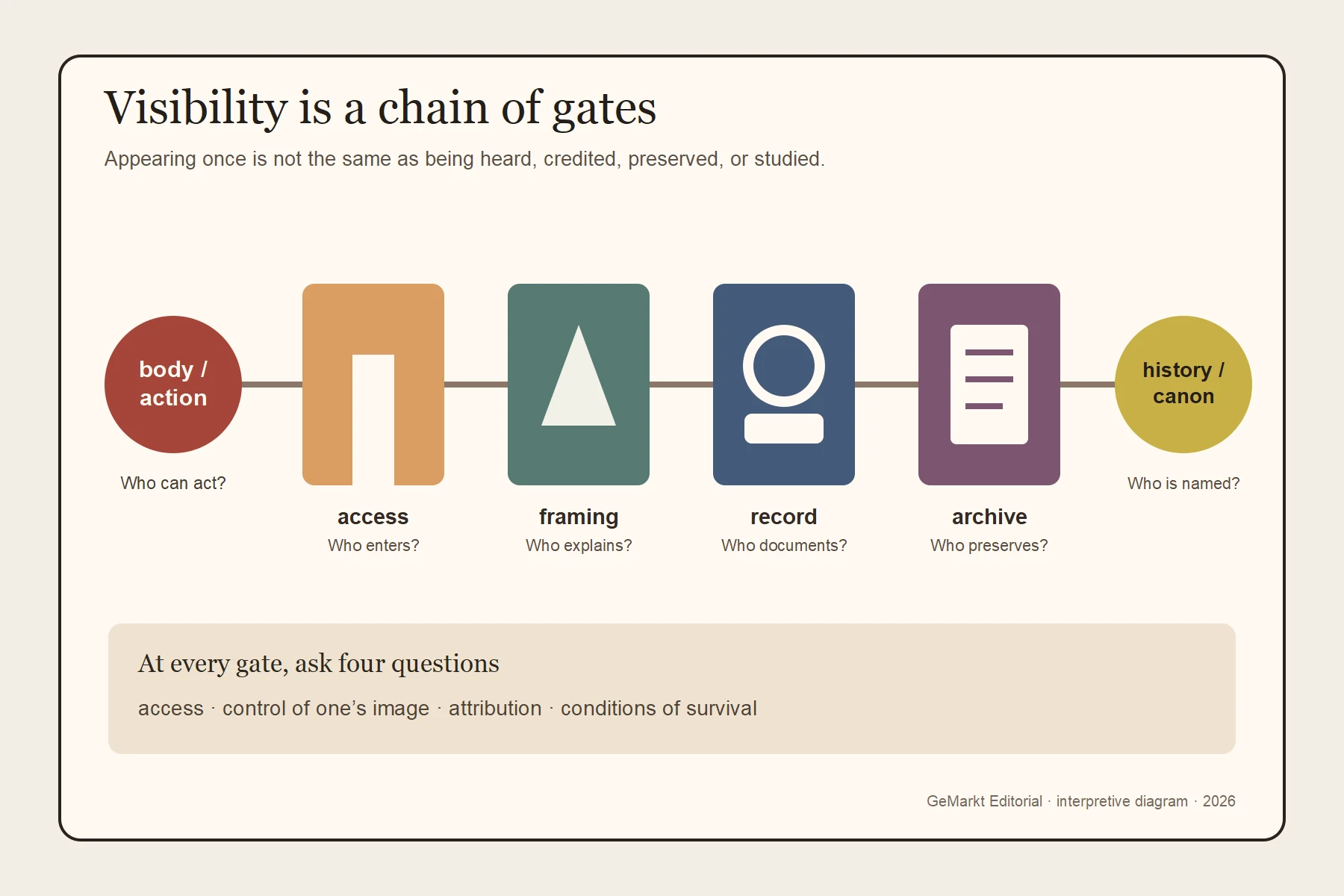
The diagram separates stages that survey narratives often collapse. A person may make work without access to a gallery. An action may enter a gallery but be framed through hostile language. A performance may be recorded yet credited only to a photographer or institution. A file may survive but remain uncatalogued. A rediscovery may place work in a canon without returning authority or resources to the communities from which it came.
These gates are not a one-way ladder. Artists can bypass institutions through streets, books, mail, video, community spaces, or independent galleries; institutions can preserve otherwise fragile evidence. Identify each gate and its controller rather than assigning “the institution” one permanent role.
The body is both medium and governed subject
Calling the body a medium describes only part of the situation. Law, policing, medicine, domestic expectation, work, architecture, clothing rules, racialisation, gender norms, migration, and media shape what an action can mean and cost. A gesture available to one performer may be dangerous or illegible for another.
Body-based practice can make this prior governance perceptible. It can refuse the idealised nude, substitute duration for a stable object, turn domestic labour into public form, or reveal how spectators participate in looking. But the body is not raw material outside history. Ask whose body acts, what histories viewers project onto it, who is allowed to withdraw, and whether documentation continues to circulate beyond the original encounter.
Cut Piece redistributes action and risk
Yoko Ono first performed Cut Piece in Kyoto in 1964 and later in Tokyo, New York, and London. In the work, she sat onstage while audience members were invited to approach and cut portions from her clothing. The simple instruction redistributed action: the artist established the conditions, but participants determined when to approach, where to cut, how much to remove, and when the collective sequence would stop.
MoMA’s account connects the work to gender, class, and cultural identity, while Ono’s recorded commentary stresses giving and the question of what others would take. Both matter. The work does not deliver a single allegory. It produces a visible relation among invitation, restraint, escalation, spectatorship, clothing, bodily vulnerability, and the social meanings attached to a Japanese woman sitting silently before an audience.
Participation does not dissolve asymmetry
An instruction may make spectators active without making everyone equal. Ono remained the body exposed to scissors and public looking. Each participant acted briefly, yet the group accumulated an effect that no individual fully controlled. Those who stayed seated also formed the event through watching, waiting, and setting a social atmosphere.
“Interactive” and “participatory” can sound democratic, but participation has designed conditions. Who issues the invitation, knows the rules, bears risk, can leave, or owns the images? Interpretation should trace how agency, knowledge, and consequence are distributed rather than praise participation in advance.
Consent is not a one-time switch
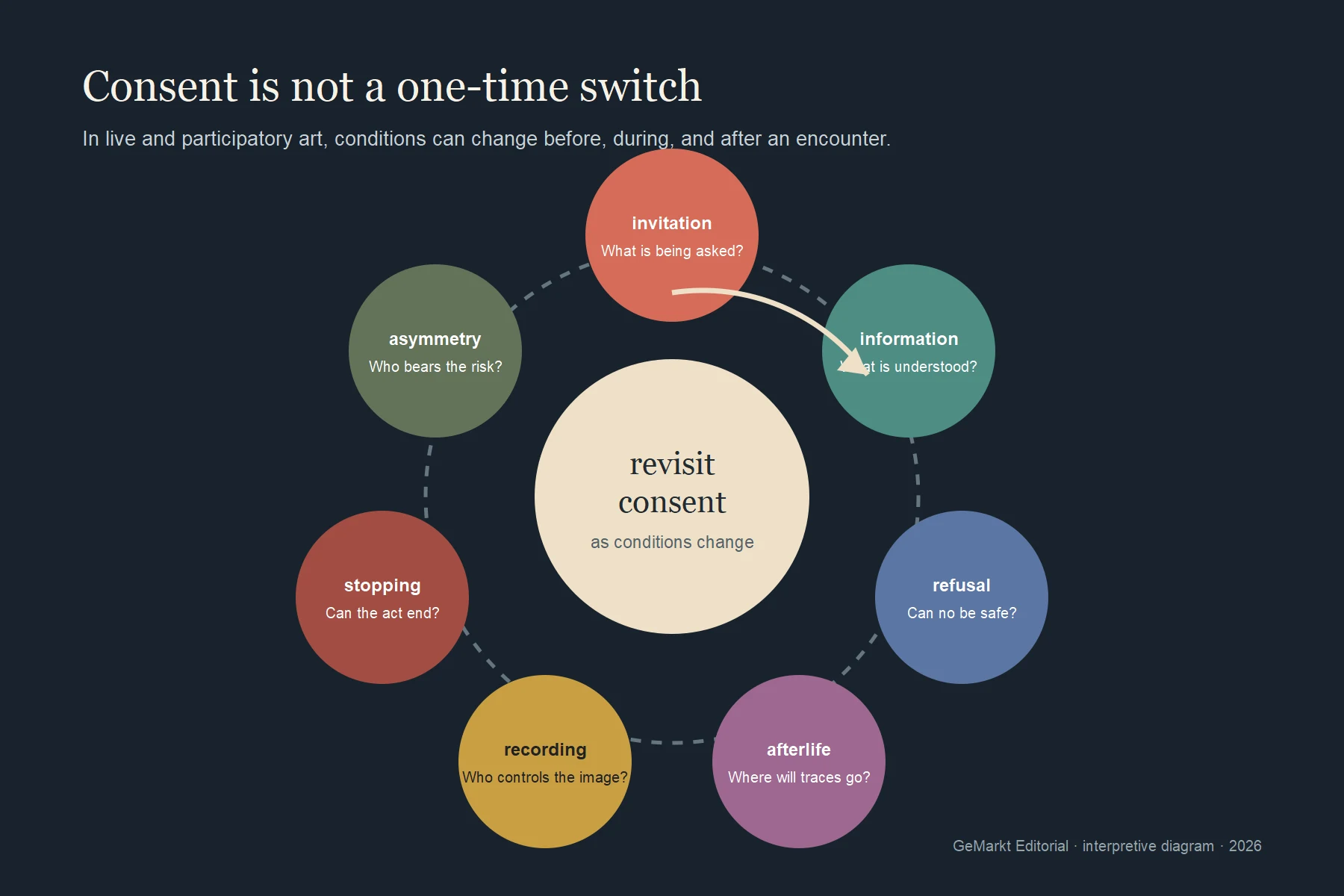
Consent in art is not solved by the presence of an invitation. Information may be incomplete; an audience can escalate; social pressure can make refusal difficult; recording can create an afterlife that participants did not anticipate. The ability to stop matters as much as the initial ability to begin.
This present-day tool is not a verdict on every historical work. Ask what participants understood, whether a performer could revise conditions, whether authority made “no” costly, and where images circulated. Uncertainty is better than romanticising bodily risk.
Womanhouse turned domestic space into public argument
In 1971, Judy Chicago and Miriam Schapiro led a feminist art programme at the California Institute of the Arts. The class transformed an abandoned Hollywood mansion into Womanhouse, opened in 1972. Rooms and performances addressed domesticity, menstruation, gendered work, sexuality, beauty, and the psychic pressure of prescribed roles. The house allowed experiences excluded from formalist teaching and mainstream exhibition to become material for collective study.
The building was not neutral. Cleaning, repairing, organising, decorating, rehearsing, and receiving visitors made domestic labour part of the infrastructure. Kitchen, bathroom, bedroom, nursery, storage, and thresholds became historically charged forms rather than background.
Pedagogy was part of the work
Womanhouse is often remembered through individual installations, but its educational process matters. An all-women class attempted to create conditions in which students could connect lived experience to artistic form, test collaborative methods, and challenge values embedded in a male-dominated art world. Authority did not disappear; teachers, students, schedules, skills, property, and publicity still structured the project. Yet the curriculum itself became an object of transformation.
A school can reproduce exclusion through assignments, critique rituals, canons, and definitions of professional seriousness. It can also build counter-publics and skills. Feminist pedagogy concerned not only who entered history but how artists named experience, evaluated work, shared labour, and addressed an audience.
The house also had boundaries
The Smithsonian American Art Museum describes Schapiro’s Dollhouse, made for Womanhouse, through the standards a white, middle-class woman of her generation was expected to meet as homemaker, mother, and heterosexual partner. That wording usefully limits the claim. Domestic ideology was powerful, but it did not organise every woman’s life in the same way.
Race, class, sexuality, disability, migration, paid domestic work, and housing insecurity change what “the home” means. A liberating account for women confined by suburban domestic ideals can marginalise women whose labour sustained other people’s homes or who were denied secure housing and familial recognition. The historical task is double: understand the project’s intervention in 1972 and examine the social boundary of the experience it made exemplary.
Institutional critique began before the museum collected it
Feminist intervention did not wait for museums to organise retrospective exhibitions. Artists formed cooperatives, published statistics and newsletters, protested selection policies, created independent spaces, challenged censorship, and demanded changes in staffing and acquisition. These actions treated museums as systems of governance rather than neutral buildings filled with masterpieces.
The shift matters because later collection can reverse the sequence. Once a protest photograph or performance document enters a museum, the institution may appear to have authored the critical history that originally confronted it. Keep chronology visible. Ask what artists and activists demanded at the time, what the museum refused or changed, which records survived, and how later exhibitions interpret the conflict.
Are Museums Relevant to Women? made governance visible
In 1971 the Brooklyn Museum hosted a public forum titled “Are Museums Relevant to Women?” Cochaired by artist and activist Faith Ringgold and writer Patricia Mainardi, it brought together twenty-nine speakers who addressed systemic failures to support women artists and visitors. The event made policy, representation, employment, education, and public accountability discussable within the institution being questioned.
A forum is not only speech. It has organisers, invitations, a room, a programme, an audience, minutes or recordings, publicity, and institutional permission or resistance. Each element affects who can speak and what survives. The title also turns relevance into a reciprocal test: instead of asking whether women can adapt to museums, it asks whether museums deserve their authority.
Mainstream feminism did not speak for everyone
“Women artists” can create political solidarity, but it can also hide differences in who is most visible within that category. The Brooklyn Museum describes the mainstream second-wave feminist movement considered by We Wanted a Revolution as primarily white and middle class. Black women artists worked at intersections of civil rights, Black Power, feminism, antiwar politics, labour, sexuality, and experimental art, often encountering sexism in Black political spaces and racism in feminist and art institutions.
This is not a request to add a few names to an otherwise complete narrative. If race changes access, policing, work, and bodily representation, it changes feminist practice itself. Analysis must move from a universal woman to situated relations among identities, institutions, movements, and media.
Black feminist practice changes the map
The research exhibition We Wanted a Revolution: Black Radical Women, 1965–85, organised by Catherine Morris and Rujeko Hockley, brought together conceptual, performance, film, video, photography, painting, sculpture, and printmaking. Its participants included Faith Ringgold, Lorraine O’Grady, Howardena Pindell, Senga Nengudi, Maren Hassinger, Betye Saar, Emma Amos, Dindga McCannon, and many others.
The exhibition refuses a choice between “political” and “experimental” art. Institution-building, abstraction, bodily action, moving image, collective work, and protest intersected. A movement history can ask how artists built spaces, audiences, and critical languages when recognition was distributed unequally.
Mlle Bourgeoise Noire enters without permission
In 1980 Lorraine O’Grady arrived at an opening at Just Above Midtown wearing a tiara, sash, and an evening gown and cape made from 180 pairs of white gloves. As the persona Mlle Bourgeoise Noire, she distributed chrysanthemums attached to a white whip, then transformed ceremonial elegance into an accusation directed at racial and gender exclusion and at caution within the Black art world. In 1981 she brought the persona to the New Museum.
The performance used beauty pageantry, middle-class respectability, service, femininity, plantation violence, and avant-garde disruption. O’Grady entered the social ritual of an opening and altered what its manners, guest list, and claims of quality could conceal.
Performance can make an institution show itself
O’Grady’s action depended on an institution without becoming its authorised programme. A gallery opening promised cultural openness while maintaining rules about who belonged, how criticism should sound, and which behaviour counted as professional. The persona made those rules visible by exceeding them. Audience reaction, discomfort, memory, photography, and later narration became part of the work’s historical field.
MoMA holds a portfolio of photographs printed later, not the 1980 event itself. It shows how an unauthorised intervention can become authorised heritage: the performance challenged institutional boundaries, while its present visibility depends partly on institutional preservation.
Free, White and 21 stages unequal credibility
Howardena Pindell’s 1980 video Free, White and 21 places testimony and rebuttal in a split performance. Pindell recounts racist experiences, then appears as a white woman using a pale stocking, blonde wig, and sunglasses to dismiss those accounts. The same artist embodies speaker and sceptic, but the roles do not carry equal social authority.
Video allows editing, costume, address to camera, repetition, and controlled circulation. Pindell does not have to wait for a hostile interlocutor to appear; she stages the logic by which lived evidence is trivialised. The work therefore concerns more than visibility. A person can be perfectly visible and still be treated as unreliable. Who is presumed objective, emotional, representative, exceptional, or disruptive shapes whose speech becomes knowledge.
Voice can be split, quoted, and contested
The camera often suggests direct access to a speaking subject, yet Free, White and 21 constructs voice deliberately. Costume marks a role; editing orders claims and responses; duration builds an argument; the monitor places the viewer before recurring disbelief. The work refuses the fantasy that testimony simply enters a neutral public sphere and is judged on equal terms.
Distinguish experience from the formal choices used to present it. Ask who speaks, to whom, in what persona, and through which medium. Pindell’s account need not statistically represent every Black woman; it intervenes in structures that made such accounts repeatedly necessary and discountable.
The political body was not one regional language
Feminist art in the United States cannot serve as the universal template against which work elsewhere appears early, late, or incomplete. The Hammer Museum’s Radical Women research, led by Cecilia Fajardo-Hill and Andrea Giunta with Marcela Guerrero, centred the “political body” across Latin America and Latina and Chicana practices in the United States. Its archive relates bodies to dictatorship, exile, censorship, imprisonment, sexuality, labour, landscape, and experimental media.
The category “feminist” travelled unevenly. Some artists used it; others rejected or rarely encountered it while challenging the regulation of bodies and gender. Begin from local terms, political conditions, and networks. A shared concern does not require one label or one-directional influence.
Ana Mendieta joined body, earth, absence, and exile
Ana Mendieta, born in Havana and sent to the United States in 1961, developed what she called earth-body works. In the Silueta series, made from 1973 to 1980, bodily outlines and traces appeared in soil, sand, vegetation, fire, blood, and other materials. Photographs and films carried these temporary formations beyond their sites and durations.
The work intersects performance, land art, photography, ritual reference, feminism, displacement, and return. Sometimes the body appears through absence: an outline remains after the performer has left. Exile is not illustrated; relations among body, place, memory, and loss become materially unstable.
A silhouette is not a universal woman
Mendieta’s recurring bodily outline can invite viewers to read “woman” as timeless or universal. That reading risks removing Cuban exile, specific landscapes, Indigenous and Afro-Cuban references, Catholic histories, United States art institutions, and the artist’s deliberate use of documentation. The form’s apparent simplicity does not cancel those contexts.
Nor should every material be converted into a vague spirituality. Identify where a work was made, what the museum record can establish, which titles were assigned by the artist or estate, and what claims come from later critics. The Brooklyn Museum connects the Silueta and Esculturas Rupestres series to feminism, environmentalism, and exile; the Hammer’s archive stresses cultural displacement and transformation. These are interpretive anchors, not permission to universalise every body-shaped trace.
Letícia Parente marks manufacture on skin
In Marca registrada (Trademark), made in 1975, Letícia Parente sits before a video camera and uses needle and black thread to sew the words “Made in Brasil” into the sole of her foot. A conventionally domestic technique, a commodity label, the body, and a recording apparatus converge. The phrase identifies origin but also turns the person into a marked product.
Parente was a chemist, teacher, printmaker, and pioneer of Brazilian video art. Named researcher Mariana von Hartenthal situates the video among Parente’s early works on body, subjectivity, and the female condition in a sexist culture. The act’s slow, controlled procedure resists a simple division between victim and agent: the artist performs the marking, while the phrase invokes systems that classify bodies and goods from outside.
Video makes the private gesture reproducible
Sewing is associated with domestic maintenance, but a close video reframes it as public evidence. The camera concentrates attention on the foot, hand, needle, thread, and emerging letters. Duration makes each puncture and pull perceptible. Reproduction allows the action to travel through exhibitions without requiring the artist to repeat the bodily procedure for every audience.
Analogue video depends on recording equipment, tape formats, playback hardware, copying, conservation, migration, and institutional access. Its immediacy relies on technical labour and preservation. Ask whether video is the work, a record, or both according to the artist and collection.
Dictatorship changes how a body is read
Brazil was governed by a civil-military dictatorship from 1964 to 1985. The Hammer’s Radical Women research connects work across the region to authoritarian control, censorship, torture, exile, and the regulation of behaviour and bodies. That context makes bodily marking, measurement, concealment, and mediated address politically charged without turning every gesture into a coded message with one decipherable meaning.
For Marca registrada, the national label, vulnerable foot, needle, and camera can support readings involving commodity, nation, gendered labour, coercion, and self-inscription. Responsible interpretation should separate documented context from inference. Parente’s work does not provide a complete image of Brazilian dictatorship, and a national history does not automatically determine every formal decision. Context narrows and strengthens questions; it should not replace looking.
The queer public is made, not simply revealed
Queer visibility is often narrated as a move from private secrecy to public openness. The history is less linear. Bars, streets, parks, dances, publications, theatres, film screenings, community centres, and demonstrations became spaces where people could recognise one another and make claims. These spaces were vulnerable to policing, censorship, violence, economic exclusion, and hostile media.
The National Park Service describes Stonewall in June 1969 as a milestone that gave momentum to organising, not the beginning of queer life or resistance. Movements disagreed about assimilation, coalition, gender, race, and tactics. Public appearance empowered and exposed because identification had legal and social consequences.
The 1976 demonstration occupies an ordinary street
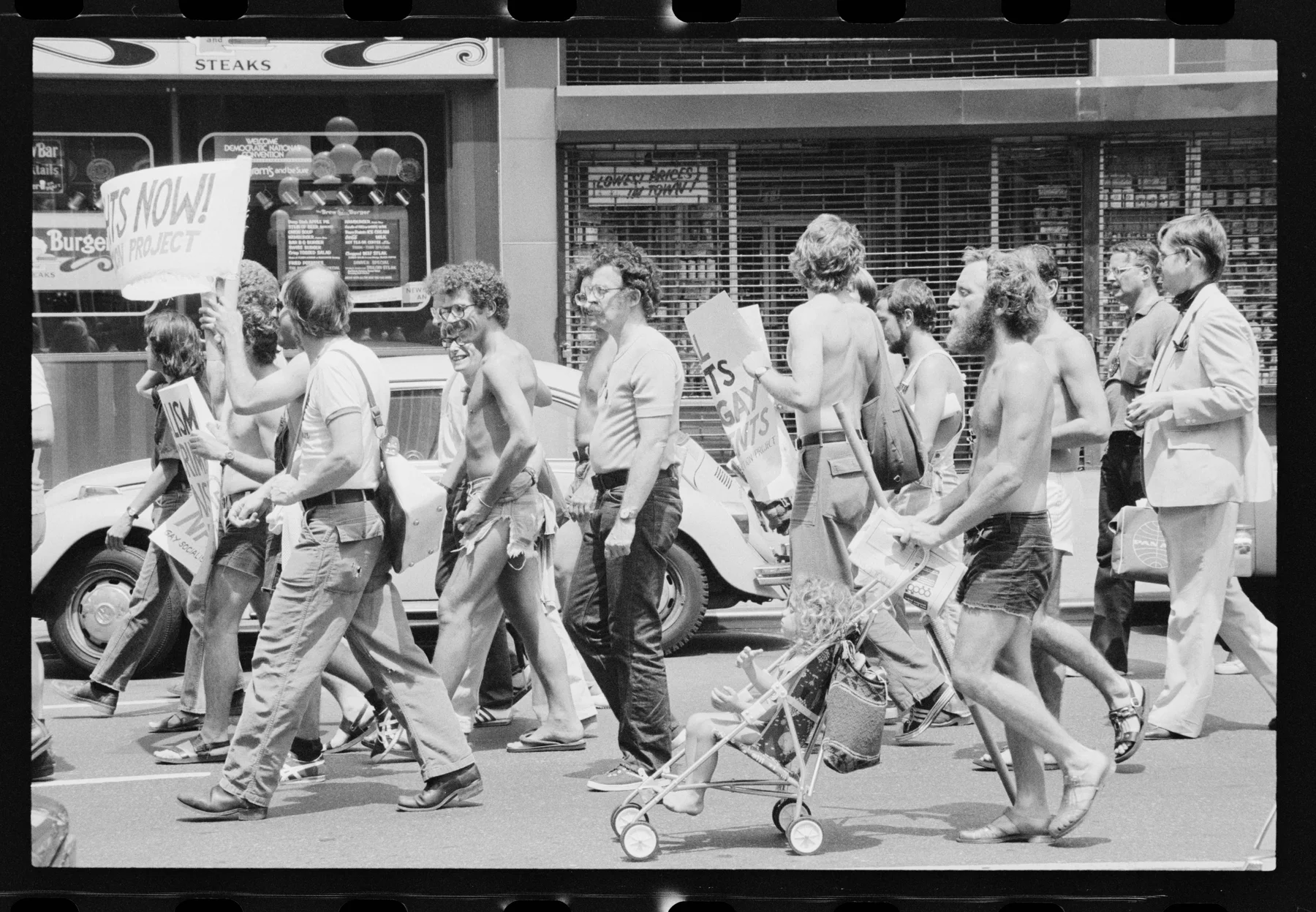
Leffler’s photograph places demonstrators among restaurants, parked vehicles, commercial signs, pedestrians, and a child’s pushchair. No monument separates political action from everyday circulation. Bodies occupy the street as a moving public addressing nearby people, news readers, and political institutions.
The current Library catalogue dates the negative 11 July 1976 and identifies the context as a demonstration at the Democratic National Convention in New York. Using that record avoids treating an unattributed repost as equivalent evidence. Date, creator, repository, and reproduction number support a defensible caption; they do not identify every participant.
One photograph of a rights demonstration is not the whole movement
The photograph’s historic catalogue language says “gay rights.” Today, LGBTQ or queer may describe a wider field, but applying current terms to every person in a 1976 crowd can overwrite self-identification. Conversely, repeating an old catalogue category without explanation may reproduce its exclusions. Historical language should be quoted or contextualised rather than treated as timeless.
The image survives because a mainstream news photographer made it, but it is not more representative than community photographs, flyers, oral histories, films, or ephemera. The Library’s LGBTQ source set combines record types; this photograph is one trace in a larger map.
Asco made images for films that did not exist
In East Los Angeles, the collective Asco—associated especially with Harry Gamboa Jr., Gronk, Willie Herrón III, and Patssi Valdez—worked through performance, photography, conceptual strategies, fashion, mural critique, and media intervention. Its “No Movies” were staged photographs presented as stills from Chicano films that did not exist. The absence was the point: Hollywood offered few and often negative representations while treating Chicano participation as peripheral.
LACMA’s research describes No Movies as “cinema by other means.” Elaborate costuming, pose, makeup, location, title, and circulation produced evidence for an imaginary film industry. The photographs did not merely ask Hollywood to include different faces. They seized production of glamour, genre, and publicity while exposing the industrial structure missing behind the still.
Public image can be seized and recirculated
The Smithsonian’s account of Asco’s À la Mode notes that the group circulated the staged image to news outlets, where it appeared as evidence of a real film. This intervention used media credibility as artistic material. If a photographic still and caption can make an absent movie seem present, public representation depends on distribution systems as much as on what the camera depicts.
Patssi Valdez’s styled body is neither an anonymous symbol nor simply a documentary subject. Pose, costume, and collaboration construct a star image on terms unavailable in dominant cinema. At the same time, copyright, authorship, and later collection remain important: performance, photographic exposure, styling, negative, print, caption, and circulation can involve different forms of labour and control.
Appearance, speech, and survival are different achievements
Across these cases, “visibility” breaks into distinct achievements. Ono appears and sets an instruction but accepts unequal exposure. Womanhouse creates a public and a pedagogy while revealing the limits of its social frame. O’Grady enters institutions to speak in a persona that refuses polite containment. Pindell shows that speaking does not guarantee credibility. Mendieta and Parente use documentation to extend temporary or bodily actions. Asco manufactures images for an absent representational system.
None supplies a universal recipe. Each makes a relation analysable: body and audience, home and school, persona and institution, testimony and disbelief, nation and skin, community and media, event and archive.
What survives a body-based event?
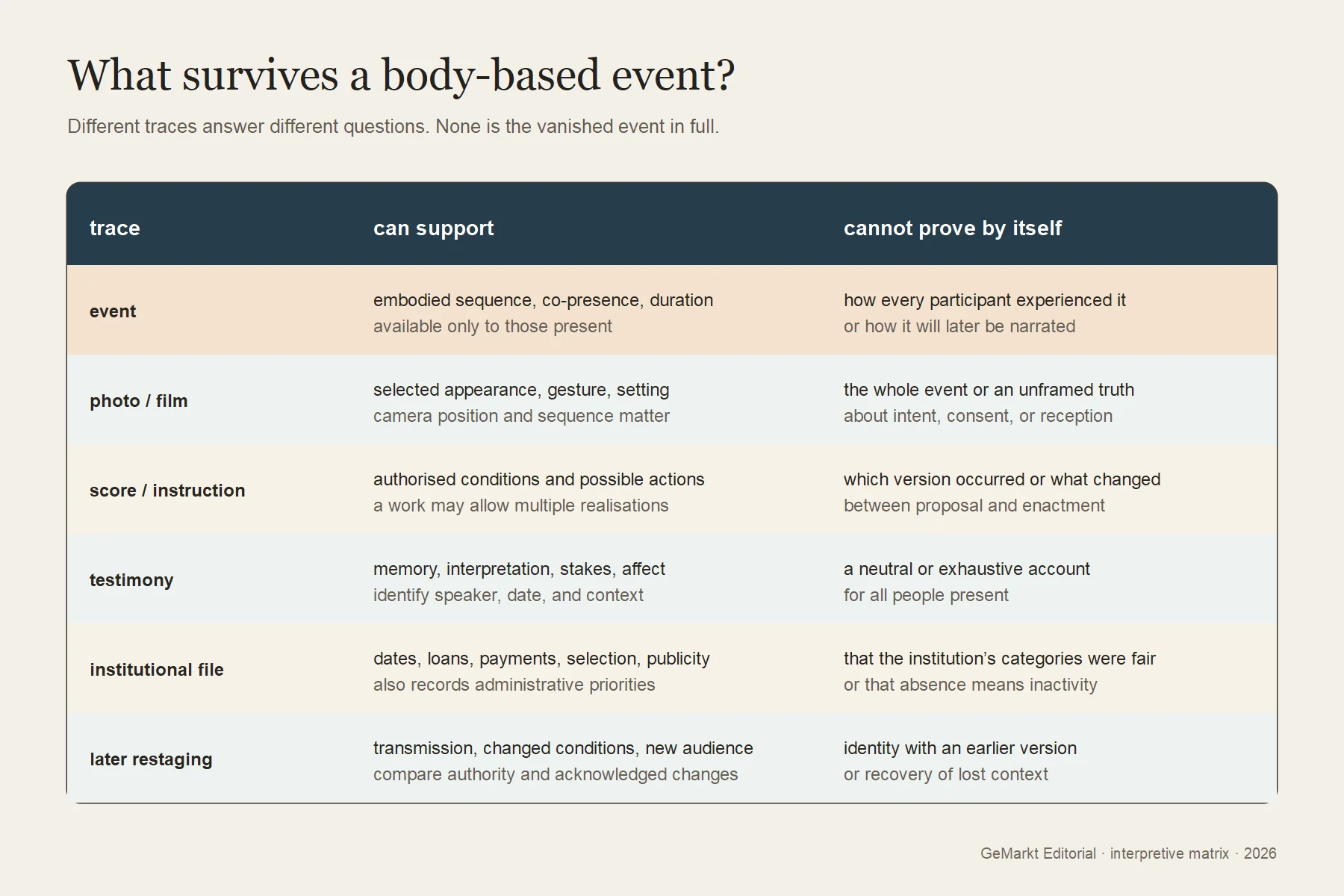
An event offers co-presence and duration but only to those present. A photograph selects appearance. A film orders viewpoints and time. A score supports possible actions, not proof that one version occurred. Testimony gives memory and interpretation from a situated speaker. An institutional file may establish dates, payments, selection, or publicity while preserving the institution’s categories. A later restaging demonstrates transmission under changed conditions.
“What is the work?” may have several authorised answers. Consult the artist, estate, collection record, and performance history; never decide from format alone that a photograph is merely documentation or an autonomous work.
Documentation is evidence with a point of view
Documentation is sometimes criticised as a betrayal of live presence and sometimes treated as transparent access to a lost event. Both positions are too simple. Cameras can be planned into a work, invited after the fact, operated by participants, or imposed by media. A photograph can be a record, a publicity image, a later artwork, or several of these at once.
Analyse the document formally. Where is the camera? What falls outside the frame? Who chose the still? What does the caption claim? Does the image favour performer, action, object, or room? Then trace circulation through press, artist archive, museum, catalogue, social media, and teaching.
Restaging changes the conditions
Instruction-based and performance works may be repeated, reperformed, screened, or reconstructed. A later version can extend access and test what a work permits. It can also change performers, audience expectations, safety standards, recording technology, institutional authority, and the political meanings of a body. Identity between versions should never be assumed.
For each restaging, ask who authorised it and what remains stable: wording, gesture, duration, material, site, performer, or intended relation. A museum version cannot recreate an earlier intervention’s precarity, but it can reveal how the questions operate in a new present.
A comparison matrix
| Case | Primary arena | Agency redistributed through | Unequal condition to track | Main surviving trace |
|---|---|---|---|---|
| Yoko Ono, Cut Piece | stage and audience | instruction and participant action | bodily exposure and ability to stop | photographs, film, scores, testimony |
| Womanhouse | school, house, exhibition | collective pedagogy and installation | whose domestic experience becomes exemplary | works, photographs, film, catalogues, recollection |
| Lorraine O’Grady, Mlle Bourgeoise Noire | gallery opening | unauthorised persona and address | race, gender, respectability, institutional access | performance photographs and artist testimony |
| Howardena Pindell, Free, White and 21 | recorded address | self-performance, costume, editing | unequal credibility assigned to speakers | single-channel video |
| Ana Mendieta, Silueta | body, landscape, camera | temporary action and material trace | exile, place, later universalisation | photographs, films, estate and collection records |
| Letícia Parente, Marca registrada | body, domestic technique, video | self-inscription and reproducible duration | gendered labour, nation, dictatorship | single-channel video |
| Asco, No Movies | street, camera, mass media | staged star image and strategic circulation | Chicano exclusion and control of public image | photographs, publications, oral and institutional archives |
Common survey traps
- One universal “female body”: bodies are historically differentiated by race, class, sexuality, disability, nation, age, migration, and the institutions that interpret them.
- Visibility equals liberation: appearance can bring recognition, surveillance, appropriation, ridicule, or danger. Track control and consequence.
- Participation equals equality: an active audience may still transfer risk toward a performer or conceal who designed the rules.
- The United States supplies the timeline: compare local concepts, dictatorships, exile, media access, and movement histories before declaring work early or late.
- Documentation equals the event: every trace selects. Establish its maker, status, date, and circulation.
- Later museum recognition repairs earlier exclusion: acquisition preserves work but does not erase the conditions that made intervention necessary.
- Current identity language maps neatly onto the past: use self-description and historically specific terms where available; explain archival language.
Questions for close looking
- What can the body do in this work, and what is done to, around, or through it?
- Who designed the conditions, and who can revise or stop them?
- What does clothing, costume, nudity, pose, gesture, voice, or silence organise?
- Which setting matters—street, home, school, gallery, landscape, studio, or monitor?
- Is the audience witness, participant, target, collaborator, risk, or later viewer?
- What evidence survives, who made it, and what does it exclude?
- Which identity terms come from the artist or historical record, and which come from later interpretation?
- What institutional gate does the work enter, bypass, expose, or construct?
- Who receives authorship and credit across performance, photography, editing, costume, and preservation?
- What would change if the same action occurred with a different body, site, law, audience, or camera?
Terms for visibility, embodiment, and archive
- Body-based practice: work in which bodily presence, action, sensation, trace, or representation is structurally important; broader than a single movement.
- Counter-public: a social space and audience formed partly in response to exclusion from dominant public institutions.
- Embodiment: the condition of experiencing and acting through a socially situated body, not merely depicting a body.
- Institutional critique: practices that analyse or intervene in museums, galleries, schools, markets, and their systems of value and access.
- Persona: a constructed role through which an artist can speak, perform, exaggerate, or redirect social codes.
- Political body: a body understood through relations of power, law, labour, identity, violence, territory, and collective action.
- Restaging: a later authorised or contested realisation of an earlier performance, action, or instruction under changed conditions.
- Situated evidence: a source whose viewpoint, production, preservation, and limits are made explicit.
A working timeline, 1964–1985
- 1964: Yoko Ono first performs Cut Piece in Kyoto.
- 1965: Ono performs Cut Piece at Carnegie Recital Hall in New York; the later photographic and film record becomes central to its study.
- 1969: the Stonewall uprising gives momentum to gay and lesbian civil-rights organising while building on earlier activism.
- 1970: the first Christopher Street Liberation Day march takes place; Leffler photographs the Washington women’s liberation march.
- 1971: “Are Museums Relevant to Women?” convenes at the Brooklyn Museum; the Feminist Art Program begins work that becomes Womanhouse.
- 1972: Womanhouse opens; Asco develops early performances in East Los Angeles.
- 1973–80: Ana Mendieta makes the Silueta series.
- 1975: Letícia Parente makes Marca registrada; Asco’s No Movies circulate staged Chicano star images.
- 1976: Leffler photographs a gay-rights demonstration during the Democratic National Convention in New York.
- 1980: Lorraine O’Grady debuts Mlle Bourgeoise Noire; Howardena Pindell makes Free, White and 21.
- 1985: the bounded chapter closes, not the histories. AIDS activism, queer art, intersectional feminist theory, and global body-based practices require subsequent routes.
Source guide
The Library of Congress women’s liberation march and 1976 gay-rights demonstration records establish creator, date, title, reproduction number, and rights advisory. Its LGBTQ primary-source set broadens the record map; the National Park Service’s Stonewall history distinguishes a galvanising event from an absolute beginning.
MoMA’s Ono overview and Cut Piece audio include artist testimony and image credit. The Smithsonian’s Dollhouse record identifies Womanhouse’s teaching context and bounded domestic standard. The Brooklyn Museum’s Feminist Art history records the 1971 forum.
The Brooklyn Museum’s We Wanted a Revolution supplies the Black feminist frame. MoMA’s Mlle Bourgeoise Noire record and artist audio distinguish event, portfolio, context, and O’Grady’s voice. The National Gallery record for Free, White and 21 establishes medium, duration, date, and provenance.
The Hammer Museum’s Radical Women archive provides named, regionally researched accounts: Cecilia Fajardo-Hill and Andrea Giunta’s introduction, January Parkos Arnall’s Ana Mendieta biography, and Mariana von Hartenthal’s Letícia Parente and Patssi Valdez entries. The Brooklyn Museum’s Mendieta object record, Hammer’s Marca registrada record, LACMA’s Asco exhibition research, and the Smithsonian’s À la Mode account anchor object-level claims.
Continue the Atlas route
This chapter follows Pop, Minimal, Conceptual, and Performance art, where instructions, participation, and documentation first became central. Here those formal questions meet gendered, racialised, sexual, national, and institutional power.
The next Atlas chapter turns from who can appear and speak to who owns, houses, names, and returns cultural objects: Decolonisation, museums, provenance, and restitution. Carry forward the same method. Separate an event from its record, a collection from a just title, institutional recognition from repair, and visibility from authority.
Editorial record
About this article
- Author
- Publisher
- GeMarkt
- Published
- Updated
- Reviewed
- Internal source & rights check. Conducted by GeMarkt Research Review. This is an internal editorial check—not independent peer review.
- Source standard
- Art history source standardPrioritises object records and research sources, distinguishes evidence from interpretation, and states material uncertainty.
Found a claim that needs checking? Report a factual error.