Art History · Learning chapter
Atlas V — Modernisms and contemporary practices · 5 of 10
Asian modernisms: empire, nation, ink, print, design, and competing modernities
Five visual studies compare how artists across several Asian networks remade ink, painting, print, design, schools, and national culture under empire.


What we’ll look at
How did Asian artists create different modernisms instead of following one path toward Westernisation?
Two pale figures meet inside a dark architectural chamber. One stands on a landing; another waits below an arch. Stairs, walls, rails, and lit planes do not settle into a single, measurable box. Gaganendranath Tagore’s Meeting at the Staircase, made in Kolkata around 1920–1925, turns an interior into a structure of concealment, passage, and uncertain contact.
The picture is a productive entrance to Asian modernisms because no one label contains it. Watercolour carries traces of wash painting and theatrical design. Angular construction invites comparison with Cubism, yet the work is not evidence that a European style simply arrived in India. Its modernity belongs to a particular artist, household, city, exhibition culture, and colonial history. The same caution is needed in Tokyo, Seoul, Shanghai, Guangzhou, Hanoi, and Batavia: comparison can reveal connected problems only if it preserves different conditions.
“Asian modernisms” is a comparative frame, not a continental style
Asia is not one art-historical unit. The word crosses empires, colonies, nation-states, languages, religions, Indigenous and diasporic communities, unequal economies, and visual traditions with different institutions and chronologies. A chapter cannot survey all of them. It can compare selected routes while refusing to treat those routes as a continental essence.
John Clark’s The Asian Modern proposes close, artist-led comparisons across places rather than a genealogy in which invention descends from a Euro-American centre. Patrick D. Flores sharpens that method through “affiliations of place”: artists belong to sites, relations, obligations, and movements as well as stylistic lineages. A later scholarly roundtable also tests the limits of Clark’s enormous category. That disagreement matters. “Asian modernisms” should remain a question about situated connections, not become a new master story replacing the old one.
Scope: five visual studies and five deliberate non-reproductions
Five rights-reviewed visuals anchor this route: Gaganendranath Tagore’s Meeting at the Staircase; Abanindranath Tagore’s Bharat Mata; Na Hye-sok’s Self-Portrait; Takehisa Yumeji’s Firework cover for Fujin Graph; and a GeMarkt diagram comparing institutional routes. The diagram interprets cited research. It is not an archival map and does not claim that every connection was equally direct.
Five central examples or groups are discussed without reproduction: Nandalal Bose’s work at Santiniketan; the third issue of Mavo; Li Hua’s Roar, China!; Nguyễn Gia Trí’s lacquer painting Landscape of Vietnam; and paintings by S. Sudjojono and Emiria Sunassa. Their institutional records support analysis, but an online image does not by itself establish permission for commercial republication across jurisdictions. Deliberate absence is not an art-historical judgement. It keeps the evidentiary record separate from the image-rights record.
Empire changed institutions but did not dictate every outcome
Colonial states and modernising governments reorganised education, exhibition, taxation, transport, publishing, museums, and the status of objects called “art” or “craft.” The Government School of Art in Calcutta, Tokyo art schools, the colonial Chosŏn Art Exhibition in Korea, and the École des Beaux-Arts de l’Indochine in Hanoi each distributed opportunity and authority unevenly. Their categories could privilege oil over workshop practice, salon painting over popular print, or a colonial administrator’s idea of local tradition over living expertise.
Yet an institution did not mechanically produce one kind of art. Students, teachers, publishers, craftspeople, patrons, and activists redirected its resources. They learned techniques, challenged juries, formed associations, wrote manifestos, moved between cities, and created media that exceeded the academy. Empire shaped the field; it did not write every move made inside it.
Meeting at the Staircase makes space unstable
Gaganendranath’s watercolour is nearly monochrome. A warm, illuminated zone opens within brown-black walls while steps rise from the lower edge. The two standing figures are simplified, almost silhouette-like, but their difference from the dark enclosure gives them a charged visibility. Small geometric marks and rails interrupt the curved arch. Architecture appears solid and psychologically uncertain at once.
The work rewards comparison with Cubist and Futurist experiments in fractured space, yet likeness is only a starting observation. Partha Mitter places Indian modernism within colonial difference and international avant-garde encounters rather than a belated timetable. Gaganendranath had worked in satire, book illustration, theatre, and painting. His spatial experiments therefore emerged from a field larger than imported canvas style: caricature, domestic performance, Japanese contact, modern printing, and the social world of the Tagore family also mattered.
Gaganendranath Tagore exceeds the revivalist-versus-European binary
Indian art around 1900 is often divided too neatly. One side becomes academic realism copied from Europe; the other becomes a spiritual “Indian” revival recovered by the Bengal School. Gaganendranath disrupts that opposition. His practice moved among wash, caricature, stage design, architecture, and angular pictorial construction. The same artist could participate in cultural reform without treating the past as a fixed style.
Tapati Guha-Thakurta’s history of new “Indian” art shows that institutions, exhibitions, criticism, and nationalism made the category; it did not wait intact to be rediscovered. Meeting at the Staircase is modern not because its geometry can be assigned to a European label, nor because watercolour proves cultural authenticity. It is modern because inherited and circulating forms were reorganised within a changing artistic public.
A staircase is also a social structure
The two figures do not meet on level ground. One occupies the illuminated landing; the other approaches from below. Their bodies are small relative to the architecture, and shadow interrupts any clear narrative. The setting can be read as domestic or theatrical, but the image does not identify the people or resolve their relation. A careful interpretation stays with that uncertainty.
Stairs organise access. They separate rooms, levels, servants, residents, guests, and observers; in theatre they choreograph entrance and delay. Gaganendranath makes that ordinary device control the entire picture. Formal analysis therefore need not choose between geometry and society. Direction, threshold, light, and scale are the means through which a social encounter becomes imaginable without being fully explained.
Bharat Mata turns wash into national allegory
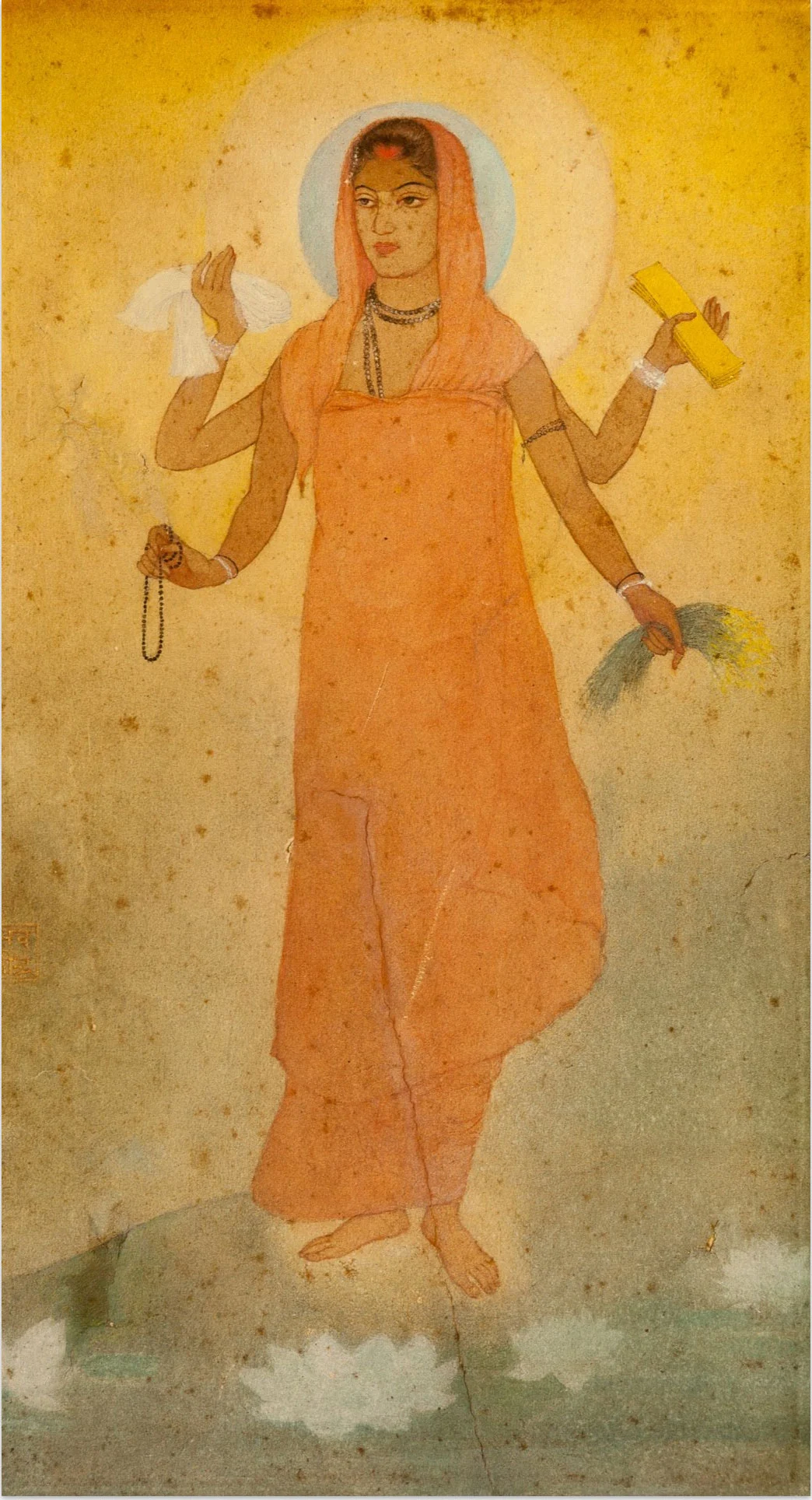

A barefoot woman stands frontally against a pale gold field. Four arms hold cloth, a book, prayer beads, and green stalks. A halo, saffron robe, and the multiplication of limbs draw on devotional conventions without presenting a simple copy of an established deity. Abanindranath first called the figure Banga Mata, Mother Bengal; it became known as Bharat Mata, Mother India, as its political audience expanded.
The small work was made during the 1905 partition of Bengal and the swadeshi movement’s campaigns for local production and anticolonial self-reliance. Its delicacy matters. The nation is not personified through military monumentality but through ascetic discipline, learning, cloth, sustenance, and spiritual authority. Watercolour and wash turn those values into an intimate portable image.
Swadeshi made medium and circulation political
Swadeshi joined boycott, production, education, dress, literature, and visual culture. To ask whether a painting looked “Indian” was therefore also to ask who made materials, who taught art, what entered exhibitions, and which goods circulated through colonial markets. The Bengal School’s rejection of academic oil naturalism did not mean isolation. Abanindranath drew on Mughal and Pahari painting, Ajanta, British Arts and Crafts thought, Japanese wash practice, and conversations with figures including Okakura Kakuzō and Yokoyama Taikan.
The Metropolitan Museum’s account of Abanindranath’s The Poet explicitly describes tempera and Japanese wash techniques working together. The mixture does not weaken an anticolonial claim; it shows that anticolonial culture could be international and selective. “Indigenous” and “foreign” were arguments assembled through use, not chemically pure substances inside pigment.
A mother-nation includes and excludes
Bharat Mata could give anticolonial politics a memorable, affective body. It could also make a Hindu-coded woman stand for a population divided by religion, caste, language, gender, and region. The 1905 partition had specific effects in Bengal, yet the later title asks the figure to represent a much larger territory. A successful symbol can conceal the negotiations it appears to settle.
Gender is central to the image’s power. The allegorical woman embodies sacrifice, purity, nurture, and land, while actual political speech and institutional leadership remained unequally available to women. That contradiction does not cancel the painting’s historical force. It changes the question from “Is the image nationalist?” to “How does it visualise the nation, who can recognise themselves in that body, and whose difference becomes difficult to see?”
Santiniketan made pedagogy into an artistic method
Rabindranath Tagore founded Kala Bhavana at Santiniketan in 1919. Visva-Bharati’s institutional history describes Nandalal Bose’s later stewardship as central to a programme linking visual practice, education, nature, craft, mural, print, and the social role of art. Classes, workshops, seasonal festivals, publications, collections, and built environments became parts of artistic formation.
This history is sometimes compressed into a “Bengal School” style, but pedagogy was more varied. Nandalal Bose, Benode Behari Mukherjee, Ramkinkar Baij, and later students developed different formal and political positions. Sonal Khullar’s idea of worldly affiliation helps explain the school’s reach: modern Indian art was made through relations among persons, places, institutions, pasts, and international routes, not through a sealed national essence.
Pan-Asian exchange was neither pure solidarity nor simple influence
Indian and Japanese intellectuals used the idea of Asia to challenge European claims to universal cultural leadership. Artists and teachers travelled; techniques and reproductions crossed the Bay of Bengal; Okakura’s writing and Japanese wash practice entered debates in Kolkata. These encounters created alternatives to a Europe-only map.
But “Asia” was never politically innocent. Japan was itself an imperial power. Pan-Asian rhetoric could support reciprocal learning, cultural hierarchy, or imperial ambition depending on speaker and moment. The National Museum of Asian Art’s Imagined Neighbors project similarly warns against describing modern Japan as exclusively Western-inspired: Japanese artists had long constructed China as both real neighbour and imagined cultural source. Inter-Asian exchange must be studied as a changing relationship, not celebrated as automatic solidarity.
Na Hye-sok paints the modern artist as a woman
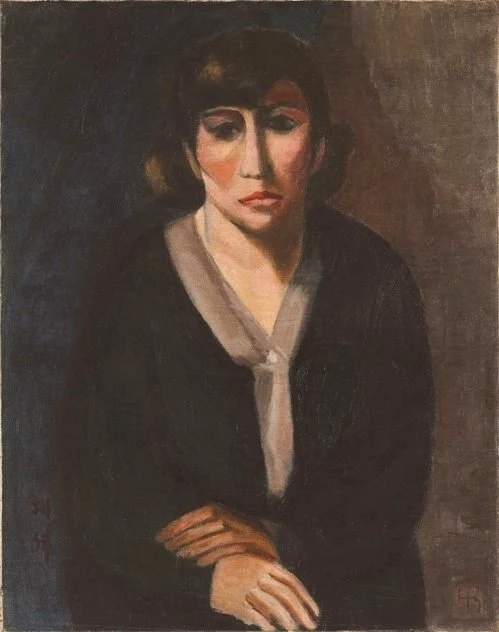

Na Hye-sok is shown against a dark, compressed background. Short hair frames a face modelled with green-grey, rose, and brown; her lowered gaze avoids the social ease of a salon portrait. One hand crosses the other near the bottom edge. Clothing and shadow make the body a heavy triangular presence rather than decorative evidence of cosmopolitan fashion.
The MMCA and LACMA exhibition The Space Between places the work within Korean modern art from 1897 to 1965, a period marked by forced opening, Japanese colonial rule, war, division, and reconstruction. LACMA identifies Na as the first Korean woman to study Western-style oil painting and records her 1921 solo exhibition in Seoul. The portrait is not simply “Western technique in Korea.” It is a claim to the public identity of artist under colonial and patriarchal constraint.
Tokyo and Paris were routes through colonial modernity
Na studied oil painting at the Women’s School of Art in Tokyo from 1913. She later travelled through Europe and the United States and worked in Paris. Those journeys provided training and visibility, but the map was unequal. Korea had been annexed by Japan in 1910; Tokyo was at once an educational centre and imperial capital. Paris carried claims of artistic universality while colonial subjects encountered racial and gender hierarchy there.
To call travel “influence” hides these conditions. Training changed Na’s palette and handling; institutions also decided who could study, exhibit, travel, and be remembered. Her route Seoul–Tokyo–Paris–Seoul was not a ladder away from Korean culture. It was a difficult circuit through which a Korean woman artist constructed professional authority while moving inside systems she did not control.
Self-portraiture cannot be separated from public speech
Na was also a writer, illustrator, and advocate for women’s autonomy. She participated in the magazine New Woman and publicly addressed marriage, divorce, work, and gendered double standards. Her later social exclusion should not be used to turn every dark tone into biography, but neither should the painting be isolated from her public authorship.
Virginia Moon’s LACMA essay notes how women became unexpectedly prominent within The Space Between exhibition while warning that their history remains incomplete. The self-portrait helps correct a survey structure in which the “New Woman” appears only as a fashionable subject painted by men. Here, the modern woman controls the painted encounter and claims the profession that produces it.
Yumeji makes a magazine cover into a modern encounter
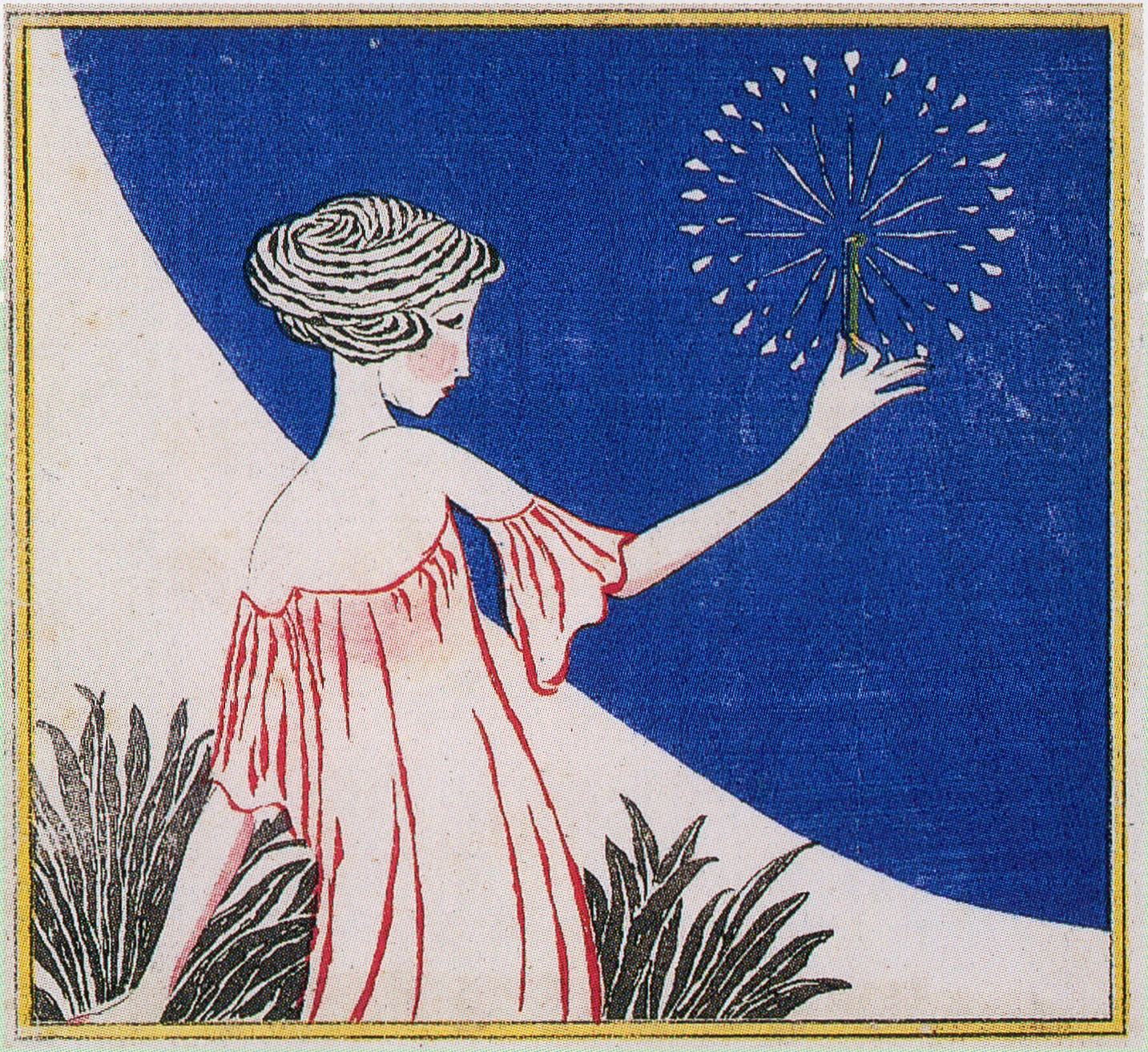

Deep blue fills most of the page. A woman turns away from us and raises one hand toward a white burst of fireworks. Her pale pink dress and coiled, striped hair create curved rhythms against the flat night, while plants and a thin gold frame keep the image close to decorative design. Takehisa Yumeji made the cover for the August 1924 issue of the women’s magazine Fujin Graph.
The viewer sees spectacle through a figure who is herself designed for circulation. The cover associates modern leisure, fashion, mass print, and a stylised “Yumeji beauty.” The woman’s turned head and extended arm produce agency within the scene, but the magazine also makes femininity an image through which modern consumer life is sold. Graphic elegance and gendered address work together.
Design crossed the border between art and daily life
A magazine can be handled, bought, lent, torn, posted, censored, and discarded. Its typography directs reading while its cover competes in the city. Fujin Graph turned an artist’s image into a serial threshold: the cover promised a modern world before a reader opened the issue. The National Diet Library records Yumeji’s covers and illustrations as central to the “Yumeji-style beauty” that reached a mass audience.
Yumeji worked across painting, print, book design, sheet music, advertising, textiles, and products. That movement does not make design a lesser application of “fine” art. It shows how modern style acquired buyers and habits. The same city also supported radical alternatives: Mavo no. 3, issued one month after Firework, used rotated type, collage, string, and attached matter to make a magazine behave like an event. Its US rights are clear, but the underlying collage’s present Japanese rights are not sufficiently established for reproduction here.
The avant-garde also lived inside empire
Mavo formed in Tokyo in 1923 around Murayama Tomoyoshi and other artists who challenged established exhibition culture. The group moved through painting, performance, architecture, theatre, book illustration, and graphic design. Gennifer Weisenfeld shows that this range was the point: Mavo sought to return art to daily experience rather than protect a self-contained fine-art object. Tokyo’s experimental culture, however, cannot be detached from Japanese imperial expansion, policing, industrialisation, and the aftermath of the 1923 Great Kantō earthquake.
This distinction prevents two errors. One is to treat every experiment made in an imperial centre as a direct expression of empire. The other is to admire formal rebellion while forgetting the colonial structure that made Tokyo a regional centre of study and publication. Na Hye-sok and Li Hua both travelled to Japan for education; their routes expose why the same city could be a site of access, hierarchy, translation, and resistance.
Chinese ink and oil were argued categories
The fall of the Qing dynasty in 1911, republican revolution, treaty-port commerce, new academies, study abroad, warlord conflict, Japanese invasion, and mass publishing transformed artistic institutions in China. Terms such as guohua—“national painting”—became necessary partly because oil painting, drawing, photography, and print changed the field. The category did not simply preserve an unchanged ancient medium.
The Metropolitan Museum’s Ellsworth collection history notes that guohua distinguished ink-and-colour practice from “Western-style painting.” Painters including Wu Changshuo, Qi Baishi, Xu Beihong, Fu Baoshi, and Pan Yuliang made radically different choices across ink, oil, academy, market, and travel. To describe their history as tradition versus modernity repeats the argument these categories were built to conduct.
The new woodcut made reproducibility a political method
Lu Xun promoted the modern woodcut in the early 1930s through publications, lectures, exhibitions, and workshops. Artists studied European, Soviet, and Japanese prints but cut their own blocks rather than merely reproduce another artist’s drawing. The distinction between reproductive engraving and the “creative woodcut” made authorship and labour visible in the same matrix.
Woodcut required relatively modest equipment and could generate multiple impressions. Its black-white contrast worked in journals, leaflets, exhibitions, and street distribution. Artists used it to address poverty, labour, political repression, nationalism, and invasion. Tang Xiaobing’s history of the movement treats this print culture as an origin of the Chinese avant-garde, while CAFA’s institutional history connects it to later printmaking education.
Roar, China! turns a bound body into public address
Li Hua’s Roar, China! of 1935 shows a monumental naked figure bound and blindfolded, twisting upward with a knife clenched in one hand. The body is simultaneously constrained and about to act. Strong diagonal cuts and an almost empty setting make captivity legible at leaflet scale. CAFA Art Museum records that impressions circulated during the December Ninth Movement, converting one carved block into repeated public address.
The work is not reproduced here because Li died in 1994 and the available online files do not establish a publication-rights chain suitable for this project. The CAFA collection video supplies the object and circulation evidence. Studying through a link preserves the distinction between historical importance and permission to republish.
Print could move faster than the museum
A painting generally gathers viewers at one place. A woodcut or magazine can generate a dispersed public: readers encounter it at different times, in different copies, and often outside art institutions. Repetition changes the artwork’s political capacity. It can coordinate a slogan, create recognition, invite handling, or reach people who never enter a salon.
Yet reproducibility does not guarantee democracy. Printing requires paper, presses, distributors, literacy, money, and protection from seizure. States and parties can use the same infrastructure for propaganda and censorship. The useful comparison is therefore not “unique art equals elite, print equals people.” Ask who controls production, how copies move, what risks makers take, and which impressions survive in archives.
Colonial Hanoi made lacquer into a disputed modern medium
The École des Beaux-Arts de l’Indochine opened in Hanoi in 1925 under French colonial rule. It taught drawing and oil painting through an academic model while encouraging students to localise their practice. A lacquer studio followed in 1927. National Gallery Singapore’s material history names artisan Đinh Văn Thành alongside students Trần Văn Cẩn and Trần Quang Trân and teachers Alix Aymé and Joseph Inguimberty. That list makes collaboration visible.
Artists experimented with sanding, layering, eggshell, metal leaf, pigment, and lacquer to build pictorial depth. Nguyễn Gia Trí’s Landscape of Vietnam of 1940 joined these procedures within a perspectival composition. The result was neither an untouched craft tradition nor European painting with an Asian surface. It emerged from specialised knowledge, colonial education, market demand, and artistic experiment.
Collaboration complicates the artist-artisan hierarchy
Colonial discourse often assigned invention to the European “artist” and manual continuity to the Vietnamese “artisan.” The lacquer workshop troubles that division because teachers, students, and village-trained specialists contributed different knowledge. If a history remembers only the signed painter, it can reproduce the hierarchy even while praising a national medium.
National Gallery Singapore asks whether lacquer was a colonial-market product or modern expression; the answer is not either-or. Furniture, boxes, screens, and paintings crossed markets and status categories. Material analysis should therefore record who prepared lacquer, who taught procedures, which workshop performed labour, how a panel circulated, and when museums reclassified it as fine art. Medium has a social history as well as a surface.
PERSAGI opposed the Beautiful Indies
In Batavia, artists including S. Sudjojono and Agus Djaya formed PERSAGI in the late 1930s. Sudjojono criticised the romantic Mooi Indië—“Beautiful Indies”—landscapes that offered mountains, rice fields, and picturesque life to colonial viewers while avoiding social conditions. National Gallery Singapore’s Sudjojono archive records PERSAGI’s demand for an Indonesian art grounded in lived reality and an artist’s inner truth.
This was an institutional act as much as a stylistic one. An association could organise exhibitions, publish arguments, build solidarity, and dispute who represented Indonesia before political independence. Sudjojono’s realism was not the only answer. Emiria Sunassa, who exhibited with PERSAGI, painted subjects connected to her travels and remains difficult to reconstruct because myth, inconsistent records, gendered neglect, and later politics shaped her archive.
A national art could still contain internal exclusions
Anticolonial nationalism gave artists a language for opposing imperial representation. It could also ask one image to stand for populations with different religions, ethnicities, islands, classes, genders, and political commitments. “The people” and “the nation” are never self-evident subjects. They are selected, staged, and circulated.
Emiria Sunassa’s place in Indonesian modernism exposes the problem. Lisa Horikawa’s research names her as a pioneer while acknowledging contradictions in the biographical record. Emiria’s images of Papuan people can challenge colonial picturesque conventions and still require questions about a non-Papuan artist’s gaze. Inclusion in national art history does not end analysis of power inside the nation.
Modernisms were made by connected infrastructures
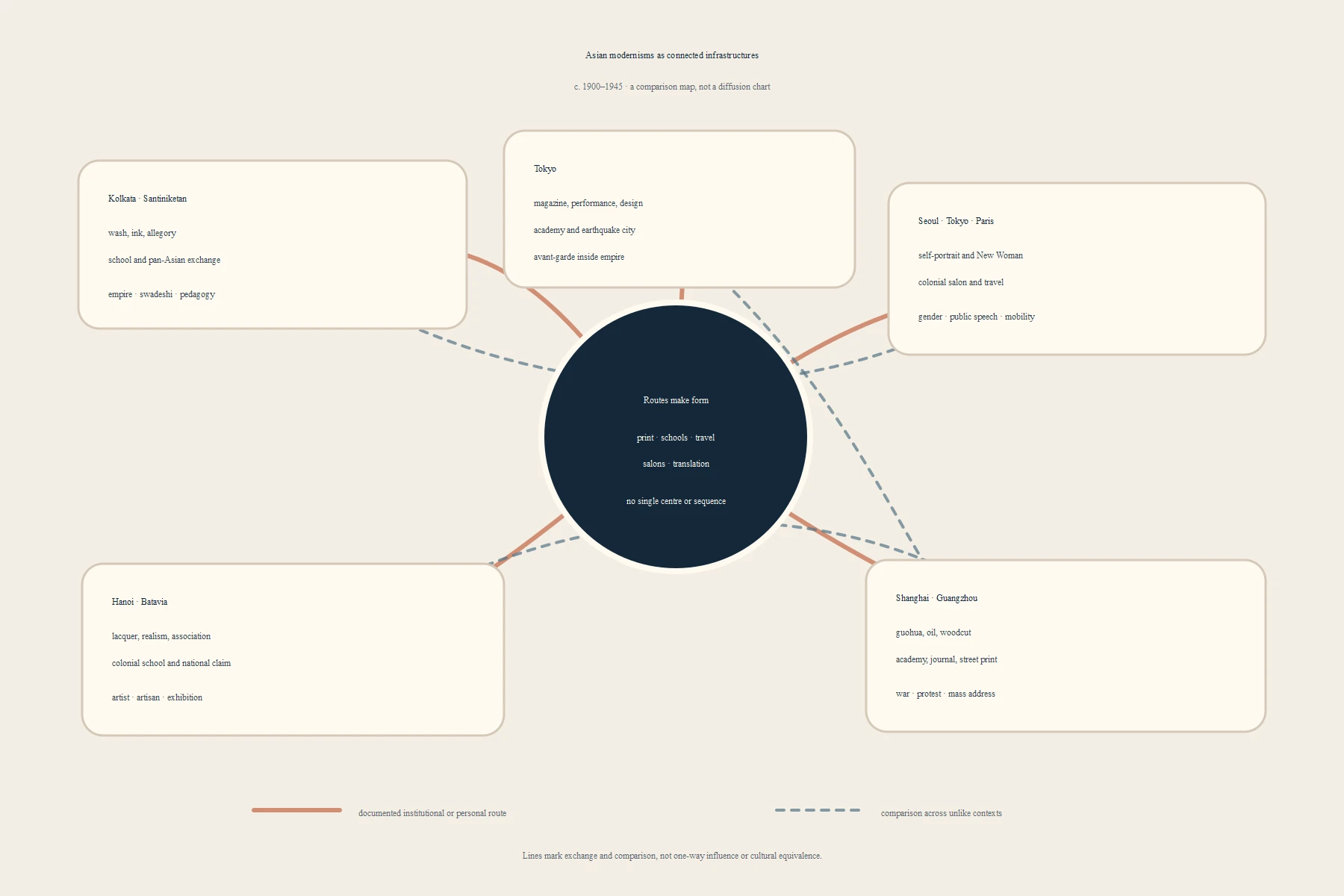
The diagram rejects a centre-and-spokes story in which a European capital invents and Asian cities receive. Kolkata and Tokyo were directly connected through people and techniques. Seoul–Tokyo–Paris describes an unequal route through colony and imperial capital. Chinese woodcut drew on Japanese, European, and Soviet materials while becoming a specific Chinese movement. Hanoi’s lacquer studio joined French academic structures to Vietnamese workshop knowledge. Batavia’s artists organised against colonial visual convention.
These routes were not equally free. Passports, colonial citizenship, race, wealth, gender, language, war, and policing shaped movement. Connection is evidence of relation, not proof of equality.
A comparison matrix
| Case | Medium and format | Institution or route | Public produced | Central tension |
|---|---|---|---|---|
| Meeting at the Staircase | Watercolour interior | Kolkata household, theatre, print, exhibition | Viewers of experimental pictorial space | International form versus local institutional history |
| Bharat Mata | Portable wash allegory | Swadeshi, Bengal School, India–Japan exchange | Anticolonial national public | Mobilising symbol versus religious and gendered exclusion |
| Na Hye-sok, Self-Portrait | Oil self-portrait | Seoul–Tokyo–Paris; colonial salon and press | Modern woman as artist and author | Mobility and agency within colonial patriarchy |
| Mavo no. 3 | Magazine cover and attached matter | Tokyo group, publishing, performance, design | Radical reader-participant | Anti-institutional experiment inside imperial Japan |
| Li Hua, Roar, China! | Creative woodcut and leaflet | Guangzhou school, Lu Xun network, protest distribution | Mobilised street and print public | Reproducibility, nationalism, and political urgency |
| Hanoi lacquer | Layered panel and workshop process | Colonial art school, artisan knowledge, market | National and international exhibition public | Fine art versus craft; collaboration versus hierarchy |
| PERSAGI | Painting, essay, association, exhibition | Batavia artists’ network | Anticolonial Indonesian art public | National truth versus internal difference |
The matrix does not rank innovation. It makes categories testable. The same word—modern—describes different relations among medium, public, institution, and power.
What changes when medium changes
Watercolour wash can make a small allegory feel intimate and devotional. Oil portraiture can claim professional parity with an academy and intensify an individual psychology. A magazine binds typography to serial circulation. Woodcut makes the same matrix capable of many impressions. Lacquer converts time-consuming workshop procedures into depth that is partly revealed by abrasion. An association turns exhibitions and essays into collective infrastructure.
Medium is therefore not a list of substances. It includes repeatability, labour, scale, drying time, portability, cost, training, and the sites where a work appears. When surveys identify modernism only by visible style, they miss these material decisions. Two works can look unlike and still answer comparable questions about who may speak, how an audience forms, and what a national culture should do.
Nation was a tool and a danger
Under empire, national culture could refuse the coloniser’s claim that the colonised merely copied or preserved timeless craft. Bharat Mata, the new Chinese woodcut, Hanoi lacquer, and PERSAGI each made form part of a political future. Schools and associations built durable capacity beyond one artwork.
The nation could also discipline difference. A mother-goddess could narrow religious belonging; “Indonesian truth” could marginalise artists or communities that did not fit its dominant image; “national painting” could turn one medium into a test of loyalty. Modernisms do not become emancipatory simply because they are anticolonial. Their achievement and their exclusions must be read together.
Common survey traps
- One Asia: geographic scale is mistaken for a shared style, chronology, or political experience.
- Late arrival: an Asian work is dated only by when a similar European form entered the survey textbook.
- Tradition versus West: ink, wash, oil, lacquer, and print are treated as civilisational containers instead of changing practices.
- Influence without route: visual resemblance substitutes for evidence of travel, publication, teaching, translation, or encounter.
- Nation as natural subject: an allegory or realist image is assumed to represent everyone it names.
- Empire as total explanation: colonial power is rightly identified, then artists’ choices and disagreements disappear.
- Named painter, unnamed labour: printers, artisans, editors, translators, models, and workshop assistants vanish behind authorship.
- Download equals permission: a visible museum or archive file is reproduced without checking work, photograph, territory, and licence.
Questions for close looking
- What can the medium do at this scale, and what labour does that effect require?
- Which institution trained, exhibited, published, purchased, rejected, or preserved the work?
- Is “traditional,” “Western-style,” “national,” “craft,” or “avant-garde” the maker’s term, an institution’s category, or a later historian’s label?
- What documented route supports a claim of exchange or influence?
- Who is invited to recognise themselves in an image of the nation, and who may be rendered peripheral?
- How do gender, class, colonial status, ethnicity, religion, and language shape access to artistic authority?
- Does reproduction widen a public, or place production and distribution under a different gatekeeper?
- What changed when the object entered a museum, archive, textbook, or digital collection?
- Whose technical labour is named, and whose is absorbed into “the artist” or “the school”?
- What would remain unknowable if we refused to confuse an available image with a cleared image?
Terms for Asian modernisms
Academy: a school and credential system that defines teachable media, professional standards, juries, and often a hierarchy between fine art and craft.
Guohua: “national painting,” a modern Chinese category for ink-and-colour practices distinguished from Western-style painting; not a timeless synonym for all Chinese painting.
Mavo: a Tokyo-based avant-garde group active chiefly in the 1920s across performance, painting, architecture, theatre, print, and design.
New Woman: a transnational modern figure associated with education, work, fashion, sexuality, authorship, and social reform; both lived identity and contested media construction.
Pan-Asianism: projects of Asian cultural or political affiliation that could support anticolonial exchange, Japanese imperial ideology, or other positions depending on context.
PERSAGI: an Indonesian artists’ association formed in late-colonial Batavia that challenged picturesque colonial convention and argued for an art accountable to contemporary life.
Swadeshi: an anticolonial movement of self-reliance and boycott intensified after Bengal’s 1905 partition; it joined economic practice to education, dress, literature, and visual culture.
Creative woodcut: a print cut and printed as an artist’s own work rather than engraved to reproduce another image; central to China’s new woodcut movement.
A working timeline, c. 1900–1945
- 1903: Okakura Kakuzō publishes The Ideals of the East, one influential statement in pan-Asian cultural debate.
- 1905: Bengal is partitioned; swadeshi activism intensifies; Abanindranath Tagore paints the image first known as Banga Mata and later as Bharat Mata.
- 1910: Japan formally annexes Korea, reshaping education, exhibition, language, and mobility under colonial rule.
- 1911: the Qing dynasty falls; artistic institutions develop amid republican revolution and political fragmentation.
- 1913: Na Hye-sok begins studying oil painting in Tokyo.
- 1919: Kala Bhavana is founded at Santiniketan; the March First Movement in Korea and May Fourth Movement in China mobilise new publics.
- 1921: Na holds a solo oil-painting exhibition in Seoul.
- 1923: Mavo forms in Tokyo; the Great Kantō earthquake transforms the city and its visual culture.
- 1924: Yumeji’s Fujin Graph covers and Mavo no. 3 show commercial and radical experiments within Tokyo print culture.
- 1925: the École des Beaux-Arts de l’Indochine opens in Hanoi.
- 1927: a lacquer studio is introduced at the Hanoi school; Na begins extended travel through Europe and the United States.
- c. 1928: Na paints the Self-Portrait studied here.
- 1931: Lu Xun organises a woodcut workshop in Shanghai, a key event in China’s new woodcut movement.
- 1935: Li Hua makes Roar, China!; print becomes an urgent vehicle for protest and national mobilisation.
- 1937–1938: PERSAGI forms in Batavia; Japan’s war in China expands into full-scale invasion.
- 1940: Nguyễn Gia Trí makes Landscape of Vietnam; Emiria Sunassa exhibits publicly in Batavia.
- 1941: PERSAGI holds a major exhibition at the Batavia Art Circle; war reorganises artistic institutions across the region.
- 1945: Japan surrenders; Korea is liberated and divided, Indonesia declares independence, and Vietnam’s August Revolution opens new struggles over state and culture.
Source guide
This chapter uses institutional records for object facts and rights, local and named scholarship for interpretation, and comparative scholarship as a method rather than a substitute for place-specific evidence.
- Comparative frame: National Gallery Singapore, John Clark’s The Asian Modern, with Patrick D. Flores and Phoebe Scott; Monica Juneja, Ming Tiampo, Nora Taylor, Gao Minglu, and Chaitanya Sambrani’s critical roundtable; and The Modern in Southeast Asian Art: A Reader, which foregrounds art writing from the region.
- India and inter-Asian routes: Visva-Bharati’s institutional history of Kala Bhavana; Atteqa Ali on modernity in South Asia; the Met’s Abanindranath object history; Tapati Guha-Thakurta, The Making of a New “Indian” Art; Partha Mitter, The Triumph of Modernism; and Sonal Khullar, Worldly Affiliations.
- Korea and Na Hye-sok: the MMCA/LACMA exhibition The Space Between: The Modern in Korean Art, LACMA’s object guide, and Virginia Moon’s essay on women in the exhibition.
- Japan, Yumeji, and Mavo: the Art Platform Japan record for Firework and the National Diet Library’s Yumeji image study; Gennifer Weisenfeld, Mavo: Japanese Artists and the Avant-Garde, 1905–1931, with an open research copy and reuse statement; the National Diet Library serial record; and the NYPL object record.
- China, ink, and woodcut: the Met’s modern Chinese painting exhibition history and Wen C. Fong’s open Between Two Cultures; Tang Xiaobing, Origins of the Chinese Avant-Garde; and CAFA Art Museum’s Li Hua retrospective and Roar, China! record.
- Vietnam and Indonesia: Phoebe Scott’s material history of Vietnamese lacquer; National Gallery Singapore’s S. Sudjojono archive introduction; and Lisa Horikawa on Emiria Sunassa.
- Image and rights checks: the museum and Commons records linked in each caption establish the working object, source-file, and rights record. The historical works were checked separately from their digital reproductions. The GeMarkt diagram is an original interpretive graphic released under CC BY 4.0. This editorial review is not legal advice.
Continue the Atlas route
The previous chapter followed African modernisms through photography, schools, landscape, public culture, ink, studio portraiture, and transnational exhibition. This chapter compared a different set of arguments: wash and national allegory in Bengal, pedagogy at Santiniketan, a woman artist’s self-portrait under colonial rule, Mavo’s magazine-design event, Chinese ink and woodcut debates, Hanoi lacquer, and PERSAGI’s demand for an Indonesian art. The next Atlas chapter turns to art after 1945, when abstraction, realism, new states, museums, international exhibitions, and the cultural Cold War reorganised many of these questions without resolving them.
Editorial record
About this article
- Author
- Publisher
- GeMarkt
- Published
- Updated
- Reviewed
- Internal source & rights check. Conducted by GeMarkt Research Review. This is an internal editorial check—not independent peer review.
- Source standard
- Art history source standardPrioritises object records and research sources, distinguishes evidence from interpretation, and states material uncertainty.
Found a claim that needs checking? Report a factual error.