Art History · Learning chapter
Atlas III — Early-modern worlds · 5 of 11
Ming and early Qing art: court, literati, workshop, porcelain, and global trade
A critical guide to Ming and early Qing art through court painting, Suzhou literati culture, printed manuals, Jingdezhen labour, porcelain routes, and Qing imperial legitimacy.

What we’ll look at
How did courts, workshops, print, and trade shape art under the Ming and early Qing?
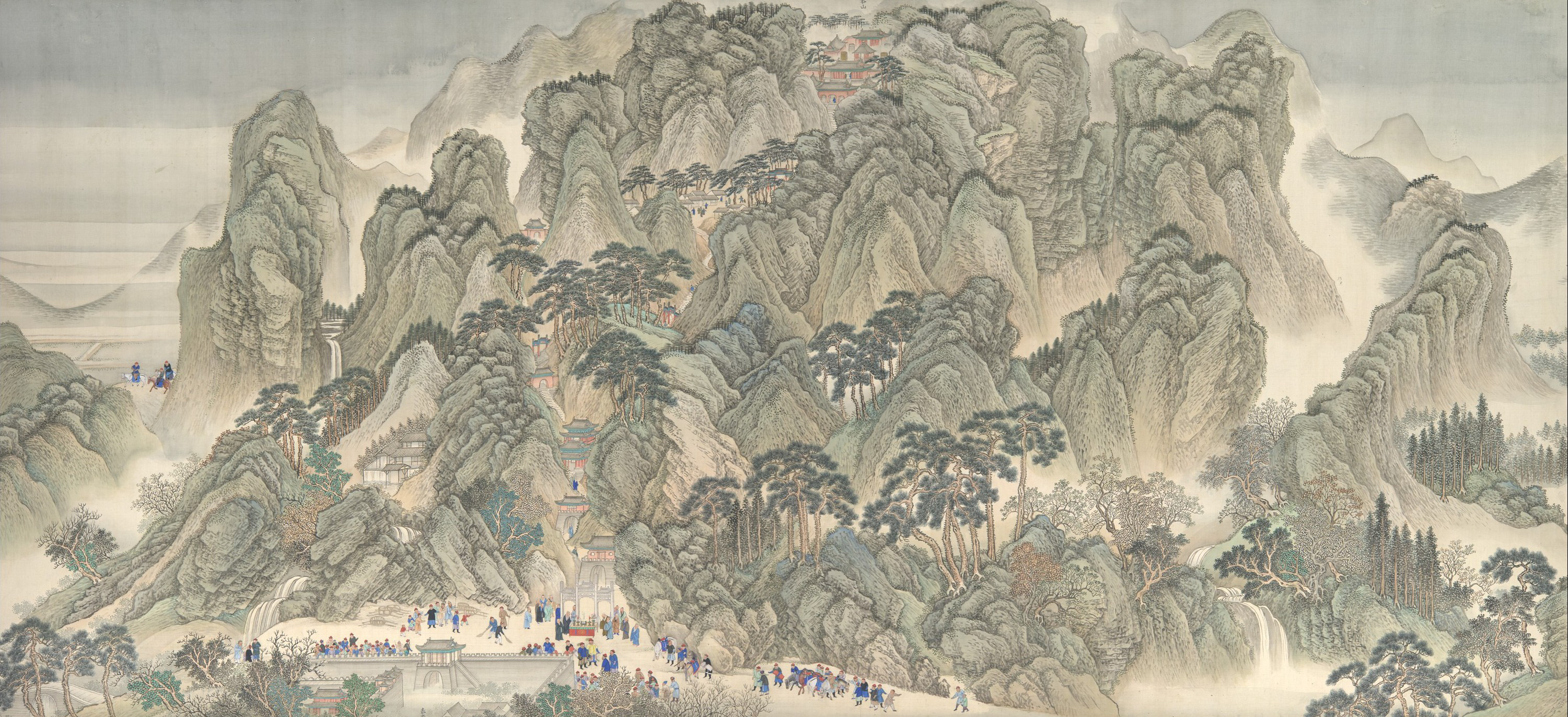
The landscape above belongs to a handscroll almost fourteen metres long. It shows the Kangxi emperor’s 1689 journey from Ji’nan to Mount Tai, although Wang Hui did not visit the mountain. He and his assistants worked from maps, prints, official records, older landscapes, and one another’s labour. The scroll is neither a neutral map nor an eyewitness report. It presents a recent Qing conqueror moving through former Ming territory as ruler of prosperous settlements, secure roads, sacred peaks, and a cultivated past.
That scroll complicates any art history divided into a creative Ming and an imitative Qing. Its authority depended precisely on reuse. Older styles were made to serve a new dynasty; printed information helped construct places the painter had not seen; many hands disappeared beneath the name of a celebrated director; and a mobile format required the viewer to unroll imperial space gradually.
This chapter examines selected visual worlds from the founding of the Ming dynasty in 1368 through the early Qing, concentrating on the fifteenth through late seventeenth centuries. It moves among the imperial court, Suzhou scholar networks, commercial print, Jingdezhen kilns, maritime trade, and Kangxi patronage. These are connected histories, not a complete account of all art made across the empire. Architecture, textiles, Buddhist and Daoist production, regional workshops, popular religious images, and the visual cultures of many non-Han communities require fuller studies of their own.
The central question is not which dynasty possessed the better style. It is how institutions made authority visible. A hanging scroll could imagine an emperor who welcomed criticism. A scholar’s fisherman could turn retirement into social identity. A printed manual could package brush knowledge as reproducible parts. A porcelain jug could join Jingdezhen clay, Islamic metalwork form, Portuguese heraldry, and maritime exchange. Each object makes a different network briefly legible.
A dynasty is not an aesthetic container
The Ming dynasty governed from 1368 to 1644. The Qing dynasty, founded by the Manchus, took Beijing in 1644 and ruled until 1911. These dates matter because courts reorganised taxation, official appointments, ritual, workshops, trade policy, collections, and patronage. They do not mean that every maker adopted a new visual language on the day a capital fell.
“Ming art” can therefore be a useful address, but it is not one style. A court painter in Beijing, a scholar-calligrapher in Suzhou, a potter near Jingdezhen, a carver cutting blocks for a commercial publisher, and an anonymous painter of a local temple image worked within different materials, audiences, and systems of value. Even the same person could occupy several roles across a lifetime.
The same warning applies to “Chinese art.” It names a field with long internal arguments, political boundaries that changed, mobile makers, and objects made for several languages and markets. The aim is not to discard the category but to make it answerable to place, date, medium, patron, maker, audience, and route.
Ming and Qing meet at a violent threshold
The Ming collapse emerged through fiscal strain, environmental pressure, rebellion, military conflict, and regional crises rather than one sudden cultural exhaustion. Li Zicheng’s rebel forces entered Beijing in 1644. Ming general Wu Sangui allied with Manchu forces, which then occupied the capital and established Qing rule. Warfare continued for decades against Ming loyalist regimes and other opponents.
For artists, patrons, publishers, collectors, craftspeople, and their families, dynastic change could mean death, flight, lost income, altered allegiance, new appointments, confiscated collections, or survival through accommodation. Some elite painters represented loyalty or withdrawal; others served new patrons; many responses remain hard to recover because the archive privileges named men and durable luxury objects.
Continuity after conquest was never neutral. Qing patrons could claim earlier cultural traditions as their inheritance. Ming survivors could use those same traditions to mourn, remember, work, or negotiate safety. The object alone does not always reveal which position its maker took, so biography, inscription, patronage, date, and provenance must carry the argument.
Begin with an imperial journey made after the fact
In 1689 the Kangxi emperor undertook his second southern inspection tour. The Qing conquest was still a living political fact, and the Jiangnan region contained wealth, influential scholar-official networks, memories of resistance, and water-control problems essential to government. An imperial tour could inspect administration and river works while also making the ruler physically visible across a vast territory.
Wang Hui was later commissioned to direct a set of twelve monumental handscrolls recording the journey. The surviving third scroll, datable to 1698, follows the route from Ji’nan to Mount Tai. The Met object record identifies Wang and assistants, ink and colour on silk, and dimensions of 67.8 by 1,393.8 centimetres. “Assistants” is not a footnote to individual genius. A project of this length required coordinated drawing, painting, copying, mounting, supply, supervision, and revision.
Maxwell Hearn’s essay in the Met’s open-access catalogue Landscapes Clear and Radiant relates the scrolls to official accounts, preparatory designs, maps, woodblock sources, and the recruitment of Jiangnan artists. The series did not preserve a passing event like a camera. It rebuilt that event as official history.
A handscroll is a route, not a panorama
A handscroll is normally viewed on a table, unrolled from right to left in sections. The viewer reveals one passage while rerolling another. The whole fourteen-metre image is not encountered at once in the way it appears in a museum photograph or digital thumbnail.
That format makes movement temporal. Gates open, processions appear and disappear, plains yield to foothills, and Mount Tai grows into a destination. Viewers control the speed of looking but follow a route already designed. Space is assembled through successive viewpoints rather than one fixed optical position.
The scroll’s present display and reproduction alter that experience. A museum may show an extended section; a website can provide a slider; a book breaks the work into plates. Each method permits comparison while losing the hand’s rhythm, the silk’s scale, or the suspense of partial revelation. Medium is therefore part of the historical claim, not packaging around an image.
Kangxi’s tour made conquest look like ordered continuity
Wang Hui had not visited Mount Tai. According to the Met’s object research, he drew on available maps and woodblock prints and transformed topographic information through inherited landscape idioms. Blue-and-green passages evoked prestigious precedents while populated roads, cities, river crossings, and cultivated fields pictured a governable world.
The emperor’s procession is present within an environment much larger than any single body. This can make rule appear integrated with land, sacred history, and social order rather than imposed by force. The route joins recent Qing authority to Mount Tai’s deep ritual and political associations. Historical continuity becomes a visual resource for a new regime.
Calling the scroll propaganda is not wrong, but it is incomplete. The term should lead to formal questions: how does length naturalise a journey, how do old styles authorise new claims, where are labour and conflict absent, and what does the viewer have to do to follow the emperor? Political meaning operates through format and pictorial decisions.
Court painting made advice visible
Ming court painting served many functions: ancestor and ruler portraits, religious images, narratives, records of ceremonies, decorative birds and flowers, auspicious subjects, landscapes, and moral examples. Painters worked through palace institutions and could receive official ranks. Their positions, responsibilities, and access changed across reigns.
The early Ming court recruited painters and revived selected Song-dynasty models. That reuse could signal restoration after Mongol Yuan rule, provide tested formats for imperial ritual, or support current didactic needs. It did not produce a mechanical return to an earlier age. New scale, density, colour, and symbolic emphasis changed what older resources did.
An institutional history asks who ordered a work, where it hung, who saw it, what rank the painter held, and how the subject supported palace life. “Academic” should not be used as shorthand for technically polished but spiritually empty art. The court was a workplace and political environment, not a single style.
Liu Jun stages a ruler who listens
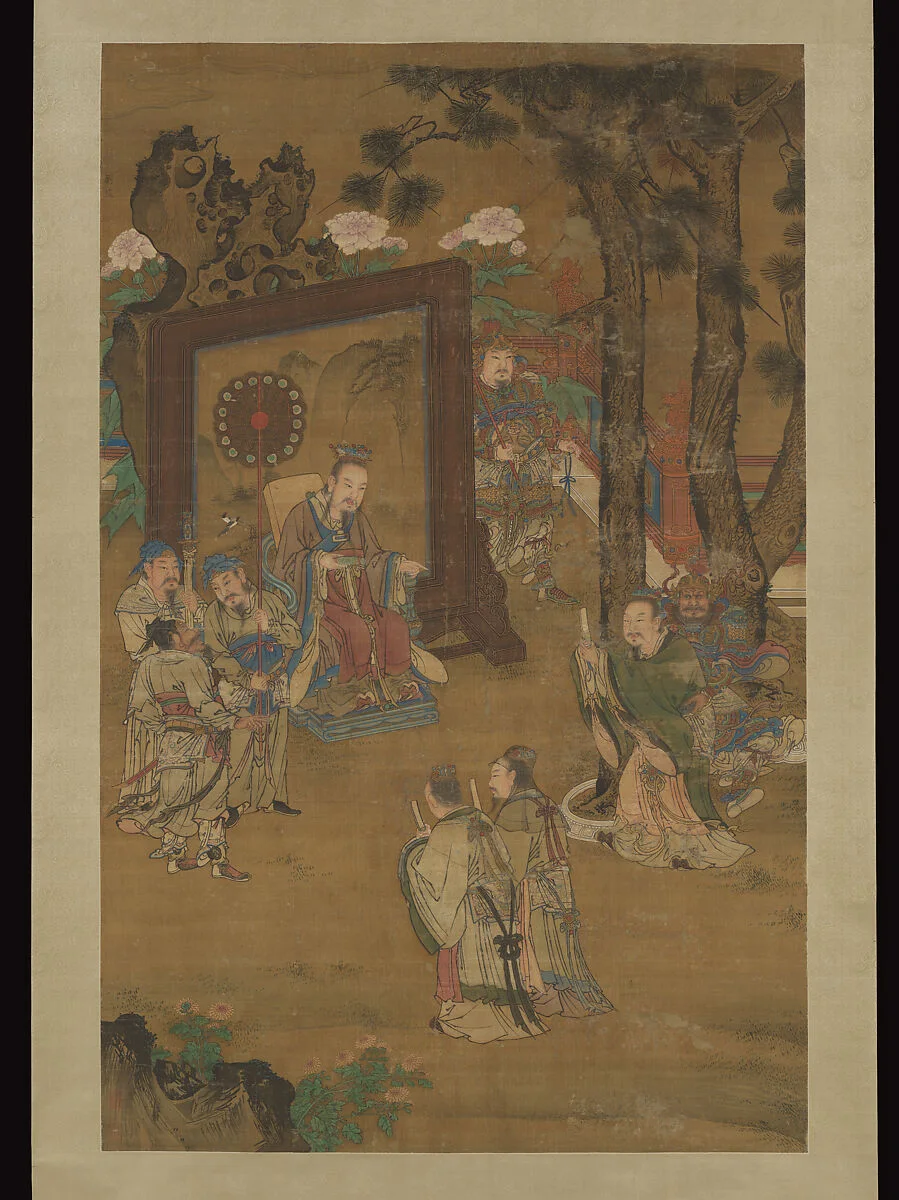
Liu Jun’s Remonstrating with the Emperor depicts a loyal official offering frank criticism to a ruler. The emperor sits within a carefully articulated palace landscape while attendants and officials organise access. Architecture, rocks, trees, paths, gestures, and rank turn political counsel into a visible hierarchy.
The Met’s record states that the work was commissioned to enhance the image of a just sovereign who welcomed admonition—and immediately cautions that political reality could be very different. That distinction is essential. The scroll is evidence that receptive rule was an imperial ideal worth picturing, not proof that an emperor consistently accepted criticism.
Liu’s signature and honorary rank connect painting to advancement within court service. Yet the surviving name should not make the work solitary. Silk production, pigments, mounting, architectural knowledge, workshop practice, and palace commissioning formed the conditions of authorship.
The academy was an institution, not a style label
Art surveys often oppose a Ming “academy” of professional court painters to independent literati. This produces a useful first map only if its edges remain open. Court painters did not all paint alike. Recruitment, rank, subject, location, and imperial favour changed, and a painter could adapt older conventions with considerable intelligence.
The Met’s overview of Ming arts notes strong court recruitment under the Xuande emperor and a decline in academy activity by about 1530, followed by greater support from private and merchant patrons. That chronology describes shifting institutions rather than the disappearance of professional work.
“Professional” means that painting participated in livelihood or paid service; it does not identify inferior brushwork. “Amateur” in literati discourse signalled an elite ethical and educational claim, not necessarily the absence of exchange, income, assistants, or market value. Treating either term as a quality score repeats historical status ideology as modern fact.
Court and literati were not sealed worlds
Literati painting was associated with educated elites who valued calligraphy, poetry, historical reference, brush expression, friendship exchange, and self-cultivation. These priorities could challenge illusionistic description or decorative finish. They also helped distinguish elite social identity from artisans and professional painters.
But the distinction was porous. Scholar-officials served the state, collected courtly and professional work, hired makers, advised patrons, designed gardens, wrote for publishers, and sold or exchanged paintings. Professional artists studied literati models and could move among urban markets and elite networks. Court collections preserved earlier works that became models for later scholar-painters.
The categories matter because historical actors argued through them. They fail when treated as sealed populations. The better question is who claimed literati status, for which audience, through what forms, and with what material support.
Shen Zhou fishes without a hook
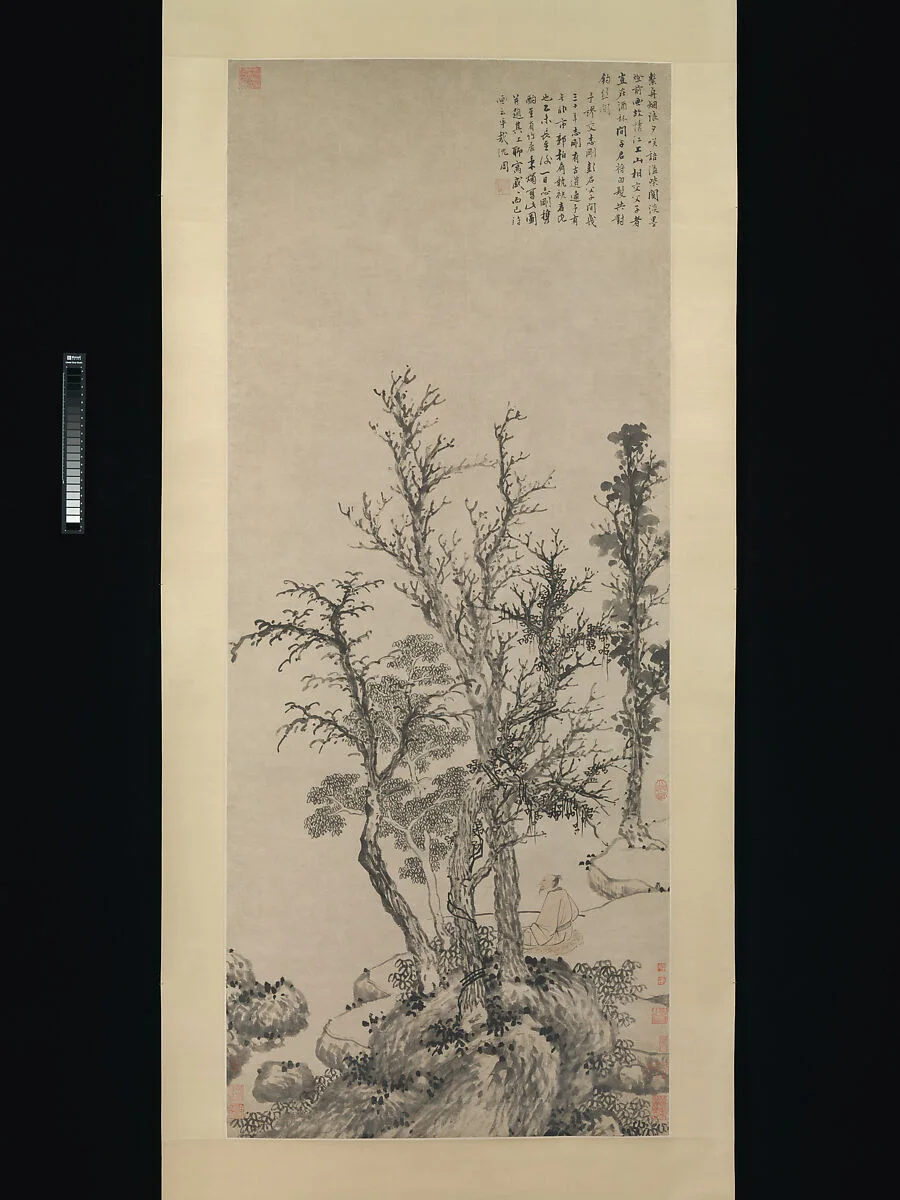
Shen Zhou made Silent Fisherman in an Autumn Wood in 1475 for two old friends, a father and son who visited him. The narrow hanging scroll pushes bluntly brushed trunks and foliage toward the surface. A large inscription occupies the open paper above. Word, brush, gift, and remembered meeting belong to one object.
The fisherman wears a scholar’s robe and sits on a leopard skin. His pole has no hook or line. As the Met object record explains, fishing becomes a symbol of cultivated retirement rather than subsistence work. The image asks us to recognise a literary and social type, not document an ordinary fisher’s labour.
The absent hook is a small visual argument. The figure can inhabit nature without needing a catch. Yet his leisure is materially supported: paper, ink, landholding family, education, friends who understand the allusion, and time to paint and write.
Reclusion could be social performance
Retirement in literati art did not always mean physical isolation or political refusal. It could describe a cultivated state of mind, withdrawal from office, a family circumstance, or a role enacted among friends. Poems and paintings of empty pavilions, fishermen, old trees, and mountain dwellings helped people recognise one another as educated participants in a shared tradition.
Shen Zhou remained embedded in Suzhou social life. Making a painting for visiting friends turned “reclusion” into relationship. The scroll could later circulate, receive seals or inscriptions, and display the maker’s learned identity to people he never met.
This is not hypocrisy. Social performance is how identities become legible. The problem arises when a modern viewer mistakes the idealised fisherman for proof that the artist existed outside family wealth, collecting, gifts, obligations, and markets.
Suzhou joined gardens, friendship, money, and taste
By the fifteenth and sixteenth centuries, Suzhou and the broader Jiangnan region supported dense networks of landholding families, officials, merchants, collectors, gardens, book production, painting, calligraphy, and luxury craft. The Wu School label gathers painters associated with this environment, especially Shen Zhou and Wen Zhengming, but it does not name a formal academy with one curriculum.
Craig Clunas’s studies of Ming visual culture, including Fruitful Sites, examine gardens as material and social sites rather than timeless retreats from history. Gardens required property, labour, plants, water management, architecture, writing, and access. Their images and descriptions helped make elite status visible.
The expansion of commercial publishing and art markets did not simply democratise culture. It widened access for some people while producing new rankings, fashions, copies, fraud anxieties, and exclusions. Merchant wealth could purchase scholarly objects; scholarly taste could confer value on market goods. Money and cultivated identity were opponents in rhetoric and partners in practice.
A painting remains open to later viewers
Chinese paintings and calligraphy often accumulated seals, colophons, titles, mountings, and collection records. A handscroll might be opened among invited viewers, followed by written responses, remounted, or joined to later texts. A hanging scroll could be displayed for an occasion and stored between viewings.
These additions make time visible on the object. A collector’s seal can establish possession but also obscure the image. A colophon can preserve interpretation while redirecting attention. A prestigious attribution can increase value, and later research may revise it.
Museum photographs often crop mountings or isolate the painted field. That clarity is useful, but it can make the work look complete at the moment of initial painting. Close reading should ask which parts belong to first production, which were added, and how present institutional framing shapes what counts as the artwork.
Copies can be arguments
Copying earlier masters was central to learning calligraphy and painting. A copy could train the hand, preserve a damaged model, demonstrate connoisseurship, answer an earlier composition, or combine historical idioms. Similarity did not imply the modern legal or moral category of plagiarism.
Wang Hui became famous for commanding multiple historical landscape languages. The Met’s study of his career stresses that his versions of old works were not line-for-line replicas. He selected and animated prior models through his own brushwork and composition.
Access was power. Court and elite collections made rare paintings available to some students but not others. Printed reproductions widened the repertoire while changing scale, colour, surface, and detail. The ability to cite the past therefore depended on institutions that controlled originals, copies, catalogues, teachers, and reputations.
Print made the canon portable
Late Ming commercial publishing produced illustrated fiction, drama, ritual guides, catalogues, technical books, painting manuals, and luxury editions. Woodblock printing required authors or compilers, editors, calligraphers, designers, block carvers, printers, paper, ink, colourists, binders, booksellers, and buyers.
An image cut into a block could be printed repeatedly, but every impression was not identical. Blocks wore; paper and ink varied; colour could be applied through additional blocks or by hand; pages were assembled into different editions; owners annotated and rebound books.
Print made selected visual knowledge more portable. It also narrowed that knowledge into reproducible lines and named categories. What could be diagrammed, labelled, marketed, and recopied gained authority. Practices that depended on bodily demonstration, rare materials, local apprenticeship, or non-elite transmission remain less visible.
Mustard Seed Garden teaches parts before wholes
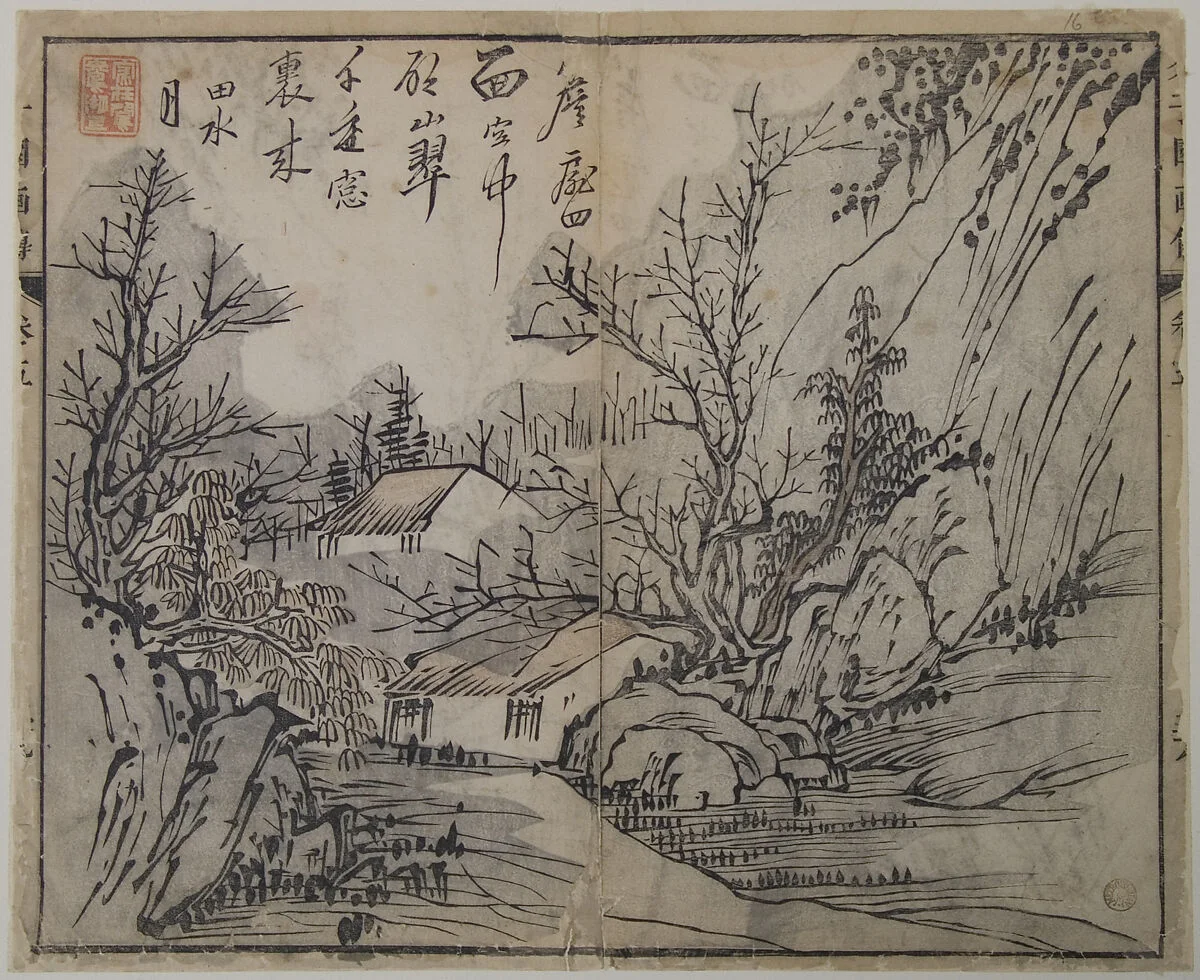
The Mustard Seed Garden Manual of Painting was first printed in 1679, early in the Qing dynasty. The edition was published by Li Yu and illustrated by Wang Gai. Its pages organise brush methods and motifs—rocks, trees, leaves, figures, buildings, and compositional resources—so readers can study reusable parts.
The manual does not reduce painting to a formula. It demonstrates that a sophisticated tradition could be analysed, named, sequenced, and printed. A learner could compare examples, copy marks, recombine components, and encounter historical models without standing before every original painting.
The page above is both instruction and designed commodity. Text and image coordinate; colour, paper, cutting, printing, and binding affect use. The Met record identifies this leaf as a woodblock print from the first edition. Its survival in a museum separates one opening from the larger manual that structured study.
A manual records a market, not every practice
The manual’s success and later editions show demand for codified painting knowledge. They do not prove that everyone learned in the same way or that the book represented every workshop, region, gender, or social group. Printed canons are selective.
Yuming He’s Home and the World treats late-Ming publishing as an active remaking of the world rather than passive transmission. Editors could arrange antiquity, geography, objects, and images for readers whose knowledge was increasingly mediated by commercial print. The page made distant things imaginable while giving publishers power over selection.
Use the manual as evidence for a publishing ecology, an instructional ambition, and a portable repertoire. Do not use it as a transparent census of actual painting. The gap between prescription and practice is itself historical evidence.
Jingdezhen was a city of skilled hands
Jingdezhen became the most famous centre of Chinese porcelain production, but the familiar phrase “made at Jingdezhen” can hide a regional manufacturing system. Clay and glaze materials had to be quarried, refined, transported, mixed, shaped, moulded, joined, carved, painted, glazed, stacked, fired, sorted, packed, and carried to consumers.
Anne Gerritsen’s The City of Blue and White reconstructs Jingdezhen through objects, local records, natural resources, skilled workers, and global circulation. Her chapter on skilled hands shows that kiln administrators struggled to bind mobile specialists to imperial production. Workers could move between imperial and private kilns, and administrative ideals did not perfectly control labour.
This changes the story from emperor orders, pot appears. Quality came from knowledge distributed across many tasks. So did risk: failed firings, dangerous heat, dust, resource pressure, transport loss, debt, and fluctuating demand. Named court patrons survive more readily than the hands that made their porcelain possible.
Imperial and private kilns shared an ecology
Imperial kilns produced wares for the court; private kilns served domestic and overseas markets and could also participate in official supply. The boundary mattered because orders, standards, supervision, and destination differed. It was not a wall between two unrelated industries.
Workers, fuel, clay, cobalt, technical knowledge, transport, and urban services circulated through the same wider region. Imperial demand could concentrate resources and impose costs. Private producers responded to varied buyers with different shapes, imagery, price, and quality. A single kiln site could change function over time.
“Imperial porcelain” therefore names a relationship of commission and control, not just exceptional beauty. “Export porcelain” names a destination or market orientation, not a lower artistic category. Both labels should be tested against archaeological context, inscriptions, kiln evidence, and object history.
Porcelain begins with geology and fire
Porcelain is not simply white clay decorated in blue. Jingdezhen wares depended on suitable ceramic stone and kaolin-bearing materials, careful preparation, glaze chemistry, cobalt pigments, kiln design, fuel, temperature control, and knowledge of how bodies changed during firing.
Underglaze blue painting had to anticipate transformation. The painter worked before the transparent glaze and high-temperature firing produced the final contrast. Shapes could warp; pigments could blur; firing could reveal flaws invisible in the unfired vessel. Repetition required judgement rather than automatic manufacture.
Material history keeps global demand grounded. A European collection label may emphasise heraldry or trade, but the object’s possibility began with Jiangxi landscapes, extraction, water, wood or other fuel, skilled labour, and kiln communities. “Blue-and-white” is an appearance produced by infrastructure.
One jug carried several worlds
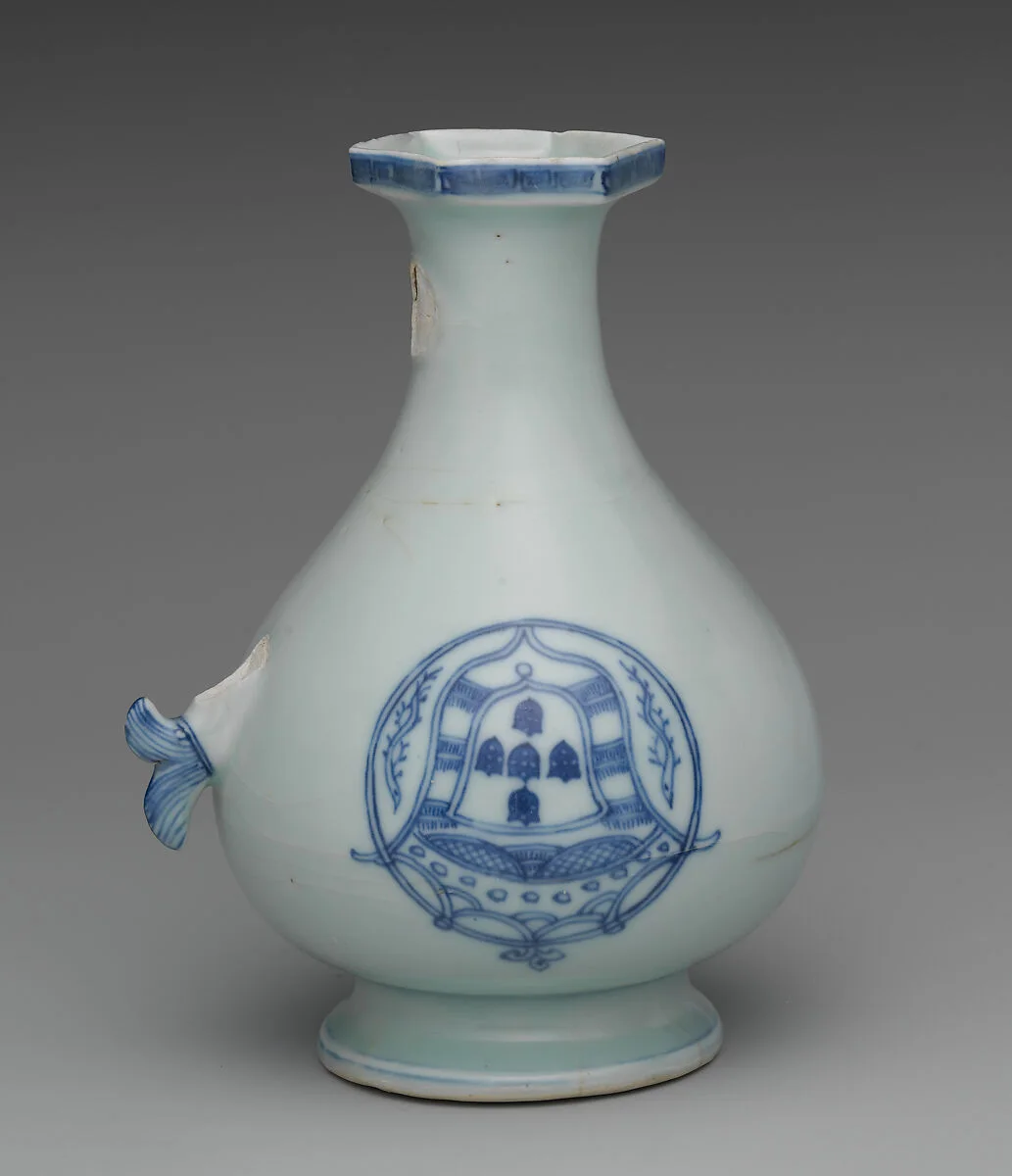
This jug was made at Jingdezhen about 1520–40 for a Portuguese market. Its material and underglaze painting are Chinese; its coat of arms refers to the Portuguese monarchy; its vessel form, according to the Met object record, derives from Islamic metalwork made for Near Eastern markets.
The object is therefore not a meeting of two sealed worlds called East and West. At least three histories are already visible in form, material, and emblem, while maritime carriers, commissioners, brokers, models, and consumers add more nodes. The potters did not need to visit Portugal to make for Portuguese buyers. Information could travel as a sample, sketch, verbal instruction, metal vessel, or earlier ceramic.
Its small scale matters. The jug is 18.7 centimetres high, an object for handling and display rather than a monument. Global history can be carried by a handle, spout, copied silhouette, and painted shield.
The upside-down arms are historical evidence
The Portuguese arms appear inverted. It is tempting to use this as a comic story of error or proof that Chinese painters did not understand Europe. That response assumes the foreign emblem should have been self-evident and ignores the conditions of transmission.
The inversion shows that a design crossed linguistic and heraldic systems through incomplete instructions. A craftsperson could reproduce lines skilfully without sharing the commissioner’s rules for orientation. The error survived glazing, firing, sorting, shipping, ownership, and collecting, so it evidently did not make the object unusable.
Imperfection is evidence of translation. It reveals distance between buyer and maker, the priority of recognisable motif over heraldic precision, and the limits of control in commissioned global production. Export was not one side giving a complete specification and the other obeying without interpretation.
Global trade did not begin when Europeans arrived
Chinese ceramics circulated across East and Southeast Asia, the Indian Ocean, the Islamic world, and parts of Africa long before Portuguese ships entered direct maritime trade with China. Earlier chapters in this Atlas trace ceramics and other objects through Tang, Song, Yuan, and Silk Roads networks.
Portuguese and later Dutch companies changed routes, volume, violence, and European access. They did not invent the global mobility of Chinese goods. The Met’s overview of Chinese export porcelain documents wares made for several overseas preferences, forms, and coats of arms, but the category should not make Europe the default destination.
Anne Gerritsen’s account follows Jingdezhen porcelain through East and Southeast Asia, the Indian Ocean, Africa, the Americas, and Europe. Starting from the production city rather than a European cabinet restores the asymmetry between distributed skilled labour and the collector histories that later claimed the object.
Silver, porcelain, and coercive routes
Late Ming commercial expansion was connected to large flows of silver. Silver from Japanese mines and the Spanish Americas entered Chinese markets through complex routes, including Manila, maritime trade, smuggling, taxation, and intermediary merchants. Chinese silk and porcelain travelled outward through some of the same systems.
These routes were not neutral lines on a map. Mining imposed dangerous labour and environmental costs. Iberian colonisation in the Americas and Philippines involved conquest and coercion. European chartered companies used armed force. Chinese maritime restrictions, taxation, piracy labels, and coastal conflict affected who could trade and at what risk.
Avoid the phrase “global exchange” when it erases power. Name the commodity, route, carrier, labour, and institution where evidence permits. A porcelain shard in Mexico, a cargo in a Southeast Asian wreck, and a Portuguese-arms jug in a New York museum record different segments of a system, not one harmonious encounter.
1644 did not reset artistic time
After the Ming fall, artists faced changed political conditions but continued to work with paper, silk, ink, brushes, printed books, collections, teachers, and inherited genres. Some identified with Ming loyalism; some accepted Qing office; some withdrew; some moved between positions; artisans and commercial makers still needed livelihoods.
The labels “loyalist” and “individualist” can help interpret named seventeenth-century painters when biography and inscription support them. They should not become a romantic style in which eccentric brushwork automatically means political resistance. Formal difference does not decode allegiance by itself.
Qing rule also changed through time. The first decades of conquest differ from Kangxi’s consolidation and patronage. Manchu rulers engaged Chinese scholarly traditions while maintaining Manchu institutions, languages, military structures, and imperial ambitions. Appropriation, adaptation, and sponsorship were instruments of rule—not evidence that the court lacked its own agency.
Orthodoxy and individualism are not quality rankings
Later art history often groups early Qing painters as “Orthodox” traditionalists or “Individualist” masters. The first category is associated with lineages of learned landscape practice and figures such as the Four Wangs; the second with highly distinctive painters including Shitao and Bada Shanren, whose biographies intersected with Ming royal descent, monastic life, or loyalist memory.
These categories map arguments about lineage, brush method, identity, and response to conquest. They do not rank obedient repetition against authentic self-expression. Wang Hui’s command of old styles could generate new large-scale political pictures. Shitao’s writing and painting likewise emerged through study, travel, patronage, and historical reference rather than creativity without predecessors.
The Kangxi tour scroll closes the chapter’s circle. A “traditionalist” painter directed an unprecedented imperial project; assistants converted print and cartographic information into a moving painted route; old landscape languages helped a Manchu emperor claim ordered succession. Reuse was not the opposite of innovation. It was the field in which innovation and power became visible.
A comparison matrix
| Work | Format and viewing action | Institution or network | What it makes visible | What it leaves uncertain |
|---|---|---|---|---|
| Liu Jun, Remonstrating with the Emperor | Large hanging scroll displayed vertically | Ming court service and moral counsel | Just rulership as an image of listening | Whether a specific ruler accepted criticism in practice |
| Shen Zhou, Silent Fisherman | Hanging scroll joining painting, poem, and inscription | Suzhou friendship and literati self-fashioning | Retirement as cultivated identity | The full economic support behind scholarly leisure |
| Mustard Seed Garden Manual | Bound printed openings studied and copied | Commercial publishing and painting instruction | Canon as named, divisible, portable repertoire | How any one reader actually learned or painted |
| Portuguese-arms jug | Handled porcelain vessel made through kiln production | Jingdezhen workshops and maritime commission | Multi-node design transfer and imperfect translation | The identities of most makers, brokers, and first users |
| Kangxi southern tour, scroll three | Handscroll revealed sequentially | Qing court, Wang Hui’s team, maps, print, official history | Territory as prosperous, sacred, and governable | Conflict, extraction, and many labouring lives outside the procession |
The comparison works because it keeps medium, institution, and uncertainty together. “Style” alone cannot explain why a painted ruler, a scholar-fisherman, a printed rock diagram, a heraldic jug, and an imperial route belonged to overlapping historical worlds.
Common survey traps
Ming equals literati painting. Ming visual culture also includes court production, ceramics, textiles, print, architecture, religious images, urban craft, and objects made for domestic and overseas markets.
Court art is conservative; literati art is free. Both positions involved conventions, patronage, training, access, and social claims. Court makers could invent; scholar-painters could depend on markets.
The Qing merely copied the Ming. Early Qing reuse of earlier models occurred after conquest and could serve loyalist memory, livelihood, scholarship, or imperial legitimacy. Context determines the work of copying.
Porcelain is one master’s creation. Jingdezhen production distributed skill across extraction, preparation, shaping, painting, glazing, firing, sorting, packing, and transport.
Export porcelain is a European story. Chinese ceramics travelled widely before and beyond direct European trade. Europe was one destination within larger routes.
An inscription or seal settles meaning. Marks can identify makers, patrons, owners, viewers, and later interventions, but they require dating, translation, authentication, and relation to the material object.
Questions for close looking
- Format: Is the work a hanging scroll, handscroll, album leaf, printed page, or vessel? What actions does that format ask from a viewer or user?
- Labour: Which hands are named, and which material tasks must have occurred even when their makers are absent from the record?
- Institution: Does the object connect to court service, friendship exchange, publishing, kiln administration, ritual, or trade? Can it belong to more than one?
- Reuse: Which older style, object form, text, or motif is cited? What changes when it enters a new commission?
- Power: What kind of ruler, scholar, consumer, or territory does the work imagine? Who is outside that image?
- Route: How did information, material, and the finished object move? Which parts of the route are documented and which are inferred?
- Survival: Why might this object have entered a major collection while everyday, fragile, local, or anonymous works did not?
For the hero scroll, try one practical exercise. Cover most of the digital image and reveal it from right to left in sections. Note when the procession, settlement, water, foothills, and sacred peak become legible. The result will not recreate historical handling, but it will expose how much meaning the full-width thumbnail suppresses.
Terms for Ming and early Qing art
Hanging scroll: A vertically displayed painting or calligraphy work designed to be hung for viewing and rolled for storage.
Handscroll: A horizontal work viewed progressively by unrolling one section at a time, conventionally from right to left in Chinese examples.
Literati painting: A changing set of elite claims linking painting to calligraphy, poetry, historical knowledge, self-cultivation, and educated social identity; not one appearance or proof of unpaid work.
Court painter: A painter working through imperial patronage or palace institutions, sometimes with official title or rank. The term identifies institutional relation, not a uniform style.
Wu School: A retrospective label for painters associated with Suzhou and its networks, especially Shen Zhou and Wen Zhengming; not a single formal academy.
Woodblock print: An image or text printed from a carved block. Production can involve design, calligraphic transcription, carving, printing, colour, paper, and binding.
Jingdezhen: A city and regional kiln ecology in Jiangxi that became a major centre for porcelain serving imperial, domestic, and global markets.
Underglaze blue: Cobalt decoration applied to a ceramic body before transparent glaze and high-temperature firing.
Provenance: The documented history of ownership, custody, transfer, and sometimes excavation; not the same as attribution or original function.
Orthodox School: A later category for early Qing painters who emphasised historically grounded lineages and brush methods, including the Four Wangs. It should not be used as a synonym for uncreative.
Source guide
This chapter uses museum object records as primary institutional evidence for titles, dates, media, dimensions, accession histories, public-domain status, and current attributions. The central object records are the Met’s pages for Liu Jun, Shen Zhou, the Portuguese-arms jug, the Mustard Seed Garden Manual leaf, and Wang Hui’s Kangxi scroll. Object records are revised over time and should be cited with access dates in formal student work.
The hero master was resized without cropping from The Met’s official primary image file; the linked object record remains the authority for the title, attribution, object identity, and Public Domain/Open Access designation.
For painting history and close reading, consult Maxwell K. Hearn’s How to Read Chinese Paintings, the Met’s open-access Wang Hui catalogue Landscapes Clear and Radiant, and the institution’s focused essays on Ming art, landscape painting, and Qing loyalists and individualists. These categories reflect particular historiographies and should be compared rather than adopted without question.
For material production and global history, Anne Gerritsen’s Cambridge University Press study The City of Blue and White: Chinese Porcelain and the Early Modern World connects Jingdezhen’s resources and skilled hands to local and global circulation. Timothy Brook’s The Confusions of Pleasure provides a social and commercial history of the Ming. Craig Clunas’s work on Ming gardens, pictures, objects, and visuality is useful for testing the opposition between cultivated taste and market life.
No single source represents all Ming and Qing makers. Museum collections overrepresent portable, durable, elite, and collectable works. Dynastic histories and literati writings privilege court and educated male perspectives. Kiln archaeology, local gazetteers, technical study, inscriptions, workshop records, and research published in Chinese and other languages are necessary correctives.
Continue the Atlas route
This chapter follows Persianate arts across Safavid and Mughal courts and the Atlas studies of Tang–Song–Yuan China, Korean and Japanese worlds, Silk Roads movement, and Ottoman visual worlds. Together they show that courts and workshops did not sit inside sealed civilisations: texts, ceramic knowledge, pigments, metalwork forms, printed models, people, silver, and objects moved along uneven routes.
The next Atlas chapter turns to Joseon Korean art. It will examine court ritual, Confucian space, painting, ceramics, and knowledge exchange without reducing five centuries to austere white porcelain or treating “Confucian” as one timeless appearance. Keep the method used here: begin from how an object was made and viewed, then follow the institutions and routes that made its world.
Editorial record
About this article
- Author
- Publisher
- GeMarkt
- Published
- Updated
- Reviewed
- Internal source & rights check. Conducted by GeMarkt Research Review. This is an internal editorial check—not independent peer review.
- Source standard
- Art history source standardPrioritises object records and research sources, distinguishes evidence from interpretation, and states material uncertainty.
Found a claim that needs checking? Report a factual error.