Art History · Learning chapter
Atlas II — Connected worlds · 10 of 10
Art on the Silk Roads: objects, beliefs, materials, and movement
A five-object guide to reading the Silk Roads through findspot, form, textile structure, funerary representation, and ritual use.


What we’ll look at
How did objects move along the Silk Roads, and where does the evidence stop?
A Buddha small enough to hold in one hand was made thousands of kilometres from the Swedish island where archaeologists found it.
Its face retains traces of colour and silver; the mark on its forehead may once have been gold. The figure sits on a double lotus throne. The Swedish History Museum dates its manufacture to the late fifth or early sixth century, probably in the Swat Valley on the present-day border of Pakistan and Afghanistan. It was excavated in 1956 from a settlement context at Helgö.
The distance is certain. The journey is not.
No surviving label names the people who carried it, the markets or gifts through which it changed hands, or what its last owner at Helgö believed it to be. That gap is not a problem to solve with an adventurous story. It is the beginning of a better method.
This guide asks one question across five objects:
What exactly moved: the object, the material, the technique, the motif, the belief, or the person?
The answer changes each time. A metal figure reaches Scandinavia. A Mediterranean vessel shape becomes Sogdian courtly tableware. A Sasanian-derived roundel is woven into silk associated with Xinjiang. A Chinese tomb figure represents a Central Asian groom and camel but was made to remain with the dead. A Buddhist banner gives an already travelled religion a local ritual form at Dunhuang.
Together, the works replace a line on a map with a chain of evidence.
A term invented after the journeys
The people discussed here did not call their routes “the Silk Road.” The Smithsonian’s Sogdians project notes that the German geographer Ferdinand von Richthofen coined the term in 1877. The singular English form later encouraged a seductive picture: one continuous highway carrying silk from China to Rome.
The British Museum’s introduction to the Silk Roads uses the plural to describe overlapping networks rather than one route. Those networks crossed land and sea, ran in several directions, and carried people, objects, technologies, stories, and religions as well as commodities. “Silk Roads” is still a modern study term, but the plural makes its limits harder to forget.
This article is narrower than the full subject. It concentrates on selected overland connections between about 500 and 1000 CE: the Swat Valley and Gandharan region, Sogdiana, the oasis routes of present-day Xinjiang and Gansu, northern China under the Sui and Tang dynasties, and the much more distant findspot at Helgö. It does not cover the maritime routes, earlier Han-era exchanges, or the later Mongol period.
Nor do the five objects form one caravan. Long-distance goods usually passed between agents and trading towns. The Met’s historical introduction to Afghanistan stresses that products were seldom carried from one end of the network to the other by the same merchants. The route of any individual object must therefore be demonstrated, not borrowed from the fame of the Silk Roads.
Helgö: the object moved, but the route is unknown
The Helgö Buddha offers the strongest kind of movement evidence in this article: a probable place of manufacture and a distant archaeological findspot.
At 8.4 centimetres high, the figure was portable. Its compact scale made a long journey physically possible, but portability does not reveal an itinerary. It may have moved as a sacred image, diplomatic gift, valued curiosity, piece of metalwork, traded possession, or several of these in succession. The Swedish History Museum says directly that how it reached Scandinavia is unknown.
That distinction protects the object from two easy mistakes.
The first is to imagine direct contact between a Buddhist maker in Swat and a Scandinavian owner. An object can cross a continent through relay exchange while none of its custodians travels the whole distance. The second is to assume that meaning travels intact. The figure was made as a Buddha image, but its use at Helgö is not documented. A familiar form in one community may become an unfamiliar substance, amulet, heirloom, or prestige object in another.
The findspot proves presence, not understanding.
Look at the seated pose, robe, lotus throne, and forehead mark. These features made the figure legible within a Buddhist visual world. Then look at its worn surface and small scale. They register handling and material survival, but they cannot identify the hands or intentions involved. A responsible account stops where the evidence stops.
Sogdiana: a vessel shape becomes local
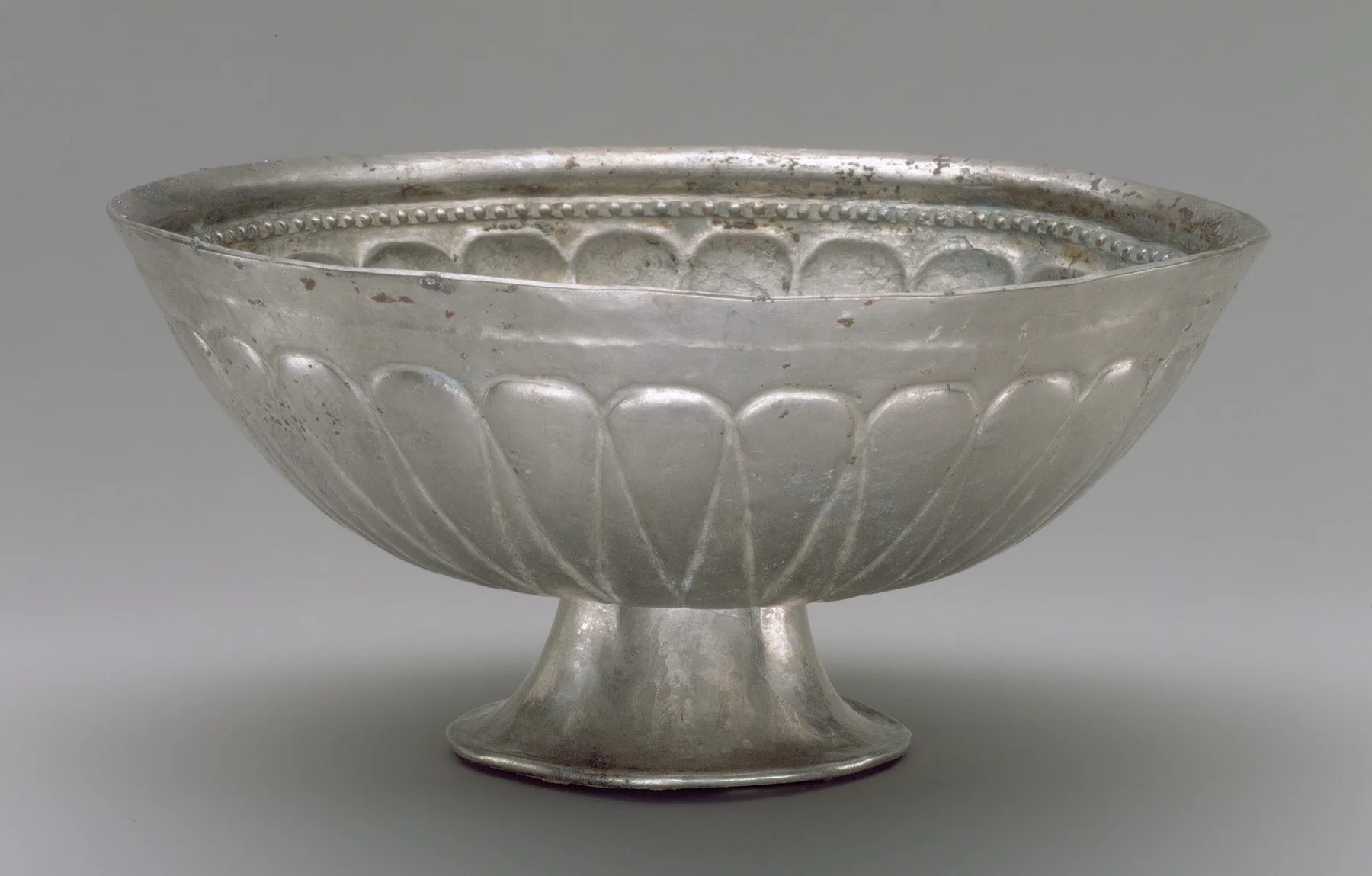
This silver cup did not have to travel from Rome to Sogdiana for its form to have a history of movement.
The bowl rests on a high flaring foot. Large repoussé petals rise around its exterior, and a beaded relief runs beneath the inner rim. The Met identifies the vessel type as western in origin, probably from the Roman Mediterranean, and says that it reached Iran and Central Asia around the fifth century. By the sixth century, the form belonged to the luxury tableware represented in Sogdian court paintings.
The wording matters. “Probably” preserves a scholarly attribution. “The type” names what travelled: a shape and a way of organising prestige at the table. The surviving cup is catalogued as Sogdian, not as a Roman import.
Sogdiana centred on regions of present-day Uzbekistan and Tajikistan. Sogdian-speaking merchants and communities lived across Central Asia and in cities farther east. The Smithsonian’s historical map of Sogdian trade routes describes settlements at oasis centres such as Turfan and communities in Tang China. Their role was not simply to carry sealed cultural packages between two greater civilisations. Sogdian courts, workshops, religious communities, and households selected and remade forms for their own uses.
The cup therefore records adoption without surrendering locality. Its western genealogy and Sogdian identity are not competing answers. A form can arrive, become normal, and support a new social setting.
Xinjiang: a motif is not a passport
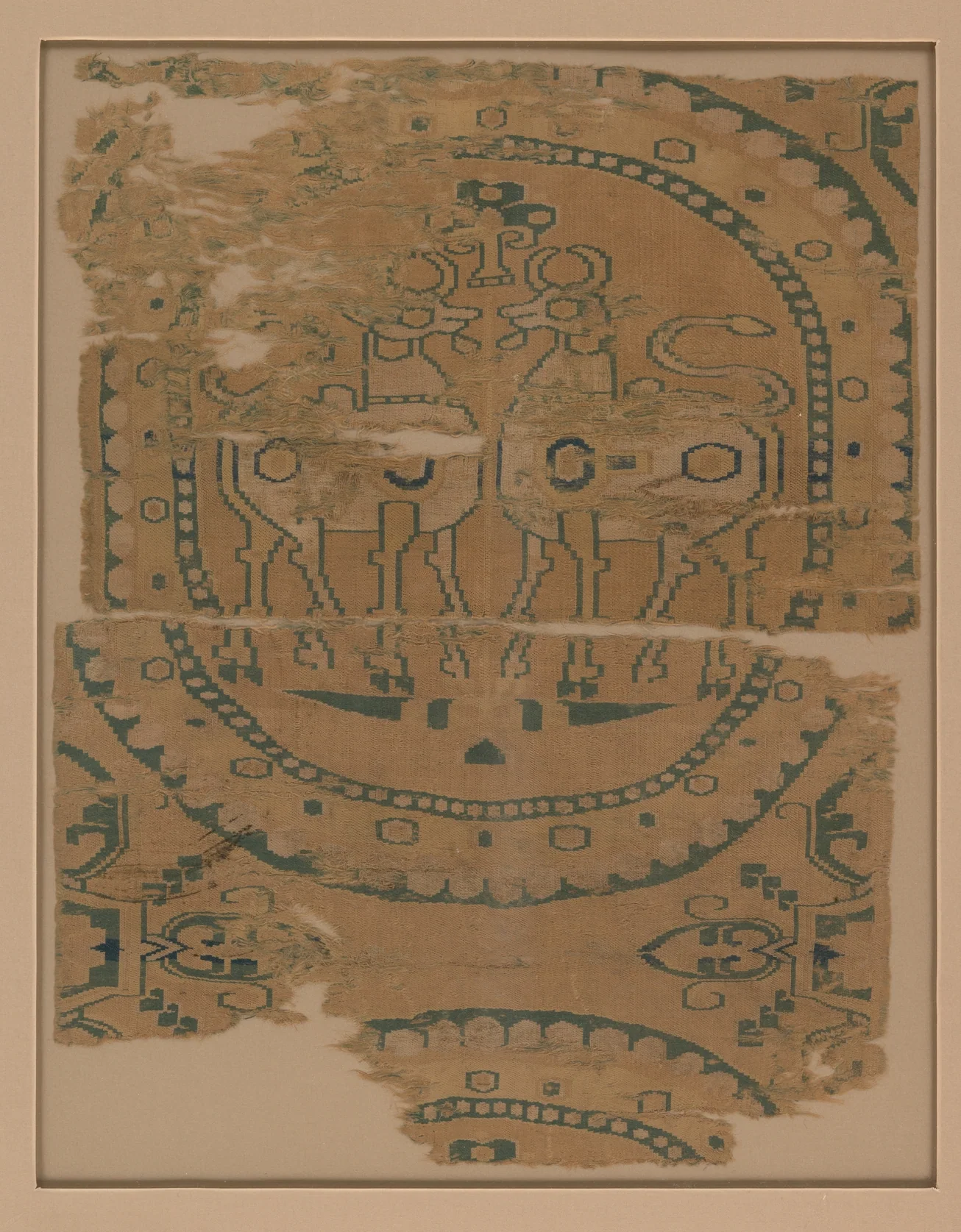
Two horned animals face one another inside a large circle edged with pearl-like beads. The textile survives in damaged fragments; missing threads interrupt the animals, borders, and smaller ornaments. The losses are useful. They force the eye away from the illusion of a perfect travelling pattern and back toward a woven object.
The Met catalogues the fragments to the Xinjiang region and dates them broadly to the seventh through ninth centuries. They are made in weft-faced compound silk twill, a structure in which coloured wefts build the visible design. The museum traces the paired-animal pearl-roundel tradition to the late Sasanian world and associates the textile category’s overland circulation with Sogdian merchants.
That does not make every pearl roundel Sasanian, every textile Sogdian, or every pair of animals evidence of a direct journey from Iran to China. A motif is not a passport stamp.
To argue for movement, an art historian combines several kinds of evidence: fibre and dye analysis; weave structure; excavated context; inscriptions; comparison with securely dated textiles, coins, metalwork, and wall paintings; and records of the communities present in a region. Visual resemblance begins the inquiry. It does not finish it.
The fragments also show why “influence” is often too weak a word. It hides the agent and the operation. Did a merchant carry finished cloth? Did a weaver inspect imported silk? Did a patron request a prestigious roundel? Did a workshop translate a metalwork motif into a loom structure? The object record supports circulation and adaptation, but it does not select one undocumented scene of transmission.
What survives is not an unchanged Sasanian message. It is a textile in which a mobile design category has been rebuilt through particular threads, colours, repetitions, and workshop decisions.
Tang China: an image of travel stayed with the dead
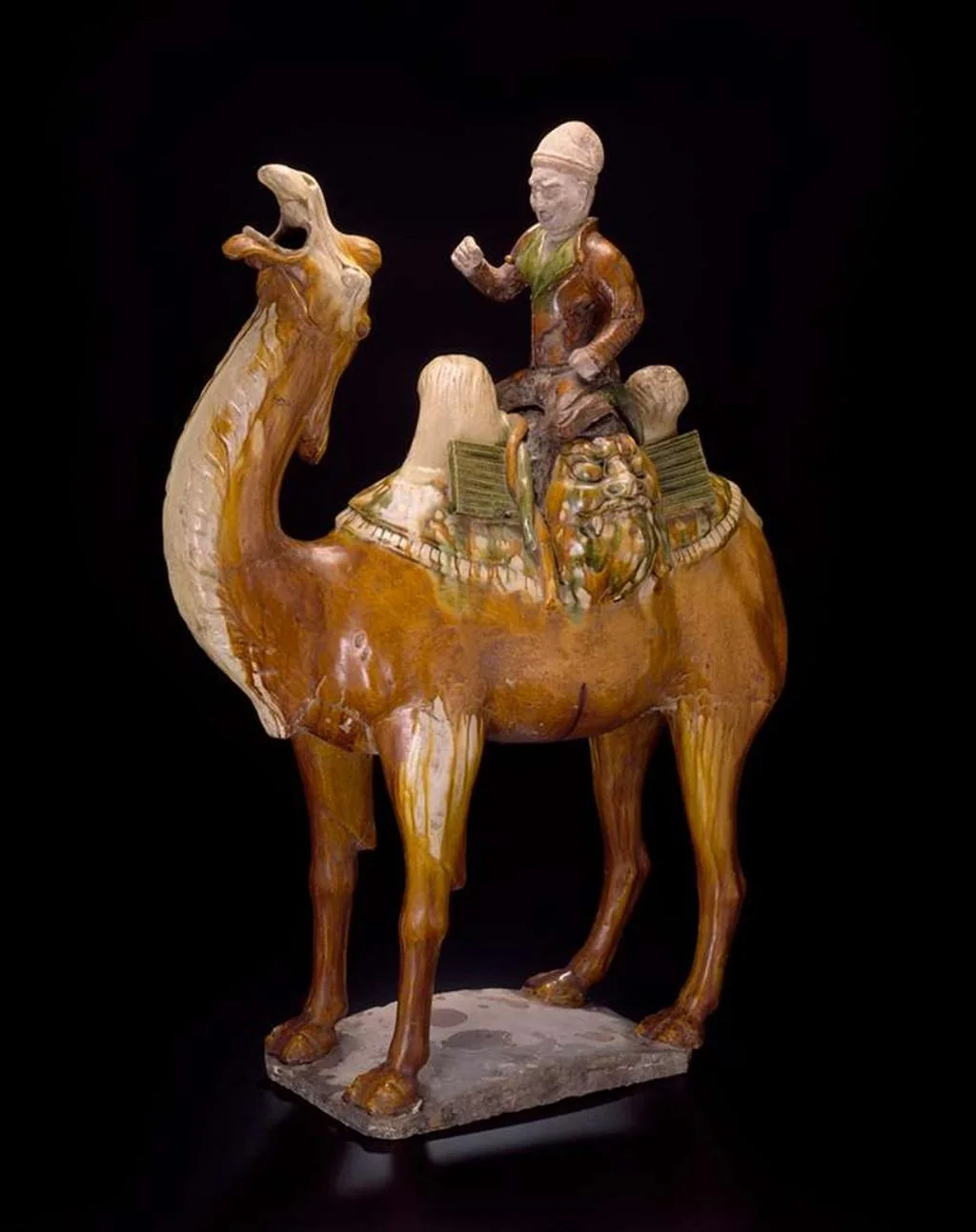
The camel seems to be caught mid-protest: neck stretched, mouth open, rider leaning above its two humps. Amber, cream, and green glazes run across the earthenware surface. The rider’s cap, coat, boots, and facial treatment mark him as Central Asian to the figure’s Tang audience.
But this camel did not carry goods across a desert. It is a mingqi, or “spirit object,” made for a tomb.
The Art Institute of Chicago dates the group to the first half of the eighth century and describes Tang sculptors’ close observation of Bactrian caravans. Its teaching record on the object’s construction and burial context explains that such figures were assembled from moulded hollow sections, covered with a light slip, glazed, fired, and completed with unfired pigment. They provided the deceased with people, animals, goods, protection, and status in the tomb.
The distinction between evidence and representation is crucial. The sculpture supports the presence of a visual category—camel and foreign groom—inside Tang elite burial culture. Its sancai glaze and moulded body document Chinese ceramic production. Its subject makes long-distance transport desirable enough to reproduce for the afterlife.
It does not prove that this rider was a portrait, that this ceramic travelled with a caravan, or that Central Asian people occupied equal positions in Tang society. The stylised “foreigner” may register admiration, dependence, hierarchy, and stereotype at once. Cosmopolitan imagery is not the same as social equality.
The broader political frame was also coercive. The Met’s account of Tang internationalism connects the movement of goods and designs to diplomacy, tribute, military expansion, and control of oasis territories, as well as trade and pilgrimage. The tomb figure turns that complex world into durable property for one burial.
Dunhuang: a travelled religion becomes local practice
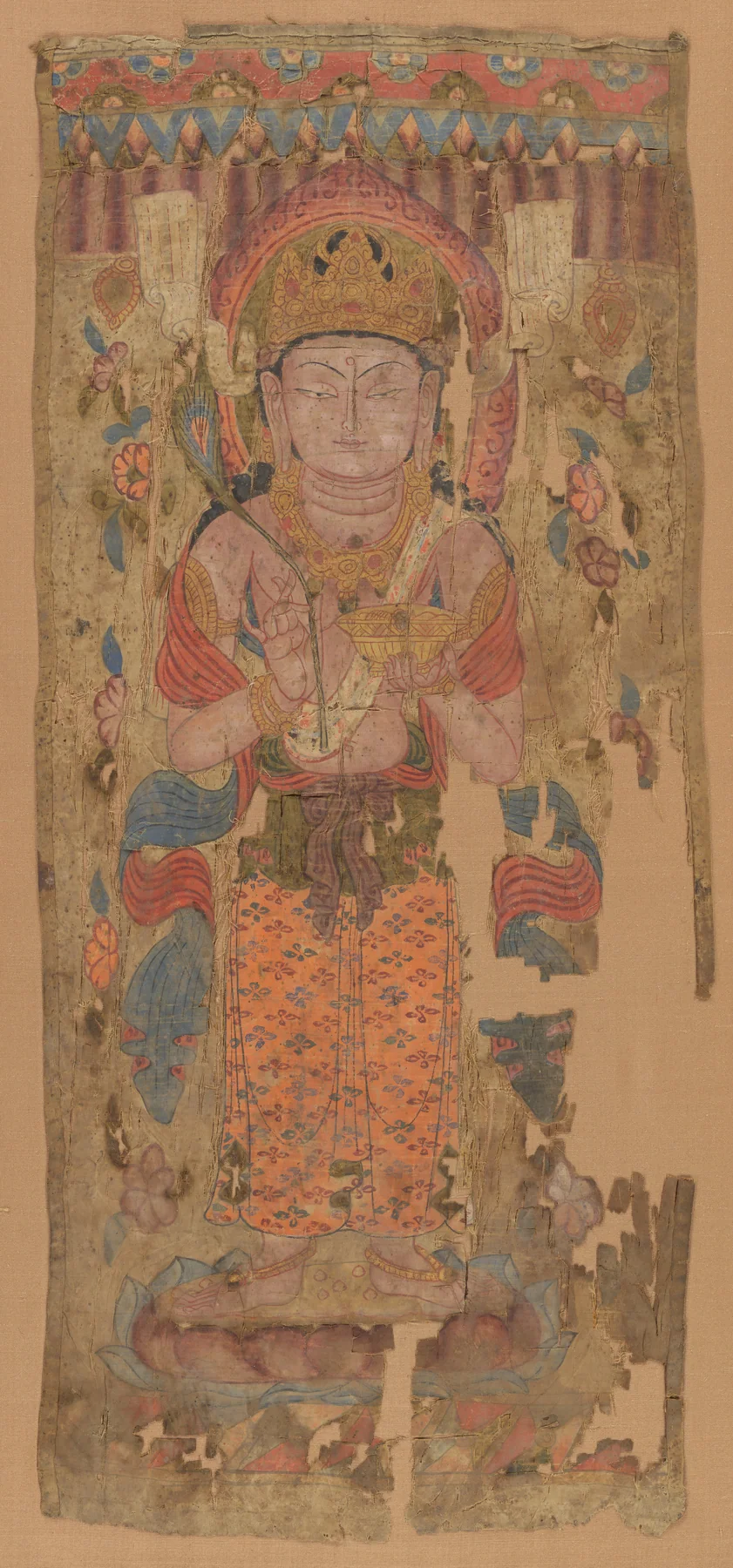
Dunhuang stood where routes north and south of the Taklamakan Desert converged before continuing into northern China. It was an oasis, garrison, trading centre, and place of Buddhist patronage. UNESCO’s Mogao Caves record describes the oasis near the routes’ fork as a relay station where merchandise and ideas circulated, a history also preserved in manuscripts written in Chinese, Tibetan, Sogdian, Khotanese, Uyghur, and Hebrew.
The banner belongs to that local religious world. A bodhisattva stands on a lotus, richly adorned and holding a flower and shallow vessel. The silk has torn and faded, but blue, orange, red, and gold still structure the figure and surrounding blossoms. The Met dates it to the ninth or tenth century and says that such a banner may have hung inside a temple or cave sanctuary, been displayed outside, or been carried on a pole during ceremony.
Its material and format turn doctrine into an encounter. Silk allows a light, suspended image. The elongated field suits a standing sacred figure. Hanging or carrying the banner would let air, movement, changing light, and the bodies of worshippers participate in its appearance. The object was not merely an illustration of Buddhism; it organised attention within Buddhist practice.
The surviving museum object also contains a warning. It consists of a rectangular painted field and a triangular headpiece that, according to the Met, may not originally have belonged together. A modern display can make fragments look more complete and certain than their evidence permits.
The record identifies the work only with the Dunhuang area. It does not assign it to the famous Cave 17, and neither should we. Cave 17 contained tens of thousands of manuscripts, prints, paintings, and textiles in many languages, but its contents were dispersed among institutions in China, Britain, France, Russia, Japan, India, and elsewhere during the early twentieth century. The International Dunhuang Programme now reconnects many of those collections digitally while documenting how the dispersal occurred.
Objects on the Silk Roads did not stop moving in 1000. Excavation, purchase, removal, museum acquisition, conservation, photography, and digitisation created later routes. Those collection histories need the same evidentiary care as the medieval ones.
Five objects, five claims about movement
| Object | What the evidence supports | What it does not support by itself |
|---|---|---|
| Helgö Buddha | A small metal Buddha made probably in the Swat Valley was present in a much later settlement context at Helgö. | A known itinerary, one end-to-end traveller, or continuity of Buddhist meaning in Scandinavia. |
| Sogdian footed cup | A vessel type probably rooted in the Roman Mediterranean became part of Sogdian luxury tableware. | That the surviving cup was made in Rome or copied passively from one prototype. |
| Xinjiang silk fragments | A Sasanian-derived pearl-roundel category circulated and was materially remade in Central Asian textile production. | That motif alone identifies workshop, ethnicity, patron, or exact route. |
| Tang camel and rider | Tang tomb makers represented the Bactrian camel and a Central Asian groom through moulded sancai earthenware. | That the ceramic travelled with a caravan or that its rider is an individual portrait. |
| Dunhuang banner | Buddhist imagery, silk painting, and ritual display were embedded in a local oasis community. | That the banner itself came from India, belonged to Cave 17, or retains its complete original assembly. |
The strongest histories do not make all five rows sound alike. They match the size of the claim to the kind of evidence available.
Exchange depended on power and labour
“Cultural exchange” can sound voluntary, balanced, and peaceful. The objects tell a rougher story.
Routes opened, shifted, or closed through imperial campaigns, treaties, tribute demands, taxation, garrisons, and protection payments. Courts moved artisans and diplomats. Religious communities established monasteries, translated texts, commissioned images, and housed travellers. Merchants depended on guides, animal handlers, interpreters, lenders, innkeepers, and oasis farmers whose names rarely survive in museum labels. Captivity and forced relocation could move skills as effectively as invitation.
Materials had their own labour chains. Silver had to be mined, refined, hammered, and decorated. Silk required sericulture, spinning, dyeing, loom knowledge, and repair. A sancai tomb figure required clay preparation, moulds, joining, drying, glazing, firing, painting, sale, and burial. A painted banner joined woven silk to pigments, drawing, sewing, mounting, suspension, and ritual handling.
Movement is therefore not a magic force called “influence.” It is work organised through institutions and unequal relationships.
A compact timeline
| Date | Event or object | Why it matters here |
|---|---|---|
| Late 5th–early 6th century | Probable manufacture of the Helgö Buddha in the Swat Valley | The object’s early place and sacred identity are distinct from its later Scandinavian context. |
| 5th–6th century | A western footed-vessel type reaches Iran and Central Asia; the Sogdian cup is made in the sixth century | A form can move and become local without the surviving object being an import. |
| 618 | Tang dynasty begins | Court, military, religious, and commercial systems reshape connections across northern China and Central Asia. |
| 629–645 | The monk Xuanzang travels from Tang China to South Asia and returns with texts, images, and relics | Pilgrimage moves people and knowledge as well as portable sacred things. |
| 7th–9th century | Xinjiang pearl-roundel textile | Motifs and loom practices reveal adaptation across connected workshops and markets. |
| First half of 8th century | Tang camel and rider is made for a tomb | The routes become a represented resource inside funerary culture. |
| 9th–10th century | Dunhuang bodhisattva banner | A mobile religion takes material form in an oasis sanctuary and ceremonial system. |
| c. 800–1100 | Archaeological context assigned to the Helgö Buddha | Manufacture date and deposition date must not be collapsed into one moment. |
| 1877 | Richthofen coins Seidenstrassen | The famous name is modern, not a label inherited from the people who used the routes. |
| 1900 onward | Cave 17 at Dunhuang is opened and its contents are dispersed | Modern collecting creates a second history of movement that museums must document. |
Key terms
Silk Roads: a modern collective term for changing land and sea networks that connected communities across Eurasia and beyond. It does not name one road, one direction, or one continuous political system.
Relay exchange: the transfer of goods through multiple agents and regional stages rather than one merchant carrying them from origin to final destination.
Sogdiana: a historical region centred in parts of present-day Uzbekistan and Tajikistan. Sogdian-speaking communities were important traders, settlers, craftspeople, and cultural actors across Central Asia and Tang China.
Findspot: the place where an object was discovered. A findspot is evidence of presence, not automatically of manufacture or original meaning.
Provenance: the documented history of an object’s ownership, custody, excavation, sale, or transfer. Gaps should be stated rather than filled with inference.
Motif: a repeated visual element, such as paired animals inside a pearl-bordered roundel. A motif can be copied, adapted, translated between media, or independently revived.
Mingqi: objects made for Chinese tombs to serve, protect, or display the status of the deceased in the afterlife.
Sancai: literally “three colours,” a term for lead-glazed Chinese ceramics associated especially with the Tang period. The palette often includes cream, amber, green, and sometimes other colours.
Bodhisattva: in Mahayana Buddhist traditions, an awakened being committed to the path of enlightenment and the liberation of others. Bodhisattvas appear in many regional forms and ritual settings.
Questions for close looking
Choose an object that seems “international” and test the claim before repeating it.
- Which feature appears to have travelled: substance, technique, shape, motif, text, religious identity, or the whole object?
- What evidence fixes manufacture, date, and findspot? Which of those fields remains uncertain?
- What had to be remade locally for the object to work in its new setting?
- Does the object document movement, or does it represent movement for an audience that stayed in place?
- Which people supplied the labour, translation, animals, protection, credit, and ritual knowledge behind the route?
- How did the object move after excavation, and is that modern collection history visible?
Turn the observations into an argument with the Observation → Effect → Context → Argument method. If you compare two objects, hold the question constant—such as “what kind of movement is actually evidenced?”—and use the relational structure in How to compare two artworks.
Five myths to retire
- “The Silk Road was a highway from China to Rome.” The term is modern; the historical reality was a changing network of routes, hubs, and relay exchanges.
- “A shared motif proves direct influence.” Resemblance is a clue. Material, technical, archaeological, textual, and chronological evidence must establish the route.
- “The most famous object must have travelled far.” The Tang camel is an image of mobility made for a stationary burial context.
- “Ideas moved unchanged.” Communities translated beliefs and forms into local materials, institutions, languages, and rituals.
- “Exchange was naturally peaceful and equal.” Trade and pilgrimage existed alongside conquest, tribute, displacement, hierarchy, and invisible labour.
Where to continue
Primary object records used here are the Swedish History Museum’s Helgö Buddha, the Met’s Sogdian footed cup, Xinjiang textile, and Dunhuang banner, and the Art Institute of Chicago’s Tang camel and rider. Each link separates current catalogue knowledge from the interpretation built here.
For the network itself, continue with the British Museum’s essay Beyond sand and spices: introduction to Silk Roads, the Smithsonian’s research project The Sogdians, the Met’s accounts of Buddhism along the Silk Road and Tang internationalism, UNESCO’s Mogao Caves record, and the International Dunhuang Programme’s history of Cave 17 and its dispersed collections.
The next time an object is described as a product of “East–West exchange,” ask for the noun and the verb. What moved? Who moved it? What changed? What evidence remains?
Editorial record
About this article
- Author
- Publisher
- GeMarkt
- Published
- Updated
- Reviewed
- Internal source & rights check. Conducted by GeMarkt Research Review. This is an internal editorial check—not independent peer review.
- Source standard
- Art history source standardPrioritises object records and research sources, distinguishes evidence from interpretation, and states material uncertainty.
Found a claim that needs checking? Report a factual error.