Art History · Learning chapter
Atlas I — Foundations and ancient worlds · 4 of 10
Bronze Age Aegean art: palace, sea, ritual, and archaeological reconstruction
A five-case guide to Cycladic, Cretan, Theran, and Mycenaean art that separates Bronze Age evidence from the modern reconstructions through which we see it.


What we’ll look at
Which parts of Bronze Age Aegean art are ancient, restored, or reconstructed?
At Knossos, the most immediately legible building is also an argument.
Red columns taper toward the floor. A bull charges across a blue field. Rebuilt walls rise beside lower, rougher masonry. The view feels complete enough to enter as an ancient scene, yet much of that completeness was made in the twentieth century. Excavation exposed fragments; conservation kept them standing; reconstruction supplied height, colour, sequence, and atmosphere.
This does not make Knossos false. It makes the site unusually honest once we learn to see its layers.
The same discipline applies across the Bronze Age Aegean. A Cycladic figure now appears white although colour once transformed many such bodies. A Theran vessel carries dolphins and wild goats, but its imagery is not a map of an empire. A bull’s-head rhyton looks whole even though only half of its stone head is ancient. At Mycenae, later epic memory can rush through a gateway faster than the archaeological evidence.
This guide asks one question across five cases:
How much of the Bronze Age Aegean world can objects establish, and how much has been assembled by modern names, restorations, and stories?
The route runs from the Cyclades around 2700 BCE to mainland Greece around 1200 BCE, with stops on Crete and Thera. It is not a complete survey of the Aegean Bronze Age. Cyprus, western Anatolia, the northern Aegean, the Adriatic, and the wider eastern Mediterranean enter only where a material route requires them. Nor are Cycladic, Cretan, Theran, and mainland histories stages in one civilisation’s rise.
What connects them is water, movement, and archaeological comparison—not a single people.
The Aegean is a map, not a nation
Modern archaeology uses three overlapping regional chronologies:
- Cycladic for the islands at the centre of the Aegean;
- Minoan for Bronze Age Crete;
- Helladic for the Greek mainland, with Mycenaean commonly applied to the Late Bronze Age palace-centred cultures there.
These labels help organise pottery sequences, buildings, burials, scripts, and changing networks. They do not reproduce a Bronze Age passport system.
“Minoan” was built by modern scholarship around Crete and the mythic name Minos. “Mycenaean” takes one archaeological site, Mycenae, and extends its name across varied mainland centres. “Cycladic” is geographical, but the islands did not all make the same things or follow the same history. Thera belongs to the Cyclades, yet its sixteenth-century material culture shows intense contact with Crete while retaining distinctly local forms.
Period names also overlap imperfectly. Early Cycladic II, the Cretan New Palace or Neopalatial period, Late Cycladic I, and Late Helladic IIIB belong to different regional sequences. A single column labelled “Bronze Age” can hide those differences.
There is a second surprise in the name: most of the works in this article are not bronze. They are marble, clay, plaster, steatite, shell, crystal, and stone architecture. Bronze depended on copper and tin arriving through long supply chains. The Uluburun shipwreck, sunk off the coast of present-day Türkiye around 1320 BCE, carried both metals alongside glass, pottery, resin, ivory, jewellery, tools, and personal possessions. Bronze is therefore not just a material. It is evidence of connected extraction, transport, knowledge, and demand.
A Cycladic figure: the modern whiteness of an ancient body
In brief: The first example is a 37-centimetre marble female figure made in the Cyclades around 2700–2500 BCE. It looks white today, but traces on related figures show that its ancient surface may have been painted.
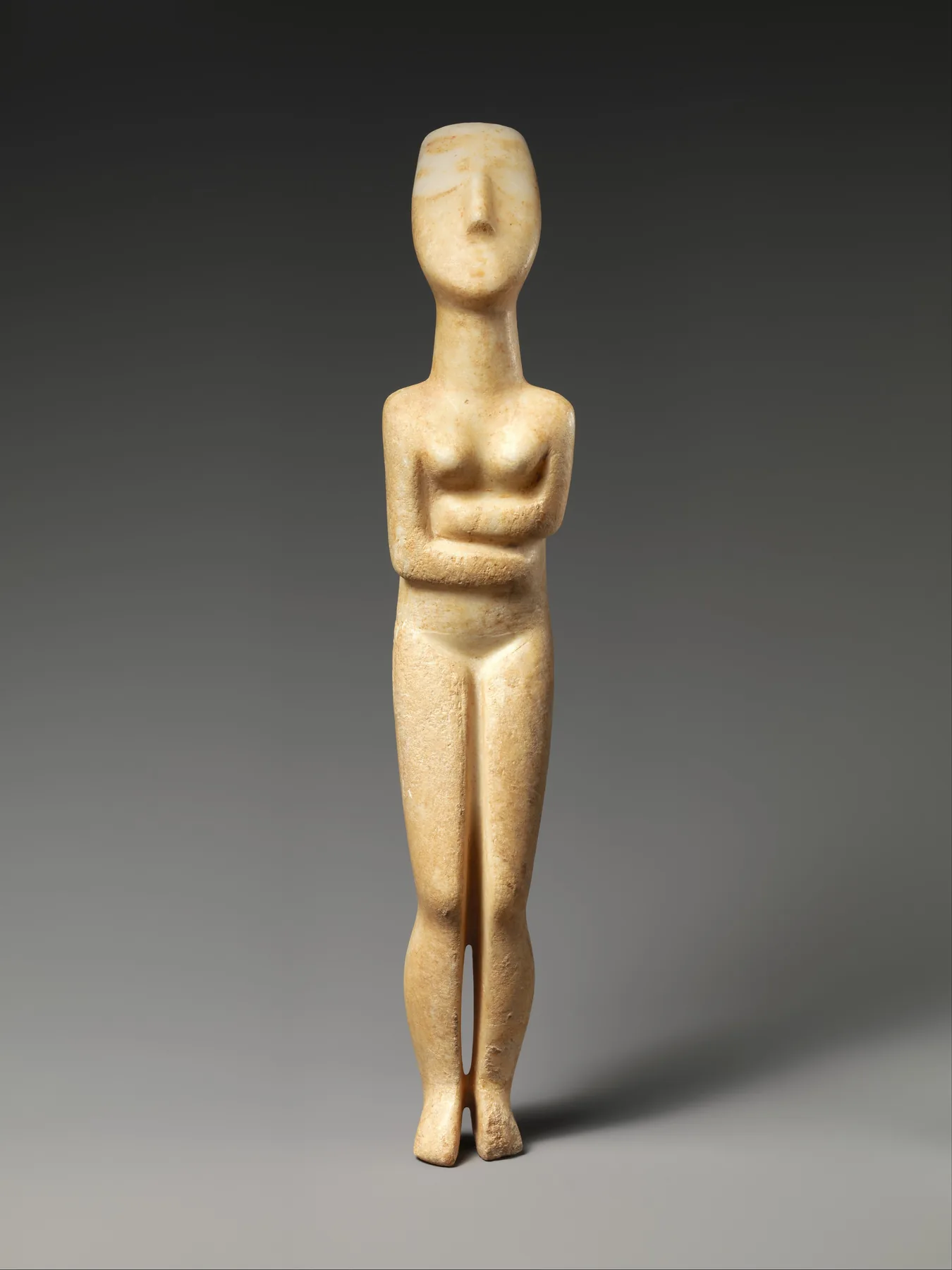
The figure narrows and widens through a small set of decisions. Toes point down. Legs separate only near the ankles. Forearms cross the torso. The head tilts back, and a projecting nose interrupts an otherwise spare face.
The Met object record dates the 37.1-centimetre marble figure to Early Cycladic II, 2700–2500 BCE. It says the object is believed to have been found with a marble bowl and a fragment of a terracotta offering vessel. No excavated site or grave is named in the online record.
That absence matters. Many Cycladic figures come from funerary contexts, but the Museum of Cycladic Art’s review of their function warns that looting, especially in the 1950s and 1960s, destroyed a large amount of archaeological information. A general pattern cannot replace the missing findspot of one object. We can say this figure belongs to a recognised type; we cannot rebuild its precise ancient setting from resemblance alone.
Its present colour is another loss disguised as simplicity. Scientific study has established that Early Cycladic makers used mineral pigments on marble. Some figures retain traces or smoother “paint ghosts” where colour once protected the surface. The Museum of Cycladic Art’s colour study records red, blue, green, and black pigments used for features, hair, ornaments, and other marks. That evidence supports a practice across the corpus. It does not justify digitally repainting this particular figure with a confident face.
Modern viewers often admire Cycladic figures as ancestors of twentieth-century abstraction. The comparison can sharpen looking: both may privilege contour, reduction, and proportion. It becomes misleading when modern taste is projected backward as the maker’s intention. The white, isolated museum figure is already a transformed object—cleaned of most colour, separated from companions, raised upright, and lit as autonomous sculpture.
The safest interpretation is smaller and stronger. A skilled maker used island marble, abrasion, incision, and learned conventions to produce a portable human image. The folded-arm form was repeated and varied across communities. Its exact identity—deity, ancestor, mourner, companion, prestige object, or something outside those categories—remains unsettled.
Knossos: when preservation becomes a picture of the past
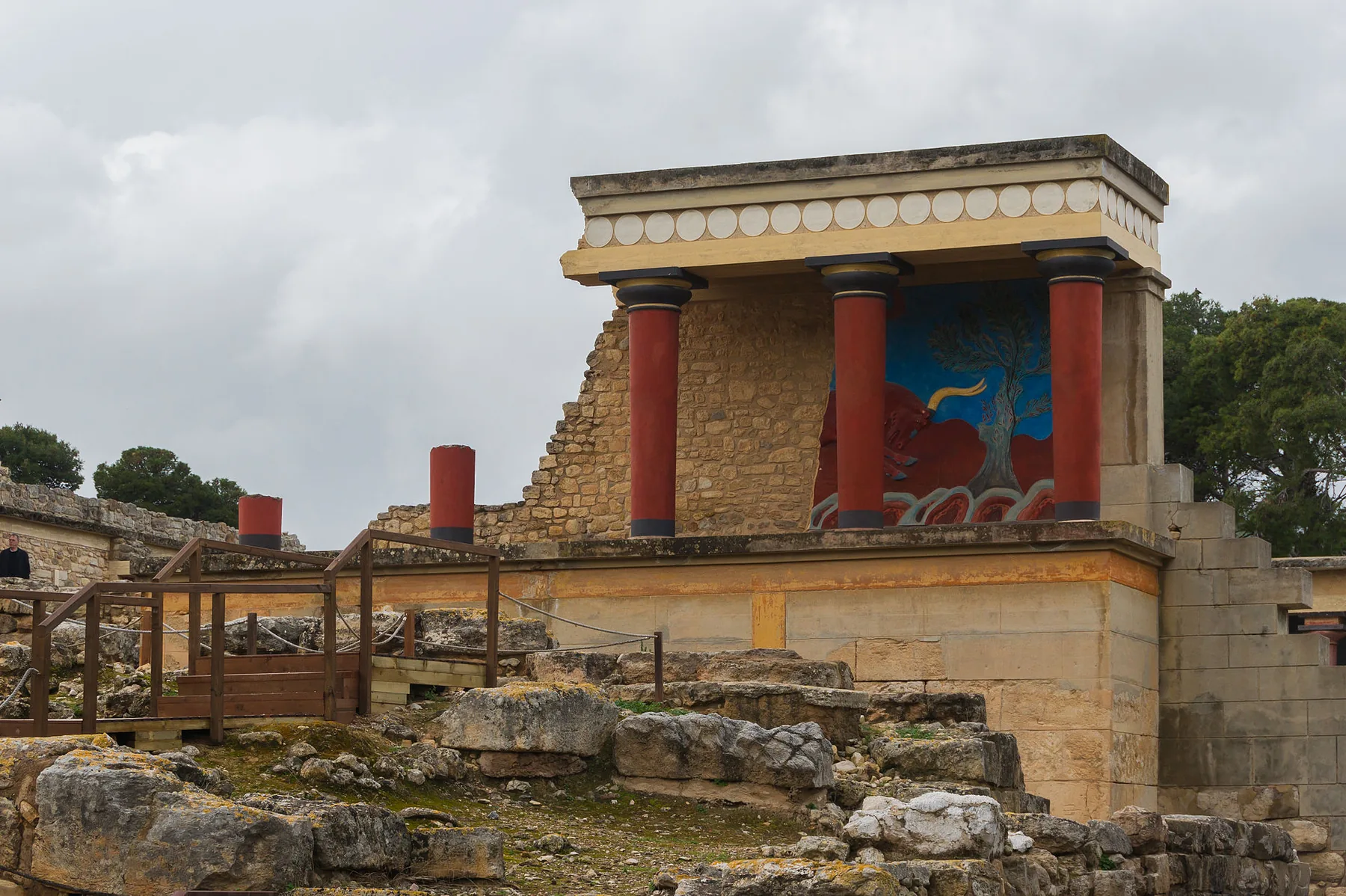
Look at the photograph as a stratigraphic section in plain sight.
Low stonework and irregular surfaces mark ancient fabric. Above and beside them, reinforced structures, painted columns, flat planes, and a copy of a bull image create a legible entrance. Railings, walkways, and barriers belong to the visitor site. Weather acts on all three layers.
The Hellenic Ministry of Culture records continuous occupation at Knossos from the Neolithic period into Roman times. It dates the principal palace phases broadly between the second millennium and the fourteenth century BCE and states plainly that Arthur Evans carried out the restoration that produced the site’s present form. The British School at Athens continues to care for and study excavation collections spanning more than a century of work.
Evans began systematic excavation in 1900. His teams did not merely reveal a ready-made building. They grouped spaces, named rooms, connected wall fragments, installed copies of paintings, and rebuilt architectural volumes. Some interventions protected vulnerable remains; others fixed contested interpretations in concrete. Later conservators inherited two connected responsibilities: Bronze Age material and a consequential modern restoration history.
Even the word palace is an interpretation. Knossos contains courts, storerooms, workshops, reception spaces, cult areas, archives, circulation routes, and connections to a larger settlement. “Palatial centre” is useful when it names this concentration of administrative, economic, social, and ritual functions. It becomes too narrow when it turns the complex into the private residence of a known king.
In July 2025, UNESCO inscribed six Minoan palatial centres—Knossos, Phaistos, Malia, Zakros, Zominthos, and Kydonia—as a serial property. That recognition helps correct the old visual habit of making Knossos stand for all of Crete. The sites share features, but each has its own landscape, building history, archives, workshops, and conservation conditions.
The reconstructed North Entrance is therefore useful twice. It proposes how architecture and imagery may have directed movement through an important complex. It also reveals how a modern archaeologist could turn partial evidence into a persuasive public image.
The right question is not “ancient or fake?” It is: which element belongs to which intervention, and how does each intervention guide what we believe?
Akrotiri: a local vessel looks toward land and sea
.jpg)
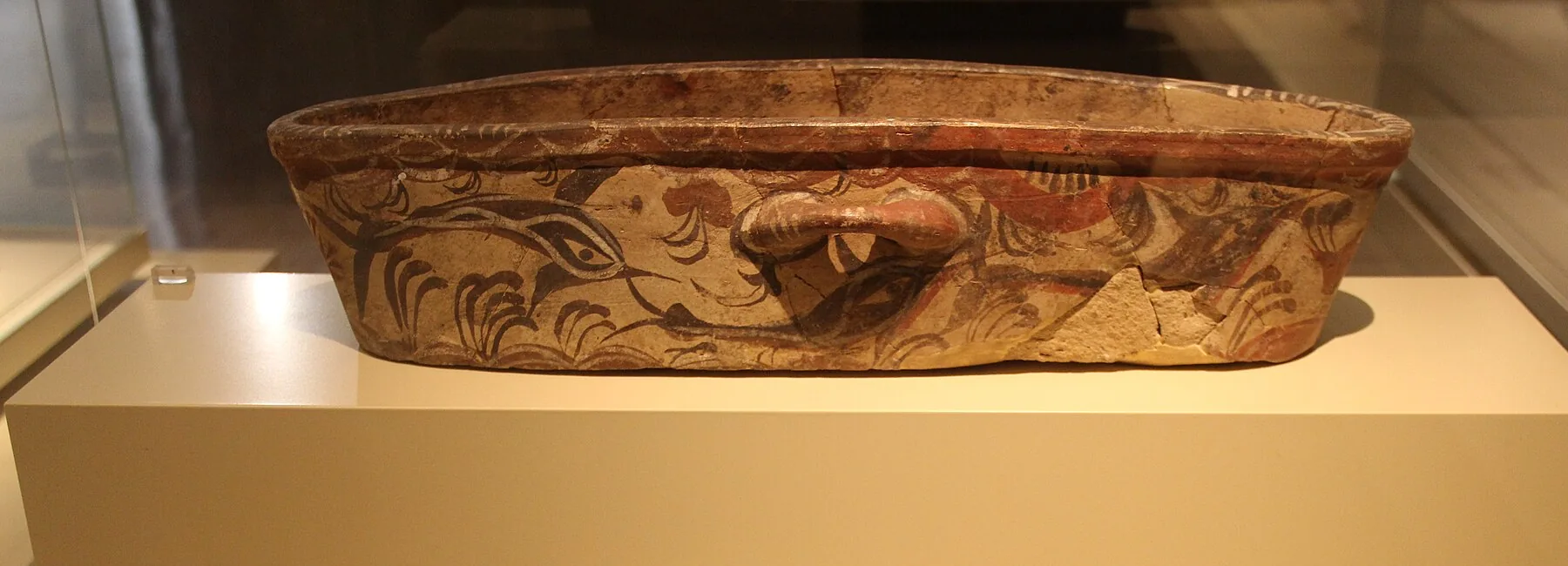
The vessel is long, shallow, rounded at the ends, and equipped with handles on its sides. Dolphins travel through a marine field on one face. Three wild goats move among oversized crocuses on the other. To see the complete programme, a viewer must circle the pot.
The National Archaeological Museum’s object study identifies it as a kymbe, a Theran shape not found elsewhere in the prehistoric Aegean. It was excavated in Room 7 of the House of the Ladies at Akrotiri and dates to the beginning of the sixteenth century BCE. The museum counts only eight known examples.
This context lets us say more than “Minoan marine style.” Akrotiri was a Cycladic settlement with close Cretan connections, not a passive copy of Crete. Its makers combined shared techniques and motifs with a local vessel form. The museum’s wider Thera collection account describes multi-storeyed buildings, wall paintings, varied pottery, and objects preserved by volcanic burial. It also distinguishes evidence of Cretan contact from the local history of the settlement.
The House of the Ladies had residential and probably ritual dimensions. The vessel’s rarity, shape, and imagery make special use plausible, but its exact purpose is unknown. “Ritual” should mark a reasoned possibility, not act as a bin for every unusual object.
The dolphins are equally vulnerable to over-reading. Sea imagery belongs naturally to island life, observation, memory, exchange, and symbolic thought. It does not by itself prove a centrally governed “Minoan sea empire.” Material routes need material evidence: imported substances, harbour installations, shipwreck cargoes, foreign objects in dated contexts, production analysis, and records where they survive.
Uluburun demonstrates a densely connected Late Bronze Age Mediterranean, but even that exceptional wreck was not simply “a Minoan ship.” Its cedar hull, cargo origins, equipment, and personal possessions point toward a wider eastern Mediterranean network. The Aegean participated in maritime exchange without owning every route that touched it.
The kymbe gives a more intimate truth. Sea and land could meet on one locally made object. Connection did not erase place.
A bull’s-head rhyton: ritual through an assembled face


The bull appears alert because several materials cooperate. Incisions and relief describe hair. White shell outlines the muzzle. Rock crystal and jasper build an eye whose shaped crystal magnifies the pupil. The restored gilded horns carry the silhouette far beyond the dark head.
Now remove, mentally, the right half and both horns.
The Heraklion Archaeological Museum states that only the left side of the black steatite head is original. The horns were not found; the ancient ones were probably gilded wood. The displayed object is an evidence-based restoration, not an untouched masterpiece.
Its function is more securely constrained than its complete appearance. A rhyton is a pouring vessel. Liquid entered through an opening behind the neck and exited through the mouth. Find context, internal channels, wear, and comparable vessels support its use for libations—liquid offerings. The object’s material engineering made a controlled stream part of the image: the bull did not merely represent; it acted.
That does not recover a full ceremony. We do not know every substance poured, word spoken, participant present, deity addressed, or occasion observed. Nor should the much later Minotaur story be used as a translation key. Bulls recur in Cretan images and practices, but repetition establishes cultural importance more readily than one fixed meaning.
The museum associates stone bull’s-head rhyta with the New Palace period and palatial, probably Knossian production. This joins specialist quarrying, carving, drilling, inlay, and lost woodworking to elite ritual display. “Palace art” here should direct attention to concentrated resources and ceremonial settings—not erase the craftspeople whose names are absent.
The restoration is not a footnote to that reading. It makes the liquid-bearing animal imaginable while also producing a wholeness the excavation did not supply. A responsible caption must do what the polished silhouette cannot: keep ancient fragment, comparative reconstruction, and modern material visible at once.
Mycenae: a gateway before it became an epic image
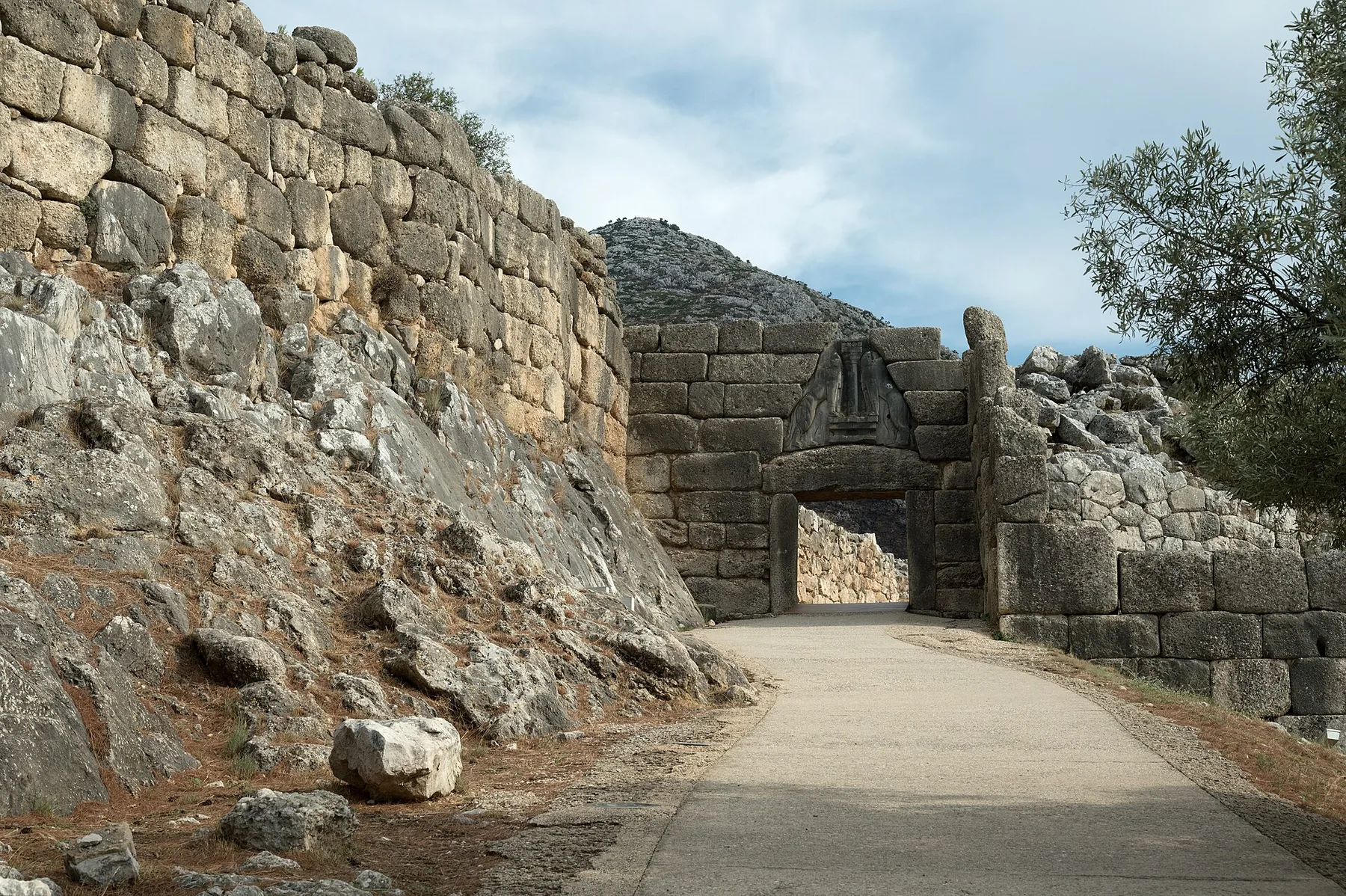

Mycenae makes movement narrow before it makes power visible.
A visitor approaches between massive walls, passes under a single stone lintel, and sees two opposing felines place their forelegs on raised forms beside a central column. The relief occupies the triangle that reduces weight over the opening. Structure, image, and controlled passage are one composition.
The Hellenic Ministry of Culture’s site history places the Lion Gate and the western and southern enlargement of the fortification around 1250 BCE, during Late Helladic IIIB1. The gate led toward Grave Circle A, buildings, cult areas, workshops and storerooms, and the palace at the citadel’s highest point. The UNESCO site record situates Mycenae and nearby Tiryns within a network of Late Bronze Age palatial centres rather than treating one citadel as the whole mainland.
The missing heads impose a limit. “Lion Gate” is a useful modern name, but the surviving bodies do not settle every zoological or symbolic detail. The central column resembles architectural forms known in Cretan imagery. That resemblance supports inquiry into transferred motifs and remade authority. It does not prove that a Cretan symbol retained one meaning when carved over a mainland fortress entrance.
Scale gives us stronger ground. Quarrying, moving, dressing, and positioning the blocks required organised labour and technical knowledge. The approach controls bodies. The elevated relief joins the gate’s physical strength to a visual claim about the institution behind it. Palace administration is also documented by workshops, storerooms, roads, and Linear B tablets. Linear B records an early form of Greek, but those administrative texts do not provide a caption for the gate.
Later literature is no substitute. Mycenae became inseparable from Agamemnon in Greek epic and from Heinrich Schliemann’s nineteenth-century search for Homeric places. Yet the gate was built centuries before the surviving epic texts took written form. Calling it “Agamemnon’s gate” turns a later association into an excavated fact.
Modern archaeology has its own chronology here. The Lion Gate was cleared in 1841, before Schliemann excavated Grave Circle A in 1876. Conservation and restoration continued through Greek archaeological institutions. The site we walk is ancient construction, long exposure, excavation, stabilisation, paths, labels, and modern national stewardship.
It is powerful enough without a named legendary king.
Five cases, five reconstructions
| Case | Surviving evidence | Modern frame or intervention | Strongest responsible claim | What remains unresolved |
|---|---|---|---|---|
| Cycladic marble figure | Carved marble body; typological and possible object associations | Museum isolation, upright display, lost colour, incomplete find context | A learned folded-arm convention joined marble skill to portable human imagery | Exact findspot, identity, use, and the decoration of this individual figure |
| Knossos North Entrance | Ancient foundations, walls, fragments, stratigraphy, associated finds | Evans-era architectural rebuilding, painted copies, concrete, visitor circulation | A major centre concentrated economic, administrative, social, and ritual activity | The exact form of many upper spaces and whether “palace” captures every function |
| Akrotiri kymbe | Excavated room context, local vessel shape, painted dolphins, goats, and plants | Fragment assembly and museum display | Theran makers joined local form to wider Aegean visual and maritime connections | Exact use, ritual occasion, and meaning of the imagery |
| Bull’s-head rhyton | One ancient steatite side, inlays, channels, find context, parallels | Rebuilt second side and reconstructed horns | A specialist pouring vessel made liquid offering a visual performance | Complete ancient appearance, ceremony, participants, and addressee |
| Mycenae Lion Gate | Masonry, relief bodies and column, route, fortification phase | Missing heads, later epic naming, excavation and conservation landscape | Monumental image and architecture choreographed access to a palatial citadel | The felines’ precise identity, motif meaning, and ancient viewers’ words for it |
“Reconstruction” therefore names more than adding new stone or plaster. Typology reconstructs a damaged form from comparisons. Chronology reconstructs sequence from layers and styles. A map reconstructs networks from scattered finds. A museum reconstructs an object encounter through lighting and placement. A historian reconstructs a social world from buildings, residues, texts, and absences.
The work is unavoidable. The obligation is to show its joints.
A compact timeline
| Date | Regional frame | Case or change | Caution |
|---|---|---|---|
| 3200–2000 BCE | Early Cycladic / Early Helladic / Early Minoan sequences | Island, mainland, and Cretan communities develop distinct but connected material traditions | The three chronologies are not one ladder |
| 2700–2500 BCE | Early Cycladic II | Met marble female figure | The date and type are stronger than the object’s undocumented exact findspot |
| about 1900 BCE onward | Cretan palatial sequences | Major centres develop and are rebuilt in changing phases | “Palace” need not mean only a royal residence |
| 1600–1450 BCE | Cretan New Palace / Neopalatial period | Knossos bull’s-head rhyton and intensive palatial production | The displayed vessel is substantially restored |
| beginning of sixteenth century BCE | Late Cycladic I at Akrotiri | Dolphin-and-goat kymbe in the House of the Ladies | Volcanic preservation gives context, not a complete account of belief |
| after about 1450 BCE | Final Palatial Crete / mainland Late Helladic developments | Linear B administration appears at Knossos; mainland centres expand | Change is not a clean replacement of one homogeneous people by another |
| about 1250 BCE | Late Helladic IIIB1 | Lion Gate and enlarged fortifications at Mycenae | Later Homeric names are reception history, not contemporary labels |
| around 1200 BCE and after | End of mainland palatial systems | Destructions, abandonments, continuities, and regional reorganisation | There was no single simultaneous event or universally accepted cause |
The last line deserves emphasis. Recent scholarship studies the end of the Aegean Bronze Age as social change as well as palace destruction. The palatial system ended; communities, practices, and people did not vanish on one night. A 2024 review in Antiquity stresses that destruction events were not simultaneous and rejects a single “silver bullet” explanation. A 2025 Cambridge study of post-palatial change similarly asks what reorganised after 1200 BCE rather than treating “collapse” as the disappearance of society.
Key terms
Aegean Bronze Age: a modern study frame for the third and second millennia BCE around the Aegean. Its boundaries and regional chronologies vary.
Cycladic: a geographical and archaeological label for the Cyclades. It does not describe one unchanged island culture.
Minoan: the modern conventional label for Bronze Age Cretan cultures, named through the later myth of Minos. It is useful but not a recovered ancient ethnic name.
Helladic: the archaeological chronology used for the Bronze Age Greek mainland: Early, Middle, and Late Helladic, each with finer phases.
Mycenaean: conventionally, the Late Bronze Age material and palace-centred cultures of mainland Greece, named after Mycenae. The label can hide differences among centres.
Palatial centre: a monumental complex concentrating combinations of administration, storage, production, ceremony, gathering, and authority. The term does not prove a known monarch lived in every room.
Rhyton: a vessel designed for controlled pouring, often through a second opening. Context and construction can support ritual use, but do not recover a full rite.
Libation: a liquid offering. Archaeologists infer the practice from texts, vessels, channels, residues, images, and contexts with different levels of certainty.
Linear A: an undeciphered script used principally on Crete and at some connected Aegean sites. Its presence documents administration and writing, not a translated history.
Linear B: a syllabic script adapted to record an early form of Greek, used in palace administration on Crete and the mainland.
Anastylosis: rebuilding a monument with identified original elements, normally with modern additions made legible. Knossos includes broader and more interpretive reconstruction than this narrow term alone describes.
Provenience: the exact archaeological find location and associations of an object. It differs from provenance, its later ownership and collecting history.
Questions for close looking
Choose one Aegean object or site and separate three layers: ancient evidence, archaeological inference, and modern presentation.
- Which parts are original material, ancient repairs, modern fills, copies, supports, or complete reconstructions?
- Does the present museum colour match evidence for the ancient surface?
- Is the findspot documented at room, building, grave, settlement, island, or only regional level?
- Which word—palace, goddess, ritual, king, Minoan, Mycenaean—carries more certainty than the evidence warrants?
- Does a marine motif document observation, connection, symbolic meaning, trade, political control, or only some of these?
- What labour is visible in quarrying, carving, painting, transport, rebuilding, and conservation?
- If a comparable object supplies a missing horn, wall, or motif, is that comparison labelled?
- What changes when the object is returned mentally to a doorway, floor, procession, grave, storeroom, or pouring action?
Use Observation → Effect → Context → Argument to keep the levels distinct. To compare the Cycladic figure with the bull rhyton, or Knossos with Mycenae, hold one problem steady—body, movement, concentrated resources, reconstruction, or controlled access—and build the relationship with the comparative method.
Six myths to retire
- “The Minoans, Cycladic people, and Mycenaeans were one Greek civilisation developing in sequence.” The labels belong to different geographies, periods, languages, and archaeological problems, even when their makers exchanged objects and practices.
- “Cycladic figures were designed as pure white abstractions.” Many were coloured; their current whiteness is a condition of survival and display.
- “A palace is simply a king’s house.” Aegean palatial centres combined storage, administration, production, gathering, ritual, and political authority in changing ways.
- “Dolphins and ships prove a Minoan sea empire.” Imagery establishes attention to the sea; political control requires different evidence.
- “A restored museum object shows what excavators found.” The Knossos rhyton joins one ancient half to modern completion, and the difference changes interpretation.
- “Mycenae confirms Homer.” Bronze Age remains and later epic traditions have a powerful reception history; association is not contemporaneous identification.
Where to continue
Begin with exact objects. The Met’s Cycladic figure supplies measurements, date, associated objects, image status, and the limit of its published find information. Pair it with the Museum of Cycladic Art’s research on colour, manufacture, and the damage caused by looting to interpretation.
For Crete, read the Hellenic Ministry’s Knossos site account, UNESCO’s newly inscribed Minoan Palatial Centres, and the British School at Athens on continuing research and legacy excavation material. Then return to the Heraklion Museum’s bull’s-head rhyton record and notice how clearly it distinguishes the surviving half from the restored whole.
For Thera, the National Archaeological Museum’s kymbe study is unusually valuable because it gives room-level provenance, measurements, rarity, and uncertainty about use. Its Thera collection overview keeps local development and Cretan connection in the same frame.
For mainland Greece, use the Hellenic Ministry’s Mycenae history alongside UNESCO’s combined record for Mycenae and Tiryns. The first supplies construction and excavation sequence; the second prevents the most famous site from erasing another major centre.
Then look again at Knossos. The reconstructed columns no longer disappear into “the ancient palace,” but neither do they become useless scenery. They are evidence of how archaeology became public vision.
The Bronze Age survives in fragments. Our task is not to refuse reconstruction. It is to reconstruct without hiding the seams.
Editorial record
About this article
- Author
- Publisher
- GeMarkt
- Published
- Updated
- Reviewed
- Internal source & rights check. Conducted by GeMarkt Research Review. This is an internal editorial check—not independent peer review.
- Source standard
- Art history source standardPrioritises object records and research sources, distinguishes evidence from interpretation, and states material uncertainty.
Found a claim that needs checking? Report a factual error.