Art History · Learning chapter
Atlas II — Connected worlds · 6 of 10
South Asian temple worlds, c. 600–1400: image, movement, patronage, and ritual presence
A five-work guide to how stone, brick, bronze, movement, and patronage made sacred presence across selected South Asian temple worlds.

_(37425784596).jpg)
What we’ll look at
How did sacred images gain meaning through material, movement, and worship in South Asian temples?
Bodies gather around a break in the stone. Some stand in disciplined stillness; others lean, fly, kneel, gesture, or turn. A many-armed Shiva faces a thin ascetic balanced on one leg. Below them, attendants, animals, and hybrid beings compress different kinds of life into one granite field.
This is a detail of the Great Relief at Mamallapuram on the Coromandel Coast of present-day Tamil Nadu. The complete carving stretches across two adjoining boulders. A deep vertical cleft divides them. The relief is often called Descent of the Ganges, as though the fissure were a river falling from heaven. It is also called Arjuna’s Penance, after the hero who practises austerities to receive a weapon from Shiva. Neither title has settled the question.
That uncertainty is useful. A sacred image was not necessarily designed to deliver one museum-label answer. Stone, water, story, royal authority, bodily discipline, and a viewer’s movement could work together. Meaning happened through an encounter.
The same principle changes how temples are studied. A temple is easy to reduce to a silhouette: tower, doorway, ornament, style. Yet sacred architecture joined buildings to images, images to consecration and care, patrons to institutions, and routes to moving bodies. Some gods remained in sanctums. Others left in procession. Monasteries joined worship to teaching, sleeping, eating, copying, and debate. Rock-cut sites accumulated Buddhist, Hindu, and Jain activity over generations rather than expressing one timeless “Indian religion.”
This guide asks:
How did makers and patrons turn material, movement, and repeated acts into sacred presence—and what disappears when South Asian temples are treated as static stone containers?
Five studies offer different answers. Mamallapuram makes landscape participate in narrative. Ellora produces a mountain-temple by removing basalt. Somapura Mahavihara organises monastic life and circumambulation through brick, terracotta, and a vast courtyard. A Chola-period Nataraja was made to move and be seen. A marble Jain Tirthankara makes stillness the focus of active veneration.
They are not five stages of one style. They are five ways material became relational.
What do “South Asian” and “temple worlds” mean here?
South Asia is a modern regional label, not the name of one historic civilisation. This article follows selected works in places now within India and Bangladesh. It does not stand for every history in present-day Afghanistan, Pakistan, India, Nepal, Bhutan, Bangladesh, Sri Lanka, or the Maldives, nor for every mobile community connected to them.
The date range c. 600–1400 holds several transformations together: growing regional courts, temple and monastic construction, new devotional movements, long-distance pilgrimage, changing image practices, and connections across the Indian Ocean, Himalayas, and Bay of Bengal. It does not describe a sealed “Hindu period.” Buddhist, Hindu, and Jain institutions coexisted with many local practices and, in later centuries, with expanding Islamicate courts, mosques, tombs, workshops, and commercial networks.
Temple worlds is deliberately plural. “Temple” can identify a deity’s dwelling, a shrine within a larger compound, a monastic complex, or a modern category imposed across institutions with different names and functions. A mandapa, vihara, cave sanctuary, processional image, and Jina sculpture cannot be treated as interchangeable because all now appear in art-history surveys.
Nor is religion only a belief stored behind form. Temples gathered land, water, labour, food, music, lamps, flowers, textiles, inscriptions, taxation, gifts, legal claims, teaching, and pilgrimage. They could support communities and display unequal access. Royal patronage mattered, but so did merchants, officials, monastics, craftspeople, dancers, musicians, cooks, cleaners, image bearers, and unnamed donors.
The British Museum’s Ancient India: living traditions project stresses that Hindu, Buddhist, and Jain sacred arts belong to living religions rather than a completed ancient past. Historical interpretation therefore has two responsibilities: distinguish past contexts carefully and avoid writing present practitioners out of the story.
Mamallapuram: when a stone surface becomes an event
In brief: The Great Relief at Mamallapuram was carved into granite on the coast of Tamil Nadu, India, in the seventh century. Gods, people, and animals gather around a natural cleft, but the scene’s exact meaning remains debated.
The photograph above does not show a portable object. The figures remain part of granite outcrops in a coastal landscape. Their scale and density require a viewer to scan, step back, approach, and connect separate groups. The natural cleft interrupts the composition without becoming empty background.
The UNESCO record for Mamallapuram describes a Pallava port city whose seventh- and eighth-century monuments include cave sanctuaries, monolithic rathas, open-air reliefs, structural temples, and excavated remains. Those categories reveal experimentation. Makers did not move cleanly from primitive cave to mature building. They tested how a boulder could imitate constructed architecture, how a cliff face could become an inhabited scene, and how assembled masonry could preserve lessons learned from carving living rock.
The Great Relief is conventionally associated with the reign of Narasimhavarman I Mamalla in the seventh century. Its modern titles identify two plausible narrative structures.
In the Descent of the Ganges, the ascetic Bhagiratha performs austerities so the celestial river will descend and purify the remains of his ancestors. Shiva receives its destructive force in his hair. The cleft may then become more than a picture of water. Channels above the relief have encouraged the hypothesis that real water once descended through it, animating carved nagas, humans, gods, and animals gathered around the flow. The mechanism and occasion remain debated; possibility should not become staged certainty.
In the Arjuna’s Penance reading, the ascetic is the warrior Arjuna seeking the pashupata weapon from Shiva. Discipline produces access to divine and martial power. A royal audience could connect that gift to Pallava claims of protection and conquest.
The two readings need not be forced into a contest with one winner. Art historian Padma Kaimal has argued for purposeful ambiguity, while other scholars have developed overlapping ritual and political interpretations. The responsible description begins with what is visible: Shiva, an ascetic, the cleft, many beings, changes of scale, and coordinated attention. Narrative follows evidence; it does not replace it.
Look also at the makers’ labour. Granite resists. Teams had to negotiate existing rock shape, remove mass, establish depth, and keep legible bodies across an enormous surface. The boulder was not a neutral support delivered to a studio. Its split, height, grain, and location became design conditions.
The result makes patronage visible without allowing a king to become the sole author. Pallava rule supplied political resources and an arena for monument making. Unrecorded designers, stonecutters, finishers, water managers, ritual specialists, and viewers made the work function. “Commissioned by” cannot mean “made by.”
Ellora: a mountain made by removal
,Cave_No.16.jpg)
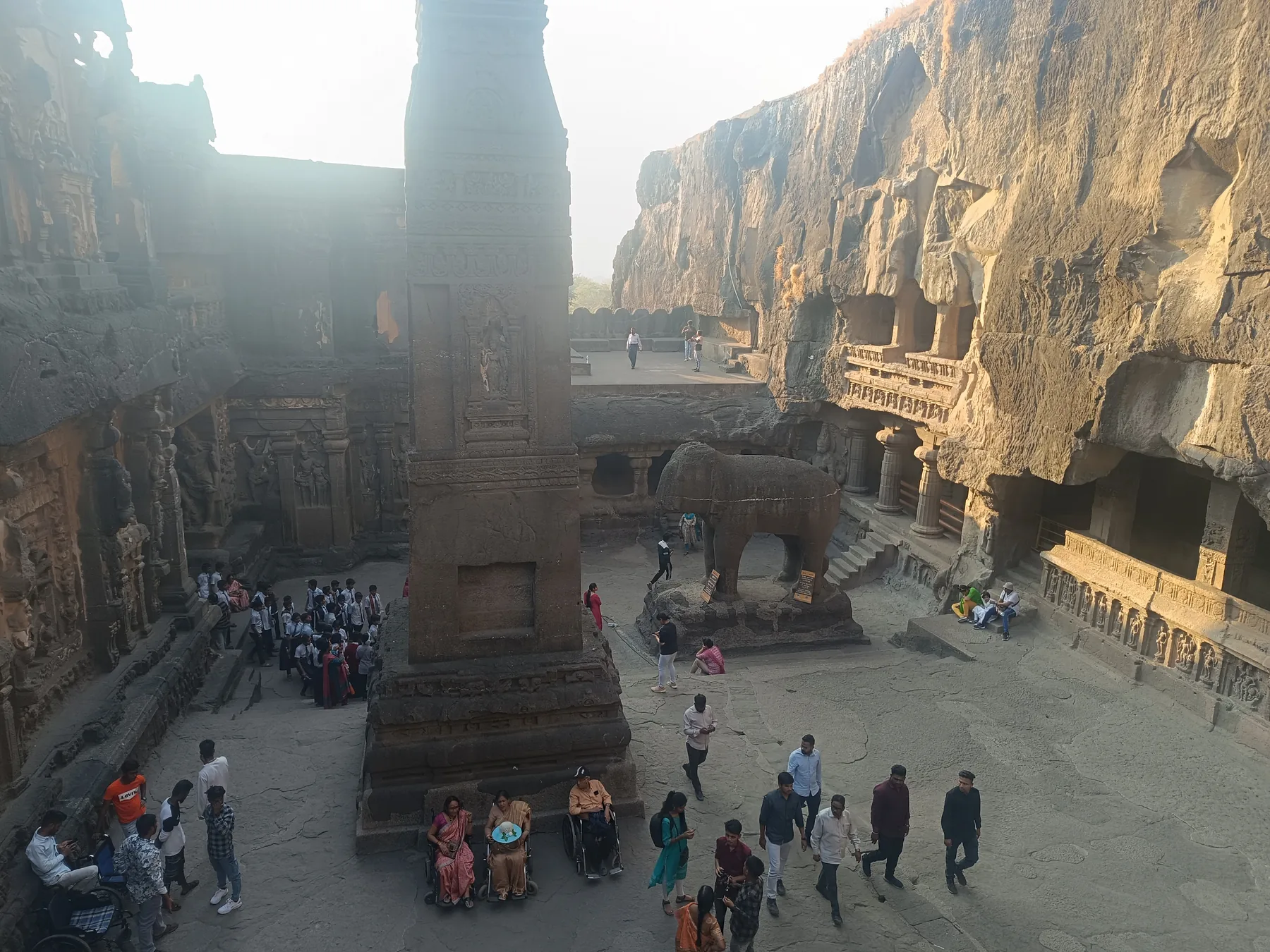
The photograph appears to show a building placed in a courtyard. It shows almost the reverse. The court, gateways, pavilions, halls, shrine, tower, bridges, elephants, and sculpted surfaces emerged by removing the basalt around and within them.
Kailasa, or Kailasanatha, is Cave 16 in the Ellora complex in present-day Maharashtra. Its name invokes Mount Kailasa, Shiva’s mountain abode. Workers cut trenches into the escarpment to isolate a mass of rock, then translated forms associated with constructed temples into a monolithic excavation. A separate Nandi pavilion faces the principal shrine. Pillared halls, subsidiary shrines, relief programs, and circulation routes make a complete sacred environment from material that once filled the space.
This is not carving as decoration applied after architecture. Excavation and construction are the same operation. Every open volume is the result of stone removed; every surviving support records a decision not to remove more. Planning had to anticipate loads and sequences because a mistaken cut could not be replaced like a masonry block.
The UNESCO Ellora record places thirty-four monasteries and temples along more than two kilometres of basalt. Buddhist caves were excavated from roughly the fifth through eighth centuries, Brahmanical caves from the seventh through tenth, and Jain caves especially from the ninth through twelfth. Kailasa belongs to a site developed through overlapping campaigns, communities, and changes of use.
It is often attributed to the Rashtrakuta ruler Krishna I in the mid-eighth century. The association rests partly on a later inscription issued away from Ellora and is not repeated across all Rashtrakuta genealogies. The scholarly Ellora guide published by Smarthistory therefore treats the exact nature of royal patronage as a question, not a solved signature. Monumental scale implies extraordinary coordination and resources; it does not license invention where the patronage record is incomplete.
UNESCO describes the Buddhist, Hindu, and Jain sanctuaries as evidence of coexistence and tolerance. Their proximity is important, but “tolerance” should not become an effortless moral. The monuments were not all made at once. Different groups secured access at different moments; older spaces were adapted; patronage could be royal, monastic, mercantile, or local. Side-by-side survival proves a shared sacred landscape more readily than equal power or continuous harmony.
The site’s Jain caves sharpen that point. Inscriptions identify some lay patrons, while sculpted devotees and monastics show forms of participation not reducible to dynasties. Makers also reused architectural and visual solutions across religious affiliations. Shared workshops and close observation can explain formal relationships without claiming that doctrinal differences disappeared.
Kailasa turns the mountain into a dwelling of Shiva, but the divine geography is neither purely natural nor purely architectural. It is produced through subtraction, sculpture, naming, ritual approach, and repeated use.
Somapura: a monastery-city organised around movement
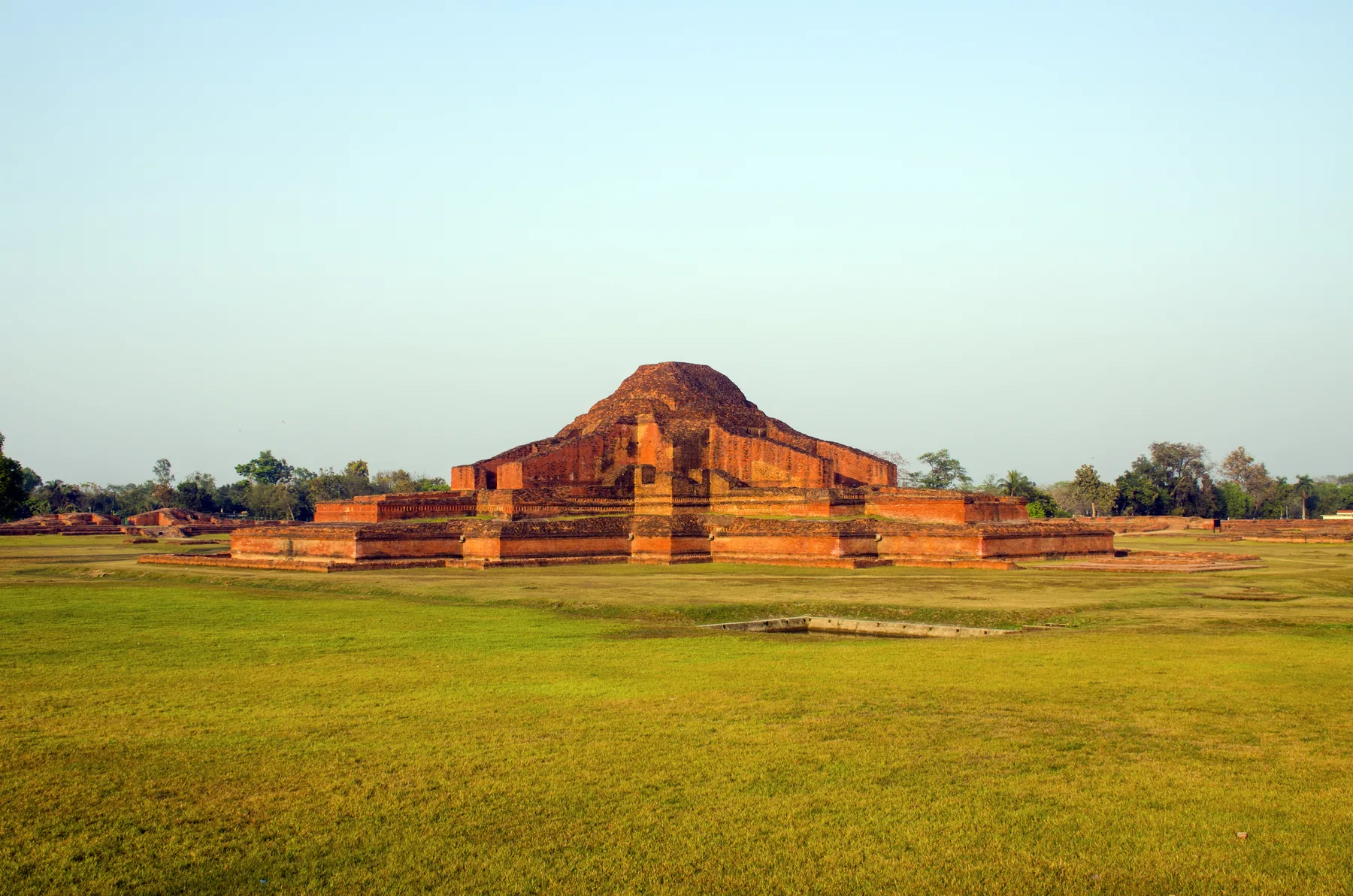

From ground level, Somapura appears as brick terraces, passages, cells, and a central mass whose original upper form is gone. The photograph’s open grass and low walls can make the site look emptied. Its plan describes an institution once full of scheduled life.
Somapura Mahavihara stood in ancient Varendra, now north-west Bangladesh. According to a clay seal found in the compound and cited by UNESCO’s Paharpur record, its first builder was the Pala ruler Dharmapala, who reigned in the late eighth and early ninth century. The complex became an important Buddhist intellectual and religious centre linked to Bodhgaya and Nalanda.
A nearly square outer monastery enclosed a large court. In its later phases, 177 cells faced inward. A fortified northern gate controlled entry. Kitchens and a refectory connected doctrine to food, fuel, water, storage, and labour. The central shrine rose on a cruciform plan with projecting terraces and chapels. A broad path directed circumambulation around it.
This organisation makes movement legible. A monastic resident crossed between cell, teaching, meal, shrine, and service spaces. A pilgrim approached through a controlled entrance, encountered the central monument, and moved around it in a prescribed direction. Architecture did not simply shelter ritual. It distributed attention, proximity, and permission.
Terracotta plaques once ran in bands around the shrine. Stone sculptures, including Hindu deities, also occupied its lower levels. Their presence inside a Buddhist monastic complex warns against sorting every image into isolated religious boxes. Workshops, visual languages, protective beings, regional practices, and patronage crossed categories even where institutions remained distinct.
Brick changed the relation between building and time. Unlike Ellora’s excavated basalt, Somapura could be added to, repaired, robbed, weathered, and reconstructed unit by unit. Fired terracotta allowed repeated images and intricate surfaces, but salts, water, vegetation, and removal threatened them.
The ruin seen now is not a transparent photograph of the eighth century. UNESCO records major twentieth-century conservation interventions, including replaced brickwork and earlier mortars that damaged material authenticity. Terracotta plaques were removed because of decay, vandalism, and theft; earlier replacement campaigns also separated some original plaques from their architectural sequence.
Conservation is necessary, but it produces a new historical layer. A clean outline may help a visitor read the plan while concealing uncertainty about elevation, surface, and use. The monument survives as archaeology, managed heritage, national history, and a place connected to living Buddhist memory. Those are related statuses, not one unchanged identity.
Somapura also widens the map. Its form and scholarship were connected across Bengal and beyond. UNESCO traces architectural influence toward Myanmar, Java, and Cambodia. “Influence” should not mean a design travelling by itself. Monks, pilgrims, craftspeople, texts, gifts, diplomatic relations, and remembered monuments carried knowledge through specific routes.
Chola Nataraja: the divine image leaves the building
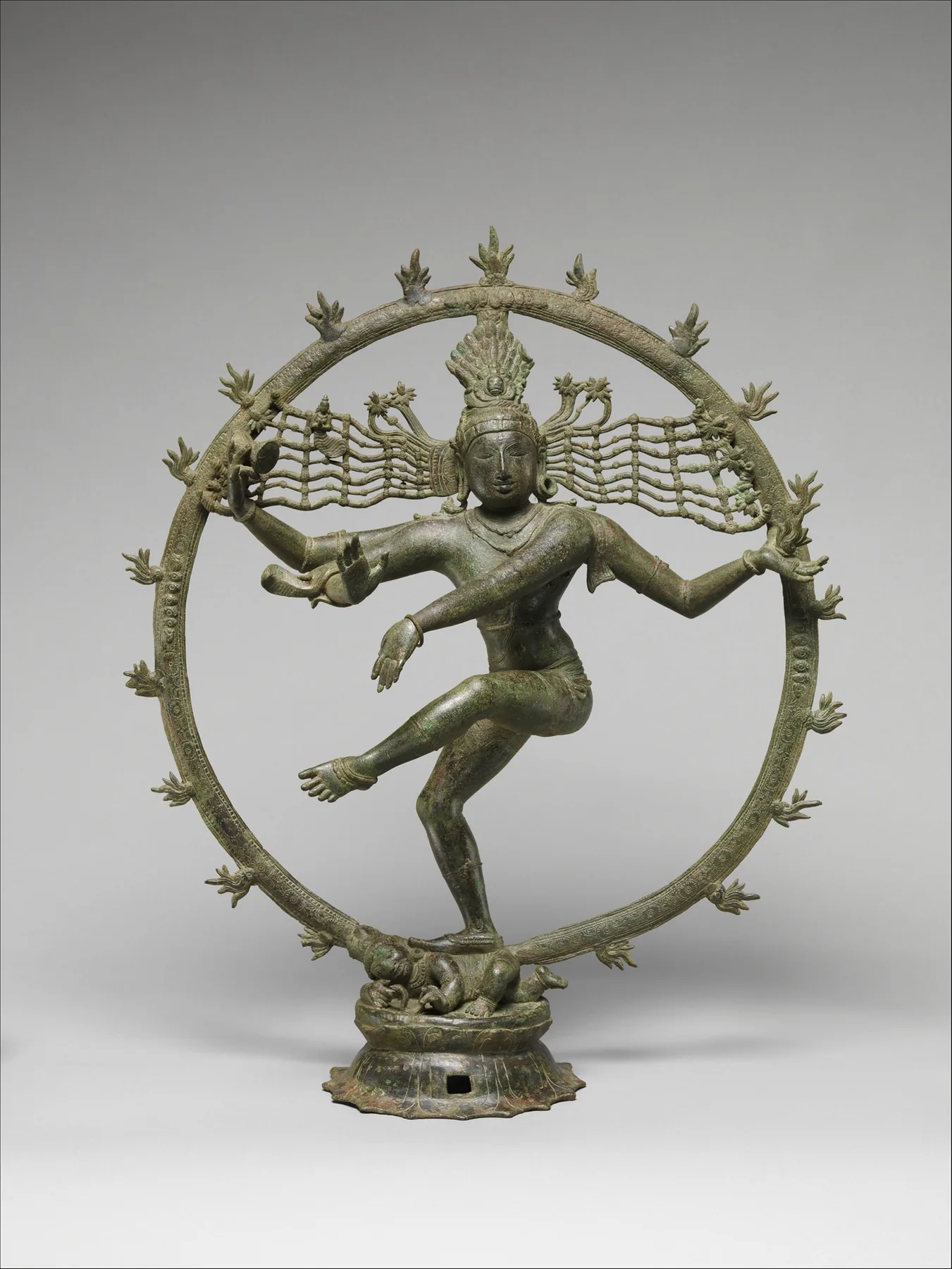
Shiva’s body holds balance and instability together. One foot presses down; the other crosses the torso and lifts. Four arms extend actions into different directions. A drum marks creation, fire destruction, an open hand protection, and another gesture points toward refuge. Locks of hair fly horizontally while a ring of flames fixes the dance into a portable outline.
The sculpture was cast in copper alloy in Tamil Nadu during the Chola period. It is often called a bronze, a useful historical category only if it does not replace the museum’s more precise material description. Lost-wax casting began with a model shaped in wax. A mould formed around it; heat removed the wax; molten metal entered the cavity; the mould was broken to release a unique cast. Modelling, alloy, firing, flow, finishing, and structural balance had to agree.
The image’s portability matters as much as its iconography. The Met object record states that images of this type were carried in festival processions so the public could see them. A base and balanced mass allowed bearers, poles, or a platform to turn metal into coordinated movement. Garlands, cloth, jewellery, lamps, music, recitation, and crowds could alter how the image appeared.
In this context, seeing was not detached observation. Darshan names an encounter in which a devotee sees and is seen by a divine presence. Consecration and worship distinguish a sacred image from a picture that merely illustrates a god. Care—bathing, dressing, feeding through offerings, lighting, sheltering, waking, resting—can make presence a repeated relation.
That does not prove the exact biography of this Met sculpture. The public record identifies its date, region, material, iconographic type, museum purchase fund, and 1964 accession. It does not establish the original temple, commission, consecration history, bearers, festival route, or complete chain of ownership before the museum. General knowledge about processional Natarajas explains what the form enabled, not every event this individual object experienced.
Chola temples show how images, buildings, gifts, and repeated rituals worked together. UNESCO’s Great Living Chola Temples record says Brihadisvara at Thanjavur was founded by Rajaraja I and consecrated in 1009–1010. Its complex joined a tall tower, walking routes, murals, carved dance poses, smaller shrines, and inscriptions. Temples also received land, goods, lamps, staff, and metal images from royal and other donors. Worship continues at these sites today, but present practice should not be assumed to match every medieval rite.
The Nataraja therefore corrects an architectural bias. A temple’s most socially visible sacred encounter may occur when an image crosses the threshold.
A Jain Tirthankara: active veneration, disciplined stillness
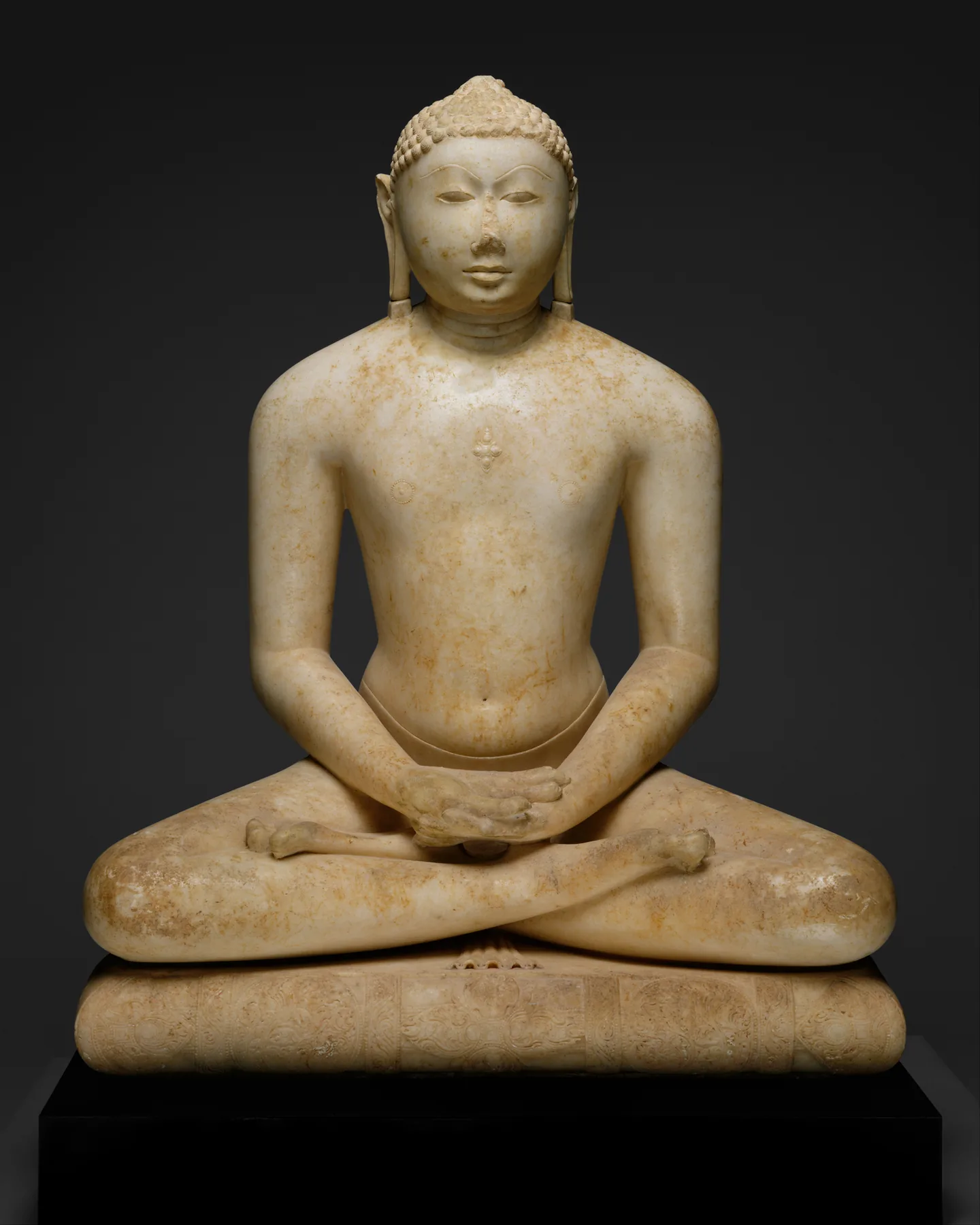
The Tirthankara does not twist or dance. Legs cross into a stable triangle. Hands rest together. Shoulders broaden, the waist narrows, and the face meets the viewer without theatrical emotion. A small shrivatsa mark on the chest distinguishes the figure from a Buddha, despite the shared seated meditation posture.
Stillness here is not absence of action. A Tirthankara is a “ford-maker,” one of twenty-four liberated teachers who reveal a path across rebirth. The image directs attention toward disciplined withdrawal, knowledge, and release. Its symmetry helps a viewer sustain contemplation rather than follow a narrative sequence.
The Met record attributes the sculpture to Gujarat or Rajasthan in the first half of the eleventh century, during the Solanki period. It identifies the material as marble and proposes that the figure was probably intended as Mahavira. “Probably” matters. Without a preserved emblem, inscription, or original ensemble sufficient for certainty, a familiar face cannot be converted into a named person by confidence alone.
The record also places image veneration at the heart of daily Jain observance. A liberated Jina is not a creator god who intervenes in the world, yet a consecrated image can focus worship, offerings, recitation, and meditation. The sculpture’s calm does not make its social life passive. People approached it, cleaned it, placed materials before it, looked, remembered teachings, and organised institutions around such encounters.
Marble carries regional and ethical questions. Its pale surface catches slight changes of light and makes traces of touch, pigment, liquid, repair, and cleaning visible. Quarrying, transport, rough shaping, fine carving, polishing, installation, and architectural framing involved specialised labour. The ideal of renunciation was materialised through expensive stone and organised patronage—a productive tension, not a contradiction that dissolves the practice.
Jain patronage frequently included merchants and lay communities as well as rulers. Donations could turn wealth into religious merit, communal standing, and long-term institutional support. The donor does not replace the ascetic ideal; patronage creates a material setting in which that ideal can be encountered.
The sculpture’s modern setting changes the relation. It entered the Met in 1992 through purchase. Its public page does not identify an original temple, consecration, removal event, or complete pre-museum ownership chain. On a museum plinth, steady climate, neutral light, and a fixed front encourage formal comparison. They do not reproduce a shrine.
That gap should not be filled with invented ritual biography. It should remain part of the work’s history: an image type made for veneration, an individual object with an incomplete public provenance, and a living Jain tradition whose practitioners are not simply evidence for the past.
Five works, five ways of making presence
| Work or site | Material operation | Movement organised | Patronage or institution | What the surviving record withholds |
|---|---|---|---|---|
| Great Relief, Mamallapuram | Granite outcrop becomes an open-air field of bodies, landscape, and possible water | Scanning, approach, narrative connection, perhaps animated flow | Pallava court project, unrecorded makers, port-city sacred landscape | Settled title, exact ritual occasion, full labour organisation |
| Kailasa, Ellora | A structural temple form is excavated from one basalt mass | Entry, ascent, circumambulation, movement between pavilion, hall, shrine, and relief | Large coordinated campaign often linked to Rashtrakuta rule within a multireligious site | Certain patronage sequence, names and organisation of work teams, equal relations among communities |
| Somapura Mahavihara | Brick, terracotta, and stone create a monastery around a central shrine | Controlled entrance, cell-to-court movement, circumambulation, teaching and service routines | Pala royal foundation, Buddhist monastic and intellectual institution | Original elevation, complete plaque sequence, unchanged fabric before modern intervention |
| Chola-period Nataraja | Lost-wax copper alloy holds a balanced dancing body in portable form | Festival procession, carrying, dressing, viewing, music, and darshan | Temple and festival systems supported by courts, donors, specialists, and worshippers | This object’s original temple, consecration, route, bearers, and early provenance |
| Jain Tirthankara | Carved and polished marble gives ascetic stillness durable presence | Approach, viewing, offering, recitation, meditation, and repeated care | Jain image veneration and lay patronage; individual commission unknown | Secure identity, original shrine, consecration, removal, and full ownership history |
The table does not describe progress from rock to metal or from building to portable art. Each work solves a different relation among matter, body, institution, and time. A ruin can organise remembered movement; a motionless image can generate repeated action; a moving bronze can depend on a permanent temple economy.
A temple was not a container
The phrase “temple sculpture” often imagines a building first and decoration added second. These cases resist that order.
At Mamallapuram, relief and landscape are inseparable. The cleft, boulder, possible water, and open air structure the image. At Ellora, sculpture, architecture, and geology are one subtractive process. Somapura’s terracotta bands operated along paths; their sequence answered to moving viewers and the shrine’s changing elevation. The Nataraja could extend a temple beyond its walls. The Tirthankara made a visual and bodily centre around which a shrine could function.
Nor was sacred presence automatically present because a material resembled a deity. Ritual traditions distinguish making, consecration, installation, maintenance, and worship. The same form can be an active sacred image, an unfinished workshop object, a damaged remnant, an archaeological find, a looted commodity, or a museum sculpture. Status is historical and relational.
This is why formal analysis needs verbs. Ask not only what an image represents, but what people did with it: approached, circled, carried, unveiled, washed, dressed, fed, lit, copied, repaired, protected, removed, catalogued, and contested.
Patronage was a network, not a signature
Royal names dominate because inscriptions and monuments preserved them. Narasimhavarman, Dharmapala, Krishna I, and Rajaraja I help establish political conditions, but the list can make temple history look like architecture ordered by kings and delivered complete.
Patronage distributed resources and claims. A ruler could grant land, redirect taxes, commission a monument, endow lamps, support specialists, or associate divine order with conquest. A merchant could fund an image, hall, repair, food distribution, or pilgrimage service. Monastic communities could manage gifts and teaching. Lay donors could inscribe names beside figures of devotion. Later patrons altered older compounds.
Production required another network: quarry and metal workers, modellers, brickmakers, carpenters, architects, stonecutters, casters, painters, polishers, transporters, accountants, cooks, musicians, ritual experts, and maintenance workers. Some labour was highly honoured; some was constrained by hierarchy, obligation, caste, debt, or political extraction. A monumental achievement is not proof of harmonious work.
The useful question is therefore not “Who built it?” in the singular. Ask who authorised, financed, designed, made, supplied, maintained, used, recorded, and benefited—and whether the surviving evidence names each role equally.
Movement made meaning
Art-history photographs reward the still object and empty monument. Temple worlds were full of changing positions.
Circumambulation made sequence from architecture. A path could align the body with a sacred centre, reveal images one by one, and distinguish permitted proximity. Direction mattered. So did whether a visitor could enter a court, hall, passage, or sanctum.
Procession changed scale and audience. The Nataraja could move from restricted interior care into a public route. The image’s appearance changed with textile, jewellery, flowers, lamps, weather, sound, and the physical effort of bearers. A festival was temporary architecture made from bodies and streets.
Pilgrimage connected institutions. Travellers carried gifts, stories, visual memory, texts, and practices between sites. Somapura’s links with Bodhgaya and Nalanda were not lines on a map; they depended on people able to travel, stay, learn, and return.
Workshop movement also matters. Makers, models, techniques, and materials circulated across courts and religious institutions. Resemblance can arise through shared labour or observation without implying identical meaning.
Movement was unequal. Not everyone could enter every space, finance a gift, travel safely, or be represented in an inscription. Bodies were organised by office, gender, community, status, vocation, and ritual rule. “Participation” should not conceal restricted access.
From sacred relation to heritage and museum object
The five cases survive through different institutions of visibility.
Mamallapuram and Ellora are managed archaeological and World Heritage sites visited at modern scale. Railings, routes, opening hours, conservation, photography, and tourism shape encounters. Somapura is a ruin whose readable plan partly depends on excavation and reconstruction that also altered original material.
The Nataraja and Tirthankara are isolated on museum backgrounds. Open-access photographs give extraordinary visual access, yet remove weight, scale, side views, sound, smell, clothing, touch, restriction, and community. A clean caption begins with the object and may end with the museum credit line even when the most difficult movement happened before accession.
Sacred status also demands care in language. A museum may classify an image as art while a practitioner understands related forms as divine presence, teacher, or focus of worship. Historical study need not adopt every theological claim as empirical fact; it must accurately describe what the image is understood to do within its tradition.
Living communities should not be used as fossils that explain medieval people unchanged. Contemporary practice can reveal possibilities, vocabularies, ethical concerns, and continuities. It also has its own history. Continuity and change belong in the same sentence.
Five shortcuts to refuse
“Indian temples follow one style”
“Nagara” and “Dravida” can help describe broad architectural tendencies, but they do not contain every regional workshop, material, date, or sacred institution. A Pallava rock relief, Bengali brick monastery, Deccan excavation, Chola bronze, and western Indian Jain marble do not become one style because modern borders place most of them in India.
“Hindu, Buddhist, and Jain images are interchangeable”
Shared postures, symbols, workshop practices, or sites are evidence of connected visual worlds, not identical doctrine. A meditating Tirthankara is not a Buddha. A linga, Buddha image, and Jina can organise presence differently. Identify the institution, attributes, practice, and evidence before using resemblance.
“A sacred image is an illustration of belief”
Illustration places belief first and image second. Consecration, darshan, offering, procession, and care show that images could participate in religious action. Their material, scale, eyes, base, portability, and access were part of what they did.
“The king made the monument”
A named ruler may authorise and fund a project without designing or carving it. Monumental patronage rests on administrative power, material supply, specialist knowledge, and extensive labour. Credit the political claim while keeping makers and institutions visible.
“A ruin or museum preserves the original experience”
Ruin, heritage site, and museum are later conditions. Somapura’s present brickwork includes conservation decisions. Ellora’s empty photograph excludes ritual and tourism just outside the frame. Museum lighting isolates metal and marble from shrine practice. Preservation saves evidence and changes relations at the same time.
A working timeline, c. 600–1400
- Sixth–eighth centuries: Buddhist caves are excavated at Ellora; some spaces are later adapted as the site grows.
- Seventh century: Pallava patrons and makers develop cave sanctuaries, monolithic forms, and major open-air reliefs at Mamallapuram.
- Seventh–eighth century: The Great Relief at Mamallapuram is carved; its modern titles remain contested.
- Seventh–tenth centuries: Brahmanical caves are excavated at Ellora, including the great Kailasa complex.
- Mid-eighth century: Kailasa is principally produced, commonly associated—though not without evidentiary questions—with Rashtrakuta Krishna I.
- Late eighth–early ninth century: Somapura Mahavihara is founded under Pala ruler Dharmapala in ancient Varendra.
- Ninth–twelfth centuries: Jain activity at Ellora produces caves, paintings, images, and inscriptions of royal and non-royal participation.
- Ninth–thirteenth centuries: Chola courts and temple institutions expand across Tamil regions through conquest, gifts, inscriptions, architecture, painting, and metal images.
- 1009–1010: Brihadisvara Temple at Thanjavur is consecrated under Rajaraja I.
- First half of the eleventh century: The marble Svetambara Tirthankara now at the Met is made in Gujarat or Rajasthan.
- Eleventh–thirteenth centuries: Chola-period workshops produce major copper-alloy processional images, including Nataraja forms.
- Until about the twelfth century: Somapura remains a major Buddhist religious and intellectual centre through changing building phases.
- Late twelfth–early thirteenth century: The Nataraja now catalogued as Met 64.251 is cast in Tamil Nadu.
- Thirteenth–fourteenth centuries: Temple institutions continue to change amid regional courts, pilgrimage, trade, devotional movements, and expanding Islamicate political and architectural worlds.
Terms for looking and reading
- Darshan: Reciprocal sacred seeing; the devotee sees and is seen by a divine image or holy presence.
- Puja: Worship through acts such as offering, bathing, dressing, lighting, recitation, or food presentation; practices vary by tradition and context.
- Prana pratishtha: A consecration process through which a Hindu image is ritually established as a living divine presence; terminology and rites vary.
- Garbhagriha: The inner sanctum or “womb chamber” of a Hindu temple, often housing its principal sacred image or linga.
- Mandapa: A pillared hall or pavilion whose form and use vary across temple and cave contexts.
- Vihara: A Buddhist monastic residence or complex; it can include cells, teaching, worship, and service spaces.
- Pradakshina: Circumambulation of a sacred centre, commonly clockwise, as a bodily act of reverence.
- Tirtha: A crossing place or sacred destination; the term can connect pilgrimage, water, landscape, and religious passage.
- Tirthankara: In Jainism, one of twenty-four liberated ford-makers whose teaching reveals a path beyond rebirth.
- Linga: A form through which Shiva is present and worshipped; “aniconic” should not be mistaken for imageless or symbolically empty.
- Nataraja: Shiva as Lord of Dance, combining movement, cosmic action, protection, and refuge in a developed iconographic form.
- Vimana: In South Indian temple architecture, the tower and structure rising over the sanctum; usage differs regionally.
- Ratha: Literally chariot; at Mamallapuram, a modern/local name for monolithic structures resembling temple forms, not necessarily processional vehicles.
- Lost-wax casting: A process in which a wax model is replaced by molten metal inside a mould that must be broken to release the cast.
- Consecration: Ritual establishment or dedication that changes an image or place’s status; it is not reducible to physical completion.
- Patronage: The provision and organisation of resources, authority, land, labour, or gifts; it does not make the patron the sole maker.
Questions to carry to the next temple or image
- Is “temple” the historical institution’s own category or a modern umbrella term?
- What can the material do, and what labour, landscape, extraction, or maintenance does it require?
- Does the photograph show an object, a detail, a route, a restored surface, or a complete site?
- Which bodies were expected to stand still, walk, circle, carry, dance, enter, or remain outside?
- Was an image fixed, portable, dressed, bathed, illuminated, hidden, or seasonally displayed?
- What evidence establishes sacred function for this individual work rather than for its type in general?
- Who authorised, financed, designed, made, supplied, maintained, and used the work?
- Does a royal name clarify patronage or erase other donors and labour?
- Are shared forms evidence of a common workshop, movement, adaptation, competition, or only visual resemblance?
- Do modern religious labels sharpen historical difference or impose clean boundaries the site did not have?
- What did excavation, conservation, removal, tourism, or museum display add and take away?
- Is a living community present in the interpretation as a contemporary subject or used only to explain an ancient past?
Source guide
Begin with site and object records, then compare their institutional claims with specialised scholarship and living-community perspectives.
- For Mamallapuram, UNESCO’s World Heritage record establishes the Pallava port-city setting, monument categories, material experimentation, management, and current boundaries. Smarthistory’s Great Relief study introduces the competing narrative readings and relevant scholarship without pretending the title is settled.
- For Ellora, UNESCO’s site record supplies the sequence and current conservation framework. Lisa N. Owen’s multireligious Ellora essay is especially useful for disputed patronage, workshop sequence, Jain donors, adaptations, and the limits of turning proximity into a simple tolerance story.
- For Somapura, UNESCO’s Paharpur record provides the Dharmapala seal, plan, 177 cells, circumambulatory paths, terracotta bands, regional connections, and unusually candid account of conservation damage and replacement.
- For Chola temple institutions, UNESCO’s Great Living Chola Temples record identifies royal foundations, inscriptions, building sequences, continuing worship, and later interventions. The Met’s Nataraja record provides the individual object’s material, dimensions, date, procession statement, accession, and Open Access status.
- For Jain image veneration, use the Met’s Tirthankara record for the work’s attribution, material, iconographic qualification, daily-veneration context, accession, and rights. The British Museum’s living-traditions project offers a recent multi-faith framework developed with practising Hindu, Buddhist, and Jain advisers.
The three site photographs were checked separately from the monument histories: Richard Mortel’s Mamallapuram relief detail is CC BY 2.0; K. Venkataramana’s Kailasa view is CC0; and Rangan Datta Wiki’s Somapura view is CC BY-SA 4.0. The two Met object images are marked Public Domain and Open Access on their collection pages.
Continue the route
This chapter follows West African and Sahelian art, c. 800–1600, Islamic worlds, c. 650–1250, and art on the Silk Roads. Their chronologies overlap because religious, political, and commercial worlds overlapped.
The next atlas chapter turns to Southeast Asian temple and court worlds, c. 600–1400: water, mountain, merit, and power.
One question should travel with us: when an artwork looks still, which movements made it present—and which later institution taught us to see it as motionless?
Editorial record
About this article
- Author
- Publisher
- GeMarkt
- Published
- Updated
- Reviewed
- Internal source & rights check. Conducted by GeMarkt Research Review. This is an internal editorial check—not independent peer review.
- Source standard
- Art history source standardPrioritises object records and research sources, distinguishes evidence from interpretation, and states material uncertainty.
Found a claim that needs checking? Report a factual error.