Art History · Learning chapter
Atlas III — Early-modern worlds · 2 of 11
Northern Renaissance art: oil, devotion, print, Reformation, and mercantile cities
A critical guide to Northern Renaissance art through oil technique, devotion, workshops, print networks, merchant cities, Reformation, and material exchange.

What we’ll look at
How did technique, devotion, trade, print, and reform change art in northern Europe?
The two paintings at the top of this chapter are easy to turn into a technical legend. Light glances from armour, gems, tears, brocade, skin, clouds, and distant buildings with a precision long associated with Jan van Eyck. For centuries, that precision supported a memorable story: Van Eyck invented oil painting, and northern artists used the new medium to discover the visible world.
The objects are less obedient than the legend. They were once painted on wood but are now on canvas. Their original red-and-gold frames survive, yet technical study indicates that the panels were not always the diptych they appear to be today. Their Christian narrative contains visual conventions that demean Jewish people. Their surfaces are both extraordinary pictures and evidence of later transfer, reframing, conservation, collecting, and interpretation.
They introduce the central problem of this chapter. “Northern Renaissance” art does not become intelligible by listing innovations or comparing its realism with Italy. It asks us to follow materials through workshops, pictures through devotional routines, prints through cities, portraits through merchant networks, and images through religious conflict.
The north is not one place
Northern Renaissance is a retrospective organising label, not the name of a unified culture. In this chapter it covers selected artistic worlds between about 1400 and 1600 in the Burgundian and Habsburg Netherlands, German-speaking cities and territories, and the routes that carried makers and patrons to places including London. France, Iberia, Scandinavia, Bohemia, Poland-Lithuania, and other regions belong to broader northern histories but cannot be responsibly compressed into this single route.
Political units changed across the period. The Holy Roman Empire contained cities, bishoprics, principalities, and other jurisdictions rather than one centralised state. The Burgundian dukes assembled territories that later passed into Habsburg rule. Urban centres could be linked by dynastic government while maintaining different guilds, markets, devotional institutions, and artistic habits.
The label therefore names a field of comparison. It does not mean that every place north of the Alps shared one style, that Italy had already achieved a “Renaissance” which others copied, or that the year 1400 reset European culture. Late medieval practices continued inside works now called Renaissance. Italian and northern artists, prints, books, diplomats, merchants, and luxury objects crossed in several directions.
A working map, not a border
Begin with nodes and routes rather than a coloured block on a map.
- Bruges joined courtly patronage to international trade and a market for panels, manuscripts, textiles, and luxury goods.
- Ghent, Tournai, and Brussels sustained workshops, civic institutions, churches, and courts whose people and commissions moved across political boundaries.
- Antwerp became a powerful sixteenth-century production and trading centre with specialised workshops and a growing market for pictures made beyond one named commission.
- Nuremberg and Augsburg linked craft organisation, humanist print culture, metalwork, banking, and long-distance commerce.
- Wittenberg made the workshop of Lucas Cranach the Elder central to the visual politics of the Reformation.
- London drew mobile painters and merchants, including Hans Holbein the Younger and members of the German Steelyard community.
This map follows surviving objects. That is also its limitation. Panel paintings and prints often enter survey books more easily than lost stained glass, damaged church interiors, ephemeral festival structures, dispersed altarpieces, worn domestic objects, or textiles whose valuable threads were later removed. Survival is not a neutral sample of what once mattered.
Begin with an object that changed support
In brief: Jan van Eyck made the small devotional panels known as the Crucifixion and Last Judgment around 1436–38. Their original arrangement is unknown, and the paint was later transferred from wood to canvas.
The Met catalogues Van Eyck’s Crucifixion and Last Judgment as two panels, each only 19.7 centimetres wide. Both are now oil on canvas transferred from wood. That transfer is not a minor footnote. The visible paintings arrived in the present through an intervention that separated paint layers from their original wooden supports and attached them to another material.
The current pairing once seemed self-evident, yet the Met’s technical study of the panels used infrared reflectography, X-radiography, and X-ray fluorescence mapping to investigate construction and sequence. Frame inscriptions and physical evidence suggest that the paintings may have served as wings or doors in a more complex arrangement rather than beginning as a freestanding diptych.
The narrow formats compress different kinds of vision. The Crucifixion looks across a crowd and plunging landscape; the Last Judgment stacks resurrection, judgement, heaven, and hell along a vertical axis. Their frames add language to the encounter. Imaging has helped recover fragmentary inscriptions without restoring the original configuration with certainty.
A responsible object history can therefore hold three sentences at once: Van Eyck made the paintings; their first arrangement remains debated; what survives has been materially changed. Attribution does not erase object biography.
Oil was a method, not a sudden invention
Jan van Eyck did not invent oil painting. Drying oils had been used before his career. The older invention story survives because it attaches a complicated material history to one famous name and makes visual change look instantaneous.
Painters did not use one northern European oil-painting recipe. They combined prepared supports, underdrawing, pigments, binders, drying times, transparent layers, and opaque paint in different ways. The National Gallery’s study by Rachel Billinge, Lorne Campbell, Jill Dunkerton, Susan Foister, Jo Kirby, Jennie Pilc, Ashok Roy, Marika Spring, and Raymond White documents practices from 1400–1550. It finds linseed and walnut oils alongside egg-tempera underpainting, pre-polymerised oils, resins, and other mixtures.
Oil could dry slowly enough to permit transitions and revisions, bind saturated colour, create translucent glazes, and describe the different ways light behaves on skin, glass, metal, velvet, or water. It could also wrinkle, yellow, crack, or darken. Results depended on preparation and skill, not on pouring an inherently “realistic” substance onto a panel.
Van Eyck’s achievement remains consequential after the myth is removed. It becomes more exact: an exceptional refinement of established and developing methods, joined to pictorial decisions that made surfaces carry theological and social meaning.
Light, surface, and devotional attention
In Early Netherlandish pictures, precise surfaces do more than prove that an artist can imitate things. They can slow the viewer, connect ordinary objects to sacred narratives, and make the act of seeing feel like disciplined attention.
Maryan Ainsworth’s Met overview of Early Netherlandish painting places large public altarpieces beside small pictures used for private devotion. Patrons included rulers and courtiers, merchants, confraternities, religious orders, and urban institutions. Scale, format, and destination altered how detail worked.
A reflective vessel can join several spatial zones. A jewel can signal wealth, divine light, or both. A landscape can extend biblical time toward a contemporary city. Textures make sanctity imaginable through matter, but they can also make the donor’s costly possession visible. Devotion and status were not always separable motives.
Calling such pictures “photographic” obscures their construction. Different distances, scales, and degrees of clarity can coexist inside one scene. A painter may sharpen a foreground object while inventing an enormous world beyond it. The surface persuades through selection and arrangement, not through automatic transcription.
Naturalism is not neutral
Visual specificity can make a fiction persuasive, a social hierarchy seem observable, or a hostile stereotype appear like evidence. Naturalism deserves analysis, not automatic praise.
The Crucifixion panel differentiates dress, gesture, face, weapon, horse, and social group across a compressed crowd. The Met’s current interpretation explicitly confronts antisemitic imagery within the scene. Some figures identified as Jewish are made visibly other and implicated in Christian blame narratives with long histories of persecution. The painting’s refinement does not neutralise that violence; it helps deliver it.
This is not a reason to stop looking. It changes what close looking must include. Ask who receives individualised sympathy, who becomes a type, which inherited conventions organise difference, and how a present-day museum explains an object made within a Christian visual culture hostile to Jews.
“The artist observed society accurately” is therefore an unsafe shortcut. A convincing face or textile does not guarantee a fair account of the person represented. Representation can intensify prejudice precisely because it looks particular.
Open, close, carry, pray
Many paintings now fixed upright in galleries once moved. Diptychs folded. Triptychs opened and closed. Curtains covered images. Small panels travelled with owners. Altarpieces changed appearance across liturgical calendars, and doors could conceal sacred centres behind less festive exteriors.
Handling belongs to meaning. A small devotional object organises intimacy through proximity to the body. Hinges produce sequences: outside before inside, closure before revelation, ordinary time before feast. Wear at an edge may record repeated touch. A lock, clasp, case, or protective textile can be part of the viewing system even when it no longer survives.
The current Van Eyck panels demonstrate the cost of forgetting that system. Their frames remain, but their original relation to any central image or architectural setting is uncertain. A museum display presents one defensible arrangement, not time travel.
When analysing another northern panel, record front and back, frame, hinge marks, dimensions, inscriptions, and signs of cutting or transfer before interpreting the depicted scene. The object may preserve instructions for an encounter that a frontal reproduction suppresses.
Carved presence beyond paint
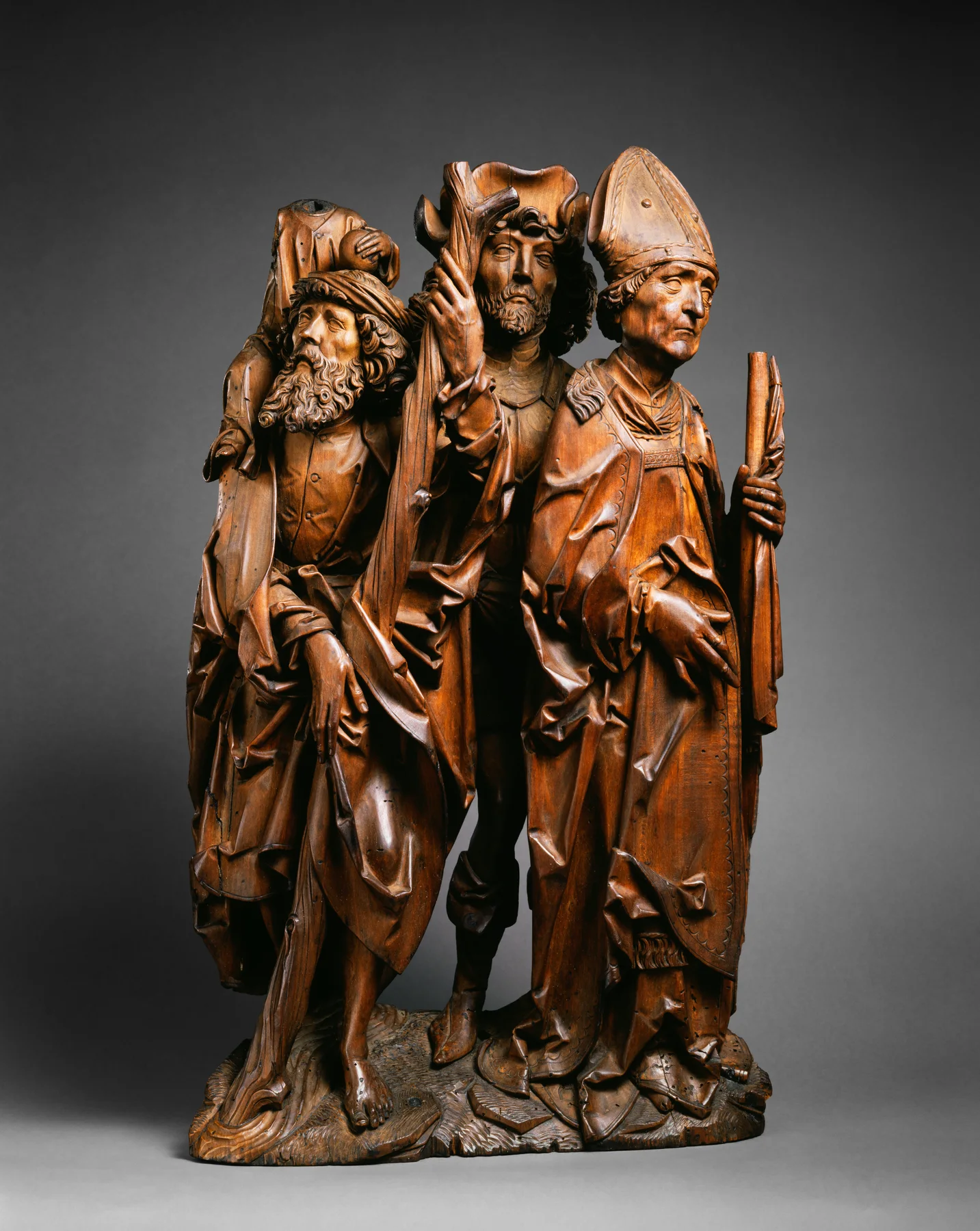
Tilman Riemenschneider’s group of three helper saints interrupts a painting-centred survey. The Met identifies it as limewood carved in Würzburg, probably the left portion of a larger group. Christopher, Eustace, and Erasmus were invoked against particular dangers and bodily suffering. Their identities would have connected material presence to prayer and need.
The sculpture is largely carved from one block with an added piece. Deep folds, tools, hair, and small narrative attributes emerge from a material light enough for complex altarpiece construction and responsive to sharp tools. The Met notes that its detailed finish indicates that it was not intended to receive paint. That matters because unpainted sculpture was not simply an unfinished version of coloured sculpture. A restricted surface could display the carver’s control of grain, shadow, and toolwork.
The missing larger ensemble also matters. The surviving fragment gives three bodies but not the full architectural, liturgical, and social programme around them. Modern admiration for an isolated sculptural group can hide the loss that made isolation possible.
Guilds, workshops, and hidden hands
Artists did not move through a frictionless creative economy. Guilds regulated training, workshop ownership, market access, quality, and civic status in ways that varied by city and craft. A master’s name could organise a business whose objects passed through several hands.
The Met’s Northern Renaissance gallery guide draws attention to workshop labour that records often leave indistinct: apprentices, assistants, servants, and specialists preparing supports and materials. Gender, class, birthplace, religion, and guild rules shaped who could train, run a shop, sign a work, or enter the archive under an independent name.
“Workshop of” is not a polite substitute for failure. It can describe an actual production system in which a leading practitioner supplied designs, supervised labour, intervened in key passages, or authorised an object made to a recognised standard. Attributions may change as technical imaging reveals underdrawing, revisions, repeated patterns, or incompatible materials.
The correct response is not to dissolve every decision into anonymous teamwork. It is to scale claims. Name documented makers; distinguish attribution from certainty; identify the workshop as a structured institution; and leave space for labour the object needed but the record did not preserve.
Cities made art mobile
Northern European cities concentrated buyers, churches, courts, guilds, presses, fairs, docks, credit, raw materials, and skilled labour. They did not merely provide backdrops for individual artists. Their institutions altered what kinds of object could be produced and how far those objects could travel.
A commissioned altarpiece tied work to a particular site and patron. A small panel, carved figure, printed sheet, metal vessel, or luxury textile could move through different channels. Market production did not abolish commissions; it widened the mix. Makers could work for known clients, prepare objects for open sale, export repeated types, or adapt designs to anticipated buyers.
Money moved unevenly through these systems. Court splendour and merchant display depended on taxation, rents, trade privileges, finance, household labour, and supply chains extending well beyond the city. “Urban prosperity” should not make accumulated wealth sound ownerless.
Bruges, Ghent, Tournai, and Brussels
Bruges is central to the history of Jan van Eyck, Petrus Christus, Hans Memling, and international patronage, but it was one node among connected Netherlandish centres. Ghent’s civic and ecclesiastical institutions supported ambitious projects; Tournai sustained influential workshops; Brussels became important to courtly production and tapestry. Artists changed residence, joined local guilds, served rulers, and responded to clients whose businesses crossed borders.
The Met’s open-access volume From Van Eyck to Bruegel, edited by Maryan W. Ainsworth and Keith Christiansen, connects object research to attribution, workshop practice, patronage, and collecting history. Ainsworth and Maximiliaan P. J. Martens’s study of Petrus Christus similarly situates a named painter within Bruges’s merchants, court connections, guild structures, and technical evidence.
Replace “the Flemish style” with a more demanding sentence: which object, made in which centre or workshop, for which use, under which political and commercial conditions? Regional labels are useful only when they remain open to that level of correction.
Antwerp and the expanding market
Antwerp’s sixteenth-century growth changed the scale at which pictures, prints, and designs could be produced and exchanged. The city drew migrant artists and merchants; its Guild of Saint Luke organised several image-making trades; workshops responded to both local demand and export.
The Met’s account of Northern Mannerism describes Antwerp as a commercial and cultural meeting point where artists engaged Italian models and one another. The resulting work should not be reduced to derivative “influence.” Prints, drawings, imported objects, travel, workshop repetition, and market calculation were specific mechanisms.
Expansion also complicates the relation between invention and repetition. An image made for sale without a single pre-identified patron could be designed around recognisable subjects, reusable patterns, or efficient divisions of labour. Novelty operated inside a market that also rewarded familiar formats.
Prints changed the scale of looking
An engraving or woodcut could produce many impressions from one matrix. Those sheets could travel more easily than an altarpiece, carry designs across workshop boundaries, enter albums, illustrate books, be pasted to walls, or become templates for objects in other media.
Print was not instant mass communication in a modern sense. Matrices required specialised labour; paper and distribution cost money; literacy and access varied; impressions differed; blocks and plates wore, moved, and could be reprinted. Yet multiplication changed the possible size and geography of an audience.
Prints also circulated arguments. During the Reformation, combinations of image and text could praise, ridicule, teach, identify, polarise, and mobilise. The same infrastructure could distribute devotional images, classical bodies, maps, ornaments, portraits, propaganda, scientific observation, and artists’ designs.
The medium connects close looking to network history. Study the cut or engraved line, then ask who printed, published, sold, copied, collected, coloured, annotated, or reused the sheet.
Dürer: one engraving, many routes
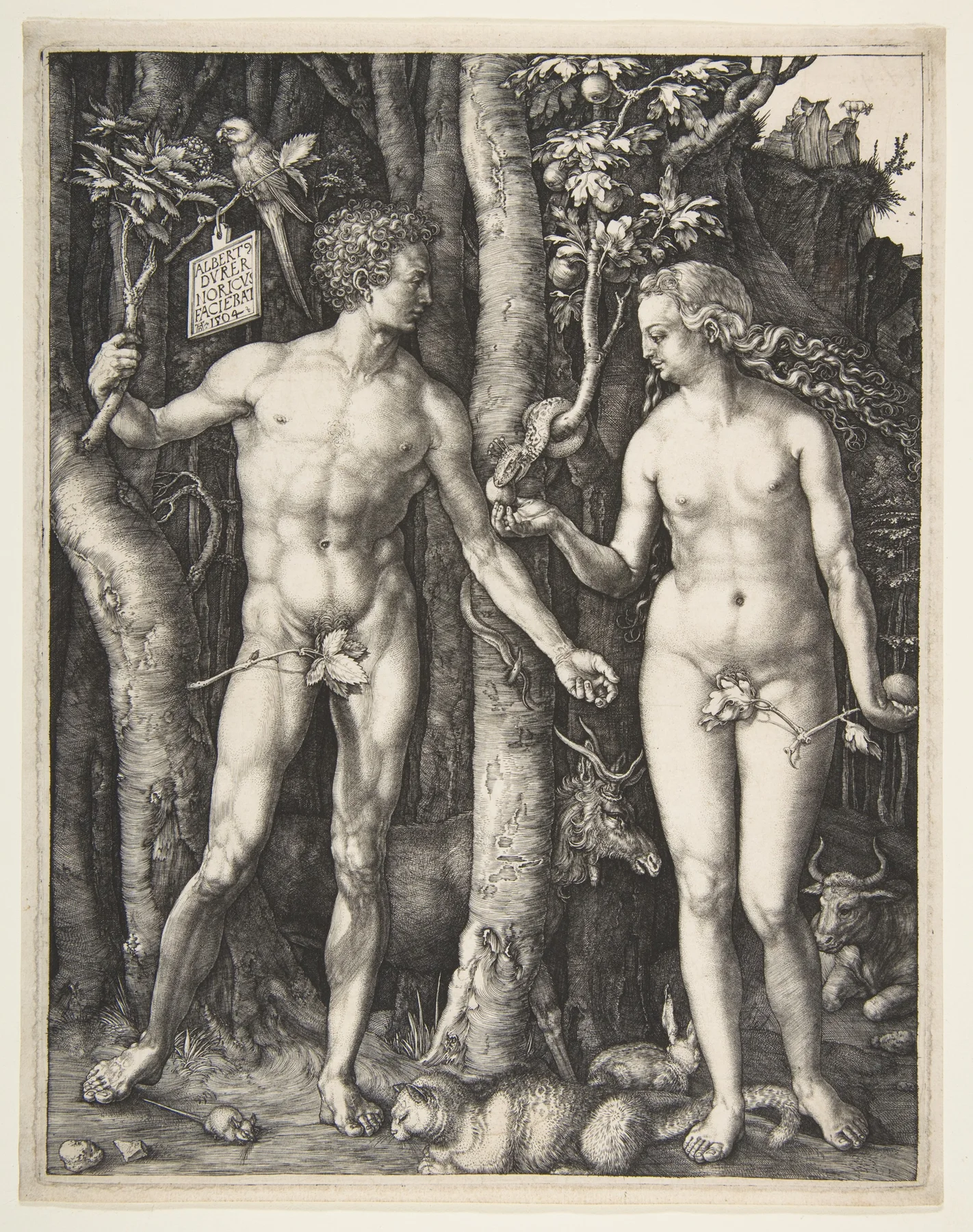
Albrecht Dürer’s Adam and Eve makes one copper plate carry several intellectual worlds. The Met’s record dates the engraving to 1504. The bodies engage study of classical proportion; the forest, animals, and plants exhibit the descriptive possibilities of tightly controlled engraved line; the biblical subject remains central.
The animals have been read through the medieval theory of four bodily temperaments. Such interpretation does not make the image a coded puzzle with one final solution. It shows how classical, Christian, natural, and medical learning could coexist on one sheet.
Dürer’s Latin inscription and monogram declare authorship inside the depicted forest. The mark could travel wherever an impression travelled. A panel remained attached to a support; an engraved identity could circulate across cities and generations.
That mobility joined north and south without making either side passive. Dürer travelled to Italy, worked in Nuremberg, studied and transformed other artists’ designs, and became a source for further copies. “Italian influence on a German artist” is only the first arrow in a much larger diagram.
Copying, authorship, and the monogram
Print culture made designs portable and copying visible. A sheet could preserve another artist’s composition, reverse it, resize it, simplify it, combine it with new elements, or move it into glass, metal, painting, embroidery, and sculpture.
Modern viewers often divide those outcomes into original and counterfeit. Early modern categories were not identical to current copyright law. Still, makers did defend marks, privileges, investments, and reputations. Dürer’s AD monogram became both a graphic signature and an economic claim.
For research, distinguish at least four things:
- the maker of a design;
- the maker of the matrix;
- the printer or publisher responsible for an issue;
- the maker of a later copy or translation into another medium.
One person could occupy several roles, but they should not be assumed to collapse. The Met’s The Print in the North offers an object-based route through these production and circulation questions.
Portraiture and mercantile identity
Portraits did not merely preserve what a sitter looked like. Dress, scale, pose, setting, inscription, heraldry, book, ring, letter, and gaze could claim lineage, office, learning, trustworthiness, marriageability, faith, or commercial standing.
Merchant portraiture made reputation visible within communities built on credit and distance. A likeness might circulate among relatives, partners, or prospective spouses. Yet “merchant” was not a visual essence. It is an identification that must come from names, records, objects, and social context rather than from sober clothes alone.
Portrait naturalism has its own politics. A meticulously described face can appear to grant direct access to character, but physiognomic interpretation imports the viewer’s assumptions. A painting stages a person through selected signs; it does not expose an inner self without mediation.
Holbein between Augsburg, Basel, and London
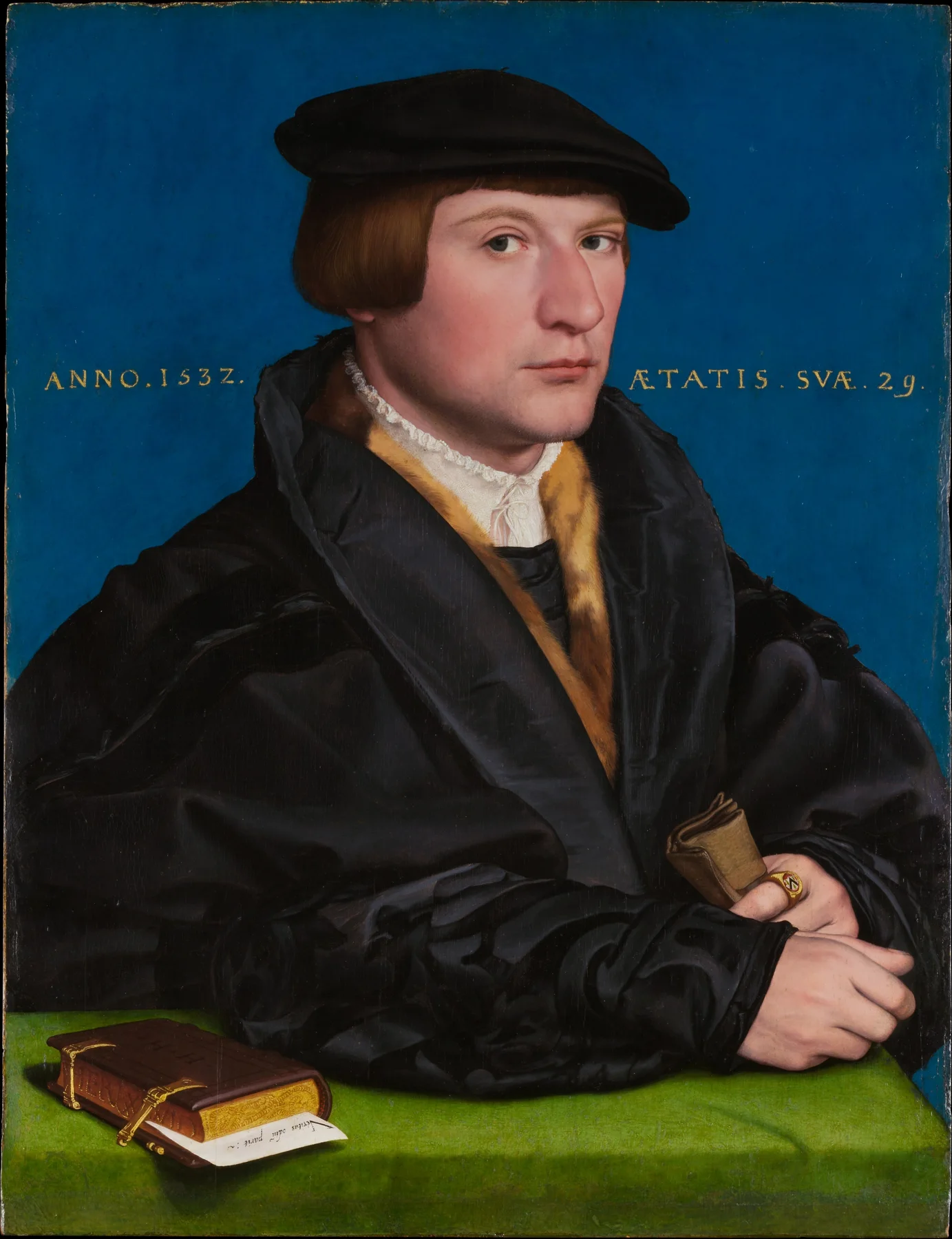
Hans Holbein the Younger was born in Augsburg, established a career in Basel, and made decisive work in England. His mobility resists national containers. So does the sitter in this portrait.
The Met identifies him as Hermann von Wedigh III, a member of a prominent Cologne family who probably sat to Holbein in London. His coat of arms, age, date, and the book help anchor the identification. The book’s motto can be translated as “Truth breeds hatred,” a compact humanist claim held near a carefully staged face.
Oil and gold on oak join minute description to a limited field of colour. Gloves occupy the hands without converting the sitter into a worker caught at a task. The blue background removes most local setting, while clothes, ring, inscription, heraldry, and book rebuild social location through portable signs.
The Met notes that a strip was added to the bottom of the panel. That material change is small beside the transfer of Van Eyck’s paintings, but it again warns that a portrait’s current rectangle may not equal its first state.
Humanism in books, bodies, and inscriptions
Renaissance humanism involved renewed study of classical languages and texts, educational practices, correspondence, collecting, and the social prestige attached to learning. In northern art it appears through more than mythological subject matter.
Dürer’s measured bodies, Holbein’s inscribed book, Latin signatures, scholarly portraits, printed editions, and designs derived from antiquity all belong to different humanist contexts. The printing press made texts and images more reproducible while producing new errors, variants, editions, and contests over authority.
Humanism did not automatically create religious scepticism or political liberation. Scholars served courts and churches; classical form could support Christian interpretation and elite distinction. Nor did an antique quotation prove direct study of an ancient object. A motif might arrive through a print, drawing, description, cast, coin, or another artist’s adaptation.
Ask for the route. “Classical influence” becomes historical only when the evidence shows how a text, image, object, or practice became available.
The Reformation did not simply end images
The Protestant Reformation challenged ecclesiastical authority and practices from the early sixteenth century, but its visual consequences differed by territory, confession, institution, and moment. Jacob Wisse’s Met essay on the Reformation follows both destruction and new production: images could become targets, teaching devices, confessional statements, political satire, portraits, or objects relocated from sacred settings.
Some reformers rejected particular uses of sacred images rather than every image. Catholic patrons continued commissioning art and, in the Counter-Reformation, developed new responses to Protestant criticism. Civic authorities, rulers, householders, printers, and schools gained different roles in visual culture.
The result was not one switch from religious to secular art. It was a redistribution of subjects, sites, patrons, and risks. An altarpiece removed from a church might be destroyed, stored, sold, reframed, or collected as art. A printed portrait could make a reformer recognisable far beyond a pulpit. Biblical images could enter domestic instruction under a different theory of use.
Cranach and the manufacture of a public reformer
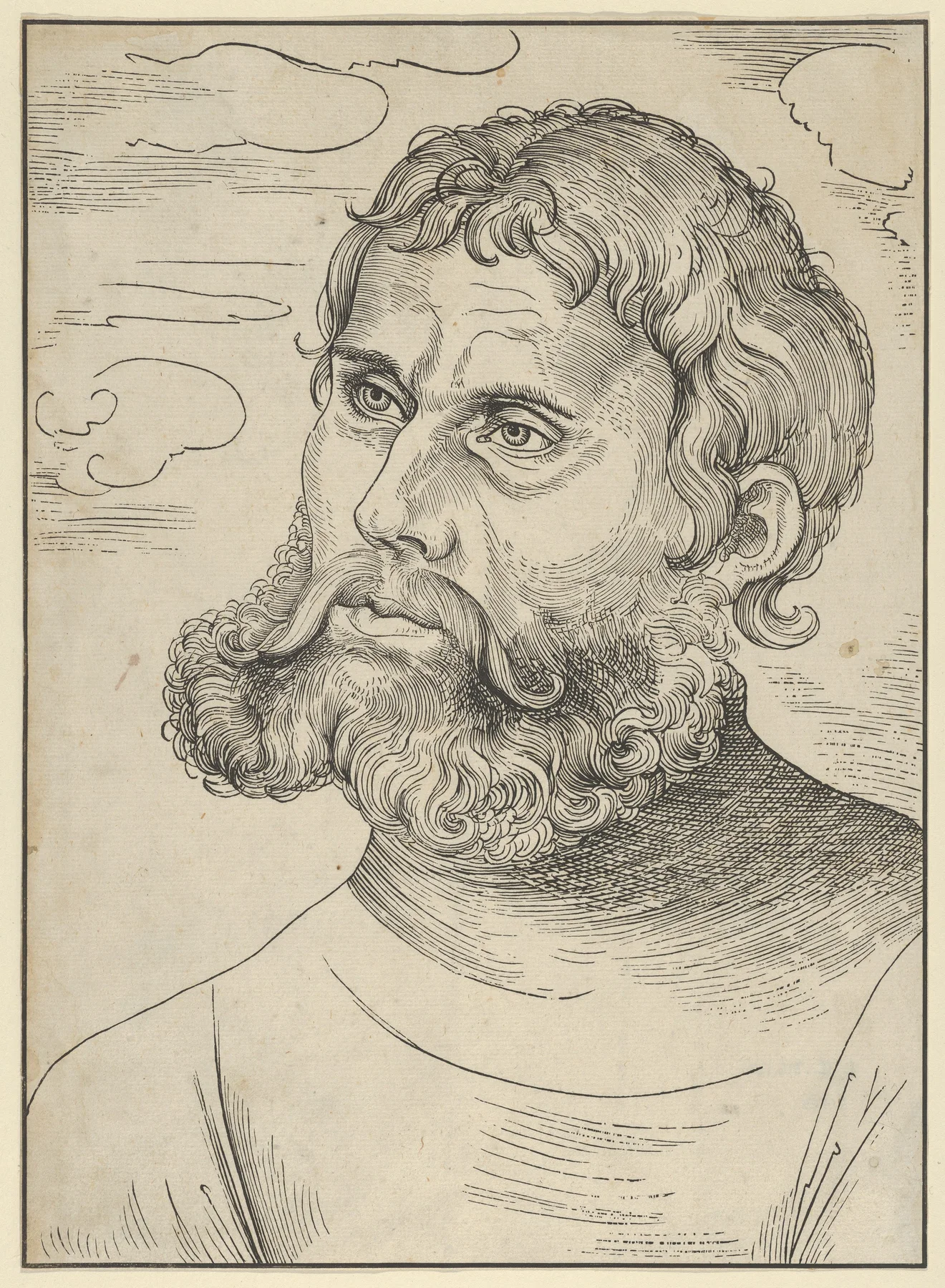
After the Diet of Worms, Martin Luther lived under protection at Wartburg Castle disguised as “Junker Jörg,” or Knight George. Lucas Cranach the Elder’s 1522 woodcut turns that temporary identity into a reproducible face.
The portrait does not show a public sermon or theological debate. Beard, haircut, coat, and direct profile of the head make disguise itself the subject. Multiplication allows the hidden reformer to become publicly knowable.
Cranach’s Wittenberg workshop was closely connected to Luther and the Saxon court, producing portraits, biblical imagery, polemical designs, and other works at speed. Yet confessional boundaries were not instantly pure. Maryan Ainsworth, Sandra Hindriks, and Pierre Terjanian’s study Lucas Cranach’s Saint Maurice stresses that Cranach worked for Protestant and Catholic patrons.
The artist cannot be reduced to a visual press office. Workshop organisation, court service, commercial production, and conflicting patronage all shaped the image economy in which a reformer’s face became a recognisable public sign.
Iconoclasm, survival, and changed interiors
Iconoclasm names attacks on images, but it should not flatten every event into the same motive. Objects could be broken as idols, signs of rejected authority, stores of valuable material, targets in political conflict, or vulnerable features of a transformed church. Destruction ranged from regulated removal to collective violence.
Survival is therefore confessional and institutional evidence. A church interior stripped of sculpture does not simply contain “less art”; its emptiness may be a produced visual order. Whitewashed walls, removed altarpieces, displaced tombs, retained heraldry, new pulpits, and changed seating can communicate what a community authorised viewers to see and do.
Museums often isolate survivors from that struggle. A carved saint may now appear as autonomous sculpture because the altar around it was dismantled. A painted wing may be displayed open forever because hinges and liturgical use disappeared. A print made to intervene in conflict may be admired chiefly for line.
Object history should reconnect those forms of survival to changed interiors without pretending that every missing work can be reconstructed.
Tapestry, glass, metal, and relative value
Oil painting dominates modern reproductions partly because a flat luminous image travels well on screens. Early modern value did not follow the same hierarchy.
Tapestries required costly wool, silk, dyes, and sometimes metal-wrapped thread, as well as designers, cartoon painters, dyers, weavers, merchants, and installers. The Met’s account of how tapestries were made explains a labour-intensive process capable of covering entire rooms, insulating walls, moving with courts, and turning architecture into a textile environment.
Stained glass transformed transmitted light and marked churches, civic buildings, and domestic spaces. Metalwork concentrated costly matter, specialised skill, and the possibility of melting and reuse. Carved wood could generate altarpiece ensembles larger than any individual figure now in a museum.
The Met’s Relative Values project compares northern objects through raw material, labour, rarity, technique, and historical market value. The exercise prevents a famous painter’s name from becoming the only measure of importance. A tapestry could cost far more than a panel painting; a small surviving fragment may once have belonged to the room’s most expensive object.
Materials travelled through unequal worlds
Pigment, metal, silk, dyestuff, paper, gems, wood, and ivory reached workshops through routes shaped by labour and power. The Met’s Northern Renaissance gallery guide connects sixteenth-century wealth to extended merchant networks and European colonial exploitation. This wider frame matters, but chronology must remain exact.
Do not project the mature seventeenth-century Dutch or British colonial systems backward onto every fifteenth-century Netherlandish panel. Do not treat all imported material as proof of one direct route. Instead, identify the object date, material evidence, port, intermediary, political jurisdiction, and available documentation.
The moral language should be equally exact. “Global exchange” can make coercion disappear; “colonialism explains everything” can erase regional distinctions and unsupported routes. A strong account names the relationship it can demonstrate: Portuguese expansion on African and Asian coasts; Atlantic conquest and extraction after 1492; merchant and banking networks; mining and forced labour; or an earlier Mediterranean, Baltic, or overland trade.
Materials do not arrive with innocent geography. Their price and availability connect a polished surface to people who mined, cultivated, hunted, processed, transported, financed, taxed, and sometimes stole the matter from which it was made.
A comparison matrix
| Object | Material and format | First problem to investigate | Movement or audience | What a flat reproduction hides |
|---|---|---|---|---|
| Van Eyck, Crucifixion and Last Judgment | Oil; formerly on wood, now transferred to canvas; framed narrow panels | Original configuration, technical sequence, devotional and antisemitic rhetoric | Probably movable components of a larger object; later collecting and museum display | Support transfer, frame depth, inscriptions, scale, opening system |
| Riemenschneider, Three Helper Saints | Unpainted limewood group, likely a fragment | Carving, saintly intercession, missing ensemble, workshop labour | Religious interior and embodied devotion | Grain, shadows, rear carving, relation to lost architecture |
| Dürer, Adam and Eve | Engraving printed from copper | Classical proportion, temperaments, signature, impression history | Multiple impressions across print markets and collections | Paper, plate mark, ink, condition, differences among impressions |
| Holbein, Hermann von Wedigh III | Oil and gold on oak | Sitter identification, merchant networks, inscriptions, altered panel | Cologne family connections and probable London sitting | Panel thickness, added strip, surface scale, heraldic detail |
| Cranach, Luther as “Junker Jörg” | Woodcut | Disguise, recognisability, workshop production, confessional politics | Reproducible public image within Reformation networks | Paper and impression differences, reverse, circulation context |
Use the matrix to design comparisons, not to finish them. Select one shared problem—mobility, authorship, religious use, material value, or audience—then return to object-level evidence.
Common survey traps
“Van Eyck invented oil paint.” Earlier painters used drying oils. Van Eyck’s distinction lies in the extraordinary refinement and pictorial use of techniques with longer histories.
“Northern art is detailed; Italian art is intellectual.” The contrast denies thought to surface and observation to Italian practice. Both regions joined theory, devotion, material experiment, classical study, and social ambition in different configurations.
“Flemish” means all northern European art. Flanders was not a synonym for every Netherlandish or German-speaking centre. Check the artist’s location, political geography, and the object’s place of production.
“Realism records society neutrally.” Description can serve devotion, status, exclusion, humour, hostility, or fantasy. Ask what the convincing surface asks a viewer to believe.
“The Reformation destroyed religious art.” It destroyed and displaced many works, but consequences varied. It also generated new image types, patrons, markets, and theories of proper use.
“Print made images democratic.” Multiplication enlarged circulation, but access still depended on money, infrastructure, literacy, censorship, trade, and political power.
“The master made everything.” A famous name may stand over workshop labour and specialist collaboration. Preserve the attribution while investigating the production structure.
Questions for close looking
Choose one northern European object and build an account in three passes.
Pass one: material event
- What are the support, binder, matrix, fibre, wood species, metal, glass, or thread?
- What sequence of preparation, making, drying, firing, printing, weaving, carving, mounting, or installation can be documented?
- Which later transfers, trims, repairs, coatings, reframings, or restorations changed the object?
Pass two: social use
- Was it commissioned, made for a market, exchanged as a gift, or produced under another arrangement?
- Did viewers open, close, carry, wear, touch, read, pray before, process with, or inhabit it?
- Which guild, workshop, court, church, household, press, or trading institution shaped production?
Pass three: circulation and conflict
- Which actual route—not a vague “influence”—brought a design, person, text, or material into contact?
- Did reproduction change audience, authorship, price, or political force?
- How did confession, iconoclasm, collecting, colonial expansion, or museum display alter survival and meaning?
Conclude with one bounded claim that connects a visible feature to a documented system. “The work is realistic” is not yet a conclusion. “The minute gold-edged book turns a mobile Cologne merchant’s humanist learning into a portable sign of credibility” can be tested.
Terms for Northern Renaissance art
Altarpiece: an object or ensemble associated with an altar. It may include fixed and movable painted or carved components.
Binder: the material that holds pigment particles together and attaches them to a surface; drying oil and egg are examples.
Diptych: two panels designed to be read together, often hinged or paired.
Engraving: an intaglio print process in which lines are cut into a metal plate; ink held in those recesses transfers under pressure.
Guild: a locally specific corporate body regulating aspects of a trade, training, production, market access, and membership.
Iconoclasm: the rejection, removal, defacement, or destruction of images, often within religious and political conflict; motives and methods differ.
Impression: one printed sheet pulled from a matrix. Impressions of the same state can differ.
Oil painting: painting in which drying oil is a principal binder. It names a family of material practices, not one recipe.
Panel: a rigid painting support, often made from prepared wood. Construction and wood species can help locate workshop practice.
Reformation: a set of sixteenth-century religious movements and institutional conflicts rather than one uniform event.
State: a recognised stage in a print matrix after deliberate alteration.
Underdrawing: preparatory drawing beneath paint, sometimes visible through infrared reflectography.
Woodcut: a relief print process in which ink rests on the uncut surface of a carved block.
Source guide
The links below combine current institutional object records, technical study, collection scholarship, and named research. Object metadata, provenance, and image-rights terms can change and should be rechecked before reuse or formal citation.
Objects and technical evidence
- Jan van Eyck, The Crucifixion; The Last Judgment, The Metropolitan Museum of Art.
- A New Look at a Van Eyck Masterpiece, The Met, on imaging and changing reconstruction of the panels.
- Unlocking the Mysteries of Two Jan van Eyck Frames, The Met, on inscriptions and X-ray fluorescence research.
- Methods and Materials of Northern European Painting in the National Gallery, 1400–1550, by Rachel Billinge, Lorne Campbell, Jill Dunkerton, Susan Foister, Jo Kirby, Jennie Pilc, Ashok Roy, Marika Spring, and Raymond White.
- Jan van Eyck catalogue entry and bibliography, by Lorne Campbell, National Gallery, London.
- Tilman Riemenschneider, Three Helper Saints, Albrecht Dürer, Adam and Eve, Hans Holbein, Hermann von Wedigh III, and Lucas Cranach, Luther as “Junker Jörg”, The Metropolitan Museum of Art.
Regional, workshop, and confessional histories
- Early Netherlandish Painting, by Maryan W. Ainsworth, The Met’s Heilbrunn Timeline of Art History.
- From Van Eyck to Bruegel, edited by Maryan W. Ainsworth and Keith Christiansen, The Metropolitan Museum of Art.
- Early Netherlandish Painting at the Crossroads, edited by Maryan W. Ainsworth, with essays on methodology, attribution, markets, and workshop production.
- Petrus Christus: Renaissance Master of Bruges, by Maryan W. Ainsworth and Maximiliaan P. J. Martens.
- The Print in the North: The Age of Albrecht Dürer and Lucas van Leyden, The Metropolitan Museum of Art Bulletin.
- The Reformation, by Jacob Wisse, and Lucas Cranach’s Saint Maurice, by Maryan Ainsworth, Sandra Hindriks, and Pierre Terjanian.
- Layered Narratives: The Northern Renaissance Gallery and its visiting guide, The Metropolitan Museum of Art.
- Relative Values: The Cost of Art in the Northern Renaissance and How Medieval and Renaissance Tapestries Were Made, The Metropolitan Museum of Art.
- The Met Open Access policy, the rights basis for all five image files reproduced in this chapter.
Continue the Atlas route
This chapter follows Renaissance art in Florence, Urbino, Venice, and Rome but rejects a centre-and-periphery story. Read the two together through a shared question: which routes moved materials, designs, artists, patrons, and claims to authority in more than one direction?
The next Atlas chapter turns to Ottoman visual worlds, c. 1450–1700: architecture, book, ceramic, textile, and imperial space. The transition requires care. Northern merchant cities and sixteenth-century material abundance cannot be separated from expanding European conquest and extraction, but later colonial systems must not be projected backward without dates and evidence.
Keep the method established here: begin with the physical object, recover how it was handled or installed, identify the workshop and institution, trace a demonstrable route, and ask which forms of labour or violence the polished surface makes difficult to see.
Editorial record
About this article
- Author
- Publisher
- GeMarkt
- Published
- Updated
- Reviewed
- Internal source & rights check. Conducted by GeMarkt Research Review. This is an internal editorial check—not independent peer review.
- Source standard
- Art history source standardPrioritises object records and research sources, distinguishes evidence from interpretation, and states material uncertainty.
Found a claim that needs checking? Report a factual error.