Art History · Learning chapter
Atlas IV — The long nineteenth century · 2 of 7
Romanticisms: landscape, nation, ruin, resistance, and the colonial sublime
Five object-led studies test how Romantic ruin, wreck, nation, landscape, slavery, settlement, and the sublime organised unequal positions for viewers and sufferers.


What we’ll look at
How did Romantic art connect disaster, nature, ruins, politics, and emotion?
A ship leans into a blood-red horizon. At first the storm, sunset, and heaving paint dominate J. M. W. Turner’s Slave Ship. Then looking becomes ethically harder. Chains, a dark leg, hands, fish, and birds surface in the foreground. The vessel that abandoned these people is already moving away.
This is not simply an image of powerful nature. It stages unequal relations to danger. A gallery viewer can experience colour and terror at a distance; the represented people cannot. The question is not whether beauty cancels political protest or protest excuses beauty. It is how the painting makes catastrophe visible, what it makes difficult to see, and which histories its sublime storm asks a museum public to remember.
That problem connects the five works in this chapter. Ruin, wreck, national allegory, cultivated valley, and violent sea organise positions for observers and sufferers. They can make state failure and resistance public. They can also turn a living homeland into scenery or a murdered person into a fragment of painterly intensity.
Romanticisms are a problem, not a mood
“Romanticism” is useful only if it remains a question. It gathers practices that developed unevenly from the late eighteenth into the nineteenth century: renewed attention to landscape and weather, medieval ruins and national pasts, recent catastrophe, unstable perception, individual experience, popular literature, political revolution, and colonial expansion. No artist or institution adopted all of these aims.
The plural—Romanticisms—prevents a European sequence from pretending to be a universal clock. Friedrich worked within German exhibition and collecting systems; Géricault and Delacroix sought attention in Paris; Turner was a Royal Academician and market-savvy exhibitor; Cole transformed transatlantic landscape conventions in the United States. Greek independence, French colonial administration in Senegal, the British Atlantic slave trade, and United States settlement are not background themes. They are histories that shaped what images could do.
Scope: five works and several publics
The route begins with Caspar David Friedrich’s Abbey in the Oakwood, made as a pendant to Monk by the Sea and exhibited in Berlin in 1810. It then turns to two French Salon-scale responses to contemporary events: Théodore Géricault’s Raft of the Medusa and Eugène Delacroix’s Greece on the Ruins of Missolonghi. Thomas Cole’s Oxbow moves the problem into a United States landscape shaped by cultivation, tourism, settlement, and Indigenous dispossession. Turner’s Slave Ship closes the chapter by bringing sublime seascape into the memory politics of Atlantic slavery.
The sublime describes a relation, not a subject
Eighteenth-century writers did not define the sublime as an inventory of mountains, ruins, and storms. Edmund Burke associated it with terror, obscurity, vastness, power, and the bodily intensity produced when danger is perceived without immediately destroying the observer. Immanuel Kant distinguished the mind’s encounter with overwhelming magnitude or force from ordinary judgements of beauty. Their theories differ, but both locate the sublime in an encounter among object, perception, distance, and limit.
That relation matters more than a checklist. A quiet horizon can unsettle scale; a monumental wreck can make recent news feel immeasurable; a cultivated valley can be divided into threatening storm and ordered prospect. The sublime is not the opposite of thought. It makes thought confront what cannot be easily grasped or controlled.
It also has politics. Safety is unevenly distributed. The person contemplating a storm from a gallery, summit, or philosophical text occupies a different position from the person drowning, enslaved, displaced, or made to represent a nation. Asking who receives contemplative distance turns an aesthetic category into a historical method.
Academies and Salons did not disappear
A familiar survey story sets Romantic rebels against academic rules. The institutions in this chapter make the boundary porous. Friedrich submitted his pendants to the Berlin Academy exhibition. Géricault and Delacroix depended on the Paris exhibition world even when juries, critics, or purchasers disappointed them. Turner entered the Royal Academy Schools as a teenager, became a full Academician, and used its annual exhibition across his career. Cole helped establish the National Academy of Design in New York and painted The Oxbow for its 1836 exhibition.
Institutional continuity does not make the works politically conservative or formally identical. It changes the question. Innovation reached a public through catalogues, hanging positions, reviews, sales, royal or state purchases, and benefit committees. A shocking recent subject still needed a title and a wall. A solitary landscape still entered a room crowded with other claims on attention.
Friedrich built a ruin from fragments and memory
In brief: Caspar David Friedrich painted The Abbey in the Oakwood in 1809–10 and exhibited it in Berlin in 1810. Instead of copying one real place, he combined landscape fragments into a scene about death and memory.
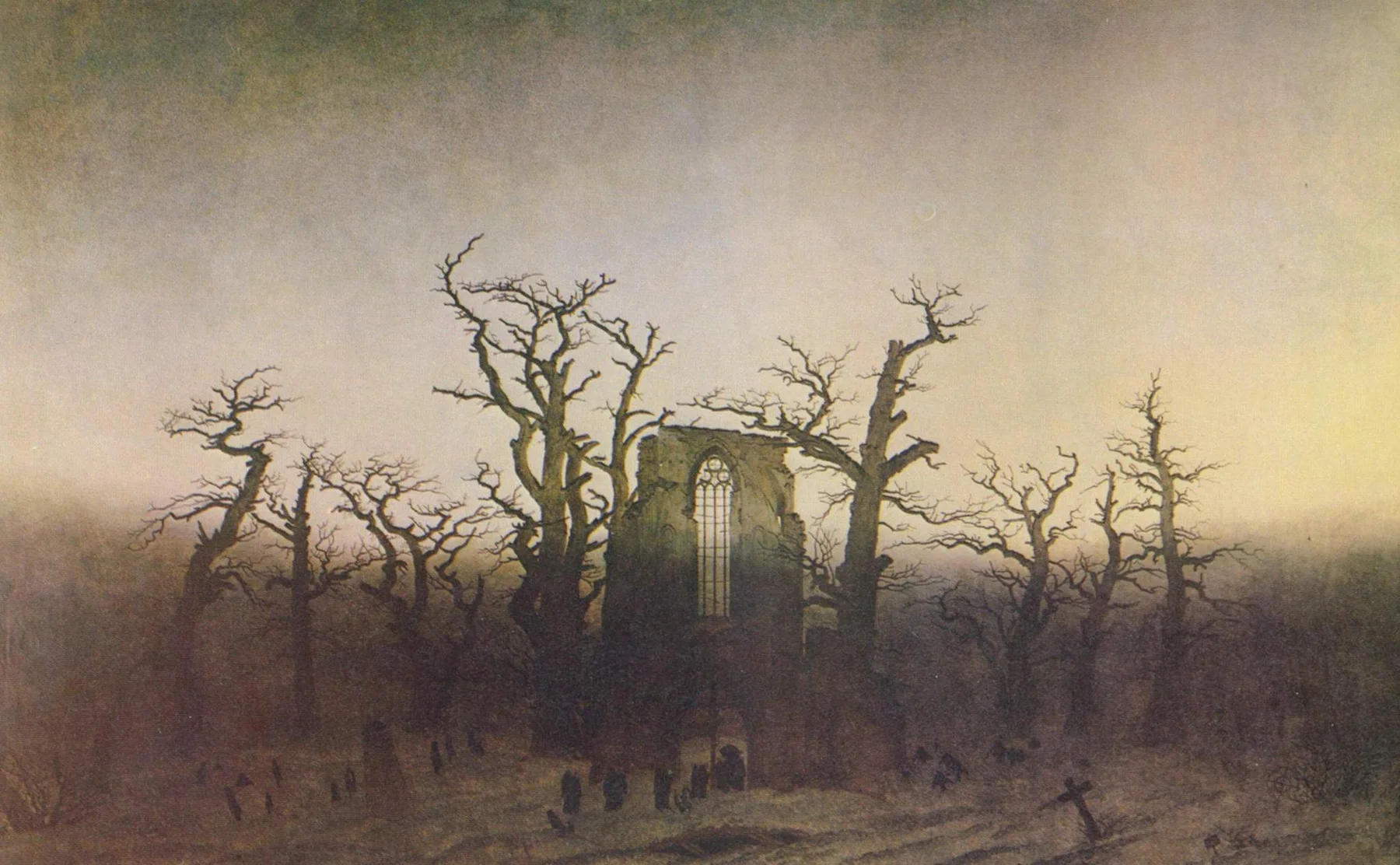

Bare oaks rise like broken architecture around a Gothic window. A line of monks carries a coffin into a graveyard; crosses and headstones interrupt the frozen ground. The building is not documentary topography. Friedrich combined remembered and studied motifs, including Gothic ruins associated with Eldena Abbey near Greifswald, into an invented threshold.
The vertical window and trees divide the canvas, but low figures and graves prevent the ruin from becoming a scenic ornament. Earth receives the procession while the pale upper zone remains visually open. The painting does not illustrate one event or identify the dead person. It makes burial a movement through material decay.
Technical research by the Alte Nationalgalerie also limits myths of spontaneous vision. Friedrich worked with unusually thin paint layers, precise underdrawing, and controlled revisions. Damage and extensive earlier restoration complicate what viewers now call his original atmosphere. The fragile surface is evidence, not transparent access to an untouched artistic mind.
The abbey is a pendant, not a solitary icon
The Abbey in the Oakwood was conceived and first exhibited beside Monk by the Sea. In the latter, a tiny solitary figure faces an almost empty sea and sky; in the former, a community moves toward burial among ruins. One withdraws conventional landscape anchors, while the other accumulates trees, architecture, graves, and ritual.
Reading the abbey alone can turn it into a general symbol of melancholy. The pair produces a more specific sequence without dictating one solution: exposed individual perception meets communal rite; horizon meets ruin; vast openness meets the material histories of building and burial. The two canvases are close in width and were treated as a linked work at the 1810 Berlin Academy exhibition.
A Prussian purchase authorised a private threshold
The two landscapes attracted intense attention at the Academy exhibition and were purchased for the Prussian crown in 1810. Royal acquisition converted an artist’s severe experiments into collectable national culture. It did not settle their meaning. Contemporary responses ranged from fascination to discomfort; Heinrich von Kleist’s famous discussion of Monk by the Sea registered the destabilising effect of its radical emptiness.
Friedrich’s reputation later declined before exhibition and scholarship renewed attention around 1906. The modern canon was reconstructed, not inherited continuously from 1810.
Géricault made colonial state failure monumental
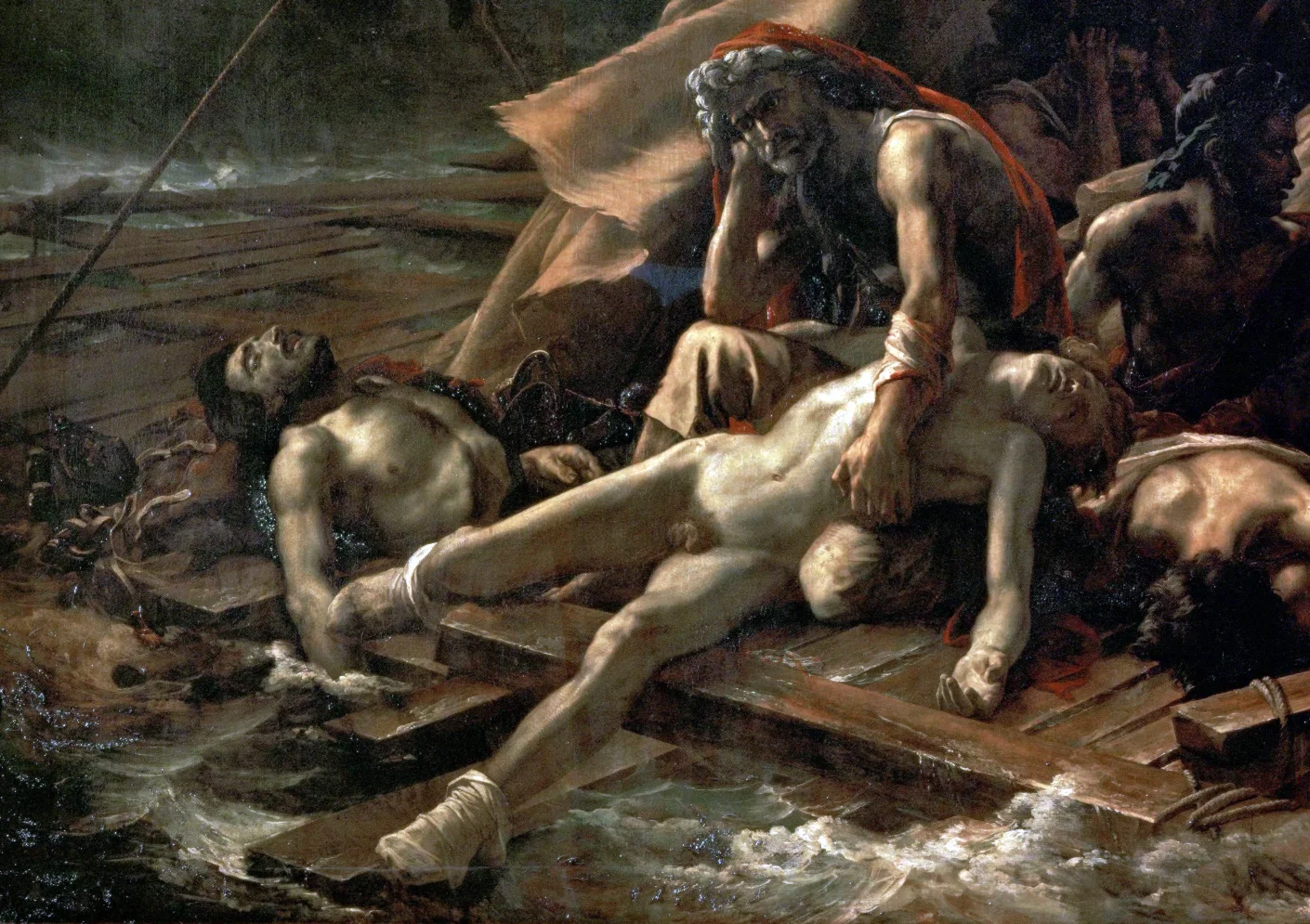

The French frigate Méduse sailed toward Saint-Louis in Senegal in 1816 with roughly four hundred people. It grounded on the Arguin Bank. A makeshift raft carrying about 150 people was abandoned when the lines connecting it to boats were cut. After twelve days, the Argus found fifteen survivors. The voyage belonged to France’s restored colonial administration; its failure became a scandal at home.
Géricault enlarged a recent, politically charged disaster to more than seven metres wide. He interviewed survivors Alexandre Corréard and Henri Savigny, studied bodies and sea conditions, made models, and tested episodes including mutiny and cannibalism before choosing the distant sighting of possible rescue.
The raft rises from death toward uncertain rescue
The composition builds two linked pyramids. A mast and sail lean left into the storm; bodies rise right toward a figure waving red-and-white cloth. The diagonal begins among corpses and exhausted survivors, passes through twisting bodies, and reaches a Black man standing on a barrel. Far away, the Argus is barely a mark.
Hope is therefore directional but not secure. The rescuing ship can be seen only because the painting’s scale makes human vision strain across painted distance. A wave approaches from the left. The raft’s lower edge presses bodies toward the spectator, including a father-like figure holding a dead young man. Classical anatomy and monumental arrangement do not remove horror; they make it legible through prestigious visual equipment.
That equipment creates tension. The survivors appear more muscular and composed than starvation would allow. Géricault makes disaster public by translating it into bodies a Salon audience had been trained to read as history painting.
Research does not make catastrophe transparent
Survivor accounts are indispensable, but they are not the voices of everyone who sailed. The archive preserves officers, administrators, trial records, published narratives, critics, and an artist more readily than many soldiers, labourers, colonial subjects, or those who died. The Louvre record can establish route, grounding, abandonment, duration, and survival count. It cannot recover each person’s experience.
The preparatory process also changed the event. Early studies tested different climaxes. The final canvas suppresses some documented violence and concentrates the instant before rescue. The decision increases suspense and gives viewers a collective movement from death to hope.
A neutral Salon title could not neutralise scandal
At the Salon of 1819, the work appeared under the general title Scene of Shipwreck. The catalogue did not name the Méduse. Viewers and critics recognised the subject. A neutral label could reduce direct confrontation with the Bourbon government, but public knowledge reattached the recent scandal to the enormous image.
Géricault hoped for a royal purchase. The state did not buy the canvas at the Salon; the Louvre acquired it after his death in 1824, and it entered permanent display in 1826. Rejection and canonisation belong to the same institutional history. An image can fail to gain immediate official approval and later become a national masterpiece.
The shift also changes political memory. Museum status can preserve a work’s accusation while softening its original risk. A scandalous current event becomes “Romanticism” unless labels reconnect it to colonial administration, patronage, race, and the dead.
Joseph at the apex changes the history
Musée d’Orsay research identifies the standing Black model as Joseph, born in Saint-Domingue and later known in Parisian studios. He embodies the sailor who raises the signal at the composition’s apex. An early sketch contained no Black figure; the final painting contains three, more than survivor accounts report. This revision connects the raft to Géricault’s abolitionist commitments and to the racial politics of Restoration France.
Naming Joseph corrects a long habit of treating models as raw material for a famous artist. It does not tell us what he thought of the painting or how he negotiated the sitting; Géricault’s surviving correspondence is silent about the Black women and men who posed for him. Presence in the archive remains unequal.
The apex matters formally and politically. A Black body carries the group’s most visible action and collective hope. Yet the painting still controls his pose, partial nudity, and public identity. Recognition is stronger when it can hold agency, modelling labour, abolitionist symbolism, and the limits of authorship together.
Missolonghi turned defeat into a female nation
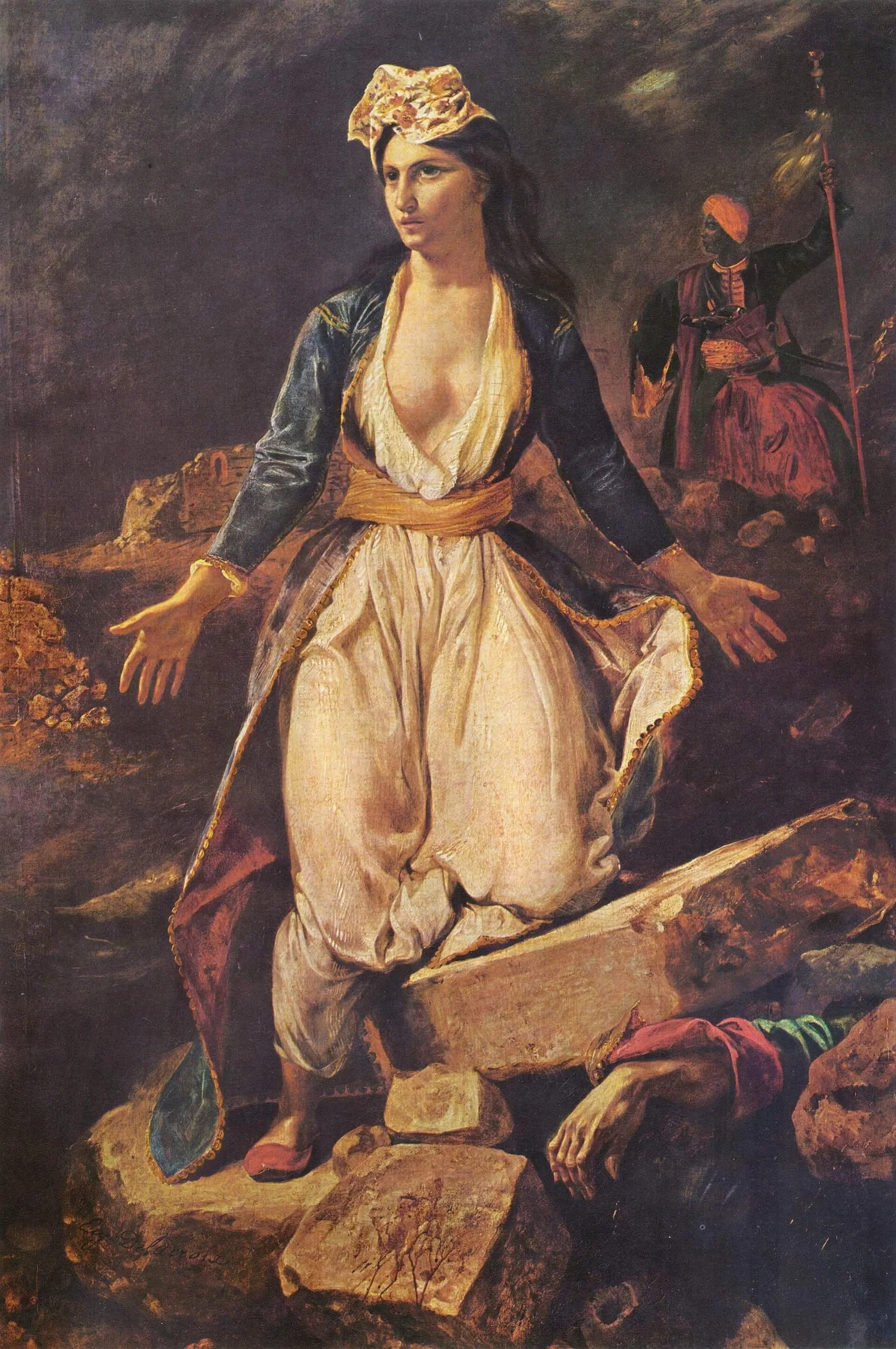

The long siege of Missolonghi ended in April 1826 when inhabitants attempted a mass breakout from Ottoman forces. Many were killed or captured. The event intensified European philhellenic support for the Greek struggle for independence. Delacroix responded with a kneeling female personification of Greece above rubble and a crushed hand. An armed Ottoman soldier appears behind her.
The figure wears clothing intended to signal Greek locality, but she is not a portrait of one participant. Her open arms, exposed chest, and frontal grief turn defeat into a body that French viewers could read through religious lament, classical inheritance, and contemporary politics.
Personification condenses. It makes a distant struggle memorable, but it replaces many named and unnamed actors with one idealised woman. The question is not whether allegory is false. It is what political complexity allegory enables a public to feel and what it edits out.
A benefit exhibition made spectators into supporters
The canvas was shown in 1826 at the Galerie Lebrun in Paris in an exhibition organised to raise money for the Greek cause. Admission and attention could therefore become material support. The display linked looking to a campaign rather than placing the work only before a Salon jury or prospective buyer.
This setting changes the painting’s address. Greece’s kneeling gesture does not merely invite aesthetic sympathy; it belongs to an event designed to mobilise resources. The committee, gallery, press, visitors, and existing philhellenic networks helped produce its political effect.
Philhellenism joined solidarity to Orientalist distance
European philhellenism drew strength from admiration for ancient Greece, Christian identification, liberal politics, travel writing, and opposition to Ottoman rule. Greek fighters and diaspora networks were active political agents, not passive recipients of European sympathy. The National Gallery of Greece describes French artistic philhellenism as both moral and practical support for a nation fighting for independence.
The movement also sorted identities through unequal visual conventions. Delacroix’s radiant, vulnerable Greece faces the darker, armed Ottoman figure. Costume and racialised contrast make the conflict quickly readable to a French public. “Europe” can recognise itself in a feminised classical-Christian Greece by casting the Ottoman opponent as an Oriental other.
Solidarity and distance can coexist. A work may support anticolonial or national resistance while imagining the people involved through inherited hierarchy. Identifying that contradiction is more accurate than dismissing all support as cynical or celebrating all sympathetic representation as equal partnership.
Cole divided one valley into storm and settlement
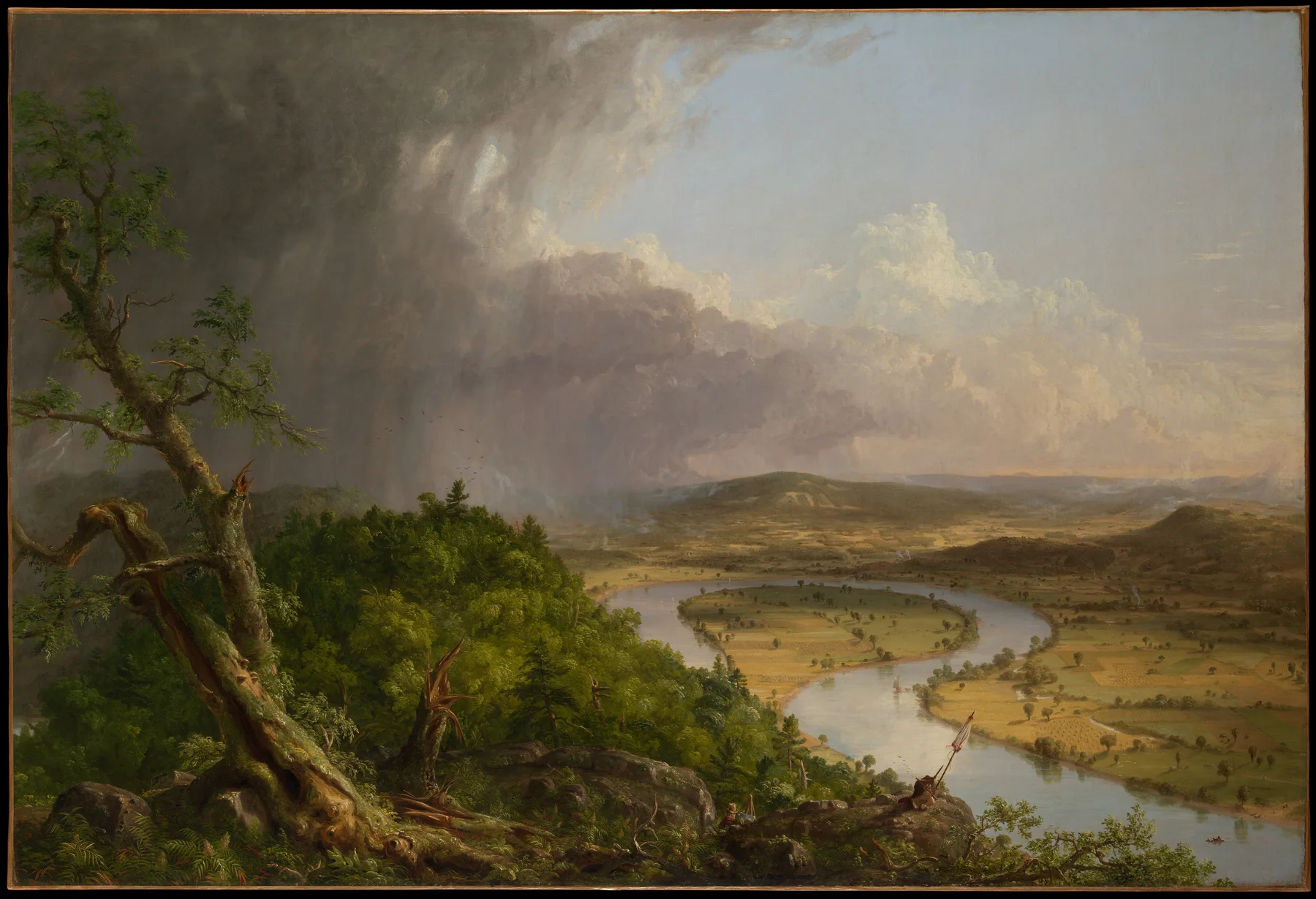
Cole looks from Mount Holyoke across a bend in the Kwinitekw, now widely called the Connecticut River. The left side is close, dark, steep, wooded, and storm-tossed. The right opens into sunlight, distant hills, fields, roads, buildings, smoke, and a controlled river prospect. A broken tree and abandoned painting equipment intensify the near ground.
The division is not a simple before-and-after. Wild-looking forest and cultivated valley coexist in one view. Weather moves between them. The river binds them. Cole’s tiny self-portrait, visible near his easel, places artistic labour at the hinge.
The Met identifies the painting’s concern with the encroachment of Euro-American settlement into supposedly untamed wilderness. “Supposedly” is crucial. The right side is not culture arriving in an empty natural world; the whole valley was already historical land.
Wilderness was already an Indigenous homeland
Mount Holyoke overlooks the ancestral homelands of Nonotuck people and a wider Kwinitekw Valley connected to Pocumtuck, Woronoco, Agawam, Nipmuc, Wampanoag, Mohegan, Pequot, Mohican, Abenaki, and other nations. Local histories document seasonal movement, farming, fishing, forest management, kinship, trade, colonial debt, coercive deeds, warfare, displacement, return, and persistence.
That knowledge changes the painting without requiring an Indigenous figure to be hidden somewhere in it. The visual opposition between wilderness and cultivation is itself historical. Land that appears wild to a settler viewer can bear long stewardship; fields that appear as peaceful improvement can result from dispossession.
Indigenous absence from the image should not be converted into a claim that people disappeared. Historian Margaret M. Bruchac and local museums stress continued presence and return despite colonial narratives of vanishing. The ethical correction is not to insert invented bodies. It is to refuse the empty-land premise.
The tiny painter occupies a commanding view
Cole sits between trees with brush and canvas, almost concealed. His scale can suggest humility before nature, but his position is also commanding. The summit organises a broad valley into one intelligible prospect. Roads, farms, weather, river, and horizon become available to a single mobile gaze.
The view was already part of tourism. A summit house opened in 1821, and visitors climbed or rode to experience the panorama. Cole’s painting transforms embodied travel and sketches into a portable scene for exhibition and ownership. The viewer inherits his elevated position without making the climb.
Conservation and expansion could share one landscape
Cole criticised reckless development and feared that industrial change would destroy valued scenery. His 1836 “Essay on American Scenery” argued for landscape’s moral, cultural, and national importance. That concern deserves recognition as an early conservationist position.
It did not automatically oppose settler expansion. The painting can criticise uncontrolled clearing while accepting the transformation of Indigenous homeland into farms, towns, property, and national scenery. On the sunny side, cultivation appears ordered and productive rather than coercive. Environmental care and colonial possession are not logical opposites.
The tension is historically productive. Viewers need not choose between “Cole loved nature” and “Cole served expansion.” The stronger account asks which forms of change he opposed, which forms he naturalised, and how a national landscape tradition could mourn lost wilderness while participating in a story that made Native people vanish.
Turner made the slave ship almost disappear
Turner’s vessel is small, dark, and already distant. The foreground holds the evidence of abandonment: shackles, limbs, hands, bodies, fish, birds, and turbulent water. Red, orange, yellow, white, green, and brown refuse stable separation among sunset, storm, blood, spray, and paint.
The full exhibition title—Slavers Throwing Overboard the Dead and Dying—Typhoon Coming On—directs viewers toward an action that the image makes difficult to parse. Turner paired the work with lines from his unfinished poem Fallacies of Hope. Text names what atmospheric vision risks dissolving.
The painting was exhibited at the Royal Academy in 1840, the year London hosted the World Anti-Slavery Convention. Britain had abolished its slave trade in 1807 and slavery in most colonies through the 1833 act, but Atlantic slavery and its economic legacies continued. The image addressed a public for whom abolition could be moral identity as well as unfinished struggle.
The Zong was murder before it was a sublime image
Turner’s subject recalls the Zong. In 1781 the ship’s crew murdered more than 130 enslaved African people by throwing them overboard during the voyage to Jamaica. The owners sought insurance compensation. The resulting litigation, Gregson v Gilbert, treated the deaths through the law of cargo and insured loss rather than prosecuting homicide.
Royal Museums Greenwich preserves a bound volume containing a court transcript, Granville Sharp’s letter, and an account of the murders. The United Kingdom National Archives lists the surviving King’s Bench and Exchequer records. These documents reveal both evidence and violence in archival form: many victims entered the public record because owners and insurers disputed monetary value.
Turner likely encountered the history through abolitionist publication, including the 1839 edition of Thomas Clarkson’s account. But influence is not origin. The painting comes fifty-nine years after the murders. It is one episode in a longer struggle over how the Zong could be documented, mourned, represented, and used.
Abolitionist display did not end spectacle
The MFA describes Slave Ship as a forceful indictment of the transatlantic trade. Its timing, title, literary accompaniment, and horrific fragments support an abolitionist reading. That intention does not resolve how the work positions Black suffering.
The people in the water are not given names, faces, or recoverable bodies. Their fragmentation can register the slave system’s destruction of personhood. It can also make their deaths material for a spectacular surface consumed by distant viewers. The painting’s high market and museum status adds another asymmetry: an object about commodified human life became a treasured commodity.
Contemporary interpretation should not solve this by claiming that beauty is immoral or that artistic power excuses every choice. Sylvia Quarles Simmons, Nancy Scott, and Musa Harar model different responses in the MFA’s discussion of the work. Ethical looking can remain divided, attending to abolitionist accusation and aestheticised violence at once.
Colour can expose violence and absorb it
Turner’s colour refuses the clean outline that made Géricault’s bodies anatomically legible. Forms emerge and vanish within paint. This makes perception active: the viewer discovers chains and flesh after being drawn toward the sun. Delayed recognition can reproduce moral shock—beauty turns into evidence.
But absorption cuts both ways. If storm and sunset dominate memory, the murdered can become details proving Turner’s modern handling. Formal innovation may eclipse the named history that gives the image urgency. A museum label and title are therefore not external supplements. They help keep painterly sensation connected to slavery, insurance, law, and death.
Ruin, wreck, storm, and horizon organise time
Friedrich’s ruin makes past institution and future decay coexist. Géricault’s horizon delays rescue; Delacroix’s ruins turn a recent defeat toward national futurity. Cole’s storm and cultivation divide competing stories of land change. Turner’s ship recedes while submerged evidence remains in the viewer’s present.
Romanticisms repeatedly make history felt as incomplete. That incompletion can open critical thought, but it can also replace material causes with atmospheric fate. The method is to move back and forth between pictorial time and documented chronology.
Nation and resistance were not the same project
Friedrich’s German reception, Delacroix’s philhellenism, and Cole’s United States scenery all helped later national canons. Yet national visibility does not automatically equal resistance. A nation may resist empire, build empire, erase internal difference, or do several at once.
Greek independence involved resistance to Ottoman rule and active international networks. United States national landscape developed within a republic expanding through Indigenous dispossession and slavery. Prussian collection of Friedrich could turn difficult inward images into state cultural inheritance. Abolitionist Britain could remember the Zong while profiting from slavery’s legacies.
The colonial sublime distributes danger unequally
The phrase “colonial sublime” names a recurring structure rather than a style shared by all five artists. Vastness, obscurity, danger, elevation, and mastery can be organised through colonial relations. A viewer safely surveys land represented as empty; a metropolitan audience encounters distant suffering as intense sensation; a national allegory turns complicated actors into an available body.
The sublime does not cause colonisation, and every storm is not imperial propaganda. The concept becomes useful when supported by object-level evidence: the Méduse sailed in a colonial mission; the Kwinitekw Valley was Nonotuck homeland; the Zong litigation treated murdered Africans as insured property; philhellenic imagery arranged Europe and the Ottoman world through unequal types.
The ethical question is positional: Who is permitted to experience danger as an elevating limit of perception, and who bears danger as material reality? Romantic art can expose that inequality. It can also depend on it.
A comparison matrix
| Work | First public-making structure | Sublime or allegorical operation | Political capacity | Necessary limit |
|---|---|---|---|---|
| Friedrich, Abbey in the Oakwood | 1810 Berlin Academy exhibition and Prussian purchase | Ruin, burial, winter, and paired scale turn landscape into a threshold | Supports mourning and contested historical or national reflection | No single nationalist code is proven by the canvas |
| Géricault, Raft of the Medusa | 1819 Paris Salon and press scandal | Monumental bodies rise toward a nearly invisible rescue | Makes recent colonial state failure public; gives a Black figure collective agency | Research and abolitionist symbolism do not restore every victim’s voice |
| Delacroix, Greece on the Ruins of Missolonghi | 1826 Paris benefit exhibition | A female personification condenses siege, land, defeat, and future nation | Mobilises sympathy and funds for Greek independence | Philhellenic solidarity uses gendered and Orientalist difference |
| Cole, The Oxbow | 1836 National Academy of Design exhibition and art market | Elevated view divides storm-dark forest from cultivated prospect | Critiques environmental destruction and builds national landscape | “Wilderness” obscures Nonotuck stewardship and settler dispossession |
| Turner, Slave Ship | 1840 Royal Academy exhibition near an abolition convention | Colour, storm, obscurity, and distant vessel delay recognition | Indicts Atlantic slavery and insurance logic | Black death risks becoming fragmented spectacle for a safe viewer |
What the surviving archive overrepresents
Academy catalogues, royal purchases, Salon criticism, state museum records, legal proceedings, famous artists’ papers, and monumental canvases survive because institutions preserved them. That density can make metropolitan viewers appear to be the only historical public.
The imbalance is especially severe around catastrophe and colonisation. Méduse survivors who published accounts, Zong owners and insurers, European committees, and landholding institutions left records under their own categories. People who died, were enslaved, were displaced, posed anonymously, or participated through oral and community histories enter unevenly.
Common survey traps
“Romanticism replaced reason with emotion.” These works organise feeling through research, revision, exhibition, theory, and institutions.
“The sublime means dramatic nature.” It describes a relation among perception, scale, danger, distance, and power.
“Friedrich painted German nationalism.” National context matters, but the invented ruin and anonymous burial do not disclose one fixed programme.
“Géricault painted exactly what happened.” He researched the disaster and constructed one selected instant at Salon scale.
“Joseph is only a symbol.” He was a named, working model from Saint-Domingue. His labour and the limits of the archive matter.
“Delacroix gave Greece a voice.” The work supported a political cause while translating many Greek actors into a French allegory.
“Cole showed untouched wilderness.” The view is Nonotuck homeland shaped by long stewardship and colonial dispossession.
“An abolitionist painting cannot exploit spectacle.” Political intention and unequal representation can coexist.
Questions for close looking
- Where does the work place the viewer: shore, raft, ruin, summit, crowd, or safe distance?
- Which forms are clear, and which emerge only after extended looking?
- How do scale, horizon, weather, colour, and bodily arrangement control knowledge?
- Is a ruined building evidence of a specific past, an invented composite, or both?
- What did the maker research, and where did composition depart from documentary reconstruction?
- Who commissioned, purchased, exhibited, publicised, or raised money through the work?
- Does national personification preserve political agency or replace many actors with one body?
- What histories of land use become invisible when a place is called wilderness?
- How does naming a model, survivor, nation, ship, or homeland change interpretation?
- Who can contemplate danger, and who is represented as suffering it?
Terms for Romanticisms and the sublime
Romanticisms: overlapping, locally specific artistic and intellectual practices associated with heightened perception, landscape, history, nation, ruin, catastrophe, imagination, and political change; not one style or timetable.
Sublime: an aesthetic relation in which magnitude, obscurity, danger, or power presses against comprehension; it depends on the position and relative safety of a perceiver.
Picturesque: a historically specific mode of arranging varied, irregular, and often touristic scenery for pleasurable viewing; not a neutral synonym for pretty.
Pendant: a work designed to be displayed with another work as a pair, through matched dimensions, contrasting subjects, or linked meaning.
Personification: an embodied figure representing an abstract idea, place, polity, or nation.
Philhellenism: support for Greek culture and, in this period, the Greek independence struggle; it included Greek agency, international solidarity, classical idealisation, Christian politics, and Orientalist assumptions.
Orientalism: the production of an imagined and unequal “East” through Western scholarship, administration, travel, and representation; not simply the presence of non-European costume.
Settler colonialism: a continuing structure in which settlers seek land and sovereignty, often through Indigenous displacement and narratives of disappearance.
Colonial sublime: a critical term for sublime viewing positions organised through conquest, settlement, slavery, extraction, or the conversion of another person’s danger into distant spectacle.
A working timeline, c. 1790–1850
- 1790: Burke’s Philosophical Enquiry is already in multiple editions; theories of the sublime circulate across British and European art worlds.
- 1807: Parliament abolishes the British slave trade, not slavery itself.
- 1809–1810: Friedrich paints The Abbey in the Oakwood.
- 1810: Friedrich’s pendant landscapes appear at the Berlin Academy exhibition and are purchased for the Prussian crown.
- 1816: the Méduse grounds during a French colonial voyage to Senegal; its raft is abandoned.
- 1818–1819: Géricault paints The Raft of the Medusa.
- 1819: the canvas is shown at the Paris Salon as Scene of Shipwreck.
- 1821: the Greek War of Independence begins; a summit house also opens on Mount Holyoke.
- 1824: the French state acquires Géricault’s canvas after his death.
- 1826: the Missolonghi breakout and mass death intensify philhellenic mobilisation; Delacroix exhibits his allegory at a Paris benefit.
- 1830: the independent Greek state receives international recognition under the London Protocol.
- 1833: the British Parliament passes the Slavery Abolition Act, with coerced apprenticeship and compensation to slave owners rather than the enslaved.
- 1836: Cole publishes “Essay on American Scenery” and exhibits The Oxbow at the National Academy of Design.
- 1839: a new edition of Clarkson’s abolition history renews circulation of the Zong account.
- 1840: Turner exhibits Slave Ship at the Royal Academy; the World Anti-Slavery Convention meets in London.
- 1848: France abolishes colonial slavery again; revolutions and national movements transform European political life.
Source guide
Object records anchor dates, dimensions, titles, custody, and early display: the Staatliche Museen zu Berlin record for The Abbey in the Oakwood and its technical conservation project; the Louvre’s record for The Raft of the Medusa; the French Ministry of Culture Joconde record for Delacroix; the Met’s Open Access record for The Oxbow; and the MFA’s Turner exhibition research and multivoice interpretation.
Named and local research limits a Paris-London-only account. The Musée d’Orsay exhibition The Black Model from Géricault to Matisse identifies Joseph and reconstructs Géricault’s changes. The National Gallery of Greece’s exhibition history places Delacroix within Greek and French philhellenic art. The Mount Holyoke College Art Museum names the ancestral Nonotuck homeland, while the Porter-Phelps-Huntington House Museum’s Indigenous land-stewardship history draws on Margaret M. Bruchac and Lisa Brooks to document Kwinitekw Valley presence, dispossession, persistence, and return.
For landscape and the sublime, compare Tim Barringer, Gillian Forrester, and Jennifer Raab’s Picturesque and Sublime: Thomas Cole’s Trans-Atlantic Inheritance with the Met’s Cole project. These sources support transmission through prints, environmental critique, and landscape’s national ambitions without making Cole’s position equivalent to Indigenous histories of land.
For the Atlantic case, Royal Museums Greenwich preserves the Zong court-document volume and catalogues James Walvin’s named study The Zong: A Massacre, the Law and the End of Slavery. The UK National Archives research guide supplies exact record series and explains how enslaved Africans were classified as goods in shipping records. M. NourbeSe Philip’s Zong! is a later creative and critical response to the legal archive, not evidence about Turner’s intention.
Image rights were checked independently of object descriptions. The Turner, Friedrich, Géricault, and Delacroix images are marked public domain on their Wikimedia Commons file pages. The Cole image is provided through the Met Open Access programme as Public Domain / CC0. Every local derivative preserves the full composition, records intrinsic dimensions, and was resized to WebP without cropping. The hero appears only once.
Continue the Atlas route
Read this chapter after Revolutions, academies, and empire, c. 1750–1850 to see why Romantic experiment did not replace academies, state purchase, or public exhibition. Pair Cole with Indigenous and colonial American visual worlds, c. 1492–1750 before treating United States landscape as empty scenery. Use Who makes an art period? when “Romanticism” begins to act like a universal timeline.
The next Atlas chapter follows industrialisation and mass visibility after 1800: factories, railways, commodity worlds, photography, and illustrated print. Its central question is how machines altered not only what artists represented but who could make, reproduce, own, and circulate an image.
Editorial record
About this article
- Author
- Publisher
- GeMarkt
- Published
- Updated
- Reviewed
- Internal source & rights check. Conducted by GeMarkt Research Review. This is an internal editorial check—not independent peer review.
- Source standard
- Art history source standardPrioritises object records and research sources, distinguishes evidence from interpretation, and states material uncertainty.
Found a claim that needs checking? Report a factual error.