Art History · Learning chapter
Atlas II — Connected worlds · 5 of 10
West African and Sahelian art, c. 800–1600: court, trade, sacred authority, and material
A five-work guide to how earth, clay, brass, and ivory made urban life, sacred authority, court hierarchy, and long-distance exchange visible.


What we’ll look at
How did materials support religion, trade, and rule in West Africa and the Sahel?
The wall is not smooth. Hand-sized hollows, projecting teeth, patched planes, and a dark doorway interrupt its earthen surface. Light catches every change. Nothing in the photograph suggests a material trying to escape age. The architecture shows that endurance can require alteration.
This is an interior detail of Djingareyber Mosque in Timbuktu. Its first construction is associated with Mansa Musa’s return from pilgrimage in the fourteenth century. It was rebuilt and enlarged in the sixteenth, then maintained by generations of custodians and craftspeople. The wall visible now is not a fossilised piece of 1320s earth. It is a historical structure kept present through material knowledge and communal use.
That distinction matters far beyond one mosque. Much of what survives from West Africa between about 800 and 1600 has reached modern viewers through uneven processes: earthen buildings renewed in place, fired-clay figures removed from archaeological settings, copper-alloy works found during construction, court objects seized by an invading army, and ivory commissions carried across the Atlantic into European collections. The archive is rich, but it is not neutral.
This guide asks:
How did makers across West African cities, courts, sacred institutions, and trade networks materialise authority—and how do archaeology, colonial removal, and uneven survival shape what can be seen today?
Five works provide five partial answers. Djingareyber makes maintenance part of monumentality. A seated terracotta figure from the Middle Niger region gives a body intense formal presence while withholding its original use. A brass head from Ife joins technical control to sacred kingship without becoming a simple portrait. A Benin palace plaque turns scale, regalia, and imported metal into court hierarchy. A Temne or Bullom ivory saltcellar, commissioned for a Portuguese patron, records African invention inside an expanding Atlantic trade.
They do not add up to one “African style.” They show different societies making power tangible—and modern institutions deciding which histories remain visible.
What do “West African” and “Sahelian” mean here?
West Africa is not a single cultural zone, and the Sahel is not a country. Sahel names a broad ecological band south of the Sahara. Its shifting grasslands, river systems, desert edges, farming zones, and trade routes cross modern national borders. “West African,” used at continental scale, can gather coast, forest, savanna, delta, and Sahel into a false unity.
This article follows selected works from locations in present-day Mali, Nigeria, and Sierra Leone between about 800 and 1600. The dates hold the growth of Sahelian cities and states, the flourishing of Ife and Benin court arts, and early Atlantic commissions together without proposing a shared beginning or end.
The Metropolitan Museum of Art’s Sahel exhibition overview describes a region shaped from the first millennium by influential polities and trade networks, including Ghana, Mali, and Songhay. That frame must remain plural. Empire did not erase local languages, practices, professions, or rivalries, and Islam did not replace every earlier practice in one conversion event.
Modern state names below are geographic aids, not historical political borders. Yoruba, Edo, Temne, and Bullom identify living peoples and languages, not museum styles sealed in the past.
Timbuktu and the Inland Niger Delta were linked to Saharan and riverine movement. Ife and Benin developed urban and court traditions farther south. Coastal Sierra Leone entered an early Atlantic market. Contact does not cancel difference.
Djingareyber: a monument survives by changing
The photograph above offers no complete façade, aerial plan, or timeless silhouette. It brings the viewer close enough to see earth as worked material. The surface has thickness; the doorway has been shaped; projecting forms catch light and may support access during maintenance. What looks from a distance like one ochre mass is the result of repeated technical decisions.
Djingareyber is one of the three major mosques included in UNESCO’s Timbuktu World Heritage property. UNESCO associates its initial construction with Sultan Kankan Musa—better known as Mansa Musa—after his pilgrimage to Mecca. The building was rebuilt and enlarged between 1570 and 1583 under Imam al-Aqib, qadi of Timbuktu. These two moments alone prevent a one-date label from explaining the structure.
Mansa Musa’s pilgrimage of 1324–25 made Mali’s wealth visible across North Africa and the Mediterranean. The evidence supports his royal patronage more securely than every detail of the lone-genius architect story repeated online. Construction also depended on people who sourced earth, timber, fibre, water, labour, measurements, and local knowledge.
Earth was not merely a cheap substitute for stone. At Timbuktu it enabled walls responsive to local supply and climate, but demanded active knowledge: plaster erodes, cracks must be read, and damaged sections renewed. Maintenance is one condition by which the mosque remains a mosque.
UNESCO’s record makes that continuing relation explicit. The three mosques retain significance through architecture, traditional construction techniques, present-day maintenance, and use. Management includes mosque committees and the cultural authorities of Timbuktu. The site is also vulnerable to flooding, urban pressure, climate change, conflict, and failures of maintenance; it has remained on the List of World Heritage in Danger since 2012.
The building’s earlier histories cannot be separated from current custodianship. Prayer, teaching, cleaning, access, repair, and decisions about change keep sacred architecture socially present.
The 2010 photograph identifies an interior restored with support from the Aga Khan Trust for Culture. It records a maintained surface, not untouched fourteenth-century fabric. Its stronger claim is that skilled continuity leaves a material trace.
A Middle Niger terracotta: the body survives, the setting does not
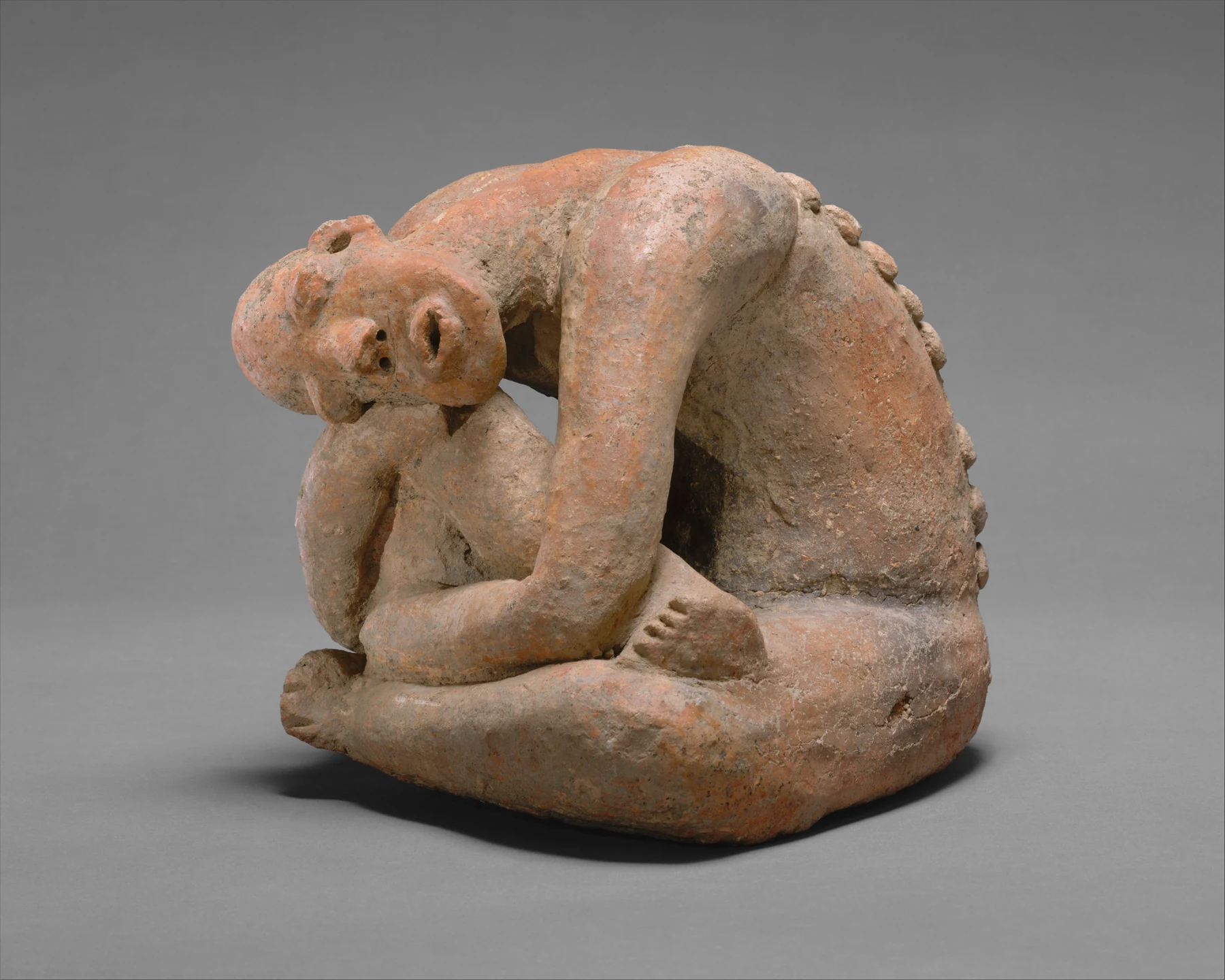
The body folds into itself. One leg lies across the base, the other rises into a rounded wall. Arms bind the arrangement together. The tilted head rests on a knee, but the face turns outward enough to meet a viewer. Small applied forms run along the back and limbs.
It is easy to supply an emotion: grief, exhaustion, illness, prayer, anxiety, sleep. The sculpture’s compression invites bodily recognition, yet recognition is not identification. A pose that feels psychologically immediate to a modern museum viewer does not disclose its thirteenth-century name, setting, or action.
The Met catalogues the figure to the Inland Niger Delta region of present-day Mali and describes it as coming from Jenne-jeno. That ancient settlement developed within the fertile floodplain of the Niger and Bani river systems. Archaeological research has shown an urban centre by about 850, with long histories of farming, ironworking, specialised production, and exchange. The Met’s Inland Niger Delta overview emphasises both the city’s importance and the central problem: most known terracotta figures were removed without documented archaeological context.
Context is not decorative paperwork. An object’s position in a house, burial, shrine, wall, refuse layer, or workshop can transform interpretation. Associated materials help establish date and use. Detached from them, style carries more weight than it can safely bear.
The Met’s object page itself acknowledges that only a few controlled excavations provide even vague outlines for the original significance of such figures. Its catalogue date of the thirteenth century is an institutional attribution, not a diary written by the maker. The figure entered the museum through purchase in 1981; the public record does not reconstruct a complete chain from deposition to excavation to market.
What can still be seen? A maker understood how clay would carry weight across a compact form. Joined limbs create structural stability and emotional pressure. Viewers have to move around the curve of the back, patterned additions, and voids between limbs. Firing made the clay durable, while breakage, soil, collection, and conservation altered its surface.
The work also warns against treating urbanism as imported civilisation. Jenne-jeno’s growth, professional districts, and production developed south of the Sahara over centuries. Trade mattered, but a route is not an external hand that creates the societies it reaches.
The seated figure gives those urban histories a body while refusing a complete biography. Describe its choices closely, locate it within regional archaeology, and mark what removal made impossible to recover.
Ife: likeness, casting, and sacred kingship
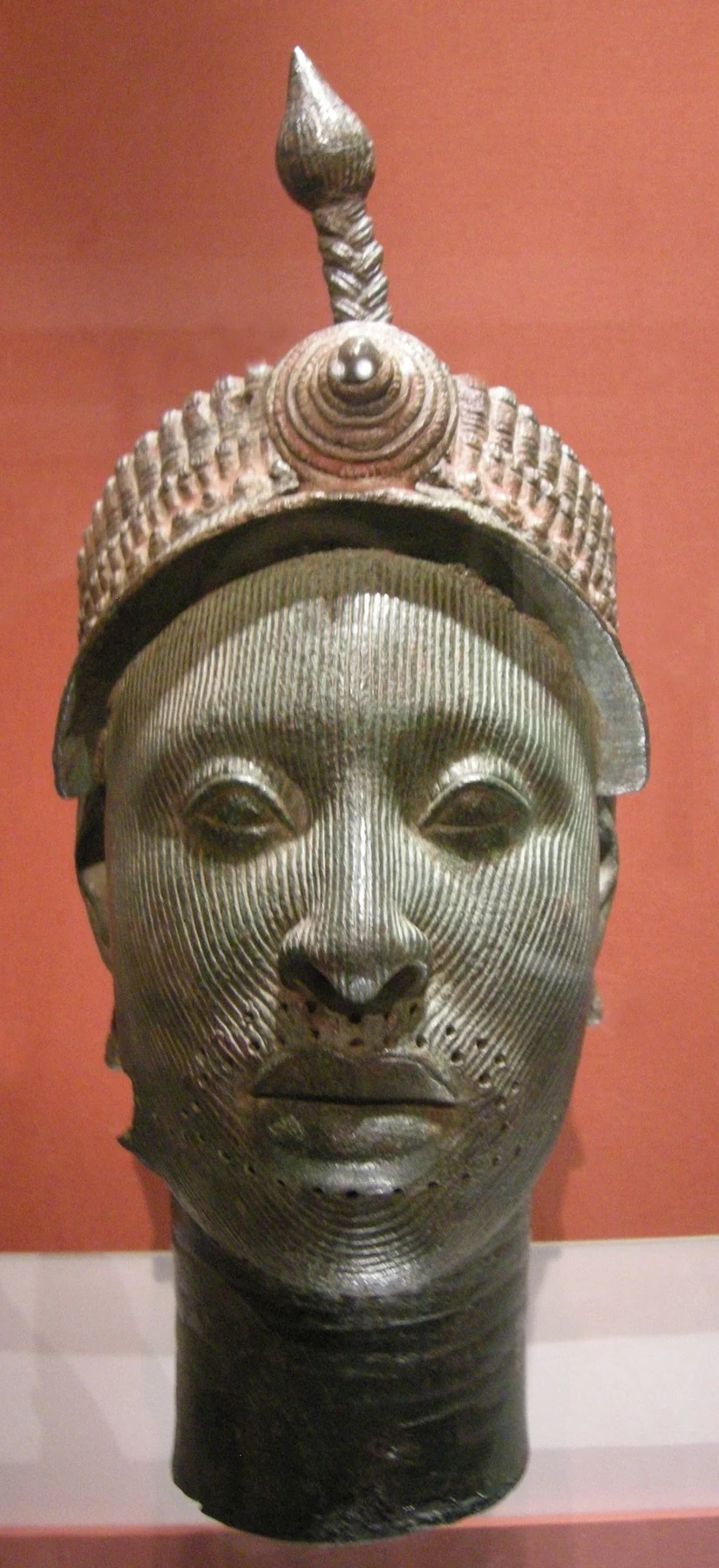

A calm face rises above a cylindrical neck. Fine vertical lines cover the skin. Small holes pass through the areas around the lips, jaw, and neck. Above, rows of beads, rosettes, a circular boss, a plaited crest, and surviving traces of pigment build a crown far more complex than the face’s quiet symmetry first suggests.
The head was found accidentally in 1938 during building work at Wunmonije Compound near the palace at Ife. It belonged to a group that included sixteen other brass and copper heads and the upper half of a brass figure. That find was not a slow archaeological excavation, but it preserved a crucial association among objects and place.
The British Museum record dates the head probably to the early fourteenth through early fifteenth century. It identifies the material more precisely than “bronze”: heavily leaded zinc-brass. The head was made by lost-wax casting. Makers shaped a wax model, enclosed it in a mould, melted the wax out, and poured metal into the empty space. They then broke the mould to release the casting. The process allowed thin, detailed forms but required close control of the model, mould, alloy, heat, and finishing.
Technical virtuosity should not be separated from political and sacred meaning. Ife remains a centre of Yoruba sacred kingship. The elaborate crown suggests an association with an Ooni, a ruler of Ife, but the museum notes that the precise identity and function of the Wunmonije heads remain uncertain. “Head of a ruler” is plausible; “portrait of a named king” would outrun the record.
The facial striations and holes also resist a purely naturalistic reading. Attachments may once have transformed the head. Pigment added colour. Crown and beads signal status. The sculpture may have worked within display, ceremony, storage, or ritual practices not reconstructed by the modern pedestal.
When Ife works became widely known in Europe, their lifelike modelling collided with racist expectations. Some observers looked for Mediterranean authorship or even Atlantis rather than accept Yoruba achievement. European resemblance became a false measure of skill, and African authorship was doubted precisely when the work exceeded a stereotype.
The better question is not whether the head looks Greek. It is how Ife makers developed their own relation among ideal presence, surface pattern, sacred office, and metal technology. Lifelike does not mean copied directly from one face. Idealised does not mean generic. A work can join close observation to the requirements of royal power without functioning like a modern passport image.
The head’s collection history also belongs to its meaning. Henry Maclear Bate, editor of the Nigerian Daily Times, purchased it in Ife. Kenneth Clark then bought it for the National Art Collections Fund, which presented it to the British Museum in 1939. “Purchased” does not exhaust the late-colonial structure in which an object connected to sacred kingship entered a British national collection.
The photograph cannot restore the Wunmonije group. It isolates one head and softens the metal through glass and exposure. It should lead back to the find circumstances and living Yoruba authority—not into a universal history of portraiture measured elsewhere.
Benin: a palace turns hierarchy into brass
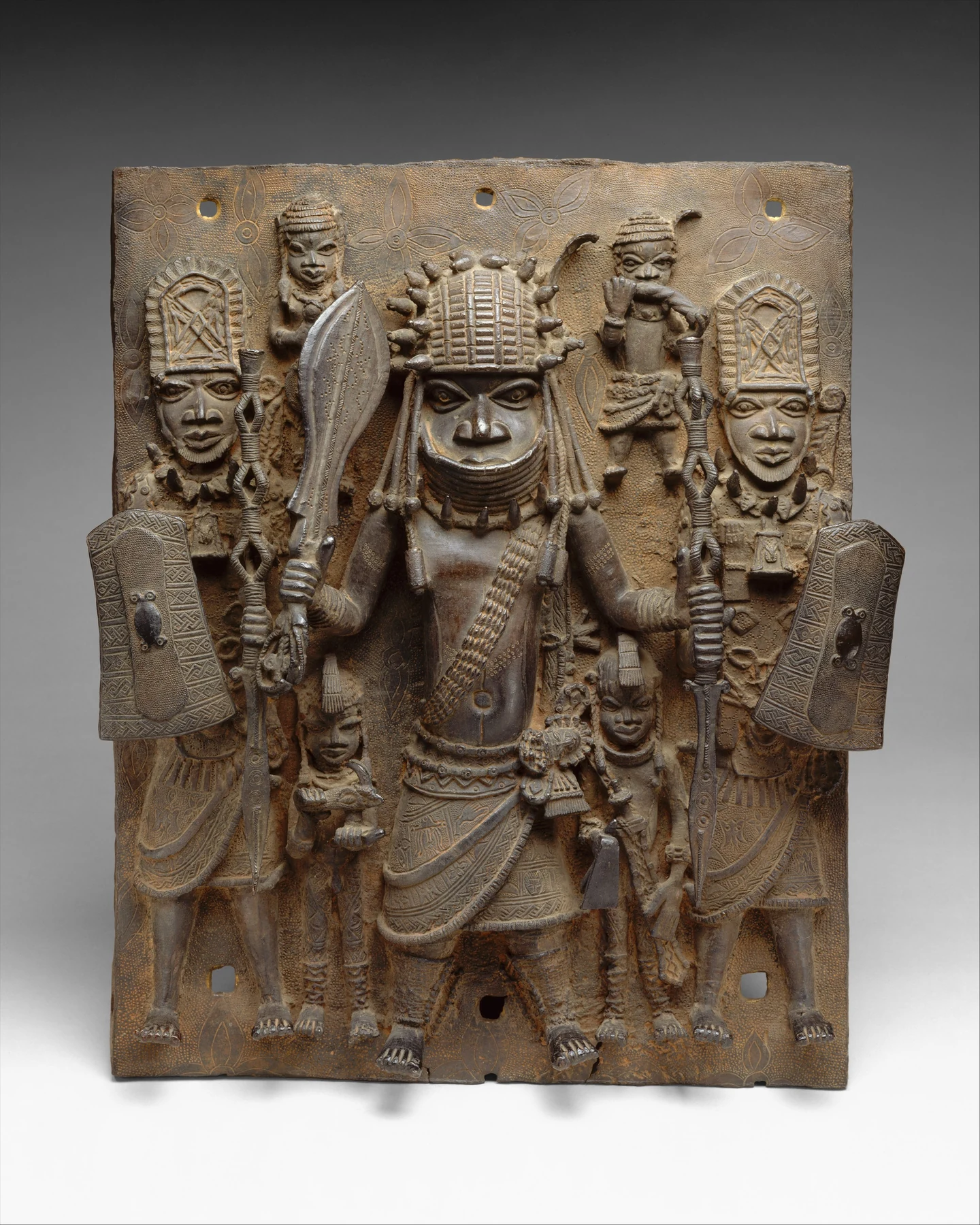
The largest body owns the centre. A warrior chief faces outward, holding a ceremonial sword and spear. Coral regalia, a leopard-tooth necklace, patterned cloth, scarification, and a projecting hip ornament accumulate around him. Shield bearers stand smaller at either side; attendants with a fan, trumpet, and offering occupy further levels of rank.
Scale is political grammar. The central figure is not larger because he stood closer to an imagined camera. The artists used hierarchical proportion to make authority immediately legible. Regalia and service explain who this person is within the court more forcefully than individual facial likeness.
The plaque was made by artists of the Ìgùn Ẹ́rọ̀nwwọ̀n, the hereditary brass-casting guild serving the Oba of Benin. The plural attribution matters. “Benin Bronze” has become a global category, but this specific work is brass, and its production belonged to a regulated court institution with specialist knowledge. Guild membership, access to metal, commission, iconography, and placement tied artistic labour to royal authority.
Plaques like this formed part of the palace environment in Benin City. A seventeenth-century visitor described wooden pillars covered with brass plaques around courtyards and galleries. Their original sequence is no longer secure. A museum wall turns one part of a palace program into a self-contained picture.
Brass carried its own politics. During the fifteenth and sixteenth centuries, Benin’s rulers negotiated trade with Portuguese merchants. Pepper, textiles, ivory, and other goods moved outward; metals moved inward. The Met’s history of Benin court art connects that influx of brass to expanded court production, from altar heads to palace plaques. Imported material did not dictate the image. Guild artists transformed it according to Edo court structures, technologies, and priorities.
The surface stages several kinds of power at once. Leopards associate the warrior with royal force. Coral and brass mark controlled wealth. Weapons imply military authority; attendants make service visible. Pattern integrates the figures into a charged metal field rather than neutral background.
The plaque’s present location is not an innocent second chapter. In 1897 British forces invaded Benin City, exiled Oba Ovonramwen, burned parts of the city, and plundered the palace. Thousands of royal and sacred works were dispersed. The violence broke relationships among objects, altars, buildings, rulers, guilds, and descendants.
The Met records that works from this dispersed corpus entered its collection through donors who had acquired them on the international art market; this plaque was given by Klaus and Dolly Perls in 1990. A clean credit line—“Gift, 1990”—is true but incomplete if it begins only at the latest transfer. The 1897 invasion is not background to tack onto a formal analysis. It helps explain why the palace must now be reconstructed from objects spread across institutions.
Benin art did not end in 1897. Monarchy, guilds, ceremonies, and artistic knowledge continued and changed. Calling it only a masterpiece of a vanished kingdom freezes living authority into the past.
The object asks two inseparable questions. How did brass make rank visible in the sixteenth-century palace? And what responsibilities follow when the same plaque is displayed far from that palace because of nineteenth-century conquest?
A Sierra Leone saltcellar: commission is not surrender
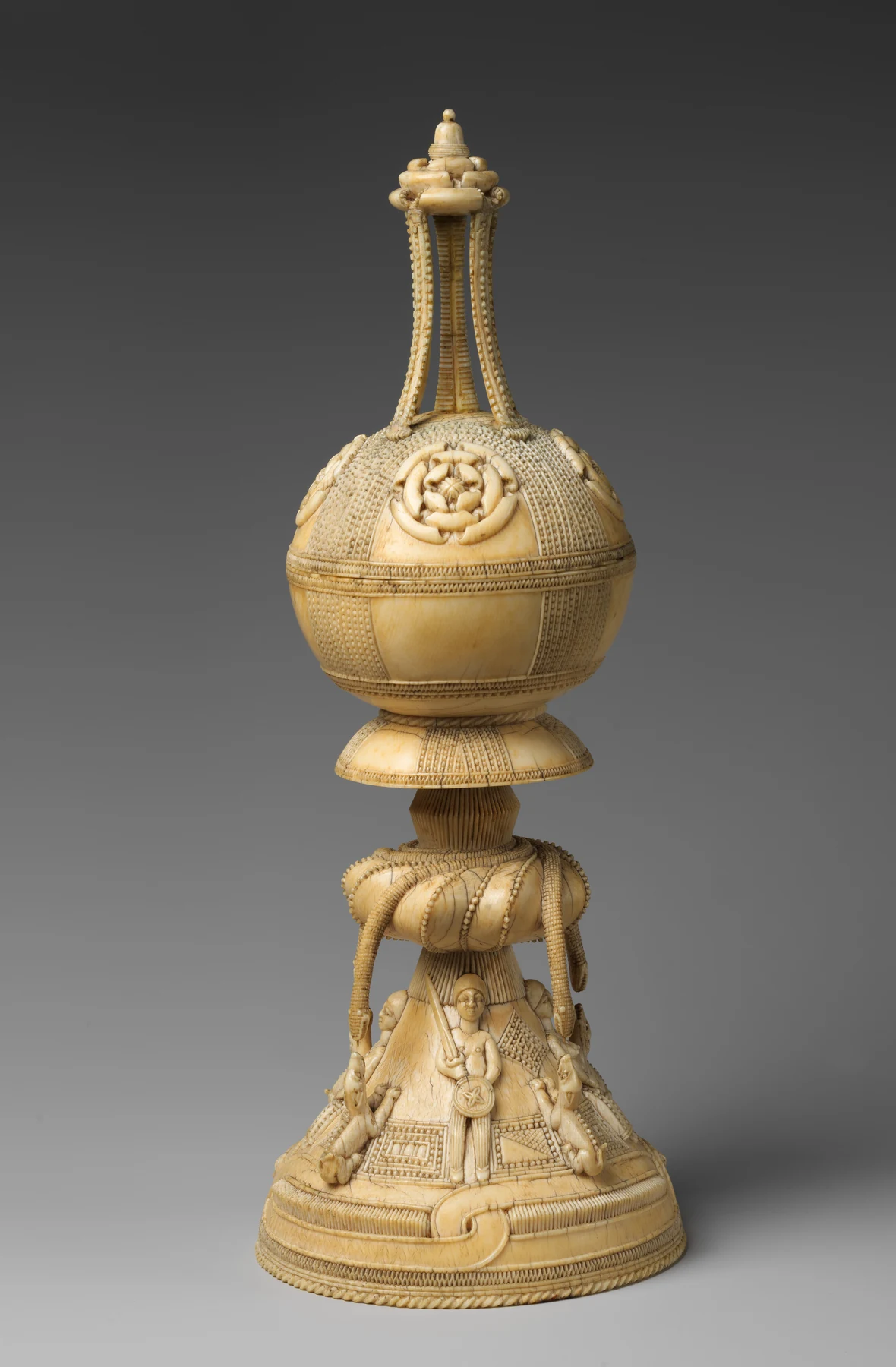
The vessel looks architectural. A broad base carries human figures, snakes, dogs, and deeply cut patterns. Above them, narrow supports open the form before meeting a round container and lid. Every band changes texture: plaiting, dots, zigzags, petals, smooth fields, and pierced spaces. The eye travels upward before understanding where salt would have gone.
Portuguese patrons commissioned this object from a Temne or Bullom carver in Sierra Leone around 1490–1530. In elite European households, salt and pepper were expensive, and an elaborate container could advertise access to distant goods and exceptional workmanship. The vessel was made for export, but “export art” does not mean that the patron supplied all its meanings.
The Met identifies snakes associated with mystical wealth and dogs understood as animals able to perceive spirits. Their confrontation may also echo animated hunting scenes in European prints supplied to African artists. The rounded container and footed superstructure may combine forms from several visual and material traditions. Commission operated through translation: a patron could specify a use or provide a model, while a maker reworked structure, surface, figure, and symbolism through local knowledge.
“Afro-Portuguese” or “Sapi-Portuguese ivory” usefully recognises cross-cultural production and helped recover the African origin of works European collections had forgotten. The label can still hide authorship if its hyphen suggests an equal blend of two complete styles. A specific maker or workshop solved a commission under particular trading conditions.
Portuguese merchants did not yet control the West African coast. They negotiated with rulers and commercial communities able to set terms and limit access. Yet Portuguese expansion was already tied to extraction, armed competition, and the enslavement and transport of Africans. Early encounter was not a space outside power.
Ivory makes that tension material. It could signal luminosity, rarity, technical difficulty, and elite value. It was also elephant tusk: a body taken through hunting and trade. In European cabinets, African carving could be admired while its makers’ names, language, and location disappeared. The object became evidence of a collector’s worldliness before it became evidence of a Temne or Bullom workshop.
The surviving saltcellar therefore documents neither simple domination nor uncomplicated equality. It records negotiation inside an expanding and increasingly violent system. African makers were not passive recipients of European design. European demand, however, was not neutral appreciation. It reorganised materials, labour, routes, and display around distant elite desire.
The open supports make a dense object feel suspended. Snakes cross structural levels; human figures support and inhabit the form rather than merely decorate it. The commission set a problem. The maker authored the answer.
Five works, five institutions of visibility
| Work | First material setting | Authority made visible | What the surviving record withholds |
|---|---|---|---|
| Djingareyber Mosque | Living mosque and urban sacred centre | Royal patronage, Islamic learning, communal worship, and skilled maintenance | One untouched original fabric or a complete list of builders across campaigns |
| Middle Niger seated figure | Uncertain; catalogued from the Jenne-jeno region | Bodily presence within an urban and ritual world not fully recoverable | Secure excavation context, original placement, named subject, and complete market history |
| Ife brass head | Wunmonije group near the palace at Ife | Sacred kingship, controlled metalwork, crown, and ideal presence | Named ruler, exact function, full colonial-era circumstances of transfer |
| Benin warrior plaque | Royal palace architecture and court record | Rank through scale, regalia, service, weapons, and guild production | Original palace sequence, relationships broken by the 1897 plunder |
| Temne or Bullom saltcellar | Export commission for European elite display | Workshop skill, negotiated form, luxury, and command of ivory | Maker’s name, original African account of the commission, early chain of ownership |
This is not a developmental line. Earth is not an early stage before metal, and export does not make the saltcellar more modern than the mosque. Each material organised a different relation among maker, institution, viewer, and movement.
Material was political
Material is not neutral substance beneath style. Here it governed access.
Earth connected Djingareyber to local building knowledge and repeated maintenance. That repetition distributed authority over time. A ruler could sponsor construction, but no royal moment could make the walls permanent without later custodians.
Clay allowed Middle Niger makers to model bodies and fire them into durable form. Its archaeological value depends on where it was deposited and what was found beside it. Once looting or undocumented digging separates clay from soil, the material survives while historical relationships vanish.
Brass required trade, alloy knowledge, fuel, mould making, and controlled labour. At Ife and Benin, casting served different political worlds. Shared metal does not prove shared function or influence; it raises questions about routes, recycling, guilds, and patrons.
Ivory condensed animal life, regional exchange, carving skill, and elite appetite. Its pale density accepted minute detail and polish. The same qualities that made it precious also encouraged removal into distant collections.
Materials are therefore social arrangements. They bring landscapes, bodies, routes, institutions, and maintenance into the artwork. A formal analysis that stops at colour and texture misses half the object.
Trade was not one direction
Two maps often dominate this period: trans-Saharan routes moving north and south, and Atlantic routes moving between Europe and Africa. Both can make West Africa look like a space crossed by other people’s lines.
Begin instead with centres. Jenne-jeno produced food, iron, pottery, and urban organisation. Timbuktu connected scholarship, manuscripts, worship, markets, and desert-edge settlement. Ife and Benin shaped court authority, technical institutions, and regional relations. Coastal communities negotiated maritime access. External trade entered already organised worlds.
Movement did transform those worlds. Salt, gold, copper alloys, textiles, manuscripts, horses, ivory, pepper, captives, technologies, and stories travelled through unequal conditions. Goods relied on translators, rulers, transport workers, credit, security, and local knowledge.
Nor is every resemblance proof of peaceful exchange. Material can travel as tribute, purchase, diplomatic gift, taxation, theft, or plunder. People can move as merchants, scholars, artisans, pilgrims, migrants, soldiers, captives, or enslaved labourers. The verb “exchange” is too gentle unless the mechanism is named.
The saltcellar makes negotiation visible in its form. The Benin plaque makes imported brass answer to Edo court hierarchy. Djingareyber joins an Islamic architectural institution to local earthen construction and present maintenance. None is evidence that global contact erased local authorship.
What the archive selects
The five works reached this article through four powerful filters.
First, materials survive differently. Clay and metal often outlast wood, fibre, paint, food, sound, and performance. Earthen architecture survives through renewal. A material canon is not a historical inventory.
Second, archaeology can recover relationships or destroy them. Controlled excavation records layers, associations, and uncertainty. Undocumented digging selects attractive objects and abandons the information around them. The Middle Niger figure’s expressive form made it collectible; that desirability may be one reason its context is weak.
Third, conquest and colonial collecting reorganised visibility. The Benin plaque became globally accessible because the palace corpus was violently dispersed. The Ife head entered the British Museum under colonial rule through purchase and institutional gift. Public display can widen study while resting on transfers that require ethical examination.
Fourth, digitisation creates another selection. A front view flattens sculpture; a dark background isolates ivory; an empty architectural photograph removes worshippers; a caption can begin history at acquisition. Digital access does not dissolve the museum.
This is why provenance belongs inside art history. It is not an administrative appendix after the “real” visual analysis. It describes the forces that produced the modern encounter.
Five shortcuts to refuse
“African art is one style”
The phrase collapses a continent, thousands of languages, and radically different institutions into a visual type. Even this bounded route crosses Sahelian cities, Yoruba sacred kingship, an Edo royal guild, and a Temne or Bullom export workshop. Comparison should sharpen difference, not erase it.
“Trade brought civilisation into West Africa”
Trade connected societies; it did not create empty recipients. Jenne-jeno’s urbanism, local production, and food systems had deep regional histories. Ife and Benin shaped their own political and technical institutions. Ask what a route connected, not which outside power supposedly switched history on.
“Naturalism means European influence”
Ife’s lifelike heads were once denied African authorship because viewers assumed technical and observational achievement must come from elsewhere. Similarity to a European category is not evidence of European cause. Study the object’s material, find context, local authority, and formal system first.
“The Benin Bronzes are simply museum masterpieces”
They are masterpieces, but the phrase can detach them from palace, altar, guild, living Edo authority, the 1897 invasion, and restitution. “Bronzes” is also a broad historical category containing many brass works. Name the specific material and removal history when known.
“Cross-cultural art proves equal exchange”
The Sierra Leone saltcellar demonstrates African authorship, adaptation, and commercial negotiation. It does not prove equality across every relation between African polities and Portuguese expansion. Contact can produce extraordinary form while participating in extraction and violence.
A working timeline, c. 800–1600
- Around 800–850: Jenne-jeno develops into a major walled urban centre in the Inland Niger Delta after centuries of settlement.
- Eleventh century: Islam becomes increasingly important in Sahelian courts and commercial centres, alongside varied existing practices.
- About 1200–1500: Ife flourishes as an artistic, political, commercial, and sacred centre.
- Thirteenth century: The Middle Niger seated figure is made according to the Met’s current attribution.
- About 1230: The Mali Empire takes shape under Sunjata in histories preserved through oral, written, and material sources.
- 1324–1325: Mansa Musa undertakes his pilgrimage to Mecca, making Mali’s wealth and networks widely visible.
- Fourteenth century: Initial construction of Djingareyber Mosque is associated with Mansa Musa’s patronage after the pilgrimage.
- Probably early fourteenth–early fifteenth century: The crowned brass head later found at Wunmonije is cast at Ife.
- Around 1400: Jenne-jeno is abandoned while the nearby city of Jenne continues as a major commercial and Islamic centre.
- Fifteenth century: Benin expands under Oba Ewuare; court institutions and brass casting develop within increasing regional and Portuguese trade.
- 1464–1591: Songhay becomes a major Sahelian empire; Timbuktu is an important centre within its political and intellectual world.
- About 1490–1530: Temne or Bullom artists in Sierra Leone make ivory works commissioned through Portuguese trade.
- About 1540–1570: Artists of the Benin brass-casting guild make the warrior-and-attendants plaque for the royal palace.
- 1570–1583: Imam al-Aqib directs the rebuilding and enlargement of Djingareyber Mosque.
- 1591: A Moroccan expedition defeats Songhay forces at Tondibi, transforming the region’s political order without ending Sahelian art or scholarship.
Terms for looking and reading
- Sahel: The broad, changing ecological zone south of the Sahara; not a nation, culture, or single style.
- Western Sudan: A historical geographic term for regions south of the western Sahara, unrelated to the borders of the modern Republic of Sudan.
- Terracotta: Fired clay. Its interpretation depends not only on form but on firing, surface, breakage, and archaeological context.
- Tell: A settlement mound formed by accumulated occupation, rebuilding, and debris over time.
- Provenance: The documented history of an object’s ownership, custody, movement, and transfer. It is distinct from, but related to, archaeological find context.
- Lost-wax casting: A process in which a wax model is replaced by molten metal inside a mould; variations can produce highly complex individual casts.
- Brass: An alloy primarily of copper and zinc. Many works conventionally grouped as “Benin Bronzes” are brass.
- Ooni: The sacred ruler of Ife. The spelling and interpretation of titles should follow living Yoruba usage and specialist sources.
- Oba: A royal title used in several southern Nigerian polities; here it refers specifically to the ruler of Benin.
- Guild: An organised body of specialist makers with regulated knowledge, obligations, access, and authority; its exact structure varies by society.
- Hierarchical proportion: Deliberate differences in figure scale used to communicate rank rather than optical distance.
- Regalia: Materials, garments, ornaments, and objects that make office, rank, or sacred authority visible.
- Afro-Portuguese ivory: A scholarly category for African-made ivory works commissioned through early Portuguese trade; useful only if it does not erase specific makers and communities.
- Spoliation: Removal or seizure of cultural property, especially through war, colonial conquest, or coercion.
- Restitution: The return of cultural property to a person, community, institution, or state with a claim grounded in ownership, law, ethics, or historical justice.
Questions to carry to the next object
- Does the regional label identify evidence, or merely make unfamiliar works look alike?
- Which modern country name is only a geographic coordinate for an earlier polity or community?
- What institution controlled the material, commission, workshop, display, or maintenance?
- Is the work’s date based on excavation, scientific analysis, comparison, oral history, written record, or several methods?
- What would secure archaeological context add to the interpretation?
- Does the object’s material reveal local knowledge, imported supply, recycled wealth, animal life, or environmental maintenance?
- Is scale describing optical space or social rank?
- When an object combines distant forms, who set the commission and who authored the solution?
- Did movement occur through pilgrimage, trade, tribute, migration, slavery, conquest, collection, or restoration?
- Where does the museum credit line begin, and what earlier transfer does it omit?
- Is the community associated with the work discussed as living in the present or confined to a historical label?
- What does the photograph make easy to see, and what relation to site, body, group, use, or ownership does it remove?
Source guide
Begin with object and site records, then test broad histories against their limits.
- For Timbuktu, UNESCO’s World Heritage record supplies the building sequence, traditional maintenance, living use, management, and current danger status. Its community conservation project places reconstruction and custodianship within local participation rather than treating international conservation as the only authority.
- For the Inland Niger Delta, compare the Met’s seated figure record with its regional archaeology overview. Both acknowledge the limits created by undocumented removal.
- For Ife, the British Museum object record provides material, technique, find circumstances, uncertainty, and acquisition history. The Met’s Ife overview offers a concise history of sacred and artistic importance while retaining the category as a bounded synthesis.
- For Benin, use the Met’s plaque record for iconography, date, guild, material, and collection credit, and its history of court art and the 1897 invasion for the dispersal that shaped modern collections.
- For the Sierra Leone saltcellar, the Met’s object record supplies attribution, imagery, and commission context. Its older Afro-Portuguese ivories essay is useful as a history of the category but should be read critically where it turns complex contact into “negotiation of equals.”
- For a wider regional frame, the Met’s Sahel exhibition overview connects material culture to Ghana, Mali, Songhay, trade, urbanism, oral history, archaeology, and Islamic histories without proposing one regional style.
The two Creative Commons photographs were checked independently from the object histories: Ousmane Garba Kounta’s Djingareyber interior is CC BY-SA 4.0, and Sailko’s British Museum view of the Ife head is CC BY-SA 3.0. The three Met object images are marked Public Domain and Open Access on their collection pages.
Continue the route
This chapter follows medieval European art, c. 900–1400, Islamic worlds, c. 650–1250, and art on the Silk Roads. The chronology overlaps deliberately. “Medieval” is not the world’s master clock, and movement across the Sahara belongs to global history as fully as movement across the Mediterranean or Central Asia.
The next atlas chapter will turn to South Asian temple worlds, c. 600–1400: image, movement, patronage, and ritual presence.
One principle should travel with us: survival is never only a property of material. Buildings endure through maintenance; excavated objects through recorded context; court works through—or despite—political seizure; and knowledge through people who keep using, disputing, naming, and caring for what institutions call art.
Study mode · no score
Check your recall
Retrieve the idea before revealing it. Choose “I’m not sure yet” whenever that is the honest answer; every response opens an explanation and retries are unlimited.
Editorial record
About this article
- Author
- Publisher
- GeMarkt
- Published
- Updated
- Reviewed
- Internal source & rights check. Conducted by GeMarkt Research Review. This is an internal editorial check—not independent peer review.
- Source standard
- Art history source standardPrioritises object records and research sources, distinguishes evidence from interpretation, and states material uncertainty.
Found a claim that needs checking? Report a factual error.