Art History · Learning chapter
Atlas V — Modernisms and contemporary practices · 9 of 10
Decolonisation, museums, provenance, and restitution
Five visual studies trace how authority over cultural objects can move through naming, provenance research, law, title, custody, consent, and return.

What we’ll look at
How can museum decolonisation change ownership, authority, and interpretation?
The blue carriage survives almost intact: two spoked wheels, painted timber, metal braces, and a barrel so densely worked in silver and gold that it resists the ordinary image of a weapon. The current Rijksmuseum record calls it the Cannon of Kandy. That name is not a neutral description. It restores a political and cultural origin obscured during the object’s long life in the Netherlands.
The cannon was seized when Dutch East India Company forces attacked the palace at Kandy in 1765. It later entered a Dutch national collection, where its history was repeatedly reframed. In 2023 legal ownership and physical custody moved to Sri Lanka. The object therefore permits a precise question: when a museum says it is decolonising, what has actually changed—its words, its evidence, its decisions, the object’s owner, its location, or the authority of the people to whom it returns?
Decolonisation is a redistribution of authority
Museum decolonisation has no single checklist. The term joins anticolonial struggle and political independence to disputes over collections, governance, interpretation, access, care, and return. Used carelessly, it flatters any new label. Used historically, it asks who acquired the power to classify other people’s worlds and whether that power is moving.
Restitution is one disposition within this field. It can transfer title and possession. A museum can return an object without changing its wider governance, or revise displays while retaining ownership and final authority. Analyse each layer. Vocabulary does not prove decolonisation, and restitution remains real without completing every form of repair.
Scope: 1945–present, five visual studies, and deliberate non-reproductions
This chapter begins after 1945, when decolonisation transformed states, museums, and claims to cultural sovereignty, but its case objects were removed earlier: Kandy in 1765, Abomey in 1892, and Benin City in 1897. Five rights-reviewed visuals structure the route: two public-domain Rijksmuseum object photographs and three original GeMarkt diagrams.
Several central objects and people are discussed without reproduction. No ancestral human remains or culturally sensitive items appear. Copyrighted installation photographs and contested collection images are not treated as free because they are online. The absences prevent illustration from silently repeating the museum’s old privilege to display. The geographic cases are not a universal history: Dutch, French, United States, Māori, Moriori, Nigerian, Beninese, Sri Lankan, and international processes operate under different laws and authorities.
The cannon carries two histories at once
In brief: This decorated cannon was made before 1745 for the court of Kandy in Sri Lanka and taken by Dutch forces in 1765. Its return required separating the object’s place of origin from the history of the institution that held it.
The cannon records extraordinary labour. Its bronze barrel bears silver and gold, precious stones, Sinhala inscriptions, floral bands, and royal emblems. The blue carriage converts force into ceremony: colour, heraldry, and engineering make authority visible. Decoration alone, however, leaves its later career unexplained.
As a collected object, it records seizure, transport, registration, display, misidentification, renewed research, state decision, title transfer, travel, and reception. Formal study shows how it materialises power; provenance asks how another power took and renamed it. The returned cannon remains evidence of Kandyan making and Dutch colonial violence.
Kandy made a ceremonial object, not a Dutch national relic
The Rijksmuseum dates the cannon before 1745 and identifies its maker as unknown. Its inscriptions and royal symbols connect it to the court of Kandy. “Unknown” here means that the current catalogue does not name an individual maker; it does not mean the object lacks a cultural authorship, workshop history, or political purpose. Court production commonly joined specialist labour that later European inventories compressed into one anonymous thing.
Dutch forces captured Kandy in 1765. The cannon entered the collection of the company’s governor in Ceylon and eventually the Dutch national collection. Calling it Dutch because it spent centuries in the Netherlands mistakes possession for origin. A collection can preserve an object while producing a false centre around it.
Plunder can be followed by misnaming
For years the cannon was associated with the Dutch admiral Michiel de Ruyter and interpreted as a diplomatic gift. The Rijksmuseum’s current object record rejects that account. Provenance research instead connects it to the 1765 plunder of Kandy. The correction matters because a gift and war booty describe opposed relations: consent versus seizure, exchange versus coercion, legitimate title versus a title requiring review.
Misnaming is not an innocent layer floating above ownership. A prestigious Dutch biography made the cannon easier to absorb into national history; the Kandyan court became secondary. Yet a corrected label alone would have left the Dutch State as owner and the Rijksmuseum as custodian. Knowledge repair can make a claim legible. It does not automatically decide that claim.
Joint provenance research changes the evidence base
The cannon’s revised account emerged through research involving Dutch and Sri Lankan specialists. The Rijksmuseum credits Alicia Schrikker and Doreen van den Boogaart and records collaboration with Asoka de Zoysa, Ganga Dissanayake, Ruth Brown, Kay Smith, and specialists in metals and conservation. Earlier Sri Lankan scholarship, including work by P. E. P. Deraniyagala and colleagues, also helped identify the object’s language and symbols.
This matters methodologically. Colonial archives were built by administrations, armies, traders, collectors, and museums pursuing their own purposes. They can establish dates, shipments, inventories, and official intent while excluding local names, losses, relationships, or refusals. Joint research is not guaranteed to be equal, but it can alter the questions, languages, archives, and expertise considered admissible. Cite who contributed rather than turning “collaboration” into an anonymous institutional virtue.
A museum may be custodian without being owner
Before restitution, the Dutch State owned the cannon and the Rijksmuseum managed it. This division explains why museum research and recommendation were necessary but not sufficient: the museum could not privately give away another legal entity’s property. Government policy, an independent advisory process, documentation, and agreements were required.
After transfer, ownership belonged to Sri Lanka and the cannon’s location became the Colombo National Museum. Owner, custodian, and location aligned more closely, but they remain conceptually distinct. A state can own while a national museum holds; a community can possess authority without holding legal title; a returned object can later travel on loan. Every caption about restitution should specify which relation changed rather than saying only that an object “went back.”
Restitution unfolds through several events
In July 2023 the Netherlands announced 478 returns to Indonesia and Sri Lanka after requests and review. For the Sri Lankan group, the Rijksmuseum records an ownership transfer signed on 28 August and physical transport on 28 November. A headline condenses the sequence; the dates reveal distinct thresholds.
A careful event ledger asks: Who requested which object? What evidence supported involuntary loss? Who recommended action? Which authority deaccessioned or transferred title? When did risk and insurance shift? Who packed and received the work? Where is it now? These questions do not reduce an ethical claim to paperwork. They show where authority changed and make institutions accountable for completion.
The gold kastane returns as part of an ensemble
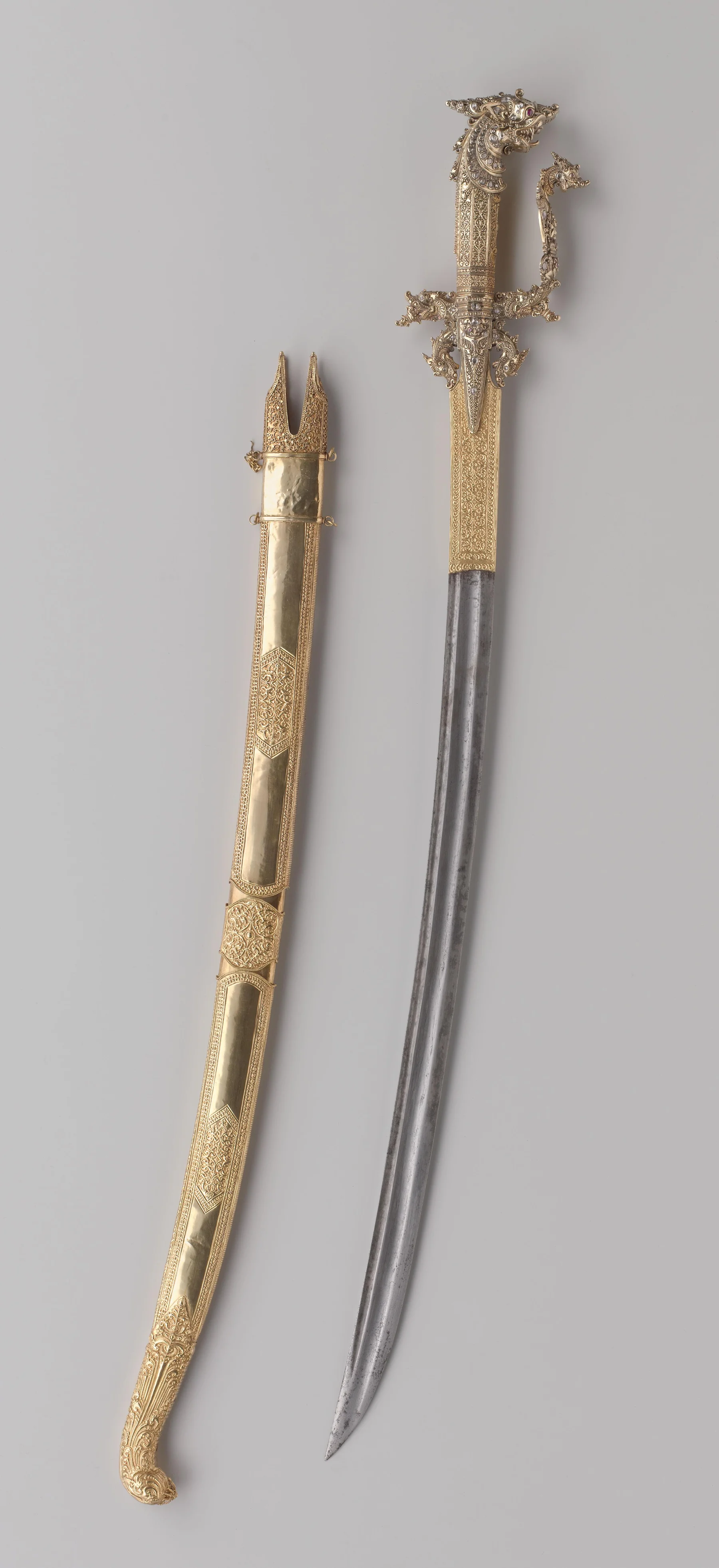
The kastane’s curved blade, gold scabbard, animal-headed hilt, rubies, and diamonds make it easy to isolate as luxury. Its provenance resists isolation. Dutch troops also captured it in the palace at Kandy in 1765. It returned with the cannon and four other objects: another kastane, a ceremonial knife, a silver gun, and two large wall guns.
An ensemble can preserve relations that a masterpiece display destroys. Weapons, insignia, furniture, documents, textiles, and ritual objects may have worked together within court ceremony. Dispersal produces separate inventory numbers and visual categories. Restitution can reassemble research questions even where an original arrangement cannot be reconstructed.
Objects do not return alone
A return carries records, conservation knowledge, legal agreements, photographs, publications, and unresolved interpretations. It can reopen relationships among museums, states, descendant communities, and scholars. These are not substitutes for the object; they shape what can be learned afterward.
The six Kandyan objects now reside at the Colombo National Museum, according to the Rijksmuseum. Their new location does not restore the eighteenth-century palace world or undo violence. It creates a different future of proximity, study, teaching, ceremonial meaning, and public interpretation. Repair should not be measured against the impossible standard of reversing time; it should be evaluated through the powers, resources, knowledge, and responsibilities actually transferred.
Decolonisation exceeds restitution
Many museum relations cannot be solved by moving every object to one national destination. Communities may disagree about custody. Diasporic publics may value access in several places. Sacred or restricted material may require non-display. Digital records may expose knowledge that should not circulate. Artists and archives may cross borders by design. Historical states do not always map onto present claimants.
These complications require specific inquiry, not permanent possession. Decolonisation may involve returns, shared authority, community-led care, new collecting rules, paid research, restricted access, governance change, or refusal to reproduce. Ask what the relevant people request and what the institution can change. Avoid declaring one universal endpoint from outside the relation.
A museum authority stack
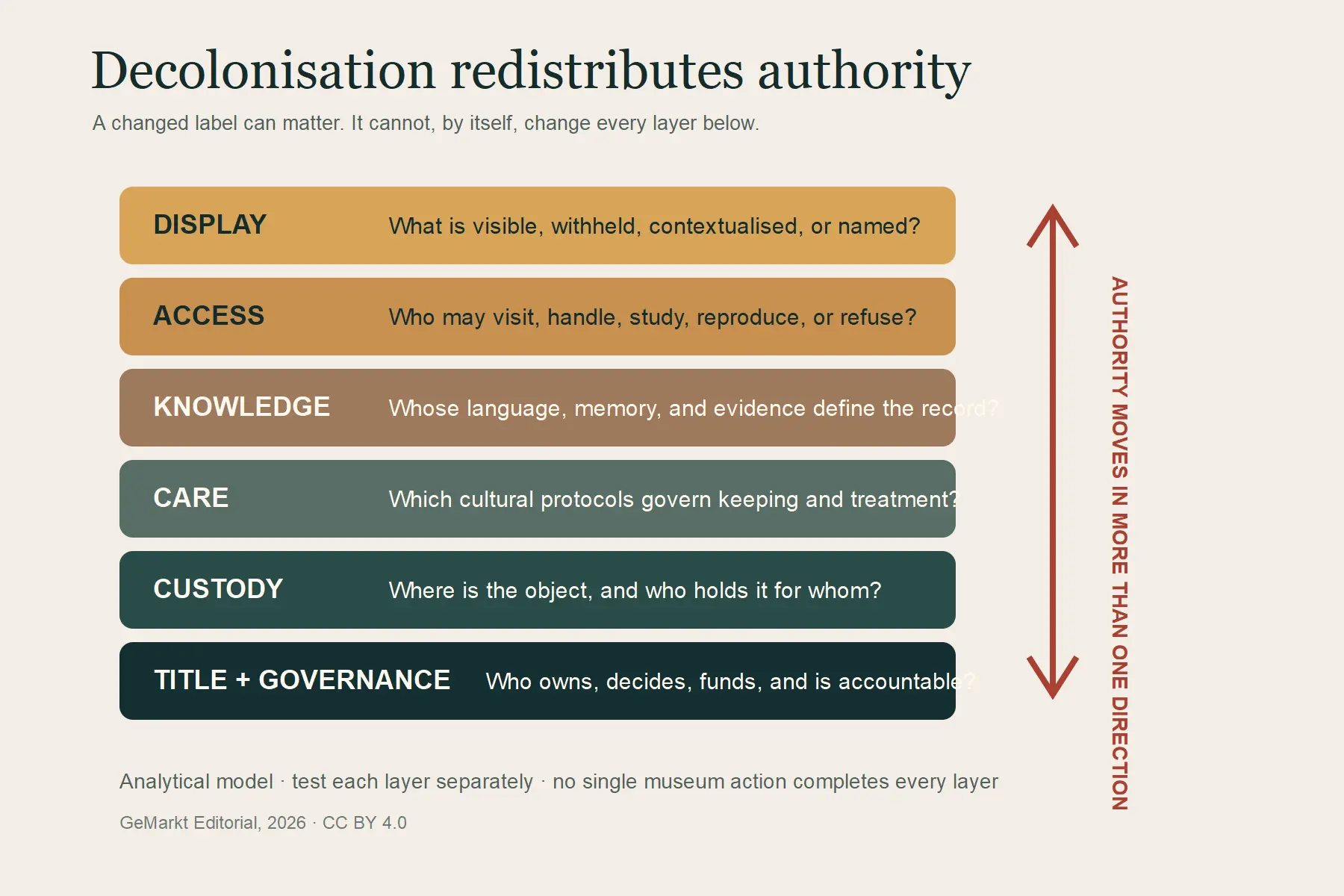
The diagram prevents a symbolic change at the top from standing in for every relation beneath it. Display concerns visibility and framing. Access includes visiting, handling, studying, reproducing, and refusing. Knowledge concerns names, evidence, language, and interpretation. Care includes conservation and cultural protocols. Custody asks who physically holds an object. Title and governance ask who owns, decides, funds, and answers for those decisions.
Layers can move in different directions. A museum may retain an object but grant a community authority over access. Ownership may transfer while an object stays temporarily on loan. A new label may acknowledge plunder while governance remains unchanged. None is meaningless; none should be overstated.
Renaming matters but cannot carry the whole claim
Catalogue language affects search, memory, and public knowledge. Replacing a collector’s invented title, naming an Indigenous nation, correcting “gift” to “seized,” or restoring a maker’s identity can interrupt inherited violence. Names also determine which records connect across databases. This is real institutional work.
Language can become a cheap substitute for harder material change. A museum may acknowledge colonial acquisition on a label yet refuse restitution, keep revenue and decision-making power, or ask community experts to work for free. Compare new wording with published provenance, budgets, access policy, governance, and the decision about the object. Asking whether a label is “merely symbolic” misses the point: symbols organise knowledge. Ask which powers the new language transfers and which it leaves in place.
New national museums challenged imperial classification
Political independence after 1945 created and transformed museums across Africa, Asia, the Caribbean, and the Pacific. National institutions could reclaim histories that colonial museums had arranged as ethnography, natural history, or evidence of supposedly vanishing cultures. They could preserve collections locally and address publics previously treated as objects of study.
Nationalisation was not automatically decolonial. New states inherited colonial borders, buildings, categories, laws, and elite hierarchies. A national museum might centralise objects taken from communities within its territory or use cultural unity to suppress difference. The postcolonial museum is therefore a field of political possibility and conflict, not the simple opposite of an imperial museum.
Independence did not empty former imperial museums
European museums retained immense collections after colonies became independent. Legal doctrines protected national holdings; provenance was incomplete; market transactions blurred coercion; and former colonial powers often defined requests as exceptional diplomacy. Objects continued to support national narratives, scholarship, tourism, and institutional prestige far from the societies in which they were made.
Claims nevertheless persisted. Communities, governments, activists, artists, and scholars documented removals, demanded access, challenged displays, and proposed new relations. Contemporary returns should not be narrated as sudden generosity discovered by museums in the twenty-first century. They answer longer histories of claim-making. Establish who asked, when, and how institutions responded before celebrating the final ceremony.
Benin 1897 made a dispersed palace archive
In February 1897 British forces attacked Benin City, burned parts of the capital, exiled Oba Ovonramwen, and removed thousands of works from the royal palace. Brass plaques, commemorative heads, ivories, regalia, and other objects entered official allocations, private collections, auctions, and museums. “Benin Bronzes” is a useful collective term, but the dispersed works include several materials and functions.
The objects are not illustrations of an abstract kingdom. They formed a court archive of rulers, offices, ceremonies, diplomacy, spiritual relations, and memory. Dispersal created the museum map through which they are studied. Connect each path to 1897 where evidence supports the link, without assuming every Benin work followed the same route.
The Smithsonian separated documented cases from unresolved cases
In 2021 the Smithsonian’s National Museum of African Art evaluated thirty-five works associated with the Kingdom of Benin. It identified twenty-nine as removed during the 1897 raid and said six required further research. In June 2022 the Smithsonian Board of Regents voted to deaccession the twenty-nine and transfer title to Nigeria’s National Commission for Museums and Monuments; a formal ceremony followed in October.
Separating documented cases from unresolved ones demonstrates an important standard. Ethical urgency does not require pretending the evidence says more than it does. Nor should uncertainty become permanent delay. Publish the known chain, identify gaps, fund research, and revise conclusions. “Benin Bronze” is a category to investigate, not automatic proof of one acquisition event.
Title can move while objects remain in place
After the Smithsonian transfer, Nigeria became the owner of twenty-nine works. Not every object immediately occupied the same location. Current Smithsonian exhibition information states that nine Nigerian-owned works remain in Washington on loan and that interpretation was developed in consultation with Nigerian museum professionals.
This arrangement makes the distinction among ownership, custody, and location visible. A visitor can stand before an object in the United States that is no longer United States property. The label should make that relation explicit. Otherwise a loan after restitution may look identical to old possession. Legal title changes who authorises future display, travel, research, and disposition; physical presence alone cannot answer those questions.
A loan after return reverses the old relation
Return followed by a loan reverses the usual presumption that a holding museum keeps control and permits temporary access elsewhere. The restituted owner decides that an object may remain or travel. The same gallery location can therefore contain a different political relation.
Post-return loans are not pressure-free: wealth, insurance, diplomacy, and visibility shape negotiation. Read duration, renewal, conservation, reproduction, and withdrawal terms where available. Return can nevertheless create exchange chosen by the new owner rather than permission granted by the former holder.
Abomey required a change in French law
French public collections are governed by an inalienability principle: objects in the public domain cannot ordinarily be transferred as if they were disposable property. In December 2020 France enacted a specific law removing twenty-six works from the national collections so ownership could pass to the Republic of Benin within one year. The law did not create a general international rule; it authorised bounded returns to Benin and Senegal.
This legal history shows why moral acknowledgement and museum preference may be insufficient. The state had to create authority for deaccession. It also shows the limitation of object-by-object legislation: each return may depend on new political action. Identify the jurisdiction and legal instrument rather than claiming that one national statute settles restitution everywhere.
An inventory annex made the return object-specific
The French law’s annex lists the twenty-six Abomey works by inventory number. Among them are royal statues, doors, thrones, altars, regalia, and other court objects taken when French forces captured Abomey in 1892. Inventory specificity makes the legal act auditable. It prevents a broad promise about “African heritage” from floating free of the objects transferred.
Object-level precision also reveals what a return does not include. Twenty-six works can be historically momentous without representing every object removed from the Kingdom of Dahomey, every Beninese claim, or a continent. Count, name, and trace. Large civilisational language may communicate importance, but it can conceal the bounded work through which title actually changes.
Benin received ownership and planned a museum future
France transferred title in Paris on 9 November 2021, and the works arrived in Cotonou soon afterward. The Government of Benin described the state as owner again. Exhibitions, research meetings, training, conservation, and museum planning accompanied the return. These activities placed the objects within a future-facing cultural programme rather than treating arrival as the final scene.
The case also followed years of debate, including the 2018 report by Senegalese economist and writer Felwine Sarr and French art historian Bénédicte Savoy. Commissioned by the French president, their report proposed a new relational ethic for African heritage in French collections. It was influential policy scholarship, not itself a court ruling or international law.
Infrastructure must support return, not postpone it
Buildings, storage, trained staff, documentation, transport, research access, and budgets affect what happens after return. Investment can widen public and scholarly value. Collaborative conservation and data transfer can address asymmetries produced when objects and expertise accumulated in former imperial centres.
Yet “capacity” can become a paternalistic test imposed only on claimants. Museums routinely lend to imperfect buildings, store objects off view, and hold collections with incomplete documentation. A former holder should not make return conditional on reproducing its own institutional model. Separate ownership from service: the rightful authority may choose local display, community custody, restricted access, a new museum, a loan abroad, or no exhibition. Infrastructure should enable that choice, not replace it.
NAGPRA redistributes authority through law
The United States Native American Graves Protection and Repatriation Act of 1990 created processes for museums and federal agencies to inventory Native American human remains and certain cultural items, consult with lineal descendants and tribes, publish notices, and repatriate under defined conditions. It applies within a particular federal legal framework; it is not a general law for every museum or every Indigenous people.
Revised regulations took effect in January 2024. The Department of the Interior states that they require deference to Indigenous Knowledge, strengthen consultation, remove the old “culturally unidentifiable” category, and require free, prior, and informed consent before exhibition, access, or research involving human remains or cultural items. Law here changes who must be asked and what institutions may do before agreement.
Consultation is not a museum asking for advice
Ordinary museum consultation can mean requesting feedback while retaining final control. NAGPRA consultation is a regulated process tied to information sharing, decision-making, inventories, notices, deadlines, and repatriation responsibilities. The National Park Service distinguishes possession or control from temporary custody and explains obligations for institutions receiving federal funds.
Do not flatten every community relationship into the same word. Ask whether participation is legally required or voluntary, when it begins, who sets the agenda, whether people are paid, what information is shared, how disagreement is recorded, and who decides. Consultation that begins after a label and exhibition plan are complete cannot redistribute the same authority as consultation over access, research, treatment, and disposition from the start.
Consent changes display, access, and research
The revised NAGPRA rule makes consent operational. Free, prior, and informed consent is not a general feeling of respect. “Free” excludes coercion; “prior” places agreement before the action; “informed” requires relevant knowledge; and consent must come through the appropriate lineal descendant, tribe, or Native Hawaiian organization. Exhibition is only one action among several. Photography, scientific analysis, teaching access, handling, and online publication may also require review.
The implications are substantial for art history. Availability in a museum or database does not create an unlimited scholarly right to inspect or reproduce. Responsible inquiry can include waiting, accepting restricted information, changing a research question, or declining to illustrate. Knowledge is produced through relations of authority as well as through vision.
Human remains are ancestors, not neutral collection material
Museums historically collected human remains through excavation, warfare, medicine, racial science, grave robbery, and unequal exchange. Catalogue systems could turn people into specimens, accession numbers, or teaching materials. Indigenous repatriation work rejects the premise that institutional classification cancels personhood, kinship, ceremony, and responsibility.
The phrase “human remains” is legal and administrative; many communities speak of ancestors or ancestral remains. Use the language of the relevant community where available. Do not aestheticise, display, or reproduce images by default. A survey of museum decolonisation can analyse policy without showing a skull, burial, or restricted object. Ethical restraint is not evidence avoidance when official records establish the process under discussion.
Karanga Aotearoa makes interim custody explicit
Te Papa Tongarewa’s Karanga Aotearoa Repatriation Programme has held a New Zealand government mandate since 2003 to support the return of Māori and Moriori ancestral remains from overseas institutions and then to iwi and imi. Te Papa states that ancestors returning internationally enter its care only on an interim basis. They are not accessioned into the museum collection or exhibited.
This is a radically clear custody statement. The museum does not convert arrival into ownership or a new permanent collection. It serves as a coordinating place while provenance and community relationships are established. As of 1 May 2024, Te Papa reported approximately 850 ancestors returned internationally and estimated about 450 still awaited return. Date the figure; a live programme changes.
Provenance can include oral history, waiata, and whakapapa
Karanga Aotearoa describes research that cautiously triangulates accession information, collectors’ diaries, auction records, oral histories, waiata, pātere, and other knowledge. Its advisory panel includes Māori and Moriori experts. This source ecology changes provenance from a paper trail owned by collecting institutions into a relational inquiry about identity, genealogy, place, language, and responsibility.
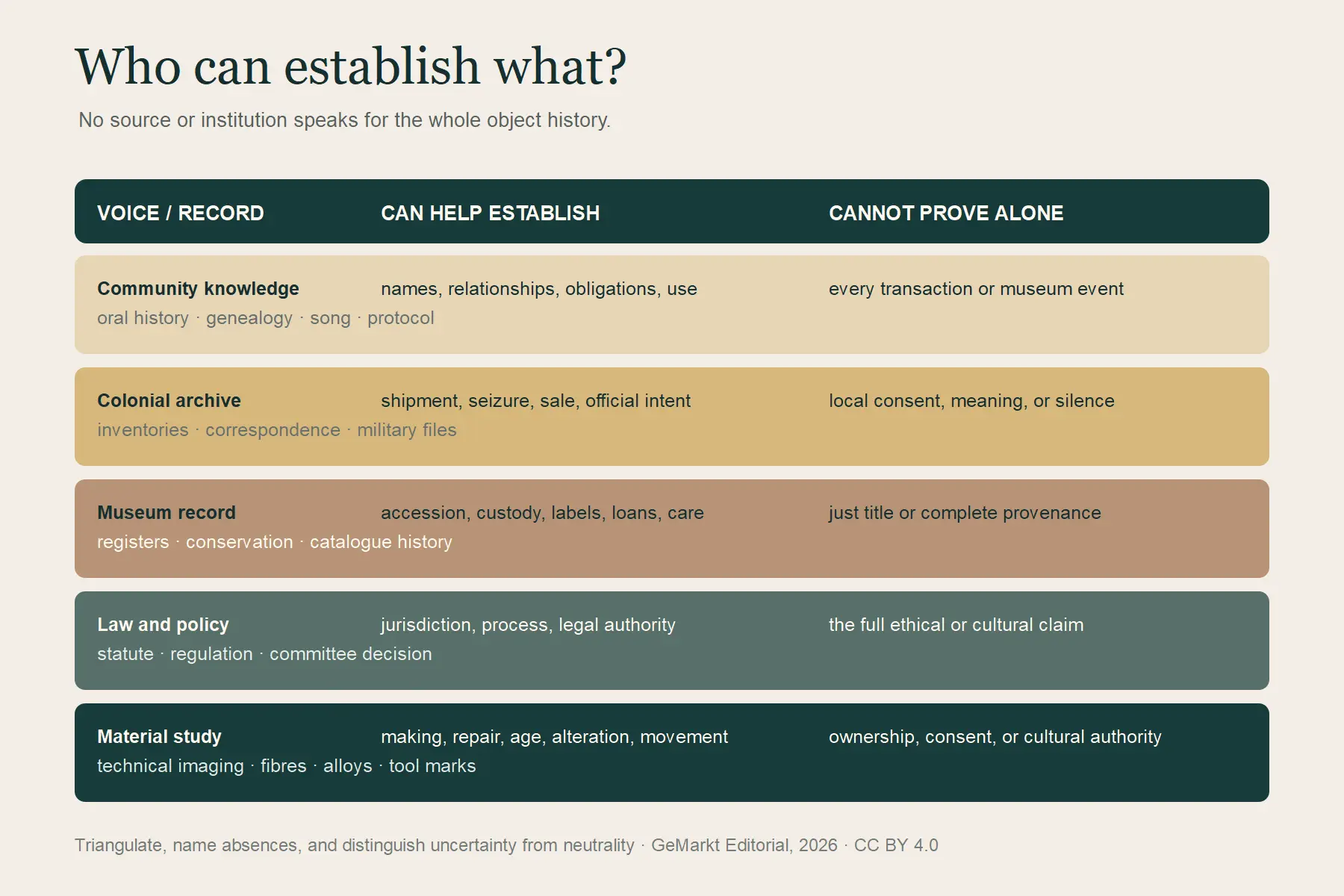
Community knowledge should not be romanticised as complete or made public against protocol. Colonial records also remain useful despite their bias. The method is triangulation: ask what each source can establish, whose purposes produced it, what is absent, and who has authority to interpret or restrict it. A gap in a museum ledger is not proof that nothing was known elsewhere.
No image is an ethical and evidential choice
This chapter contains no photographs of ancestral remains or sensitive cultural items. That choice has two grounds. Ethically, republication can violate community protocols and extend the exposure created by collecting. Evidentially, an image of remains would not prove that a museum consulted, transferred authority, or completed repatriation. The official regulation and programme records better support those claims.
“No image” should not make Indigenous people invisible while leaving only institutions visible. Names, laws, programme structures, community authorities, and research methods remain central. Nor is non-reproduction a universal rule imposed from outside. The responsible decision follows the relevant community and legal context, rights status, purpose, and possible harm.
Return is a chain, not a press release
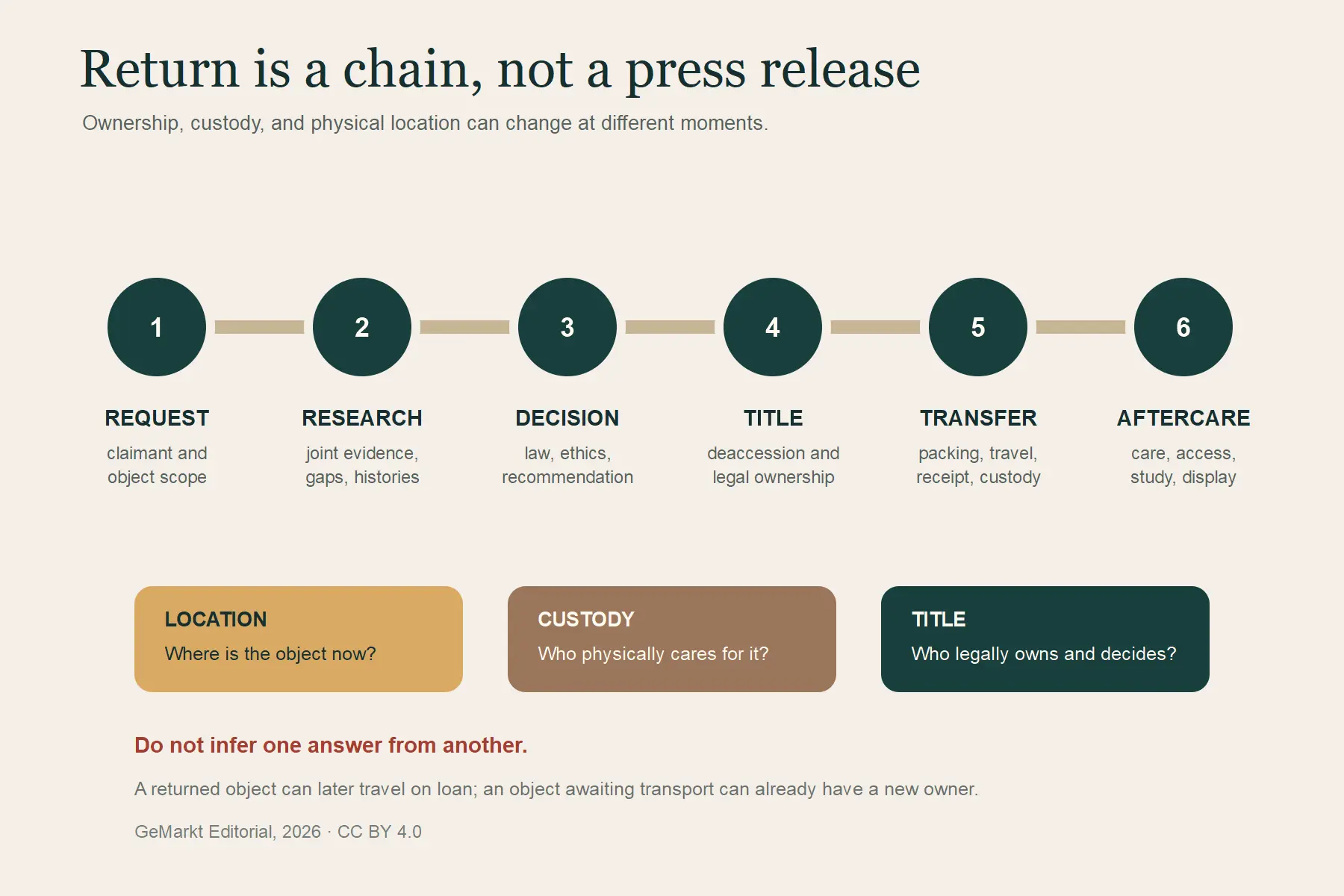
A request defines claimant and scope. Research tests archives, material evidence, and community knowledge. A recommendation or legal decision establishes authority to act. Deaccession removes an object from a collection under its governing rules; title transfer changes ownership. Physical transfer changes location and custody. Aftercare continues through conservation, access, interpretation, restriction, study, and possible loans.
Not every case follows this order. Urgent returns may precede complete documentation; title may change before transport; a community may reject a museum destination. Use the chain as a set of questions, not a bureaucratic gate that former holders control.
After-return stewardship continues
Return is sometimes presented as loss for one museum and arrival for another. Stewardship after return is more dynamic. Returned objects may enter community care, national collections, new exhibitions, restricted repositories, ceremonies, study programmes, or international loans. Records must be corrected across old databases; digital images and casts may require separate decisions; knowledge created during provenance work should travel where permitted.
The former holder should acknowledge the history, preserve a transparent deaccession record, share documentation, and avoid claiming sole authorship of repair. The receiving authority determines the future. Art history should follow the object beyond the handover ceremony.
Who gets to define the claimant?
Claims may come from a state, nation, royal court, lineal descendant, tribe, iwi, imi, local community, religious authority, museum, or coalition. These are not interchangeable. Colonial borders and legal categories can place several authorities around one object. Museums should not select the easiest representative simply because state-to-state transfer is administratively familiar.
The question cannot be solved in the abstract. Establish the object’s makers and relations, history of removal, relevant community structures, current law, and the requested disposition. Record disagreement without treating it as proof that the status quo is neutral. Existing possession is also a decision backed by power. The aim is not to invent a perfect claimant but to make authority and uncertainty explicit.
A comparison matrix
| Case | Authority redistributed through | Specific outcome | Limit not to erase |
|---|---|---|---|
| Kandy / Netherlands | joint provenance, advisory review, state transfer | six objects owned by Sri Lanka and physically in Colombo | return does not reconstruct the eighteenth-century court |
| Benin City / Smithsonian | ethical-returns policy, deaccession, title transfer | Nigeria owns twenty-nine works; nine remain on loan in Washington | six other studied works required more research |
| Abomey / France | object-specific national legislation | title to twenty-six works transferred to Benin | the law was not a universal restitution statute |
| NAGPRA / United States | federal law, consultation, consent, notices | authority over remains and cultural items shifts under defined processes | Smithsonian follows the NMAI Act, not NAGPRA |
| Karanga Aotearoa / Aotearoa New Zealand | government mandate, Indigenous expertise, interim care | international returns move toward iwi and imi | totals change and community research continues |
Common survey traps
- Decolonisation as a style: it concerns authority and historical relations, not a shared visual appearance.
- Every correction equals decolonisation: labels matter, but display, access, knowledge, care, custody, title, and governance can remain unchanged.
- All removals are legally identical: plunder, coercive sale, excavation, gift, exchange, and undocumented transfer require object-specific evidence.
- Current possession proves title: a museum register establishes custody and accession history, not necessarily just ownership.
- A national return resolves every community claim: states, courts, Indigenous nations, local communities, and descendants may hold different authority.
- Infrastructure as a precondition: capacity building should support the receiving authority’s choices, not license indefinite retention.
- One law governs the world: French public-domain law, NAGPRA, the NMAI Act, and Dutch policy have different jurisdictions.
- Return ends the story: title, transport, aftercare, access, loans, digital records, and interpretation continue.
Questions for object and institution analysis
- Who made the object, for whom, and within which relationships or obligations?
- What event moved it, and which words—gift, purchase, seizure, excavation, expedition—come from which source?
- What can the colonial, museum, legal, material, oral, and community records each establish?
- Which names or classifications changed, and who authorised the revision?
- Who currently holds legal title, physical custody, cultural authority, and power over access?
- Has a claimant requested return, restriction, research, digital removal, shared care, or another outcome?
- Which law or policy applies, and what does it not govern?
- Are consultation and consent required, funded, early, and capable of changing the decision?
- What exactly occurred—recommendation, deaccession, title transfer, physical transport, loan, or reception?
- What responsibilities and possibilities continue after return?
Terms for museum decolonisation and return
- Deaccession: a formal removal from a museum collection under its governing rules; it does not itself name the next owner.
- Decolonisation: contested work to analyse and redistribute authority shaped by colonialism; not a completed institutional status.
- Disposition: the authorised outcome for an object after review, including return, transfer, exchange, or another action.
- Indigenous Knowledge: living knowledge systems with their own authorities and protocols, not supplementary folklore added to an institutional record.
- Provenance: the documented and researched history of ownership, custody, movement, and associated events, always subject to gaps and revision.
- Repatriation: return to a people, community, nation, state, or place of origin; legal programmes may define it more narrowly.
- Restitution: restoration of an object or title in response to wrongful loss; usage and law vary, so state the specific act.
- Title: legal ownership, distinct from an object’s physical location or day-to-day custody.
A working timeline, 1945–2024
- 1945–1970s: political decolonisation transforms states and museum systems while former imperial centres retain large colonial collections.
- 1960: Nigeria becomes independent; claims concerning objects removed from Benin City continue within a longer history of requests and negotiation.
- 1975: the International Council of Museums adopts principles concerning the return of cultural property; institutional debate expands beyond bilateral claims.
- 1990: the United States enacts NAGPRA.
- 2003: the New Zealand government mandates Te Papa’s Karanga Aotearoa Repatriation Programme.
- 2018: Felwine Sarr and Bénédicte Savoy submit their report on African heritage in French collections.
- 2020: France enacts the object-specific law enabling transfer of twenty-six Abomey works to Benin.
- 2021: France transfers title and the twenty-six works arrive in Benin.
- 2022: the Smithsonian transfers title to twenty-nine works removed from Benin City in 1897.
- 2023: the Netherlands authorises 478 returns to Indonesia and Sri Lanka; six Kandyan objects travel to Colombo.
- 2024: revised NAGPRA regulations take effect; Te Papa publishes dated international-return figures for Karanga Aotearoa.
Source guide
For Kandy, the Rijksmuseum records for the Cannon of Kandy and gold kastane establish materials, dimensions, identifiers, public-domain image status, seizure, title-transfer, transport, and present location. Its restitution overview, war-booty research, and collaboration account explain custody and method. The Dutch government’s 478-object announcement establishes policy scope. Caroline Drieënhuizen’s study of colonial provenance limits provides named scholarship on the exclusions built into European archives.
For Benin City, the Smithsonian’s Board of Regents decision, October 2022 transfer account, and current Nigerian-owned loan display distinguish research, deaccession, title, handover, and location.
For Abomey, the official French Law no. 2020-1673 and inventory annex, the Government of Benin’s 10 November 2021 account, and the French Ministry of Culture’s publication of the Sarr–Savoy report separate statute, transfer, national reception, and policy scholarship.
For United States law, the National Park Service regulations, compliance guide, and frequently asked questions define NAGPRA’s reach and clarify that the Smithsonian follows the National Museum of the American Indian Act. The Department of the Interior’s final-rule announcement summarises the 2024 changes. Te Papa’s Karanga Aotearoa programme and advisory panel establish mandate, interim custody, methods, dated totals, and named Māori and Moriori expertise.
Continue the Atlas route
In the syllabus, this chapter follows the forthcoming Feminist, queer, and body-based practices, where visibility, consent, institutional access, and archival survival are distinct gates. Museum decolonisation carries those questions into ownership, cultural authority, custody, and law. Use the Methods chapter Provenance, attribution, and restitution to test individual objects with an event ledger, while using this chapter to analyse the historical redistribution of museum authority. The Atlas chapter remains unlinked until publication.
The final Atlas chapter turns to Contemporary global art: biennials, migration, ecology, networks, and digital practice. It is not a roundup of trends. Carry forward the same questions: which institutions and infrastructures make art global, who can move through them, where environmental and digital costs fall, and how artists work within or against those networks.
Editorial record
About this article
- Author
- Publisher
- GeMarkt
- Published
- Updated
- Reviewed
- Internal source & rights check. Conducted by GeMarkt Research Review. This is an internal editorial check—not independent peer review.
- Source standard
- Art history source standardPrioritises object records and research sources, distinguishes evidence from interpretation, and states material uncertainty.
Found a claim that needs checking? Report a factual error.