Art History · Learning chapter
Atlas II — Connected worlds · 2 of 10
Byzantine worlds: icon, mosaic, liturgy, court, and contested visibility
A five-object guide to how Byzantine images worked through ritual, imperial power, material presence, dispute, destruction, and historical memory.


What we’ll look at
How did Byzantine images gain authority in churches, courts, and worship?
The Virgin sits on a throne high above the place where Hagia Sophia’s altar once stood. Her dark robe forms a deep vertical shape against a field of gold. The Christ Child rests on her lap, one hand raised and the other holding a scroll. Their bodies are large enough to be read from the floor but distant enough to remain beyond ordinary reach.
This is not simply a picture placed inside a building. The curve of the apse gathers the gold field around the figures. Windows, lamps, polished marble, moving clergy, incense, chant, and changing daylight once altered how the surface appeared. The image occupied the eastern end of a church where the Eucharist was celebrated below it. Architecture, ritual, material, and representation acted together.
The mosaic was dedicated in 867, more than three centuries after Justinian’s cathedral was built and twenty-four years after the official restoration of icon veneration in Constantinople. Its installation made a theological position monumental. An image that now seems to define “Byzantine art” entered a building whose sixth-century decoration had been organised differently.
That history gives this guide its central question:
How did Byzantine images acquire authority through buildings, ritual, courts, materials, and acts of viewing—and why did their visibility become a matter of political and theological conflict?
Five objects provide five answers. A Ravenna mosaic inserts an emperor into a sanctuary he governed from afar. A painted panel at Sinai coordinates frontal saints with angels who look beyond the picture. Hagia Sophia’s apse turns the restoration of images into public space. A small psalter uses pictures to attack the opponents of pictures. A late icon remembers the settlement of 843 as a staged alliance of sacred image, empress, patriarch, monks, and martyrs.
A Roman empire later called Byzantine
“Byzantine Empire” is a modern scholarly label. The empire’s medieval inhabitants commonly described themselves as Rhomaioi—Romans—and understood their state as the Roman Empire centred on Constantinople. The Met’s historical overview follows that political world from the foundation of Constantinople in 330 to its Ottoman conquest in 1453 while stressing changes in territory, language, institutions, and patronage across the long period.
This article begins in Justinian’s reign in the sixth century and ends with an icon made around 1400. It is not a complete survey of eleven centuries. It follows a narrower problem: how sacred images worked where imperial government, church institutions, and ritual met.
“Byzantine worlds” is deliberately plural. Constantinople was an exceptional centre, but the empire was not one city or one ethnic culture. Its territories and networks connected the Balkans, Anatolia, the Aegean, the Black Sea, Italy, the eastern Mediterranean, North Africa, and West Asia in changing configurations. Greek became dominant in government and worship, yet Latin, Syriac, Armenian, Georgian, Coptic, Arabic, Slavonic, and other languages belonged to neighbouring and overlapping histories.
Political borders also moved around enduring communities. Ravenna passed from western Roman to Ostrogothic and eastern Roman rule. Sinai’s monastery continued after the region left Byzantine control. Byzantine makers and objects travelled through diplomacy, trade, marriage, pilgrimage, war, and plunder. Orthodox image traditions developed in places that were connected to Constantinople without becoming copies of it.
The route does not substitute five famous works for Armenian, Georgian, Syriac, Coptic, Ethiopian, South Italian, Balkan, or Rus’ histories. Monumental gold and elite manuscripts also survive disproportionately; ordinary churches and domestic objects often vanished.
Ask what a particular image was made to do, who controlled its setting, and what survives of its use.
San Vitale: the emperor enters the sanctuary
In brief: This mosaic was made around 547 in the Church of San Vitale in Ravenna, Italy. It shows the distant emperor Justinian as if he were joining a sacred offering, making imperial power present inside the church.
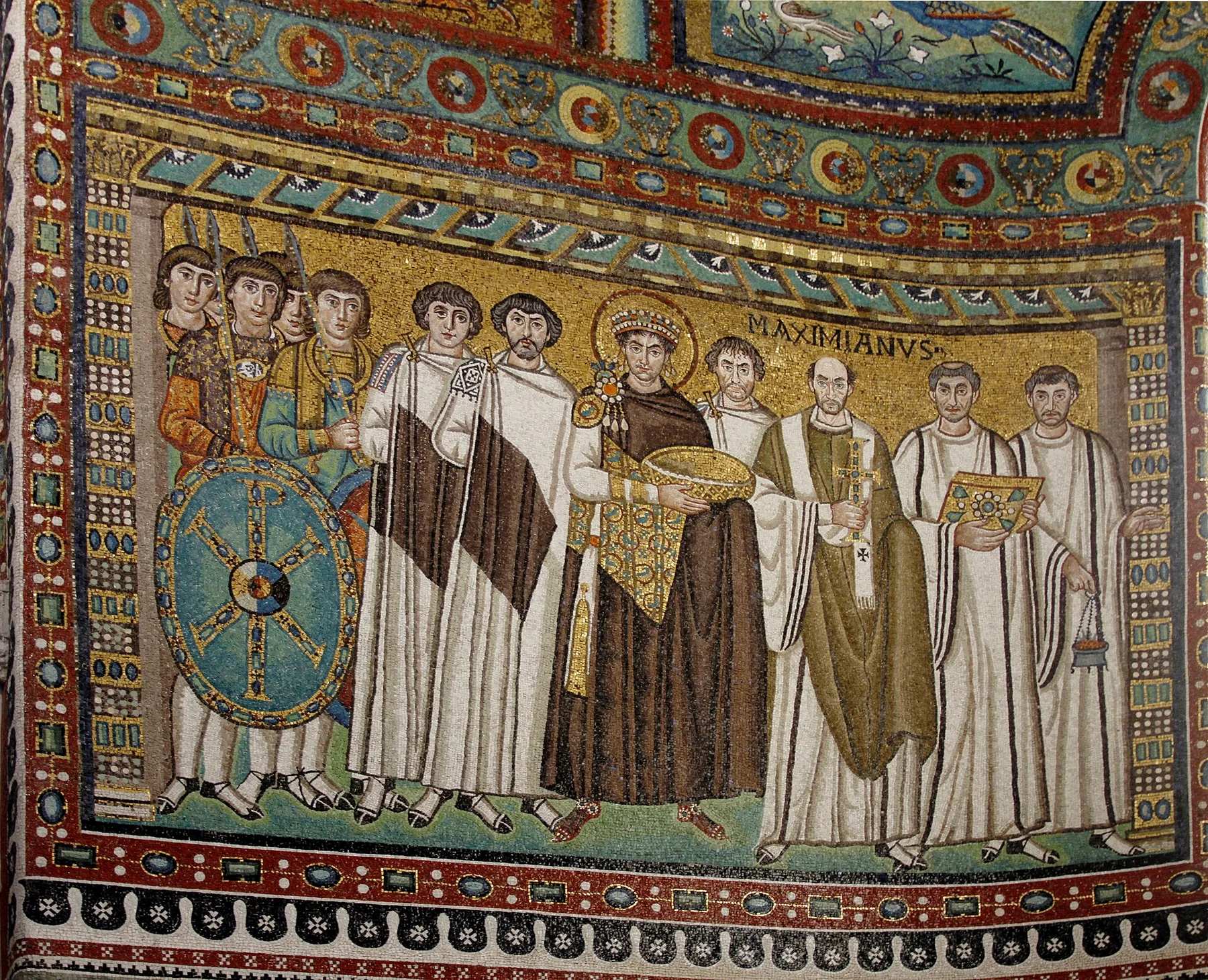

Justinian stands near the centre of a line of twelve men. A purple-brown cloak covers his white tunic; a jewelled fibula fastens it at the shoulder. His crown and halo isolate his head against the gold. He holds a broad golden vessel for the Eucharistic bread.
The people around him divide into groups without separating cleanly. Soldiers press in from the left behind a shield marked with the Chi-Rho monogram of Christ. Court officials occupy the space nearest the emperor. Clergy approach from the right. Bishop Maximian, identified by an inscription, carries a cross; attendants bring a jewelled Gospel book and censer.
Feet overlap and bodies compete for the front edge. Justinian’s purple shoe crosses the foot of the man beside him, yet Maximian’s arm and cross move forward across another attendant. The ambiguity is useful. Emperor and bishop each claim proximity to the sacred offering without becoming the same office.
San Vitale was begun under Bishop Ecclesius, supported by the patron Julianus Argentarius, and completed under Maximian. An Italian Ministry of Culture record places its inauguration in May 547 and describes the presbytery program as an exaltation of Justinian’s protection of Ravenna’s church. The opposing wall shows Empress Theodora carrying a chalice with her own attendants. Neither procession is an ordinary documentary scene. Together they make imperial gifts perpetually approach the altar.
Eastern Roman forces took Ravenna from the Ostrogoths in 540. The city’s buildings belonged to competing Christian confessions and political regimes; UNESCO accordingly treats its monuments as evidence of western Roman, Ostrogothic, and Byzantine phases, not one uninterrupted style.
The mosaic turns distance into presence. Justinian ruled from Constantinople; the picture places him inside Ravenna’s sanctuary whenever worship occurs. His halo need not make him a saint. In late antique and Byzantine visual language, a halo could distinguish imperial rank and set the ruler within a sacred order. The vessel makes patronage liturgical: state power arrives as an offering.
Yet “church and state were united” is too blunt. Emperors, bishops, monks, councils, patrons, and congregations had different resources and could conflict. Justinian legislated and funded churches, but clergy could resist rulers or recruit imperial power for their own disputes.
The mosaic does not prove harmony. It manufactures an ideal arrangement of military defence, court hierarchy, episcopal office, scripture, incense, and Eucharist. Its value as historical evidence lies partly in the order it wanted viewers to see.
The Sinai icon: a panel coordinates different kinds of presence
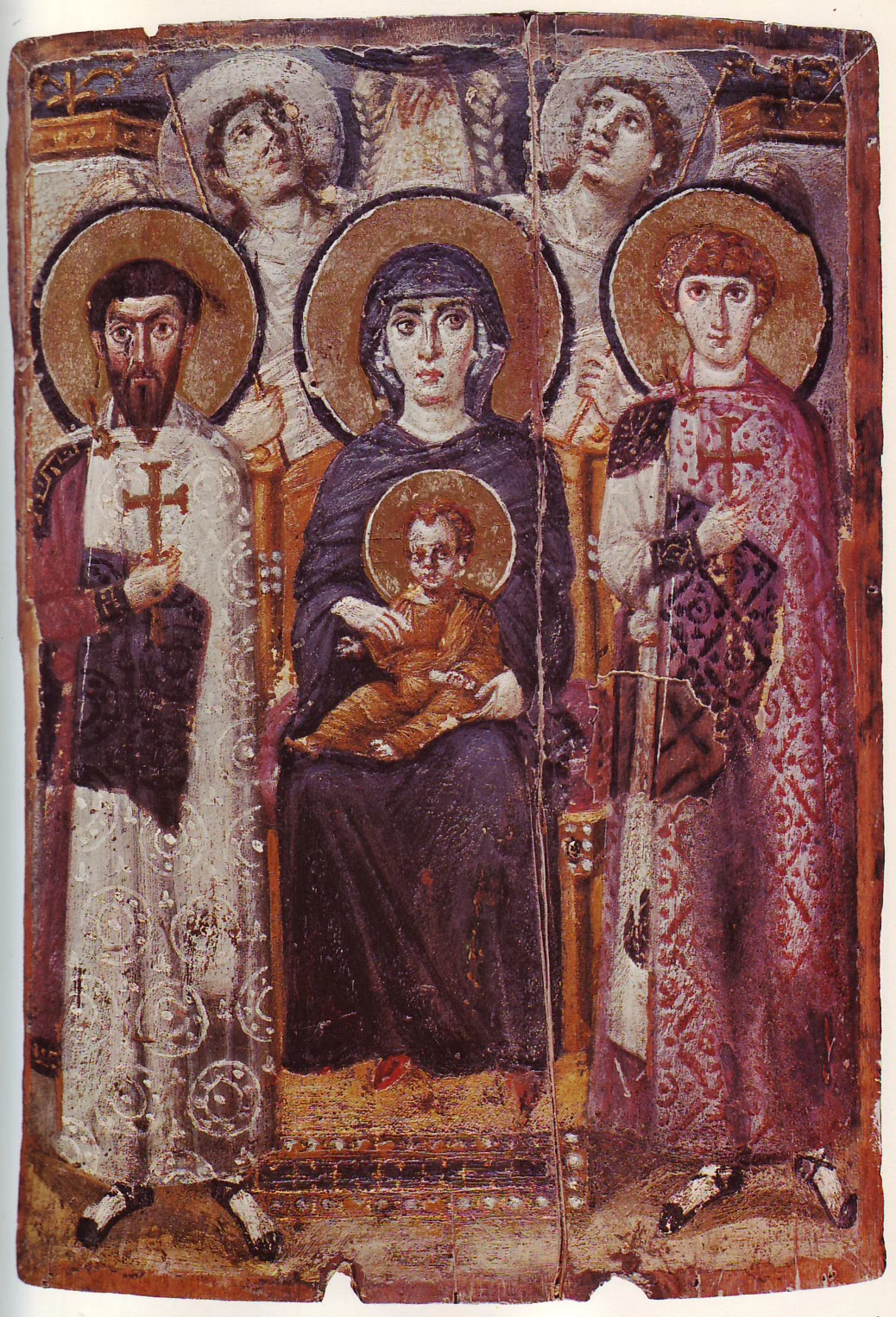

The panel appears more intimate than San Vitale, but its space is less simple.
The Virgin sits directly before us with the Child at the centre of her body. Saints Theodore and George stand at either side, each holding a cross and facing outward. Their large circular haloes create a stable row across the lower half. Behind them, two angels turn their heads upward toward a hand emerging from a burst of light.
The saints meet the viewer frontally; the angels model a different act of looking. Their tilted heads and lifted eyes direct attention beyond the panel’s visible surface. The composition does not choose between bodily presence and transcendent reference. It gives each a position.
The medium is encaustic: coloured pigment bound in wax and applied to wood. The saints are firm and immediate; the angels appear lighter and more mobile; the Virgin holds the centre without becoming a diagram.
An icon is sometimes explained as a “window into heaven.” The metaphor is helpful only if it does not make the object disappear. This panel is wood, wax, pigment, cloth preparation, damage, repair, weight, and scale. Its material surface enabled the relationship it was believed to mediate.
Byzantine defenders distinguished veneration offered before an image from worship due to God. Honour could pass to the sacred person represented—the prototype—rather than stop at wood and pigment. In practice, people lit lamps, burned incense, touched, kissed, and carried images; particular icons acquired particular reputations.
Its exact first location, users, and rites are unknown. A general account of icon use must not become a fictional object history.
Its survival at Sinai is nevertheless significant. The UNESCO record for Saint Catherine’s describes a sixth-century monastery that has continued its original monastic function and preserves outstanding collections of early Christian manuscripts and icons. Remoteness, institutional continuity, and the region’s movement outside Byzantine imperial rule all affected what survived there.
Pre-iconoclastic panels are rare, so Sinai carries enormous explanatory weight. Its icons establish that large portable sacred images existed before the eighth-century controversy, not how common every practice was across the empire.
The panel also refuses a familiar stereotype: Byzantine painting did not abandon observation for a single flat formula. Its maker uses frontal stillness, turned heads, oblique gazes, translucent flesh, rigid haloes, and an unstable depth together. Different visual modes distinguish different kinds of presence.
Hagia Sophia: visibility becomes an institutional claim
Hagia Sophia was constructed for Justinian between 532 and 537 by Anthemius of Tralles and Isidore of Miletus. The UNESCO record for the Historic Areas of Istanbul identifies its dome and spatial system as a major sixth-century achievement. Marble, gold, windows, curtains, lamps, chant, and procession made the interior more than a stone shell.
The sixth-century church and the 867 apse mosaic are therefore different historical layers. The building’s surviving early ornament privileges crosses, vegetal and geometric forms, and luminous materials. Later patrons inserted figural programs into that inherited space.
The controversy preceding the mosaic is called Byzantine Iconoclasm, literally “image breaking.” It had two major phases of official opposition, interrupted by the council at Nicaea in 787 and ending with restoration under Empress Theodora and Michael III in 843. Its causes, enforcement, geography, and destruction remain debated.
At issue was not every visual form: crosses, imperial signs, secular images, ornament, and coins had different status. Opponents feared idolatry in devotional images; defenders argued from the Incarnation that Christ’s visible human body could be represented.
The dispute was theological but also institutional. Emperors called councils; bishops and monks could lose office, property, freedom, or life. Image policy changed churches, sacred access, donations, and the past recognised by the state.
Nor did policy operate everywhere alike. The Met’s more recent exhibition study of iconoclasm warns against imagining a straightforward, universally enforced program and notes strong concentration around Constantinople. Sinai’s icons survived beyond the capital’s immediate control. In regions under Muslim rule, Christian, Jewish, and Muslim communities negotiated images under different political conditions. “The iconoclast period” is not a single visual blank across the eastern Mediterranean.
The apse mosaic made the settlement visible at the empire’s most important church. The Virgin and Child occupy the semi-dome above the altar, joining an image of Christ’s embodied birth to the Eucharistic rite performed below. A dedicatory inscription presented the work as the resetting of images that opponents had cast down. Patriarch Photios preached at its inauguration in 867. The placement transformed a doctrinal conclusion into a repeated spatial experience.
Its gold is not a painted symbol of an empty background. Small glass tesserae meet the curved wall at slightly varied angles. Light breaks across them rather than reflecting as one flat mirror. From the floor the surface can flicker, recede, or gather around the figures. The mosaic’s authority came from scale, height, cost, labour, location, and controlled visibility as much as iconography.
Hagia Sophia became a Latin church after the Fourth Crusade in 1204, returned to Orthodox worship in 1261, became a mosque in 1453, opened as a museum in 1935, and returned to mosque use in 2020. Türkiye’s official cultural portal identifies it as Ayasofya-i Kebir Camii; UNESCO records it within a World Heritage property.
Those later histories do not turn the building into a neutral container passed between owners. Each institution changed access, furniture, sound, inscription, conservation, and the visibility of earlier layers. The mosaics remain Byzantine objects inside an active mosque and a protected heritage monument. Responsible viewing must hold all three facts together.
The Chludov Psalter: pictures argue about pictures
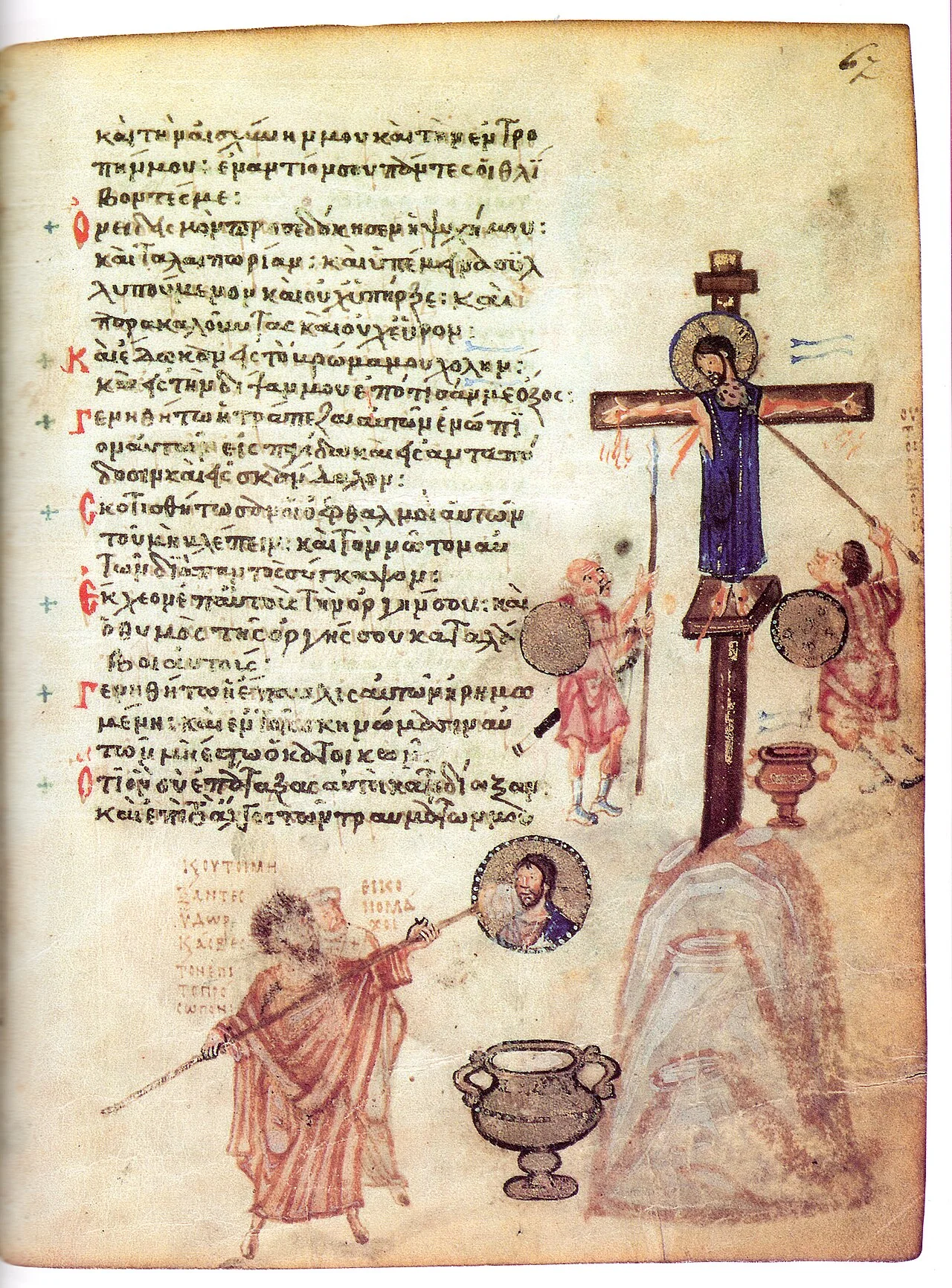

Most of the Chludov Psalter’s page is writing. Lines of Greek text occupy the left and centre; small coloured marks organise reading. At the right, however, two scenes turn the margin into an argument.
Above, Christ hangs on the cross while men offer a sponge on a pole. Below, two men attack a circular image of Christ, one raising a long implement while vessels stand beside them. The page visually compares the humiliation at the Crucifixion with contemporary hostility toward icons. The lower action does not merely illustrate a psalm. It interprets present conflict through scripture and condemns named opponents.
This is a marginal psalter: a manuscript of the Psalms whose images occupy and activate the spaces beside the text. Lines, gestures, repetitions, and proximity link biblical language with commentary. A reader does not encounter word first and picture afterward. The eye moves between them.
The manuscript measures about 19.8 × 15 cm. A 2025 account by the Russian Federation’s UNESCO Commission and its State Historical Museum curator records 169 parchment folios, 208 marginal miniatures, a frontispiece, extensive fourteenth-century overpainting, and current multispectral study.
“A ninth-century image” does not mean every visible stroke is ninth-century pigment. Ink faded, colour changed, and later hands reinforced text and miniature.
The page is hostile evidence, not an impartial account of iconoclast belief. Its upper scene draws on Christian accusations against Jews in the Passion narrative, then transfers blame to iconoclasts below. The polemic must be named rather than repeated as fact.
This manuscript overturns the idea that iconoclasm was a contest between images and no images. Both sides used visual and material signs. Iconophiles answered the destruction of images by producing pictures about destruction. The page’s authority comes from combining sacred text, historical analogy, caricature, and the reader’s hand-held attention.
It also shows that restoration did not close the dispute by erasing memory. The settlement of 843 generated new images, feast days, saints, stories, and accusations. Victory had to be narrated.
The Triumph of Orthodoxy: a victory remembered five centuries later
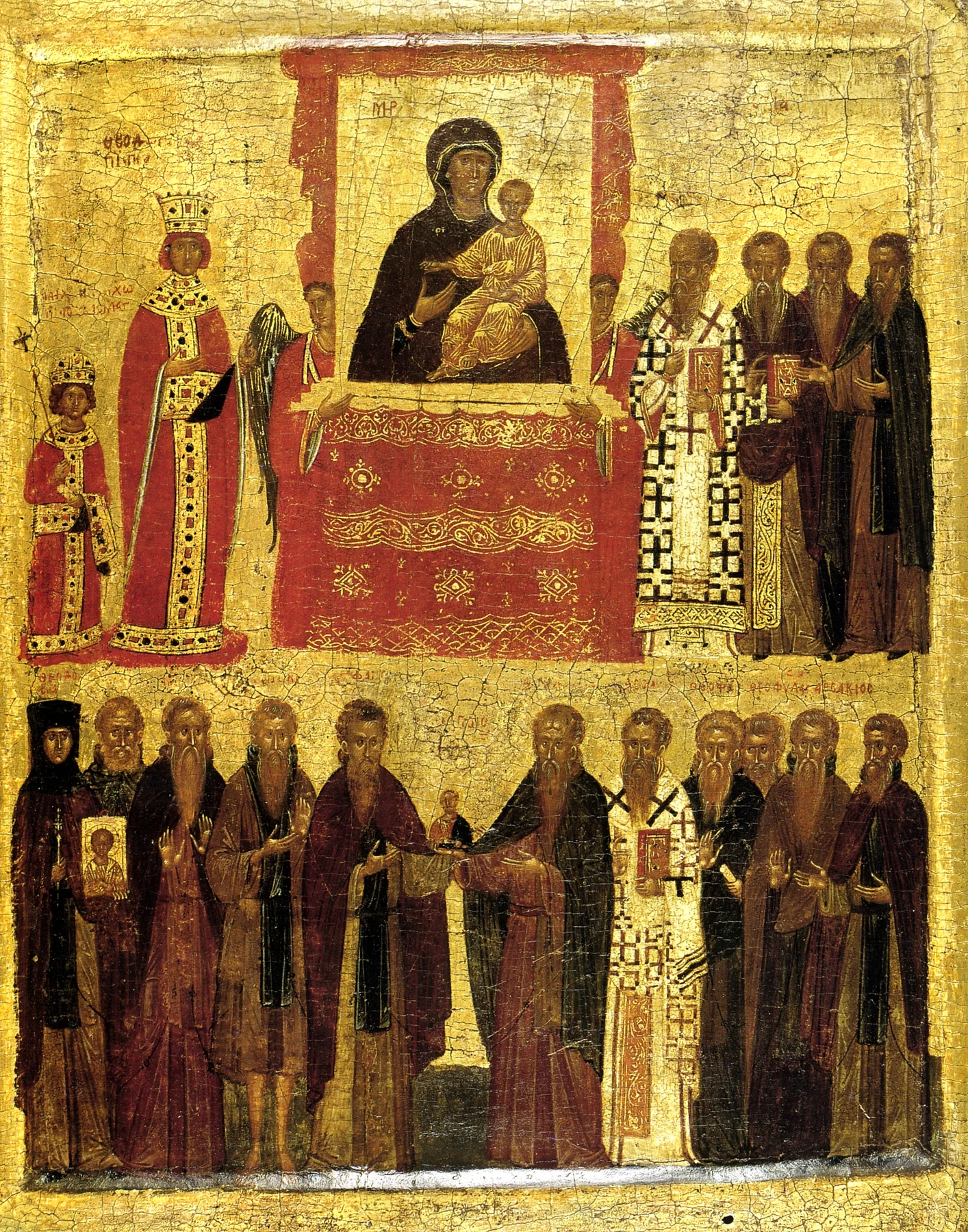

At the centre of the upper register stands another icon. A red textile covers its support; curtains draw aside; two winged guardians flank the painted Virgin Hodegetria and Child. The object within the object is the compositional axis.
Empress Theodora and the young Michael III stand to its left. Patriarch Methodios and church figures stand to its right. Below, monks, bishops, and martyrs form a second assembly. Several carry images or crosses. The panel does not show a spontaneous crowd celebrating in 843. It constructs a genealogy of people whose lives and reputations could be organised around the defence of icons.
The British Museum dates the unsigned panel around 1400; its probable Constantinopolitan attribution depends on stylistic comparison. It is the earliest known version of the subject, not proof that no earlier one existed.
The gap between event and object is the point. More than five centuries after 843, the restoration of images remained present in the church calendar through the Sunday of Orthodoxy, celebrated during Lent. The panel may have participated in that annual remembrance. It turns history into a liturgical present.
The central Hodegetria was believed to reproduce an image painted by Luke. Historians cannot verify that authorship, but the belief made copying an act of continuity and shaped processions, donations, and arguments.
Fourteenth-century disputes over Hesychast prayer and divine light gave the theme a new environment. The British Museum’s catalogue proposes a connection while keeping place and date open.
Political circumstances were severe. Crusaders had taken and looted Constantinople in 1204. Byzantine rule returned in 1261, but the restored empire controlled less territory and faced competing powers. Yet shrinking state capacity did not equal artistic silence. Churches were repaired; monasteries commissioned mosaics and frescoes; icons continued to be made in precious and economical materials.
The panel therefore remembers one victory while living inside another period of instability. It aligns empress, emperor, patriarch, sacred prototype, and ascetic witnesses into a unity history had never supplied so neatly. Memory is one of the things Byzantine images did.
Five objects, five systems of visibility
| Object | Medium and scale | Primary encounter | Authority made visible | What the object cannot prove |
|---|---|---|---|---|
| Justinian mosaic, San Vitale | Monumental glass and gold mosaic in a sanctuary | Congregational worship, clerical movement, imperial representation | Emperor, bishop, soldiers, scripture, incense, and Eucharistic gift arranged as one procession | That the represented group assembled together or that imperial and episcopal interests were always harmonious |
| Sinai Virgin and Child | Portable encaustic panel, 68.5 cm high | Focused devotional viewing within a monastery | Sacred figures appear materially present while angels direct vision beyond the panel | Its exact first location, users, rites, or how typical it was across the empire |
| Hagia Sophia apse mosaic | Monumental mosaic above the altar | Long-distance viewing within liturgy and imperial ceremony | The restored legitimacy of figural sacred images occupies the Great Church | Uniform enforcement or experience of iconoclasm in every Byzantine and neighbouring community |
| Chludov Psalter, fol. 67r | Hand-held parchment page | Reading, commentary, polemical instruction | Text and image condemn iconoclast opponents through biblical analogy | A neutral account of iconoclast belief or an untouched ninth-century paint surface |
| Triumph of Orthodoxy icon | Portable tempera-and-gold panel, 39 cm high | Feast, devotion, and historical commemoration | Sacred icon, empress, patriarch, monks, and martyrs become a victory community | An eyewitness view of 843 or a securely documented date and workshop |
The comparison replaces “Byzantine style” with operations. San Vitale stages. Sinai coordinates. Hagia Sophia institutionalises. The psalter accuses. The late icon remembers.
What an icon did
The Greek word eikon means image. In Byzantine use, an icon was not restricted to a portable panel with a gold background. Sacred images appeared in mosaic, fresco, ivory, enamel, textile, ceramic, manuscript, and metalwork. The Met’s guide to icons and iconoclasm emphasises this material range.
Function did not follow medium automatically. A monumental mosaic could act as an icon. A small ivory could support private prayer. A panel could be fixed in a church, carried through streets, dressed with metal covering, or stored and revealed on feast days. The same compositional type could move between scales and materials while changing its audience and physical behaviour.
The modern museum isolates and lights an untouchable object. Byzantine settings regulated visibility differently.
- A curtain might conceal and reveal an image.
- Lamps and daylight made gold and glass change.
- Incense obscured as well as honoured.
- A procession moved an image toward viewers who did not control its route.
- A high mosaic remained visible but inaccessible.
- Kissing and touching concentrated wear on particular areas.
- Metal revetments could cover painted bodies while exposing faces and hands.
- Repetition made a famous type locally present without making every copy identical.
Liturgy organised these encounters. The Met’s account of medieval liturgical art places books, vessels, crosses, censers, lights, textiles, and furnishings within communal worship. An image belonged to this environment of objects and actions.
Court patronage added another layer. Emperors and empresses funded churches, donated objects, appeared in mosaics, convened councils, and enforced image policy. Their representation could make rule seem divinely ordered. But sacred authority could also judge an emperor, legitimise a regent, preserve an opponent’s memory, or outlast a dynasty.
Theodora’s place in the Triumph icon is a case in point. Her authority as regent helped restore images in 843. The panel both records female political agency and encloses it within a later orthodox victory narrative. Recognising her power should not make every Byzantine woman equally powerful or turn an empress into evidence of general emancipation.
Contested visibility was also controlled access
Iconoclasm is the most dramatic contest in this article, but visibility was governed before and after it.
A sanctuary separated clergy from much of the congregation; palaces and monasteries also regulated approach. Gender, rank, office, wealth, and ritual status affected where a person stood and what they could handle. A “public image” was not equally accessible.
Materials encoded access. Gold mosaic required monumental patronage; ivory depended on African and Mediterranean trade; parchment and panels concentrated skilled labour in prepared animal skin, wood, ground, pigment, writing, and binding.
Destruction redistributed visibility: crosses, inscriptions, curtains, or replacement programs could occupy an image’s place. Restoration also made something new—the 867 mosaic inside a sixth-century building and the c. 1400 panel’s history of 843.
Conquest produced another form of control. The Fourth Crusade’s sack of Constantinople in 1204 dispersed relics, metalwork, sculpture, and other objects into western churches and treasuries. The porphyry Tetrarchs discussed in the preceding Late Antique chapter became Venetian spolia. Objects admired today as evidence of Byzantine achievement may also be evidence of coercive movement.
Visibility is therefore never only a question of whether an image exists. Ask who could commission it, place it, approach it, cover it, move it, interpret it, or call for its destruction.
Why there is no single Byzantine style
Eleven centuries cannot have one look. The five works already disagree.
San Vitale compresses depth so rank and offering remain legible. Sinai shifts between frontal saints and upward-looking angels. Hagia Sophia joins vast scale and curved gold to architecture. Chludov makes gesture and analogy urgent in a margin. The Triumph panel orders many figures into historical registers.
None of these choices can be measured adequately by asking how closely it imitates a naturally seen room.
Byzantine artists modelled flesh, abbreviated bodies, revived antique forms, constructed space, and repeated inherited types in changing combinations. Metropolitan and regional workshops exchanged formats; materials changed what was possible.
Gold can suggest transcendence while signalling expenditure and changing light. Frontality can establish encounter; repetition can claim continuity; hierarchy can determine scale more strongly than optical distance.
The better question is: what relation does a formal choice organise?
- Frontality can organise address.
- Overlap can organise rank.
- Gold can organise light and value.
- Scale can organise access.
- Repetition can organise memory.
- A margin can organise argument.
Style becomes historical when linked to work done in a setting.
A compact timeline
| Date | Event or object | Why it matters here |
|---|---|---|
| 527–565 | Reign of Justinian I | Imperial reconquest, law, doctrine, and major church patronage reshape the eastern Roman world |
| 532–537 | Justinian’s Hagia Sophia is built | Architecture, material, light, and liturgy create the empire’s most important church interior |
| 540 | Eastern Roman forces take Ravenna from the Ostrogoths | San Vitale’s completion occurs within a new political order in Italy |
| 547 | San Vitale is inaugurated | Justinian and Theodora’s offering processions join imperial presence to the sanctuary |
| late sixth century | Sinai Virgin and Child icon | A large encaustic panel demonstrates pre-iconoclastic devotional imagery outside Constantinople |
| 754 | Council of Hieria supports the iconoclast position | Imperial and episcopal authority formalise opposition to devotional images |
| 787 | Second Council of Nicaea defends icon veneration | Veneration is distinguished from worship; the first iconoclast phase ends |
| 815 | Official iconoclasm resumes | Image policy again changes church decoration and institutional power |
| 843 | Icon veneration is restored under Theodora and Michael III | The settlement becomes the annual Triumph of Orthodoxy |
| mid-ninth century | Chludov Psalter is produced | Word and image turn the recent conflict into polemical memory |
| 867 | Virgin and Child mosaic is dedicated in Hagia Sophia’s apse | The legitimacy of figural sacred images becomes monumental and liturgical |
| 1204 | Fourth Crusade sacks Constantinople | Latin occupation and plunder disperse Byzantine objects and damage institutions |
| 1261 | Byzantine rule returns to Constantinople | Churches and artistic patronage revive within a smaller, politically pressured empire |
| c. 1400 | Triumph of Orthodoxy icon | A late panel makes the victory of 843 active within new theological and political debates |
| 1453 | Ottoman forces take Constantinople; Hagia Sophia becomes a mosque | The empire ends at the capital, while Byzantine and Orthodox visual traditions continue elsewhere |
| 1935 / 2020 | Hagia Sophia opens as a museum / returns to mosque use | Modern institutions again alter access, interpretation, and the visibility of historical layers |
Dates organise comparison, not a smooth march. Image practices changed through reversals, local variation, later repainting, and retrospective memory.
Key terms
Byzantine: A modern label for the medieval eastern Roman Empire and its cultures. Its inhabitants commonly called themselves Romans.
Icon: A sacred image of Christ, the Virgin, saints, angels, or a holy event; not limited to portable panel painting.
Iconoclasm: Literally image breaking; here, the eighth- and ninth-century Byzantine controversies and policies concerning devotional images. It should not be imagined as uniform in time or geography.
Iconophile / iconodule: A defender or venerater of sacred images. Historical texts use partisan labels, so terminology itself belongs to the conflict.
Prototype: The sacred person represented by an icon. Defenders argued that honour shown to an image passed to this prototype.
Veneration: Honour or reverence offered to sacred persons and their images, distinguished in orthodox theory from worship owed to God.
Liturgy: The structured rites of communal worship. It organised bodies, sound, objects, movement, time, and visibility.
Theotokos: Greek for “God-bearer,” a title for the Virgin Mary that emphasises Christ’s divine and human identity.
Encaustic: Painting with pigments bound in wax, usually applied while warm.
Tessera: One small unit of stone, glass, ceramic, or other material used to build a mosaic.
Hodegetria: A type of Virgin and Child image in which the Virgin gestures toward Christ as the way; its famous Constantinopolitan prototype was believed to have been painted by Luke.
Spolia: Material removed from an earlier setting and reused. Reuse may be practical, honorific, competitive, or the result of conquest.
Ten questions for reading a Byzantine image
- Is the work fixed, portable, wearable, readable, or carried—and how does that shape viewing?
- Where was it placed relative to altar, sanctuary barrier, ruler, congregation, reader, or street?
- Which materials create light, weight, touch, durability, or cost?
- Who could approach the object, and who remained physically or institutionally distant?
- Does frontality establish presence, while turned heads or gestures direct attention elsewhere?
- Which inscriptions name a person, event, donor, or theological claim?
- Is the image recording an event, staging an ideal order, or remembering the past from much later?
- What has been covered, repainted, restored, moved, dispersed, or lost?
- Which claim comes from the object, which from a partisan text, and which is a modern inference?
- How would the work change under chant, incense, moving light, procession, touch, or restricted access?
These questions can be used on a church interior, manuscript page, ivory, textile, coin, or panel. They are more reliable than identifying “Byzantine features” from appearance alone.
Five shortcuts to refuse
“Byzantine means decorative and flat”
This turns a long history into a formal insult. Ask what frontality, gold, repetition, or compressed depth accomplishes in a particular location.
“Icons were worshipped as gods”
This repeats the accusation at the centre of iconoclast polemic. Orthodox defenders distinguished veneration of the image from worship of God, even though actual devotional practices remained materially intense.
“Iconoclasm erased every image everywhere”
Policy, survival, and enforcement varied. Sinai alone disproves total erasure; regional evidence must be studied separately.
“Court art is a photograph of power”
The San Vitale mosaic stages an ideal relation among ruler, army, bishop, and Eucharist. Representation is political work, not transparent documentation.
“1453 ended Byzantine art”
It ended eastern Roman imperial rule in Constantinople. Makers, communities, icon types, liturgies, and workshops continued and changed across Ottoman territories, the Balkans, Mediterranean islands, Rus’, and diasporic networks.
A source guide for further study
- The Metropolitan Museum of Art, Byzantium (ca. 330–1453): political phases, architecture, portable arts, and the Romans/Byzantines terminology problem.
- The Metropolitan Museum of Art, Icons and Iconoclasm in Byzantium: icon media, the image–prototype relation, controversy, and post-843 developments.
- The Metropolitan Museum of Art, Iconoclasm: a corrective to a uniform empire-wide destruction narrative.
- UNESCO World Heritage Centre, Historic Areas of Istanbul: Hagia Sophia’s architecture, urban setting, successive imperial histories, and conservation framework.
- UNESCO World Heritage Centre, Early Christian Monuments of Ravenna: the western Roman, Ostrogothic, and Byzantine monument group.
- UNESCO World Heritage Centre, Saint Catherine Area: monastery continuity and its exceptional manuscript and icon collections.
- State Historical Museum, Chludov Psalter catalogue record, and the Russian Federation’s UNESCO Commission, 2025 scientific-research account: current object identity, material state, and imaging research.
- British Museum, Icon with the Triumph of Orthodoxy: material, dimensions, attribution limits, iconography, feast context, and later-fourteenth-century debates.
Continue the route
This chapter follows Late Antique art: remaking Roman, Christian, Jewish, and West Asian visual worlds. That earlier guide shows the Roman materials, institutions, and religious plurality from which Byzantine histories emerged.
For objects moving across rather than remaining within one empire, continue with Art on the Silk Roads: objects, beliefs, materials, and movement.
The next atlas chapter will examine Islamic worlds from about 650 to 1250 through word, geometry, object, building, and patronage. It will not treat Islamic art as an icon-free opposite to Byzantium. The useful comparison is how different communities organised representation, sacred text, material splendour, and controlled visibility under changing institutions.
Editorial record
About this article
- Author
- Publisher
- GeMarkt
- Published
- Updated
- Reviewed
- Internal source & rights check. Conducted by GeMarkt Research Review. This is an internal editorial check—not independent peer review.
- Source standard
- Art history source standardPrioritises object records and research sources, distinguishes evidence from interpretation, and states material uncertainty.
Found a claim that needs checking? Report a factual error.