Art History · Learning chapter
Atlas II — Connected worlds · 8 of 10
Tang, Song, and Yuan China: court, monastery, landscape, ceramic, and scholar culture
A five-work guide to how tombs, monasteries, courts, kilns, handscrolls, and scholar networks shaped art across Tang, Song, and Yuan China.

What we’ll look at
How did Tang, Song, and Yuan institutions shape who made and used art?
The mountain range seems to arrive all at once. Peaks crowd the centre. Mist opens passages between them. Travellers, houses, a bridge, trees, and a temple retreat appear small enough to miss. Red seals and later inscriptions sit on the silk like a second history laid over the first.
But Summer Mountains was not made to arrive all at once. It is a handscroll. A viewer would unroll a section from the right while rolling up what had already been seen on the left. The landscape would exist as an interval held between two hands: path, pause, turn, arrival. The full-width digital reproduction above is useful for comparison, yet it produces a view that the historical format did not normally offer.
That difference between an object and its online image opens this chapter. Art made under the Tang, Song, and Yuan dynasties was never simply a sequence of styles. It was organised by institutions and practices: tombs built for the dead, monasteries supported by donors, courts that collected and classified, kilns that managed earth and fire, and scholar networks that joined painting to poetry, calligraphy, friendship, office, and political choice.
This guide asks:
How did tomb, monastery, court, kiln, and study reorganise who could make, see, use, and remember art across Tang, Song, and Yuan China—and what disappears when those histories become one continuous national style?
Five cases provide five incomplete answers. A seventh-century clay rider connects Tang burial to horses, dress, rank, and expansion toward Central Asia. The Mogao Caves make Buddhist art inseparable from cliff, cell, patron, ritual, manuscript, and conservation. Summer Mountains turns landscape into a route managed by the hand and eye. A Southern Song Guan dish joins court taste to kiln uncertainty and controlled firing. Zhao Mengfu’s Twin Pines, Level Distance makes brushwork, inscription, antiquity, and service under Mongol rule difficult to separate.
They are not five stages of progress. They are five situations in which art had work to do.
What do Tang, Song, and Yuan name here?
Tang, Song, and Yuan are dynastic names. They identify regimes, ruling houses, administrative periods, and powerful later frameworks for organising history. They do not name three sealed cultures with stable borders.
The Tang dynasty ruled from 618 to 907. Its courts at Chang’an and Luoyang drew people, animals, materials, religions, music, and dress through routes extending across East and Central Asia. Expansion brought contact and opportunity, but also armies, garrisons, tribute, displacement, unequal incorporation, and contested frontiers. “Cosmopolitan” is useful only when it does not turn empire into a frictionless festival of diversity.
After Tang power fragmented, the Song dynasty ruled from 960 to 1279, first from Kaifeng and, after the Jurchen conquest of the north in 1127, from Hangzhou. “Song China” should not fill the entire modern map. The Liao, Western Xia, Jin, Dali, and other states and communities were contemporaries, rivals, neighbours, and participants in shared material and intellectual worlds. Northern and Southern Song describe a political rupture and relocation, not merely two art styles.
Khubilai Khan founded the Yuan dynasty in 1271, and Mongol forces defeated the Southern Song in 1279. Yuan rule linked territories in China to the wider Mongol Empire, moving artisans, officials, religious specialists, technologies, and motifs across long distances. It was also a conquest that ranked people unequally and forced difficult choices about service or withdrawal. Calling the Yuan only a “foreign interruption” erases art made within its multiethnic institutions; calling it simple cultural fusion erases violence and hierarchy.
“China” is used here as a geographic and historiographic aid. The chapter does not claim one unbroken nation, one ethnicity, or one visual language between 618 and 1368. Nor does it make court records stand for everyone living within changing imperial borders.
A route through five institutions
The route is selective by design. It cannot represent more than seven centuries of architecture, painting, calligraphy, sculpture, metalwork, textiles, print, ritual objects, urban life, and trade. It also leaves Korea and Japan to the next chapter rather than treating them as receivers at the edge of a Chinese centre.
The five cases were chosen because their differences are instructive:
- A tomb object asks how the living equipped, ranked, and remembered the dead.
- A cave-monastery joins image, architecture, devotion, lodging, donation, and archive.
- A handscroll landscape makes viewing temporal and bodily.
- A court ceramic turns taste into a chain of materials, labour, risk, and selection.
- A scholar painting links handwriting, historical models, social exchange, and political position.
Each also carries a modern institutional history. The four movable objects are now in the Metropolitan Museum of Art. Mogao is a protected heritage and religious site managed in China, while manuscripts and paintings removed from its Library Cave are dispersed among institutions worldwide. Museum photography isolates an object against a neutral ground. Heritage photography can make an active and managed site look empty. The image is evidence, but never the entire situation.
Tang tomb figure: movement preserved for the dead
In brief: This small clay rider was made for a tomb during the seventh-century Tang dynasty and probably comes from Astana in present-day Xinjiang. Its exact findspot and the identity of the person buried with it remain unknown.
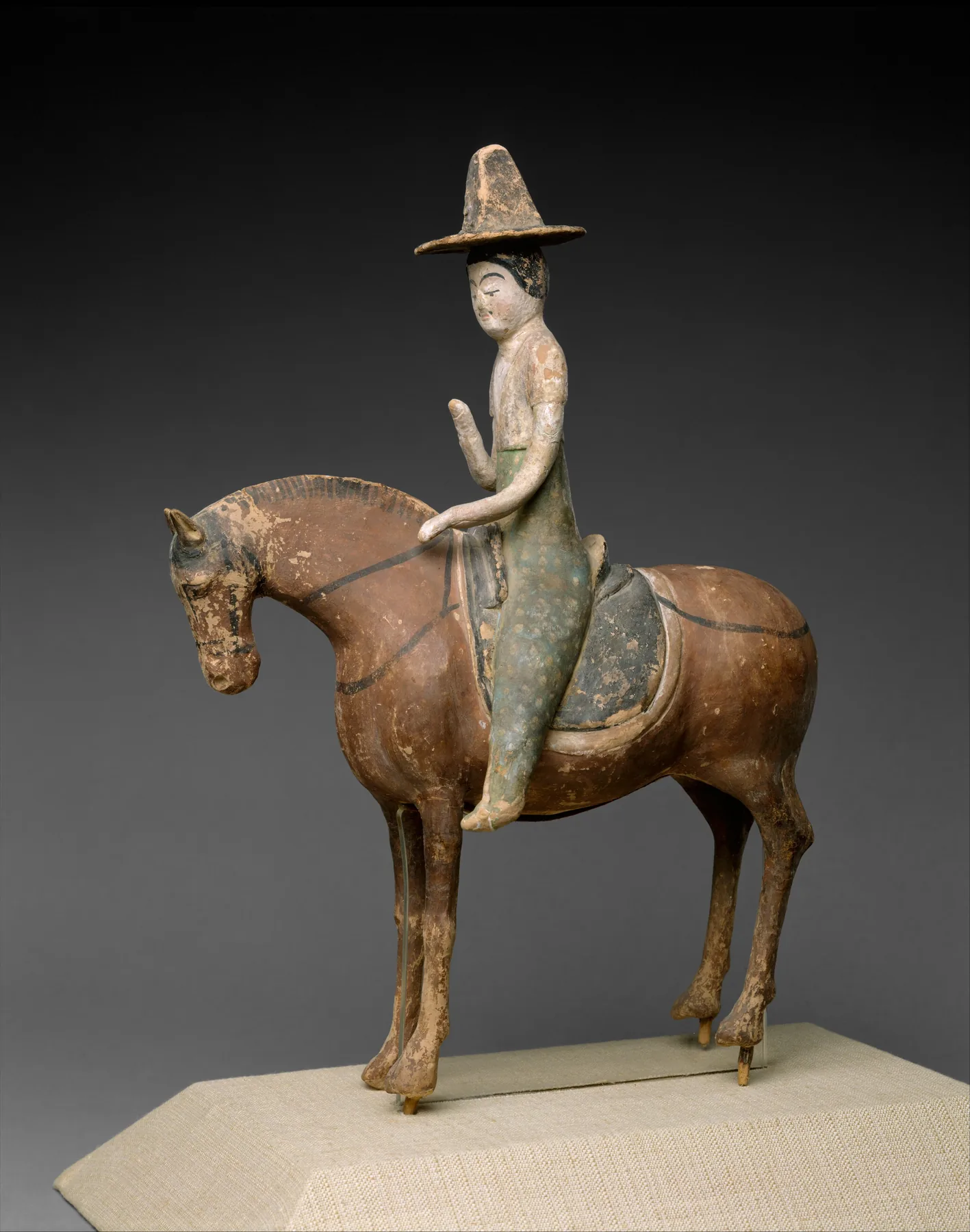
The rider sits upright rather than racing. Her narrow face, tall flared hat, close-fitting clothes, patterned saddle cloth, and the horse’s controlled stance make mobility look composed. Pigment distinguishes body, garment, tack, and animal, although time has muted their original colour.
The Met classifies the work as tomb pottery and says it likely came from Astana, in present-day Xinjiang. That “likely” matters. A secure archaeological context would connect the figure to a named tomb, other objects, human remains, position, date, and burial sequence. The public record does not supply that chain. The figure can support a history of Tang funerary practice and north-western connections; it cannot reconstruct one deceased person’s biography.
Such figures are often called mingqi, or “spirit goods.” They participated in a larger tomb program intended to provide, protect, serve, and establish status around the dead. The Met’s overview of mingqi stresses that Tang funerary objects were also relations among the living: important burials could display rank, consolidate family memory, involve state sponsorship, and make political ties durable.
That function changes how the rider should be read. She is not a portrait of “a Tang woman” and not a candid record of everyday riding. She is a made surrogate inside a ritual and social environment. Her dress could refer to fashions associated with Central or Western Asia. The horse could evoke transport, military strength, prestige, frontier administration, or the resources required to maintain elite mobility. But the combination has been selected, modelled, painted, placed, and idealised for burial.
Astana intensifies the problem of labels. The cemetery lay near Gaochang, an oasis centre on routes around the Tarim Basin. Tang forces conquered Gaochang in 640 and established administrative control in a region where Chinese, Sogdian, Turkic, Iranian, and other communities had long interacted. A clay rider from this setting is evidence of connection under imperial reach. It is not proof that frontier society became culturally uniform.
The object also corrects a common hierarchy of media. Unfired clay with pigment may look less durable or prestigious than bronze, jade, or glazed ceramic. Yet its material allowed modelling, colouring, workshop repetition, and burial at scale. The fact that it survives is partly accidental. Perishable textiles, wooden structures, food offerings, scents, spoken rites, and bodily movement have largely disappeared, leaving the clay figure to stand for a much denser ceremony.
Mogao: monastery, donor, and archive in one cliff
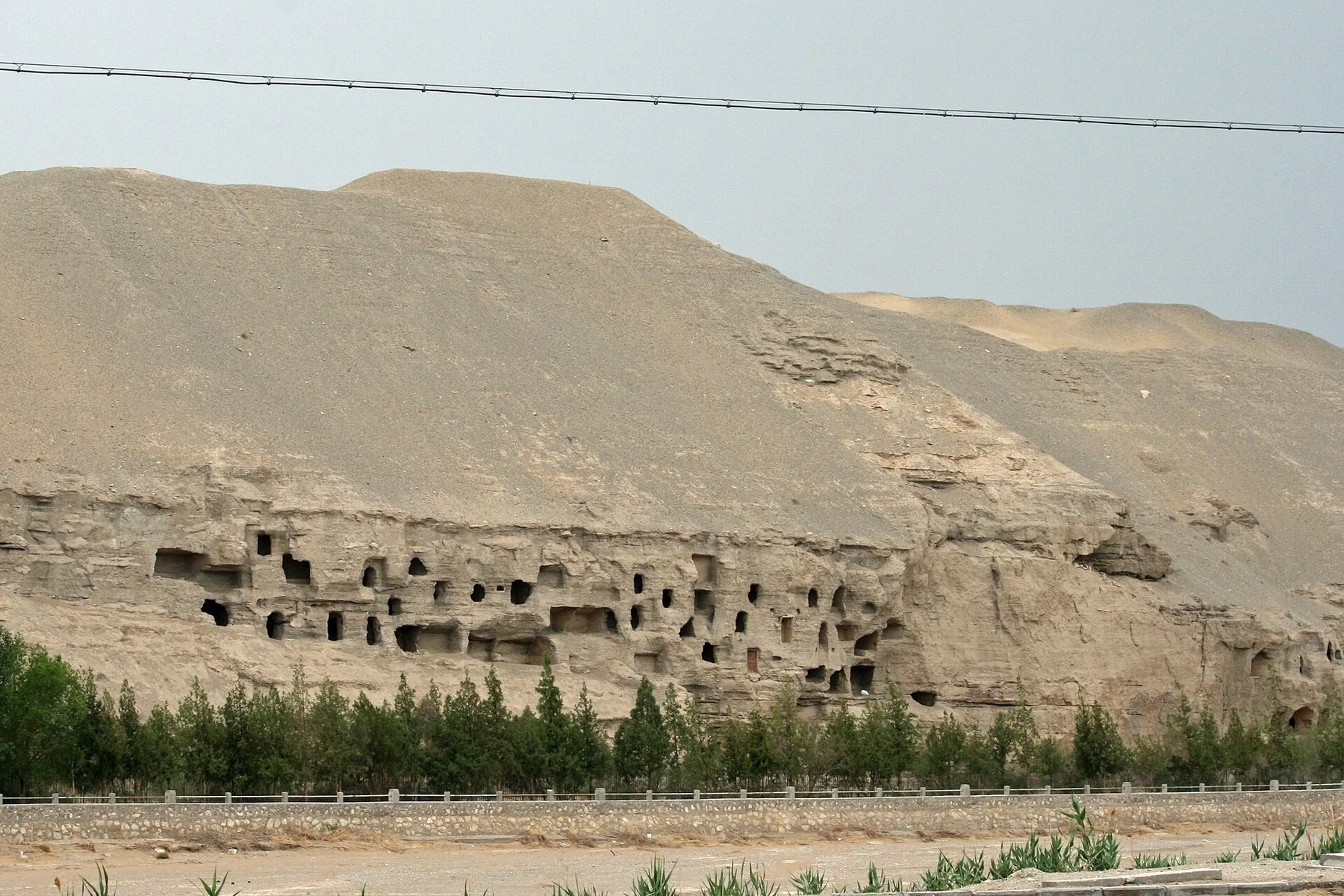

The photograph initially appears almost empty. Dark openings puncture a pale cliff. Trees form a narrow band below. A modern road, barrier, and overhead cable cross the view. No mural or painted Buddha is visible.
That absence is useful. Mogao is often reproduced through a spectacular interior wall, detached from the architecture, patron, cave number, route, lighting, and restrictions that made it meaningful. The exterior restores the first material fact: hundreds of spaces were cut into a cliff above the Dachuan River near the Dunhuang oasis.
UNESCO’s Mogao record counts 492 preserved caves, about 45,000 square metres of murals, and more than 2,000 painted sculptures made across the fourth to fourteenth centuries. Those totals describe accumulation, not one building campaign. Caves were founded, enlarged, repainted, repaired, rededicated, occupied, abandoned, and remembered under changing regimes, including Tang, Tibetan, Five Dynasties, Song, Uyghur, and Western Xia authority.
“Monastery” also names more than a prayer hall. Mogao contained sanctuaries, painted sculpture, narrative and devotional murals, donor portraits, ritual settings, meditation and living cells, burial spaces, manuscripts, textiles, and administrative traces. UNESCO identifies the northern area as a place where monks lived and meditated and where burials occurred. The monumental southern caves and smaller northern cells belonged to one institutional landscape even when their surviving decoration differs.
Patronage makes that landscape social. A cave could be commissioned or sustained by officials, military governors, monastics, merchants, local families, and other donors. Images could generate merit, honour relatives, support teaching, stage ritual, and declare position. Donor portraits placed patrons inside sacred pictorial worlds, but paying for a cave did not make one person its sole author. Quarrying, plastering, carpentry, pigment preparation, drawing, painting, modelling, gilding, inscription, ritual activation, maintenance, and provisioning required networks of makers and caretakers.
The walls also resist the phrase “Silk Road fusion” when it is used without agents. Chinese, Tibetan, Sogdian, Khotanese, Uyghur, and other languages survive in materials from the site. Buddhist texts and image systems travelled through Indian, Central Asian, Tibetan, and Chinese traditions. Yet a motif did not move by itself. A translator chose a word; a donor selected a subject; a workshop adapted a figure to a wall; a local institution decided what a cave should do.
Cave 17, commonly called the Library Cave, makes survival and removal inseparable. The International Dunhuang Programme records tens of thousands of manuscripts, printed documents, paintings, and other items sealed there in the early eleventh century. After the chamber became known in 1900, explorers and collectors from Britain, France, Russia, Japan, and elsewhere acquired large groups of material. The archive is now dispersed across institutions and countries. Digitisation can reunite images and catalogue data for research; it does not reverse the history of removal or restore original physical relations.
The modern site is equally active. Conservation limits light, humidity, visitor numbers, and physical access because the conditions that make a mural visible can also damage it. A reader should therefore refuse a false choice between unrestricted looking and cultural loss. Restricted photography and controlled entry are not failures of access alone; they are part of caring for fragile surfaces. At the same time, every digital surrogate should identify which cave, wall, date, restoration layer, and institution it represents.
Summer Mountains: a handscroll that makes time visible
The hero image is the painted section of Summer Mountains, attributed by the Met to Qu Ding and dated around 1050. The attribution is not a signature turned into certainty. The museum connects the work to a painter active in the orbit of Yan Wengui through style, technique, later records, and seals associated with the collection of Emperor Huizong. “Attributed to” keeps that reasoning visible.
From right to left, the scroll moves through riverbank and settlement, wooded slopes, travellers and paths, dense mountain forms, a temple retreat, and more distant terrain. Small human figures offer scale and possible routes of attention. Ink wash produces atmosphere; texture strokes differentiate rock and vegetation; pale colour remains subordinate to tonal structure.
It is tempting to call this “nature.” The word hides construction. The mountains are arranged to make passage, concealment, distance, and hierarchy legible. A viewer can imaginatively walk through, rest within, or dwell in the painted terrain. The central mass has been compared to an emperor among subjects, a political metaphor supported by Song theories of ordered landscape. But the analogy should not become the only content. The scroll could also organise seasonal sensation, travel, retreat, cultivated looking, and the pleasure of moving through complexity.
Format changes the argument. A hanging scroll can establish a strong vertical field in a room. An album leaf concentrates attention within a small frame. A handscroll is normally encountered in successive sections on a table. The viewer controls pace, reverses direction, compares passages, and physically covers what has passed. Seeing is a performance rather than a neutral reception of the whole image.
Later ownership also performs on the surface. Collectors added seals, inscriptions, mounts, labels, and records. Emperor Huizong’s seals are evidence in the work’s modern dating and attribution. They also show that collecting was not external to art history. An imperial collection could classify earlier works, establish canons, invite copies, support workshops, and turn possession into cultural authority.
The painting belongs to the Northern Song, but its later life crosses dynasties. The Met’s open study Summer Mountains: The Timeless Landscape follows how older idioms were adopted and transformed. “Copying” in this context need not mean failure of originality. Studying an earlier master could preserve a lineage, test brush discipline, claim cultural position, or deliberately remake the past for a new present.
This is why a single label such as “realistic landscape” is inadequate. The scroll offers convincing spatial experience without being a map of one location. It joins close observation to inherited conventions, political metaphor, collection history, hand movement, and imaginative travel.
Guan dish: court taste made by fire
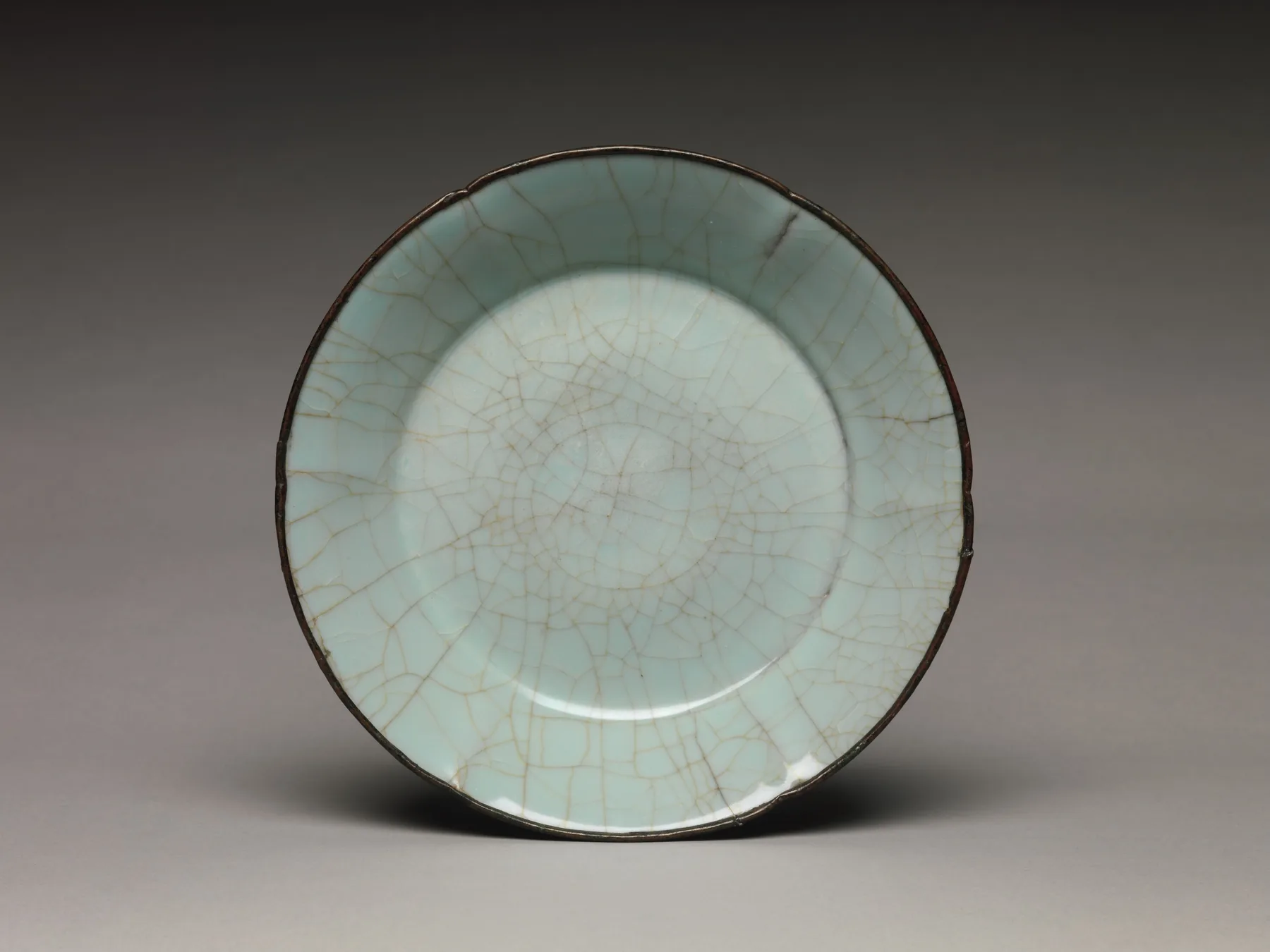
The dish looks quiet because much of its work has been made invisible. A low circular wall surrounds a shallow basin. The blue-green glaze changes with thickness and light. Fine dark lines spread across the surface. The rim appears darker, sharpening the boundary between object and background.
The museum identifies it as Guan ware, made near the Southern Song capital of Hangzhou in the late twelfth or thirteenth century. It relates the object to efforts to recreate or answer rare Ru wares produced for the Northern Song court before the loss of the north. That history turns an apparently simple bowl into an object of displacement and institutional memory: a southern court used new production to establish continuity with a northern imperial past.
The crackle deserves especially careful language. Glaze and ceramic body expand and contract differently as a vessel cools. That mismatch can create a network of cracks in the glaze. On this dish, the Met describes the effect as deliberate—potters learned to make a firing result associated with accident into a controlled aesthetic resource. “Controlled” does not mean perfectly predictable. Clay composition, glaze chemistry, kiln atmosphere, temperature, cooling, stacking, and placement all affected the result.
Court taste therefore began long before selection at the palace. Clay had to be located, prepared, levigated, shaped, dried, glazed, loaded, fired, cooled, sorted, transported, handled, and sometimes rejected. Kiln workers depended on fuel, water, roads, finance, technical memory, and coordinated labour. A surviving dish is the successful end of a field that also contained wasters, failures, experiments, and ordinary wares.
The word Guan means “official,” but it should not erase uncertainty. Scholars have debated kiln sites, classifications, chronology, and the relation between documentary terms and excavated bodies. Museum labels stabilise a category so that objects can be taught and compared; archaeology can complicate that stability. Good looking holds the named ware and the evolving evidence together.
Nor should the dish be praised as timeless minimalism. That phrase imports a modern design ideal and strips away court ritual, dining, display, connoisseurship, antiquarian reference, and the labour of firing. Restraint was historically produced. The apparently empty surface directs attention to proportion, glaze depth, rim, touch, light, and controlled irregularity because institutions taught certain viewers to value those features.
The neutral museum photograph adds another transformation. It gives an unusually clear account of shape and crackle while removing hand, table, food, paired vessels, storage, sound, and changing light. It is excellent evidence for one kind of looking and weak evidence for use.
Zhao Mengfu: scholar culture under Mongol rule
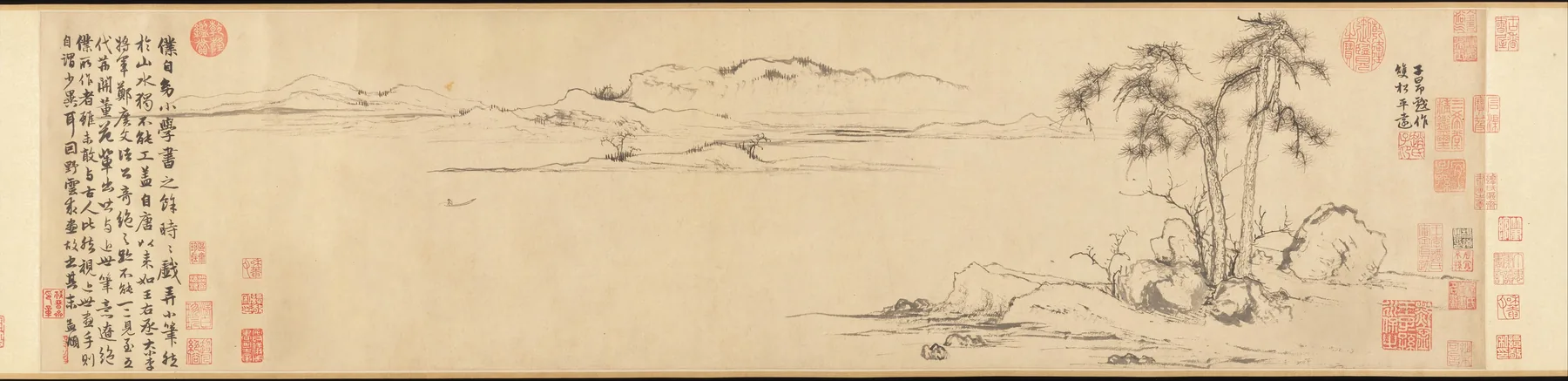
Two pines stand at the right. Beyond them, low banks and spare trees cross open paper toward a distant shore. An inscription occupies the landscape rather than sitting safely outside it. Red seals punctuate both image and mounting. Compared with the dense mass of Summer Mountains, the work can seem deliberately bare.
Zhao Mengfu made Twin Pines, Level Distance around 1310. He was a descendant of the Song imperial house who accepted service under the Mongol-led Yuan. That decision has shaped later readings of both his ethics and his art. Some accounts make him a collaborator; others make every archaic brushstroke an encrypted act of cultural resistance. Neither position should be assumed from the pines alone.
The Met emphasises Zhao’s use of calligraphic brush conventions. Rock and tree are not rendered by hiding the hand behind an illusion. Their lines call attention to movement, pressure, dryness, continuity, and script-like discipline. Painting and calligraphy become related practices in which the educated viewer recognises not only a represented object but a history of marks.
The work also turns backward. “Level distance” recalls older landscape structures. Zhao’s engagement with historical models was not simple nostalgia for a pure pre-Mongol style. Archaism could create a critical distance from recent academic convention, make lineage available for invention, and position an artist within a long conversation. The old form became material for a new claim.
Pines had associations with endurance and integrity. The museum proposes that they may refer to Zhao’s political survival and the persistence of culture under Mongol rule. The conditional is essential. Symbolic convention makes the interpretation plausible; it does not convert the painting into a one-sentence confession.
“Scholar-amateur” can be equally misleading. Zhao possessed specialised training, historical knowledge, social standing, calligraphic skill, and access to networks of exchange and collection. His art was not made outside institutions merely because it differed from a salaried workshop product. Scholar painting circulated through gifts, gatherings, inscriptions, family relations, office, friendship, reputation, and later connoisseurship. The category excluded many makers even while it elevated personal expression.
The Yuan context must remain larger than one educated Han Chinese man’s dilemma. The Met’s Khubilai Khan exhibition research documents artisans and forms moving across a Mongol imperial system that connected northern and southern China with Central and West Asia and the Himalayan world. Courts sponsored multiple religious traditions and workshops. Yuan art includes court architecture, textiles, ceramics, Buddhist images, theatre, metalwork, and the production of relocated or coerced craftspeople—not only literati ink painting.
Twin Pines is powerful because it does not resolve participation and integrity for us. It makes the brush a place where service, historical memory, social identity, and invention meet.
The object, institution, viewer compared
| Case | Primary setting and task | Material system | Who organised it? | What the surviving image hides |
|---|---|---|---|---|
| Tang rider | Tomb; serve, protect, rank, and remember the dead | Unfired clay, modelling, pigment, horse and dress conventions | Family, funerary officials, patrons, workshops, ritual specialists; exact tomb network uncertain | Tomb position, companion objects, rites, perishable offerings, secure identity of the deceased |
| Mogao Caves | Cave sanctuary and monastery; devotion, merit, teaching, residence, burial, archive | Excavated cliff, plaster, timber, pigment, clay sculpture, manuscripts, textiles | Monastics, donors, officials, families, merchants, workshops, caretakers, changing regimes | Most interiors, ritual sound and movement, restricted access, dispersed Library Cave materials |
| Summer Mountains | Handscroll and collection; staged travel, ordered landscape, cultivated viewing | Ink and light colour on silk, mounting, seals, inscriptions | Painter and workshop histories, collectors, court cataloguers, mounters, viewers | Gradual right-to-left encounter, changing mounts, embodied handling, uncertain attribution |
| Guan dish | Kiln, court, table, treasury, or collection; use and connoisseurship | Stoneware body, blue glaze, kiln atmosphere, fuel, cooling, sorting | Kiln workers, suppliers, transporters, court selectors, users, later collectors | Failed firings, production scale, paired vessels, touch, food, sound, exact kiln debate |
| Twin Pines | Study and social network; painting, calligraphy, gift, self-positioning | Ink on paper, inscription, mounting, seals | Zhao Mengfu, recipients, peers, officials, family and collector networks, later mounters | Original occasion and recipient, changing viewing contexts, complete political intention |
The comparison replaces a sequence of “masterpieces” with a sequence of relations. A tomb object requires a burial. A mural requires a wall and a funded cave. A scroll requires handling and memory. A ceramic requires an industrial ecology. A scholar painting requires a trained social world.
Courts organised visibility, but not alone
Courts concentrated resources, regulated ranks, sponsored rituals, maintained workshops, collected earlier art, and rewarded particular forms of knowledge. Tang funerals made elite relations visible. Huizong’s Northern Song collection left catalogues and seals that still affect attribution. Southern Song demand organised specialised ceramic production near Hangzhou. Yuan rulers moved artisans and sponsored religious and material systems across an imperial network.
Yet “court art” can become a fiction of single authorship. The ruler survives in records while miners, kiln crews, painters, mounters, translators, carriers, and accountants disappear. Patronage names the power to initiate, fund, select, or claim; it does not name all the intelligence required to make. Nor was a court one mind: household, academy, ritual office, workshop, treasury, and regional administration could pursue different goals.
Monasteries were workshops, archives, and social systems
The word monastery may suggest withdrawal. Mogao shows dependence on land, routes, food, water, donors, labour, translation, political permission, and maintenance. Images there were not illustrations alone: placement, scale, inscriptions, light, repetition, and moving bodies allowed a paradise, bodhisattva, narrative, protector, or donor to teach, generate merit, mark memory, and establish presence.
Cave 17 preserves both the breadth and vulnerability of that institution. Sacred texts sit beside letters, contracts, calendars, drawings, and traces of work. Their dispersal enabled new catalogues and research while breaking physical groupings. Digital reunification is therefore a scholarly achievement and evidence of a damaged archive.
Landscape was a practice of viewing
Landscape painting built relations among brush, format, historical model, social position, and viewer. In Summer Mountains, paths and tiny travellers invite entry into layered mass. In Twin Pines, open paper, calligraphic marks, and inscription return attention to the artist’s hand and to earlier painting. Both are landscapes; they ask different participation.
Shanshui, literally “mountain-water,” can organise cosmology, moral order, political metaphor, retreat, travel, season, poetry, and brush study. No one philosophy explains every image. Begin with evidence: where does the scroll invite entry; what appears next; which mark behaves like writing; where are roads and buildings; what do seals do; who could handle the work?
Ceramics were systems before they were masterpieces
The Guan dish is small enough to hold, yet its production extends across a landscape. Clay and glaze minerals came from particular places; fuel linked kilns to managed supply; water entered processing; roads and waterways moved materials and finished goods. Firing consumed skill and capital before anyone knew which vessels would succeed.
This system corrects the solitary-genius and timeless-national-style stories. Kiln centres competed, borrowed, served courts and markets, exported goods, and changed with political geography. Song forms and glazes travelled widely, but that movement made neither every celadon a court object nor every local response derivative.
Scholar culture was neither private nor free of power
Literati painting identifies arguments made by educated elites about calligraphy, poetry, historical reference, and personal brush expression. Brushwork could carry ethical or biographical meaning; inscriptions could join image and writing; gifts and later additions could make an artwork a social event across time.
The category misleads when “amateur” becomes “untrained,” elite practice becomes all Chinese painting, or withdrawal is mistaken for freedom from institutions. Literacy, office, family resources, gender, access to collections, paper, leisure, and recognition structured participation. Professional painters, women artists, religious makers, artisans, court workshops, and commercial producers remain part of the field.
Zhao Mengfu also prevents a clean opposition between court and scholar. He served the Yuan while redefining educated painting. Participation could compromise, protect, enable, or burden; withdrawal could preserve integrity or depend on privilege. His scroll records a position, not a universal solution.
Survival remade the evidence
The five cases passed through different filters. Clay endured underground but lost its tomb ensemble. Mogao’s cliff protected murals while water, smoke, repainting, tourism, and time altered them. Library Cave objects survived by being sealed, then dispersed because they were valued. Scrolls required remounting, storage, and care. Firing made the dish durable; owners kept it so.
Modern institutions added another filter. Museums removed objects from use and placed them in comparative collections. Neutral photography increased access while flattening scale. Wide images made whole scrolls visible at once. Heritage management stabilised caves while restricting some looking.
Provenance is therefore part of visual analysis. The rider is only “likely” from Astana in the Met’s public record; the scrolls and dish have gaps before their modern collection histories. Missing evidence is not permission to invent a seamless biography.
Five shortcuts to refuse
“Tang cosmopolitanism was borderless harmony”
Long-distance movement shaped Tang art and society, but it operated through empire, warfare, taxation, garrisons, markets, migration, and unequal status as well as curiosity and exchange. Name who moved, under what conditions, and who controlled the route.
“A tomb figure is a snapshot of daily life”
Dress, horses, and gesture preserve valuable evidence, but a mingqi is a funerary surrogate selected for the dead and the living. It is neither a portrait nor a transparent census of ordinary experience.
“Song landscape is simply nature worship”
Landscape was constructed through brush conventions, handscroll timing, political metaphor, poetic memory, collection, and cultivated viewing. Identify what the format makes the body do before assigning a philosophy.
“The finest ceramic is simple because it has little decoration”
Visual restraint is a produced effect. Clay, glaze, fuel, firing, failure, selection, court memory, use, and connoisseurship make the Guan dish historically dense.
“Yuan scholar painting proves resistance to foreign rule”
Mongol conquest and unequal Yuan institutions shaped scholar choices, but no pine or archaic brushstroke has one automatic political meaning. Service, withdrawal, cultural memory, ambition, compromise, and invention could coexist.
A working timeline, 618-1368
- 618: The Tang dynasty is founded.
- 630s–650s: Tang military expansion and administration extend into parts of Central Asia; Gaochang is conquered in 640.
- Seventh century: The painted clay Horse and female rider is made, probably for a tomb in the Astana area.
- Eighth century: Tang patronage at Mogao expands; caves, murals, sculpture, donor imagery, and manuscripts record Dunhuang’s religious and political connections.
- 755–763: The An Lushan rebellion severely disrupts Tang authority and society.
- 781–848: Tibetan rule shapes Dunhuang before local and regional regimes reconfigure authority.
- 907: The Tang dynasty ends; multiple states rule during the Five Dynasties and Ten Kingdoms period.
- 960: The Song dynasty is founded with its northern capital at Kaifeng.
- Around 1050: Summer Mountains is painted by a master whom the Met associates with Qu Ding.
- Early eleventh century: Cave 17 at Mogao is sealed with tens of thousands of manuscripts, paintings, printed works, and other items.
- 1101–1125: Emperor Huizong rules, supports court art, and forms the collection whose seals and catalogue inform later painting histories.
- 1127: The Jurchen Jin capture Kaifeng; the Song court re-establishes rule in the south, eventually from Hangzhou.
- Late twelfth–thirteenth century: The Guan dish is produced near Hangzhou in relation to Southern Song court taste and memories of northern imperial wares.
- 1206: Temujin is proclaimed Chinggis Khan, consolidating Mongol power.
- 1234: Mongol and Song forces defeat the Jin; Mongol-Song conflict continues.
- 1271: Khubilai Khan declares the Yuan dynasty.
- 1279: Yuan forces complete the conquest of the Southern Song.
- Around 1310: Zhao Mengfu paints Twin Pines, Level Distance during his career under Yuan rule.
- 1368: The Yuan court loses Dadu to Ming forces; Yuan and Mongol histories continue beyond this chapter’s political endpoint.
Terms for looking and reading
- Mingqi: Objects made for burial, sometimes translated as “spirit goods”; their forms, materials, and regulation changed across time and status.
- Sancai: A low-fired lead-glaze palette associated especially with Tang ceramics; literally “three colours,” though actual palettes vary.
- Chang’an: Tang imperial capital near present-day Xi’an and a major administrative and cultural centre; not the dynasty’s only centre.
- Dunhuang: Oasis and regional centre near the Mogao Caves in present-day Gansu, connected to multiple routes, languages, and regimes.
- Merit: Beneficial ethical and karmic result cultivated through giving, worship, copying texts, supporting monastics, and other practices; not a simple commercial exchange.
- Donor portrait: An image of a patron or patron group within a religious program; it can stage devotion, family memory, rank, and institutional relation.
- Handscroll: A horizontal format stored rolled and normally viewed in sections, commonly progressing from right to left.
- Mounting: The physical support and framing of a painting or calligraphy; remounting can preserve a work while changing its borders and sequence.
- Shanshui: “Mountain-water,” a broad term associated with landscape imagery and writing; it does not name one style or philosophy.
- Ink wash: Diluted ink used to build tone, atmosphere, volume, and texture.
- Guan ware: “Official ware,” a debated category associated here with Southern Song court-linked stoneware production near Hangzhou.
- Crazing or crackle: A network of lines produced when glaze and ceramic body contract differently; it may be accidental, selected, or deliberately cultivated.
- Kiln atmosphere: The oxygen conditions during firing, which interact with clay, glaze, fuel, and temperature to affect colour and surface.
- Literati or wenren: Educated cultural figures associated with writing, calligraphy, painting, collecting, and official or social networks; not a synonym for every scholar or artist.
- Three perfections: The joined practices of poetry, calligraphy, and painting, especially valued in later scholar culture.
- Archaism: Deliberate engagement with older forms or models; it can be inventive, political, scholarly, or social rather than merely nostalgic.
- Yuan: The Mongol-led dynasty declared by Khubilai Khan in 1271; it was one part of a wider and changing Mongol imperial world.
- Provenance: The documented history of ownership, custody, excavation, transfer, and collection; missing links limit what can be claimed.
Questions to carry to the next object
- Does the dynasty label identify the maker, the ruler, the place of production, the burial date, or a later museum category?
- Which states and communities existed beside the dynasty named in the caption?
- Is a tomb figure being read as a ritual surrogate or mistaken for a portrait?
- What was the object’s original ensemble, and which related materials have disappeared?
- Does “cosmopolitan” name specific movement, or conceal coercion and unequal power?
- Who funded the monastery, who worked there, and who maintained its images?
- Is a mural shown with its cave number, wall position, adjacent scenes, and restoration history?
- Does the digital image preserve the handscroll’s direction and sectional viewing?
- Which seals, inscriptions, and mounts belong to later owners rather than the initial maker?
- What material failures and workshop experiments sit behind a successful ceramic?
- Has “literati” erased professional painters, artisans, women, religious makers, or commercial workshops?
- Is a political interpretation documented, plausible, or merely repeated until it appears certain?
Source guide
Begin with object and site records, then widen the frame. Institutional records are strongest for accession data, medium, dimensions, current attribution, conservation, site boundaries, and rights. Their interpretive language still needs comparison and qualification.
- For the Tang rider, the Met’s object record supplies the seventh-century date, material, dimensions, tomb classification, likely Astana origin, and Public Domain status. The Met’s mingqi essay places Tang figures within burial programs and living political relations. The National Museum of Asian Art’s study of Tang riders offers a securely grouped comparison without transferring that comparison’s tomb history to this object.
- For Mogao, UNESCO’s World Heritage record establishes the preserved cave count, mural and sculpture scale, fourth- to fourteenth-century duration, northern monastic area, multilingual finds, and conservation framework. The International Dunhuang Programme history documents Cave 17’s contents, early twentieth-century dispersal, and the collaborative digital response. Smarthistory’s Cave 17 study is useful for patrons, paintings, manuscripts, and family maintenance.
- For Summer Mountains, use the Met’s object record for the current attribution, date, medium, dimensions, Huizong seals, and Public Domain status. Wen Fong’s open Met publication Summer Mountains: The Timeless Landscape traces attribution and the transformation of older styles. The Met’s Chinese painting essay provides a concise format and institutional overview.
- For the Guan dish, the Met’s object record establishes its late twelfth- to thirteenth-century date, stoneware body, crackled blue glaze, dimensions, Southern Song court relation, and Public Domain status. The record’s confident naming should be read alongside archaeological debate over kiln sites and ware categories.
- For Twin Pines, the Met’s object record provides the date, dimensions, right-to-left format, calligraphic analysis, and conditional political reading. The Met’s Yuan exhibition overview widens the frame to Mongol imperial workshops, religions, media, and long-distance movement. Its Yuan painting installation focuses on literati transformation and should not be mistaken for the whole period.
The images were audited separately from the historical claims. The four Met records mark their downloadable images Public Domain under Open Access. The Mogao exterior is Flickr user eviltomthai’s CC BY 2.0 photograph, preserved through Wikimedia Commons. Every local WebP retains the source aspect ratio and contains no crop.
Continue the route
This chapter follows Southeast Asian temple and court worlds, c. 600–1400 and art on the Silk Roads. The first studies how courts and religious institutions translated water, mountain, merit, and imported forms into local worlds. The second follows objects and beliefs across routes that also reached Tang frontiers and Dunhuang.
The next atlas chapter turns to Korean and Japanese art, c. 600–1400: monastery, court, ceramic, narrative, and local change. It does not ask how faithfully Korea and Japan copied China. It asks how travellers, texts, workshops, courts, and religious communities rebuilt shared forms within distinct political and material histories.
One question should travel with us: when a museum label names a dynasty, which institution actually taught the object what to do?
Editorial record
About this article
- Author
- Publisher
- GeMarkt
- Published
- Updated
- Reviewed
- Internal source & rights check. Conducted by GeMarkt Research Review. This is an internal editorial check—not independent peer review.
- Source standard
- Art history source standardPrioritises object records and research sources, distinguishes evidence from interpretation, and states material uncertainty.
Found a claim that needs checking? Report a factual error.