Art History · Learning chapter
Atlas III — Early-modern worlds · 8 of 11
African kingdoms and Atlantic encounter, c. 1450–1750: court, diplomacy, trade, and violence
A critical guide to how Kongo, Benin, Sapi, and Akan makers and institutions negotiated Atlantic diplomacy, trade, Christianity, enslavement, and power.

What we’ll look at
How did African kingdoms respond to Atlantic trade, diplomacy, and violence?
Tiny bearded heads look outward from the crown of an ivory face. Between them, long-bodied mudfish bend into an openwork screen. Iron-rimmed eyes, dark pupils, forehead inlays, scarification marks, and bead forms below the chin turn the pale material into a field of contrasts. The Portuguese figures are conspicuous, but they do not govern the composition. They have been made small enough to sit inside Benin royal regalia.
The pendant is associated with Ìyọ́bà Idià, mother of Oba Esigie, and with the sixteenth-century court of Benin in present-day Nigeria. Its imagery is often introduced as evidence of an “encounter” between Africa and Europe. That word can be useful if it names contact among historically specific people. It becomes misleading when it imagines two equal, sealed continents meeting for the first time, or when every African history is made to begin with a European ship.
This chapter starts from the African institutions already in place. Portuguese merchants, missionaries, envoys, metals, commissions, and weapons entered worlds organised by rulers, offices, guilds, markets, sacred practices, and older trade routes. African institutions decided what to accept, change, restrict, display, or resist. That agency did not remove the violence around it: the Atlantic trade enslaved people, intensified capture and civil conflict, invited foreign military pressure, and later helped move royal objects into colonial museums.
The central question is therefore not whether contact was “good” or “bad.” It is more demanding:
How did African courts, guilds, merchants, and ritual specialists make Atlantic contact serve local institutions—and when did exchange become inseparable from coercion?
The Atlantic did not arrive in an empty continent
The Atlantic coast was not a frontier waiting to be connected. Before sustained Portuguese navigation in the later fifteenth century, West and Central African societies participated in inland, riverine, coastal, Saharan, and Indian Ocean histories of their own. Gold moved north through Muslim commercial networks. Copper and copper alloys travelled over long distances. Courts regulated specialist labour. Religious ideas, languages, crops, technologies, and people moved without European direction.
The Kingdom of Kongo had a capital, provinces, tribute relationships, titled offices, diplomatic practices, and contested succession. Benin had a walled capital, an oba, palace associations, hereditary craft guilds, military institutions, and regional commerce. “Akan” names related peoples and changing states across parts of present-day Ghana and Côte d’Ivoire, not one timeless empire. Portuguese writers grouped several Sierra Leonean peoples under labels such as “Sapi”; modern attributions to Temne or Bullom makers remain scholarly reconstructions rather than signatures.
Calling these “kingdoms” should not turn them into static ethnic containers. Borders shifted. Authority was negotiated. People could owe different forms of allegiance, and political identity did not map cleanly onto present nation-states. The term identifies institutions of rule; it does not make every inhabitant equally represented by a court object.
Scope: four routes, not one African response
No five objects can represent a continent. This chapter selects four connected but distinct routes between about 1450 and 1750: Kongo relations with Portugal and Rome; Benin royal control of foreign persons and materials; Temne or Bullom export carving in Sierra Leone; and Akan gold measurement across northern and coastal commerce.
The frame excludes far more than it includes. It does not survey Ethiopia and the Red Sea, Swahili and Indian Ocean ports, the Great Lakes, the central African interior, Saharan Morocco, Egypt, the Cape, or every polity between Senegambia and Angola. It also cannot reconstruct the lives of most people who farmed, carried, mined, sailed, hunted, translated, fought, or were enslaved.
“Atlantic Africa” is a route category, not a style. A Kongo cross and an Akan weight are not visually related because both entered Atlantic-era histories. Compare the institutions that activated them: court and church, palace and guild, market and scale, European cabinet and African workshop.
A court pendant makes encounter subordinate to kingship
The hero object is a small pendant, only 23.8 centimetres high. The Met attributes it to artists of the Ìgbèsànmwà, the Benin ivory- and wood-carving guild, and identifies it as one of a nearly identical pair. The related mask now in the British Museum was among works taken during the British invasion of Benin City in 1897; the precise early ownership chain of the Met pendant is not fully reconstructed in its public record.
The face occupies the centre. A high openwork crown and deep collar extend its outline, while carved Portuguese heads alternate with mudfish. These foreign figures are not documentary portraits of named merchants. They are signs placed within a court system of associations: ocean, wealth, dangerous distance, pale colour, and the oba’s capacity to command what came from beyond ordinary land.
The pendant may have been worn by Oba Esigie in rites honouring his mother. Comparable pendants remain part of annual ceremonial renewal in the living Benin dynasty. Museum isolation encourages a viewer to treat the object as a self-contained mask. A pendant instead acts through attachment, dress, movement, scale, sound, audience, and the body of a ruler.
The first lesson is compositional and political. Encounter appears here, but the court decides its size and place.
Idia is historical, but this is not a passport portrait
Idià was the mother of Oba Esigie, who ruled in the early sixteenth century. Benin histories associate her with political and military support during her son’s contested accession and with the establishment or elevation of the title Ìyọ́bà, queen mother. The work is therefore not a generic “African woman.” It belongs to historical memory around a named office and person.
Specific identity does not make the carving a neutral record of facial appearance. Its symmetry, controlled expression, inlaid forehead marks, coral forms, crown, and precious material construct ideal presence. Court portraiture can identify by regalia and role while transforming an individual into an enduring model of authority.
“Portrait of Idia” is a supported attribution. Claims about exactly how she looked, what she felt, or whether every feature was observed from life go beyond the evidence. The Met itself uses both “believed to have been produced” and “idealized portrait.” Those qualifications belong in analysis, not in a footnote added after certainty.
Gender also requires care. The exceptional prominence of a queen mother does not prove equal political access for all women. It shows that Benin court institutions could create a powerful female office under particular dynastic conditions. The rarity of female images in the surviving royal corpus may reflect commission, ritual use, survival, removal, and cataloguing—not the absence of women from political and economic life.
Ivory was sacred substance and commercial material
The pendant’s elephant ivory is not a blank luxury surface. In Benin, whiteness could be associated with ritual purity and with Olókun, a deity of the sea, wealth, fertility, and extraordinary power. The sea was a source of foreign arrivals and royal riches; Olókun could be understood as a spiritual counterpart to the oba. Material, colour, marine imagery, and kingship therefore reinforce one another.
Ivory was also an elephant’s tusk. Hunting, court claims, transport, carving, waste, polish, and exchange preceded the finished pendant. European demand made West African ivory highly desirable abroad, while Benin rulers controlled it as a royal material at home. Sacred meaning and commercial value were not mutually exclusive.
The mudfish intensify this double register. Able to survive in water and on land, they were associated with a ruler whose authority crossed ordinary divisions. Portuguese heads, also imagined through the sea, enter the same marine grammar. It would be too simple to translate them as “Europeans equal wealth.” Their placement makes foreign difference one component of a larger royal cosmology.
Guild authorship matters
Object labels once reduced works like this to “Benin, anonymous.” The Met now credits Ìgbèsànmwà guild artists. That does not recover personal names, but it replaces continental anonymity with an institution of skilled labour.
Guilds regulated access to materials, knowledge, commissions, and service to the oba. Carving ivory required planning around a curved, fibrous tusk; cutting openwork without breaking the crown; drilling and fitting metal; creating contrasting surfaces; and finishing an object meant to move close to a royal body. Apprenticeship, workshop coordination, and quality control are visible even when documents do not identify hands.
The singular word “artist” can hide this system. A named ruler did not personally mine brass, hunt elephant, prepare tools, carve every recess, install inlays, make regalia, or organise ceremony. Court art concentrated authority by coordinating many kinds of work.
Crediting the guild also changes the encounter story. Portuguese traders supplied neither all the meanings nor the full design. Benin specialists transformed foreign likeness and imported substances according to court requirements.
Kongo chose Christianity as statecraft
Portuguese navigator Diogo Cão reached the Kongo coast in 1483. Diplomatic exchanges followed. Kongo ruler Nzinga a Nkuwu was baptised as João I in 1491; his son Mvemba a Nzinga, later Afonso I, made Catholic institutions central to his reign after taking power in 1506.
“Missionaries converted Kongo” hides political choice. Kongo rulers requested clergy and teachers, sent people abroad, adopted Christian names and titles, wrote to Portugal and Rome, built churches, and used Christian ritual in succession and diplomacy. These decisions could strengthen royal legitimacy and international claims while creating conflict inside Kongo.
Nor did one royal baptism instantly convert a population. Christian practices developed unevenly through court sponsorship, local teachers, objects, festivals, burial, language, and debate. Cécile Fromont calls attention to a Kongo Christian visual culture produced through sustained translation, not a thin European layer placed over an unchanged “traditional” religion.
The UNESCO World Heritage property at Mbanza Kongo preserves archaeological and architectural evidence from the political and spiritual centre. Its histories also exceed the visible remains: the capital connected local authority to Atlantic and Catholic networks while remaining a Kongo place.
A brass cross is not evidence of failed conversion
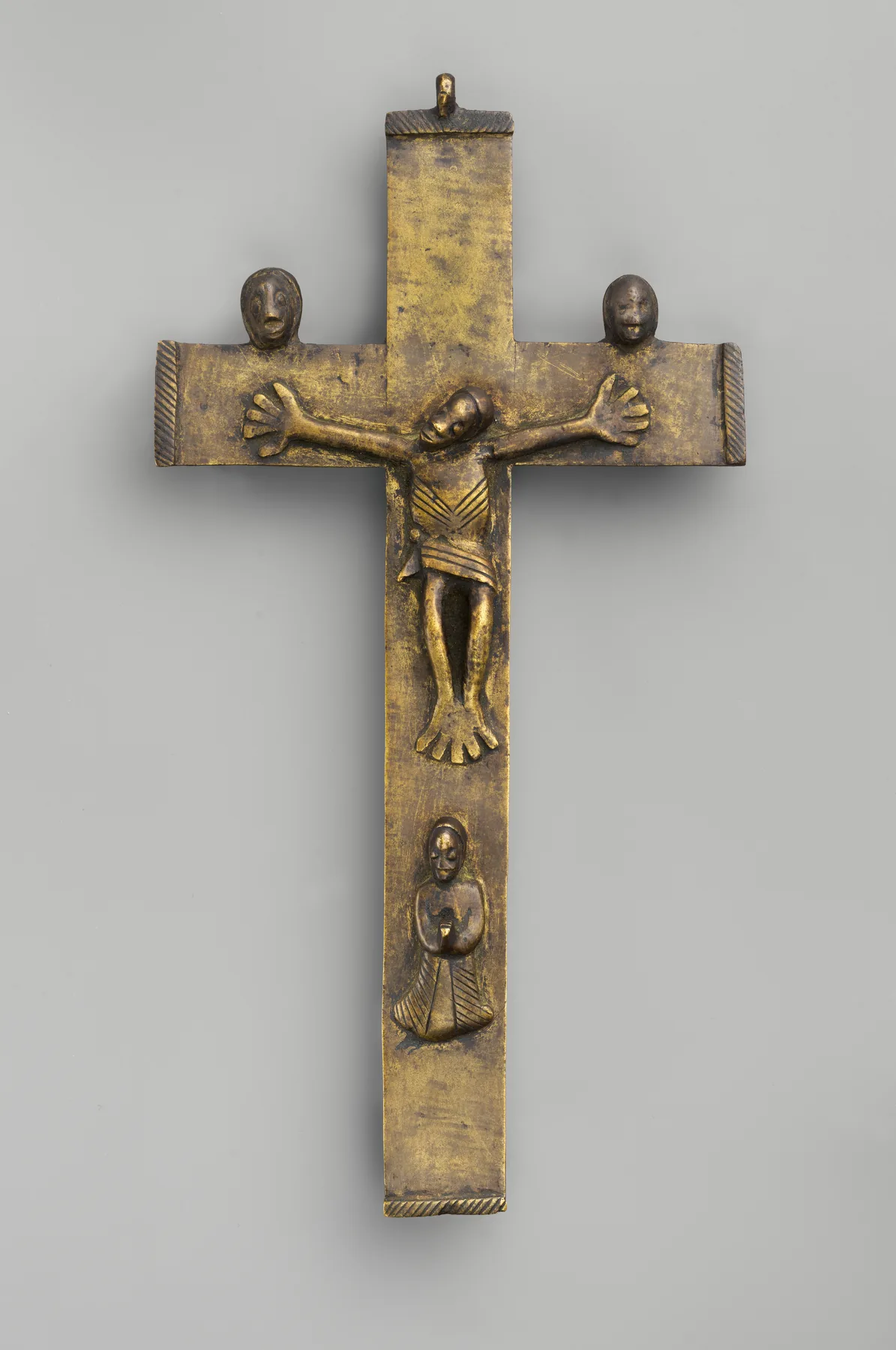
Christ’s hands extend almost to the ends of the crossbar. His ribs and tied cloth are incised; his feet merge into a single five-toed form. Two small praying heads or figures rise from the arms, while a kneeling figure occupies the lower stem. The cross follows a Christian type without behaving like a mass-produced Portuguese import.
The Met dates it to the seventeenth century and attributes it to Kongo peoples in northwestern Angola. Kongo casters often used open moulds and brass available through imported rings or manillas. European metal and Christian iconography entered a local casting process. The result was neither a copy nor proof that Christianity had been misunderstood.
Older accounts used “syncretism” to describe a supposedly incomplete mixture of two pure religions. The term can be useful if every religion is recognised as historically made. It becomes condescending when European Christianity is treated as coherent and African Christianity as contamination. Kongo believers, clergy, rulers, and makers argued over doctrine and practice as Christians elsewhere did.
The cross moved through law, healing, and office
Kongo crosses did not all perform one action. They could belong to rulers, judges, chiefs, priests, ritual specialists, households, or communities. They could appear as insignia, devotional objects, protective forms, oath-bearing objects, and signs of authority. A cross’s function depended on scale, attachments, handling, owner, and setting.
This example’s added figures expand the Crucifixion beyond an isolated body. Prayer, witness, ancestor, and office may intersect, but the image does not identify each figure by name. “Attendant” is safer than inventing a saint where no attribute secures one.
Kongo concepts of the boundary between visible and invisible worlds made the cross form especially resonant, but resemblance should not become an explanation that erases Christianity. A cruciform sign could hold several histories at once. The important evidence is documented use: crosses were incorporated into systems of law and rank as well as Catholic devotion.
The object also reveals a material politics. Brass arrived through trade, yet casting made it local again. A Kongo authority could hold a sign shared with Portugal and Rome without becoming subordinate to either.
Diplomacy was written, translated, and strategic
Kongo-Portugal relations generated one of the richest written archives for early modern Central Africa. Letters from Afonso I and other rulers addressed kings, clergy, and popes through diplomatic forms. Kongolese students travelled to Portugal; Afonso’s son Henrique was consecrated a bishop in Rome. Books, vestments, personnel, and requests crossed the Atlantic in both directions.
Letters are powerful evidence, but they are not transparent speech. Secretaries wrote in Portuguese. Messengers carried documents. Formulae such as “brother” established claims about royal parity. Copies, translations, archival selection, and publication mediate what survives. A king’s correspondence records court priorities more readily than the views of farmers, captives, or political rivals.
The archive nevertheless overturns the image of silent reception. Kongo rulers evaluated foreign conduct, demanded skilled personnel, complained about merchants, negotiated jurisdiction, and described threats to sovereignty. They were not merely described by Europeans; they produced diplomatic arguments.
Afonso’s 1526 letters are not an abolitionist manifesto
In 1526 Afonso I protested that Portuguese-connected traders and Kongolese collaborators were seizing people without lawful authorisation, including free and noble subjects, and moving them toward enslavement. He asked João III of Portugal for regulation and for goods that would support his kingdom rather than uncontrolled human trafficking. The original letters survive in Portugal’s Torre do Tombo archive; translated extracts appear in Malyn Newitt’s Cambridge source collection The Portuguese in West Africa, 1415–1670.
They are extraordinary protests against kidnapping and the erosion of royal control. They are not a modern demand to abolish all slavery. Afonso’s court authorised some enslavement and export, and his complaint distinguished lawful captives from unlawfully seized subjects. Portugal’s support for his Christian project was entangled with continued access to enslaved labour.
Reading him as an uncomplicated abolitionist creates a comforting hero but weakens the source. Reading him as powerless is also wrong. The letters show a sovereign using diplomacy to defend jurisdiction inside a relationship becoming structurally dangerous.
The distinction matters beyond one ruler. Opposition to illegal capture, participation in slavery, and alarm at an expanding export market could coexist. Historical agency does not require moral innocence.
Benin pictured Portuguese traders inside a court grammar
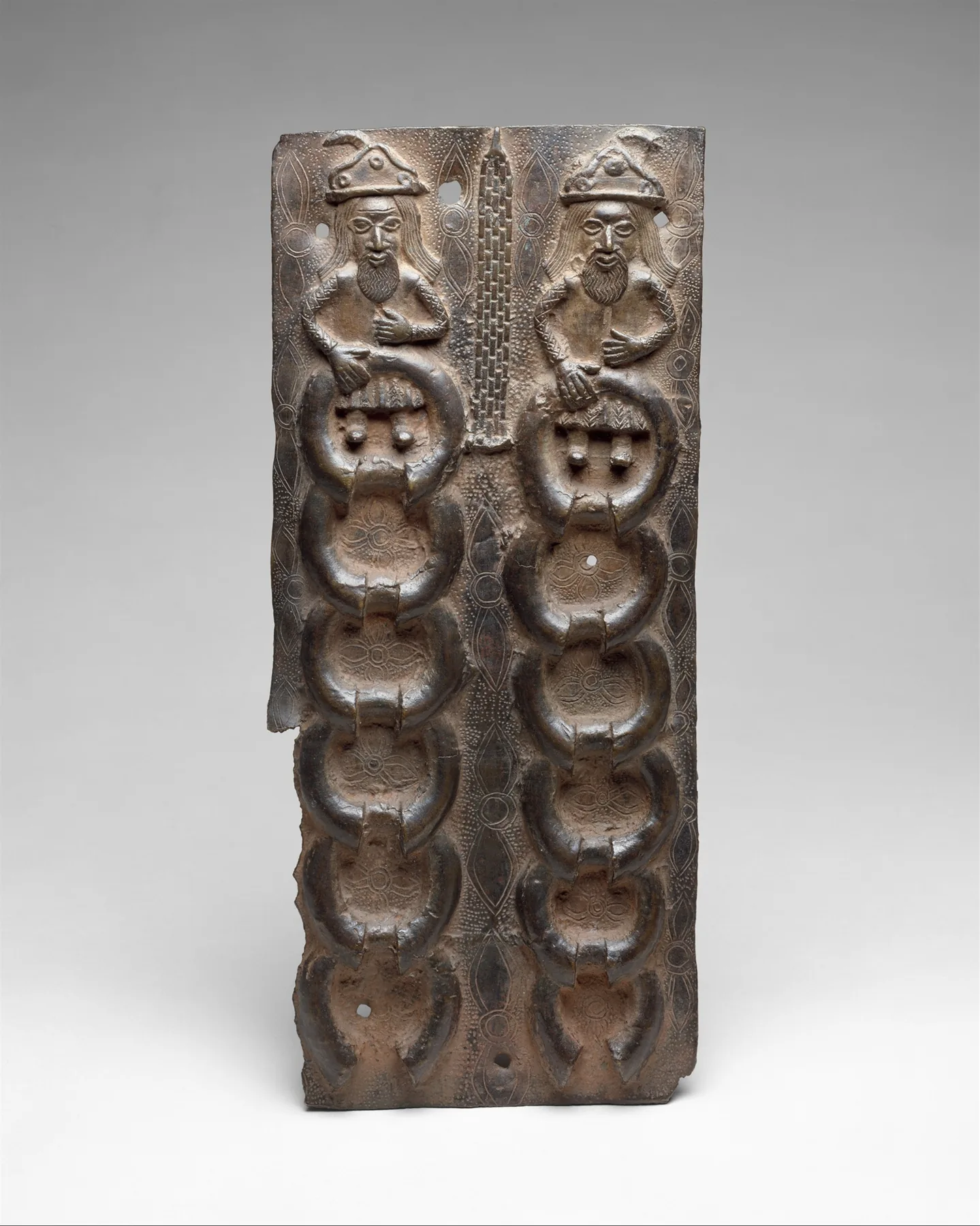
Two bearded men occupy the upper corners of a narrow relief. Their hair, hats, noses, dress, and weapons mark them as Portuguese. Below each is a vertical sequence of large ring forms: manillas, copper-alloy objects imported in great quantities and used in exchange and casting.
The plaque does not show Europeans taking command. It places foreign traders and their metal inside a visual system designed by the Ìgùn Ẹ́rọ̀nwwọ̀n, the hereditary brass-casting guild serving the oba. Repeated borders, relief, scale, paired bodies, and metal surface turn a commercial relationship into palace knowledge.
Barbara Plankensteiner has argued that such images do political work rather than merely document appearance. Portuguese figures could signify ocean-derived wealth and unusual power because the oba was understood to control access to them. The plaque says less about an individual trader’s personality than about where foreignness belonged in royal order.
Manillas were money, material, and political sign
“Manilla” names several types of horseshoe- or ring-shaped copper-alloy objects made in Europe for African trade. Their value, dimensions, alloy, and acceptance varied by period and place. Calling them simply “coins” can conceal that value was negotiated and that many were melted for new use.
In Benin, imported brass expanded material available to court casters. The relationship was not mechanical: more brass did not automatically produce one style or date every object. But control over metal supported an exceptional corpus of altar heads, figures, vessels, bells, and plaques.
On this relief, manillas are both represented things and possible ancestors of the plaque’s substance. Rings become image and material. The court shows the source of a foreign commodity while transforming that commodity into a durable claim about the court.
Manillas later became deeply implicated in the purchase of enslaved people. That history should not be projected identically onto every sixteenth-century exchange, but neither should the attractive metal be separated from the human trade its later volumes helped finance.
Imported metal did not import the image
Material origin is not artistic authorship. European furnaces may have produced part of the copper alloy; Benin casters decided how it would become a plaque. Lost-wax casting required modelling, mould preparation, firing, molten-metal control, release, finishing, and installation. The mould was destroyed to free the work, so each casting involved a new model even within recurring types.
The plaque’s thin, tall format answered architecture. Figures are organised for frontal legibility rather than European linear perspective. Their paired placement and manilla chains make relation more important than naturalistic space.
Describing the work as a “European-influenced bronze” therefore misses both medium and institution. It is brass, and it represents Europeans through Benin court categories. Influence is not a substance that flows from donor to receiver. Ask who chose, recoded, restricted, and displayed the borrowed element.
Palace plaques belonged to an architectural archive
Benin plaques once belonged to the royal palace, where brass reliefs were associated with wooden pillars and courtyards. A seventeenth-century European description reports pillars covered with plaques, though their precise sequence and use changed before the British invasion. They may have helped organise court histories, rank, and ceremonial precedent.
A museum wall makes the relief behave like a framed picture. Its original setting involved repeated metal fields, posts, thresholds, movement, attendants, ritual events, and the oba’s presence. One plaque’s meaning emerged beside others.
Calling the corpus an “archive” does not mean it worked like a written file cabinet. It recognises that court knowledge could be stored in regalia, images, oral accounts, titles, ceremonies, and spatial arrangement. The archive was activated by people who knew how to read relationships.
The 1897 dispersal destroyed much of that relational order. Formal analysis can recover pattern and hierarchy, but it cannot reconstruct the entire palace merely by assembling thumbnails from museums.
A gold weight makes trade measurable
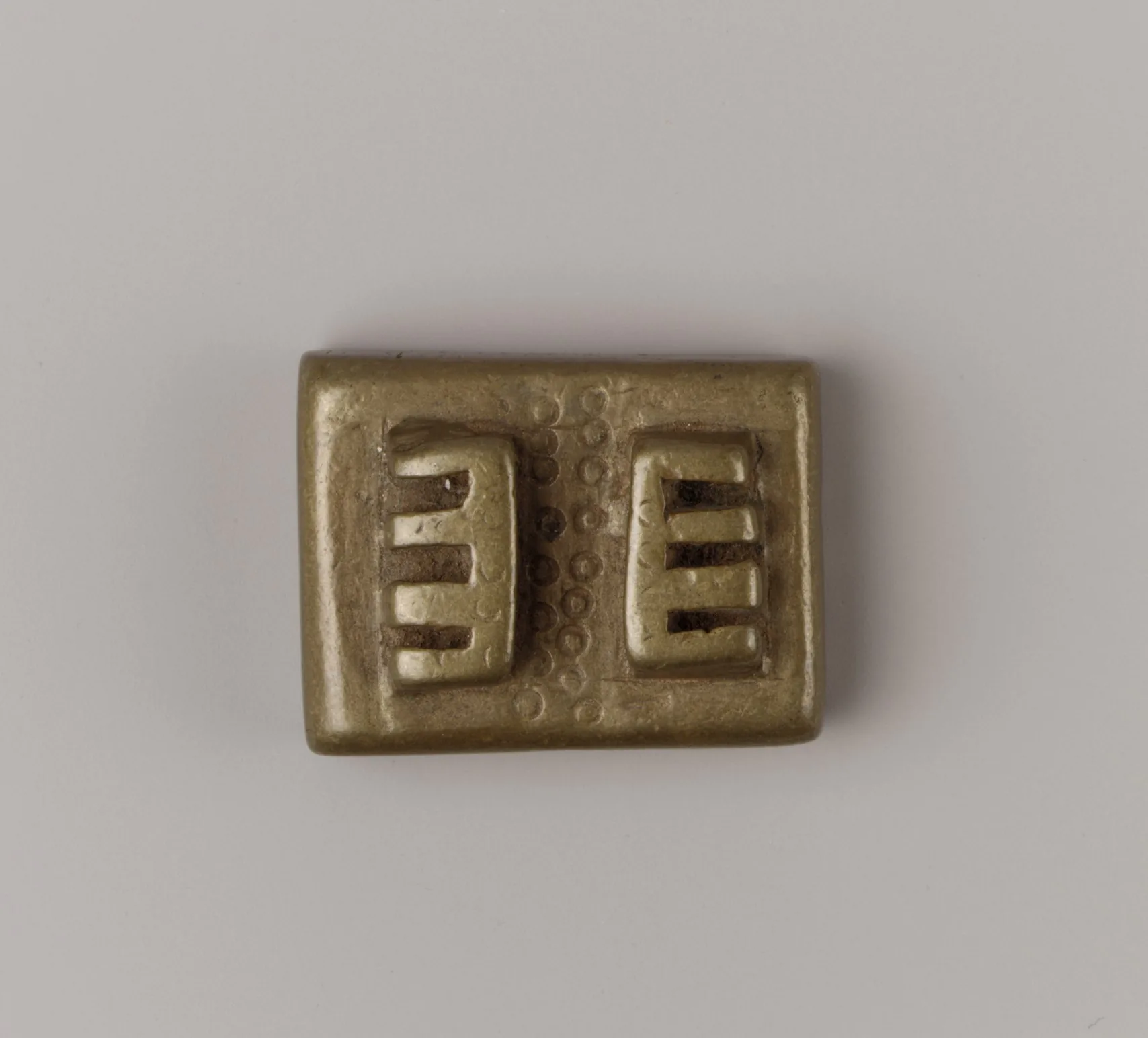
The weight is smaller than a palm. Two open, comb-like shapes oppose one another across a central ridge. Raised circles articulate the surface. It is visually compact because it had to be handled, compared, carried, and trusted.
Akan merchants and rulers used brass weights with balances to measure gold dust. The gold went on one side, a weight on the other. A transaction depended on shared standards, calibrated sets, scales, boxes, spoons, and the expertise to detect fraud. Exchange was not only the movement of valuable substance; it was an institution of measurement.
The Met dates this example to the sixteenth or seventeenth century. Exact dates for individual weights are difficult because forms continued, sets circulated, and archaeological context is often absent. Timothy Garrard’s studies in the Transactions of the Historical Society of Ghana compared weight standards, metal, wear, form, and documentary lists rather than dating by appearance alone.
Akan systems faced north and south
West African gold moved through Saharan networks centuries before Portuguese ships reached the coast. Muslim merchants, Sahelian towns, forest producers, and intermediaries connected mining regions to markets in North Africa and beyond. Some Akan weight standards and geometric forms have parallels with Islamic systems, although the meaning of this object’s specific pattern remains uncertain.
From the later fifteenth century, Portuguese and then other European traders sought gold along the coast. Akan commercial systems therefore faced inland and maritime routes. Atlantic commerce did not replace a northward world overnight.
This matters for visual history. A geometric brass weight cannot be labelled “Atlantic art” merely because Europeans wanted gold. Its standards may preserve older commercial relations while incorporating later measures. Multiple systems were combined through long use.
The rise of the Asante confederacy belongs mainly to the end of the seventeenth century and after. “Akan” should not be replaced automatically by “Asante” for earlier weights. Related peoples and states used gold measures before one polity achieved regional dominance.
Small scale carried public trust
Monumentality is not a synonym for importance. A weight only a few centimetres wide could decide payment, tax, fine, bridewealth, toll, or market fairness. Its significance lay in repeated use rather than distant display.
Geometric pattern may have helped identify a value, owner, or mnemonic association, but not every motif has a securely preserved proverbial translation. Modern catalogues sometimes match forms to proverbs too confidently. Enid Schildkrout’s 2025 Met research explicitly marks uncertainty: similar designs occur elsewhere, and some may have numerical significance, yet the meanings of most geometric patterns are unknown.
Wear, patina, repair, and variation are evidence. A weight that does not meet its intended standard may have been adjusted, copied for collectors, misidentified, or separated from its set. Digital scale enlarges every dot while hiding the object’s actual lightness.
The market required more than metal. Trust was distributed among maker, owner, witness, standard, balance, and reputation. Measurement made commerce social before it made it mathematical.
The oliphant was made for export but authored locally
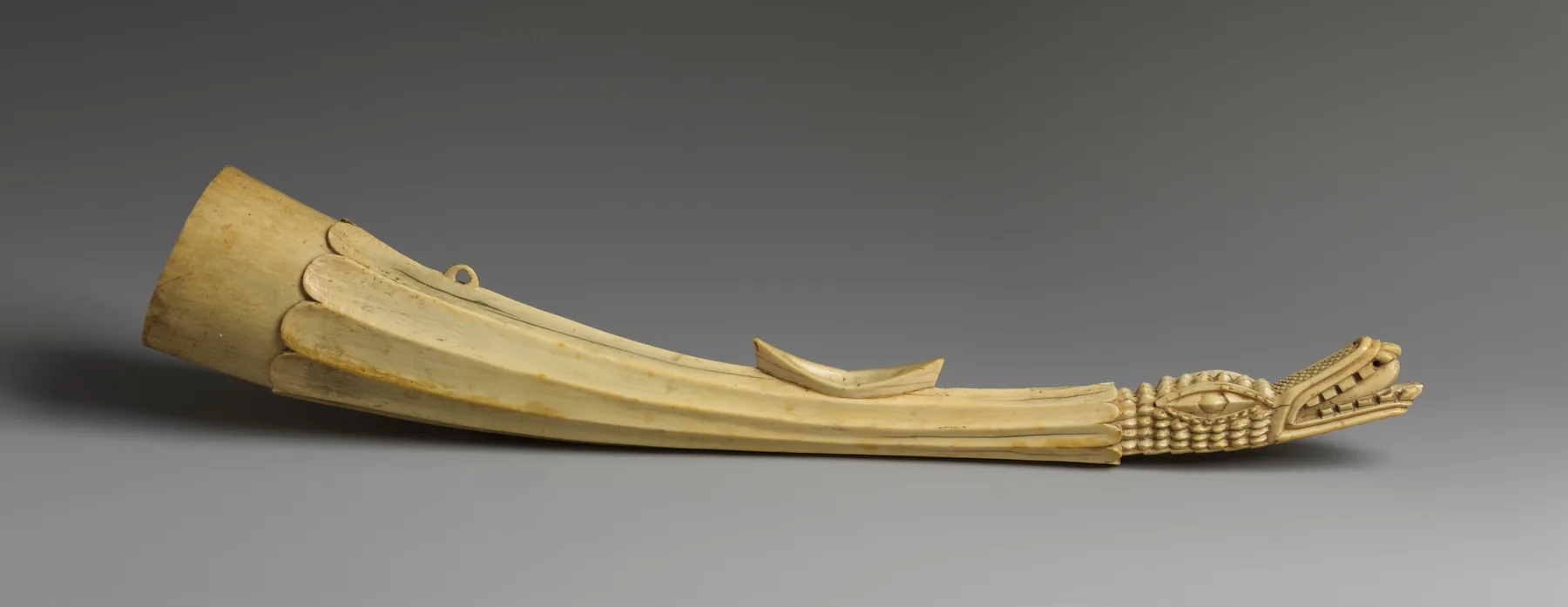
The horn follows the curve of a tusk. Long flutes run from its open end toward a crocodile head whose teeth, scales, eye, and raised jaw make the tip active. A small lozenge-shaped mouthpiece lies on the inner curve rather than at the end.
The Met attributes the work to Temne or Bullom artists in Sierra Leone and dates it about 1490–1530. It was made for European use and entered a category often called Sapi-Portuguese ivory. Only a small number of comparable side-blown export horns survive in documented collections.
Commission does not cancel authorship. European patrons valued ivory hunting horns and may have supplied requests, emblems, prints, or examples. Sierra Leonean makers controlled tusk selection, hollowing, wall thickness, carving, acoustic function, surface rhythm, and a regional mouthpiece technology.
“Hybrid” is useful only if it does not split the horn into European idea and African execution. The maker solved a cross-cultural problem and produced the object as a whole.
A side-blown mouthpiece changes the instrument
The mouthpiece is an argument in material form. Many European oliphants were blown at the narrow tip. West African horns commonly placed a mouth opening on the side. This example keeps the recognisable curved luxury format while requiring the player to hold and sound it differently.
That is more than decoration. It shows that adaptation reached the object’s operation. A courtly European owner could display a familiar prestige type that embodied African musical knowledge.
The crocodile also resists a single origin story. Zoomorphic carving answered regional visual traditions and European appetite for wondrous animal forms. The present object cannot reveal which participant first requested that head. Close looking can identify how the jaw grows from the curve, how the ridge becomes a snout, and how the loop joins carrying or suspension to the animal form.
The horn’s thin wall demonstrates risk. Removing too much ivory could break the object; leaving too much would alter resonance and weight. Technical skill survives where a maker’s name does not.
European admiration could preserve an object and erase its maker
African ivories entered princely treasuries and Wunderkammern, collections that displayed rarity, reach, craft, and possession. Some were carefully kept because European owners valued them. That survival is real; so is the reframing.
An oliphant could become proof of a Habsburg or merchant collection’s global extent while the carver’s language, workshop, and social position disappeared. Later catalogues sometimes assigned African works to India, the Middle East, or Europe because scholars did not recognise or accept African authorship. Praise for technique could coexist with ignorance about makers.
Modern terms such as “Afro-Portuguese” helped restore geographic and historical relations. They can still centre Portuguese demand if the African noun seems only a modifier. The Met’s current credit—Temne or Bullom artist(s)—keeps attribution uncertain but places making first.
Preservation is therefore not innocent rescue. Ask who preserved the object, under what name, after what movement, and for whose prestige.
Trade and enslavement must be distinguished and connected
The same ships and commercial relationships could carry cloth, brass, books, diplomats, missionaries, ivory, pepper, gold, and enslaved people. It is wrong to reduce every exchange to slave trading. It is equally wrong to isolate artistic exchange from the coercive economy expanding around it.
Chronology matters. Gold, pepper, ivory, and textiles could dominate particular routes and decades. Benin rulers at times limited which captives could be sold and retained strong control over coastal relations. Kongo rulers attempted to regulate traders and jurisdiction. Sierra Leonean workshops negotiated luxury commissions.
Yet categories shifted under pressure. Captives taken in war, people convicted by courts, persons pawned for debt, kidnapped free people, and those targeted through raids could all be forced into sale. Labels of lawful capture were produced by political systems and did not remove the captive’s violence.
Connect the histories without making them identical. A brass plaque is not an invoice for enslaved persons. Imported brass, maritime finance, firearms, court competition, and human sale nevertheless became materially entangled.
Atlantic slavery changed scale, incentives, and political risk
Slavery existed in varied forms within African societies before Atlantic plantation expansion. That fact does not make the later trade a continuation without rupture. European colonies in Atlantic islands and the Americas generated sustained demand for coerced labour. Maritime transport connected capture and sale to plantation production, hereditary racial slavery, finance, insurance, and commodity markets across an ocean.
The SlaveVoyages project reconstructs documented voyages and estimates missing traffic from incomplete records. Its methodology warns that dates, ports, and numbers are often imputed. The database is strongest when it makes uncertainty visible, not when one total is repeated as perfect fact.
For the period covered here, west-central African routes became especially consequential. War within and around Kongo, Portuguese expansion in Angola, shifting alliances, and demand from São Tomé and Brazil exposed communities to capture and forced movement. The trade altered incentives for raiding, punishment, debt, and political rivalry without making every conflict “caused by Europe.”
Scale is not only a number. It is the repeated conversion of persons into cargo categories, the deaths before embarkation, the Middle Passage, separation of families, and the work extracted after arrival.
African participation was real but not a single collective choice
African rulers, merchants, soldiers, brokers, and captors participated in enslaving and selling people. Some profited and pursued political aims. Others resisted traders, restricted sales, rescued captives, moved away from danger, or were themselves captured. The same polity could change policy across reigns and wars.
“Africans sold Africans” turns a continent into one moral person. A Benin courtier, Kongo noble, coastal broker, inland captive, Akan merchant, and Temne carver did not share a government or interest simply because later racial categories called them African. Europeans were also divided by crown, company, confession, port, and competition, but European plantation demand and maritime capital gave the Atlantic system expanding external power.
Agency is not blame distributed evenly. It asks what choices particular actors had, which institutions rewarded them, and who bore the cost. A ruler able to negotiate terms and a person bound for a ship do not represent two equal sides of “exchange.”
Avoid the opposite simplification too: Africans were not only victims acted upon from outside. Political history has perpetrators, resisters, beneficiaries, and casualties on the continent. Precision makes the violence clearer.
Objects do not count the people forced aboard ships
The five works in this chapter survive because durable or valued materials entered collections. Captives usually left no portrait, signed testimony, or object securely tied to a name. Palace art can therefore fill the visual field while the people whose forced movement transformed the Atlantic remain statistically present and individually absent.
A viewer should not assign an enslaved biography to a depicted court figure without evidence. Nor should the lack of a captive’s image make slavery background. Use voyage records, legal documents, letters, archaeology, oral histories, and diaspora sources alongside art objects.
The archive’s imbalance is itself evidence. Courts commissioned objects to preserve legitimacy. Merchants recorded cargo. Colonial museums acquired royal and ritual works. The lives most exposed to capture were least able to control what entered the record.
Responsible visual history says what an object can show and brings in other sources for what it cannot.
1750 is a cutoff, not an ending
The syllabus ends this chapter around 1750 to keep the route manageable. No institution stopped then. Kongo Christianity, political contest, Atlantic slavery, Akan state formation, Benin court production, and European coastal fortification continued under changing conditions.
The eighteenth century saw major shifts in the scale and routes of the slave trade, the balance of regional powers, firearm circulation, and plantation demand. Nineteenth-century abolition campaigns did not end enslavement immediately; colonial conquest created further violence. In 1897 British forces invaded Benin City and looted its palace. In the twentieth and twenty-first centuries, independence, museum building, provenance research, and restitution changed the public life of displaced objects.
Period boundaries organise study. They should not turn an unfinished process into a closed style.
Five objects, five institutions of encounter
The pendant belongs first to royal regalia and memory. The cross joins Catholic form to Kongo law, devotion, and office. The plaque organises foreign traders within palace hierarchy. The weight makes commercial value reproducible. The horn answers a foreign commission through Sierra Leonean technology.
None is a neutral souvenir of “first contact.” Each was made useful through an institution. The institution determined who could commission, handle, see, sound, measure with, or interpret the work.
Material routes also differ. Ivory could remain in Benin regalia or travel to a European treasury. Brass could arrive as manillas and be recast into court history or Christian authority. Gold dust moved through scales while a brass weight stayed with its owner. Movement is not one condition shared equally by all objects.
A comparison matrix
| Work | First institutional action | Foreign element | Local transformation | What the object cannot prove alone |
|---|---|---|---|---|
| Pendant of Ìyọ́bà Idià | royal regalia, commemoration, and renewal | Portuguese heads, imported metal, oceanic trade | Ìgbèsànmwà carving makes foreign figures serve Benin kingship | exact facial likeness, first ceremony, or complete provenance |
| Kongo crucifix | devotion, law, rank, or ritual authority | Christian cross type and imported brass | Kongo casting, figures, handling, and political use | one fixed theology for every owner |
| Portuguese-and-manillas plaque | palace display and court memory | traders and imported rings | Ìgùn Ẹ́rọ̀nwwọ̀n guild orders them through Benin relief grammar | a complete trade ledger or original palace sequence |
| Akan geometric weight | balance measurement and trusted exchange | layered northern and coastal standards | makers combine systems into portable local practice | exact motif meaning or a precise date from style alone |
| Temne or Bullom oliphant | European luxury display and sounding | export commission and oliphant format | side mouthpiece, ivory technology, crocodile form, acoustic skill | the patron’s full brief or the carver’s personal name |
The matrix does not rank agency. It identifies where decisions became material.
What survives is an archive shaped by colonialism
The five objects are now in one New York museum. That convenience can make a dispersed and unequal archive look universal. Their routes differ: purchase, gift, private collecting, uncertain early ownership, and the broader displacement of royal works through colonial conquest and markets.
Museum object pages provide essential dimensions, materials, images, and bibliography. They also change. A credit line beginning with a twentieth-century donor is not the same as a complete provenance. “Public Domain” describes copyright status for the image; it does not settle ownership history or ethical claims.
The archive overrepresents portable, durable, elite, and marketable objects. Architecture, performance, wood, fibre, ordinary tools, local collections, and works kept in ritual use are less visible in global survey books. European written accounts survive in disproportionate numbers, while African oral, performed, and material histories were often filtered through colonial disciplines.
Do not solve this imbalance by refusing museums. Read their records against their gaps and alongside institutions in Africa.
Benin 1897 belongs to the object history
In February 1897 British forces invaded Benin City, deposed and later exiled Oba Ovonramwen, burned parts of the city, and looted royal and sacred property. Objects were retained by participants, transferred to British institutions, and sold to offset campaign costs or enter international collections.
Digital Benin connects records for thousands of historic Benin objects dispersed across more than a hundred institutions. Its provenance interface identifies people, dealers, ships, auctions, and museums connected to the 1897 campaign. The project also includes Edo-language designations, oral histories, maps, and research rather than treating Western accession numbers as the only knowledge system.
Not every Benin object outside Nigeria has an identical route, and the exact early chain of the Met pendant or plaque should not be invented. Corpus-level evidence nevertheless makes 1897 unavoidable. The invasion broke relations among altars, plaques, regalia, guilds, palace spaces, rulers, and descendants.
“Discovered by Europe” is especially perverse here. British soldiers encountered works by destroying the institution that had preserved them.
Restitution is not only a change of address
Restitution can involve transfer of legal title, physical return, long-term loan, shared stewardship, digital access, research partnership, or combinations of these. These arrangements are not equivalent. A loan from a museum that still claims ownership is different from unconditional return.
In 2021 the Met transferred three works to Nigeria’s National Commission for Museums and Monuments and announced a memorandum of understanding. That action does not resolve claims for every Benin work, but it shows that museum ownership is not historically fixed.
Return also cannot restore a sixteenth-century palace unchanged. It can rejoin objects with living institutions, support local interpretation and public access, repair legal title, and change who decides future movement. Provenance research should include Edo expertise rather than ask former imperial collections to judge themselves alone.
The strongest student question is not “Should all museums be emptied?” It is: what specific object, evidence, claimant, law, act of taking, and proposed remedy are under discussion?
Common survey traps
European arrival began African history. Kongo, Benin, Akan, Temne, and Bullom institutions already had political, sacred, technical, and commercial histories.
All contact was domination from the first moment. African rulers could control access and negotiate terms; power changed across route and century.
Agency makes the Atlantic trade equal. Negotiating elites and captive people did not possess equivalent choices, and plantation demand reorganised violence at expanding scale.
Kongo Christianity was superficial. Kongo Christians built a durable religious culture through doctrine, ritual, language, object, office, and dispute.
Imported brass made Benin art European. Material was recast by hereditary guilds serving a Benin court.
The Idia mask is a literal face. It identifies a historical queen mother through idealised court portraiture and regalia.
Every geometric gold weight has a known proverb. Many meanings remain uncertain; measurement and wear can be more secure evidence than modern symbol lists.
Export art is made by the buyer. A commission sets conditions; the Temne or Bullom maker authored form, carving, operation, and technical solution.
A museum credit line is provenance. It records one transfer, not necessarily the path from first use to present custody.
1897 is later background. The invasion helps explain why Benin court works are dispersed and why their original relationships are broken.
Questions for close looking
- Which institution made this object act: palace, church, guild, market, court, household, ship, or collection?
- Is a foreign figure shown as ruler, trader, attendant, captive, threat, resource, or controlled sign? What visual evidence supports the role?
- Did the material arrive from elsewhere? Who recast, carved, measured, or renamed it after arrival?
- Does “portrait” mean physical likeness, named identity, office, ancestor, ideal presence, or several at once?
- What can scale tell you? Was the work worn, held, sounded, weighed against, installed, or viewed across a courtyard?
- Which claim comes from the object and which from a letter, oral history, voyage record, archaeology, or later museum catalogue?
- Does the provenance begin at first use, colonial removal, a dealer, a donor, or only museum accession?
- Are slavery and trade being collapsed into one event, or separated so completely that their shared routes disappear?
Place the tiny Akan weight beside the monumental political meaning it carried. Then compare the oliphant’s 58-centimetre length to its compressed digital image. Scale reveals different forms of authority: repeated trust in one hand, rare spectacle in a treasury.
Terms for African kingdoms and Atlantic encounter
Mwenekongo: A title for the ruler of Kongo, often rendered “Manikongo” in Portuguese sources. It names an office, not every Kongo person.
Mbanza Kongo: The political and spiritual capital of the Kingdom of Kongo, in present-day Angola; known as São Salvador in some Portuguese-period sources.
Ìyọ́bà: Queen mother in the Benin court, an office strongly associated with Idià and later dynastic practice.
Ìgbèsànmwà: Benin ivory- and wood-carving guild serving the royal court.
Ìgùn Ẹ́rọ̀nwwọ̀n: Benin brass-casting guild serving the oba; collective credit is more precise than “anonymous tribal artist.”
Oba: Ruler of Benin. The title and dynasty continue; “Benin” here means the historic kingdom and present court centred in Benin City, not the modern Republic of Benin.
Manilla: A ring- or horseshoe-shaped copper-alloy object made in varied standards for trade, exchange, and remelting; not one timeless currency.
Mrammuo / abrammuo: Akan terms used for brass weights that measured gold dust; spelling varies across languages and catalogues.
Oliphant: A horn made from elephant ivory. The name describes object type and material history, not necessarily a European maker.
Atlantic slave trade: The forced transport of enslaved Africans across the Atlantic within systems connecting capture, sale, shipping, plantation labour, finance, and racialised hereditary slavery.
Provenance: The documented history of ownership, custody, transfer, and movement. Gaps should be stated, not smoothed into a continuous story.
Restitution: A remedy addressing wrongful taking or ownership, which may involve legal title and physical return. It is not synonymous with any temporary loan.
A working timeline, c. 1450–1750
| Date | Event or process | Why it matters for visual history |
|---|---|---|
| c. 1450–1500 | Benin court institutions and guild production expand under powerful obas | Atlantic visitors enter an existing palace and craft system |
| 1483 | Diogo Cão reaches the Kongo coast | sustained Kongo-Portuguese diplomatic contact begins |
| 1491 | Kongo ruler Nzinga a Nkuwu is baptised as João I | Catholic ritual becomes part of court politics |
| c. 1490–1530 | Temne or Bullom export ivories are carved in Sierra Leone | foreign commissions preserve African technical authorship |
| 1506–1543 | Afonso I rules Kongo | letters, church building, education, and conflict document strategic Christian statecraft |
| early sixteenth century | Oba Esigie’s reign and Idià’s commemoration | queen-mother imagery joins dynastic memory to Atlantic signs |
| 1526 | Afonso protests unauthorised capture and sale of subjects | a primary source reveals sovereignty under pressure without demanding total abolition |
| c. 1540–1570 | Benin palace plaque production flourishes | imported brass and foreign figures become court history |
| sixteenth–seventeenth centuries | Akan gold-measure systems combine layered standards | northern and coastal commerce meet through local metrology |
| seventeenth century | Kongo crucifixes circulate through Christian and political institutions | cross form is made locally meaningful through casting and use |
| 1665 | Battle of Mbwila and the death of Kongo ruler António I | Portuguese-Kongo conflict accelerates political fragmentation |
| late seventeenth–eighteenth centuries | Atlantic plantation demand and regional warfare intensify human export | trade, weapons, political rivalry, and forced movement become increasingly entangled |
| c. 1750 | This chapter’s boundary | the processes continue; the date is an editorial stop, not a historical ending |
Source guide
The Metropolitan Museum of Art provides the current object records, dimensions, attributions, and Open Access images for the Idià pendant, Kongo crucifix, Benin traders-and-manillas plaque, Akan gold weight, and Temne or Bullom oliphant. These records are institutional interpretations under revision. Public Domain image status does not establish complete provenance or uncontested ownership.
For Kongo, Alisa LaGamma’s major Met catalogue Kongo: Power and Majesty joins objects to four centuries of political and religious history. The linked publication page provides its catalogue record and a sample rather than unrestricted full text.
Cécile Fromont’s The Art of Conversion uses Kongo and European objects, images, and documents to analyse Christian visual culture without reducing it to passive reception. Koen Bostoen and Inge Brinkman’s edited The Kongo Kingdom brings archaeology, linguistics, history, anthropology, and art history together.
The UNESCO Mbanza Kongo record and nomination documentation provide place-based evidence and identify the 1526 letters in the Torre do Tombo archive.
For Benin, Digital Benin is essential for cross-institutional provenance, Edo-language designations, oral histories, and research on the 1897 dispersal. Barbara Plankensteiner’s edited Benin: Kings and Rituals brings Nigerian and international scholarship to court arts and living ritual. Paula Girshick Ben-Amos’s Art, Innovation, and Politics in Eighteenth-Century Benin uses archival and oral evidence to treat art as political strategy. Institutional object labels should be checked against this wider work rather than copied as final truth.
For Akan measurement, the Met record includes Enid Schildkrout’s named 2025 research and its explicit uncertainties. Timothy Garrard’s “Studies in Akan Goldweights” articles in the Transactions of the Historical Society of Ghana remain important for origins, standards, names, and dating; later scholarship should reassess their conclusions rather than turn them into universal symbol keys. The Ghana Museums and Monuments Board identifies gold weights within Ghana’s living material heritage, while the Smithsonian’s National Museum of African Art demonstrates the scale-and-balance system with collection evidence.
For Atlantic slavery, SlaveVoyages provides voyage records, estimates, downloadable data, and methodology. It should be cited with query settings and accessed date when numerical results are used. UNESCO’s General History of Africa, volume V includes African and diaspora historians on the sixteenth through eighteenth centuries. Afonso’s letters should be read in archival or scholarly editions, not through decontextualised quote graphics.
The visible archive is structurally uneven. It privileges court commissions, valuable portable materials, European documents, objects selected by collectors, and works now digitised by wealthy institutions. Named African makers are rare because guild, court, colonial, and museum records preserved different kinds of identity. That absence is a research problem, not evidence that authorship did not matter.
Continue the Atlas route
This chapter follows Edo Japanese art, where regulated gateways, imported pigments, commercial publishing, pilgrimage, and status also complicate the fiction of a sealed culture. The comparison must preserve asymmetry: Tokugawa restrictions acted through a different state system, and managed Dutch or Chinese trade is not interchangeable with Atlantic enslavement.
The next Atlas chapter turns to Indigenous and colonial American visual worlds, c. 1492–1750. It will ask how Indigenous makers and communities preserved, translated, and redirected visual knowledge inside systems of invasion, mission, tribute, forced labour, slavery, colonial law, and collecting rather than treating European arrival as a complete cultural replacement.
Editorial record
About this article
- Author
- Publisher
- GeMarkt
- Published
- Updated
- Reviewed
- Internal source & rights check. Conducted by GeMarkt Research Review. This is an internal editorial check—not independent peer review.
- Source standard
- Art history source standardPrioritises object records and research sources, distinguishes evidence from interpretation, and states material uncertainty.
Found a claim that needs checking? Report a factual error.