Art History · Learning chapter
Atlas IV — The long nineteenth century · 6 of 7
Post-Impressionisms: Cézanne, Van Gogh, Seurat, and competing futures for painting
Five paintings show how Cézanne, Van Gogh, and Seurat turned Impressionism's broken colour into three different forms of pictorial order.


What we’ll look at
How did Cézanne, Van Gogh, and Seurat organise colour in three different ways?
From across a gallery, Georges Seurat’s A Sunday on La Grande Jatte—1884 can look strangely still. Figures stand, sit, fish, walk, watch, and recline beside the Seine. Their profiles lock into place. Parasols become disks; tree trunks become uprights; long shadows divide the grass into measured bands.
Move closer and the calm breaks apart.
Yellow sits beside blue. Orange interrupts green. Small strokes and dots keep each area unsettled, even where a dress or lawn reads as a single colour from a distance. Around the scene is another painted field: the coloured border Seurat added in 1888–89, after the canvas had already been exhibited. It turns the edge into part of the experiment.
This is not an Impressionist instant preserved by faster painting. It is a modern afternoon reconstructed through preparatory drawings, oil studies, large-scale transfer, divided colour, revision, and display. The scene’s order is achieved, not found.
Paul Cézanne and Vincent van Gogh also learned from the brighter palettes, visible brushwork, outdoor practice, and independent exhibition culture associated with Impressionism. Yet neither accepted the fleeting impression as a final answer. Cézanne made colour build durable relations. Van Gogh made the stroke carry rhythm, pressure, and chosen intensity. Seurat tried to organise colour and modern bodies through a disciplined system.
This chapter therefore asks:
How did Cézanne, Van Gogh, and Seurat turn Impressionism’s broken colour into three different kinds of order—and why is “Post-Impressionism” a later label rather than a movement they joined?
Five paintings provide a route: Cézanne’s view of Mont Sainte-Victoire and his unstable basket of apples; Van Gogh’s double-sided Paris self-portrait and a wheat field painted at Saint-Rémy; and Seurat’s monumental Sunday crowd. The works date from 1882 to about 1893. The final Impressionist exhibition of 1886 is the hinge; the retrospective naming of 1910 is part of the afterlife.
First, the label arrived late
“Post-Impressionism” sounds like a group announcing the next stage of art. It was not.
The British critic and curator Roger Fry coined the term for the London exhibition Manet and the Post-Impressionists, which opened at the Grafton Galleries in 1910. The National Gallery’s glossary notes that Fry used it for artists including Cézanne, Van Gogh, Gauguin, and Seurat. By then Van Gogh and Seurat were dead, Cézanne had died four years earlier, and the works brought together had emerged from different projects, relationships, and places.
The Met’s account of Post-Impressionism is explicit: these artists did not understand themselves as members of one collective movement. The category is useful when it identifies a historical problem—what came after and out of Impressionism—but misleading when it implies one programme, one style, or one orderly succession.
Treat 1886 as a turning point, not a hard border. The final Impressionist exhibition placed Seurat and Signac beside artists who already disagreed about independent painting. Van Gogh arrived in Paris and learned through studios, shops, exhibitions, and friends. Cézanne worked farther from the capital but continued to address problems opened by earlier exhibitions. Monet, Degas, Morisot, Pissarro, and Renoir did not suddenly belong to the past. “After Impressionism” names overlapping work, not a neat handoff between generations.
Nor does the prefix post- mean that every artist rejected Impressionism. Outdoor practice, high-key colour, broken touch, modern subjects, and artist-organised exhibition remained active resources. What changed was the confidence that these resources alone could organise a painting. The issue was not how to reverse Impressionism, but what else could be built from it.
This chapter uses Post-Impressionisms, in the plural, as an editorial method. It is not offered as the period’s standard name. The plural keeps three incompatible answers visible:
- Cézanne sought stability without returning to polished academic illusion.
- Van Gogh used learned systems of colour and mark to intensify observed experience.
- Seurat separated colour into controlled touches and organised leisure on the scale of history painting.
They knew some of one another’s work, shared artistic networks, and responded to overlapping conditions. They did not move in formation. “Post-” should mark a contested field, not a victory podium.
Cézanne: a landscape held together by relations
In brief: Paul Cézanne painted this southern French landscape near Mont Sainte-Victoire between 1882 and 1885. He linked the tree, mountain, and railway bridge through repeated blocks of colour.
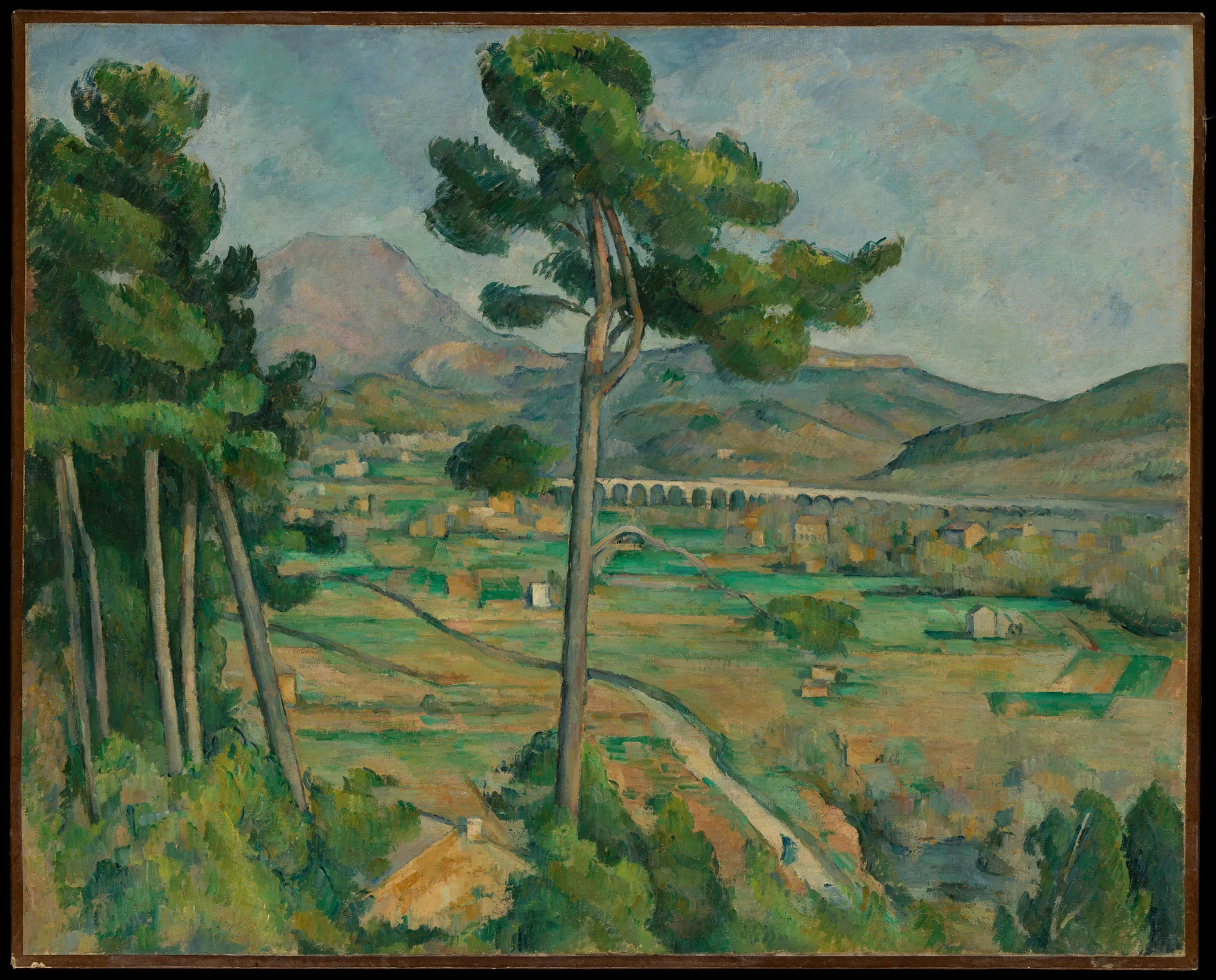
A pine trunk cuts through the centre of Mont Sainte-Victoire and the Viaduct of the Arc River Valley. It should obstruct the famous mountain. Instead it helps the painting cohere.
The trunk’s vertical pressure is balanced by the mountain’s sloping side, the angled road below, the hanging branch above, and the long horizontal viaduct. Houses, fields, trees, hills, and sky are not finished as separate objects and then placed into depth. Short strokes and colour intervals make them answer one another across the surface.
Cézanne knew this landscape near Aix-en-Provence from childhood. Between 1882 and 1890 he began sustained campaigns around Mont Sainte-Victoire. The Met’s object record locates this viewpoint near his sister’s property at Montbriand and identifies the arches in the valley as a railway viaduct. The painting therefore holds two kinds of time together. A modern transport structure crosses a landscape Cézanne also connected to the durable order of older art; the viaduct can resemble a Roman aqueduct in a painting by Nicolas Poussin.
This does not make Provence timeless. Railway engineering, property, roads, farms, and family access shaped the view. Cézanne did not discover an untouched nature beneath modernity. He made a modern landscape feel structurally continuous by aligning its parts.
His route to that structure passed through Impressionism. Cézanne exhibited three works in the first independent exhibition of 1874. Camille Pissarro encouraged him to paint outdoors and to lighten a palette that had been much darker and heavier. Cézanne retained broken, visible handling but slowed its effect. A stroke does not merely report the shimmer of light; it helps a volume turn, a plane advance, or one colour find its weight beside another.
Cézanne later spoke of making Impressionism “solid and durable, like the art of museums.” The phrase is often treated as a declaration of war on fleeting perception. In this canvas it works better as a problem. How can a painting remain responsive to changing colour while acquiring the internal necessity of something built?
Look at the mountain. It is not outlined uniformly or modelled into a smooth geological mass. Rose, blue, grey, and green make it hover between near and far. Yet its triangular pressure is repeated throughout the painting. Durability comes from relation, not from polishing away the brushstroke.
Cézanne: a still life that refuses one fixed eye
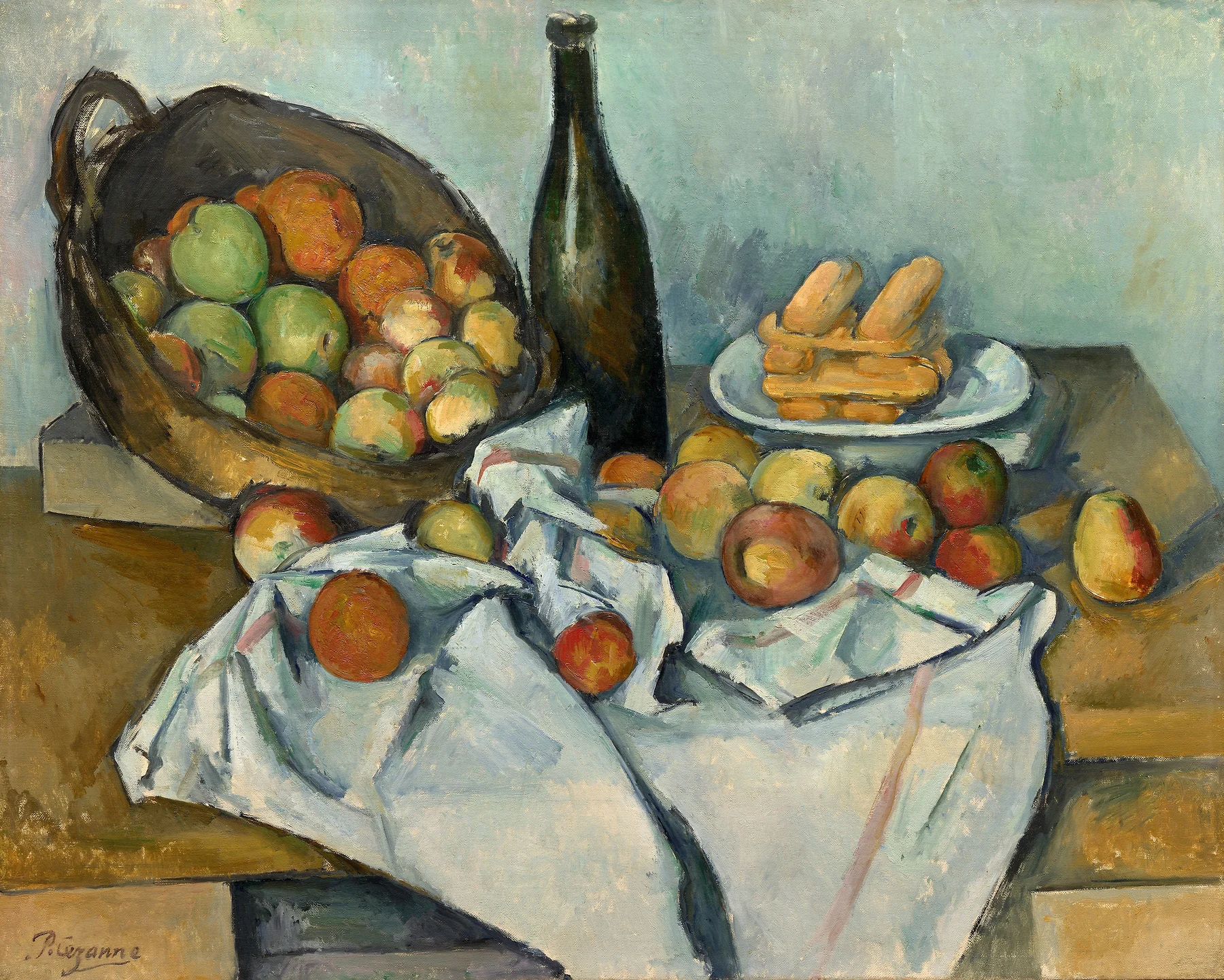

The table in The Basket of Apples cannot decide how to behave.
Its right edge tilts upward. The left edge falls away at another angle. We seem to look down into the plate of biscuits while meeting the bottle more nearly from the side. Some apples press forward; others settle into the dark basket, whose opening is visible beyond what a single fixed viewpoint would comfortably allow. A white cloth twists through the arrangement and hides the joins that conventional perspective would make consistent.
Calling this distortion is accurate but incomplete. The painting is not careless about structure. Cézanne adjusts each local relation so the entire field remains active. The bottle steadies the vertical centre. The basket’s dark arc answers the pale plate. Rounded fruit carries reds, greens, and yellows across the width. The cloth supplies a sequence of angled planes, interrupted by apples that stop the eye from sliding out of the picture.
Academic perspective could organise every object under one stationary viewer and one rational space. Photography made that model of a single optical instant increasingly familiar, although cameras did not cause Cézanne’s decisions. Here, looking unfolds through time. The painter attends to one cluster, changes position or emphasis, then makes the next relation work. The final canvas preserves adjustments rather than hiding them beneath a seamless illusion.
That does not mean Cézanne invented a scientific system of multiple viewpoints later handed intact to Cubism. Pablo Picasso and Georges Braque studied his work, but retrospective influence should not turn this still life into a diagram whose only purpose was to predict them. Its first achievement is present-tense: familiar things become difficult because seeing them is an activity rather than a photograph.
The painting also had an institutional life. Cézanne signed it, and the Art Institute records that it appeared in his first solo exhibition, organised in 1895 by the Paris dealer Ambroise Vollard. The show assembled roughly 150 works and brought sustained attention to an artist then in his mid-fifties. Cézanne’s supposed isolation was mediated by a dealer willing to rent a space, gather paintings, assume risk, and create a market encounter.
Post-Impressionist independence did not mean being alone. It required new routes between studio, exhibition, criticism, buyer, and museum.
Van Gogh: a self-portrait made through exchange
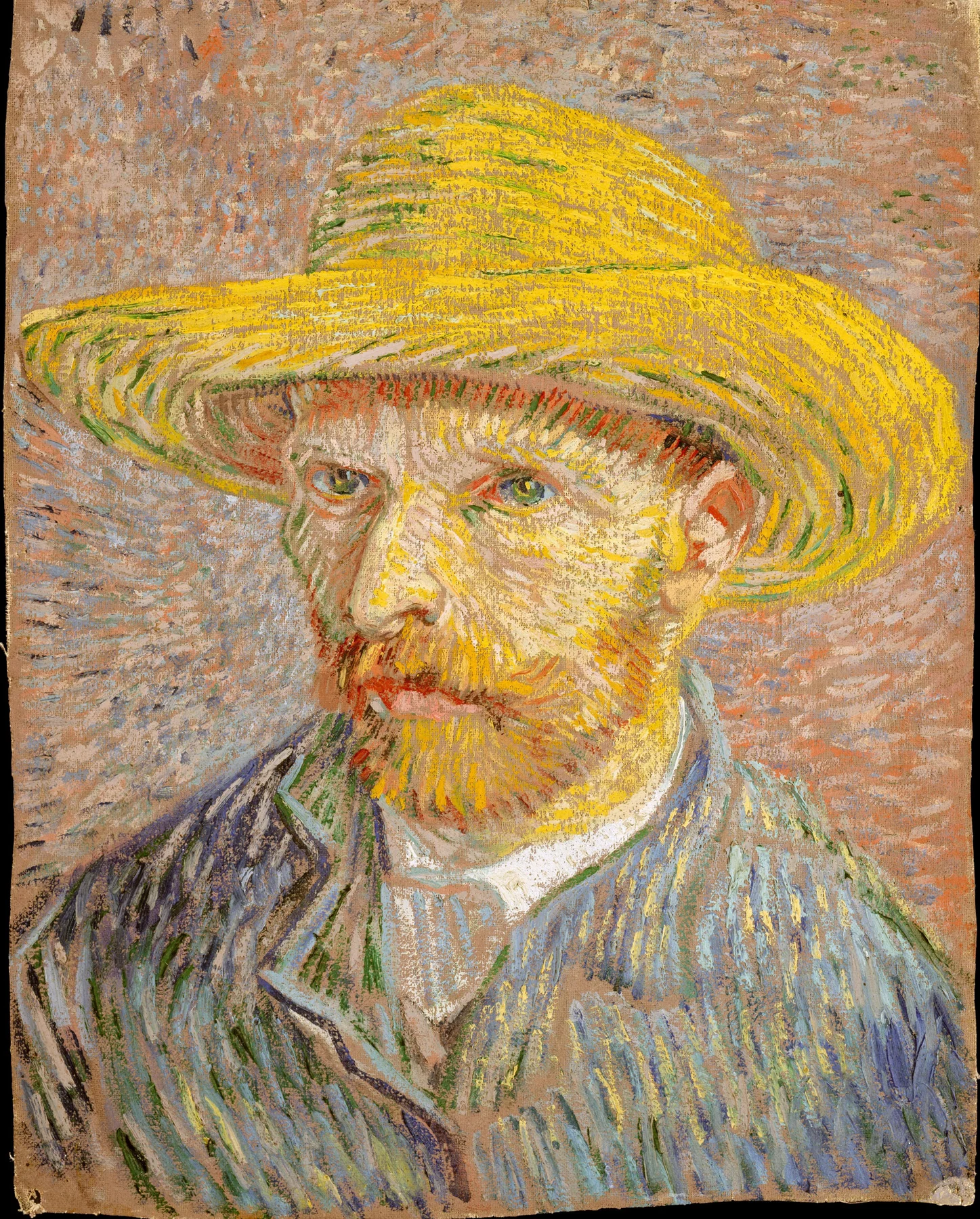
Van Gogh’s yellow hat is not filled with one yellow. Green and ochre lines bend around its crown; brighter strokes flare along the brim. On the face, red sits beside green, blue beside orange, cream beside violet. The jacket and background are built from similarly separated marks, so the whole surface participates in one vibrating system.
It is tempting to read every stroke as a direct trace of Van Gogh’s inner state. That approach turns biography into a shortcut and learning into solitary genius. The painting is better evidence of exchange.
Van Gogh arrived in Paris in 1886 with experience of dark Dutch peasant subjects and drawing. There he encountered paintings by the Impressionists and by younger artists including Seurat and Paul Signac. He saw brighter colour, broken touch, and contemporary debates about complementary contrast. The Met’s record for this portrait describes his awareness of Neo-Impressionist technique and colour theory. He did not copy Seurat’s dots. He varied the length, direction, density, and pressure of the mark until colour became a way to construct a face.
The object itself prevents a myth of effortless self-expression. Van Gogh painted more than twenty self-portraits during his Paris years partly because he could not afford a model. He practised on the person always available in the mirror. This portrait occupies the reverse of an earlier, dark-toned peasant study, The Potato Peeler. Canvas was valuable enough to use twice.
What looks like an autonomous modern identity therefore depended on economy, reuse, a mirror, a city of competing artists, Theo van Gogh’s support, pigment manufacture, exhibitions, dealers, and looking at other art. The self is made through materials and relationships.
The two sides also resist a neat conversion story. Dark Dutch realism was not simply discarded when Paris taught Van Gogh colour. The earlier worker remains physically present behind the brighter portrait. An object can hold consecutive artistic problems at once.
Van Gogh: observed nature organised as rhythm
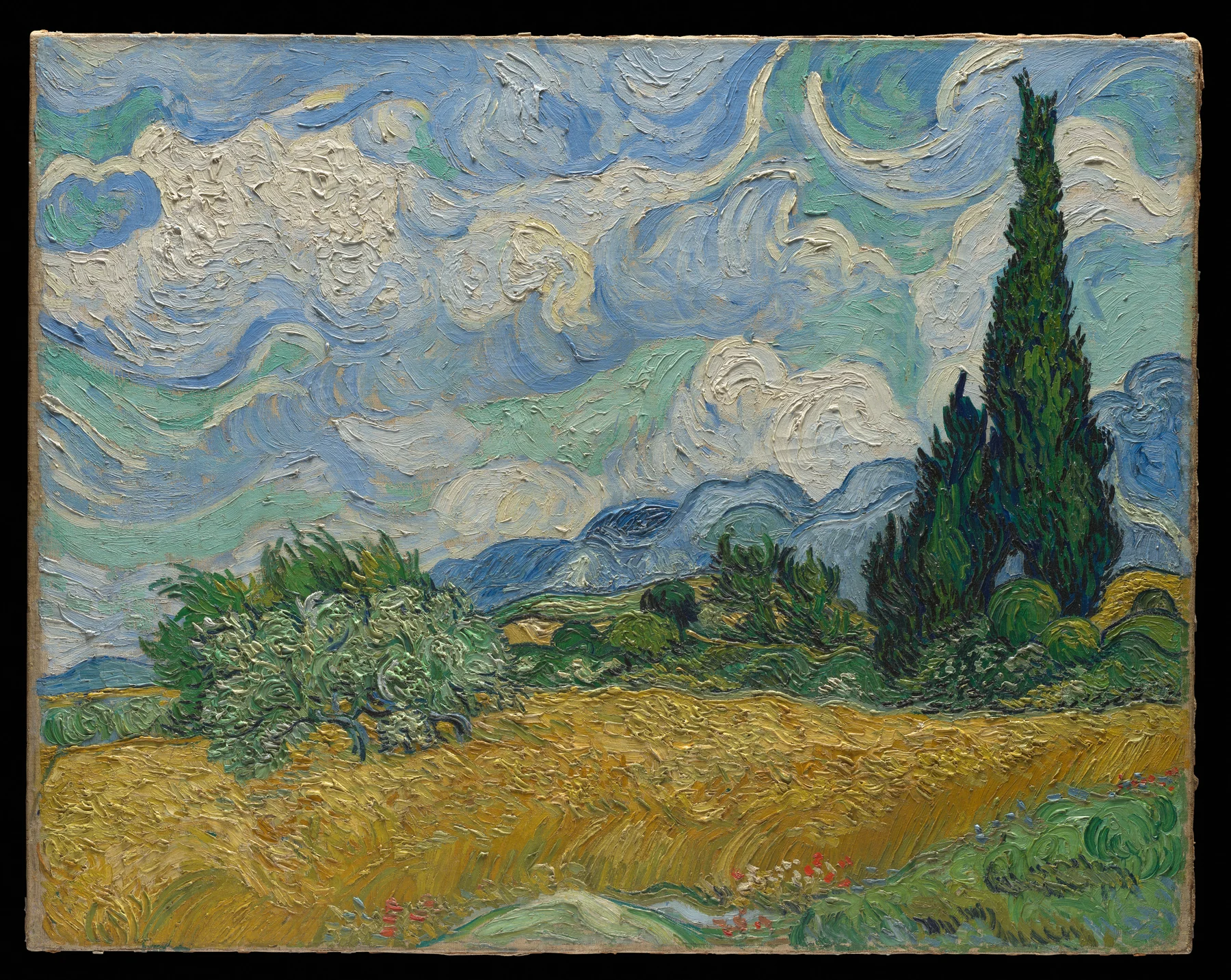
In Wheat Field with Cypresses, almost nothing is still. Wheat bends into ochre currents. Shrubs knot into green curls. Hills roll; clouds fold; the blue sky turns around white arcs. The dark cypress rises through these horizontal bands like a flame or an obelisk.
The canvas was painted at Saint-Rémy in June 1889. It is the initial on-site oil study, not one of the more controlled versions Van Gogh made in the studio that September. That distinction matters. Direct observation and deliberate construction were not enemies for him. He could work before nature, then repeat and reconsider a composition later.
A letter to Theo dated 2 July 1889 gives unusually close primary evidence. Van Gogh described cypresses, wheat ears, poppies, a blue sky “like a multicoloured Scottish plaid,” and thick impasto. The comparison directs attention to interlaced colour rather than to a diagnosis. The painting’s energy is designed through repeated directional decisions: short diagonal wheat marks below, denser turning strokes in shrubs, long loops in cloud, and the cypress’s compressed verticals.
Van Gogh’s health and his stay at the asylum belong to the work’s circumstances. They do not explain the formal choices by themselves. Illness does not mix pigments, choose scale, study a motif, compare versions, or write precisely about colour. Treating visible intensity as automatic evidence of mental crisis replaces the painting with a stereotype.
His understanding of southern France was also shaped by Japanese prints. Van Gogh and Theo collected hundreds of them in Paris. In an 1888 letter to Émile Bernard, Vincent compared Provence’s clear atmosphere and strong colour effects to Japan. The comparison was productive and unequal: he learned from real Japanese printed images but also imagined “Japan” through European collecting, commerce, and fantasy. Japanese artists did not form one timeless style waiting to renew France.
In the wheat field, high horizon, compressed depth, strong contours, and patterned colour can be considered beside that print culture. They also belong to Van Gogh’s study of contemporary French painting, older European artists, direct landscape work, and his own repetitions. Influence is a route with selection and misunderstanding, not a magical transfer of essence.
The result is neither raw nature nor raw emotion. It is observed nature made rhythmically legible.
Seurat: a Sunday built over two years
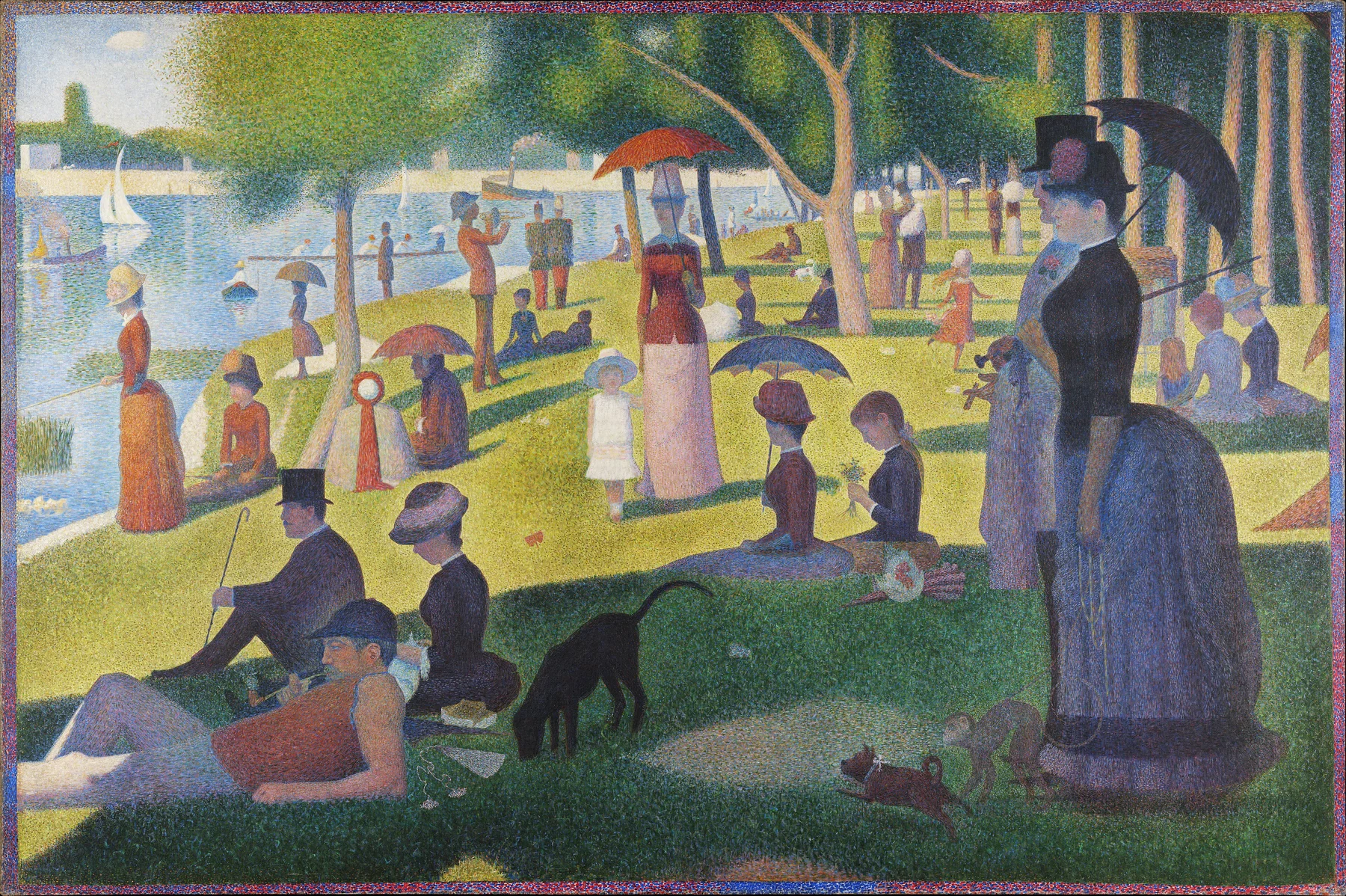
Seurat made dozens of drawings and oil studies for A Sunday on La Grande Jatte—1884. Some isolate figures; others test the distribution of light and bodies. His final painted study at the Met uses small, patchy, often criss-crossed strokes. On the monumental canvas, the touch becomes tighter and more regular.
The distinction clarifies two terms often confused. Divisionism names the principle of separating colour into adjacent touches so that relationships are produced partly in the viewer’s perception. Pointillism describes the dot-like appearance of much Neo-Impressionist handling. Seurat preferred the first because it named a colour method rather than a brush shape.
The method drew on nineteenth-century writings about colour and perception, including work associated with Michel Eugène Chevreul, Ogden Rood, and Charles Henry. In 1886 the critic Félix Fénéon coined Neo-Impressionism for the new practice. Its supporters could present it as more disciplined or “scientific” than Impressionist spontaneity.
Quotation marks matter around that last word. Seurat’s painting engaged contemporary colour theories; it does not prove a modern laboratory law that dots objectively blend into the one correct colour. Adjacent pigments can heighten contrast, pulse, or mix at different viewing distances, but perception depends on scale, light, eyesight, surface, and the actual materials that age on the canvas.
The picture’s social order is as deliberate as its colour. Visitors from different classes share a commercial leisure landscape on an island northwest of central Paris. Boats and factories appear across the river; dresses, hats, umbrellas, canes, pets, and posture distinguish bodies. The large fashionable couple at right brings a monkey on a leash. A woman fishes at the left. Soldiers, workers, children, nurses, and bourgeois visitors have been proposed among the crowd, although costume does not make every identity certain.
Seurat monumentalised this mixed public at more than three metres wide. The figures barely interact. Many appear in profile or frontal stillness, like a modern frieze. Leisure becomes a choreography of distance: many people occupy the same place without forming one shared experience.
When the canvas debuted at the eighth and final Impressionist exhibition in 1886, its deliberate finish and optical programme challenged the group’s already unstable identity. Seurat later surrounded the scene with a painted border whose colour changes beside the colours at each edge. He intended a specially designed white frame beyond it. Display was not neutral packaging; it completed the experiment.
Material change has since altered the experiment. Art Institute conservation research found that unstable zinc yellow darkened relatively soon. Some yellows, oranges, and greens now appear duller and browner than Seurat intended. The current surface remains the historical object, but it is not a transparent window onto 1886. “Optical mixture” has a chemical history.
Three answers to one pictorial problem
Once Impressionism made changing perception and modern experience public problems, what could make a painting hold together when the fleeting impression no longer seemed enough?
| Painter | Source of order | What the mark does | Time in the work | Main risk in interpretation |
|---|---|---|---|---|
| Cézanne | Relations among colour planes, volumes, intervals, and repeated directions | Builds weight without sealing the surface | Looking accumulates through adjustment | Treating every instability only as a forecast of Cubism |
| Van Gogh | Directional rhythm, complementary contrast, repetition, and material pressure | Carries movement and chosen intensity | Observation can be followed by memory and repetition | Turning every formal decision into a symptom |
| Seurat | Divided colour, preparatory study, scale, and measured placement | Separates hues so proximity and distance activate them | Many studies and revisions construct one public afternoon | Calling the method “scientific” as if history had proved it correct |
These are not stages in which Seurat perfects Impressionist colour, Van Gogh adds emotion, and Cézanne delivers geometry to Cubism. The works overlap in date and problem. Their artists borrowed, disagreed, repeated, and changed. Each answer also contains tensions: Cézanne’s stability depends on visible adjustment; Van Gogh’s intensity depends on disciplined learning; Seurat’s system produces a scene full of social ambiguity.
Colour theory promised control, but paint kept its history
All three painters made colour structural, but colour never became immaterial thought.
Industrial manufacture expanded the pigments artists could buy. Dealers sold prepared paint in tubes; transport networks moved artists and supplies; illustrated books and prints carried theories and examples. Complementary contrast offered a language for why red might intensify green or orange activate blue. None of these conditions prescribed one style.
Cézanne often used colour shifts to turn form without relying on smooth light-to-dark modelling. Van Gogh pushed contrast and directional touch into conspicuous rhythms. Seurat regularised adjacency and asked viewing distance to participate. The difference lies less in who understood colour “best” than in what kind of order each expected it to produce.
The paintings also remind us that colour theories are tested in fallible matter. Pigments fade, darken, react, crack, and acquire varnish or dirt. Canvas tension changes; frames alter neighbouring colour; photographic reproductions flatten texture and are calibrated differently from screen to screen. The WebP images in this chapter can support comparison, not replace the objects.
Science belongs here as historical ambition, technical inquiry, and conservation method. It should not be used as a certificate declaring one painting objectively advanced.
Independence was an institutional achievement
The heroic story says that radical artists reject the establishment, work alone, and are recognised after society catches up. These five objects show a denser system.
Seurat co-founded the Société des Artistes Indépendants in 1884 after Bathers at Asnières was rejected by the Salon. Its exhibitions offered a route without a jury or prizes, while also generating new debates, rivalries, and exclusions. The 1886 Impressionist exhibition gave Grande Jatte a charged public setting. Critics such as Fénéon supplied language that helped strangers perceive a movement.
Cézanne’s 1895 Vollard exhibition changed the visibility and circulation of decades of work. Van Gogh depended materially and emotionally on Theo, who worked inside the art trade and preserved, exhibited, and discussed the paintings. After Vincent and Theo died, Johanna van Gogh-Bonger organised loans, sales, exhibitions, and publication of the letters, work fundamental to Van Gogh’s reputation.
Fry’s 1910 exhibition then assembled differences under a new retrospective category. London’s public encountered the works through selection, wall placement, catalogue language, and controversy. In 1929 the Museum of Modern Art opened its first exhibition around Cézanne, Gauguin, Seurat, and Van Gogh, helping turn a loose historical field into a canonical prehistory of modernism.
Independence changed the institutions around art; it did not eliminate institutions. Cooperative exhibitions, critics, family labour, dealers, collectors, photographers, conservators, publishers, and museums all shaped what became visible and valuable.
What the plural leaves outside the frame
Cézanne, Van Gogh, and Seurat cannot stand for the whole field after Impressionism.
Paul Gauguin, Émile Bernard, Louis Anquetin, Henri de Toulouse-Lautrec, Paul Signac, Camille Pissarro, Odilon Redon, and many others produced different answers. Women artists were not absent from modern painting after 1886, but museum narratives and market canons often made them harder to see. Suzanne Valadon, Anna Boch, and others require more than a compensatory name in a list.
Gauguin especially cannot be folded into this chapter as merely a fourth colour system. His work in Brittany and Polynesia raises questions about Synthetism, religion, sexual power, colonial rule, primitivism, mobility, and the unequal authority to represent another culture. Those histories deserve a focused account rather than a decorative detour.
This selection is therefore bounded, not complete. It follows three artists with substantial GeMarkt collection routes and asks one comparative question across five objects in France from 1882 to about 1893. It does not claim that Paris generated modern art alone, that influence flowed only outward from Europe, or that the artists excluded were secondary.
The plural is useful only if it keeps the map open.
A compact timeline
- 1874: Cézanne participates in the first independent exhibition in Paris.
- 1877: The third exhibition publicly adopts “Impressionists” in its title; Cézanne participates for the last time.
- 1882–85: Cézanne paints Mont Sainte-Victoire and the Viaduct of the Arc River Valley.
- 1884: Seurat helps establish the Société des Artistes Indépendants and begins studies for Grande Jatte.
- 1886: The eighth and final Impressionist exhibition includes Grande Jatte; Van Gogh arrives in Paris; Fénéon coins “Neo-Impressionism.”
- 1887: Van Gogh paints Self-Portrait with a Straw Hat on the back of an earlier peasant study.
- 1888–89: Seurat adds a painted border to Grande Jatte.
- 1889: Van Gogh paints the first oil version of Wheat Field with Cypresses at Saint-Rémy, then makes later studio repetitions.
- About 1893: Cézanne paints The Basket of Apples.
- 1895: Vollard mounts Cézanne’s first solo exhibition in Paris.
- 1910: Fry’s London exhibition coins “Post-Impressionists” retrospectively.
- 1929: MoMA’s inaugural exhibition places Cézanne, Gauguin, Seurat, and Van Gogh at the opening of its modern canon.
Key terms
- Post-Impressionism: A retrospective umbrella term coined in 1910, useful for related departures from Impressionism but not the name of one artist-led movement.
- Neo-Impressionism: The contemporary term Fénéon introduced in 1886 for Seurat, Signac, and related painters who pursued divided colour and a more systematic practice.
- Divisionism: The separation of colour into adjacent touches intended to interact perceptually rather than being fully mixed on the palette.
- Pointillism: A description of dot-like application; narrower than Divisionism and initially often used critically.
- Impasto: Paint applied thickly enough for ridges and directional handling to remain physically visible.
- Constructive stroke: A later critical description for Cézanne’s repeated, often parallel touches that help build relations among planes and volumes.
- Optical mixture: The perceptual interaction of adjacent colours at a viewing distance; not a guarantee that all viewers see one identical blend.
- Repetition: A new version of an existing composition, which may change handling, scale, colour, or degree of finish rather than mechanically duplicate it.
Ten questions for close looking
- Which part of the painting first appears stable, and what makes it less stable on a second look?
- Does colour describe local objects, connect distant areas, or both?
- How does the direction of a brushstroke change the sense of surface or movement?
- Where does the painting ask you to stand: close enough to see marks, far enough to see forms, or moving between both?
- Which edges are drawn, built through colour contrast, left open, or revised?
- Does space assume one fixed viewpoint, or does looking seem to accumulate across time?
- What evidence distinguishes an on-site study, a studio repetition, and a finished exhibition work?
- Which people, materials, institutions, and transport systems made the apparently independent picture possible?
- What might pigment change, conservation, framing, photography, or screen display have altered in your encounter?
- Which historical claim comes from the object, which from a primary document, and which from later interpretation?
Five shortcuts to refuse
“Post-Impressionism was one movement after Impressionism”
The term was coined retrospectively in 1910. Use it to compare different responses, not to erase their conflicts.
“Cézanne abandoned perception for pure geometry”
His order emerges through prolonged looking, colour, adjustment, and material touch. Geometry is an effect of relations, not a complete formula imposed from outside.
“Van Gogh’s brushwork is a medical record”
His health matters historically, but formal decisions require evidence from paintings, letters, materials, training, and exchange. Diagnosis cannot substitute for looking.
“Seurat proved the science of colour”
He worked with contemporary theories and systematic ambition. The canvas remains an artistic construction made from pigments whose chemistry and appearance changed.
“These men independently invented modern art”
Their work depended on peers, family, Japanese print culture, older art, dealers, critics, workers, exhibitions, collectors, and later museums. Modernism was networked and unequal.
Source guide
This chapter prioritises museum object files, primary documents, technical study, and institutionally maintained research:
- The National Gallery, Met, and MoMA explain the late naming and limits of “Post-Impressionism.”
- The Met’s object files document Cézanne’s Mont Sainte-Victoire, Van Gogh’s double-sided self-portrait and Wheat Field with Cypresses, and Seurat’s final painted study.
- The Art Institute’s records document Cézanne’s The Basket of Apples and Seurat’s A Sunday on La Grande Jatte—1884, including object dates, dimensions, display history, and public-domain status.
- The Van Gogh Letters edition identifies manuscript status, dates, translations, notes, and related works. Letters 587, 620, and 784 support the discussion of Japanese prints, southern colour, and the cypress composition.
- The Met’s Neo-Impressionism essay distinguishes the historical movement, Divisionist colour, and its theoretical sources.
- Art Institute technical research in Conservation at the Art Institute of Chicago documents Seurat’s pigments and the darkening of zinc yellow. Conservation evidence supports a history of material change; it does not reconstruct one perfectly recoverable original appearance.
- The Art Institute’s archived Seurat and the Making of La Grande Jatte research records approximately forty-five related works in its 2004 exhibition; the Met’s Vollard exhibition history documents the dealer’s 1895 Cézanne retrospective and its financial risk.
- A Van Gogh Museum research article traces Jo van Gogh-Bonger’s strategic loans, exhibitions, and sales; MoMA’s archive documents its November 1929 inaugural exhibition.
Object records can be revised as research develops. Dates such as “about 1893” identify scholarly judgement, not missing precision that a confident writer should invent.
Continue through the collections
The most useful next step is comparison, not choosing a single winner. Follow the Cézanne collection to test how colour planes behave across landscape and still life. Use the Van Gogh collection to compare Parisian broken touch with later directional rhythms. Move through the Seurat collection to see how studies, dots, artificial light, coast, and commercial spectacle put pressure on the idea of one fixed method.
These collection routes support the chapter, but the argument does not depend on a purchase. The five open-access object records above are enough to begin a rigorous comparison.
Post-Impressionism becomes clearer when the singular breaks apart. Cézanne, Van Gogh, and Seurat inherited no finished future from Impressionism. Each rebuilt painting’s order—and each left a different problem for the artists, institutions, and viewers who followed.
Editorial record
About this article
- Author
- Publisher
- GeMarkt
- Published
- Updated
- Reviewed
- Internal source & rights check. Conducted by GeMarkt Research Review. This is an internal editorial check—not independent peer review.
- Source standard
- Art history source standardPrioritises object records and research sources, distinguishes evidence from interpretation, and states material uncertainty.
Found a claim that needs checking? Report a factual error.