Art History · Learning chapter
Methods · 6 of 6
How to cite art and images: captions, editions, rights, and digital files
A practical method for identifying artworks, editions, pages, and digital files while keeping captions, citations, credits, rights, and alt text distinct.

What we’ll look at
How do you identify an artwork and the exact image file you used?
The print at the top of this chapter has a familiar title, a famous maker, and a date. That is enough to begin looking. It is not enough to identify what you are looking at.
Rembrandt revised the copper plate from which The Hundred Guilder Print was pulled. More than one impression survives. Each sheet has its own paper, inking, condition, margins, ownership history, and accession number. The photograph on this page is not the copper plate, the design in the abstract, or every surviving impression. It is a digital representation supplied by a particular museum of one physical impression catalogued as the second of two states.
Art writing becomes unreliable when those layers collapse. A caption names the painting but not the file. A bibliography cites a book but not the page illustrated. “Public domain” appears without saying who made that determination or which image it covers. Pixel dimensions replace physical dimensions. An image search result stands in for a collection record. Alt text becomes a cramped copyright notice and stops describing what the image contributes.
This chapter treats citation as object care in words. The task is not to make every caption enormous. It is to know which identities and permissions must remain recoverable, then distribute them clearly across the caption, notes, bibliography, alt text, and production record.
A caption is not a citation
A caption helps a reader identify and interpret what is displayed. A citation lets a reader locate the evidence you consulted. A credit line acknowledges a maker, owner, donor, photographer, or provider in the form requested by a source. A rights statement or licence notice communicates what the provider says about reuse. Alt text gives a text alternative suited to the image’s purpose on that page.
One line can sometimes perform several of these jobs. The jobs do not become identical.
Consider “Rembrandt, The Hundred Guilder Print, 1648, The Met.” It is a compact label, but it leaves open:
- which impression and state;
- the physical medium and dimensions;
- the accession number;
- whether the researcher saw the sheet in person or an online record;
- which digital file was reproduced;
- what reuse terms apply;
- whether the image was cropped or altered.
Not every context needs every field on the page. A museum wall label, a seminar slide, a dissertation figure list, an online lesson, and a commercial book have different space and risk. The underlying production record should still preserve the answer.
Name the five layers before you write
Begin by separating five related entities.
| Layer | Example | Best identity anchors |
|---|---|---|
| Intellectual work or design | Rembrandt’s composition commonly called The Hundred Guilder Print | creator, title, work date, catalogue raisonné number when relevant |
| Physical object or component | one impression of the second state | medium, state, sheet or plate size, accession number, holding institution |
| Descriptive record | the Met’s current online catalogue entry | institution, stable object URL, access date when the record is mutable |
| Digital representation | the downloaded JPEG and this site’s WebP derivative | source file URL or manifest, pixel dimensions, download date, checksum in production records |
| Rights and responsibility statement | the Met’s Public Domain and Open Access (CC0) designation | exact statement, linked licence or policy, provider, verification date |
The Getty’s Categories for the Description of Works of Art similarly distinguishes a cultural work from related visual documentation. Its core fields are designed to identify a work unambiguously, while a separate image record can identify the photograph, scan, slide, or other surrogate.
This is not bureaucratic excess. A painting may be public domain while a newly commissioned installation photograph is copyrighted. A book may have several editions while a scan shows one copy of one edition. A print’s title may remain constant while the plate changes between states. A digital file may be colour-corrected or cropped after leaving the archive.
If a claim concerns one layer, cite that layer. Do not ask the title of the underlying artwork to identify every file made from it.
Start with the exact object
Use the holding institution’s accession number or another persistent local identifier before relying on title text. Titles are translated, shortened, modernised, reassigned, and repeated. Accession numbers are not infallible, but they are designed to distinguish records within a collection.
Copy these fields into your notes:
- creator or culture as the institution currently states it;
- exact title and any former or translated title relevant to your argument;
- object date, including qualifiers such as “about,” “before,” or a range;
- object type, medium, and technique;
- dimensions with the measured extent named;
- state, edition, impression, proof, folio side, volume, or part where relevant;
- institution, collection, credit line, and accession number;
- stable object URL or persistent identifier;
- current rights or reuse statement for the supplied image;
- the date you checked a record likely to change.
Transcribe uncertainty instead of polishing it away. “Attributed to,” “workshop of,” “probably,” and “second state of two” are part of the identity. They are not editorial clutter.
A minimum artwork caption
For a unique object reproduced in an academic or editorial context, a useful starting pattern is:
Creator or culture, Title, date. Medium; physical dimensions. Holding institution, accession number. Image provider and rights statement.
Adapt it to the object. A building needs place and construction phases. A performance needs performers, venue, and performance date. A print needs state and impression information if known. A manuscript leaf needs folio side and parent manuscript. A photograph needs both photographic process and the identity of the physical print or negative.
The caption should not impersonate a full catalogue entry. Put lengthy provenance, catalogue raisonné references, photographer credits, file identifiers, licence links, and access dates in a figure list, note, bibliography, or image ledger when the publication’s format supports them.
What matters is recoverability. A reader should be able to move from the displayed figure to the exact record without guessing among similarly titled works.
Worked case: one print, one state, one impression
In brief: The first example is a specific paper impression of Rembrandt’s 1648 Hundred Guilder Print, now at the Met in New York. Because the copper plate exists in two states, the title alone does not identify the image.
The Met record for The Hundred Guilder Print identifies the object as an etching, engraving, and drypoint dated 1648. It calls this impression the second state of two, records a plate size of 28 by 39.3 centimetres, and assigns accession number 29.107.35.
Those details make a defensible caption possible:
Rembrandt van Rijn, The Hundred Guilder Print, 1648. Etching, engraving, and drypoint, second state of two; plate 28 × 39.3 cm. The Metropolitan Museum of Art, 29.107.35. Public Domain, Open Access (CC0).
The phrase “second state of two” does not mean “copy two of two.” It says the matrix was altered and this impression reflects the later of two recognised configurations in the cited state system. Nor does the plate measurement necessarily describe the sheet of paper, which may extend beyond the plate mark or have been trimmed.
If your argument concerns how Rembrandt changed the plate, title and date are insufficient. You need the state, the authority defining the state sequence, and ideally comparison with a documented impression of the other state. If your argument concerns this sheet’s condition or provenance, accession number and object-level evidence matter more than a generic reproduction found elsewhere.
Edition, state, impression, and proof
These terms describe different relationships among multiples.
- A matrix is the plate, block, stone, screen, or other surface from which an image is printed.
- A state records a recognised stage after the matrix has been deliberately altered. The Getty’s state guidance stresses that state helps distinguish otherwise similar prints.
- An impression is one printed object pulled from a matrix. Two impressions of one state can differ through ink, wiping, paper, pressure, wear, hand colouring, later intervention, and condition.
- An edition is a defined issue or set of closely related multiples. A numbered modern print marked 4/75 identifies one impression within an edition of 75, but the fraction does not by itself prove the printing sequence.
- A proof is an impression made for testing, review, or a special stage rather than simply another synonym for a print. Terms such as artist’s proof and printer’s proof need contextual evidence.
The Getty’s edition category also warns that “edition” works differently for books: a new book edition normally involves substantive revision, not merely another copy coming off the press.
Do not infer a state or proof from appearance alone. Copy the catalogue statement, name the authority when the argument depends on it, and preserve disagreement between catalogues.
Cite the record you actually consulted
If you saw an artwork in a gallery, you can cite that encounter and still consult the online record. If you used a museum’s online image and metadata, cite the online record. If you found the object through Wikimedia but downloaded the museum’s Open Access file, record both discovery and actual source only if both affected your work.
Do not cite a famous book you have not read because a museum bibliography lists it. Do not cite the museum homepage when an object page exists. Do not cite a raw image URL alone when a descriptive landing page explains its identity and rights.
The MLA Style Center’s current image guidance begins with creator, title, date, and location, then adds the website and URL for an online view. Other styles order and punctuate those elements differently. The ethical rule beneath the style is stable: identify the thing and the route by which you encountered it.
For a mutable catalogue page, an access date can document when you observed an attribution, title, or rights statement. An archived snapshot may help a long project, but it does not replace checking the live record before publication.
Credit line, source line, and rights line
A museum credit line often records acquisition history: gift, purchase fund, bequest, donor, or collection. It may be important to reproduce exactly, especially when the provider requests it. It is not automatically the identity of the photographer or the licence.
A source line tells readers where the reproduced image or information came from. A rights line tells them what the provider states about copyright or reuse. A licence may require an attribution in a particular form. These lines can sit together, but each needs a clear referent.
Creative Commons recommends the practical TASL pattern—title, author, source, licence—for CC-licensed material. Its reuse guidance also notes that CC0 imposes no attribution condition, while source credit remains good scholarly practice.
Avoid “Photo: Creative Commons.” Creative Commons supplies legal tools; it is usually not the photographer, archive, or source. Avoid “Courtesy of” unless the institution actually supplied the image on those terms. Courtesy can imply permission or a relationship that does not exist.
Public domain is not a file-permission shortcut
“Public domain” normally describes copyright status in a work, but real image reuse can involve several layers: the underlying artwork, the photograph or scan, database terms, trademarks, privacy or publicity, cultural protocols, contractual access conditions, and the law of the place where reuse occurs.
This chapter is a research method, not legal advice. Do not convert one institution’s statement into a universal ruling.
The Met’s Open Access policy says that images it designates for public-domain works are made available under CC0. That specific policy supports use of the three files in this chapter. Another museum may mark the same underlying work differently, supply only a thumbnail, require a credit, or say that rights have not been evaluated.
RightsStatements.org distinguishes “No Known Copyright” from a conclusive public-domain declaration and from situations where copyright status is undetermined. Those labels communicate an institution’s assessment; they are not licences issued by RightsStatements.org and should not be rewritten as broader permission.
Record the exact wording, provider, link, and date checked. If the statement is unclear, the work is recent, the use is high-risk, or a restriction conflicts with your plan, pause for qualified advice or a permissions decision.
Case two: a page is not a whole book
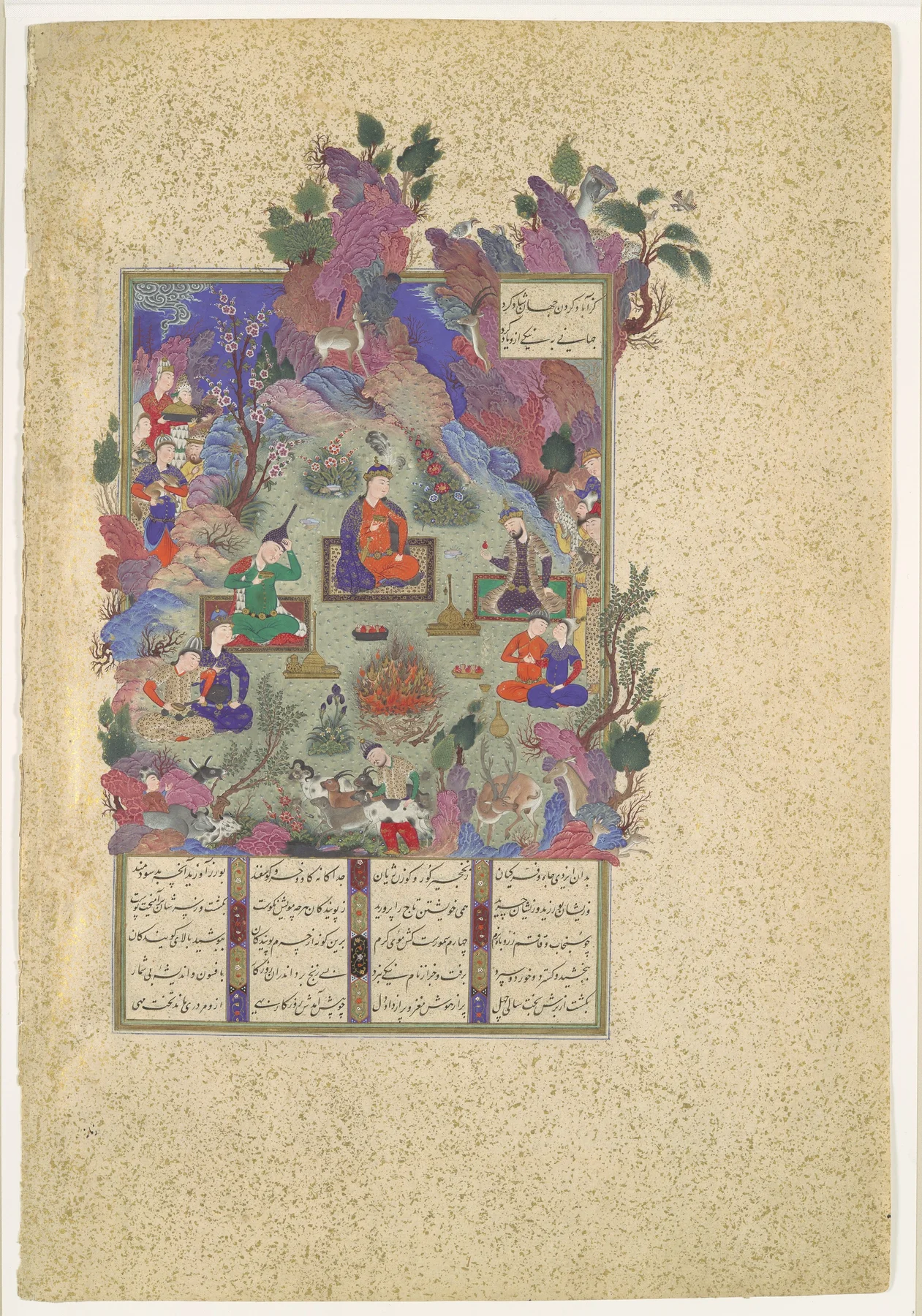
The image above is not “an image from the Shahnama” in a generic sense. The Met record identifies it as The Feast of Sada, folio 22v from the Shahnama made for Shah Tahmasp, painted around 1525 and attributed to Sultan Muhammad. The text is Firdausi’s, but that does not make Firdausi the painter.
The museum distinguishes the painted area—24.1 by 23 centimetres—from the full page—47 by 31.8 centimetres—and from the modern mat. Those measurements answer different questions. A crop containing only the painted scene would conceal the text block, margins, page structure, and evidence that the image belongs to a manuscript leaf.
The accession number identifies this separated folio in the Met. The manuscript title identifies the larger codex from which it came. A research caption needs both because the argument may concern either the individual page or the dispersed book.
Folio, recto, verso, volume, plate, and page
A leaf has two sides. Recto is conventionally the front and verso the back, abbreviated r and v. “22v” therefore means the verso of folio 22, not page 22 of a modern edition. Printed books may instead number pages, leaves, columns, plates, gatherings, or volumes.
Always follow the source’s system. Do not silently convert folio 22v to page 44, because blank leaves, inserted material, later numbering, or cataloguing conventions may break the arithmetic. Preserve Roman numerals, supplied brackets, and plate numbers where they help locate the cited image.
For an illustrated book, record at least:
- author, editor, translator, artist, engraver, printer, and publisher only in the roles relevant to your claim;
- full book or manuscript title;
- edition, volume, and publication or production details;
- page, folio side, plate, or figure number;
- the specific copy, repository, shelfmark, or accession number when copy-level evidence matters;
- the digital collection or scan used, with its stable URL and rights statement.
A digitised page may show marginal notes, damage, colour, or binding evidence unique to one copy. Citing only the abstract book edition would erase the very evidence you analysed.
Case three: the photograph is also an object
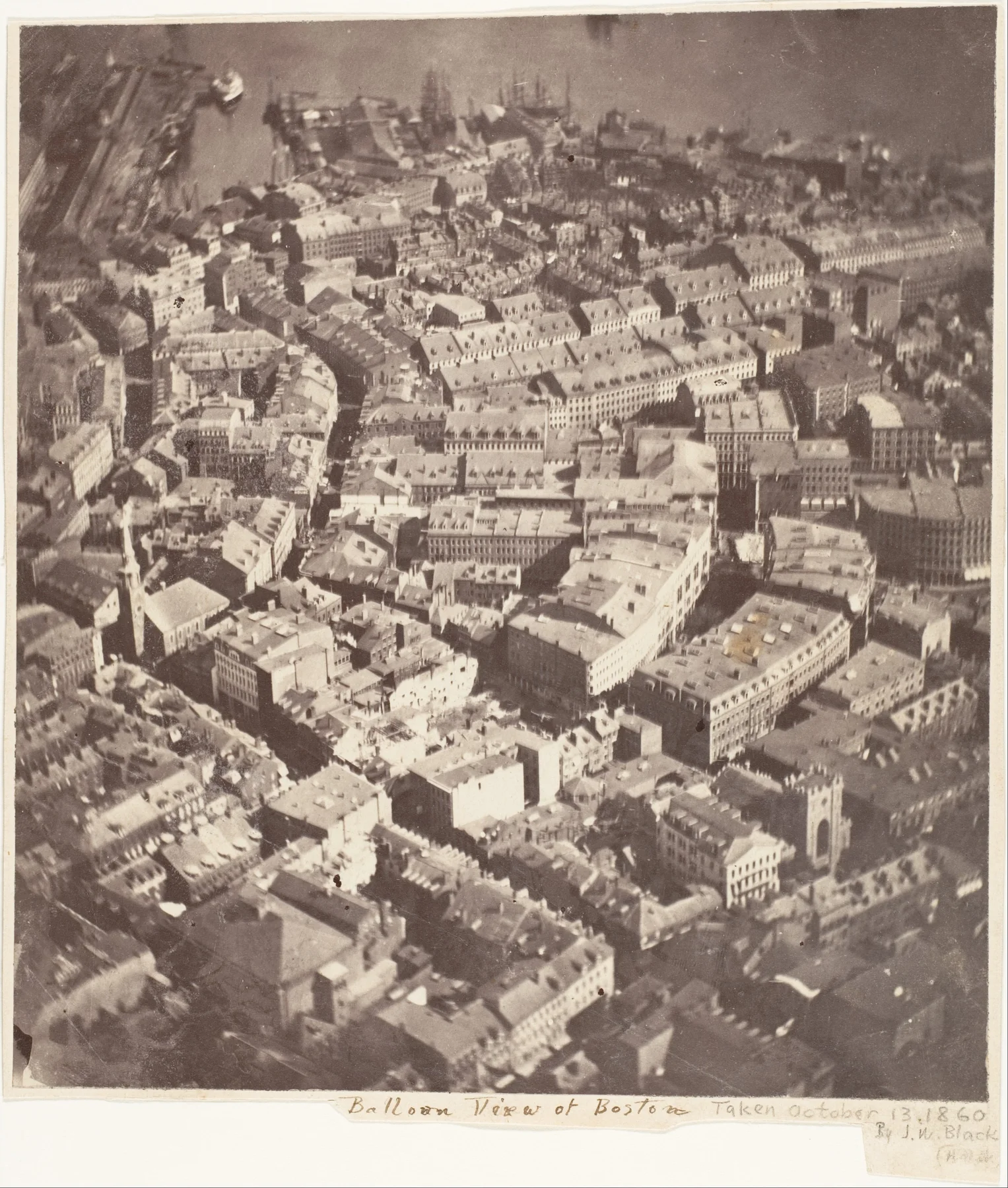
James Wallace Black’s photograph depicts Boston, but Boston is not its medium. The Met record identifies a particular albumen silver print made from a glass negative in 1860. It gives separate measurements for the irregularly trimmed image and mount and assigns accession number 2005.100.87.
A caption such as “Boston, 1860” reduces a photographic object to subject matter. It hides maker, process, viewpoint, material history, and the difference between negative and print. “Aerial view from a balloon” is a valuable description, not a substitute for object identity.
Photographs frequently require at least two descriptive sentences in your notes:
- what the photograph depicts and from what position;
- what photographic object or file you examined.
The first supports iconographic, spatial, or historical analysis. The second supports claims about cropping, tonal range, inscriptions, process, condition, and circulation.
Digital files have their own identity
A JPEG, TIFF, PNG, WebP, PDF page, or IIIF-delivered region is a technical object with its own history. Record enough to reproduce your production decision:
- provider and descriptive landing page;
- direct file or IIIF service identifier when stable and useful;
- original filename if supplied;
- file format and pixel dimensions;
- date downloaded;
- rights or licence statement checked on that date;
- checksum for high-integrity workflows;
- transformations made after download.
The public caption rarely needs a checksum. The private or institutional ledger may. A checksum lets an editor confirm that the reviewed file is the file eventually published, even after filenames change.
Do not use a search-engine thumbnail as the source file. Search results may resize, recompress, cache, strip metadata, mislabel, or link to a page that has changed. Move from discovery to the provider’s object record and download mechanism.
Crop, colour, restoration, and derivatives
Every edit should be described in relation to the original file and permitted by the applicable terms.
Useful production notes include:
- “cropped to the plate mark”;
- “detail from upper-right quadrant”;
- “rotated 90 degrees clockwise for comparison”;
- “background removed”;
- “contrast increased for legibility”;
- “colour composite from infrared and visible-light images”;
- “annotations added by the author.”
A mechanical resize and format conversion may not need space in a reader-facing caption, but they belong in a reproducible workflow. A crop that changes what the reader can see should be disclosed near the figure. A reconstruction, recolouring, or composited technical image needs a fuller method note.
Do not call a digitally cleaned image “restored” unless a qualified conservation or digital-restoration process supports that term. Do not erase a mount, inscription, ruler, colour target, page edge, or damaged area if your argument depends on object history. The apparent clutter may be evidence.
Creative Commons licences differ on adaptation, commercial use, and share-alike obligations. Check the exact version and deed; “CC” alone is not a permission category.
Physical size and pixel size answer different questions
Physical dimensions tell us about the object: scale, handling, display, manufacture, relation to a body, or the extent of a plate, sheet, image, mount, frame, page, text block, or support. Pixel dimensions tell us about a digital representation: how many picture elements it contains before display scaling or further processing.
The Getty measurement guidance recommends naming the extent measured because a print can have both plate and sheet dimensions and a manuscript can have volume, page, and text-block dimensions. Its image-documentation guidance separately accommodates pixel measurements.
Never turn 1800 by 1292 pixels into a physical size without a declared resolution and output context. Never use the dimensions of a WebP derivative as if they described Rembrandt’s copper plate or paper impression.
For online publication, record intrinsic width and height so browsers can reserve layout space and reduce shifting. That is a production fact, not an art-historical measurement.
Stable identifiers and IIIF manifests
A stable object URL is preferable to a search result or temporary viewer address. Accession numbers, shelfmarks, catalogue numbers, DOIs, ARKs, Handles, and other persistent identifiers can remain useful when page design changes.
The IIIF Presentation API 3.0 offers a model for complex digital objects. A Manifest usually describes how to present one object such as a book, statue, or album. Canvases provide ordered views or time spans, such as pages, a sculpture’s sides, or a video’s duration. Content resources carry the images, audio, or video used to render those views.
An IIIF manifest can therefore preserve structure that a single JPEG loses. It may expose page order, multiple views, labels, attribution text, rights URIs, and links to descriptive metadata. The IIIF Image API can request a region, size, rotation, quality, and format from a compatible service.
Cite the manifest when your research depends on the compound object’s structure. Cite the specific canvas or image request when your argument depends on one view or crop. Preserve the human-readable object page as well; a machine-readable manifest is not automatically a complete scholarly catalogue.
Alt text is not a miniature catalogue
Alt text should convey the image’s purpose and essential visual information in context. It is not the place to hide a licence, accession number, keyword list, or full bibliographic citation.
The W3C Web Accessibility Initiative advises that an informative image’s text alternative communicate the meaning or content it contributes, which may differ from a literal inventory. Complex information may need a short alt text plus a visible long description or structured explanation.
For the Rembrandt image in this lesson, useful alt text names the central light around Christ and the groups gathering from differently worked dark and light zones because those features orient the visual argument. The caption supplies creator, title, medium, state, size, institution, and rights.
Write alt text after deciding why the image is present:
- If composition matters, describe the main spatial relationships.
- If technique matters, describe visible marks, surface, or contrast.
- If the image is a detail, say what part is shown.
- If adjacent prose already gives a full description, avoid needless repetition.
- If the image is decorative, use the appropriate empty alternative rather than forcing it into the reading order.
Accessibility and citation cooperate, but neither substitutes for the other.
Architecture, installations, and time-based media
Some works cannot be reduced to one portable object.
For architecture, identify building or site, architect or makers when known, place, construction phases, and the date and viewpoint of the photograph. A modern photograph of a medieval building is both evidence of the building and a dated view shaped by restoration, weather, access, lens, and framing.
For an installation, identify the work and the specific installation: exhibition or venue, city, dates, version, dimensions as installed, photographer, and image provider. If components change between venues, do not let one photograph stand for an invariant whole.
For performance, film, sound, and time-based media, identify work date separately from the performance, recording, screening, or file consulted. Add duration, version, performers, venue, recording date, timecode, and platform or archive as relevant. A still frame is a selection from a temporal work and should be labelled as such.
For site-specific and community-held cultural works, access and reuse may involve custodial or community protocols beyond ordinary image licensing. Record the authority supplying those instructions rather than translating them into a generic copyright label.
Citation styles change; evidence fields do not
MLA, Chicago, APA, Harvard, MHRA, and house styles differ in order, punctuation, italics, access dates, and note-bibliography structure. Follow the style assigned to the project. Do not let style software decide what the object is.
Build structured notes before formatting:
| Evidence field | Why it survives style changes |
|---|---|
| exact creator role and display name | prevents author, painter, photographer, and publisher from collapsing |
| title and title type | preserves institutional or translated wording |
| work date and object/copy date | distinguishes creation from later printing, casting, or publication |
| medium and measured extent | identifies the material object |
| state, edition, folio, volume, plate, version | locates the relevant manifestation or component |
| repository and accession/shelfmark | anchors the exact holding |
| source and persistent identifier | lets readers reach the consulted record |
| rights statement and licence URI | preserves provider’s reuse information |
| access/download date and transformations | documents mutable web and production history |
Once the fields are sound, formatting is mechanical. If fields are missing, immaculate punctuation will only make the uncertainty look authoritative.
Common citation failures
Citing Google Images or Pinterest. These are discovery routes, not reliable object or rights records. Follow the image to an accountable provider.
Naming the institution as the artist. A repository can hold, describe, digitise, or provide a work without having created it.
Writing “public domain” with no referent. Say whether the institution marks the artwork, the supplied image, or both, and link the policy or licence.
Using one title for all copies. Add accession, shelfmark, state, edition, impression, cast, or version when object-level difference matters.
Confusing image and sheet dimensions. Name the extent measured: plate, image, sheet, page, mount, frame, or overall.
Dropping qualifiers. “Attributed to,” “probably,” “after,” and date ranges transmit evidence status.
Citing the whole book for one scanned page. Add page, folio side, plate, copy, and scan source.
Putting rights text in alt. Keep source and rights visibly associated with the figure; let alt text serve access.
Hiding edits. Disclose crops, composites, annotations, colour changes, and reconstructions when they affect interpretation.
Treating a credit as permission. Attribution does not cure an unauthorised use, and permission does not remove the need for scholarly citation.
A reusable caption-and-rights ledger
Create one row per displayed image, not one row per named artwork.
| Field | Record |
|---|---|
| Figure ID | local stable label, such as fig-07 |
| Work identity | creator/culture, title, work date |
| Object identity | medium, state/edition/version/folio, physical dimensions |
| Holding identity | institution, collection, accession or shelfmark |
| Consulted record | stable landing-page URL and access date |
| Digital source | file or IIIF identifier, original filename, format, pixels |
| Rights | exact provider statement, licence/rights URI, verification date |
| Required credit | provider’s requested wording, if any |
| Transformations | crop, resize, colour, rotation, annotations, composite |
| Accessibility | purpose of image, alt text, long-description location if needed |
| Publication status | reviewed, permission pending, replace, or do not publish |
Keep evidence with the row: a saved rights page or timestamped note, correspondence, invoice or permission, and the reviewed file checksum where proportionate. Do not publish personal contact details or confidential licence terms in the public caption.
The ledger is not a legal verdict. It is an audit trail that exposes unanswered questions early enough to solve them.
Practice task: cite one work three ways
Choose one artwork with a credible institutional record and an image you may lawfully use. Produce three outputs.
1. Seminar slide
Write a two-line caption readable at presentation scale. Include creator, short title, date, repository, accession number, and a compact source/licence line.
2. Research paper
Write a figure caption plus a full note or bibliography entry in the assigned style. Add medium, dimensions, state/edition/version, stable URL, and access date where relevant.
3. Online lesson
Write the caption, source and rights line, purposeful alt text, intrinsic pixel dimensions, and a production ledger entry recording transformations.
Then exchange work with a peer. The reviewer should be able to find the exact object, exact record, stated reuse basis, and disclosed crop without asking you which version you meant.
If the outputs are identical, you probably have not adjusted for reader, medium, and function. If the underlying identity changes between them, the research record is unstable.
What a strong image note sounds like
Weak:
Rembrandt, Hundred Guilder Print. Google Images. Public domain.
Stronger:
Rembrandt van Rijn, The Hundred Guilder Print, 1648. Etching, engraving, and drypoint, second state of two; plate 28 × 39.3 cm. The Metropolitan Museum of Art, 29.107.35. Image downloaded from the Met’s object record, 9 August 2026; the institution designates the image Public Domain and Open Access under CC0. File converted from JPEG to WebP and resized proportionally; no crop or tonal adjustment.
The stronger note does not claim to solve copyright law everywhere. It reports the object identity, consulted record, provider’s statement, date, and production changes. Another editor can audit it.
In the published article, shorten the visible caption if needed while retaining the complete ledger. Concision should be the result of organised evidence, not missing evidence.
Terms for art and image citation
- Accession number: a repository’s local identifier for an accessioned object; useful with, not instead of, institution name.
- Canvas: in IIIF Presentation, a virtual frame representing one view or time span of an object.
- Caption: reader-facing identification or explanation associated with a figure.
- Credit line: requested or institutional acknowledgement of ownership, acquisition, maker, photographer, or provider.
- Derivative or adaptation: a changed work whose legal definition and permitted uses depend on jurisdiction and applicable terms.
- Edition: a defined issue or set of multiples; its meaning varies by medium.
- Impression: one printed object taken from a matrix.
- Manifest: an IIIF resource describing the presentation and structure of an object or work.
- Matrix: the surface from which a print is produced.
- Persistent identifier: an identifier designed to remain resolvable or stable over time, such as a DOI, ARK, or Handle.
- Proof: an impression made for testing, approval, record, or a specially designated category.
- Recto/verso: the front and back sides of a leaf.
- Rights statement: standardised or local communication about assessed copyright and reuse status; not necessarily a licence.
- State: a recognised stage in the alteration of a print matrix or another work produced in multiples.
- Surrogate: an image, scan, cast, facsimile, recording, or other representation used in place of direct access to an object or event.
Source guide
Object and image description
- The Getty Vocabulary Program’s Categories for the Description of Works of Art provides field-level guidance for works, states, editions, measurements, rights, related documentation, and citations.
- Murtha Baca, Patricia Harpring, Elisa Lanzi, Linda McRae, and Ann Whiteside’s Cataloging Cultural Objects develops a content standard for describing cultural works and their images.
- The Visual Resources Association’s VRA Core 4.0 documentation describes works of visual culture and the images that document them as related but distinct records.
Digital structure and access
- The IIIF Presentation API 3.0 specifies manifests, canvases, ranges, annotations, rights, and provider statements for presenting compound digital objects.
- The IIIF Image API 3.0 specifies interoperable image requests by region, size, rotation, quality, and format.
- The W3C WAI Images Tutorial gives context-sensitive guidance for informative, decorative, functional, grouped, and complex images.
Rights and attribution
- Creative Commons licence guidance explains the six CC licences and CC0; always follow the exact linked version and conditions.
- RightsStatements.org defines standard statements used by cultural-heritage organisations and explains why a statement is not necessarily a licence.
- The Library of Congress Prints and Photographs rights guide shows how collection-specific restrictions, Rights Advisory fields, reproduction numbers, and credit lines work together.
- The College Art Association’s Code of Best Practices in Fair Use for the Visual Arts is a field-developed US resource for analysing fair use; it is not a global permission rule.
The worked objects
- The Metropolitan Museum of Art records for The Hundred Guilder Print, The Feast of Sada, folio 22v, and Boston, as the Eagle and the Wild Goose See It supply object identity, dimensions, accession data, and Public Domain designations.
- The Met’s Image and Data Resources policy defines the Open Access and CC0 basis used for the files reproduced here.
Check live object records and rights pages again at publication. Cataloguing, links, and provider statements can change even when a work’s historical date does not.
Complete the Methods route
This chapter completes a six-part route from looking to accountable publication:
- analyse one artwork without turning description into premature interpretation;
- compare two artworks through a shared question rather than a list of differences;
- question period labels and the survival bias hidden inside chronology;
- research one artwork through an object record and source map;
- trace provenance, attribution, and restitution as distinct histories and claims;
- identify the exact object and image, state what you changed, and preserve the evidence behind every caption.
The route ends with publication because publication is not separate from research. A precisely cited image allows another person to retrace your path, test your interpretation, find a different impression or page, and see which rights statement you relied on. That is how a picture becomes evidence without ceasing to be an object with its own history.
Editorial record
About this article
- Author
- Publisher
- GeMarkt
- Published
- Updated
- Reviewed
- Internal source & rights check. Conducted by GeMarkt Research Review. This is an internal editorial check—not independent peer review.
- Source standard
- Art history source standardPrioritises object records and research sources, distinguishes evidence from interpretation, and states material uncertainty.
Found a claim that needs checking? Report a factual error.