Art History · Learning chapter
Atlas IV — The long nineteenth century · 4 of 7
Photography: evidence, art, reproduction, science, and colonial instrument
Five object-led studies test how exposure, process, caption, sequence, science, war, survey, empire, and archives make photographs into evidence.

What we’ll look at
When can a photograph be trusted as evidence?
White letters float on a field of blue. They name a new kind of book: Photographs of British Algae: Cyanotype Impressions. Anna Atkins made the title page photographically, but its calligraphy, ruled border, binding, page order, chemistry, and careful presentation make it impossible to call the result an untouched piece of nature.
That is the productive difficulty at the centre of photography. Light acts on a prepared surface. Something stood before a lens or rested on sensitised paper. Yet the resulting trace never arrives alone. A maker selects the apparatus, process, moment, duration, viewpoint, and object. Someone develops, fixes, prints, titles, sequences, publishes, files, copies, or discards it. Later institutions add dates, categories, captions, rights statements, and search terms.
Photography is a material trace, not automatic truth
A photograph begins with a causal event: light reflected or emitted from the world changes a photosensitive material or, in digital systems, produces measured signals. That physical relation distinguishes a photograph from an image invented wholly by hand. It does not certify every claim attached to the result.
The camera records only what its apparatus can register during an exposure. Colour sensitivity, lens, focus, plate or paper, chemical preparation, weather, movement, and processing determine what becomes visible. Framing excludes what lies beside and behind the camera. A title may identify a place accurately, approximately, strategically, or incorrectly. A sequence may establish chronology or simulate it.
Scope: five objects and a deliberately limited archive
The chapter follows five works made between about 1838 and 1873: Louis Daguerre’s view of the Boulevard du Temple in Paris; Atkins’s cyanotype book of British algae; Roger Fenton’s Crimean War landscape; Timothy O’Sullivan’s photograph of Canyon de Chelly, or Tséyi’; and Felice Beato’s view inside the North Dagu, historically Taku, Fort after its capture.
This is not a complete origin story. It cannot stand for early photographic practice in Africa, South Asia, Latin America, the Ottoman world, China, Japan, or the many local studios and image traditions that reworked imported processes. It omits portraiture, policing, medicine, astronomy, spirit photography, family albums, stereographs, abolitionist practice, and photography by colonised people.
Process determines what kind of object can circulate
Daguerreotypes are direct positive images on silver-coated copper plates. Each plate is a singular object whose appearance changes with viewing angle and light. A cyanotype uses iron salts and water to form a blue image; Atkins placed specimens against sensitised paper, making a one-to-one silhouette while repeating the process across pages.
Fenton used wet-collodion glass negatives and made salted-paper prints. Beato also worked with cumbersome glass negatives, from which albumen silver prints could be produced and assembled into albums. O’Sullivan’s survey photographs likewise circulated as albumen prints in government volumes. A negative allowed multiple positives, but every print still involved paper, chemistry, exposure, washing, mounting, and decisions about tone.
Daguerre’s boulevard records duration, not an instant
In brief: Louis Daguerre photographed this Paris boulevard around 1838 using a process that required a long exposure. Most of the crowd disappeared, while two people who stayed still long enough remained visible.
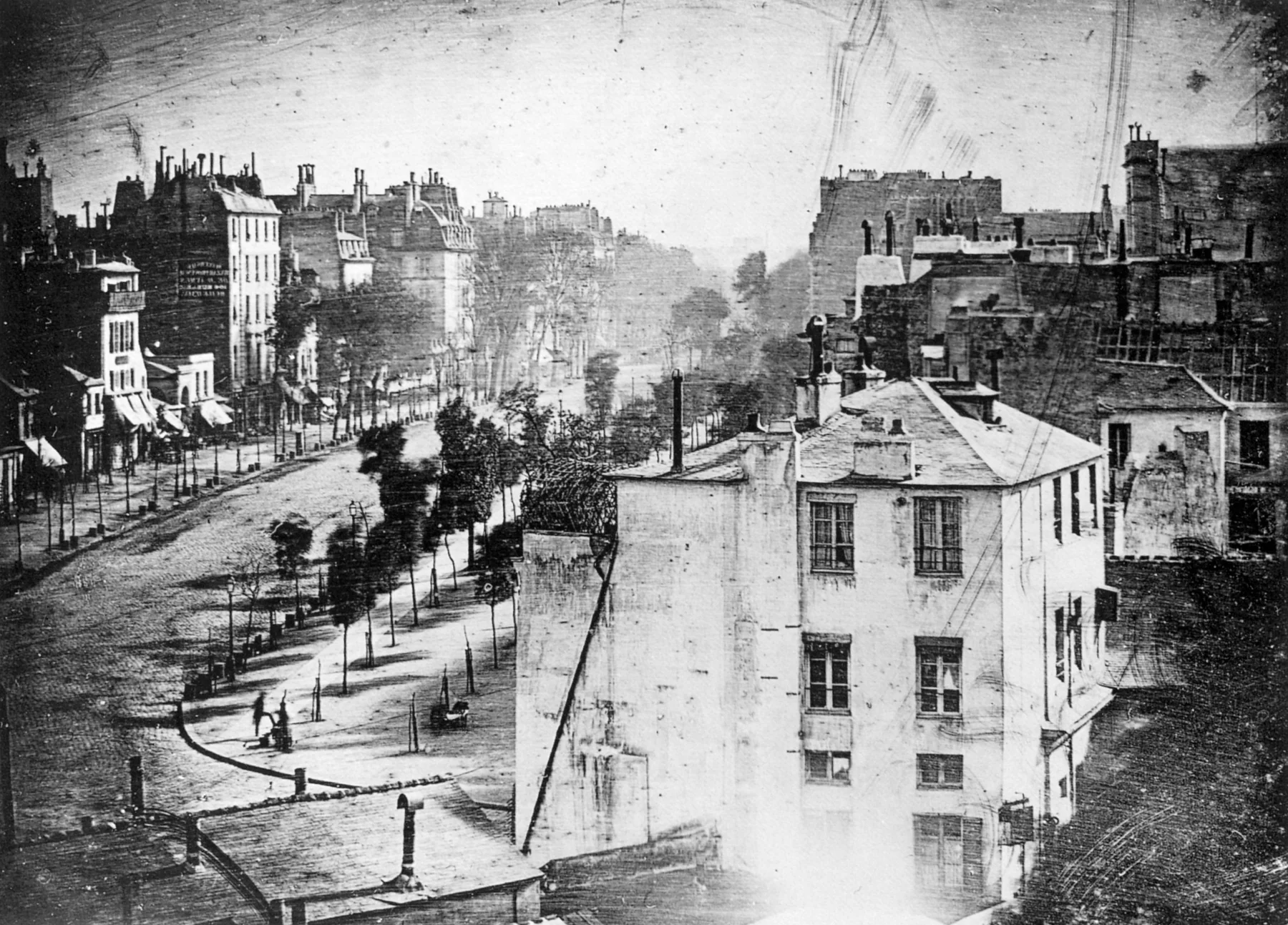

Daguerre looked from an elevated position across roofs toward a broad Parisian street. Buildings, trees, chimneys, pavement, and sky accumulate extraordinary detail. The road appears strangely quiet. Near the lower left, a small upright person seems to face another figure at foot level, conventionally interpreted as a customer remaining still while a shoeshiner worked.
The Bayerisches Nationalmuseum preserves Daguerre’s gift to King Ludwig I of Bavaria as a triptych of Paris street views and a study of antique sculptures, with originals, later facsimiles, original mount, dedication, and frame. The street plates are labelled midday and eight in the morning. The familiar image is therefore one member of a comparative presentation, not an isolated miracle.
Moving crowds can vanish while stillness appears
The boulevard was not necessarily empty. A long exposure could fail to register pedestrians and vehicles that moved through each position too quickly to create a stable deposit. Architecture remained. A person who paused could appear. Time did not stop; the plate accumulated some effects of time while losing others.
This makes absence an ambiguous visual fact. The image can show that the road surface did not retain most moving bodies under that exposure. It cannot by itself prove that no crowd passed. Nor can the tiny surviving figures tell us their names, relationship, occupation with certainty, or awareness of the camera.
A unique plate resists the logic of limitless copies
The daguerreotype is often described as a mirror with a memory because its polished metal surface can shift between positive and negative as it catches light. That experience is difficult to reproduce on a luminous screen. A modern digital file gives broad access to the composition while flattening reflectivity, scale, enclosure, scratches, and the viewer’s movement before the object.
Uniqueness shaped use. A plate could not simply generate a print run as a negative could. It could be copied through engraving, lithography, or another photograph, but each translation changed tone, orientation, detail, and material status. The image’s fame therefore depends on reproductions that contradict its original singularity.
Gift, frame, facsimile, and museum make public evidence
Daguerre’s triptych arrived as a diplomatic and technological demonstration addressed to a king. Dedication and frame made the new process a gift, a claim to prestige, and a carefully staged encounter. Royal ownership helped validate photography before a broad public could practise or even see it.
Evidence includes that biography. The street scene is evidence of an exposure, but the triptych is also evidence of photography’s institutional introduction. To cite only the visible boulevard loses how gift, enclosure, copy, royal recipient, and museum custody made the plate durable and authoritative.
Atkins made a scientific book in blue
Atkins began issuing Photographs of British Algae: Cyanotype Impressions in fascicles in 1843 and continued the project for a decade. The Metropolitan Museum of Art’s album contains 154 cyanotypes. Its record describes it as the first book photographically printed and illustrated—a precise institutional claim about book form, not proof that Atkins alone invented photography.
The cyanotype process had been announced by astronomer and chemist John Herschel in 1842. Atkins adapted it to botanical study. She placed wet algae directly on light-sensitised paper, exposed the sheet to sunlight, and washed it. Exposed areas became Prussian blue while the specimen blocked light and left a pale silhouette.
The title page uses the same process for language. Handwritten and cut or arranged lettering became a photographic impression. Scientific image, calligraphy, border, ornament, and book design occupy one blue field. The album announces from its opening that photography can classify and compose simultaneously.
Contact does not remove arrangement
Because the algae touched the paper, each silhouette has a strong causal intimacy with a specimen. Fine branching structures can appear without the interpretive hand of an engraver. This made cyanotype useful where outline, proportion, and repeated division carried botanical information.
Contact is not neutrality. Atkins selected specimens she collected or received, separated and spread their fronds, chose orientation, decided whether parts overlapped, exposed under variable sunlight, washed the sheet, judged the result, and sometimes tried again. Pressure and moisture affected contact. The living organism became a gathered, flattened, named sample.
A book turned repeated exposure into scientific sequence
One cyanotype does not make a taxonomy. Atkins joined impressions to handwritten labels and arranged them according to the nomenclature of William Henry Harvey’s Manual of the British Algae of 1841. The book made specimens comparable across pages while supplying names that the images could not generate themselves.
Fascicle publication distributed work over time. Surviving copies differ in contents and order because Atkins revised and assembled them by hand. “The book” is therefore both a recognised project and a group of materially non-identical objects. Repetition created scientific reach without industrial uniformity.
Scientific naming and aesthetic composition coexist
The Met stresses that artistic expression was not Atkins’s primary goal while recognising the elegance of her arrangements. That distinction is useful only if it does not divide the pages into scientific information on one side and decorative beauty on the other.
Clarity itself can be designed. Spacing prevents branches from collapsing into a knot; contrast makes morphology readable; orientation gives the eye a route; handwritten labels link name and form. The same decisions that make a page compelling can make it useful for comparison. Beauty is not proof of inaccuracy.
Fenton arrived after action with a difficult camera
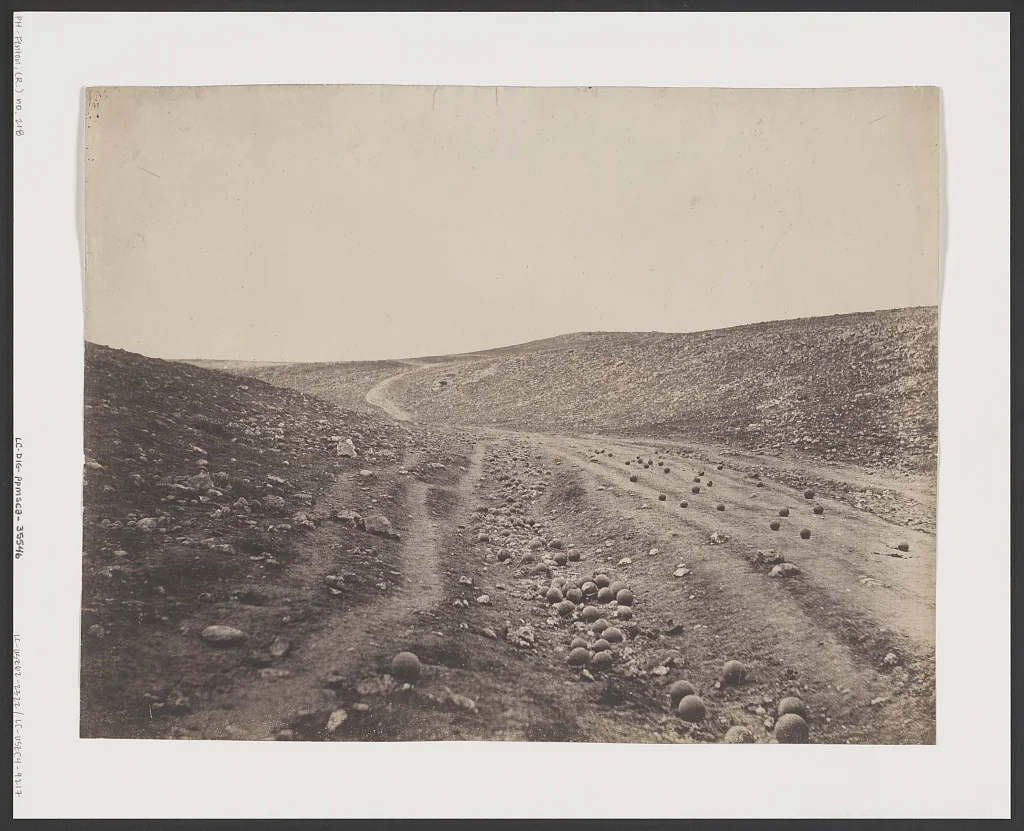
In 1855 Fenton travelled to Crimea with a horse-drawn darkroom, large camera, fragile glass plates, chemicals, water, and assistants. The wet-collodion process required coating, sensitising, exposing, and developing a plate while it remained wet. Equipment and chemistry constrained where and when he could work.
Long exposure and operational danger made combat action effectively inaccessible. Fenton photographed camps, officers, soldiers, roads, harbours, batteries, and ground marked by violence. The Valley of the Shadow of Death shows no charge and no wounded body. A road bends between bare slopes under a blank sky; spent round shot supplies the event’s residue.
Two negatives make evidence comparative
Fenton made two negatives from almost the same camera position. In one, cannon shot lies mainly beside the road. In the other—the version reproduced here—many balls occupy the roadway. Comparison establishes that objects moved between exposures. It does not, by itself, identify who moved them, whether movement was purposeful staging, salvage, clearing, danger, or some combination.
That limit matters. A single image may feel self-evident; the pair reveals an intervention. Yet even the pair needs physical and historical research: negative sequence, changing shadows, plate marks, Fenton’s letters, military practice, and later print histories. Digital comparison can strengthen an inference without reading intention directly from pixels.
Cannonballs signify casualties without showing bodies
The round shot gives scale, repetition, and threat to otherwise empty terrain. Near balls appear large enough to count; distant ones recede into a trail. Their distribution turns the road into a field of impacts. The biblical title, derived from Psalm 23 and used by troops for a dangerous place, intensifies the landscape’s metaphorical force.
The photograph is not an inventory of the Crimean War’s causes, combatants, deaths, disease, supply failures, or civilian experience. It makes one aftermath eloquent. Cannon shot can stand for casualties while protecting viewers from the bodies whose absence allows symbolic contemplation.
War photography is also logistics and circulation
Fenton produced several hundred Crimean negatives in a few months, but photographs did not move through illustrated newspapers as direct halftone reproductions in 1855. Prints were exhibited and sold; engravings could translate photographic information into mass print. The public encountered a mediated campaign through selection, caption, publisher, exhibition, and price.
The wet plate’s slowness also organised the represented military world. Officers able to pose and camps stable enough for equipment entered the archive more readily than assault, panic, or rapidly changing civilian harm. Technical limitation and social access reinforced one another.
O’Sullivan made a Diné homeland into survey space
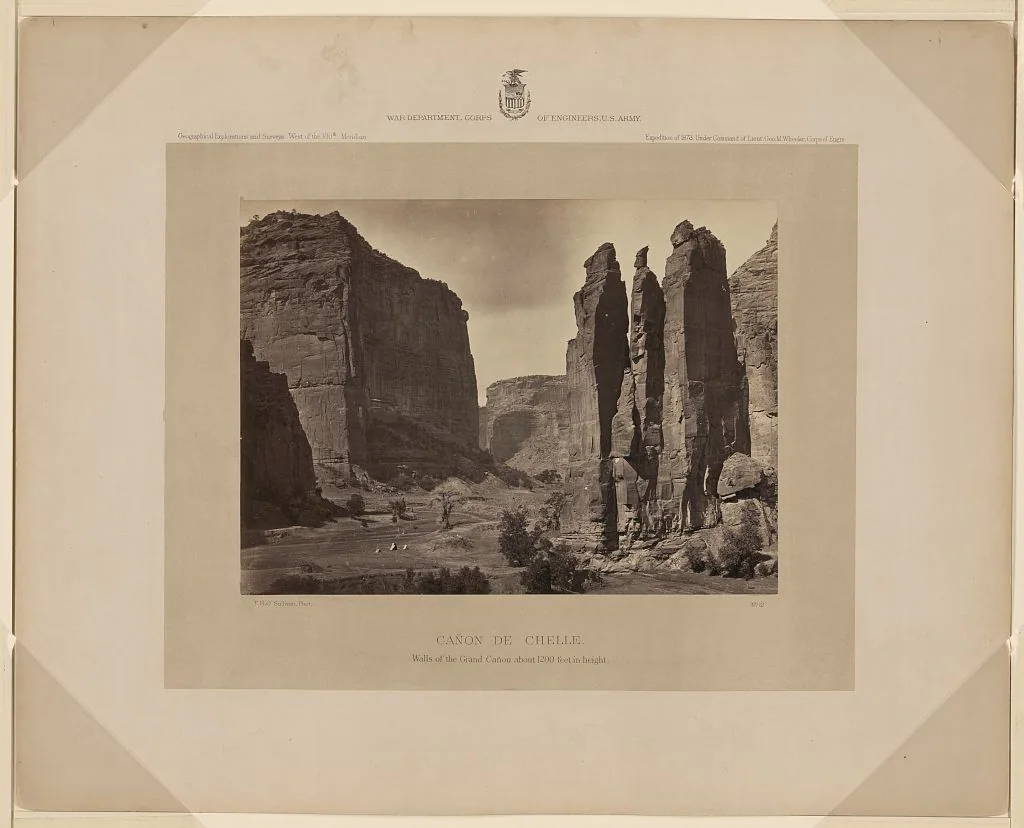
O’Sullivan made this photograph during a United States War Department survey led by Lieutenant George M. Wheeler. The image later appeared in a government volume of landscapes, geology, settlements, Indigenous people, camps, and routes made during expeditions west of the hundredth meridian.
The caption calls the place “Cañon de Chelle,” a Spanish rendering connected to the Diné name Tséyi’, “within the rocks.” Today Canyon de Chelly National Monument states plainly that Diné families live, farm, and raise livestock there; the land lies within the Navajo Nation and is managed through partnership with it. The canyon is not an empty geological specimen.
Tiny figures establish scale and a viewing position
Sandstone walls enclose the view while three narrow rock towers rise near the right. Two tiny figures stand on the canyon floor. They may be survey participants, local guides, or other people; this photograph alone does not identify them. Their scale makes the cliffs appear immense and gives viewers a human unit of measure.
The figures also disclose staging. Someone chose where the camera stood, where the people paused, and when the plate was exposed. O’Sullivan had to translate an enormous space onto a glass negative and later a mounted print. Monumentality is produced through viewpoint, tonal contrast, lens, foreground, figure placement, and the caption’s estimate of 1,200 feet.
Caption and survey rename inhabited land
The printed mount carries the War Department and Corps of Engineers identity above the photograph. O’Sullivan’s name is small; the survey command, official crest, numbered plate, place name, and height claim organise the image as federal knowledge. The mount is part of the photograph’s argument, not empty border.
Government surveys gathered topographic, geological, military, ethnographic, and resource information useful for settlement and control. Their categories could separate “landscape” from the people whose laws, histories, names, farming, and sacred relations made it homeland. A view that seems to discover untouched nature follows recent conquest.
The archive must reconnect image to forced removal
The United States Army conducted a destructive campaign against the Navajo in 1863–1864, burning crops, killing livestock, and forcing thousands on the Long Walk to incarceration at Bosque Redondo. Many died. The 1868 treaty permitted survivors to return to a reduced part of their homeland. O’Sullivan arrived only five years later with a military survey.
That chronology changes the photograph. An apparently timeless canyon follows forced removal and return. The tiny human presence cannot be read as generic scale alone when the institution behind the plate had recently participated in dispossession across the region.
Beato photographed a fort after imperial violence
Content note: the photograph and discussion below include visible bodies of Chinese soldiers after battle.
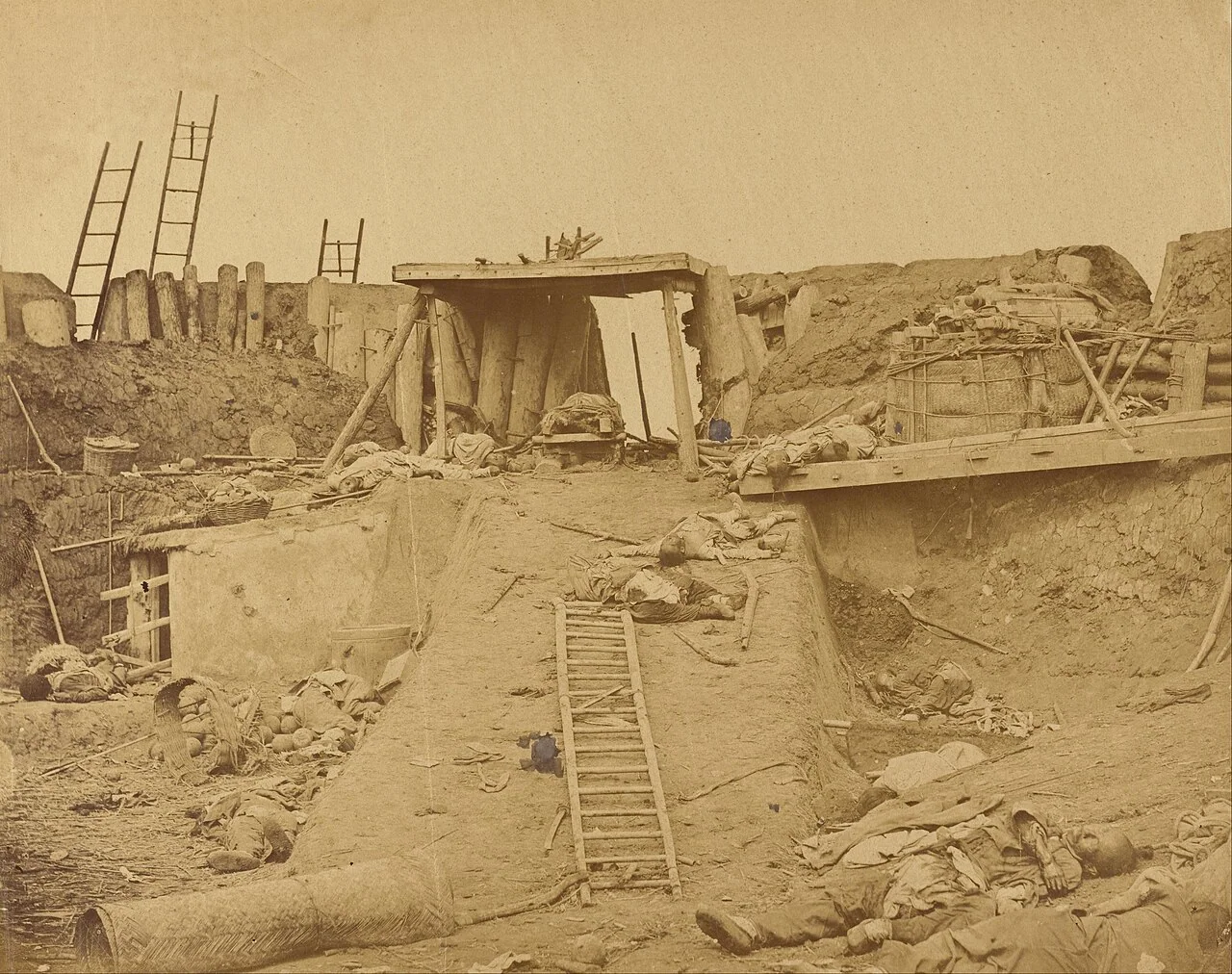

Beato entered the North Dagu Fort soon after Anglo-French forces captured it during the Second Opium War. The photograph looks across ruptured earthworks, ladders, baskets, platforms, guns, debris, and Chinese dead. No living victor stands at the centre, but conquest structures every visible condition.
The Getty record identifies the print as one of eight views that recreate the event in sequence. British military physician David F. Rennie remembered Beato asking that a group of bodies not be disturbed until he photographed it. The statement documents urgency and an aestheticising response by a witness; it does not tell us what the dead would have consented to or how their families understood the image.
The war forced Qing China into further unequal concessions after a conflict bound to foreign demands, diplomacy, trade, and the illegal British opium economy. “After capture” is therefore not a neutral time label. It announces the viewpoint of the force that gained the fort.
The camera’s delay determines whose bodies appear
Early wet-plate photography could not record the assault at battle speed. It could record bodies that no longer moved. The same technical threshold that erased traffic from Daguerre’s boulevard gave the dead a terrible photographic visibility. Stillness is not a formal property without politics.
Beato had to prepare and process large glass plates near the battlefield. That labour has often been used to celebrate his endurance. It should also direct attention to unequal vulnerability. The photographer could withdraw with his apparatus; the soldiers in the image could not control pose, caption, sale, or later display.
An ethical account neither hides the photograph nor treats shock as knowledge. It describes only what is necessary, gives the conflict and named location, acknowledges the bodies as people rather than compositional elements, and warns viewers. The image can document imperial violence while repeating an imperial relation of looking.
Sequence, caption, and album organise colonial victory
The Dagu photographs move from approach and breached defences to interiors, bodies, and occupied space. When arranged as a sequence, they can simulate the progress of battle even though exposure order followed practical need: bodies had to be photographed before removal, while exterior and architectural views could wait.
Captions direct that reconstruction. Terms such as “English entrance,” “French entrance,” and “immediately after its capture” map allied action onto the fort. Beato sold photographs to soldiers and assembled views into albums. A military record became a souvenir, commercial product, family possession, and evidence of imperial reach.
Albums are arguments made through order. They can move viewers from obstacle to breach to aftermath and make victory seem coherent. The Historical Photographs of China project, mirrored by Shanghai Jiao Tong University, allows dispersed prints and captions to be studied together. Reconstructing the series exposes how a single iconic image belonged to a larger campaign narrative.
Showing the dead does not explain the war
Graphic visibility can defeat the comforting claim that war left only damaged architecture. It can also narrow explanation to the instant after violence. The photograph does not show the opium trade, treaty negotiations, decisions in London, Paris, and Beijing, naval bombardment, civilian deaths, looting, the destruction of the imperial gardens, or Chinese accounts of defeat.
Nor is the camera simply on “the side of victims” because bodies appear. Beato travelled with invading forces, relied on military access, photographed from captured ground, and sold to a Western audience. The evidential trace and its imperial conditions must be held together.
The strongest historical use is relational. Place the image beside Qing and foreign documents, Chinese scholarship, campaign memoirs read critically, maps, material remains, other photographs in the series, and the later lives of the prints. A photograph can make denial harder without making interpretation unnecessary.
Photography became art through decisions, not escape from fact
Early debates often placed mechanical record against artistic invention. The five objects dissolve that opposition. Daguerre chose an elevated urban view and comparative time labels. Atkins arranged specimen, page, script, and sequence. Fenton compressed war into a curving road and scattered shot. O’Sullivan converted scale into stark geometry. Beato constructed an album narrative from delayed aftermaths.
None of these choices eliminates the world’s action on sensitive material. Artistry lies partly in deciding what relation to establish with that action. Composition can clarify evidence, turn it into metaphor, beautify domination, preserve ambiguity, or do several at once.
Institutional recognition then changes status. Scientific album, royal gift, publisher’s exhibition, federal survey volume, commercial war album, and art museum do not merely contain photographs. They propose ways of seeing them. “Art” is not a substance discovered inside the image; it is a contested practice and history of attention.
Reproduction expands access and changes authority
Paper negatives and glass negatives made multiple positives possible, while printed albums organised those copies for distant readers. Engravings translated photographs into mass-circulation newspapers before direct photomechanical reproduction became common. Every route widened access while altering scale, tone, detail, caption, and sequence.
Digital files continue that history. They let a student compare Fenton’s variants, inspect Atkins’s title page, or read the official mount around O’Sullivan’s print without travelling. They also make photographs look frictionlessly interchangeable. A daguerreotype, cyanotype, salted-paper print, albumen print, scan, and compressed WebP can occupy the same rectangle on screen.
Good digital use records the translation. Link the object record and image file; state rights; preserve the full composition; record intrinsic dimensions; identify resizing or cropping; distinguish an original print from a modern scan. Access becomes more trustworthy when its transformations are visible.
Evidence requires a chain, not a feeling of reality
A convincing photographic claim should connect at least six links: the event or object before the camera; the apparatus and process; the resulting negative, plate, or print; its caption and sequence; its custody and reproduction history; and the question a researcher asks. A broken link does not always destroy evidence, but it limits what can be claimed.
For Daguerre, the plate can establish duration-sensitive urban detail, not an empty street. For Atkins, contact can establish outline and arrangement, not a whole ecology. Fenton’s paired negatives establish movement of cannon shot, not motive by themselves. O’Sullivan’s mounted print establishes a survey view, not vacant land. Beato’s exposure establishes visible aftermath, not a complete cause of war.
This method avoids two lazy extremes. “The camera never lies” ignores mediation. “All photographs are constructed, so nothing is knowable” ignores material constraint and comparative research. Evidence is graded, situated, and revisable.
A comparison matrix
| Object | Process and form | Evidential strength | Institutional operation | Critical limit |
|---|---|---|---|---|
| Daguerre, Boulevard du Temple | Unique daguerreotype plate within a framed triptych | Fine architectural detail and duration-sensitive visibility | Gift to Ludwig I; later facsimile, conservation, museum catalogue, and digital copy | Movement can disappear; the plate does not prove an empty street or identify the tiny figures |
| Atkins, British Algae | Cameraless cyanotypes assembled and labelled as a book | Direct specimen contact preserves outline and branching for comparison | Botanical network, fascicle publication, hand assembly, later museum access | Flattened silhouette omits colour, habitat, volume, and ecological relation; identification can change |
| Fenton, Valley of the Shadow of Death | Glass negative and salted-paper prints; two variants | Terrain, shot, and comparison between exposures | Commission, royal access, commercial exhibition and sale, later archives | Changed cannonball positions do not alone disclose mover or motive; battle and casualties remain outside frame |
| O’Sullivan, Cañon de Chelle | Glass negative and albumen print on a numbered federal mount | Landform, survey presence, caption, and scale construction | War Department survey, government volume, federal and museum archives | Military naming and measurement can suppress Diné sovereignty, recent forced removal, and living presence |
| Beato, Interior of North Fort | Glass negative, albumen print, campaign sequence, and album | Immediate visible aftermath and material state of captured fort | Military access, captions, commercial albums, imperial circulation | Bodies are exposed without consent; victors’ sequence does not explain war or preserve Chinese testimony |
What the surviving archive overrepresents
The archive is dense where states, armies, publishers, collectors, and museums invested in objects. Daguerre’s royal gift, Fenton’s commission, O’Sullivan’s federal survey, and Beato’s military access generated records because powerful institutions wanted images. Atkins’s hand-built books survived through learned networks and collectors, but many contributors and specimens remain less visible than the named author.
Survival also favours stillness and property. Buildings, geology, pressed specimens, officers, weapons, and bodies could endure an exposure. Moving labour, conversation, fear, refusal, and people who controlled neither camera nor caption disappeared more easily.
Digital abundance can conceal this imbalance. Thousands of scans do not equal representative history if they reproduce one institution’s categories. Search results inherit titles and descriptions written by surveyors, conquerors, collectors, and older catalogues. Research must use the archive and study how it was built.
Common survey traps
“The first photograph tells us when photography began.” Multiple inventors, experiments, private demonstrations, public announcements, processes, and survival histories make singular firsts unstable. State the exact claim and source.
“Daguerre photographed an empty Paris.” Long exposure could erase moving traffic. The plate records duration-sensitive visibility, not a census.
“Atkins removed the artist’s hand.” Contact reduced one kind of translation while selection, arrangement, chemistry, naming, and book design remained.
“Fenton moved the cannonballs.” The two negatives show that positions changed; identify agency and motive only to the degree external evidence supports them.
“A government survey is neutral science.” Measurement can be accurate while serving military intelligence, settlement, resource extraction, and territorial rule.
“Canyon de Chelly was an empty sublime landscape.” It is Tséyi’, a living Diné homeland photographed shortly after forced removal and return.
“Graphic suffering explains violence.” Visibility can document harm, but cause, responsibility, and testimony require other evidence.
“A negative means unlimited identical copies.” Prints vary, materials decay, editions end, and captions or albums alter meaning.
“Calling photography art makes truth irrelevant.” Artistic and evidential claims can coexist and must each be tested.
Questions for close looking
- What photographic process produced the object, and is this a plate, negative, print, page, album, reproduction, or digital surrogate?
- What duration did the exposure record, and what kinds of movement became invisible?
- Who selected the viewpoint, arranged the subject, prepared materials, processed the image, and supplied its title?
- Does another negative, print, page, caption, or frame allow comparison?
- Which claim is supported by visible detail, and which depends on external documentation?
- Who commissioned, financed, transported, purchased, published, filed, or collected the photograph?
- What sequence does an album, survey, exhibition, or website create?
- Whose names and testimony survive, and who appears only as type, scale figure, specimen, or body?
- How do scientific usefulness and aesthetic organisation support or complicate one another?
- What changed when the object became a scan, and are rights and transformations documented?
Terms for photography, evidence, and circulation
Daguerreotype: a direct positive image on a sensitised, silver-coated copper plate; extremely detailed, reflective, fragile, and normally unique.
Cyanotype: an iron-based photographic process that produces a blue image; in a contact photogram, covered areas remain pale while exposed paper turns blue.
Photogram: an image made by placing objects on or near light-sensitive material without a camera lens.
Wet-collodion negative: a glass plate coated, sensitised, exposed, and developed while wet; capable of fine detail but demanding portable darkroom labour.
Salted-paper print: a paper positive, often made from a paper or glass negative, whose image is embedded in the paper fibres and tends toward a matte surface.
Albumen silver print: a photographic print on paper coated with egg white and salts, producing a relatively glossy, detailed surface; dominant in the later nineteenth century.
Indexical trace: a sign caused by physical contact or connection with what it records. The connection constrains an image but does not validate every interpretation.
Chain of custody: documented movement, ownership, handling, and preservation of evidence from creation to current use.
Survey: a coordinated programme of measurement, description, mapping, image making, and classification; both a knowledge practice and a potential instrument of rule.
Caption: text that identifies and frames an image. It can preserve indispensable context, repeat historical power, or introduce error.
A working timeline, c. 1838–1875
- About 1838: Daguerre makes the surviving Boulevard du Temple plates later presented to Ludwig I of Bavaria.
- 7 January 1839: François Arago announces Daguerre’s process to the French Académie des Sciences; full public instructions follow in August.
- 1841: William Henry Fox Talbot patents the calotype negative-positive process in Britain; William Henry Harvey publishes his Manual of the British Algae.
- 1842: John Herschel announces the cyanotype process.
- 1843: Atkins begins issuing Photographs of British Algae in fascicles.
- 1844–1846: Talbot publishes The Pencil of Nature, joining photographs and text in a commercially issued book.
- 1851: Frederick Scott Archer publishes the wet-collodion process, increasing detail and reducing exposure while requiring immediate plate preparation and development.
- 23 April 1855: Fenton makes two exposures in the Crimean location called the Valley of the Shadow of Death.
- 1855–1856: Fenton’s Crimean photographs are exhibited and offered for sale through Thomas Agnew and other dealers.
- 21 August 1860: Anglo-French forces capture the North Dagu Fort; Beato photographs its aftermath and the wider campaign.
- 1863–1864: the U.S. military campaign against the Navajo destroys resources and forces thousands onto the Long Walk to Bosque Redondo.
- 1868: a treaty permits the Navajo to return to a portion of their homeland.
- 1873: O’Sullivan photographs Canyon de Chelly during the Wheeler Survey.
- 1875: the War Department publishes a volume of fifty mounted survey photographs from the 1871–1873 expeditions.
Source guide
The material starting points are the Bayerisches Nationalmuseum’s record for Daguerre’s framed triptych given to Ludwig I and Malcolm Daniel’s Met essay on Daguerre’s process, Niépce partnership, institutional announcement, and art-science claims. The museum’s image carries a restrictive CC BY-NC-ND notice, so the local article file instead derives from a separately verified Public Domain Mark reproduction on Wikimedia Commons.
The Met’s Open Access record for Atkins’s Photographs of British Algae establishes date, process, extent, dimensions, method, Harvey nomenclature, and public-domain status. Its public collection API supplied the full-resolution hero file. The record’s “first book photographically printed and illustrated” language is retained as an attributed institutional claim rather than widened into a universal invention myth.
For Fenton, use the Library of Congress object and rights record, the Getty’s survey of his Crimean work, and the Getty’s open research volume Roger Fenton: Photographer of the 1850s. The existence of two negatives establishes rearrangement between exposures; interpretations of sequence and staging should identify the comparison and remain clear about what motive cannot be recovered from image data alone.
For O’Sullivan, the Library of Congress records the individual plate and the fifty-print Wheeler Survey volume. Robin E. Kelsey’s named study, “Viewing the Archive: Timothy O’Sullivan’s Photographs for the Wheeler Survey, 1871–74”, analyses how survey graphics, scientific limitation, and political persuasion interact. The Canyon de Chelly National Monument, managed with the Navajo Nation on tribal trust land, identifies Tséyi’ as a living Diné homeland; NPS history documents the Long Walk and return.
For Beato, begin with the Getty object record, its exhibition Felice Beato: A Photographer on the Eastern Road, and the Getty’s open scholarly catalogue. The University of Bristol’s Historical Photographs of China, mirrored by Shanghai Jiao Tong University, reconstructs dispersed Dagu prints and rests on Terry Bennett’s named scholarship. MIT Visualizing Cultures provides a contextual, source-rich chapter on Beato’s battlefield views, captions, albums, Chinese absence, and imperial circulation.
Image rights were checked separately from object metadata. The Atkins hero is Public Domain/Open Access at the Met. The Fenton and O’Sullivan files come from the Library of Congress and have no known restrictions on publication. The Daguerre and Beato files carry Public Domain Marks on Wikimedia Commons and link to institutional objects.
Each local WebP keeps the complete source frame and recorded dimensions; none is cropped. The Atkins hero is not repeated in the body. A content note comes before Beato’s image because evidence of war does not remove duties of care toward the people shown or today’s viewers.
Continue the Atlas route
Read this chapter after Realism, labour, industry, and the modern city to compare painted claims of observation with camera-made traces. Then revisit How to research an artwork and How to cite art and images to build an evidence chain for one photograph.
Continue to Impressionism: exhibition, leisure, labour, colour, and the rebuilt city to ask how artists made modern experience public through independent exhibitions, urban subjects, manufactured colour, and contested accounts of leisure and work.
Editorial record
About this article
- Author
- Publisher
- GeMarkt
- Published
- Updated
- Reviewed
- Internal source & rights check. Conducted by GeMarkt Research Review. This is an internal editorial check—not independent peer review.
- Source standard
- Art history source standardPrioritises object records and research sources, distinguishes evidence from interpretation, and states material uncertainty.
Found a claim that needs checking? Report a factual error.