Art History · Learning chapter
Atlas V — Modernisms and contemporary practices · 7 of 10
Pop, Minimal, Conceptual, and Performance art: object, system, instruction, and spectacle
Five visual studies connect postwar consumer images, serial fabrication, instruction scores, participation, performance, and how exhibitions shaped the categories applied to them.

What we’ll look at
How did artists share creative decisions with factories, instructions, audiences, and documents?
One woman guides striped fabric through a sewing machine. Another bends over a field of stars. Farther back, a third worker aligns a nearly completed flag on a long table. Repeated rectangles fill John T. Bledsoe’s 1960 photograph, yet no two positions, gestures, or folds are identical.
Repetition, industrial appearance, commercial signs, delegated manufacture, bodily action, and national spectacle already belonged to social life. Artists selected, reorganised, or contested them; museums and critics later separated the results into movements.
The labels overlap before they separate
“Pop,” “Minimal,” “Conceptual,” and “Performance” are not four sealed rooms. A screenprint can be a commodity image and a political message. A geometric object can be fabricated from instructions. An instruction can be read privately, enacted publicly, or preserved as a document. A performance can depend on engineered equipment and leave photographs that enter collections as objects.
The labels identify arguments, networks, and recurring practices. They become misleading when arranged as a clean relay race in which one movement removes what the previous one valued. Artists worked across those supposed borders and through different centres at the same time.
Scope: five visual studies and deliberate non-reproductions
This chapter uses a frame of about 1955–1975. Its five rights-reviewed visuals are two Library photographs and three GeMarkt diagrams. The photographs show production and consumption without calling either art. The diagrams are interpretations of cited records, not archival evidence.
Major works by Andy Warhol, Donald Judd, Yoko Ono, Lygia Clark, Hélio Oiticica, David Medalla, and participants in 9 Evenings are discussed but not reproduced. Most remain protected by copyright. A museum webpage or online image does not automatically authorise commercial republication. Their absence is a rights decision, not an estimate of importance.
The workshop makes seriality visible
The Library of Congress identifies the hero photograph as fifty-star flag production at the Copeland Company in Alexandria, Virginia, on 28 June 1960. Hawaii had entered the United States in August 1959; the new flag became official on 4 July 1960. The image therefore records production for a scheduled change in a national sign.
The elevated viewpoint compresses several stations into one vertical field. Stars recur in folded and unfolded sections; stripes run forward, sideways, and over edges. Sewing machines, lamps, thread, tables, hands, and fabric form a working system. Repetition results from measurement, cutting, stitching, checking, stacking, and coordination.
Repetition does not remove labour
In survey language, seriality can sound almost automatic. The photograph makes that abstraction harder to sustain. A repeated unit still has to be specified, supplied, moved, joined, inspected, and sometimes corrected. Machines change labour; they do not make it vanish. The workers’ different postures also show that production is distributed across bodies and stations rather than contained in one heroic gesture.
For industrially fabricated art, asking whether the artist personally welded or assembled the object is too narrow. Follow the chain: who developed dimensions, sourced material, interpreted drawings, operated equipment, finished surfaces, installed the result, and received credit?
National sign and commercial object share a worktable
A flag is not an ordinary commodity, yet this flag is also a manufactured product. It joins collective symbolism to fabric, wages, deadlines, standards, and sale. That double status anticipates a problem central to Pop: mass culture does not arrive as pure imagery. It arrives attached to ownership, production, consumption, identity, pleasure, discipline, and unequal work.
The photograph is not a simple allegory of “America.” It shows one business, one date, and an unnamed workforce selected by a magazine photographer. It nevertheless demonstrates how a public sign depends on commercial infrastructure.
Pop begins in media circuits
British and American Pop developed through different but connected circumstances. In London, artists, architects, designers, and critics associated with the Independent Group examined advertising, science fiction, automobiles, domestic technology, magazines, and new environments during the 1950s. In the United States, commercial printing, television, packaging, celebrity publicity, comics, and the expanding gallery market became material for divergent practices.
Pop cannot be defined by a shopping list of motifs. Its historical force lay partly in changing relations among high art, graphic design, mass reproduction, display, and desire. Calling every product image a celebration—or every appropriation a critique—replaces interpretation with a verdict.
This Is Tomorrow made consumption an environment
The Whitechapel Gallery’s archive describes the 1956 exhibition This Is Tomorrow as a collaboration among thirty-eight participants organised into twelve groups. Artists worked with architects, designers, and theorists to make installations rather than isolated contributions. Visitors navigated environments without explanatory panels. Richard Hamilton, John McHale, and John Voelcker formed one group; other participants included Eduardo Paolozzi, Alison and Peter Smithson, Nigel Henderson, Mary Martin, and Lawrence Alloway.
The exhibition did not announce a ready-made movement called Pop. It staged a problem: modern life arrived through linked images, objects, buildings, technologies, and habits of spectatorship. Correspondence, posters, photographs, invoices, and the catalogue reveal category-making as collaborative labour.
The supermarket is already an image system
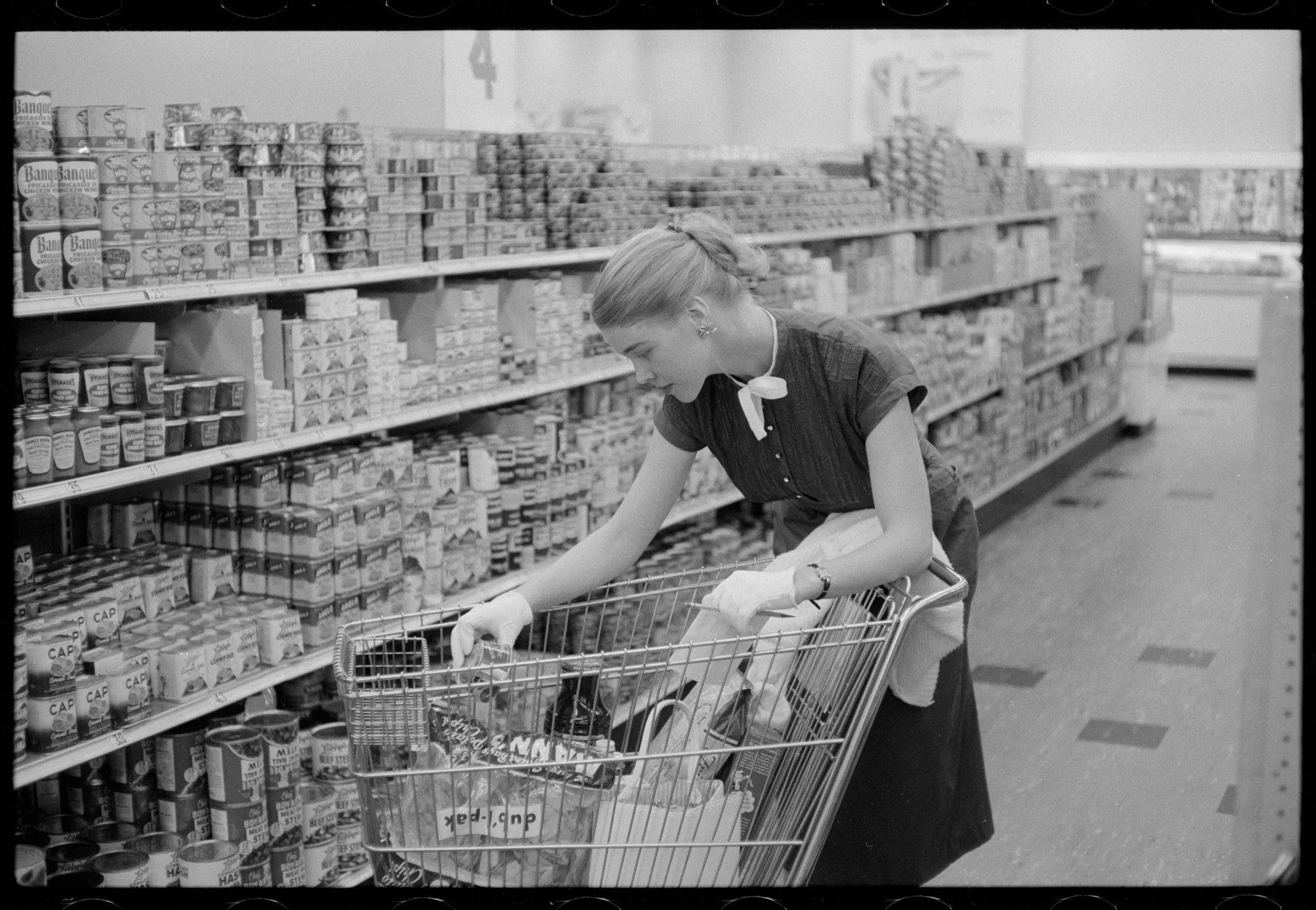
O’Halloran’s supermarket photograph is dense with designed repetition. Packages make horizontal colourless bands even in black and white; type, logos, prices, and brand distinctions organise difference inside abundance. The trolley frames the shopper as an active selector, while the aisle, shelf plan, stock system, and advertising have prearranged the field from which she chooses.
The Library’s title preserves the period word “housewife,” not a neutral identity description. The photograph participated in a media culture that represented consumption as gendered domestic responsibility and modern convenience. It can document a retail environment and a visual ideology at once. Pop artists quoted this field, but the field had photographers, designers, printers, warehouse workers, clerks, shoppers, and corporate owners before it entered a museum.
Campbell’s Soup Cans changed context, not the existence of packaging
Andy Warhol’s thirty-two Campbell’s Soup Cans were first shown in 1962. Each canvas presented a different soup variety with a closely repeated package design. The Warhol Museum connects the work to mass-produced, advertised food and the transformation of everyday objects; the Smithsonian’s account of Pop prints explains how commercial processes such as screenprinting and lithography helped generate flat, reproducible surfaces.
Warhol changed scale, support, sequence, labour process, viewing time, and institutional location. A grocery sign moved into a gallery without losing its commercial memory. Its attitude cannot be settled from motif alone.
Screenprinting can repeat colours, divide labour, and produce an edition, but no printing process carries one fixed ideology. It can promote a brand, distribute protest, support a fundraiser, or make art affordable. Politics emerge from relations among form, message, labour, audience, price, and distribution—not from ink passing through mesh by itself.
Corita Kent redirected commercial language
Corita Kent’s Heroes and Sheroes comprises twenty-nine prints made in 1968–69. The Corita Art Center notes that the series drew directly on mass-media imagery while addressing labour and civil rights, nuclear disarmament, political assassinations, and figures including Martin Luther King Jr., Coretta Scott King, César Chávez, and Robert F. Kennedy.
Kent’s work makes the limits of a brand-centred Pop narrative visible. Commercial colour, lettering, slogans, cropping, and visual speed could be redirected through Catholic education, peace activism, and social movements. The borrowed language did not become politically pure once repurposed; its familiarity was precisely the contested resource. Studying Kent beside Warhol shifts the question from “Is this Pop?” to “What does reproducible public language allow different makers to do?”
AfriCOBRA made reproduction a community strategy
AfriCOBRA formed in Chicago in 1968 around Black self-determination, unity, pride, direct statements, vivid colour, rhythm, and community responsibility. Smithsonian American Art Museum research identifies Barbara Jones-Hogu as a founding member and the only trained printmaker among the early group. Her screenprints were inexpensive to produce and distribute; works circulated through Black-owned bookshops and record stores at accessible prices.
This is not an “inclusive example” added to an unchanged Pop canon. It changes the analytical model. Reproducibility here links aesthetics to audience-building and collective political purpose. Text does not merely quote advertising; it addresses viewers. Distribution does not simply expand a market; it helps define a public. Technique remains shared with commercial production, but ownership of the message and the intended social relation have changed.
A media ecology is better than a one-way arrow
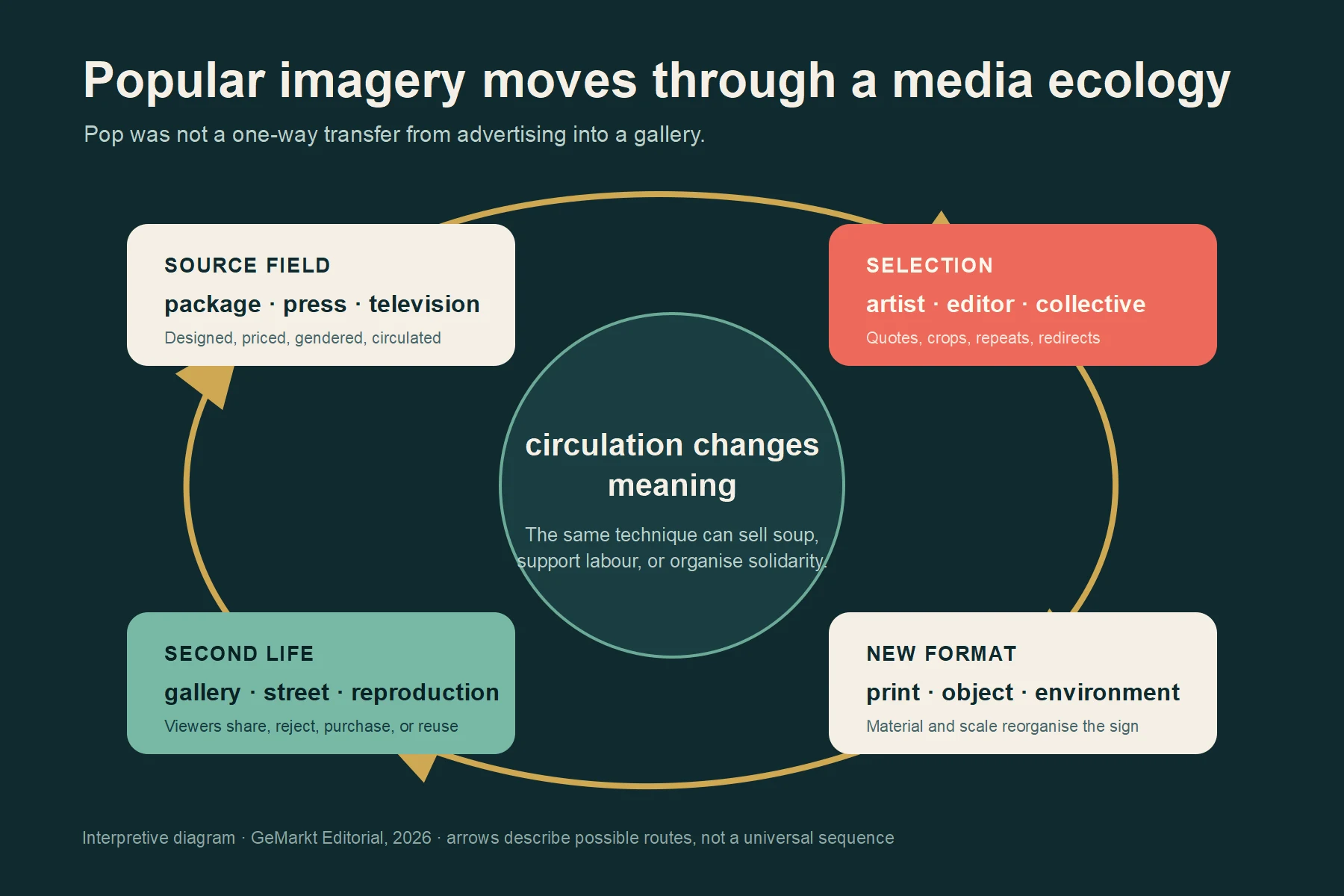
“Artist borrows advertisement” is only one route. Press photographs can become paintings and return as magazine reproductions. A collective can use a commercial print process to reach a public outside galleries. A museum can transform an inexpensive edition into a rare collectible. Viewers can purchase, quote, reject, or recirculate an image.
The four stages—source field, selection, new format, and second life—prevent medium from becoming destiny. Package, poster, canvas, photograph, and screenprint are nodes in circuits whose power depends on access and control.
Minimalism changed the object, viewer, and room
Works later called Minimal often used clear geometry, repeated units, industrial materials, direct placement on wall or floor, and reduced evidence of hand modelling. The apparent simplicity can be deceptive. A box changes as a viewer approaches it; polished metal reflects a room; a repeated sequence measures a wall; a floor work redirects walking. Object, architecture, light, gravity, and body become mutually legible.
Minimalism was not a universal rejection of meaning. Artists disagreed over composition, material, perception, fabrication, and the term itself. Anne Truitt’s painted columns, Dan Flavin’s fluorescent light, Carl Andre’s floor units, Donald Judd’s fabricated objects, Rasheed Araeen’s open structures, and Charlotte Posenenske’s variable industrial forms cannot be collapsed into one appearance without losing their different locations and social propositions.
Specific Objects was a report, not a rulebook
Donald Judd’s essay “Specific Objects,” first published in 1965, described new three-dimensional work that did not fit comfortably within inherited divisions of painting and sculpture. The Judd Foundation reproduces the primary text and emphasises Judd’s later clarification: he considered it a report on diverse practices, not a doctrinaire manifesto or a statement only about his own work.
Canonical criticism is evidence of one informed participant naming a situation, not a law every object obeyed. Read Judd’s attention to actual space, wholeness, and material beside the works and disagreements he selected.
Fabrication distributes authorship
Dia describes Judd’s use of industrial materials including anodised aluminium, stainless steel, Plexiglas, and plywood, and his delegation of fabrication to specialised technicians working from instructions and sketches. The point was not that the object made itself. Decisions moved among design, material availability, technical interpretation, tooling, finishing, installation, and maintenance.
The factory photograph at the chapter’s entrance returns with new force. Serial appearance can depend on exact handwork. “Artist-designed” and “fabricator-made” are not opposing truths; together they describe a production relation. Conservation research adds another layer because replacement, refabrication, and surface repair require evidence about which properties are essential. Authorship becomes a structured chain of judgement rather than a vanished hand.
Primary Structures helped produce a category
The Jewish Museum’s 1966 Primary Structures: Younger American and British Sculptors, organised by Kynaston McShine, gathered work that soon became central to histories of Minimalism. Its selection, open installation, catalogue, graphic design, reviews, and New York location helped viewers see geometric and formally reductive sculpture as a shared development.
The exhibition placed differences into comparison and gave later historians a memorable archive. Its title described structures rather than “Minimalism,” yet later retellings made it a movement landmark. Its geography and exclusions could then harden into the apparent boundaries of the art.
The global correction changes the category
The Jewish Museum’s 2014 Other Primary Structures explicitly revisited the 1966 focus on artists based in the United States and Britain. It presented early reductive sculpture from Latin America, Asia, Africa, the Middle East, and Eastern Europe, including work by Rasheed Araeen and other artists whose practices emerged under different conditions.
This was not a matter of filling regional slots in an established template. Did similar geometry result from the same debates? Were objects fixed, variable, social, architectural, spiritual, or anti-market? Charlotte Posenenske’s reconfigurable sculpture joined seriality to socioeconomic concerns unlike Judd’s. Formal resemblance begins comparison; it does not complete it.
An instruction can be the work
An instruction artwork may exist as a sentence, diagram, score, certificate, protocol, or proposal. Its material economy can look like a rejection of objects, but instructions generate other materials: paper, language, tools, actions, travel, administration, photographs, permissions, and memory. They move decisions from one moment and person into a chain of possible realisations.
Ask which decisions the proposition fixes, which it leaves open, who may perform it, how context alters the result, and what counts as an authorised version.
Grapefruit travels through reading and imagination
Yoko Ono published Grapefruit in Tokyo in 1964 and initially sold it herself. MoMA’s “22 Instructions” project describes sections devoted to music, painting, event, poetry, and object. Some scores can be enacted; others are improbable or primarily realised in imagination. Ono’s work moved through Tokyo, New York, and London networks rather than originating inside one national movement.
The book turns a reader into a possible participant without guaranteeing a public performance. Reading is already an event of interpretation. MoMA’s archival accounts and Ono’s own comments emphasise her willingness to let others finish works. That transfer does not abolish her authorship: she composed and circulated the conditions under which another person could imagine or act.
A score creates versions, not identical copies
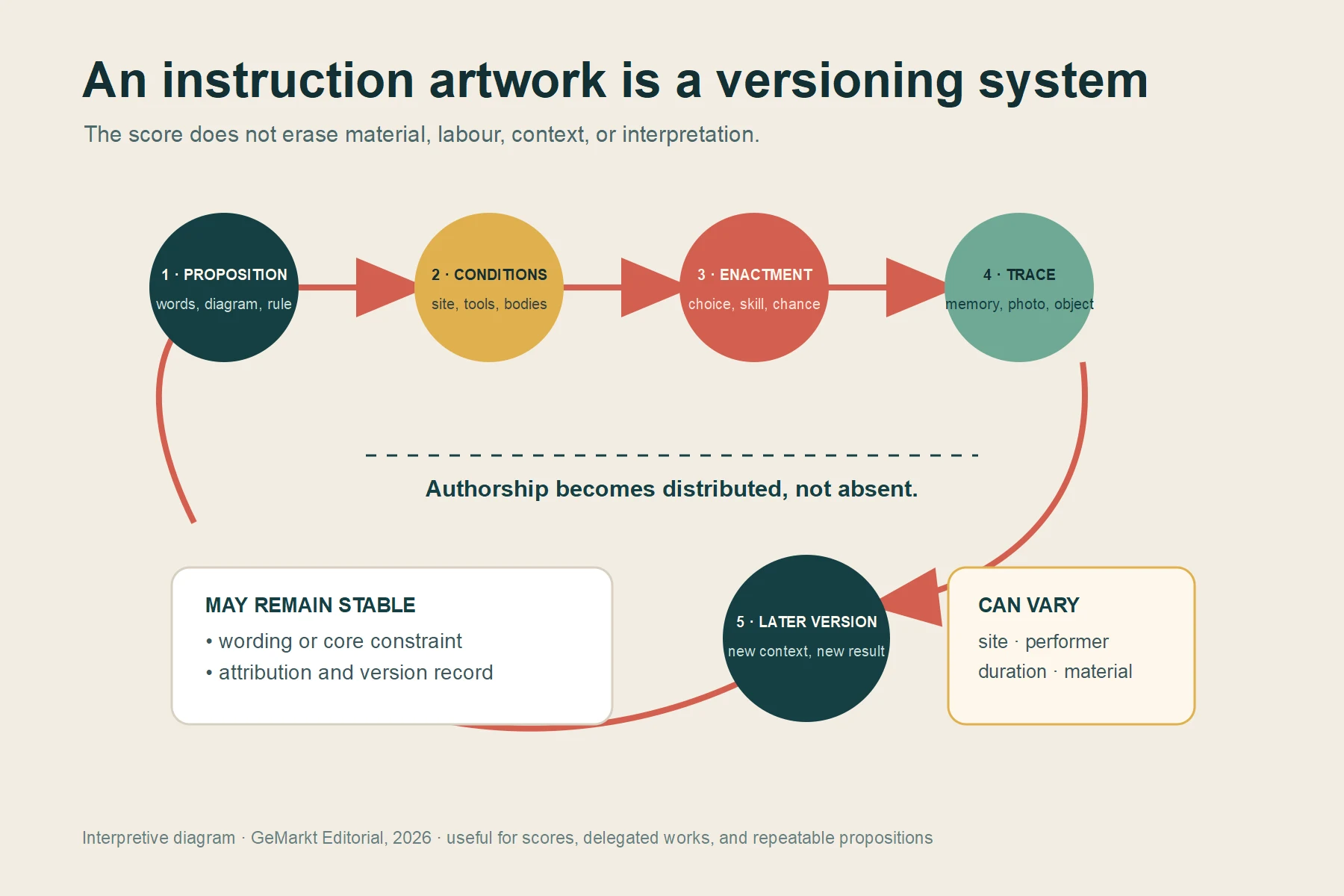
The score may preserve wording or a core constraint while site, participant, duration, material, and result vary. An enactment can leave an object, photograph, recording, or only memory. A later performance can be historically related without pretending to recreate every condition of the first.
This versioning model helps with authorship and conservation. It asks what must remain stable for identity to continue and what variation the work invites. It also demands honest captions: “realisation of,” “performed by,” “after an instruction dated,” and “documentation of” are not interchangeable phrases.
Fluxus was a network, not one style
Fluxus connected scores, publications, performances, mail, inexpensive multiples, music, film, humour, and ordinary actions. Its routes crossed New York, Tokyo, European cities, and many individual correspondences. MoMA’s research on Tokyo foregrounds Ono, Mieko Shiomi, the Sōgetsu Art Center, and event scores, showing that the network cannot be narrated as ideas exported from one Western capital.
A network is not automatically equal. Publishers, venues, travel resources, language, gender, and later collecting shaped visibility. Follow a score’s route: who wrote, translated, received, performed, printed, and archived it?
Participation changes what an object does
Participation is broader than pressing a button or walking around a sculpture. It can make a viewer responsible for sequence, touch, duration, risk, cooperation, refusal, or care. The object may become a prompt, hinge, wearable structure, sensory device, or record of encounter. Meaning emerges through what participants do under specific conditions.
Participation has degrees. A museum can invite a controlled gesture while retaining authority over access and interpretation. Describe that distribution of agency rather than treating “interactive” as praise.
Lygia Clark turns a line into an act
Lygia Clark’s hinged metal Bichos of 1960–63 could be reconfigured by handling. In Caminhando (1963), a participant cuts along a Möbius strip, repeatedly choosing a path until the paper becomes too narrow. MoMA curator Connie Butler describes the cut as an activated line; Clark insisted that the act produces the work.
This is more than a stable sculpture offered for play. Time, decision, and irreversible material change become the proposition. Brazilian critic Mário Pedrosa recognised that the maker transferred realisation to the participant. Irene V. Small’s scholarship further cautions against treating Clark only as a regional anticipation of later Euro-American art; her experiments require the histories and debates of Brazilian Neo-Concretism.
Parangolés require bodies, rhythm, and place
Hélio Oiticica began developing Parangolés after frequenting the Estação Primeira de Mangueira samba school in Rio de Janeiro in 1964. MAM Rio describes capes, banners, tents, bodily movement, music, rhythm, popular and vernacular experience, and the spatial organisation of the favela as integral to the works. They cannot be reduced to colourful textiles hanging still.
The 1965 Opinião 65 opening is a key episode because Mangueira participants activated Parangolés outside the museum. But a dramatic anecdote should not substitute for longer relationships. Irene Small’s archival study argues that Oiticica’s participation produced models for rethinking art and life rather than simply abandoning art. Place and social difference are constitutive, not atmosphere added to a universal interactive form.
Participation is not automatically emancipatory
A participant can gain agency and still encounter unequal rules. Who is invited, bears risk, owns documentation, and receives credit? Participation is a structure, not a moral guarantee.
Yoko Ono’s Cut Piece, first performed in Kyoto in 1964, makes this tension especially visible: an audience is given agency over an artist’s clothing and bodily exposure. The work belongs partly to the next chapter’s history of feminist, queer, and body-based practices. Here it demonstrates why participation must be analysed through consent, duration, gendered power, and spectatorship—not celebrated as openness by default.
Medalla’s foam makes a sculpture temporary
David Medalla’s first Cloud Canyons appeared in 1964. National Gallery Singapore records later versions using wood, Perspex, compressors, timers, water, and detergent. Foam emerges, accumulates, spills, changes, and evaporates. The machinery is durable infrastructure for a form that cannot remain fixed.
Medalla, born in the Philippines and active through London’s Signals network, unsettles a simple Minimal-to-Process sequence centred on New York. The work can resemble a geometric machine while behaving like an unruly event. National Gallery Singapore also records Medalla’s association of the foam with childhood memories of ginataan. Local memory and transnational technology coexist; neither should be erased to make the work fit one movement label.
Performance and technology need infrastructure
Live art can appear to escape the commodity object, yet it needs rooms, rehearsal, transport, electricity, technical labour, schedules, insurance, publicity, and audiences. Electronic performance adds engineers, transmitters, control systems, troubleshooting, and institutional funding. The event’s ephemerality does not make its support system immaterial.
A performer’s action may remain central while technicians determine whether sensing, sound, light, or communication functions. Programmes and technical diagrams can reveal collaborators whom iconic photographs omit.
9 Evenings turns engineering into stage conditions
9 Evenings: Theatre and Engineering took place at New York’s 69th Regiment Armory in October 1966. The Daniel Langlois Foundation’s research archive identifies ten artists and roughly thirty to forty engineers who developed technological components for new performances. Participants included John Cage, Lucinda Childs, Öyvind Fahlström, Alex Hay, Deborah Hay, Steve Paxton, Yvonne Rainer, Robert Rauschenberg, David Tudor, and Robert Whitman.
The archive shows systems rather than technological magic. In Rauschenberg’s Open Score, equipped tennis racquets transmitted impacts that affected sound and lighting. Alex Hay’s Grass Field amplified bodily signals and organised performers around a task. Technical failure and adjustment were part of the history. The event did not prove a seamless merger of art and science; it exposed the negotiations required to make collaboration visible on stage.
Documentation is not the event
A photograph of a performance fixes a viewpoint and fraction of time. A film adds sequence but still frames, edits, and converts scale. A programme may describe intention rather than outcome. A technical diagram can show connections without reconstructing audience experience. Each source answers different questions.
Documentation can become an artwork, evidence for restaging, or a market object. Caption precisely: “performance photograph” is not “performance,” and an installation view is not the installation. Compare score, testimony, equipment, image, and review.
Exhibitions make categories
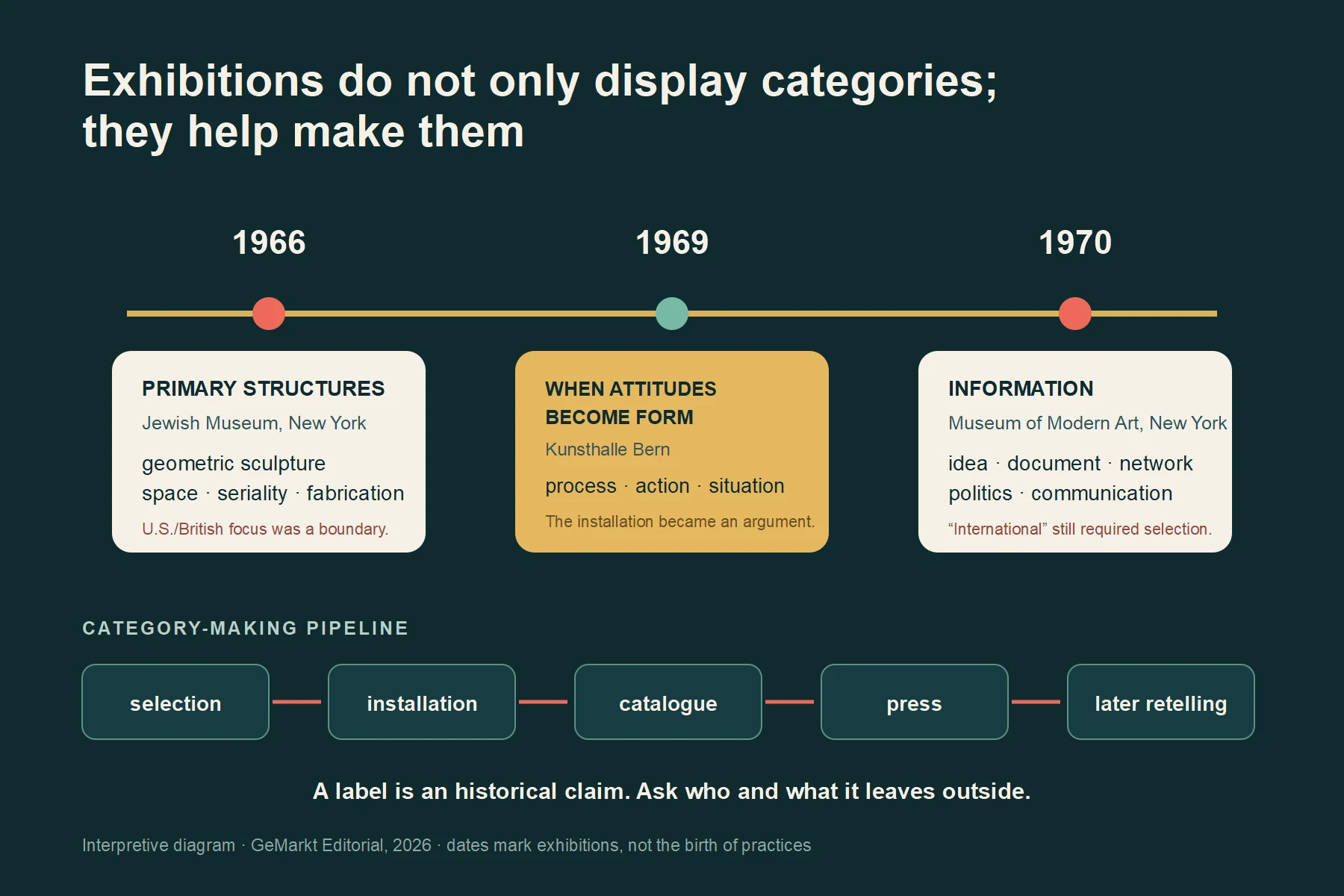
Selection places practices beside one another. Installation proposes relations in space. A catalogue names and reproduces. Press coverage turns a temporary arrangement into a public event. Later surveys retell the exhibition as an origin. At every stage, people and works fall outside.
The diagram compares three influential exhibitions without claiming that they invented Minimal or Conceptual art. Their dates mark institutional events, not the birth of a practice. Their value is evidential: catalogues, checklists, correspondence, photographs, and press releases let us study how a category was assembled.
When Attitudes Become Form made installation an argument
Harald Szeemann curated Live in Your Head: When Attitudes Become Form at Kunsthalle Bern in 1969. Fondazione Prada’s 2013 reconstruction describes Szeemann’s exhibition practice as a linguistic medium and attempted to preserve the original visual and spatial relations inside a different building.
The title shifted attention from finished things toward actions, processes, situations, and propositions. Yet the exhibition depended on selected artists, rooms, permissions, travel, installation, sponsorship, photographs, and a catalogue. Its later reconstruction asks whether fidelity lies in objects, spatial relations, atmosphere, or curatorial argument.
Information used the museum as a communications node
MoMA’s Information, curated by Kynaston McShine from 2 July to 20 September 1970, included more than 150 artists from fifteen countries. Archival files contain proposals, instructions, correspondence, photographs, publications, and research organised by country. Works involved conceptual, process, systems, earth, Arte Povera, political, film, and communications practices.
The catalogue was not merely a record. It carried artist contributions, diagrams, descriptions, and unrealised proposals, while the exhibition engaged television, postal exchange, polling, documentation, and anti-war politics. McShine later warned against a mythic claim that the title prophetically announced an “Information Age”; he recalled it arising from his research requests. That correction is a model of responsible historiography: later significance should not be projected backward as original intention.
Three exhibitions, three different boundaries
Primary Structures focused on younger American and British sculptors and helped organise reductive three-dimensional work. When Attitudes Become Form grouped processes and propositions through a curatorially assertive installation. Information adopted an international-report model and used documents and communication systems, though “international” still depended on travel, networks, and institutional selection.
None supplies a complete map. Jane Farver, Rachel Weiss, Luis Camnitzer, and an international curatorial team later organised Global Conceptualism: Points of Origin, 1950s–1980s around practices shaped by local histories. Their later self-criticism shows that enlarging a checklist is not enough.
A comparison matrix
| Analytical focus | Pop-related practice | Minimal-related practice | Conceptual/instruction practice | Performance/participatory practice |
|---|---|---|---|---|
| primary transfer | existing image changes context | design passes into fabricated object and room | proposition passes into a possible version | score or situation passes into bodily time |
| often hidden labour | printing, licensing, retail, publicity | fabricators, finishers, installers, conservators | editors, translators, administrators, realisers | performers, technicians, documentarians, hosts |
| key evidence | source image, edition, distribution route | drawings, invoices, material analysis, installation record | wording, correspondence, certificates, versions | score, programme, testimony, equipment, recording |
| common false conclusion | product imagery equals approval | simple form equals simple meaning | idea eliminates material | participation equals freedom |
| better question | who redirects whose public language? | which relations must fabrication preserve? | what is fixed, open, authorised, and recorded? | who has agency, exposure, credit, and control? |
The columns are lenses, not boxes. One work can occupy several. The purpose of comparison is to expose changing relations among decisions, labour, materials, institutions, and audiences.
Common survey traps
- Treating movements as a relay race: overlapping practices become falsely sequential.
- Equating technique with politics: screenprinting, seriality, participation, or video receives an automatic ideological value.
- Calling every repeated object Minimal: form is compared without local history, function, or social proposition.
- Calling Conceptual art immaterial: paper, communication, administration, bodies, property, and archives disappear from view.
- Confusing documentation with event: one photograph becomes the whole performance.
- Using “global” as a bigger checklist: work from elsewhere appears only as a delayed analogue of a U.S. or British category.
- Making participation automatically democratic: consent, risk, access, and institutional control go unexamined.
- Ignoring copyright: online visibility is mistaken for permission to reproduce.
Questions for close looking
- Which features repeat, and where do variation or error remain visible?
- What existed before the artist’s intervention: an image, product, rule, technology, movement, or social practice?
- Who made each material decision, and who performed the physical work?
- Does the work require a particular site, body, duration, or institution?
- What changes between proposition, execution, documentation, and later display?
- Which viewers can act, and what limits their action?
- What evidence supports the movement label: the artist’s words, a contemporary exhibition, later criticism, or formal resemblance?
- Who or what became less visible when the category was made?
Terms for object, system, instruction, and event
- appropriation: deliberate reuse or recontextualisation of an existing image, object, or convention; it does not by itself determine criticism, consent, or legality.
- fabrication: production of an artwork requiring resources or specialist makers beyond one artist’s direct handwork.
- seriality: organisation through repeated or systematically varied units.
- score: a written, visual, or otherwise encoded proposition for possible action or realisation.
- version: one authorised or historically related realisation whose permitted variables must be identified.
- participation: a structure in which a viewer or other person contributes materially, bodily, interpretively, or socially to the work.
- documentation: a trace or record that may evidence, interpret, authorise, or outlive an event without being identical to it.
- media ecology: the interacting channels, institutions, technologies, makers, and audiences through which images acquire and change meaning.
A working timeline, 1955–1975
| Date | Event | Why it matters here |
|---|---|---|
| 1956 | This Is Tomorrow opens at Whitechapel Gallery | collaboration and environment organise mass-media modernity |
| 1957 | O’Halloran photographs “Gisella” in a supermarket | a designed system of packaged choice precedes gallery Pop |
| 1960 | Bledsoe photographs fifty-star flag production | serial sign, skilled labour, and national spectacle share one workshop |
| 1960–63 | Lygia Clark makes Bichos | the object becomes contingent on handling |
| 1962 | Warhol exhibits thirty-two soup-can canvases | commercial package changes support, sequence, and institution |
| 1963 | Clark develops Caminhando | a participant’s irreversible act produces the work |
| 1964 | Ono publishes Grapefruit; Medalla makes the first Cloud Canyons; Oiticica begins Parangolés | instruction, process, and bodily participation emerge through different local routes |
| 1965 | Judd’s “Specific Objects” appears; Parangolés are activated around Opinião 65 | criticism and event test inherited object categories |
| 1966 | Primary Structures and 9 Evenings take place | exhibition and technical collaboration redistribute form and authorship |
| 1968 | AfriCOBRA forms; Kent begins Heroes and Sheroes | reproducible language serves collective, civil-rights, labour, and peace concerns |
| 1969 | When Attitudes Become Form opens; Jones-Hogu makes One People Unite | process exhibition and community-directed print circulation complicate one centre |
| 1970 | Information opens at MoMA | museum, catalogue, document, politics, and communications become linked nodes |
| 1975 | Lucy Lippard’s “Six Years” frame has already entered debate | retrospective naming begins to consolidate a heterogeneous field |
Source guide
For the two contextual photographs, begin with the Library of Congress object records for John T. Bledsoe’s flag workshop and Thomas J. O’Halloran’s supermarket shopper. Both supply creator, date, call number, digital identifier, and “no known restrictions” rights guidance.
For Pop and public print culture, consult the Whitechapel Gallery’s This Is Tomorrow archive account, the Warhol Museum’s lessons on Campbell’s soup and everyday objects, the Corita Art Center’s Heroes and Sheroes, and Smithsonian American Art Museum entries by Gabriella Shypula and museum educators on Barbara Jones-Hogu and One People Unite.
For Minimalism and fabrication, read Judd’s primary essay “Specific Objects” beside the Judd Foundation’s context for his writing, Dia’s account of delegated fabrication and spatial experience, and the Jewish Museum’s paired histories of Primary Structures and Other Primary Structures. The Getty Conservation Institute’s materials research helps distinguish industrial appearance from maintenance reality.
For instruction and participation, MoMA provides Ono’s Grapefruit instructions, its research on Fluxus in Tokyo, a close account of Clark’s Caminhando, and André Lepecki’s essay on Clark and performance. Use these with MAM Rio’s Portuguese records for Parangolés and Opinião 65, and Irene V. Small’s archive-based Hélio Oiticica: Folding the Frame.
For process, performance, and exhibition infrastructure, National Gallery Singapore’s David Medalla collection record documents Cloud Canyons materials and chronology. The Daniel Langlois Foundation preserves the research archive for 9 Evenings: Theatre and Engineering. Fondazione Prada records the research-led reconstruction of When Attitudes Become Form. MoMA’s Information exhibition record, McShine papers, and oral-history correction should be read together.
For historiography beyond a single centre, Jane Farver’s reflection on Global Conceptualism names the international curatorial team and local research structure; Rachel Weiss’s retrospective assessment foregrounds recoveries, omissions, and the difference between global links and local conditions. These are reflective sources, not a claim that one later exhibition solved the problem permanently.
Continue the Atlas route
The previous chapter follows abstraction, realism, institutions, and the cultural Cold War. The next chapter turns to feminist, queer, and body-based practices: who is permitted to appear, act, desire, speak, and control the terms of visibility?
When a work appears to remove image, hand, object, author, or permanence, ask where materials, labour, judgement, rights, and institutions moved.
Editorial record
About this article
- Author
- Publisher
- GeMarkt
- Published
- Updated
- Reviewed
- Internal source & rights check. Conducted by GeMarkt Research Review. This is an internal editorial check—not independent peer review.
- Source standard
- Art history source standardPrioritises object records and research sources, distinguishes evidence from interpretation, and states material uncertainty.
Found a claim that needs checking? Report a factual error.