Art History · Learning chapter
Atlas IV — The long nineteenth century · 1 of 7
Revolutions, academies, and empire, c. 1750–1850: who authorised public history?
How academies, revolutions, slavery, empire, museums, and reproduction authorised public history from David and Goya to Belley, Tipu's Tiger, and Trumbull.

.jpg)
What we’ll look at
Who turned images into public history during revolutions, and who was excluded?
A man in a white shirt raises both arms. A firing squad points rifles toward him. A lantern makes the condemned visible, but the soldiers’ faces disappear behind repeated backs and weapons. Francisco de Goya painted this Madrid execution in 1814, six years after the violence it depicts. Memory, selection, reconstruction, and a new political situation stand between event and image.
That distance is the subject of this chapter. Between about 1750 and 1850, revolutions repeatedly declared new publics, while academies, states, armies, museums, and publishers built the machinery through which those publics could see a past. The machinery did not simply record history. It ranked subjects, trained bodies, awarded access, paid for canvases, seized objects, selected walls, printed copies, and converted some scenes into civic memory.
The central question is therefore:
When revolutions claimed to speak for a public, which patrons, academies, states, armies, museums, publishers, and audiences gained the power to turn an image or object into public history—and who remained outside that authorised scene?
History painting was an institution before it was a style
“History painting” can mislead if it sounds like any picture of something that happened. In European academies it named the most prestigious category: ambitious compositions drawn from scripture, classical history, mythology, allegory, and, increasingly after 1789, contemporary events. The category demanded command of the human body, gesture, expression, costume, architecture, perspective, and narrative. Its high status was taught, judged, exhibited, and funded.
Scale mattered, but institutional permission mattered more. A portrait could carry the intellectual and political work of history painting. A small cabinet picture could prepare a national monument. An automaton could become an imperial history object through seizure and museum display. The five studies here therefore include three paintings, a portrait that presses against category boundaries, and a mechanical tiger.
The period does not move neatly from “Neoclassical reason” to “Romantic emotion.” David’s polished classicism served several regimes; Goya’s violence remained deliberately constructed; Girodet’s academic finish met a Black legislator whose political world exceeded France; and Mysorean and United States objects created rival histories of rule.
Scope: five objects, several publics, no single revolution
The route is selective. It begins with David’s Death of Socrates in pre-revolutionary Paris, turns to Goya’s reconstruction of occupation and execution in Madrid, then reads Girodet’s portrait of Jean-Baptiste Belley against the Haitian Revolution and French abolition. It follows Tipu’s Tiger from the palace at Srirangapatna to an East India Company museum in London, and ends with Trumbull’s small Declaration of Independence and its enlargement for the United States Capitol.
These cases are connected, not equivalent. “Revolution” did not mean the same thing to an enslaved insurgent in Saint-Domingue, a deputy in Paris, a court artist in Madrid, a Mysorean ruler resisting a company-state, or a legislator in Washington.
The chapter uses linked objects to expose a recurring problem: a public becomes visible through institutions with gates. Those gates may open wider while remaining unequal.
Academies ranked subjects and trained bodies
The French Royal Academy of Painting and Sculpture tied professional status to a hierarchy of genres, approved training, competitions, membership, and court patronage. Its branch in Rome, founded in 1666, placed classical monuments, anatomy, life drawing, copying, and royal commissions at the centre of education. The Prix de Rome, established in 1674, funded selected artists to study there. David won it in 1774 after repeated attempts.
This system trained more than technique. It trained historical plausibility: which gesture looked noble, which body could embody virtue, which costume signalled antiquity, and how a composition directed moral judgement. Antique sculpture and Renaissance painting became reusable authorities. An artist learned to make a frozen instant legible as cause, choice, and consequence.
Access was restricted by gender, class, sponsorship, and racialised ideas about whose body could represent universality. Women became academicians and exhibitors in small numbers, under constraints that included limited access to nude life study. Model, student, patron, and history painter were not equally available positions.
The Salon made judgement public but not equal
The Paris Salon brought academic art before crowds. The Louvre’s Salon Carré had been assigned to the Academy in 1692; from 1737 its exhibitions became major public events. Paintings hung densely in rows, criticism circulated in print, and reputations could be made beyond a court chamber or private collection.
“Public” did not mean unfiltered. Before the Revolution, exhibition was tied to Academy membership. After the Academy’s abolition in 1793, the Salon admitted a wider field but retained selection by jury. Space, hanging position, catalogue language, criticism, and state purchase continued to distribute attention unequally. A viewer might enter without owning the work, yet institutions still decided what could be viewed together and under what name.
The Salon thus changed art’s social address. It made judgement collective, argumentative, and reproducible without making it neutral. The question shifted from whether gatekeeping existed to who controlled its new forms.
David turned ancient death into present moral pressure
In brief: Jacques-Louis David completed The Death of Socrates in Paris in 1787, two years before the French Revolution began. He used an ancient death to raise questions about virtue and resistance to unjust authority.
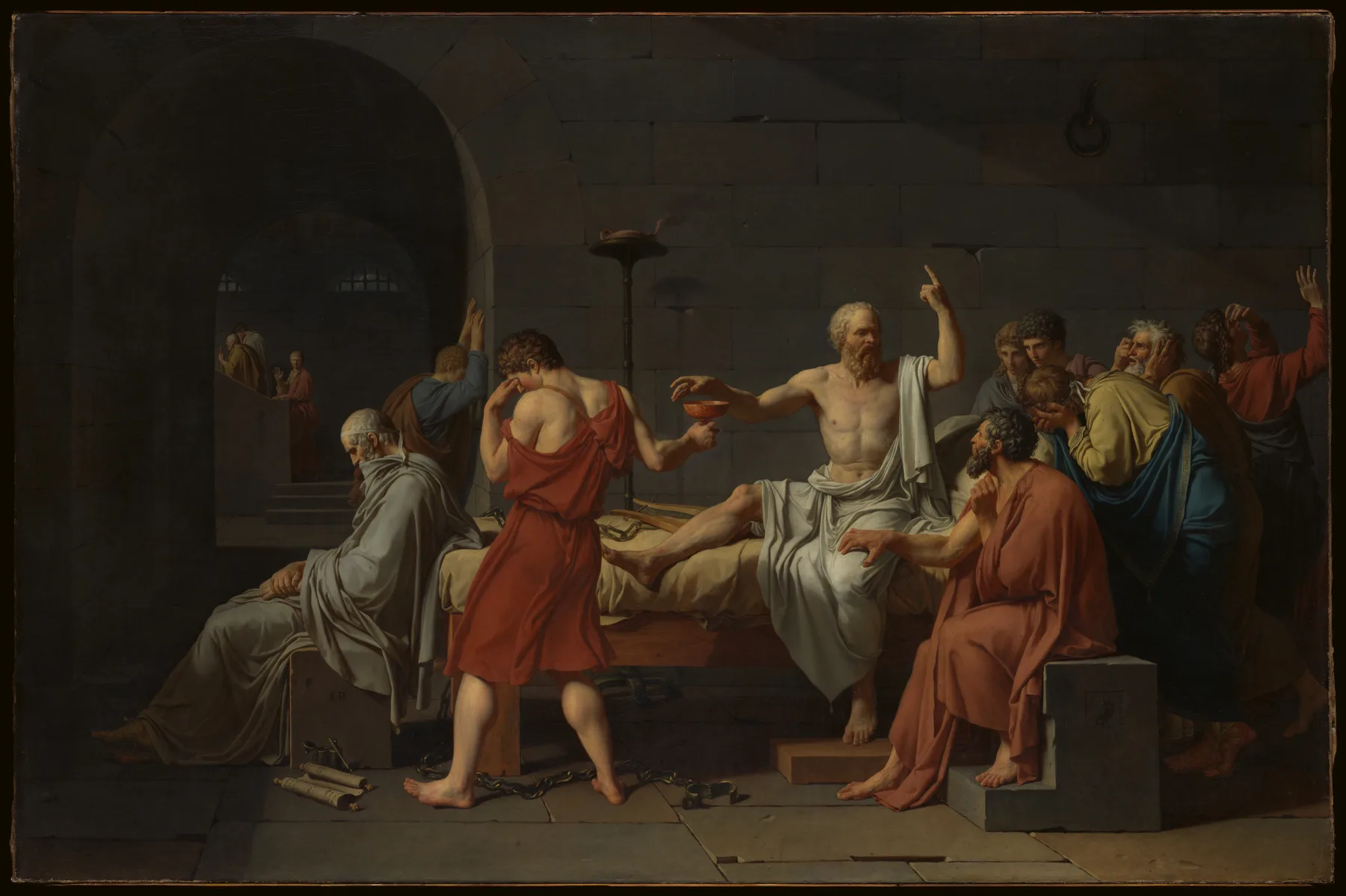
David gives the story a severe, shallow stage. Stone blocks, a barred opening, and a low bed hold the figures parallel to the picture surface. Socrates reaches toward the poison without looking at it. His other hand points upward as he continues to teach. Grief travels outward: the cup-bearer turns away, Crito grips the philosopher’s thigh, disciples close their faces or raise their hands.
The action is not archaeologically transparent. Plato, seated at the foot of the bed, was not present at Socrates’ death. David includes him as the author whose Phaedo preserved the account. The old writer appears as witness to his own text. A lyre invokes the dialogue’s discussion of body and soul. Historical authority is constructed through anachronism, not achieved by eliminating it.
The offered cup and approaching hand create an interval before the fatal act. Moral choice becomes visible as controlled delay.
Socrates was commissioned before the Revolution
Charles-Louis Trudaine de Montigny, a wealthy councillor in the Paris parlement, commissioned the subject around 1786; David completed it in 1787, two years before the Bastille fell. The artist had explored the story earlier, then revised it through drawings and antiquarian consultation.
The work illuminates a pre-revolutionary appetite for virtue and resistance to unjust authority; it does not predict 1789. During the Terror, Trudaine appealed unsuccessfully to David and was guillotined in 1794. David, by then a revolutionary politician, was imprisoned after Robespierre’s fall. The afterlife made the dilemma newly personal without changing the original date.
This is a useful test for political interpretation: begin with commission, exhibition, and chronology before turning resemblance into intention.
Classical clarity was political equipment, not one politics
David’s contours, planar arrangement, controlled light, and polished surface make gesture readable. Those devices are often called Neoclassical, but they do not contain one political programme. The same visual equipment could dignify royal patronage, republican sacrifice, revolutionary martyrdom, or imperial rule.
David himself worked for monarchy, radical revolutionaries, and Napoleon. In 1804 Napoleon appointed him First Painter to the Emperor. Students trained in his studio adapted its discipline to sensual mythology, portraiture, battle, plague, medieval history, and colonial crisis. Form travelled more easily than allegiance.
The safest claim is therefore limited: classical reference offered an authoritative language for bodies under pressure, exemplary acts, and civic judgement. Who used that authority, for what patron, and before which public must be established object by object.
Revolution changed patrons faster than training
The National Convention abolished the Royal Academy in 1793, an act David supported, and suspended the Prix de Rome until 1797. Yet academic habits did not vanish with a decree. Drawing schools, juries, studios, state commissions, prizes, and the Roman curriculum were reorganised rather than erased. David’s pupils carried his methods into the nineteenth century.
The Revolution accelerated another shift: recent events became worthy of ambitious art. Ancient sacrifice did not disappear, but contemporary martyrs, battles, assemblies, and political leaders entered the field with new urgency. Napoleon’s regime then used the same opening to commission images of present imperial history.
Institutional rupture and technical continuity coexisted. New sovereigns inherited old visual tools; old tools acquired new audiences.
Goya painted an execution after occupation ended
Goya’s Third of May 1808 is not eyewitness reportage made during the shooting. French forces occupied Madrid in 1808; popular resistance on 2 May was followed by executions. Goya began the large paired canvases after French rule ended. Prado research places their execution between June and October 1814, within the unstable restoration of Ferdinand VII.
The delay matters. The work reconstructs an event after six years of war, regime changes, and Goya’s continued service as court painter under Joseph Bonaparte. It belongs beside The Second of May 1808, where chaotic combat answers the disciplined violence of the firing squad. The pair does not divide cleanly into innocent Spanish action and uniquely French cruelty; Prado scholarship stresses reciprocal brutality and Goya’s pessimism about dehumanising violence.
History painting here no longer requires ancient distance. Yet it still requires arrangement.
The lantern makes violence visible without explaining it
The lantern at the centre is a machine of exposure. It illuminates the white shirt and yellow trousers of the kneeling man, the dead and bleeding bodies, and the faces of those waiting. It also throws the firing squad into a darker repeated mass. Rifles link the soldiers into an instrument; their hidden faces refuse the viewer an individual villain.
The condemned man’s raised arms can recall crucifixion, but the painting does not convert him into a serene saint. Fear, disbelief, prayer, grief, and physical damage coexist. The church on the horizon does not intervene. The ground tilts upward and compresses escape.
Light therefore produces evidence without producing certainty. We can see who is exposed to fire. We cannot reduce the scene to one heroic biography, exact topographical transcript, or universal religious allegory. The painting gives violence form while withholding consolation.
A national commission is not neutral memory
Goya proposed commemorating the Madrid uprising, after which the Regency Council authorised and paid for the work. The Prado record rejects the older assumption that the canvases were made for street display. They went to the Royal Palace in 1814, entered the Prado before 1834, and were not listed in its catalogue until 1872.
That sequence complicates “public.” A work may be national in subject and official in funding yet have a limited early audience. Later museum display can make it foundational and invite viewers to project that status backward.
The restoration context also matters. Ferdinand VII abolished the 1812 Constitution as he returned. An image of popular resistance could support national memory without endorsing constitutional government. Commemoration joins a political present; it never stands outside one.
Contemporary history broke academic distance
In academic theory, temporal distance allowed history to be purified into an exemplary action. Goya’s executed bodies refuse that purification. Anonymous contemporary clothing, blood, dirt, darkness, and a mechanically repeated volley make the event feel unresolved.
That does not make the painting anti-academic in every respect. It still selects a climax, orchestrates gesture, concentrates light, and relates a pair of canvases. “Immediate” effect is the result of composition. The shift lies in what could bear historical seriousness: unnamed civilians and recent state violence now occupy a scale once reserved for scripture and antiquity.
The public history problem becomes sharper. If contemporary suffering can enter the grand image, who decides which suffering acquires a wall?
Saint-Domingue forced universal language to confront slavery
The French Declaration of the Rights of Man and of the Citizen announced equality in 1789 while slavery and plantation rule continued in the colonies. Enslaved people and free people of colour did not wait for metropolitan principle to complete itself. Insurrection expanded in Saint-Domingue in 1791. Republican commissioners proclaimed emancipation there in 1793 amid war, revolt, and political crisis.
Jean-Baptiste Belley, Jean-Baptiste Mills, and Louis-Pierre Dufay travelled as the colony’s elected delegation. Their admission to the National Convention preceded the decree of 4 February 1794 abolishing slavery across French colonies. The National Assembly’s own history links that vote to insurgency and the Saint-Domingue delegation, not to a solitary gift from Paris.
The order of cause and image matters. A portrait painted in France did not create emancipation. It entered a political field transformed by Black collective action in the Caribbean.
Belley appears as legislator, veteran, and constructed image
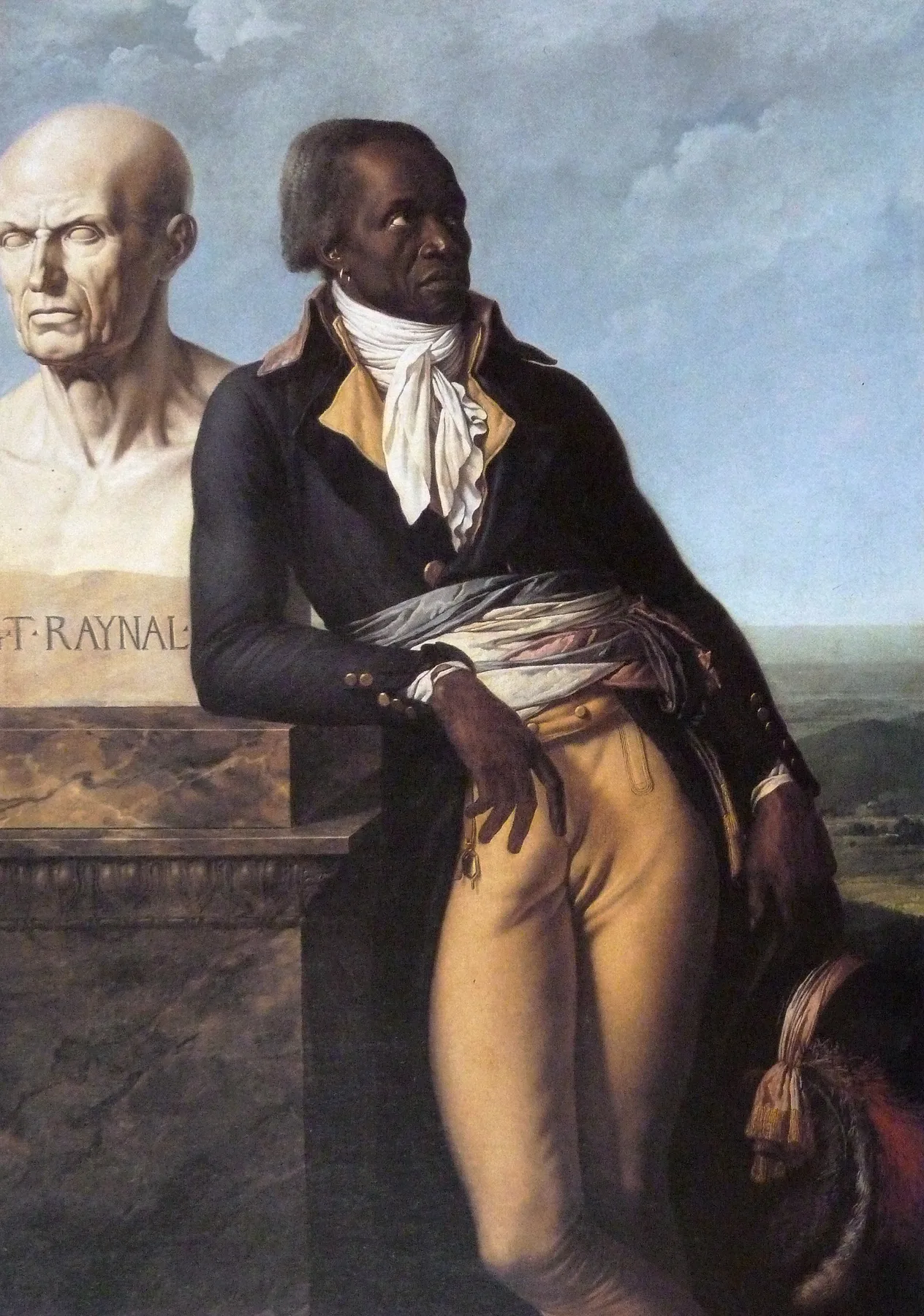

Belley occupies nearly the full height of Girodet’s canvas. His dark coat, tricolour sash, pale trousers, earring, and relaxed contrapposto combine official dress with individual presence. The cloudy landscape opens toward Saint-Domingue. Beside him stands a white marble bust of Guillaume-Thomas Raynal, whose writing criticised colonial slavery.
Versailles describes the work as the first representation of a Black man in the official position of a Western political legislator. Belley had been enslaved, became free, served in the military, and represented Saint-Domingue in revolutionary government. By 1797 his legislative mandate had ended. No commission has been found; the scale and circumstances suggest Girodet initiated the work.
That last point limits what we can claim about self-fashioning. Belley sat for the portrait, but no surviving evidence tells us that he selected the bust, pose, or intended audience.
The portrait gives presence and controls it
The work is often praised as an abolitionist landmark, and it deserves close attention as an unprecedented named Black political portrait in the Salon world. It also submits Belley to an intense racialised gaze. Girodet models skin, fabric, anatomy, and the contrast between living Black body and white marble with conspicuous virtuosity. The composition makes Belley visible while making difference a spectacle.
Raynal’s bust supplies a genealogy of European philosophical authority. Belley leans on it, and their heads nearly align, but the stone writer remains an organising reference for the living legislator. Darcy Grimaldo Grigsby’s study of the portrait has made this mixture of liberty, empire, race, body, and desire difficult to flatten into uncomplicated celebration.
The picture asserts Belley’s official stature while controlling the terms of his Parisian visibility. Presence is not the same as authorship.
French abolition was won, reversed, and exceeded
The abolition of 1794 was real and historically consequential, but neither secure nor uniformly implemented. Bonaparte’s government used the law of 20 May 1802 and further colonial measures to maintain or restore slavery and the slave trade where imperial control allowed. France abolished colonial slavery again in 1848.
Belley’s own trajectory registers the reversal. He returned to Saint-Domingue in military service, was removed during the Leclerc expedition, imprisoned at Belle-Île, and died there in 1805. A portrait that once made republican citizenship visible survived the state that curtailed it.
Dates alone can turn this into a sequence of French decrees. The more accurate structure includes enslaved insurgency, military struggle, free people of colour, competing colonial factions, and the limits of metropolitan enforcement. Law named freedom after people had made colonial slavery ungovernable.
Haiti cannot be contained by a French portrait
The Haitian Revolution defeated the expedition sent to restore French control, and Haiti declared independence on 1 January 1804. It became the first independent Black republic produced by a successful revolt against slavery and colonial rule. This outcome exceeded the political horizon of Girodet’s 1797 portrait.
Belley represented Saint-Domingue in a French assembly; the painting frames emancipation through French republican office and Raynal’s philosophy. It cannot stand for all Haitian actors, rival leaders, rural labourers, women, soldiers, or the independent state that followed. Nor should Belley’s French citizenship be dismissed as false simply because later events took another path.
The portrait is most useful as a threshold object. It shows that Black political authority entered an elite Paris exhibition system. It also reveals how that system could translate a Caribbean revolution into one male body, one French office, and one European philosophical companion.
Tipu’s Tiger made empire audible from Mysore
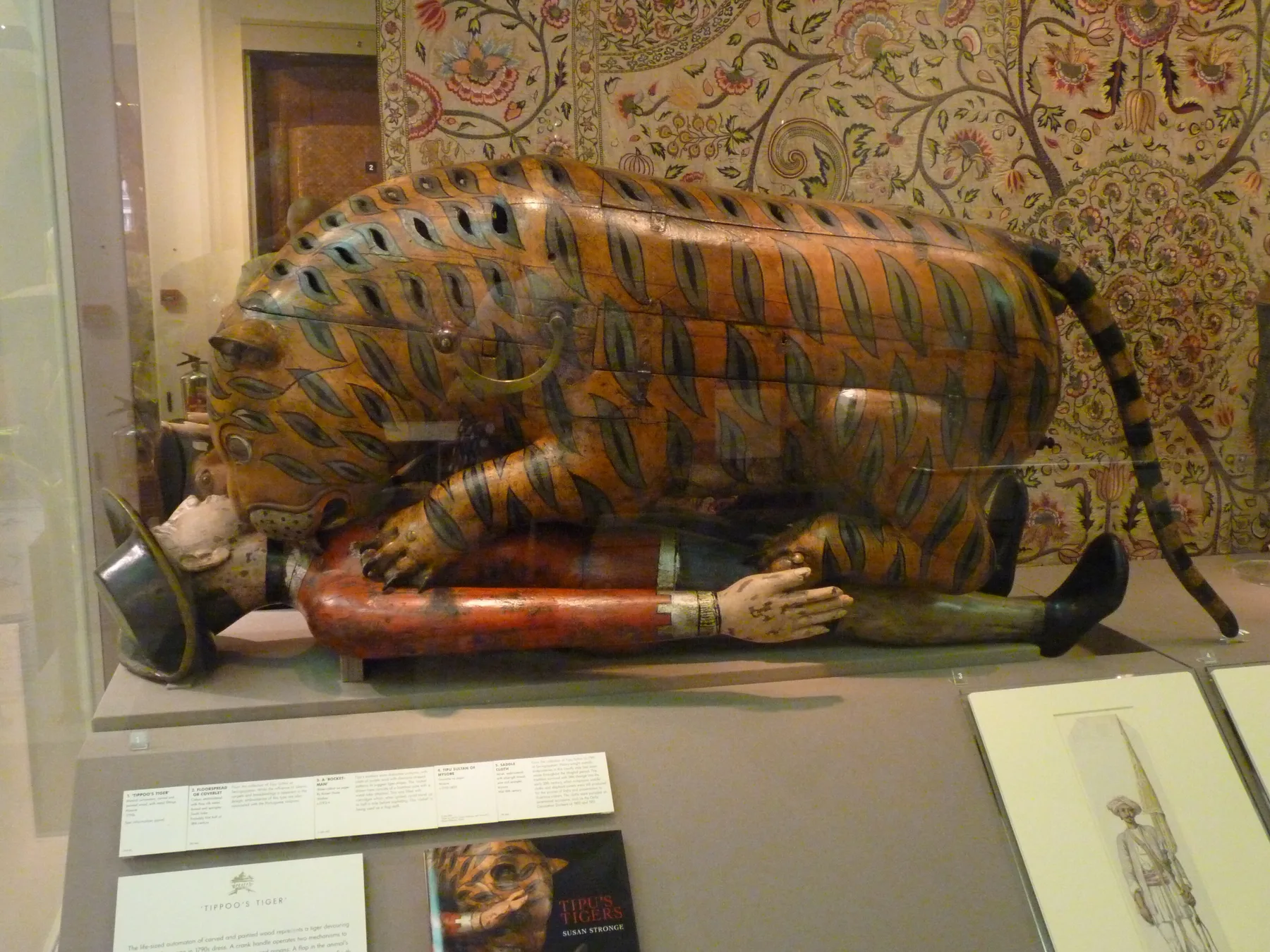

Tipu’s Tiger is almost life-size. A tiger pins a European soldier and closes its teeth around him. Turning a handle operates bellows and an organ: the soldier’s arm moves while the mechanism produces a sustained cry. Courtly emblem, mechanical curiosity, music, bodily comedy, and threatened violence occupy one object.
It was made for Tipu Sultan, ruler of Mysore from 1782 to 1799 and a determined opponent of East India Company expansion. Tiger heads and stripes appeared across his throne, arms, coinage, uniforms, and other courtly and military objects. Yet the motif should not be reduced to an English-versus-Indian cartoon. Kate Brittlebank places Tipu’s tiger imagery within South Indian ideas of sovereignty, sacred power, and a shared religious landscape, while also recognising its dynastic association with his father Haidar Ali.
The automaton’s unknown makers translated royal power into sound. Its victim does not remain a painted sign; the conquered body is repeatedly made to move and moan.
Seizure turned resistance into trophy
The East India Company’s army stormed Srirangapatna in 1799, killed Tipu, and looted the city and palace. The tiger was shipped to London. That change in location reversed the object’s political situation without changing its physical subject.
In Mysore, a royal owner could activate an image of a tiger overcoming a European. In London, Company officials and visitors could encounter the same image after the ruler’s defeat. The object became proof that the power it celebrated had been conquered and possessed. A resistant joke was folded into victory.
“Trophy” therefore describes a relation, not a visual style. Seizure, transport, inventory, and display can turn an object into evidence for the victor. The object’s earlier meanings persist, but under a new custodian’s frame.
The museum rewrote who controlled the joke
The Company displayed the tiger in its East India Museum; it later moved to the South Kensington Museum, now the V&A. Visitors could once operate the mechanism. Display made Company expansion sensible as curiosity and entertainment.
The museum did not merely preserve an endangered artefact. It inherited material produced through conquest and assigned it a London public. Labels, placement, demonstrations, and institutional ownership determined whether viewers encountered Mysorean sovereignty, British victory, mechanical ingenuity, caricature, or some unstable combination.
The V&A’s current history explicitly names the 1799 looting. That is a meaningful interpretive change, not a reversal of possession. Provenance can expose the force that an older display naturalised, while questions of custody remain.
Trumbull assembled founders who never stood together
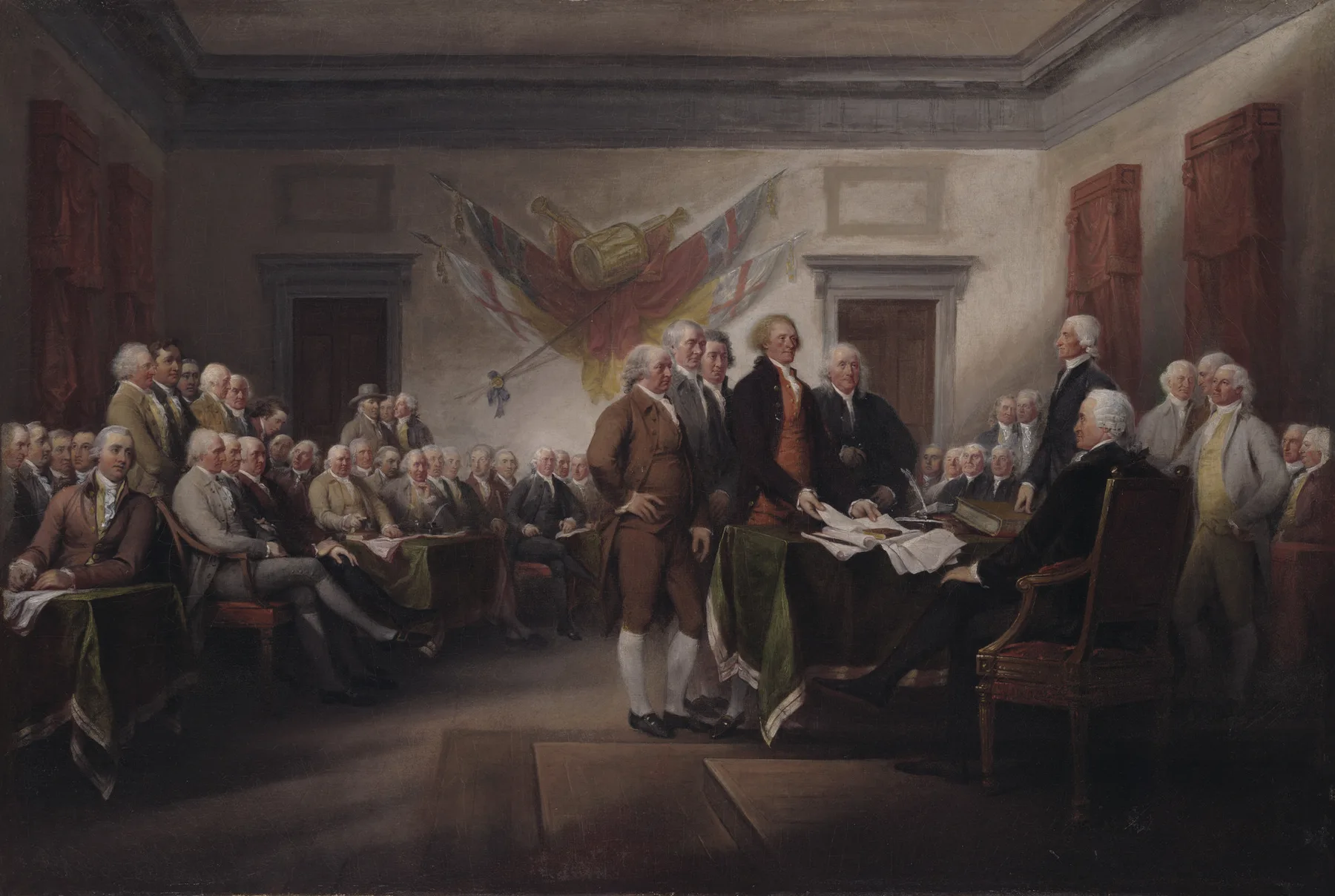

Trumbull did not paint a signing on 4 July. He represented the drafting committee presenting its text to Congress on 28 June 1776. Nor did every depicted delegate stand together at that instant. Trumbull spent decades gathering likenesses from life, memory, and other portraits. He included some people absent from the meeting and omitted others when he judged that no authoritative likeness was available.
The small canvas began in the 1780s and remained a long project. Its architecture also reconstructs memory: Jefferson supplied a sketch of the room whose doors, windows, and furnishings proved inaccurate. These departures are not minor embarrassments around an otherwise photographic core. They reveal the work’s purpose—to preserve recognisable founders in a legible civic assembly.
Collective origin is made through portrait collection, selection, and staged simultaneity.
Congress converted a painting into civic architecture
In 1817 the United States Congress authorised the president to employ Trumbull to make four paintings of major revolutionary events for the Capitol. The monumental Declaration of Independence, completed in 1818, enlarged the small composition to roughly 3.7 by 5.5 metres. It entered the Rotunda, a ceremonial interior where state architecture and image reinforce one another.
Congress selected which episodes deserved permanent national scale. Trumbull’s assembly became one of four scenes moving from declaration and military surrender to Washington returning command—a sequence that turns contested revolution into orderly civic inheritance.
The small painting, the Capitol canvas, engravings, guide keys, textbooks, stamps, and later reproductions are not interchangeable objects. Together they show how an image becomes canonical through repetition across institutions and media.
The universal public had material exclusions
The Declaration’s equality language travelled far beyond the intentions and practices of its signers. Abolitionists and enslaved petitioners used revolutionary principles to press claims the founding government denied. That productive afterlife should not conceal the 1776 political field.
Trumbull’s subject is a legislative body, so the absence of women, enslaved people, and Indigenous nations is not by itself evidence that the painter secretly removed them from the room. It does identify who could appear as an authorised national founder. The new republic maintained slavery; Jefferson and many other political leaders enslaved people. Formal political participation was organised around men and unequally restricted by race, property, and state law. The Declaration itself framed Indigenous resistance through colonial hostility rather than recognising Native sovereignty.
The image’s crowded white male assembly therefore visualises a real but partial public. Later viewers must hold two facts together: universal language enabled radical future claims, and the institutions that first monumentalised it excluded many of those claimants.
Prints, museums, and replicas multiplied authority
An image becomes public through circulation as well as access to an original. Trumbull arranged an engraving after his composition and sold subscriptions. Goya’s reputation grew through museum installation and reproduction long after the uncertain early display of the 1814 canvases. Salon criticism extended paintings into text. Tipu’s Tiger became known through demonstrations, descriptions, caricature, and museum publicity.
Reproduction extends access beyond palace, capital, or metropolitan museum. It can also strip away scale, sequence, material, sound, frame, and provenance, stabilising an interpretation that the object complicates.
Public history is thus an ecology of original, site, copy, caption, and audience. Authority accumulates when the same selection is repeated without its conditions being repeated with it.
Revolutions and empires were entangled
It is tempting to place revolution on the side of freedom and empire on the side of domination. The objects resist that diagram. Revolutionary France abolished slavery, restored colonial slavery under Bonaparte, and became an empire. The Haitian Revolution converted universal claims into anticolonial independence. The early United States rejected British rule while maintaining slavery and expanding onto Indigenous lands. The East India Company operated as both corporation and territorial power. Mysore’s resistance to Company conquest was also a royal project with its own hierarchies.
Images travelled through the same entanglement. Academic training survived regime change. Museums opened royal collections to wider publics while imperial seizure filled galleries. Portraits made new citizens visible while racialising their bodies. National memorials universalised political ideals through selective founders.
The goal is not to declare every claim hypocritical and stop looking. It is to ask how freedom was made visible, which institutions authorised that visibility, and which coercive systems remained inside the frame or just beyond it.
Five works, five authorising systems
David’s work moved from a private commission and academic training into the Salon and later the museum canon. Goya’s painting went from an artist’s proposal and Regency funding to the royal collection and the Prado. Girodet’s portrait seems to have begun with the artist before entering the Salon and a state collection. The East India Company turned Tipu’s Tiger into a trophy through conquest. Congress, the Capitol, and reproductions gave Trumbull’s project national authority. No single institution explains all five; each transfer changed the work’s meaning.
A comparison matrix
| Work | First authorising structure | Public-making mechanism | What it makes visible | What requires caution |
|---|---|---|---|---|
| David, Death of Socrates | Private commission plus academic training | Salon reputation and later museum canon | Moral choice through classical history | It predates 1789 and is not a coded forecast |
| Goya, Third of May | Artist’s proposal accepted by Regency government | Palace custody, later Prado display and reproduction | Anonymous civilians under state violence | Painted in 1814; national memory is constructed |
| Girodet, Belley | Probably artist-initiated portrait | Exhibition, criticism, state collection | A named Black former legislator at monumental scale | Belley’s control over pose and programme is unknown |
| Tipu’s Tiger | Mysorean court and unknown specialist makers | Performance, seizure, Company museum, V&A | Royal resistance made mechanical and audible | London display reverses the object’s power relation |
| Trumbull, Declaration | Artist’s long portrait project, then Congress | Capitol architecture, engraving, mass reproduction | Founders assembled as a civic body | It reconstructs 28 June and visualises a partial public |
What the surviving archive overrepresents
Large canvases, official portraits, palace objects, congressional commissions, inventories, and museum trophies leave substantial records because powerful institutions preserved them. Their survival can make elite authorisation look like the whole visual culture of revolution.
Ephemeral banners, clothing, cheap prints, songs, destroyed monuments, domestic images, and unnamed makers survive unevenly. Enslaved and colonised people often appear in archives made by institutions that controlled them. A rich record may preserve institutional attention rather than community priorities.
Absence should not be filled with invented certainty. It should change the question: who had the resources to make durable objects, whose names entered catalogues, what was seized, what wore out, and what later collectors considered worth keeping?
Common survey traps
“Neoclassicism caused revolution.” Classical form was politically flexible. Establish patron, date, audience, and use.
“Romanticism replaced reason with feeling.” Goya’s terror is carefully structured; David’s clarity is emotionally charged. Style labels do not divide human faculties.
“The state commission tells the state’s official truth.” Commissions can contain ambiguity, conflict, and meanings a regime cannot control. They still belong to material systems of payment and display.
“Belley embodies the Haitian Revolution.” He is a specific former deputy represented by a French artist in 1797. Haiti’s revolution was collective and continued beyond the portrait’s French republican frame.
“Tipu’s Tiger has one anti-British meaning.” Its Mysorean royal setting, South Indian symbolism, mechanism, seizure, and London afterlife form distinct contexts.
“Trumbull painted the signing.” The scene reconstructs the committee’s presentation of a draft on 28 June.
“A museum public cancels imperial provenance.” Wider access and violent acquisition can coexist.
Questions for close looking
- What exact moment does the object select, and what happened before and after it?
- Which bodies carry action, authority, fear, virtue, or defeat?
- Does light reveal evidence, confer dignity, or organise hierarchy?
- What sources did the maker use: eyewitness memory, text, portrait sitting, earlier image, court symbol, or institutional instruction?
- Who commissioned, proposed, paid for, seized, exhibited, catalogued, or reproduced the work?
- Was its first audience private, courtly, exhibition-going, military, metropolitan, legislative, or museum-based?
- How did a change of site alter the object’s political relation to its viewer?
- Which historical actors appear by name, which as types, and which only through contextual research?
- Does a universal claim describe existing rights, a contested aspiration, or both?
- What would you need to know before calling the work revolutionary, imperial, abolitionist, national, or public?
Terms for revolutions, academies, and empire
Academy: an institution that regulated training, membership, competition, exhibition, and professional prestige; academies differed by city and period.
History painting: the academically prestigious construction of exemplary narrative from religious, classical, allegorical, literary, or contemporary subjects.
Salon: a major public exhibition in Paris tied first to the Royal Academy and later to juried state systems; also the critical culture surrounding it.
Neoclassicism: a varied set of practices drawing authority from ancient Mediterranean art and modern ideas of clarity, contour, virtue, and order; not one political allegiance.
Public: an audience produced through access, address, media, and institutions, not a synonym for everyone.
Authorisation: the chain through which a subject gains resources, legitimacy, visibility, and repetition—commission, training, jury, state, seizure, museum, publisher, or audience response.
Company-state: a commercial corporation exercising governmental and military power; the East India Company’s territorial expansion makes the term useful here.
Trophy: an object whose seizure and display materialise victory, even when its original imagery resists the victor.
Abolition: the legal ending of slavery, produced through political struggle and implemented unevenly; a decree, lived emancipation, and durable freedom are not identical.
A working timeline, c. 1750–1850
- 1774: David wins the Prix de Rome.
- 1776: the United States Declaration of Independence is adopted.
- 1782–1799: Tipu Sultan rules Mysore; the tiger automaton is made during the 1780s or 1790s.
- 1787: David completes The Death of Socrates.
- 1789: the French Revolution begins; the Declaration of the Rights of Man and of the Citizen is adopted.
- 1791: mass insurrection expands in Saint-Domingue.
- 1793: the French Royal Academy is abolished; emancipation is proclaimed in Saint-Domingue.
- 1794: the National Convention abolishes slavery in the French colonies.
- 1797: Girodet paints Belley after his legislative mandate ends.
- 1798: the portrait is shown at the Paris Salon.
- 1799: Company forces capture Srirangapatna; Tipu is killed and his palace is looted.
- 1802: Bonaparte’s government maintains or restores colonial slavery and the slave trade through law and force.
- 1804: Haiti declares independence; Napoleon becomes emperor and appoints David First Painter.
- 1808: uprising and executions occur in Madrid under French occupation.
- 1814: Goya paints the Second and Third of May canvases after French rule ends.
- 1817: Congress commissions Trumbull’s four Capitol history paintings.
- 1818: the monumental Declaration of Independence is completed.
- 1826: Trumbull’s revolutionary canvases are installed in the Capitol Rotunda.
- 1848: France abolishes colonial slavery again; revolutions across Europe renew questions of public sovereignty.
Source guide
The object records establish titles, dates, dimensions, collections, and provenance: the Met on David’s painting and Perrin Stein on its preparatory drawing and commission; the Museo del Prado catalogue and its research exhibition Goya in Times of War; Versailles on Belley; the V&A on Tipu’s Tiger; the Yale University Art Gallery record; and the Architect of the Capitol on Trumbull’s monumental version.
Institutional histories support the chapter’s account of mediation: Kathryn Calley Galitz’s French Academy in Rome and legacy of David; the Louvre’s histories of the Salon Carré and public museum; the French National Assembly on the 1794 abolition debate; the text of the 20 May 1802 law; and the National Archives on the 1848 abolition decree.
Named scholarship prevents the objects from becoming illustrations of a European-only chronology: Kate Brittlebank’s “Sakti and Barakat: The Power of Tipu’s Tiger” places the emblem in a South Indian field of kingship and religious meaning; Darcy Grimaldo Grigsby’s Extremities: Painting Empire in Post-Revolutionary France supplies a major critical account of Girodet, race, body, and empire; and Luce-Marie Albigès’s archival study of Belley connects portrait, declarations, and Bonapartist records.
For the United States case, compare the National Archives transcript and history of the Declaration, the 1817 congressional resolution commissioning Trumbull, the Smithsonian’s history of the image and its reproductions, Monticello’s research on liberty and slavery, and the National Park Service’s primary-source lesson pairing a 1776 newspaper printing with slavery advertisements.
Image rights were checked separately from object metadata. The Goya and Trumbull files are faithful public-domain reproductions marked on Wikimedia Commons; the Belley file is CC0; the Met file is Open Access/CC0; and Ricardo Tulio Gandelman’s Tipu photograph is CC BY 2.0. Each displayed image records creator, source, licence, dimensions, and the fact of resizing without cropping.
Continue the Atlas route
Read this chapter after Rococo and global luxury, c. 1700–1789 to see how rooms, materials, and extraction entered the revolutionary period. Return to African kingdoms and Atlantic encounter, c. 1450–1750 and Indigenous and colonial American visual worlds, c. 1492–1750 before treating Atlantic revolutions as a purely European intellectual export.
The next Atlas chapter follows industrialisation, photography, and mass print after 1800. Its central problem changes from who could authorise a grand public history to how new machines, cities, commodities, and reproducible images altered the scale and speed of visibility.
Editorial record
About this article
- Author
- Publisher
- GeMarkt
- Published
- Updated
- Reviewed
- Internal source & rights check. Conducted by GeMarkt Research Review. This is an internal editorial check—not independent peer review.
- Source standard
- Art history source standardPrioritises object records and research sources, distinguishes evidence from interpretation, and states material uncertainty.
Found a claim that needs checking? Report a factual error.