Art History · Learning chapter
Methods · 3 of 6
Who makes an art period? Chronology, labels, and survival bias
Learn how art-historical periods are built, dated, and revised—and how survival, collecting, and cataloguing shape the histories we inherit.

What we’ll look at
Who creates art-historical periods, and what do their labels hide?
Open the Mérode Triptych and the first puzzle is not what it depicts. An angel has entered a furnished room; Mary reads beside a table; tiny Christ flies toward her carrying a cross. The donors wait outside the central panel, while Joseph works in a shop on the right. The puzzle is where—historically—to put it.
The Metropolitan Museum of Art catalogues the triptych as the work of the workshop of Robert Campin, made around 1427–32 in Tournai or the South Netherlands. A survey might place it in the Northern Renaissance. Another course might call it Early Netherlandish painting. A historian of devotion could treat it as a late medieval object for private prayer. A history organised by political geography might situate it in the Burgundian Netherlands. None of those labels changes the oak panels. Each changes the questions that surround them.
So who makes an art period? Rulers and institutions create calendars, dynasties, reigns, eras, and reforms. Makers inherit and alter techniques. Archaeologists group material patterns. Collectors and museums preserve some objects and not others. Historians select names and boundaries. Publishers, teachers, databases, and students repeat them. A period is made across all these actions.
This does not make periods false. It makes them tools with authors, evidence, and consequences. The period is a handle, not a room. It helps us lift a difficult body of evidence, but the object does not live inside it.
A period is a claim, not a container
A period label combines three things: a name, a date range, and a place or field. “Edo period” links Japan’s political rule to dates usually given as 1603 or 1615–1868. “Renaissance” is a later story of cultural renewal, and its dates and geography change by author. “Middle Kingdom” groups part of Egyptian history through modern reconstructions of rulers and state formation. “Wari” may describe a political power, a material culture, a style, an archaeological horizon—related evidence found across a broad area—or several at once.
The distinctions matter. A political period may begin with an accession or conquest, but potters do not replace every technique that morning. A movement may be named by its participants, mocked by its critics, or invented after the fact. A material phase can cross borders that political histories treat as decisive. A museum department can make “Islamic art,” “Asian art,” or “European paintings” look like natural categories even though each contains different relations among geography, religion, language, medium, and time.
PeriodO offers a useful model. Its public-domain gazetteer records period definitions found in scholarly sources. Each definition is tied to a name, temporal coverage, spatial coverage, and an authority. The accompanying peer-reviewed account by Adam Rabinowitz and colleagues treats periods as assertions made in sources rather than universal blocks on one master timeline. Overlapping or conflicting definitions are therefore data, not errors to be silently erased.
When you meet a period, ask first: whose definition am I using, for which evidence, in which place?
The label audit: five questions before you trust a period
A label audit takes five minutes. It can prevent an essay from turning a convenient heading into a historical cause.
- Who uses the name? Is it contemporary with the works, a later scholarly construction, a museum department, a political chronology, or a teaching convenience? Find an explicit source rather than relying on the label’s familiarity.
- What fixes its boundaries? A ruler’s reign, a change in settlement, dated documents, stylistic comparison, excavated layers, technical evidence, or a convention? Are the boundaries precise years or approximate zones of transition?
- Where and for what evidence does it work? Does the label describe one city, a state, a trade network, a language area, a medium, an institution, or an entire continent? A chronology built from court architecture may not fit village ceramics.
- What survives in the sample? Stone, fired clay, elite tomb goods, published photographs, objects in large museums? What was perishable, reused, looted, left unexcavated, held in community custody, or never digitised?
- What changes if the label changes? Does a new name alter the centre of the story, the actors who appear, the presumed direction of influence, or the question you can ask?
The fifth question separates useful criticism from word substitution. Replacing “Northern Renaissance” with “Early Netherlandish” is not automatically an intellectual advance. It becomes one if the shift helps you study local workshops, urban markets, devotional practice, or cross-regional exchange without treating Italy as the silent measure of development.
A label may remain valuable after the audit. The point is to use it knowingly and at the right scale.
Worked example: how many periods fit the Mérode Triptych?
In brief: The Mérode Triptych is a three-panel painting made in a Tournai workshop around 1427–32 and now held by the Met in New York. It shows how different period labels can bring different parts of the same object into view.
Begin with the object record. The triptych is oil on three oak panels, about 64.5 centimetres high and 117.8 centimetres wide when open. The Met identifies the central panel and wings with the workshop of Robert Campin rather than presenting the ensemble as the untouched product of one isolated hand. It dates the work approximately, not to a documented day. The donors’ identities are uncertain, and technical and stylistic study has revised how the parts and stages of production are understood.
Now test four labels.
| Label | What it makes easier to see | What it may obscure |
|---|---|---|
| Northern Renaissance | Oil technique, detailed surfaces, exchange with Italy, and a familiar Europe-wide comparison | The south remains the implied centre; “north” covers distinct courts, cities, languages, and devotional cultures |
| Early Netherlandish | Workshops and patrons in the fifteenth-century Low Countries; relations among Campin, van Eyck, and later painters | “Netherlandish” can sound like a modern nation projected backwards |
| Burgundian Netherlands | Court networks, urban wealth, territorial politics, and movement across connected centres | A political frame can overstate direct court control of every workshop or devotional object |
| Late medieval private devotion | Scale, folding wings, domestic imagery, prayer, and the relation between ordinary interiors and sacred presence | A broad functional frame may flatten local innovations in painting and workshop practice |
The Met’s Early Netherlandish overview emphasises the extraordinary pictorial detail and oil technique of painters working in the Low Countries. The National Gallery’s definition of Renaissance describes a broad cultural movement whose reach and timing vary across Europe. These frames can coexist, but they do different work.
A defensible paragraph might therefore say: Made in a Tournai workshop around 1427–32, the Mérode Triptych belongs to the history usually called Early Netherlandish painting; treating it simultaneously as a late medieval devotional object draws attention to how its new pictorial intensity served an existing practice of prayer. That sentence gives the labels jobs. It does not ask one period to explain everything.
Dates are evidence bundles, not decorative numbers
“Ca. 1427–32” looks compact. Behind it may stand dendrochronology of oak, workshop attribution, comparison with other paintings, technical imaging, provenance, costume history, and documentary evidence. The printed date is the visible tip of an argument.
Different methods answer different questions:
| Evidence | What it can establish | Main caution |
|---|---|---|
| Inscription, contract, inventory, or reign | A named event, owner, commission, or political interval | Documents can be later, partial, formulaic, mistranslated, or unrelated to the present object |
| Archaeological context and stratigraphy | Relative sequence: one layer, deposit, or construction before or after another | Disturbance, reuse, and undocumented excavation can break the association |
| Radiocarbon or dendrochronology | A calibrated probability range for organic material, or tree-ring sequence and timber date | It dates sampled material, not automatically the moment an artwork was designed, used, or deposited |
| Typology and style | Relationship to securely dated forms, techniques, or conventions | Circular reasoning arises if objects date the style and the style dates the same objects |
| Technical examination and provenance | Materials, alterations, workshop process, ownership history, and earliest secure appearance | An old material may be reused; a modern record does not recover a lost original context |
Historic England’s guidance on radiocarbon dating and chronological modelling explains why results require calibration, contextual interpretation, and often Bayesian modelling rather than conversion into a single exact year. National Park Service guidance likewise distinguishes relative methods such as stratigraphy from chronometric methods.
Record the kind of date you have: made, first documented, excavated, published, acquired, restored, or reattributed. Those events should not be compressed into one number.
Case one: William and the many clocks of Middle Kingdom Egypt
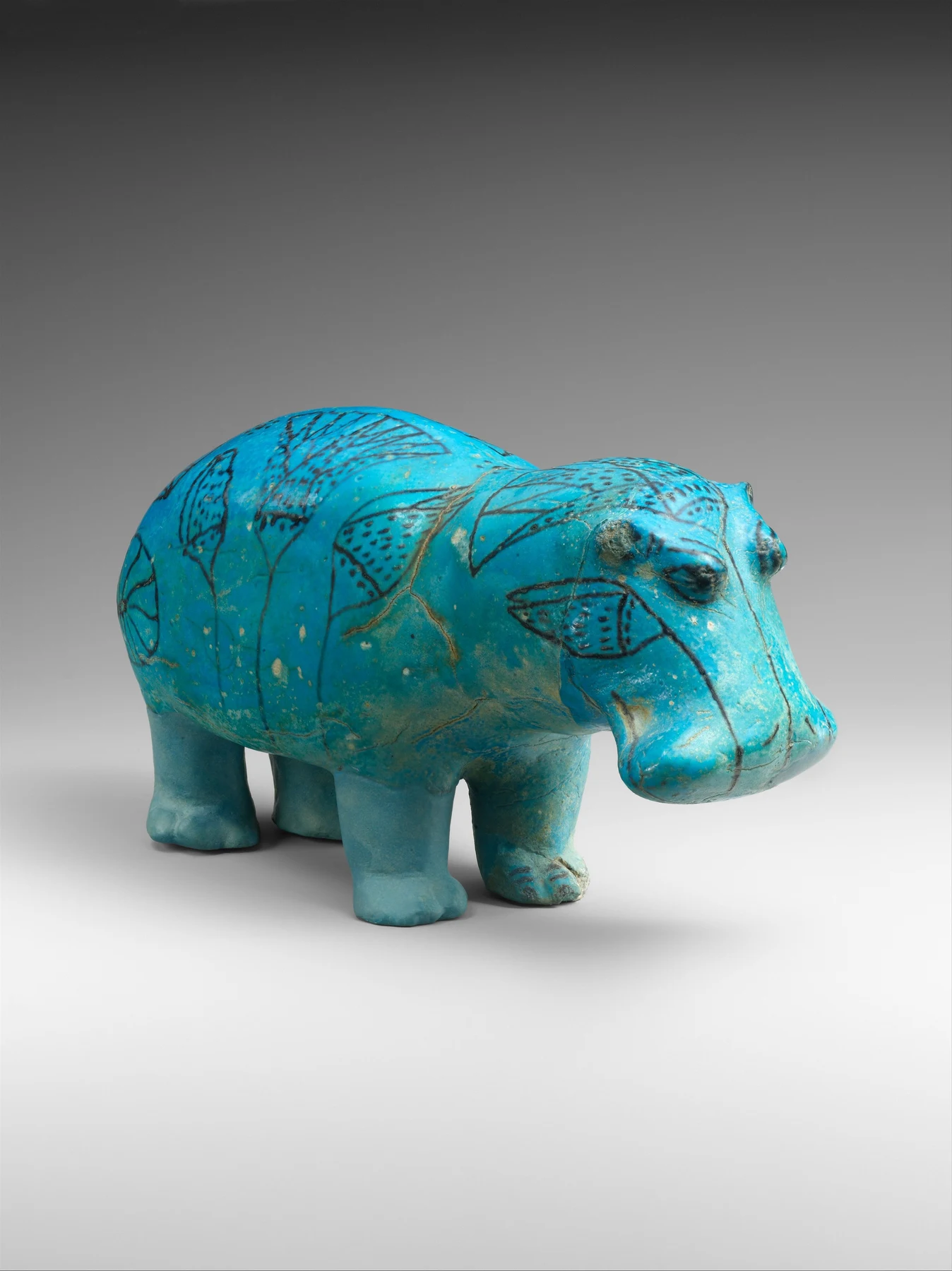
The Met dates this faience hippopotamus to the early Middle Kingdom, Dynasty 12, during the reigns of Senwosret I to Senwosret II, approximately 1961–1878 BCE. It was found in 1910 at Meir, in a tomb associated with Senbi II. Three legs are modern restorations; the museum notes that the original legs were probably deliberately broken to reduce the dangerous force the animal could embody before it accompanied the dead.
That one catalogue line carries several clocks. “Middle Kingdom” is a broad historical reconstruction. “Dynasty 12” is a ruler-based sequence inherited through ancient king lists and modern Egyptology. The reign range narrows the political frame. The tomb and findspot provide archaeological association. The museum acquisition and restoration create a twentieth-century object history. The nickname “William,” adopted after the object entered the museum, belongs to reception rather than ancient identity.
The lotus plants painted on the body link the animal to the Nile environment and regenerative imagery; its tomb context changes those signs from decoration into part of a funerary problem. Yet “Middle Kingdom style” cannot by itself establish the precise role of this particular object. Context, condition, comparison, and institutional record work together.
Use the most precise clock your evidence supports. Write “a Dynasty 12 faience hippopotamus excavated from Tomb B3 at Meir,” then explain why the broader Middle Kingdom matters. Do not reverse the logic and claim that the object looks orderly because the Middle Kingdom was an age of order.
Case two: a Wari tunic and an archaeological horizon
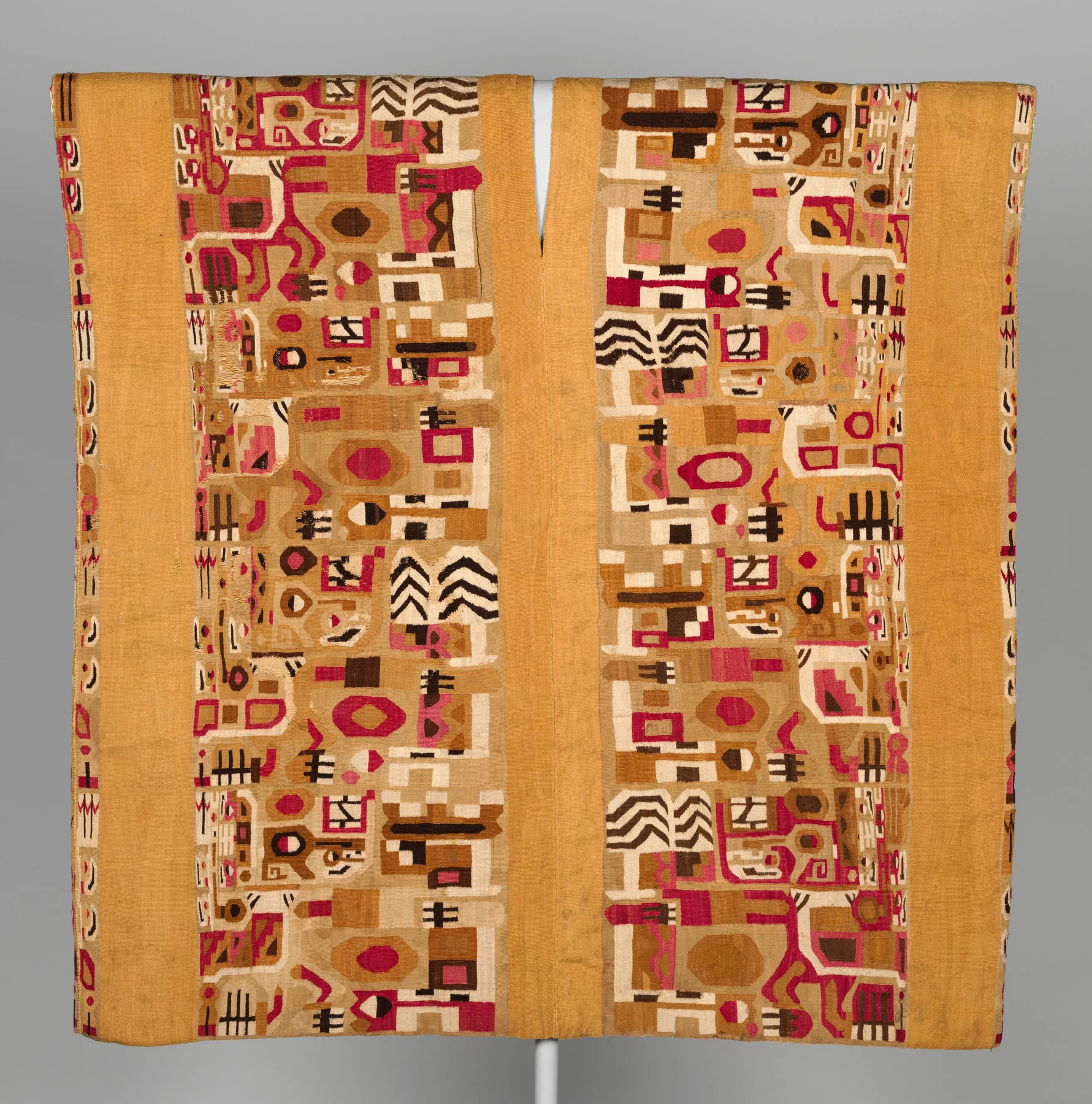
The Met identifies this tunic as Wari and dates it 650–1000 CE. It consists of two joined woven panels. Rows of compressed, winged feline figures submit bodies to the logic of the grid; colour and interlocking contour make repetition active rather than mechanical. The museum relates the standardised format and labour-intensive tapestry weave to elite identity across the Wari sphere.
“Wari” does not name a modern nation-state. Depending on context, it can refer to a polity, a material culture, a style, or an archaeological horizon. Archaeologists use distributions of architecture, ceramics, textiles, imagery, and other material patterns to discuss Wari political and cultural expansion. Those patterns do not map perfectly onto one border or one kind of control. A tunic can participate in an archaeological horizon without proving that every place where related forms appear was governed in the same way.
Its date is also a range. The public object record provides no excavated findspot for this tunic; it entered the Met as a gift in 2021. Comparison with better-contextualised textiles can support attribution and chronology, but the lost or unpublished early history limits what this object alone can prove about original owner, burial, or route of movement.
Preservation further shapes the category. The Met’s exhibition on the Andean tunic notes the exceptional survival of ancient textiles in dry environments. Amy Oakland’s study of Wari and Tiwanaku provincial garments links textile evidence to regional identity while confronting uneven contexts. What survives as “Wari art” is therefore partly an environmental map and a history of collecting, not a transparent census of what Wari makers valued.
Case three: Hokusai and the difference between a period and an edition
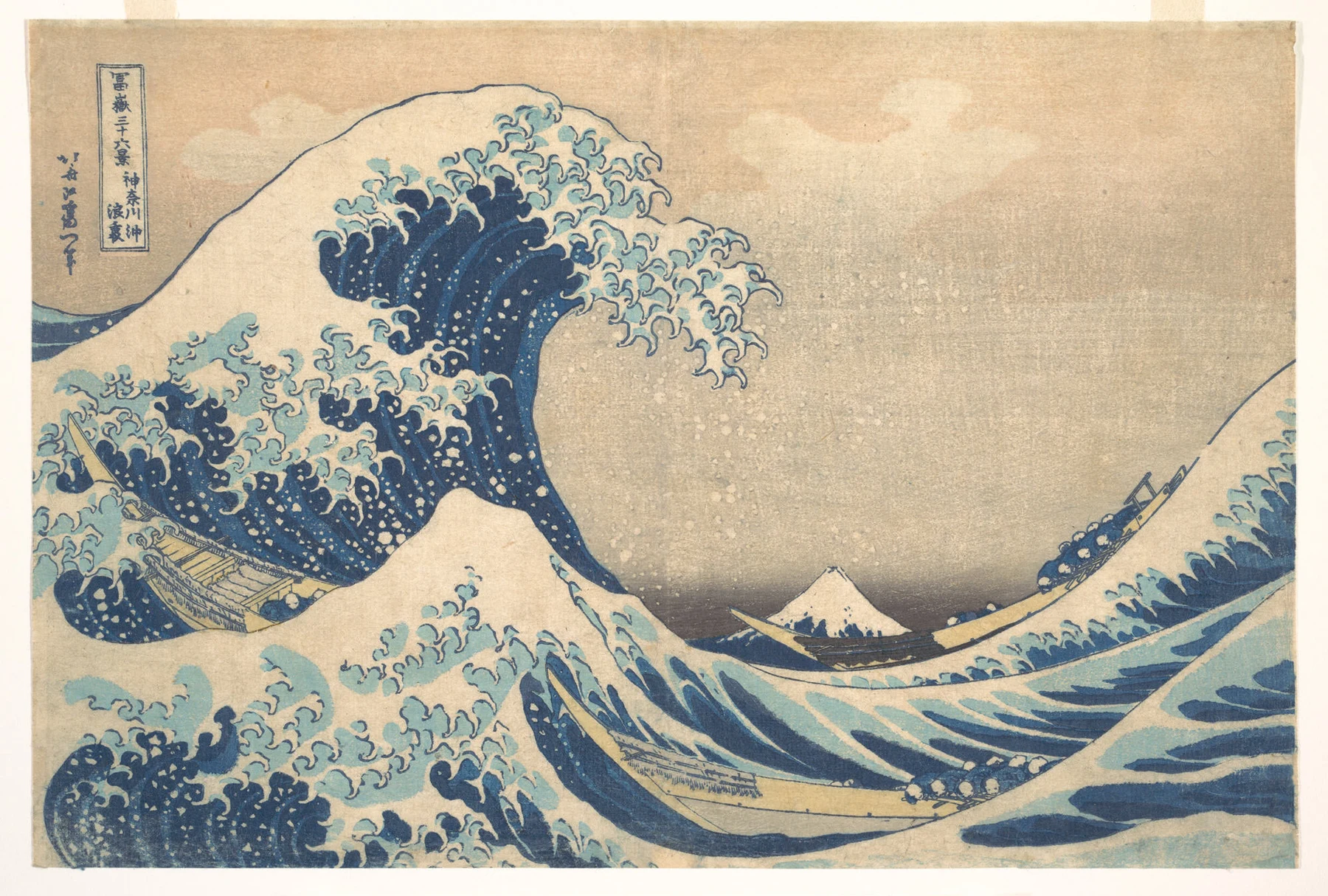
The Met places this impression in the Edo period and dates the design around 1830–32. “Edo” supplies a political and urban frame extending far beyond the print’s production. “Ukiyo-e” identifies a field of images and commercial practices. Thirty-six Views of Mount Fuji supplies the series. “Great Wave” is the popular reception title. None is a substitute for the edition history of the physical sheet.
A colour woodblock print was made through coordinated design, block cutting, inking, and printing. Blocks wore down; colours and papers varied; later impressions could lose fine lines or use different combinations. The Art Institute of Chicago’s record for its impression discusses the print’s manufacture and the importance of imported Berlin blue. The British Museum’s scientist Capucine Korenberg has compared impressions and production changes, demonstrating that “the same image” survives as materially distinct sheets.
An Edo-period date cannot tell you whether an impression is early or late. Conversely, a study of worn line and colour does not explain the political category. The period and the edition answer different questions. A precise analysis keeps both: this impression of a design produced around 1830–32 belongs to an edition history within the late Edo commercial print world.
Survival bias begins before the museum
The surviving archive is not the past made smaller. It is the past transformed by successive filters.
- Production: some materials and makers were commissioned, valued, and recorded more often than others.
- Use and deposition: an object might be buried, burned, worn out, repaired, recycled, ritually retired, inherited, or discarded.
- Material environment: fired clay, stone, and metal often behave differently from wood, fibre, food, pigment, or unfired earth. Oxygen, moisture, salts, acidity, insects, and temperature matter.
- Recovery: excavation, looting, building work, chance discovery, community custody, and research priorities determine what becomes available.
- Collection and description: collectors, states, museums, markets, legal regimes, cataloguers, and photographers select, separate, name, and publish.
- Access and teaching: digitisation, language, image rights, search ranking, textbook space, and course design decide what students repeatedly see.
The Canadian Conservation Institute’s guidance for archaeological collections explains how burial chemistry and waterlogging can preserve one material while damaging another. The National Park Service’s introduction to archaeological survival makes the basic asymmetry clear: inorganic materials commonly endure, while organic materials need unusually favourable conditions.
This is why a stone-heavy chapter does not prove that stone dominated every visual world. It may reveal what endured, what institutions collected, and what could be photographed and reproduced. Survival is evidence—but evidence about preservation as well as production.
Collection bias becomes curriculum
The filters continue inside institutions. A museum’s holdings reflect gifts, purchases, excavations, colonial extraction, markets, laws, donor tastes, departmental boundaries, and resources for cataloguing. Its online collection is another selection: some records have images and research histories; others are minimal, restricted, misclassified, or absent.
A large quantitative study by Chad Topaz and colleagues sampled more than 10,000 identifiable artist records in the online catalogues of eighteen major United States museums. The authors reported that 87 per cent of the artists were men and 85 per cent were white. The open-access study is important precisely when read at its actual scale: it analyses artist demographics in selected online collections, not every maker, every object, or every museum in the world. Many historical works have unknown or collective makers and therefore sit outside that calculation.
Still, the finding shows how an inherited collection can shape the apparent field of available examples. If a textbook author begins with famous museum databases, and a teacher begins with that textbook, the same imbalance becomes a syllabus. Repetition then masquerades as importance.
Linda Nochlin’s 1971 essay “Why Have There Been No Great Women Artists?” redirected attention from myths of individual genius to the institutions that distributed training, access, recognition, and professional possibility. The method remains powerful: when a category looks empty, investigate the systems that produced the record before treating absence as lack of achievement.
A period label can carry geography in disguise
Period names often look temporal while quietly selecting a centre.
“Renaissance” describes rebirth, but rebirth of what, claimed by whom, and measured from where? Applied globally, “the Renaissance period” can force unrelated histories to become contemporary sidebars to developments in Italian and northern European cities. “Northern Renaissance” improves geographic specificity while still defining a region by its position relative to a south.
“Pre-Columbian” organises the histories of the Americas around the arrival of one European navigator. It may be convenient in collection systems, but it tells us little about local chronologies. “Ancient,” “medieval,” and “modern” acquire different meanings when carried across Europe, East Asia, Africa, the Islamic world, or the Americas. Dynasty names such as Tang or Edo can be precise political references, yet become misleading when they are asked to explain all artistic change within today’s national borders.
The solution is not to ban broad terms. It is to declare their operating range. James Elkins’s Stories of Art challenges the expectation that world art must fit one inherited narrative. Partha Mitter’s essay “Decentering Modernism” examines the centre–periphery model that makes non-Western modernisms derivative by definition.
Write the smaller, testable claim: “In Florentine painting…”, “among court-linked workshops…”, “in excavated coastal burials…”, or “in this museum’s holdings…”. Geography then becomes evidence instead of atmosphere.
The same object can sit in several timelines
Return to the Mérode Triptych. Its production history may involve stages, workshop participation, and later changes. Its devotional history begins with use by owners whose identities remain debated. Its ownership history moves through collections before acquisition by the Met. Its technical history changes when conservation and imaging reveal joins, paint layers, or alterations. Its reception history includes its twentieth-century status as a canonical masterpiece reproduced in surveys.
Which is the object’s date?
The answer depends on the question. For workshop practice, ca. 1427–32 is central. For private devotion, the period of original use matters. For museum history, acquisition in 1956 is decisive. For the history of “Northern Renaissance” as a teaching category, publication and display may matter more than the day pigment met oak.
Objects with long lives make this especially visible. A temple can be founded, expanded, damaged, rebuilt, reconsecrated, excavated, conserved, and converted into a heritage site. A bronze can be cast from older metal, moved between ritual and market settings, renamed in a catalogue, and digitally recomposed through a photograph. Insisting on one date can turn that life into a false instant.
Use verbs to keep the clocks apart: made, attributed, used, buried, recovered, restored, acquired, displayed, published, reclassified. A good chronology is often a sequence of actions rather than a row of period labels.
Three timelines are better than one
When a period begins to feel too smooth, draw three parallel timelines.
1. Political and institutional time
Mark reigns, dynasties, states, religious institutions, laws, wars, trade regimes, schools, academies, markets, and exhibition organisations. These can change who commands resources and where makers work. Do not assume political change instantly produces stylistic change.
2. Object and material time
Mark material procurement, making, use, repair, copying, circulation, burial, decay, restoration, and technical examination. This timeline follows what happened to the thing. It often crosses several political periods.
3. Reception and knowledge time
Mark excavation, collection, attribution, publication, renaming, display, restitution claims, digitisation, and syllabus entry. This timeline shows how the object became evidence for our history.
Now look for misalignment. Hokusai’s design and a later impression share an image but not exactly the same production event. William’s ancient manufacture, 1910 excavation, modern restoration, and popular nickname belong to radically different temporal orders. The Wari tunic has a broad attributed production range and a much more recent documented museum history.
The gaps are analytically productive. They stop “during this period” from acting as an explanation. Instead, you can ask which change actually affected the object, which boundary is merely convenient, and which history remains unknown.
Common failure modes
Treating a label as a cause
“Artists used naturalism because it was the Renaissance” merely repeats the classification. Name the mechanism: workshop competition, devotional demand, courtly exchange, access to models, technical practice, or a new market—and provide evidence.
Giving a boundary false precision
A textbook date such as 1400 or 1600 may organise a course, not mark a universal rupture. Use “around,” overlapping ranges, or different local boundaries when the evidence requires them.
Sliding between scales
A change documented in a capital does not automatically describe a continent. A court object cannot stand for every household. State the place, institution, medium, and sample.
Dating by style alone
Stylistic comparison is evidence, but it is vulnerable to revival, copying, conservative practice, trade, and circular reasoning. Pair it with materials, provenance, archaeology, or documents where possible.
Mistaking survival for prevalence
Ten surviving stone sculptures and one textile do not prove a ten-to-one production ratio. Ask what preservation conditions favour.
Mistaking a database for the world
An online catalogue reflects one collection and its metadata. Record search terms, date of access, missing images, uncertain attributions, and institutional scope.
Solving bias with token additions
Adding one previously excluded artist while keeping the old centre and questions intact may change representation without changing the narrative. Ask whether chronology, geography, causation, and comparison also need revision.
A reusable periodisation worksheet
Use this sheet before writing any sentence that begins “During the…”
| Field | Your evidence |
|---|---|
| Period label exactly as used | |
| Source and author of the definition | |
| Date range and degree of certainty | |
| Geographic and institutional scope | |
| Mediums or object types represented | |
| Evidence fixing the start boundary | |
| Evidence fixing the end boundary | |
| Contemporary name or later construction? | |
| One object that fits well, and why | |
| One object that crosses or resists the boundary | |
| Material unlikely to survive | |
| People or practices weakly represented in the archive | |
| Collection or database shaping your sample | |
| Alternative label or timeline | |
| What changes in your argument if you use it? |
Then write one sentence defining your usage: In this essay, “Edo period” refers to the political and commercial setting of Japanese print production under Tokugawa rule; individual impressions are dated more narrowly through edition evidence.
That sentence is modest but powerful. It makes the category inspectable. Another researcher can disagree with your dates or scope without guessing what you meant.
Practice task: redraw one familiar period
Choose one label you think you already understand: Renaissance, Baroque, Edo, Middle Kingdom, Wari, modernism, or another used in your course.
- Find two scholarly or institutional definitions. Record their dates, places, and evidence. Do not merge disagreement away.
- Select one securely documented object near the centre of the period and one near a boundary.
- Build the three timelines: political/institutional, object/material, and reception/knowledge.
- Add the six survival filters from production to teaching. Mark at least two points where evidence could disappear.
- Write a 150-word paragraph explaining which label you will use, what it reveals, and where it fails.
- Revise the paragraph without the phrase “because it was the [period].” Replace the period-as-cause with a mechanism supported by evidence.
For a harder version, compare the chapter divisions in two survey books. Which regions receive fine-grained periods? Which receive thousand-year spans? Which histories are named through local terms, and which through European simultaneity? The table of contents is already an argument about historical time.
What a strong paragraph sounds like
Here is a weak version:
Hokusai made The Great Wave during the Edo period. Edo art used strong colours and showed everyday life. The print is an example of this style and shows the power of nature.
The dates are not necessarily wrong, but the period supplies a personality and the object merely illustrates it.
A stronger version:
Designed around 1830–32 within the late Edo commercial print market, Hokusai’s Under the Wave off Kanagawa combines a repeatable woodblock process with costly imported Berlin blue. “Edo period” locates the political and urban setting, while the series title and evidence from individual impressions identify a narrower production history. The wave’s fame therefore belongs to at least two chronologies: the manufacture and sale of impressions in nineteenth-century Japan, and the later collection and reproduction that made one design stand for an entire period abroad.
The revised paragraph does four things. It specifies the scale of the label, introduces an evidenced mechanism, distinguishes design from impression, and adds reception without pretending to reconstruct it fully. The period remains useful, but it no longer thinks on the writer’s behalf.
Terms for looking and research
- Chronology: an ordered account of events or phases; not necessarily a single universal timeline.
- Periodisation: the practice of dividing historical time into named intervals.
- Terminus post quem: the earliest possible date after which something must have happened.
- Terminus ante quem: the latest possible date before which something must have happened.
- Stratigraphy: analysis of the relative sequence of archaeological layers and deposits.
- Typology: grouping objects by recurring formal or technical features, sometimes used to propose sequences.
- Dendrochronology: dating wood by matching tree-ring sequences; the felling date and object-making date still require interpretation.
- Radiocarbon calibration: conversion of a radiocarbon measurement into probabilistic calendar ranges using calibration data.
- Archaeological horizon: a widely distributed pattern of material evidence associated with a broad interval or process.
- Provenance: the history of ownership and custody after an object was made; it is not the same as archaeological find context.
- Survival bias: distortion created because what endures is not a representative sample of what once existed.
- Collection bias: distortion created by what institutions and collectors acquire, retain, research, classify, and publish.
- Reception history: the history of how an object has been interpreted, valued, copied, displayed, or contested after its production.
Source guide
Start with the object, then expand the map.
- Use museum object records for accession numbers, dimensions, material, attribution language, image rights, and collection history. Treat “ca.”, “attributed to,” and missing provenance as evidence, not clutter.
- Use excavation reports, conservation studies, technical reports, catalogues raisonnés, inscriptions, contracts, inventories, and contemporary documents for the reasoning behind dates.
- Use PeriodO to compare sourced period definitions rather than assuming one boundary.
- Use the Getty Art & Architecture Thesaurus to see how controlled vocabularies organise styles, periods, cultures, object types, materials, and processes. A controlled term improves retrieval; it does not settle historical debate.
- Use named scholarship to test the architecture of the narrative: who defines the centre, what counts as change, and which archive supports the claim.
- Use conservation and archaeological guidance to understand what could survive and what a scientific date actually measures.
Keep a source map with separate rows for object facts, dating evidence, period definition, historical interpretation, survival, provenance, image source, and rights. A source can support more than one row, but no polished citation should be asked to prove something it does not address.
Continue the methods route
This chapter changes how you organise historical time. Pair it with How to analyse a work of art to keep period labels grounded in visible and material evidence, and with How to compare two artworks to prevent unequal chronologies from becoming false comparisons.
The next Methods chapter will move from chronology to research practice: how to begin with an object record, follow claims back to their sources, separate evidence from interpretation, and build a source map that remains usable when attribution or provenance changes.
Editorial record
About this article
- Author
- Publisher
- GeMarkt
- Published
- Updated
- Reviewed
- Internal source & rights check. Conducted by GeMarkt Research Review. This is an internal editorial check—not independent peer review.
- Source standard
- Art history source standardPrioritises object records and research sources, distinguishes evidence from interpretation, and states material uncertainty.
Found a claim that needs checking? Report a factual error.