Art History · Learning chapter
Atlas I — Foundations and ancient worlds · 9 of 10
Ancient Mesoamerican art: city, calendar, rulership, and living material
Five works show how Mesoamerican makers joined city, calendar, rulership, writing, and materials that moved through living worlds.


What we’ll look at
How did Mesoamerican societies make cities, calendars, writing, and rulership visible?
The stone stands upright today, facing visitors like a vast circular picture. That display makes one name feel obvious: the Aztec Calendar. Yet the twenty-four-tonne monument joins day signs to cosmic eras, solar movement, fire-serpent bodies, sacrifice, and an unstable present world. Many scholars argue that it originally lay horizontally as a ritual platform, although its precise date and use remain debated.
Turn the stone ninety degrees in your mind and the question changes from “What does this symbol mean?” to “What did bodies do around, upon, and because of it?” That shift opens a route through several distinct traditions: the Gulf Coast of present-day Mexico, Teotihuacan, the Maya city of Copán, Ñuu Dzavui in Oaxaca, and Mexica Mexico-Tenochtitlan. These places span more than two millennia and differ in language, government, and visual practice.
This guide asks:
How did Mesoamerican makers turn city, calendar, rulership, and living material into public memory—and what disappears when surviving stone is treated as the whole archive?
The route joins a basalt head, an architectural mural, a dynastic altar, a painted deerskin screenfold, and the Sun Stone. It is neither a ladder from “simple” to “advanced” nor a claim to represent everything called Mesoamerica.
Mesoamerica is a region of study, not one civilisation
Mesoamerica is a modern name for a cultural region with changing boundaries across much of present-day central and southern Mexico and parts of Central America. Communities exchanged maize, cacao, obsidian, shell, greenstone, feathers, ceramics, stories, technologies, and ways of reckoning time. Shared practices did not erase difference. The Metropolitan Museum of Art’s current gallery framework calls the region a “mosaic of traditions” with fluid frontiers—better than one civilisation progressing through Olmec, Maya, Teotihuacan, and Aztec stages.
The labels are coordinates, not sealed peoples. Olmec is a modern archaeological name, not a recovered self-name for San Lorenzo. Teotihuacan is a later Nahuatl name for a city whose ancient name remains unknown. Maya identifies related languages and many historical and living communities, not one empire. Mexica more precisely names the people of Mexico-Tenochtitlan within the broader modern umbrella Aztec. Many people long grouped as Mixtec identify through Ñuu Savi, Ñuu Dzahui, or related language-specific forms.
The date range here runs from about 1200 BCE to the Spanish-led conquest of Mexico-Tenochtitlan in 1521 CE. That end point marks the boundary of this chapter, not the end of Indigenous art or history. Mesoamerican languages, communities, ritual knowledge, agricultural practice, making, and political thought did not vanish when European rule began. They changed under invasion, epidemic disease, forced conversion, exploitation, alliance, resistance, and creative survival.
The archive is uneven. Stone and fired clay survive where bark paper, cotton, wood, flowers, feathers, rubber, food, incense, skin, sound, and movement often do not. Climate, war, colonial destruction, campaigns against Indigenous books and ritual things, looting, collecting, and museum separation all shaped what can now be seen. Missing materials and displaced objects therefore belong inside the history.
A throne remade as a face: San Lorenzo Colossal Head 2
In brief: The first example is a basalt head over two metres tall, carved before about 900 BCE at San Lorenzo in present-day Veracruz, Mexico. Reworked from an older throne, it may have made a high-status person or role visible in public.
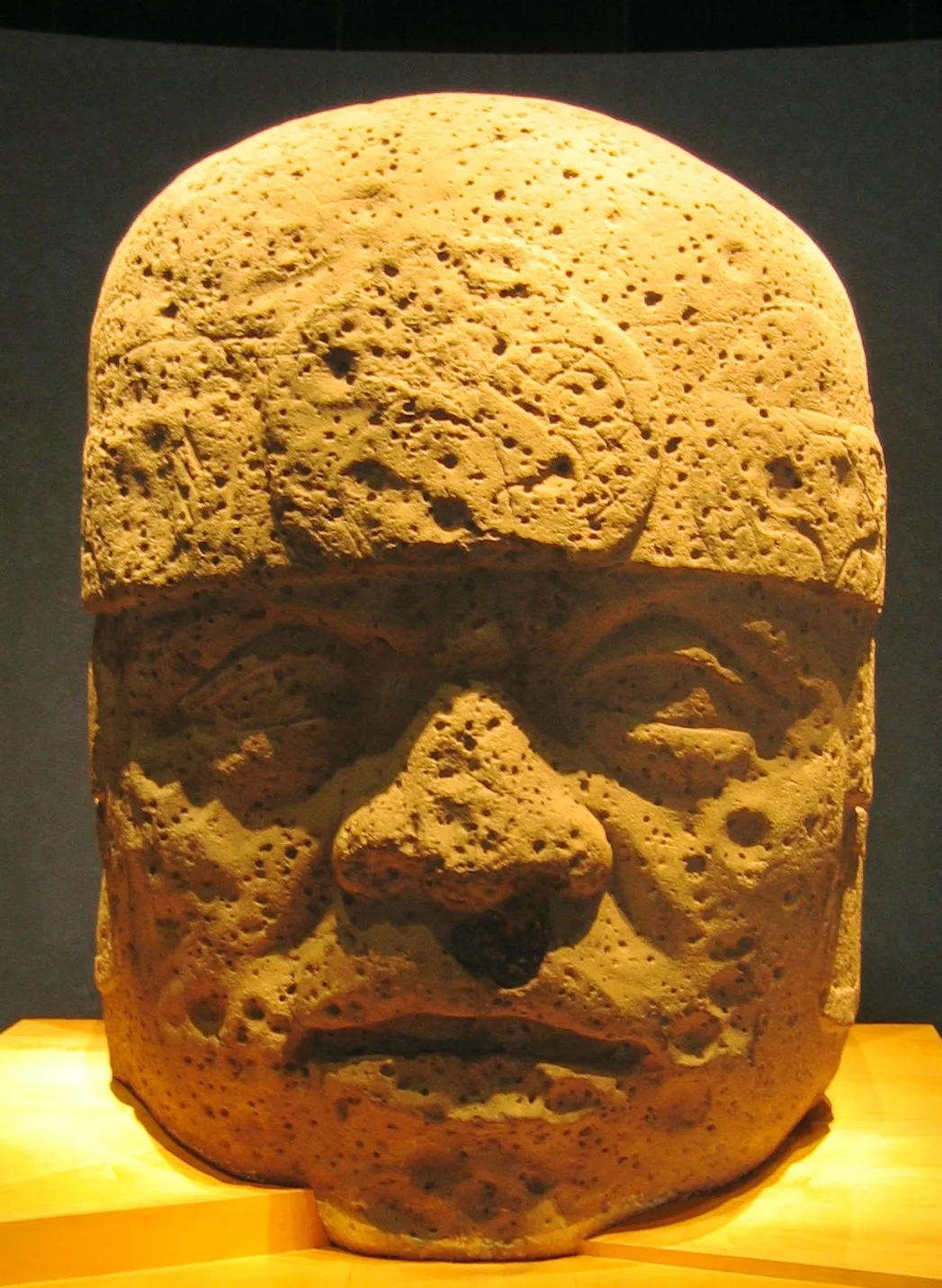

The face is individual enough to resist becoming a type. Its eyes descend at slightly different angles. The mouth is open just enough to show teeth. Lines run from the nose toward the lips. A fitted headdress crosses the forehead; the Museo Nacional de Antropología identifies three curved-beak bird heads in its design and suggests that they may have referred to a name or lineage.
At more than two metres high, the head exceeds a standing viewer. Its basalt originated in the volcanic Tuxtla Mountains, away from San Lorenzo’s riverine plateau. Although the route is unknown, moving and carving it required organised labour, technical knowledge, food, tools, and authority.
That authority is why the heads are most often interpreted as portraits of rulers. Seventeen colossal heads are currently known from San Lorenzo, La Venta, Tres Zapotes, and La Cobata. Each has different facial features and headgear. Repetition establishes a recognisable political form; variation makes particular persons imaginable.
“Portrait” remains an interpretation: no inscription names the figure, and ruler, ancestor, ballplayer, warrior, or ritual specialist need not be mutually exclusive roles. Nor does older scholarship’s male designation settle gender. The strongest claim is that the monument made a socially specific, high-status presence public.
Head 2 contains a second history in its stone. The museum’s archaeological account argues that it was recarved from a monumental throne. Its flattened back and a curved depression near one ear preserve the earlier niche; unfinished drilling and damaged surfaces register the transformation. A seat of authority became an ancestral or ruling face.
Recarving may have followed political change, death, succession, or a new use for an old seat. Whatever the occasion, power was transferred through material that already had a political life.
The head has also attracted fantasies about visitors from Africa because nineteenth- and twentieth-century observers mapped modern racial categories onto its facial features. Archaeology does not support that transatlantic origin story. The stone, quarry region, site, sculptural tradition, and settlement history belong to the Gulf Coast. The pseudo-historical claim tells us more about modern racial looking than about ancient San Lorenzo.
San Lorenzo, La Venta, Tres Zapotes, and connected communities exchanged forms and materials, but were not chapters of one centrally directed “mother culture.” Head 2 offers the firmer history: stone travelled, a throne changed form, and a face became large enough to organise public memory.
A city that was painted: Teotihuacan’s Puma Mural
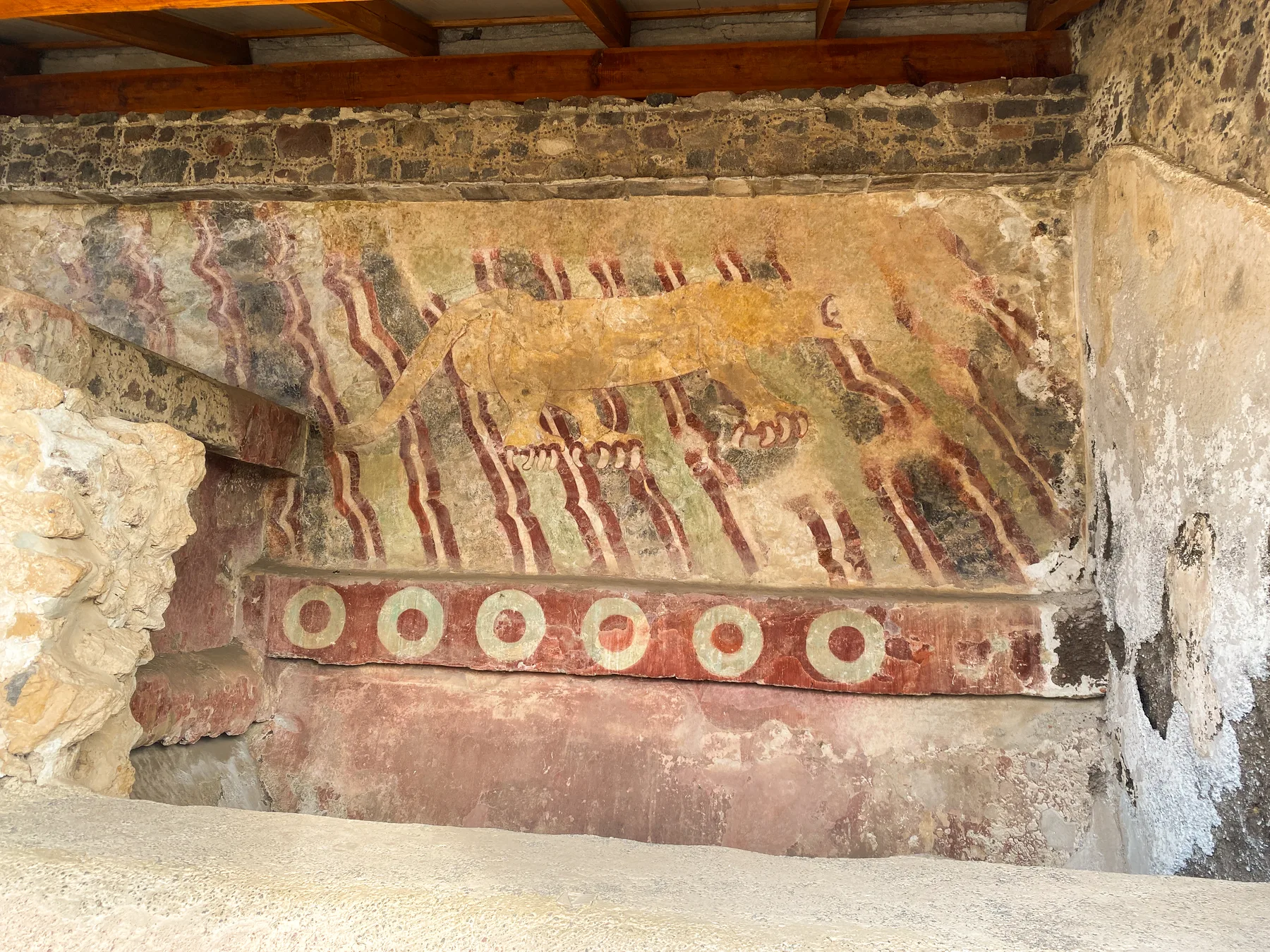

The animal does not float in a frame. It moves along a wall.
Its ochre body stretches horizontally. Four claws touch broad undulating bands in green, white, and dark red. Beneath them, pale green circles repeat against a red border. The INAH site record identifies those circles as chalchihuites, signs of precious greenstone, water, and value, and calls the animal a puma. Only part of the head survives. “Jaguar mural,” the name used in many photographs, is less secure than the general observation that a monumental feline strides through a field of precious, watery colour.
The damaged image corrects the grey city imagined from modern ruins. Murals lined Teotihuacan’s porticoes, courtyards, rooms, platforms, and routes; red grounds, green and blue minerals, ochres, black, and white turned architecture into fields of animals, plants, water, processions, offerings, and powerful beings.
The Puma Mural stood on a building along the northern Avenue of the Dead. Walking past it would have made the animal’s direction and the viewer’s movement interact. The image did not simply depict motion. Architecture produced it.
According to UNESCO’s site documentation, Teotihuacan covered about 36 square kilometres at its height; the ceremonial centre occupied roughly ten percent. Streets, drains, workshops, neighbourhood centres, and thousands of residential compounds filled the wider metropolis. Archaeology also identifies neighbourhoods connected to Oaxaca, the Gulf Coast, Maya regions, and western Mexico. The city was neither only its pyramids nor one population sealed from Mesoamerica.
Unlike several Classic Maya cities, Teotihuacan has not yielded a secure sequence of named rulers on abundant portrait stelae. Scholars debate individual and more corporate forms of authority, while images often repeat richly dressed figures rather than isolate a named king. That does not prove equality: monumental planning, military power, unequal housing, and controlled production indicate hierarchy. Teotihuacan could concentrate power without presenting it as Copán did.
Ancient repainting, rebuilding, burial, excavation, conservation, modern shelter, and photography mediate the fragment. Even so, it preserves a decisive fact: paint joined architecture to movement, and urban experience was one of Teotihuacan’s major arts.
Sixteen rulers on one stone: Copán’s Altar Q
.jpg)
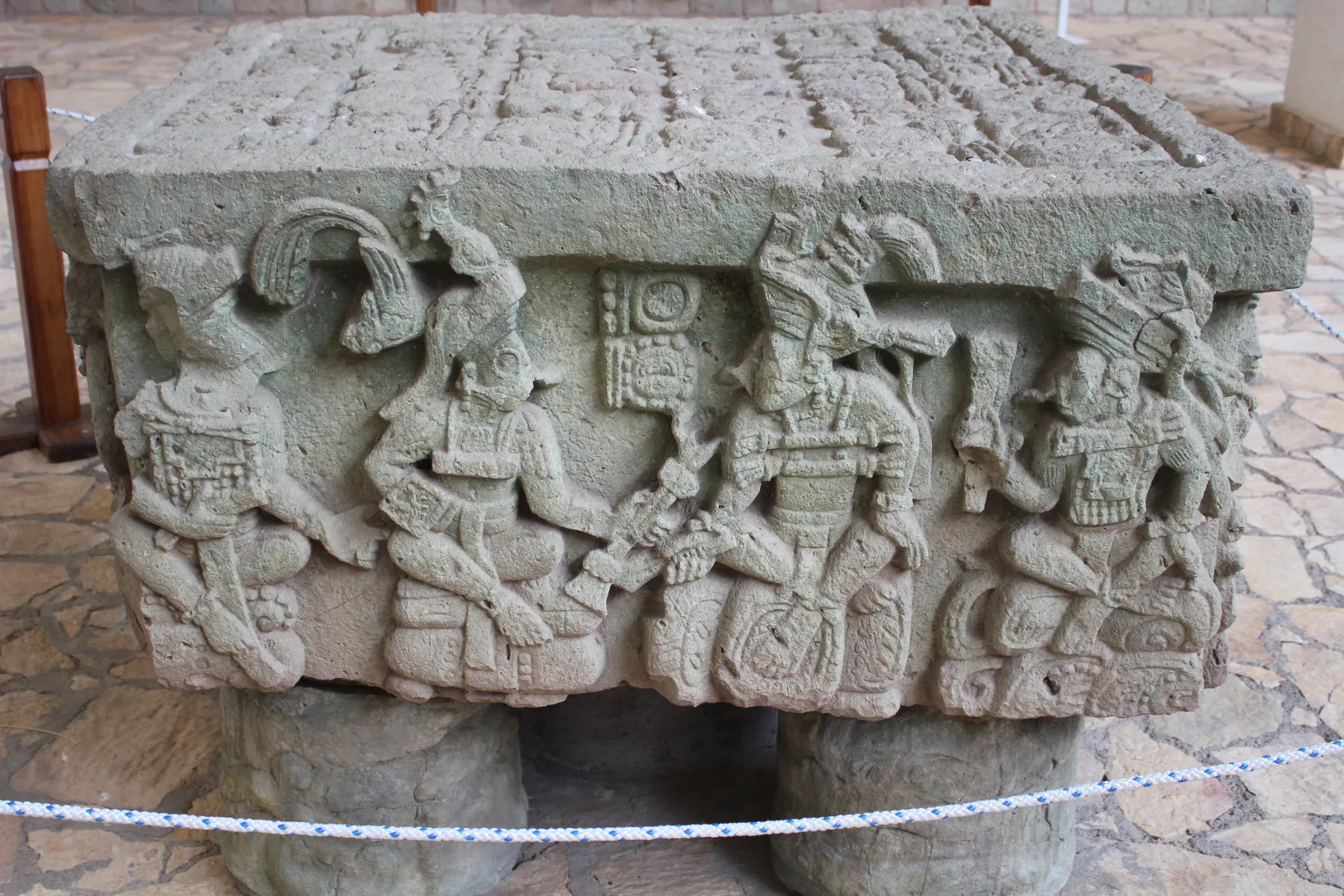
Four seated figures fill the visible side. Their bodies turn in profile, but their headdresses, ear ornaments, staffs, bundles, and glyphic seats make each position different. Continue around the square altar and the sequence reaches sixteen: the rulers of Copán’s dynasty as the monument presents them.
On the west side, commissioner Yax Pasaj Chan Yopaat, Copán’s sixteenth ruler, faces dynastic founder K’inich Yax K’uk’ Mo’. Between them, the Calendar Round date 6 Kaban 10 Mol marks Yax Pasaj’s accession in 763 CE as the founder seems to pass him an insignia. They lived more than three centuries apart; the altar folds that interval so the latest ruler receives authority directly from the first.
The upper text links the founder’s accession and arrival at Copán, probably ancient Oxwitik, to Yax Pasaj’s dedication in 776. The Peabody Museum’s research resource shows how names, dates, figures, and excavation support this reading while the founder’s origin and Teotihuacan-associated regalia remain debated.
Altar Q is an extraordinary source, not a neutral kings list. Commissioned by the sixteenth ruler, it selects a continuous male line and converts a remote founder into present authority. Conflict, contested succession, royal women, subordinate nobles, defeated rivals, and ordinary households remain outside its frame.
Maya scribes combined a 260-day ritual cycle, a 365-day cycle, and the Long Count to anchor accessions, deaths, wars, dedications, and remembered events. Calendar notation made political and ritual history answerable to sequence, not merely prediction.
Image and writing refuse a modern split between illustration and caption: rulers sit on name blocks, while dress evokes office, ancestry, or affiliation. The founder’s eye elements, shield, and quetzal headdress recall Teotihuacan centuries after its decline. They show how Yax Pasaj’s court wanted him seen in 776, not transparently what happened in the fifth century.
One side cannot show the sequence, and the upper text resists a frontal photograph. A viewer circles stone as dynastic time circles from the sixteenth ruler to the first. Copán’s solution was specific, not “the Maya” as a whole: form turned a vulnerable present into an apparently unbroken past.
A history that folds: the Tonindeye Codex
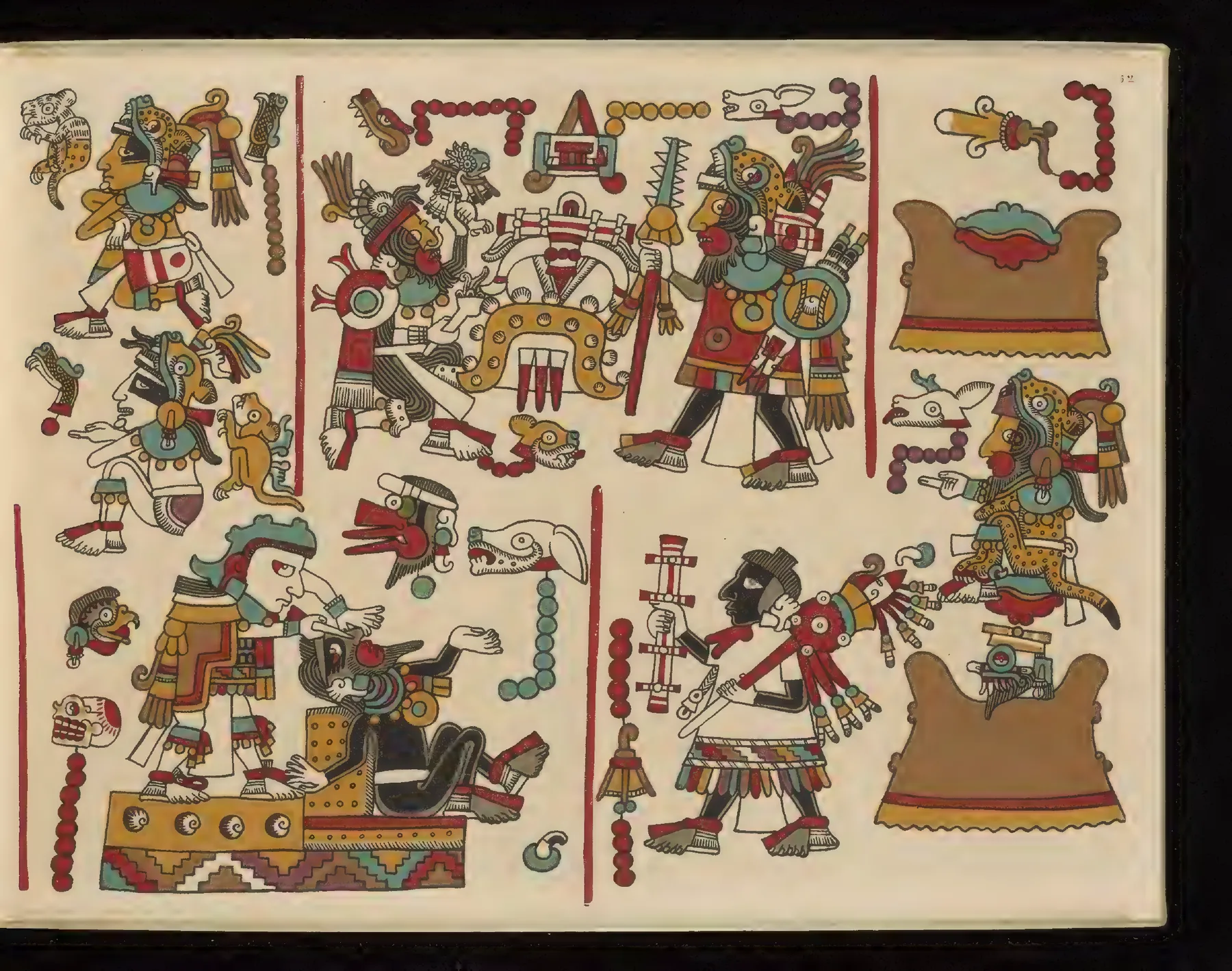
The page does not wait for a single line of alphabetic text to explain it. Figures carry calendar names beside their bodies. Hills, temples, rivers, animals, weapons, footprints, patterned platforms, and red dividers organise relations across the surface. Reading is an act of following.
The British Museum manuscript joins forty-seven prepared deerskin leaves into a screenfold more than eleven metres long, painted on both sides. One side records histories of Ñuu Dzavui centres and dynasties; the other follows the genealogy, marriages, rituals, alliances, conflicts, and acts of Iya Nacuaa Teyusi Ñaña, often called Lord 8 Deer “Jaguar Claw.”
The Latin label codex can mislead. Tonindeye is not paper bound at one edge: it expands, contracts, turns, and changes direction. A reader can compare several openings, point, speak, and perform history for listeners.
Calendar names join identity to time. “8 Deer” combines a number and day sign within the 260-day cycle. Name and place signs let people and towns recur across changing dress, age, and action. Pictorial writing does not transcribe speech word for word, but neither is it free-floating illustration.
On page 57, University of Kentucky curators read Iya Nacuaa receiving ritual nose perforation from Lord 4 Jaguar, while a priest performs the rite below. The interpretation depends on names, sequence, action, regalia, place signs, and related manuscripts—not one isolated figure.
Iya Nacuaa is central, but women, marriage alliances, priests, rivals, ancestors, places, sacred beings, and collective rites prevent the book from collapsing into one heroic biography.
Deer, plaster, pigments, brushes, painters, folding, storage, recitation, and repair made that network mobile. The folds are not damage around the image; they are part of its technology.
Few pre-invasion screenfold books survive. “Zouche-Nuttall” remembers a British owner and the scholar who published its 1902 facsimile; Tonindeye has been foregrounded through recent work with Indigenous researchers. The British Museum’s record also discusses Ñuu Dzavui, Ñuu Savi, and Ñuu Dzahui language-specific forms. Access, language, custody, and authority remain present questions: preservation does not erase the colonial geography separating a book from many descendants of its makers.
The image above is an open 1902 facsimile, not the deerskin manuscript. Colour reproduction, paper, page order, and framing mediate it: a source can be legally open and materially incomplete.
A calendar that is not just a calendar: the Mexica Sun Stone
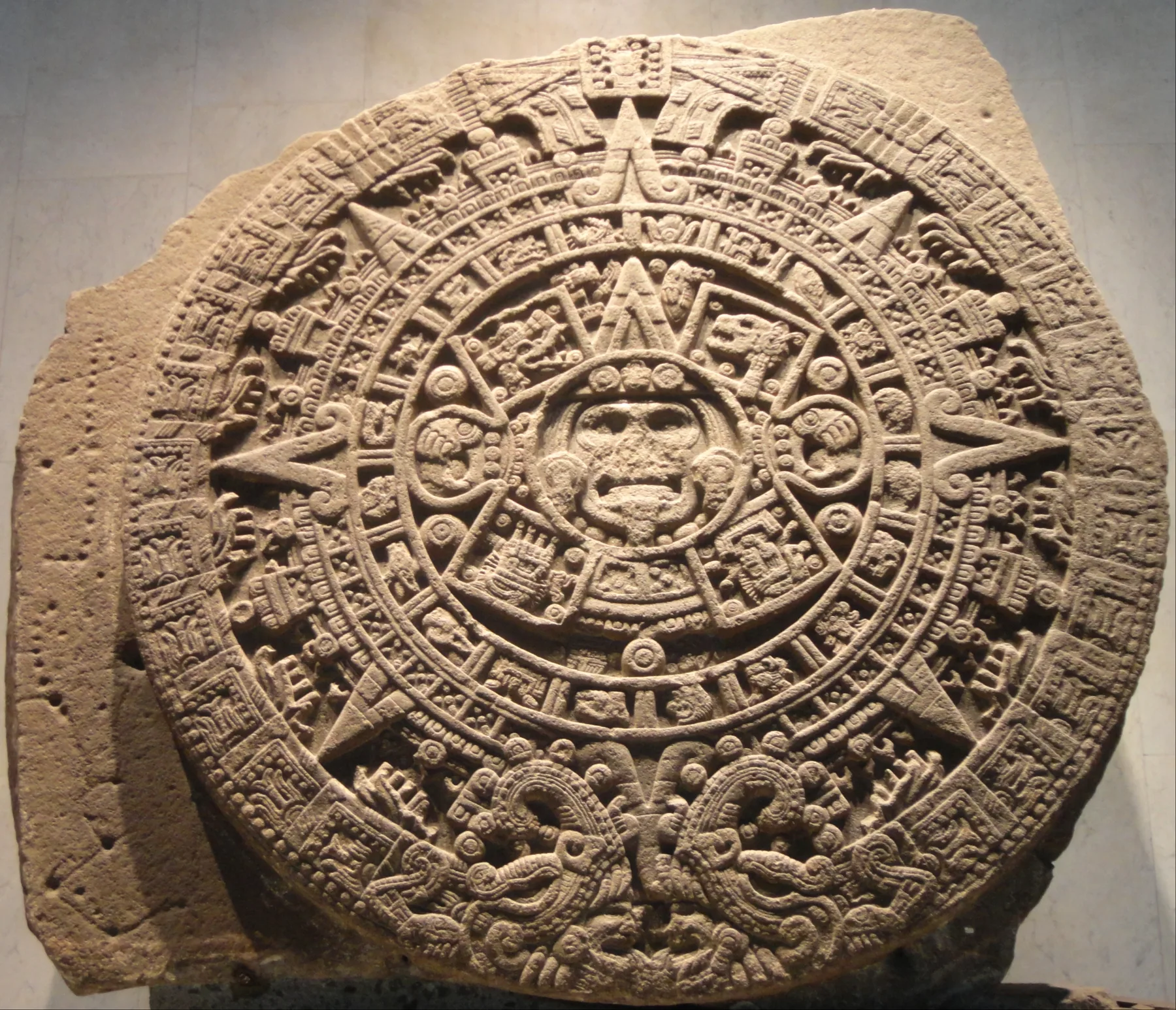
At the centre, a face emerges within the sign Nahui Ollin, Four Movement. Around it, four rectangular compartments refer to previous world eras. A ring of twenty day signs follows. Solar rays, signs of preciousness, dates, and paired fire-serpent bodies drive the composition outward and around.
The nested order explains the calendar label, but the stone is not a wall chart. It joins the 260-day tonalpohualli, the 365-day xiuhpohualli, cosmic eras, solar movement, ritual danger, and Mexica authority. Political and ritual order are made through time.
The centre is often identified as solar deity Tonatiuh, as in INAH’s 2025 account; earth, composite, and deathly solar readings also exist. The disagreement does not make the whole stone unknowable: Nahui Ollin names the present Fifth Sun, previous eras surround it, day signs form a cycle, and the outer imagery binds movement to danger and renewal.
One INAH account reads 13 Reed as 1479 under Axayacatl; another institutional publication proposes about 1512 under Motecuhzoma II. Because date, use, iconography, damage, and colour remain under study, “late fifteenth or early sixteenth century” is the safer label.
Found relief-side down in Mexico City’s Plaza Mayor in 1790, the stone was already displaced. Its carved edge, comparison with other monuments, and later descriptions support a horizontal ceremonial platform connected with solar offerings, combat, or sacrifice, but do not secure one ritual use.
Mounted beside Mexico City Cathedral after discovery, moved to the Museo Nacional in 1885, and displayed at the Museo Nacional de Antropología since 1964, the stone acquired a powerful modern afterlife. “Aztec calendar” makes it instantly recognisable while flattening weight, orientation, and ritual danger.
The grey surface performs a similar simplification: its colour is lost, and reconstructions vary. Durable basalt preserved a diagram, not the full relation among relief, colour, daylight, offerings, sound, and bodies. The missing movement has to return.
Five works, five ways of making memory act
| Case | Material operation | Relation made public or durable | What the surviving object hides | Main interpretive limit |
|---|---|---|---|---|
| San Lorenzo Colossal Head 2 | Quarrying, moving, recarving, and displaying basalt | High-status person, throne, succession, ancestral or ruling presence | Transport labour, temporary architecture, ceremony, spoken names, political conflict | A ruler portrait is the leading interpretation, but no inscription identifies the person |
| Teotihuacan Puma Mural | Preparing plaster, grinding pigments, painting and repainting architecture | Feline power, precious water, route, neighbourhood, city | Most painted surfaces, roofs, textiles, bodies, sound, and daily movement | Species and exact meaning remain uncertain; the conserved fragment is not the ancient whole |
| Copán Altar Q | Carving figures and glyphs around four sides and an upper text | Sixteen rulers, founder, accession, dynastic continuity | Rival histories, royal women, subordinate actors, performance, original architectural encounter | It is a retrospective commission by the sixteenth ruler, not a neutral chronicle |
| Tonindeye | Preparing deerskin, painting pictorial writing, folding, unfolding, pointing, reciting | Calendar names, places, marriages, ritual, political history | Voice, gesture, reading occasion, many lost manuscripts, community access | The original is in London; the image here is a 1902 facsimile, not the skin manuscript |
| Mexica Sun Stone | Moving and carving basalt, painting, orienting horizontally, using in ceremony | Cosmic eras, calendrical cycles, solar movement, imperial ritual order | Colour, offerings, architecture, bodies, music, movement, original setting | Date, central deity, and specific ritual function remain debated |
The comparison does not reveal one Mesoamerican formula. It reveals a recurring problem: how to make relations persist beyond one body or moment.
San Lorenzo enlarged a face and embedded it in a stone with an earlier life. Teotihuacan distributed images across a city’s surfaces. Copán turned succession into a route around a monument. Tonindeye made history portable and reconfigurable through folds. Mexico-Tenochtitlan condensed moving time into a stone that may itself have been used as a platform.
In every case, the object was less self-contained than a museum photograph suggests.
The archive beyond stone
The five works can still produce a distorted history if their survival is mistaken for ancient priority. Two are basalt monuments, one is another carved stone, and one is a mural preserved on masonry. The deerskin screenfold is the exception that exposes the rule.
Mesoamerican makers worked with cotton, agave fibre, wood, bark paper, gourds, reeds, flowers, rubber, wax, resins, shells, feathers, human and animal hair, skin, food, blood, smoke, and sound. Costumes transformed bodies. Featherwork changed with air and light. Paper banners moved. Rubber balls struck courts. Cacao vessels circulated through feasts and diplomacy. Flowers and incense altered an architectural space without leaving a durable wall.
These materials were not secondary decorations applied to real art made of stone. They carried value, place, life, breath, scent, status, and obligation. Many depended on trade routes and ecological knowledge. Their making joined farmers, hunters, dyers, painters, weavers, feather workers, scribes, cooks, performers, merchants, tribute collectors, priests, rulers, and captives.
Nor was the human body simply a viewer. Bodies were painted, pierced, clothed, fed, fasted, danced, carried, enthroned, bound, sacrificed, buried, and remembered. Some of those acts involved coercion and violence. They should be studied without converting Mesoamerican societies into spectacles of cruelty or hiding violence behind aesthetic admiration. European conquest did not introduce a peaceful outside observer; it brought warfare, massacre, enslavement, epidemic catastrophe, and colonial violence of its own.
“Living material” therefore has two meanings. It names substances taken from plants, animals, and bodies. It also names an art history that remains connected to living Indigenous communities rather than sealed in a vanished pre-Columbian world.
A compact timeline
- About 1500–1200 BCE: early monumental centres and shared visual practices develop across parts of the Gulf Coast and neighbouring regions; the boundaries of what scholars call Olmec remain debated.
- About 1200–900 BCE: San Lorenzo reaches its major florescence; colossal heads, thrones, water systems, plazas, and other sculptures organise its plateau.
- About 100 BCE–550/650 CE: Teotihuacan grows into a major planned metropolis whose monuments, residential compounds, workshops, neighbourhoods, and murals shape connections across Mesoamerica.
- 426/427 CE: K’inich Yax K’uk’ Mo’ establishes the dynasty later commemorated at Copán, according to Maya inscriptions.
- 763 CE: Yax Pasaj Chan Yopaat accedes as Copán’s sixteenth ruler.
- 776 CE: Altar Q is dedicated, joining the sixteenth ruler to the fifth-century founder through image, calendar, and inscription.
- Eleventh–early twelfth century CE: the life and political career of Iya Nacuaa Teyusi Ñaña, Lord 8 Deer “Jaguar Claw,” later recorded in several Ñuu Dzavui manuscripts.
- Probably fifteenth–early sixteenth century CE: the surviving Tonindeye screenfold is painted, preserving histories reaching into earlier centuries.
- Late fifteenth–early sixteenth century CE: the Mexica Sun Stone is carved; proposed dates and patrons differ.
- 1521 CE: Mexico-Tenochtitlan falls to the Spanish-led coalition after siege, warfare, and epidemic disease; colonial rule transforms but does not end Indigenous art and history.
- 1790 CE: the Sun Stone is excavated in Mexico City’s Plaza Mayor and begins a new life as antiquity, museum object, national symbol, and globally reproduced image.
- 1902 CE: Zelia Nuttall publishes the public-domain facsimile used for the Tonindeye figure in this guide.
These dates connect cases; they do not divide the region into clean, universal periods.
Terms worth knowing
- Mesoamerica: a modern name for a historically changing cultural region in Mexico and Central America. It identifies networks and shared practices without implying one people or state.
- Formative / Preclassic: broad archaeological periods used for early settled, monumental, and urban developments before the Classic period. Boundaries vary by region.
- Classic: broad period, often about 250–900 CE, associated in several regions with large cities, courts, writing, and monumental building. It does not mean aesthetically superior.
- Postclassic: broad period from about 900 CE to European invasion, marked by diverse city-states, kingdoms, empires, trade networks, and artistic systems.
- Olmec: modern archaeological label for related Gulf Coast sites, objects, and practices of the Formative period; not a recovered self-name or one proven empire.
- Teotihuacan: later Nahuatl name for the Central Mexican metropolis; its inhabitants’ own ancient name and main language remain uncertain.
- Maya: related historical and living peoples and languages across southern Mexico and northern Central America; not one timeless civilisation or empire.
- Ñuu Dzavui / Ñuu Savi / Ñuu Dzahui: related Indigenous names commonly translated as “Nation of Rain,” with spelling and pronunciation varying across languages and communities long grouped as Mixtec.
- Mexica: Nahuatl-speaking people of Mexico-Tenochtitlan and Tlatelolco; more precise than using “Aztec” for every society in Central Mexico.
- Calendar Round: combination of a 260-day cycle and 365-day cycle that repeats every fifty-two solar years.
- Long Count: Maya system for counting days from a mythic starting point, allowing dates to be fixed across periods longer than the Calendar Round.
- Tonalpohualli: 260-day ritual count used in Central Mexico, combining thirteen numbers with twenty day signs.
- Xiuhpohualli: 365-day solar-year count used by the Mexica and other Nahua communities.
- Screenfold: a long manuscript support folded back and forth. Opening pattern, direction, and handling are part of how the book works.
- Pictorial writing: communication through conventional figures, signs, names, places, paths, and spatial relations. It is neither merely illustration nor necessarily a word-for-word transcript of speech.
- Chalchihuitl: precious greenstone or jade; in visual signs it can also evoke water, preciousness, fertility, and value depending on context.
Ten questions for close looking
- Which features make San Lorenzo Head 2 appear individual, and which make it part of a repeated monumental form?
- Where does the earlier throne remain visible in the head, and how does reuse change the meaning of political material?
- How does the Puma Mural use the direction of the animal, the horizontal wall, and the viewer’s path together?
- Which parts of the Teotihuacan photograph belong to the ancient mural, which to damage and conservation, and which to the modern shelter?
- On Altar Q, how do seated posture, name glyph, headdress, hand-held object, and position in the sequence make one ruler distinct?
- What becomes impossible to understand when a four-sided altar is represented by one frontal photograph?
- On the Tonindeye page, how do red dividers, calendar-name signs, facing bodies, place forms, and repeated figures guide sequence?
- How would reading change if several deerskin pages were opened together and accompanied by speech and pointing?
- On the Sun Stone, which forms create concentric order and which generate rotation, pressure, or outward movement?
- Across all five cases, what material, body, action, or voice has to be reconstructed before the surviving image can work historically?
Five shortcuts worth refusing
1. Mesoamerican art belongs to one civilisation
Mesoamerica contained many languages, polities, ecologies, and histories. Shared calendars, materials, or architectural forms show interaction, not uniform identity. Maya and Mexica art are parts of the region, not synonyms for it.
2. The Olmec were a mysterious mother race
“Olmec” is a modern archaeological category. Gulf Coast communities participated in wide networks, but later societies were not passive descendants of one source. Colossal heads do not prove African colonisation; that claim substitutes modern racial projection for archaeological evidence.
3. Teotihuacan was an Aztec pyramid city
The city flourished centuries before the Mexica Empire. Its present name is later, and pyramids occupied only part of a metropolis made of residential compounds, workshops, neighbourhoods, streets, water systems, and painted architecture.
4. Altar Q is a neutral photograph of sixteen kings
It is a late dynastic commission that makes the sixteenth ruler receive authority from a founder dead for centuries. The monument preserves names and dates while actively shaping political memory.
5. A codex is a primitive illustrated book
Tonindeye is a sophisticated two-sided deerskin screenfold whose pictorial writing coordinates time, name, place, genealogy, ritual, and action. Its unfolding, recitation, and comparison differ from a bound alphabetic volume without being less capable of historical thought.
A source guide for further study
Begin with site and object records, then use scholarship to test how interpretations were built:
- The Metropolitan Museum of Art’s Arts of the Ancient Americas gallery framework provides a current introduction to Mesoamerica’s fluid boundaries, ecological range, shared practices, materials, and enduring Indigenous histories.
- The Museo Nacional de Antropología’s San Lorenzo Colossal Head 2 study documents individual headgear, recarving from a throne, volcanic stone, transport uncertainty, surface alteration, and discovery history.
- Lauren Kilroy-Ewbank’s Smarthistory essay on Olmec colossal heads is a useful scholarly synthesis of scale, individuality, gender assumptions, stone movement, and the evidence for recarved thrones.
- UNESCO’s Pre-Hispanic City of Teotihuacan record establishes the extent of the metropolis, the small proportion occupied by its ceremonial centre, the residential compounds, urban plan, and architectural role of wall painting.
- INAH’s Puma Mural record describes the feline, wavy bands, chalchihuitl border, architectural placement, and limits of survival, while the Met’s Teotihuacan mural painting essay places animals, processions, and powerful beings within the wider painted city.
- UNESCO’s Maya Site of Copán record supplies the archaeological and conservation setting. David Stuart’s Peabody Museum resource on Altar Q and Copán explains the west side, founder, accession date, upper inscription, Teotihuacan-associated imagery, and the difference between history and dynastic presentation.
- The British Museum’s Tonindeye collection record gives the manuscript’s forty-seven leaves, deerskin and plaster preparation, dimensions, two narratives, place of production, and Indigenous naming project.
- The British Museum essay “An Indigenous reframing of the fall of the Aztec empire” explains why the quincentenary project centred Indigenous archaeologists and contemporary voices rather than treating 1521 as the end of Mesoamerican history.
- Christopher Pool and Barry Kidder’s University of Kentucky record for Tonindeye page 57 identifies the nose-perforation scene and demonstrates how a specific page is read through age, name, ritual, and dynastic context.
- The 1902 Peabody Museum public-domain Tonindeye facsimile supplies the reusable image here. It should be treated as a historical reproduction, not a substitute for the original skin object.
- INAH’s 2025 account of the Sun Stone and Nahui Ollin documents discovery, Postclassic material, calendrical-cosmic structure, and proposed ceremonial-platform function. An earlier INAH object note gives the 1479 attribution; reading the two together makes institutional uncertainty visible.
- Eduardo Matos Moctezuma’s study of the Sun Stone’s history and proposed horizontal function and Xavier Noguez’s review of its continuing questions show why orientation, date, colour, use, and iconography must remain open to revision.
No source is complete. Site records recover place but may condense debate. Museum records document objects while inheriting collecting histories. Inscriptions preserve selected ancient voices. Colonial texts describe practices through later political and religious pressures. Indigenous scholarship reconnects objects to languages and communities that older art histories pushed outside the frame.
The five cases become more precise when those records are allowed to disagree.
San Lorenzo made a face from travelled and reused stone. Teotihuacan made a city through painted routes and rooms. Copán made dynasty by turning calendar and ancestry around a square. Tonindeye made history unfold across skin. The Mexica Sun Stone made time heavy enough to stand on.
Stone is part of the archive. Movement makes it speak.
Editorial record
About this article
- Author
- Publisher
- GeMarkt
- Published
- Updated
- Reviewed
- Internal source & rights check. Conducted by GeMarkt Research Review. This is an internal editorial check—not independent peer review.
- Source standard
- Art history source standardPrioritises object records and research sources, distinguishes evidence from interpretation, and states material uncertainty.
Found a claim that needs checking? Report a factual error.