Art History · Learning chapter
Atlas III — Early-modern worlds · 3 of 11
Ottoman visual worlds, c. 1450–1700: architecture, book, ceramic, textile, and imperial space
A critical guide to Ottoman visual worlds through Süleymaniye, court books, calligraphy, İznik ceramics, Bursa silk, workshops, trade, and imperial power.


What we’ll look at
How did Ottoman buildings and objects make imperial institutions visible and usable?
The interior at the top of this chapter is not an empty monument waiting to be classified. People walk, sit, pray, clean, teach, listen, and look beneath a dome completed in the sixteenth century. Electric lamps hang where other systems of illumination once operated. Calligraphic panels, painted surfaces, windows, carpets, conservation campaigns, and repairs belong to different moments. A photograph made in 2013 records one present state of a building that is still in use.
That is a better entrance to Ottoman art than a line of detached masterpieces. The empire’s visual worlds were made through repeated actions: crossing a courtyard, reading a decree, opening a book, serving food, receiving an honour robe, covering a wall with tile, weighing silk, or endowing revenue so that a complex could keep functioning.
The famous names—Mehmed II, Süleyman I, Mimar Sinan, Murad III—matter. They do not explain how paper, pigment, stone, ceramic, silk, metal thread, wages, taxes, routes, and many forms of skilled labour were assembled. This chapter follows those systems without treating imperial magnificence as a neutral description.
An empire is not a style
“Ottoman” can identify a dynasty, state, institution, chronology, language, or context of production. It should not imply that every object made across Ottoman territory looked alike or expressed one identity.
By 1500 the dynasty governed lands in Anatolia and the Balkans. Sixteenth-century conquest extended rule into Syria, Egypt, the Hijaz, Iraq, parts of North Africa, and central Europe, while borders with Habsburg and Safavid powers remained contested. The empire included Muslim, Christian, and Jewish communities; speakers and writers of Ottoman Turkish, Arabic, Greek, Armenian, South Slavic languages, Persian, Ladino, and others; settled and mobile populations; imperial officials, guild members, peasants, merchants, enslaved people, soldiers, scholars, and religious institutions.
That plurality did not create equal power. The court taxed, legislated, appointed, conquered, resettled, recruited, rewarded, and punished. Local communities negotiated imperial structures from unequal positions. A survey must therefore recognise connection without turning difference into decorative “diversity.”
Use “Ottoman visual worlds” in the plural. The phrase holds a court manuscript and a provincial mosque within one historical field while leaving room for different makers, patrons, audiences, confessions, and local histories.
A working scope, not an imperial totality
This chapter covers selected works and institutions between about 1450 and 1700. It begins around Mehmed II’s conquest of Constantinople in 1453 and the remaking of the city as an imperial capital. It closes after seventeenth-century changes in court employment, markets, and artistic production had become visible. Neither date marks a clean stylistic boundary.
The route concentrates on Istanbul, İznik, and Bursa, with references to Edirne, Cairo, Baghdad, the Balkans, Safavid Iran, Venice, and other connected centres. It is not a complete account of every Ottoman province. North African, Arab, Balkan, Armenian, Greek Orthodox, Jewish, Kurdish, and many other visual histories require object groups and scholarship of their own.
The Met’s overview of Ottoman art before 1600 is useful precisely because it names a network rather than one workshop: Istanbul for court production, İznik for ceramics, Bursa for silk, Cairo for carpets, and Baghdad for arts of the book. Those labels are starting points. They do not mean that each city made only one thing or that every object from a region obeyed a capital design.
Begin inside a building that is still in use
The Süleymaniye Mosque was built for Sultan Süleyman I and designed under Mimar Sinan, chief of the Ottoman Corps of Royal Architects. UNESCO dates the complex to 1550–57 and treats it as a defining element of Istanbul’s historic skyline.
Inside, a central dome and supporting half-domes organise an expansive prayer hall. Piers, arches, windows, calligraphic inscriptions, coloured glass, stone, plaster, carpet, and suspended light create several scales of attention. The qibla wall directs prayer toward Mecca; the mihrab marks that direction; the minbar supports the Friday sermon. Architecture orders bodies through orientation, gathering, sound, and repeated use.
The photograph above cannot show the building as it looked in 1557. Fires, earthquakes, repairs, repainting, conservation, changing lamps, carpets, and modern services have altered what a visitor encounters. Even the camera’s wide view makes the interior appear continuously available in a way that a moving body experiences only over time.
A caption should therefore distinguish the sixteenth-century architectural project from the date and state of the photograph. “Süleymaniye Mosque, 1557” is not an adequate identity for a digital image made 456 years later.
The mosque is not the whole complex
The dome dominates distant views, but Süleymaniye was planned as a külliye: a coordinated complex of buildings with religious, educational, charitable, residential, commemorative, and economic functions. Selçuk Mülayim’s TDV İslâm Ansiklopedisi study insists that the mosque, medreses, guest and food services, tombs, streets, and topography be read together.
The complex included schools, a hospital, kitchens and dining facilities, a bath, commercial spaces, lodging, tombs, and service structures in changing combinations. Their placement on a sloping urban site was not an accidental ring around a sculptural centre. Retaining walls, terraces, streets, courtyards, and revenue-producing elements joined the project to the life of the city.
This changes the first analytical question. Instead of asking only how Sinan supported a large dome, ask how different users reached prayer, food, study, treatment, work, residence, and burial. Which paths crossed? Which remained restricted? Which façade addressed the skyline, and which entrance served a daily need?
Monumentality and service were connected. A sultan’s pious provision benefited people while making his name, legitimacy, wealth, and governing reach physically durable.
Waqf turns patronage into duration
A waqf is an endowment in which designated property or income supports a religious, charitable, educational, or other recognised purpose. A building’s construction was only the beginning. Staff, food, lamps, water, teaching, maintenance, and repair needed continuing revenue and administration.
Waqf documentation can identify endowed assets, employees, salaries, beneficiaries, duties, and conditions. It helps convert “the sultan built a mosque” into a system of land, shops, baths, agricultural revenue, rents, administrators, legal oversight, and daily work.
The system joined charity to political economy. Endowment did not make wealth independent of taxation, conquest, landholding, or labour. It redirected specified revenue into a durable institution while displaying the patron’s piety and place in the city.
When studying a complex, pair the plan with its endowment history. A soup kitchen without grain supply and paid workers is only a room. A school without salaries, books, maintenance, and students is only a building type.
Sinan was a chief architect, not a solitary builder
Sinan made consequential design and organisational decisions. Calling him a solitary genius, however, collapses the institution he led.
As chief architect, Sinan worked within the Corps of Royal Architects and negotiated with patrons, officials, accountants, site supervisors, engineers, quarry workers, masons, carpenters, tile makers, glass workers, calligraphers, labourers, carriers, and many others. Records can preserve categories of material, origin, wage, and work without giving every participant a biography.
Gülru Necipoğlu’s The Age of Sinan argues that the variety among Sinan’s mosques emerged through negotiation between architect and patron rather than unrestricted formal experiment by one mind. Aptullah Kuran’s study of form and function in Ottoman building complexes likewise treats the complex as an urban and institutional form.
“Designed by Sinan” remains useful. It should open research into hierarchy and collaboration, not close it. The building’s scale is evidence of coordinated labour as much as individual imagination.
Istanbul was remade, not made from nothing
The Ottoman capital emerged through conquest and transformation of an existing Byzantine city. Constantinople in 1453 contained churches, monasteries, palaces, cisterns, fortifications, streets, harbours, neighbourhoods, ruins, and living communities. Conquest involved death, enslavement, displacement, appropriation, and resettlement; later building did not begin on a blank site.
Çiğdem Kafescioğlu’s Constantinopolis/Istanbul frames the new capital through cultural encounter, imperial vision, and the reformulation of the Byzantine city. Conversion of Hagia Sophia into an imperial mosque, construction of Topkapı Palace, new mosque complexes, markets, water systems, and repopulated neighbourhoods created an Ottoman capital through both reuse and intervention.
The skyline itself became a political field. Süleymaniye took a prominent hill and entered a visual conversation with earlier monuments, especially Hagia Sophia, without being reducible to imitation. Its domes and minarets asserted an Ottoman dynastic presence across a city whose material past remained visible.
“East meets West” is too vague for this history. Name the building reused, community displaced or recruited, material transferred, institution founded, and route created.
Topkapı organised access through thresholds
An imperial palace is not simply a ruler’s large house. Topkapı combined residence, administration, education, ceremony, treasury, kitchens, gardens, service, and controlled encounter. The Republic of Türkiye Ministry of Culture and Tourism identifies it as the sultans’ residence and an administrative centre from the period of Mehmed II.
Successive courtyards, gates, walls, audience spaces, residential zones, and service areas organised degrees of access. A visitor did not see “the palace” at once. Rank and purpose determined how far a person moved, where they waited, which door they used, and whether the sultan became visible.
Architecture made hierarchy through sequence. Distance could magnify authority; partial concealment could be politically active; ceremony could turn a route into a repeated image of order. Kitchens and storerooms reveal another side of that image: rule depended on provisioning large households and staged hospitality.
The palace also accumulated objects from diplomacy, tribute, purchase, inheritance, conquest, and workshop production. Collection was not passive storage. It organised knowledge of other courts, preserved dynastic memory, and made materials available for reuse or study.
Imperial space extended beyond the capital
Istanbul concentrated court institutions, but imperial visual order was not confined to it. Mosque complexes, bridges, caravanserais, baths, fountains, fortifications, tombs, administrative buildings, and repairs connected cities and routes across Ottoman territories.
The Selimiye Mosque and its social complex in Edirne, built for Selim II under Sinan, demonstrates that a major imperial project could reshape a former capital’s skyline. Buildings in Sarajevo, Damascus, Jerusalem, Cairo, Mostar, Baghdad, Mecca, Medina, and many smaller centres answered different topographies, materials, patrons, crafts, and inherited urban forms.
It is tempting to describe that spread as a capital style imposed on provinces. Sometimes central institutions did distribute plans, staff, or preferred forms. Yet provincial patrons and makers adapted, resisted, repaired, and recombined them. Existing churches, mosques, markets, streets, and craft traditions affected what could be built.
Look for both directions. A form may travel outward from Istanbul while a maker, material, technique, or manuscript comes toward the capital.
A signature became architecture on paper
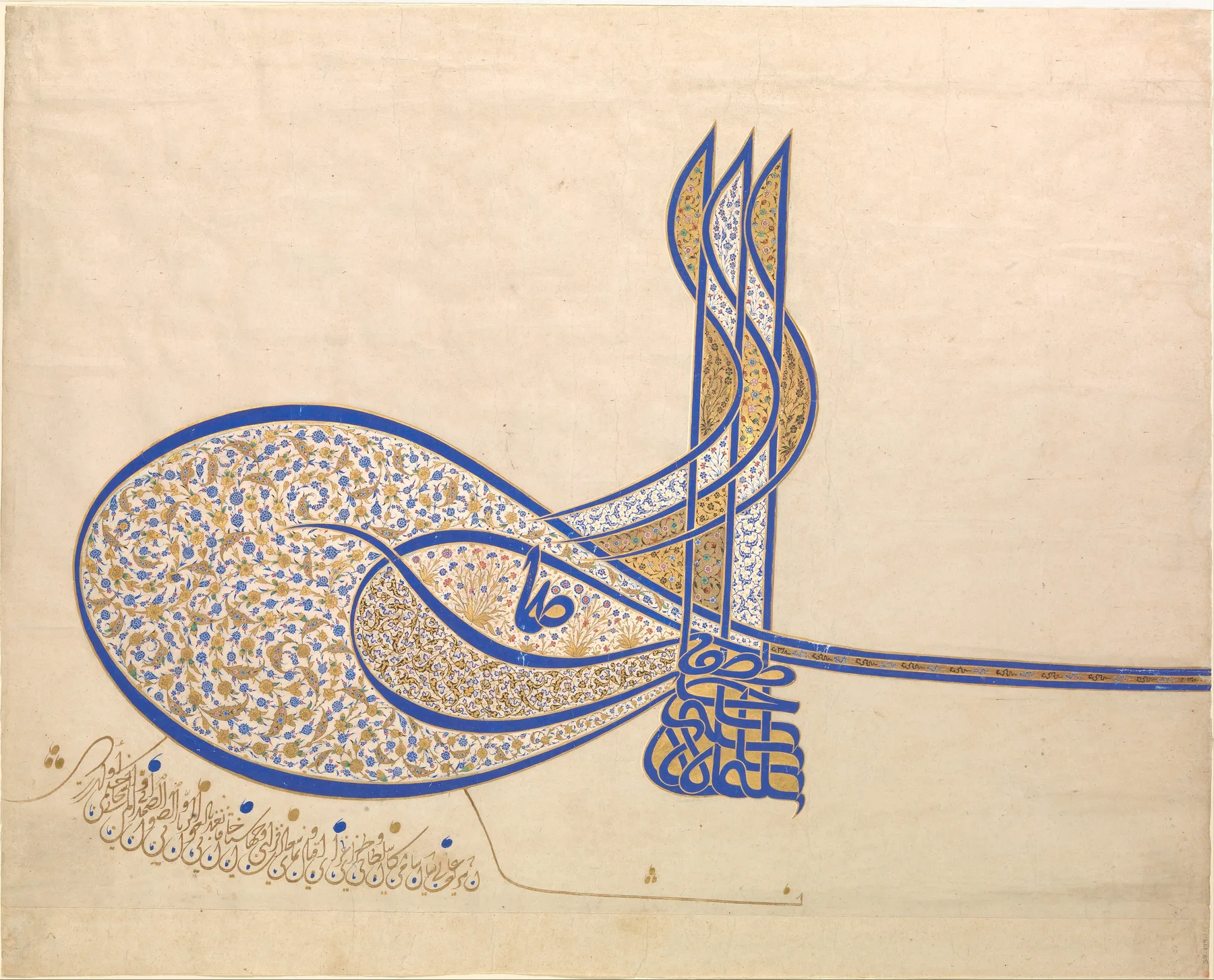
A tughra was the Ottoman sultan’s calligraphic insignia, applied to official documents and other authorised contexts. The Met’s record identifies the example above with Süleyman I and dates it to about 1555–60.
The emblem contains the ruler’s name, his father’s name, title, and a formula of victory. Its loops, horizontal strokes, and three rising shafts make language immediately recognisable as dynastic form even for a viewer unable to parse every letter. Blue outlines hold fields of gold and minute floral ornament. Administrative validation becomes a sustained act of looking.
The surviving sheet also warns against treating the tughra as an autonomous logo. It originally headed a document. The first line remains below, but the decree’s full text and legal action are no longer present. Museum display elevates the emblem and removes much of the transaction it authorised.
To interpret it, reconstruct the missing relationship: whose command, addressed to whom, concerning what land, office, payment, privilege, or obligation?
Read the tughra as text, image, and institution
The tughra performed at least three roles at once.
As text, it named a particular ruler within a dynastic line. Transliteration and translation matter because the shape is not abstract ornament.
As image, it created a repeatable silhouette whose proportions and internal illumination could vary. Recognition could precede full reading.
As institution, it marked an authorised act of rule. Calligraphers and chancery officials prepared documents through regulated procedures; the sultan did not necessarily draw each emblem by hand.
Courtney A. Stewart’s Met essay on the tughra uses branding as a modern comparison, but the analogy has limits. A corporate mark seeks recognition; a tughra also operated inside law, hierarchy, scribal practice, and sovereign command.
Do not separate beauty from bureaucracy. The visual force of the signature helped an administrative document materialise power.
Court workshops were systems of people
The ehl-i hiref, the salaried community of palace craftspeople, included specialised groups involved in painting, calligraphy, illumination, binding, metalwork, textiles, arms, jewellery, and other production. Payroll registers record names, origins, categories, wages, apprentices, deaths, and changing staff totals.
Murat Uluskan’s study of Tabrizi makers in sixteenth-century payroll registers demonstrates both the scale and mobility of this organisation. A register attributed to 1501–05 records 360 craftspeople; the 1526 register lists 598 across 38 classes. These numbers describe documented employees, not every maker serving the palace or every artisan in Istanbul.
Origins in the records matter. Court production brought together people from Anatolia, the Balkans, Iran, Arab lands, and elsewhere through patronage, career movement, dynastic networks, war, and at times coerced transfer. “Cosmopolitan workshop” can sound celebratory if it erases how people arrived.
Nor was the court the whole economy. Guild and independent workshops made objects for urban buyers and export. Court designers could propose patterns later adapted in ceramics or textiles, but makers outside the palace translated those patterns through different materials, schedules, prices, and customers.
Bookmaking joined several hands
An imperial manuscript could require an author or compiler, calligrapher, paper preparer, ruler, illuminator, painter, margin decorator, binder, proofreader, librarian, patron, and administrator. Titles such as “made by the palace workshop” should not merge those roles into a single hand.
Books also joined several temporal layers. A text written in the fourteenth century could be copied and illustrated in the sixteenth. A manuscript could later be rebound, repaired, reorganised, or divided into separate folios. Album makers could remove drawings and calligraphies from earlier settings and assemble new sequences.
Emine Fetvacı’s Picturing History at the Ottoman Court shows that late sixteenth-century illustrated chronicles did more than flatter a sultan. Courtiers and patrons shaped political agendas; books constructed a historical record and a shared elite culture through controlled circulation.
Study the codex as a route. The order of pages, relation of text and image, moments of opening, scale of handling, and intended audience all produce meaning that an isolated digital image cannot preserve.
One folio from a six-volume life
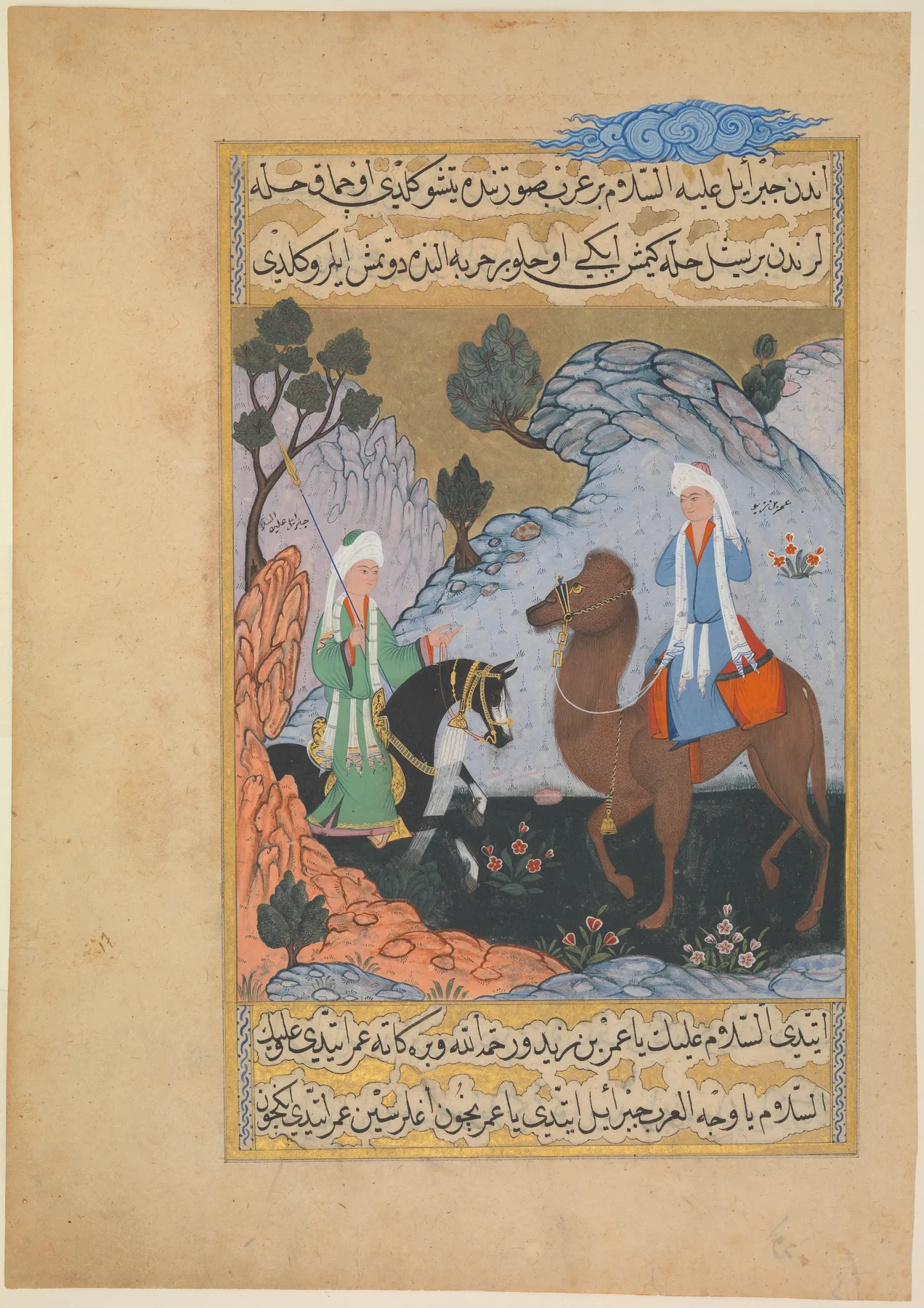
The Met identifies this page as a folio from the fourth volume of a six-volume Siyer-i Nebi, a life of the Prophet Muhammad commissioned by Murad III. The fourteenth-century text was by Mustafa b. Yusuf al-Darir al-Erzerumi; this painting is attributed to Mustafa ibn Vali and dates to about 1595.
Large lines of Ottoman Turkish text frame a meeting in a highly organised landscape. Rock formations, trees, flowers, horses, clothes, gesture, and writing do not occupy separate illustrative and literary worlds. Reading and seeing advance together on the page.
The present object is also evidence of dispersal. One folio in New York cannot represent the sequence of six volumes. Its accession history and removal from the codex changed how it can be handled, read, and compared with adjacent scenes.
Caption it at all those levels: scene, folio, volume, parent work, author, painter, patron, date, medium, current institution. “Ottoman miniature” identifies too little.
Figural images and the wrong universal rule
The claim “Islam forbids images” cannot explain an illustrated Ottoman life of the Prophet. Neither can the opposite claim that there were no restrictions.
Debates about figural representation differed across medium, setting, period, patron, legal tradition, and community. A painted figure in a courtly or literary manuscript did not have the same use as an image in a mosque. Portraits, historical scenes, scientific diagrams, talismanic figures, puppets, textiles, and architectural ornament occupied different contexts.
Avoid making a single work prove universal tolerance or prohibition. Ask what this manuscript was for, who commissioned it, who could see it, how sacred figures were represented, and what conventions governed that representation.
The visual culture of Islam includes calligraphy, geometry, vegetal ornament, architecture, objects, and figural art. Those categories overlap. The tughra is both script and image; the Siyer-i Nebi makes writing part of the pictured page.
Pattern moved between media
Leaves, palmettes, carnations, tulips, cloud bands, rosettes, arabesques, and saz forms travelled among drawings, book margins, ceramics, tiles, textiles, metalwork, and architecture. Movement did not mean mechanical copying.
A brush can taper a line differently on paper and on a ceramic body. A loom requires repeat structures and interlaced threads. A stone carver answers grain and load. A tile panel must coordinate joints, walls, and viewing distance. Each craft translates a design through material constraints and specialist knowledge.
Court design ateliers helped circulate preferred motifs, while gifts, trade, copied drawings, migrant makers, and existing workshop repertoires created other routes. The same form could acquire a different scale, cost, texture, and audience in each medium.
When two objects “share a style,” diagram the transfer you can defend. A motif’s resemblance is evidence for comparison, not yet proof of direct contact.
Iznik was a town and a production network
İznik in northwestern Anatolia became a major centre for Ottoman stonepaste ceramics and architectural tiles. Workshops prepared silica-rich bodies, shaped vessels or tiles, applied designs, covered them with transparent glaze, and fired them. Cobalt blue, turquoise, green, black outlines, and a raised iron-rich red entered different phases of production.
The history of the label is instructive. The Victoria and Albert Museum’s ceramics guide notes that nineteenth-century European collectors often attributed these wares to Persia, Damascus, or Rhodes; scholars only established İznik production more securely in the twentieth century. Museum names record collecting history as well as origin.
Walter B. Denny’s Iznik: The Artistry of Ottoman Ceramics connects court design in Istanbul to ceramic workshops in İznik while covering both vessels and architectural tiles. The relationship was strong, but “court style” does not mean every surviving dish was directly commissioned by the palace.
Production joined local potters, painters, kiln workers, suppliers, merchants, court orders, architectural projects, and wider demand. Quality and palette changed over time; workshop practice was not one unbroken recipe.
One dish, two birds, many routes
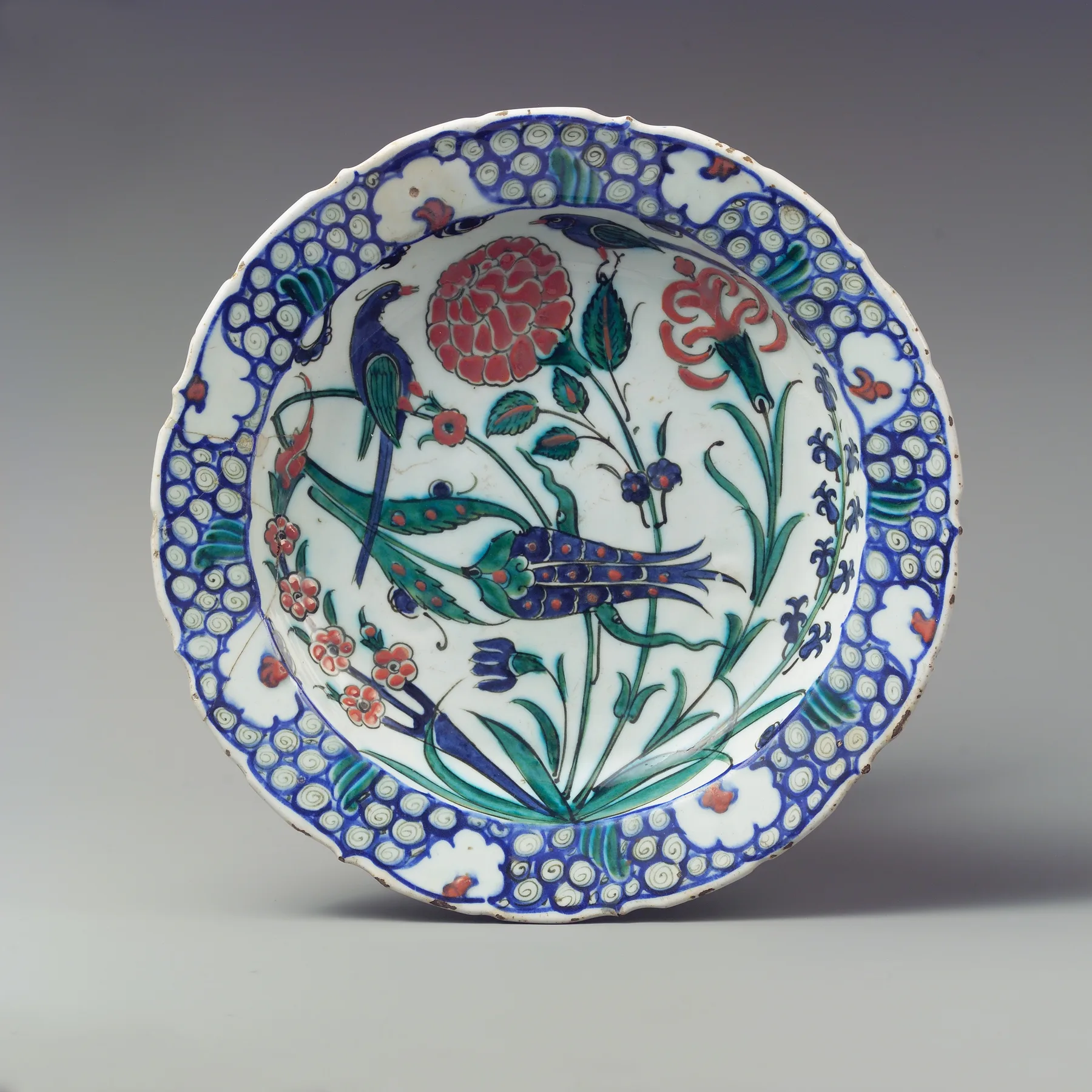
The Met records this dish as made in İznik around 1575–90. Two birds move through a field of tulips, carnations, hyacinths, leaves, and stems. Red, green, and blue differentiate forms under a transparent glaze; a dense border converts the circular rim into its own patterned zone.
The painter did not simply transfer a botanical specimen. Flowers bend to the dish’s centre, curvature, and available white ground. Birds overlap the vegetal system while remaining legible from above. Rotation has no single compulsory starting point.
Chinese blue-and-white porcelain, Persianate drawing, Ottoman court pattern, local ceramic knowledge, and Mediterranean demand all belong to the broader history of İznik ware. Those connections should not be merged into “influence.” Identify the feature: cobalt palette, cloud form, floral vocabulary, vessel shape, workshop technique, or route of trade.
The chips, cracks, and worn edge visible in the museum image are part of the object. A perfect digital circle would conceal use and survival.
Tiles and vessels did different work
An İznik dish and an İznik tile may share pigment, glaze, and pattern. Their spatial lives differ.
A dish can be lifted, rotated, stacked, served from, displayed, traded, and broken. Its design answers a rim and well. A tile becomes one unit in a wall system. Repetition must coordinate grout lines, architectural borders, inscriptions, windows, niches, and the changing distance of a walking viewer.
Court and elite architectural commissions could create large, predictable demand for tiles. Vessel production could answer court orders, urban buyers, diplomatic gifts, and export markets. The balance varied; identical material does not guarantee identical patronage.
The distinction also affects museum interpretation. A detached tile panel may appear like a framed picture even though it once wrapped a room. A dish mounted vertically loses the hand, table, food, and rotation that belonged to its design.
Silk made power tactile
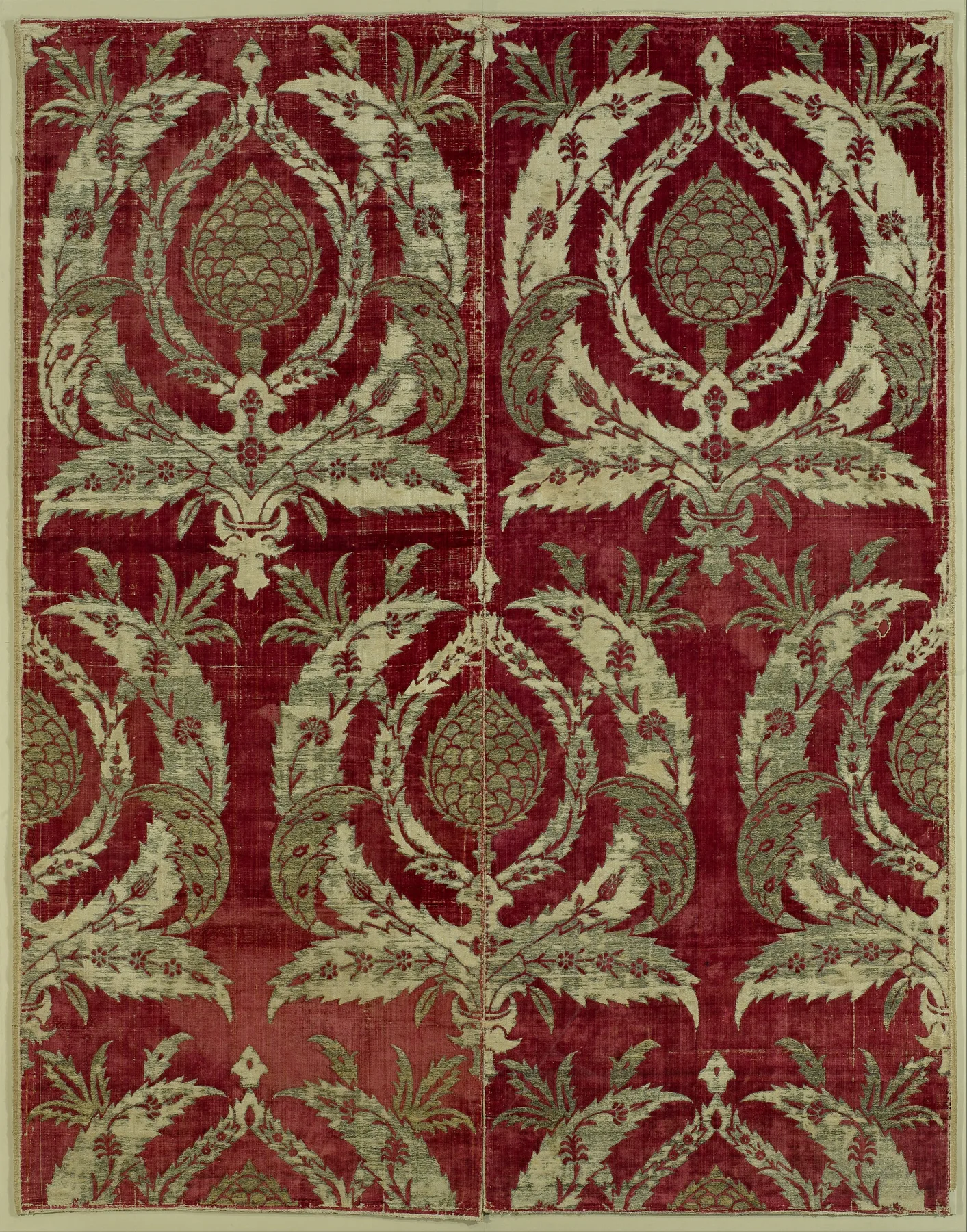
This textile joins red silk pile to metal-wrapped thread in a large repeat of artichoke-like forms, serrated leaves, and smaller blossoms. The Met attributes it to Bursa in the second half of the sixteenth century and records two loom-width pieces sewn together.
Velvet is structural, not painted fuzz. Extra warp threads are raised over rods to form loops; cutting selected loops creates pile. Voided areas, brocaded metal thread, dye, and changing reflection make the surface respond to movement and light.
The surviving rectangle probably served as furnishing fabric. Repetition allowed a larger interior field to continue beyond one loom width, while the seam exposes how scale was assembled. A textile could cover cushions, walls, clothing, a tent, a ceremonial body, or another valued object. It made authority soft, mobile, and close to skin.
The makers are unnamed. Attribution to Bursa identifies a probable production centre, not an individual hand.
Bursa connected loom, tax, and trade
Bursa was both a weaving centre and an entrepôt in the raw-silk trade. Nazanin Hedayat Munroe’s Met study of Ottoman silks traces undyed silk from Safavid Iran through government-controlled scales, taxation, Ottoman workshops, and European merchants. Political conflict in the mid-sixteenth century affected supply and encouraged more sericulture within Ottoman territory.
This history makes the textile a map of relations:
- silk cultivation and reeling in one region;
- caravan transport and border risk;
- weighing and taxation in Bursa;
- dyeing, pattern preparation, loom setup, weaving, cutting, and finishing;
- court, urban, diplomatic, or export use;
- later reuse, collecting, conservation, and museum display.
“Made in Bursa” does not mean every material originated there. Nor did Ottoman-Safavid war stop trade permanently. Rival states fought over territory and legitimacy while merchants and materials crossed contested boundaries.
Luxury condenses labour. The shine of metal-wrapped thread should prompt a question about who prepared the metal, silk core, dye, and loom—not only who wore the finished cloth.
Gift, robe, furnishing, and relic wrapping
Textile value came partly from its ability to change function. The same bolt might become a caftan, cushion cover, wall hanging, tent furnishing, ceremonial gift, or diplomatic offering. Ottoman honour robes formalised relationships by clothing a recipient in material bestowed by authority.
Export added new contexts. Munroe documents Ottoman silks entering European palaces and churches, where they could become secular dress, ecclesiastical vestments, or coverings for relics. A floral Ottoman textile in a Christian treasury is not evidence that its makers designed a Christian object. It is evidence of movement, revaluation, cutting, and reuse.
Present classifications often name the last surviving form. “Chasuble” may describe what a textile became in Europe, not what the Ottoman loom originally produced. Seams, selvedges, pattern direction, and mismatched pieces can help reconstruct that transformation.
Follow the cloth through each identity instead of choosing one culture to own its entire life.
Empire moved people and materials unequally
Ottoman expansion connected workshops to new territories, resources, buildings, and makers. It also relied on siege, warfare, forced labour, enslavement, recruitment, taxation, and political hierarchy. Art history loses explanatory power when “exchange” replaces all of those relationships.
The Met notes that victories over the Safavids in 1514 and conquest of the Mamluk sultanate in 1516–17 increased the presence of Iranian and Arab artists and intellectuals at the Ottoman court. Payroll research records Tabrizi makers in palace service. Individual paths could involve invitation, career opportunity, dynastic relocation, captivity, or coercion; do not assign one motive without evidence.
Materials also carry unequal histories. Imperial building extracted and purchased stone, timber, metal, glass, and labour across distance. Silk taxation generated revenue. Diplomatic gifts could signal reciprocity between courts while tribute and booty marked asymmetry.
The task is not to reduce every object to domination. It is to keep beauty, skill, service, piety, profit, and violence inside the same historical frame when the evidence connects them.
Centre and province are not opposites
“Court versus province” sounds like a clean division between invention and imitation. Ottoman production was more entangled.
Istanbul workshops could formulate designs and issue commissions. Bursa and İznik makers translated patterns through looms, kilns, guild structures, and markets. Cairo’s established crafts did not begin with Ottoman conquest. Baghdad’s book arts connected Ottoman administration to longer Persianate and Arab traditions. Balkan buildings combined imperial patronage with local construction knowledge and urban needs.
Provincial elites also commissioned ambitious works and pursued their own political visibility. Objects and specialists moved toward, away from, and between capitals. A court could absorb a regional form; a village workshop could make for international export.
Replace a vertical diagram with a network, then restore hierarchy inside it. The capital had unusual resources and coercive capacity, but it did not possess every skill or control every transaction.
Change after 1600 is not decline by default
Older surveys often describe the seventeenth century as a decline from the “classical” age of Süleyman and Sinan. Economic pressure, inflation, war, court reorganisation, and changing patronage were real. Decline becomes misleading when it treats difference from a sixteenth-century canon as failure.
Marika Sardar’s Met essay on Ottoman art after 1600 records a reduction in the salaried court scriptorium and growing incentives for artists to work for open markets. That is an institutional shift, not the disappearance of artistic intelligence. Ahmed I’s mosque, albums, calligraphy, textiles, ceramics, domestic patronage, and urban production created different centres of demand.
Use measurable claims. Did court payroll shrink? Did ceramic composition change? Did a workshop close, price fall, imported object become more common, or new buyer group appear? “Quality declined” requires criteria and comparison, not nostalgia for imperial concentration.
A comparison matrix
| Work or site | Material system | Institution | Movement and use | Power question |
|---|---|---|---|---|
| Süleymaniye Mosque and complex | Stone, brick, timber, glass, plaster, metal, textiles, water, coordinated labour | Sultan’s commission, Corps of Royal Architects, waqf administration, religious and service staff | Prayer, study, food, treatment, burial, urban circulation; later repair and continued worship | How did charitable service, skyline, dynastic memory, and imperial revenue reinforce one another? |
| Süleyman’s tughra | Paper, ink, pigment, gold, calligraphic and chancery practice | Court and imperial administration | Headed an official document; later detached and collected | How did a recognisable form authorise rule, and what command is missing from the fragment? |
| Siyer-i Nebi folio | Paper, text, painting, illumination, binding, multi-volume sequence | Murad III’s commission and collaborative book production | Elite reading; page-turning; later dispersal into separate collections | Who shaped the historical and religious narrative besides the sultan? |
| İznik bird dish | Stonepaste, underglaze pigments, glaze, kiln, vessel market | Workshop production linked to court designs and wider demand | Handling, serving or display, trade, collection | Does “court style” reveal or hide the unknown potter, painter, buyer, and route? |
| Bursa velvet fragment | Raw silk, dye, metal-wrapped thread, loom and seam | Bursa workshops, guild and trade systems, court and export markets | Furnishing, dress, gift, reuse, European collection | Which labour and taxed routes made luxury available to the person who displayed it? |
The matrix does not rank the works. It shows that “imperial” can describe a funding structure, an administrative act, a visual claim, a trade system, or a later interpretation—and that those meanings do not always coincide.
Common survey traps
“Ottoman art is Turkish national art before the republic.” The modern nation-state does not contain the empire’s geography, languages, communities, or historical categories.
“Islamic art avoids figures.” Figural representation varied by medium and context. The Siyer-i Nebi folio makes the universal claim untenable without making images unrestricted everywhere.
“Sinan built hundreds of buildings.” As chief architect he shaped an extraordinary institutional output. Each project depended on patrons, architects, site supervisors, craftspeople, labourers, suppliers, and administrators.
“The mosque is the monument.” A külliye integrated worship with education, charity, infrastructure, revenue, residence, and burial. Isolating the dome hides much of the project.
“İznik ware was palace porcelain.” It is stonepaste ceramic, not porcelain. Court design and orders mattered, but workshops also made vessels for wider markets.
“Miniatures illustrate text.” A manuscript painting works with page order, calligraphy, patronage, performance, and audience. “Miniature” should not imply minor importance or an autonomous little picture.
“Ottoman style spread from centre to province.” Some forms did. Other techniques and makers moved toward the capital, while local institutions transformed what they received.
“The seventeenth century declined.” Specify the institution, material, wage, market, or formal change. Difference from a preferred classical canon is not data.
Questions for close looking
Choose one object or building and make four evidence passes.
Material
- What is it physically made from, and where might those materials have originated?
- Which sequence of specialised tasks turned matter into the surviving object?
- What later repair, cutting, transfer, rebinding, reuse, or conservation changed it?
Institution
- Was it commissioned by the court, endowed through waqf, made by a guild workshop, produced for a market, or moved through more than one system?
- Which named office, register, contract, inscription, or collection record supports that answer?
- Whose necessary labour remains unnamed?
Use
- Did people enter, wear, read, sign, rotate, serve from, hang, gift, store, pray within, or process around it?
- How did scale and movement organise different viewers?
Power and route
- Which conquest, tax, trade route, diplomatic relation, migration, or local practice is demonstrably connected?
- Does “imperial” describe origin, audience, style, institution, later ownership, or a claim made by the object?
End with a bounded sentence. “Ottoman artists loved flowers” is a generalisation. “The İznik painter bends tulips and carnations into the dish’s circular field, translating a shared court floral vocabulary into a vessel that can be rotated by hand” connects form, medium, and use.
Terms for Ottoman visual worlds
Çatma: a cut and voided velvet technique, often using silk pile and metal-wrapped thread.
Ehl-i hiref: organised and salaried groups of palace craftspeople recorded in Ottoman court payrolls.
Firman: an official imperial decree; spelling and document categories vary in English usage.
Hil’at: a robe of honour bestowed to formalise favour, office, diplomacy, or hierarchy.
İznik ware: a modern art-historical category for Ottoman stonepaste ceramics and tiles associated principally with İznik production; attribution and chronology require object evidence.
Külliye: a coordinated complex of buildings, often centred on a mosque and incorporating educational, charitable, funerary, commercial, or service functions.
Mihrab: a feature marking the qibla, the direction of prayer toward Mecca.
Minbar: a pulpit associated especially with the Friday sermon.
Nakkaşhane: a term used for the Ottoman court design or painting atelier; it should not imply that every craft took place in one room.
Saz: an energetic design vocabulary of long serrated leaves, composite flowers, and sometimes fantastic creatures, prominent in sixteenth-century Ottoman and Persianate arts.
Stonepaste: a ceramic body rich in crushed silica, combined with smaller amounts of clay and glassy material; İznik ware is not porcelain.
Tughra: a sultan’s calligraphic insignia used in official and dynastic contexts.
Waqf: an endowed property or revenue arrangement supporting designated religious, charitable, educational, or social purposes.
Source guide
The sources below combine current object and heritage records, Turkish reference scholarship, archival research, technical or material history, and named art-historical interpretation. Object metadata, provenance, and image-rights terms can change and should be rechecked before reuse or formal citation.
Architecture, city, and institution
- Historic Areas of Istanbul and Selimiye Mosque and its Social Complex, UNESCO World Heritage Centre.
- “Süleymaniye Camii ve Külliyesi”, by Selçuk Mülayim, TDV İslâm Ansiklopedisi.
- The Age of Sinan: Architectural Culture in the Ottoman Empire, by Gülru Necipoğlu.
- “Form and Function in Ottoman Building Complexes”, by Aptullah Kuran, Archnet.
- Constantinopolis/Istanbul: Cultural Encounter, Imperial Vision, and the Construction of the Ottoman Capital, by Çiğdem Kafescioğlu.
- Topkapı Palace, Republic of Türkiye Ministry of Culture and Tourism.
Court, book, and inscription
- The Art of the Ottomans before 1600 and The Age of Süleyman “the Magnificent”, by Suzan Yalman based on original work by Linda Komaroff, The Met.
- Tughra of Sultan Süleiman and The Angel Gabriel meets ’Amr ibn Zaid, The Metropolitan Museum of Art.
- “Ehl-i Hiref Maaş Defterlerinde Kayıtlı Tebrizli Sanatkârlar (1526–1566)”, by Murat Uluskan, Belleten 85, no. 304.
- Picturing History at the Ottoman Court, by Emine Fetvacı.
- Sinan’s Autobiographies: Five Sixteenth-Century Texts, edited and translated by Howard Crane and Esra Akın with Gülru Necipoğlu, Archnet.
Ceramic, textile, and exchange
- Dish Depicting Two Birds among Flowering Plants and Rectangular Textile Fragment, The Metropolitan Museum of Art.
- Iznik: The Artistry of Ottoman Ceramics, by Walter B. Denny.
- An A–Z of Ceramics, Victoria and Albert Museum, including the changing attribution history of İznik ware.
- Silks from Ottoman Turkey, by Nazanin Hedayat Munroe, The Met.
- İpek: Imperial Ottoman Silks and Velvets, by Nurhan Atasoy, Walter B. Denny, Louise W. Mackie, and Hülya Tezcan.
- The Art of the Ottomans after 1600, by Marika Sardar, The Met.
- The Met Open Access policy, the rights basis for the four Met object files reproduced here. The hero photograph’s author and CC BY-SA 3.0 licence are recorded on its linked Wikimedia Commons file page.
Continue the Atlas route
This chapter follows the Italian Renaissance and Northern Renaissance routes without treating Europe as the source from which early-modern culture radiated. Ottoman, Venetian, Habsburg, Mamluk, and Safavid institutions competed and exchanged objects across the Mediterranean and overland routes. Each shaped what the others could buy, imitate, fear, tax, gift, or claim.
The next Atlas chapter turns to Persianate arts across Safavid and Mughal courts. Several bridges are already visible: raw silk moving from Safavid Iran through Bursa; Tabrizi makers recorded in Ottoman palace payrolls; saz designs crossing political borders; Persian-language literary and historical traditions entering Ottoman books; and rivalry generating both conflict and artistic attention.
Carry one question forward: when a form appears in two courts, what moved—a person, page, textile, diplomatic gift, captured object, commercial product, or idea recorded through another medium? Naming the route is how comparison becomes history.
Editorial record
About this article
- Author
- Publisher
- GeMarkt
- Published
- Updated
- Reviewed
- Internal source & rights check. Conducted by GeMarkt Research Review. This is an internal editorial check—not independent peer review.
- Source standard
- Art history source standardPrioritises object records and research sources, distinguishes evidence from interpretation, and states material uncertainty.
Found a claim that needs checking? Report a factual error.