Art History · Learning chapter
Atlas II — Connected worlds · 4 of 10
Medieval European art, c. 900–1400: monastery, cathedral, court, city, and devotion
A five-object guide to how monasteries, courts, cathedrals, Jewish households, and communes organised labour, memory, belief, and authority.


What we’ll look at
What roles did art play in medieval monasteries, cathedrals, courts, and cities?
A gold figure sits behind protective glass. Her dark blue eyes turn slightly apart. Gems, antique cameos, enamel, crystal spheres, and small metal plaques cover her robe and throne. Modern white flowers rest in hands remade centuries after the figure first took shape. Reflections from the case make it difficult to tell where the object ends and its present display begins.
This is the reliquary statue of Sainte Foy at Conques. It contains part of the skull associated with a young Christian martyr, but it is not a sealed ninth-century time capsule. A wooden body, a reused late antique head, early medieval goldwork, later jewels, a thirteenth-century reliquary on the chest, fourteenth-century enamels, sixteenth-century hands, and modern supports have accumulated into one powerful presence.
The object immediately unsettles a familiar picture of medieval art. There is no single date, maker, style, or original surface to recover. Its history belongs not only to a goldsmith but to a monastery, a cult of relics, travelling pilgrims, donors, rival sacred institutions, later repairers, and present custodians.
That layered figure gives this guide its central question:
How did medieval institutions make authority visible through objects and spaces—and what disappears when five centuries are reduced to a march from Romanesque to Gothic?
Five works offer different answers. Sainte Foy turns a relic into a public, mobile body. The Bayeux Embroidery makes a disputed conquest unfold through linen, wool, image, and Latin words. The Good Samaritan Window at Chartres joins biblical narrative to the labour and gifts of urban shoemakers. The Golden Haggadah brings sacred history into a Jewish Passover book made for handling and recitation. Ambrogio Lorenzetti’s Sienese mural makes civic government look like an organised city and countryside.
Together they show that medieval art was not one church style. It was a set of material practices through which monasteries, bishops, courts, households, workshops, and communes claimed memory, disciplined attention, negotiated status, and imagined good order.
What does “medieval European” mean here?
“The Middle Ages” is a modern period label. It defines a time as being between an ancient world and a later modern one, usually with western European history as the measure. That chronology cannot be exported as a universal stage through which every society passed.
This article uses c. 900–1400 as a limited route through selected Latin Christian and Jewish settings in present-day France, England, Spain, and Italy. It does not cover the whole of Europe. Byzantine Roman worlds and Islamic societies have their own histories, while Scandinavia, the Baltic, central and eastern Europe, the Balkans, Ireland, and many regional traditions require more than a passing paragraph. Even within the five chosen locations, rulers, languages, laws, religious communities, and workshop structures changed repeatedly.
The familiar labels Romanesque and Gothic are useful coordinates, not names for two unified movements. The Metropolitan Museum of Art’s history of Romanesque art notes that nineteenth-century art historians coined “Romanesque” to classify especially eleventh- and twelfth-century western European architecture. The term can highlight renewed engagement with Roman building, but it can obscure Insular, Byzantine, Islamic, and local resources. “Gothic” also began as a later and once-derogatory label; the Met’s Gothic overview traces its application to art built around the pointed arch from the twelfth century onward.
Neither word describes what every maker believed they were doing. A thirteenth-century glazier did not wake up inside a textbook transition from Romanesque heaviness to Gothic lightness. The immediate problems were more specific: how to make a window withstand wind, how to align a story with a bay, how to coordinate patrons and workshops, and how coloured glass would be seen from the floor.
The sequence below is therefore institutional rather than evolutionary. It moves among monastery, episcopal conquest narrative, cathedral, household, and commune. The question is not which work looks most advanced. It is what each work enabled people to do.
Sainte Foy at Conques: a relic receives a body
A reliquary contains remains or objects associated with a holy person. The container does not merely protect them. It directs how people approach, recognise, carry, display, and remember what is inside.
At Conques, the relic associated with Sainte Foy arrived from Agen in 866 through what the abbey’s own history calls a “furtive translation”—a sacred relocation that another institution could describe as theft. The transfer strengthened Conques as a pilgrimage centre. By about 1050 the present abbey church was under construction, and the site became an important stop on a route toward Santiago de Compostela. Belief, travel, hospitality, competition, and material patronage met there; none can be separated cleanly from the others.
The statue is about 85 centimetres high. According to the French Ministry of Culture’s object record, its materials and parts cross many dates: wood; gold and gilded silver worked in repoussé and filigree; enamel and stones; a thirteenth-century chest reliquary; fourteenth-century translucent enamels; a fifteenth-century neck jewel; and sixteenth-century hands. The shoes and footstool are modern. The Conques treasury’s object history further identifies the hollow gold head as a reused late antique bust and the body as yew wood.
This accumulation is not damage to an otherwise pure original. It is evidence of continuing attention. Gifts could be attached, reset, repaired, or reinterpreted. Antique engraved stones carrying non-Christian figures could enter a Christian saint’s splendour without their earlier histories being fully legible to every viewer. Preciousness here is a process of gathering.
The figure’s frontal throne, crown, large eyes, and bright skin make the absent saint present as a heavenly intercessor. Yet the visual force troubled some medieval observers. Bernard of Angers, writing in the early eleventh century, compared the statue to an idol before defending it as a memorial that moved the faithful toward the saint. The Met’s study of relics and reliquaries uses his account to show that the distinction between image, relic, and worship was debated inside medieval Christianity, not invented by modern critics.
The institution made that distinction operational. Monks guarded the treasury, narrated miracles, organised access, celebrated feast days, and placed the object within liturgy and procession. Pilgrims did not encounter gold as an isolated sculpture. They arrived tired, heard stories, moved through an abbey church, prayed, gave, watched, touched when permitted, and carried memories away.
The photograph records a later arrangement. Protective glass, modern lighting, flowers, and altered hands mediate the view. It cannot reproduce procession, candlelight, crowding, chant, or the moment when a hidden relic was understood to act through a shining body. Nor can the surviving treasury tell us what poorer gifts, textiles, wax, food, or temporary decorations once accompanied it.
The Bayeux Embroidery: conquest becomes a sacred story
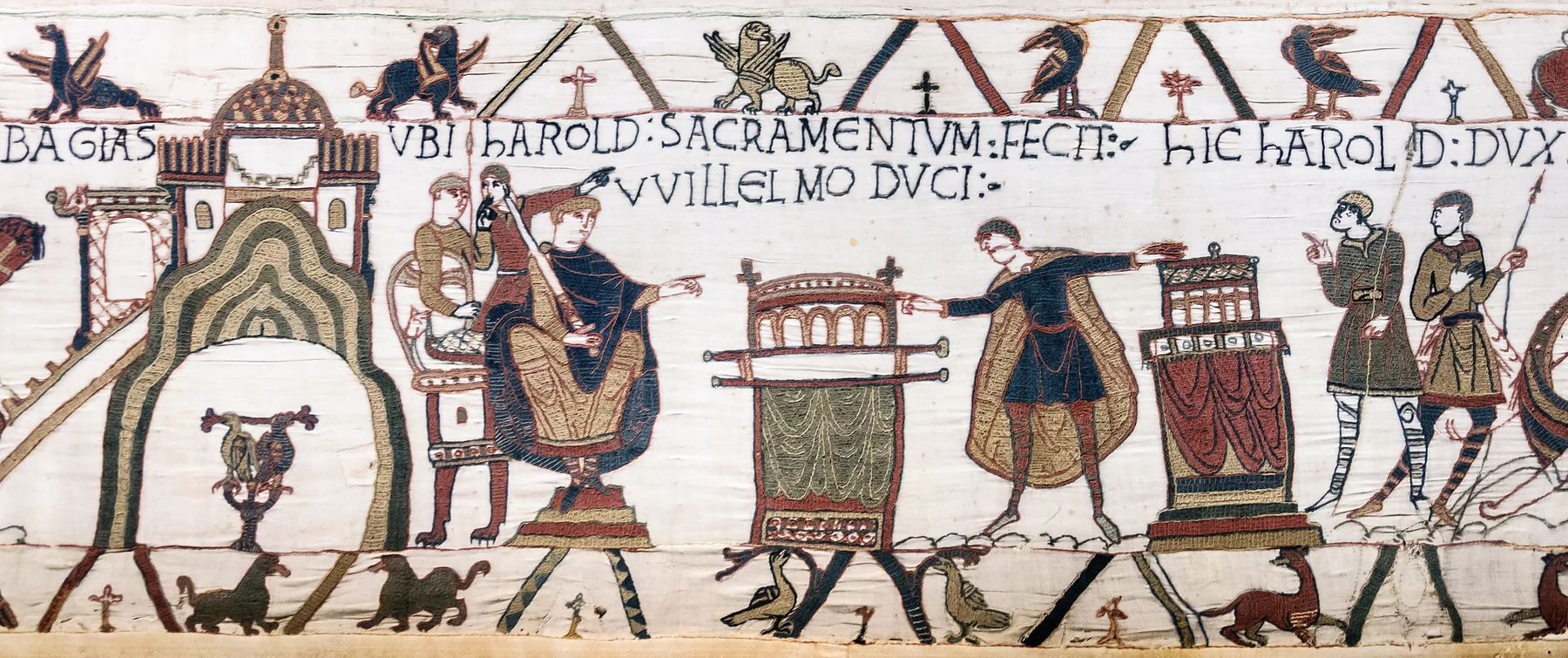

Harold stretches his arms between two covered structures. His fingers touch their upper surfaces while William, Duke of Normandy, sits at the left. Above, Latin words identify the action: Ubi Harold sacramentum fecit Willelmo duci—where Harold made an oath to Duke William. Birds and hybrid animals continue almost indifferently along the borders.
The scene makes sacred matter serve political narrative. According to the embroidery’s story, Harold’s later acceptance of the English crown violates an oath sworn over relics. William’s invasion can then appear not simply as successful force but as punishment and rightful correction. The image does not neutrally record a legal event. It gives one contested succession a moral structure.
Despite its usual name, the Bayeux Tapestry is an embroidery. In tapestry weaving, the image and supporting textile are made together. Here, wool threads were stitched onto previously woven linen. The Bayeux Museum’s material account describes nine joined linen panels, ten colours of wool, and four stitch types across about 68.3 metres. Line, fill, inscription, seam, and repair make the narrative move.
The labour remains only partly recoverable. The makers are unknown. Bishop Odo of Bayeux, William’s half-brother, is widely proposed as patron, and production in England is strongly argued, but neither proposition is a surviving signature. Romantic tradition assigned the work to Queen Matilda and her ladies; the museum rejects that story. “Likely” still matters. The textile cannot name every designer, draughtsperson, spinner, dyer, embroiderer, supervisor, or repairer whose work it contains.
Material decisions shape the politics. Stem stitch outlines faces and letters; couching fills large colour fields; changing leg positions give horses speed. The long strip asks a viewer to follow sequence, but no one viewpoint reveals the whole. Repeated appearances of William, Harold, and Odo create recognition. Short Latin captions guide readers without explaining every ambiguity. Border creatures, fables, labour, feasting, ships, and corpses widen the story beyond named elites while remaining organised around their conflict.
The oath scene is especially strategic because relics lend invisible consequences to a gesture. Harold’s open arms create visual proof of commitment, though historians cannot verify the event exactly as shown. The covered containers reveal little of their contents. Their authority depends on viewers accepting that sacred remains are present.
The work’s later institutional life matters too. A 1476 inventory documents it in Bayeux Cathedral, where it was hung in the nave once a year and otherwise stored in a chest. That evidence does not prove precisely how it was first displayed four centuries earlier. It does show that a conquest narrative could become a church treasure, unfolded periodically for a new public.
Modern high-resolution images reverse the original scale problem: one scene fills a screen while the 68-metre sequence disappears. Detail becomes clearer, but bodily movement along the textile is lost. A single fragment can therefore teach how the oath is staged, not what every viewer made of the complete conquest story.
Chartres: glass joins scripture, trade, and collective building
_-_Cath%C3%A9drale_Notre-Dame_-_Nef_-_Parabole_du_bon_Samaritain_(44)_(33976579518).jpg)
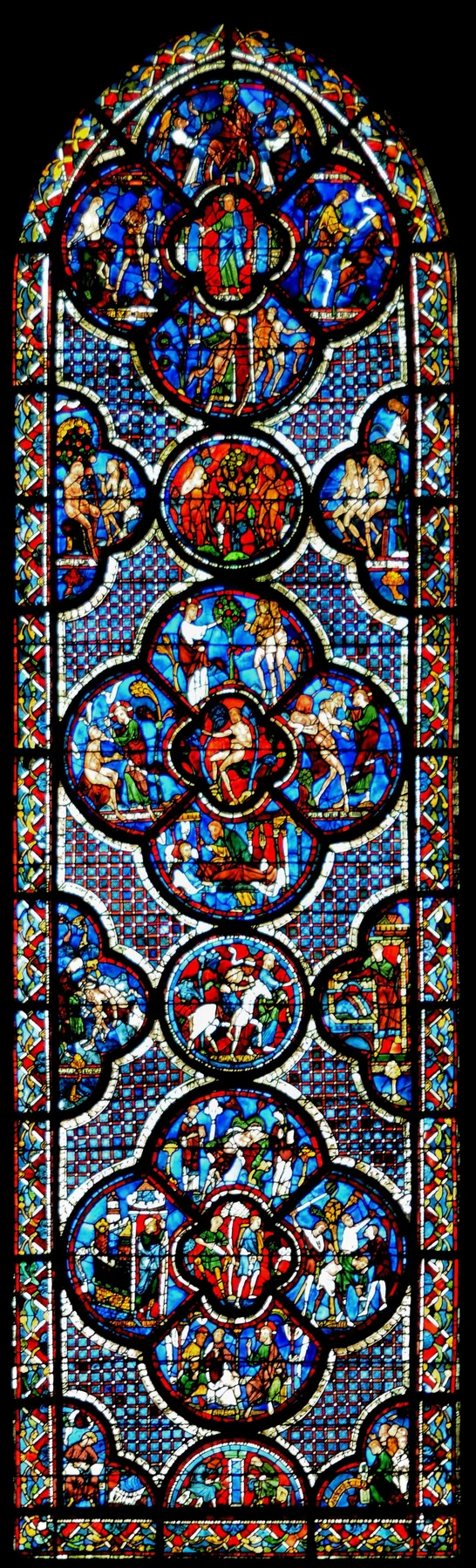
The full window is more than eight metres high. On a screen, every panel appears available at once. From the cathedral floor, the lower scenes can be approached more closely while the upper figures recede into coloured light. Scale creates different audiences inside the same object.
Chartres Cathedral was largely rebuilt after a fire in 1194. UNESCO describes a rapid twenty-six-year campaign that joined architecture, sculpture, and an exceptional surviving ensemble of twelfth- and thirteenth-century glass. “Rapid” is relative: it still required long coordination among a cathedral chapter, bishops, administrators, donors, quarry workers, carpenters, masons, glaziers, painters, metalworkers, carriers, and many other labourers. A cathedral was not the enlarged product of one solitary architect.
The Good Samaritan Window belongs to the south aisle of the nave. The French heritage record dates it about 1205–1215, identifies an unknown maker, records an 1897 restoration, and notes the shoemakers represented as donors in the lowest register. Above them, small scenes combine the parable of the wounded traveller aided by a Samaritan with the Creation and Fall of humanity, culminating in Christ. The juxtaposition turns one story into a theological interpretation of another: human fall and divine rescue echo through the same vertical structure.
The shoemakers complicate a simple division between sacred cathedral and secular town. Their tools and labour enter the lower edge of sacred history. Donation could express devotion, professional identity, prosperity, obligation, and a claim to visibility. Yet donor panels do not make the cathedral socially equal. Clergy controlled liturgy and much of the image program; wealth and status shaped the capacity to give; many workers remain unnamed.
Glass itself demanded distributed skill. Coloured pieces were cut to a full-scale design, fitted into lead cames, painted for faces, folds, and detail, fired, joined into panels, and installed within iron armatures. The Met’s account of medieval stained glass uses the twelfth-century treatise of Theophilus as crucial evidence for the process. A written recipe, however, cannot identify the exact workshop sequence at Chartres or turn every glazier into the same kind of artisan.
Light did not simply pour through transparent pictures. Thick coloured glass filtered it; weather and hour changed contrast; distance reduced detail; lead lines held the surface together while segmenting it. The window therefore organised looking through both visibility and difficulty. Recognising a saint, a familiar parable, or a donor’s trade did not require reading every panel in the same way.
The cathedral was a Marian pilgrimage destination and a working urban church. Processions, feast days, preaching, private prayer, ordinary traffic, and commercial life around it produced different encounters. The Chartres stained-glass program distinguishes monumental upper figures from lower narrative windows designed for nearer attention. That spatial logic is more useful than the claim that medieval windows were merely “the Bible of the illiterate.” Viewers brought uneven knowledge, heard sermons and stories, watched ritual, and learned with other people.
The photograph isolates and illuminates the complete lancet. It reveals composition but removes the surrounding nave, changing daylight, neighbouring windows, and viewer’s neck and feet. It also records a restored object. Survival is an achievement of continuing conservation, not evidence that every pane remains untouched since 1210.
The Golden Haggadah: sacred history enters the household
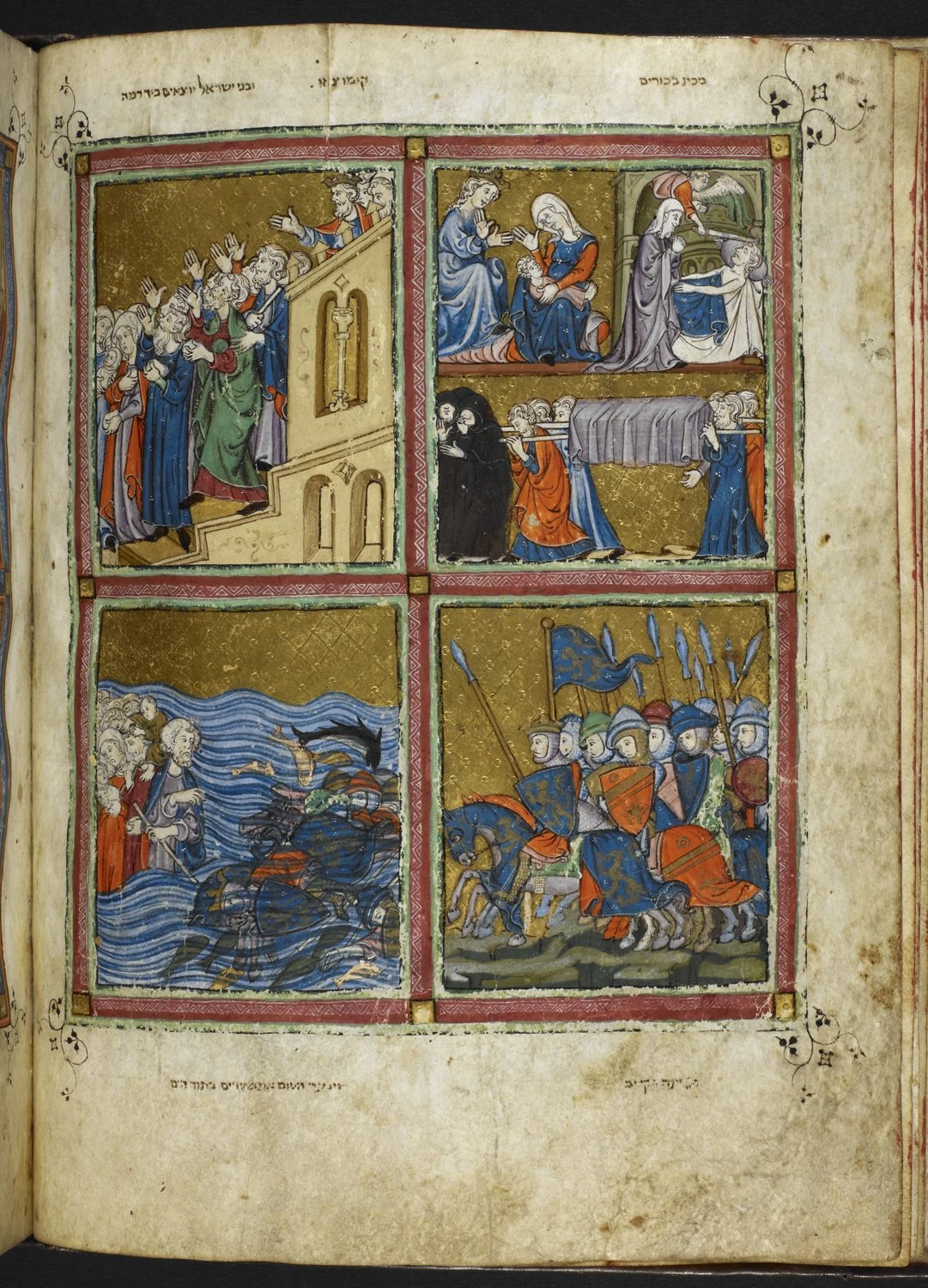

Four scenes occupy one gold-backed page. Mourning follows the death of the Egyptian firstborn. Israelites leave with small bundles. Pharaoh’s mounted force gives chase in armour that belongs visually to medieval Iberia rather than ancient Egypt. At the Red Sea, escape and destruction share the last field.
This is folio 14v of the Golden Haggadah, a Hebrew manuscript made in Catalonia, probably Barcelona, about 1320–1330. A Haggadah contains the order and narrative used at the Passover Seder, the ritual meal that commemorates the Exodus. Its primary setting was not cathedral or monastery but a Jewish household gathered around food, questions, blessings, recitation, and remembered liberation.
The British Library catalogue records 101 folios, fourteen full-page miniatures in colour and gold near the beginning, numerous decorated words and marginal images, Sephardic square script, and later seventeenth-century additions. The book is named for the patterned gold-leaf grounds behind its miniature cycle. It is again not one untouched moment: medieval parchment, later paper, censorship erasures, new decoration, rebinding, collecting, and digitisation all shape the surviving codex.
The page turns ancient events into contemporary visual experience. Pharaoh’s soldiers look like mounted medieval warriors. Buildings, clothing, gesture, and heraldic colour translate scripture into forms available to the makers and users. That translation is not proof that the book documents one real Catalan street or army. It is a visual strategy for making remembered history present.
The manuscript also refuses the equation “medieval European art equals Christian art.” Jewish patrons, scribes, readers, and artists were active participants in European visual culture. The Met’s study of Jews and the arts in medieval Europe stresses both artistic interaction with surrounding Christian and Muslim communities and the inadequate survival of Jewish material evidence. Hebrew and Christian manuscripts produced in the Crown of Aragon could share formats, ornament, and workshop knowledge without making their religious uses identical.
Who painted the Golden Haggadah remains uncertain. Stylistic relationships can suggest contact with Christian manuscript production, but they do not securely identify the artists’ religion. A workshop may cross confessional boundaries; a shared motif is not evidence of social equality. The Met’s history of artistic interaction in medieval Iberia pairs exchange with changing legal inequality, bias, territorial conflict, and persecution. “Convivencia” cannot mean uninterrupted harmony.
The book’s luxury also marks uneven power within Jewish communities. Parchment, pigments, gold, skilled writing, illumination, and binding required resources. One lavish Haggadah cannot stand for every Seder, household, class, gendered role, or regional practice. Nor do narrative images turn the book into a secular picture album. Its paintings frame a performed sequence of reading, speaking, eating, and teaching.
The digital image makes gold uniformly bright and the page easy to enlarge. In use, reflection changed with angle; hands turned folios; words, song, food, and voices surrounded the picture. A household repeatedly activated the page.
Siena: government paints the order it wants to see
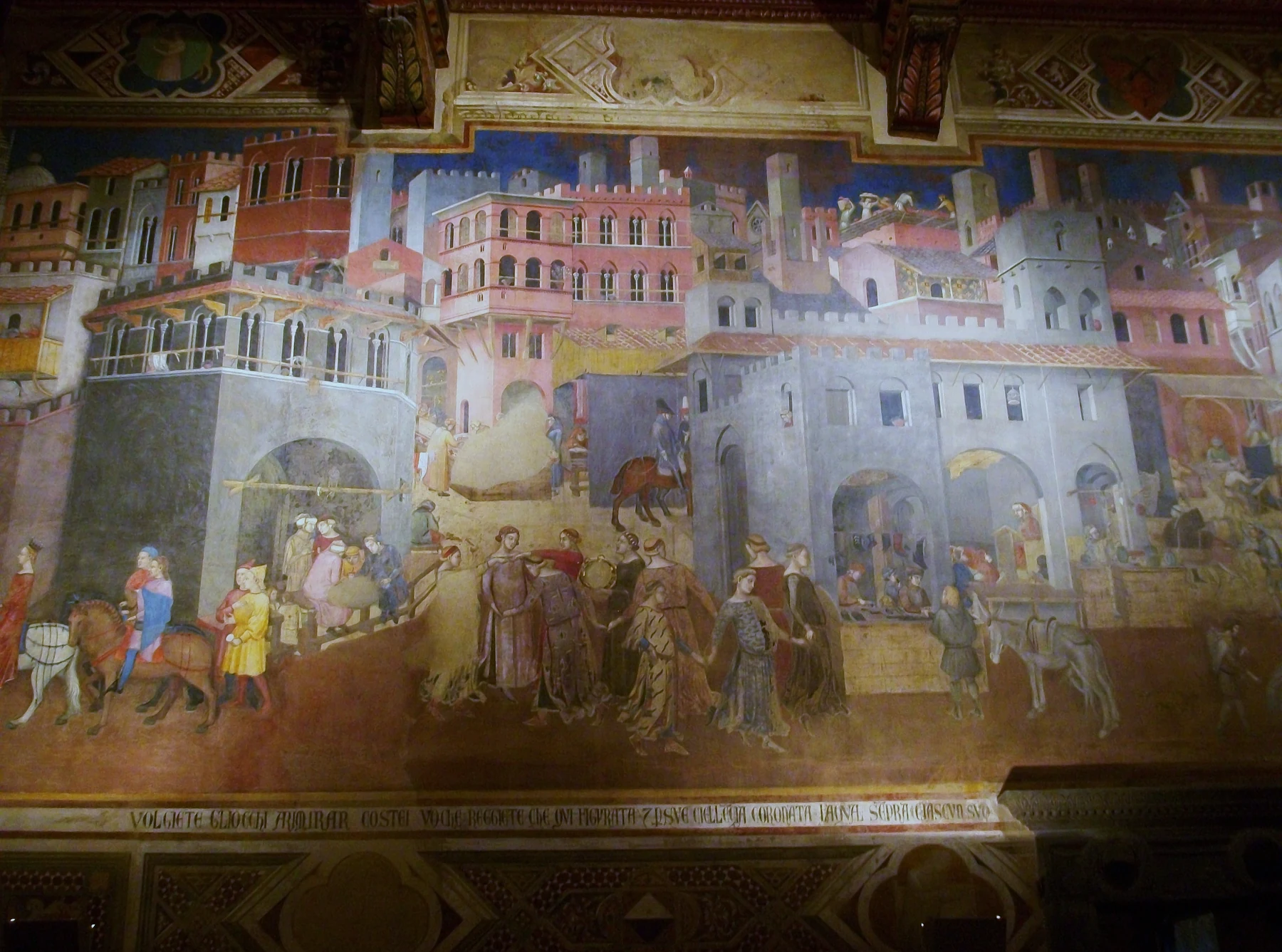

Siena appears crowded but coherent. Buildings rise at different angles. Masons work on a roof. Goods move through shopfronts and streets. Riders pass, pupils gather, and dancers form a ring. The scene feels observational because it contains so much activity.
It is not a photograph of ordinary life.
Ambrogio Lorenzetti painted the cycle now called the Allegory and Effects of Good and Bad Government in 1338–1339 for the room used by Siena’s governing Nine in the Palazzo Pubblico. The Comune di Siena’s Museo Civico record describes three walls devoted to the regime’s allegory and to its effects in city and countryside. Magistrates met inside a visual argument about the consequences of their decisions.
The complete cycle contrasts ordered and disordered government. Justice, concord, peace, security, and the common good become personifications; productive city and cultivated territory appear as effects. On the opposing wall, tyranny and violence undo that order. The relation is instructional, not descriptive: a governing body commissions images that define its rule as the condition of prosperity.
That claim deserves pressure. “Good” government here is the Nine’s civic ideal. The active city includes labour, trade, construction, education, ceremony, and pleasure, but it does not give every resident equal political voice. The countryside feeds the city; security depends on armed power; wealth is unevenly distributed; gender and class structure who occupies streets, workshops, households, and office. The mural’s abundance can conceal extraction as effectively as it celebrates coordination.
Lorenzetti is a named artist, unlike the makers of the previous four works. His name does not make the cycle an individual manifesto detached from commission, room, plaster, assistants, and civic program. Large wall paintings require prepared surfaces, drawn schemes, pigment, timed plaster sections, scaffolding, and cooperation. Naming a master can illuminate authorship while still compressing a workshop.
The room completes the argument. Unlike a portable panel, the images surround their political audience. The magistrates could turn from allegorical causes to urban and rural effects, then to the warning of bad rule. Windows, doors, meeting furniture, speech, and official routine interrupted and activated the painted field. Government saw itself while governing.
The selected photograph is deliberately incomplete. It gives the city enough scale for close looking but removes the allegorical figures, the countryside, the opposite wall, and the viewer’s position in the chamber. Current conservation matters as well: the Museo Civico’s project record documents continuing diagnostics and maintenance. What looks like a direct view of 1339 is a surviving, monitored surface whose colours, losses, and repairs have histories.
Five institutions, five kinds of encounter
| Work | Institution or social setting | Material operation | Likely encounter | Authority made visible | What the work cannot prove |
|---|---|---|---|---|---|
| Sainte Foy reliquary | Monastery, treasury, cult, pilgrimage route | A relic receives a composite gold body enlarged by later gifts and repairs | Altar display, feast, procession, prayer, treasury visit | Saintly intercession and monastic custodianship | One original appearance, uncomplicated consent to the relic’s transfer, or identical belief among pilgrims |
| Bayeux Embroidery | Episcopal and elite conquest narrative; later cathedral treasure | Stitched line, colour, word, and sequence moralise a disputed succession | Movement along a long hanging; periodic later display | Norman victory presented through oath, providence, and sacred sanction | A neutral record of 1066, a securely named patron, or identified makers |
| Good Samaritan Window | Cathedral chapter, pilgrimage church, urban donors and workshops | Coloured glass filters light while lead and painted detail order narrative | Distant and near viewing amid liturgy, movement, and changing daylight | Scriptural interpretation, institutional scale, and donor identity | Equal access to patronage, one viewer’s reading, or a completely untouched thirteenth-century surface |
| Golden Haggadah | Jewish household ritual and luxury manuscript culture | Gold, colour, writing, turning pages, recitation, and meal make Exodus present | Passover Seder, study, teaching, later collecting and display | Sacred memory and learned household practice | The experience of every Jewish family, the makers’ religious identities, or harmonious Iberian coexistence |
| Good Government cycle | Commune, council chamber, city and dependent territory | Wall painting surrounds magistrates with allegorical causes and social effects | Deliberation, official ceremony, repeated political viewing | The Nine’s claim that justice and concord produce prosperity | A documentary census of Siena or proof that represented order was socially equal |
The comparison changes the meaning of “audience.” A pilgrim could follow a reliquary in procession. A cathedral visitor stood beneath a window. A household passed through a ritual book. A magistrate sat inside a painted argument. These were not five versions of passive museum looking.
It also changes “patronage.” A bishop’s probable commission, shoemakers’ donor images, an unknown Jewish household, monastic accumulation, and a civic council distributed control differently. Patronage could set subject, location, cost, and access, but it did not replace workshop knowledge or determine every viewer’s response.
Materials carried memory across borders
None of these works belongs to a sealed Europe.
Sainte Foy incorporates a reused late antique head and engraved stones whose earlier subjects entered a new sacred body. The Bayeux Embroidery links England and Normandy through conquest, church office, textile skill, and cross-Channel political memory. Chartres drew on mobile glaziers and techniques that travelled among building sites. The Golden Haggadah emerged within a Catalan manuscript culture where Jewish and Christian books could share artistic resources. Siena’s trade, finance, pigments, cloth, and political life depended on networks extending far beyond its walls.
The preceding Byzantine worlds and Islamic worlds chapters make the problem clearer. Medieval western Christian makers inherited, purchased, captured, translated, and reworked materials and forms associated with Byzantium and Islamic societies. Iberia cannot be understood without Muslim and Jewish histories. Mediterranean trade cannot be described as a purely Latin Christian achievement. The crusades moved people and objects through devotion, war, looting, settlement, and forced displacement—not through neutral “exchange” alone.
Ask what moved and how. A gem can travel as trade, gift, inheritance, or plunder. A technique can move with a hired artisan, migrant family, captive worker, copied book, diplomatic contact, or reused object. Visual resemblance alone rarely selects one route.
Anonymous does not mean without agency
Four of the five studies lack a securely named maker. That absence has often encouraged two opposite mistakes: imagining a humble collective with no individual ambition, or replacing evidence with a romantic genius whose name is lost.
Anonymity is first an archival condition. Institutions were more likely to preserve the names of rulers, bishops, saints, and major patrons than those of embroiderers, quarry workers, glaziers, parchment makers, painters, metalworkers, cleaners, and repairers. Some makers signed medieval works; others were named in accounts; many records disappeared. Different media and regions preserved credit differently.
Agency can still be studied through decisions. The Bayeux embroiderers adjusted stitch direction to produce mass and speed. Chartres workshops coordinated colour with distance and architecture. Golden Haggadah illuminators translated biblical actors into contemporary bodies. Generations of goldsmiths made Sainte Foy’s accumulated surface cohere without erasing every earlier piece.
The evidence does not always reveal who proposed those decisions or under what labour conditions. A visible solution is not automatically proof of free choice. Workshop hierarchy, religious authority, household wealth, civic regulation, gender, coercion, and access to materials set boundaries. The most defensible claim is neither “the artist was irrelevant” nor “the artist was modern.” It is that skilled choices operated inside institutions.
Five shortcuts to refuse
“The Middle Ages were a dark pause before the Renaissance”
The phrase makes later European self-definition into historical fact. These works required sophisticated metalworking, textile design, architectural coordination, glass technology, manuscript production, narrative planning, and civic theory. Conflict, persecution, disease, and institutional collapse were real; they do not turn five centuries into cultural darkness.
“Medieval art was only made for the church”
Christian institutions were major patrons, but they were neither the only institutions nor internally uniform. The Golden Haggadah belongs to Jewish ritual life; Lorenzetti’s cycle addresses civic government. Even within Christian settings, monastery, cathedral, court, parish, pilgrimage shrine, and household created different uses and audiences.
“Romanesque naturally evolved into Gothic”
The labels describe overlapping, retrospective groupings with strong regional variation. Pointed arches and larger windows did not make older forms obsolete everywhere. Materials, patrons, building failures, local traditions, and mobile workshops shaped change. A timeline is not a ladder.
“Anonymous artists had no individuality”
Lost names do not erase skilled decisions. They reveal whose identities institutions and archives preserved. Formal variation can show different hands or workshops, but it should not be turned into invented biographies.
“A detailed image is a transparent record of medieval life”
The Bayeux Embroidery argues for conquest; Chartres aligns trades with salvation; the Golden Haggadah translates Exodus; Lorenzetti promotes a civic ideal. Detail can be historically informative while serving persuasion, ritual, memory, or theology. Ask who organised the scene and what action it was meant to support.
A working timeline, c. 900–1400
- 866: Relics associated with Sainte Foy are transferred from Agen to Conques.
- Around 900–1000: The core form and early precious covering of the Sainte Foy reliquary take shape; additions continue for centuries.
- Around 1050: Construction of the present abbey church at Conques begins as the pilgrimage cult expands.
- 1066: William’s forces defeat Harold at Hastings; the succession conflict becomes the subject of the Bayeux Embroidery.
- Probably 1070s: The Bayeux Embroidery is made, likely in England for a Norman-aligned context; patron and workshop remain debated.
- Late eleventh–twelfth centuries: Large monastic and pilgrimage churches expand across parts of western Europe; “Romanesque” is a later label for varied production.
- 1140–1144: The rebuilt ambulatory at Saint-Denis gives an influential early form to architecture later called Gothic.
- 1194: Fire leads to the major reconstruction campaign at Chartres Cathedral.
- About 1205–1215: The Good Samaritan Window is made for Chartres’s new nave.
- 1204: Latin crusaders sack Constantinople, a reminder that artistic movement between eastern and western Christian worlds could be structured by violence.
- 1236: The Great Mosque of Córdoba is consecrated as a Catholic church, joining the medieval Iberian histories treated in the preceding Islamic-worlds chapter.
- About 1320–1330: The Golden Haggadah is produced in Catalonia, probably Barcelona.
- 1338–1339: Ambrogio Lorenzetti paints the Good and Bad Government cycle for Siena’s Nine.
- 1391: Anti-Jewish violence and mass conversions transform communities across parts of Iberia; artistic interaction had never guaranteed equal security.
- Around 1400: A useful stopping point for this route, not the end of medieval art or a universal beginning of the Renaissance.
Terms for looking and reading
- Medieval: A modern period term, used here for a bounded western and southern European route rather than a universal civilisational stage.
- Reliquary: A container for bodily remains or associated objects understood as relics; its form shapes access and meaning.
- Pilgrimage: Travel undertaken toward a sacred place or object. It could involve devotion, hospitality, danger, commerce, status, and institutional competition.
- Translation: In relic history, the formal or contested movement of sacred remains from one location to another.
- Spolia: Material reused from an earlier object or building. Reuse may involve economy, prestige, availability, conquest, memory, or several at once.
- Embroidery: A design stitched onto an existing support. The Bayeux work is embroidered wool on linen, not technically a woven tapestry.
- Romanesque: A nineteenth-century category commonly applied to varied eleventh- and twelfth-century western European art, especially architecture.
- Gothic: A later label for varied art and architecture associated initially with forms emerging around twelfth-century northern France, including pointed arches and rib vaults.
- Stained glass: Coloured and/or painted glass joined into panels, usually with lead cames and structural armatures.
- Donor: A person or group that gives resources to support an object or institution; representation of a donor is also a claim to memory and status.
- Haggadah: The book containing texts and order for the Passover Seder.
- Seder: The ritual meal and sequence through which Passover is narrated and observed in Jewish households.
- Commune: A self-governing urban political body in parts of medieval Europe; its membership and power were not socially universal.
- Fresco: Wall painting made partly or primarily on fresh plaster; large cycles also depend on design, timed plaster work, pigments, scaffolding, and maintenance.
Questions to carry to the next object
- Which institution made, housed, moved, or regulated this work?
- Was its first encounter stationary, processional, handheld, architectural, or performed?
- Which parts belong to one campaign, and which were reused, restored, or added later?
- Who is named as patron or maker, and what archive preserved that name?
- What skilled decisions remain visible even when makers are anonymous?
- How do scale, light, touch, sound, food, or bodily movement affect meaning?
- Does the image document an event, argue for it, ritualise it, or imagine an ideal?
- What moved across a border: people, materials, forms, texts, relics, or authority?
- Did that movement occur through trade, gift, migration, devotion, conquest, or coercion?
- What does the modern photograph reveal, and what original relation does it remove?
Source guide
Begin with the surviving work and its institutional record, then compare object history with broader interpretation.
- For Sainte Foy, use the French Ministry of Culture object record, the Conques treasury’s material account, the abbey’s cult and site history, and the Met’s introduction to relics and reliquaries.
- For Bayeux, the official museum explains embroidery technique and materials, narrative and disputed patronage, and later cathedral display. UNESCO’s Memory of the World record supplies scale and documentary status.
- For Chartres, compare UNESCO’s cathedral record, the French heritage record for Good Samaritan bay 44, the cathedral project’s account of image placement, and the Met’s stained-glass process overview.
- For the Golden Haggadah, the British Library catalogue for Add MS 27210 supplies contents, material structure, additions, script, and provenance. The Met’s studies of Jews and the arts in medieval Europe and artistic interaction in medieval Iberia keep exchange and inequality in the same frame.
- For Lorenzetti, the Comune di Siena’s Museo Civico record identifies the room, governing Nine, date, and program; the museum’s conservation project documents the present material study of the cycle.
- For the period labels themselves, begin with the Met’s bounded histories of Romanesque, Gothic, and western medieval monasticism, then test those syntheses against the object records above.
Continue the route
This article follows Islamic worlds, c. 650–1250: word, geometry, object, building, and patronage and Byzantine worlds: icon, mosaic, liturgy, court, and contested visibility. Reading the three together prevents “Europe,” “Byzantium,” and “Islam” from becoming sealed aesthetic containers.
For a later European route through workshop, merchant, court, church, and civic patronage, continue with Renaissance art beyond the lone genius.
The next atlas chapter will turn to West African and Sahelian art, c. 800–1600: court, trade, sacred authority, and material. That shift is not a departure from medieval history. It is a refusal to let one European period label set the clock for every connected society.
One principle should remain: an institution does not sit outside an artwork as background. It helps determine the work’s scale, materials, labour, access, movement, and claims. Start there, then ask where makers and viewers exceeded the order designed for them.
Editorial record
About this article
- Author
- Publisher
- GeMarkt
- Published
- Updated
- Reviewed
- Internal source & rights check. Conducted by GeMarkt Research Review. This is an internal editorial check—not independent peer review.
- Source standard
- Art history source standardPrioritises object records and research sources, distinguishes evidence from interpretation, and states material uncertainty.
Found a claim that needs checking? Report a factual error.