Art History · Learning chapter
Atlas IV — The long nineteenth century · 3 of 7
Realism, labour, industry, and the modern city
Five object-led studies ask how realist art pictured roadwork, factory labour, infrastructure, craft, laundry, class, fatigue, and unequal visibility after 1848.


What we’ll look at
How did nineteenth-century art make workers, industry, and the modern city visible?
A young girl grips one child while another leans against her. Road workers occupy the centre. A flower seller, beer carrier, unemployed labourers, wealthy pedestrians, riders, campaigners, dogs, and two celebrated thinkers crowd the same hot street. Ford Madox Brown called the painting simply Work.
The title sounds universal, but the picture is a highly selective argument. Productive excavation takes centre stage; intellectual observation receives portraits; childcare falls to a poorly dressed girl; people without recognised employment become social types. Brown’s own published guide names and judges them. The image expands what ambitious painting can show while retaining the power to rank what it sees.
That tension guides this chapter. Realist art made labour newly difficult to ignore, but visibility did not automatically give workers authorship, names, wages, or political power. Painters, patrons, juries, critics, buyers, and museums still organised the scene.
Realism is a claim, not transparent reality
“Realism” can mean a mid-nineteenth-century movement associated especially with Gustave Courbet, a broader commitment to contemporary subjects, a naturalistic manner, or the persuasive effect that an image tells the truth. These meanings overlap but are not interchangeable. A detailed surface can idealise; a rough surface can be meticulously designed; an invented crowd can communicate social structure without documenting one instant.
The capitalised label Realism belongs to particular French debates after the Revolution of 1848. The lower-case problem of making work appear real crossed borders and artistic identities. Brown was close to the Pre-Raphaelite circle, Menzel occupied Prussian and German art institutions, Caillebotte joined independent Impressionist exhibitions, and Degas repeatedly rejected a simple “Impressionist” identity. None becomes Courbet’s follower merely by representing labour.
The method is therefore object-led. Ask what was observed, invented, repeated, titled, exhibited, sold, preserved, or lost. “Real” is an achievement produced through those choices, not proof that mediation disappeared.
Scope: five works and a deliberately limited map
The five studies connect road maintenance near Ornans, a waterworks excavation in Hampstead, rail production at Königshütte in Upper Silesia, floor finishing in a Paris residence, and ironing in an urban laundry. They move between rural roadside, suburban street, industrial hall, bourgeois interior, and service workshop.
This is not a world survey of nineteenth-century labour. It does not stand for plantation, mine, port, colonial railway, textile mill, domestic service, craft workshop, agricultural estate, prison, or unpaid household work across the many places transformed by industrial capitalism and empire. Its map is deliberately narrow: selected French, British, and Prussian-German objects whose records allow close comparison of making and public circulation.
The limit prevents “industrialisation” from becoming one European invention that the rest of the world passively received. Cotton, dyes, metals, fuel, food, capital, coerced labour, and colonial markets connected these urban scenes to much wider systems, even when a painting keeps those connections outside its frame.
After 1848, labour changed scale without gaining authorship
Revolution in 1848 made work, unemployment, suffrage, association, poverty, and the “social question” urgent across Europe. In France, the provisional republic announced a right to work and created National Workshops, then closed them; the resulting June Days uprising was violently suppressed. Political visibility did not become economic security.
Courbet’s paintings of Ornans entered the Salon just after this rupture. He brought rural workers and provincial townspeople onto canvases associated with prestigious history painting. Later artists made building sites, factories, laundries, railways, and city streets ambitious subjects. Scale challenged the hierarchy that reserved monumentality for rulers, scripture, myth, and exemplary death.
Yet workers usually did not commission these canvases, write their catalogues, or control their sale. Representation could honour labour, warn elites, classify poverty, admire bodily skill, eroticise working bodies, or convert hardship into artistic innovation. Gaining pictorial scale was not the same as gaining the means of representation.
Courbet blocked the view with road work
In brief: Gustave Courbet painted The Stone Breakers in France in 1849. The large canvas gave heavy, repetitive road labour the scale of history painting; the work was destroyed in 1945.
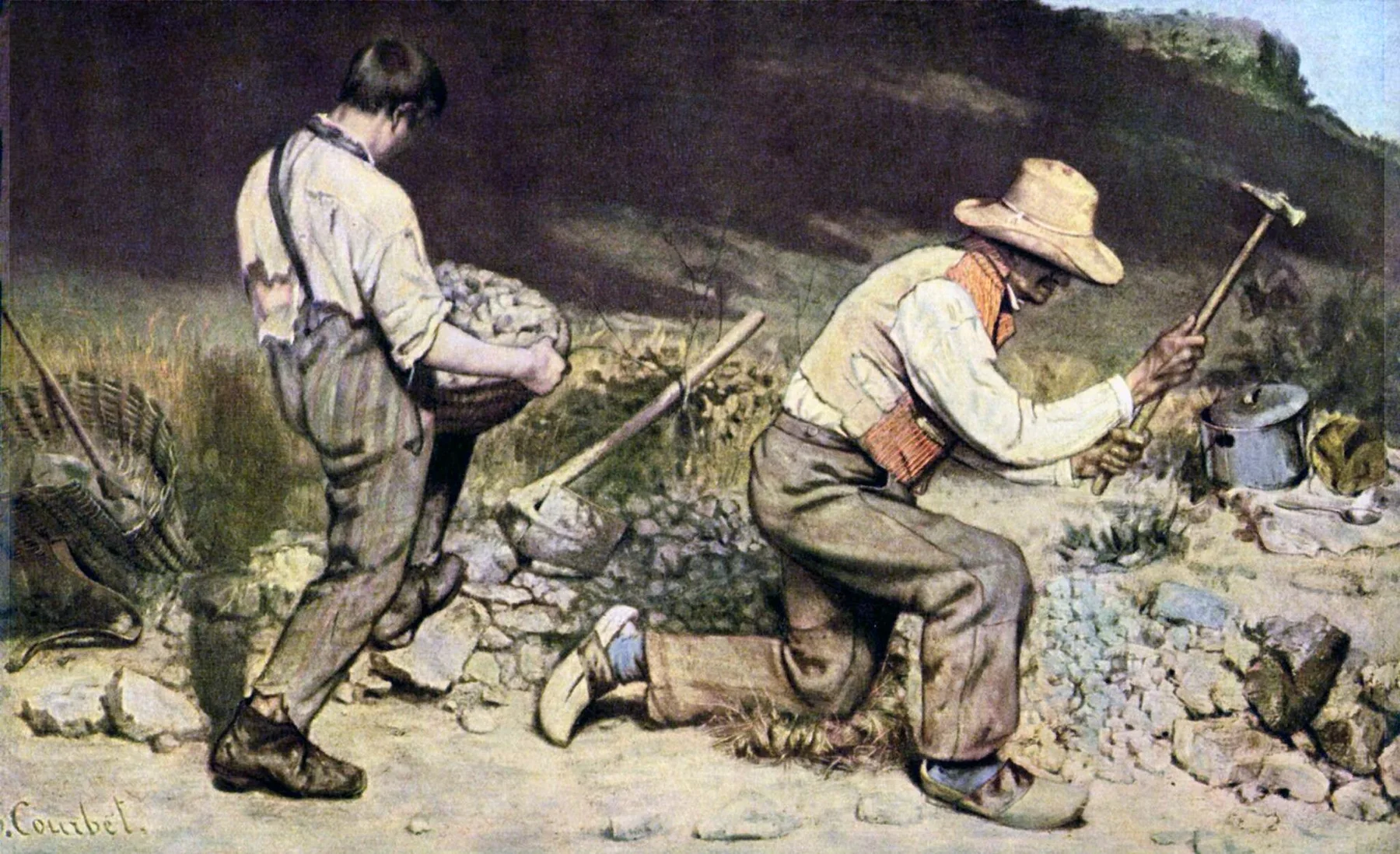

Two people work against a low embankment. The older man kneels with hammer raised; the younger carries a basket of broken stone. Tools, cooking pot, torn clothing, patched fabric, dust, and scattered rock fill a space with little horizon. The hill blocks a picturesque escape.
Road work is modern infrastructure, not timeless peasant life. The broken stones will support movement by other people and goods, while the labourers’ bodies absorb weight and repetition. Courbet makes the construction process occupy nearly the full width of a canvas once suited to grand narrative.
The scene is arranged. The raised hammer and bent knee concentrate force; the standing figure balances load; the dark bank presses both toward the surface. What looks uncomposed is a strong refusal of academic climax and scenic distance.
Anonymity turns two workers into a life course
Neither face offers a conventional portrait. The older worker turns down and partly away; the younger shows the back of his head beneath a hat. Age and task encourage viewers to read the pair as stages in a life of hard labour: youth carries, age breaks, and neither appears to leave the cycle.
That interpretation is powerful but not documentary certainty. The painting does not identify kinship, wage, legal status, exact road contract, or the sitters’ own understanding of the work. Calling them father and son goes beyond the visible evidence. Anonymous figures can make structural poverty legible while withholding individual history.
The problem is not solved by inventing names. Responsible looking distinguishes what bodies and tools show from what contextual research can establish. The absence of a name is itself evidence about who entered the artistic and archival record as a person and who entered as a type.
Monumental scale made poverty a public problem
Courbet showed The Stone Breakers with other Ornans subjects at the Salon of 1850–51. Contemporary viewers were accustomed to everyday labour in smaller genre scenes. Enlarging it disrupted the hierarchy of subjects: no heroic rescue, religious lesson, idealised antique body, or picturesque peasant softened the demand on attention.
The timing encouraged political readings. Courbet called himself republican, and socialist thinker Pierre-Joseph Proudhon later read the work as an indictment of an industrial civilisation unable to free people from punishing tasks. But the painting is not a party programme. Courbet also denied that he practised politics in painting, and his later political action followed a complicated path through the Paris Commune and exile.
The most defensible claim is narrower. Subject, scale, rough material description, and Salon display made poverty a problem that official exhibition culture could not easily assign to the margins.
A destroyed painting survives as a mediated image
The original entered the Dresden collection and was destroyed during the Second World War in 1945. Every current colour reproduction is therefore not a new photograph of the canvas but part of an earlier reproduction history. Dimensions vary slightly among reference sources, and colour, texture, edge, and surface cannot be checked against the object.
This changes close looking. Composition, pose, clothing, tools, and broad colour relations remain available. Claims about exact paint handling, tonal subtlety, or condition require caution. A digital file may appear crisp while the material evidence it seems to deliver no longer exists.
Loss is not a footnote outside art history. It determines what can be known. The painting’s canonical status now depends on photographs, books, catalogues, remembered display, scholarship, and copies—an archive that preserved the image unevenly after failing to preserve the object.
Brown made work into a social panorama
Brown began Work in 1852 after observing excavators in Hampstead and completed the principal version in 1865. The road crew occupies the bright centre, but the composition expands outward into a dense taxonomy of Victorian society. Wealth, unemployment, street trade, childcare, organised religion, electoral publicity, policing, animal ownership, and intellectual labour meet around a trench.
The arched format and saturated detail do not imitate Courbet’s blocked spareness. Brown’s “realism” depends on accumulation. Posters can be read; clothing differentiates class; gestures create miniature stories; sunlight exposes physical exertion. The painting invites prolonged decoding rather than a single encounter with two bodies.
It is also constructed across years. Brown painted parts of the Hampstead background on site, used models, revised the composition, and connected observed work to figures drawn from texts and social debate. Density is not the same as one photographed instant.
Road excavation was modern infrastructure
Brown wrote that work connected with water supply was underway near the Hampstead street he painted. The trench therefore represents a system that usually disappears once completed. Pipes, water, drainage, roads, and maintenance produce urban life by becoming ordinary and often invisible.
At the centre, a worker on a platform receives earth shovelled from below and transfers it upward. Labour forms a vertical chain. Wheelbarrow, shovel, rope, boards, baskets, and the opening in the road show that infrastructure is coordinated process, not a lone muscular act.
The crowd must move around the works. A mounted gentleman’s route is blocked; elegant pedestrians squeeze past; sellers find a temporary market; children enter the work zone. The modern street is not simply architecture seen from a clean boulevard. It is interruption, repair, congestion, heat, and negotiation among unequal users.
The artist’s caption reveals moral sorting
For the painting’s 1865 exhibition, Brown published a guide identifying many figures and assigning them stories. The document is valuable primary evidence. It explains the central navvies, names Thomas Carlyle and F. D. Maurice as intellectual workers, describes unemployed migrants, and links posters to current institutions and politics.
It also reveals prejudice. Brown moralises about the “useful” trained worker, imagines criminal potential in a poor plant seller, caricatures bodies, stereotypes Irish people, and distinguishes respectable from failed labour. Description becomes social discipline. The artist does not merely observe a hierarchy; his prose helps build it.
Using the guide critically means neither discarding it nor repeating its judgements as neutral fact. Compare caption to image, ask what evidence supports each biography, and notice who receives a proper name. The two thinkers are portraits; most workers and poor people are narrated types.
Care appears as child labour at the edge
In the foreground, a girl of roughly ten manages younger children. Brown’s guide calls them motherless and reads her oversized dress, discipline, and anxiety as signs of premature household responsibility. Her labour is continuous but does not receive the title’s central muscular heroism.
This group destabilises the painting’s declared hierarchy. Waterworks construction is recognised as productive; childcare is made to look like family misfortune. The girl creates safety, food access, and order for others without wage, training, or public status. She is both visible and structurally peripheral.
Florence Claxton’s 1861 satire Woman’s Work: A Medley, now also in Manchester’s collection, challenged the restricted roles available to women. Reading it beside Brown helps expose how “work” was gendered. The question is not whether women appear in his crowd, but which activity counts as work, vocation, charity, display, dependence, or vice.
Menzel mapped production as coordinated danger
_-_Adolf_Friedrich_Erdmann_von_Menzel_(Alte_Nationalgalerie).jpg)
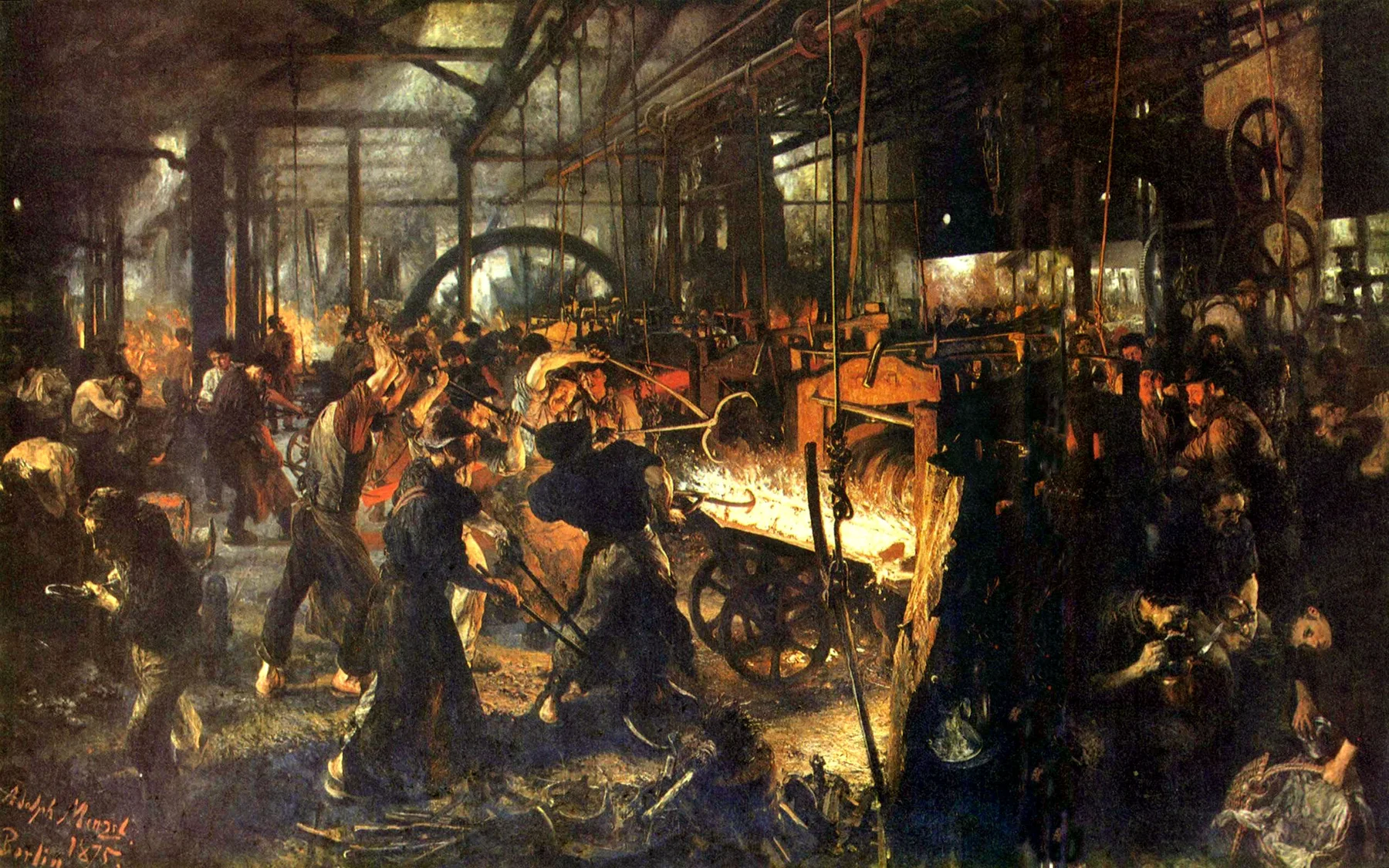
Menzel visited the Königshütte rail works in Upper Silesia in 1872. He studied unfamiliar machinery, read technical literature, and made numerous drawings of tools, bodies, and sequences. The final painting is not a snapshot of one shift. It combines research into an intelligible production system.
Heat and darkness organise the hall. A white-hot mass draws workers toward the rolling machinery; shafts, wheels, belts, chains, and beams extend beyond the frame. No central manager controls the composition. Attention moves among teams, machines, an inspector-like figure, and workers eating at the right.
This distributed structure makes labour both collective and difficult to totalise. Each task depends on another stage. The factory exceeds any one body, while the painting attempts to hold the system in view.
A rail is made across the canvas
In 1879 Menzel explained the represented sequence to Nationalgalerie director Max Jordan. A heated “puddle ball” moves through rollers and toward workers who will form it into rail. The image therefore has process direction even though flames, bodies, and machinery first appear chaotic.
Rail production connects factory interior to a network outside the frame. Finished metal will support trains, military movement, coal, commodities, commuters, and territorial integration. Königshütte’s thousands of workers belonged to an industrial region transformed by investment, extraction, ethnic and class difference, dangerous work, and social conflict.
The painting makes a commodity before it becomes anonymous. A rail is not simply an object delivered to a city. It is heated, lifted, rolled, received, and shaped through timed cooperation. Realist attention restores a labour chain that the finished network conceals.
Modern Cyclopes dignifies and mythologises
The alternative title Modern Cyclopes compares the workers to the one-eyed metalworking giants of Greek myth. The phrase raises industrial labour to epic scale and acknowledges the furnace as a modern forge. It can confer strength on people excluded from conventional history painting.
Myth also alters them. “Cyclopes” may turn specific wage workers into a collective type defined by bodily power and elemental fire. Individual knowledge, injury, family, association, bargaining, and dissent become harder to see. Monumental dignity and deindividualisation coexist.
The bodies themselves resist a simple heroic reading. Some strain, some coordinate, some wait, and some eat. Machine and worker do not merge into seamless progress. The crowded floor asks whether industrial modernity is collective achievement, organised exhaustion, national power, or all three.
The Nationalgalerie turned factory work into national art
The painting was not commissioned by a factory owner. Banker Adolph von Liebermann acquired it as Menzel worked, then financial difficulty led to its sale to the Nationalgalerie in 1875. Public acquisition made a privately initiated industrial subject part of the young German national collection soon after political unification.
That transfer matters. A steelworks scene could represent technical modernity and national strength even without a ruler, battle, or owner at the centre. Workers supplied the visible energy of modern Germany, while a state museum supplied the durable frame.
Museum canonisation need not erase the painting’s ambiguity. It does, however, change the audience and stakes. The factory becomes an object citizens contemplate at leisure. Heat, risk, noise, and time discipline are translated into a prestigious surface whose acquisition price and national status belong to a different economy than the wages represented.
Caillebotte brought urban labour into a bourgeois room
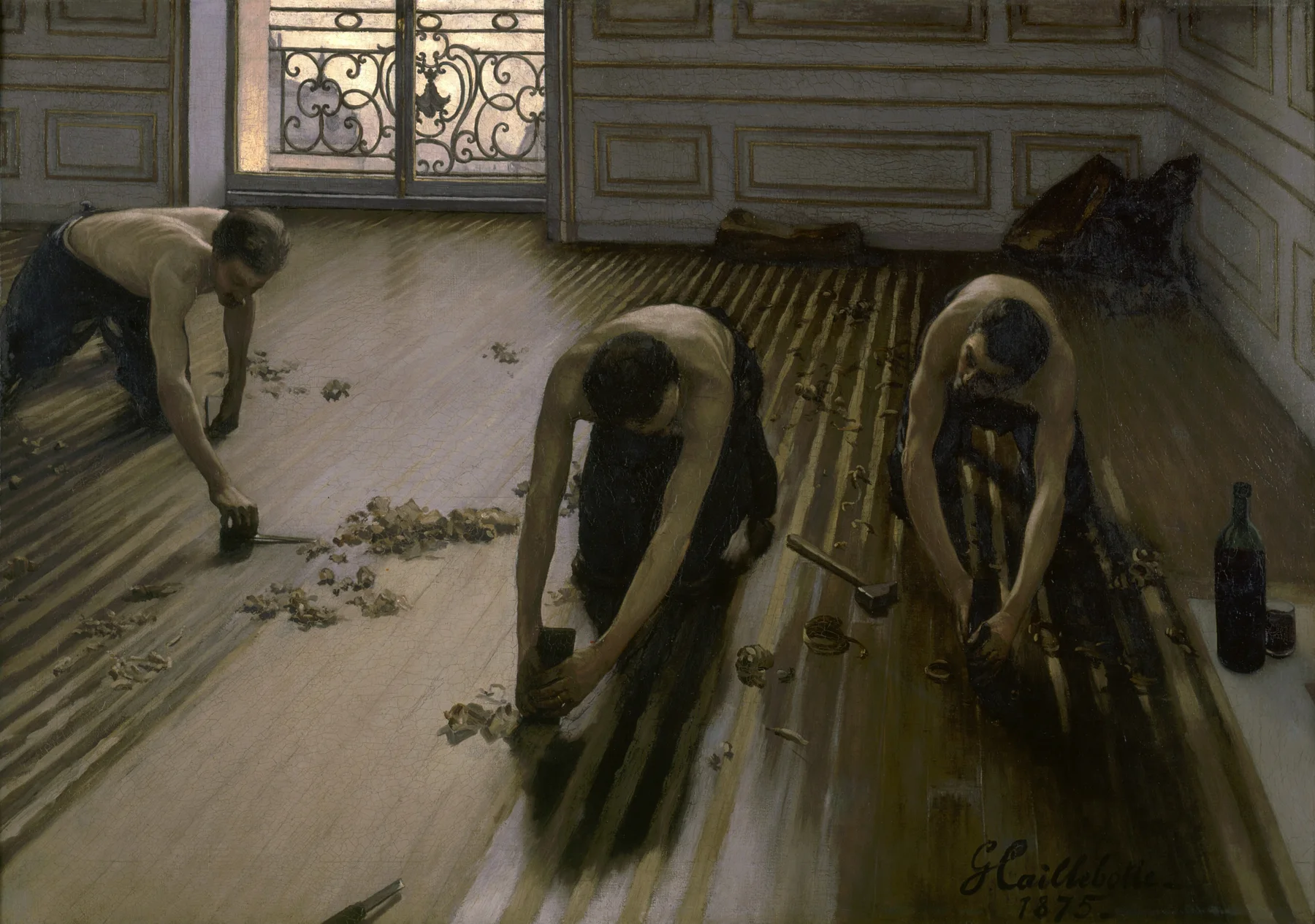

Three men kneel in a high-ceilinged Paris room. They use hand planes or scrapers to remove old finish from floorboards; curled shavings gather around their hands. Their shirts lie aside, and a bottle with a glass stands near the wall. The balcony, ornamental ironwork, panelling, and generous dimensions identify an affluent interior under preparation.
The workers were probably employees connected to Caillebotte’s family residence. Their labour makes bourgeois domestic space new while the future occupant remains absent. This reverses a common picture of modern Paris: instead of showing elegantly dressed consumers on a completed boulevard, the painting shows skilled bodies producing a refined surface.
Caillebotte was a wealthy property owner and painter looking into work performed for his class. Proximity gives unusual detail; it does not remove unequal control over image, room, or finished floor.
Floorboards, perspective, and bodies share one rhythm
Strong floor lines rush toward the balcony. Scraped and unscraped boards divide the room into bands; the workers’ backs, arms, and tools repeat a forward-and-back motion. Light catches skin and bare wood, connecting physical effort to the changing material surface.
The elevated viewpoint tilts the floor upward, making labour available to inspection. The nearest figure is cut by the lower edge, while all three heads turn down. As in Courbet, faces matter less than posture and task. Unlike Courbet’s closed hillside, geometric perspective opens a deep, ordered room.
The composition can be admired as daring design, but design is inseparable from work process. The lines viewers praise are also boards being scraped one after another. Formal rhythm is the trace of repetitive skilled labour.
Male workers become visible through the patron’s gaze
Musée d’Orsay research describes The Floor Scrapers as an early large-scale representation of the urban proletariat and also places it within Caillebotte’s sustained interest in modern masculinity. Bare torsos expose exertion and permit comparison with heroic or athletic male nudes.
That visibility is double. The men gain scale, coordination, skill, and bodily presence. They are also arranged for a wealthy male painter and exhibition audience. Recent scholarship asks how admiration, republican fraternity, class difference, and desire coexist in Caillebotte’s images of men.
No surviving worker testimony accompanies the painting. We do not know how the models understood posing, whether the depicted group reproduces one actual job, or what they were paid as labourers or models. Acknowledging the patron’s gaze does not cancel their skill; it marks who controlled the durable representation.
Salon rejection changed the route to a public
The work was likely rejected by the 1875 Salon jury. Caillebotte then showed it at the second independent Impressionist exhibition in 1876, where its subject and scale attracted attention. “Realism” reached a public through an alternative group exhibition rather than through automatic acceptance by the official system.
This history complicates a linear movement from Courbet to Impressionism. Caillebotte’s careful modelling, controlled interior, and dark tonal structure differ from the broken outdoor colour later used as shorthand for Impressionism. Yet he became an organiser, collector, and financial supporter of the group.
After his death, his heirs donated The Floor Scrapers to the state through Renoir in 1894. Rejection, independent display, private wealth, donation, and national museum status form one route. Style alone cannot explain how the painting became public.
Degas made exhaustion a working gesture
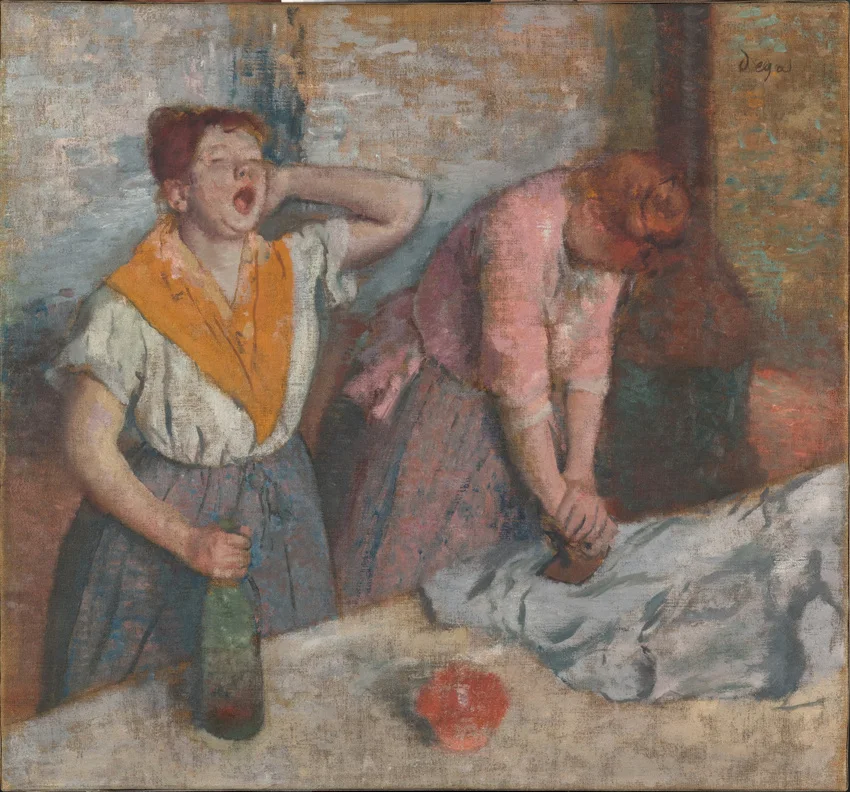

One woman yawns or stretches, hand behind her neck, while holding a bottle. Another leans her full weight over an iron. White linen piles and spreads across the foreground; a rough wall and vertical stove pipe compress the workshop. Neither body becomes an ideal nude.
Degas had studied laundresses and ironers since the late 1860s. In this later composition, fatigue is not an after-work consequence hidden from view. It enters the action. The open mouth and bent back show different phases of bodily depletion within the same room.
The picture does not explain the bottle. It may belong to refreshment, routine, or contemporary associations between laundry workers and drink. Treating it as proof of moral failure would repeat the stereotypes through which working women were judged.
Laundry linked the private and public city
Clean linen seems domestic, but nineteenth-century urban laundry joined households to commercial workshops, deliveries, water, fuel, heat, rent, and piece rates. Women collected, washed, dried, ironed, folded, and returned textiles across boundaries between private residence and street economy.
This work was physically demanding and poorly paid. Laundresses handled steam, heavy irons, long hours, and reputational suspicion because they moved through public streets and sometimes entered clients’ homes. Naturalist novels and social commentary made them familiar types, especially after Émile Zola’s L’Assommoir appeared in 1877.
The painting restores labour to finished white cloth, but it does not map the full chain. Washerwomen, water carriers, fuel workers, delivery routes, clients, and household servants remain beyond the frame. The modern city depends on networks that a two-figure scene can only partly reveal.
Repetition belongs to worker and painter
The ironer presses the same tool over successive sections of fabric. Degas repeated the subject across paintings, drawings, and four closely related versions of this two-woman composition. Worker and painter both perform repeated gestures, but under radically different conditions of control, pay, reputation, and ownership.
The Musée d’Orsay canvas uses oil on coarse, unprimed cloth. Brown linen remains visible beneath pastel-like colour, making surface look worn, unfinished, and active. The technique can echo friction and fatigue without being a direct imprint of them.
It is tempting to call Degas’s painterly repetition equivalent to manual labour. That metaphor should remain limited. Artistic work could be demanding, but the artist controlled revision and retained authorship; laundresses repeated tasks because customers, schedules, and piece-rate economies required them.
Empathy is not worker testimony
The Musée d’Orsay interprets the image as unsentimental but not without tenderness. The National Gallery of Art, discussing another Degas ironer, cautions that the artist may have been more interested in characteristic gesture than in workers’ social situation. These readings need not cancel one another.
Empathy can shape pose, proximity, and refusal of caricature. It does not make the canvas the women’s own account. Their names are not preserved in the object record; their voices do not accompany its later sale through dealers and collectors. The artist’s attentive gaze remains structurally unequal.
Realisms overlapped with other artistic identities
Courbet publicly claimed Realism; Brown produced Pre-Raphaelite detail and moral narrative; Menzel joined observational research to national history and industrial spectacle; Caillebotte combined exact construction with an independent Impressionist network; Degas joined modern-life subjects to repeated studio invention.
No single technique unites them. Courbet blocks depth, Brown multiplies incidents, Menzel disperses action, Caillebotte accelerates perspective, and Degas compresses fatigue into rough surface. Their common ground is a dispute over which contemporary bodies, tasks, and materials can sustain ambitious art.
Infrastructure connects the five works
Courbet’s broken stones make roads. Brown’s excavation exposes urban waterworks. Menzel’s mill produces rail. Caillebotte’s workers finish the interior surface of valuable property. Degas’s laundry maintains clothing and household respectability. Each task produces conditions other people use.
Infrastructure is often most successful when users stop seeing the labour inside it. A smooth road, flowing tap, railway journey, polished floor, or clean shirt appears ready. The paintings reverse that disappearance by showing an unfinished state.
They also reveal different ownership. Public road, municipal utility, industrial capital, private residence, and service market organise workers through different contracts and authorities. “Labour” is not one social position simply because all five scenes contain effort.
The modern city distributes visibility
The modern city in this chapter is not one skyline. It is a distribution system for bodies, materials, attention, and risk. Some people travel; others prepare the road or rail. Some occupy completed interiors; others make or maintain them. Some appear with names and theories; others appear through backs, bent heads, anonymous gestures, or artist-authored types.
Gender changes that distribution. Male road, excavation, factory, and floor work gains monumental width and exposed muscular action. Laundry occupies a smaller, compressed room; childcare sits at the edge of Brown’s panorama. This is not a universal division of actual work. It is a pattern in the selected representations and the institutions that preserved them.
Visibility can challenge hierarchy without ending it. The critical task is to ask who becomes legible as skilled worker, political subject, exhausted body, moral warning, national resource, or invisible support.
A comparison matrix
| Work | Labour system | Visual operation | Route to a public | Critical limit |
|---|---|---|---|---|
| Courbet, The Stone Breakers | Road construction near Ornans | Two anonymous bodies and a closed bank fill history-painting scale | Salon of 1850–51, Dresden collection, reproductions after loss | Names, contract, and exact surface are unavailable; the original was destroyed |
| Brown, Work | Hampstead waterworks within a street economy | Dense crowd sorts manual, intellectual, care, commercial, and unemployed activity | Long private production, 1865 exhibition and artist guide, Manchester collection | The artist’s caption moralises and stereotypes many people he represents |
| Menzel, Iron Rolling Mill | Rail production at Königshütte | Distributed teams and machinery make a commodity as process | Private purchase, then Nationalgalerie acquisition in 1875 | Epic scale can dignify workers while turning them into national-industrial types |
| Caillebotte, Floor Scrapers | Skilled finishing in a bourgeois Paris interior | Floor perspective and bare male bodies join repetitive rhythm | Rejected Salon submission, 1876 independent exhibition, 1894 state donation | Worker skill is seen through the wealthy property owner’s gaze |
| Degas, Women Ironing | Urban laundry and service economy | Yawn, bent back, bottle, linen, and rough canvas materialise fatigue | Dealer and collector network, 1911 state bequest | Sympathy and gesture do not preserve the women’s names or testimony |
What the surviving archive overrepresents
Artists’ letters, exhibition catalogues, critics, collectors, purchase files, museum records, and finished canvases survive more readily than wage books, casual workers’ speech, domestic negotiations, injury, smell, heat, noise, and repetition. Brown’s unusually detailed guide preserves his interpretation, not a democratic transcript of the street.
The Stone Breakers demonstrates a second problem: objects can disappear while reproductions survive. Degas’s series shows the reverse abundance, where repeated versions may make an artist’s interest highly visible while individual sitters remain unnamed.
Archive density follows property and institutional attention. Responsible history uses what survives but does not mistake the patron’s contract, artist’s caption, or museum accession for the whole social relation.
Common survey traps
“Realism copies what the eye sees.” Every work selects, composes, scales, and addresses an audience.
“A labour subject is automatically socialist.” Establish the artist’s politics, commission, display, and reception rather than inferring a programme from tools.
“An anonymous worker represents all workers.” Anonymity can reveal structure while erasing personal history and difference.
“Brown documented one London moment.” The panorama joins site study, models, texts, symbolic figures, and years of revision.
“Industry replaced human skill with machines.” Menzel shows machines depending on timed bodily knowledge, hierarchy, and coordination.
“Caillebotte erased class because he admired workers.” Admiration can coexist with property, patronage, desire, and unequal authorship.
“Degas gave laundresses a voice.” He made fatigue and gesture visible; the object record does not preserve the sitters’ testimony.
“The modern city means boulevards and leisure.” Water, roads, rail, maintenance, service work, and care make those surfaces possible.
Questions for close looking
- What task is being performed, with which tools, materials, sequence, and bodily knowledge?
- Does the work show production, maintenance, transport, service, care, unemployment, or consumption?
- Where does composition place the horizon, exit, manager, patron, and viewer?
- Are workers named, portrayed, anonymised, idealised, eroticised, moralised, or compared with myth?
- What evidence distinguishes observed detail from invented social type?
- Who commissioned, purchased, rejected, exhibited, donated, or preserved the image?
- Which labour chain continues beyond the frame?
- How do gender, age, migration, skill, and class affect visibility?
- What can a surviving reproduction establish when the original is lost?
- Does sympathy change the worker’s control over representation?
Terms for Realism, labour, and industry
Realism: a historically contested artistic claim, especially important in France after 1848, that brought contemporary subjects and material conditions into conflict with academic hierarchy; not transparent copying.
Naturalism: close attention to bodies, environment, causation, and social conditions across art and literature; sometimes overlapping with Realism, but not identical to it.
Genre painting: scenes of everyday life, historically ranked below history painting in many European academic systems.
Proletariat: people dependent primarily on selling labour rather than owning productive capital; the category contains major differences of skill, gender, status, and organisation.
Infrastructure: durable systems that support movement, water, energy, communication, habitation, and exchange, including the labour that builds and maintains them.
Piece work: payment by unit or completed task rather than by time, often shifting demand and risk onto workers.
Social reproduction: paid and unpaid work that sustains people and households—care, food, cleaning, clothing, health, and education—so economic life can continue.
Artist-authored type: a figure constructed to represent a social category; potentially revealing, but not equivalent to a named person’s testimony.
Salon: a juried official exhibition whose selection, hanging, criticism, and purchase shaped artistic careers and public legitimacy.
A working timeline, c. 1848–1886
- 1848: revolutions spread across Europe; France’s provisional republic announces a right to work and opens National Workshops.
- June 1848: closure of the workshops contributes to the June Days uprising and violent suppression in Paris.
- 1849: Courbet paints The Stone Breakers.
- 1850–1851: Courbet’s large Ornans paintings appear at the Paris Salon.
- 1852: Brown begins Work after observing excavation in Hampstead; France enters the Second Empire under Napoleon III.
- 1853 onward: Haussmann’s transformation of Paris expands boulevards, sewers, water, demolition, property change, and building labour.
- 1865: Brown completes and exhibits the principal Manchester version of Work with a published explanatory guide.
- 1871: German unification and the Paris Commune alter the political settings in which industry and labour are represented.
- 1872: Menzel studies production at Königshütte in Upper Silesia.
- 1875: Menzel completes The Iron Rolling Mill and the Nationalgalerie acquires it; Caillebotte paints The Floor Scrapers.
- 1876: Caillebotte shows The Floor Scrapers at the second independent Impressionist exhibition.
- 1877: Zola publishes L’Assommoir, centred on the life of a Paris laundress.
- 1884–1886: Degas paints the Musée d’Orsay version of Women Ironing.
- 1886: the eighth and final Impressionist exhibition demonstrates how far the independent network has moved beyond one shared style.
Source guide
Object and institutional records establish the material base: Kathryn Calley Galitz’s Met essays on Courbet and nineteenth-century French Realism; the Courbet Museum’s collection and biography guide; Manchester Art Gallery on Brown’s surviving 1865 guide and its modern interpretation; the Alte Nationalgalerie collection history; and the Musée d’Orsay records for Caillebotte and Degas.
For Menzel, the German History in Documents and Images project provides a documented account of Königshütte research, rail production, ownership, and museum acquisition. The project is produced by the German Historical Institute in Washington and supplies a specialist bridge between object, industrial process, and German history.
For gendered labour, use the Musée d’Orsay’s research programme on representing work in the nineteenth century and its exhibition Caillebotte: Painting Men. Manchester’s acquisition of Claxton’s Woman’s Work: A Medley supplies a near-contemporary counter-image to Brown. These sources support interpretation; they do not substitute institutional voices for worker testimony.
Named scholarship deepens the political questions: T. J. Clark’s Image of the People examines Courbet and the Second Republic; Linda Nochlin’s studies of Realism and women’s labour test myths of transparent style and universal experience; and Michael Fried’s Menzel’s Realism analyses the painter’s close, unstable relation to embodied seeing. Their arguments should be compared rather than compressed into one consensus.
Image rights were checked separately. All five local files reproduce works by artists who died more than a century ago and are marked Public Domain or Public Domain Mark on their Wikimedia Commons file pages. The Brown and Caillebotte files derive from Google Art Project reproductions; the Degas file links to the Musée d’Orsay record. Local derivatives preserve the full composition, record intrinsic dimensions, and were resized to WebP without cropping. The Brown hero is not repeated in the body.
Continue the Atlas route
Read this chapter after Romanticisms: landscape, nation, ruin, resistance, and the colonial sublime to see how recent history and unequal viewing positions move into labour and infrastructure. Continue to Photography: evidence, art, reproduction, science, and colonial instrument to ask how camera-made traces reorganised claims about observation, labour, place, and proof.
The next Atlas chapter studies photography as evidence, art, reproduction, science, and colonial instrument. It asks how a medium praised for automatic truth still depends on operator, apparatus, exposure, caption, archive, circulation, and institutional power.
Editorial record
About this article
- Author
- Publisher
- GeMarkt
- Published
- Updated
- Reviewed
- Internal source & rights check. Conducted by GeMarkt Research Review. This is an internal editorial check—not independent peer review.
- Source standard
- Art history source standardPrioritises object records and research sources, distinguishes evidence from interpretation, and states material uncertainty.
Found a claim that needs checking? Report a factual error.