Art History · Learning chapter
Atlas I — Foundations and ancient worlds · 6 of 10
Etruscan and Roman worlds: tomb, home, forum, portrait, and empire
Five Etruscan and Roman works connect burial, portraiture, domestic illusion, conquest, and local identity without treating Rome as one uniform civilisation.

What we’ll look at
How did Etruscan and Roman art display identity, status, and imperial power?
The Monteleone chariot appears ready to move, but almost everything about that impression is unstable.
Its wheels, body, and pole now form a complete vehicle because modern conservators placed surviving ancient fittings on a new structural support. The wood and leather beneath the bronze disappeared long ago. The chariot was not found on a road or battlefield. It was deposited in a tomb in central Italy. Its embossed panels tell episodes from the Greek hero Achilles, yet the object is not therefore simply “Greek.” Its ceremonial use, manufacture, burial, and combination of images belonged to an Etruscan world.
One object has already crossed several boundaries: between movement and burial, Greek story and local claim, ancient material and modern reconstruction, archaeological context and museum display.
Those crossings offer a better entrance to Etruscan and Roman art than a parade of emperors and white marble. The period contains city communities, republics, an imperial court, conquered territories, domestic interiors, graves, workshops, temples, roads, ports, farms, and military frontiers. Rome connected many of them through law, violence, taxation, citizenship, trade, slavery, patronage, and building. It did not make them culturally identical.
This guide asks one question across five cases:
How did Etruscan and Roman works make belonging visible—and what did those claims of belonging conceal?
The selected route runs from an Etruscan tomb around 575–550 BCE to a funerary relief made at Palmyra around 125–150 CE. It stops in central Italy, a villa near Vesuvius, the city of Rome, and Roman Syria. That is a long route, but not a complete survey. North Africa, Egypt, Iberia, Britain, Gaul, the Balkans, and much of western Asia require chapters of their own. So do Roman temples, coins, engineering, mosaics, army settlements, Jewish visual cultures, early Christian art, and the transformations now grouped under Late Antiquity.
The purpose is not to compress a millennium and an empire into one style. It is to learn how to separate systems that later museum labels often place side by side.
Etruscan and Roman are not two steps on one ladder
“Etruscan” does not name one centralised nation awaiting replacement by Rome. It describes related communities whose cities, languages, sanctuaries, political arrangements, burial customs, and workshops developed across parts of pre-Roman Italy. Their objects show sustained connections with Greek, Phoenician, central European, and other Mediterranean networks. Exchange did not erase local choices.
The survival of Etruscan evidence is uneven. Richly furnished tombs and durable grave architecture can dominate the modern picture because they survived and attracted excavation. They do not prove that Etruscan life was only about death. The UNESCO account of the necropolises of Cerveteri and Tarquinia explains how thousands of tombs, some arranged like streets and houses, preserve changing burial practices from the ninth to the first century BCE. That archive is exceptional precisely because ordinary buildings, textiles, wood, food, gestures, and voices survive less completely.
Nor were the Etruscans a mysteriously vanished people. Rome extended control over Etruscan cities across centuries. Political incorporation, warfare, mobility, intermarriage, and the spread of Latin changed identities and institutions; they did not cause every earlier practice to disappear at one moment.
More than ten thousand Etruscan inscriptions are known, most of them short. The Met’s introduction to the Etruscan language distinguishes a language that can be read in large part from a literary archive that has mostly not survived. “Undeciphered” and “unknown” are dramatic words, but neither accurately describes the whole field.
Roman period labels require equal discipline. The Republic, conventionally 509–27 BCE, was governed through elected offices, assemblies, law, Senate authority, family alliances, and fierce elite competition. It was not a democracy of equal modern citizens. Legal and social position depended on distinctions including freedom and enslavement, sex, citizenship, wealth, family, age, and office. Rome had also ruled extensive territories long before one man became emperor.
The Principate, beginning with Augustus in 27 BCE, presented monarchic power through selected republican forms. “Early Empire” names the same broad political era from a different angle. Neither label produces one imperial style. A portrait in Rome, a tomb relief at Palmyra, a wall painting near Vesuvius, and a monument financed by conquest could all belong to the Roman Empire without saying the same thing or serving the same audience.
The sequence Etruscan → Republican Roman → Imperial Roman is therefore not a ladder from borrowed art to mature art. It is a study map across changing, unequal, and overlapping worlds.
A chariot from a tomb: movement, metal, and an Etruscan claim
In brief: The first example is a two-wheeled ceremonial chariot made around 575–550 BCE and found in an Etruscan tomb in central Italy. Its ancient bronze and ivory pieces are mounted on a modern support, so the whole vehicle we see today is not ancient.
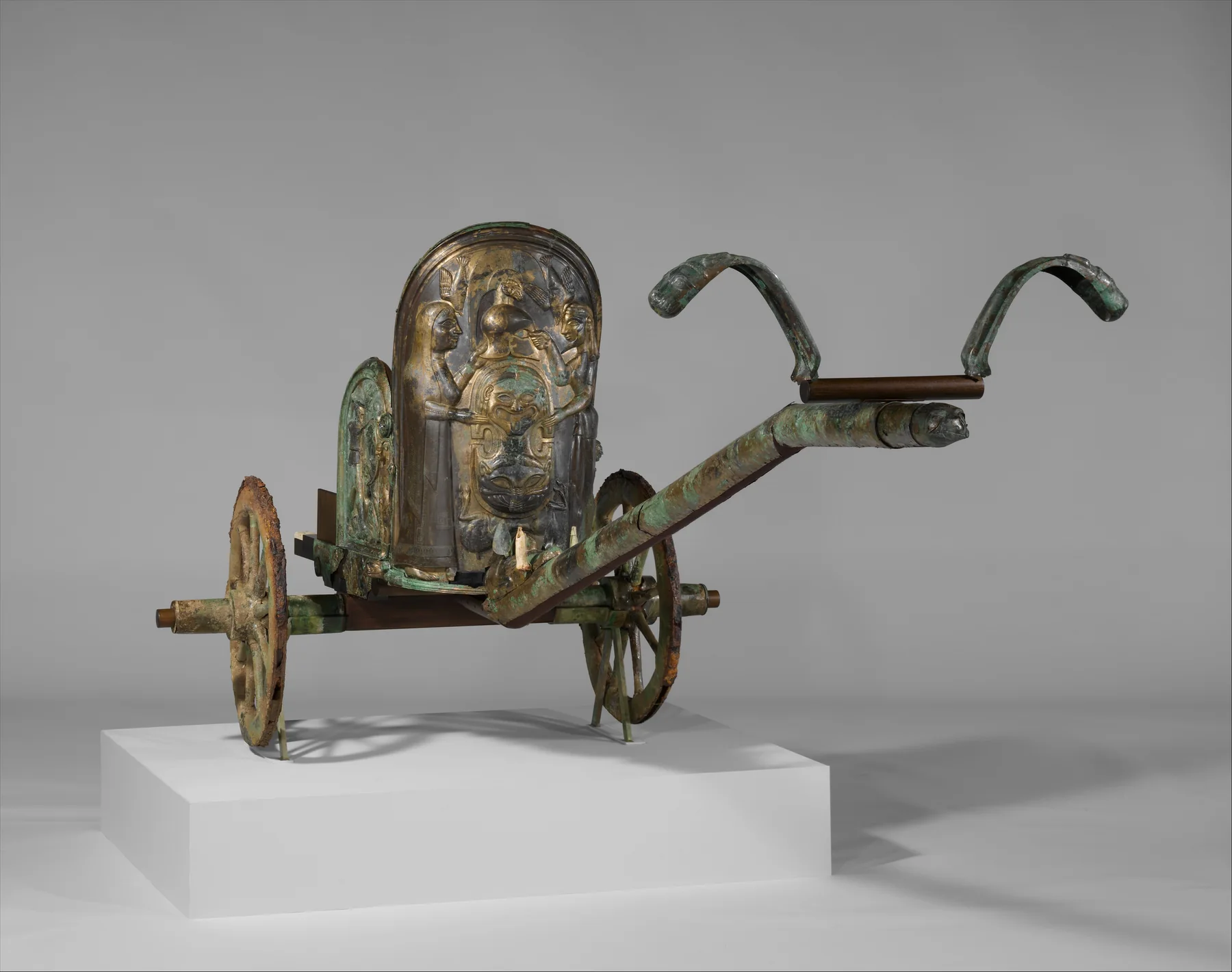
Three large bronze panels organise the body of this vehicle. The central scene shows Achilles receiving armour from his mother, Thetis. At the sides, episodes of combat and ascent extend the hero’s story. Figures, animals, patterned borders, ivory inlays, and hammered metal turned a wooden chassis into a moving field of reflected light.
The Met object record dates the chariot to the second quarter of the sixth century BCE. A landowner discovered it in 1902 within a built tomb beneath a mound near Monteleone di Spoleto. It passed through owners and dealers in Italy and Paris before the museum acquired it in 1903. Its modern biography matters: removal from the tomb changed a burial assemblage into separate collectible objects, while museum reconstruction changed fragments into a legible vehicle again.
The surviving bronze relief was made by repoussé: craftspeople hammered the metal from behind, then sharpened details from the front. They fixed the panels to a body of wood and leather, with iron strengthening parts such as the tyres. Small pieces of elephant and hippopotamus ivory show that some materials travelled far before reaching central Italy.
The chariot brought several forms of power together: skilled metalwork, imported materials, prestigious stories, and enough wealth to remove a costly vehicle from use and bury it with the dead.
It was probably a parade chariot rather than a machine for battlefield manoeuvre. The vehicle could carry a driver and a distinguished passenger, turning arrival into performance. Burial made that performed status durable. Yet the object cannot tell us by itself the buried person’s name, every ceremony in which it participated, or the exact identities of its makers.
Greek myth does not settle those questions. Achilles circulated widely around the Mediterranean, but an image’s subject is not the same as its cultural function. The Met’s study of the chariot locates its materials, construction, iconographic selection, and use within Etruscan practice, while allowing debate over the workshop and the movement of artists. A maker could know Greek models without becoming a passive copier. A patron could choose Achilles to articulate a local ideal of prestige.
The reconstructed vehicle now invites a full view that no ancient mourner necessarily received in the same way. Museum light reveals every panel at once; the tomb withdrew the object from ordinary sight. What survives is a claim to distinction, but also evidence of deliberate disappearance.
A face without a name: portrait as political resemblance
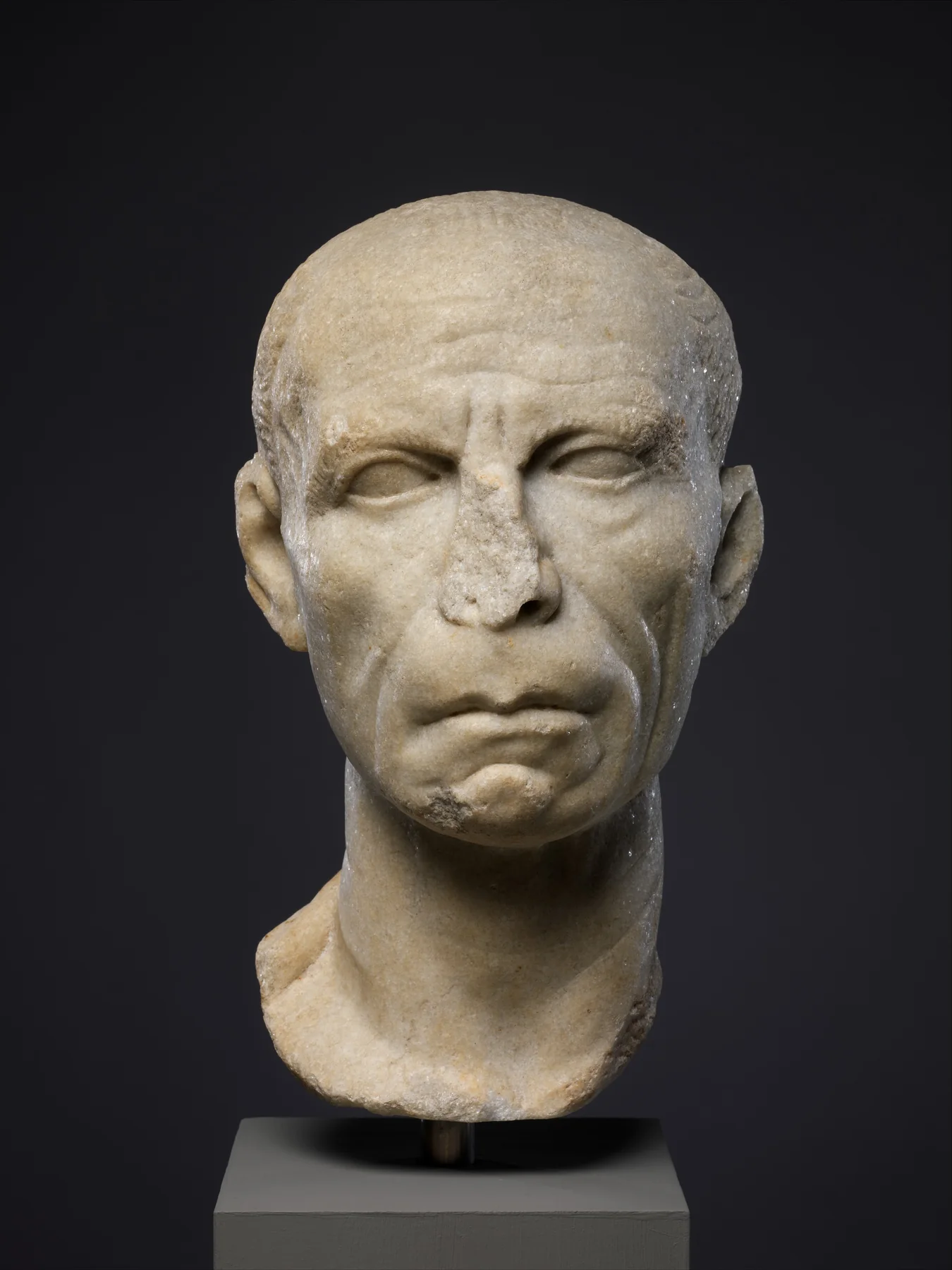
The forehead is broad and creased. The temples contract, the cheeks draw inward, and a long neck supports a narrow head. Damage to the nose makes the face feel more archaeological, but it should not be mistaken for an ancient choice. Nor should age lines be read as a transparent record of one body.
The Met dates this portrait to the late first century BCE, at the unstable boundary between Republic and the age of Augustus. The sitter is unknown. The head was once identified as Julius Caesar because its proportions resemble portraits associated with him. The museum now offers a more careful possibility: an unknown man may have wanted that resemblance to signal political sympathy with Caesar and the populares. Even this remains an interpretation, not a recovered name.
That uncertainty is useful. Roman portraiture did not simply ask, “What did this person look like?” It also asked, “Which virtues, ancestry, office, allegiance, age, and authority should this body perform?” The style commonly called verism emphasises features such as lines, folds, thin lips, bony structure, and signs of age. Modern viewers often praise it as brutally honest realism. But a carved face can be highly selective while appearing candid.
The Met’s history of Roman portrait sculpture connects late Republican portrait habits with elite competition and the display of ancestral wax masks. Families used lineage, offices, public service, and funeral ritual as political resources. In that system, an aged male face could signify experience, gravity, endurance, and service. It did not show every Roman, and it did not make every wrinkle politically equal.
The object has also lost its body and original setting. We do not know with certainty whether the completed portrait stood in a house, tomb, or more public environment, what costume or inscription framed it, or who looked at it. A studio photograph intensifies the isolated psychology of the head because it removes architecture, colour, neighbouring objects, and social action.
The transition to Augustus did not end portrait politics. It reorganised them. Repeated official types distributed a controlled youthful image of the new ruler across the empire. Republican-looking age and Augustan-looking youth were not a simple shift from truth to idealisation. Both were constructed languages of authority.
This unknown man’s face therefore holds two absences. His personal identity is lost, and the many people excluded from elite portrait systems were rarely granted comparable marble permanence. The face seems individual. Its power came from a social type.
A room that opens: domestic luxury and the labour outside the view
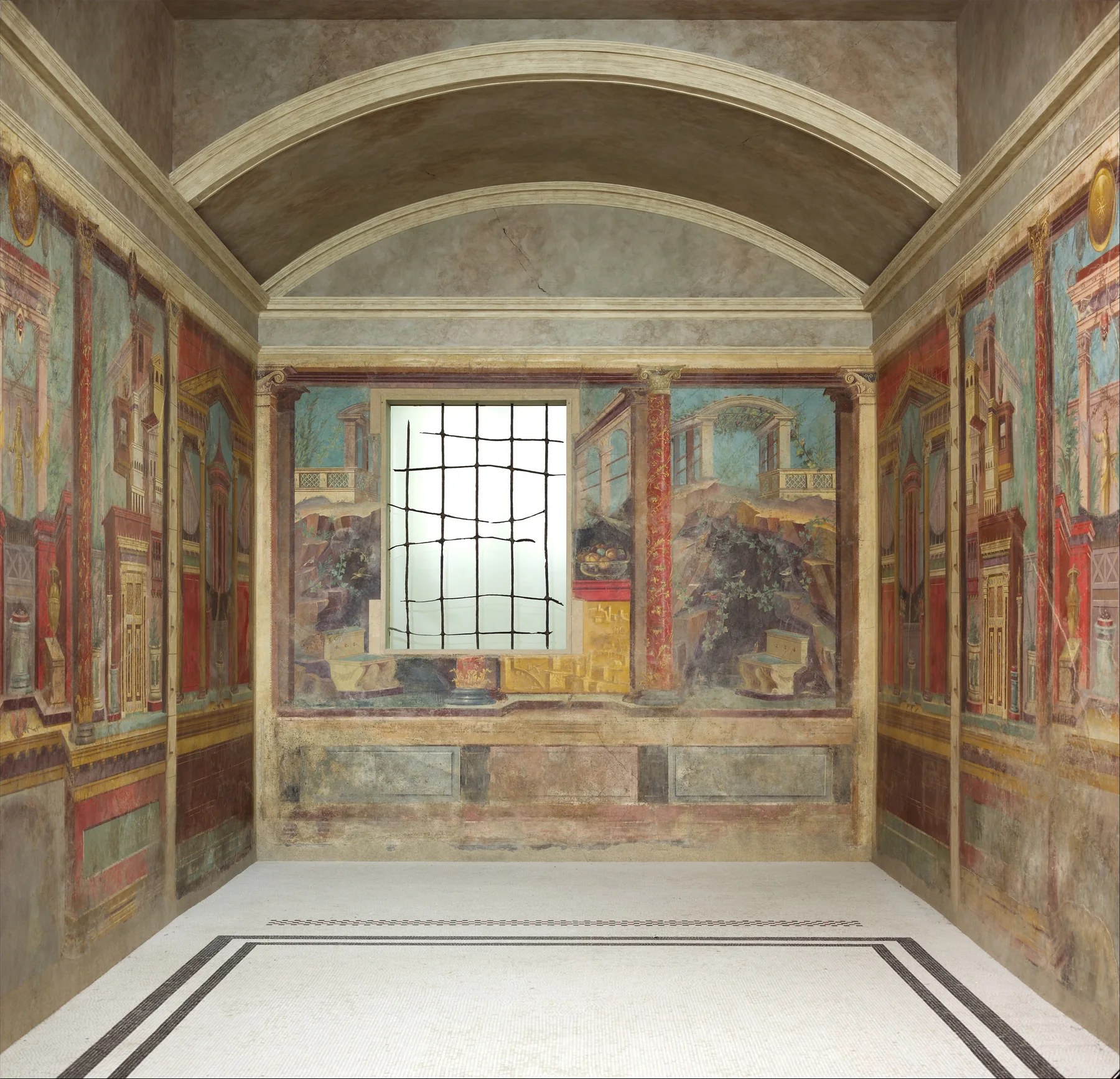
Painted columns appear to stand in front of walls that appear to open onto courts, sanctuaries, rocky ground, distant architecture, and a grotto with a fountain. Each surface insists that it is more than a surface. The actual bedroom remains enclosed while painting gives its occupant imaginary command of several spaces at once.
The room comes from a villa at Boscoreale, near Pompeii and Mount Vesuvius. Its frescoes were buried by the eruption of 79 CE and excavated in 1900. The Archaeological Park of Pompeii’s excavation history dates the decoration to about 40–30 BCE and notes a basic problem of identity: the villa is conventionally named for Publius Fannius Synistor because that name appeared on a vessel, but later evidence may point to Lucius Herennius Florus as an owner. A familiar site name is not a secure biography.
The room now at the Met is cubiculum M, usually called a bedroom. The museum dates its paintings to about 50–40 BCE and identifies them with the modern category Second Style. That category groups late Republican interiors in which painted architecture dissolves or extends a wall. It is a useful formal description, not an ancient manifesto followed uniformly by every workshop.
The imagery evokes the architecture and luxury associated with Hellenistic palaces at a moment when Roman power had taken control of those kingdoms. Painted columns, costly pigments, skilled plaster preparation, perspective devices, and a room designed for close viewing allowed a villa owner to possess an imaginary architecture larger than the chamber itself. This was empire translated into domestic atmosphere.
But “domestic” does not mean purely private. Elite Roman houses combined family life with reception, patronage, business, ritual, storage, production, and service. The Met’s account of Roman housing cautions that enslaved people are often difficult to locate in surviving plans even though their work sustained households. The Boscoreale villa was also a working agricultural estate. Its painted abundance depended on material systems beyond the image: land, crops, transport, water, food preparation, maintenance, and labour under unequal conditions.
We should not pretend the room identifies every worker or proves the legal status of each person who served there. Roman Italy was deeply dependent on enslavement, but a structural history cannot assign a biography where the villa’s evidence is silent. The more precise conclusion is that luxury concealed work by converting its products into effortless visual command.
Modern display adds another layer. Excavators cut the paintings from their walls; the decoration was dispersed among museums in Naples, New York, Brussels, Paris, Mariemont, Amsterdam, and elsewhere. The Met installation reunites panels from one room inside a modern shell with a recreated ceiling and floor. It helps visitors understand spatial effect, but it is not the villa and cannot restore the estate, light, furniture, smell, sound, inhabitants, or relationships of power.
The room’s most persuasive fiction is not that a wall has disappeared. It is that ownership has no visible labour.
A forum built from conquest: the column that organises war
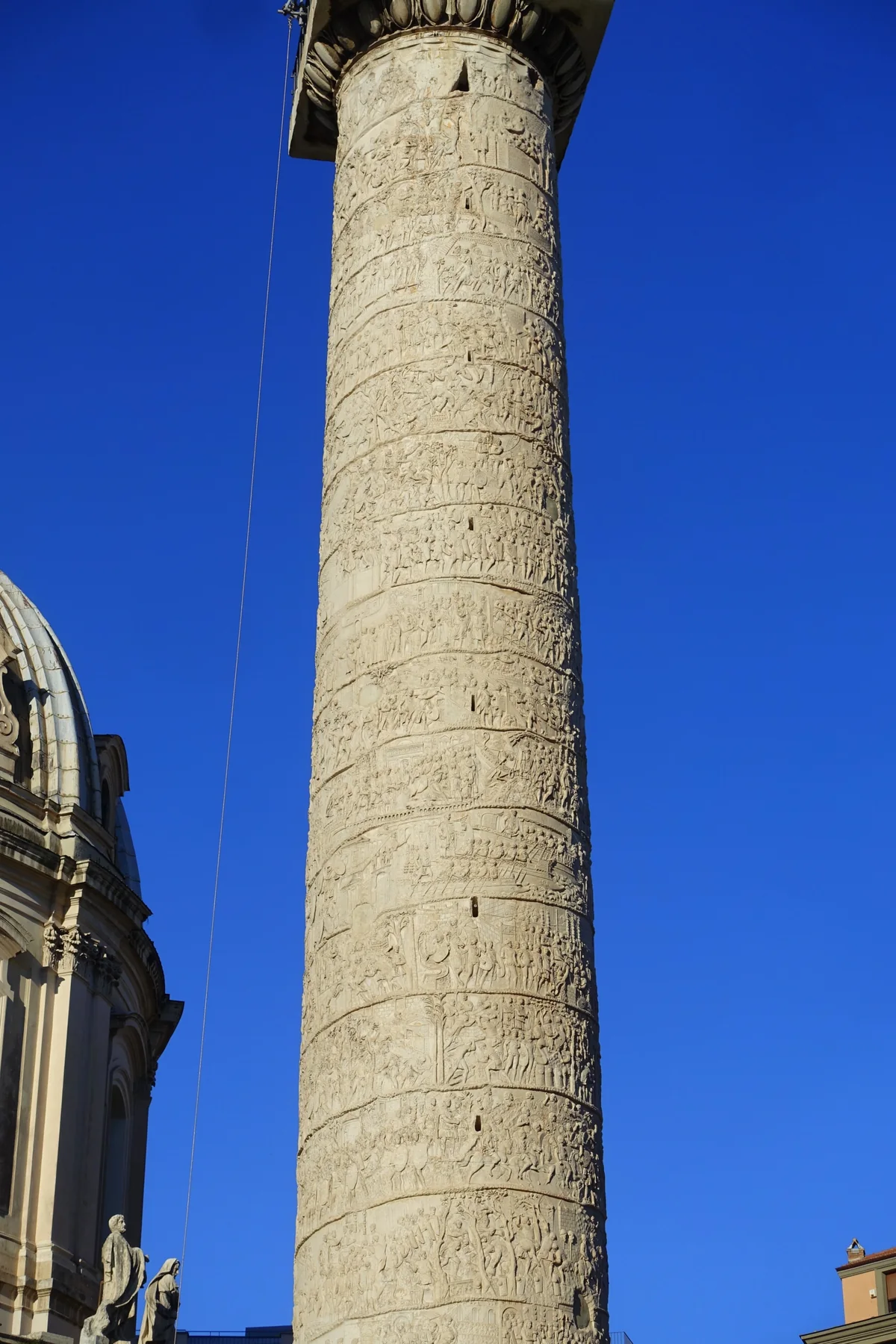

Trajan’s Column turns two wars into a continuous upward order. Roman troops march, build camps, cross rivers, address assemblies, sacrifice, negotiate, fight, and receive submission. Dacian people appear as opponents, families, captives, envoys, and dead. The emperor returns again and again, recognisable through position and action rather than colossal scale.
The column was dedicated in 113 CE within Trajan’s new forum in Rome. Its spiral relief winds around the shaft twenty-three times for roughly two hundred metres. An interior stair reaches the capital. Trajan and, later, his wife Plotina were associated with burial in the base. The emperor’s original statue no longer crowns it; a statue of Saint Peter was installed there in the late sixteenth century.
Those facts make the column more than an illustrated chronicle. The forum complex was financed through the spoils of Trajan’s Dacian campaigns of 101–102 and 105–106 CE. According to the scholarly Trajan’s Column project, the monument stood between libraries and near the Basilica Ulpia, with upper levels offering possible views of sections of the relief. Ancient viewers did not receive today’s isolated postcard monument. Architecture, texts, ceremonies, movement, and restricted viewpoints organised what could be seen.
The frieze is sometimes approached as a documentary film in stone. It does contain detailed evidence for Roman equipment, construction, movement, and imperial representation. But detail is not neutrality. Scenes have been selected, compressed, repeated, and arranged from a Roman state perspective. The narrative makes logistics look disciplined, the emperor attentive, religious acts proper, and imperial advance inevitable. Dacians are visible, but they do not control the account.
Even the photograph above changes the work. It compresses many coils into one vertical field and brings high scenes nearer than a person on the ground could see them. The relief was originally painted and supplemented with metal details; its present pale surface is a remainder, not the complete ancient visual system. A close modern lens clarifies carving while concealing the monument’s control of distance.
The official Turismo Roma record notes another function: the column recorded the height of the hill removed to construct the forum. Engineering, urban transformation, burial, commemoration, and conquest were made to support one another. The shaft measured earth moved in Rome while its relief narrated land conquered across the Danube.
The forum promised public magnificence. Its material source was war. Monumentality made that extraction visible as Roman achievement and difficult to hear as another community’s loss.
An Aramaic name within Roman rule: portrait without cultural surrender
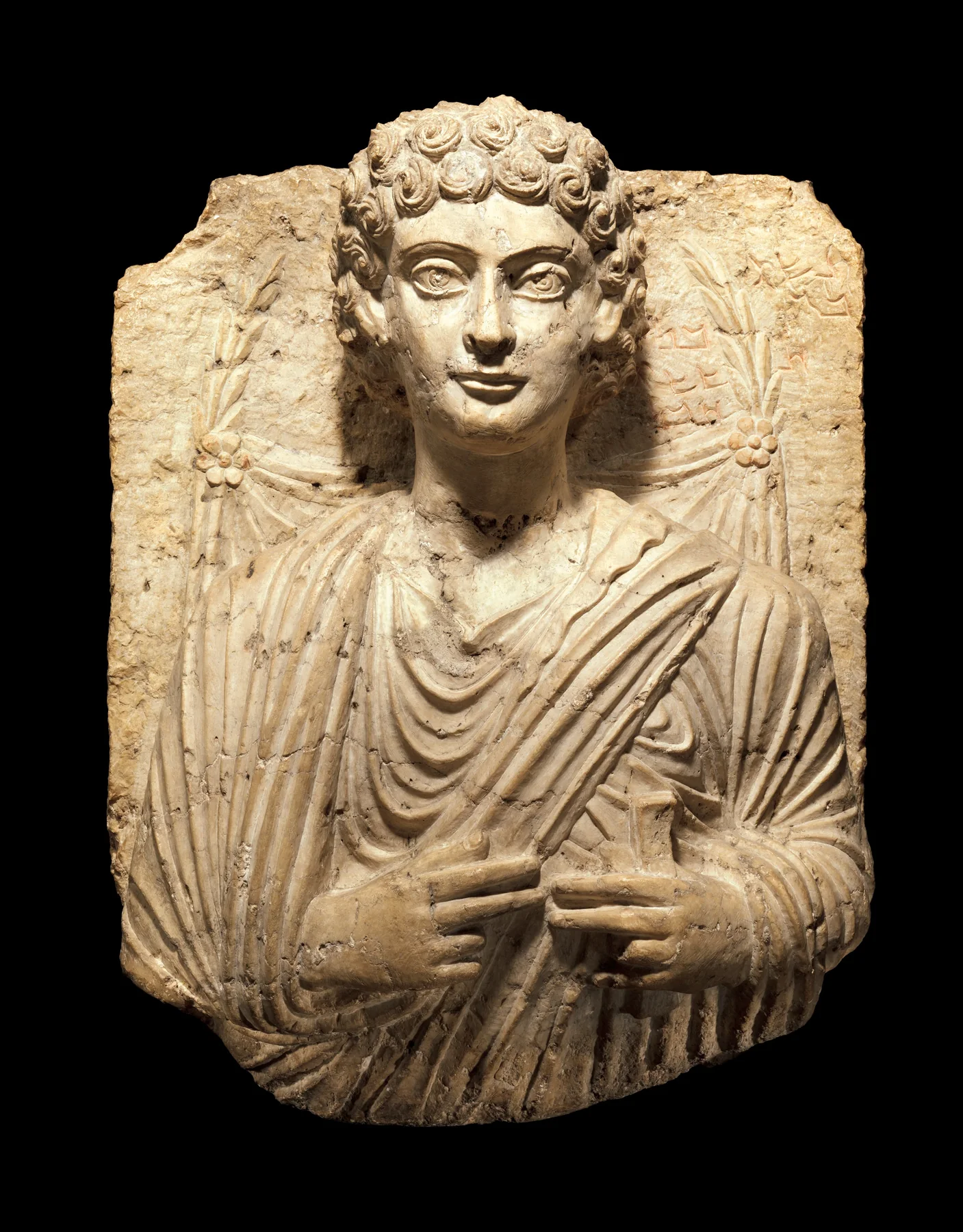
The young man faces outward with large, sharply cut eyes. A mantle wraps around one arm. He may hold a small scroll. Rosettes and a hanging textile enrich the shallow field. Beside him, letters retain traces of red.
They are not Latin letters. The inscription is in Palmyrene Aramaic and names Nesha, son of someone whose name is incomplete, and Belha, son of Hashash, followed by a funerary lament: “Alas.” Yet the Met object record does not simply assign one of those names to the visible man. A second inscription and the fragment’s altered shape suggest that the relief originally included two portraits and was cut apart after removal from its tomb. Text survives, but the modern fragment has damaged the relationship between name and body.
Palmyra was an oasis city in present-day Syria with deep local histories and far-reaching commercial connections. It came under Roman control in the first century CE, but “Roman” did not replace every language, god, family structure, dress practice, or carving tradition. The UNESCO description of ancient Palmyra emphasises the city’s distinctive combination of local, Greco-Roman, and Persian traditions. Combination should not be imagined as a neutral meeting between two abstract halves called East and West. Palmyra’s position was produced through particular routes, powers, communities, and choices.
This relief once sealed a burial niche, or loculus, inside a family tomb. It marked a specific place among the dead while presenting a recognisable social person to the living. Local limestone, frontal pose, garment, attribute, pigment, inscription, and family name worked together. A large research corpus now counts more than 3,700 Palmyrene funerary portraits. The open-access Palmyra Portrait Project demonstrates that this is not a marginal imitation of metropolitan Rome but the largest surviving portrait corpus from one place in the ancient world.
The object also corrects a common model of empire. The Met’s survey of art in the Roman provinces shows that locally rooted media, languages, and visual strategies persisted within imperial structures. “Provincial” describes a political relationship to Roman rule; it should not function as a quality grade. A work can participate in an empire without surrendering its local address.
That does not make Roman rule harmless, nor does it make local identity pure and unchanged. Political authority, army movement, taxation, trade, citizenship, migration, and elite ambition affected what could be built and remembered. The relief gives one family a durable face while leaving many other Palmyrene inhabitants less visible. Its survival in New York also separates it from the tomb architecture and other portraits that organised its original meaning.
Palmyra’s archaeological site has suffered looting, conflict, and deliberate destruction in the present. That history demands careful stewardship, but this person should not be reduced to an illustration of modern catastrophe. The relief first asks to be read as a local act of naming and mourning.
Inside Roman rule, an Aramaic lament still addresses the dead.
Five claims of belonging, five concealments
| Case | Belonging made visible | Material operation | What the claim conceals | Evidence limit |
|---|---|---|---|---|
| Monteleone chariot | Elite Etruscan identity articulated through ceremony, burial, craft, and Mediterranean myth | Hammered bronze, imported ivory, wood, leather, iron, movement, tomb deposition | The labour and routes that concentrated costly materials; the object’s withdrawal from ordinary use | Owner and makers are unnamed; ancient support is lost; modern reconstruction shapes the complete view |
| Unknown male portrait | A Roman man’s age, service, ancestry, or Caesarian allegiance | Marble carving, selected physiognomy, bodily display, possible resemblance to a political type | Elite male visibility was not universal Roman citizenship or experience | Sitter, original body, setting, audience, and political allegiance remain uncertain |
| Boscoreale cubiculum | Villa ownership as access to Hellenistic architecture, cultivated land, and visual abundance | Layered plaster, pigment, skilled painting, architectural illusion, reconstructed installation | Agricultural and household labour disappear behind effortless luxury | Conventional owner name is uncertain; furnishings, people, sound, light, and dispersed rooms are incomplete |
| Trajan’s Column | Emperor, army, religion, engineering, and conquest organised as Roman order | Quarrying, transport, spiral relief, architecture, colour, metal attachments, controlled viewpoints | Spoils finance magnificence; conquered people appear inside an official Roman narrative | Missing colour and setting alter viewing; images select and compress events rather than recording them neutrally |
| Palmyrene relief | Family memory named in Palmyrene Aramaic within a Roman-ruled city | Local limestone, carving, pigment, inscription, sealed burial niche | One commemorated family cannot represent every status or community in Palmyra | The double portrait was cut apart; two names survive, so the visible sitter is not securely identified |
The cases do not form a clean progression. A sixth-century BCE chariot and a second-century CE grave relief both connect mobility with burial. A Republican face and an imperial column both transform political claims into bodily form. A villa room and a public forum both make power look spatially natural.
The comparison also exposes a bias in the archive. We often meet wealthy owners, office-seeking men, emperors, armies, and commemorated families because they commanded durable materials. Enslaved people, agricultural workers, carriers, miners, woodworkers, painters’ assistants, mourners, defeated communities, and viewers remain structurally present but individually difficult to recover. Responsible interpretation names that absence without inventing lives the evidence cannot supply.
A compact timeline
| Date | Political or cultural frame | Selected development | Caution |
|---|---|---|---|
| ninth–first centuries BCE | Etruscan city communities | Changing urban, sacred, domestic, craft, and funerary traditions across central Italy | Surviving tombs are an archival bias, not proof that Etruscan culture was only funerary |
| about 575–550 BCE | Archaic Etruscan world | Monteleone chariot combines elite ceremony, metalwork, distant materials, and Achilles imagery | Greek subject matter does not make the object’s use and identity simply Greek |
| 509–27 BCE | Roman Republic, conventional dates | Elected offices, Senate authority, assemblies, conquest, alliance, and elite family competition reshape Rome and Italy | “Republic” does not mean equal participation or the absence of empire |
| about 50–40 BCE | Late Republic | Boscoreale painters open an elite villa room into imaginary architecture | “Second Style” is a modern classification; luxury depended on work outside the painted view |
| late first century BCE | Late Republic / Early Augustan age | An unknown man’s portrait uses an aged, Caesarian-looking face as social and perhaps political language | Verism is not an unfiltered photograph, and the sitter is not securely identified |
| 27 BCE | Beginning of Augustus’s Principate | Monarchic authority is presented through selected republican forms and distributed portrait types | Political transition did not impose one style across every region or medium |
| 101–106 CE / 113 CE | Dacian wars / Trajanic Rome | Campaign spoils support Trajan’s Forum; the Column is dedicated with a spiral conquest narrative | Monumental detail remains selective state representation, not neutral documentary footage |
| about 125–150 CE | Roman-ruled Palmyra | A local limestone portrait and Aramaic inscription seal a family burial niche | “Provincial” names political position, not artistic inferiority or cultural surrender |
Dates help us order change. They become dangerous when they imply that every workshop transformed on schedule. Etruscan practices continued under expanding Roman control. Republican institutions and memories continued under emperors. Local languages and visual forms continued inside imperial government.
Key terms
- Etruscan: a modern umbrella for related ancient communities and practices in parts of central and northern Italy; not one centralised state or a mysterious prelude without history.
- Repoussé: metalworking that raises relief by hammering from the reverse, often refined from the front.
- Roman Republic: the conventional name for Rome’s political order from 509 to 27 BCE; an unequal system that also created an expanding empire.
- Principate: the imperial system established by Augustus that framed one ruler’s power through the language and selected offices of the Republic.
- Verism: a modern term for emphatically aged or individualised-looking portrait features; a constructed social language, not a guarantee of exact likeness.
- Cubiculum: a small room in a Roman house, often described as a bedroom, though room use could be flexible.
- Second Style: a modern category for Roman wall painting, especially in the first century BCE, that uses painted architecture and perspective to open or dissolve the wall.
- Forum: a civic and monumental complex for political, legal, commercial, religious, commemorative, and ceremonial activity; not simply an empty plaza.
- Province: a territory placed under Roman administration. The word describes power and governance, not one cultural identity or artistic rank.
- Palmyrene Aramaic: the local written form of Aramaic used at Palmyra, including on funerary monuments.
- Loculus: a burial niche, often sealed at Palmyra by a carved portrait slab.
Questions for close looking
Use the same sequence with any Etruscan or Roman work:
- Which political label is being used? Does “Etruscan,” “Republican,” “imperial,” or “provincial” clarify the object, or flatten a more local history?
- What is ancient and what is restored? Identify replacement supports, reconstructed rooms, missing colour, detached fragments, recut surfaces, and modern mounts.
- Where did the material travel? Follow stone, metal, ivory, pigment, timber, food, and human skill before treating an object as the product of one isolated culture.
- What action did the work organise? Burial, procession, reception, sleep, business, sacrifice, public memory, and mourning generate different meanings.
- Who could see it, and from where? A sealed tomb, small bedroom, family burial chamber, and giant urban column create different kinds of access.
- Whose identity becomes durable? Look for names, costumes, office, family resemblance, language, scale, and control over expensive labour.
- Which people are necessary but hard to see? Ask about makers, servants, enslaved workers, agricultural labourers, soldiers, carriers, conquered communities, and caretakers without assigning invented biographies.
- How has collecting changed the work? Has an assemblage been separated, a room moved, a body lost, a double portrait cut, or an archaeological setting replaced by a studio photograph?
- What does the image claim rather than merely show? Realistic detail, architectural perspective, and sequential narrative can all make arguments.
- Which uncertainty must remain visible? A disputed owner, unnamed sitter, lost colour, missing context, or ambiguous inscription is part of the knowledge, not a defect to hide.
Seven myths to retire
“The Etruscans mysteriously vanished.” Their cities were conquered and incorporated through long political and cultural transformations. Uneven textual survival is not sudden human disappearance.
“An Etruscan object with a Greek myth is really Greek art.” Stories, makers, and materials moved. Use, patronage, workshop decisions, ritual, and local setting also make meaning.
“Roman art began when Etruscan art ended.” Communities and practices overlapped. A later Roman identity did not require every earlier language, ritual, or craft habit to stop at once.
“A veristic portrait is an objective photograph in stone.” Age and individuality could be deliberately selected to project political and moral qualities. Likeness and construction can coexist.
“A Roman house was a private home with rooms like ours.” Elite houses could host business, patronage, production, ritual, service, and display. Modern room names are useful but imperfect.
“Trajan’s Column is a neutral visual record of the Dacian wars.” It is an extraordinarily detailed monument and an official, selective narrative financed by conquest. Those statements are compatible.
“Provincial art is a weaker version of art made in Rome.” Provinces contained established communities with their own languages, materials, patrons, and visual histories. Imperial rule connected and constrained them; it did not turn difference into a quality hierarchy.
Where to continue
Begin with object records because they separate measurements, materials, dates, inscriptions, collection histories, and interpretive claims:
- The Metropolitan Museum of Art: Monteleone chariot, late Republican or Early Augustan male portrait, Boscoreale cubiculum, and Palmyrene funerary relief.
- Adriana Emiliozzi, “The Etruscan Chariot from Monteleone di Spoleto”, for construction, reconstruction, iconography, and use.
- The Archaeological Park of Pompeii, history of excavation at the Villa of P. Fannius Synistor, for the uncertain owner name and dispersal of the paintings.
- Roger B. Ulrich’s Trajan’s Column project, for the monument’s architecture, measurements, viewing conditions, and photographic archive.
- UNESCO World Heritage Centre: Etruscan necropolises of Cerveteri and Tarquinia and ancient city of Palmyra, for place-scale archaeological contexts and current stewardship.
- The Palmyra Portrait Project, for the open research corpus and its method of studying thousands of funerary portraits together.
- The Met’s thematic essays on Etruscan art, Roman portraiture, Roman housing, and art of the Roman provinces.
Read these sources in layers. An object page establishes a record. Archaeology rebuilds a setting. Technical study reconstructs making. Social history asks who paid, worked, ruled, served, mourned, or disappeared from durable evidence. Heritage research follows what excavation, collecting, war, conservation, and display have done since.
Etruscan and Roman art becomes harder—but more human—when “Rome” stops being the answer and becomes one of the forces the object asks us to investigate.
Editorial record
About this article
- Author
- Publisher
- GeMarkt
- Published
- Updated
- Reviewed
- Internal source & rights check. Conducted by GeMarkt Research Review. This is an internal editorial check—not independent peer review.
- Source standard
- Art history source standardPrioritises object records and research sources, distinguishes evidence from interpretation, and states material uncertainty.
Found a claim that needs checking? Report a factual error.