Art History · Learning chapter
Atlas III — Early-modern worlds · 4 of 11
Persianate arts across Safavid and Mughal courts: manuscript, workshop, portrait, and transfer
A critical guide to Safavid and Mughal art through manuscripts, albums, workshops, portraiture, natural history, migration, diplomacy, and imperial power.

What we’ll look at
How did artistic knowledge move and change between Safavid and Mughal courts?
The page above once belonged to one of the most ambitious books made in sixteenth-century Iran. Its painting turns a legendary king’s victory into an ordered field of mounted bodies, demons, rocks, blossoms, cloud, gold, and verse. Yet it is not a free-standing picture. Columns of Persian poetry determine the image’s shape. The generous margins announce costly paper and sustained labour. The reverse carries another part of the story. A reader originally encountered it by turning leaves within a manuscript of 759 folios.
That manuscript no longer exists as one book. It travelled as a diplomatic gift from the Safavid court to an Ottoman sultan, entered later collections, and was divided in the twentieth century. Individual folios now appear in museums and private holdings. The page therefore records at least two histories: the making of kingship through a royal book and the unmaking of that book through possession, sale, and display.
This chapter follows such changes across Safavid Iran and Mughal South Asia between about 1500 and 1700. It does not place two sealed styles side by side. It asks what moved: Persian texts, calligraphy, artists, pigments, page formats, albums, portraits, animals, diplomatic gifts, captured libraries, and ideas about rulership. It also asks what did not remain the same when those resources entered another workshop or court.
Persianate is a route, not an ethnicity
Persianate names places and communities where Persian language, literature, court customs, administration, and book arts carried authority beyond Iran. It can connect histories in Iran, Central Asia, South Asia, Anatolia, and elsewhere without claiming that these regions shared one culture or ethnicity.
It is not a synonym for Persian ethnicity. Safavid rulers emerged from a Turkic-speaking military and Sufi environment while making Persian central to administration and literary culture. Mughal rulers traced Timurid and Chinggisid genealogies, governed a predominantly South Asian empire, and used Persian as a major court and administrative language alongside many other languages. Makers in both empires came from different cities, religions, families, ranks, and training systems.
The Persian Manuscripts Association defines its field through regions historically engaged with Persian language and culture rather than a single modern nation. That broad field is useful if every connection remains testable. “Persianate influence” by itself explains nothing. A sound account names a manuscript carried to a library, a painter recruited across a border, a poem recopied, a page bought, or a diplomatic image adapted.
Two empires are not one style
The Safavid dynasty established power in Iran in 1501 and made Twelver Shi’a Islam the state confession. Its capitals moved from Tabriz to Qazvin and then, under Shah Abbas I, to Isfahan. Court patronage interacted with provincial workshops, shrine endowments, merchants, urban consumers, and international markets.
The Mughal dynasty began its South Asian rule with Babur’s victory in 1526, lost and regained territory under Humayun, and expanded dramatically under Akbar. Its court moved among cities including Agra, Fatehpur Sikri, Lahore, and Delhi. Imperial workshops brought together makers trained in Iranian, Central Asian, and multiple South Asian practices.
Both courts valued Persian texts, calligraphy, manuscripts, textiles, gardens, genealogy, and gifts. That does not produce one “Islamic” or “Persian” style. Safavid and Mughal institutions selected, translated, enlarged, recombined, and disputed shared resources. Local building traditions, pigments, flora and fauna, religious communities, political rivals, and workshop personnel changed the result.
Comparison should therefore use verbs. Who commissioned, copied, translated, designed, painted, wrote, assembled, viewed, gifted, seized, or dispersed the work? Resemblance is evidence to investigate, not the conclusion.
Start with a book that no longer exists as one book
In brief: The Shahnameh of Shah Tahmasp was a vast illustrated court manuscript begun in Tabriz during the 1520s. It retold stories of ancient Iranian kings in ways that helped the Safavid court describe its own power.
The Shahnama, or Book of Kings, is Firdausi’s long Persian epic recounting Iran’s legendary and historical rulers before the Islamic conquests. Courts commissioned copies over centuries. A new manuscript could connect a current ruler to an inherited language of justice, succession, heroism, catastrophe, and legitimate kingship without becoming a literal chronicle of that ruler’s reign.
The copy associated with Shah Tahmasp contains 759 folios and 258 paintings. The Met’s object history dates its production from the early 1520s through at least another twenty years in the royal atelier at Tabriz. Scholars disagree over exact chronology and allocation of hands. The project probably began under Shah Isma’il I and continued under his son Tahmasp.
The page above depicts Tahmuras defeating the divs, beings translated imperfectly into English as demons. The king occupies the centre on horseback while chained, wounded, and fleeing figures generate several directions of motion. Calligraphy above and below prevents the scene from becoming an autonomous window. The page asks for reading, looking, and turning.
The Shahnama made kingship readable
The story presents Tahmuras as a culture hero who defeats hostile forces and acquires knowledge from them. The image can therefore join violence to civilisation: enemies are subdued, while writing and skill enter the king’s ordered world. That is not a transparent statement of Safavid policy, but it offered a royal reader a charged model of authority.
Composition makes the claim sensorial. The king’s horse carries him through the compressed centre; landscape bands separate groups without obeying one optical viewpoint; silvered ground, pigments, patterned clothes, and gold margins make control of rare materials part of control over narrative. A reader close enough to follow the script could also inspect tiny facial, vegetal, and textile differences.
Royal manuscripts did more than praise patrons. Their stories included failed rulers, unjust decisions, rebellion, mourning, and dynastic collapse. A king reading the Shahnama encountered standards against which kingship could be imagined and judged. The book’s political force came partly from this capacity to hold warning and glory together.
A royal manuscript was a coordinated institution
No single painter made the Shah Tahmasp Shahnama. Francesca Leoni’s Met study names Sultan Muhammad, Mir Musavvir, and Aqa Mirak among successive leaders associated with two generations of renowned makers. Encyclopaedia Iranica’s survey of Safavid art describes a production sequence involving paper makers, calligraphers, painters, illuminators, and binders under organised direction.
Planning began before paint. Text had to be copied with spaces reserved for images. Sheets were ruled; paper could be dyed or gold-sprinkled; calligraphers distributed lines; designers organised scenes; painters applied colour and detail; illuminators made headings, borders, and marginal systems; binders turned separate units into a usable volume. Corrections and changes could interrupt that sequence.
Modern attribution often privileges the person thought to have designed or painted a scene. The page itself preserves broader coordination. Its script, ruling, border, surface preparation, pigment, and later mounting are not supporting decoration around the “real art.” They are the conditions through which the image became legible, durable, and prestigious.
Tabriz gathered inherited practices
Safavid Tabriz did not invent royal manuscript culture from nothing. Timurid, Turkmen, and earlier Iranian books, painters, calligraphers, and workshop habits were available as objects and knowledge. Conquest and dynastic change could assemble makers trained under former rulers at a new court.
The Met’s account of Safavid art before 1600 describes artists associated with preceding Aq Qoyunlu and Timurid contexts working within the new Safavid project. The result should not be reduced to a clean synthesis of named styles. Individual training, access to older manuscripts, collaboration, patronal decisions, and changing project leadership all mattered.
The court’s ability to gather talent was a form of power. So was its capacity to obtain fine paper, precious colourants, gold, time, and specialised labour for a book that took decades. “Masterpiece” can describe quality; it must not hide the resources and hierarchy that made such concentration possible.
Gift, diplomacy, and dispersal changed the manuscript
In 1568 Shah Tahmasp sent the manuscript to Sultan Selim II as part of an embassy marking the Ottoman ruler’s accession. The gift carried Persian epic, Safavid workmanship, and an image of courtly magnificence into the hands of a rival dynasty. Diplomatic exchange did not erase competition; it gave rivalry material form.
The volume later left Ottoman possession and entered European collecting networks. In the twentieth century it was divided. Pages moved through dealers, auctions, museums, and private collections. A viewer can now compare high-resolution digital files from several institutions, but cannot turn the intact book in its original sequence.
Dispersal changed value. A folio could be sold, framed, reproduced, or canonised under an individual painter’s name. The complete manuscript’s rhythm, weight, paired openings, reverse sides, and transitions became harder to experience. Sheila Canby’s The Shahnama of Shah Tahmasp reconstructs that larger project; individual object records document present holdings.
Provenance is therefore not an appendix. The route from royal library to diplomatic gift to dispersed art market explains why this page appears to us as a picture and what forms of knowledge its current isolation removes.
From codex to single page
By the later sixteenth and seventeenth centuries, single-page drawings and paintings gained prominence in Safavid Iran. They could be commissioned, exchanged, sold, collected, or mounted into albums rather than designed as illustrations to one continuous literary text.
This shift did not end manuscript production. It widened the economy of the image. A single sheet could display an artist’s line, signature, or recognisable type with fewer materials and less coordination than a vast royal codex. Patrons beyond the monarch—including officials, merchants, and connoisseurs—could participate in collecting.
The muraqqa’, or album, then made new relationships among separate works. Calligraphy, drawing, painting, borders, and specimens from different times or regions could be arranged into sequences. An album was not merely a storage folder. Selection, trimming, mounting, pairing, illumination, and binding produced a new object from prior objects.
Riza-yi Abbasi and the economics of the album page
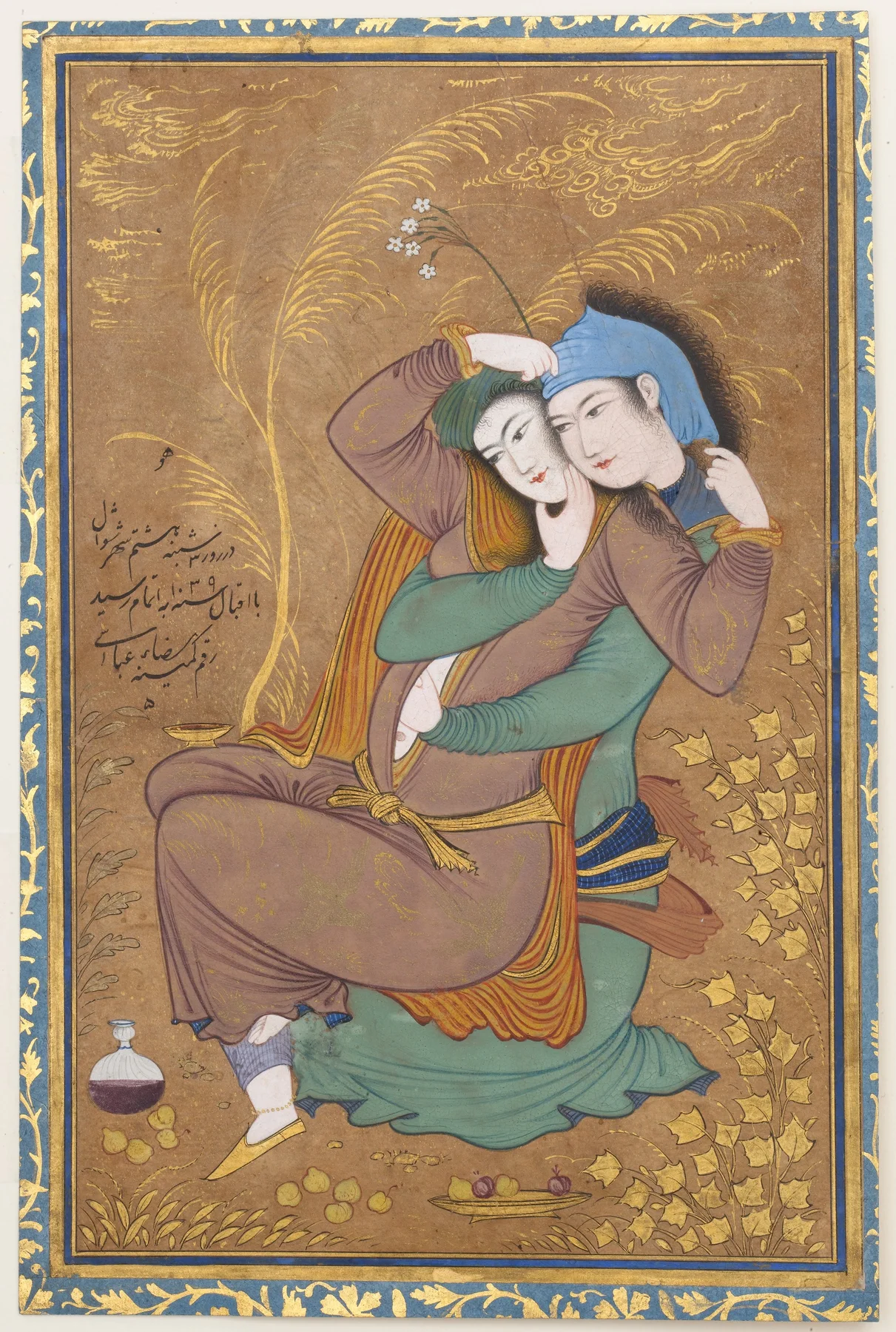
Riza-yi ’Abbasi’s The Lovers compresses an intimate encounter into a small sheet. The figures interlock through arms, tilted faces, layered textiles, and the shared curve of their bodies. A flask, cup, fruit, and plants place desire within a poetic and sensual field. The inscription includes the artist’s name and date.
The Met’s record identifies the work as opaque watercolour, ink, and gold on paper. Line carries much of its force. Contour, hair, folds, and fingers reward close viewing, while the limited ground frees the figures from a full narrative setting.
Riza worked for Shah Abbas I but also for other patrons and markets. The Met’s survey of Iranian arts after 1600 connects his career to the prominence of independent drawings and paintings. “Independent” here describes a page format, not freedom from money or institutions. The sheet still depended on paper, pigments, buyers, reputation, and the possibility of later album assembly.
Do not call the couple a realistic record of ordinary private life. Their idealised bodies, inscription, poetic setting, and carefully staged embrace construct a desirable type. The image expands subject matter while remaining a crafted commodity within elite visual culture.
Isfahan changed where art met public life
Shah Abbas I moved the Safavid capital to Isfahan in 1597–98 and sponsored a major programme of palaces, mosques, gardens, bridges, markets, and a new public square. The Met’s overview of Shah Abbas and Isfahan links court representation to urban space and international trade.
Architecture organised ceremonial routes and commercial activity; painted decoration extended courtly imagery onto palace walls; bazaars brought luxury production and exchange into the capital’s remaking. Single-page art belonged to this larger ecology of workshops, shops, visitors, diplomats, officials, and collectors.
The change should not be narrated as a simple rise from Tabriz manuscript to Isfahan painting. Royal books continued, older works were copied and collected, and provincial centres remained important even when the court concentrated resources. Isfahan changed the balance among palace, page, market, and urban spectacle.
Humayun’s exile became an artistic route
The Mughal emperor Humayun lost control of his South Asian territories and spent part of his exile at the Safavid court of Shah Tahmasp. Safavid military support helped him regain Kabul and, in 1555, Delhi. Artists travelled through this political route.
Mir Sayyid ’Ali and ’Abd al-Samad, both trained in Iranian court painting, entered Humayun’s service and later held leading roles under Akbar. The Met’s open-access catalogue Wonder of the Age traces ’Abd al-Samad from Safavid service to Humayun’s court in exile and Akbar’s expanding atelier.
“Influence” is unusually concrete here: defeat produced exile; exile created diplomatic dependence; a ruler recruited named painters; those painters moved with a recovering court; their training entered a new institution. Yet their arrival did not cause Mughal painting by itself. South Asian makers, materials, storytelling practices, and an imperial programme of unprecedented scale transformed what the migrants could teach.
Migration was opportunity for some and loss for others. Safavid patronage changed; artists sought security or advancement; imperial courts competed for skill. A biography crossing a border reveals the uneven conditions behind stylistic connection.
Akbar expanded the imperial workshop
Akbar’s court commissioned illustrated histories, epics, romances, translations, portraits, and religious or scientific works. The Met’s survey of Mughal art before 1600 stresses that the imperial workshop included Iranian artists, Indian Muslims, and Hindus.
Contemporary marginal ascriptions preserve the names of more than one hundred painters active across projects. Yael Rice’s study “Workshop as Network” uses those ascriptions to analyse changing teams: designers and colourists repeatedly collaborated in different combinations rather than occupying one fixed assembly line.
That evidence changes the meaning of “Mughal style.” A recognisable imperial visual language could emerge from fluctuating relationships among people with different training. The court created conditions for collaboration, evaluation, pay, and rank; makers solved pictorial problems inside those conditions.
Agency was unequal. The emperor and senior officials selected projects and rewarded performance. Workshop leaders allocated tasks. Some artists were named and praised; many suppliers and assistants remain less visible. The archive’s unusual abundance of painter names should not be mistaken for a complete labour record.
Hamzanama made collaboration enormous
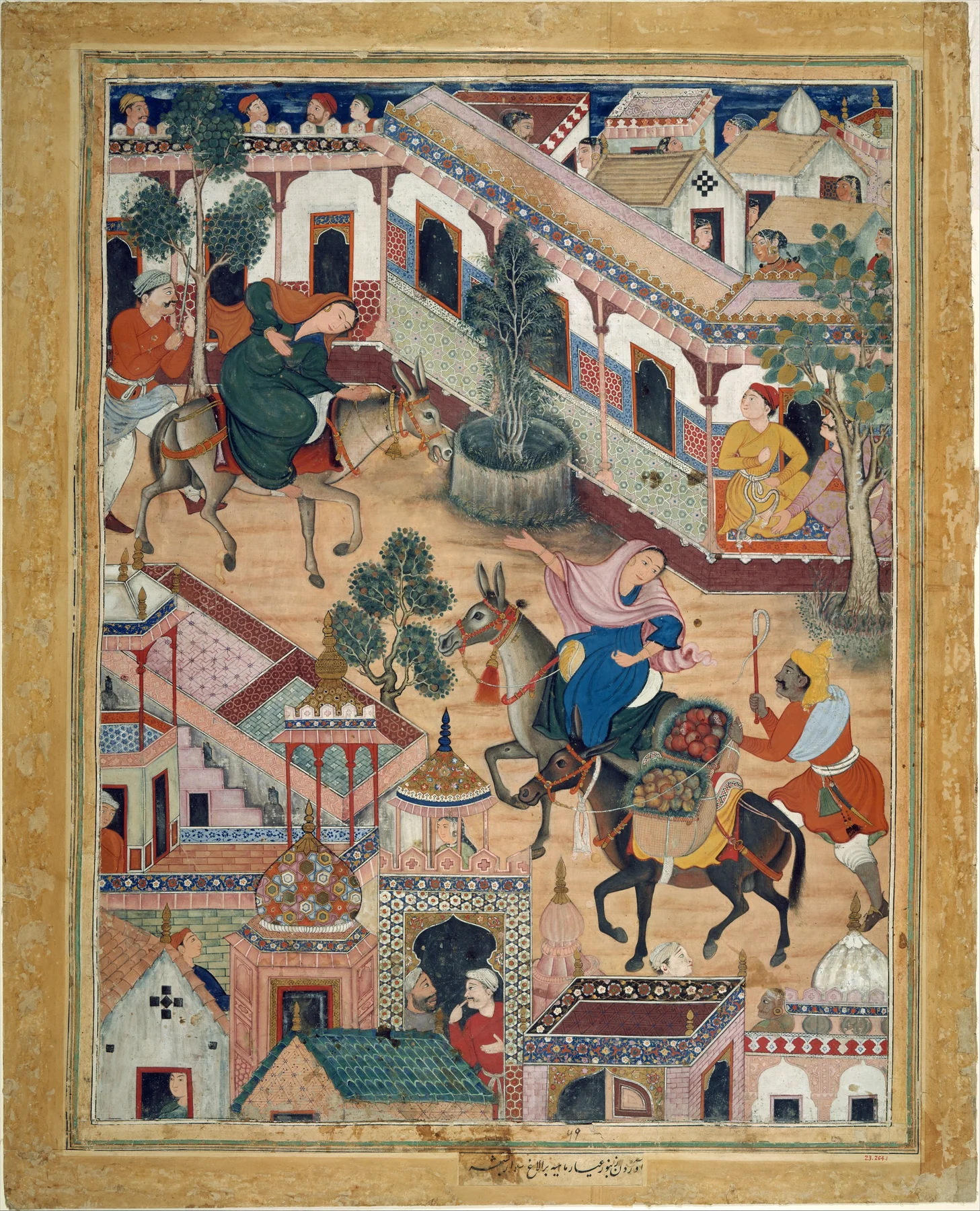
The Hamzanama narrated the fantastic adventures of Amir Hamza. Under Akbar, the story became an exceptional cycle of very large paintings on cloth. Surviving sheets approach the scale of portable presentation boards rather than intimate book pages. Text was written on the reverse so that a storyteller could read while an audience saw the image.
In this folio, Zambur brings Mahiya into Tawariq. Buildings stack and overlap around riders, donkeys, trees, goods, and spectators. Architecture creates several simultaneous episodes rather than one distant viewpoint. Iranian-derived page organisation meets close attention to South Asian structures, clothing, bodies, vegetation, and urban action.
The Met attributes the page to Kesav Das and Mah Muhammad. Such dual attribution is evidence of divided work, not a defective version of individual authorship. The larger project required design, drawing, colour, finishing, text, cloth preparation, mounting, sequencing, supervision, and performance.
The often-repeated claim that 1,400 paintings were planned or made comes through courtly textual accounts and later reconstruction; the exact original extent and sequence remain scholarly questions. What survives securely demonstrates extraordinary scale, not a need for inflated precision.
Designer, colourist, calligrapher, binder
Mughal manuscript annotations sometimes distinguish tarh, the design, from ’amal, the work or execution associated with colouring and finish. Those labels allow historians to reconstruct collaboration, but they should not become universal job descriptions imposed on every page.
A designer could establish composition and figures; another painter could apply colour or elaborate surfaces; specialists might contribute portraits, animals, or borders; calligraphers and illuminators worked through different sequences; binders eventually ordered and protected the leaves. Project leaders could revise work, and the emperor might inspect results.
Attribution is therefore a claim about a role and evidence, not simply the name nearest an image. A later librarian’s note may differ from a contemporary inscription. Signatures can be genuine, copied, altered, or added. Technical imaging may reveal underdrawing and revisions that complicate written evidence.
Rice’s The Brush of Insight argues that Mughal painters became active mediators of imperial vision rather than anonymous illustrators. That recovery of agency is important. It remains compatible with recognising hierarchy, collaboration, and the many makers whose names are absent.
Translation was also visual government
Akbar’s court sponsored Persian translations and illustrated adaptations of Sanskrit works, including the Mahabharata, known in its Persian version as the Razmnama, or Book of War. It also commissioned illustrated Persian histories of the emperor’s reign and copies of major literary texts.
Translation did not transfer stable content between two sealed languages. Scholars, readers, scribes, painters, and officials selected terms, episodes, genealogies, and visual forms. An image could negotiate what a Persian-reading imperial audience should recognise in a South Asian epic.
This was intellectual curiosity and political work. Bringing texts associated with different communities into an imperial library allowed the court to present itself as an organiser of knowledge. Participation did not imply equality, consensus, or modern religious pluralism. Patronage occurred within conquest and centralisation.
The British Library’s Persian manuscript cataloguing programme spans material from Iran, Central Asia, and India, including Timurid, Safavid, and Mughal manuscripts. Read alongside individual object records, that breadth makes translation and reuse visible as material histories rather than an abstract meeting of traditions.
Portraiture does not merely record a face
Under Jahangir, individualised portraits, animal and plant studies, and single-page paintings became especially prominent. Court artists paid close attention to facial features, age, dress, rank, and species. That descriptive precision is often called naturalism.
A portrait still stages its subject. Profile, scale, halo, weapon, jewel, inscription, carpet, globe, attendant, or gesture can rank a person and claim access to imperial recognition. A face may be observed from life while the completed image places it in an allegory that never occurred.
Portrait collections also helped rulers classify relationships. Images of nobles, ascetics, rulers, envoys, Europeans, and ancestors could make a world of status available in an album. The court controlled which difference became visible and how it was ordered.
Naturalism and ideology are not opposites. Precise likeness can strengthen a political fiction by making its impossible gathering appear witnessed.
Jahangir stages a hierarchy of worlds
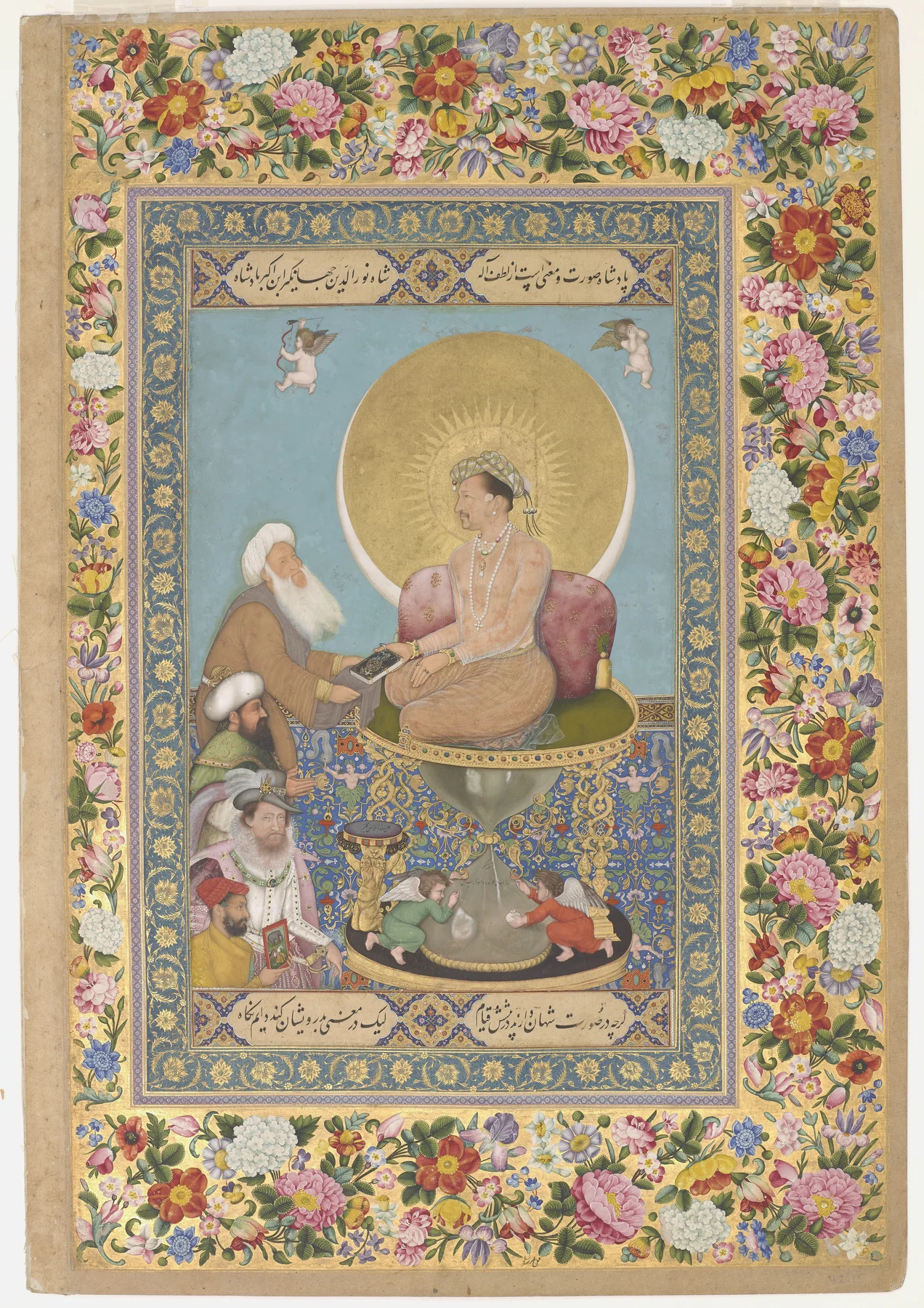
Jahangir sits above an hourglass while a vast sun and crescent frame his head. He offers a book to an elderly Sufi shaikh. Below wait an Ottoman sultan, King James I of England, and Bichitr, the artist who holds a small painting. Winged figures work at the hourglass; inscriptions help state the image’s claims.
The encounter is allegorical, not a neutral group portrait. Scale, vertical order, gesture, and access rank the figures. The emperor appears to prefer spiritual counsel over temporal rulers, yet the composition makes him the distributor of attention at the centre of both worlds.
The National Museum of Asian Art record dates Bichitr’s painting to about 1615–18 and attributes its later floral margins to Muhammad Sadiq in 1747–48. Two dates therefore coexist on the current leaf. The object we see is already an edited historical assembly.
The museum’s updated provenance records another transformation. Nadir Shah’s forces carried Mughal paintings and manuscripts to Iran after the 1739 invasion of Delhi. Works were assembled into albums there and later dispersed through the art market. The page’s route makes conquest—not only aesthetic exchange—part of Persianate mobility.
European images became Mughal material
James I did not sit beside Jahangir and the Sufi. Bichitr adapted his likeness from a European portrait source. The small winged figures and other devices also engage Christian and European prints that reached the Mughal court through diplomacy, trade, and Jesuit missions.
Adaptation did not make the page Europeanised in any simple sense. The artist extracted useful forms, changed their scale and context, and placed them inside a Persian-inscribed Mughal claim. A European king becomes a ranked participant in Jahangir’s imagined order.
Ebba Koch’s research on Mughal art, imperial ideology, and artistic links with Europe shows why borrowed motifs must be read through court politics. A globe, halo, cherub, or portrait type can carry a new argument after transfer.
Use “source” and “adaptation” more carefully than “influence.” Ask which print or object was available, who obtained it, what the painter retained, what changed, and what work the transformed form did in its new setting.
The artist appears inside imperial order
Bichitr includes himself at the lower left, holding a small painting and wearing a modest yellow garment. His signed self-presentation records artistic identity, but it does not place painter and emperor on equal terms.
The artist is both maker and represented court servant. He controls the composition that ranks him last; he displays his skill through the very image that visualises his dependence. This is a more interesting agency than the modern fantasy of an artist standing outside patronage.
Yael Rice argues that Mughal painters helped constitute imperial knowledge and visionary authority. Their images did not only decorate decisions made elsewhere. Yet recognition came through court structures that could assign rank, reward, title, salary, and access.
Read the self-portrait twice: as evidence that a painter could claim visibility and as evidence that visibility itself was organised by imperial hierarchy.
Albums make time non-linear
The muraqqa’ joins pages that need not share date, maker, or place. The Met’s study of the Shah Jahan Album notes that the album begun under Jahangir passed to Shah Jahan and Aurangzeb, received later additions, and was rebound around 1820. Its present form spans centuries.
Albums can pair a Mughal portrait with older Iranian calligraphy, surround a seventeenth-century painting with nineteenth-century borders, or reuse a page whose reverse belongs to another time. Recto and verso may have separate makers and histories. Mounting and illumination create visual harmony without erasing those differences.
An album therefore turns collecting into authorship. Selection places artists and rulers into a retrospective canon; borders regularise unequal fragments; seals and inscriptions mark ownership; sequence makes comparison possible. Later viewers can mistake that curatorial order for original production.
When cataloguing an album leaf, identify painting, calligraphy, border, mounting, and binding separately. “Mughal, seventeenth century” may describe only one layer.
Mansur’s nilgai: observation and possession
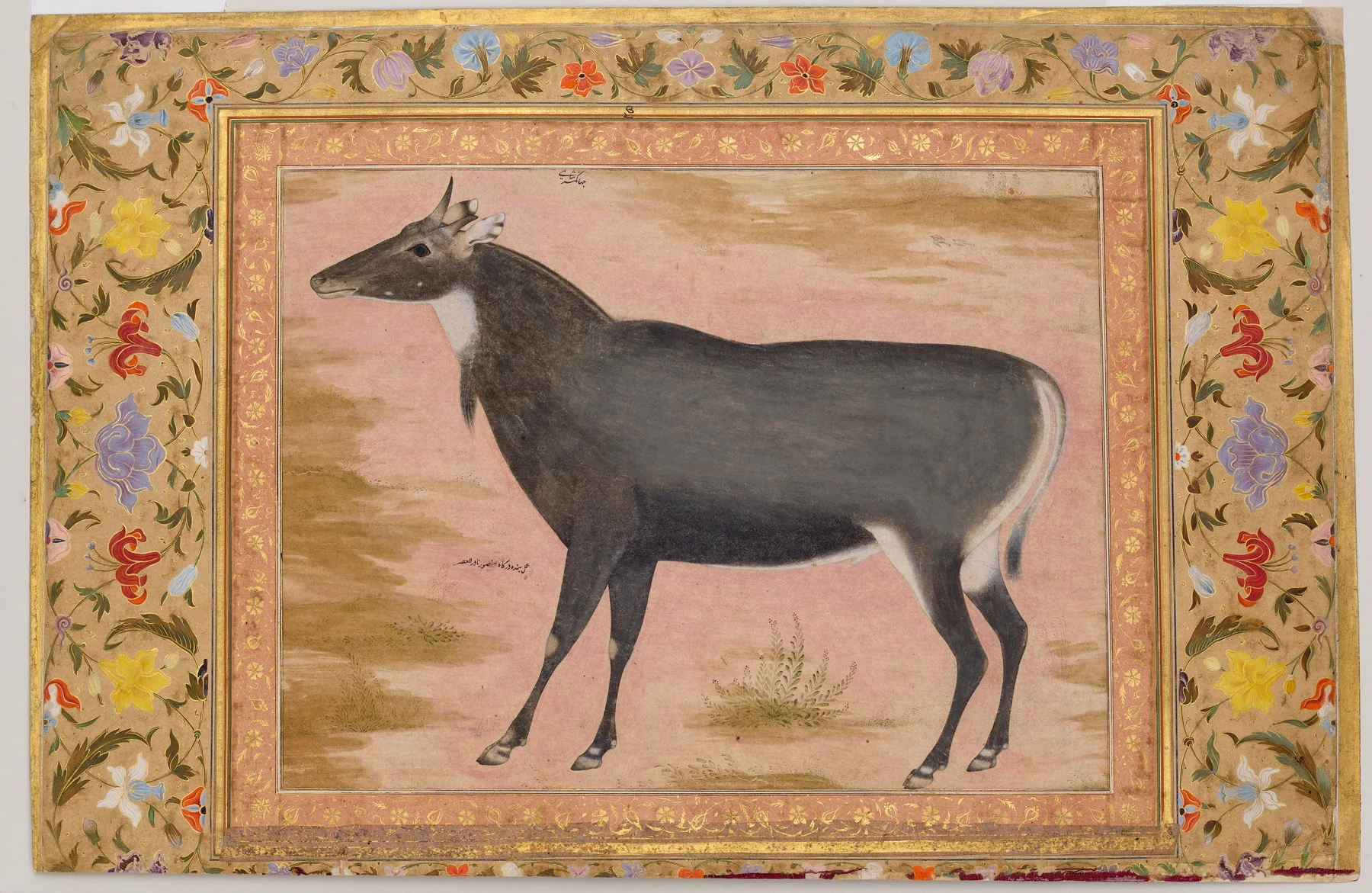
Mansur’s nilgai stands in profile against a restrained ground. Changes in the animal’s dark coat, white markings, horn, eye, hoof, and swirl of neck hair are carefully differentiated. The Met’s record suggests that Mansur probably observed it in Jahangir’s zoological garden.
The painting is one side of an album folio. The other contains calligraphy made by Mir ’Ali Haravi around 1540, roughly eighty years earlier and in another region. Album assembly makes Safavid-era Persian calligraphy and Mughal animal study neighbours without making them contemporaneous.
The nilgai was native to regions of South Asia. Its conversion into an imperial study depended on access: a court could collect animals, employ a specialist painter, preserve an image, and bind it into a prestigious album. Observation belongs to a system of possession as well as knowledge.
The floral border further changes the encounter. The animal does not inhabit a reconstructed ecosystem; it occupies a courtly page framed by cultivated abundance. Precision has been extracted from habitat and reorganised for inspection.
Naturalism is a court practice, not transparent truth
Jahangir’s memoirs record sustained interest in unusual animals, plants, and phenomena. Painters such as Mansur received titles and produced images through which rare specimens could be studied, remembered, and displayed.
That attention generated valuable evidence. Some paintings preserve morphological detail of animals that were transported far from their usual range or later became rare. Yet the image is not a camera before photography. The painter selected profile, scale, pose, background, and degree of finish. The court determined access and value.
“Scientific” should therefore be used with boundaries. The work participates in empirical observation and classification, but it was not produced within a modern scientific institution or a neutral field study. Its naturalism supports connoisseurship, wonder, imperial reach, and the ruler’s identity as a discerning observer.
Close description becomes stronger when joined to institutional questions: Who brought the animal? Under what conditions was it kept? What did the painter observe directly? Who named the species? Who could view the completed page?
Safavid and Mughal are not centre and derivative
A model-and-copy narrative makes Iran the origin and India the recipient. The history is more reciprocal and more uneven. Iranian painters moved to South Asia; Mughal patrons collected Iranian calligraphy and painting; Safavid makers responded to Indian subjects and markets; textiles, books, envoys, and animals moved in several directions.
Mughal workshops transformed imported training through large collaborative projects, South Asian visual knowledge, new portrait practices, and an imperial translation programme. Safavid single-page painting developed through its own urban, commercial, poetic, and court contexts. Similar album formats could host different claims.
Nor should “local” mean untouched by movement. Tabriz inherited Timurid and Turkmen practices; Mughal India contained many regional courts and languages; Isfahan drew materials and visitors from long-distance routes. Every centre was made through prior connections.
Compare mechanisms, not civilisations. A line may travel through a drawing; a face through a diplomatic portrait; a text through translation; a maker through refuge; an album page through conquest. Each route changes what “shared” means.
Transfer could be gift, refuge, recruitment, purchase, or coercion
The same object type can move under very different conditions. Shah Tahmasp’s Shahnama reached the Ottoman court as a diplomatic gift. Mir Sayyid ’Ali and ’Abd al-Samad changed patrons through Humayun’s exile and recovery. Album pages entered collections through commission and purchase. Nadir Shah’s army took Mughal library material after invading Delhi.
These routes should not all be softened into “exchange.” Gift giving can stage hierarchy and obligation. Recruitment can offer advancement while following war or lost patronage. Purchase depends on unequal wealth and market access. Conquest can remove objects and people by force.
Provenance records are often incomplete. The Smithsonian notes gaps in the modern history of Bichitr’s page even while documenting its transfer from Delhi to Iran and later appearance on the Tehran and New York markets. Stating the gap is part of evidence-led writing.
Transfer is also material transformation. A page may be trimmed, mounted, paired, given new margins, stamped, rebound, separated, restored, photographed, and digitised. Movement leaves visible and archival traces.
Court workshops and regional futures
Imperial workshops did not contain all artistic production. Safavid Shiraz supported commercial bookmaking; Mughal painters also served nobles and princes; Deccani, Rajput, Pahari, and other South Asian courts developed distinct practices through selective engagement with imperial and regional resources.
When central patronage contracted or a ruler died, artists did not simply vanish. They moved, changed clients, taught relatives, adapted formats, and worked in provincial or regional centres. The Met’s account of Mughal art after 1600 follows painters moving into other courts as imperial support changed.
Calling this “decline” treats one court’s concentration of labour as the measure of all art. It also makes regional creativity derivative by definition. A better question asks which skills, people, and objects moved after an institutional change, and what new audiences made possible.
Court history remains necessary because courts commanded resources and archives. It becomes responsible when it also tracks makers beyond court walls and recognises what imperial records omit.
A comparison matrix
| Work or system | Material and labour | First institutional setting | Later transformation | Strong research question |
|---|---|---|---|---|
| Shah Tahmasp Shahnama folio | Paper, calligraphy, pigments, silver, gold, design, painting, illumination, binding | Safavid royal atelier, Tabriz | Diplomatic gift to the Ottoman court; twentieth-century dispersal | How did separation convert a sequenced book into collectible pictures? |
| Riza-yi ’Abbasi’s Lovers | Paper, ink, colour, gold, signed single-page painting | Safavid court and connoisseurial market in Isfahan | Collection and museum display | What new patrons and subjects became possible when a page did not illustrate a continuous text? |
| Hamzanama folio | Large cloth support, drawing, colour, gold, text, mounting, team labour | Akbar’s imperial workshop and oral-visual presentation | Fragmentary survival across collections | How did variable teams turn different training into a legible imperial project? |
| Bichitr’s Jahangir allegory | Portrait sources, paper, pigment, gold, calligraphy, later margins | Jahangir’s Mughal court | Taken to Iran after the 1739 invasion; remounted and dispersed | How does provenance change the meaning of a picture about universal rule? |
| Mansur’s nilgai | Direct observation, drawing and colour; calligraphy on reverse; album borders | Mughal court collection and zoological access | Paired with older Iranian calligraphy in an album | How do empirical attention, possession, and retrospective assembly operate together? |
The matrix prevents “Safavid versus Mughal style” from becoming the only comparison. Each row joins appearance to labour, institution, use, and later history. The same court label can describe a commission, workshop, audience, collection, or claim made by the work; those are related but not interchangeable.
Common survey traps
“Persianate means ethnically Persian.” It identifies a changing cultural and linguistic field. Makers and patrons within it had many languages, genealogies, confessions, and regional identities.
“Islamic art avoids figures.” These courtly manuscripts and albums contain abundant human and animal representation. Figural practice varied by medium, audience, legal interpretation, and institution.
“A miniature is small and minor.” Some Hamzanama paintings are about 74 centimetres high. “Miniature” derives through manuscript terminology, not a reliable hierarchy of physical or cultural importance.
“A painting has one artist.” Named designers and colourists, calligraphers, illuminators, paper makers, border painters, and binders could contribute at different stages. Attribution must specify the role.
“Mughal painting is Persian painting in India.” Iranian-trained artists were important, but South Asian makers and imperial projects transformed workshop practice, subject, scale, and visual knowledge.
“Naturalism is neutral observation.” Accurate description was shaped by court access, selection, classification, album display, and claims about a ruler’s discernment.
“Albums preserve original pages unchanged.” Albums cut, mount, pair, border, sequence, stamp, and rebind material from different times. Their assembly is an additional history.
“Exchange is always peaceful.” Objects and makers moved through gifts, markets, refuge, recruitment, diplomacy, war, seizure, inheritance, and dispersal. Name the route.
“Court contraction equals artistic decline.” It may redirect makers and formats toward nobles, merchants, regional courts, or new markets. Track institutions before judging quality.
Questions for close looking
Choose one manuscript or album page and make four passes.
Page
- What are the full dimensions, support, pigments, script, margins, and reverse-side contents?
- Was the image planned with the text, mounted later, or assembled from an earlier sheet?
- Which traces of trimming, repair, rebinding, seals, or later borders remain visible?
Hands
- Does the record identify a designer, colourist, calligrapher, illuminator, border painter, or binder?
- Is a name a signature, contemporary attribution, later inscription, catalogue attribution, or scholarly proposal?
- What necessary labour remains anonymous?
Institution
- Was the work made for royal reading, performance, an album, diplomatic gift, market, shrine, noble patron, or another setting?
- How did patronage, access to materials, workshop hierarchy, and political power shape the result?
Route
- What exactly moved between places: person, text, design, object, animal, technique, or later interpretation?
- Was movement voluntary, commissioned, commercial, diplomatic, caused by exile, or coerced through conquest?
End with a bounded claim. “Persian art influenced India” is too broad. “The migration of Mir Sayyid ’Ali and ’Abd al-Samad through Humayun’s Safavid-supported return brought named Iranian court painters into an expanding Mughal workshop where they collaborated with South Asian makers” identifies people, route, institution, and change.
Terms for Persianate court arts
Album / muraqqa’: a bound or assembled collection of calligraphy, paintings, drawings, and decorated pages, often combining material from different makers, regions, and dates.
Atelier / kitabkhana: modern scholarship uses these terms for court library-workshop institutions connected to book production; actual organisation varied and should not be imagined as one room.
Calligraphy: disciplined writing valued as language, visual form, devotional or literary practice, and transferable specimen; several scripts carried different uses and prestige.
Div / divs: supernatural beings in Persian epic and folklore; “demon” is a convenient but incomplete English equivalent.
Hamzanama: an illustrated cycle of stories about the adventures of Amir Hamza; Akbar’s exceptionally large project was designed for oral and visual presentation.
Naturalism: close description of observable appearance; not a guarantee of neutral truth or modern scientific method.
Nasta’liq: a calligraphic script strongly associated with Persian poetry and prized across Persianate manuscript cultures.
Persianate: a historically changing field connected by Persian language, texts, court practices, institutions, and cultural forms across several regions; not a racial or ethnically uniform category.
Recto / verso: the front and back of a leaf. In album studies, the two sides may carry works from different dates and places.
Shahnama: Firdausi’s Book of Kings, a Persian epic of legendary and historical Iranian rulers completed around the early eleventh century.
Tarh / ’amal: terms encountered in Mughal painting ascriptions that can distinguish design from execution or work; their meaning depends on the inscription and project.
Source guide
The sources below combine current museum records and rights statements, open-access catalogues, manuscript data, named scholarship, and institutional histories. Object metadata, provenance, and image-rights terms can change and should be rechecked before reuse or formal citation.
Safavid Iran and the arts of the book
- The Art of the Safavids before 1600, The Shahnama of Shah Tahmasp, and Shah Abbas and the Arts of Isfahan, The Metropolitan Museum of Art.
- Sheila R. Canby, The Shahnama of Shah Tahmasp: The Persian Book of Kings, The Metropolitan Museum of Art.
- “Art in Iran ix. Safavid to Qajar Periods”, Encyclopaedia Iranica.
- Persian Manuscripts Association, including its geographically broad account of manuscript cultures across the Persianate world.
- Tahmuras Defeats the Divs and The Lovers, The Metropolitan Museum of Art.
Mughal workshop, manuscript, portrait, and album
- The Art of the Mughals before 1600, The Art of the Mughals after 1600, and The Shah Jahan Album, The Metropolitan Museum of Art.
- The British Library’s catalogue record for Akbar’s Persian Baburnama, alongside its current catalogue of available digitised Persian manuscripts.
- Yael Rice, “Workshop as Network: A Case Study from Mughal South Asia”, Artl@s Bulletin 6, no. 3 (2017), and The Brush of Insight: Artists and Agency at the Mughal Court, University of Washington Press, 2023.
- John Guy and Jorrit Britschgi, eds., Wonder of the Age: Master Painters of India, 1100–1900, The Metropolitan Museum of Art.
- Ebba Koch, selected publications on Mughal art, architecture, and imperial ideology, University of Vienna.
Object histories and image rights
- The Spy Zambur Brings Mahiya to the City of Tawariq and Study of a Nilgai (Blue Bull), The Metropolitan Museum of Art.
- Jahangir Preferring a Sufi Shaikh to Kings and its IIIF manifest, National Museum of Asian Art, Smithsonian Institution.
- The Met Open Access policy and Smithsonian Open Access FAQ, the rights bases for the files reproduced here.
Continue the Atlas route
This chapter follows Ottoman visual worlds by tracking a different set of imperial institutions across overlapping routes. The two histories meet in Tabrizi artists recorded at the Ottoman court, Safavid silk passing through Ottoman markets, the diplomatic journey of Shah Tahmasp’s Shahnama, and continuous rivalry along contested borders.
The next Atlas chapter turns to Ming and early Qing art. The bridge is not a vague “East–West exchange.” Chinese porcelain, silk, paper, motifs, and objects entered Safavid and Mughal collections; Iranian and South Asian consumers shaped export demand; court painting and album culture registered selected foreign things; merchants and political authorities controlled routes unequally.
Carry one method forward: whenever two works look connected, name the carrier. Was it a person, page, object, animal, raw material, copied image, diplomatic gift, commercial shipment, or captured collection? Art history becomes more accurate when movement has a mechanism.
Editorial record
About this article
- Author
- Publisher
- GeMarkt
- Published
- Updated
- Reviewed
- Internal source & rights check. Conducted by GeMarkt Research Review. This is an internal editorial check—not independent peer review.
- Source standard
- Art history source standardPrioritises object records and research sources, distinguishes evidence from interpretation, and states material uncertainty.
Found a claim that needs checking? Report a factual error.