Art History · Learning chapter
Methods · 5 of 6
Provenance, attribution, and restitution: how an object's story changes
A practical method for separating ownership history, authorship, legal title, ethical claims, and return when an artwork's public story changes.

What we’ll look at
How do ownership, attribution, and restitution change an artwork’s story?
The brass plaque has not become lighter, smaller, or less carefully cast. Yet its public identity can change profoundly. A museum may revise who made it. An archive may reveal when it crossed a border. A community may renew a claim that an old catalogue suppressed. A governing board may remove the object from a collection, transfer title, return it, or lend it back after return.
These events are often squeezed into one sentence: “The museum discovered the work was looted and gave it back.” Even when broadly true, that sentence leaves crucial questions unanswered. Who linked this object to the seizure, and with what evidence? Did legal ownership change, physical possession, or both? Was the decision ordered by a court, negotiated under a treaty, or made under museum policy? And who received it: a state, royal court, family, religious authority, Indigenous nation, or another claimant?
The answer is not to retreat into neutral-sounding vagueness. It is to build a record precise enough to show where the violence, uncertainty, decision, and authority actually lie.
An object has at least three overlapping biographies: a custody history of possession and ownership, a knowledge history of names and attributions, and a claims history of people asserting rights, responsibilities, or relationships. This chapter offers a method for researching all three without pretending that they are the same story.
An object can change without moving
Imagine a painting fixed to one wall for twenty years. During that time, conservators remove a dark varnish, scholars reject the artist named on its label, heirs identify a wartime owner, and the museum accepts a claim. The physical object may barely move until the final decision, but four kinds of status have changed:
- its visible condition;
- its attributed maker;
- the account of its custody;
- its legal or ethical disposition.
Each change needs its own evidence and date. A conservation report can show what was removed from the surface; it cannot by itself establish legal title. A dealer invoice can document a transaction; it cannot prove that the seller acted freely. A stylistic resemblance can support attribution; it cannot erase an ownership gap. A government agreement can authorize transfer; it does not settle every historical interpretation of the object.
This separation is the chapter’s central discipline. Do not ask one document to answer a question it was not created to answer.
The practical consequence is simple: write verbs before conclusions. “Seized,” “sold,” “exported,” “catalogued,” “attributed,” “recovered,” “restituted,” “deaccessioned,” “transferred,” “returned,” and “lent” describe different events. If your source only supports one of them, do not replace it with another because the substitute sounds stronger.
Four questions that must not be collapsed
Begin an object-history investigation with four columns.
| Question | What it asks | Typical evidence |
|---|---|---|
| Where has the object been, and who possessed or owned it? | Custody and provenance | inventories, correspondence, bills of sale, auction catalogues, customs records, collection files |
| Who or what made it? | Attribution and authentication | signatures, inscriptions, technical analysis, workshop comparison, archives, catalogue raisonné scholarship |
| Who has a claim, right, responsibility, or continuing relationship? | Claims and cultural authority | family records, community knowledge, law, treaties, requests, consultation records, institutional policy |
| What action occurred? | Disposition | court order, agreement, deaccession record, transfer deed, receipt, return ceremony, loan agreement |
The columns interact. Provenance can strengthen an attribution when a painting can be traced to the artist’s dealer. A revised attribution can expose a false sales history. Archaeological context can demonstrate that an object was recently excavated despite a seller’s older story. Community knowledge may identify a sacred function that an old market label concealed.
Interaction is not equivalence. “The museum owns it” does not answer “Who should interpret it?” “The artist is unknown” does not mean “The previous owner is unknown.” “The object was exported legally under the law then in force” does not end an ethical discussion about colonial coercion. “The museum returned it” does not tell us whether title went to a government, family, community, or traditional authority.
Write the four questions at the top of your notes. When a source arrives, assign it to the question it can actually help answer.
Build a custody timeline, not a clean pedigree
The Smithsonian’s provenance introduction defines provenance as the history of ownership from creation to the present and notes that incomplete histories are more common than complete ones. The Getty’s documentation standard adds the means of transfer, agents, dealers, locations, sales, disappearance, theft, or destruction.
That is more demanding than a list of prestigious names. Older provenance writing sometimes resembled a pedigree: a smooth chain designed to increase confidence and market value. Research needs a timeline that can tolerate breaks.
For every event, record:
- an earliest and latest possible date;
- the person or institution acting;
- the person’s role: owner, custodian, dealer, agent, claimant, finder, excavator, or lender;
- the action;
- the place and jurisdiction;
- the object identifier used in the source;
- the evidence and its location;
- whether the event is documented, reported, inferred, disputed, or unknown.
Do not make a semicolon carry more certainty than the archives. A sequence such as “Collection A; Dealer B; Collector C” hides whether the object was inherited, sold, seized, consigned, stored, or merely photographed in each place. Replace the elegant line with dated events.
The goal is not a complete chain at any cost. It is an auditable account of what the surviving evidence permits.
Provenance and provenience are not synonyms
In much museum and art-market writing, provenance means ownership and transmission. In North American archaeology, provenience often means the object’s recorded three-dimensional findspot and its relation to a layer, feature, burial, building, or associated material. The Archaeological Institute of America’s glossary makes this distinction explicitly.
An antiquity can therefore have a long market provenance and no secure archaeological provenience. It may have passed through named dealers and collections while its excavation site, stratigraphic layer, and associated finds remain unknown. A confident ownership list cannot restore the context destroyed by undocumented digging.
Conversely, an excavated object may have excellent field provenience but a later custody gap. Research both paths.
| Context record | Custody record |
|---|---|
| trench, locus, layer, feature | owner, custodian, dealer, institution |
| coordinates and site | city and jurisdiction of transfer |
| associated objects and remains | sale, gift, seizure, loan, inheritance |
| excavation date and permit | export and import documentation |
| field number | collection and accession numbers |
Not every discipline uses the spelling consistently. Define your terms once, then show the underlying facts so the argument does not depend on vocabulary alone.
Worked case: Benin 1897 and the broken palace archive
In brief: The first example is one of the brass relief plaques made for the royal palace in Benin City during the sixteenth or seventeenth century. British forces looted the palace in 1897, changing the group’s location, context, and ownership history.
Look closely at the plaque at the top of this chapter. An ọ́bà mounts a horse. Larger attendants support him; smaller figures occupy other ranks. The hierarchy is material and spatial. The plaque belonged to a much larger sixteenth- and seventeenth-century programme made by court guild artists for the palace at Benin City.
The Met’s object record explains that roughly 900 rectangular brass reliefs once covered palace pillars and that their removal severed works made for particular court and ancestral settings from those contexts. In 1897 British forces invaded Benin City, exiled Ọ́bà Ovonramwen, plundered the palace, and dispersed its contents through state allocations and the art market.
The plaque illustrated here remains at the Met. It is not one of the three works the museum transferred to Nigeria in 2021. That distinction matters.
The Met and Nigeria’s National Commission for Museums and Monuments announced the return of two other sixteenth-century Benin plaques—Warrior Chief and Junior Court Official—and an Ife head after collaborative research. The two plaques had been taken from the royal palace in 1897, entered the British Museum in 1898, left it in 1950, and later reached a New York collector who eventually offered them to the Met.
One collection can therefore hold closely related works with different recent custody histories and different dispositions. “A Benin bronze” is not a sufficient identity. Start from accession numbers and event-level evidence.
What the 1897 rupture changes in the record
The violent event does not merely add an unfortunate previous owner. It damaged an archive made of relationships.
Plaques, memorial heads, carved tusks, altar objects, regalia, buildings, performances, guild knowledge, oral histories, and royal ceremonies worked together. Removal dispersed those relationships among thousands of object files. A catalogue that begins with a European officer, dealer, or museum makes the collecting institution look like the start of the story precisely because the earlier system was broken apart.
Nigerian artist and art historian Peju Layiwola describes 1897 as a fragmented past continually reworked by Nigerian artists, memory, and demands for restitution. Her account is not a substitute for shipment lists or board resolutions. It explains why the loss cannot be measured only as a transfer of movable property. The objects were also media through which historical and communal knowledge was made present.
This changes the questions you ask:
- Which palace room, altar, or ensemble is documented?
- Which guild or court role is named by Edo sources?
- Who produced the first inventory after the invasion, and for what purpose?
- How did sale and museum classification separate works that had functioned together?
- Which names entered the catalogue from Edo knowledge, colonial records, market descriptions, or later scholarship?
- What does the current authority in Nigeria request: title, physical return, access, long-term loan, research partnership, or some combination?
Do not turn “context was lost” into an excuse to stop. Treat it as a reason to reconstruct relations without claiming that a spreadsheet can undo the rupture.
From deaccession to transfer of title
Public announcements often use “return” for a sequence of institutional steps.
In June 2022, the Smithsonian Board of Regents voted to deaccession 29 Benin Kingdom court works and transfer title to Nigeria’s National Commission for Museums and Monuments. In October, the Smithsonian completed the ownership transfer; eight works were physically transferred at the ceremony. A subsequent agreement allowed a group of Nigerian-owned works to remain in Washington on loan, as the National Museum of African Art’s exhibition record explains.
That sequence contains at least five events:
- provenance and policy review;
- a governing body’s approval to remove the works from the Smithsonian collection;
- transfer of legal title to the NCMM;
- physical handover of selected works;
- a loan of Nigerian-owned works for continued display.
After legal title was transferred, physical location alone no longer identified the owner. A visitor could stand in Washington before an object owned in Nigeria.
The Smithsonian acted under its institution-wide Shared Stewardship and Ethical Returns policy, adopted in April 2022. The policy permits appropriate returns based on ethical considerations, including circumstances involving theft, duress, or removal without consent. This is a clear example of an institution making an ethical decision through its own governance rather than waiting for a court to deliver a universal legal ruling about every colonial-era removal.
Return, restitution, repatriation, and shared stewardship
These words do not have one fixed meaning across every legal system and institution. Use the term chosen in the governing document, then define what physically and legally occurred.
- Return is the broadest practical word: an object or control over it goes from one party or place to another.
- Restitution often emphasizes restoration after wrongful loss, seizure, theft, coercion, or illicit transfer.
- Repatriation often emphasizes return to a country, people, Indigenous nation, community, or culturally affiliated authority.
- Deaccession removes an object from an institution’s accessioned collection under its policy. It does not by itself name the new owner or destination.
- Transfer of title changes legal ownership.
- Physical transfer changes possession or location.
- Loan changes custody for a defined period without necessarily changing title.
- Shared stewardship can distribute care, access, interpretation, authority, or movement through an agreement; it should not be used as a warm phrase when the actual powers remain undisclosed.
The 2018 report by Felwine Sarr and Bénédicte Savoy, commissioned and published by the French Ministry of Culture, argued for a new relational ethics around African cultural heritage in French public collections. Read it as an influential policy proposal with a defined national scope, not as an international statute.
Whenever you use one of these terms, add a second sentence: who transferred what right, to whom, under which document, on what date, and where the object then went.
Case two: Nazi persecution and a documented return

Henri Fantin-Latour’s small 1861 Self-Portrait offers a different kind of custody rupture and a richer surviving paper trail. The National Gallery of Art’s record places the painting with collector David David-Weill by 1936. During the Second World War, the Nazi Einsatzstab Reichsleiter Rosenberg confiscated it from his collection in France. Allied forces recovered the painting at Alt Aussee.
The record then becomes unusually specific. Munich Central Collecting Point documents show restitution to France on 11 July 1946, with David-Weill identified as presumed owner. French correspondence records return to the David-Weill family in September 1946. The painting later passed through the Paris dealer Robert Schmidt, was sold to Paul and Rachel Mellon in June 1971, and entered the National Gallery as a gift in 1995.
Notice where the wartime history appears: not in the short main line, but in a footnote. A researcher who copied only “Madame Fantin-Latour; Tempelaere; David-Weill; Robert Schmidt; Mellon; NGA” would omit confiscation, recovery, state-to-state restitution, and family return—the events that make the chain historically intelligible.
This is why punctuation is not evidence. Expand notes, open linked names, follow archival identifiers, and preserve the distinction between restitution to a state administering post-war recovery and return to the dispossessed owner or heirs.
Why 1933–1945 research needs its own method
Nazi persecution produced confiscations, forced sales, sham transactions, flight-related losses, discriminatory taxes, blocked accounts, and transfers made under conditions in which an ordinary sales record may conceal duress. A price and signature do not prove free consent.
The non-binding Washington Conference Principles on Nazi-Confiscated Art established a framework in 1998 for identifying relevant art, opening records, publicizing works, considering gaps in light of wartime circumstances, and seeking “just and fair solutions.” The United States and other endorsing states issued Best Practices in 2024, which incorporate the 1998 Principles by reference and clarify that Nazi-confiscated and looted art can include sales made under coercion or duress.
For a work that changed hands in Europe between 1933 and 1945, add a dedicated research pass:
- identify every owner, dealer, auction, and country in the period;
- determine whether an owner was persecuted or forced to flee;
- read sale conditions, tax records, currency restrictions, and account access alongside the invoice;
- search seizure inventories and databases by title variants, dimensions, photographs, and collection numbers;
- trace post-war collecting-point cards and restitution receipts;
- distinguish return to a national government from return to the individual owner or heirs;
- publish unresolved gaps rather than replacing them with “private collection.”
The U.S. National Archives’ international research portal links archival institutions created to make these records more accessible. Use databases as routes to records, not as verdict machines. A database match starts an identity check; it does not finish one.
Case three: attribution changes while ownership stays still
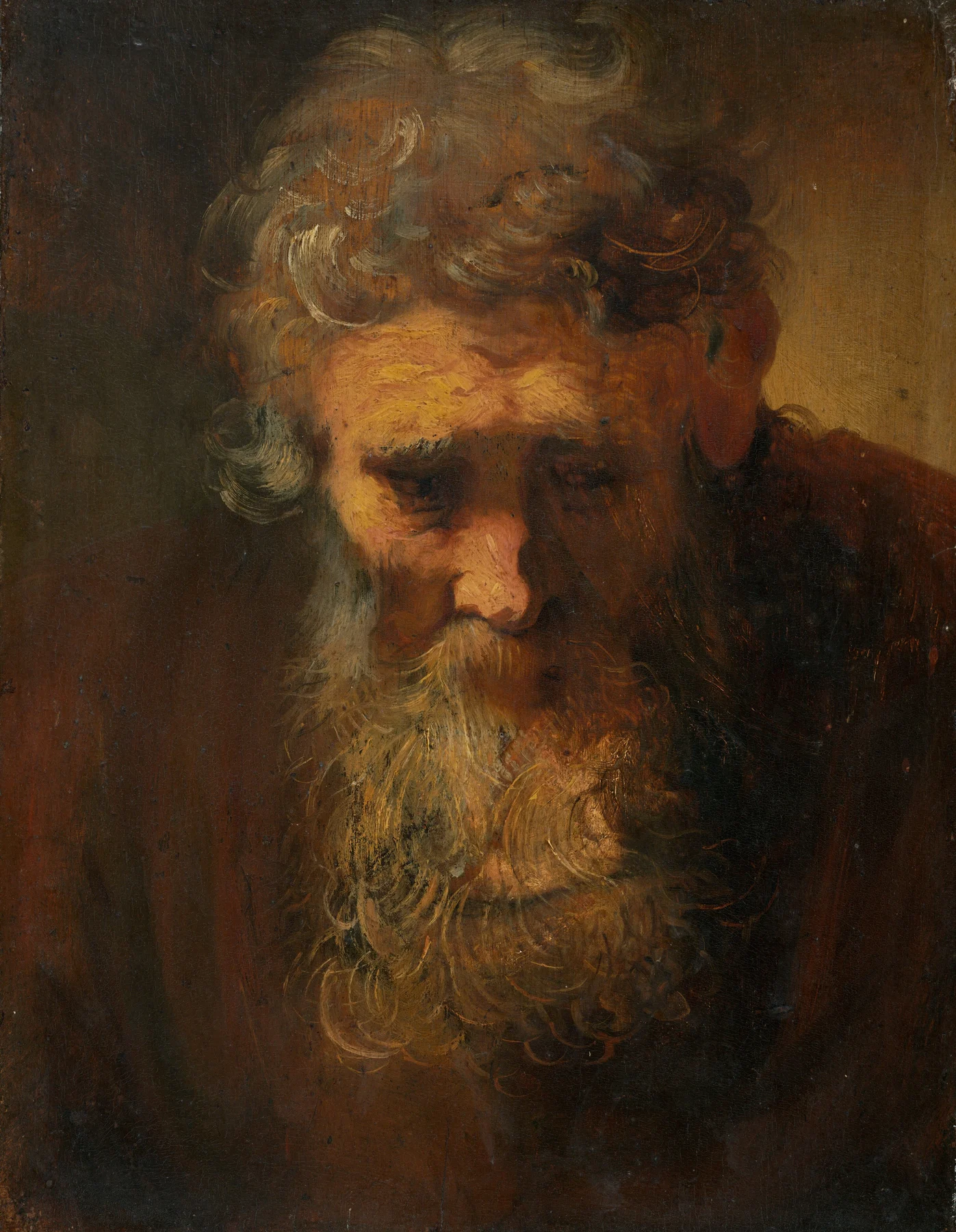
The panel entered the London market in 1905 as a Rembrandt. It passed to Peter A. B. Widener, remained in the family collection, and became part of the National Gallery of Art in 1942. The ownership path is short and comparatively stable. The attribution is not.
Early twentieth-century catalogues praised the head as a work by Rembrandt. Other scholars doubted, rejected, or omitted it. In 1984 the Gallery changed the attribution to “Style of Rembrandt.” The current object record identifies a follower of Rembrandt and dates the work probably to the late seventeenth century. X-radiography shows that the visible head was painted over an earlier profile on an old panel; the Gallery concludes that the present image was almost certainly made after Rembrandt’s death in emulation of his manner.
The panel did not leave the museum when the label changed. No restitution occurred. What changed was the institution’s public answer to “who made this?” and “when?”
The case prevents a common error: treating attribution and ownership as one credibility package. A documented provenance does not guarantee an attribution. A revised attribution does not automatically invalidate every custody event. Track the histories separately, then ask where they inform one another.
Attribution is an argument about making
Attribution assigns a work to a maker, workshop, culture, place, or period at a stated level of confidence. It can rest on several kinds of evidence:
- signed or inscribed names, tested for date and relation to the object;
- archival descriptions, commissions, inventories, letters, or photographs;
- secure provenance linking the object to a maker or early owner;
- material and technical evidence: support, ground, pigment, alloy, tool mark, weave, paper, watermark, underdrawing, or construction;
- comparison with works whose authorship is better established;
- workshop practice, collaboration, repetition, copying, and later emulation;
- named scholarly judgment.
Terms such as “by,” “attributed to,” “workshop of,” “circle of,” “follower of,” “after,” and “style of” are not decorative hedges. Institutions define them differently, but each signals a claim about participation, proximity, date, or dependence. Preserve the exact institutional wording and review date.
Technical analysis is powerful and bounded. A pigment introduced after an artist’s death can disprove an early date. Materials consistent with a workshop do not necessarily identify one hand. X-radiography can reveal another composition without naming its painter. Style is also evidence, but it becomes stronger when the comparison set and criteria are visible.
Write “the Gallery attributes” rather than “it is” when the distinction matters. Name who made the current judgment and what evidence the record publishes.
Read gaps as questions, not verdicts
A gap is an interval for which the researcher has not found adequate evidence. It is not automatically evidence of theft, innocence, forgery, concealment, or lawful export.
Classify the gap:
| Gap type | Question to pursue |
|---|---|
| Owner known, transfer unknown | Was it sale, inheritance, seizure, gift, deposit, or consignment? |
| Place known, holder unknown | Which archive, directory, exhibition, dealer stock book, or photograph may identify the person? |
| Holder known, dates broad | What is the earliest and latest documented sighting? |
| Market appearance with no earlier record | Was it recently excavated, rediscovered, reattributed, or simply unpublished? |
| “Private collection” | Is anonymity documented, and does the source establish country and date? |
| Wartime or colonial interval | What coercive institutions, military events, emergency laws, or unequal conditions shaped transfer? |
| Findspot missing | Was archaeological context never recorded, destroyed, withheld, or still held in an excavation archive? |
Use square brackets or notes to mark uncertainty. Do not silently stretch one person’s ownership to cover an empty decade. “By 1936” is not “from 1929 to 1936.” “After 1946” is not a transfer date.
Negative evidence must also be bounded. Failure to find an object in one digitized database may reflect spelling, cataloguing, incomplete digitization, or a different identifier. State where you searched, on what date, under which variants.
Build an event ledger
A source map tells you where evidence lives. An event ledger forces you to state what each source supports.
| Event ID | Date or range | Actor and role | Action | Object identifier | Place | Evidence | Status |
|---|---|---|---|---|---|---|---|
| E01 | ca. 1540–70 | Court guild artists | made plaque | Met 1978.412.309 | Benin City | object record; material study | institution’s current attribution |
| E02 | 1897 | British military force | invaded and plundered palace | ensemble, not yet exact Met number | Benin City | military and museum histories | documented event; exact object path requires separate evidence |
| E03 | 1946-07-11 | Allied/French authorities | restituted Fantin-Latour painting to France | Munich card 181/6 | Munich/France | collecting-point card; receipt | documented |
| E04 | 1946-09 | French authorities/David-Weill family | returned painting to family | NGA 1995.47.9 | France | government correspondence | documented in NGA file |
| E05 | 1984 | National Gallery of Art | changed attribution | NGA 1942.9.63 | Washington | catalogue and technical research | institutional decision |
The second row models restraint. The 1897 plunder of the palace is documented, but linking one specific plaque’s every step to today’s accession number demands object-level evidence. An ensemble history may establish the rupture while the individual market path remains incomplete.
Give each event one main verb. If one source documents several actions, split them into rows. Then your prose can cite the exact event rather than gesturing toward “the provenance.”
Evidence hierarchy by claim
There is no universal source ranking. Authority depends on the claim.
Object identity and current catalogue status
Start with the holding institution’s live record and accession file. Confirm title variants, dimensions, image, number, maker line, and update date. Then test consequential claims against the cited scholarship or archive.
Transfer and ownership
Prioritize deeds, probate files, invoices, correspondence, stock books, auction catalogues, customs documents, accession registers, seizure lists, collecting-point cards, court records, and signed agreements. A later catalogue may summarize them; follow its notes.
Archaeological context
Use field notebooks, excavation reports, permits, photographs, locus records, site inventories, and relevant local heritage authorities. A dealer’s country label is not a findspot.
Attribution
Use the object, conservation and scientific reports, inscriptions, archival documentation, catalogue raisonné research, and named specialist scholarship. Record disagreement and the date of each opinion.
Community meaning and authority
Use named community representatives, cultural authorities, knowledge holders, artists, local scholars, institutional consultation records, and sources produced in relevant languages and places. Do not ask a colonial catalogue to be the sole authority on a living cultural relationship.
Legal status
Use statutes, treaties, ratification and implementation records, judgments, official claims, contracts, and specialist legal analysis tied to the relevant jurisdiction. Museum ethics codes are important; they are not statutes.
Rights in the image file
Use the source institution’s rights statement for the exact digital asset. Copyright in the depicted artwork, rights in the photograph or scan, contractual access conditions, cultural sensitivities, and permission to reproduce are related but separate questions.
Legal thresholds and ethical thresholds differ
The 1970 UNESCO Convention was adopted on 14 November 1970 and entered into force on 24 April 1972. It requires state cooperation against illicit import, export, and transfer within its treaty framework. Its application depends on state participation, dates, national implementation, the category of property, and the facts of the case. It is not a universal retroactive switch declaring every object removed before 1970 legally returnable.
The 1995 UNIDROIT Convention addresses private-law claims for stolen or illegally exported cultural objects among contracting states. It requires return of a stolen cultural object within its scope and sets due-diligence and limitation rules. Its temporal provisions are prospective, while expressly leaving other available remedies for earlier events untouched.
The ICOM Code of Ethics for Museums sets professional standards concerning acquisition, due diligence, provenance, return, and restitution. An institution’s own policy can establish additional ethical grounds for action, as the Smithsonian example shows.
Therefore ask two separate questions:
- What legal claim or duty is available in the relevant forum under the law applicable to these facts?
- What ethical responsibilities has the institution recognized, even where litigation is unavailable, time-barred, uncertain, or inappropriate?
This chapter is a research method, not legal advice. Never infer a legal conclusion from a historical wrong alone, and never use the absence of a simple legal route to claim that no ethical responsibility exists.
Dates are filters, not universal verdicts
Certain dates help researchers triage records: 1897 for the invasion of Benin City, 1933–1945 for Nazi persecution and war, 1970 for the UNESCO Convention’s adoption, 1995 for UNIDROIT, 1998 for the Washington Principles. None is a universal moral or legal cut-off.
For each date, ask:
- What happened on that date: an event, adoption, entry into force, ratification, implementation, acquisition-policy threshold, or research convention?
- Which country, institution, object category, and claim does it govern?
- Is the date used as a legal rule, a due-diligence signal, or an ethical collecting standard?
- Does another law, policy, agreement, or remedy apply?
A museum acquisition policy may ask for documentation showing an archaeological object was outside its country of modern discovery before 1970. That is a risk-control standard, not proof that every pre-1970 removal was fair or every post-1970 object illicit.
Write the rule and its source beside the date. A naked year should never decide the paragraph.
Community authority and future custody
An object-history project should not end when it identifies a previous owner. It must also ask who has authority and responsibility now.
Possible parties include individuals and heirs, states, Indigenous nations, royal courts, religious institutions, municipalities, museums, archaeological services, source communities, artists’ estates, and custodial families. Their claims may overlap or conflict. The researcher should not erase those differences under “country of origin.”
Consultation must affect the record. It may change a title, restrict the display of culturally sensitive material, add a community name, identify care obligations, recognize that an object is living or sacred, or shape an agreement about access and movement. It can also reveal disagreement within a community. Do not invent unanimity.
Future custody offers more than two possibilities. Transfer of title, physical return, renewable loan, joint research, rotating display, digital access, community-controlled knowledge, shared conservation, and restrictions on reproduction can be combined. The exact agreement matters more than the label “partnership.”
Transparency has a limit: publication should not expose sacred knowledge, precise vulnerable-site locations, private claimant data, security details, or information restricted through legitimate community protocols. Record why access is bounded without using confidentiality to hide the institution’s own decision-making.
Common failure modes
Treating absence as exoneration or conviction
“No proof of theft” and “no proof of lawful sale” can both be true. State the gap and the searches performed.
Giving an ensemble history to a specific object
An event may explain how a group was dispersed without documenting the exact route of one accession number. Label the level of inference.
Calling every transfer a sale
Seizure, forced sale, gift, consignment, deposit, inheritance, export, restitution, and loan have different evidential and ethical implications.
Using present possession as proof of title
A borrower possesses an object. A custodian cares for it. Neither condition alone establishes ownership.
Treating a return announcement as the full agreement
Find the decision, deed, recipient, object list, handover record, and any subsequent loan.
Flattening claimants into nations
Identify the state agency, family, Indigenous nation, royal authority, religious body, or community actually involved.
Freezing the latest attribution
Record qualifiers, responsible institution or scholar, evidence, and review date. A current catalogue line is a dated conclusion.
Confusing artwork rights with image rights
A centuries-old object may be in the public domain while a particular photograph is restricted. Conversely, an open-data record may not grant reuse of every image.
Performing false balance
Do not weaken documented plunder into “contested acquisition” merely because a present holder prefers softer language. Precision includes naming coercion when the evidence establishes it.
A reusable object-history worksheet
Identity block
- current title and every relevant variant;
- maker or culture line with qualifiers;
- material, dimensions, date, and inscriptions;
- accession, inventory, excavation, catalogue, and database numbers;
- current custodian, owner if different, and canonical record;
- exact image source, rights statement, and access date.
Context block
- original or earliest documented function;
- archaeological provenience or original architectural/ritual ensemble;
- maker, workshop, patron, community, and cultural authority;
- what was separated, altered, restored, or lost.
Event ledger
- one row per action;
- earliest/latest dates;
- actor and role;
- place and jurisdiction;
- transfer mode;
- source and archival identifier;
- status: documented, reported, inferred, disputed, unknown.
Attribution history
- exact label and date for each attribution;
- scholar or institution responsible;
- documentary, stylistic, and technical basis;
- published objections;
- evidence that could change the conclusion.
Claims and disposition
- claimant and authority asserted;
- object list and identifiers;
- requested remedy;
- legal basis, ethical policy, or negotiated framework;
- decision-maker;
- title transfer, physical transfer, loan, or other outcome;
- unresolved obligations and future review.
Publication check
- Are facts distinguished from institutional claims and your inference?
- Are violent or coercive events named when documented?
- Are uncertain dates and identities visibly qualified?
- Are living people, sensitive knowledge, and vulnerable sites protected?
- Can a reader follow every consequential claim to a source?
Practice task: audit one decade
Choose one object with a public museum record and a visible provenance gap or attribution change. Do not attempt its entire biography. Audit one decade.
- Freeze the identity using the accession number, dimensions, medium, and current image.
- Copy the institution’s provenance exactly, including brackets, question marks, and footnotes.
- Select a ten-year interval containing a transfer, gap, or contested attribution.
- Search title variants, owner names, dealer names, collection numbers, and photographs.
- Build at least five event-ledger rows. A row may state that an event remains unknown.
- Locate one primary or near-primary record and one named scholarly interpretation.
- Identify the relevant jurisdiction and any policy or legal framework without declaring a legal outcome you cannot support.
- Write 180–250 words separating custody, attribution, and claims.
End with two sentences: what is documented, and what remains necessary before a stronger claim can be made.
Do not choose an active claim involving private people if you cannot protect personal information or distinguish public evidence from allegation. Public museum cases with published records are safer learning material.
What a strong paragraph sounds like
The Metropolitan Museum of Art identifies Plaque with equestrian ọ́bà and attendants (1978.412.309) as a sixteenth-century work by the Benin court brass-casting guild. The Museum’s broader object history connects the palace plaques to the British invasion and plunder of Benin City in 1897, but the public page does not publish every transfer linking this specific plaque to its present accession number. It should therefore be discussed within the documented dispersal of the palace ensemble without borrowing the complete provenance of another plaque. In 2021 the Met transferred two different Benin plaques and an Ife head to Nigeria after joint research with the NCMM. That decision is evidence for those named works and for an institutional process; it does not show that every Benin object in the collection has the same custody record or present disposition.
The paragraph does four things. It anchors identity, names the documented historical event, marks the object-level gap, and distinguishes a related restitution decision from the illustrated plaque. It neither hides the violence nor claims evidence it does not have.
Use the same structure elsewhere:
- current identity and authority;
- event and evidence;
- limitation or disagreement;
- consequence for interpretation or action.
Terms for object histories
| Term | Working definition |
|---|---|
| Provenance | History of ownership, custody, transmission, and location; usage varies by discipline |
| Provenience | In much North American archaeology, the recorded findspot and three-dimensional context |
| Attribution | A reasoned assignment to a maker, workshop, culture, place, or period |
| Authentication | Evaluation of whether an object is what it is claimed to be; not identical to attribution |
| Custody | Physical care or possession, which may be separate from ownership |
| Title | Legal ownership under an applicable system of law |
| Claimant | A person or body asserting a legal, ethical, familial, cultural, religious, or custodial relationship |
| Deaccession | Formal removal from an institution’s accessioned collection under its governance |
| Restitution | Restoration following a wrongful or illicit loss, as defined in the relevant framework |
| Repatriation | Return to a country, people, Indigenous nation, community, or culturally affiliated authority |
| Return | Broad term for transfer back; specify title, possession, recipient, and authority |
| Spoliation | Despoiling or seizure, especially used for wartime and Nazi-era loss |
| Due diligence | Reasonable investigation before acquisition or transfer, defined by the applicable law or policy |
| Shared stewardship | Agreed distribution of care, access, interpretation, or authority; powers must be stated |
Source guide
Object records and institutional decisions
- The Metropolitan Museum of Art — Plaque with equestrian ọ́bà and attendants: current identity, measurements, open-access image, palace context, and institutional account of the 1897 dispersal.
- The Met and NCMM — Return of three works to Nigeria: exact works, collaborative research, and announced transfer.
- Smithsonian — Board vote to return 29 Benin works: deaccession authority and transfer-of-title resolution.
- Smithsonian — Transfer ceremony and loan: ownership transfer, physical handover, and continuing institutional relationship.
- National Gallery of Art — Fantin-Latour, Self-Portrait: object record, public-domain image, Nazi confiscation, collecting-point restitution, family return, and later custody.
- National Gallery of Art — Study of an Old Man: attribution history, X-radiographic evidence, provenance, and public-domain image.
Standards, law, and research infrastructure
- UNESCO — 1970 Convention text and status: treaty text, adoption, entry into force, parties, reservations, and declarations.
- UNIDROIT — 1995 Convention: stolen and illegally exported cultural objects, due diligence, claims, and temporal scope.
- ICOM — Code of Ethics for Museums: professional standards on acquisition, provenance, due diligence, return, and restitution.
- U.S. Department of State — Best Practices for the Washington Principles: 2024 guidance on transparency, coercion, and just and fair solutions.
- U.S. National Archives — International Resources for Holocaust-Era Assets Research: official research portal linking relevant archival institutions.
- Smithsonian Provenance: introductory method and the problem of incomplete ownership histories.
- Getty — Ownership/Collecting History: structured documentation categories for owners, agents, places, dates, transfers, and citations.
- Archaeological Institute of America — Glossary: provenance/provenience and archaeological-context terminology.
Named and locally grounded scholarship
- Peju Layiwola — “Making meaning from a fragmented past: 1897 and the creative process”: a Nigerian artist-art historian’s account of 1897, memory, artistic practice, and restitution.
- Peju Layiwola and Sola Olorunyomi, eds. — Benin1897.com: Art and the Restitution Question: Nigerian exhibition, colloquium, and publication record.
- Felwine Sarr and Bénédicte Savoy — The Restitution of African Cultural Heritage: the official 2018 report and its defined French policy context.
- National Gallery of Art — Issues of Attribution in the Rembrandt Workshop: named technical and art-historical method for workshop attribution and uncertainty.
Source and rights review completed 9 August 2026. Institutional records and legal or policy frameworks can change; check the live source, jurisdiction, and decision document before relying on them in a claim or acquisition.
Continue the Methods route
Begin with How to analyse a work of art when you need to separate observation from inference. Use How to research an artwork to build the source map behind the event ledger, and Who makes an art period? to test chronological labels and survival bias.
The next Methods chapter will turn from object histories to publication practice: how to cite an artwork, caption an image, identify an edition or state, separate the underlying work from its digital file, and record rights without claiming more permission than the source grants.
Editorial record
About this article
- Author
- Publisher
- GeMarkt
- Published
- Updated
- Reviewed
- Internal source & rights check. Conducted by GeMarkt Research Review. This is an internal editorial check—not independent peer review.
- Source standard
- Art history source standardPrioritises object records and research sources, distinguishes evidence from interpretation, and states material uncertainty.
Found a claim that needs checking? Report a factual error.