Art History · Learning chapter
Atlas II — Connected worlds · 3 of 10
Islamic worlds, c. 650–1250: word, geometry, object, building, and patronage
A five-object guide to how makers across Islamic worlds used word, geometry, light, figures, materials, and patronage without producing one style.


What we’ll look at
How did different Islamic societies use writing, geometry, light, and material?
The golden dome is the first thing a distant viewer notices. Below it, an octagonal wall carries blue, green, and white tiles; an arcade partly screens the building from the camera. The modern photograph makes the Dome of the Rock look visually complete. Historically, it is anything but simple.
The shrine was built in Jerusalem under the Umayyad caliph Abd al-Malik between 688 and 692. Its octagon, central dome, interior mosaic, marble, and bands of Arabic inscription assembled a new Islamic monument through forms and techniques already active in the late antique eastern Mediterranean. Yet much of the exterior visible today belongs to later campaigns. Ottoman tilework replaced earlier exterior mosaic, roofs and mosaics were repaired repeatedly, and the dome received its present gilded covering in the late twentieth century.
One building can therefore be early Islamic, Umayyad in patronage, late antique in technical inheritance, Ottoman and modern in visible fabric, sacred to Muslims, and entangled with Jewish and Christian histories. None of those descriptions cancels the others.
That complexity gives this guide its central question:
How did makers across Islamic worlds use word, geometry, light, luxury, and figures to organise belief and power—and why can no single style contain them?
Five works provide different answers. The Dome of the Rock surrounds a sacred centre with architecture, mosaic, and proclamation. A folio from the Blue Qur’an makes script into a measured field of gold on indigo. Córdoba’s congregational mosque turns reused columns and repeated arches into an expanding social space. A bowl probably made in Samarqand converts good wishes into ornament around food. A metal ewer attributed to Iran or Afghanistan covers a useful vessel with zodiac signs, planets, animals, and silver inlay.
Together they challenge three habits: treating “Islamic art” as one religious style, assuming that Islamic societies prohibited all figures, and reading ornament as decoration added after meaning. Word, pattern, material, use, and patronage were not separate layers. They made meaning together.
Why “Islamic worlds” is plural
“Islamic art” covers more than art made for worship. It includes Qur’an manuscripts and mosques, but also palaces, ceramics, textiles, metalwork, scientific instruments, and illustrated books. The Metropolitan Museum of Art’s account of the category therefore includes both sacred and nonreligious works from societies where Islam shaped political and cultural life.
The label is not a test of the maker’s or user’s faith. Muslim rulers governed populations that included Christians, Jews, Zoroastrians, and others. Workshops could cross confessional and linguistic boundaries. A Christian mason working for a Muslim patron, a ceramic vessel excavated in an Iranian city, and a Qur’an copied for recitation do not become equivalent because a museum places them in one department.
The plural worlds keeps differences visible. Between about 650 and 1250, authority moved among the Umayyads, Abbasids, rival caliphates, regional dynasties, courts, governors, and religious foundations. Arabic connected administration, scripture, scholarship, and trade without eliminating Persian, Greek, Coptic, Syriac, Hebrew, Berber languages, or local practices.
This route is deliberately selective. Its western point is Córdoba; its eastern objects are associated with Samarqand, Nishapur, Khurasan, or Herat. It cannot stand for the Arabian Peninsula, Fatimid Cairo, sub-Saharan Africa, Anatolia, the Indian Ocean, South Asia, or Southeast Asia. It also stops before the later Ottoman, Safavid, and Mughal empires, each of which requires its own historical frame.
The dates are working boundaries, not the birth and death of a style. Around 650 marks the generation after the first Islamic conquests. Around 1250 catches major changes in political power without implying that workshops, buildings, texts, or beliefs suddenly stopped. The objects themselves refuse a neat timeline: they were restored, excavated, collected, converted, dispersed, and reinterpreted long after their production.
The Dome of the Rock: a building argues through position
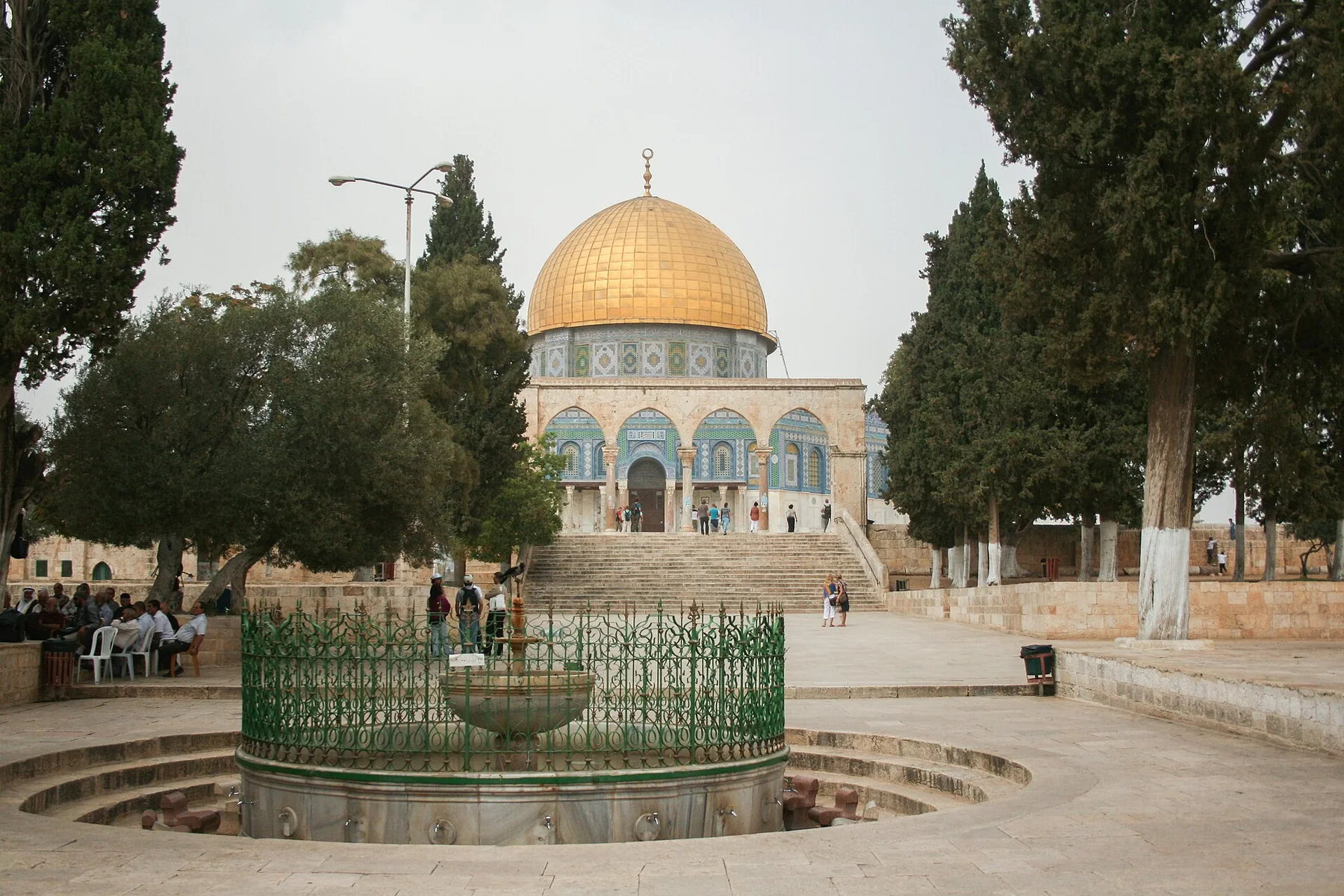
The Dome of the Rock is a shrine, not a congregational mosque. Its plan organises movement around a rock at the centre. An outer octagon encloses two concentric ambulatories; piers and columns support a circular drum and dome. The structure gives visitors more than a frontal façade. It makes a sacred centre approachable through repeated turning.
Abd al-Malik commissioned the building after decades of conquest and civil conflict had transformed the eastern Mediterranean. The Met’s study of the Umayyad period presents it as an early monumental statement of the new dynasty. Its intended first purpose remains debated. Scholars have connected it to pilgrimage, the sanctity of the rock, eschatological belief, imperial competition, and the declaration of Islam in a city dense with Jewish and Christian sacred histories. No surviving document reduces those possibilities to one motive.
The building’s location does political and religious work. It occupies the elevated enclosure known to Muslims as al-Haram al-Sharif and to Jews as the Temple Mount. The site holds different sacred memories and remains politically contested. An art-historical description should not turn living claims into picturesque background or use modern sovereignty to settle medieval meaning.
Inside, gold-ground mosaics show crowns, jewels, vessels, wings, vegetation, and architectural forms without a narrative procession of human figures. Their materials and techniques connect to Byzantine mosaic practice; some motifs also evoke Sasanian royal culture. “Influence” is too passive a word. Umayyad patrons and makers selected, relocated, and recombined visual resources in a new architectural and theological program.
Long Arabic inscriptions run through that program. They include Qur’anic passages and statements about God, prophecy, Jesus, and Muhammad. In a city where monumental Christian buildings proclaimed the divinity of Christ, the inscriptions articulate an Islamic account of revelation and divine unity. They also name Abd al-Malik’s patronage. Word is not a label attached to the architecture. Its scale, repetition, gold surface, location, and movement around the centre turn reading—or recognising scripture without reading every phrase—into a spatial experience.
Not every visitor could read the inscription fluently. That does not make it ineffective. Script could signal revelation, authority, and learned control while its exact wording addressed a more restricted audience. Meaning operated at several levels: legible proposition, recognisable sacred language, precious surface, measured rhythm, and dynastic commission.
The modern exterior photograph must be used carefully. Its blue tiles largely belong to Ottoman and later restoration; the gleaming dome is not a seventh-century skin. The image documents the shrine’s current layered appearance, not an untouched Umayyad original. The building’s endurance depends on change.
The Blue Qur’an: a page slows the eye
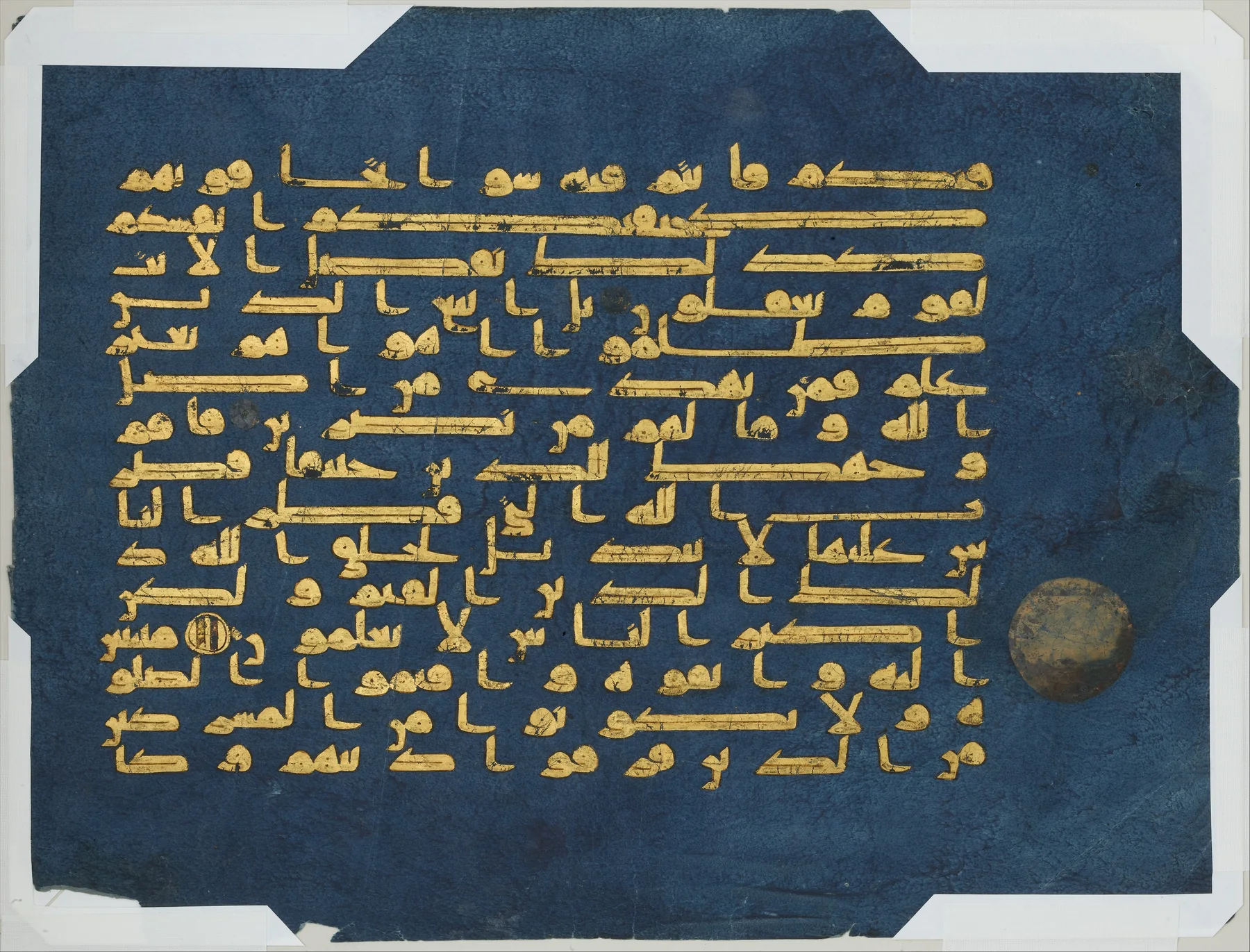
Fifteen lines of gold script cross a sheet of dark blue parchment. The letters are broad, angular, and strongly horizontal. Spaces expand and contract as the copyist balances words across the page. Short strokes lean into long gold bands; small signs hover above them. A circular marker near the lower edge once shone silver and has darkened with oxidation.
This is a folio from a dispersed manuscript known as the Blue Qur’an. The Met dates it from the second half of the ninth to the middle of the tenth century and places its making in Tunisia, possibly Qairawan. “Possibly” matters. The manuscript has also been associated with other western Islamic settings, and no secure colophon names its workshop or patron. Its modern leaves entered separate collections, so a whole book now has to be studied through fragments.
The materials made copying unusually demanding. Parchment was dyed indigo before gold lettering and silver markers were applied. The contrast reverses dark ink on a light support; gold appears and disappears as light changes.
The page displays Qur’anic language, yet visual splendour does not replace recitation. A manuscript could support reading, memorisation, teaching, donation, display, and ritual esteem. The angular script reduces many later reading aids and stretches letters into a highly controlled rhythm. A trained reader could move through the text, but the object also asks the eye to pause over proportion and interval.
The Met’s study of calligraphy in Islamic art distinguishes written content from the many visual jobs script could perform. That distinction is useful here. Calligraphy is not simply “beautiful writing,” and ornament is not the opposite of meaning. Changing a letter’s length changes the field through which sacred words are encountered.
The page also complicates luxury. Indigo, gold, silver, prepared animal skin, specialised labour, and a large format imply substantial resources. Their cost may indicate elite or institutional patronage, but it does not identify one patron. Nor does preciousness make the book merely decorative. Material expense could honour scripture, support a donation, make authority visible, and intensify sensory attention at once.
Modern display changes the work again. A museum frames one leaf behind glass, lit for conservation and detached from the sequence of a bound volume. Digital photography makes every gold letter equally visible on a screen. Neither encounter reproduces the pace of turning pages, the sound of recitation, the weight of a book, or the uneven reflection of metal in changing light.
Córdoba: architecture grows by repetition and interruption
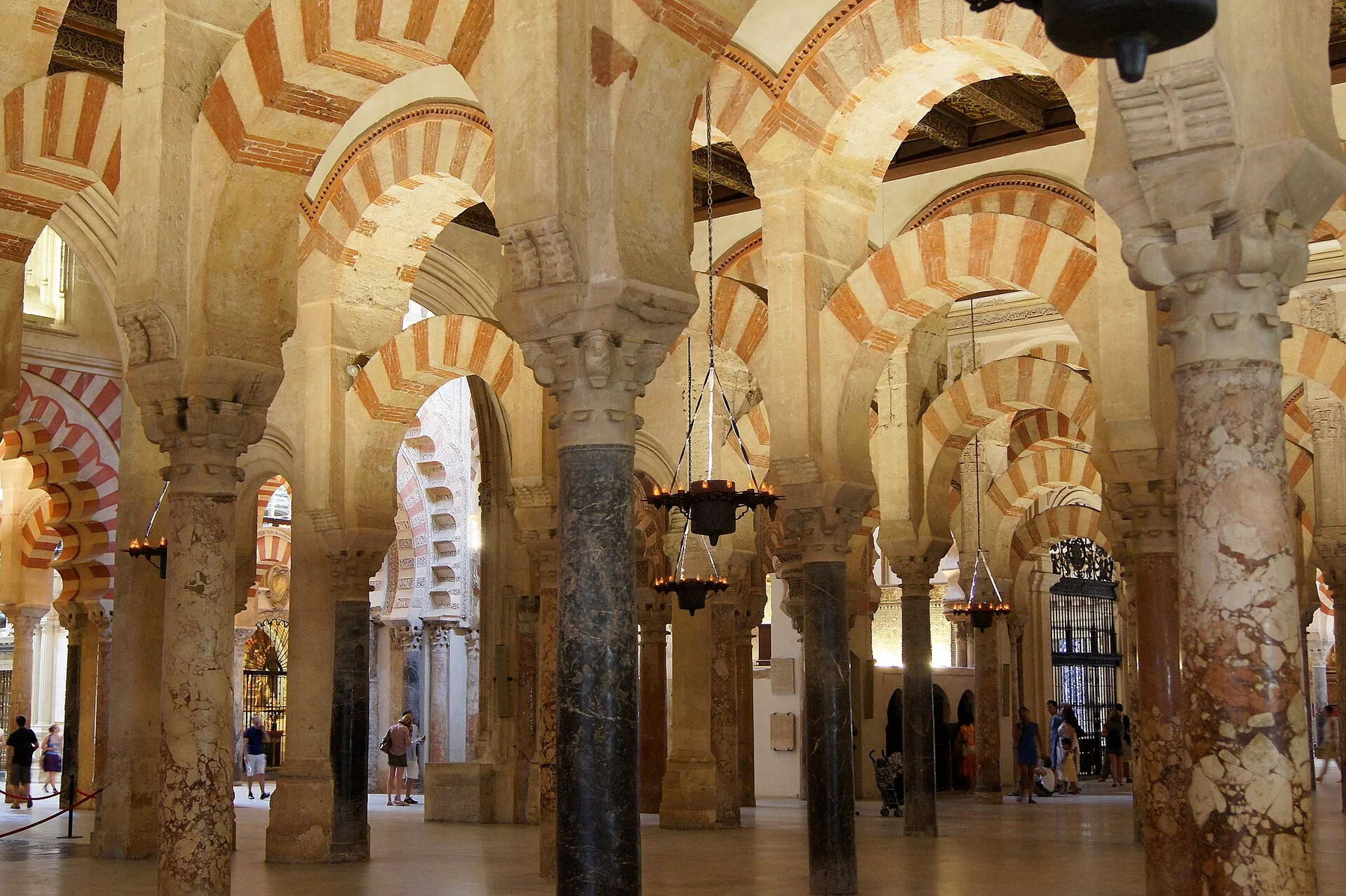

The photograph offers a forest of supports. Marble and stone shafts differ in colour and thickness. Capitals change from one column to the next. Above them, two levels of arches create height: lower horseshoe arches brace the supports while upper semicircular arches carry the roof system. Alternating pale stone and red brick make the structure legible as rhythm.
That rhythm did not appear all at once. Abd al-Rahman I, an Umayyad prince who established rule in al-Andalus after his dynasty lost power in Damascus, founded the congregational mosque in 786–788. The official Mosque-Cathedral history records major enlargements under Abd al-Rahman II in 833–848, Abd al-Rahman III’s minaret campaign in 951–952, al-Hakam II’s southward extension in 962–966, and al-Mansur’s eastward enlargement in 991–994.
Each campaign inherited constraints and created new centres. Repeated bays could absorb expansion, but repetition was not sameness. Al-Hakam II’s extension added a richly articulated maqsura, the protected zone associated with the ruler, and an elaborate mihrab area. Interlacing arches, ribbed domes, marble carving, and gold mosaic intensified the approach to the qibla wall. Architecture graded access and attention.
Many early columns and capitals were spolia—elements reused from Roman and Visigothic buildings—while later campaigns produced new pieces in related forms. Reuse saved material and labour, but economy is not the whole explanation. Different stones brought the region’s built past into a new congregational order. The uneven supports were made coherent by carefully adjusted impost blocks, arches, and roof levels.
The mosque was more than an image of dynastic power. It organised Friday prayer, teaching, social encounter, bodily alignment, sound, shade, and movement. The qibla oriented worship; the minbar supported the sermon. Political authority entered those practices through building campaigns and public words.
Córdoba also stood within networks rather than outside Europe. Builders worked with late Roman and Visigothic materials; horseshoe arches had earlier regional histories; carved stucco, ivory, textiles, manuscripts, and diplomatic gifts linked the Umayyad court to North Africa and the eastern Mediterranean. The mosaics near al-Hakam II’s mihrab relate to Byzantine techniques and court exchange. Such connections do not make Córdoba a copy of Damascus or Constantinople. Makers translated portable knowledge into local stone, scale, and politics.
After Christian forces took Córdoba in 1236, the building was consecrated as a Catholic church and later became a cathedral. Chapels, screens, furnishings, and burials altered its spaces. A major Renaissance choir and crossing intervention began in the sixteenth century. The UNESCO record treats this accumulation as part of the monument’s history, while its present institution identifies it as an active Catholic sacred space.
The photograph therefore does not show “the mosque in the eighth century.” It shows selected Islamic structural layers, later Christian use, modern conservation, lamps, barriers, and visitors at once. Nor should medieval Iberia be simplified into either perpetual conflict or perfect interfaith harmony. Muslims, Christians, and Jews lived within unequal and changing political orders; artisans and forms crossed boundaries without dissolving them.
A Samarqand bowl: good wishes enter the meal
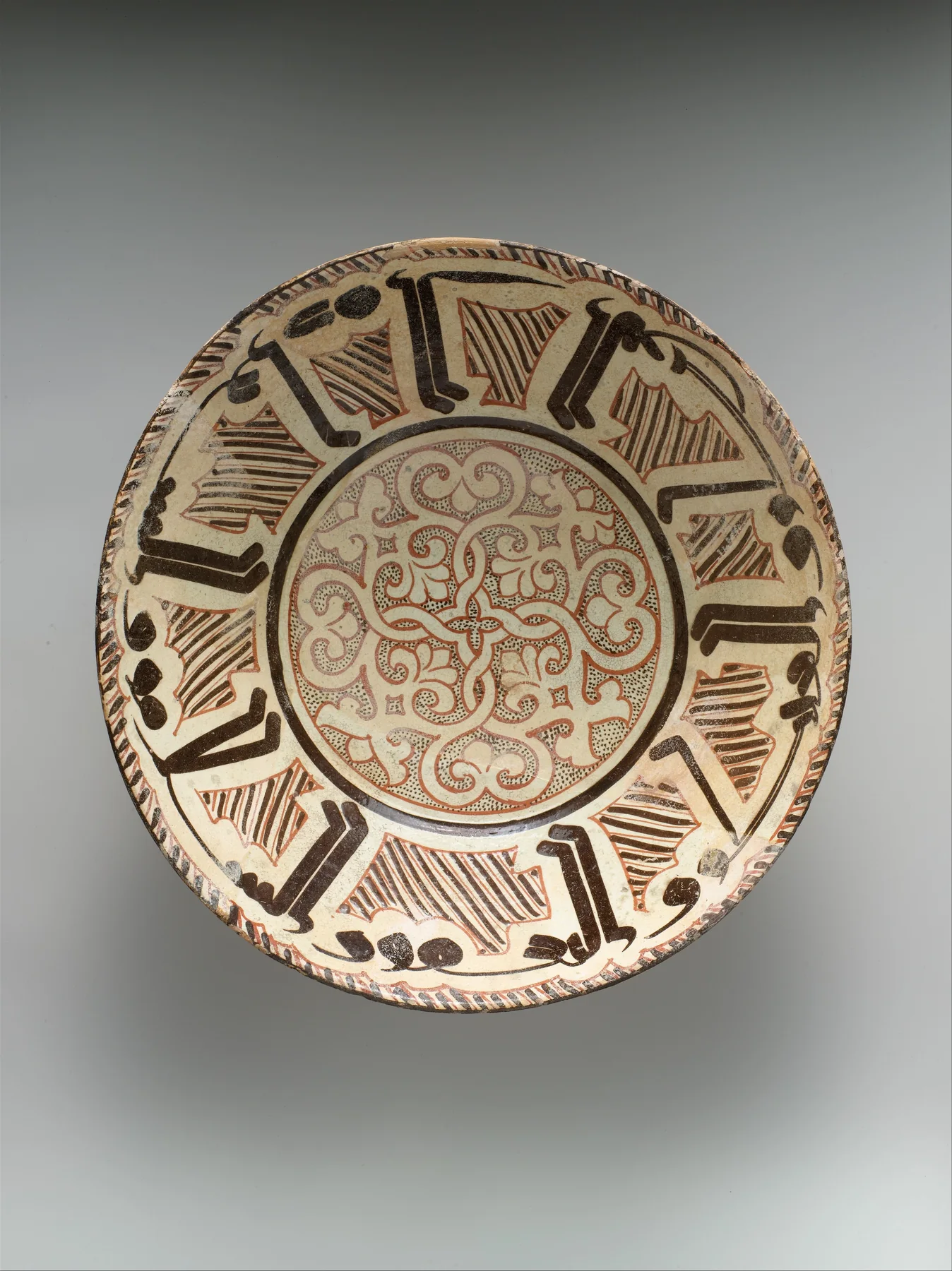
Large dark letters travel around the bowl’s rim. Between them, striped red forms tilt in the opposite direction. A fine border contains the movement; a red vegetal design fills the centre. From a distance the inscription can resemble a ring of abstract shapes. Read closely, it offers a sequence of wishes: “Blessing, Prosperity, Well-being, Happiness.”
This is not a Qur’anic quotation. Arabic script does not automatically make an object religious. The words belong to a broader culture of benediction, sociability, status, and exchange. A bowl could bring wishes for well-being into serving, eating, gifting, or display.
The vessel was formed in earthenware, covered with a pale slip, painted with darker and coloured slips, and sealed beneath a transparent glaze. That technique created a bright ground without the cost of porcelain. Potters working in Central Asian and Iranian centres developed many solutions for making ordinary clay carry sharp contrast, fluid marks, and durable surfaces.
The inscription is semantically generous and visually manipulated. The Met notes an extra al in its reading, probably inserted to sustain visual harmony. A letter can serve language and pattern at the same time. That dual action is not a defect in legibility; it is the design problem the maker solved.
At 35.6 centimetres across, the bowl could organise a shared field of food. Its message would be partly covered during use and revealed as the contents disappeared. Fingers, ladles, reflected liquid, conversation, and rotation would change which letters were visible. Museum display empties and fixes the vessel, allowing a viewer to see the whole inscription at once but removing the social event for which the form was made.
The provenance requires equal care. The Met catalogues the bowl as made in present-day Uzbekistan, probably Samarqand, yet records that it was excavated at Nishapur in present-day Iran. Place of production and place of recovery are not interchangeable. The distinction may indicate movement through trade or ownership, but one travelling bowl cannot map an entire commercial network.
Excavation is also a modern chapter in the object’s history. Archaeological context, division of finds, museum acquisition, and conservation determine what can now be known. A clean studio photograph can hide the fact that the vessel reached New York through twentieth-century systems of excavation and collecting.
A Khurasan ewer: the heavens cover a useful object
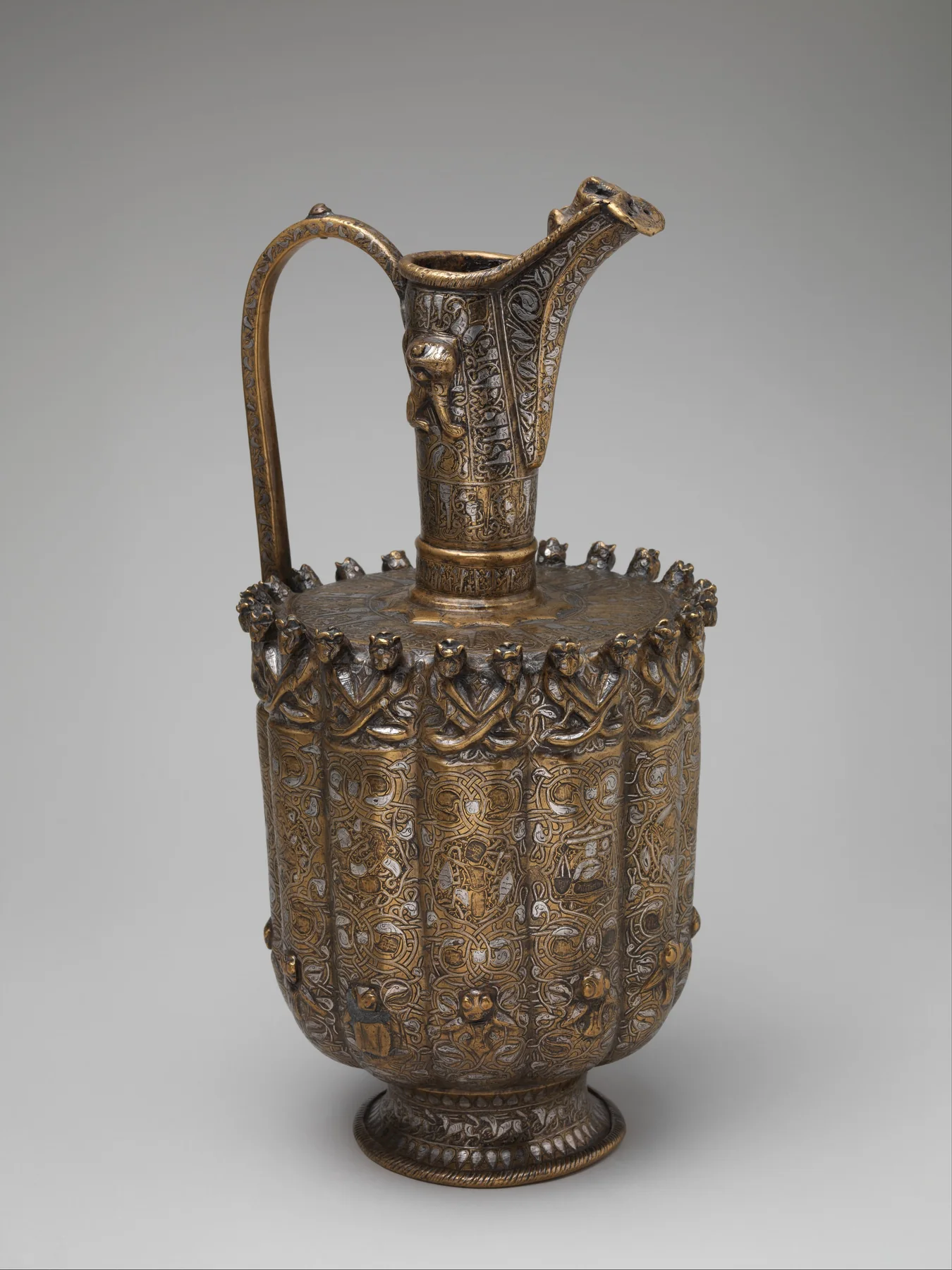
The ewer is a container with a handle and spout, but almost no surface remains visually idle. Silver lines brighten against brass and dark filling. Vines turn into animal heads; inscription bands circle the neck and body; seated figures and zodiac imagery occupy medallions. A row of projecting creatures marks the shoulder. The handle, spout, foot, and body are all brought into the ornamental system.
The Met dates it about 1180–1210 and attributes it broadly to Iran or Afghanistan, perhaps Khurasan or Herat. Those alternatives are evidence of uncertainty, not a menu from which to choose the most impressive city. The vessel has no secure maker’s signature, findspot, or documented first owner. Comparison with related metalwork supports the attribution, but the catalogue responsibly keeps its geography open.
Its base material is brass. Makers raised and worked the body, used repoussé to shape relief, cut channels into the surface, and hammered in silver and dark compound. The contrast would originally have been sharper. Production required coordinated knowledge of sheet metal, casting or attached elements, engraving, inlay, polishing, proportion, and iconography. “The artist” may conceal several specialised hands.
The imagery includes the signs of the zodiac with their ruling planets. In medieval Islamic courts and scholarly cultures, astronomy, astrology, calendars, medicine, and ideas of auspicious timing could overlap without being identical. The Met’s scholarly publication Following the Stars: Images of the Zodiac in Islamic Art places such objects within a long movement of celestial knowledge among Greek, West Asian, Persian, Indian, and Arabic traditions.
The figures give a direct answer to the claim that Islam simply banned images. Figural representation appears widely in secular and courtly metalwork, ceramics, manuscripts, textiles, and palaces. Restrictions and preferences varied by setting, medium, period, and community. A Qur’an manuscript, a mosque’s prayer space, and a luxury ewer were governed by different expectations.
The ewer does not prove unrestricted figuration everywhere. Its imagery belonged to a particular kind of object and probable elite environment. We do not know who handled it, what it poured, or how its astronomical program was explained.
What is clear is that use and cosmic imagery were made intimate. A person lifting the handle would rotate the heavens; liquid would pass through an animal-headed spout; reflected light would activate silver planets. The universe was not illustrated on a flat page and then attached to a vessel. Metal, motion, touch, and iconography made one experience.
Five works, five ways of making order
| Work | Organising device | Likely encounter | Patronage or authority | What it cannot prove |
|---|---|---|---|---|
| Dome of the Rock | Centralised plan, encircling movement, mosaic, monumental inscription | Movement around a sacred rock; recognition and reading at different levels | Umayyad caliphal patronage in a city shared by several sacred histories | One uncontested original purpose, an untouched seventh-century exterior, or a complete policy on figures |
| Blue Qur’an folio | Gold script, indigo ground, measured line and interval | Recitation, reading, memorisation, donation, display | Expensive materials imply substantial resources, but no named patron survives | A secure city of production, one mode of use, or the appearance of the complete manuscript |
| Great Mosque of Córdoba | Repeated columns and double arches, directional prayer space, graded enrichment | Congregational prayer, teaching, sermon, movement, later Christian worship | Successive Umayyad rulers and later Catholic institutions reshaped the site | A single construction date, an untouched mosque interior, or effortless interfaith harmony |
| Inscription bowl | Benediction stretched into a circular rhythm | Serving, eating, gifting, display | Prosperity is addressed through a useful ceramic; first owner unknown | That Arabic text is necessarily Qur’anic or that excavation place equals production place |
| Zodiac ewer | Silver inlay, figures, celestial signs, animated handle and spout | Pouring, hospitality, elite display, learned conversation | Costly specialised labour and auspicious imagery suggest privilege; patron unknown | Universal freedom from image restrictions, a precise workshop, or a documented first use |
The category becomes more precise when turned into verbs. The Dome of the Rock centres and proclaims. The Blue Qur’an paces and honours. Córdoba repeats and ranks. The bowl blesses and circulates. The ewer animates and augurs.
No one verb defines Islamic art. The comparison instead reveals recurring problems: how to give word a body, how to organise repeated form, how to make material carry authority, and how to address viewers with different kinds of knowledge.
Geometry was a practice, not a disembodied code
Geometric pattern is often praised as timeless mathematics. The phrase hides work.
A circle may be drawn with a compass; a square may be rotated; a grid may generate stars and polygons. Yet a design has to enter a material. A mosaicist cuts tesserae. A carpenter joins pieces under structural pressure. A potter turns a curved vessel while judging slip and firing. A metalworker cuts channels that must hold silver. Small errors behave differently in each medium.
The Met’s teaching study Islamic Art and Geometric Design demonstrates how circles, squares, radial divisions, and grids can generate complex designs. It also places basic forms within older Mediterranean and West Asian traditions. Muslim makers did not invent geometry from nothing, and a repeated star is not proof that a specific mathematician instructed a specific workshop.
Geometry could support several ends. It could extend a surface beyond one focal figure, coordinate mismatched architectural parts, stage controlled variation, display virtuosity, frame text, or direct movement. Repetition can imply continuity, but it can also mark hierarchy when one zone becomes denser, more colourful, or more costly than another.
“Infinite pattern” is therefore an interpretation, not a universal medieval statement. Some designs invite continuation beyond the frame; others terminate decisively at borders, inscriptions, or architectural joints. Begin with what the pattern physically does before turning it into a philosophy.
Ornament did not arrive after meaning
Modern speech often uses “ornamental” to mean optional. These works show another arrangement.
On the Blue Qur’an page, extending a letter changes reading pace and visual balance. On the bowl, adding a syllable helps maintain the circular sequence. On the ewer, vines connect figures to the vessel’s contours. In Córdoba, alternating voussoirs reveal structural rhythm while producing colour. At the Dome of the Rock, vegetal mosaics and inscriptions differentiate zones and bind a visitor’s movement to the building.
Ornament can perform at least four jobs simultaneously:
- Articulation: showing where an edge, bay, neck, rim, or sacred zone begins.
- Attention: slowing the eye, intensifying a centre, or distributing focus across a field.
- Association: linking a patron to luxury, scripture, court culture, blessing, or cosmic order.
- Transformation: making clay resemble a brilliant pale surface, turning brass into a field of silver light, or making architecture appear less heavy.
The term arabesque is useful for certain scrolling vegetal systems, but it should not become a label for every non-figural Islamic pattern. Vegetal scrolls existed before Islam and took many regional forms afterward. Nor should calligraphy, geometry, and vegetal ornament be treated as sealed categories. They interlace, imitate one another, and compete for the same surface.
Sacred and secular were different, but not sealed
The Qur’an folio and congregational mosque had explicit religious functions. The bowl and ewer were useful objects whose inscriptions and celestial imagery could carry ethical, auspicious, learned, or social meanings. The Dome of the Rock joined shrine, scripture, sacred place, and caliphal authority.
Calling the first group sacred and the second secular clarifies something, but not everything. A ruler’s gift to a mosque could be devotional and political. A blessing on a dining bowl could use religious language in ordinary life. Astrology could be scholarly, practical, controversial, entertaining, or courtly depending on its claim and audience. Precious vessels might move through inheritance, donation, trade, and reuse.
Context sets expectations. Figural imagery that appeared on a palace wall or metal vessel need not appear in the same way beside a mosque’s mihrab or within a Qur’an. This is more historically useful than searching for a single rule that every Muslim patron and maker followed for six centuries across three continents.
It also keeps absence from becoming empty. A prayer hall without narrative figures may concentrate attention through architecture, script, light, sound, and bodily alignment. Non-figuration is a positive organisation of experience, not a failure to make pictures.
Patronage names power; labour reveals its limits
Abd al-Malik and the Umayyad rulers of Córdoba are named because chronicles, inscriptions, and monumental institutions preserve rulers. The makers of mosaic, parchment, pigment, brick, carved marble, ceramic, brass, and silver are far less visible.
Patronage supplied resources and could determine site, scale, program, access, and inscription. It did not mean that a ruler personally designed every arch or chose every line. Workshops carried procedures learned through apprenticeship. Administrators sourced materials. Labourers quarried, transported, fired, polished, scaffolded, repaired, and cleaned. Reciters, preachers, servants, and worshippers completed an object’s social life after production.
Religious identity cannot be read directly from technique. A mosaic that uses Byzantine practice does not prove that every worker was sent from Constantinople or was Christian. Reused Visigothic material does not make Córdoba’s mosque Visigothic. A Persianate motif on an Umayyad monument is neither foreign contamination nor automatic evidence of peaceful exchange. Forms move through conquest, taxation, diplomacy, migration, enslavement, trade, gifts, and skilled employment.
Naming those routes changes the story. “Cultural exchange” can sound voluntary even when empire structured the choices. “Influence” can make one culture active and another passive. Ask instead: what moved, through whose labour, under what conditions, and who gained authority by relocating it?
Five shortcuts to refuse
“Islam forbids all images”
Practices varied. Qur’an manuscripts and many mosque contexts privileged word, geometry, vegetal form, and architecture, while figural imagery flourished in numerous palaces, manuscripts, textiles, ceramics, and metal objects. The zodiac ewer is not an exception that destroys a rule; it is evidence that the rule was badly framed.
“Arabic inscription means religious text”
Arabic carried scripture, poetry, ownership, signatures, dates, blessings, titles, and jokes. The Blue Qur’an transmits revelation; the Samarqand bowl offers prosperity and happiness. Read before classifying.
“Geometry is pure mathematics without history”
Geometric systems depended on tools, materials, training, cost, architectural joints, and regional practice. A drawn construction explains possible design logic, not the entire social meaning of a finished object.
“Every work reflects one unified Islamic civilisation”
Shared languages, beliefs, techniques, and trade mattered, but political borders, confessions, class, ecology, and local materials produced differences. Córdoba, Qairawan, Jerusalem, Nishapur, Samarqand, and Herat were connected without becoming interchangeable.
“A famous building is its first date”
The Dome of the Rock and Mosque-Cathedral of Córdoba are layered monuments. Later repair, conversion, conservation, and present worship affect what survives and how it can be seen. A modern photograph is evidence of that layered present.
A working timeline, c. 650–1250
- 661: The Umayyad dynasty establishes caliphal rule centred on Damascus.
- 688–692: Abd al-Malik commissions and completes the Dome of the Rock in Jerusalem.
- 711: Muslim-led forces enter the Iberian Peninsula; al-Andalus develops under changing governors and dynasties.
- 750: The Abbasids overthrow Umayyad rule in most of the caliphate and later establish Baghdad as their capital.
- 756: Abd al-Rahman I establishes an independent Umayyad emirate in al-Andalus.
- 786–788: Construction begins on the Great Mosque of Córdoba.
- 833–848: Abd al-Rahman II enlarges Córdoba’s mosque.
- Second half ninth–mid-tenth century: Probable production range of the Blue Qur’an.
- 929: Abd al-Rahman III declares a caliphate at Córdoba.
- 951–952: Córdoba’s mosque receives a new minaret under Abd al-Rahman III.
- 962–966: Al-Hakam II extends the mosque and develops its maqsura and mihrab zone.
- 991–994: Al-Mansur enlarges the building eastward.
- Late tenth–eleventh century: Probable production range of the inscription bowl associated with Samarqand and excavated at Nishapur.
- About 1180–1210: Probable production range of the zodiac ewer attributed to Iran or Afghanistan.
- 1236: Córdoba’s former congregational mosque is consecrated for Catholic worship.
- 1250: A useful stopping point for this route, not an end to Islamic art or its networks.
Terms for looking and reading
- Islamic art: A modern study category encompassing religious and non-religious works made in societies shaped by Islam; not a claim that every object, artist, or user was Muslim.
- Qur’an: Islam’s sacred scripture, understood by Muslims as revelation in Arabic. Manuscripts transmit its text but differ greatly in scale, script, material, and use.
- Calligraphy: Deliberately shaped writing. Its content, legibility, rhythm, scale, and placement all matter.
- Qibla: The direction of prayer toward the Kaaba in Mecca; in a mosque, the qibla wall helps organise worship.
- Mihrab: A niche or marked area in the qibla wall that indicates prayer direction; forms and meanings vary.
- Maqsura: A protected or distinguished area near the mihrab, often associated historically with a ruler.
- Hypostyle: A hall whose roof is supported by many columns or piers.
- Spolia: Architectural or sculptural elements reused from earlier structures.
- Slip: Liquid clay applied to a ceramic surface before firing, used to change colour or receive decoration.
- Inlay: Material set into a cut or prepared surface; the ewer uses silver and a dark compound in brass.
- Repoussé: Relief made by hammering metal, generally from the reverse.
- Aniconism: The avoidance or restriction of figural imagery in a particular context; not a universal synonym for Islamic art.
- Arabesque: A modern art-historical term often used for rhythmic vegetal scrolls; it should not cover every Islamic ornament.
Questions to carry to the next object
- Is the object religious, non-religious, or moving between those categories?
- What does its inscription actually say, and who could read it?
- How do scale, material, light, touch, or sound shape the encounter?
- Does pattern continue evenly, or does it create centres and hierarchies?
- Which parts were made together, reused, restored, or added later?
- Who is named as patron, and whose labour remains anonymous?
- Is a place of production secure, probable, attributed, or simply a findspot?
- What route carried the object, material, or technique—and was that route voluntary?
- What does the museum photograph clarify, and what use does it remove?
- Which broad claim does this particular work support, limit, or contradict?
Source guide
Begin with object and monument records, then use surveys to build comparisons.
- The Metropolitan Museum of Art: Dome of the Rock study, Umayyad period, Umayyad Spain, calligraphy, and the nature of Islamic art.
- The Met’s primary catalogue records for the Blue Qur’an folio, inscription bowl, and zodiac ewer supply dates, dimensions, materials, attributions, provenance, and Open Access images.
- The official Mosque-Cathedral history and UNESCO Córdoba record document the building’s successive Islamic and Christian campaigns.
- UNESCO’s Old City of Jerusalem record supplies protected-site context without resolving present political and religious claims.
- For comparison beyond these five works, the Met’s Abbasid period, Seljuqs of Iran, and artistic interaction in medieval Iberia introduce regional change without turning it into one stylistic march.
Continue the route
This article follows Byzantine worlds: icon, mosaic, liturgy, court, and contested visibility. Reading the two together makes shared late antique materials and rival religious claims visible without reducing Islamic art to an icon-free opposite of Byzantium.
For objects moving between courts, monasteries, ports, and markets, continue with Art on the Silk Roads: objects, beliefs, materials, and movement.
The next chronological guide will turn to medieval European worlds: monastery, cathedral, pilgrimage, court, and town. It will ask how institutions organised labour and visibility across regions that were never culturally sealed from Byzantium or Islamic worlds.
One principle should remain: do not ask whether an object looks “Islamic” before asking what it was made to do. A category becomes useful only when it sends us back to a particular material, place, labour system, patron, and audience.
Editorial record
About this article
- Author
- Publisher
- GeMarkt
- Published
- Updated
- Reviewed
- Internal source & rights check. Conducted by GeMarkt Research Review. This is an internal editorial check—not independent peer review.
- Source standard
- Art history source standardPrioritises object records and research sources, distinguishes evidence from interpretation, and states material uncertainty.
Found a claim that needs checking? Report a factual error.