Art History · Learning chapter
Atlas V — Modernisms and contemporary practices · 1 of 10
European avant-gardes, c. 1900–1939: manifesto, machine, abstraction, war, and mass politics
Five object-led studies ask how manifestos, media, war, revolution, and repression shaped competing European avant-gardes.


What we’ll look at
How did avant-garde groups use art, media, and politics to claim the future?
The word future occupies only a small part of the newspaper page above. Horse racing, theatre, finance, parliamentary news, advertisements, and social notices continue around it. That setting is not incidental. Filippo Tommaso Marinetti did not merely write a declaration; he obtained space in an established Paris daily and made a new movement arrive as news.
The European avant-gardes repeatedly used this method. They named a group, announced a break, found a medium, staged an event, and recruited a public. Their claims were often larger than their organisations. Their politics were irreconcilable. Some celebrated violence and national power; some attached experiment to revolution; some attacked the culture that had produced war; others mobilised the same modern print networks for pacifism.
Avant-garde is a position, not one style
Avant-garde came from military language: a force placed ahead of the main body. In art history it describes artists and groups who claimed to move ahead of inherited institutions, media, and social arrangements. The term does not identify one appearance. A Futurist bronze, a nearly black painting, a Dada performance, a revolutionary lithograph, and an anti-war poster may all occupy that position while disagreeing about almost everything.
The useful question is therefore not “What does avant-garde art look like?” It is “How was the claim to be ahead made credible?” A movement needed names, allies, enemies, venues, publications, money, labour, and channels of repetition. Formal invention mattered, but so did publicity, translation, pedagogy, scandal, censorship, and later museum display.
Scope: five objects and an incomplete European map
This chapter follows five visual objects made between 1909 and 1924: the front page that published Marinetti’s Futurist manifesto; Umberto Boccioni’s Unique Forms of Continuity in Space; Kazimir Malevich’s first Black Square; El Lissitzky’s Beat the Whites with the Red Wedge; and Käthe Kollwitz’s Never Again War!. Dada enters through performances and publications whose dispersed archive resists reduction to one object.
This route is not a complete account of European modernism. It leaves major work by Expressionists, Cubists, Constructivists, Bauhaus makers, Surrealists, filmmakers, photographers, architects, dancers, textile artists, and many others for comparison elsewhere. It also does not make Europe self-sufficient. European movements worked through imperial cities and appropriated African, Oceanic, Asian, Islamic, and Indigenous forms under unequal conditions. The next Atlas chapter makes that asymmetry, too often hidden inside the word “influence,” its central problem.
New media made movements before style made consensus
The avant-gardes did not wait for stylistic agreement. Cheap print, illustrated newspapers, railways, postal systems, galleries, cafés, cabarets, artists’ books, lectures, and touring exhibitions allowed a few people to announce a collective identity. A manifesto could describe an art that had not yet been made. A journal could connect participants who lived in different cities. A photograph could circulate an exhibition that few had entered.
These networks created an important mismatch. Movements often appear coherent in textbooks because a name groups selected objects after the fact. In their own time, membership shifted, factions split, declarations contradicted practice, and identical geometric devices carried opposing meanings. Media could manufacture the impression of a united front before one existed.
Marinetti turned a newspaper front page into a launch mechanism
On 20 February 1909, Le Figaro printed Marinetti’s “Founding and Manifesto of Futurism” in French on its front page. The Bibliothèque nationale de France identifies three tall columns, eleven numbered points, and a vocabulary centred on speed, modernity, aggression, and change. The complete page shows that the declaration was embedded in a commercial information system rather than hovering outside ordinary life.
Marinetti had already circulated versions of the text in Italy, but publication in a prominent Paris newspaper gave the claim international visibility and cultural prestige. A literary movement acquired a memorable date. Typography, placement, translation, and the authority of the host newspaper all became part of the work’s effect.
The manifesto creates a future by inventing enemies
A manifesto speaks in the present tense as if its desired world has already arrived. It reduces uncertainty to commands, converts difference into membership, and makes hesitation appear obsolete. Marinetti’s text opposed museums, libraries, inherited beauty, moral caution, and the imagined passivity of the past. It offered youth, velocity, risk, machinery, and rupture as a new value system.
That rhetoric does more than describe taste. It divides time into living and dead zones, then gives the self-appointed vanguard authority to judge who belongs where. The genre’s clarity comes from exclusions. Futurism’s declared contempt for women cannot be repaired by treating its aggression as a harmless metaphor, even though women later participated in, revised, and contested Futurist practice.
Speed and violence were political choices
The manifesto admired racing vehicles, industrial force, crowds, danger, and war. These were not automatically modern values forced upon artists by new technology. They were selections. The same factories, trains, newspapers, and expanding cities could be interpreted through labour politics, pacifism, public health, domestic change, or environmental damage.
Futurist speed was attractive because it promised to dissolve distance between intention and action. But the fantasy also made friction, care, vulnerability, maintenance, and consequence look weak. Violence entered the movement’s programme as purification. When later Futurists campaigned for Italian entry into the First World War, they extended rather than betrayed a politics already present in the founding text.
A French newspaper internationalised an Italian claim
The page crosses several borders at once. An Italian poet used French language and Parisian media to announce a movement tied to Italian renewal. The international platform did not make the project politically cosmopolitan; it made nationalist ambition exportable. This is an early lesson in avant-garde geography: circulation and ideology do not have to point in the same direction.
The surviving scan also changes the object. Online, the front page becomes globally inspectable and searchable. Yet the low-contrast columns remind us that a historical newspaper was made to be handled at a particular scale, among other news, on a particular morning. Digital access expands the public while flattening paper, sequence, price, and the social routines of reading.
Boccioni made a body continuous with displaced air
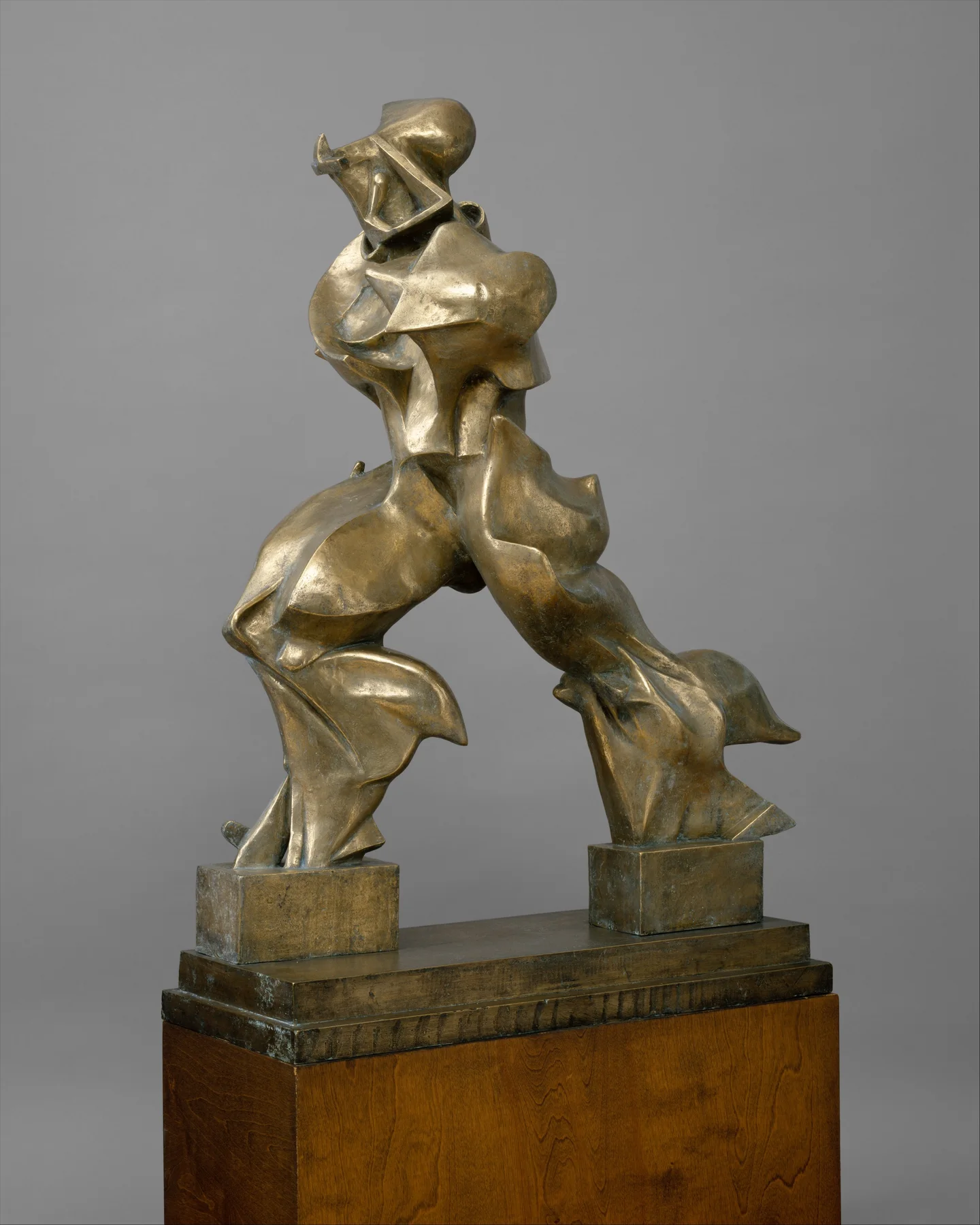
A figure advances, but anatomy will not hold still. Calves widen into flanges, shoulders open like armour, and the head loses an individual face. Concave hollows alternate with swelling volumes. Rather than place a solid body inside empty space, Boccioni joined the striding figure to the air it appears to displace.
The Met’s study of Boccioni explains this through his idea of “plastic dynamism”: relative motion between object and environment combined with an energy imagined as inherent in the object. The sculpture does not depict a sequence of separate poses. It tries to make one body contain movement’s continuity.
The machine body remains strangely manual
The figure is frequently called mechanical, but it is not a diagram of an actual machine. There are no functional joints, gears, pistons, or engine. Its mirrored bronze sheen and blade-like contours encourage mechanical association while the irregular surface, asymmetry, modelling, and muscular rhythm preserve the work of a hand shaping matter.
That tension is more useful than a simple label. Futurism wanted to remake human perception through industrial modernity, yet Boccioni’s sculpture depends on inherited sculptural problems: weight, balance, the freestanding body, the pedestal, and changing profiles as a viewer walks around it. The machine is an analogy used to reorganise the body, not a literal replacement for making.
A posthumous bronze contradicts the sculpture’s programme
The familiar museum object is not Boccioni’s 1913 plaster. The Met records its bronze as a 1950 cast, while its curatorial history explains that Boccioni’s surviving plasters were cast only after his death. Marinetti and later custodians sought durable versions. Met research on the casts notes the paradox: Boccioni had argued against bronze, yet metal replicas made the work transportable, collectible, and famous.
The contradiction is not a footnote to remove. It shows canon formation at work. Fragile plaster carried the first form; bronze supplied permanence and institutional circulation. Different casts have different dates, surfaces, bases, and genealogies. “The sculpture” is therefore a 1913 proposition encountered through later objects that partially violate it.
Futurism’s war did not remain a metaphor
Boccioni and fellow Futurists campaigned for Italian intervention in the First World War. After Italy entered in 1915, he volunteered. He died in 1916 following a fall during cavalry training. Biography does not make every projecting form in Unique Forms a weapon, but it prevents a neutral celebration of dynamism.
The figure’s anonymous masculinity, forward thrust, and armoured surfaces could embody a broad modern human or a narrower ideal of force. Viewers should keep both possibilities visible. Aesthetic energy does not prove fascism, yet neither should formal admiration erase Futurism’s militarism or Marinetti’s later political relationship to Italian Fascism.
Malevich put a black quadrilateral in an icon corner
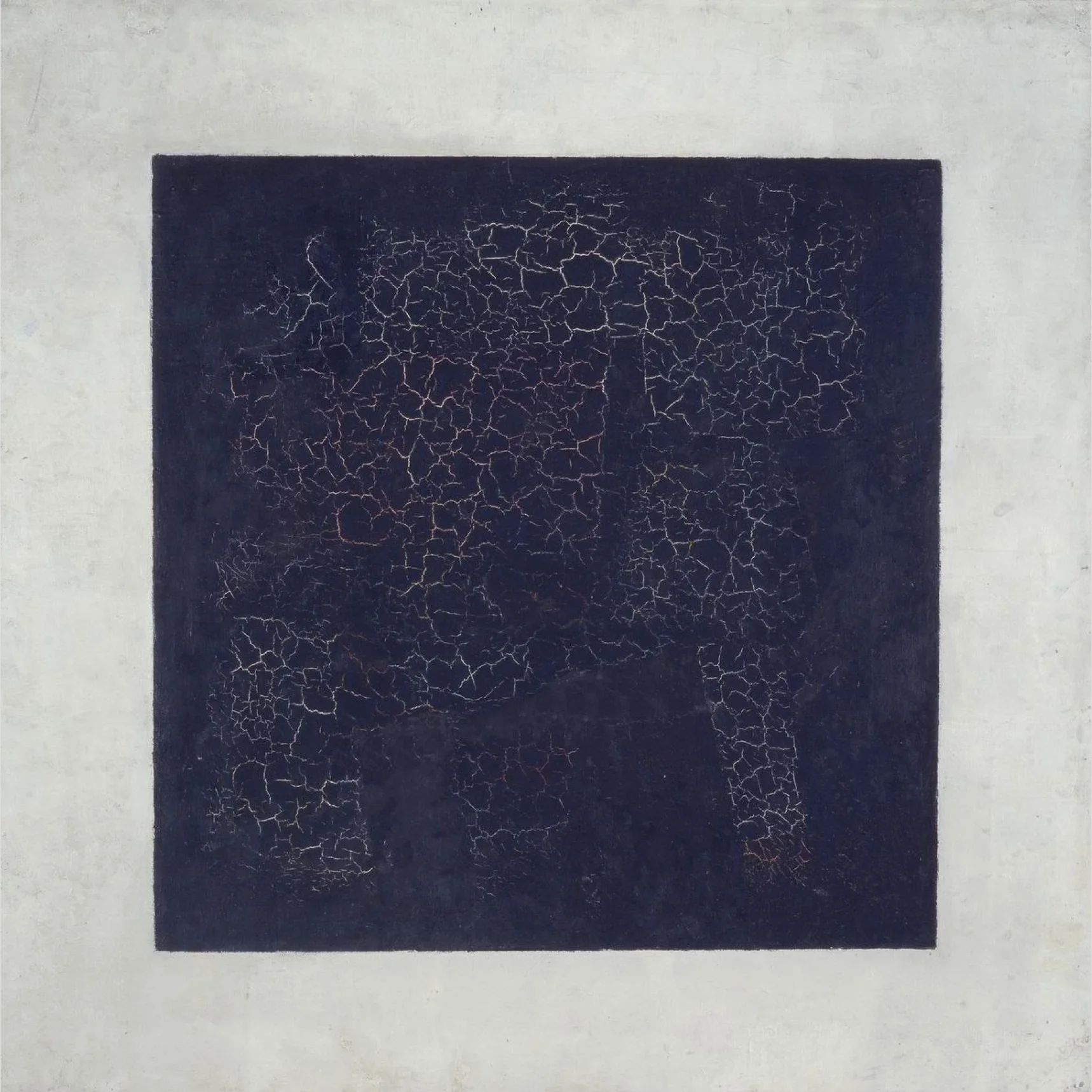

Malevich unveiled Black Square at the Last Futurist Exhibition of Paintings 0.10 in Petrograd in December 1915. Installation photographs show it high across a room corner, a place associated in Orthodox homes with devotional icons. The gesture did not simply replace religion with geometry. It borrowed a powerful spatial convention to demand that non-objective painting be encountered as a foundational presence.
The square is not mathematically exact. Its sides shift, the black is uneven, and a white margin separates it from the canvas edge. Calling it a quadrilateral restores the tension between a declared absolute and a visibly made object.
Black Square is paint, cracking surface, and repeated proposition
The reproduced image is often compressed into a perfect black icon on a clean screen. The painting itself resists that simplification. Its surface has developed an extensive network of cracks, with underlying layers visible in places. Age and material procedure have turned apparent reduction into dense physical information.
Malevich made later versions in 1924, 1929, and around the early 1930s. They are not interchangeable copies. Scale, paint, surface, date, and historical purpose differ. Repetition allowed the proposition to reappear when an earlier work was inaccessible or too fragile, but it also complicates the desire for one pure origin.
Non-objectivity did not mean no context
Malevich called his new mode Suprematism and rejected painting’s obligation to represent visible objects. At 0.10, coloured geometric forms floated on white grounds. MoMA’s account of the exhibition describes this abandonment of reference and Malevich’s claim that painting could work through its basic language—colour, line, form, and surface.
Non-objectivity did not remove institutions or politics. The exhibition had a city, organisers, rivals, a printed leaflet, and an audience during wartime. Malevich later taught in Vitebsk, and Suprematist signs entered books, ceramics, street decoration, and the collective work of UNOVIS. A form can avoid depicting an object while remaining embedded in social use.
“First abstraction” is the wrong question
Art-historical surveys sometimes turn abstraction into a race won by one European painting. That frame is unstable. Artists developed non-representational, non-objective, ornamental, diagrammatic, spiritual, and process-based forms through different traditions and at different dates. The categories do not perfectly coincide, and many cultures made images without naturalistic representation long before modernism.
Malevich’s importance does not require a universal first. The sharper claim is local and documented: Black Square anchored a public declaration of Suprematism in 1915, occupied a charged exhibition position, and generated a long programme of images, texts, teaching, and disputes.
Dada answered war with exile, performance, and contradiction
Dada emerged during the First World War through several centres rather than one headquarters. Zurich’s neutrality made it a gathering place for exiles; New York developed an independent point of origin; Berlin, Cologne, Hannover, and Paris produced distinct political and artistic configurations. MoMA’s Dada research describes an explicitly international network responding both to wartime disaster and to modern media and machine culture.
Cabaret Voltaire performances in Zurich combined sound poetry, music, masks, dance, recitation, costume, and provocation. Dadaists used nonsense not because nothing mattered, but because inherited claims to reason, civilisation, and cultural refinement appeared compromised by industrial slaughter. Yet “Dada” never settled into one anti-war doctrine. Its participants quarrelled, mocked their own categories, and moved between aesthetic revolt, political critique, and strategic publicity.
Cabaret, costume, sound, and gender complicate an object-only history
Performance leaves uneven evidence. A mask or photograph may survive while voice, timing, audience response, bodily risk, and collaborative labour disappear. Posters and journals can make the men who edited or signed declarations appear to have created an event alone. Sophie Taeuber-Arp’s dance, textile, beadwork, puppets, interiors, geometric works, and teaching expose the weakness of hierarchies that separate “fine art” from applied practice.
Later museums have helped reconstruct such careers, but the archive still rewards durable, ownable objects. This chapter therefore does not pretend that five images can contain Dada. The missing figure is deliberate: a rights-uncertain reproduction would not repair the larger problem of making ephemeral, collaborative work visible.
Lissitzky converted Suprematist geometry into a command
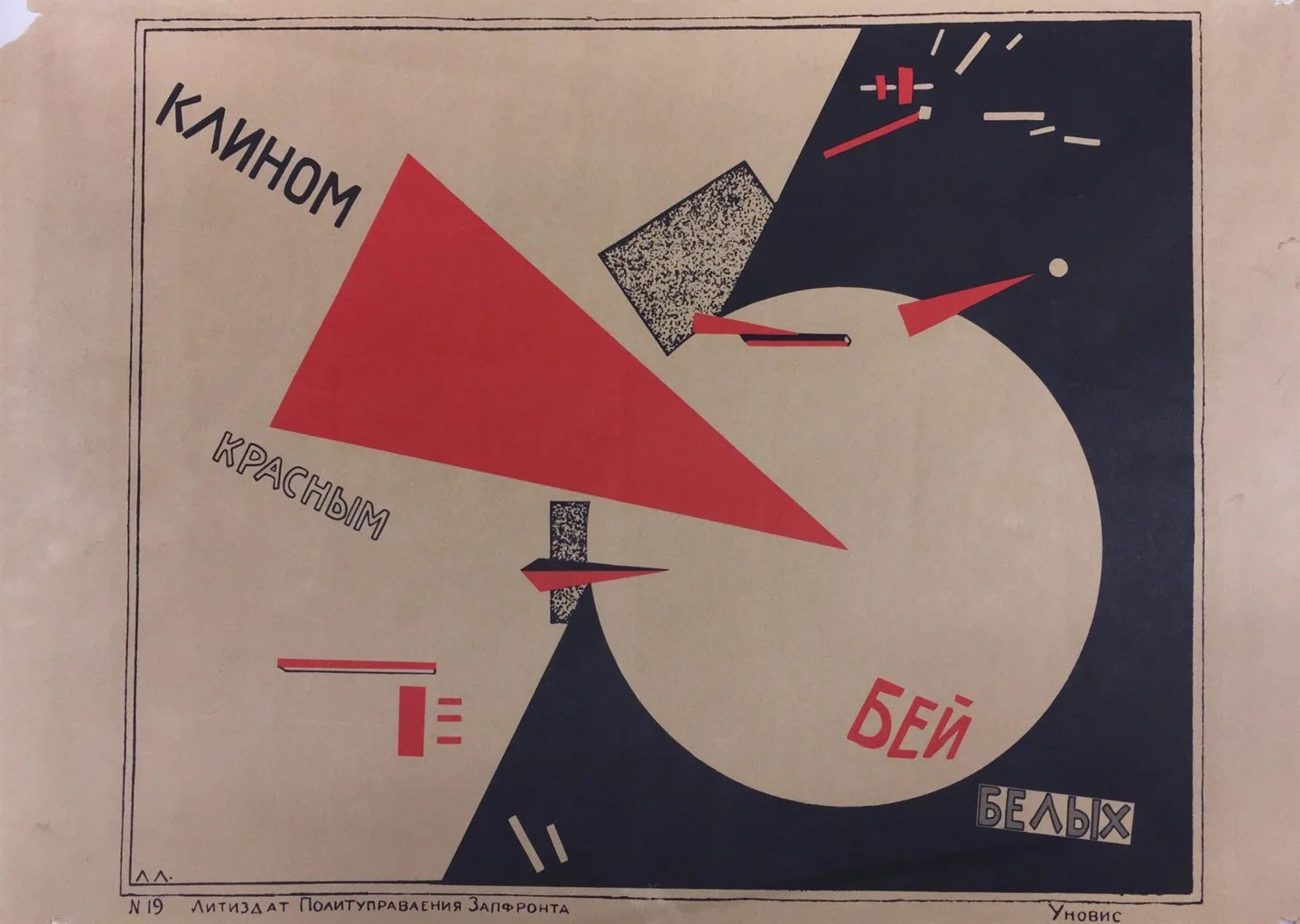

A red triangle penetrates a white circle. Smaller wedges, bars, and typographic fragments scatter around the collision. The composition turns Suprematist elements into actors: direction, colour, and impact make a political sentence visible before a reader translates every Cyrillic word.
The title identifies the forces. “Reds” refers to the Bolshevik side in the Russian Civil War; “Whites” groups its varied opponents. The Art Platform Japan record, based on data supplied by the Utsunomiya Museum of Art, identifies the work as a 1919 lithograph on paper. Medium matters: this was a reproducible graphic object, not a unique autonomous painting.
Red, white, type, and direction compress a civil war
The wedge gains force from asymmetry. Its narrow point concentrates energy against the circle, while the broad red base seems to continue beyond the page. The white circle is large but static, already breached. Black fields and small projectiles extend conflict through the surrounding space. Angled letters refuse calm horizontal reading.
This clarity is constructed, not discovered. The White movement was not one homogeneous body; the Civil War involved regional armies, foreign intervention, shifting alliances, anti-Bolshevik socialists, nationalist forces, peasant resistance, pogroms, famine, and mass civilian suffering. Geometry compresses that history into a desired outcome. Its efficiency is the point and the danger.
Propaganda is not the opposite of design
Calling the print propaganda should begin analysis, not end it. Propaganda identifies a goal, audience, and conflict; design supplies hierarchy, legibility, rhythm, memory, and reproducibility. The image persuades precisely because red, white, circle, wedge, border, and type have been organised with exceptional economy.
Nor is propaganda simply false information. The poster openly takes a side. Its more important operation is reduction: it turns a complex war into two visual forces and makes victory appear inherent in form. A close reading asks what the design enables viewers to grasp quickly, what action it solicits, and what histories it makes unnecessary to see.
Revolutionary institutions changed what an artist could be
Lissitzky trained in architecture and worked across Jewish book illustration, exhibition design, photography, typography, publishing, and teaching. In Vitebsk he joined Malevich and UNOVIS, where Suprematist forms moved beyond easel painting into collective signs and public commissions. His later Proun works tested a space between painting and architecture.
Revolutionary conditions opened roles for the artist as organiser, engineer, educator, and designer of public information. They also introduced new dependencies on state institutions and party priorities. The useful contrast is not free artist versus political designer. It is between changing systems of commission, collective identity, material production, distribution, and control.
Kollwitz made a raised hand carry a sentence
,_Plakat_%C2%BBNie_wieder_Krieg%C2%AB,_1924.jpg)
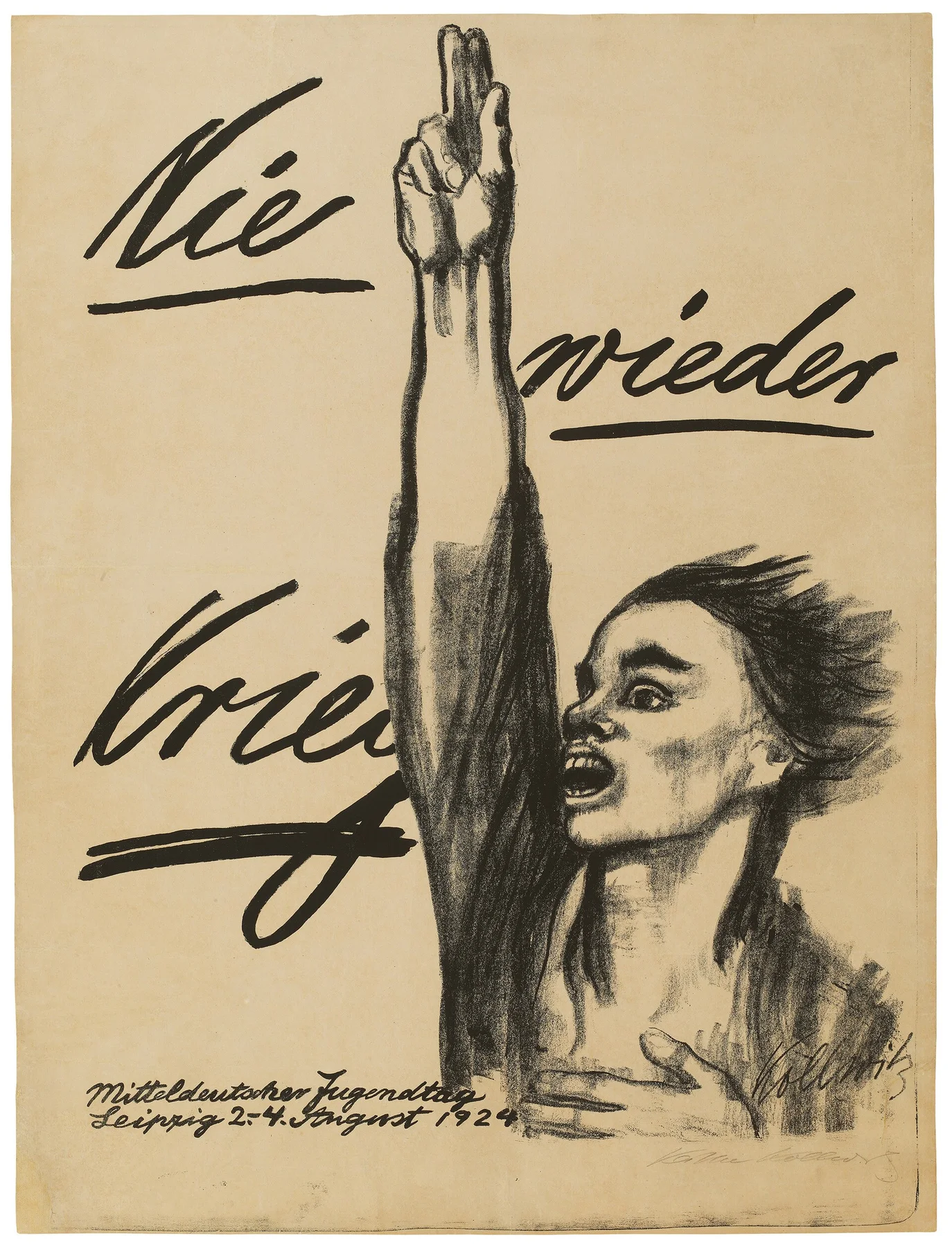
A young person’s open mouth turns the poster into imagined sound. One arm rises vertically through the composition; two extended fingers create an oath-like gesture. The words Nie wieder Krieg do not sit in a separate caption box. Large handwritten strokes cross the page and seem to pass behind the arm, joining voice, body, and slogan.
The Deutsches Historisches Museum records the work as a 1924 lithograph. Its cream ground and limited black drawing could be reproduced economically. Unlike Boccioni’s solitary forward body, this figure turns outward to address other people.
The poster addresses youth as political agents
Kollwitz designed the poster for the Central German Convention of Young Socialist Workers in Leipzig. The Kollwitz Museum Köln biography records that context and notes its later status as an icon of the peace movement. The small handwritten line at the bottom names the youth gathering and dates, 2–4 August 1924.
That inscription prevents the image from becoming a timeless symbol detached from organisation. It addressed a specific political youth public ten years after the First World War began. The raised hand does not merely express private anguish; it performs commitment before a collective.
Repetition served an anti-war public
Lithography allowed the design to travel beyond a single encounter. The image could be posted, carried, reproduced, and later reactivated in new peace campaigns. Its apparent spontaneity—a shout, a brushy line, handwriting—was therefore built for multiplication.
Repetition changes meaning. In 1924 the poster belonged to socialist youth organisation in the Weimar Republic. After another world war, it became a broader peace emblem. Museums, textbooks, demonstrations, postcards, and digital files have continued the work, sometimes preserving the original commission and sometimes smoothing it into universal moral appeal.
Grief became public action without becoming neutral
Kollwitz’s younger son Peter died as a German volunteer in Belgium in 1914. Her sustained work on mourning, hunger, workers, parents, and war emerged from personal loss but was not reducible to autobiography. She made images for socialist, labour, humanitarian, and anti-war organisations because she wanted art to act in her present.
That commitment was partisan, not a view from nowhere. Yet it did not mirror Futurism’s model of political force. Never Again War! recruits viewers against renewed militarism by making a vulnerable human voice monumental. The comparison shows why “political art” is too broad a category unless we also ask which politics, which public, and which action.
The 1930s closed some futures and weaponised others
Avant-garde organisations did not simply mature into accepted modern art. Political regimes destroyed, redirected, censored, and appropriated them. In the Soviet Union, experimental artists lost institutional ground as state cultural policy consolidated around Socialist Realism; the Tretyakov Gallery later recorded that avant-garde works were removed from public display in 1936 and remained in reserves for fifty years.
In Germany, Nazi pressure closed the Bauhaus in 1933. Kollwitz was forced to resign from the Prussian Academy that year. The 1937 “Degenerate Art” exhibition displayed 650 confiscated works from 32 German museums as objects of ridicule, while a much larger seizure dispersed or destroyed modern art. These events were not stylistic corrections. They joined cultural control to racial persecution, political repression, forced migration, and dictatorship.
A comparison matrix
| Object or practice | Material and channel | Constructed public | Political operation | What later display can hide |
|---|---|---|---|---|
| Marinetti in Le Figaro, 1909 | Newspaper front page, French translation | Metropolitan mass readership | Declares a movement through rupture, speed, misogyny, and violence | The manifesto’s dependence on an established commercial paper |
| Boccioni, Unique Forms, 1913 / cast 1950 | Plaster proposition, later bronze cast | Exhibition and museum viewer | Makes force and motion into an idealised body | Posthumous casting, multiple versions, and Futurist interventionism |
| Malevich, Black Square, 1915 | Oil painting, exhibition installation, later repetitions | Initiated exhibition public and students | Declares non-objectivity as a foundational visual system | Cracked material surface, icon-corner placement, and institutional programme |
| Dada, from 1916 | Performance, magazine, photograph, sound, costume, object | Cabaret, urban network, reproducible counter-public | Attacks wartime reason and cultural authority through contradiction | Ephemeral, collaborative, gendered, and non-collectible labour |
| Lissitzky, Red Wedge, 1919 | Reproducible lithograph | Revolutionary public | Compresses civil war into a directional command | Heterogeneous forces and civilian violence behind the geometry |
| Kollwitz, Never Again War!, 1924 | Lithographic poster | Socialist youth and later peace movements | Converts voice and oath into anti-war mobilisation | The original event and political organisation behind a universal icon |
What the surviving archive overrepresents
The archive favours named movements, signed manifestos, durable paintings and sculptures, editions acquired by museums, and artists already connected to metropolitan institutions. It can underrepresent stage labour, costume, dance, textiles, anonymous print production, translators, printers, organisers, political meetings, and work destroyed by war or repression.
It also makes Europe look more original than it was. Colonial collecting and ethnographic classification brought appropriated objects into artists’ reach while frequently withholding maker names, community meanings, and reciprocal access. An honest survey treats that inequality as part of modernism’s infrastructure, not as an optional ethical appendix.
Common survey traps
- Turning the avant-garde into a single look. Geometric abstraction, dynamic figuration, anti-art performance, functional design, and socially engaged print did not form one visual programme.
- Equating novelty with political progress. Formal innovation could support militarism, revolution, pacifism, nationalism, internationalism, or no stable programme.
- Believing the manifesto is a census. A declaration tells us what signatories wanted to claim, not everything participants made or believed.
- Calling every geometric work neutral. Colour, direction, scale, caption, commission, and distribution can make apparently elementary forms highly specific.
- Treating reproduction as loss alone. Copies may flatten surface and context, but they also create publics, preserve fragile proposals, and enable political action.
- Using “first” as explanation. Priority disputes can obscure the more important evidence of exhibition, reception, repetition, and use.
- Letting a museum bronze stand silently for a 1913 original. Cast date, material history, and custodial decisions belong to interpretation.
- Ending at formalism. War, empire, gender, class, revolution, dictatorship, and migration altered who could work and what could circulate.
Questions for close looking
- On the Le Figaro page, how do scale and column position distinguish the manifesto from surrounding news without isolating it?
- Walk mentally around Boccioni’s figure. Which profiles suggest muscle, armour, wind, drapery, or machinery—and which details resist each analogy?
- What does the cracked surface of Black Square do to the idea of an absolute, timeless form?
- In the Red Wedge print, which formal decisions make one side appear active and the other vulnerable before you read the title?
- How does Kollwitz join handwriting, voice, gesture, and event information into one public address?
- Which work requires a unique object, and which depends on multiplication? How does that difference shape authority?
- What evidence would you need before assigning a political meaning to an abstract form without a title or commission record?
Terms for avant-garde movements and mass politics
- Avant-garde: a claimed forward position in cultural and social struggle, produced through networks and institutions rather than a single style.
- Manifesto: a public declaration that names principles, allies, enemies, and intended action, often before a programme is fully realised.
- Futurism: a movement launched publicly by Marinetti in 1909 that promoted rupture, speed, technology, and aggression across many arts; its histories include interventionism and relationships to Italian Fascism.
- Suprematism: Malevich’s non-objective system of elemental coloured forms on open grounds, publicly announced in 1915.
- Dada: an international, multi-centred wartime network using performance, print, object, image, sound, chance, and contradiction to contest cultural authority.
- Constructivism: varied post-revolutionary practices that redirected experiment toward material construction, communication, production, and collective social use.
- Propaganda: organised communication designed to shape interpretation and action for a political cause; its analysis requires attention to form as well as message.
- Counter-public: a public formed through alternative spaces and media in tension with dominant institutions or norms.
- Non-objective art: art that does not derive its primary forms from recognisable external objects; it remains materially and historically situated.
A working timeline, c. 1909–1939
- 1909: Marinetti’s founding Futurist manifesto appears on the front page of Le Figaro.
- 1912: Boccioni and colleagues publish Futurist sculpture declarations; Delaunay, Picasso, Braque, Kupka, Kandinsky, and others pursue incompatible routes beyond naturalistic representation.
- 1913: Boccioni models Unique Forms of Continuity in Space in plaster; Malevich works on Victory over the Sun, later linked to Suprematist form.
- 1914: The First World War begins; European artistic networks fracture, mobilise, or move into exile.
- 1915: Black Square appears at 0.10 in Petrograd; Italy enters the war and Boccioni volunteers.
- 1916: Cabaret Voltaire opens in Zurich; Boccioni dies during military service.
- 1917: Revolutions in Russia transform cultural institutions amid continuing war.
- 1919: Lissitzky makes Beat the Whites with the Red Wedge during the Russian Civil War; the Bauhaus opens in Weimar.
- 1920–1922: UNOVIS develops collective Suprematist work in Vitebsk; Dada networks proliferate and split.
- 1924: Kollwitz designs Never Again War! for a socialist youth convention in Leipzig.
- 1933: Nazi pressure closes the Bauhaus; Kollwitz is forced from the Prussian Academy.
- 1936: Tretyakov avant-garde holdings are removed from public view under Soviet cultural control.
- 1937: The Nazi “Degenerate Art” exhibition weaponises confiscated modern art as a tool of persecution.
- 1939: Germany invades Poland; the Second World War begins in Europe.
Source guide
The object records establish medium, date, dimensions, present custody, and image status. Interpretive claims were checked against institutional essays and movement histories; disagreement and scope limits remain visible.
- Bibliothèque nationale de France — Futurist manifesto on Le Figaro’s front page and the public-domain historical scan.
- Rosalind McKever, The Met — Umberto Boccioni, the Met object record, and McKever’s study of the posthumous casts.
- State Tretyakov Gallery — Black Square object record, MoMA — Suprematism at 0.10, and the Tretyakov Gallery Magazine’s account of twentieth-century display history.
- MoMA — Dada’s multi-centred wartime network. Dada is discussed without reproducing a rights-ambiguous work.
- Art Platform Japan / Utsunomiya Museum of Art — Beat the Whites with the Red Wedge and the public-domain image record.
- Deutsches Historisches Museum — Never Again War!, its Weimar peace-movement context, and the Kollwitz Museum Köln biography.
- Bauhaus-Archiv — chronology through the 1933 closure and Deutsches Historisches Museum — the 1937 “Degenerate Art” exhibition.
The five local images retain the full compositions. The Met file is Public Domain/Open Access; the four historical scans are public-domain files whose Commons records were checked on 10 August 2026. Conversion removed embedded metadata and changed file format and size, not content or crop.
Continue the Atlas route
Return to Posters and Art Nouveau: print technology, advertising, nightlife, travel, and the mass viewer to compare an earlier commercial print network with avant-garde publicity.
The next planned Atlas chapter is Modernism and colonial appropriation: the problem of “primitivism”. It will ask how European claims to radical formal invention depended on objects, people, and categories moved through colonial violence—and how museums can restore names, histories, and unequal conditions that the modernist canon concealed.
Editorial record
About this article
- Author
- Publisher
- GeMarkt
- Published
- Updated
- Reviewed
- Internal source & rights check. Conducted by GeMarkt Research Review. This is an internal editorial check—not independent peer review.
- Source standard
- Art history source standardPrioritises object records and research sources, distinguishes evidence from interpretation, and states material uncertainty.
Found a claim that needs checking? Report a factual error.