Art History · Learning chapter
Atlas IV — The long nineteenth century · 5 of 7
Impressionism: exhibition, leisure, labour, colour, and the rebuilt city
Five paintings show how the Impressionists made modern experience public—and why the movement was never only a style of light and loose brushwork.

What we’ll look at
How did Impressionists remake modern life through colour, viewpoint, and independent exhibitions?
The wind is not painted as a separate object. It appears as pressure.
Camille Monet’s veil crosses her face. Her dress lifts to the left while grass leans, clouds break, and the green parasol tilts against the sky. The low viewpoint turns the hill into a narrow stage. Jean Monet stands farther back, partly cut by its ridge, as though he has entered a moment already in progress.
Claude Monet’s Woman with a Parasol—Madame Monet and Her Son can seem like the definition of an Impressionist instant: outdoors, bright, loose, rapidly perceived. Yet the instant is not simply found. It is made.
The parasol anchors the upper canvas. Camille’s long shadow draws the eye towards the viewer. Bare or thinly covered ground helps the sky flicker. Brushstrokes that record the direction of grass, cloud, veil, and dress make several different surfaces participate in one weather system. The picture is signed and dated, and in 1876 it entered a deliberately organised public setting: the second exhibition mounted by the artists who were becoming known as the Impressionists.
This chapter asks:
How did the artists who exhibited as “independents” turn the modern city, leisure, labour, weather, and intimate space into a new public language—and what disappears when Impressionism is reduced to pleasant light and loose brushwork?
Five paintings provide a route: Monet’s windy hillside; Renoir’s commercial river resort at La Grenouillère; Degas’s rehearsal room; Berthe Morisot’s woman before a mirror; and Gustave Caillebotte’s rain-darkened Paris intersection. They were made between 1869 and about 1880, while the wider independent exhibition project ran from 1874 to 1886.
The route is centred on Paris and its suburbs, not because Impressionism was the only modern art of the period, but because these artists built their shared public identity there. Even within that narrow field, “Impressionism” never meant one appearance, one method, or one politics.
Impressionism began as an exhibition problem
Before it became a museum category, Impressionism was an attempt to change who could place art before a public. Selection by the official Salon jury offered visibility, medals, commissions, and access to buyers; rejection could keep an artist outside the main public arena. The artists later grouped as Impressionists did not all abandon the Salon, nor were they alone in opposing it. In late 1873, painters, sculptors, and printmakers established the Société Anonyme des Artistes Peintres, Sculpteurs, Graveurs, etc. as a cooperative company.
Its first exhibition opened on 15 April 1874 in the former studio of the photographer Nadar at 35 Boulevard des Capucines. The announcement promised an exhibition “without juries or prizes.” Thirty artists presented about two hundred works. Claude Monet, Edgar Degas, Berthe Morisot, Camille Pissarro, Auguste Renoir, Alfred Sisley, Paul Cézanne, and others appeared together without claiming that they formed one school.
That distinction matters. Degas’s controlled interiors and drawings did not look like Monet’s open-air landscapes. Cézanne’s dense handling did not dissolve into Renoir’s social shimmer. Morisot’s access to bedrooms, gardens, nurseries, balconies, and fashionable interiors differed from the routes available to her male colleagues. The group was initially unified less by one style than by its effort to exhibit independently.
The first show did not overthrow the Salon. The National Gallery of Art’s reconstruction records roughly 3,500 visitors during its month-long run, compared with about half a million at the Salon, and few sales. A hostile review by Louis Leroy turned the title of Monet’s Impression, Sunrise into the mocking label “Impressionists.” Some artists accepted the name; others resisted it.
The collective’s membership changed across eight exhibitions held between 1874 and 1886. Pissarro alone participated in all eight; Morisot appeared in seven. Édouard Manet, despite his importance to the circle and to paintings of modern life, never exhibited with the group. Mary Cassatt joined later. Caillebotte was artist, organiser, financial supporter, and eventual collector. Prints, pastels, and drawings appeared beside paintings.
Impressionism was repeatedly assembled through rooms, catalogues, loans, arguments, critics, buyers, and absences. Its public was built rather than discovered.
Weather made into structure: Monet’s Woman with a Parasol
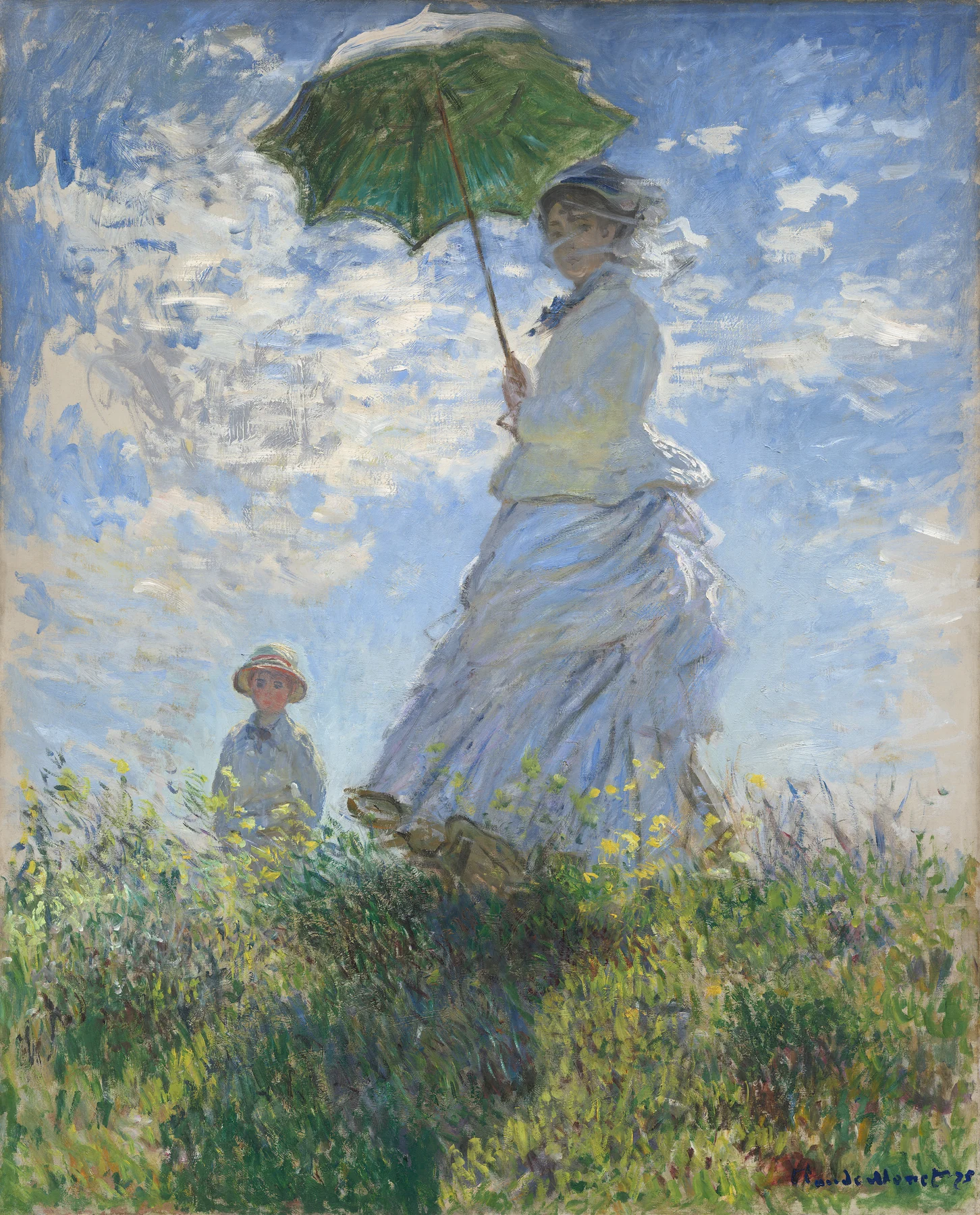

Monet painted Camille and Jean at Argenteuil in 1875. The National Gallery of Art describes the work as completed in a single outdoor session. That information supports speed; it does not make the canvas an unmediated optical transcript.
Look first at the viewpoint. Camille is seen from below, so her figure rises against the sky instead of merging with a distant horizon. The parasol almost touches the top edge. Jean’s lower body disappears behind the crest, clarifying distance without a carefully modelled landscape. A diagonal shadow stretches from Camille towards the bottom edge, joining her body to the viewer’s space.
Now look at the paint. White is not one substance. Across the clouds it is dragged, broken, and left beside blue. On Camille’s clothing it turns into light catching folded fabric. Across her face it becomes a moving veil. In the grass, small yellow touches puncture green and repeat on her sleeve. The canvas is visible in places, especially in the sky. What an academic painting might treat as incomplete becomes active brightness.
The same economy makes the picture feel temporary. Camille is not posed frontally for a permanent family identity. Her face is partly veiled. Jean is present but visually secondary. Wind keeps both figure and surface from settling.
Yet the work also has a social history. Camille was Monet’s wife, not an anonymous type, and Jean their child. The painting appeared in the second independent exhibition of 1876 as La Promenade and was acquired that year by the physician and collector Georges de Bellio. The “instant” depended on a chain: family, field, studio decisions, exhibition, collector, and later museum.
Monet’s rapid session was concentrated judgement: where to stand, what to omit, how to keep the ground open, which direction each mark should take, and when to stop.
The picture does not prove that every Impressionist painting was finished outdoors or in one sitting. Many were revised in the studio. Here, visible incompletion structures weather, movement, and attention.
Leisure had an address: Renoir at La Grenouillère
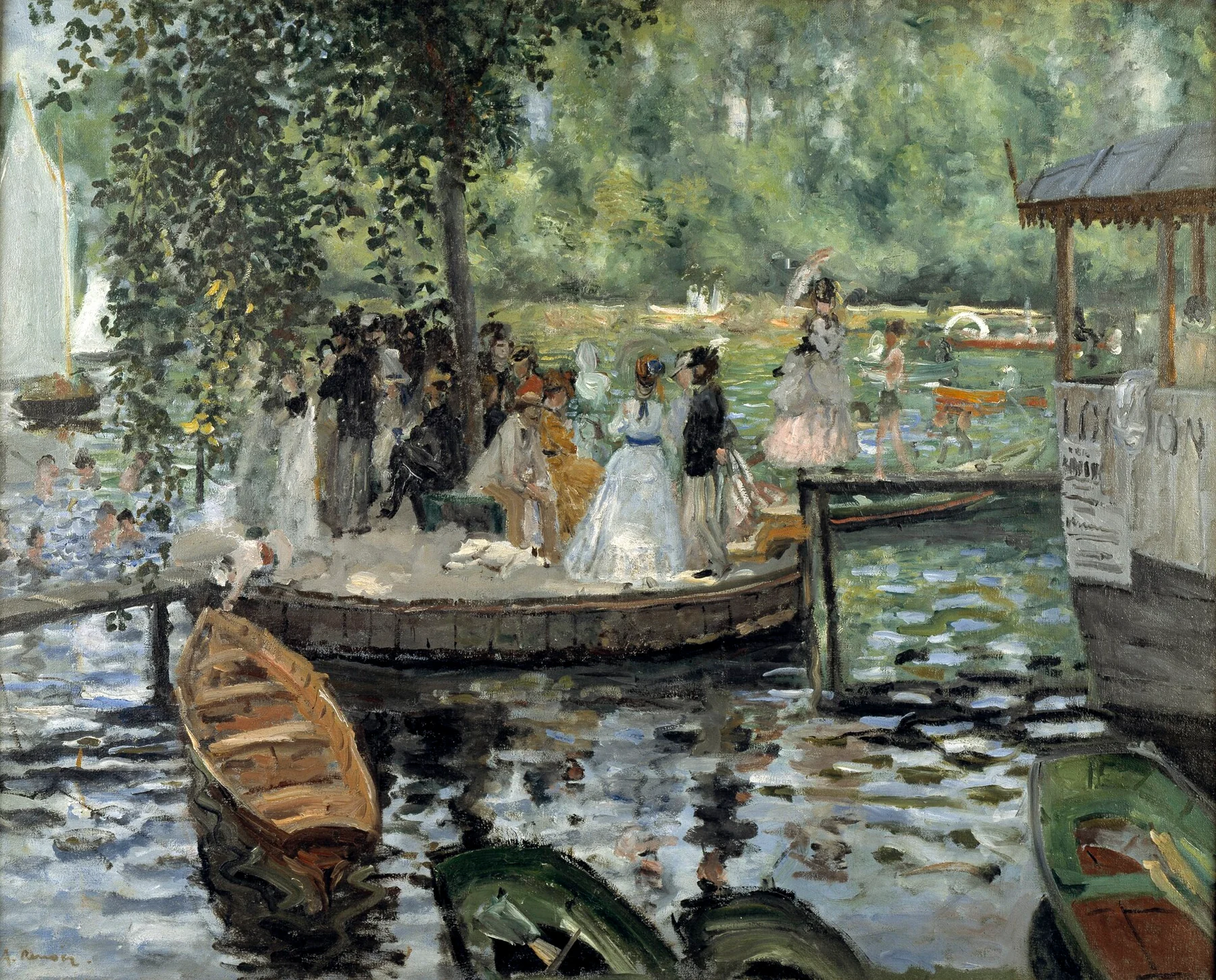
Six years before Monet’s hillside, Renoir and Monet worked beside one another at La Grenouillère near Bougival, west of Paris. The resort combined a floating café, bathing area, boats, and a small artificial island nicknamed the camembert. Rail and river connections made such suburban sites available to day visitors from the capital.
Renoir’s painting does not give every figure a stable outline. People gather as intervals of black, white, ochre, pale blue, and flesh colour. Reflections are not smooth mirror images; horizontal strokes interrupt the water with cold blues, green, cream, and black. A dark boat points from the foreground towards the crowded island, while another curve at the lower edge makes the viewer feel close to the water rather than safely above it.
The brushwork links different kinds of movement. Swimmers break the left bank. Sailcloth rises in the distance. Leaves filter the light. Boats shift against their moorings. The scene is socially crowded and optically unstable.
It is easy to receive this as an idyll of democratic leisure. The Nationalmuseum’s account makes the historical setting less innocent. La Grenouillère was a commercial venue used by working- and middle-class visitors, but access, respectability, looking, and mobility were organised by gender and class. Fashionable clothes marked some bodies as observers and others as available for observation. The resort was also associated with sex work, flirtation, alcohol, and urban spectacle.
“Modern leisure” was never the absence of labour. Someone operated the café, maintained boats, served drinks, washed clothing, transported visitors, and kept commercial infrastructure functioning. Those workers are not the painting’s named subjects. The freedom of the day-tripper rested on other people’s time.
Renoir and Monet’s joint campaign complicates the myth of the isolated genius. They painted related views in September 1869, testing how short strokes and relatively unmixed colour could register water, figures, and light. Monet often gives more area to river and reflection; Renoir draws the viewer towards the social cluster. Working side by side created comparison and shared discovery.
La Grenouillère predates the first independent exhibition. It is better understood as an experiment from which later practice was built: modern commercial subject, suburban mobility, compressed handling, and changing relations among light, water, and people. Its pleasure is real. So are its exclusions.
Performance begins with repetition: Degas’s The Dance Class
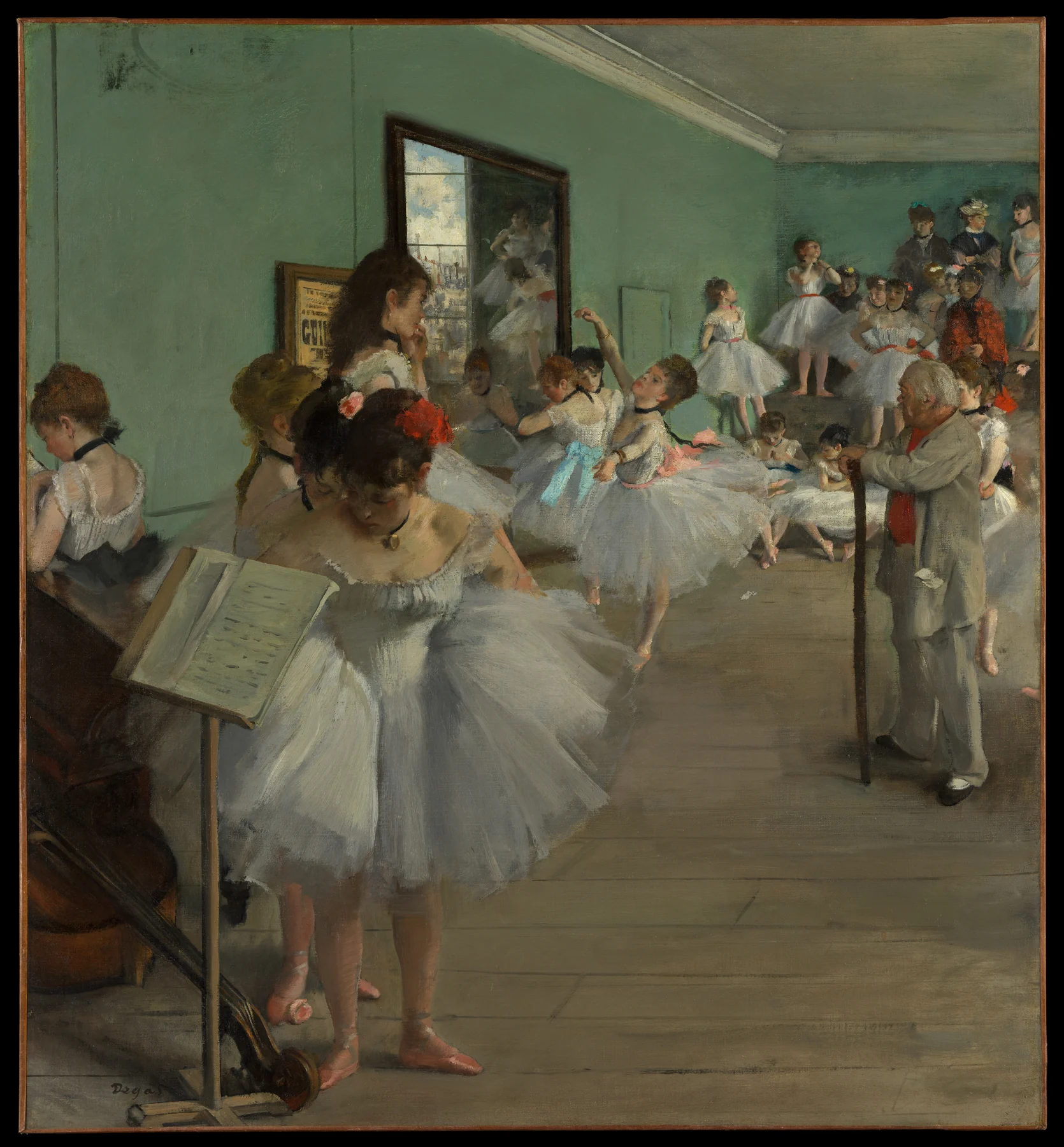
Degas did not need sunlight, a river, or broken colour to make a painting central to Impressionism.
In The Dance Class, bodies are everywhere, but no unified performance has begun. A dancer near the centre raises one arm while leaning back. Another bends to examine her foot. Someone scratches her back. Others adjust a sash, talk, wait, or watch. Mothers sit or stand among the dancers. Jules Perrot, the elderly ballet master, occupies the right foreground, marking authority with the vertical line of his staff.
The room is imaginary. Degas based it on the old Paris Opéra, which had recently burned, and assembled approximately twenty-four dancers and accompanying women into a space that feels observed but was carefully constructed. The mirror opens another field of bodies. The floorboards pull the eye towards the rear. The strongest empty area—a broad diagonal of floor—separates Perrot from the nearest dancers and makes waiting visible.
Cropping intensifies the impression of accidental sight. On the left, the body of a musician and the neck of a double bass are cut by the edge. Figures overlap or disappear. Yet the composition was revised over a long period. The Met records that the opera singer and collector Jean-Baptiste Faure commissioned the painting in 1872; Degas completed it over roughly two years and Faure lent it to the 1876 independent exhibition.
Apparent immediacy and prolonged construction are not opposites here. Degas used studies, altered poses, and repeated arrangements to create the experience of a room whose attention is scattered.
The painting also changes what counts as ballet. Instead of the lit stage, it shows repetition, correction, fatigue, waiting, maintenance, and supervision. The Met’s study of Degas and dance notes practice-room equipment across his work, from barres and instruments to watering cans used to dampen dusty floors. Grace is an achieved surface supported by disciplined bodies and material routines.
Those bodies belonged to a demanding institution. Many dancers entered the Paris Opéra young and worked under economic and social pressures that the white costumes can conceal. Wealthy male subscribers had privileged access to backstage spaces. A complete history must therefore resist treating every watcher as a neutral connoisseur or every dancer as a carefree emblem of movement.
Its invented room is not a documentary photograph, but it makes labour unavoidable. A lifted arm exists beside another dancer’s rest. Performance is distributed across people who are ready, corrected, bored, ambitious, tired, and watched.
Degas reveals why style alone cannot contain Impressionism. His drawing is deliberate, his colour comparatively muted, and his scene indoors. What connects him to the independent project is a new account of modern experience and an exhibition structure broad enough to hold difference.
Modernity from inside the room: Morisot’s Woman at Her Toilette
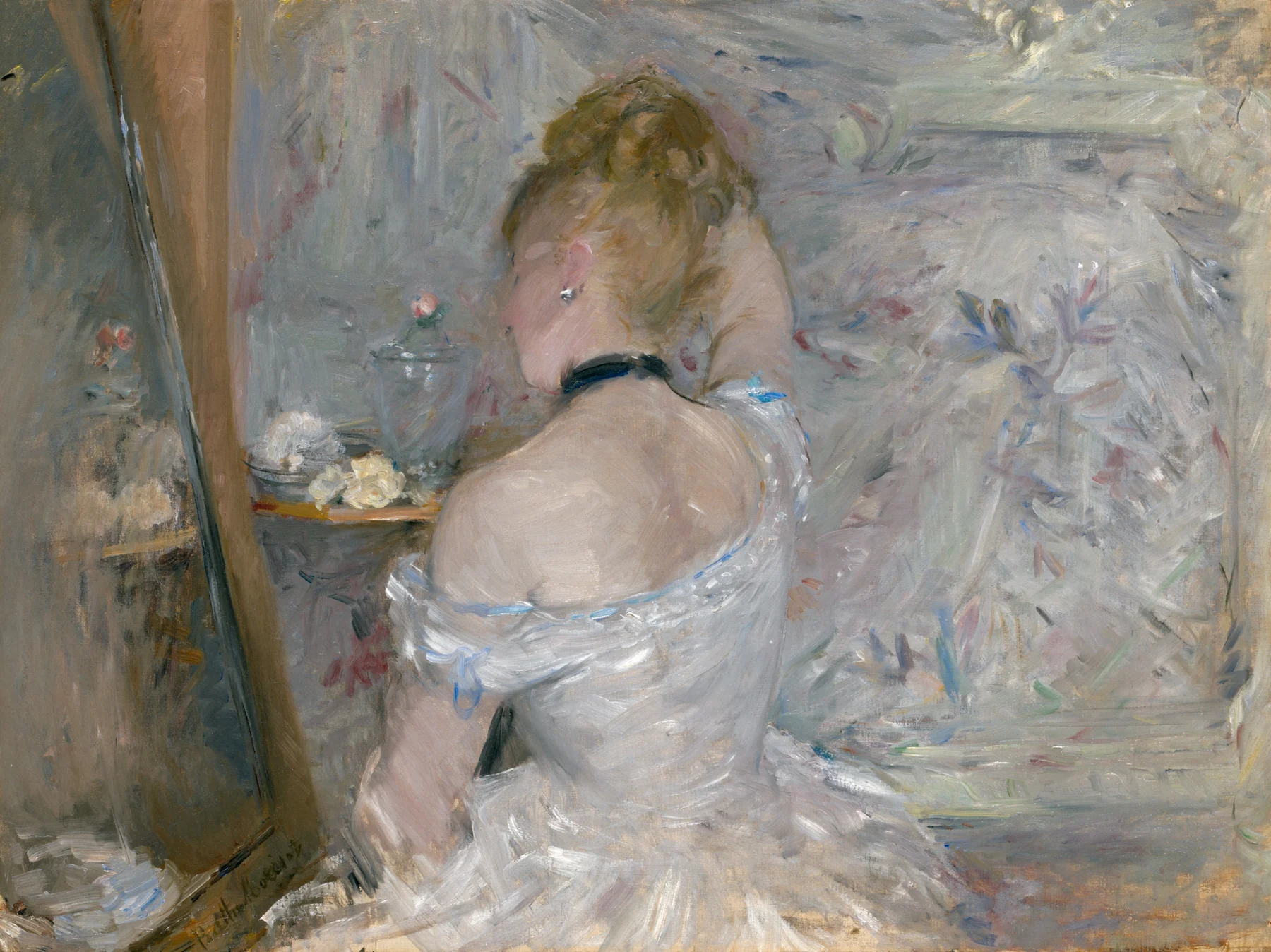
The mirror offers no face.
A woman turns away from the viewer and raises one hand towards her hair. Earrings and a black ribbon remain after a formal event; the Art Institute identifies the moment as one of undressing after a ball. Her pale garment slips across her shoulders. Around her, floral pattern, upholstery, wall, and reflected light become a field of grey, lavender, pink, blue, and white marks.
Morisot keeps the figure physically close while refusing the clarity that a voyeuristic scene might promise. The mirror is a dark vertical presence, but its surface does not return an available likeness. Instead, it blurs into the room. Morisot signed her name along its lower edge, placing authorship where a reflection might have stabilised the sitter.
The toilette was a familiar subject in European art, often used to make a woman’s private preparation visible for an imagined male viewer. Morisot’s painting does not remove the politics of looking, but it rearranges them. The sitter is absorbed in an action rather than displaying herself frontally. Her face remains inaccessible. Paint refuses to separate skin, fabric, décor, and atmosphere into equally finished descriptions.
This interior also expands the meaning of modern life. The famous male flâneur—the urban stroller who observes the street—has often served as its model spectator. But nineteenth-century Paris did not grant everyone the same freedom to wander, look, remain anonymous, or enter nightlife without social cost. Gender, class, respectability, accompaniment, and time of day shaped movement.
Morisot’s domestic and semi-private scenes should not therefore be treated as a retreat from modernity. Bedrooms, dressing spaces, nurseries, dining rooms, balconies, theatres, gardens, and holiday homes were among the environments she could study closely and transform. They held fashion, paid and unpaid care, preparation, privacy, social performance, and the labour of making an acceptable public self.
The painting belongs to Morisot’s unusually sustained participation in the independent exhibitions. She showed in seven of the eight, missing only 1879 after the birth of her daughter. Woman at Her Toilette appeared in the fifth exhibition in 1880. Contemporary praise did not erase the structural barriers facing women artists: restricted training opportunities, expectations around family and respectability, unequal access to public space, and a critical language that repeatedly treated women as exceptions.
Nor should “woman’s perspective” become one permanent style. Morisot, Mary Cassatt, Marie Bracquemond, Eva Gonzalès, and others worked from different positions. Morisot’s canvas does not represent every woman; it shows how the map of modernity changes when intimate space is treated as historically active rather than secondary to the boulevard.
The room is not outside public life. It is one of the places where a public self was assembled.
The rebuilt city did not become neutral: Caillebotte’s Paris Street; Rainy Day
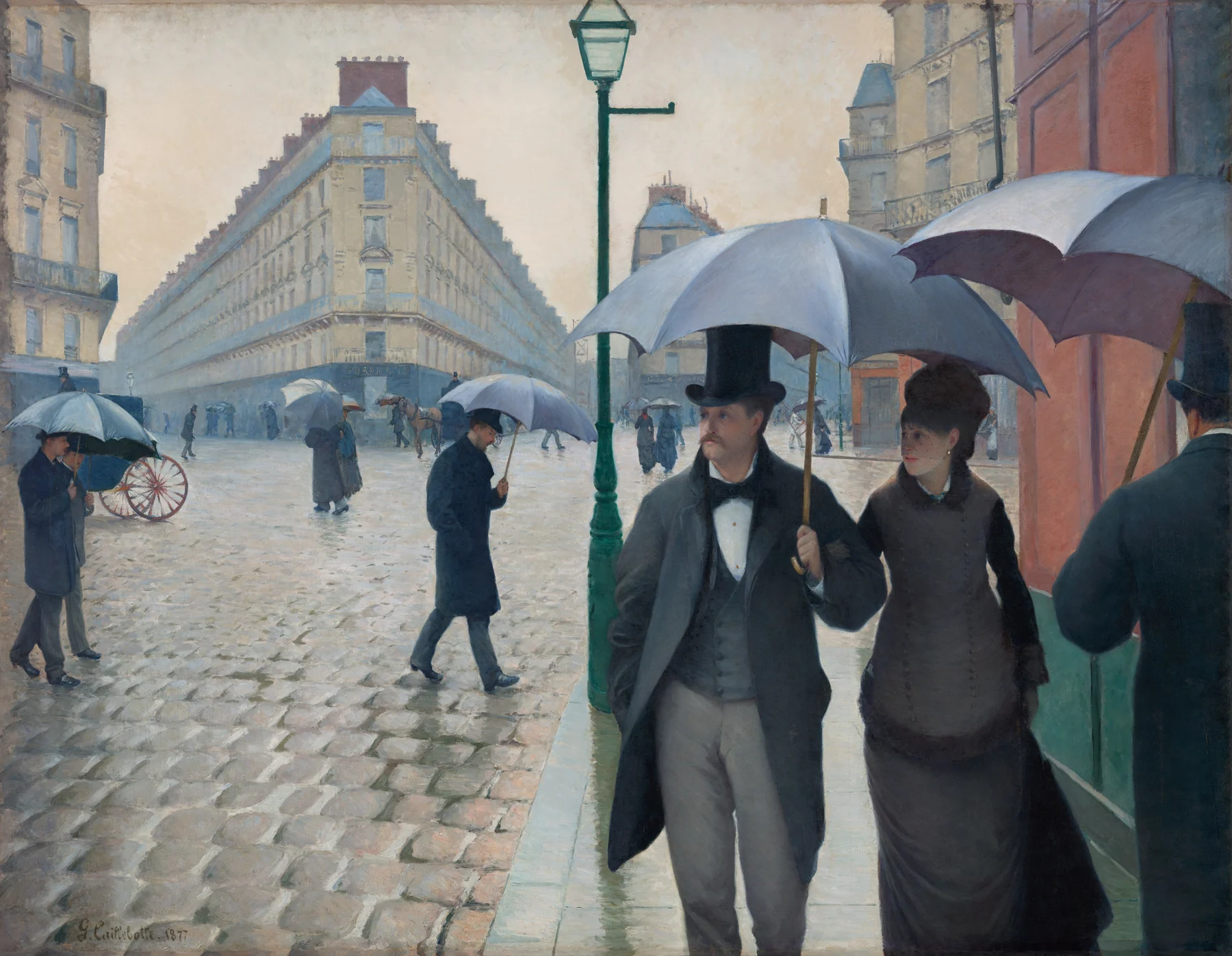
Caillebotte’s canvas is wider than many doorways. Its scale belongs to ambitious public painting, but its event is ordinary: people pass through rain.
A well-dressed couple approaches on the right. Their umbrella overlaps another behind it, while a man’s cropped back occupies the edge. The central street lamp divides the surface. Beyond it, apartment blocks recede towards the Place de Dublin near the Gare Saint-Lazare. Umbrellas repeat across wet cobbles like moving grey disks.
The geometry is exact enough to feel architectural, yet the encounter is unstable. The foreground man looks left, perhaps to avoid the oncoming pedestrian whose shoulder is cut by the frame. The couple’s path seems about to cross the viewer’s. Large empty stretches of paving separate bodies who share space without forming a community.
This is the Paris reshaped under Napoleon III and his prefect Georges-Eugène Haussmann between the 1850s and 1870. Old streets and buildings were demolished as wide boulevards, sewers, parks, rail connections, and more uniform façades remade the capital. The new routes improved circulation and sanitation in important ways. They also displaced residents, changed property values and class geographies, and distributed benefits unevenly.
The intersection Caillebotte painted stood in a newly developed district close to his own neighbourhood. Its broad visibility is not natural; it is the product of demolition, finance, regulation, stone, iron, paving, and labour. The painting gives us the finished surfaces more readily than the workers and removals that produced them.
Caillebotte’s technique also resists a simple Impressionist formula. Figures and buildings are more firmly modelled than in Monet’s sky. Perspective creates a deep, controlled field. At the same time, asymmetrical cropping, wet atmospheric colour, repeated walkers, and a subject without heroic climax make perception feel provisional. The Art Institute notes that photography may have informed the dramatic edges, although resemblance to a photographic crop does not prove that one specific photograph was copied.
The painting appeared as catalogue number one in the third independent exhibition of 1877. Caillebotte helped organise and finance that show. His role reminds us that artistic independence required resources. Renting rooms, printing catalogues, arranging works, attracting critics, and surviving poor sales all had costs. Some participants had more wealth than others, just as some could move through the city with greater freedom.
Conservation has added another history to the surface. When the Art Institute treated the work before its 2015 exhibition, removing discoloured varnish and old retouching revealed a cooler, bluer, more varied sky and stronger relationships among architecture, clothing, and wet street. What viewers call “Caillebotte’s grey Paris” is partly mediated by the material life of paint and later care.
The boulevard offered openness and anonymity, but not equality. Caillebotte’s monumental crossing turns modern public space into a choreography of proximity without contact.
Colour was material, not magic
Impressionist colour is often described as if painters simply learned to see more intensely. Vision mattered, but colour also arrived through manufacture, trade, packaging, instruction, money, and maintenance.
Nineteenth-century artists could buy an expanding range of synthetic pigments, including vivid blues, greens, yellows, and purples. Commercially prepared paint in collapsible metal tubes made transport and storage easier. Portable easels and railway routes helped painters work outside established studios and reach suburban or coastal sites. None of these inventions automatically caused Impressionism. Many artists used the same materials differently. They changed what was practical and available.
The five paintings show several colour systems rather than one palette:
- Monet lets blue sky and exposed ground participate in white cloud and clothing.
- Renoir breaks water into alternating warm and cool strokes around dense social figures.
- Degas controls a rehearsal room through green walls, neutral floorboards, white tutus, and small accents.
- Morisot compresses figure and interior into closely valued pale colour without eliminating bodily presence.
- Caillebotte uses blue-grey atmosphere, wet stone, black clothing, and the salmon-red wall at right to organise urban distance.
Display changed colour too. Many independents avoided the thick golden varnish that conventionally warmed a finished painting. Age later altered the contrast as varnish yellowed, pigments changed, surfaces accumulated dirt, and restorers made consequential choices.
“Paint what the eye sees” is therefore too simple. The eye encountered a material system. Artists selected among manufactured colours, absorbent grounds, brush sizes, canvas textures, drying times, transport options, and exhibition lighting. Perception became public through things.
Five paintings, one contested modernity
| Case | What feels immediate | What constructs the effect | Modern system inside the scene | What the familiar label can hide |
|---|---|---|---|---|
| Monet, Woman with a Parasol | Wind, changing cloud, a passing family encounter | Low viewpoint, diagonal shadow, exposed canvas, directional marks, exhibition title | Suburban family life, outdoor mobility, collector and independent exhibition | Speed as trained judgement; Camille and Jean as people rather than generic “figures in light” |
| Renoir, La Grenouillère | Water, crowds, boats, flickering sunlight | Shared painting campaign, compressed colour, foreground boats, social clustering | Railway-era excursion, commercial leisure, bathing, café culture | Service labour, sex work, class and gendered access behind an apparent idyll |
| Degas, The Dance Class | Accidental poses, waiting, bodies cut by the frame | Studies, revisions, imaginary room, mirror, floor geometry, commission | Paris Opéra, training, patronage, backstage hierarchy | Repetition and fatigue behind graceful performance; unequal power around dancers |
| Morisot, Woman at Her Toilette | A private gesture after a social event | Obscured mirror, turned body, signature, compressed pale surface | Fashion, domestic labour, preparation, gendered mobility | Interior life as modern history; the refusal of an easily available female image |
| Caillebotte, Paris Street; Rainy Day | A near collision in wet streets | Monumental scale, rigorous perspective, asymmetric crop, repeated umbrellas | Haussmannisation, property, infrastructure, fashion, exhibition finance | Demolition, displacement, building labour, and unequal freedom within the “open” city |
The table does not prove that every Impressionist work addressed all these systems. It makes a narrower point: formal decisions and social history cannot be separated without losing explanatory power.
Brushwork changed how weather could be pictured. It also challenged standards enforced by exhibitions. A river resort offered new reflections and a commercial social world. A rehearsal room produced cropped poses and exposed the labour that made performance possible. An interior loosened paint and revised who could count as a modern observer. A boulevard reorganised perspective because the city itself had been reorganised.
Independence did not mean isolation
The independent exhibitions are sometimes told as a heroic escape from institutions. They were better understood as institution-building.
The artists needed one another, rooms, rent, catalogues, printers, installers, frames, transport, coverage, loans, and visitors. Collectors such as de Bellio and Faure helped works circulate. Dealers, especially Paul Durand-Ruel, later supported careers and international markets. Caillebotte used personal wealth to sustain group activity and acquired colleagues’ work.
These relationships created opportunity and dependence at once. A dealer could provide income while influencing reputation; a critic could create visibility through ridicule; a collector could lend a commission to an independent exhibition. Removing the Salon jury produced new disagreements about membership, quality, and direction.
The eight exhibitions were not a straight rise from rejection to triumph. Participation and financial results varied. Artists argued over members who still submitted to the Salon. By 1886, stylistic and strategic differences were too large for one recurring show.
That failure of permanence was productive. The exhibitions proved that artists could construct an alternative public, however fragile, through a changing network rather than one jury.
What sits outside these five frames
No five paintings can stand for France in the 1870s.
The period included defeat in the Franco-Prussian War, the Siege of Paris, the revolutionary Paris Commune and its violent suppression, the end of the Second Empire, and the uncertain formation of the Third Republic. Rebuilding and entertainment unfolded beside political trauma. France was also a colonial empire. Materials, commodities, wealth, people, and images moved through imperial systems that are not fully visible in these scenes.
The selected works focus on relatively privileged Parisian and suburban environments. Degas brings training labour to the centre, and Renoir’s resort implies service and sexual economies, but factory work, construction crews, laundresses, domestic servants, railway workers, rural poverty, colonial subjects, and much of working-class political life remain outside the route.
That absence should change the claim, not produce a token paragraph pretending the archive is complete. Impressionism made some forms of modern experience newly public. It did not picture modernity as a whole.
The next questions are comparative: how Realists represented labour, what photographers claimed as evidence, how posters organised the mass urban viewer, how colonial exhibitions and racialised looking entered French visual culture, and what artists outside Paris understood as modern. Impressionism is an opening into those histories, not their answer.
A compact timeline
- 1853–70: Haussmann’s prefecture under Napoleon III transforms Paris through demolition, boulevards, infrastructure, parks, and new development.
- 1869: Monet and Renoir paint related views at La Grenouillère.
- 1870–71: Franco-Prussian War, Siege of Paris, Paris Commune, and violent suppression reshape political and urban life.
- 1873: The artists’ cooperative later responsible for the first independent exhibition is established.
- 15 April 1874: First exhibition opens at Nadar’s former studio; thirty artists show about two hundred works.
- 1875: Monet paints Woman with a Parasol.
- 1876: Second exhibition includes Monet’s La Promenade and Faure’s loan of Degas’s The Dance Class.
- 1877: Third exhibition presents Caillebotte’s Paris Street; Rainy Day and uses “Impressionists” more deliberately as a group identity.
- 1880: Fifth exhibition includes Morisot’s Woman at Her Toilette.
- 1886: Eighth and final group exhibition demonstrates how far the participants’ practices have diverged.
Key terms
- Salon: The major official Paris exhibition, selected by a jury and central to artistic visibility, reputation, and patronage.
- Independent exhibition: In this chapter, one of the eight shows organised outside the Salon by a changing group between 1874 and 1886; not a synonym for financial self-sufficiency.
- Impression: A term with histories in perception and sketching that became attached to the group through Monet’s title and Leroy’s hostile review.
- Flâneur: A modern urban observer imagined as able to wander and look; useful only when its gendered, classed, and racial limits are examined.
- Haussmannisation: The physical, administrative, financial, and social remaking of Paris associated with Haussmann’s prefecture.
- Synthetic pigment: A colourant produced through modern chemical manufacture; one part of the material conditions that expanded nineteenth-century palettes.
Ten questions for close looking
- Which marks describe an object, and which create light, movement, or atmosphere without closing its outline?
- Where is the horizon, and what social position does the viewpoint give the observer?
- What has been cropped, obscured, reflected, or left as exposed ground?
- Does the painting record a brief action, or construct the effect of a brief action through revision?
- Who is free to move, watch, rest, or remain anonymous in the depicted space?
- Whose labour makes the scene’s leisure, fashion, infrastructure, or performance possible?
- How do colour temperature and value organise attention before individual objects become clear?
- What changes when the work’s commission, exhibition, collector, and conservation history are added?
- Which modern technologies are visible, and which merely altered the conditions under which the painting could be made or circulated?
- What part of nineteenth-century life would remain invisible if this image became your evidence for the whole period?
Five shortcuts to refuse
“Impressionism is one style of loose brushwork”
The independent exhibitions held sharply different drawing, colour, media, finish, and subject. Shared institutional action preceded a stable stylistic label.
“The paintings are spontaneous records of exactly what the artist saw”
Even a rapidly painted canvas is structured. Degas revised extensively; Monet’s apparent instant depends on viewpoint, selection, and trained control.
“Leisure scenes are socially neutral because everyone is relaxing”
Commercial leisure depended on transport, money, service work, codes of respectability, and unequal access. Pleasure and power can occupy the same image.
“Women Impressionists painted interiors because they were less modern”
Mobility was unequal. Morisot’s interiors reveal preparation, privacy, care, fashion, and looking as central parts of modern social life.
“The new boulevards simply made Paris better”
Haussmannisation improved circulation and infrastructure while demolishing neighbourhoods, displacing residents, concentrating investment, and changing who could afford to remain near new development.
Source guide
The factual spine of this chapter begins with collection records and current institutional research:
- The National Gallery of Art’s 1874: The Birth of Impressionism, the exhibition project Paris 1874: The Impressionist Moment, and its research publication establish the first exhibition’s institutional, political, and critical setting.
- The Metropolitan Museum of Art’s Impressionism: Art and Modernity provides a concise account of changing membership, colour, new materials, suburban mobility, and modern subject matter.
- The NGA’s open catalogue The Impressionists at Argenteuil supports close study of Monet’s handling and the social and industrial landscape around Paris.
- The National Gallery of Art object record for Monet, the Nationalmuseum record for Renoir, the Met record for Degas, and Art Institute of Chicago records for Morisot and Caillebotte supply object metadata, exhibition histories, provenance, and image-rights status.
- The Met’s essay The Ballet connects Degas’s repeated rehearsal compositions to training, equipment, and the transition between ordinary and choreographed movement.
- The Art Institute’s conservation account Still a Paris Street, but a Less Rainy Day shows how technical examination and varnish removal changed the visible colour relationships in Caillebotte’s painting.
- Esther da Costa Meyer’s research, introduced by Yale University Press in Why Does Paris Look the Way It Does?, supports the distinction between Haussmannian infrastructure gains and demolition-led displacement.
These sources do not make interpretation automatic. They allow claims about objects, institutions, materials, and rights to be separated from inference.
From the exhibition room to GeMarkt’s collection
The three artists with the strongest direct connection to GeMarkt appear here for historical reasons, not as decorations added after the argument.
- Explore the Claude Monet collection to compare Woman with a Parasol with river, railway, garden, coast, and series paintings across his longer career.
- Explore the Edgar Degas collection to test how rehearsal, performance, café life, millinery, bathing, portraiture, and racing demand different kinds of looking.
- Explore the Auguste Renoir collection to compare La Grenouillère’s compressed experiment with later theatres, dances, boating scenes, portraits, and gardens.
The aim is not to turn an art-history chapter into a sales claim. It is to let close looking continue across a real body of works.
Impressionism survives because its surfaces still feel open. Its history becomes stronger when the systems behind that openness remain visible: exhibitions made collectively, colour made materially, leisure supported by labour, private rooms shaped by unequal mobility, and streets rebuilt through power.
The modern instant was never only an instant.
Editorial record
About this article
- Author
- Publisher
- GeMarkt
- Published
- Updated
- Reviewed
- Internal source & rights check. Conducted by GeMarkt Research Review. This is an internal editorial check—not independent peer review.
- Source standard
- Art history source standardPrioritises object records and research sources, distinguishes evidence from interpretation, and states material uncertainty.
Found a claim that needs checking? Report a factual error.