Art History · Learning chapter
Atlas II — Connected worlds · 9 of 10
Korean and Japanese art, c. 600–1400: monastery, court, ceramic, narrative, and local change
A five-work guide to how Korean and Japanese monasteries, courts, kilns, and narrative workshops rebuilt travelled forms within distinct local institutions.


What we’ll look at
How did Korean and Japanese institutions transform forms that arrived from elsewhere?
The room is open from above. Roof and ceiling have disappeared, leaving beams, screens, curtains, mats, and clothed bodies arranged at an angle. A musician holds an instrument. Another figure leans into the social space. Beyond the veranda, the garden thins into worn paper and almost invisible grasses.
This is one surviving painted section from a twelfth-century illustrated handscroll of The Tale of Genji, not an architect’s plan or a record of an ordinary household. The convention often called a “blown-off roof” makes an elite interior visible while screens and curtains continue to hide, divide, and rank its occupants. Architecture controls who can approach, overhear, withdraw, or be seen.
The scene is a useful entrance to art made on the Korean Peninsula and Japanese archipelago between about 600 and 1400 because it refuses a simple choice between connection and difference. Buddhism, writing, architectural knowledge, ceramic technology, images, stories, and skilled people travelled across seas and political borders. Yet what arrived was not copied into an empty place. Courts, monasteries, kilns, workshops, patrons, readers, and worshippers gave travelled forms new materials, uses, and consequences.
This chapter asks:
How did Korean and Japanese makers turn travelled forms into local institutions—and what disappears when connection is mistaken for copying?
Five cases provide five incomplete answers. Seokguram turns an international Buddhist image-world into an artificial granite sanctuary under Silla rule. A Goryeo celadon bottle joins adapted kiln technology to inlaid cranes, clouds, and courtly demand. Tōdai-ji makes a colossal bronze Buddha inseparable from state ambition, donation, casting, destruction, and repeated rebuilding. The Genji scroll connects court narrative to calligraphy, gender, architecture, and controlled looking. An early fourteenth-century Yūzū Nenbutsu scroll set uses painted narrative to make religious teaching, institutional memory, and collective practice move through the viewer’s hands.
They are not steps toward a national style. They are five occasions when movement had to become material somewhere.
What do “Korea,” “Japan,” and c. 600–1400 name here?
The dates are a practical frame, not the lifespan of two stable cultures. In the seventh century, the Korean Peninsula included Goguryeo, Baekje, Silla, Gaya legacies, and communities poorly represented in royal chronicles. With Tang support, Silla defeated Baekje and Goguryeo and controlled much of the peninsula by the late seventh century. “Unified Silla” can overstate that unity: Balhae ruled northern territories from 698 to 926, and regional differences continued. Goryeo was founded in 918, brought rival southern regimes together, and lasted until 1392.
“Korea” is therefore geographic and historiographic shorthand. It does not project the modern border between North and South Korea backward, and it does not make Silla or Goryeo culturally uniform.
The Japanese sequence is equally compressed. Asuka, Nara, Heian, Kamakura, and early Muromachi are period names tied to capitals, regimes, and later historical organisation. The imperial court moved to Nara in 710 and Heian-kyō, present-day Kyoto, in 794.
Warrior governments later redistributed political power, but the court, temples, shrines, estates, local lineages, and trade networks remained consequential. No central regime governed every community in the archipelago in the same way. Histories of northern Honshu and Hokkaido, including Satsumon and Ainu ancestors, and of the Ryukyu Islands require routes different from a court-centred story.
The approximate end date of 1400 crosses another boundary. The Kamakura shogunate fell in 1333; competing courts and the Ashikaga regime reorganised authority while religious lineages, workshops, estates, and scroll projects continued. Period labels locate an object without walling off experience.
The surviving record is uneven. Stone sanctuaries and high-fired ceramics endure differently from timber houses, garments, food, performance, spoken prayer, or an ordinary person’s letter. Court and temple archives preserve some lives more fully than others. The five cases below make those biases visible rather than claiming to overcome them.
A route through five local institutions
The route begins in a sanctuary, moves to a kiln, enters a state temple, and ends with two kinds of handscroll. Each case changes the unit of analysis:
- Seokguram asks how architecture, sculpture, royal or elite patronage, terrain, and worship form one work.
- A Goryeo maebyeong asks how imported technology becomes local through clay, glaze, kiln atmosphere, inlay, selection, and use.
- Tōdai-ji asks what “state Buddhism” means when a sacred image requires metal, timber, taxation, specialists, donations, and ritual consent.
- The Genji handscroll asks how text, image, calligraphy, gendered literacy, and controlled interior space shape one another.
- The Yūzū Nenbutsu scrolls ask how narrative images can teach, gather support, preserve a founder, and materialise relations among practitioners.
The route is comparative, not symmetrical: an immovable sanctuary, an unexcavated portable object, a rebuilt living temple, fragmented pages, and a divided scroll set demand different evidence. Their differences prevent “Korean art” and “Japanese art” from becoming tidy boxes.
Seokguram: a granite cosmos built rather than found
In brief: Seokguram is a Buddhist sanctuary built near Gyeongju in present-day South Korea during the mid-eighth century. It is not a natural cave: builders assembled it from granite blocks and covered it with earth.
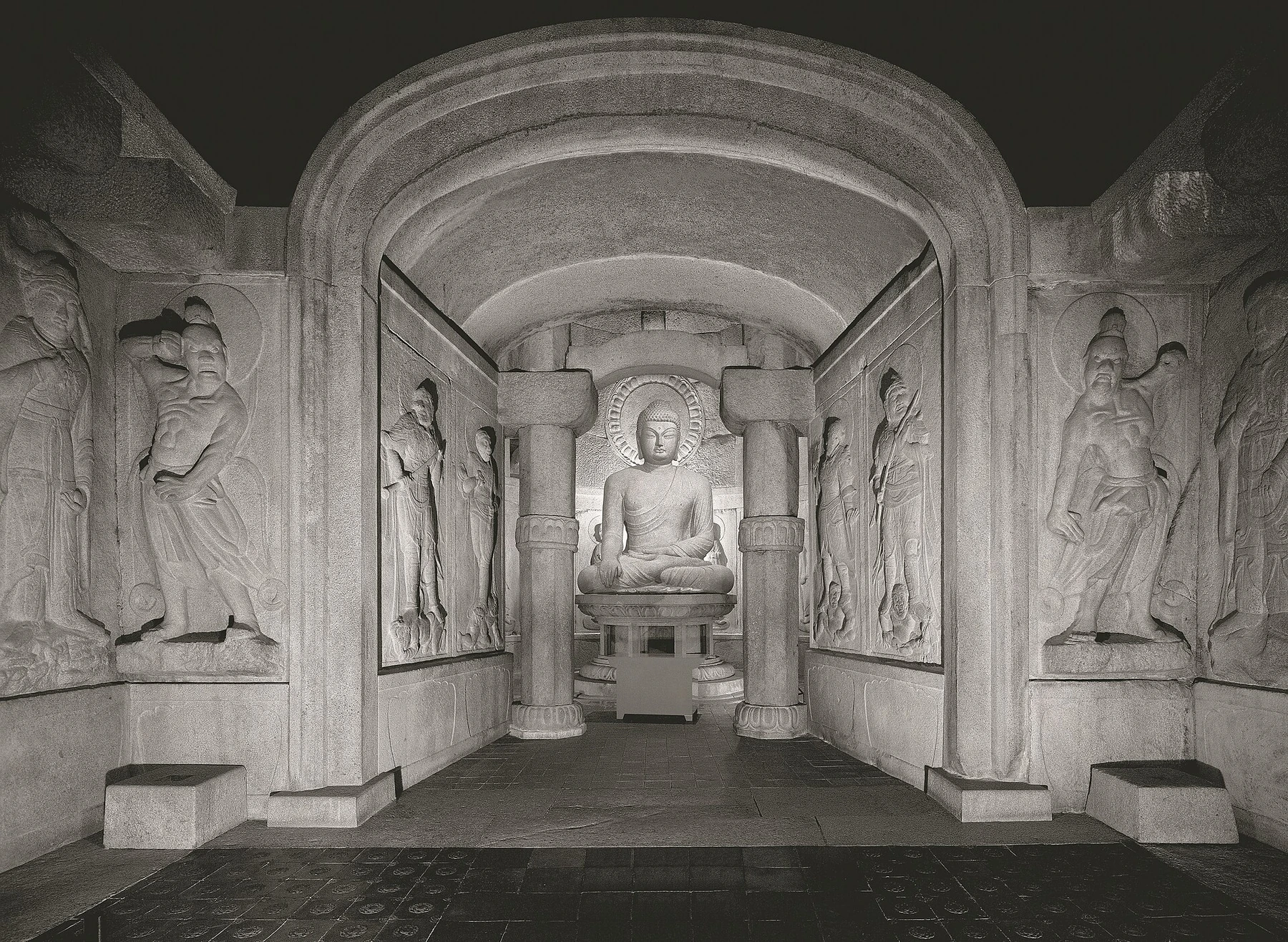

Seokguram looks excavated from a mountain. It was assembled.
Built on Mount Toham near the Silla capital of Gyeongju in the mid-eighth century, the sanctuary uses shaped granite blocks to construct an antechamber, a narrow corridor, and a circular domed chamber. UNESCO’s site record counts more than 360 stone slabs in the structure. A monumental seated Buddha occupies the centre. Guardians confront the visitor in the passage; bodhisattvas, disciples, and other sacred figures line the walls around the principal image.
The sequence matters. A person approaches from a rectangular space, passes protective figures, and encounters a round chamber ordered around the Buddha. Sculptures are not independent statues later stored together. Their positions produce direction, hierarchy, protection, and a community of enlightened beings. The building is an image system that must be entered—or, under present conservation conditions, viewed from a controlled threshold.
Artificial construction was a local material answer to a travelled architectural idea. Buddhist cave sanctuaries had long histories in South and Central Asia and China. The Korean Peninsula did not offer the same expanses of workable cliff at every royal centre.
Builders at Seokguram made a cave from hard granite modules, joined architecture to freestanding and relief sculpture, and covered the chamber with earth. The National Museum of Asian Art’s study of Korean Buddhist architecture places such adaptation within a much wider diversity of Korean temple plans shaped by kingdom, topography, school, and local building practice.
This is why the phrase “Chinese influence” explains too little. Iconographies and architectural precedents travelled through India, Central Asia, China, and the Korean Peninsula. Silla monks studied abroad; texts and images crossed political networks. But granite selection, geometric planning, interlocking construction, carving, transport, site preparation, and ritual use happened through Silla institutions and labour. Connection supplied possibilities, not a finished building.
Royal and aristocratic patronage made large Silla sanctuaries possible, and Buddhism helped rulers organise legitimacy, memory, and protection. UNESCO repeats the later tradition that the official Kim Dae-seong initiated Seokguram and Bulguksa. It records remembered patronage, not a contemporary contract listing the mostly unnamed quarry workers, haulers, planners, sculptors, builders, ritual specialists, and caretakers.
Nor was the sanctuary only state messaging. The central Buddha’s earth-touching gesture refers to awakening and the defeat of obstruction. Bodhisattvas and disciples organise a sacred assembly. Worship, merit, protection, doctrine, commemoration, sensory control, and political authority could coexist without becoming identical.
The photograph records a modern Seokguram as well as an eighth-century one. Lighting, flooring, barriers, monitoring, ventilation decisions, and limits on visitors shape the present encounter. UNESCO notes continuing control of environmental risks and visitor numbers. Such intervention complicates the fantasy of untouched survival, but it does not make the site inauthentic. Conservation is now one of the institutions through which Seokguram exists.
Goryeo celadon: a travelled technology becomes a kiln decision
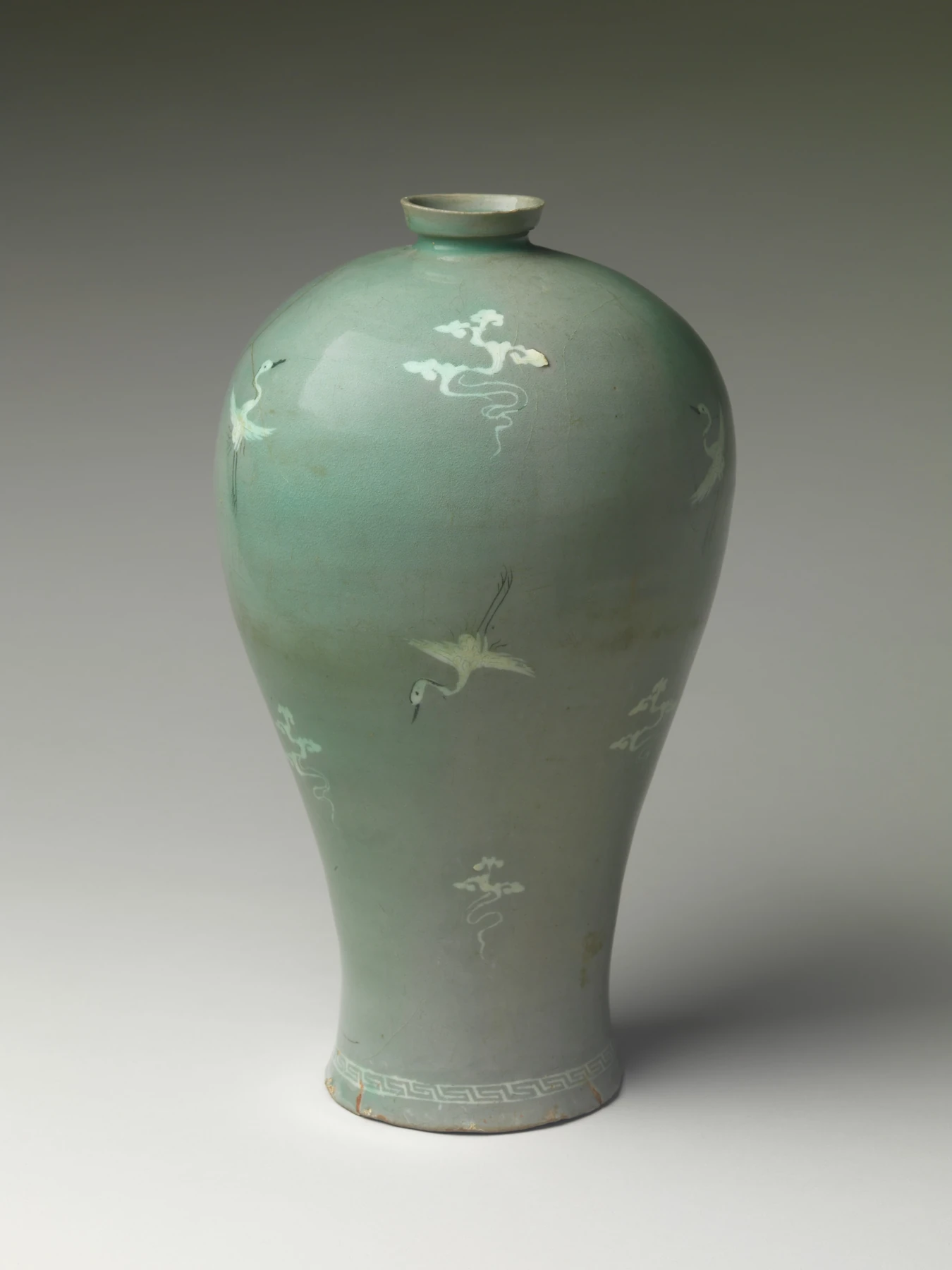
The bottle first appears to be one colour. Then cranes emerge from the blue-green glaze: some descend, some climb, others are partly hidden by the vessel’s curve. White clouds loosen into scrolling lines. A narrow foot supports a swelling shoulder and small mouth. The decoration does not sit on a flat field; it becomes visible as the object turns.
The Met dates the bottle to the second half of the twelfth century, during the Goryeo dynasty. Its Korean name, maebyeong, identifies a vessel form related to the Chinese meiping. “Plum bottle,” the habitual English gloss, should not be converted into proof that this particular object held plum branches. The form travelled, but its proportions and uses changed. The bottle’s small mouth, full shoulder, long contraction, and low foot are part of a Goryeo solution rather than evidence of failed imitation.
The surface makes that solution technical. Potters incised or carved designs into a leather-hard clay body, filled the recesses with white and dark slips, cleaned the surface, applied a translucent celadon glaze, and fired the vessel. This inlay technique is called sanggam. Inlay existed in other materials and places, so it should not be declared an isolated invention. Its sustained and highly developed use under celadon glaze became a distinctive strength of Goryeo ceramics.
The glaze depended on iron-bearing clay and glaze ingredients as well as a reducing kiln atmosphere in which oxygen was limited during part of the firing. The Met’s Goryeo celadon overview traces an initial adaptation of kiln and glaze technologies associated with Chinese production, followed by concentrated industries in places such as Gangjin and Buan on the peninsula’s south-western coast. By the twelfth century, potters and patrons were not merely receiving a technique. They were reorganising it around local deposits, kiln knowledge, vessel forms, inlay, and demand.
“Court ceramic” is too narrow if it makes the palace the maker. Elite and royal consumption helped define prestige, while celadon also served Buddhist and other settings. Miners, clay processors, woodcutters, kiln builders, throwers, decorators, loaders, fire managers, sorters, carriers, and users absorbed the production risk. Clay, glaze, temperature, atmosphere, stacking, and cooling affected every firing. Archaeological kilns and failed wares preserve a production history absent from the museum case.
The cranes and clouds are commonly associated with long life and auspicious realms. That convention supports interpretation, but the bottle does not disclose its commissioner, first room, contents, or exact ritual and social use. Its modern record is also partial. It entered the Met as a 1911 gift from the dealer Sadajirō Yamanaka; the public record does not provide a secure excavation context. The museum photograph clarifies form and colour while removing hand, liquid, paired vessels, table, storage, and movement.
Local change is visible here not as freedom from exchange but as mastery within it. A travelled ceramic technology became Goryeo because people made thousands of decisions in Goryeo materials and institutions.
Tōdai-ji: state Buddhism cast, burned, and rebuilt
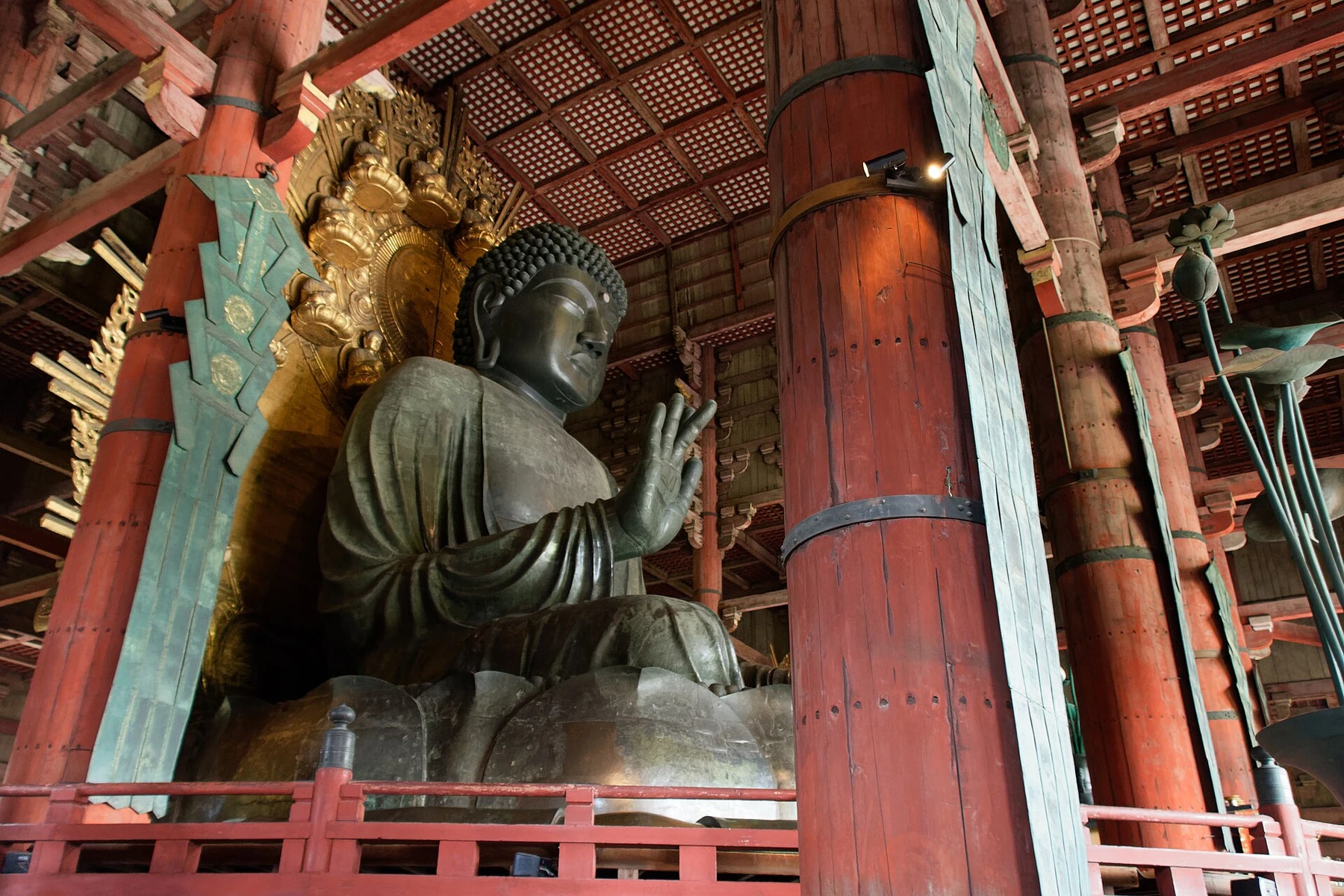

Scale is the first argument. The seated bronze body rises among timber columns, gilded halo elements, lotus forms, barriers, lamps, and visitors. But the photograph does not show one eighth-century object preserved intact. Tōdai-ji is a layered monument whose authority has repeatedly depended on repair.
The temple’s official history begins with Kinshō-ji, founded in 728 after the death of Emperor Shōmu’s son. In 741 Shōmu ordered a national system of provincial monasteries and convents. In 743 he proclaimed the creation of a colossal image of Vairocana, the cosmic Buddha central to the Avataṃsaka Sūtra. Casting began after the capital returned to Nara, the image was completed in 749, the hall in 751, and an elaborate consecration was held in 752.
The sequence joined devotion to government. Tōdai-ji became the chief temple in a state-sponsored network and a centre for rituals intended to protect the realm, but also for monastic study and continuing worship. “State Buddhism” is useful when it names this administrative and material organisation. It is misleading when it turns faith into nothing but propaganda.
The Great Buddha was an undertaking in metal, fuel, moulds, scaffolding, land, transport, food, finance, and consent. Tōdai-ji says the image was cast in eight stages over three years. The monk Gyōki helped solicit participation and donations; a construction office supervised a much larger complex. UNESCO’s preservation plan for ancient Nara describes resources from across the realm being invested in a group of buildings at unprecedented scale. Imperial command mattered, but no emperor could personally mine copper, prepare a mould, manage a pour, feed workers, or move timber.
The project followed more than a century of transformation. Japanese records say Baekje sent Buddhist images and texts to the court in the sixth century. Monks, scholars, artisans, technologies, and ritual knowledge travelled from the Korean Peninsula, while Japanese envoys and clerics also engaged Chinese centres directly. The Tokyo National Museum’s account of Buddhism’s arrival treats these travellers as active carriers of knowledge, not an anonymous bridge.
Tōdai-ji did not end that movement by becoming “Japanese.” After an earthquake brought down the Buddha’s head in 855, it was restored. Fire connected to war destroyed much of the compound in 1180.
The monk Chōgen organised reconstruction with political support, provincial income, new timber systems, and the help of the Song-dynasty caster Chen Heqing in repairing the image. The Buddha was reconsecrated in 1185 and the new hall completed in 1195.
Another fire in 1567 caused catastrophic loss. The present Buddha was consecrated in 1692; the current hall, narrower than its predecessors because funds were limited, was dedicated in 1709.
Calling the statue “eighth century” names its foundation and continuing identity, not every visible piece of bronze. Recasting mobilised new communities around an inherited sacred centre: continuity through material change.
Tōdai-ji remains a religious institution rather than an abandoned state project. Ritual, maintenance, tourism, scholarship, and heritage protection now overlap in the hall. A visitor looks at Nara ambition, medieval reconstruction, early-modern repair, modern engineering, and living worship at once.
The Genji handscroll: court narrative becomes spatial
The hero image belongs to a handscroll project made in the first half of the twelfth century, roughly a century after Murasaki Shikibu composed The Tale of Genji. It is not Murasaki’s manuscript and should not be credited to her as a painting. The Tokugawa Art Museum identifies the surviving sections as the oldest extant illustrated manuscript of the tale. Their makers are not securely named; stylistic unity should not be mistaken for one hand.
Text and image worked in sequence. Calligraphed passages on decorated paper preceded painted scenes, and a viewer unrolled the work from right to left while rolling up what had already been seen. Only a manageable interval was normally visible. The complete digital image above gives close access to one painted section, but it suppresses the pause between reading and looking, the touch of paper, the control of pace, and the disappearance of what has passed.
The scene comes from Yadorigi, or “Mistletoe,” Chapter 49 of the fifty-four-chapter tale. Its roofless view is selective rather than omniscient. Diagonal beams direct attention, but curtains, blinds, screens, and bodies continue to block it. Court architecture organised social permission: rank, gender, kinship, intimacy, and danger affected who could cross a threshold or see a face. The painting turns those constraints into narrative structure.
Faces are restrained, while posture, costume, placement, season, objects, and poetry carry emotional pressure. A modern viewer searching for an individualised facial expression can miss the work’s more distributed psychology. Feeling is built across paper, architecture, colour, gesture, quoted verse, and what a figure cannot openly say.
Gender belongs to that system. Women such as Murasaki Shikibu and Sei Shōnagon created enduring vernacular prose in an elite court world, but literacy, paper, time, service, family position, and manuscript access remained unequal. “Women’s hand,” a historical association of kana calligraphy, was socially produced rather than natural style. The Met’s open catalogue The Tale of Genji: A Japanese Classic Illuminated follows how calligraphy, copying, literary prestige, and later attribution remade the tale.
Calling Genji “the world’s first novel” imposes a modern competition on unlike genres. It is securely an extraordinarily long and influential court narrative; its importance needs no universal trophy.
Survival has changed the work’s form. The Tokugawa Museum reports that known remnants represent sections from twenty chapters rather than a complete fifty-four-chapter cycle. In 1932, text and image leaves were separated and mounted in frames for preservation. A conservation project conducted from 2012 to spring 2020 stabilised the supports and returned the sections to handscroll format. The museum’s conservation account describes that decision as a way to restore the visual relation between calligraphy, decorated paper, and painting.
Our hero reproduction was published in 1937, during the framed phase of the object’s modern history. It is valuable evidence and not a neutral window onto an original twelfth-century whole. The visible wear, missing ensemble, old photograph, modern file, and restored object belong to different moments.
The Yūzū Nenbutsu scrolls: teaching moves through a network
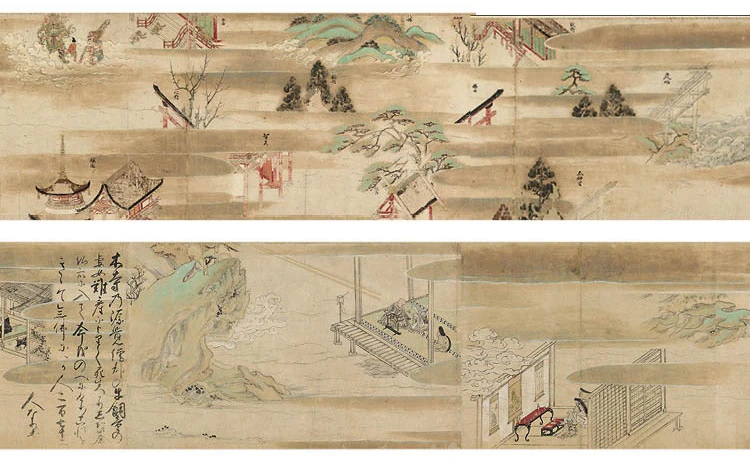
The two details refuse the stillness of an icon. Buildings, clouds, slopes, trees, riders, seated figures, calligraphy, and open paper organise a route. No single photograph can reproduce that route because the complete scrolls extend for more than eleven metres each.
The set narrates the life, death, and miracles associated with the monk Ryōnin and the Yūzū Nenbutsu teaching. The Art Institute of Chicago’s first scroll follows Ryōnin’s religious development and mission. The Cleveland second scroll begins with his death and presents episodes demonstrating the efficacy of his teaching. Cleveland summarises its premise as the interconnection of all things and the spiritual benefit of chanting the name of Amida Buddha for one another.
The work makes an immaterial relation visible. It cannot preserve a medieval voice, but assemblies, journeys, visions, texts, patrons, gold, and colour give recitation material consequence. Sequential viewing turns doctrine into encounters rather than an abstract proposition.
It is tempting to label this “popular Buddhism” in contrast to the elite ritual of Nara or Heian institutions. The contrast is too clean. Accessible recitation could draw broad participation, but monastic lineages, court connections, donors, professional workshops, and later shogunal patrons remained important. The first scroll itself moves from religious retreat toward engagement with the imperial court and a larger sacred-social world.
Later reproduction made the narrative an institutional instrument. Takagishi Akira follows copies made from the fourteenth to sixteenth centuries, showing how memorial rites, fundraising, patrons, calligraphers, painters, and monastic organisers sustained it. Copies renewed relationships and moved the narrative into print, new patronage, and new ritual occasions.
That history makes the scroll a poor illustration for the claim that new religious movements simply replaced old institutions with individual belief. Practice became mobile through an organisation: teachers, reciters, donors, images, texts, places, memories, and bodies. A recent specialist study of the material networks of ritualised words similarly uses Yūzū Nenbutsu imagery to ask how spoken and written invocations acquired visual and physical form.
The two scrolls are now divided between Chicago and Cleveland. Digital juxtaposition reunites details for comparison, but the composite above is not the historical set laid out at once. It removes scale, sequence, mounting, handling, and the distance between present collections. Like the teaching it represents, the work survives through a network—although not the network its makers could have predicted.
Connection is not a one-way arrow
A familiar diagram runs from India to China, from China to Korea, and from Korea to Japan. It captures part of Buddhism’s long-distance movement and distorts the people who made it happen.
Baekje rulers and envoys were not a passive pipe. They selected objects, texts, specialists, and diplomatic occasions. Monks, scholars, and artisans from the Korean Peninsula taught, translated, built, cast, copied, debated, and formed families in the Japanese archipelago. Silla monks travelled to Tang centres and some continued toward India. Japanese monks and envoys crossed directly to Sui and Tang China. Maritime routes, courts, monasteries, merchant communities, migration, alliance, conquest, and shipwreck created multiple directions of travel.
The objects show different kinds of movement:
- Seokguram reorganised cave-sanctuary and sculptural traditions through Silla granite construction and a planned mountain complex.
- Goryeo celadon adapted Chinese kiln and glaze knowledge, then developed vessel profiles and ceramic inlay at a scale rare elsewhere.
- Tōdai-ji depended on earlier transmissions through the peninsula, Nara state institutions, and later Song expertise during reconstruction.
- The Genji scroll joined imported writing technologies and pictorial resources to a vernacular court narrative with local conventions of space and calligraphy.
- Yūzū Nenbutsu scrolls made a Buddhist doctrine of interrelation operative through medieval Japanese teaching, patronage, copying, and recitation.
“Influence” becomes meaningful only when followed by questions: What moved? Who carried it? Under what political conditions? Which local material resisted? Who paid? Who gained authority? What was misunderstood, rejected, or remade?
Movement was not automatically peaceful. Diplomatic gifts could serve rivalry. Conquest displaced people. Courts competed for sacred legitimacy. Skilled migrants did not always move freely. State monasteries drew resources unevenly. Exchange is not a moral compliment; it is a historical relation requiring agents and costs.
Locality, in turn, is not purity. A kiln is local because its clay, workers, firing history, supply system, and patrons meet there—not because nothing foreign enters it. Seokguram and Tōdai-ji are local achievements precisely because they transformed knowledge that had travelled.
Court, monastery, kiln, and scroll compared
| Case | Institution and task | Material system | Movement transformed locally | What the present image hides |
|---|---|---|---|---|
| Seokguram | Silla Buddhist sanctuary; worship, merit, protection, commemoration, authority | Quarried and shaped granite, relief and freestanding sculpture, assembled dome, mountain site | Cave-sanctuary plans and Buddhist iconographies became an artificial granite interior | Approach, ritual sound, changing light, named labourers, modern barrier and environmental controls |
| Goryeo maebyeong | Kiln-to-elite network; containment, display, use, gift, or ritual context not securely known | Iron-bearing clay and glaze, throwing, carved recesses, white and dark slip, reduction firing | Celadon technology and the meiping form became Goryeo proportions, inlay, glaze, and kiln practice | Wasters, kiln crew, fuel, original contents, first owner, secure excavation context, touch and rotation |
| Tōdai-ji Great Buddha | State temple and living monastery; protection, doctrine, study, ritual, political legitimacy | Copper alloy, mould sections, fuel, scaffolding, vast timber halls, donations and provincial resources | Buddhism transmitted through Asian networks became a Nara state system and later a repeated reconstruction project | Most labour, original eighth-century appearance, destroyed fabric, full scale of the compound, living rites |
| Genji handscroll | Court manuscript and viewing setting; reading, painting, calligraphy, literary memory | Paper, mineral and organic colour, ink, decorated sheets, mounting, sequential handling | Writing and pictorial practices became a vernacular narrative environment shaped by Heian court relations | Most of the original cycle, reading pace, adjoining text, touch, audience, frames and later remounting |
| Yūzū Nenbutsu scrolls | Monastic lineage and donor network; teaching, miracle account, memorial, recitation, legitimacy | Long paper rolls, ink, colour, gold, calligraphy, copying, performance and storage | Buddhist recitation and interrelation became narrative, collective memory, and reproducible institutional form | Voice, guided explanation, full eleven-metre sequences, patron network, relation between the now-separated scrolls |
The table does not rank media. It changes the question from “Which civilisation made the more original masterpiece?” to “Which relations had to hold for this work to exist?”
What these five cases leave outside
Five cases cannot represent eight centuries across a peninsula and an archipelago. The exclusions are structural, not minor footnotes.
The Korean route omits Goguryeo tomb murals, Baekje temple and metalworking traditions, Balhae sites, Silla gold and burial culture, Goryeo Buddhist painting, printed scripture, lacquer, metal inlay, textiles, wood architecture, village production, and the material lives of people outside elite and monastic records. Seokguram and celadon can easily make Korean art appear more centralised and refined than the surviving evidence permits.
The Japanese route privileges institutions connected to Nara and Kyoto. It does not adequately cover regional shrines, combined kami-Buddha practice, provincial temples, tomb and domestic archaeology, lacquer, textiles, armour, sculpture, performance, or the changing material worlds of farmers, fishers, craftspeople, and traders. It does not tell northern histories or the emerging Ryukyu networks on their own terms. “Japanese court culture” is not a synonym for life in Japan.
The chapter also brackets later collecting and colonial histories that deserve independent treatment. Korean objects entered Japanese, European, and American collections through markets shaped by unequal power and often poor provenance. Japanese temple and court works were reframed as national treasures under modern institutions. Conservation, archaeology, photography, museum law, restitution debates, and digitisation now determine what can be studied and how.
Those omissions do not make comparison impossible. They set a limit on its claim. The five cases are a route into questions, not a miniature total history.
A working timeline, c. 600–1400
- 538 or 552: Japanese chronicles place the court’s formal reception of Buddhism from Baekje in one of these years; the dating remains source-dependent.
- 660–676: Baekje and Goguryeo fall; Silla consolidates control over much of the peninsula after conflict involving Tang forces.
- 698: Balhae is founded in territories north of Silla and lasts until 926.
- Mid-eighth century: Seokguram is built near Gyeongju under Silla rule.
- 710: The Japanese imperial capital moves to Nara.
- 743–752: Emperor Shōmu proclaims the Great Buddha; casting and the hall proceed toward the 752 consecration at Tōdai-ji.
- 794: The capital moves to Heian-kyō, present-day Kyoto.
- Early eleventh century: Murasaki Shikibu composes The Tale of Genji in a Heian court setting.
- 918: Goryeo is founded; the dynasty lasts until 1392.
- First half of the twelfth century: The surviving Genji illustrated handscroll sections are made.
- Second half of the twelfth century: The inlaid crane-and-cloud maebyeong is produced.
- 1180–1195: Tōdai-ji burns during warfare and is rebuilt under Chōgen; the Buddha is reconsecrated in 1185 and the hall completed in 1195.
- 1185–1333: The Kamakura period conventionally frames the first warrior government, although court and temple power continue.
- Early fourteenth century: The two Yūzū Nenbutsu scrolls now in Chicago and Cleveland are made; related versions and copies continue to circulate.
- 1333–1400: Competing courts and Ashikaga government reshape authority while workshops, monasteries, and narrative projects cross the period boundary.
Terms for looking and reading
- Maebyeong: A Korean vessel form related to the Chinese meiping, usually with a small mouth, full shoulder, and narrowing lower body; “plum bottle” is a conventional English gloss, not a guaranteed function.
- Celadon: High-fired ceramic with an iron-bearing glaze fired to produce colours often ranging from grey-green to blue-green or olive.
- Sanggam: Inlay made by cutting a design into a ceramic body and filling it with contrasting slips before glazing and firing.
- Reduction firing: Firing with limited oxygen, changing how iron and other materials develop colour in the clay and glaze.
- Vairocana: A cosmic Buddha especially important to the Avataṃsaka or Flower Garland tradition; the Great Buddha of Tōdai-ji represents Vairocana.
- Handscroll or emaki: A horizontal work stored rolled and normally viewed in successive sections from right to left.
- Kana: Japanese phonetic scripts that supported vernacular writing and acquired strong, historically constructed associations with women’s court literature and calligraphy.
- Fukinuki yatai: “Blown-off roof,” a modern art-historical term for pictorial interiors shown without roof or ceiling so that rooms and figures become visible from above.
- Nenbutsu or nembutsu: Invocation of Amida Buddha’s name through recitation, contemplation, or related practice; spelling varies with romanisation.
- Engi: An account of the origins, efficacy, or sacred history of a temple, shrine, lineage, or practice; it can be textual, pictorial, performed, copied, and used ritually.
- Provenance: The documented history of excavation, ownership, custody, transfer, and collection. A missing context limits what an object can prove.
Questions to carry to the next object
- Does a country label describe the maker, production place, later collection, or a modern border projected backward?
- What exactly moved: a person, text, image type, technique, object, ritual, or institutional model?
- Who carried it, and did that person travel by choice, diplomacy, trade, migration, or coercion?
- Which local court, monastery, kiln, workshop, or household selected and changed what arrived?
- How did local stone, clay, metal, timber, fuel, or paper alter the possible result?
- What work did the object perform: worship, protection, storage, narration, prestige, teaching, memory, or more than one?
- Which labourers and organisers disappear when the patron receives sole credit?
- Is “influence” supported by a documented route, a material comparison, a stylistic resemblance, or an inherited assumption?
- Has rebuilding or remounting been treated as damage alone, or studied as part of the work’s continuing history?
- Does the digital image preserve scale, sequence, colour, surface, and rights—or quietly replace the object with a new viewing format?
A more defensible conclusion
The five cases do not prove that Korean and Japanese art developed independently of China, nor that all East Asian art belongs to one frictionless shared culture. Both conclusions remove the institutions that made difference possible.
Seokguram turned a transregional Buddhist cosmos into a precisely assembled Silla sanctuary. Goryeo potters converted travelled ceramic knowledge into kiln routines, inlay, and forms that carried local authority. Tōdai-ji made Buddhism a monumental Nara state project and then preserved its identity through repeated transregional reconstruction. The Genji scroll made court society visible through a format that controlled time, access, text, and interior space. Yūzū Nenbutsu scrolls made interdependence into a material network of images, words, patrons, reciters, and copies.
The most useful definition of local change is therefore not isolation. It is the capacity of a community to make consequential decisions about forms that move: where to place them, what to build them from, whom they should serve, how they should be funded, and how they can be remembered.
Connection explains arrival. Institutions explain transformation.
Sources and further reading
The links below prioritise current object records, site authorities, museum scholarship, open catalogues, and specialist research. Object history and image-file rights were checked separately.
- UNESCO World Heritage Centre, Seokguram Grotto and Bulguksa Temple.
- National Museum of Korea, Unified Silla Period.
- Kim Bongryol, National Museum of Asian Art, Buddhist Architecture in Korea.
- Soyoung Lee, The Metropolitan Museum of Art, Korean Buddhist Sculpture, 5th–9th Century.
- The Metropolitan Museum of Art, Maebyeong decorated with cranes and clouds, 11.8.1, and Soyoung Lee, Goryeo Celadon.
- Tokyo National Museum, The Arrival of Buddhism, 6th–8th century, and Culture of the Korean Peninsula in Japan.
- Tōdai-ji, History, The eighth century, and The twelfth to fourteenth centuries.
- UNESCO World Heritage Centre, Historic Monuments of Ancient Nara: comprehensive preservation and management plan.
- Tokugawa Art Museum, The Tale of Genji Illustrated Handscrolls: exhibition and conservation guide.
- John T. Carpenter and Melissa McCormick, eds., The Metropolitan Museum of Art, The Tale of Genji: A Japanese Classic Illuminated.
- Art Institute of Chicago, Legends of the Yūzū Nembutsu Sect, 1956.1256.
- Cleveland Museum of Art, The Illustrated Miraculous Origins of the Yūzū Nenbutsu School, 1956.87, and Shinto Masterworks.
- Takagishi Akira, “The Reproduction of Engi and Memorial Offerings: Multiple Generations of the Ashikaga Shoguns and the Yūzū nenbutsu engi emaki”, Japanese Journal of Religious Studies 42, no. 1 (2015).
- Susan Dine, “Ritualized Word: Material Networks in Thirteenth-Century Japan”, Hualin International Journal of Buddhist Studies 7, no. 2 (2024): 254–293.
Editorial record
About this article
- Author
- Publisher
- GeMarkt
- Published
- Updated
- Reviewed
- Internal source & rights check. Conducted by GeMarkt Research Review. This is an internal editorial check—not independent peer review.
- Source standard
- Art history source standardPrioritises object records and research sources, distinguishes evidence from interpretation, and states material uncertainty.
Found a claim that needs checking? Report a factual error.