Art History · Learning chapter
Methods · 4 of 6
How to research an artwork: from object record to source map
A practical method for moving from a museum object record to a transparent source map, claim ledger, and defensible art-historical argument.

What we’ll look at
How do you build reliable research from one museum record?
A young woman turns from her drawing board and looks directly at us. When the painting entered the Metropolitan Museum of Art in 1917, it carried the authority of Jacques Louis David’s name. By the middle of the twentieth century, the attribution had collapsed. For decades the canvas was commonly called Young Woman Drawing. The Met’s record now identifies Marie Denise Villers as the painter and Marie Joséphine Charlotte du Val d’Ognes as the sitter.
The paint did not rearrange itself each time the catalogue changed. Evidence was found, weighed, disputed, and connected differently.
That history makes the portrait an ideal lesson in research. An online record can give you a maker, title, date, material, dimensions, accession number, provenance, references, and a high-resolution image in seconds. It can also conceal decades of argument behind one clean line. If you copy the line without following its trail, you receive the conclusion but not the reasons.
Research begins when a fact becomes a question. Who supplied this attribution? What evidence supports the sitter’s name? Which older records use other titles? What would change the current conclusion? A useful answer is not a large pile of links. It is a source map: a visible relationship among the object, your questions, the evidence, the people who interpret it, and the claims you can responsibly make.
The object record is a beginning, not a verdict
A museum record has genuine authority. Curators, conservators, registrars, archivists, photographers, rights specialists, translators, researchers, and community partners may all contribute to it. An accession number links a public page to internal documentation and a physical object. Measurements and credit lines are usually more reliable there than in an uncredited image post.
But the record is also a publication with a history. Fields can be incomplete. A short “artist” line may compress a debated attribution. “From” can mean excavated at a documented place, reportedly collected there, culturally associated with the region, or simply catalogued that way. A date may derive from an inscription, laboratory analysis, style, archaeology, or convention. Provenance entries may contain gaps. Search interfaces may expose only part of the underlying file.
The Met itself tells users that its online records reflect continuing research. The Art Institute of Chicago likewise describes object information as work in progress. This is not a weakness to exploit. Revision is a sign that a collection record can respond to new evidence.
Treat the record as three things at once:
- an identity anchor for the exact object;
- a map of leads through fields, references, names, and histories;
- a dated scholarly statement that you should record and, for consequential claims, test.
Your first citation can be the museum. Your last source usually should not be.
Freeze the object’s identity before you search
Many research errors begin before interpretation. A student saves an attractive image, searches a short title, and unknowingly combines facts from another version, impression, cast, restoration, or object with the same name.
Create an identity block before opening ten tabs:
| Field | Record it exactly |
|---|---|
| Current maker or culture line | Include qualifiers such as “attributed to,” “workshop of,” “probably,” or “unknown” |
| Current title | Preserve diacritics and series, manuscript, building, or set information |
| Date | Include “ca.” and ranges |
| Material and dimensions | Distinguish object measurements from image pixels |
| Holding institution and department | Note whether the object is still in the collection |
| Accession or inventory number | Your strongest cross-title identifier |
| Canonical object URL | Prefer the institution’s stable page |
| Record access date | The live page may change |
| Image source and rights | Record separately from copyright in the underlying artwork |
For the Villers portrait, 17.120.204 remains useful while artist and title labels change. The current object title includes the sitter’s full name; older scholarship may use Young Woman Drawing, Portrait of Charlotte du Val d’Ognes, or a title associated with David. Searching only the newest title would miss the argument that produced it.
One object can have several identifiers. Record catalogue raisonné numbers, excavation numbers, previous collection numbers, IIIF manifest URLs, or database IDs when available. They are not decoration. They let you follow the same thing across changing vocabularies.
Turn a topic into answerable claim types
“Research this artwork” is too broad. Divide the task into claims that need different evidence.
Identity
Who or what made it? Which version or object is this? What does the title name: an original title, translated title, later description, sitter, subject, or popular nickname?
Material and making
What is it made from? How was it constructed? What alterations, repairs, pigments, tool marks, supports, printing states, or workshop hands can technical study detect?
Original situation
Where, for whom, and for what action was it made? Was it worn, folded, installed, carried, buried, exchanged, prayed before, performed, published, or sold? What evidence survives for that function?
Historical relation
Which institutions, events, ideas, networks, or visual practices help explain the object? Do not ask a period label to act as the cause; name the mechanism.
Ownership and movement
What is known about excavation, custody, market transfer, seizure, export, donation, acquisition, restitution, and present cultural authority? A blank interval is a finding, not permission to invent continuity.
Reception and knowledge
How have titles, attributions, displays, publications, copies, reproductions, criticism, or community interventions changed what the object means?
Select two or three claim types. Research becomes manageable when you know what kind of answer you are trying to earn.
Worked example: build a source map for the Villers portrait
In brief: This example follows a portrait of a woman that Marie Denise Villers exhibited at the Paris Salon in 1801 and that is now at the Met in New York. Changes in the names assigned to its artist and sitter show why source tracking matters.
The painting offers an unusually legible trail because its public identity has changed so dramatically. It is also a warning against telling a triumphant detective story. The present attribution and sitter identification are well argued; they are not magically immune from future revision.
Start with a bounded question:
How did the painting’s attribution and title change, and what kinds of evidence support its present identity?
That question needs at least four source roles:
- the current object record for present cataloguing and physical identity;
- older catalogues or archival records for previous identities;
- named scholarship that argues for a change;
- a later scholarly account that assesses the remaining uncertainty.
It does not initially require a general biography of David, a list of every woman artist in Paris, or a psychological reading of the sitter’s gaze. Those may become relevant later. Beginning with them would bury the actual research problem.
Step one: read every field in the live record
The Met object page identifies the maker as Marie Denise Villers, dates the oil painting to 1801, gives its dimensions as 161.3 by 128.6 centimetres, and links it to accession number 17.120.204. The credit line says it entered through the 1917 bequest of Isaac D. Fletcher. The page marks the image Public Domain and supplies further sections for catalogue information, provenance, exhibitions, references, and notes.
The overview makes two distinct historical claims. Villers exhibited the work at the 1801 Salon under her name; the painting was later wrongly attributed to David, an identification maintained until the 1950s. Those sentences point toward a Salon record, old museum catalogues, and the scholarship that dismantled the David attribution.
Do not copy only the first visible paragraph. Expand accordions. Look for notes attached to dates. Separate “artist,” “culture,” and “geography.” Check whether the record distinguishes object date from acquisition date. Inspect the reverse or detail images when provided. Read the provenance syntax: question marks, brackets, “possibly,” and “by descent” all carry meaning.
Record what the page does not settle. In this case, the current label does not reproduce the full chain of reasoning within its short overview. It gives conclusions and routes to deeper records. That gap defines the next search.
Step two: follow the attribution trail backward
Search the accession number in quotation marks. Then repeat with older titles and names. The fixed identifier connects sources that disagree verbally.
Anne Higonnet’s open-access essay “Through a Louvre Window” reconstructs several stages. In 1951, Met curator Charles Sterling publicly questioned the David attribution and tentatively proposed a woman painter. The picture continued to be valued and displayed while its maker became uncertain. It was retitled Young Woman Drawing, a title that described the visible action without claiming an identity the museum could no longer defend.
Margaret Oppenheimer then connected the painting to Marie Denise Villers. Higonnet cites Oppenheimer’s June 1995 letter in the Met dossier and her 1996 article, “Nisa Villers, née Lemoine (1774–1821),” in the Gazette des Beaux-Arts. That is a citation trail: a later open essay identifies an earlier scholarly argument and an archival communication. If you can access the 1996 article, read it rather than allowing the later summary to stand in for it.
Higonnet’s own research contributed to the Met’s decision to restore Charlotte du Val d’Ognes as the sitter. The current title therefore contains more than a name. It records a sequence of scholarly interventions.
Step three: let disagreement change the question
The easy story is that a famous man’s name was removed and the correct woman’s name was discovered. The evidence demands a more interesting account.
Higonnet accepts the Villers and du Val d’Ognes identifications seriously while stating that crucial evidence is missing and absolute certainty remains unavailable. She shifts attention from solving authorship alone to the painting’s representation of a woman artist. Dated fashion plates, the Louvre’s architecture, the sitter’s tools, the Salon, and the social conditions of women’s artistic training become part of the argument.
This is what strong research does: disagreement does not merely produce a winner. It changes the scale and vocabulary of the question.
A source map for the portrait might therefore contain three statuses:
- Established in the current institutional record: dimensions, medium, accession, present title, present attribution.
- Strong scholarly interpretation: the Villers attribution and du Val d’Ognes identification, with an explicit evidence trail.
- Open question: exactly how the artist, sitter, studio location, Salon entry, and depicted act relate; future archival or technical evidence could refine the answer.
Your prose should preserve those differences. “The Met attributes” is not evasive. It names the authority and the current state of the claim.
Source authority depends on the claim
There is no universal pyramid in which one source type wins every time. Authority depends on how well a source fits the question.
| Claim | Usually start with | Then test with |
|---|---|---|
| Dimensions and accession | Holding institution’s object record | Registrar or collection catalogue if discrepancy matters |
| Pigment or construction | Conservation report or technical study | Methods, sample locations, images, and named specialists |
| Artist’s stated intention | Dated letter, diary, contract, or interview | Reliable edition, translation, context, and later scholarship |
| Excavated findspot | Field notes, excavation report, context register | Later archaeological reassessment and site history |
| Attribution | Signed/documented evidence and catalogue raisonné | Technical study, provenance, comparison, and competing arguments |
| Community meaning or protocol | Relevant community authority and knowledge holders | Community-led museum research and ethically governed documentation |
| Ownership history | Archival inventories, sale records, labels, stamps, export files | Provenance databases and critical historical scholarship |
| Broad interpretation | Named peer-reviewed or scholarly publication | Other interpretations, object evidence, and explicit limitations |
The Association of College and Research Libraries calls this principle “Authority Is Constructed and Contextual”. A museum curator may be the right authority for a catalogue history; a conservator for paint stratigraphy; an archaeologist for excavated context; a living community for its own protocols and relationships; an artist’s letter for what the artist wrote at a particular moment. None automatically answers every other question.
Credentials matter. So do proximity, method, transparency, and accountability.
Case one: a small ostracon with a large excavation trail
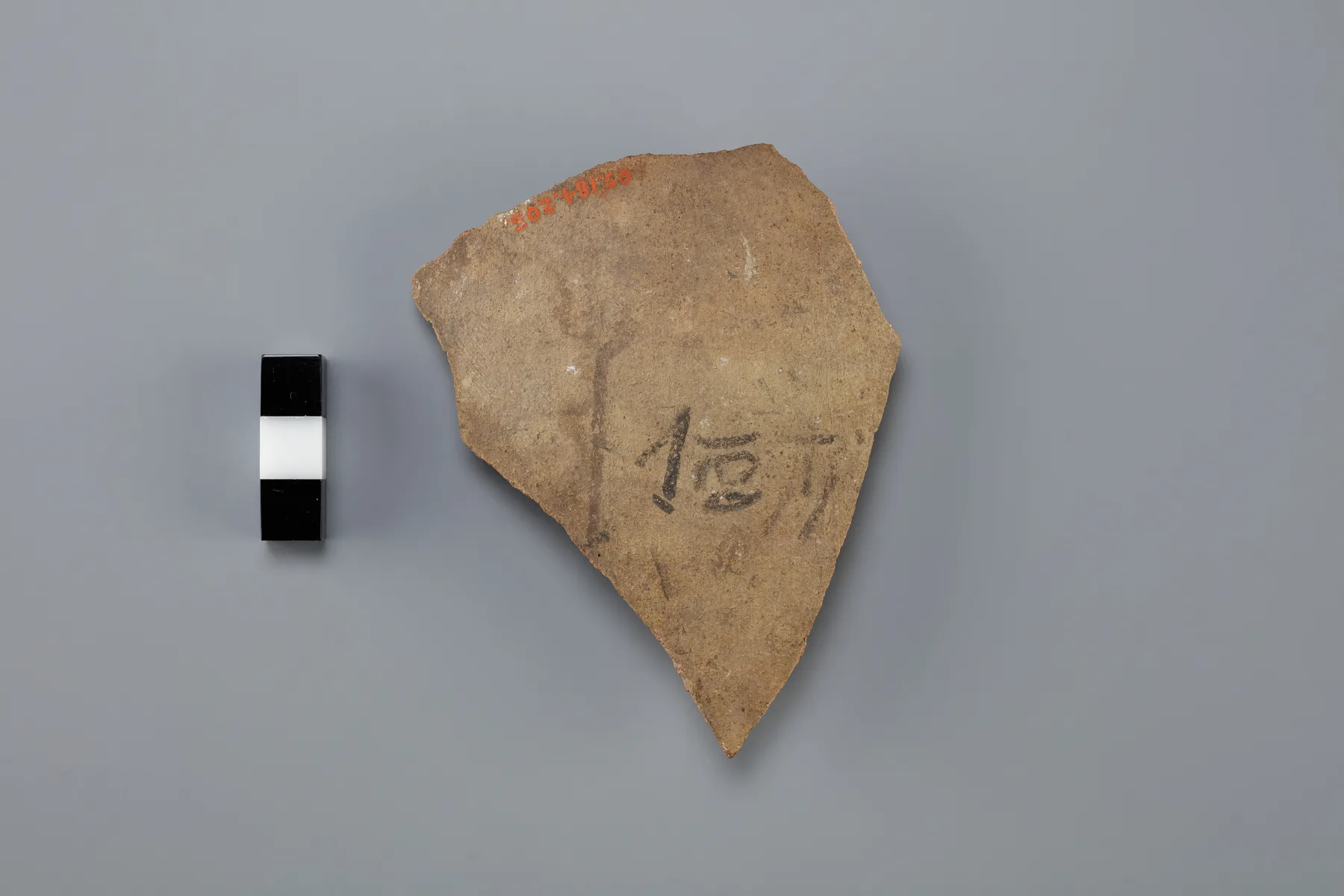
The object looks modest: a broken piece of pottery bearing a dark mark. The Met record gives the generic title Ostracon, assigns it to Dynasty 18, and dates it approximately 1550–1300 BCE. The crucial field is geography. It offers several possible contexts in the Valley of the Kings: workmen’s huts near KV 55, an area between KV 18 and KV 21, or chip heaps in the same branch of the valley, associated with Davis and Ayrton’s 1907–08 excavations.
That “or” is more informative than a confident but invented findspot. It tells you the catalogue carries uncertainty inherited from excavation or later documentation.
The next research steps are now specific:
- find Davis and Ayrton expedition publications and archival records for the season;
- identify whether the painted accession number maps to a lot, basket, or distribution list;
- compare other objects with adjacent accession numbers;
- consult a specialist before identifying or translating the mark;
- distinguish ancient ink from the modern red collection number and photographic scale.
The photograph supports observation of shape, surface, marks, and documentation. It does not prove what the sign means. A source map stops the eye from promoting resemblance into translation.
Case two: a Māori house post and the limits of institutional authority
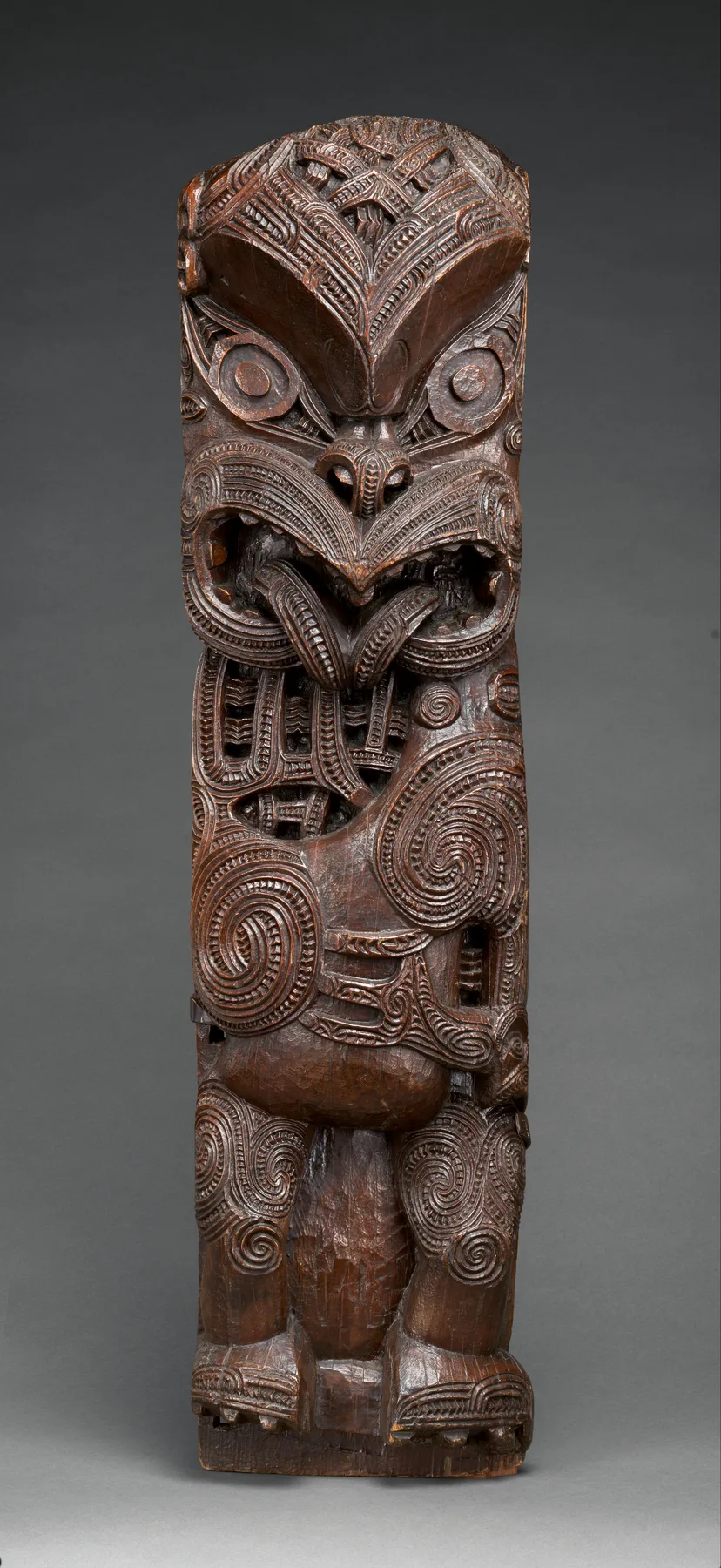
The Met catalogues this carved amo as the work of a Māori artist from Te Arawa, made around 1800 in Aotearoa New Zealand. The record explains that it once belonged to a meeting house and may depict an ancestor or warrior. Those are valuable leads. The qualifiers matter: “may” is not a name.
An institutional record outside Aotearoa cannot by itself supply every relationship the carving holds. Which house did it belong to? Which iwi, hapū, or whānau has authority to name the ancestor, narrate the carving, or define appropriate access and reuse? Was information withheld, never recorded, or separated from the object during collection? The public page does not answer those questions.
Te Papa’s mātauranga Māori research programme treats tribal and community connections, customary practice, conservation, and the reconnection of people with taonga as research—not as optional colour added after cataloguing. Local Contexts Traditional Knowledge Labels provide a community-governed way to express attribution, authority, protocols, permissions, and responsibilities around cultural heritage.
Do not attach a TK Label yourself or assume one applies to this object. The lesson is methodological: community authority is a source relationship, not a keyword. A careful researcher can record the Met’s statement, seek Māori-led scholarship and relevant authorities, and leave specific identity open when consultation has not occurred.
Search names, titles, languages, and identifiers
Search engines reward the most repeated wording. Research requires deliberate variation.
Build a query sheet:
- current and former titles;
- original-language title, transliterations, and translated variants;
- artist’s birth name, married name, aliases, workshop, dynasty, community, or guild;
- sitter, patron, site, series, building, expedition, and collector names;
- accession, inventory, catalogue raisonné, excavation, and archival numbers;
- material and technique terms used in the relevant field;
- likely historical spellings and diacritics.
The Getty Union List of Artist Names records preferred and variant names for people and organisations connected to art. It is a discovery tool, not proof that two historical identities are identical. Use it to generate searches, then confirm the relationship in scholarship.
Quotation marks are powerful for identifiers and exact phrases. Remove them when spelling varies. Search an accession number both with and without punctuation. Add filetype:pdf for catalogues and reports, a trusted domain for institutional resources, or an author’s surname once you enter a citation network.
Do not translate culturally specific terms into the nearest English category and discard the original. Keep both. The words amo, taonga, iwi, hapū, and whānau carry relationships that “post,” “treasure,” “tribe,” “subtribe,” and “family” do not reproduce exactly.
Follow citations backward and forward
When a source makes an important claim, ask two questions.
Backward: What earlier evidence does it cite? Follow footnotes to the excavation report, letter, catalogue entry, technical analysis, archival inventory, or argument it interprets. Do not cite a recent summary for an old primary statement if you have access to the primary source and can understand its context.
Forward: Who has cited, corrected, challenged, or extended it? A foundational attribution may have been refined. A pigment identification may have been superseded by a better method. A provenance claim may have changed after an archive opened or a restitution investigation began.
The Villers trail illustrates both directions. Higonnet points backward to Oppenheimer’s article, the Met dossier, Sterling’s catalogue history, Salon evidence, fashion plates, and museum records. A researcher can then look forward for responses to Higonnet’s sitter identification and the Met’s revised catalogue.
Read around the quoted page. A citation may support only one sentence, include a qualification omitted by later writers, or present an interpretation as provisional. Record page numbers while the source is open. “I saw it somewhere in the article” is how accurate research becomes unverifiable prose.
Build the source map
A source map is not a bibliography. A bibliography lists what you read. The map states what each source is doing.
| Research question | Evidence needed | Source found | Authority and limits | Status |
|---|---|---|---|---|
| What exact object is this? | Current collection identity | Met object record, 17.120.204 | Holding institution; live and revisable | Confirmed for present catalogue |
| Why Villers? | Attribution argument | Oppenheimer 1996, located through Higonnet | Named specialist; obtain full article before detailed use | Strong, reading pending or complete |
| Why name du Val d’Ognes? | Sitter-identification argument | Higonnet 2016 | Open scholarly essay; acknowledges uncertainty | Strong interpretation |
| What appeared at the Salon? | Contemporary catalogue entry | 1801 Salon record cited in scholarship | Primary source; wording and object match require checking | Open until inspected |
| What does technical study show? | Conservation imaging and material report | None yet | Absence cannot be filled by visual guesswork | Research gap |
Use links or full citations in the real sheet. Add page, figure, archive box, image number, and access date. If a source is paywalled or unavailable, mark that plainly. A citation seen only through another author is not consulted.
The map prevents source inflation. Ten museum essays repeating the same record are not ten independent confirmations. Trace shared claims back to their origin.
Keep a claim-evidence ledger
The source map organises research questions. The ledger controls the sentences you intend to publish.
| Draft claim | Evidence | Strength | Wording decision |
|---|---|---|---|
| The Met currently attributes the portrait to Villers | Current object record | Direct for catalogue status | “The Met attributes…” |
| Villers certainly painted it | Scholarly attribution with acknowledged missing evidence | Strong but not absolute | Do not write “certainly” |
| The sitter is du Val d’Ognes | Higonnet’s argument and current title | Strong, revisable | Name her; note attribution history where relevant |
| The room is a Louvre studio | Visual and architectural argument | Interpretive | “May represent…” or explain evidence |
| The sitter feels trapped | Viewer inference | Unsupported psychology | Remove or recast as analysis of enclosure and gaze |
Every consequential factual sentence should have a row while drafting. The ledger makes three problems visible: a claim with no source, a source that does not quite support the wording, and one source asked to carry too much argumentative weight.
You will not publish the ledger. Its value lies in slowing the moment when notes become certainty.
Evaluate each source with six tests
Proximity
How close is the source to the object, event, material sample, person, community, or archive? Proximity can offer access and also introduce interest or bias.
Expertise
What knowledge does the author or institution have for this exact claim? “Museum” is not a single expertise. Departments, communities, laboratories, and disciplines differ.
Method
Does the source explain how it knows? Look for sample selection, imaging method, archival citation, comparison set, translation principles, consultation process, and uncertainty.
Transparency
Can you identify the author, date, publication context, references, corrections, conflicts, and rights? Anonymous certainty deserves less trust than named, inspectable reasoning.
Fit
Does the evidence support your sentence at the same scale? A pigment test on one sample cannot establish the colour of every area. One court inventory cannot describe all households.
Independence and conversation
Are several sources independently examining evidence, or copying one statement? Do credible scholars disagree? The ACRL framework describes scholarship as a conversation because knowledge develops through sustained exchange, not isolated verdicts.
Scorekeeping can mislead; use short notes instead. “Excellent for dimensions, silent on original function” is more useful than “8/10 source.”
Digital records move, so preserve a research snapshot
An online collection page may change title, attribution, URL structure, image, or explanatory text without giving you a visible version history. Build a small audit trail.
For every important web source, record:
- author or responsible institution;
- page or document title;
- stable object identifier and canonical URL;
- publication or update date when supplied;
- date you accessed it;
- the exact field, page, figure, or passage used;
- a local note or permitted snapshot sufficient to recover your reasoning;
- image rights and credit as a separate field.
IIIF can help with stable digital object structure. The IIIF Presentation API’s manifest can bundle metadata, rights information, image canvases, and sequence. It is valuable for comparison and citation, but a manifest still reflects an institution’s metadata at a point in time. Save its URL and access date; do not assume the JSON is an eternal archive.
For sources likely to change, quote only the minimum necessary in your notes and preserve enough context to avoid later misreading. Respect access controls, cultural protocols, and copyright. “Available online” does not mean “free to republish.”
Use AI as an index, never as invisible evidence
A generative system can help produce alternate search terms, translate a tentative query, turn your own notes into a table, or point toward databases you may have overlooked. It can also invent article titles, merge similarly named objects, fabricate page numbers, omit qualifiers, and present repeated web text as independent confirmation.
Use a strict boundary:
If a reader cannot follow the claim from your citation to the underlying evidence without trusting the AI system, the claim is not ready.
Never let a generated bibliography enter your notes unverified. Open each source. Confirm author, title, venue, year, volume, pages, DOI or stable URL, and relevance. Search quoted language in the original. If the full source is unavailable, mark it unseen.
AI output is a research lead, not provenance. When a tool materially shapes translation, coding, image analysis, or method, disclose that role according to your institution’s rules. The polished sentence remains your responsibility.
Common research failures
Starting with interpretation before identity
You may write beautifully about the wrong version. Lock the object first.
Treating the first record as the whole archive
Expand every field, follow references, search the accession number, and look for conservation, exhibition, and collection publications.
Collecting links without assigning jobs
A folder of twenty tabs is not a source map. Record the question and claim each source can support.
Ranking formats instead of evaluating authority
A peer-reviewed article is not automatically the best source for an object’s current dimensions. A community statement may carry authority a distant article lacks. Match source to claim.
Hiding disagreement
Do not average two dates or silently choose the most convenient attribution. Name the positions and explain why you use one.
Quoting an artist as the final meaning
An artist’s statement is primary evidence for what was said at a moment, not a command that ends interpretation. Compare intention with the object, audience, context, and later reception.
Confusing image evidence with object evidence
A reproduction changes scale, colour, surface, angle, lighting, cropping, and sometimes orientation. State what the image permits you to see.
Filling a gap with plausibility
The ostracon’s mark looks meaningful. Without specialist evidence, “unidentified mark” is the stronger result.
A sixty-minute research sprint
This sprint produces a map, not a finished essay.
Minutes 0–10: identity. Create the object block. Save the canonical record, accession number, image source, and rights. List title and name variants.
Minutes 10–20: questions. Choose three claim types. Write one answerable question for each and name the evidence required.
Minutes 20–35: trails. Expand the museum record, follow its references, search exact identifiers, and locate one strong scholarly source. Search a relevant community or site authority where appropriate.
Minutes 35–45: map. Put each source into the source-map table. Mark direct evidence, interpretation, disagreement, dependency, and gaps.
Minutes 45–55: ledger. Draft five factual claims. Match each to evidence and adjust wording to its strength.
Minutes 55–60: next actions. Write the three most valuable searches or consultations still needed. Stop browsing when new pages merely repeat what you already have.
A productive hour ends with fewer but better questions.
Practice task: produce a defensible source map
Choose an artwork with a substantial institutional record. It may be from your course, a local museum, or a collection relevant to your community.
Submit four parts:
- Identity block: exact current catalogue data, accession number, URL, access date, image source, and rights.
- Question set: one identity, one material or functional, and one reception or ownership question.
- Source map: at least six sources with roles and limitations. Include one primary or technical source, one named scholarly argument, and an appropriate local, site, or community authority where relevant.
- Claim ledger: six publishable claims labelled direct, strongly inferred, contested, or open.
Add a 200-word research note answering: Which source changed your question most, and why? Do not reward the longest bibliography. Reward the clearest relationship between evidence and claim.
For an advanced version, find two historical catalogue entries for the same accession number. Compare title, maker, date, culture, and description field by field. Changes in metadata are part of the object’s reception history.
What a strong research paragraph sounds like
A weak paragraph borrows the certainty of a catalogue:
Marie Denise Villers painted this portrait of Charlotte du Val d’Ognes in a Louvre studio in 1801. It was wrongly thought to be by David until scholars discovered the truth.
The sentence collapses present attribution, sitter identification, location, and a long scholarly history into one solved fact.
A stronger version keeps the evidence visible:
The Met currently attributes the 1801 portrait to Marie Denise Villers and identifies its sitter as Marie Joséphine Charlotte du Val d’Ognes. The painting entered the museum under David’s name, but Charles Sterling challenged that attribution in 1951; Margaret Oppenheimer’s 1996 study later argued for Villers. Anne Higonnet’s reconstruction of the catalogue history helped restore du Val d’Ognes’s name while retaining uncertainty around parts of the identification. The shifting label is therefore not administrative noise: it records how institutional cataloguing, feminist scholarship, archival evidence, and close study have repeatedly changed the painting’s art-historical position.
That paragraph names authorities, dates the interventions, distinguishes current catalogue status from absolute certainty, and explains why the research history matters.
Terms for research
- Accession number: a stable identifier assigned when an institution formally enters an object into its collection.
- Authority file: a structured record linking preferred and variant names for people, organisations, places, or subjects.
- Catalogue raisonné: a scholarly catalogue that aims to account for the works of an artist or defined body of work; it remains an argument that can be revised.
- Collection record: an institution’s structured account of an object, its identity, management, and research.
- Concordance: a cross-reference connecting different numbering or cataloguing systems.
- Finding aid: a guide to the organisation and contents of an archive, usually at collection, series, box, or folder level.
- IIIF manifest: a machine-readable package describing digital objects, structure, metadata, images, and often rights information.
- Primary source: evidence produced in the time, process, or event under study; “primary” describes relation, not automatic truth.
- Provenance: the history of ownership and custody; distinct from archaeological find context.
- Source map: a working model that connects questions and claims to evidence, authority, limits, and research status.
- Technical study: examination using conservation knowledge, imaging, sampling, or scientific analysis to investigate material construction and change.
- Variant title: another title used for the same object, often reflecting translation, cataloguing history, attribution, or reception.
Source guide
- Begin with the holding institution’s canonical record. Save the accession number and read every expanded field.
- Use the Getty Research Portal to locate freely digitised art-historical books, catalogues, and related literature from many contributing libraries.
- Use Getty ULAN and other transparent authority files to discover name variants without mistaking controlled vocabulary for final historical proof.
- Use object bibliographies, footnotes, catalogues raisonnés, technical reports, excavation publications, archival finding aids, and primary documents to move closer to the evidence behind a claim.
- Use IIIF resources when institutions supply manifests for high-resolution viewing, comparison, metadata, and stable digital structure.
- For Indigenous cultural heritage, seek relevant community authority and community-led institutions. Te Papa’s taonga Māori research and Local Contexts demonstrate why access, attribution, and protocol are part of research method.
- Use the Getty Provenance Index for leads in dealer stock books, sales catalogues, and archival inventories, then inspect the underlying records and scope.
- Use a citation manager or structured spreadsheet, but keep your own notes on what each source proves. Software can store a citation; it cannot decide whether the citation fits the sentence.
Continue the methods route
Begin with How to analyse a work of art when you need to separate observation from inference. Use How to compare two artworks to organise evidence around a shared question, and Who makes an art period? to test the chronological labels found in your sources.
The next Methods chapter examines the point where identity and ownership become ethically urgent: provenance, attribution, and restitution. It will ask how an object’s documented movement changes its interpretation, what a gap in custody can and cannot prove, and how museums, source communities, states, heirs, and scholars make competing claims.
Editorial record
About this article
- Author
- Publisher
- GeMarkt
- Published
- Updated
- Reviewed
- Internal source & rights check. Conducted by GeMarkt Research Review. This is an internal editorial check—not independent peer review.
- Source standard
- Art history source standardPrioritises object records and research sources, distinguishes evidence from interpretation, and states material uncertainty.
Found a claim that needs checking? Report a factual error.