Art History · Learning chapter
Atlas I — Foundations and ancient worlds · 8 of 10
Early Chinese art: from Shang ritual bronze to Han tomb worlds
Five works show how early Chinese makers materialised divination, ancestry, inscribed memory, imperial labour, and the afterlife.

What we’ll look at
How did writing, bronze, armies, and tomb models organise power in early China?
The vessel seems ready to move before anyone touches it. A beaked head rises above the spout. Wings, coils, eyes, claws, and smaller creatures cross a body that is also a container. Lift the lid, fill the hollow interior, tilt the handle, and the animal becomes an action: liquid passes through a cast bronze body into a ceremony.
Behind museum glass, it is easy to call this a masterpiece and stop. Yet ore, mould clay, fuel, furnaces, specialists, food or drink, participants, and a recognised ritual occasion all had to converge. The bronze did not merely picture authority. It helped authority happen.
That distinction links five unlike cases: a divination bone, a Shang wine vessel, a Western Zhou grain vessel with a hidden text, the First Qin Emperor’s terracotta army, and a Han tomb watchtower. They share no timeless style; each gives durable form to relations that cannot be seen directly.
This guide therefore asks:
How did early Chinese makers make relations among rulers, ancestors, written memory, organised labour, and the dead materially operative—and what disappears when surviving objects are isolated from the systems that made them work?
This route runs from the late second millennium BCE to the early third century CE. It focuses on political centres in present-day Henan and Shaanxi. Here, “China” is geographic shorthand, not a modern national identity projected backwards.
The selection does not represent Sichuan bronzes, Chu, Yue, Dian, northern border regions, or societies far from royal capitals. Silk, lacquer, wood, architecture, clothing, and household objects survive less often than bone, bronze, and clay. Four museum records also lack a documented excavation context. Those gaps shape what we can know.
Dynasties are coordinates, not a style ladder
The labels Shang, Zhou, Qin, and Han identify ruling houses and broad chronological-political contexts. They do not name four sealed visual cultures, each replacing the last with a more advanced style.
The conventional Shang range is about 1600–1046 BCE, although archaeology works more precisely through sites and phases. Yinxu near Anyang supplies the largest early corpus of oracle bones and extensive evidence for royal production, burial, sacrifice, and craft. Its visibility does not make the court equivalent to everyone later maps colour “Shang.”
Zhou conquest changed political authority without discarding every Shang form, workshop practice, vessel, or ancestral claim. Inheritance and transformation varied across centuries and regional courts; “Zhou art” is not one look.
Qin created an imperial order in 221 BCE and ended in 206, while practices and problems continued into a Han dynasty that itself changed across four centuries. Chronology helps ask what persisted or was reworked; it fails when a Han tomb model becomes the destined improvement of a Shang bronze.
A crack, a question, a record: writing as an event
In brief: The first example is a marked animal-bone fragment attributed to the Shang period; the museum gives no exact date or findspot. Better-documented bones show that around 1200 BCE similar pieces were heated for divination and inscribed with questions and results.
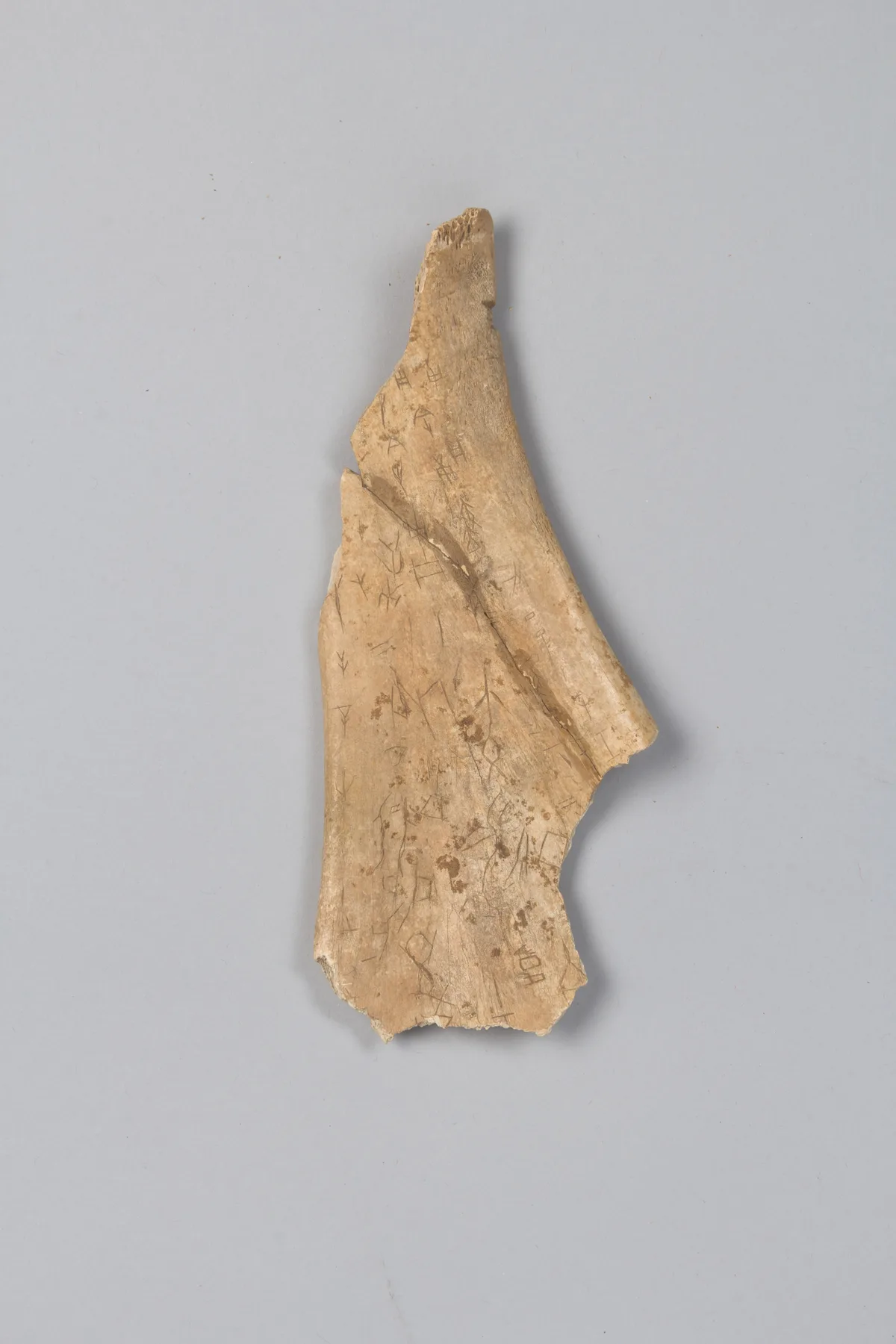
The marks on this bone are not evenly spaced typography. They turn around breaks, occupy changing strips of surface, and sit beside the physical consequences of heat and handling. The fragment asks to be seen as the residue of a procedure, not as a detached page of literature.
Most oracle bones are prepared cattle scapulae or turtle plastrons. Heat applied to drilled hollows produced cracks interpreted against a spoken charge concerning rain, harvest, warfare, illness, sacrifice, or another court concern. Scribes might add date, diviner, charge, prediction, or later verification. Because survival varies, scholars reconstruct the procedure across groups rather than impose one complete formula on every fragment.
The National Museum of Asian Art’s three-dimensional resource places divination within kingship and administration. Writing did not merely report the ritual: it organised questions, preserved decisions, named actors, and archived royal communication with powerful beings.
Animal bodies became prepared material; craftspeople thinned, hollowed, heated, and incised them; diviners turned cracks into counsel; scribes made events durable. Authority came from that chain, not beautiful signs alone.
Inscriptions around 1200 BCE form the earliest substantial surviving corpus of clearly recognisable Chinese writing. They are neither the first spoken words nor proof that script appeared from nothing at Anyang. Resemblance between earlier isolated marks and later signs does not establish an unbroken script; descent from some Shang graphs does not mean writing stayed unchanged.
Royal divination reveals kings and ritual specialists, not a diary of farmers, craft workers, captives, or neighbouring communities. Even harvest questions reach us through court power.
The Met record gives no excavated findspot or published reading. Its material belongs to the oracle-bone tradition, but its question and king cannot be invented from appearance. The fragment is eloquent partly because it refuses false fluency.
A bronze animal that organised more than vision
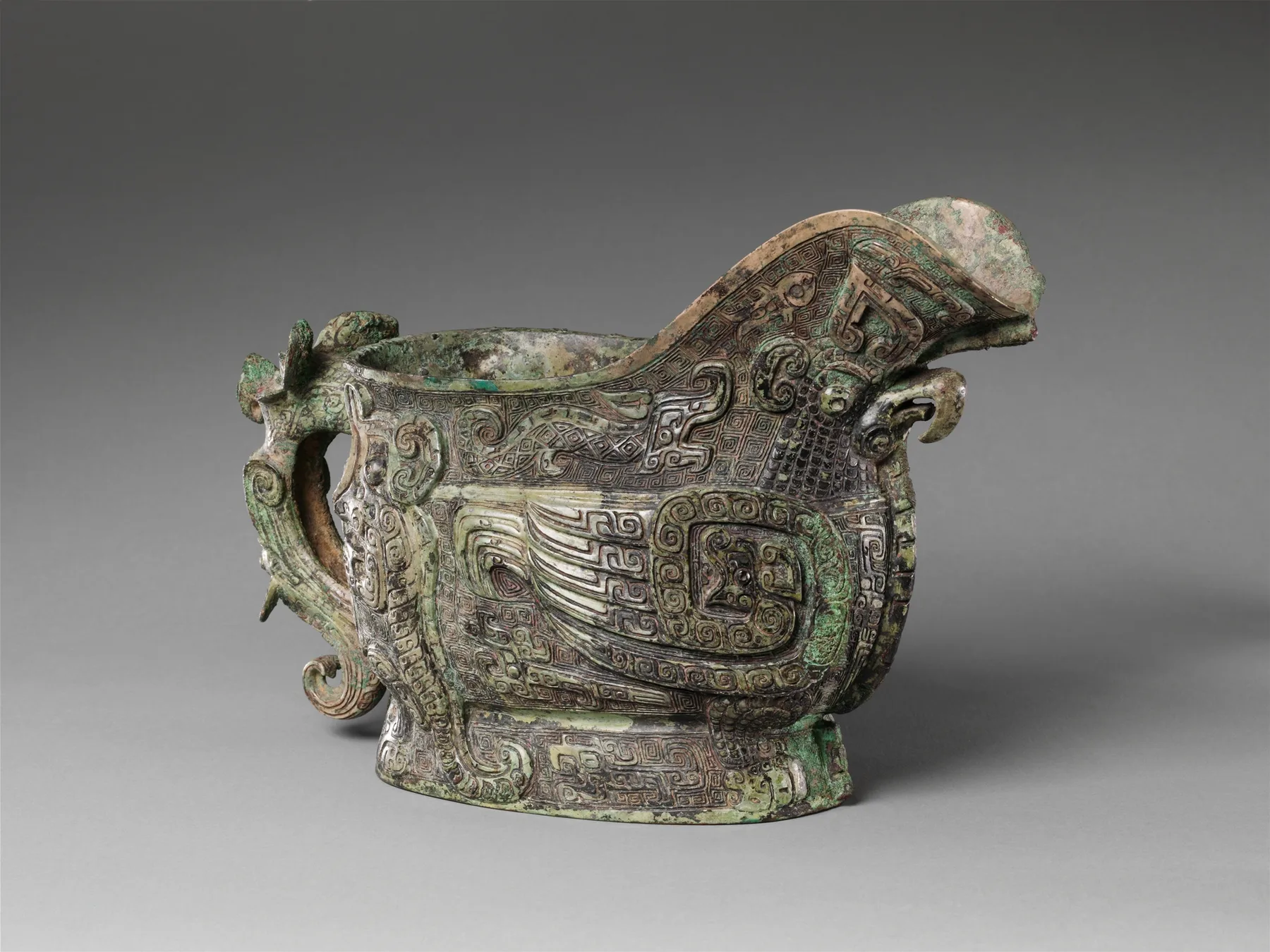
The gong does not carry one animal placed on one vessel. Container and creature are difficult to pull apart. An owl-like head projects below the spout; curling bodies and hooked forms cross the sides; a handle turns another animal into a point of touch. Pattern changes scale as the eye moves, so that a large body can contain smaller bodies without becoming a simple illustration.
The mask-like configuration called taotie appears on many Shang and Zhou bronzes, but the name comes from later texts and its Bronze Age use is modern convention. Protective beings, lineage signs, transformation, ancestors, animals, and technical display have all been proposed; no Shang dictionary decodes every mask, bird, horn, or spiral.
Function gives firmer ground. Bronze vessels held, heated, mixed, served, or offered food, wine, and water in ceremonies involving elite lineages and ancestors. Vessel types had different profiles and tasks. A gong was used for pouring wine. When handled in a ritual sequence, this one joined liquid, gesture, animal imagery, participants, and claims about access to ancestral power.
Handling also changed its image. The beak became a spout only when the vessel tilted; the handle turned an animal form into a place for the hand; the hollow body acquired weight and temperature when filled. A museum photograph fixes one angle, but ceremony made the bronze alternate between creature, container, offering, and controlled flow.
Central Plains foundries are strongly associated with piece-mould casting. Outer clay sections take the negative of a model or matrix; a core defines the hollow; bronze fills the controlled gap; moulds are broken after cooling. Joining, finishing, and inlay could add stages.
Foundry evidence shows variation and combinations of impressed and carved decoration; other traditions complicate a simple Chinese piece-mould versus foreign lost-wax opposition. The secure claim is that excavated moulds make sophisticated ceramic knowledge inseparable from Shang metallurgy.
The Smithsonian reconstruction recovers hidden tasks: preparing clays, aligning sections, managing heat, moving heavy material, and coordinating specialists. Seams and flanges could become design rather than defects.
Copper, tin, lead, clay, fuel, food, transport, tools, and supervision reached beyond one workshop. Patrons displayed capacity to organise people and landscapes, while makers should not disappear into “Shang craftsmen.” Royal evidence of warfare, captivity, sacrifice, and inequality places technical achievement beside coercive order.
The green-brown patina is not the newly cast colour. Corrosion, burial, cleaning, conservation, and photography mediate the surface now called ancient.
A text inside a vessel: memory made for repetition
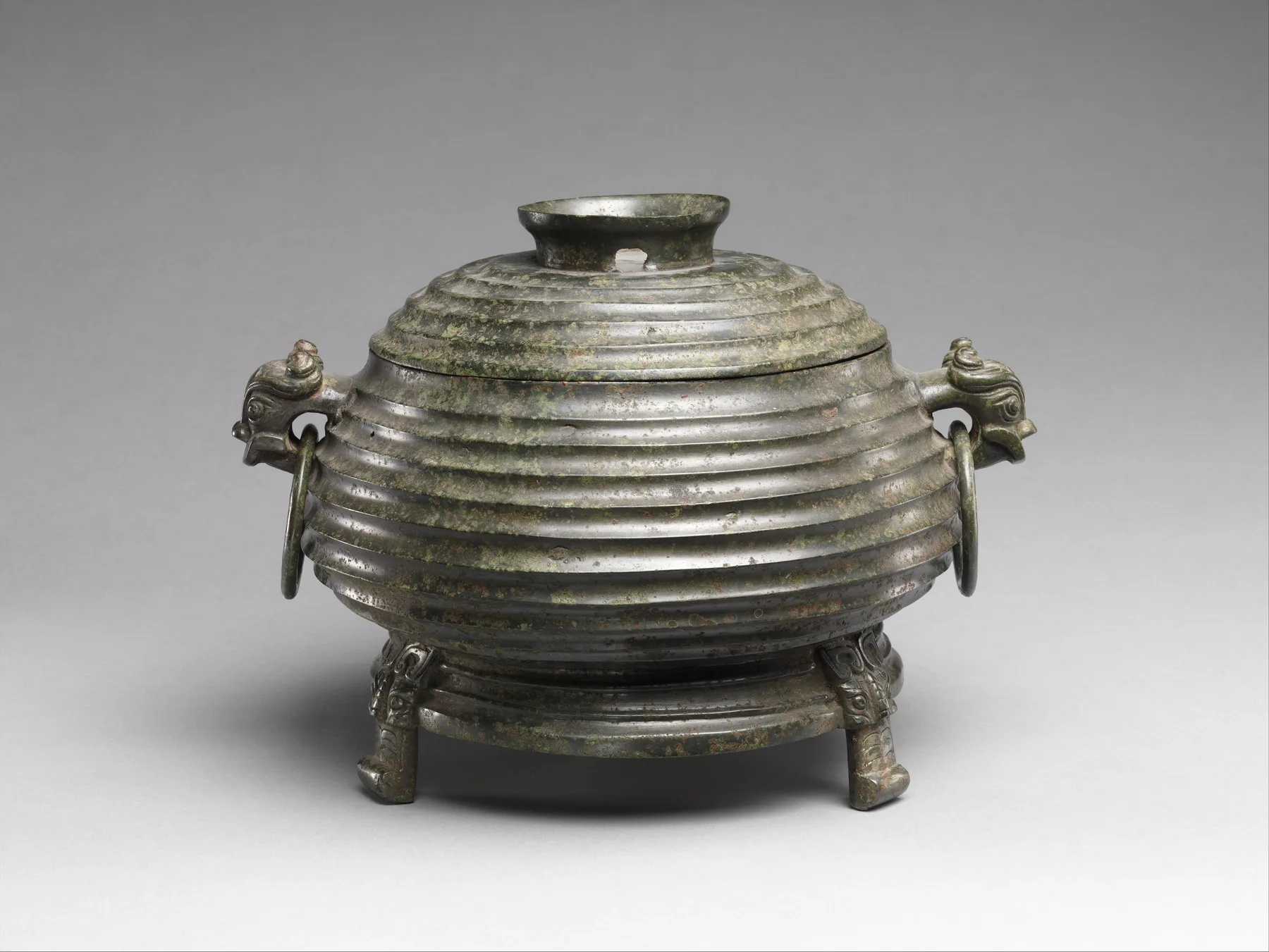
At first glance, this gui is quieter than the Shang gong. Horizontal ribs widen around its body. A lid repeats the swelling curve. Animal-headed handles carry loose rings, and four short supports lift the bowl from the surface. The strongest rhythm is not a mass of creatures but a sequence of bands.
Its most explicit claim is inside.
The Met records the same twelve-character inscription in the vessel and its lid, translated as: “The Earl of San made this precious gui for Ji of Zhe. May it be perpetually used for tens and thousands of years.” The sentence names a maker-patron or commissioner, a recipient, an object, and a desired future. It turns bronze into a relationship intended to outlast the occasion that produced it.
The doubling is materially precise. Lid and bowl could separate in use, but each retained the same dedication; reunited, they made one statement twice. The words were therefore not only information about ownership. They helped the object recognise its own parts, its named relationship, and the future ceremonies imagined for it.
This is not a street-facing inscription. The words appear when lid and bowl separate during handling, use, storage, or burial. Repetition in both components keeps them connected while doubling the claim to memory.
A gui served grain or cooked food. Food vessels and longer inscriptions gained importance in Western Zhou elite ritual, but wine did not vanish and one bowl cannot prove a total transformation. It shows inherited bronze technology redirected toward new named relations and historical record.
Bronze inscriptions can record appointments, gifts, campaigns, land, legal settlements, ancestors, or dedications, but remain commissioned and conventional accounts. Translation also depends on graphs, grammar, names, damage, and formulaic language.
“Tens and thousands of years” performs continuity rather than predicts it. Ritual reuse could return named people to the present without making memory public in the modern sense.
The online record supplies no tomb, hoard, shrine, or assemblage. The inscription preserves one ancient relation while missing archaeology removes others: a bronze archive with pages torn out.
An army underground: standardisation without sameness
.jpg)
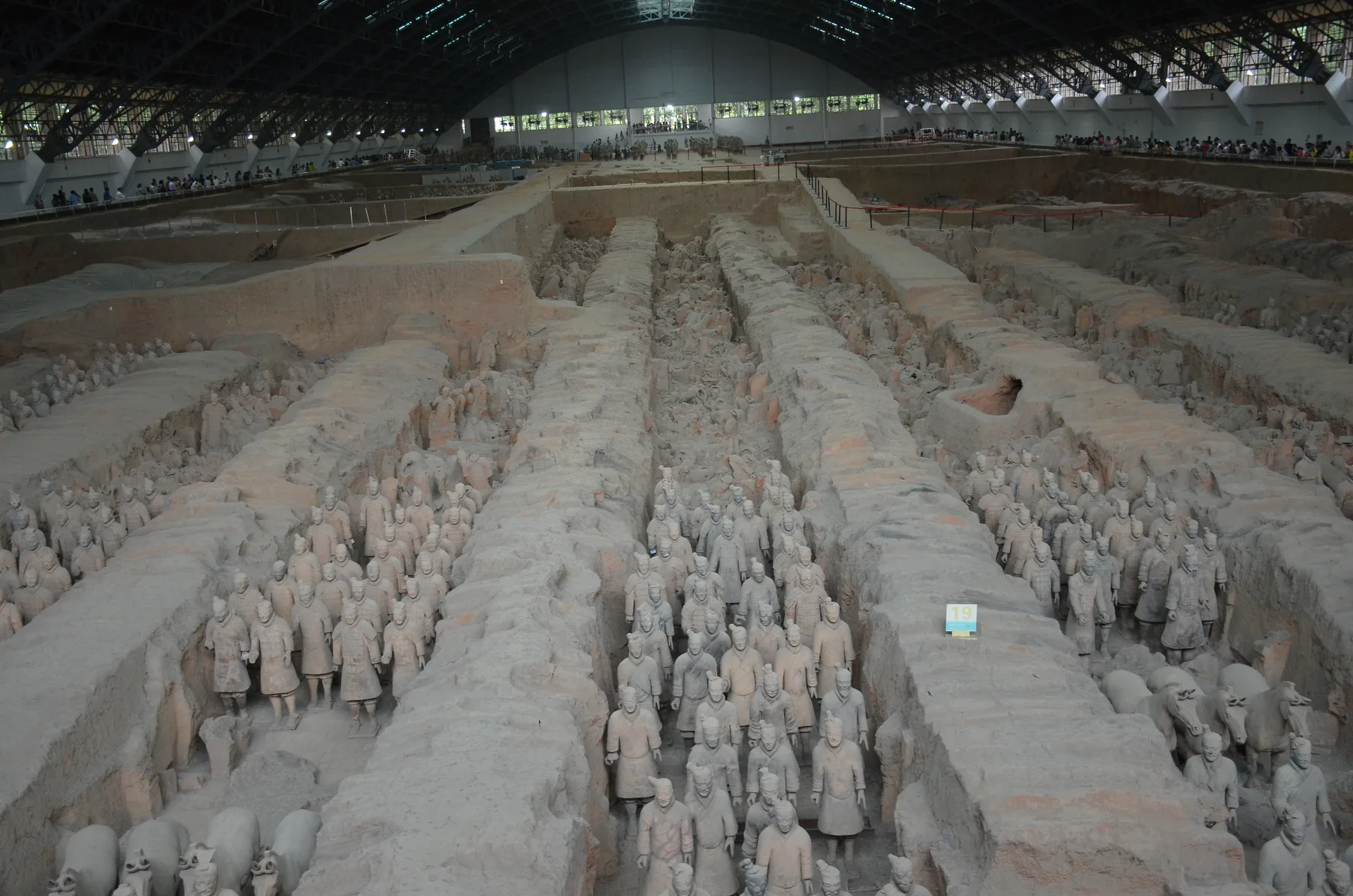
The photograph appears to offer one army. The archaeology reveals many production histories.
Pit 1 belongs to a complex begun when the future First Emperor became king of Qin in 246 BCE. After conquest in 221 he took the title Qin Shihuangdi and died in 210. UNESCO records a burial mound, walls, architecture, tombs, nearly two hundred accompanying pits, and more than six hundred identified sites. The warriors are one zone within a funerary city.
Excavation since 1974 has exposed infantry, officers, archers, horses, and chariots in collapsed timber-roofed corridors. Many figures are reassembled. Scientific study confirms bright paint over lacquer, much of which deteriorated after exposure. “Terracotta army” names the most visible survival, not the full ancient encounter.
The scale encourages opposite myths: identical mass products or exact individual portraits. Workshop studies instead show clay parts assembled, modelled, finished, fired, painted, and equipped. Repeated ranks, clothing, armour, and bodily formats enabled scale; faces and finishing vary without proving named sitters.
The 2017 petrographic study supports near-site manufacture, central clay processing, and distribution to local workshops. Bronze crossbow-trigger research found batches and spatial patterns consistent with organised manufacture.
This does not make Qin production a modern assembly line or “Toyotism.” It was an imperial craft system combining central coordination, workshop groups, batches, specialist skill, and local adjustment.
The warriors represent military and administrative order. Clay, kilns, timber, pigments, weapons, transport, food, records, supervision, and labour were coordinated over years by living people whose names mostly do not survive.
That labour remains visible in variation. A sleeve edge is sharpened differently, a moustache turns, an armour plate sits higher, a stamp or inscription associates work with a group. Such differences are neither random noise nor proof of portraiture. They show coordination that left room for sequences of modelling, finishing, correction, and placement at workshop level.
Who commanded that labour, and under what conditions? The later Han historian Sima Qian describes enormous mobilisation but cannot supply a precise archaeological count. No sensational number is needed to recognise a conquest state’s coercive capacity.
The central chamber remains unexcavated. Texts, remote sensing, material study, and pits offer different evidence, not a transparent map of belief. Even so, the complex clearly converted military hierarchy and state-managed production into a world expected to operate underground.
A watchtower for no living estate: the tomb as a made world
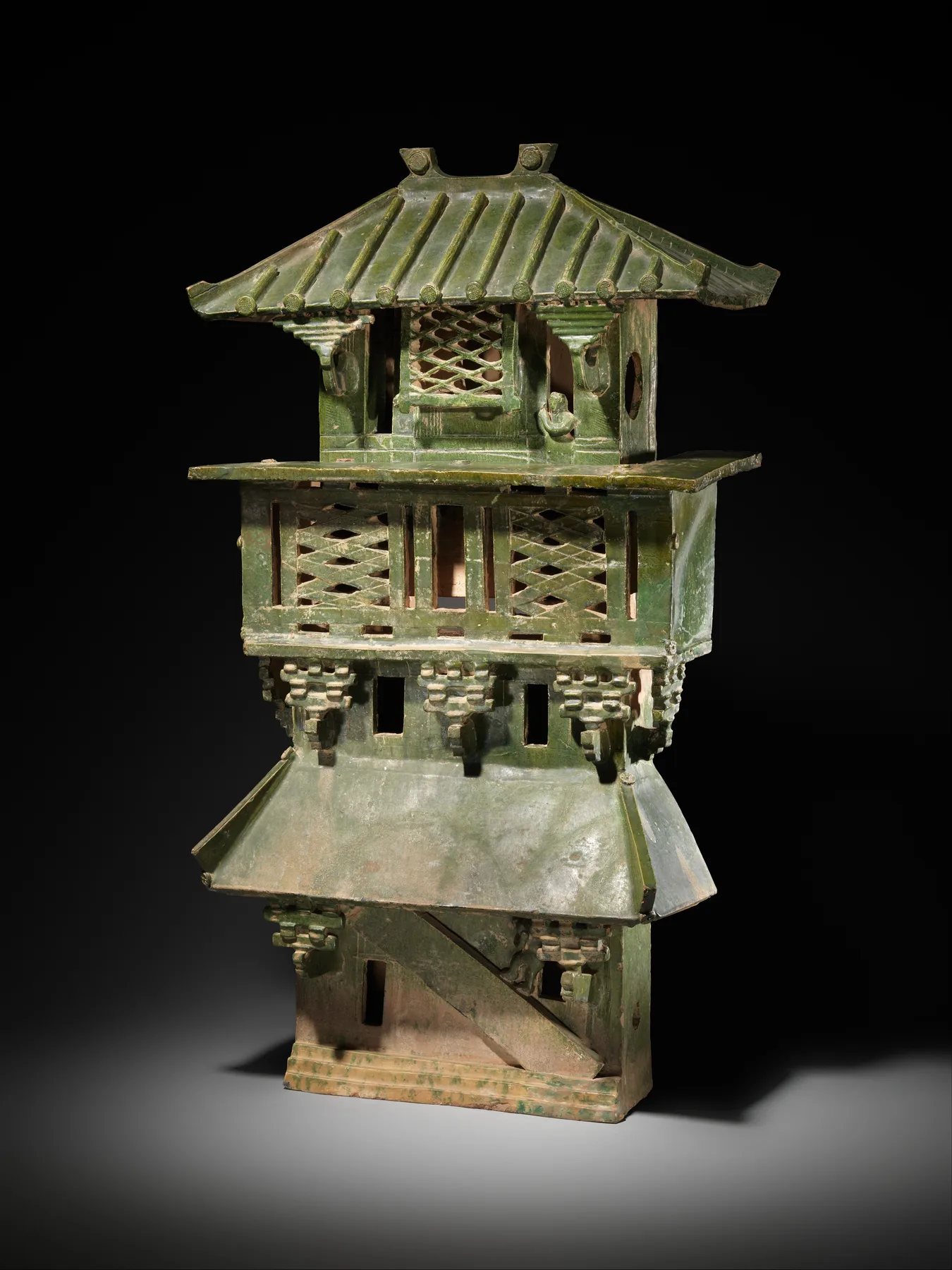
The watchtower is over a metre high: a model, but not a small trinket. Three rising architectural stages combine tiled roofs, projecting eaves, brackets, lattice screens, windows, balconies, and an enclosed base. Green lead glaze draws the levels together while pooling differently across edges and recesses.
Eastern Han burials often contained mingqi, funerary objects shaped as people, animals, vehicles, vessels, wells, granaries, houses, pens, towers, and compounds. They were made for burial, not ordinary miniatures left by accident.
The model preserves evidence for lost timber architecture—roofs, brackets, screens, gates, and vertical organisation—but not a neutral survey. Scale is selective, clay construction differs from timber, and details may express status or funerary convention rather than one measured estate.
The Met links such towers to estate security and continuing prestige. The model evokes living architecture while becoming equipment for the dead.
Mingqi organised provision, protection, hierarchy, and hope beyond death. They might render a household portable or supply servants, animals, food systems, and status; the balance varied across time, region, and social group.
They also cannot support one humanitarian story in which clay universally replaced human sacrifice. Burial practices were diverse; models changed with tomb architecture, elite display, production, ritual, and access.
The watchtower’s openings make absence visible. No living guard occupies the balcony, no grain enters the compound, and no household walks through the gate. Yet the architecture asserts that surveillance, storage, boundary, and status should continue. In that sense, the model is less an image of a building than a claim about an enduring social order.
Its glaze strengthens that claim. Liquid green gathers in recesses, thins over projecting edges, and unifies levels that would have involved many materials at full scale. What looks like architectural colour also records kiln chemistry and gravity. The model does not simply miniaturise a building; it remakes one through ceramic behaviour.
Without a findspot, the owner, workshop, other tomb objects, and regional estate remain unknown. “Tomb world” names an underground environment assembled from architecture, objects, food, texts, and remains. Modern display preserves one component while dismantling that relation.
Five objects, five systems of operation
| Case | Material operation | Relation made durable | People and systems often hidden | Central limit |
|---|---|---|---|---|
| Shang oracle bone | Preparing bone, applying heat, reading cracks, incising a record | King, diviner, ancestors, decision, archive | Herding, animal bodies, bone preparation, scribes, ritual specialists | A royal archive is not the voice of all Shang society; this fragment lacks a published findspot and translation |
| Shang gong | Piece-mould casting, finishing, filling, handling, pouring | Living lineage, offering, ancestor, court authority | Mining, transport, ceramic knowledge, fuel, foundry labour, ritual service | Animal imagery has no single recovered dictionary; museum context is not excavation context |
| Western Zhou gui | Casting a lidded food vessel and duplicating an interior inscription | Named gift, ritual use, lineage memory, desired future | Commissioner, recipient, scribes, mould makers, bronze workers, ceremony | Translation is mediated, and the original assemblage is unknown |
| Qin mausoleum army | Preparing clay, workshop production, firing, painting, arming, arranging in pits | Emperor, military hierarchy, state administration, afterlife | Workshop groups, logistics, coerced labour, conservation and reconstruction | Variation does not prove portraiture; the unexcavated tomb prevents a complete map of meaning |
| Eastern Han watchtower | Modelling architecture in fired, glazed clay and placing it in a tomb | Deceased owner, estate, security, status, continuing provision | Potters, kiln workers, tomb builders, household and agricultural labour | A funerary model is neither a measured building plan nor a transparent picture of ordinary life |
The comparison shifts scale without marching toward realism: bone concentrates a decision, bronze an offering, inscription a social bond, the Qin complex a funerary state, and the Han model an estate. Each makes absence active. These objects stored, poured, recorded, guarded, equipped, ranked, and remembered; meaning was an operation before it became a label.
A compact timeline
- About 1600–1046 BCE: conventional range of the Shang dynasty; archaeological phases and regional cultures are more complex than the dynastic label.
- About 1300–1046 BCE: late Shang royal centres at Yinxu near Anyang produce the major surviving oracle-bone corpus and extensive evidence for bronze foundries and elite ritual.
- About 1046 BCE: conventional date of the Zhou conquest of Shang; inherited ritual and craft systems continue while political and ceremonial orders change.
- Early ninth century BCE: the inscribed gui examined here is cast during the Western Zhou period.
- 771 BCE: conventional end of Western Zhou; Eastern Zhou courts and regional states develop increasingly diverse material traditions.
- 475–221 BCE: Warring States period; rival states expand administration, warfare, urbanism, tomb building, lacquer, bronze, textile, and regional visual cultures.
- 221 BCE: the king of Qin completes conquest of rival states and assumes the title of First Emperor.
- 210 BCE: the First Emperor dies; his mausoleum remains unfinished in parts and the Qin dynasty soon collapses.
- 206 BCE–220 CE: Han dynasty, interrupted by the Xin period; tomb architecture and mingqi change across regions and social levels.
- 25–220 CE: Eastern Han period; architectural tomb models including towers, houses, farms, wells, and pens become especially visible in the surviving ceramic record.
- 1974 CE: discovery and archaeological investigation of the terracotta-warrior pits begin near the First Emperor’s mausoleum; excavation, conservation, and interpretation continue.
Dates are coordinates for comparison, not proof that every workshop changed when a ruler did.
Terms worth knowing
- Anyang / Yinxu: the area of the late Shang royal centre in present-day Henan, with palatial foundations, burials, oracle-bone deposits, and foundry evidence.
- Oracle bone: modern term for prepared animal bone or turtle shell used in pyromantic divination, especially associated with the late Shang royal court.
- Pyromancy: divination through heat-produced cracks. The crack was interpreted within a ritual procedure; it was not random damage later decorated with writing.
- Charge: the proposition put to divination. A full inscription may also include date, diviner, prognostication, and verification, but survival varies.
- Piece-mould casting: bronze-casting method using an inner core and removable outer mould sections. Excavated moulds show that ceramic technology was central to bronze production.
- Gong: a covered bronze vessel type used for pouring wine. The modern romanisation identifies a vessel category; it does not recover every ancient local name or use.
- Taotie: conventional name for frontal mask-like motifs on many bronzes. Its boundaries and ancient meanings remain debated; it should not be treated as one securely identified monster.
- Gui: a vessel associated with serving cooked grain or food, especially important in Western Zhou ritual sets.
- Bronze inscription: text cast into or occasionally added to a bronze. It can record dedication, gift, ancestry, appointment, campaign, land, or legal memory while also shaping how an event is remembered.
- Mingqi: objects made for burial, often translated “spirit objects.” They could model people, animals, buildings, vehicles, vessels, and systems of provision.
- Tomb complex: an organised funerary environment larger than a coffin or chamber. It may include mounds, walls, pits, paths, buildings, images, offerings, and subsidiary burials.
- Dynasty: a sequence of rulers from a ruling house. In art history it is a chronological aid, not a guarantee of cultural, geographic, or stylistic uniformity.
Ten questions for close looking
- On the oracle bone, which marks look incised, which look like cracks, and where do later breaks interrupt both?
- How does the irregular shape of the bone govern the spacing and direction of its signs?
- On the gong, where does a vessel part—lid, spout, handle, foot—also become part of an animal body?
- Which lines on the bronze may register mould sections, joins, or finishing, and which clearly organise ornament?
- How would the experience of the gui change when its lid was removed and the interior inscription appeared?
- What does duplication of the gui inscription accomplish that a single public label would not?
- In the Pit 1 photograph, how do corridors, ranks, figures, horses, breaks, reconstructions, and the modern roof create different orders?
- Which similarities among the warriors suggest coordinated production, and which differences resist the claim that they are identical copies?
- On the watchtower, which architectural details seem structural, which signal status or defence, and which may be conventions of ceramic modelling?
- Across all five cases, what relation remains invisible unless you reconstruct handling, labour, site, ceremony, or burial?
These questions begin with form but do not stop at appearance. Close looking becomes historical when it tests what the material can and cannot support.
Five shortcuts worth refusing
1. Early Chinese art is one continuous national style
The selected objects come from different polities, regions, workshops, institutions, and centuries. Modern borders and identities cannot be projected unchanged into the second and first millennia BCE. Continuity is a question to investigate, not an answer supplied by the word “Chinese.”
2. Oracle bones are the moment Chinese language began
They preserve the earliest substantial surviving corpus of clearly recognisable Chinese writing, not the birth of spoken language. Earlier marks do not yet prove a continuous script, and later Chinese writing did not remain graphically or linguistically unchanged.
3. Every Shang bronze animal has a known meaning
Modern names such as taotie help comparison but do not provide a Shang dictionary. Meaning depended on vessel type, placement, handling, ritual, patronage, and imagery; uncertainty is more responsible than a universal monster story.
4. The terracotta warriors are either identical products or exact portraits
Repeated components and coordinated workshops made scale possible; hand finishing and controlled variation prevented total sameness. Neither variation nor realism proves that each face records one historical soldier.
5. Han architectural models are toys or photographs of daily life
They were made as tomb equipment. They preserve valuable architectural and social evidence while reshaping buildings for funerary scale, material, convention, and purpose. An elite tomb world is not a census of Han society.
A source guide for further study
Begin with records closest to objects and excavated systems, then compare interpretations:
- The Metropolitan Museum of Art’s Open Access records document the oracle bone fragment, Shang gong, Western Zhou gui, and Eastern Han watchtower. They supply materials, dimensions, dates or period labels, accession histories, inscriptions where published, and public-domain images. Their missing findspots are evidence limits, not blanks to fill imaginatively.
- The National Museum of Asian Art’s Oracle Bone in 3D connects heat-produced cracks, inscription, kingship, and administration to a manipulable archaeological object.
- Andrew Robinson’s British Museum discussion of the origins of writing distinguishes isolated Neolithic marks from the clearly recognisable and structurally complex writing of Shang oracle bones.
- The Smithsonian National Museum of Asian Art’s Casting a Shang Bronze reconstructs piece-mould production from excavated Anyang foundry evidence.
- Matthew Chastain, Jianli Chen, and Xingshan Lei’s technical study, “Decoration Techniques in Shang and Zhou Bronze Casting”, uses microscopy and chemical analysis of mould fragments to show that impressed and carved processes could be combined.
- The Met’s overview of Shang and Zhou bronze cultures is a useful institutional introduction when read with its 2004 publication date and with newer archaeological research.
- UNESCO’s Mausoleum of the First Qin Emperor record establishes the scale, components, chronology, protection, and incomplete excavation of the whole site rather than treating the warriors as an isolated attraction.
- Patrick Quinn, Shan Zhang, Yin Xia, and Xiuzhen Li’s open-access study “Building the Terracotta Army” uses ceramic petrography to argue for near-site production, central clay processing, and distribution to local workshops.
- Xiuzhen Li and colleagues’ study of marking practices and manufacture connects inscriptions and stamps to workshop groups, while a later Scientific Reports material study confirms the lacquer-and-pigment coatings now largely lost from view.
- Xiuzhen Li and colleagues’ study of bronze crossbow triggers tests batch production and spatial distribution within Pit 1 instead of relying on a modern factory analogy.
- The Met essays on mingqi in early Chinese burials and ancient architectural models place tomb pottery within changing burial environments and explain both its architectural evidence and its funerary work.
No source makes the cases transparent. Museum records document objects and rights; excavation and technical studies recover production and site; inscriptions preserve selected voices; later histories reshape the past. Read together, they reveal more than a dynastic survey: bone made a question durable, bronze an offering, inscription a gift, terracotta imperial hierarchy, and a glazed tower an estate for the dead. None acted alone.
Editorial record
About this article
- Author
- Publisher
- GeMarkt
- Published
- Updated
- Reviewed
- Internal source & rights check. Conducted by GeMarkt Research Review. This is an internal editorial check—not independent peer review.
- Source standard
- Art history source standardPrioritises object records and research sources, distinguishes evidence from interpretation, and states material uncertainty.
Found a claim that needs checking? Report a factual error.