Art History · Learning chapter
Atlas I — Foundations and ancient worlds · 7 of 10
Early South Asian art: cities, relics, bodies, and sacred space
Five works trace how early South Asian makers built presence through signs, relics, sacred bodies, movement, stone, and painted surface.

What we’ll look at
How were seals, sacred structures, and bodies used in early South Asia?
A creature with one long horn faces a tall stand. Five compact signs occupy the narrow space above its back. On the small square of pale stone, both animal and signs are cut in reverse. Press that surface into a softer material and a second image appears: raised rather than incised, facing the other way, ready to travel away from the object that made it.
The impression is legible as an image. It is not readable as a sentence.
That distinction opens early South Asian art. We inherit objects after actions have stopped, buildings have changed, bodies have broken, and languages or rituals have become hard to recover. The task is neither to fill gaps with mystery nor pretend looking solves everything.
Across this long period, makers turned material into presence: a seal carried absent authority; a relic mound organised community around an enclosure; a sacred head made a perfected body imaginable; a god cut into a hill joined cosmic rescue to political landscape; a painted bodhisattva met visitors approaching a shrine.
This guide asks one question across five cases:
How did early South Asian makers turn signs, relics, and bodies into presence—and what happens when modern labels separate what ancient sites held together?
The route runs from the Harappan world around 2600–1900 BCE through Sanchi, Mathura, and Udayagiri to late-fifth-century Ajanta. These places now lie in Pakistan and India or in networks that crossed modern borders. Sri Lanka, Nepal, Bangladesh, Afghanistan, the southern peninsula, eastern coast, Gandhara, Amaravati, and many regional and mobile traditions fall outside this route. Its gaps belong to the chapter, not to history.
South Asia is a study region, not one ancient culture
“South Asia” is a modern geographic term. It is useful because present national borders do not map neatly onto ancient routes, languages, political formations, or religious communities. It becomes misleading when it is treated as the name of one civilisation moving steadily toward the modern nation-state of India.
Harappan or Indus civilisation names connected settlements across present-day Pakistan and northwestern India. Shared weights, seals, drains, crafts, and planning did not make cities interchangeable. UNESCO’s Dholavira account records fortification, reservoirs, and long-distance exchange; Mohenjo-daro, Harappa, Dholavira, Rakhigarhi, and smaller sites preserve different portions of that world.
The decline and reorganisation of many urban centres after about 1900 BCE did not produce an empty millennium. Archaeological evidence records changing settlements, ceramics, metalwork, burial practices, agriculture, mobility, and regional networks. Later texts and objects cannot simply be projected backward to explain every Harappan image; nor should the absence of deciphered long inscriptions be mistaken for the absence of social complexity.
From the first millennium BCE, kingdoms, republic-like polities, empires, towns, monasteries, courts, guilds, farms, and ports created overlapping patronage. Mauryan, Kushan, Gupta, and Vakataka are political and chronological coordinates, not uniform styles.
Religious labels also need care. Buddhism and Jainism formed distinct communities; changing Brahmanical traditions included more specific contexts such as Vaishnava worship of Vishnu. They competed and also shared cities, patrons, craftspeople, stories, and landscapes. Contact is not sameness, and difference is not isolation.
With those limits in place, the five works can be allowed to do something more interesting than illustrate a timeline.
A tiny seal from an urban world: authority without translation
In brief: The first example is a small square stone seal made in the Indus Valley around 2600–1900 BCE. We can see its animal, but because its signs remain unread and its findspot is unknown, we do not know its owner or exact use.
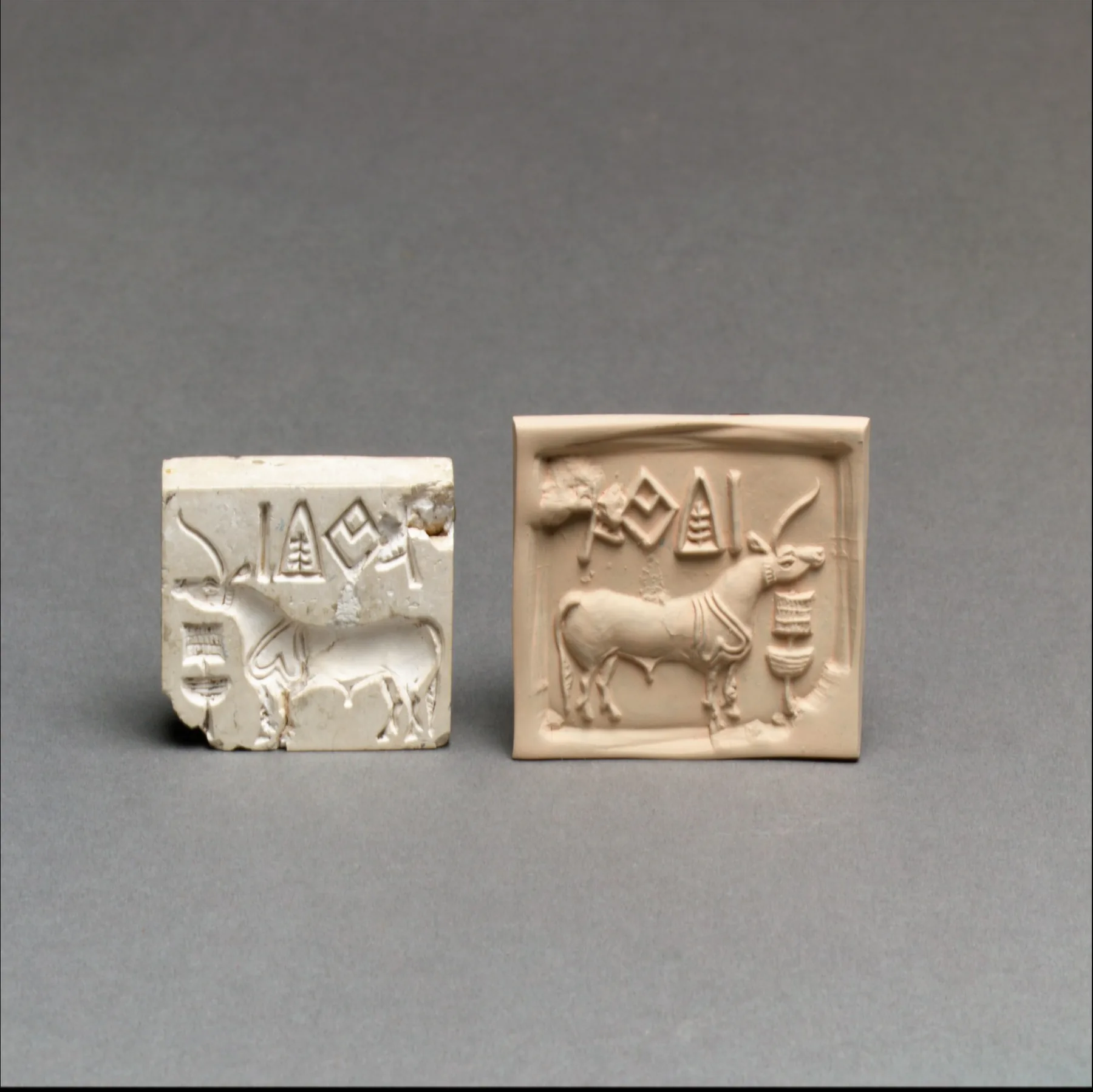
Smaller than a hand, the seal still required shaping stone, carving in reverse, forming a back boss, heating steatite to harden and whiten it, and keeping lines clear enough to press. Miniature scale did not mean minor labour.
The Met dates it to about 2600–1900 BCE and gives the Indus Valley but no excavation site. Without a documented room, street, workshop, container, or burial, it cannot be tied to one transaction or owner.
Related seals combine short sign sequences with animals, composite beings, and objects. Repeated formats, back bosses, and impressions make administrative, identifying, protective, or status functions plausible, not proved; wearing, storing, displaying, pressing, and depositing could activate different uses.
The conventional unicorn label describes one horn, not a medieval European creature. The animal may be composite or a stylised bovine; the stand has been called an incense burner, manger, offering stand, or ritual device. The museum’s question mark should remain.
Many decipherments have been proposed, but no reading commands broad agreement; sequences are short and no agreed bilingual text exists. This one cannot be translated confidently or assigned to Sanskrit, Tamil, or another language to serve a modern identity.
What, then, can be learned?
The modern impression supplies a firmer answer. Pressing converts recessed lines into raised ones and reverses animal and signs. The new surface could carry a relation to a person, institution, household, commodity, or act without its owner remaining present. The seal made authority mobile—a narrower claim than translation, but one supported by operation.
Tool and impression also divide visibility. The carved seal asks for close inspection of a hard, private surface; the pressed mark could appear on clay attached to a container, closure, or other support. One object could therefore generate many temporary images. Repetition did not require redrawing the animal or signs, only contact, pressure, and a surface able to receive them.
A relic mound made for movement: Sanchi across centuries
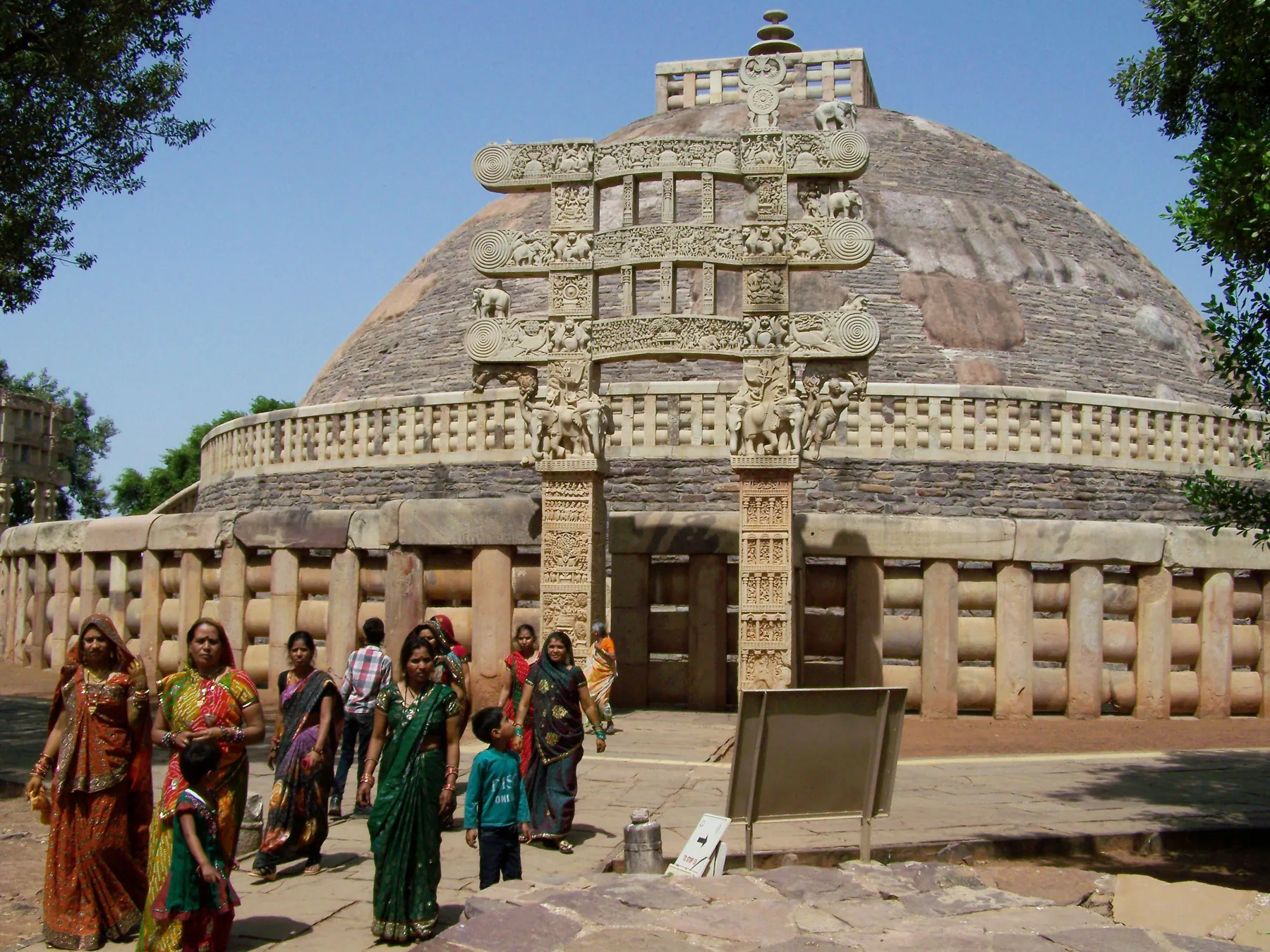

Sanchi’s Great Stupa is often reproduced as one complete masterpiece. It is better understood as accumulated work.
UNESCO’s site history associates an early brick stupa and pillar with Ashoka’s third-century-BCE reign. Later builders enlarged and faced the mound, added paths, stairs, railings, upper enclosure and umbrellas, ornamented four gateways around the first century CE, and built later shrines across the hill. Early-twentieth-century restoration also shapes the present view. No single date describes the photograph.
A stupa is a sacred mound associated with relics and commemoration. Enclosure makes the relic present without displaying it. Dome, railing, umbrellas, gateways, and images announce a centre that cannot be entered like a room.
The visitor moves instead. Paths organise normally clockwise circumambulation through gateway, railing, curve, ascent, image, landscape, and return. Architecture gives devotion direction and rhythm.
That route changes the monument’s scale. From a distance the dome reads as one simple mass; at a gateway, carving breaks attention into small figures and episodes; while walking, one scene disappears as another arrives. No single photograph can supply the sequence. The stupa is apprehended through duration, repeated turning, and the presence of other moving bodies.
The east gateway translates that movement into dense carved episodes. Animals, trees, buildings, processions, worshippers, wheels, thrones, parasols, and stupas make stories and acts of veneration visible. In early reliefs at Sanchi and related sites, the Buddha is often evoked without appearing as a human figure in the narrative scene. A tree, throne, wheel, footprints, parasol, or stupa can mark his presence.
Aniconic is useful if it means “not represented here in human form,” but misleading as a universal early Buddhist image ban. Viewers’ readings remain debated, and anthropomorphic Buddha images developed in several regions. At Sanchi, bodily absence concentrates attention on traces, places, actions, and community.
The visible complex was not one emperor’s work. Inscriptions record continuing dedication; monastic and lay support, regional workshops, political authorities, and generations of visitors extended the site. A dynastic account alone hides patrons, carvers, carriers, ritual specialists, and pilgrims.
Sanchi also prevents a relic from being reduced to passive remains. A relic could authorise a centre, connect distant Buddhist communities, attract gifts, and order repeated bodily action. The sacred person was physically absent and materially present at the same time.
Sanchi is both archaeological heritage and renewed Buddhist pilgrimage. Present-day visitors are not scale figures beside a dead monument: worship, tourism, conservation, and photography overlap without reproducing an ancient encounter.
A sacred head without a secure name: where Buddhist and Jain bodies meet
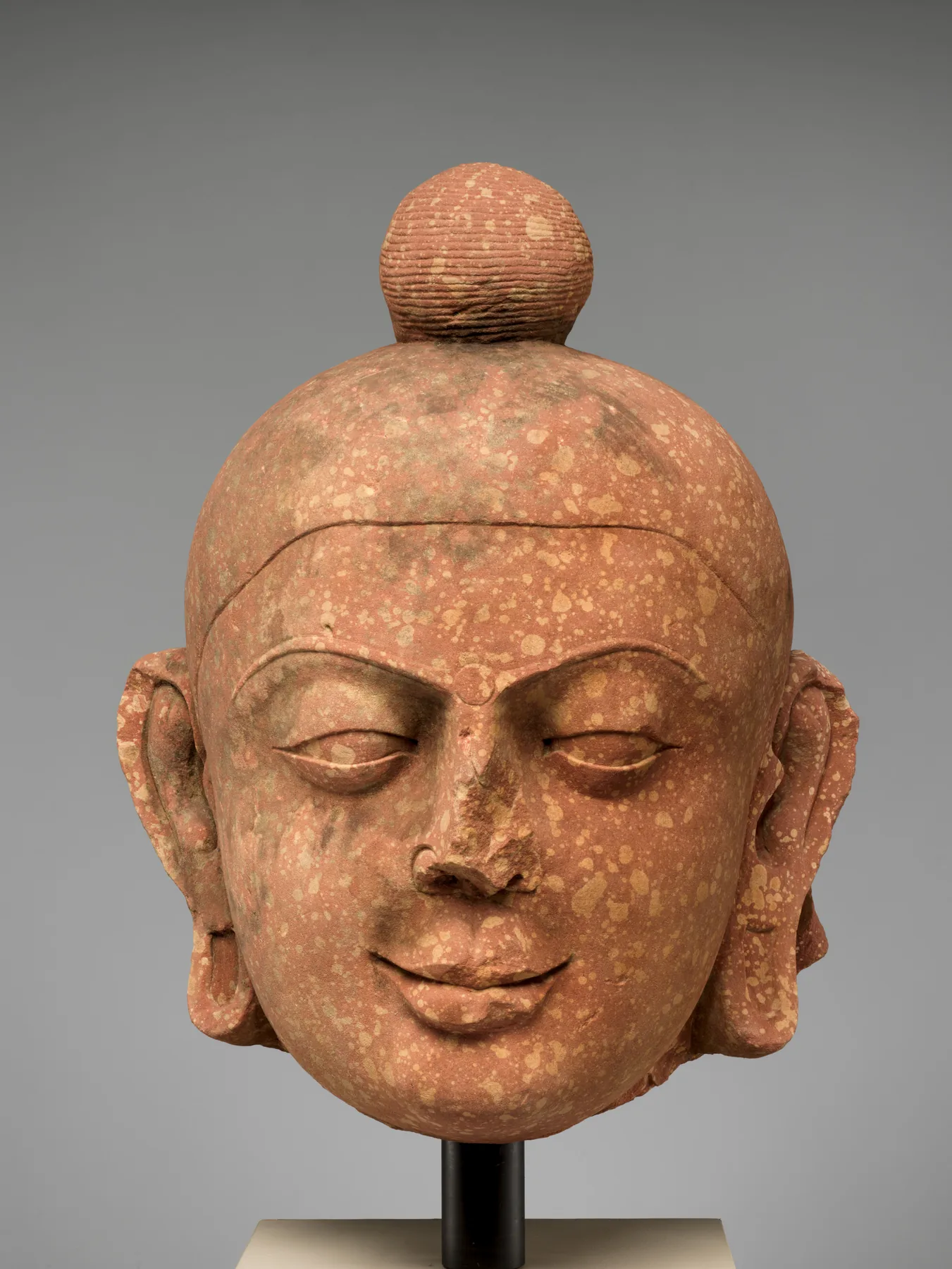
The title of this sculpture contains an “or.” That small word carries much of its history.
The eyes lower without closing. Long earlobes frame a full face. A slight curve at the mouth and smoothly organised cheeks make stillness visible. Across the rounded cranial form, parallel rows create a disciplined surface. The mottled stone itself supplies movement: pale spots travel through the warm red face without following its anatomy.
At 67.3 centimetres high, the surviving head is already larger than many living heads. Its missing body would have extended that encounter, but the break now concentrates attention on gaze and skin-like stone. The sculpture feels calm because line, volume, symmetry, and downward attention produce calm—not because expression alone supplies a reliable religious identity.
The Met dates the head to about the second century CE in Mathura, a major Kushan-period centre where Buddhist, Jain, Brahmanical, royal, civic, and protective images shared red sandstone and sometimes workshop knowledge.
That shared material world explains the hesitation. Buddhas and Jain tirthankaras could both appear as perfected beings in disciplined stillness; decisive clothing, chest marks, pedestal, halo, attendants, or inscription may have occupied the missing body and setting.
Iconography has not failed; its normal ensemble is missing. The Met’s guide distinguishes Buddha and jina images through robes, bodily marks, nudity in many Jain images, and the shrivatsa emblem. Most tests are unavailable on this head.
The “or” does not make Buddhism and Jainism the same. Mathura supported both early Jain image making and Buddha and bodhisattva forms; shared makers and bodily ideals do not erase doctrinal difference.
Workshops did not follow modern survey chapters: suppliers, carvers, donors, and viewers worked where several communities claimed visibility. In the museum, the isolated face creates compelling calm; the identity we want that calm to guarantee remains unsecured.
A god lifts the earth: rock, kingship, and a Vaishnava landscape
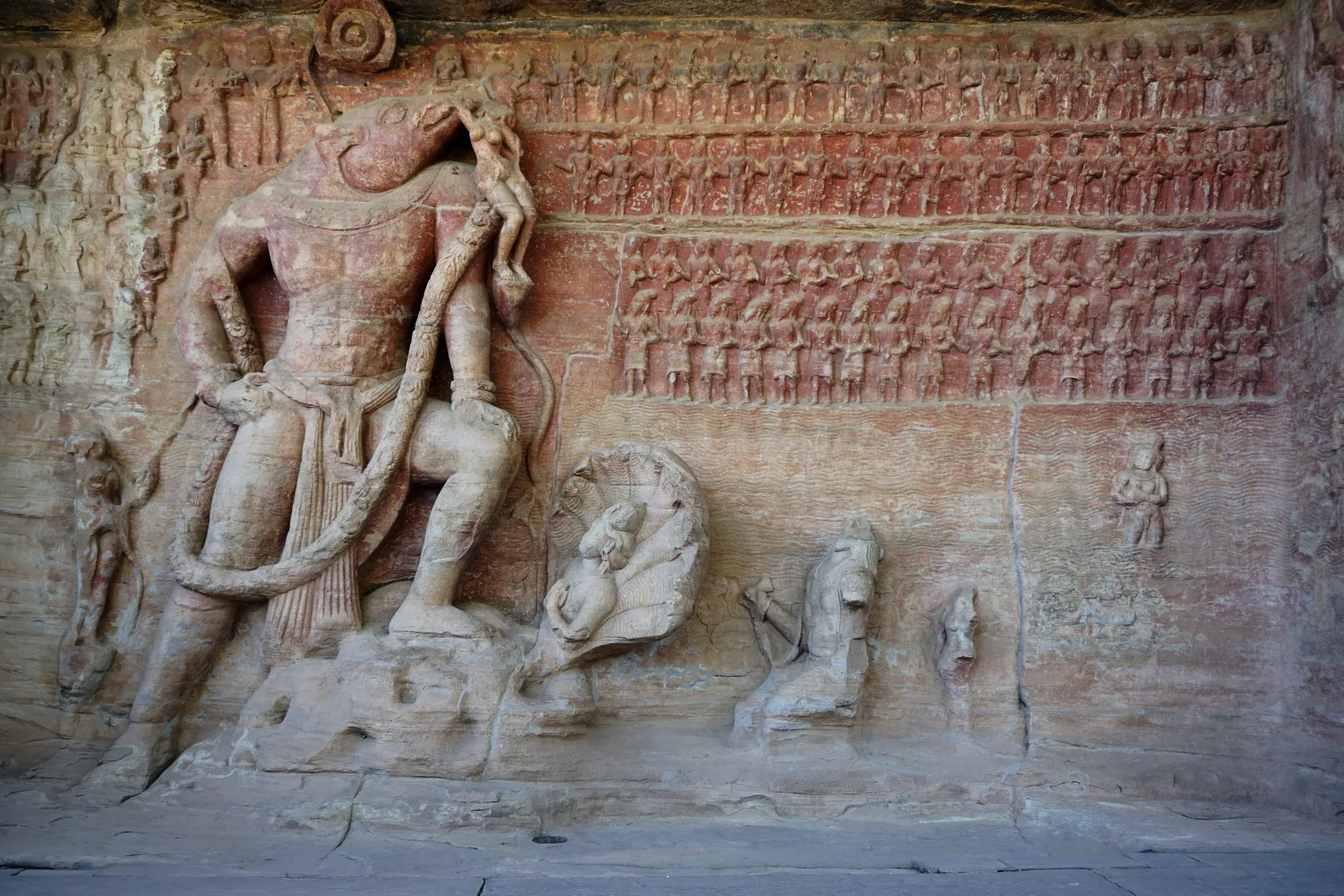

At Udayagiri, the image is not placed against the hill. It is the hill, cut back until a god and his audience emerge.
The monumental figure is Varaha, Vishnu’s boar manifestation. He raises earth goddess Bhudevi or Prithvi from cosmic waters. Vast torso and heavy legs make rescue bodily; the goddess rises near his tusk, a serpent bends below, and ranked beings witness restored order.
Scale is argument. Varaha does not occupy a separate panel within an even field. The surrounding figures measure the force of his body. Wavy horizontal cutting evokes water, while the natural stone and shallow cave bind the scene to a real slope near Vidisha. Cosmic geography and local geography become difficult to separate.
The viewer cannot step outside that relation. Moving nearer enlarges the boar head and compresses the ranked witnesses; moving sideways changes how tusk, goddess, serpent, and stone overlap. The relief controls not only what is represented but where a human body can stand before a divine rescue made far larger than itself.
Udayagiri was reshaped around the start of the fifth century under Gupta ruler Chandragupta II. Inscriptions connect it to court activity. Michael Willis’s archaeological study reads passages, caves, images, water, timing, and royal presence as a coordinated ritual landscape.
The context makes political reading persuasive: a god restores earth while a ruler claims to maintain order. Yet Varaha is not a labelled Chandragupta II portrait, nor is every figure an official. Royal allegory is argued from site, date, inscriptions, and structure—not carved as a caption.
“Hindu art” is too broad here: Varaha is Vaishnava, while Udayagiri also contains other Brahmanical images and a Jain cave. Proximity need not mean shared theology; patronage could involve negotiation and hierarchy as well as coexistence.
Weathering, touch, conservation, access, and photography mediate the worn surface. Unlike the portable seal or detached head, Vishnu remains a landscape: approaching him joins stone, story, political authority, and bodily orientation.
A painted bodhisattva in a cave: presence assembled from surface and approach
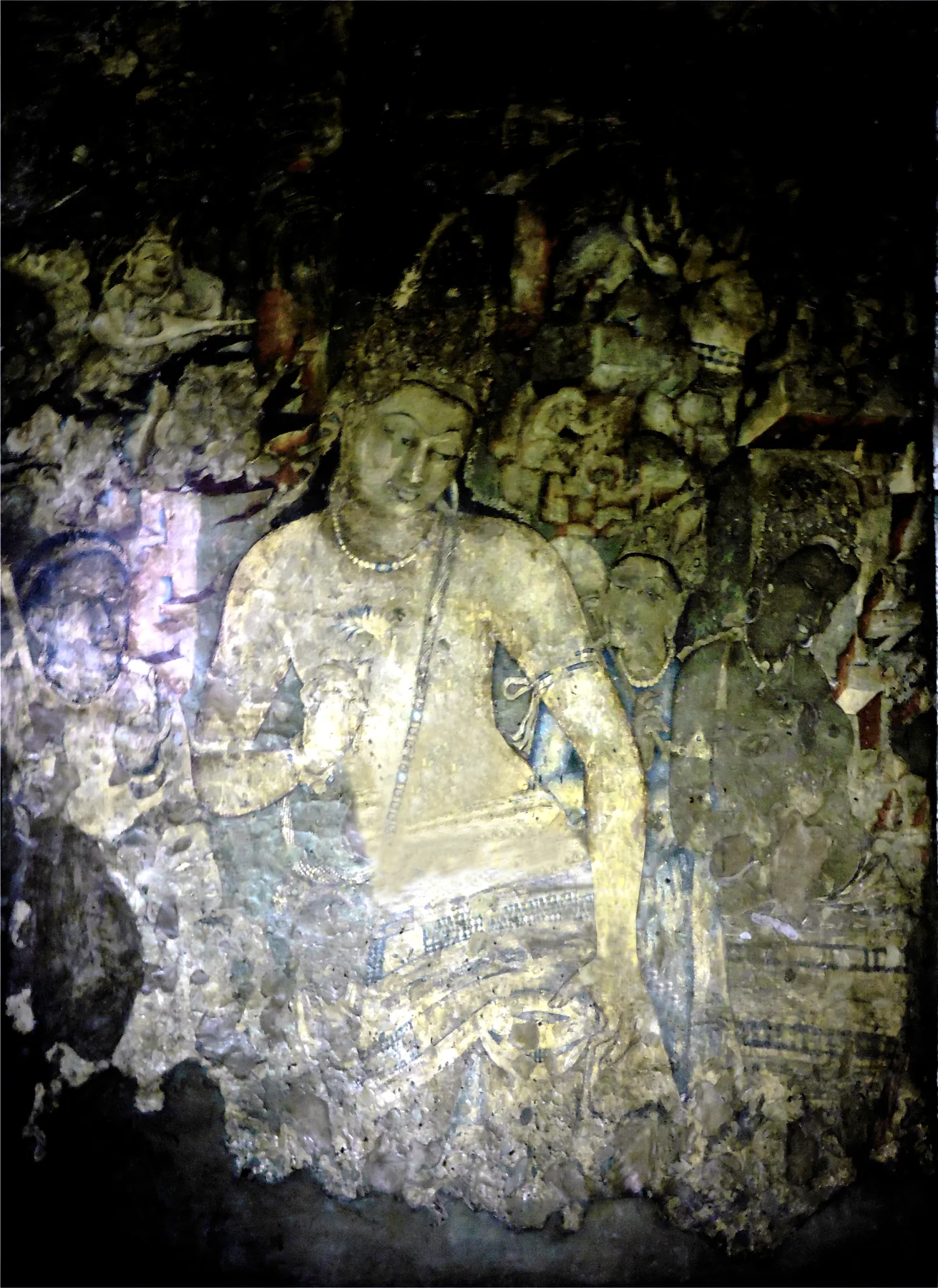

Padmapani lowers his gaze. A tall crown, strings of pearls, patterned textiles, and a blue lotus make him splendid, but not rigid. His head inclines, one shoulder drops, and the body turns through a gentle curve. Smaller attendants gather around him, some clear and others fading into the damaged surface.
The figure occupies Cave 1’s rear wall near a Buddha shrine, not an independent portrait despite modern crops. A monastic hall, cells, pillars, sculpture, and painted narratives organise a sequence of attention.
The lotus identifies Padmapani, a form of compassionate bodhisattva Avalokiteshvara. Jewellery, posture, attendants, and scale make spiritual capacity visible through a courtly body recognisable to elite audiences; splendour does not simply negate renunciation.
Cave 1 belongs to Ajanta’s later, usually late-fifth-century Vakataka phase. UNESCO distinguishes earlier caves from a fifth- and sixth-century campaign, while Cave 1’s exact sequence and patron remain debated. A network of courtly, monastic, and regional patronage is safer than one famous ruler.
The paintings are often called frescoes, but pigments were applied with binders over prepared earthen and finer plaster layers rather than true wet-lime buon fresco. Technical examination records several plaster and paint layers and uncertain binders. “Pigments on prepared plaster” is more accurate than one universal recipe.
Before an eyelid or bead appeared, teams excavated rock, finished walls, prepared plaster, planned compositions, ground pigments, mixed binders, arranged scaffolds and light, and coordinated narrative with architecture. Patronage sustained a workplace, not one inspired gesture.
The painting’s softness came from hard logistics. Mineral and organic materials had to reach the cliff; plaster had to remain workable; lines, colour fields, highlights, and jewellery had to remain legible in low light. The result is intimate at the scale of Padmapani’s lowered eyelids and monumental in relation to a visitor crossing the hall toward the shrine.
Paint has flaked, plaster cracked, colours altered, and conservation added history. Artificial light and photography reveal detail while flattening a dim, curved interior into a bright rectangle. The paintings are not an unlimited visual resource.
Reproduction fragments Ajanta again. Restore Padmapani to the cave and “Who is this beautiful figure?” becomes “How did this figure prepare a moving viewer to approach the Buddha shrine?” Presence gathers from wall, attendants, sculpture, darkness, compassion, and approach.
Five forms of presence, five limits
The five cases do not reveal one continuous “Indian style.” They reveal different solutions to the problem of making relationships endure.
| Case | Presence is made through | The material asks a body to | What remains uncertain |
|---|---|---|---|
| Harappan seal, about 2600–1900 BCE | Reversed carving, repeatable impression, compact signs | Hold, wear, store, or press a small tool | The sign sequence, the exact animal and stand, findspot, owner, and full range of uses |
| Sanchi Stupa 1, third century BCE onward | Enclosed relic focus, mound, gateways, paths, repeated dedication | Move around and sometimes ascend the sacred centre | How every scene was read, what all phases looked like, and how different visitors understood presence |
| Mathura head, about second century CE | Idealised sacred body, carved stone, controlled gaze | Encounter a perfected being at human and superhuman scale | Buddha or jina, original body, setting, donor, and specific ritual use |
| Udayagiri Varaha, early fifth century CE | Monumental divine body joined to rock, water imagery, and political landscape | Enter and orient within a charged place | The fine date, exact force of the royal allegory, and identity of every surrounding figure |
| Ajanta Padmapani, late fifth century CE | Painted surface, attributes, attendants, cave sequence, shrine approach | Adjust sight and movement in a dim monastic interior | Exact patronage, fine chronology, original colour relationships, and the full ancient viewing conditions |
Comparison works best when it preserves these limits. The Harappan seal and Sanchi both make an absent authority operative, but one acts by impression and the other by enclosure and circulation. The Mathura head and Ajanta bodhisattva both use sacred bodies, but one has been torn from its identifying ensemble while the other remains inside a painted programme. Udayagiri and Ajanta both transform rock, yet one projects a colossal body from an exposed relief while the other surrounds visitors with carved rooms and fragile painted skins.
The differences are the history.
A compact timeline
- About 2600–1900 BCE: Mature Harappan urban networks flourish; standardised seals and sign-bearing objects circulate across settlements and beyond them.
- After about 1900 BCE: many Harappan cities contract or reorganise; regional settlement, craft, burial, and exchange traditions continue in changing forms.
- Third century BCE: Ashoka’s Mauryan reign is associated with an early brick stupa and pillar at Sanchi.
- Second–first centuries BCE: Sanchi Stupa 1 is enlarged, faced with stone, and equipped with paths, stairs, and railings; other Buddhist sites and rock-cut monuments expand across several regions.
- Around the first century CE: Sanchi’s monumental gateways receive extensive relief carving; anthropomorphic Buddha images develop in regions including Mathura and Gandhara.
- About second century CE: the ambiguous Buddha-or-tirthankara head is carved in Mathura’s active multi-religious sculptural environment.
- Around 400–410 CE: Udayagiri is reshaped in a Gupta court context; an inscription beside Cave 5 is dated 401 CE, while the relief’s fine date remains a matter of scholarly reconstruction.
- Late fifth century CE: Cave 1 at Ajanta is excavated, carved, and painted during the later Vakataka-period campaign.
Dates are scholarly tools, not sealed compartments. Sites were repaired, revisited, abandoned, restored, reclassified, photographed, and worshipped at long after their first construction.
Terms that help without pretending to solve everything
Harappan / Indus civilisation: archaeological labels for connected Bronze Age settlements across parts of present-day Pakistan and India. Neither label names a securely recovered ancient self-identity for every inhabitant.
Steatite: a soft stone, often called soapstone, that can be carved finely and hardened through heating. Harappan craftspeople used it for many seals.
Seal and impression: a seal bears a recessed or reversed design; pressing it into a soft material produces a raised impression in the opposite direction. The tool and the mark are related but not identical objects.
Stupa: a Buddhist sacred mound or monument associated with relics, commemoration, veneration, and pilgrimage.
Relic: bodily remains or associated sacred material through which a person or event can become present to a community. A relic’s significance depends on practice and recognition, not chemical composition alone.
Circumambulation / pradakshina: respectful movement around a sacred focus, conventionally keeping it to the right. At Sanchi, architecture turns this action into a designed route.
Torana: a monumental gateway. Sanchi’s four toranas mark cardinal approaches and carry dense relief programmes.
Aniconic: represented without a human-form image in a particular context. It should not automatically be translated as “image-free” or “images forbidden.”
Tirthankara / jina: in Jain traditions, a perfected teacher who has crossed beyond rebirth and establishes a path for others. Tirthankara images have their own histories and identifying systems.
Bodhisattva: in Buddhist traditions, a being committed to awakening and to the liberation of others. The meaning and role of bodhisattvas vary across texts, communities, and periods.
Vaishnava: relating to Vishnu and traditions centred on him. It is more precise for the Udayagiri Varaha relief than using “Hindu” as if it named one timeless system.
Vihara: a Buddhist monastic residence or complex. At Ajanta, later viharas can include cells, assembly space, elaborate painting, sculpture, and a shrine.
Ten questions for close looking
- Which part of the Harappan photograph is ancient, and which part is a modern impression made to explain the seal’s operation?
- What changes when the seal’s incised design becomes a raised mark facing the opposite direction?
- At Sanchi, which architectural elements stop entry, and which invite movement?
- How do the gateway’s small crowded scenes and the stupa’s large plain mass divide attention?
- Which identifying features survive on the Mathura head, and which would require a body, pedestal, inscription, or setting?
- Does the mottled sandstone behave like skin, or does it insist on the figure’s material difference from a living body?
- At Udayagiri, how does the scale of surrounding figures transform Varaha from a large body into a cosmic one?
- Where does natural rock end and designed sacred space begin?
- In the Ajanta painting, how do lowered gaze, lotus, jewellery, attendants, damage, and darkness compete for attention?
- Which conclusions come from the ancient work, and which depend on a museum title, restored monument, modern light, photograph, or cropped reproduction?
These questions cannot replace historical research. They can prevent an inherited caption from becoming the only thing we see.
Five shortcuts worth refusing
1. The Indus signs have been deciphered
Many readings have been proposed; none commands broad agreement. This seal’s sequence cannot be translated securely, and the “unicorn” and stand are modern descriptive labels rather than recovered Harappan names.
2. Early South Asian art is simply the early art of modern India
Modern India is essential to the preservation and study of many works here, but the Harappan world crossed the present India–Pakistan border, and later political and religious networks followed other geographies. A modern state is not an ancient cultural container.
3. Early Buddhists banned images of the Buddha
Early Buddhist sites often made the Buddha present through relics, stupas, trees, wheels, thrones, footprints, parasols, and narrative structure. The reasons and readings are debated. Non-anthropomorphic representation is not proof of one universal prohibition.
4. Buddhism, Jainism, and Hinduism are either one religion or sealed worlds
Both extremes fail. The traditions differ in doctrine, institution, practice, and sacred history. They also shared cities, materials, patrons, stories, and craftspeople. The Mathura head is evidence for overlapping visual conditions, not evidence that difference did not matter.
5. A sacred image is decoration with a religious subject
Seals were pressed, stupas circled, images approached, caves inhabited, relics venerated, and landscapes ritually organised. Subject matter matters, but so do use, placement, movement, material, patronage, and the expectations of a community.
A source guide for further study
Start with records tied closely to the objects and sites:
- The Metropolitan Museum of Art’s Open Access record for the Harappan stamp seal supplies its title, material, date, dimensions, catalogue uncertainty, and image rights.
- UNESCO’s documentation for Dholavira gives an excavated urban context for Harappan planning, water systems, fortification, craft, and exchange. It should not be used to invent a Dholavira findspot for the Met seal.
- UNESCO’s Buddhist Monuments at Sanchi separates the site’s Mauryan beginning, later enlargements and gateways, Gupta additions, modern restoration, and continuing pilgrimage.
- The Met’s essay on Buddhism and Buddhist art is a concise introduction to relics, stupas, circumambulation, and early strategies for making the Buddha present.
- The Met record for the Buddha-or-tirthankara head, read beside its guides to recognising South Asian deities and Jain sculpture, makes identification a comparative problem rather than a guess from expression.
- Michael Willis’s archaeological study of Udayagiri connects image, route, court, water, ritual timing, and landscape while making clear that political meaning is argued from context.
- UNESCO’s Ajanta Caves record provides the broad two-phase history and monument types. The Indira Gandhi National Centre for the Arts’ summary of painting materials and scientific examination helps distinguish prepared plaster painting from true wet fresco.
These sources support a hierarchy of claims: object facts first, contextual interpretation second, unresolved debate named as debate. Matter carries relationships incompletely: the seal leaves a mark but withholds language; the stupa encloses its force; the head keeps a face after losing its name; Varaha remains joined to a political hill; Padmapani lowers his gaze through damaged paint and modern light. Presence is built from absence.
Editorial record
About this article
- Author
- Publisher
- GeMarkt
- Published
- Updated
- Reviewed
- Internal source & rights check. Conducted by GeMarkt Research Review. This is an internal editorial check—not independent peer review.
- Source standard
- Art history source standardPrioritises object records and research sources, distinguishes evidence from interpretation, and states material uncertainty.
Found a claim that needs checking? Report a factual error.