Art History · Learning chapter
Atlas I — Foundations and ancient worlds · 10 of 10
Ancient Andean art: textile, vessel, body, landscape, and pilgrimage
Five works reveal how Andean makers activated stone, cloth, clay, terrain, and dress—and why the Andes cannot be reduced to an Inca prehistory.


What we’ll look at
How did Andean societies create meaning through stone, cloth, clay, dress, and land?
From the air, the hummingbird appears all at once. A narrow beak extends across the desert. Wings open into parallel fingers. One continuous pale line turns, doubles back, and closes a body larger than any person could draw by reaching across it.
The aerial photograph is accurate. It is also a modern privilege.
The people who cleared dark stones from the lighter ground at Nasca did not need an aeroplane to plan a large figure, but most encounters with their work happened at the scale of feet, labour, route, and horizon. From the ground, a geoglyph is not primarily a picture framed against brown earth. It is a place where a line can be followed, crossed, maintained, remembered, or joined to other lines.
That difference opens this guide. Ancient Andean works are often displayed as isolated masterpieces: a stone deity, a strip of embroidery, a portrait vessel, a desert drawing, a tunic. Each is visually compelling. None was self-contained.
This chapter asks:
How did Andean makers turn material into active relationships among bodies, places, communities, and powers—and what disappears when their works are treated as portable pictures?
The five cases move from the highland pilgrimage centre of Chavín de Huántar to Paracas textile making on Peru’s South Coast, the geoglyphs of Nasca and Palpa, Moche ceramic portraiture on the North Coast, and an Inka tunic connected to a state that reached across much of the Andes. Their dates extend from the first millennium BCE into the sixteenth century CE.
This is not a ladder ending with the Inka. It is a route through five different solutions to the problem of making relations visible, durable, and repeatable.
The Andes are not one civilisation
The Andes names a vast study region, not an ancient nation or a single people. The mountain chain runs along western South America, but Andean histories also unfolded across Pacific deserts, river valleys, high plateaus, cloud forests, tropical lowlands, and coastlines. Present-day borders divide places that were joined by caravan routes, pilgrimage, migration, warfare, kinship, state expansion, and exchange.
People moved maize, potatoes, camelid fibre, cotton, feathers, metal, clay, pigments, coca, marine shell, dried fish, and knowledge across sharply different ecological zones. A shell trumpet found high in the mountains could carry the sea into a ceremonial centre. Camelid yarn embroidered on coastal cotton joined highland herding to South Coast weaving. Such movement did not make every community culturally identical. It created relations that could be accepted, adapted, negotiated, or resisted.
Archaeological labels such as Chavín, Paracas, Nasca, Moche, Wari, Tiwanaku, Chimú, and Inka help organise evidence. They can name a site, material pattern, regional history, political formation, or several of those at once.
They should not become sealed peoples who replace one another in a march toward empire. Chavín imagery travelled without proving that one Chavín state ruled every place where related forms appeared. Moche centres shared practices without necessarily forming one permanent empire. Inka expansion drew local communities into Tawantinsuyu through arrangements that varied by place and were never simply one-way cultural replacement.
The archive is uneven. Coastal aridity preserved fibres, feathers, wood, and bodies that would disappear elsewhere. Monumental sites favour institutions able to organise labour. Tombs preserve selected objects while modern looting tears them from names, bodies, and places. Museums can protect fragile works and still inherit the losses produced by extraction and an international antiquities market.
Nor are Andean cultures confined to archaeology. Quechua, Aymara, and many other Indigenous languages and communities remain living parts of Argentina, Bolivia, Chile, Colombia, Ecuador, Peru, and neighbouring regions. UNESCO’s documentation for the Qhapaq Ñan road system recognises communities as present custodians of routes, ritual practices, technologies, and knowledge—not as illustrations added after an ancient story has ended.
With that larger field in view, the first work can be entered as its historical users entered it: through architecture.
A figure held inside a mountain-like building: the Lanzón at Chavín
In brief: The first example is the Lanzón, a 4.5-metre carved stone figure made during the first millennium BCE at Chavín de Huántar in Peru. Fixed inside a narrow, dark gallery, it worked through a visitor’s movement and limited access as well as through its image.
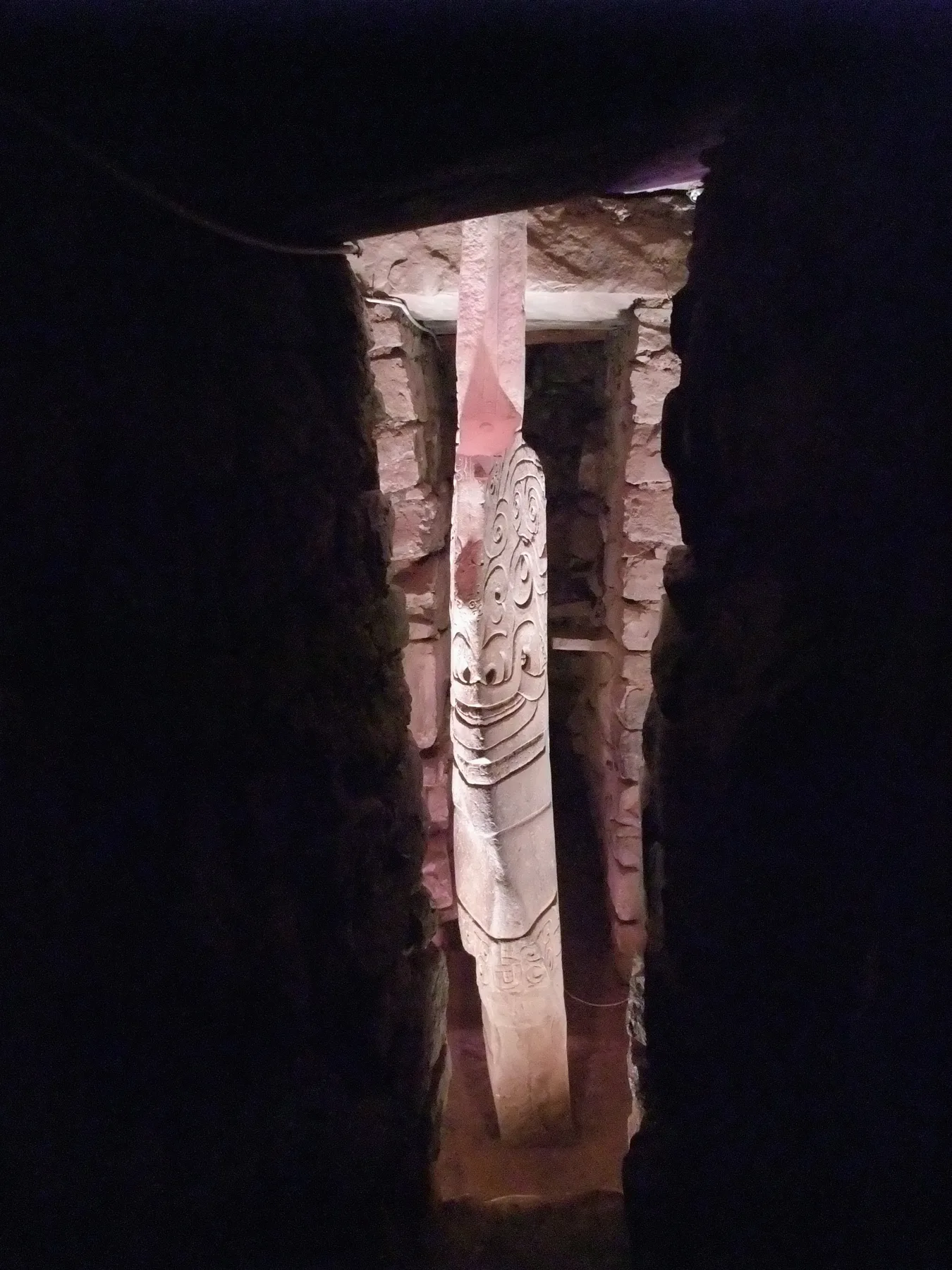

The stone cannot be seen from a single ideal position. It rises roughly 4.5 metres through a cramped crossing of interior passages. Its point enters the ceiling; its base meets the floor. A visitor standing nearby must look upward, shift position, and let parts disappear behind the narrow gallery walls.
Carving covers the pale granite. A standing being has feet, arms, and hands, yet its fingers end in claws. One hand points up while the other points down. Fangs turn sideways from a broad mouth. Hair or a headdress breaks into serpentine forms. Facial features repeat at different scales until body, animal, ornament, and image become difficult to separate.
The figure’s shifting appearance was only one part of a carefully controlled visit. Chavín de Huántar stands in a high valley where routes from the coast, highlands, and eastern slopes could meet. UNESCO describes it as a ceremonial and pilgrimage centre, built in stages with plazas, terraces, stone buildings, drains, vents, reliefs, and inner galleries. “Old Temple” and “New Temple” are modern labels, not two buildings completed on agreed dates. The safest date for the Lanzón is therefore the first millennium BCE, not one exact year.
Pilgrims would not have approached a neutral sculpture hall. Architecture separated exterior plazas from narrow interior routes. Darkness restricted sight. Turns interrupted orientation. Air shafts and drains connected spaces that bodies could not enter. Water could move through channels beneath and within the complex.
Sound mattered too. Archaeologists excavated conch-shell trumpets, or pututus, at the site, while carved figures show them being played. Miriam Kolar, John Rick, and collaborators have measured the acoustic behaviour of galleries and tested how shell-horn sound travels through them. Their integrative archaeoacoustic study establishes unusual auditory possibilities; it does not recover one complete ritual script. A trumpet, voice, footsteps, flowing water, and echoes could make a hidden interior perceptible without making it visible.
The Lanzón’s exact identity is likewise debated. Calling it a supreme god gives the figure a role more definite than the evidence permits. It may have materialised a powerful being, an oracle, a transformation, a meeting of realms, or relations among those ideas. A channel along the stone has been interpreted as a route for liquid offerings or communication, but its use is not directly recorded.
What is secure is more interesting than a forced name. The sculpture was fixed into architecture. Its upper and lower ends joined building surfaces. Its raised and lowered hands organised vertical space. Its mixed body resisted a simple division between human and animal. To reach it was to pass through a sequence designed by others.
Chavín authority therefore did not operate through image alone. It could be produced through access: who entered, who waited outside, who knew the route, who made sound, and who interpreted a being that could never be possessed in one glance.
Bodies that refuse to stay still: a Paracas mantle border

The bodies bend until their heads approach their feet. Long hair or streamers continue the curve. Red, green, yellow, and blue exchange places across the dark ground, while small detached heads, hands, and mask-like forms occupy the spaces between larger figures. Turn your attention from left to right and the bodies seem to roll, fall, fly, dance, or float.
Those verbs are modern attempts to stabilise a deliberately unstable posture. The Met’s object study notes that scholars have described the repeated being in all of those ways and have also read it as skeletonised. The image does not supply a caption that chooses among movement, transformation, death, or a combination of them.
It does reveal how repetition was made alive. The figures alternate direction without settling into mirror symmetry. Colour sequences change the weight of a face, limb, or headdress. Fringes turn the long upper edge into another rhythm. The cotton ground and camelid-fibre embroidery brought cultivated coastal material together with fibre from animals that thrive at higher elevations.
Making the strip required spinning, dyeing, weaving, embroidering, counting, turning, and controlling tension across more than a metre. It belonged to a mantle rather than an independent wall picture. On cloth, the backbent bodies could approach, encircle, and move with a human wearer.
Many Paracas textiles survive because they entered funerary bundles in one of the world’s driest regions. At Wari Kayan on the Paracas Peninsula, Julio C. Tello and his team began scientifically excavating hundreds of bundles in 1927. Bodies had been seated, dressed, and enclosed in repeated layers of plain and elaborate cloth, accompanied by other things. The Met’s open publication Ancient Peruvian Mantles, 300 B.C.–A.D. 200 shows that mantles could wrap, accompany, or be placed within such bundles.
This fragment’s record supplies no excavated bundle. It entered the Met in 1993 through a bequest, without a published archaeological findspot or earlier ownership chain on the object page. It would be tempting to attach it to the most famous Paracas cemetery. The honest history is less complete: a funerary textile tradition provides strong context for the class, while this strip’s own garment, maker, body, and place have been lost.
That gap is part of the object’s meaning now. Removing cloth from a body can turn attire into a flat design sample. Cutting or separating a border can make a technical fragment easier to display while destroying how it edged, enclosed, swung, folded, or met another garment. Museum preservation reveals the stitches and conceals the person.
The contrast with Chavín is material as much as stylistic. In the gallery, a visitor moved around a fixed stone being. On a mantle, repeated beings moved with a body—and later surrounded one in death.
A picture made as terrain: the Hummingbird and the Nasca lines
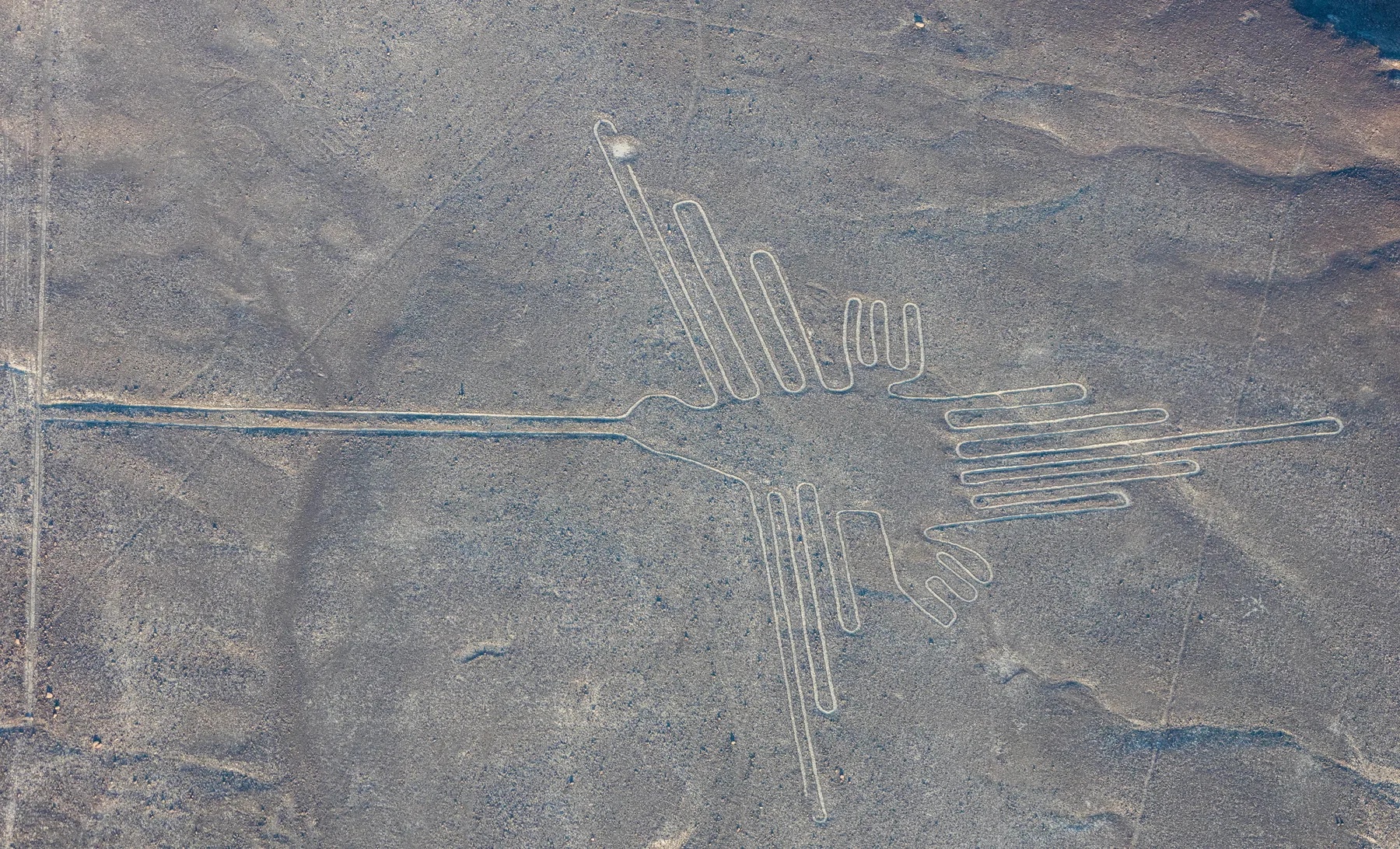
No pigment was needed to draw the hummingbird. Makers displaced the dark, weathered stones of the desert surface and exposed lighter earth. The contrast is shallow. Preservation depends on aridity and on people not driving, building, or walking carelessly across the lines.
The bird belongs to an enormous field rather than a gallery of separate animal pictures. UNESCO’s Lines and Geoglyphs of Nasca and Palpa property covers more than 75,000 hectares. Across it are representational figures, straight lines, radiating lines, spirals, rectangles, triangles, and broad cleared areas often called trapezoids. Works overlap. Some were maintained or remade. Construction continued across many centuries associated with Paracas and Nasca histories.
The famous animals are only a fraction of that landscape. Their aerial familiarity has encouraged two opposing myths: that the figures were astronomical messages meant to be seen from above, or that their scale exceeds Indigenous planning and therefore requires outsiders, lost technology, or extraterrestrials. Neither follows from the evidence. A large figure can be laid out with cords, stakes, sight lines, measured units, and coordinated labour. Nearby slopes offer partial elevated views, but complete visibility was not required for accurate construction.
There was probably no single purpose for every geoglyph. The 2024 open-access PNAS study “AI-accelerated Nazca survey” nearly doubled the documented corpus of figurative geoglyphs and found differences in scale, method, motif, and spatial relation. Small relief-type figures tended to lie beside informal trails. Larger line-type figures were more closely integrated with the formal network of lines and trapezoids. The pattern supports different acts and audiences rather than one code explaining all forms.
The Hummingbird is a line-type figure. Its outline links into extended lines, and its making required repeated decisions on the ground. Whether a particular line was walked ceremonially, marked group territory, joined a route, addressed water and mountain powers, organised gathering, or combined several purposes must be tested locally. “Ritual” is not a licence to stop asking how a place worked.
Water nonetheless belongs to the historical setting. The Rio Grande de Nasca drainage crosses an extremely dry coastal environment in which seasonal rivers, springs, aquifers, and irrigated valleys structured life. Cahuachi developed as a major ceremonial centre in that region.
Archaeological evidence connects it with pilgrimage, feasting, offerings, and changing settlement patterns. That does not turn every straight line into a map of underground water or every animal into a rain charm. It places landscape work inside communities for whom water, route, gathering, and survival could not be cleanly separated.
The modern aerial image produces its own artwork: one grey-brown field, one pale bird, one decisive frame. It helps us study the complete form while quietly removing heat, wind, distance, bodily scale, surrounding lines, and present conservation pressures.
The makers did not decorate an empty desert. They altered a lived terrain.
A face that could pour: the Moche portrait bottle
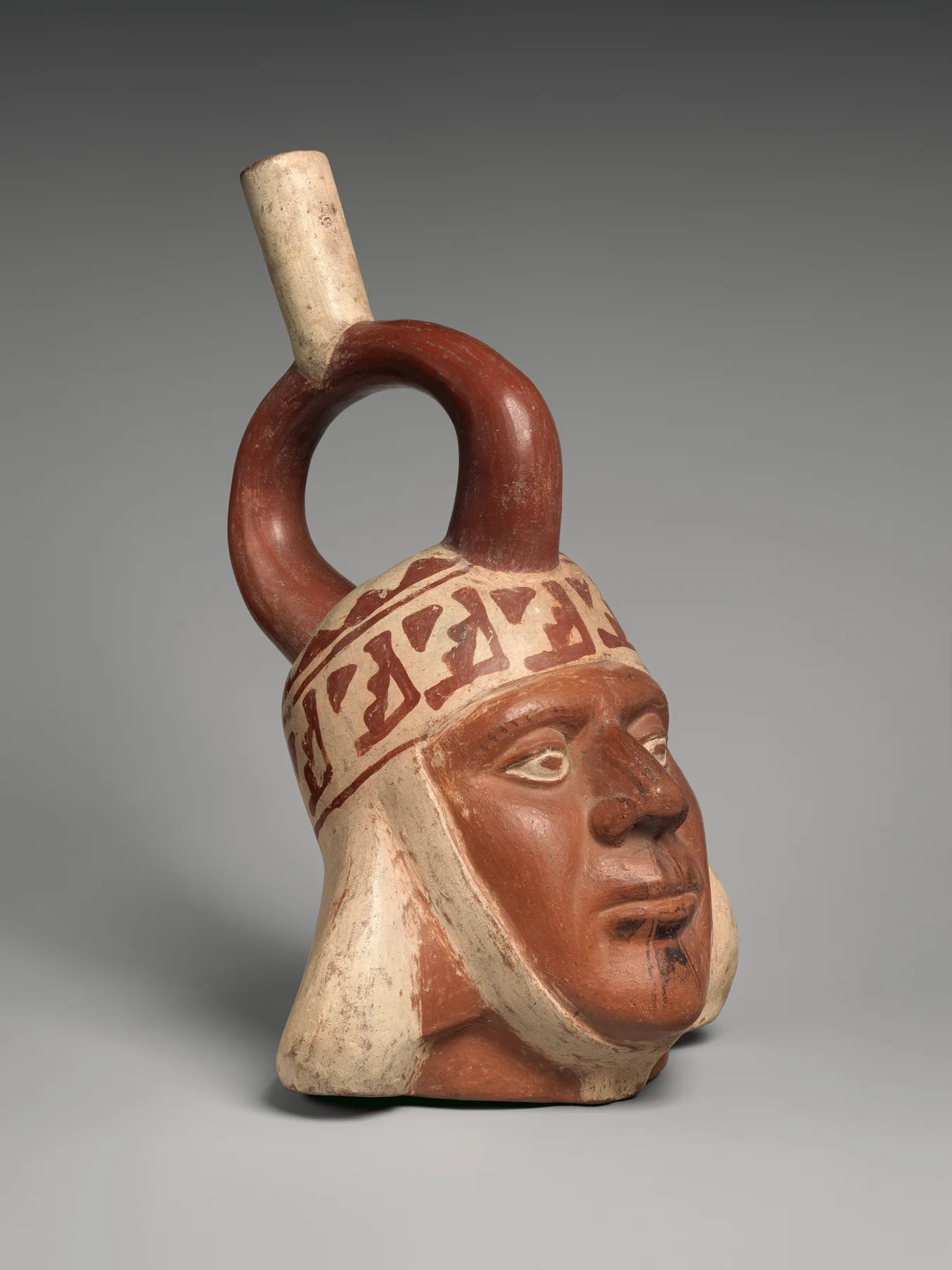
The face is particular. The eyelids are heavy but unequal. A line descends from each side of the nose. The lips press together. Black markings remain on the chin. A cream headcloth wraps beneath the jaw, while a painted band crosses the forehead.
Then the head becomes a bottle. A dark red ceramic loop rises behind it and joins a single spout. Liquid could enter, leave, and change the balance of the face in a hand.
Moche artists on Peru’s North Coast made portrait vessels during part of the first millennium CE. “Portrait” is persuasive because some faces recur across multiple vessels with consistent features, sometimes at different apparent ages. Yet it remains an analytical name. No inscription identifies this person, and resemblance does not tell us whether viewers understood the face as a living leader, warrior, ancestor, captive, remembered dead person, or something that crossed those categories.
The object was made with mould technology. Clay pressed into matrices allowed several bottles to repeat a head, while painted slip, post-fire pigment, headgear, jewellery, and finish could differentiate each one. Repetition and individuality were not opposites. A shared mould could carry a recognisable face into different settings, and each vessel could acquire its own surface and use history.
The Met’s research essay on Moche portrait vessels brings together the strongest contextual evidence. Wear and discarded sherds indicate that some vessels circulated during life. Fineline painted scenes place portrait vessels in ceremonial or elite settings. Every example recovered through documented excavation came from a high-status burial, but vessels showing men have been found with women, and images of what appears to be the same person occur in more than one tomb. The face was not simply a ceramic label for the body beside it.
The relation between head and container may also have carried danger. Mary Weismantel has argued that portrait vessels can be considered alongside Andean practices involving severed heads and relations with the dead. That interpretation challenges the reassuring idea of honorific portraiture without proving that every ceramic face represents a decapitated person. The vessel’s own form keeps both presence and containment in view.
Its collecting history limits the discussion. The bottle was associated with British diplomat Richard Gibbs in Peru and later Henry G. Marquand before entering the Met in 1882. No excavated context survives in the public record. Across the wider Moche corpus, looting has separated thousands of ceramics and metalworks from tomb architecture, human remains, offerings, dateable layers, and regional workshops. A visually intact object can arrive historically damaged.
Still, material operation supplies evidence. The head was moulded, joined to a hand-built spout, slipped, fired, painted, handled, and eventually deposited. It could hold a substance while presenting a person. Unlike a modern bust, it asked a viewer to grasp, turn, pour, and perhaps drink in the presence of a face.
Individuality here was not only something to look at. It was made to circulate.
A state pattern worn on a body: the Inka checkerboard tunic
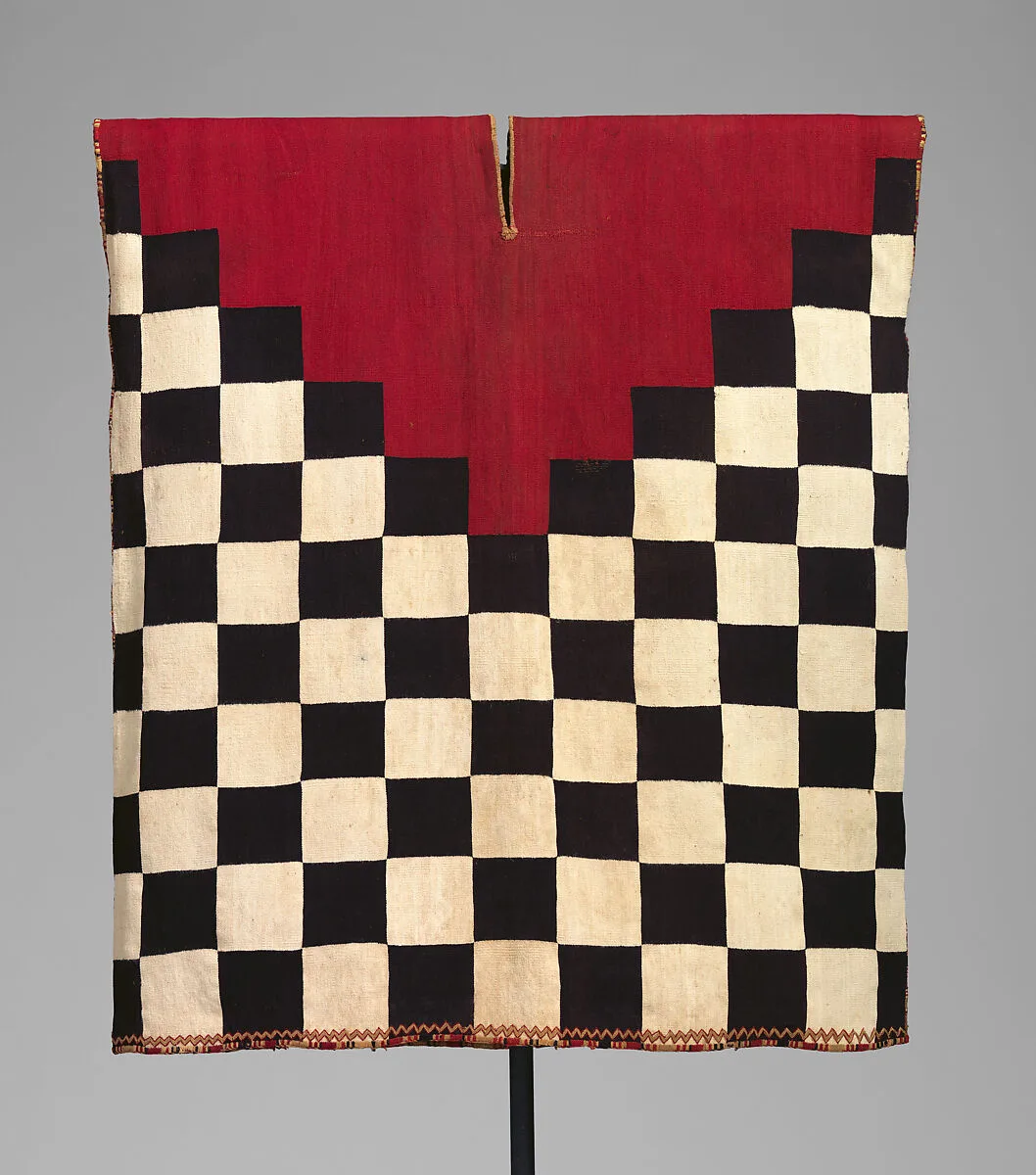
The checkerboard is difficult to dismiss as decoration. Black and white squares cover the front and back. A red field descends from the shoulders in a broad V. At the lower edge, a small zigzag nearly disappears beside the force of the grid. Turn the tunic inside out and the design remains carefully resolved.
This garment, called an unku in Quechua, was woven as one panel. The neck opening was held by temporary threads during production and opened after the cloth left the loom. Side seams and edges were then finished with dense, double-faced embroidery. Technical control made the surface look inevitable, although it required decisions at every join.
Clothing placed political signs on moving bodies. Early Spanish accounts associate black-and-white checkerboard tunics with Inka military groups, and surviving examples have therefore been connected to martial service and state identity. Fine cloth could be stored, bestowed, worn, exchanged, burned, or offered. A ruler’s gift honoured a recipient while establishing an obligation; generosity and control could operate together.
The source must be read critically. Francisco de Jerez described checkerboard livery at the 1532 encounter in Cajamarca, where Spaniards soon seized Atawallpa. His text is valuable evidence produced from inside conquest, not a neutral costume catalogue. The Met dates the garment broadly from 1400 to 1535, a range crossing the first years of invasion. Without a secure excavation context, no named wearer, workshop, event, or exact pre- or post-invasion date can be attached to this tunic.
Nor did Inka standardisation erase local agency. Tawantinsuyu expanded through military force, negotiation, resettlement, labour obligations, alliances, and existing regional institutions. State forms were made by skilled people whose knowledge came from particular communities. A 2023 PLOS ONE study of a scientifically excavated provincial unku from northern Chile found Inka conventions combined with local technical and stylistic choices. The authors describe state–local relations as asymmetric but not unidirectional: local weavers could reproduce the public signs required of imperial cloth while embedding less visible knowledge in construction.
That finding does not locate the Met tunic or decode every square. It changes the question asked of it. Instead of treating “Inka style” as a pattern transmitted intact from Cusco, we can look for the labour that made imperial consistency possible and for the regional decisions hidden inside apparent uniformity.
The grid gathered difference into a recognisable body. That body could be rewarded, ranked, mobilised, or made answerable to the state.
Textile was not a soft supplement to Andean stone architecture. It was portable infrastructure for social and political relations.
Five works, five active relations
| Case | Material action | Relation activated | What a museum-style view can hide |
|---|---|---|---|
| Chavín Lanzón | Carving granite into a figure fixed through floor and ceiling; controlling route, darkness, water, and sound | Pilgrim, specialist, powerful being, architecture, coast, and highland | Restricted access, sound, movement, changing building phases, and the impossibility of one complete view |
| Paracas border | Spinning, dyeing, weaving, embroidering, repeating, edging, wrapping | Cloth, moving body, status, ancestor, highland fibre, and coastal workshop | The missing mantle and wearer; funerary context reduced to a design fragment; lost findspot |
| Nasca Hummingbird | Removing surface stones, measuring terrain, maintaining lines, moving across a cultural landscape | Community, route, desert surface, gathering, water, and remembered place | Ground-level scale, surrounding lines, multiple periods, labour, and modern conservation pressure |
| Moche portrait bottle | Moulding a face, varying its finish, joining a spout, filling, pouring, handling, depositing | Individual likeness, repeated image, liquid, ceremony, elite household, and burial | The object biography before burial and the tomb, body, valley, and workshop erased by collecting |
| Inka unku | Spinning and dyeing fibre, tapestry weaving, finishing seams, gifting, wearing | Weaver, wearer, local community, military or political identity, and state | Labour and regional knowledge behind a standardised pattern; the unknown wearer and findspot |
The comparison produces no universal Andean symbol. It shows a recurring investment in relations that had to be performed.
The Lanzón became powerful through a difficult approach. The Paracas border needed a mantle and a body. The Hummingbird occupied terrain that people made and crossed. The portrait bottle joined a face to liquid and handling. The checkerboard tunic placed state recognition on a wearer through the work of weavers.
Remove those actions and each work becomes easier to display—and harder to understand.
What the surviving archive asks us to notice
Textile is not secondary
European art-history surveys have often made stone architecture and freestanding sculpture the measures of civilisation. In the Andes, cloth could require extraordinary labour, carry materials across ecological zones, mark political status, enclose the dead, and outvalue metal. Its portability was not evidence of lesser importance. It was one source of power.
Landscape is not an empty background
Chavín’s valley position and Nasca’s desert surface were not stages on which culture later appeared. Routes, water, mountains, soils, weather, and horizons shaped what could be built and how it could act. A cultural landscape contains work and memory as surely as a vessel contains liquid.
“Portrait” does not mean photograph
Individual features on a Moche vessel support recognition. They do not supply a modern sitter’s biography. The image may have gathered person, role, ancestry, captivity, death, and ritual use in ways the word portrait only partly holds.
Empire is a relationship, not a style filter
An Inka-looking object does not prove that Cusco replaced local making. Imperial forms depended on labour, local materials, regional experts, negotiation, and coercion. Standardisation can reveal the reach of a state while hiding the people who reproduced and altered it.
Preservation has a politics
Dry tombs preserved fibres and bodies. Excavation recovered associations when carefully recorded. Looting converted burials into inventories of saleable objects. Museum catalogues can restore part of an object’s history, but missing findspots and unnamed makers should remain visible rather than being filled with confidence.
A compact timeline without a ladder
- Before 1000 BCE: ceremonial centres, farming communities, exchange routes, and complex textile traditions already have long histories across the Central Andes.
- First millennium BCE: Chavín de Huántar grows through multiple building phases and becomes an important place of pilgrimage and interregional convergence.
- Fourth–third century BCE: the Paracas border in this guide is made on the South Coast as weavers transform fibre, colour, and repeated figures into bodily material.
- About 500 BCE–500 CE: communities create and renew thousands of lines and geoglyphs across Nasca and Palpa; dates and functions differ within the corpus.
- About 200–850 CE: Moche centres flourish in several North Coast valleys, sharing visual and ritual practices while maintaining regional political differences.
- About 600–1000 CE: Wari and Tiwanaku expand different highland political, religious, and material systems; neither is merely a failed rehearsal for the Inka.
- About 900–1470 CE: Chimú power centres on Chan Chan and the North Coast before Inka conquest; many other regional societies develop across the Andes.
- Fifteenth–early sixteenth century CE: Tawantinsuyu expands rapidly, incorporating diverse communities through changing combinations of force, alliance, labour, resettlement, road systems, storage, ritual, and local administration.
- 1532 CE: Spaniards seize Atawallpa at Cajamarca amid an Inka civil war; conquest continues through Indigenous alliances, resistance, epidemic disease, and colonial violence.
- After invasion: Andean communities, arts, languages, and knowledge continue under changing colonial and republican conditions. The archaeological period ends; Andean history does not.
Ten questions for close looking
- Which parts of the Lanzón can the photograph show clearly, and which does the narrow gallery conceal?
- How do the figure’s upward and downward hands connect body to architecture?
- On the Paracas strip, what remains constant across the backbent figures, and what changes with colour and direction?
- How would the border act differently on a garment than it does mounted flat?
- Which features make the Hummingbird legible from the air, and what would become more important on the ground?
- How do lines beyond the bird change it from an isolated picture into a landscape?
- What makes the Moche face appear individual, and what turns it unmistakably into a container?
- How might mould repetition and painted variation work together rather than oppose one another?
- Which aspects of the Inka tunic address a distant viewer, and which reward close inspection or touch?
- Across all five cases, whose labour is necessary for the work to act but absent from its modern title?
For a method you can reuse, begin with how to analyse a work of art and then place two of these cases into the claim-led structure in how to compare two artworks. A productive comparison might pair Chavín and Nasca through movement, Paracas and Inka through cloth on bodies, or the Moche vessel and Inka tunic through portable political presence.
Five shortcuts worth refusing
“Ancient Andean” means Inka
Tawantinsuyu was a late, powerful formation within millennia of Andean history. Chavín, Paracas, Nasca, Moche, Wari, Tiwanaku, Chimú, and many communities outside those labels cannot be understood as preliminary Inka stages.
The Nasca lines were made for aliens
Their construction falls within known human capacities: planning, clearing stones, cords, stakes, sight lines, measurement, repeated labour, and maintenance. The extraterrestrial claim denies Indigenous engineering while explaining none of the archaeological context.
Moche portraits identify rulers exactly
The vessels can preserve recognisable individuals without naming them. Their use, repetition, burial, and head-as-container form make the category more complex than royal portraiture.
Inka order erased local culture
Imperial expansion was unequal and often coercive, but state conventions were enacted by local people and through existing systems. Archaeological analysis finds negotiation and regional knowledge within objects that look standardised.
Ancient art ended with conquest
European invasion transformed political orders and caused catastrophic violence and loss. It did not make Andean peoples vanish. Living languages, weaving, pilgrimage, agriculture, community authority, music, and relations to land continue, change, and belong to the interpretation of heritage today.
A source guide for further study
Start with object and site records, then follow the scholarship that tests how each interpretation was built:
- UNESCO’s Chavín archaeological-site record establishes the pilgrimage setting, architectural systems, decorated stonework, conservation history, and the site’s multi-phase development.
- John Rick’s Stanford project offers a navigable introduction to Chavín de Huántar and documents the long-running mapping and gallery research behind many current interpretations.
- Miriam Kolar, John Rick, Perry Cook, and Jonathan Abel’s study of pututus and architectural acoustics connects excavated instruments, measured sound, gallery space, and ritual possibility without claiming to replay one certain ceremony.
- The Met’s Paracas border-fragment record documents material, imagery, dimensions, interpretive ambiguity, and collection history. Its publication Weaving Abstraction places Paracas fibre practice in a longer Andean history without subordinating textile to stone.
- The Met’s Ancient Peruvian Mantles distinguishes Ocucaje and Wari Kayan material and explains how cloth worked within layered funerary bundles.
- UNESCO’s Nasca and Palpa record defines the scale, chronology, construction method, variety, conservation, and cultural-landscape character of the geoglyph field.
- Masato Sakai and colleagues’ 2024 open PNAS survey uses remote sensing, field confirmation, and machine learning to expand the known figurative corpus and compare different geoglyph types with routes and line networks.
- The Met’s Moche portrait-bottle record, portrait-vessel essay, and open publication Containing the Divine bring object biography, mould production, use wear, excavated burial contexts, and competing interpretations together.
- The Met’s Inka unku record documents the checkerboard garment’s construction, dimensions, visual design, early colonial textual comparison, and Open Access image.
- Jacqueline Correa-Lau and colleagues’ open study of an excavated provincial unku provides an important corrective to one-way models of imperial style by locating local technical agency within Inka conventions.
- UNESCO’s Qhapaq Ñan record connects pre-Inka infrastructure, Tawantinsuyu’s road system, six present-day countries, and the living communities who continue to use and care for parts of the network.
These sources do different work. A World Heritage record defines and manages a place. A museum record follows an object but may begin after its archaeological context was lost. Scientific excavation can join artefact to body, architecture, and date. Experimental acoustics tests material possibilities without recovering vanished belief. Indigenous and local custodians hold knowledge that cannot be replaced by a remote catalogue.
Read together, the five cases change scale.
The Lanzón is no longer only a carved god; it is a controlled encounter inside a sounding building. The Paracas fragment is no longer only a pattern; it is the surviving edge of cloth, body, and burial history.
The Hummingbird is no longer only an aerial icon; it is labour and movement laid into terrain. The Moche face is no longer only a likeness; it is a person-shaped container with a social life.
The checkerboard is no longer only an imperial motif; it is state power made wearable by expert hands.
Ancient Andean art did not merely represent a world. It helped relations in that world take place.
Editorial record
About this article
- Author
- Publisher
- GeMarkt
- Published
- Updated
- Reviewed
- Internal source & rights check. Conducted by GeMarkt Research Review. This is an internal editorial check—not independent peer review.
- Source standard
- Art history source standardPrioritises object records and research sources, distinguishes evidence from interpretation, and states material uncertainty.
Found a claim that needs checking? Report a factual error.