Art History · Learning chapter
Atlas III — Early-modern worlds · 6 of 11
Joseon Korean art: court ritual, Confucian space, painting, and ceramic
A critical guide to Joseon Korean art through royal ritual, ancestral portraiture, uigwe protocols, scholar painting, Buddhist patronage, buncheong, porcelain, labour, and war.

What we’ll look at
How did portraits, rituals, spaces, and ceramics show social order in Joseon Korea?
The man above is not meeting our gaze in a neutral portrait studio. Yun Dongseom, a scholar, calligrapher, and civil official who lived from 1710 to 1795, appears in formal robe and winged hat, seated in a high-backed chair covered with leopard skin. His hands disappear inside his sleeves. The empty ground removes daily circumstance, while the rank badge, patterned textile, chair, footrest, face, and posture make an ordered social identity present.
The hanging scroll probably functioned at the centre of a family shrine. Descendants did not merely inspect it for resemblance. They approached an ancestor through prescribed acts of remembrance and offering. The painting’s meaning therefore extended beyond pigment on silk into genealogy, domestic space, ritual time, food, bowing bodies, storage, display, and inherited obligation.
This chapter follows such relationships across the Joseon dynasty, founded in 1392 and ending with Japanese annexation in 1910. Five centuries cannot be surveyed as a single taste for white, quiet, or restraint. The route is selective: royal ancestral ritual and protocols, portraits, court and literati painting, Buddhist patronage, buncheong, and porcelain. It cannot represent all regional, religious, domestic, textile, architectural, printed, or popular production on the Korean Peninsula.
Rather than asking what looks “essentially Korean,” this chapter asks which institutions gave objects meaning. “Confucian” is useful when it points to a school, ritual, shrine, office, family rule, record, or debate. “Korean simplicity” tells us less than the practical choices behind an object: preparing clay, meeting court demand, organising tribute, joining two vessel halves, and firing them in an unpredictable kiln.
Five centuries cannot be one style
Joseon lasted longer than many categories treated as whole eras in survey courses. Its rulers moved the capital to Hanyang, present-day Seoul; built and rebuilt palaces and shrines; changed court offices and kiln administration; survived coups, factional conflict, invasions, famine, and commercial growth; and confronted nineteenth-century imperial pressures.
A fifteenth-century buncheong vessel, a 1565 Buddhist triad, a seventeenth-century bamboo painting, an eighteenth-century ancestral portrait, and a nineteenth-century court screen did not answer one audience. Dynasty dates locate political structures. They do not make every object contemporaneous or stylistically alike.
Use “Joseon art” as a question: which part of Joseon, which institution, and whose access? Court workshops, regional kilns, Buddhist monasteries, literati networks, family shrines, urban markets, and village rites overlapped without becoming one visual language.
Joseon was founded through institutional change
Yi Seong-gye founded Joseon after the fall of Goryeo and ruled as King Taejo. The new dynasty moved its political centre, reorganised land and office, and elevated Neo-Confucian learning as a governing framework. Civil examinations, schools, ritual codes, historical writing, lineage practice, and court ceremony became important mechanisms of rule.
Change was not total replacement. Joseon inherited Goryeo personnel, Buddhist institutions, ceramic knowledge, writing systems, diplomatic relationships, and material infrastructure. Officials disputed how quickly new ritual norms should be implemented. Regional communities did not experience court policy identically.
The dynasty’s visual culture emerged through this tension: rulers claimed a new moral and political order while relying on inherited skills and objects. A founding date marks an institutional project, not a blank page.
Confucian is not an appearance
Neo-Confucianism supplied arguments about ethical cultivation, family hierarchy, education, governance, mourning, and proper rites. Its Joseon forms developed through engagement with Chinese texts and Korean political conditions. Officials disagreed over interpretation; rules changed; practice never perfectly matched prescription.
Calling an undecorated white vessel “Confucian” may identify an elite association with purity and restraint. It cannot explain the object’s clay, kiln, price, use, maker, or firing. A brilliantly coloured royal procession, carefully descriptive portrait, monumental shrine, or blue-painted porcelain could also operate within Confucian institutions.
An ideology does not emit a style. It becomes visible through choices about what to build, commission, record, wear, offer, preserve, and exclude.
Begin with an ancestor who must be present
Ancestor rites connect living descendants to the dead through names, spirit tablets, portraits, offerings, gestures, and scheduled ceremonies. The relationship is enacted, not merely believed. Objects help organise who stands where, who speaks, and whose lineage receives recognition.
Royal and family rites worked at different scales, but both made continuity material. Portraits could centre family shrines; ceramic epitaphs entered graves; spirit tablets occupied royal halls; ritual vessels held food and wine. Storage between rites was part of the object’s life because controlled absence made later presence possible.
This perspective changes portrait analysis. Resemblance matters, but so do mounting, display interval, shrine location, descendants, and the acts performed before the image.
Yun Dongseom sits for his lineage
The Met identifies the sitter through comparison with two other surviving portraits in Korean collections. The work is attributed to an unidentified Korean artist and dated about 1790–1805, near the end of Yun’s life or shortly after his death.
His face carries wrinkles, asymmetry, a sparse beard, and controlled shading. Formal robe and rank badge locate him within official hierarchy. The chair and footrest hold the body frontally, yet the face turns slightly, creating physical presence without casual encounter.
The painter’s name is unknown while the sitter’s offices and lineage remain recoverable. That imbalance is structural. Elite portraiture was designed to preserve the represented official; court and workshop makers often entered records through office or task rather than modern individual fame.
A portrait constructs truth
Joseon portraits are frequently praised for uncompromising likeness. Close observation and comparison among surviving versions support that reputation, but “realistic” cannot mean unmediated. A painter selected viewpoint, contour, colour, robe, badge, chair, and bodily stillness. Assistants or copyists could participate; later versions could renew a damaged ancestral image.
The blank ground is not absence of composition. It removes anecdote and directs attention to the ranked body. Subtle modelling makes age visible while formal clothing presents durable office. Physical specificity and ideal role strengthen one another.
Ask what kind of truth the portrait needed to produce: identification, moral character, social rank, filial memory, ritual presence, or several at once. A modern passport likeness answers a different institution.
The family shrine made painting active
A portrait rolled in storage was not dead matter. It waited for occasions when descendants installed and approached it. Offerings, bows, names, genealogies, and repeated viewing converted an inherited image into a relationship across generations.
Neo-Confucian lineage organisation strongly privileged male descent. The portrait at the centre of a shrine could make that hierarchy feel natural and continuous. Yet family survival depended on women’s labour, marriage alliances, property, ritual preparation, and reproduction even when records foregrounded men.
To call the work private also misleads. Family rites shaped public status, office networks, inheritance, and local authority. Domestic ritual was political at another scale.
Jongmyo space becomes ritual in motion
Jongmyo in Seoul houses spirit tablets of Joseon kings and queens. Its long, low halls, courtyards, gates, storage spaces, paths, and surrounding landscape were designed for royal ancestral rites. The current complex reflects rebuilding after destruction during the Japanese invasions of the 1590s and later expansion.
The UNESCO site record describes Jeongjeon, Yeongnyeongjeon, preparation halls, storage, and the paths through which participants moved. Architecture ordered waiting, procession, offering, music, and withdrawal. It became complete as ritual space when trained bodies, garments, vessels, food, sound, dance, and tablets met.
The associated Jongmyo royal ancestral ritual and music continues today under modern safeguarding institutions. Continuity is not lack of change. Performance has survived dynastic collapse, colonisation, war, heritage law, reconstruction, and new publics.
Uigwe turns ceremony into reproducible knowledge
Uigwe are royal protocols that record the preparation and execution of major ceremonies through text and illustration. Weddings, funerals, investitures, banquets, and other events required correct sequences, objects, clothing, personnel, and expenditure. A record could guide future officials as well as memorialise completed work.
The National Museum of Korea describes illustrated volumes detailing process, not simply depicting a spectacular day. Different copies could be made for royal viewing and administrative archives. Paper, silk covers, pigments, binding, calligraphy, and diagrams made recordkeeping a material art.
An uigwe image is not a camera-like eyewitness view. Processions may be arranged for legibility, ranks distinguished, objects separated, and routes flattened. Its precision serves administration and ritual memory.
Court records also document mobilised labour
Protocols can name directorates, officials, artisans, materials, quantities, wages, and deadlines. They reveal that royal splendour depended on procurement and coordination. Painters, scribes, binders, carpenters, metalworkers, textile workers, cooks, carriers, musicians, guards, and temporary labour made ceremony possible.
Documentation does not guarantee equality. A record may preserve a senior official’s title while reducing a craftsperson to role or number. Women’s work, coerced service, regional extraction, and informal assistance can remain difficult to see.
Read the archive both for what it specifies and how it ranks. “The court commissioned” is only the beginning of an explanation; uigwe help unfold the verb into tasks.
The Bureau of Painting was a workplace
The royal Bureau of Painting, or Dohwaseo, employed professional painters for portraits, documentary works, maps, decorative screens, ceremonial records, and other state needs. Examination, rank, assignment, patronage, and court demand shaped careers.
Court painters could be highly skilled while occupying lower social status than the officials whose ideals their work served. Their training crossed genres, and collective projects required division of labour. Later connoisseurship often elevates named masters while leaving routine institutional production anonymous.
The bureau should not be imagined as a modern art school or a machine producing one style. It was an office in which visual skill became state service.
Literati status was a social claim
Joseon literati joined classical learning, calligraphy, poetry, painting, office, friendship, and ethical self-fashioning. Ink painting could present the brush as a trace of cultivated character rather than manual commodity. That claim distinguished elite practice from professional craft.
But status and making intersected. Royal descendants painted; officials exchanged works; professional painters adapted literati models; imported manuals circulated; collectors and markets valued recognised hands. A scholar could make art inside economic and patronal relationships while denying commercial motivation.
“Amateur” therefore describes an ideology of rank and intention, not necessarily unpaid or untrained production. It should never be used as a quality guarantee.
Bamboo bends but does not break
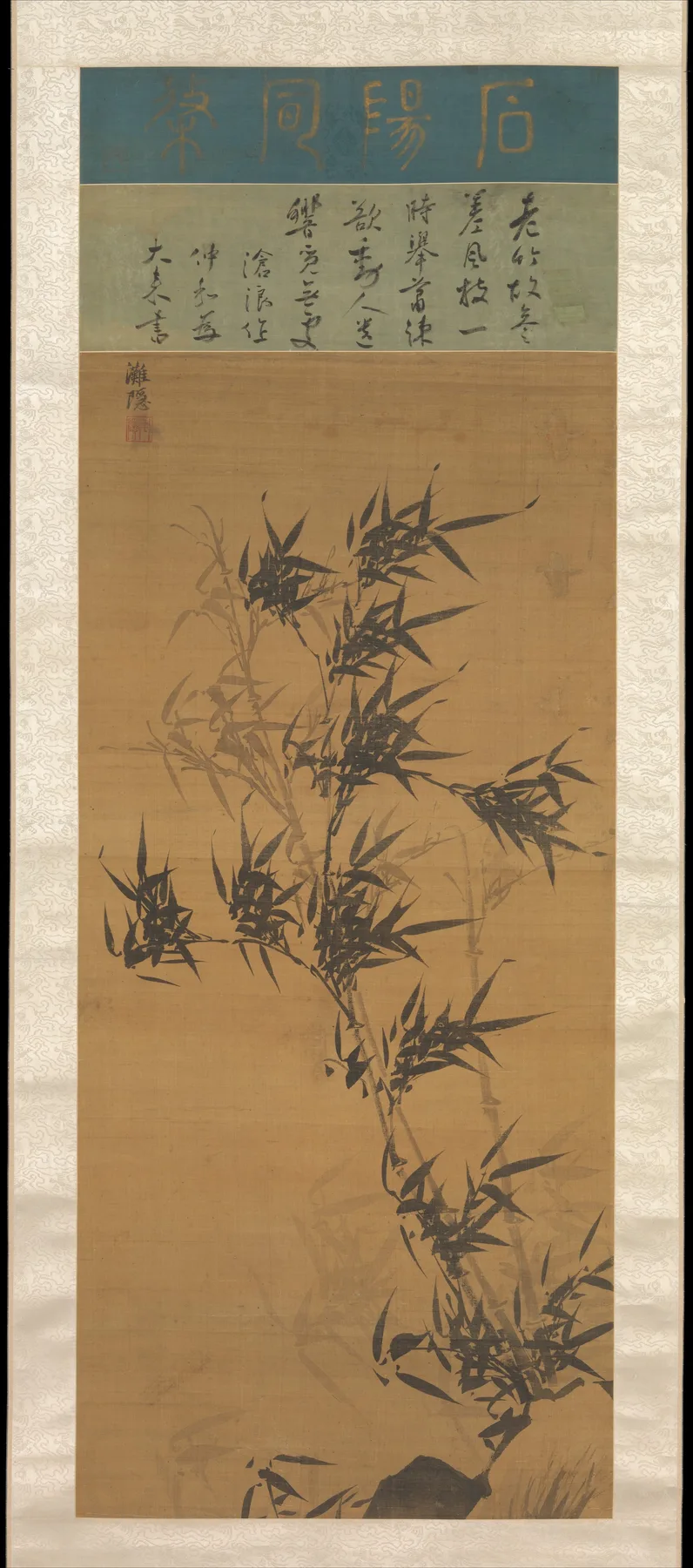
Yi Jeong, a great-great-grandson of King Sejong, was renowned for ink bamboo. In this hanging scroll, stalks rise diagonally while leaves turn, overlap, and taper under wind. Dark and light ink separate clusters and create depth without coloured description.
Bamboo carried associations of integrity and endurance across East Asian scholar culture. The inscription makes the metaphor specific: aged bamboo bends together in the breeze and seeks a human response. The plant is not a timeless national symbol but a learned pictorial and poetic resource.
Yi’s royal descent, education, access to silk, and knowledge of earlier painting belong to the work. Moral character becomes visible through material privilege as well as brush control.
Brushwork made character visible
Calligraphic brushwork allowed viewers to read movement: pressure, speed, turn, pause, wetness, dryness, dark, pale, blunt, or pointed ending. In bamboo painting, one stroke could describe a stalk segment or leaf while demonstrating bodily discipline.
The idea that brush reveals character is itself a historical convention. It trained viewers to connect formal control with ethical cultivation. A painter could deliberately perform spontaneity after years of repetition.
Close looking should test the claim rather than repeat it. Which leaves appear in one stroke? Where does pale ink recede? How do inscription, image, and mounting establish learned authority?
Imported models became Korean resources
Joseon artists studied paintings, texts, prints, and manuals circulating from Ming and Qing China. Diplomatic missions carried objects and information in both directions. Buddhist, Confucian, literary, and technical knowledge had already moved across the region for centuries.
Borrowing did not create derivative art. Makers selected models for local offices, landscapes, audiences, and materials. The Eight Views of Xiao and Xiang, Southern School landscape theory, and printed painting manuals acquired new sequences and meanings on the Korean Peninsula.
The correct unit of analysis is a route: which edition, envoy, collection, teacher, or copied work was available? “Chinese influence” without a carrier hides historical agency on both sides.
True-view landscape is still constructed
Eighteenth-century painters including Jeong Seon developed influential images of named Korean sites, especially the Diamond Mountains. The term “true-view” distinguishes attention to recognisable local topography from landscapes built chiefly through inherited conventions.
Yet a true-view painting is not unprocessed nature. Travel route, season, selected viewpoint, album sequence, brush idiom, patron, literary association, and later national interpretation shape the site. Mountains can be recognisable and rhetorically transformed at once.
The Met’s catalogue Diamond Mountains: Travel and Nostalgia in Korean Art follows how images changed from eighteenth-century travel culture through division of the peninsula. Place gains meaning through access and loss as well as topography.
Everyday-life painting is not a social photograph
Late Joseon genre paintings show markets, farming, crafts, wrestling, schoolrooms, courtship, and elite leisure. Works associated with Kim Hong-do and Sin Yun-bok have become celebrated evidence of social life and Korean identity.
They are composed images made for viewers. Humour, gesture, cropping, type, and selective detail can expose tension while also turning workers, women, or lower-status figures into subjects of elite observation. A visible activity does not tell us the depicted person’s name, voice, or consent.
Eleanor Soo-ah Hyun’s Met essay on work and leisure places the genre within earlier idealised images and eighteenth-century change. Use such paintings with tax records, tools, clothing study, literature, and local histories rather than as self-explanatory snapshots.
Buddhism did not disappear
Joseon governments restricted Buddhist institutions and promoted Neo-Confucian rule, especially compared with Goryeo court patronage. Monasteries lost land and political position; monks were marginalised within official status systems.
Buddhist practice nevertheless continued. Temples, sculptures, paintings, rituals, donors, monastic lineages, and pilgrimages survived and changed. Royal women could become major patrons. Monks fought during the Japanese invasions of the 1590s, complicating any simple opposition between Buddhist monastery and Confucian state.
“Suppression” names unequal policy. It does not mean absence. An art history that follows only official ideology reproduces the state’s desired picture of society.
Queen Munjeong commissioned four hundred images
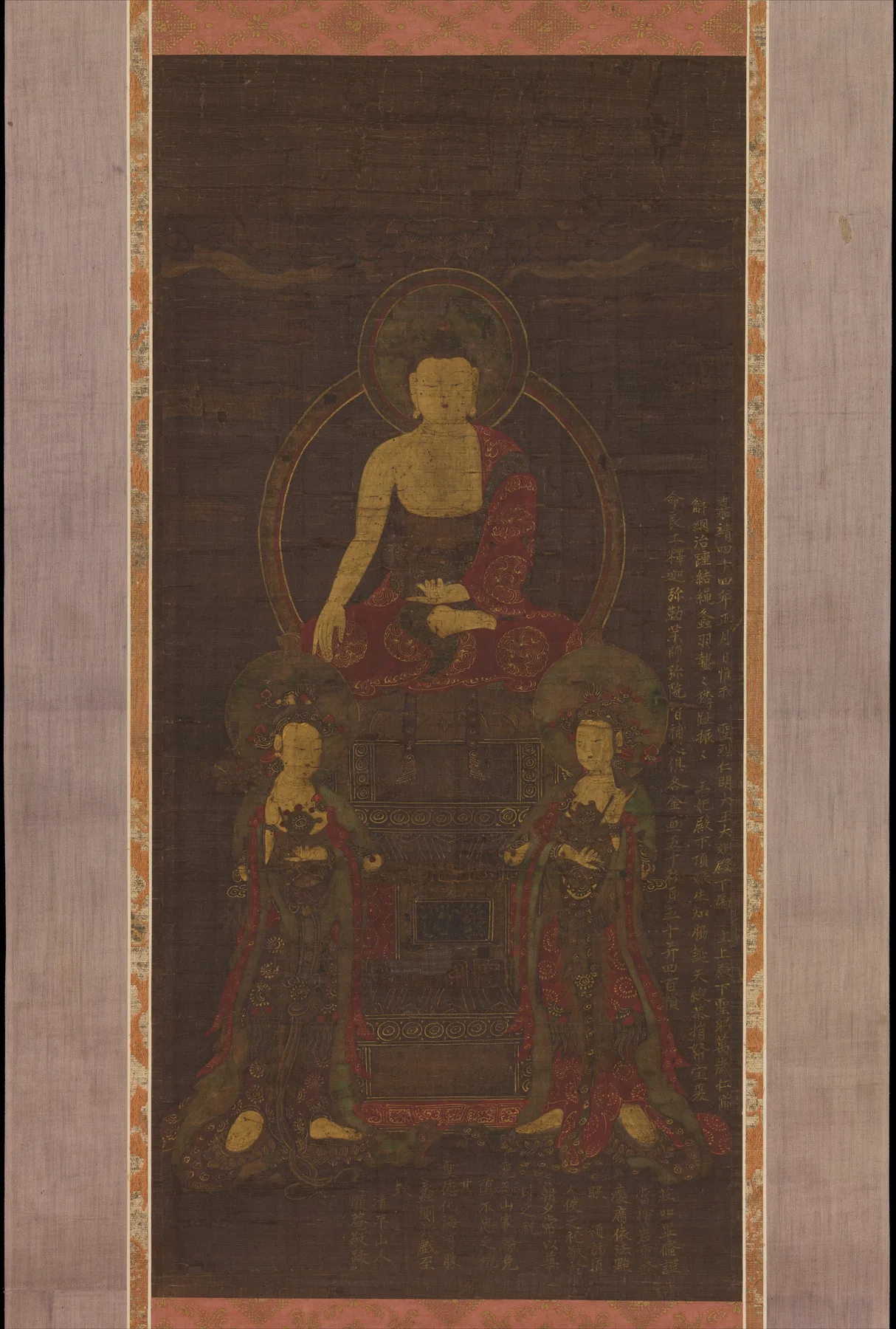
An inscription records that Queen Dowager Munjeong commissioned this image in 1565 to pray for King Myeongjong’s health, celebrate the crown prince’s birth, and mark restoration at Hoeam Temple. It belonged to an extraordinary project of four hundred paintings: sets devoted to Shakyamuni, Maitreya, the Medicine Buddha, and Amitabha, in colour and gold.
Only a handful survive. The Met object record therefore supports both scale and loss. Rich pigment, gold, patterned garments, fine silk, calligraphy, and repeated production joined devotion to royal resources.
The commission makes two exclusions visible. A narrative of austere Confucian taste cannot contain its splendour, and a male-only account of patronage cannot explain its origin. Munjeong exercised power through a Buddhist project inside a court officially committed to Neo-Confucian policy.
War remade objects, workshops, and routes
Japanese forces invaded Korea in 1592, beginning a conflict that continued to 1598. Cities, palaces, shrines, temples, archives, farms, and lives were devastated. Jongmyo and many court records were destroyed. Ming intervention and wider regional war made Joseon territory a battlefield.
Japanese commanders forcibly carried Korean potters and other specialists to Japan. Their skills contributed to new kiln traditions there, although each workshop’s history requires local evidence. Movement under capture is not cultural exchange in a benign sense.
The Manchu invasions of 1627 and 1636 further altered political relationships, diplomacy, memory, and material life. Works dated “seventeenth century” must be placed against disruption, reconstruction, and changing Qing–Joseon relations rather than treated as a calm stylistic phase.
Buncheong was not accidental folk art
Buncheong describes high-fired stoneware coated or decorated with white slip through methods including inlay, stamping, incising, sgraffito, dipping, brushing, and iron painting. It developed from late Goryeo inlaid celadon and flourished mainly in the fifteenth and sixteenth centuries.
Modern viewers often celebrate its bold marks and irregular surfaces as spontaneous folk expression. The Met and Leeum catalogue Korean Buncheong Ceramics instead documents varied production for court, elite, ritual, and broader use.
Regional kilns owed selected wares to the central government. Stamps could identify offices or standardise decoration. “Free” brushwork arose within clay preparation, slip timing, kiln schedules, demand, training, and tribute—not outside institutions.
One bottle makes regional skill visible
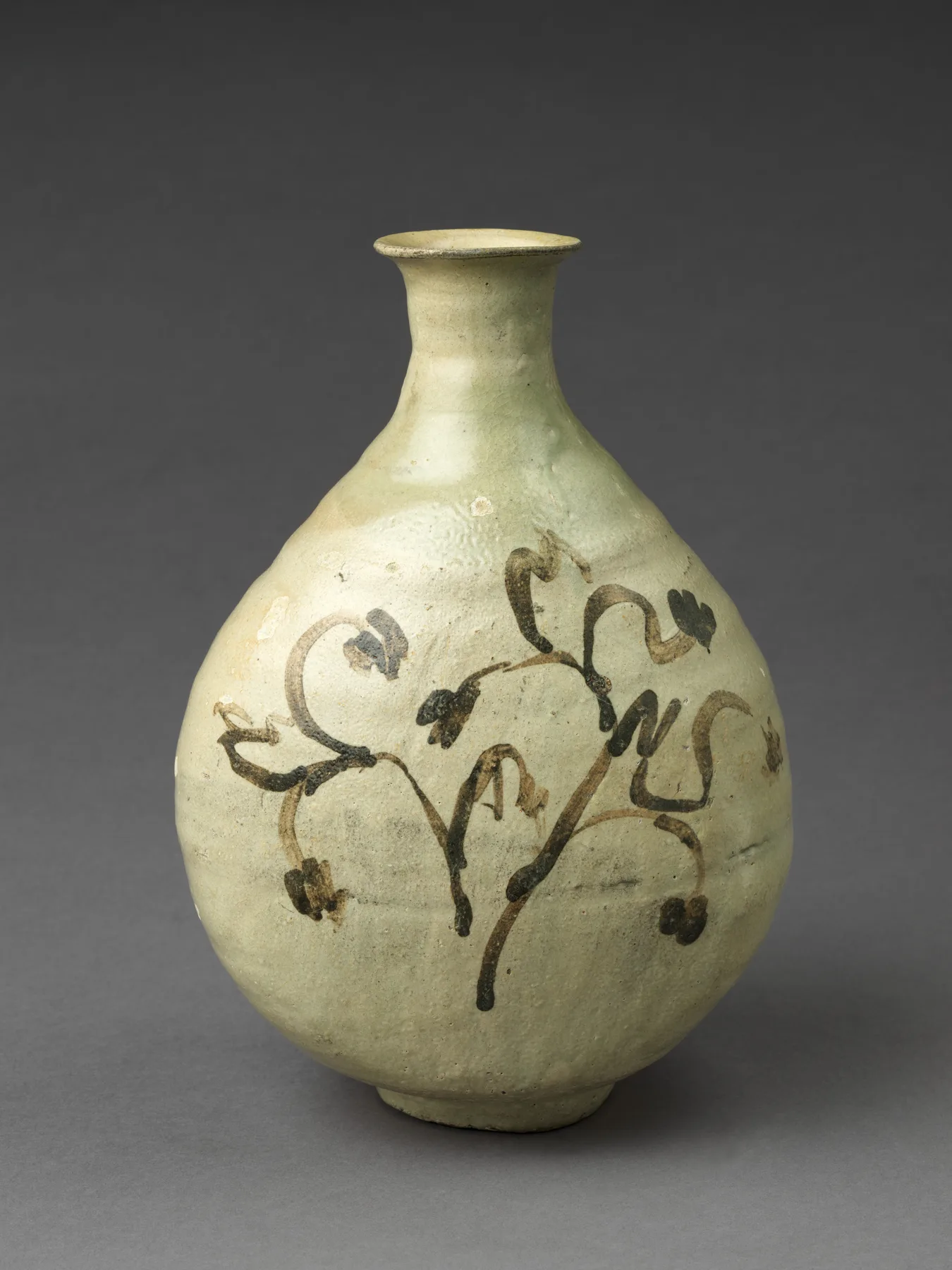
This flask-shaped bottle covers a light body with white slip and adds an iron-brown plant in quick, confident lines. The image bends around volume; gaps and thickening record the brush’s movement over a curved surface.
The Met attributes the bottle to the Goheung Undae-ri kiln context in South Jeolla Province through clay, coverage, shape, decoration, and comparison, while noting that iron painting was strongly associated with Gongju Hakbong-ri kilns. Attribution is an archaeological and technical argument, not a national style label.
Its apparent ease required control of vessel balance, slip adhesion, iron pigment, glaze, and firing. “Whimsical” describes our response; skilled sequence explains survival.
Royal kilns linked purity to administration
White porcelain became preferred at the Joseon court during the fifteenth century. Court-managed bunwon kilns near the capital produced wares for royal use from the 1460s, although sites and administration changed. Suitable white clay, fuel, transport, skilled workers, inspection, and firing linked the court table to regional resources.
Soyoung Lee’s Met essay on Joseon porcelain notes that white ware expanded beyond elite use and became widely produced. Undecorated vessels coexisted with cobalt blue, iron brown, copper red, carving, openwork, and moulding.
Purity was therefore an aesthetic and political association, not a complete description. Administration decided which whiteness, shape, flaw, or decoration was acceptable for a destination.
A moon jar is two halves and one firing
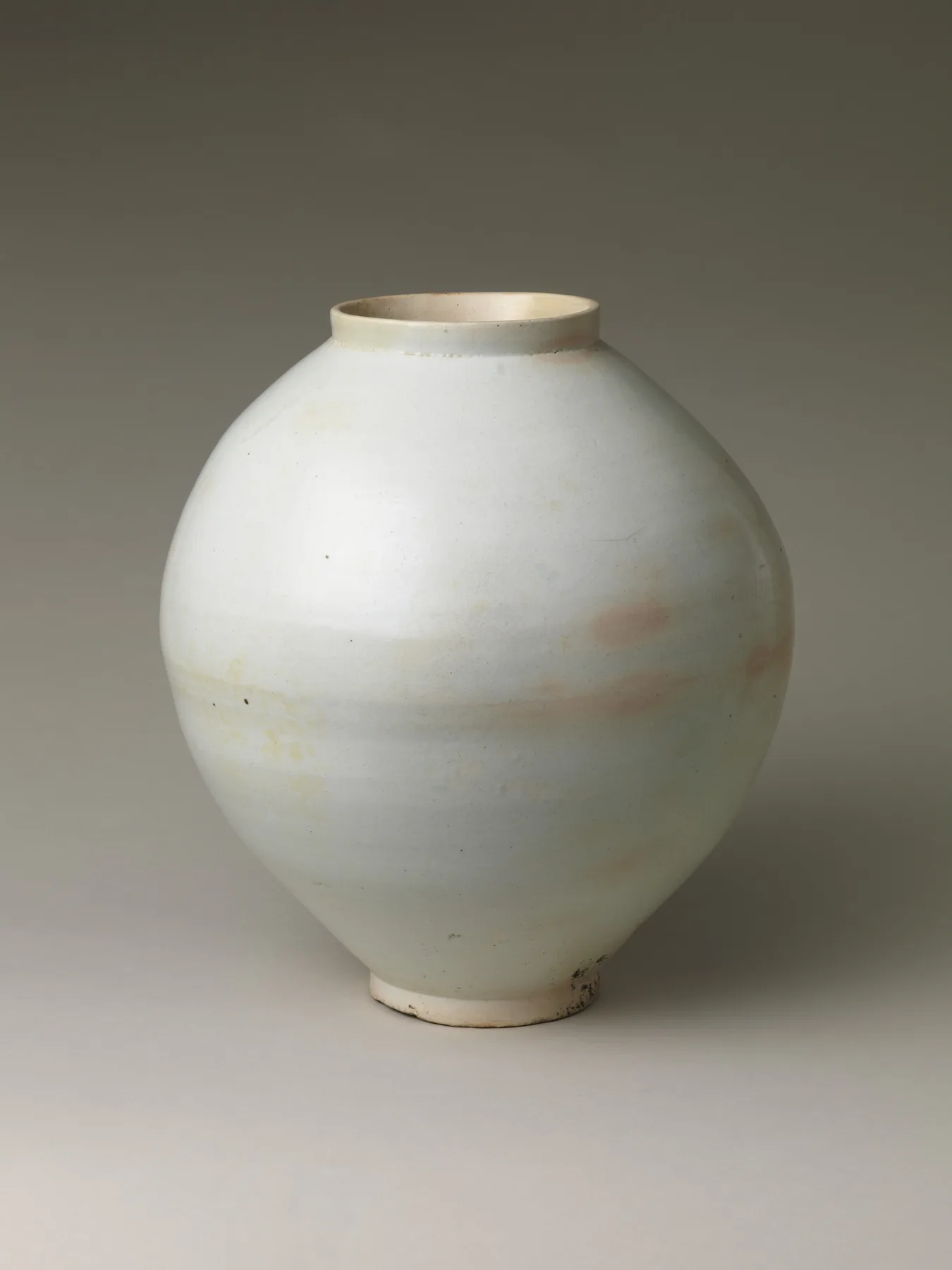
Large round jars were difficult to throw as one body. Potters formed upper and lower hemispheres, joined them, applied glaze, and fired the assembled vessel. Gravity, drying, joining, glaze flow, kiln atmosphere, and heat made exact symmetry difficult.
The result has been named “moon jar” in modern reception because its swelling white form evokes a full moon. The Met’s example carries a visible seam and peach-toned firing effects. These are traces of process, not proof that a potter pursued modern ideals of expressive imperfection.
To call the jar serenely simple ignores technical risk. Its quiet surface is the outcome of many decisions and a firing that no maker could control completely.
White was never empty
White surfaces vary with clay, glaze thickness, kiln atmosphere, light, use, burial, repair, and photography. They can appear blue, cream, grey, or peach. A vessel’s lip, shoulder, seam, foot, and interior organise attention even without painted ornament.
Modern Korean artists and critics made moon jars powerful emblems during colonial and postcolonial identity formation. International museums and markets further promoted a language of natural imperfection and national restraint. Those interpretations are historically important but later than eighteenth-century manufacture.
Begin with the object before the metaphor: measure it, trace the join, identify material and kiln evidence, and ask what it held or where it stood. Then study how “moon jar” changed its value.
Objects moved beyond the peninsula
Joseon maintained tributary and diplomatic relations with Ming and Qing China and communication with Tokugawa Japan through structured missions and intermediaries. Books, paintings, pigments, ceramics, textiles, technologies, and information travelled along these routes.
Buncheong bowls entered Japanese tea contexts through trade, appropriation, and wartime displacement. Captured potters helped establish or transform Japanese ceramic centres. Chinese cobalt and painting models entered Korean production. Movement was never one-way and never always voluntary.
Later collecting added colonial and global routes. Japanese annexation, dealers, excavations, missionaries, diplomats, and museums removed or purchased Korean objects under unequal conditions. Present provenance must distinguish documented transfer from attractive assumptions.
Gender, lineage, and the unequal archive
Joseon Neo-Confucian family reform increasingly privileged patrilineal descent, eldest-son ritual responsibility, and virilocal marriage. The timing and enforcement varied, but women’s property, mobility, ritual roles, and public representation narrowed in important ways.
Women were still patrons, makers, readers, writers, embroiderers, household managers, shamans, Buddhists, labourers, and participants in markets and ceremonies. Queen Munjeong’s commission is unusually legible because royal records and an inscription survive. Most women’s work is not preserved under individual names.
The archive’s silence is not evidence of inactivity. A responsible survey marks whose lineage a portrait centres, who prepared offerings, who spun and wove, who supplied clay and fuel, and why court and literati documents preserve some acts more readily than others.
A comparison matrix
| Work or site | Activated by | Institution | Historical claim | Limit of the evidence |
|---|---|---|---|---|
| Portrait of Yun Dongseom | hanging, offerings, descendants, shrine time | patrilineal family and official rank | a specific body can sustain ancestral presence | painter and much ritual labour remain unnamed |
| Jongmyo | procession, tablets, food, wine, music, dance | royal ancestral state rite | dynastic legitimacy is repeatedly performed | present performance is not unchanged medieval time |
| Uigwe | reading, copying, planning, archiving | court directorates and libraries | ceremony can become reproducible administrative knowledge | protocol is not a transparent view of experience |
| Yi Jeong’s bamboo | brush reading, inscription, learned exchange | royal and literati networks | plant and brush can make integrity visible | metaphor does not prove the painter’s character |
| Munjeong’s Shakyamuni triad | prayer, temple display, serial commission | royal Buddhist patronage | Buddhism remained powerful within a Confucian state | a few survivors cannot reconstruct all four hundred works |
| Buncheong bottle | handling, pouring, kiln sequence | regional workshop and wider demand | bold brushwork depends on technical organisation | first owner and precise use are not secure |
| Moon jar | joining, firing, storage or use, later display | porcelain workshop and collecting history | apparent simplicity records risk and later interpretation | “moon jar” is a later reception frame |
No column alone explains Joseon art. Ritual without material becomes abstraction; material without institution becomes technique without history.
Common survey traps
Joseon art is minimalist. Colourful Buddhist painting, court screens, blue-and-white porcelain, ritual dress, architecture, and popular imagery contradict a single aesthetic.
Neo-Confucianism eliminated Buddhism. Policy restricted Buddhist institutions, but monasteries, patrons, images, rituals, and monastic military service persisted.
Portrait realism is a photograph of character. Likeness was constructed through format, costume, rank, workshop method, ritual destination, and later copies.
Literati painters were independent amateurs. Elite status, office, family resources, gifts, markets, court collections, and professional painters supported their practice.
Buncheong is spontaneous folk pottery. It served varied social levels and depended on regional kilns, tribute, skilled sequence, repeated techniques, and demand.
Moon jars celebrate intentional imperfection. Their asymmetry begins in scale, two-part construction, joining, drying, glaze, gravity, and firing. Later aesthetics should not be projected backward without evidence.
Korea was isolated between China and Japan. Diplomacy, books, war, captured specialists, trade, pilgrimage, and collecting created many connected routes.
Questions for close looking
- What action made this object meaningful: hanging, unrolling, bowing, offering, reading, pouring, copying, firing, or travelling?
- Which role is visible—king, queen, official, monk, ancestor, scholar—and whose labour supports that visibility?
- Does “Confucian” name a documented institution or merely a modern impression of restraint?
- Which parts of a portrait signal physical likeness, and which signal rank or ritual permanence?
- Where does a ceramic reveal throwing, joining, slipping, painting, glazing, firing, use, or repair?
- What moved across borders: person, book, pigment, model, vessel, technology, or later collection object? Was movement voluntary?
- Which evidence comes from an inscription, protocol, archaeology, technical analysis, museum record, or later interpretation?
Try comparing the hero portrait and moon jar without using “simple,” “elegant,” or “realistic.” Describe edges, seams, surfaces, symmetry, posture, scale, and intended action. The prohibited adjectives force historical evidence to replace inherited taste language.
Terms for Joseon Korean art
Joseon: The dynasty ruling Korea from 1392 to 1910. The Korean Empire was proclaimed in 1897 within its final political transformation.
Neo-Confucianism: A diverse intellectual and institutional tradition shaping Joseon governance, education, ethics, ritual, and family organisation; not a visual style.
Jongmyo: The royal ancestral shrine in Seoul housing spirit tablets of Joseon kings and queens and supporting continuing ritual, music, and dance.
Uigwe: Illustrated royal protocols documenting and guiding major court ceremonies, personnel, objects, materials, and procedures.
Dohwaseo: The royal Bureau of Painting, which organised professional painters for court and state assignments.
Yangban: A historically changing elite status associated especially with civil and military official lineages; not every educated person or every patron.
Literati painting: Painting connected to learned identity, calligraphy, poetry, historical models, and ethical self-cultivation; not one appearance or proof of unpaid work.
Buncheong: Joseon stoneware covered or decorated with white slip through varied methods, flourishing especially in the fifteenth and sixteenth centuries.
Baekja: White porcelain, adopted for Joseon court use and later produced for wider consumers in many forms and decorations.
Bunwon: Court-administered porcelain kilns near the capital region, with changing sites and organisation.
Source guide
Object facts, public-domain status, current attributions, dimensions, and media come from the Met records for the Yun Dongseom portrait, Yi Jeong’s bamboo, Shakyamuni triad, buncheong bottle, and moon jar. These records remain revisable and should be cited with access dates in formal work.
For an institutionally grounded overview, use Soyoung Lee’s Met catalogue Art of the Korean Renaissance, 1400–1600, with essays by JaHyun Kim Haboush, Sunpyo Hong, and Chin-Sung Chang. The catalogue combines painting, ceramics, metalwork, lacquer, books, court politics, and Neo-Confucian institutions rather than making one medium stand for early Joseon.
For ceramics, compare the Met–Leeum catalogue Korean Buncheong Ceramics, Soyoung Lee’s porcelain essay, and kiln archaeology or Korean collection records for a specific object. Museum aesthetics should be checked against production and use.
For ritual and recorded heritage, consult the National Museum of Korea’s uigwe guide, its account of the Oegyujanggak volumes’ removal and return, UNESCO’s Jongmyo site record, and the living ritual record. Heritage recognition is a modern layer and should not be confused with unchanged continuity.
The source base remains uneven. Court archives and elite writing are unusually rich; many regional makers, women, lower-status workers, household images, ephemeral ritual objects, and lives disrupted by war are less visible. Research published in Korean, archaeological reports, conservation science, inscriptions, and local museum catalogues are necessary to move beyond an English-language survey.
Continue the Atlas route
This chapter follows Ming and early Qing art, where print, court reuse, literati status, and kilns exposed related but distinct institutions. Comparison should trace actual routes—envoys, books, captured potters, cobalt, ceremonies—not turn China and Korea into original and copy.
The next chapter moves to Edo Japanese art: city, print, theatre, painting school, and regulated status. It will test the myth of a literally “closed” country and place ukiyo-e within publishing, licensed quarters, performance, workshop labour, pilgrimage, censorship, and exchange rather than letting one print genre stand for an entire period.
Editorial record
About this article
- Author
- Publisher
- GeMarkt
- Published
- Updated
- Reviewed
- Internal source & rights check. Conducted by GeMarkt Research Review. This is an internal editorial check—not independent peer review.
- Source standard
- Art history source standardPrioritises object records and research sources, distinguishes evidence from interpretation, and states material uncertainty.
Found a claim that needs checking? Report a factual error.