Art History · Learning chapter
Atlas V — Modernisms and contemporary practices · 6 of 10
Art after 1945: abstraction, realism, institution, and the cultural Cold War
Five visual studies examine how exhibitions, museums, states, artist groups, and decolonisation shaped abstraction, realism, and cultural power after 1945.

What we’ll look at
Why was art after 1945 more complex than a Cold War propaganda contest?
Nikita Khrushchev extends an open hand. Richard Nixon answers beside a microphone. Their 24 July 1959 encounter at the American National Exhibition in Moscow turned a model kitchen into a prop for arguing about political systems.
Thomas J. O’Halloran’s photograph provides a sharp entrance to art after 1945. Exhibitions, design, photography, television, consumer products, and managed encounters made ideology visible through claims about creative freedom, everyday comfort, labour, technology, and the future.
Art after 1945 was not a two-style contest
A familiar survey story places expressive abstraction in the capitalist West against socialist realism in the communist East. The contrast has evidence behind it: governments and institutions did attach political value to styles, restrict some practices, and circulate others. But the formula becomes false when it turns two changing fields into two fixed appearances. Abstraction existed beyond the United States and Western Europe. Realisms could support a state, criticise a state, organise anticolonial solidarity, or depict ordinary life. Artists moved between them.
The period also exceeded a Washington–Moscow line. Independence and partition reorganised artistic institutions in South Asia. Artists in Japan confronted war, occupation, technology, and the body. Social realists in Singapore connected art to labour, language, and anticolonial nation-making. The São Paulo Biennial altered the routes through which modern art became international. A useful history therefore follows institutions and material practices without making artists passive illustrations of geopolitics.
Scope: five visual studies and deliberate non-reproductions
This chapter concentrates on 1945–1965. Five rights-reviewed visuals organise it: two O’Halloran photographs and three GeMarkt diagrams covering Advancing American Art, The New American Painting, and claim evidence. The diagrams interpret cited records; they are not archival objects.
Works by Pollock, Gutai artists, Chua Mia Tee, and installations at documenta and São Paulo are discussed without reproduction. Online access does not automatically grant commercial republication rights. Absence records a rights decision, not importance.
War ended, but cultural institutions had to be rebuilt
The end of the Second World War did not restore one stable art world. Cities were ruined, people displaced, and Nazi persecution had destroyed lives and networks. Colonial empires faced anticolonial movements. Occupation authorities, new governments, museums, academies, foundations, galleries, magazines, and artists’ groups competed to define legitimate culture.
“Reconstruction” was never neutral. Which prewar modernism should return? Who could represent a new nation? Could an institution claim democratic renewal while retaining officials shaped by dictatorship? Those questions produced exhibitions and collections as well as policy.
The Kitchen Debate turns an interior into political theatre
In brief: This 1959 photograph shows US vice president Richard Nixon and Soviet leader Nikita Khrushchev inside a model kitchen at the American exhibition in Moscow. The kitchen became a stage for competing claims about everyday life under their political systems.
O’Halloran frames Khrushchev and Nixon at close range. A curtain flattens the background; a dark exhibition element descends above the group. Nixon’s dark suit and Khrushchev’s light suit sharpen the visual opposition. The men’s hands perform disagreement: one open, one pointing, one partly hidden. The microphone converts conversation into an event for remote listeners. The surrounding faces show concentration rather than consensus.
The photograph is often treated as an illustration of a famous verbal exchange. Close looking reverses that hierarchy. Body positions, crowding, equipment, and press access helped produce “the debate” as a public image. The leaders did not wander into an ordinary home. They stood inside an exhibition designed to demonstrate a system through abundance and choice. The model interior was both room and medium.
Consumer design became an argument about freedom
The American National Exhibition assembled art, fashion, cars, domestic equipment, model houses, and a multi-screen film. Variety itself was presented as evidence of consumer choice and industrial capacity. A refrigerator could imply that a political economy served everyday life: design translated “freedom” into surfaces, storage, and promised time saved.
Khrushchev challenged that display. Soviet authorities also promoted housing and consumer production, especially during the Thaw. Susan E. Reid’s research shows that Soviet viewers were not one persuaded audience; they compared the display with their own material lives.
The photograph stages confrontation, not an outcome
Nothing in the photograph proves that the exhibition converted its viewers, that Nixon won the argument, or that consumer abundance decided the Cold War. It proves that named figures met in a designed environment, before cameras and microphones, and performed disagreement. Captions, transcripts, visitor books, policy files, and later reception research are needed for stronger conclusions.
That limit is methodologically useful. Photographs make events appear self-contained even when they are products of planning, editing, circulation, and retrospective memory. The Kitchen Debate image is evidence of staging and encounter. Its iconic status is a later history. Separating those layers prevents visual drama from becoming automatic causation.
Advancing American Art began as public diplomacy
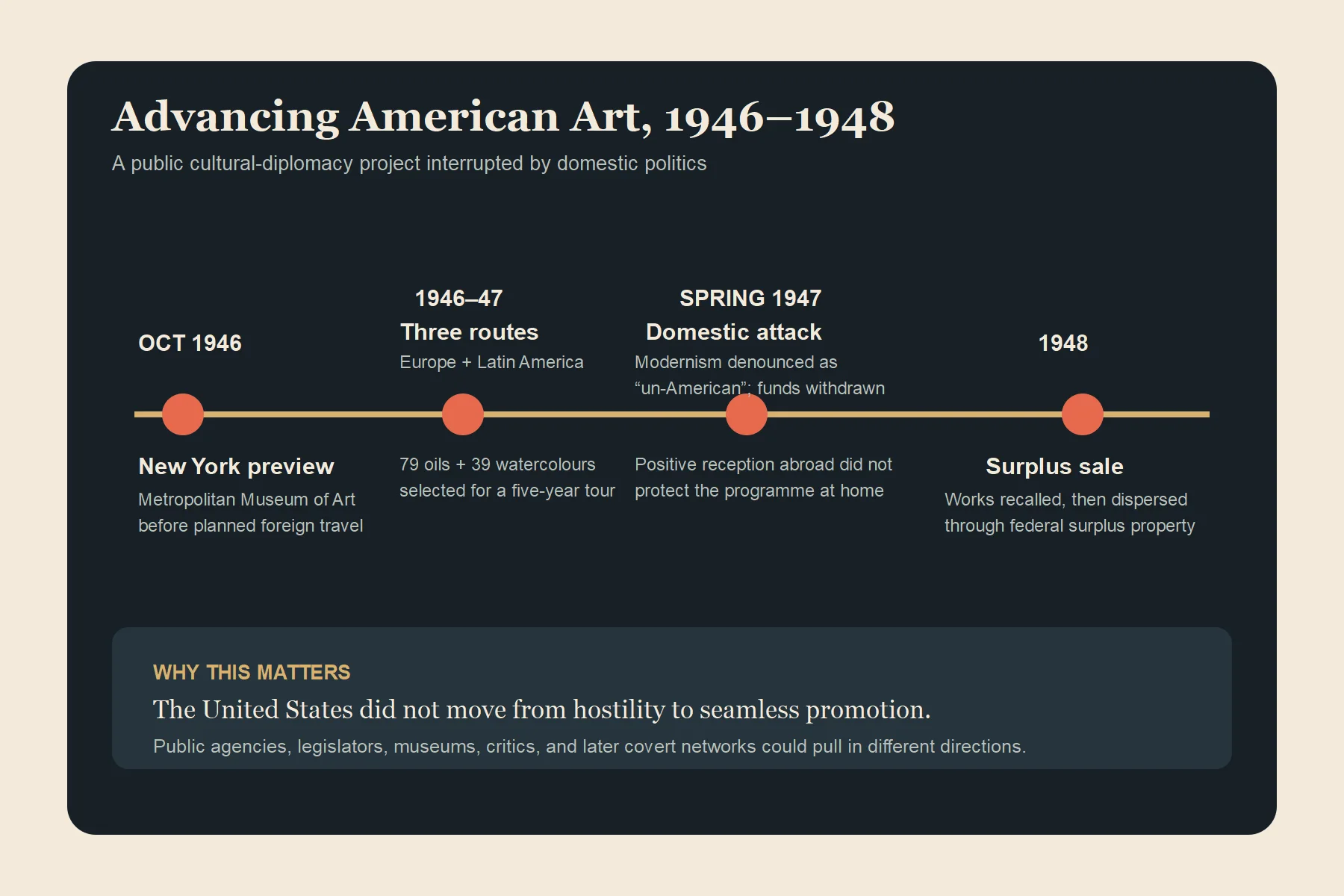
In October 1946 the United States Department of State presented Advancing American Art at the Metropolitan Museum of Art before planned travel abroad. J. LeRoy Davidson’s contemporary account explained the practical reason for purchasing works: lenders rarely released important art for the long periods required by an international programme. The project acquired 79 oil paintings and, through a contract with the American Federation of Arts, 39 watercolours. Three sections were intended to travel through Europe and Latin America over five years.
The selection included abstraction and social realism rather than one official style. Its modernism was meant to demonstrate the range of American expression. Smithsonian Archives of American Art records show that the exhibition received a positive response in Prague. Public diplomacy here was explicit, documented, and administratively difficult. It did not hide the identity of its government organiser.
Cancellation exposes conflict inside the state
Conservative politicians and commentators attacked the works as un-American or subversive. Funding was withdrawn in 1947; paintings were recalled and then sold as federal surplus property in 1948. Margaret Lynne Ausfeld and Virginia M. Mecklenburg reconstructed the controversy through exhibition history, correspondence, and surviving works. Their scholarship makes the cancellation more than an anecdote: it shows a state trying to project expressive freedom abroad while political actors at home punished modernist and socially critical art.
The episode resists an image of government as one actor with one aesthetic. Cultural officers, diplomats, legislators, presidents, journalists, museums, and audiences had different powers and objectives. A public programme could be internationalist in one office and politically vulnerable in another. “The United States promoted modernism” is therefore too broad unless the sentence names an agency, date, mechanism, and conflict.
A failed exhibition complicates the triumph story
Advancing American Art begins before New York’s international success and ends in failure. Modern art’s usefulness to diplomacy was neither immediately accepted nor secure. Private museums and nominally independent organisations later offered other structures for circulation, but that sequence was not a single master plan. Because the exhibition contained social realism alongside abstraction, its cancellation was a dispute over who could represent the nation, not one style defeating another.
Abstraction and realism were political labels, not stable opposites
“Abstraction” can describe geometry, gesture, material experiment, or partly visible reference. “Realism” can name academic illusion, socialist doctrine, documentary attention, labour imagery, or anticolonial address. Neither identifies a single politics. Institutions made them appear unified through labels, prizes, doctrine, and comparison. Formal analysis remains necessary, but form does not carry a permanent political passport.
Socialist realism was an institutional field, not one frozen look
Soviet socialist realism was an official framework tied to party institutions, exhibitions, commissions, education, and censorship. Its demands constrained what artists could show publicly, and those constraints had serious consequences. Yet reducing all socialist art to identical heroic workers erases changes within the system, differences among Soviet republics and allied states, and practices that emerged during the post-Stalin Thaw.
The State Tretyakov Gallery’s own institutional history records major all-Union exhibitions of Soviet artists during the first postwar decade. Its account of the Thaw describes weakened control, rehabilitated cultural figures, renewed attention to the avant-garde, non-figurative experimentation, design, architecture, and the “austere style.” A museum narrative is not independent proof of every claim, but it confirms that the official field changed and contained disputes. Control did not eliminate history.
Realisms could serve state power or oppose colonial rule
Outside the Soviet bloc, realist practices acquired other political uses. In 1950s Singapore, artists connected woodcut and social realism to working-class experience, anticolonial struggle, public language, and nation-making. The National Gallery Singapore’s research on the Chinese Middle Schools’ Graduates of 1953 Arts Association and the Equator Art Society documents artists who treated art as a public instrument. Reproducible woodcuts could circulate through magazines and newspapers beyond gallery walls.
Chua Mia Tee’s National Language Class of 1959 turns an everyday lesson into a scene about cultural identity and a shared Malayan future. It is not reproduced here because the Gallery’s online record does not supply republication rights for this use. The work matters because it interrupts the assumption that postwar realism merely followed Moscow. Local language, colonial administration, migration, education, and labour produced different stakes.
Abstraction could be local, material, and collective
Abstraction exceeded an export from New York. Artists across Europe, Latin America, Asia, and Africa worked with geometry, gesture, matter, calligraphy, technology, and environment. Some encountered American and European exhibitions; others extended prewar networks or local debates; many did both. Terms such as Art Informel, concrete art, and lyrical abstraction circulated, but a shared vocabulary did not make every practice equivalent.
Gutai made freedom a practice with matter and bodies
The Gutai Art Association formed in 1954 in Ashiya near Osaka. Its artists used outdoor exhibitions, publications, performance, painting, sound, light, water, paper, mud, and electrical systems. Ming Tiampo and Alexandra Munroe’s Guggenheim research situates the group against wartime totalitarianism while emphasising its international publication network and material experiments. Reiko Tomii’s scholarship likewise argues for a postwar Japanese avant-garde understood on its own terms and through transnational contact.
Works by Shiraga Kazuo, Murakami Saburō, Tanaka Atsuko, Motonaga Sadamasa, and other members are intentionally not reproduced here. The methodological point does not depend on treating them as Japanese equivalents of Abstract Expressionists. Gutai made freedom procedural: bodies collided with materials; environments changed over time; viewers participated; magazines carried actions beyond their original site. Later international framing sometimes made the group’s paintings easier to circulate than its events. Medium and route changed what became visible.
Indian progressives refused one official image of the nation
India’s independence and Partition in 1947 produced freedom, mass displacement, and violence together. The Progressive Artists’ Group in Bombay—F. N. Souza, M. F. Husain, S. H. Raza, K. H. Ara, H. A. Gade, and S. K. Bakre—did not unite around one look. National Gallery of Modern Art records identify them among the radical post-independence collectives in its collection. Asia Art Archive educator research by Sneha Ragavan places their internationalism alongside the trauma of Partition and their refusal of revivalism as a sufficient national formula.
Their work complicates an East–West style map. Figuration, abstraction, urban life, religious imagery, landscape, and modernist structure could coexist. Some artists later worked abroad, yet mobility did not erase Indian histories. Independence did not require a single national style, and internationalism did not automatically mean political allegiance to the United States.
Biennials built a new but unequal geography
Recurring international exhibitions changed comparison. Venice remained important, but São Paulo created a major route from Brazil. Biennials gathered delegations, juries, prizes, catalogues, and visitors while reproducing diplomatic hierarchies. Caroline A. Jones describes a biennial culture that synchronised places for viewers. Commissioners narrowed national fields, transport privileged portable objects, and absence from a route could resemble absence from history.
São Paulo made internationalism visible from Brazil
The Fundação Bienal de São Paulo records 729 artists, 25 countries, and 1,854 works in the first edition, held from 20 October to 23 December 1951 in a temporary pavilion on the Esplanada do Trianon. The Museu de Arte Moderna de São Paulo organised it under Ciccillo Matarazzo, with Lourival Gomes Machado as artistic director. Its scale demonstrated that international modern art did not need to be encountered only through a European or North American capital.
The exhibition also reveals the power of categories. Abraham Palatnik’s first Aparelho cinecromático was initially rejected because it did not fit the available sections, then admitted and awarded an honourable mention. A kinetic light work forced an institution to revise its classifications. Innovation here was not only a new object. It was a dispute with the exhibition system that decided what kind of object could enter.
documenta repaired one history by narrowing another
Arnold Bode organised the first documenta in Kassel in 1955. The official retrospective records 148 artists, 670 works, six represented nations, and about 130,000 visitors in the war-damaged Fridericianum. One aim was to reconnect West Germany with twentieth-century modern art after Nazi persecution of so-called “degenerate” art. Werner Haftmann’s art-historical framework presented abstraction as a continuing language interrupted by dictatorship.
That recovery mattered, but it was selective. The exhibition centred Western European narratives and largely treated abstraction as the ethical destination of modern art. A damaged building helped stage rupture and renewal. The installation made history spatial: surviving architecture, modern works, and a public moving through them produced a claim about Germany’s return.
documenta’s omissions are part of its argument
The official documenta history now notes missing political Dada, John Heartfield, George Grosz, and most women. Research has also confronted Haftmann’s Nazi Party membership and the Nazi-era careers of early organisers. These facts do not make every selected work propaganda or reduce every decision to biography. They change the question: whose art made postwar rehabilitation persuasive, and whose persecution, politics, or compromise remained outside the frame?
An exhibition route can help make a school
A style does not become internationally dominant through paintings alone. Someone selects works, borrows them, insures crates, negotiates customs, designs rooms, publishes catalogues, translates statements, briefs the press, photographs installations, and records reviews. Repetition across respected venues can make a heterogeneous group appear coherent. The route creates evidence that later surveys cite.
This institutional account does not deny artistic achievement. It explains how achievement becomes available for comparison. Scale and gesture in a painting still require close looking, but a viewer in Basel or London encountered those decisions through an exhibition title, a group of names, an installation, and a catalogue. “The New York School” was both a set of practices and a structure of visibility.
The New American Painting moved through eight countries
MoMA’s International Program organised The New American Painting at the request of European institutions. Its 81 paintings by 17 artists travelled to Basel, Milan, Madrid, Berlin, Amsterdam, Brussels, Paris, and London in 1958–1959 before a New York presentation. The itinerary printed in the catalogue makes circulation tangible. Each host provided a local public and critical context; the same list of works did not mean the same thing in every city.
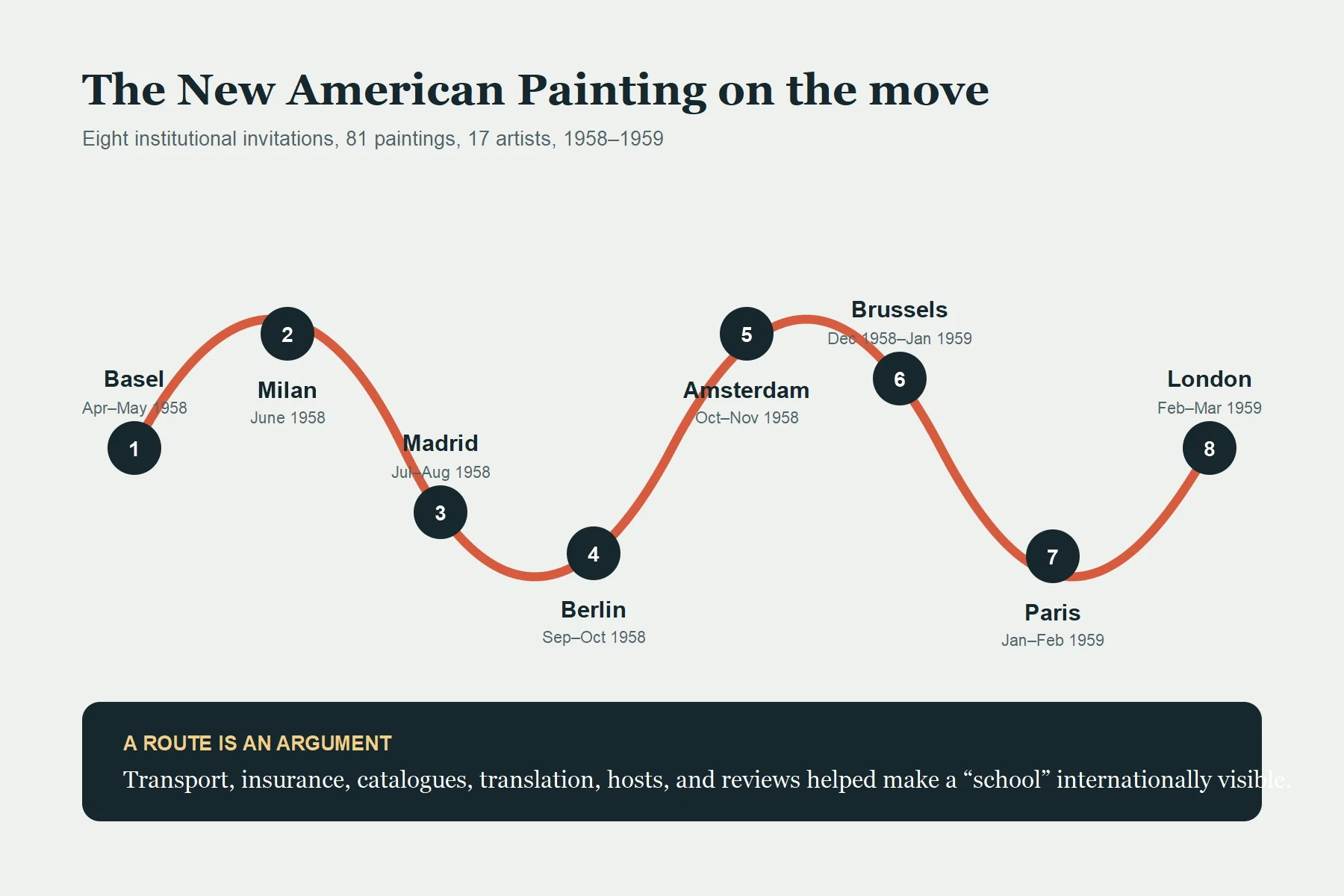
The exhibition strengthened the international legibility of Abstract Expressionism. It did not include every important American practice, and its roster did not mirror the full gendered and racial composition of art in the United States. Selection made a national painting visible by narrowing the nation.
Visibility is not the same as invention
Increased visibility is not invention. Pollock, Rothko, de Kooning, Grace Hartigan, Helen Frankenthaler, Norman Lewis, Lee Krasner, and their contemporaries developed different practices through studios, relationships, teaching, galleries, criticism, migration, and wartime experience. Circulation also did not guarantee one response: artists and critics could admire, resist, or reinterpret the works. Institutional power matters precisely because it is not total.
MoMA’s International Program worked through public partnerships
MoMA established its International Program in 1952. Its archival finding aid records collaboration among museum staff, curators, the International Council, United States Information Agency personnel, government officials, and embassies. This was not one funding stream or command structure. A private museum possessed curatorial expertise and a modernist collection; government agencies possessed diplomatic networks and foreign-policy objectives; host institutions possessed local authority.
The museum’s own retrospective language acknowledges the Cold War subtext of presenting modern art against Soviet-sanctioned socialist realism. That institutional admission supports a political interpretation. It still does not show that every selection was dictated by government or that artists shared the programme’s objectives. Partnership must be traced exhibition by exhibition.
Covert cultural funding is documented
The Congress for Cultural Freedom began with a conference in West Berlin in June 1950 and developed journals, conferences, intellectual networks, and cultural programmes. CIA’s Center for the Study of Intelligence now describes it as a major covert operation and identifies the Office of Policy Coordination’s role in funding the founding conference and supporting the organisation. The sponsorship became publicly exposed in the 1960s.
Frances Stonor Saunders documents the breadth of this cultural campaign. Serge Guilbaut relates the rise of the New York avant-garde to postwar political culture, and Eva Cockcroft’s influential essay argues that Abstract Expressionism could function as a Cold War weapon through museum and elite networks. Hugh Wilford cautions against a model in which covert sponsors simply “called the tune,” showing how intellectuals could pursue their own positions, sometimes frustrating patrons. These are not interchangeable conclusions. Together they make the archive a field of debate.
What the records do not prove
Records prove that the CIA covertly supported the Congress for Cultural Freedom. MoMA records prove that its International Program worked with USIA officials and embassies. Catalogues prove that particular exhibitions travelled. Trustee and personnel histories can prove overlapping networks. None of those facts, by itself, proves that the CIA selected Pollock’s marks, created Abstract Expressionism, ordered every MoMA exhibition, or caused European audiences to admire American painting.
The sentence “the CIA invented Abstract Expressionism” collapses four different questions: artistic production, institutional selection, financial support, and later success. Evidence for one cannot silently answer the others. The stronger and more dramatic the causal claim, the more direct the documentation must be.
Use an evidence ladder before making a causal claim
An evidence ladder disciplines interpretation. Begin with documented actions: budgets, memos, catalogues, itineraries, contracts, censorship decisions, and named organisers. Then establish relationships: who funded, hosted, selected, transported, reviewed, or restricted? Interpretation can ask how those relations changed visibility and meaning. A claim that policy produced an artwork, movement, or reception sits higher and requires substantially stronger evidence.
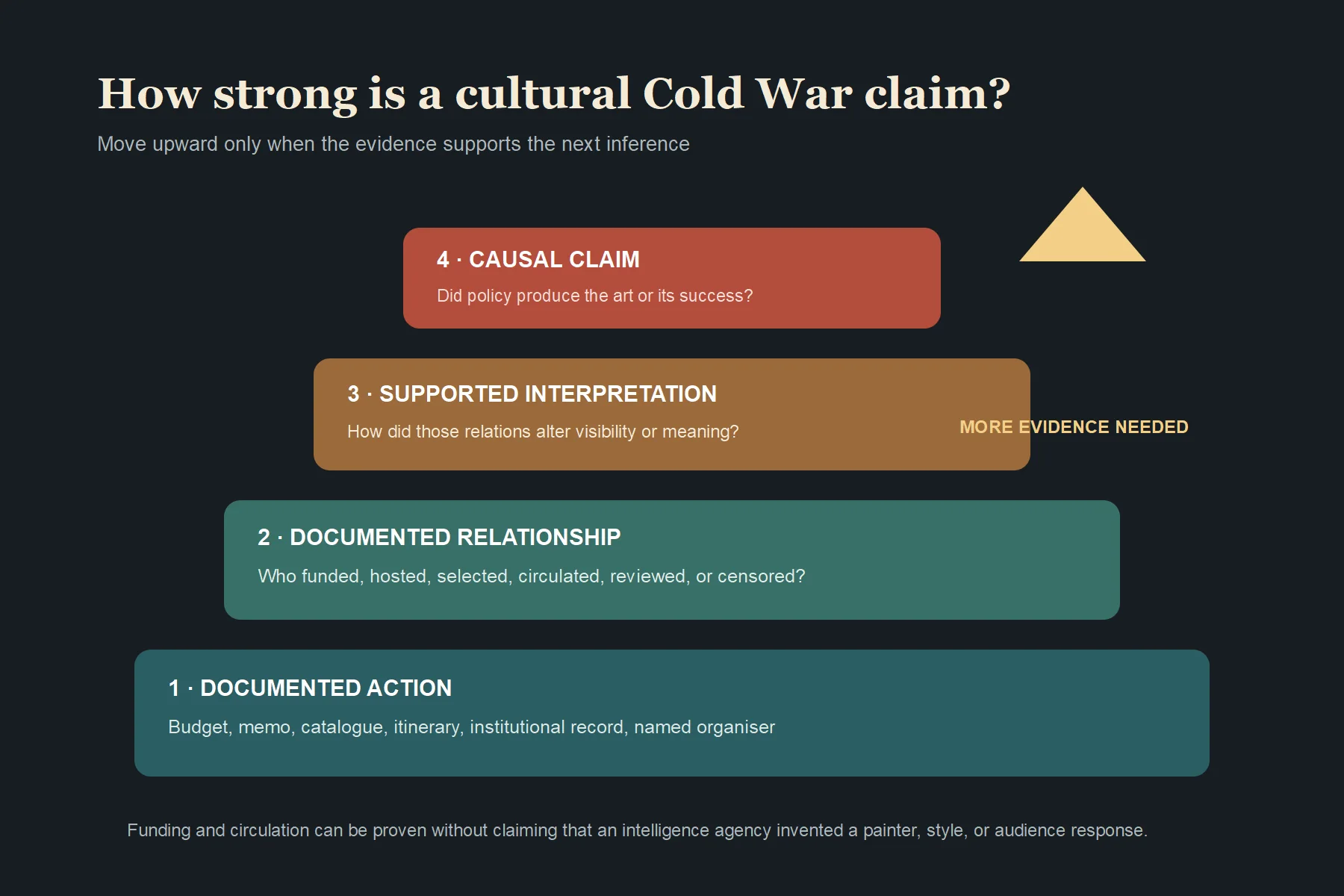
The ladder does not make political interpretation timid. It makes it specific. Covert funding is politically significant even without omnipotence. A cancelled public exhibition is significant even if it did not end modern art. The archive becomes more revealing when contradiction remains visible.
The Soviet refrigerator display returns the gaze
On 5 August 1959 O’Halloran photographed visitors examining a refrigerator and kitchen equipment in a temporary Soviet display beside the American National Exhibition. Two women and a child face an open appliance. Pots, a kettle, cupboards, a cooker, and small labels fill the background. Unlike the leaders’ debate, the picture has no central political celebrity. Attention belongs to viewers and things.
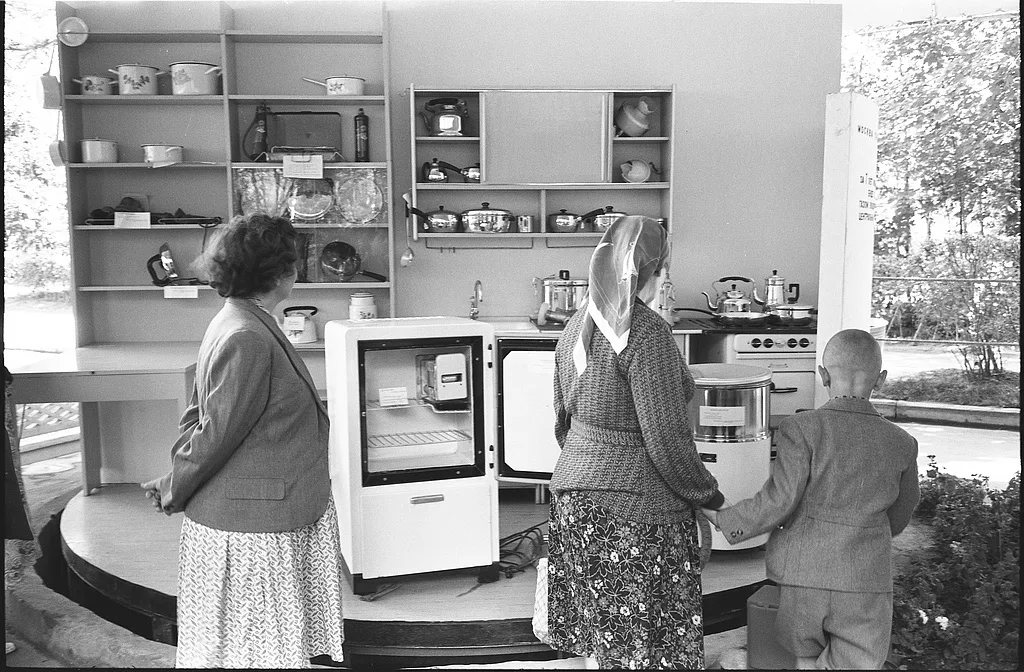
The photograph prevents the American display from appearing as the only modern future in Moscow. Soviet exhibition makers answered with their own domestic technology. The open door invites inspection, but the image cannot tell us what the visitors thought. Their backs resist easy conversion into political symbols.
Household objects carried industrial and social promises
A refrigerator coordinates electricity, factories, food distribution, housing, income, repair, and daily routines. Exhibited internationally, it can stand for a system while hiding those dependencies. Artworks are similar: a canvas framed as individual freedom still relies on manufacture, studios, galleries, shipping, and criticism. Objects make systems visible selectively.
Gender and labour complicate the model kitchen
Kitchen rhetoric promised to ease women’s work while assuming that domestic labour remained their responsibility. Appliances could reduce tasks yet require income, maintenance, and higher standards. The photograph shows women viewers but cannot make them spokespersons for all women. Housing policy, employment, advertising, testimony, and material access are needed to compare display with lived labour.
Institutions do not merely surround art
Institutions alter what art can be. A biennial creates sections and prizes; a museum makes a group visible; a state department enables travel and recalls it; a covert funder expands a network while hiding accountability. Artists still refuse invitations, redirect resources, form counter-institutions, and exceed curatorial frames. Institutional history should explain conditions without turning makers into puppets.
A comparison matrix
| Case | Public form | Main infrastructure | Political claim or pressure | What the evidence supports |
|---|---|---|---|---|
| Advancing American Art, 1946–1948 | Travelling painting exhibition | Department of State, AFA, museums | Diversity and expression abroad; anti-modernist attack at home | Explicit public diplomacy, conflict, cancellation, dispersal |
| First São Paulo Biennial, 1951 | Recurring international exhibition | MAM-SP, national delegations, jury, pavilion | International modernity viewed from Brazil | A new route and classification system, not equal representation |
| First documenta, 1955 | Historical modern-art survey | Curatorial team, ruined Fridericianum, West German reconstruction | Recovery after Nazi cultural policy | Selective rehabilitation shaped by abstraction and omission |
| Gutai, from 1954 | Group, journal, outdoor event, performance, painting | Artist association, publishing, regional and international contacts | Creative freedom after wartime totalitarianism | Material and collective experiment; later routes reframed it |
| The New American Painting, 1958–1959 | Eight-country painting tour | MoMA International Program, hosts, catalogue, transport | Modern American painting as international culture | Increased visibility through a documented route |
| American and Soviet kitchen displays, 1959 | Consumer exhibition and media event | USIA, exhibition designers, Soviet organisers, press | Competing modern everyday futures | Staged comparison and audience encounter, not automatic persuasion |
The matrix compares mechanisms, not moral equivalence. Open and covert funding are different. Censorship and curatorial selection are different. A table helps identify questions that recur without flattening their stakes.
Common survey traps
Avoid teleology, which makes New York’s prominence inevitable; binary thinking, which assigns abstraction to freedom and realism to control everywhere; conspiratorial omnipotence, which turns funding into invention; and aesthetic innocence, which ignores institutions. “International” must not mean only the West, decolonisation is not a side story, and one exhibition never represents an entire national field.
Questions for close looking
When studying a postwar work or exhibition, ask:
- What does the material do before a political label is applied?
- Who selected, paid for, transported, installed, photographed, reviewed, or restricted it?
- Which publics could encounter it, and through what media?
- Does the source document production, circulation, reception, or later memory?
- Is “abstraction” or “realism” describing appearance, institution, artist claim, or critic’s category?
- What stronger causal statement is being implied, and is there direct evidence for it?
- Which local histories disappear when the work is placed on an East–West map?
- What is not reproduced, collected, translated, or preserved?
These questions keep close looking and institutional history in the same analysis.
Terms for art after 1945
Abstract Expressionism is a retrospective grouping for varied New York practices associated with large scale, gesture, field, and abstraction; it should not erase differences among artists.
Socialist realism names an official Soviet framework and its adaptations, institutions, and debates; it is not a timeless synonym for all figurative art made under socialism.
Art Informel grouped several European postwar approaches emphasising gesture, matter, and non-geometric form.
Cultural Cold War describes competition conducted through ideas, media, education, exhibitions, publishing, performance, and intellectual networks, using open and covert means.
Soft power is later terminology for attraction and persuasion rather than coercion. It can clarify cultural diplomacy but should not replace period-specific evidence.
Biennial is a recurring exhibition, usually held every two years, whose internationalism is constructed through organisers, national or thematic structures, selection, and funding.
Decolonisation includes struggles for political independence and the longer reorganisation of culture, knowledge, land, institutions, and representation. It did not happen on one date.
A working timeline, 1945–1965
- 1945: War ends in Europe and Asia; occupation, displacement, reconstruction, and anticolonial struggle reorganise cultural institutions.
- 1946: Advancing American Art opens in New York before foreign travel.
- 1947: India becomes independent amid Partition; Bombay’s Progressive Artists’ Group forms; the State Department exhibition is recalled after domestic attacks.
- 1948: Advancing American Art works are sold as surplus property.
- 1950: Congress for Cultural Freedom convenes in West Berlin with covert United States support.
- 1951: First São Paulo Biennial opens.
- 1952: MoMA establishes its International Program.
- 1954: Gutai Art Association forms near Osaka.
- 1955: First documenta opens in Kassel; Bandung Conference gathers Asian and African states in Indonesia.
- 1956: Gutai manifesto appears; post-Stalin Thaw alters cultural possibilities unevenly.
- 1958–1959: The New American Painting travels through eight European countries.
- 1959: American National Exhibition and Kitchen Debate take place in Moscow; National Language Class is made in Singapore.
- 1960: Many African states gain independence, intensifying debates over national and transnational culture.
- 1961: Museum of Modern Art’s International Council and other programmes continue expanding exhibition routes; non-alignment gains an institutional forum at Belgrade.
- 1964: Robert Rauschenberg receives the Grand Prize for Painting at the Venice Biennale, renewing disputes about American cultural and market power.
- 1965: The postwar field is visibly multipolar, but museums, markets, states, and inherited colonial infrastructures distribute visibility unequally.
Dates organise the route; they do not make every region move at the same speed.
Source guide
Primary and institutional records
- Library of Congress, O’Halloran’s Kitchen Debate photograph record and no-known-restrictions rights advisory.
- Library of Congress, O’Halloran’s photograph of the temporary Soviet kitchen exhibit.
- National Archives, USIA and State Department Cold War photography study.
- J. LeRoy Davidson, “Advancing American Art,” Foreign Service Journal, December 1946.
- Smithsonian Archives of American Art, Advancing American Art exhibition records.
- Metropolitan Museum of Art exhibition index, 1946 entry.
- MoMA, The New American Painting exhibition record and 1959 catalogue.
- MoMA Archives, International Council and International Program finding aid.
- documenta, official retrospective of the 1955 exhibition, institutional history, and research on early organisers’ Nazi pasts.
- Fundação Bienal de São Paulo, first Biennial record and Wanda Svevo Historical Archive.
- CIA Center for the Study of Intelligence, “Origins of the Congress for Cultural Freedom, 1949–1950”.
- State Tretyakov Gallery, postwar museum history and the Thaw exhibition.
- Guggenheim Museum, Gutai: Splendid Playground.
- National Gallery of Modern Art, India, collection history.
- National Gallery Singapore, “The Real against the New: Social Realism and Abstraction”.
- Asia Art Archive, Sneha Ragavan, Towards Modernism: Art of India from 1950 to 1990.
Named scholarship and critical debates
- Margaret Lynne Ausfeld and Virginia M. Mecklenburg, Advancing American Art: Politics and Aesthetics in the State Department Exhibition, 1946–48 (Montgomery Museum of Fine Arts, 1984), Smithsonian catalogue record.
- Serge Guilbaut, How New York Stole the Idea of Modern Art (University of Chicago Press, 1983/1985).
- Eva Cockcroft, “Abstract Expressionism, Weapon of the Cold War”, first published 1974.
- Frances Stonor Saunders, The Cultural Cold War: The CIA and the World of Arts and Letters (The New Press, 2000).
- Hugh Wilford, “The Cultural Cold War: Recent Scholarship and Future Directions,” and The CIA, the British Left and the Cold War, discussed in Diplomatic History.
- Greg Barnhisel, Cold War Modernists: Art, Literature, and American Cultural Diplomacy (Columbia University Press, 2015).
- Ming Tiampo, Gutai: Decentering Modernism (University of Chicago Press, 2011), alongside the Guggenheim research above.
- Reiko Tomii, Radicalism in the Wilderness: International Contemporaneity and 1960s Art in Japan (MIT Press, 2016).
- Piotr Piotrowski, In the Shadow of Yalta: Art and the Avant-garde in Eastern Europe, 1945–1989 (Reaktion Books, 2009).
- Caroline A. Jones, The Global Work of Art: World’s Fairs, Biennials, and the Aesthetics of Experience (University of Chicago Press, 2016).
- Susan E. Reid, “Cold War in the Kitchen: Gender and the De-Stalinization of Consumer Taste in the Soviet Union under Khrushchev,” Slavic Review 61, no. 2 (2002).
The GeMarkt Research Review checks source identity, claim fit, image provenance, and rights. It is not independent academic peer review. Records from participating institutions are indispensable primary or institutional evidence, but their self-descriptions are compared with named scholarship rather than treated as neutral final accounts.
Continue the Atlas route
The previous chapters separated Latin American, African, and Asian modernisms rather than treating them as regional footnotes to Europe. This chapter followed the institutional struggle after 1945: public and covert programmes, recurring exhibitions, artist groups, kitchens, museums, and routes that made some practices international. The next chapter turns to art from the later 1960s through the 1980s, when conceptual practices, performance, feminism, institutional critique, liberation movements, dictatorship, video, land, and new exhibition networks challenged the authority of the autonomous art object.
Editorial record
About this article
- Author
- Publisher
- GeMarkt
- Published
- Updated
- Reviewed
- Internal source & rights check. Conducted by GeMarkt Research Review. This is an internal editorial check—not independent peer review.
- Source standard
- Art history source standardPrioritises object records and research sources, distinguishes evidence from interpretation, and states material uncertainty.
Found a claim that needs checking? Report a factual error.