Art History · Learning chapter
Atlas I — Foundations and ancient worlds · 5 of 10
Ancient Greek worlds: body, polis, temple, theatre, and painted pottery
A five-case guide to Greek art and public life that moves beyond white marble, Athens-only history, and a simple march from Archaic stiffness to Classical perfection.


What we’ll look at
How did Greek communities use bodies, temples, and rituals in public life?
The columns at Paestum present three useful problems before they present an ideal.
They stand in southern Italy, not beneath the Athenian Acropolis. Their surviving stone is warm and weathered, although the building once carried plaster and colour. The monument is widely called the Temple of Neptune or the Second Temple of Hera, yet the archaeological park says its dedication remains uncertain: Hera and Apollo are among the current possibilities.
This is an excellent entrance to ancient Greek art because it refuses the picture most of us inherit—a unified civilisation, made of white marble, progressing toward one Classical peak in Athens.
There were instead Greek worlds: hundreds of communities around the Aegean and Mediterranean, connected by overlapping languages, sanctuaries, stories, objects, migration, trade, warfare, and competition, but divided by local institutions and interests. Their visual cultures did not simply illustrate a finished idea called Greece. Images and buildings helped make communities visible to themselves.
This guide asks one question across five cases:
How did Greek communities use bodies, vessels, temples, and theatres to imagine public life—and who was permitted to appear within it?
The route moves from an Archaic grave marker around 590 BCE to the afterlife of Hellenistic sculpture in the first century CE. It stops in Attica, the Greek city of Poseidonia in southern Italy, and the sanctuary of Asklepios at Epidaurus. It cannot represent every island, city, settlement, workshop, language, cult, or community that participated in Greek visual culture. The western coast of Anatolia, Sicily, North Africa, the Black Sea, Cyprus, and many other centres enter only where the movement of a material or idea requires them.
Greek art is not one city or one ascent
The conventional periods remain useful if they are treated as study tools rather than laws of artistic value:
- Geometric, roughly 900–700 BCE, names traditions in which repeated linear forms organise bodies, vessels, and surfaces;
- Archaic, roughly 700–480 BCE, includes intense experimentation with monumental stone sculpture, sanctuaries, architecture, and painted pottery;
- Classical, conventionally 480–323 BCE, contains several changing styles across two centuries of war, empire, civic building, philosophy, performance, and local rivalry;
- Hellenistic, 323–31 BCE, follows Alexander’s conquests through multiple kingdoms, poleis, sanctuaries, mobile makers, and increasingly connected patrons.
These names were not neutral labels used identically by ancient makers. Nor does the sequence mean that patterned bodies became awkward statues, awkward statues became perfect ones, and perfection then decayed into Hellenistic drama. The Met’s account of Archaic art stresses exchange with Egypt, the Near East, Crete, Cyprus, and communities across the Mediterranean. Adaptation was not an embarrassing prelude to originality. It was one of the conditions of making.
The word polis needs equal care. It can name a self-governing community and its territory, institutions, cults, citizens, built spaces, and shared obligations. It is not a synonym for Athens, democracy, or a compact urban centre. Constitutions differed. So did citizenship, coerced labour, gendered roles, and access to public decision-making.
Athens matters, but it cannot stand for every Greek community. Its democracy gave eligible male citizens direct political participation. Women were excluded from those institutions, and the system relied on enslaved people and resident foreigners. Women still held essential roles in festivals and cults, as the Met’s study of women in Classical Greece explains. Enslavement also differed among poleis. An open-access Cambridge study contrasts Athenian chattel slavery with Spartan control of the helots. Greek public life was neither uniform nor equally open.
The public was produced through boundaries as well as gatherings.
A kouros: the body as an aristocratic monument
In brief: The first example is a nearly two-metre marble male figure made around 590–580 BCE for the grave of a young aristocrat in Attica. Known today as a kouros, it made the family’s wealth and status visible in the cemetery.
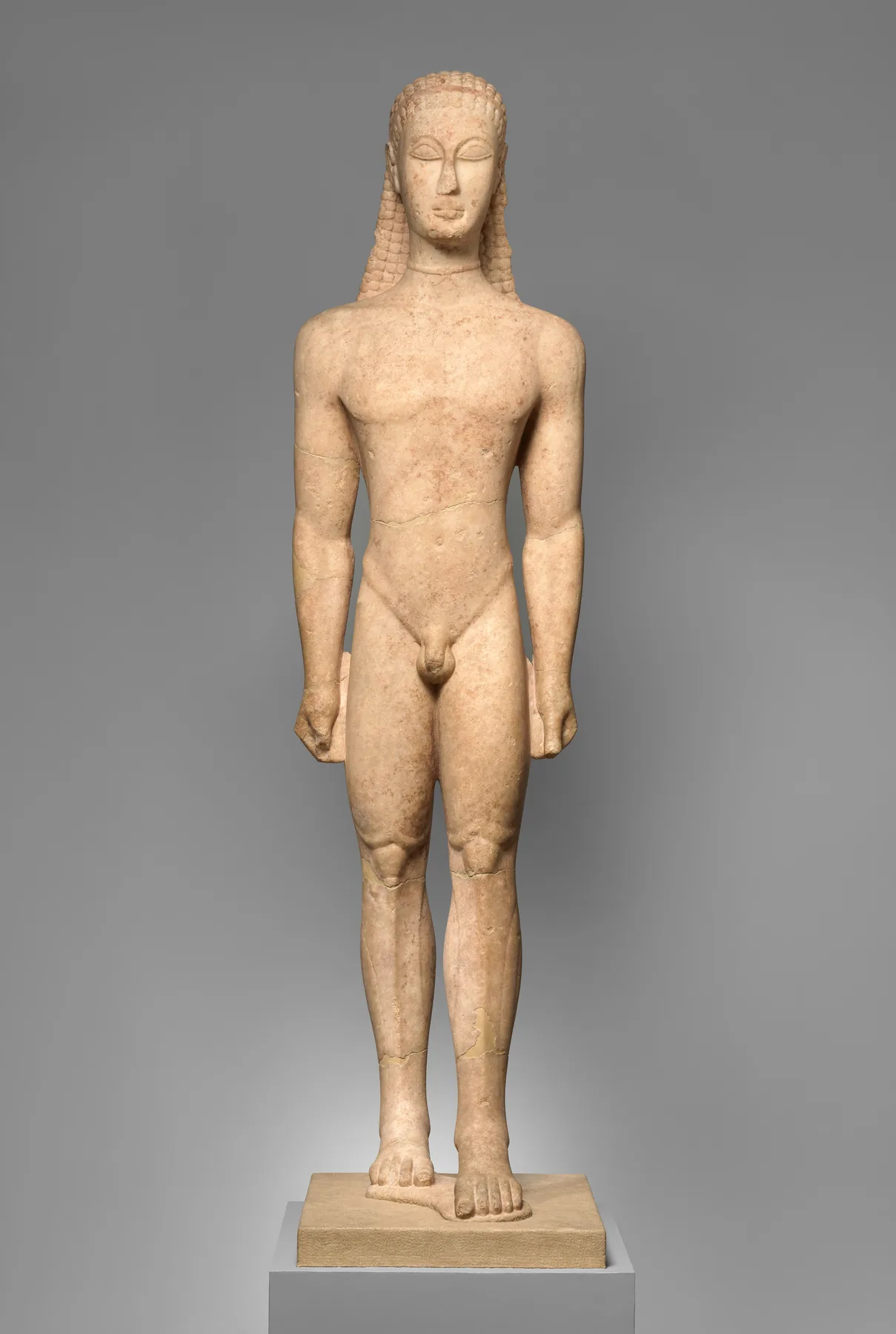
The youth does not walk, despite the advanced foot. Both legs remain straight. Weight does not pass through the hips. Arms hold the body at its edges, and the fists close beside the thighs. Patterned hair descends behind a face whose eyes, eyebrows, mouth, and ears have been organised for frontal clarity.
The Met object record dates this nearly life-size figure to about 590–580 BCE and identifies its stone as Naxian marble. The statue was made in Attica and, according to the museum, stood over the grave of a young Athenian aristocrat. Its material therefore crossed water before the completed body established a family presence in a cemetery.
Kouros is a modern type name for a standing nude youth, not this individual’s recovered personal identity. Similar figures could serve as grave markers or sanctuary dedications. The type’s frontal stance and advanced left leg show knowledge of Egyptian sculpture, but the relationship is not a simple copy. Egyptian stone figures were made within different architectural, religious, proportional, and material systems. Greek sculptors selected and altered a stable bodily formula for their own monuments.
The modern photograph introduces another transformation. It isolates the figure against grey and lets pale marble carry the entire image. Archaic sculpture was coloured. The Acropolis Museum’s continuing Archaic Colours research uses spectroscopy, specialised photography, pigment analysis, historical evidence, and experimental reconstruction to study painted marble. This corpus-level evidence requires us to reject a colourless ideal; it does not license a confident digital repainting of this kouros without object-specific evidence.
Nor should the figure be treated merely as an early attempt to make a natural body. Its repeated geometry makes a durable social claim. Youth does not age. The controlled stance does not tire. Nudity distinguishes the male body as heroic and athletic rather than simply undressed. Scale, costly imported stone, skilled labour, and cemetery placement convert a death into continuing aristocratic visibility.
The monument shows us a body. It also shows us who could afford to make one body permanently public.
A prize amphora: the polis carried in oil and image
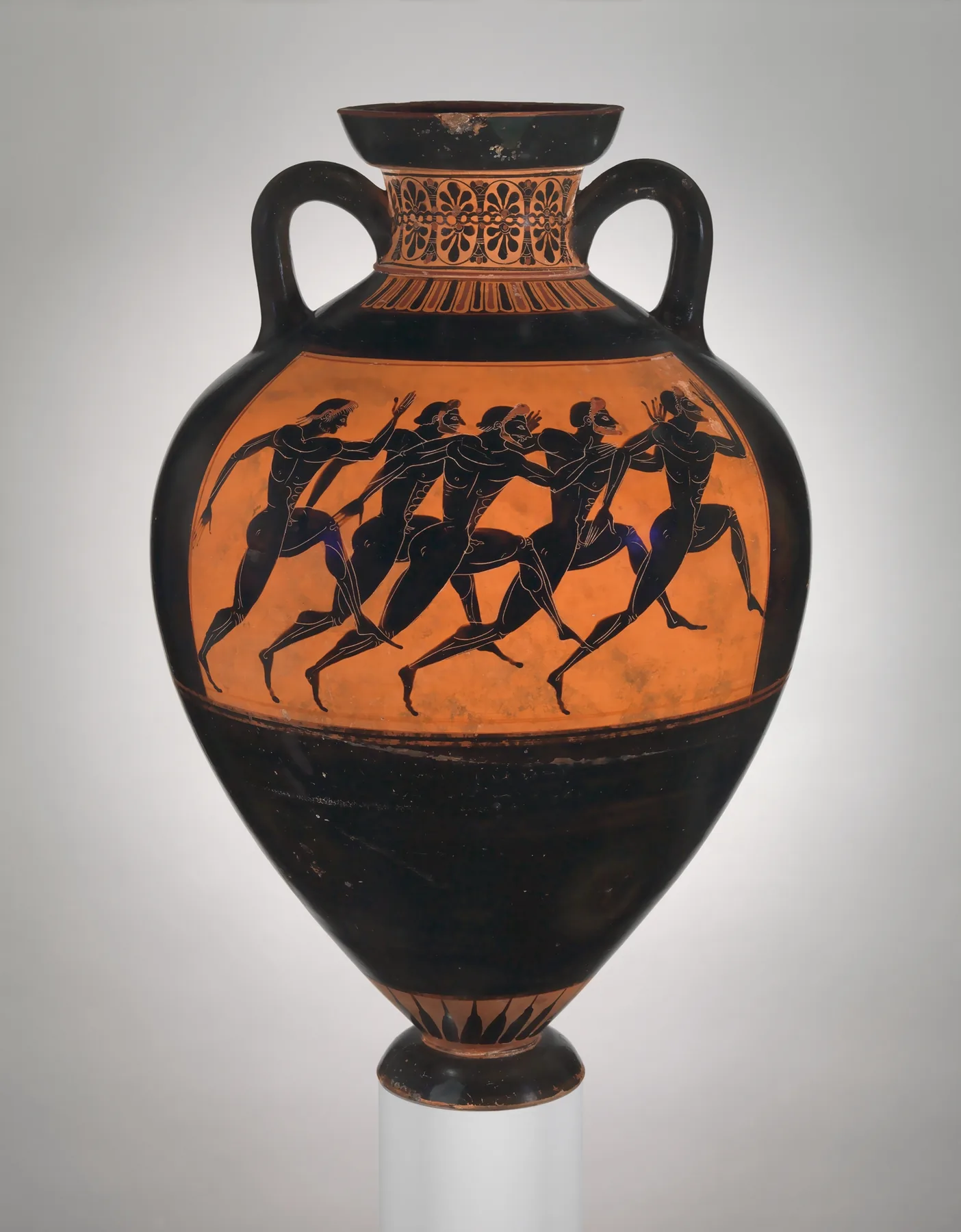
Five runners occupy a field built for fewer bodies. Their knees, elbows, and feet overlap. Incised lines cut muscles, hair, and facial features through the black slip. Each athlete repeats a type, yet each occupies a different instant in the race.
This is not simply a vase painted with sport. The Met record identifies it as a Panathenaic prize amphora attributed to the Euphiletos Painter, made around 530 BCE. Standardised amphorae were commissioned as official prizes for competitions at Athens’ festival for Athena. They carried valuable olive oil from sacred Attic groves. One face named the prize and presented armed Athena; the reverse identified the event through an image such as this footrace.
The vessel joined several systems:
- agricultural land and the labour that maintained olive groves;
- potters, painters, kilns, fuel, clay preparation, and workshop knowledge;
- civic officials who commissioned and inspected an official form;
- a religious festival for the city’s patron deity;
- athletic training and competition;
- a victor whose prize could circulate beyond Athens.
The black-figure technique matters. The painter applied a refined clay slip for figures, incised interior details, and controlled firing so selected areas changed colour. Red-figure pottery emerged around the same period and eventually became dominant, but Panathenaic prize vessels retained black-figure for centuries. An old technique could communicate official continuity. Artistic change was not a universal replacement schedule.
The runners make excellence visible, but not universally available. Greek athletic festivals differed, and women participated in some separate competitions and ritual roles. Major men’s contests largely privileged free Greek male competitors. The nude athletic body could signify discipline, status, civic honour, and readiness for war precisely because other bodies were assigned different positions.
The amphora is therefore both image and institution. It carried oil, but it also carried an authorised account of Athens: its goddess on one side, its competitive bodies on the other, its words beside them.
Turn a vessel, and the polis changes face.
Poseidonia: a Greek temple outside modern Greece
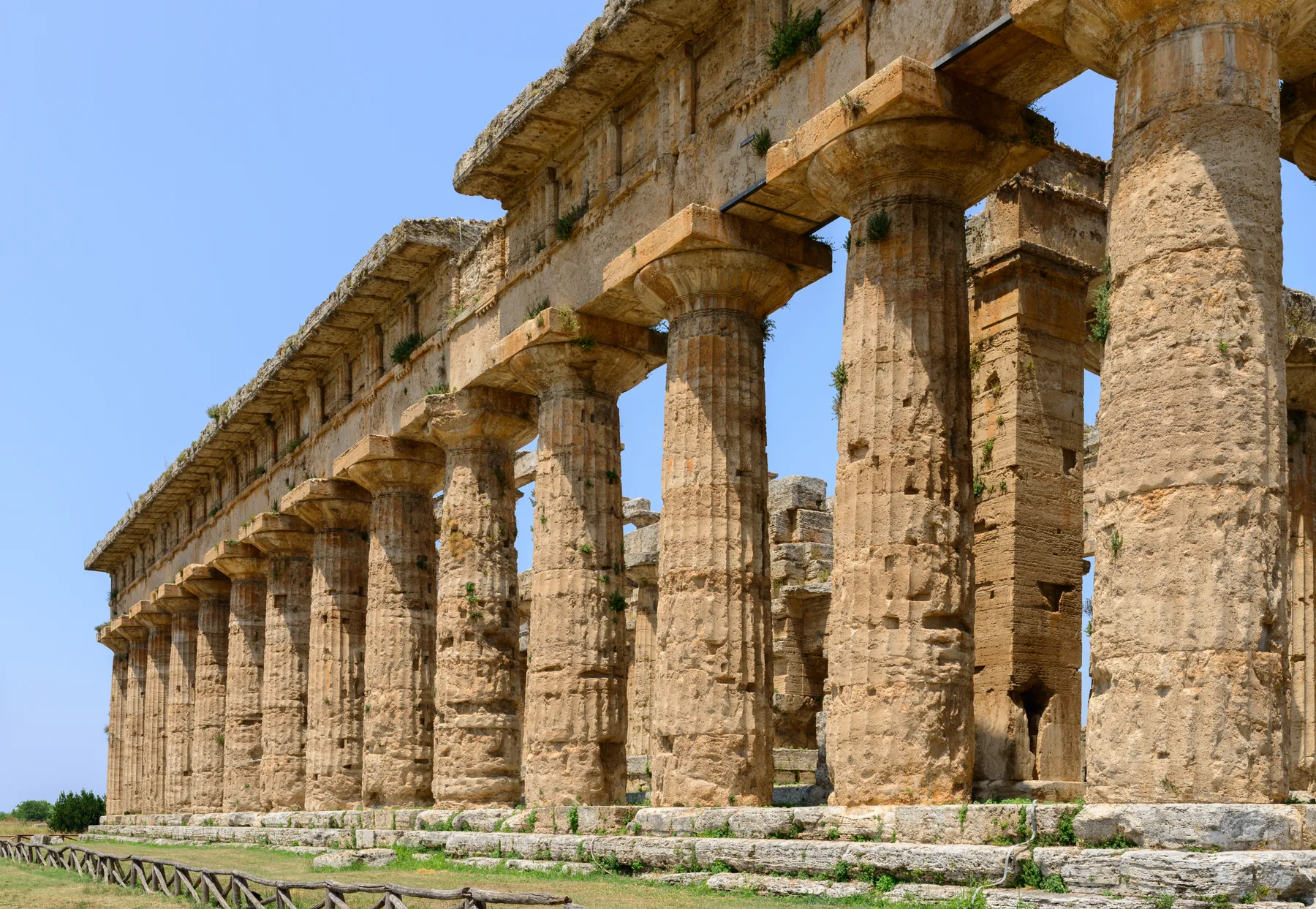
The photograph makes weight rhythmic. Column follows column; each shaft swells subtly, narrows, and meets a compressed capital. Above, blocks carry the alternating order of triglyphs and metopes. Through the outer colonnade, another vertical structure marks the inner building.
The current Paestum archaeological park account dates completion to around 460 BCE. The temple had six columns across its fronts and fourteen along its sides. Its inner chamber was divided into three aisles by two levels of Doric columns. Roof timbers, walls, doors, sculpture or painted decoration, cult equipment, offerings, people, sound, smoke, and movement supplied forms the surviving stone cannot.
“Temple” can also mislead a modern viewer. In Greek sanctuary practice, the building principally housed a divine image and valuable offerings. Large collective sacrifices took place at an altar outside. A visitor did not necessarily enter, sit, and watch a service as in many later religious buildings. The sanctuary was an ensemble of architecture, altar, route, objects, rules, landscape, and repeated action.
Its location changes the map. Poseidonia was founded by settlers connected to Sybaris and formed part of the Greek-speaking networks of southern Italy conventionally called Magna Graecia. That phrase must not empty the region of the Indigenous communities with whom settlers traded, fought, intermarried, negotiated, and remade territory. The city later came under Lucanian rule and became the Roman colony Paestum in 273 BCE. Its archaeological landscape holds Greek, Lucanian, and Roman phases rather than a sealed sample of “pure Greek” architecture.
The building’s name records another history. Eighteenth-century scholars called it the Temple of Neptune because the Greek city’s name, Poseidonia, referred to Poseidon. The park now says the dedication is not certain; current study of votive material allows Hera or Apollo as possibilities. “Hera II” is common in modern captions, but it remains an attribution, not an ancient name carved across the façade.
Its colour is less uncertain in general. The official site describes the temple as once richly coloured, and comparable architectural terracottas and surviving traces show that temples were not monochrome skeletons. Yet a full digital scheme would still combine evidence and reconstruction. The responsible image is neither the bare ruin alone nor an unlabeled colourful fantasy.
Most importantly, a Doric order is not a national style transmitted from a future country called Greece. It is a system of relationships used, adapted, and made local across different communities. At Poseidonia, local stone and Mediterranean movement became one civic-religious monument.
Epidaurus: theatre inside a healing sanctuary
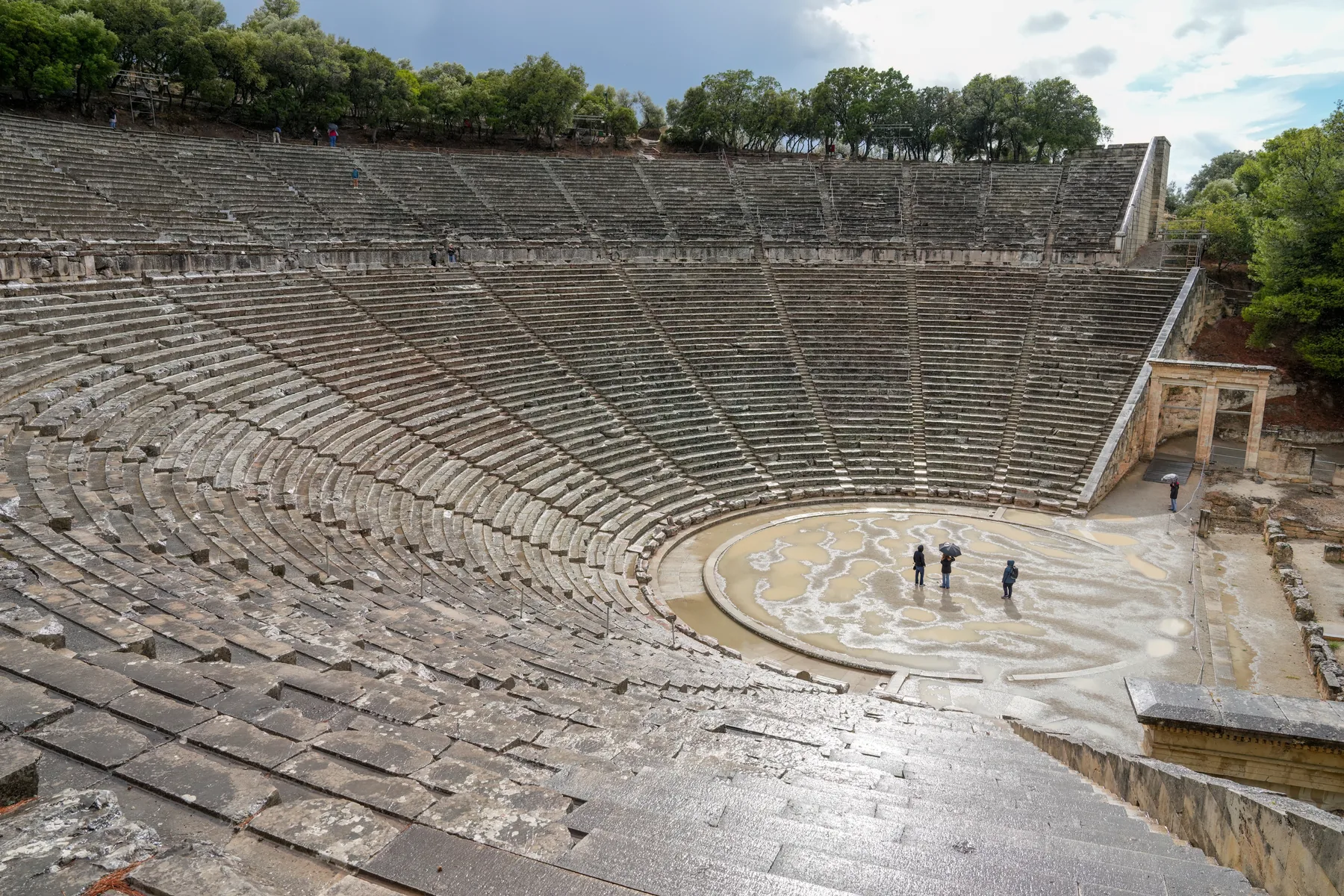

The theatre gathers sightlines before it gathers spectators. Stone seats rise around a circular orchestra. Stairways divide the cavea into wedges and turn a steep slope into ordered access. At the edge, passages connect the orchestra to the world outside the image.
It is tempting to call every Greek theatre an architectural form of democracy. That formulation works only with strict limits. Drama became civic discourse in fifth-century Athens, where tragedies and comedies belonged to competitive festivals of Dionysos. But theatres existed in communities with different constitutions and served religious festivals, music, poetry, assemblies, and other spectacles. A curved audience is not proof of equal political power.
Epidaurus makes the distinction especially clear. The theatre was built in the late fourth century BCE within the Sanctuary of Asklepios, in the Peloponnese. The Greek state submission on ancient theatres records music, drama, singing contests, and poetry recitals performed during festivals for the healing god. The UNESCO sanctuary record places the theatre within a larger system of temples, sleeping and healing spaces, baths, sport, accommodation, water management, and ritual.
Performance here was not separate from care, pilgrimage, divine presence, and the sanctuary economy. Spectators arrived through a landscape already organised by journeys, offerings, bodily vulnerability, and hope.
The architecture distributed attention. The orchestra held choral movement; the cavea organised viewers; the skēnē supplied a building behind the performance area and changed over time. Masks, costume, gesture, voice, music, weather, and the bodies of spectators completed the work. Text alone cannot recover that event.
The photograph also refuses to become a transparent window into the fourth century BCE. Modern visitors stand in the orchestra. Conservation scaffolding and technical equipment appear among trees. UNESCO records both substantial ancient material and conservation interventions designed to remain legible and reversible. Performances resumed in the modern period, and an annual festival has used the theatre since 1955.
That continued life produces knowledge and risk at once. A theatre can be preserved by being valued, studied, and used; use also requires management, repair, access systems, and decisions about which historical state to present.
We never encounter only an ancient audience. We encounter the architectures that later audiences have kept available.
An old woman: Hellenistic difference through a Roman copy
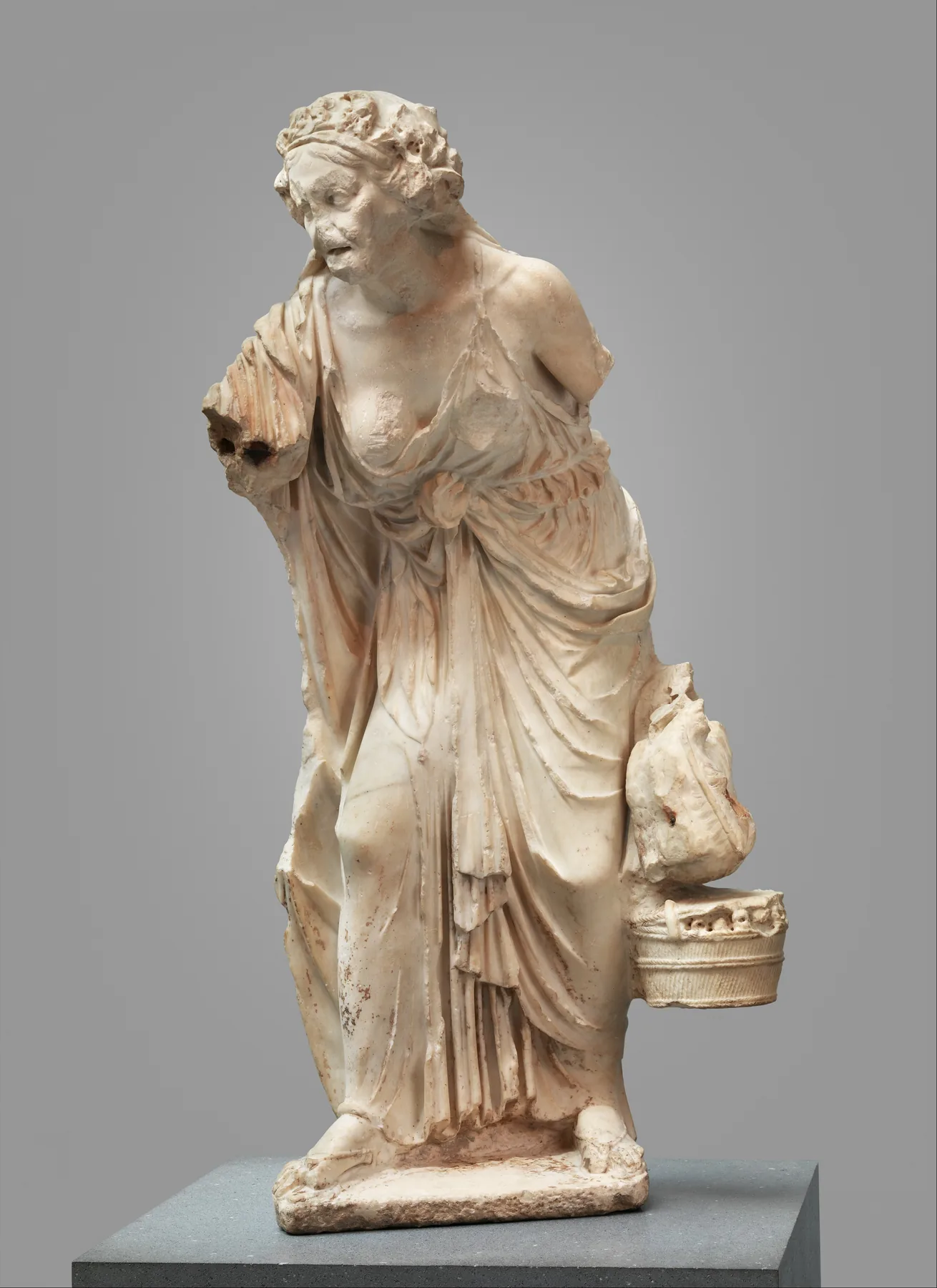
Age changes the body’s geometry. The head leans, the mouth opens, and the upper torso presses through complicated drapery. An ivy wreath circles the hair. A basket and chickens pull the composition toward provisions, offering, or festival.
Yet the work is not exactly what the familiar name Old Market Woman claims. The Met object record dates the marble to 14–68 CE and identifies it as a Roman copy of a Greek work from the second century BCE. The museum considers an aged courtesan travelling to a festival of Dionysos more likely than a market seller, based on her ivy wreath, fine clothing, sandals, and carried goods. Even that reading remains proposed rather than witnessed.
The statue expands the range of bodies associated with Hellenistic art: elderly people, children, labourers, foreigners, worshippers, rulers, and defeated enemies could join gods and ideal athletes as subjects. But “greater realism” does not automatically mean greater social equality. A patron could value the detailed image of a marginalised person as novelty, type, dedication, garden ornament, moral contrast, or display. Representation is not the same as voice.
The copy introduces a second caution. Many celebrated Greek sculptures survive through Roman-period versions made generations later. Copying could honour, collect, adapt, scale, combine, restore, or redeploy an earlier work. This statue may translate a Hellenistic dedication into Roman garden decoration. Its Pentelic marble, Roman date, missing arms, surface history, and modern museum setting all belong to the object we actually have.
The word “copy” should therefore reduce neither attention nor uncertainty. It tells us there was transmission. It does not guarantee exact duplication of an inaccessible original.
This is why the Hellenistic period should not be written as a decline from Classical restraint. Expanded subject matter, royal patronage, mobile workshops, new cities, sanctuary display, domestic luxury, and deliberate adaptation created different visual problems. The Met’s Hellenistic overview describes both innovation and the active reuse of earlier styles.
The old woman survives not as the opposite of an ideal body, but as evidence that Greek and Roman viewers made bodies carry many kinds of social attention.
Five publics, five limits
| Case | Public made visible | Material operation | Boundary or exclusion | Evidence limit |
|---|---|---|---|---|
| Attic kouros | Aristocratic family memory at a grave | Imported marble, carving, colour, scale, cemetery placement | Monumental permanence depended on wealth; the type privileges a youthful male body | Personal identity, exact find circumstances, and complete colour scheme are not recovered |
| Panathenaic amphora | Athens as goddess, festival, prize system, and athletic community | Clay preparation, wheel work, black-figure painting, controlled firing, olive production | Major competitions elevated eligible male athletes while many workers and residents lacked equal civic standing | The pictured race does not show every participant in the festival economy |
| Poseidonia temple | A community and deity joined through sanctuary, building, altar, and offerings | Quarrying, transport, precise stonework, timber roof, plaster, pigment | Settlement and territorial formation involved Indigenous neighbours and unequal power | Familiar modern names do not settle the temple’s divine dedication |
| Epidaurus theatre | Festival spectators gathered within a healing sanctuary | Slope, stone seating, orchestra, stage building, voice, mask, movement | Shared viewing did not produce identical political or social power | The surviving architecture cannot restore one complete ancient performance |
| Old woman | Age, devotion, festival, and social difference as large-scale sculptural subjects | Greek model, Roman carving, adaptation, later collection and display | Visibility of a marginal figure is not evidence of her agency or status | The Greek original is lost; identity, first setting, and the copy’s degree of fidelity remain uncertain |
These cases make “public art” less simple. A public may be a cemetery route, festival crowd, sanctuary community, group of citizens, body of competitors, patrons in a garden, or museum visitors centuries later. Each public is assembled by space, objects, rules, and labour. Each leaves someone at the edge.
A compact timeline
| Date | Conventional frame | Selected development | Caution |
|---|---|---|---|
| about 900–700 BCE | Geometric period | Repeated linear systems organise pottery, bodies, funerary display, and small bronzes | Geometric is not the absence of observation or meaning |
| about 700–480 BCE | Archaic period | Monumental sanctuaries, kouroi and korai, expanding Mediterranean settlements, black-figure and red-figure pottery | Egyptian and West Asian exchange belongs inside the history, not outside it |
| 590–580 BCE | Archaic Attica | The Met kouros marks an elite grave | “Archaic smile” is a modern formal label, not a recovered emotion |
| about 530 BCE | Archaic Athens | Euphiletos Painter’s Panathenaic prize amphora | Red-figure innovation did not immediately replace official black-figure practice |
| about 480–323 BCE | Classical period | Changing body systems, civic monuments, theatres, sanctuaries, wars, and competing poleis | Two centuries do not form one stable Classical ideal |
| about 460 BCE | Classical Poseidonia | Great Doric temple completed in southern Italy | Its deity and modern name remain debated |
| late fourth century BCE | Late Classical Epidaurus | Theatre built within the Asklepios sanctuary | Theatre does not automatically equal democracy |
| 323–31 BCE | Hellenistic period | Kingdoms, poleis, sanctuaries, and workshops transform earlier forms across a wider connected world | Difference, drama, and copying are not evidence of decline |
| second century BCE / 14–68 CE | Hellenistic model / Roman copy | Greek old-woman type survives through a Roman marble version | The copy is evidence of reception, not transparent access to a lost original |
Key terms
Polis: a self-governing community understood through people, territory, institutions, cults, and shared practices. The word does not mean “democratic city” in every case.
Kouros / kore: modern type labels for standing Archaic youths and maidens. Ancient functions varied, especially between graves and sanctuaries.
Archaic: a modern period label, conventionally about 700–480 BCE. It should not imply primitiveness or failed naturalism.
Classical: a historical period label and, separately, a value-laden claim about exemplary form. Keep those uses distinct.
Hellenistic: conventionally the period from Alexander’s death in 323 BCE to the end of the Ptolemaic kingdom in 31 BCE. It contains multiple kingdoms, poleis, languages, and local visual cultures.
Black-figure: a pottery technique in which figures are largely formed with dark slip and details are incised or added in colour before controlled firing.
Red-figure: a technique that leaves figures in the clay body’s colour while painting the surrounding field dark, allowing interior details to be drawn with a brush.
Doric order: an architectural system relating column, capital, entablature, triglyph, metope, and proportion. It travelled and changed; it is not one fixed national template.
Sanctuary: a sacred place that may include landscape, boundaries, altars, temples, offerings, treasuries, dining, performance, sport, healing, and administration.
Cavea, orchestra, skēnē: respectively the seating area, central performance space associated with the chorus, and the stage building of a Greek theatre. Their forms changed over time.
Roman copy: a Roman-period work made in relation to an earlier Greek model. The relationship may include close replication, translation, restoration, recombination, or new display.
Polychromy: the use of multiple colours and surface materials, including pigment, gilding, and inlay, on sculpture or architecture.
Questions for close looking
Choose one Greek or Greek-related work and begin with the public it creates.
- Where was the work encountered: grave road, sanctuary, festival, house, theatre, garden, or museum?
- Does the represented body stand for a person, a social type, a deity, an age, an institution, or several at once?
- Which materials arrived from elsewhere, and whose labour transformed them?
- What colour, metal attachment, roof, cloth, liquid, sound, smoke, text, or movement is now missing?
- Does “polis” in this case mean Athens, a different community, a governing body, a cult group, or a wider population?
- Who could commission, enter, compete, vote, perform, watch, serve, or be represented?
- Is an object’s name ancient, conventional, contested, or newly assigned by a museum?
- If the work is a Roman copy, which claims belong to the surviving object and which to the lost model?
- Does a period label explain the evidence, or quietly rank it?
- What changes when an isolated museum object is returned mentally to its route, offering, prize, grave, performance, or social boundary?
Use Observation → Effect → Context → Argument to prevent a label from replacing looking. For comparison, keep one problem stable: public body, controlled movement, colour loss, civic commission, sanctuary space, or later copying. The comparative method is strongest when it explains why a difference matters.
Seven myths to retire
- “Ancient Greek art is the art of one country.” Greek-speaking communities extended across the Aegean, Anatolia, southern Italy, Sicily, North Africa, and the Black Sea while remaining politically and culturally varied.
- “Archaic sculpture is a failed attempt at Classical realism.” The kouros is a durable social and ritual type, not a practice sketch waiting for contrapposto.
- “Greek sculpture and temples were pure white.” Pigment, gilding, inlay, painted terracotta, and coloured architectural surfaces were integral, even when exact schemes are only partly recoverable.
- “Polis means democracy.” Poleis had different constitutions and legal statuses. Athens’ democracy was historically significant and radically bounded.
- “A Greek temple was a church for a seated congregation.” The building housed divine presence and offerings within a sanctuary whose major collective rites often centred on an outdoor altar.
- “Theatre proves equal citizenship.” Performance could create civic discourse and collective attention without erasing differences of gender, status, origin, or political power.
- “Hellenistic art declined into emotion and realism.” Hellenistic makers transformed earlier styles, patrons, subjects, scales, cities, and networks; many works are known only through later adaptations.
Where to continue
Start with the objects. The Met records for the kouros, Panathenaic prize amphora, and old woman supply date, material, dimensions, attribution, image rights, and the limits of each identity. Pair them with the museum’s studies of Archaic art, Classical art, and Hellenistic art, but remember that a period overview is a map, not an argument about every object.
For colour, use the Acropolis Museum’s continuing Archaic Colours research and the Met’s Chroma project. Both explain how imaging, microscopy, spectroscopy, pigment analysis, comparison, and reconstruction work together—and why a reconstruction should be labelled.
For architecture outside Athens, the official Paestum archaeological-area account is unusually useful: it separates the temple’s traditional name from the uncertain dedication, restores colour and roof to the ruin, and places sanctuaries, agora, assembly building, houses, and later phases in one urban field.
For performance, read the Sanctuary of Asklepios at Epidaurus as an ensemble rather than extracting its theatre as an isolated masterpiece. Then compare it with the Met’s bounded account of theatre in ancient Greece, which begins from Athenian festival evidence instead of projecting one origin story onto every theatre.
Then return to Paestum. The temple remains monumental after its white perfection, certain name, and national border have disappeared.
Ancient Greek art becomes more coherent when it is no longer required to be pure.
Editorial record
About this article
- Author
- Publisher
- GeMarkt
- Published
- Updated
- Reviewed
- Internal source & rights check. Conducted by GeMarkt Research Review. This is an internal editorial check—not independent peer review.
- Source standard
- Art history source standardPrioritises object records and research sources, distinguishes evidence from interpretation, and states material uncertainty.
Found a claim that needs checking? Report a factual error.