Art History · Learning chapter
Atlas III — Early-modern worlds · 1 of 11
Renaissance art: patronage, perspective, workshops, and competing centres
A grounded guide to Italian Renaissance art between 1400 and 1527, following commissions and workshops across Florence, Urbino, Venice, and Rome.

What we’ll look at
How did artists, patrons, workshops, and cities shape Renaissance art together?
The familiar Renaissance story has a clean plot: classical antiquity was rediscovered, perspective made pictures more realistic, and a succession of geniuses carried European art from the Middle Ages into modernity.
Every part of that plot contains something useful. Together, however, they hide the machinery that made the art possible.
A fresco began with a wall, a payment, a programme, plaster mixed for a day’s work, and access to a building. An altarpiece had to answer to an altar, a religious community, and the changing light around it. A court portrait helped a ruler turn a face and a territory into authority. Even the most celebrated artist depended on apprentices, assistants, suppliers, carriers, carpenters, stonecutters, and other specialists whose names often disappeared behind the master’s.
This guide asks a more productive question than “Who was the greatest Renaissance artist?”
Who shaped the work: the artist, the patron, the workshop, the material, or the city?
The answer, in each case, is a changing combination of all five.
Define the map before using the period
Here, Renaissance is a study frame for art made on the Italian peninsula between about 1400 and 1527. It is not a universal clock. It does not mean that Europe moved through one style at the same speed, still less that societies elsewhere were waiting to become “modern.” Northern European, Iberian, Ottoman, African, and Asian histories intersected with these centres, but they require their own chronologies and evidence.
Nor was “Italy” a unified state. Florence and Venice were republics with very different political structures. Urbino was a court ruled by the Montefeltro dynasty. Rome was the centre of a papacy that governed territory as well as the Church. Milan, Mantua, Ferrara, Naples, Siena, and many smaller centres generated other models. War, diplomacy, marriage, trade, pilgrimage, and artists’ travel connected them.
The end date is deliberately practical rather than absolute. The imperial sack of Rome in 1527 devastated the city and dispersed artists, but Renaissance practices did not stop that year. Period boundaries help organise study; they do not switch culture off.
A commission came before a masterpiece
The word patron can make commissioning sound like generous support offered after an artist had an idea. Often the relationship was more exacting. Patrons might select the subject, destination, dimensions, expensive materials, deadline, payment schedule, and standards of workmanship. They could be confraternities, religious orders, guilds, civic governments, courts, families, or individuals seeking devotion, commemoration, status, political legitimacy, or some mixture of these.
Surviving contracts show how concrete the bargain could be. The National Gallery’s research on Sassetta’s San Sepolcro Altarpiece traces a commission agreed with Franciscan friars in 1437 and delivered in 1444. The contract governed the structure and materials; the finished double-sided altarpiece used gold, silver, and costly pigments and earned Sassetta 510 florins. At the same time, technical examination reveals changes made during painting. A contract constrained invention without eliminating it.
That distinction matters. Patronage was neither total control nor a ceremonial cheque. It established the problem within which artists and workshops made choices.
Florence: perspective built a place for the patron
In brief: Masaccio painted the Holy Trinity fresco in 1425–26 for Santa Maria Novella in Florence. Its perspective joins the sacred scene to the kneeling patrons and the real space of the church.
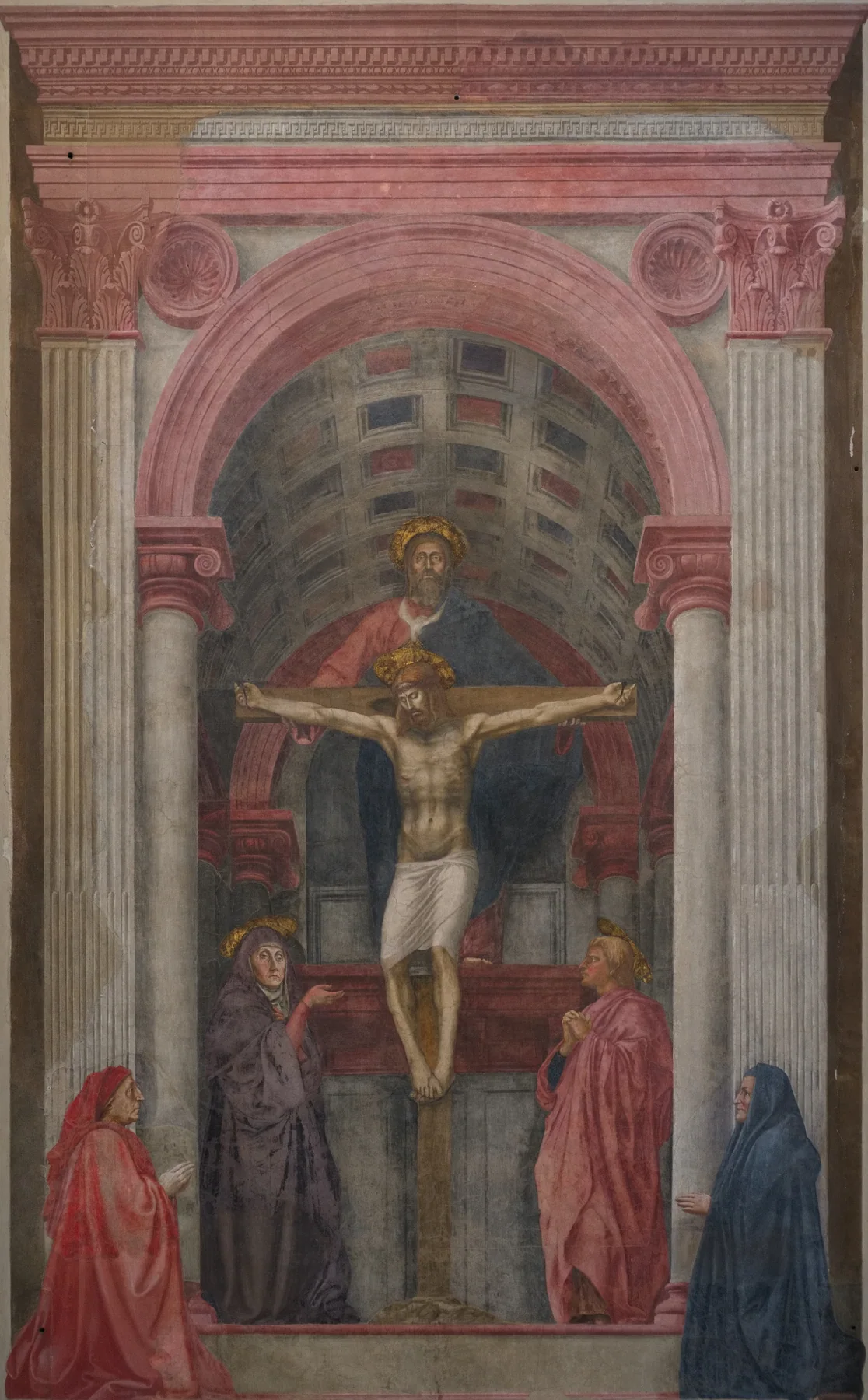

Masaccio’s Holy Trinity is often used to demonstrate linear perspective, as if it were a diagram that happened to contain a religious scene. Its location makes the geometry more interesting.
The church of Santa Maria Novella dates the fresco to 1425–26 and identifies the two kneeling figures as the work’s husband-and-wife patrons. Their names remain uncertain. They occupy the viewer’s earthly zone, outside the painted chapel but at the same scale as the Virgin and Saint John. Above them, the architecture appears to open a deep, coffered vault into a flat wall. The vanishing point sits near ordinary eye level, making the fictive space answer to a body standing in the nave.
Perspective therefore does more than display mathematical knowledge. It coordinates three spaces: the actual church, the patrons’ commemorative presence, and the sacred vision beyond them. The painted architecture gives the patrons a durable position at the threshold of the holy scene.
The monument also extended below the part reproduced here. A painted skeleton and an inscription about the viewer’s future death converted the passage from floor to Trinity into an argument about mortality and salvation. The work was later covered by an altar, moved, and restored; its present appearance is a history of the building as well as of Masaccio’s design.
Calling the fresco “realistic” is too blunt. The spatial system is highly artificial, and that is its power. It manufactures a convincing place so that devotion, memory, status, and the viewer’s own body can occupy one ordered structure.
Florence: one painting can contain more than one artistic career
The circular Adoration of the Magi reproduced at the top of this article looks, from a distance, like a unified abundance. Up close, it unsettles the expectation that one famous name should explain one object.
The National Gallery of Art records the work as tempera on a poplar panel, 137.3 centimetres in diameter, made around 1440–60 by Fra Angelico and Fra Filippo Lippi. Angelico began the tondo, or round picture, and Lippi completed it. Its early provenance is not certain, but documentary evidence makes a Medici commission probable. The subject had special civic force in Florence, where a confraternity devoted to the Magi staged elaborate processions through the city.
The composition turns that procession into a device for looking. Travellers descend from the upper right, pass through ruins, curve around the stable, and accumulate before the seated Virgin and Child. Costumes, animals, masonry, plants, and distant figures reward slow inspection. The round support has no neutral corners; bodies and routes bend to its perimeter.
The object survived changing attributions as well as changing hands. It was once sold under names including Botticelli, Fra Angelico, and members of the Lippi family. The current double attribution is not an embarrassment to be tidied away. It is evidence that completion could cross time, workshop practice, and artistic identity.
This case also corrects a common mistake about “the master’s hand.” A Renaissance workshop could produce replicas and variants, reuse designs, and distribute labour among people with different skills. A National Gallery research project on Perugino’s workshops describes pictures made by numerous assistants and material reused across two workshops. Authorship was real, but it did not always mean solitary execution.
Urbino: a court portrait turns territory into authority
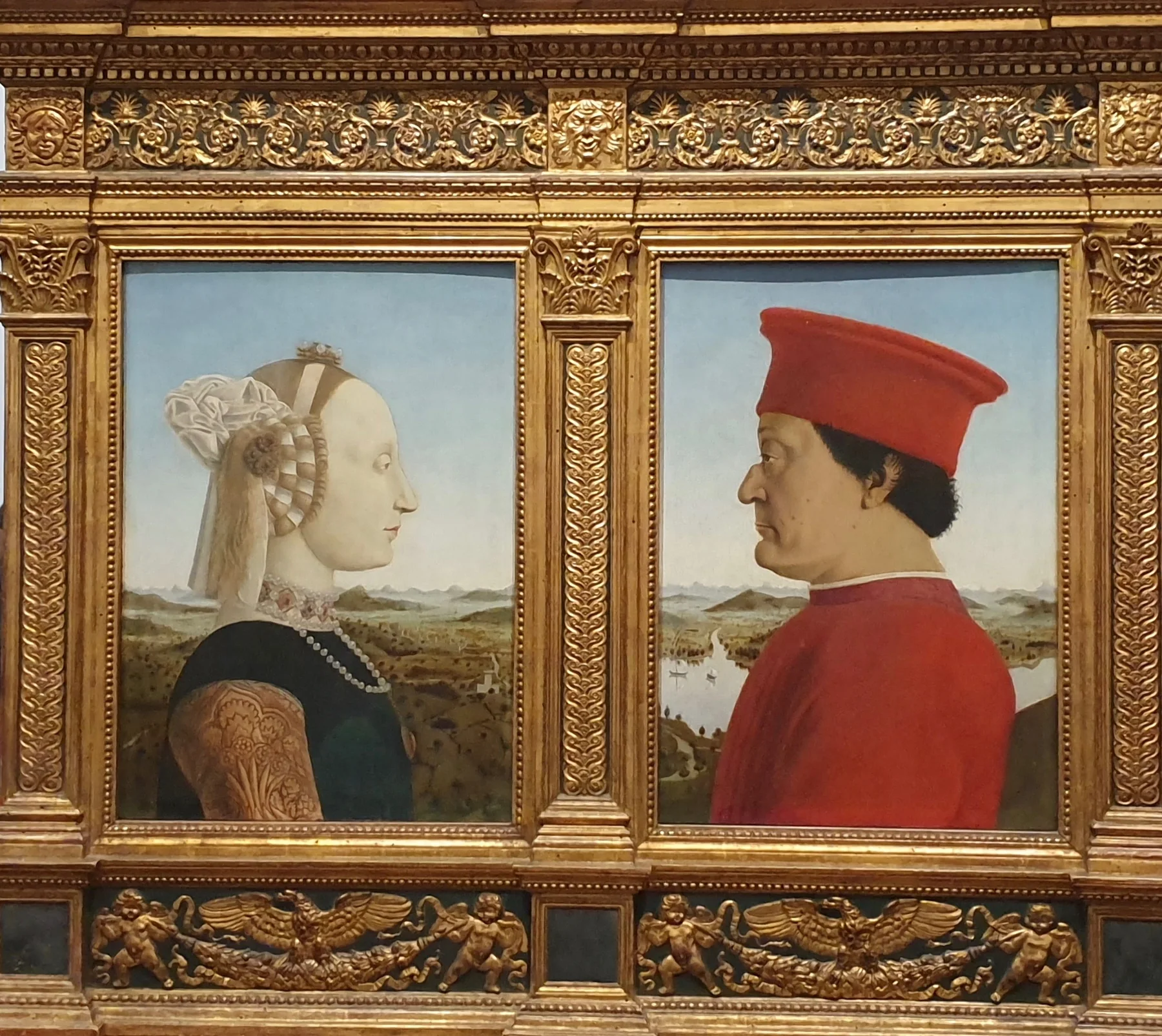

Florence was not the engine from which every Renaissance development radiated. Courts created different demands. At Urbino, Federico da Montefeltro assembled humanists, artists, architects, and manuscripts around a ruler whose military income and political alliances supported a carefully fashioned image of culture.
Piero della Francesca’s paired portraits make that image portable and intimate. The Uffizi dates the panels to about 1473–75. Federico and his wife Battista Sforza face one another in profile, a format associated with ancient coins. Their expressions reveal little. The continuous landscape does more communicative work: waterways, roads, fields, and distant settlements extend behind the rulers as a territory apparently held within their calm exchange of looks.
Battista had died in 1472. The Uffizi notes that her pallor may allude to her death, so the diptych may join rule to memorialisation rather than record a living encounter. On the reverse, triumphal vehicles carry the pair with personified virtues and Latin inscriptions. The object could be closed, handled, turned, and read. Its fronts present controlled likenesses; its backs convert those likenesses into moral claims.
Piero’s method also crosses the borders of a simple “Florentine style.” The Uffizi describes his combination of perspectival discipline learned in Florence with the minute, far-reaching description associated with Netherlandish painting. The useful question is not which region owns the result. It is what a court gained by bringing different visual competencies together: measured bodies, exhaustive land, antique authority, and Christian virtue become one political instrument.
Venice: the altar is part of the painting
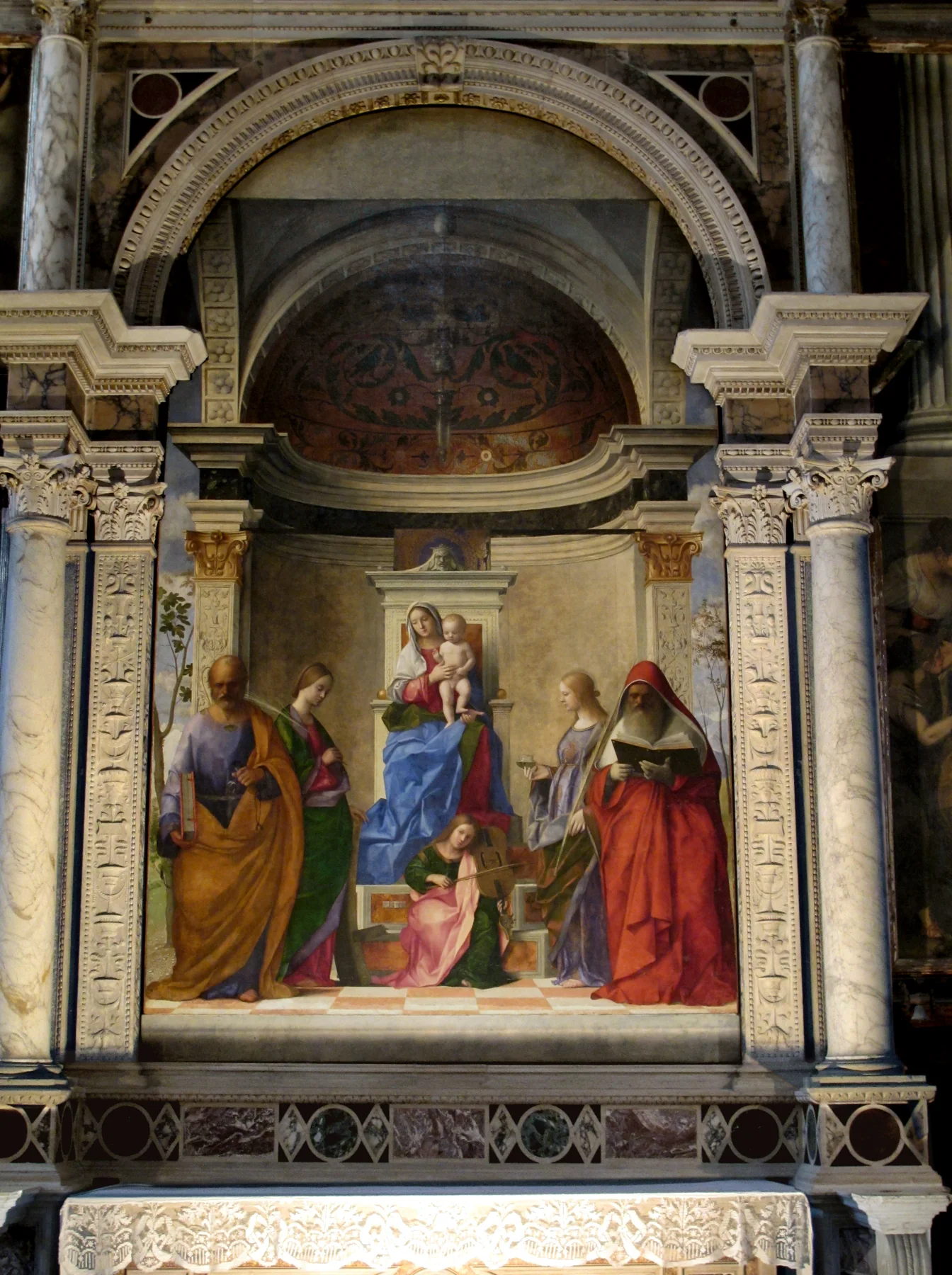

Giovanni Bellini signed and dated the San Zaccaria Altarpiece in 1505. The church network Chorus Venezia records it on the second altar to the left. It remains unusually legible in relation to the architecture for which it was made.
The surrounding marble frame does not merely decorate a rectangular picture. Bellini’s painted columns, apse, mosaic-like half dome, and tiled floor continue the chapel’s material vocabulary. Light seems to enter the painted space from the left, answering the illumination of the actual church. The Virgin and Child sit above four saints while a musician occupies the lowest step. This arrangement is called a sacra conversazione, a “holy conversation”: sacred figures from different times share one coherent setting rather than appearing in separate compartments.
Oil enabled Bellini to build colour and light through transitions that differ from the crisp divisions of a tempera panel. But “Venetian colour versus Florentine drawing” is too tidy. Artists travelled, objects arrived by sea and land, northern prints circulated south, and Italian works moved north. Venice’s distinctive painting culture grew from those routes as well as from local institutions and materials.
Most importantly, the in-situ photograph changes the analysis. A cropped reproduction encourages us to treat the altarpiece as an autonomous rectangle. The wider view shows a work calibrating painted architecture, physical stone, altar, approach, and ambient light. Its site is not background information. It is one of the media.
Rome: a drawing exposes the labour behind papal scale
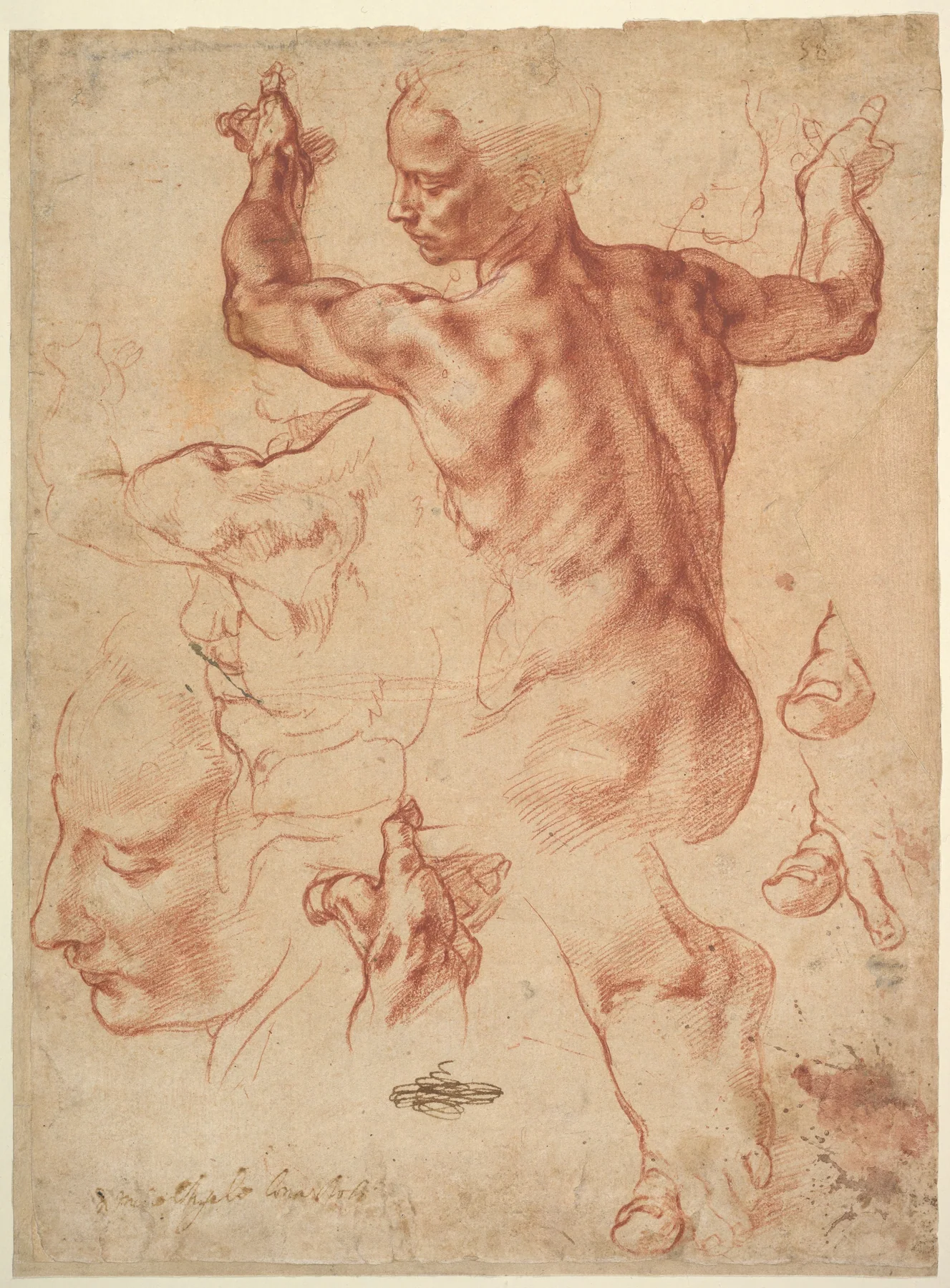
Rome offered a different scale of ambition. Pope Julius II used architecture, antiquities, tomb design, and vast fresco programmes to assert papal continuity and authority. The Met’s history of the Vatican Palace places Michelangelo’s Sistine ceiling of 1508–12 beside Bramante’s new Saint Peter’s and Raphael’s rooms: several monumental projects competing for attention within one institutional programme.
Michelangelo’s drawing for the Libyan Sibyl makes that scale human again. The Met dates the sheet to about 1510–11. Red chalk builds the back, shoulders, arms, hands, and turning neck of a model; separate studies test the head, fingers, and foot. A young male assistant posed in the studio for the monumental female prophet painted on the ceiling. Gender here was constructed through adaptation: observed anatomy became a figure whose identity, drapery, colour, and position belonged to the final sacred programme.
The drawing is not a miniature of the fresco. It is a working surface for solving weight and rotation. The finished figure had to be transferred to wet plaster high above the chapel floor. The Met’s technical account divides the Sibyl, throne, and attendants into twenty giornate—areas of surface plaster completed in a day—and describes the use of spolvero, pricking and pouncing a full-scale cartoon to transfer outlines.
“Michelangelo painted the Sistine ceiling” remains true. It is simply incomplete. The statement compresses a commission, scaffolding, assistants, cartoons, plaster, timed daily sections, and papal oversight into one celebrated name. The drawing lets us expand that sentence again.
What the four centres change
Placed together, these objects do not form a staircase from less advanced to more advanced art.
- Florence shows perspective working as a site-specific social and devotional structure, and a tondo whose authorship crosses two careers.
- Urbino shows a court turning portrait, landscape, memory, and antique form into dynastic authority.
- Venice shows oil painting organised around local light, altar architecture, religious use, and a republic connected to wider routes.
- Rome shows how papal concentration produced extraordinary scale—and how a preparatory sheet preserves the bodily labour hidden by that scale.
The centres competed, but competition did not keep them pure. Artists moved; patrons recruited; drawings, prints, pigments, books, and luxury objects travelled. The period’s energy lies partly in that tension between strong local institutions and persistent circulation.
A compact timeline
| Date | Event | Why it matters here |
|---|---|---|
| c. 1425–26 | Masaccio paints the Holy Trinity at Santa Maria Novella | Perspective coordinates fictive architecture, patrons, burial, and the viewer’s position. |
| 1437 | Franciscan friars contract Sassetta for the San Sepolcro Altarpiece | A surviving agreement makes materials, payment, programme, and delivery visible. |
| c. 1440–60 | Fra Angelico begins and Fra Filippo Lippi completes the Adoration of the Magi | A prestigious object resists the assumption of one work, one moment, one hand. |
| 1472–75 | Battista Sforza dies; Piero paints the Urbino diptych soon after | Court portraiture joins likeness, territory, commemoration, and moral authority. |
| 1494 onward | Foreign powers fight for control across the peninsula in the Italian Wars | Artistic centres operated inside military and diplomatic instability, not a sealed “golden age.” |
| 1505 | Bellini dates the San Zaccaria Altarpiece | Painted and built architecture still meet in the work’s Venetian setting. |
| 1508–12 | Michelangelo paints the Sistine ceiling for Julius II | Papal scale depends on drawings, cartoons, plaster cycles, scaffolding, and organised labour. |
| 1527 | Imperial troops sack Rome | The disaster disperses artists and interrupts papal concentration without ending Renaissance practice everywhere. |
Key terms
Commission: an agreement to make a work for a person or institution, often specifying subject, material, scale, location, price, and time.
Patron: the person or body that funds or authorises a work. Payment does not automatically reveal every decision the patron made.
Workshop: a production and training structure organised around a master, with apprentices, assistants, specialists, shared designs, and unevenly distributed credit.
Linear perspective: a geometrical method that makes parallel lines appear to converge toward one or more vanishing points. It is a representational choice, not a synonym for truth.
Fresco: pigment applied to wet lime plaster. Because the surface sets, painters organise work into daily sections called giornate.
Tondo: a circular work of art, from the Italian rotondo.
Diptych: two joined or paired panels designed to be read in relation and, often, handled or closed.
Sacra conversazione: a composition in which the Virgin and Child share a unified space with saints from different times.
How to analyse another Renaissance work
Begin with the method from our guide to analysing a work of art, then add six system questions:
- Where did the object originally work? Reconstruct its altar, palace room, street, tomb, studiolo, civic chamber, or processional route.
- Who authorised and paid for it? Separate a documented patron from a traditional or probable identification.
- What did the agreement control? Look for subject, dimensions, material, delivery, payment, penalties, and required participation by the master.
- Whose labour survives? Distinguish design, execution, assistance, specialised craft, later restoration, and uncertain attribution.
- What could the material do? Connect fresco, tempera, oil, wood, stone, bronze, textile, or print to time, cost, surface, scale, and use.
- Which routes reach the object? Replace vague “influence” with evidence of travel, trade, gifts, prints, imported objects, diplomatic contact, or workshop movement.
For a comparison paper, use our paired-work method. Compare two centres through the same problem—such as sacred space, court authority, or workshop labour—rather than writing one city after another.
Five claims to retire
“The Renaissance ended the Dark Ages.” The phrase reduces many medieval cultures to a lack and treats later Italian values as the inevitable destination of history.
“Perspective made art realistic.” Perspective can create a convincing spatial system, but it selects a viewpoint and organises bodies. It is rhetoric as well as geometry.
“The Medici commissioned Renaissance art.” Medici patronage mattered greatly in Florence; it was one network among guilds, republics, courts, popes, confraternities, religious orders, and private patrons across many centres.
“A masterpiece is the product of one genius.” Named artists made consequential decisions. They also worked inside contracts, workshops, material limits, inherited designs, and institutional programmes.
“Florence invented the Renaissance and everyone else followed.” Florence was crucial, but Urbino, Venice, Rome, and other centres posed different problems and exchanged people and objects in several directions.
The Renaissance becomes more, not less, interesting when the solitary genius is returned to the room: beside the patron, assistant, friar, courtier, carpenter, pigment seller, model, altar, wall, and viewer. A masterpiece is not diminished by its system. The system tells us what had to align for the work to exist—and whose contribution the famous name taught history to forget.
Sources and further study
- Masaccio’s Holy Trinity, Opera per Santa Maria Novella.
- Fra Angelico and Fra Filippo Lippi, The Adoration of the Magi, National Gallery of Art, Washington.
- Piero della Francesca, The Duke and Duchess of Urbino, Uffizi Galleries.
- Giovanni Bellini, Madonna and Child with Saints, Chorus Venezia.
- Michelangelo, Studies for the Libyan Sibyl, The Metropolitan Museum of Art.
- The Papacy and the Vatican Palace, The Met’s Heilbrunn Timeline of Art History.
- The Workshop and its Painters: Perugino and the Perugineschi, National Gallery, London.
- San Sepolcro Altarpiece catalogue entry, National Gallery, London.
- Florence and Central Italy, 1400–1600, Venice and Northern Italy, 1400–1600, and Rome and Southern Italy, 1400–1600, The Met’s regional chronologies.
Editorial record
About this article
- Author
- Publisher
- GeMarkt
- Published
- Updated
- Reviewed
- Internal source & rights check. Conducted by GeMarkt Research Review. This is an internal editorial check—not independent peer review.
- Source standard
- Art history source standardPrioritises object records and research sources, distinguishes evidence from interpretation, and states material uncertainty.
Found a claim that needs checking? Report a factual error.