Art History · Learning chapter
Atlas V — Modernisms and contemporary practices · 2 of 10
Modernism and colonial appropriation: the problem of ‘primitivism’
Five object-led studies separate source communities, colonial transfer, modernist borrowing, museum display, and present-day provenance research.

What we’ll look at
How did modernist artists borrow from colonised societies, and what did that hide?
The figure above looks self-contained because a museum photograph gives it a neutral ground, even light, and enough empty space to read as sculpture. Its first body was larger. The carved guardian sat above a bark container holding ancestral relics; figure, container, relics, ritual restrictions, custodians, and relationships between living and dead formed an ensemble. Separation did not reveal a previously autonomous artwork. It produced a different object.
That change is a starting point for studying modernism and colonial appropriation. European artists did not encounter a borderless world of forms waiting to be discovered. They worked in imperial cities supplied by military conquest, colonial administration, ethnographic missions, commercial dealers, exhibitions, photographs, and museums. They made real formal innovations. The question is what conventional accounts hide when innovation is credited at the last, European end of an unequal chain.
Primitivism is a colonial category, not a people
In late nineteenth- and early twentieth-century Europe, primitive and primitivism grouped different societies, objects, periods, and desires. The category could include African sculpture, Oceanic ritual objects, Indigenous American arts, European folk traditions, children’s drawings, prehistoric remains, or fantasies of instinct. What joined them was not a shared culture or style. Europeans positioned them outside, before, or beneath an allegedly modern West.
This chapter therefore uses primitivism only as a historical and critical term. It names a European desire for an imagined opposite: communal rather than alienated, spiritual rather than materialist, instinctive rather than academic, timeless rather than historical. Those pairings could criticise industrial Europe, but they still denied other societies coevalness—the fact that they inhabited and shaped the same changing world.
Scope: five objects, three transfers, and a missing equality
Five objects organise the route: an Okak-Fang eyema byeri; Firmin Bouisset’s poster for the 1906 Paris Colonial Exhibition; Gauguin’s portrait of Tehamana; Modigliani’s Head of a Woman; and a Kuba woman’s ceremonial overskirt. Picasso’s Les Demoiselles d’Avignon and Matisse’s Kuba textiles are discussed through institutional records but not reproduced because artwork and image rights are separate questions.
The route crosses objects transferred from communities into collections, colonised people transformed into spectacle or painted type, and forms translated into European prestige. It cannot recover every maker’s name, condition of departure, or represented person’s voice. Those gaps are evidence of the archive’s structure, not permission to fill them with confidence.
An appropriation chain has more than two ends
“Artist A borrowed from culture B” is too compressed to explain most cases. A more useful chain asks at least seven questions: who made the source object; what relationships and uses gave it meaning; how it left or circulated beyond that setting; where the borrowing artist encountered it; what was selected or renamed; who received authorship and cultural capital; and how museums later displayed the result.
Each link requires different evidence. Material and oral histories can reconstruct use. Provenance may document owners while leaving removal uncertain. Letters, catalogues, studio photographs, inventories, and dated visits can establish encounter. Formal comparison tests change, but similarity alone cannot prove a route. The chain prevents resemblance from standing in for history.
Eyema byeri was a guardian before it was autonomous sculpture
In brief: An Okak-Fang maker carved this wooden guardian figure in the nineteenth century in what is now Gabon or Equatorial Guinea. It originally stood on a container holding ancestral remains and helped protect it.
The Met identifies the work as a nineteenth-century eyema byeri made by an Okak-Fang artist in what is now Gabon or Equatorial Guinea. Oil saturates the dark wood; copper-alloy rings encircle the neck, wrist, and ankles. Flexed knees, contracted limbs, and a still frontal body accumulate restrained force. An old repair across the shoulder records care before museum conservation.
Filipa Duarte de Almeida, an anthropology research professor at Omar Bongo University in Gabon, interprets the posture as vigilance: stillness holds power ready for release. Her account restores an ensemble in which figure and bark receptacle protected clan ancestors’ relics. The invisible was not a European viewer’s abstract theme but part of how image, protection, continuity, and social life worked together.
Separation changed the object’s body
The Met’s object record states that guardian figures were separated from their reliquary containers before leaving Africa. The surviving figure shows the consequence. Its abbreviated thighs make sense in a seated position, but on a museum plinth they can be read as an autonomous distortion of anatomy. What appears to be a complete sculpture is a fragment of a relational structure.
Separation also redistributes visibility. The carved guardian entered the category of art, while bark, relics, custodianship, restricted knowledge, and ritual action became absent context. A formal reading of volumes and profiles remains possible; it is not false. It becomes misleading when it presents the museum condition as the work’s natural or original state.
Discovery describes European attention, not African invention
The figure later belonged to André Derain and then Jacob Epstein, two members of the European avant-garde, before passing through the Museum of Primitive Art and into the Met. Its object history places an African work inside modernism’s own collecting network. Yet familiar stories often centre the moment when Vlaminck, Derain, Matisse, or Picasso supposedly “discovered” African sculpture.
Discovery here can describe a change in European attention, valuation, or market category. It cannot describe the object’s invention. Okak-Fang makers, patrons, and communities already possessed standards of power, balance, skill, efficacy, and difference. The word becomes colonial when European recognition is treated as the event that converts an object from non-art into art.
Provenance must include what the record cannot yet say
The known succession of famous owners is not the whole provenance. The Met documents Derain, Epstein, Nelson Rockefeller’s Museum of Primitive Art, and institutional transfer. It does not presently establish in the public record who removed the ensemble from its community, when figure and container were separated, whether consent was given, or what terms governed the transaction.
An honest provenance statement distinguishes documented custody from unresolved departure. “Unknown maker” likewise means that the current record has not recovered a personal name; it does not mean the work had no author or that authorship was culturally irrelevant. A gap should generate a research question, not a romantic claim that communal art emerged without individual intelligence.
Colonial exhibitions made domination look like access
Imperial Europe built temporary worlds in which conquest could be consumed as travel. National and colonial exhibitions assembled architecture, goods, plants, animals, performances, and people. Visitors moved through compressed territories without encountering the military force, land seizure, forced labour, racial law, taxation, or resistance that made the displays possible.
Content note: the following historical poster uses a racist colonial spectacle. It depicts a Black woman and child as attractions for a European audience. It is shown to analyse how the exhibition advertised domination, not to repeat the image without context.
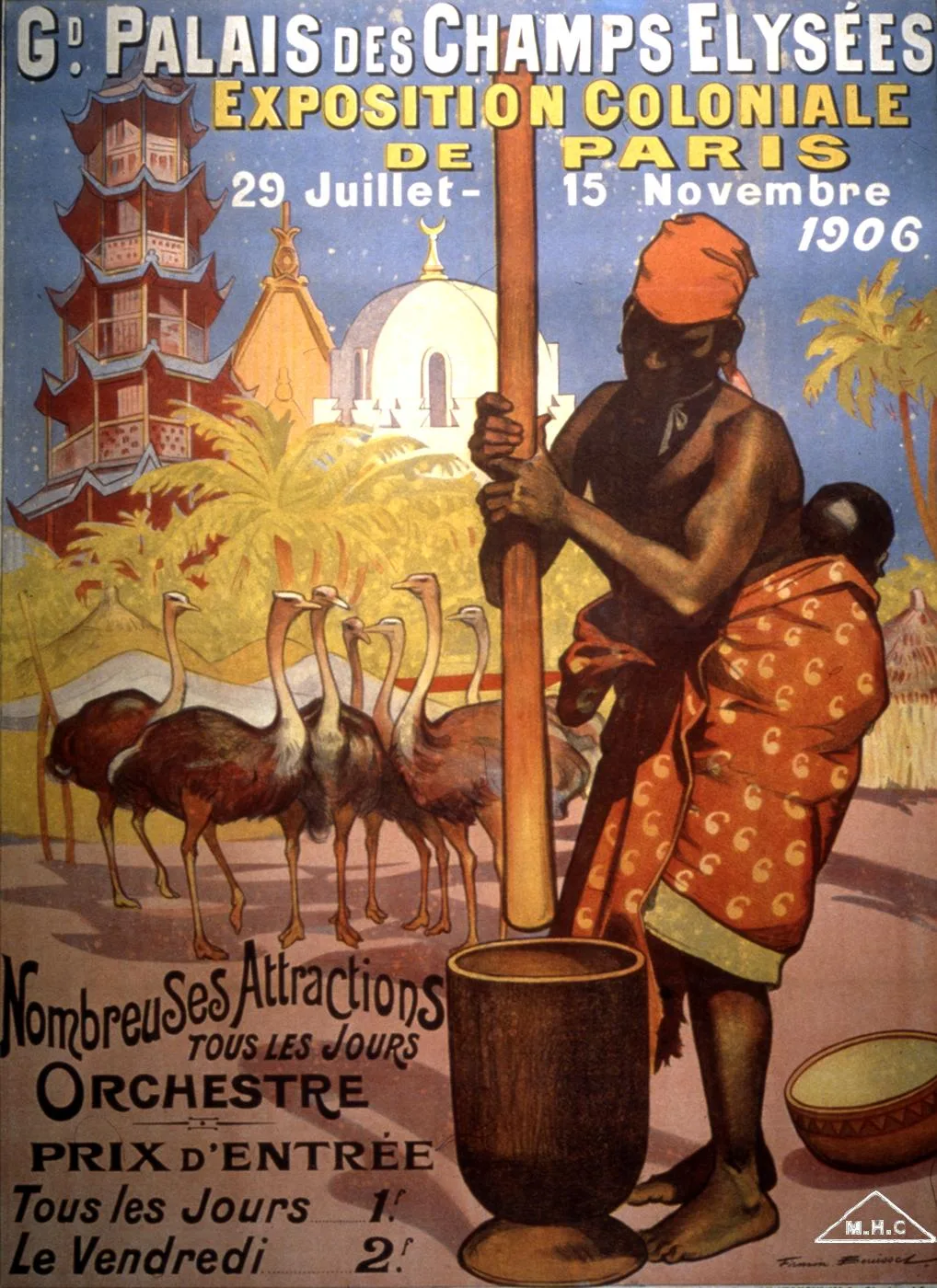
The poster arranges people as attractions
Bouisset’s lithographic poster promises “many attractions every day.” A brightly illuminated pavilion rises behind palms and ostriches. In front, a woman pounds material in a vessel while a child stands at her side. The advertising hierarchy makes bodies, animals, architecture, and consumption part of the same purchasable encounter. An admission price completes the arrangement.
The woman is active, but the poster does not identify her name, community, labour, or terms of appearance. Her task supplies atmosphere. The child intensifies the fantasy of unguarded access to an entire way of life. Histoire par l’image, drawing on La Contemporaine’s CC0 record, situates the poster within the history of reconstructed villages and “human zoos.” The image makes hierarchy pleasurable by making it look like curiosity.
Spectacle separated looking from relationship
The exhibition visitor could look without reciprocal obligation. The people displayed could not control how their clothing, bodies, dwelling forms, performance, or labour were classified. The organisers set the route and captions; the audience paid, watched, and left. Such a structure differs from learning within a community, where knowledge may depend on kinship, initiation, permission, language, time, and responsibilities.
This matters for art history because the colonial exhibition and ethnographic museum trained modes of looking. A mask, textile, sculpture, dance, and person could all become visible as specimens of a racial or cultural type. Modernist artists rejected some academic hierarchies while continuing to benefit from this unprecedented access.
Colonial modernity produced the fantasy of the primitive
The supposedly untouched “primitive” was not found outside modern history. It was manufactured by modern systems: steamship travel, military occupation, missionary networks, photography, anthropology, world’s fairs, commodity markets, and metropolitan museums. The category concealed its infrastructure by presenting the colonised world as static nature.
This is why primitivism and modernity are not opposites. The fantasy of timelessness answered anxieties produced by industrialisation, urban life, academic convention, and market competition. European artists sought renewal in forms they described as direct or original, while the institutions supplying those forms were among the most bureaucratic and technologically organised instruments of their age.
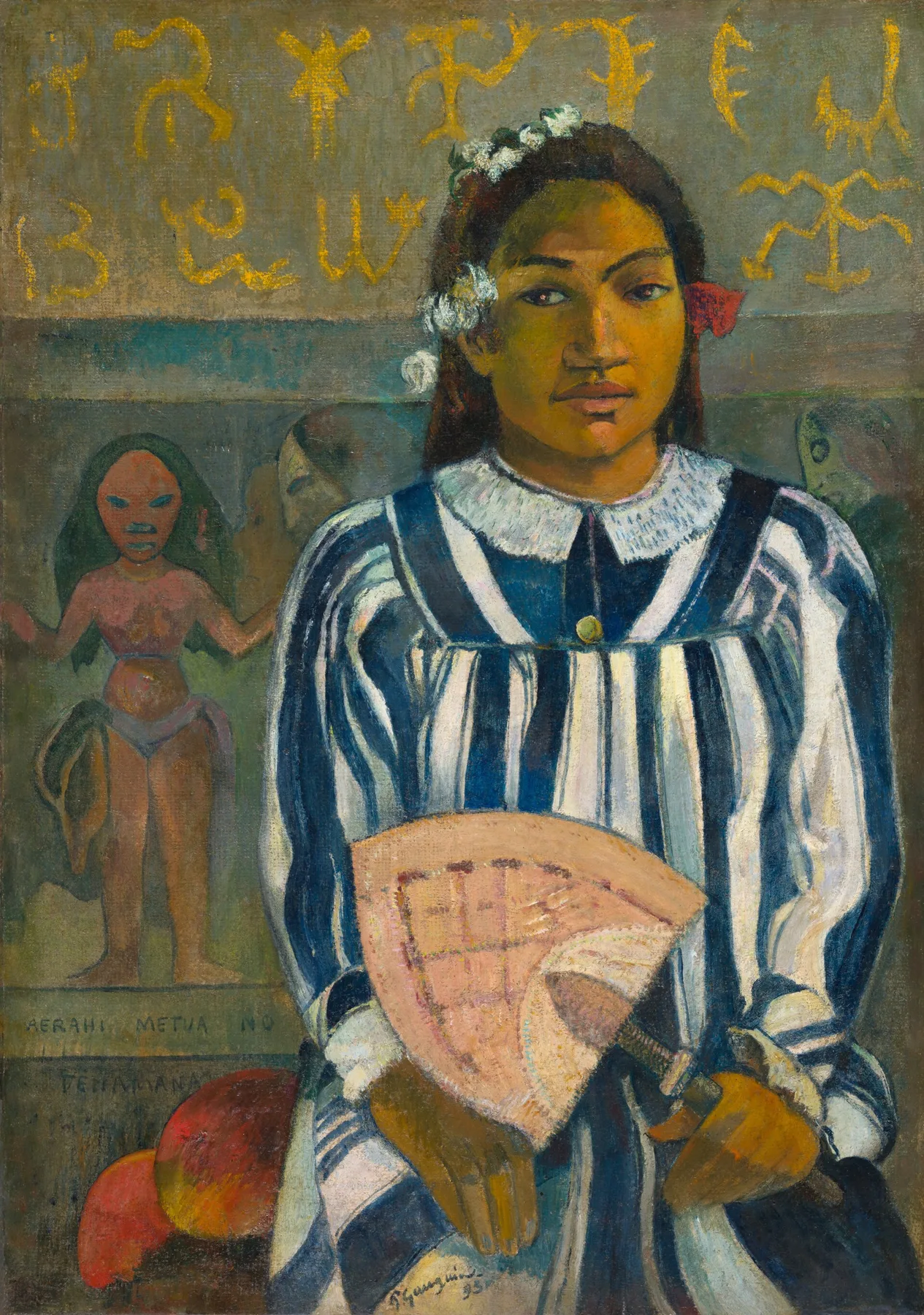
Gauguin painted Tehamana inside French colonial Tahiti
.jpg)
Gauguin travelled to Tahiti in 1891 imagining distance from European commerce and convention. Tahiti was not outside Europe’s history: it became a French colony in 1880, and Papeete contained colonial officials, missions, trade, imported clothing, and photography. The Art Institute’s scholarly catalogue identifies the sitter as Tehamana, then thirteen, and notes that the relationship is known largely through Gauguin’s semifictionalised Noa Noa.
Gauguin’s account documents how he represented the encounter; it cannot substitute for Tehamana’s testimony. Age difference, colonial status, mobility, money, and his power to publish and sell images made the relationship unequal even where family negotiations occurred.
Costume and borrowed signs manufacture authenticity
Tehamana wears a high-necked missionary dress and holds a Samoan fan. Behind her, Gauguin combined glyph-like marks derived from an Easter Island tablet with a female figure assembled from Polynesian and Hindu references. The Art Institute’s current label describes the result as a generic foreignness shaped by the artist’s desire.
The painting does not preserve one intact Indigenous religious system. It makes a synthetic setting legible to Gauguin and his European market. Missionary clothing records colonial change, while the invented wall promises access to an older spiritual world. The picture turns contradiction into atmosphere: the historical present is worn on Tehamana’s body; the fantasy of timelessness is painted behind her.
Naming the sitter does not return her voice
The inscription Merahi metua no Tehamana has been translated as “Tehamana Has Many Parents” and “The Ancestors of Tehamana.” The Art Institute catalogue, citing Bengt Danielsson’s study of Tahitian titles, connects the first reading to birth and foster parents in Polynesian family structures. The second entered circulation through the French title used at Gauguin’s 1893 Durand-Ruel exhibition.
Recovering her name is essential, but naming does not solve representation. We still meet Tehamana through Gauguin’s composition, text, title, and later scholarship. Her direct account of the sitting is not preserved in the cited archive. A responsible caption can state what is known, name the mediation, and refuse to turn her silence into either consent or a personality invented for narrative effect.
Escape from Europe depended on colonial access
Gauguin fashioned himself as an artist escaping European money, industry, and civilisation. Elizabeth C. Childs’s Vanishing Paradise: Art and Exoticism in Colonial Tahiti reconstructs how that search was already framed by Western myths of Tahiti as earthly paradise and “primitive” utopia. The contradiction is structural: colonial transport and administration enabled the European journey imagined as flight from Europe.
His paintings can be formally inventive and historically compromised at once. Flattened colour, strong contours, compressed space, and synthetic signs affected later modernists. Those achievements do not require repeating his self-mythology. Asking who could travel, return, exhibit, narrate, and profit reveals that artistic freedom was distributed through imperial power.
Matisse and Picasso encountered objects through an imperial city
By the early twentieth century, African and Oceanic objects circulated through Parisian ethnographic museums, colonial exhibitions, dealers, artists’ studios, and private collections. Denise Murrell’s Met essay on African influences in modern art links this growing presence to colonial conquest and expeditions. Paris offered concentrated access because empire had moved objects and information toward the capital.
Matisse purchased African sculpture and later collected Kuba textiles. Picasso visited the Musée d’Ethnographie du Trocadéro and collected objects himself. Their encounters were not identical, and “Africa” did not function as one source. The point is not to dissolve their agency into context. It is to include the systems that made one artist’s encounter easier than a source community’s ability to determine movement, naming, display, or return.
Resemblance alone cannot prove influence
Two elongated faces or geometric patterns may resemble one another without a direct historical connection. A defensible influence claim needs a plausible route: a dated museum visit, collection inventory, studio photograph, letter, exhibition, publication, dealer record, or sufficiently specific formal and chronological relation. Even then, the claim should identify whether the artist copied one object, studied a cultural tradition, or absorbed a wider visual category.
Broad resemblance often produces circular reasoning. An African work is selected because it looks like a Picasso; that similarity is then used to prove it caused Picasso. The method rewards whatever survives in a familiar museum image and ignores alternate sources. Influence is an argument built from evidence, not a magic property contained in shape.
Demoiselles turns encounter into European authorship
Picasso’s Les Demoiselles d’Avignon of 1907 combined references to Cézanne, Iberian sculpture, African and Oceanic arts, the brothel, and the artist’s own studies. MoMA’s 2024 gallery label explicitly states that African masks and sculptures reached France through colonial channels and that Picasso and his peers collected them. The two right-hand faces use their formal difference to intensify the painting’s psychological charge.
Calling the result mere copying would miss Picasso’s extensive transformation of scale, space, bodies, and sources. Calling it solitary invention would miss the unequal chain. The painting acquired a named author, documented preparatory history, market value, and canonical role in Cubism. Most source makers remained unnamed, their objects compressed into the category “African,” and their intentions excluded from the account of European innovation.
Modigliani carved a hybrid head from metropolitan stone
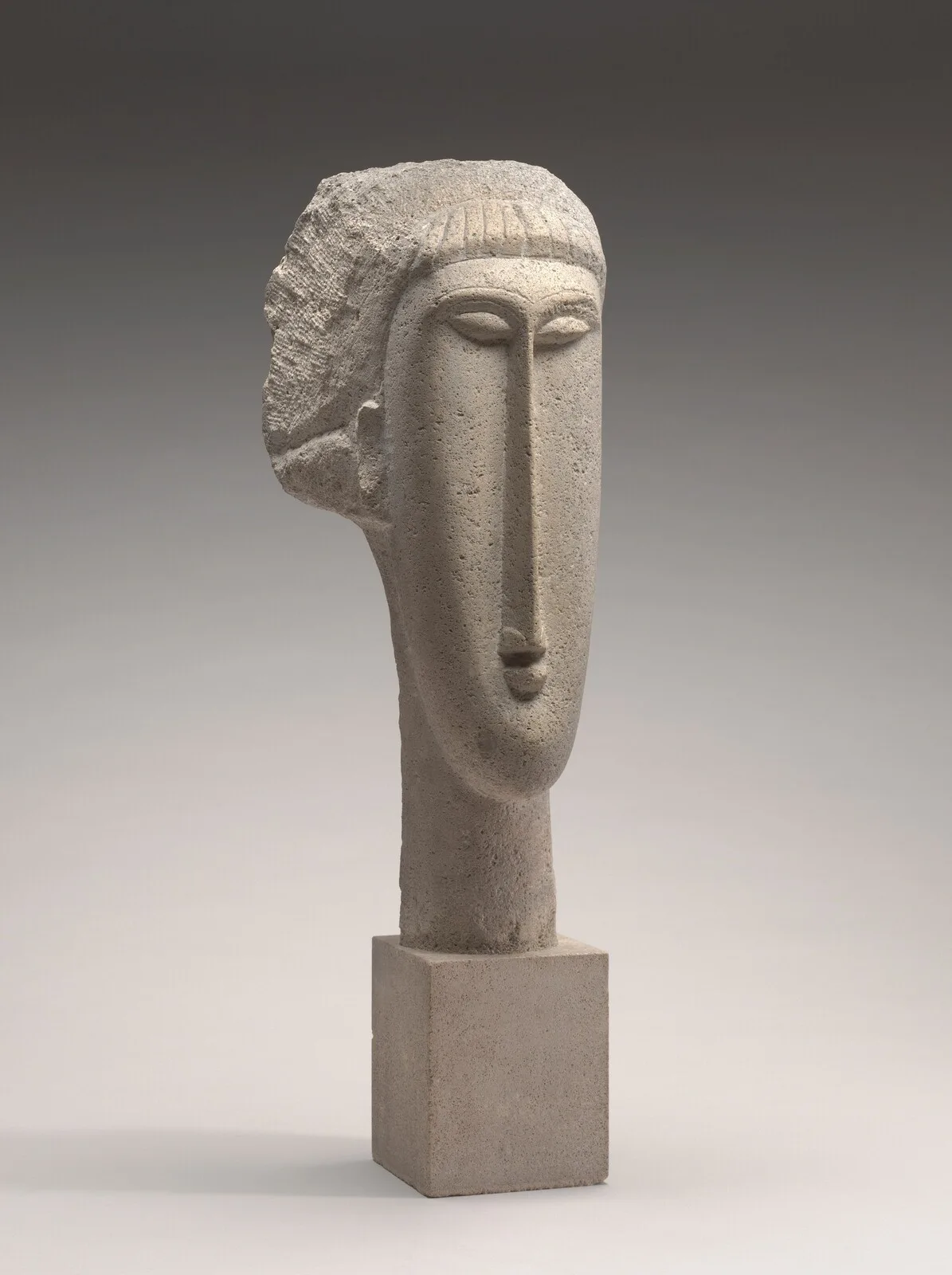
Modigliani’s head narrows face and neck into a vertical architecture. Joined brows descend into a long blade-like nose; almond eyes, small mouth, curved cheeks, and roughly cut hair alternate polish with porous stone. The National Gallery of Art identifies African sculpture and ancient Greek sculpture as sources and notes that Modigliani used limestone discarded during construction of the Paris Métro.
The work is metropolitan in a literal sense. A transport project supplied the block; an imperial ethnographic museum concentrated objects from elsewhere; inherited European sculpture remained another reference. The result is hybrid, but the credit is not: Modigliani’s name anchors the museum object while “African sculpture” remains a continental generalisation.
African is too broad, but unequal credit is real
Africa contains thousands of languages, many political histories, and multiple changing artistic traditions. “African influence” may be the most specific claim surviving evidence permits, but it should never masquerade as a precise source. A responsible account names Fang, Baule, Dan, Kongo, Kota, Grebo, Pende, Kuba, or another cultural and geographic context when documentation supports it—and preserves uncertainty when it does not.
Precision does not eliminate appropriation. A European artist may combine several sources so thoroughly that no one-to-one model exists, yet still benefit from a colonial economy that anonymised makers and made their works available. Formal transformation and unequal attribution can coexist. Recognising one does not cancel the other.
Kuba cloth is collaborative design, dress, currency, and memory
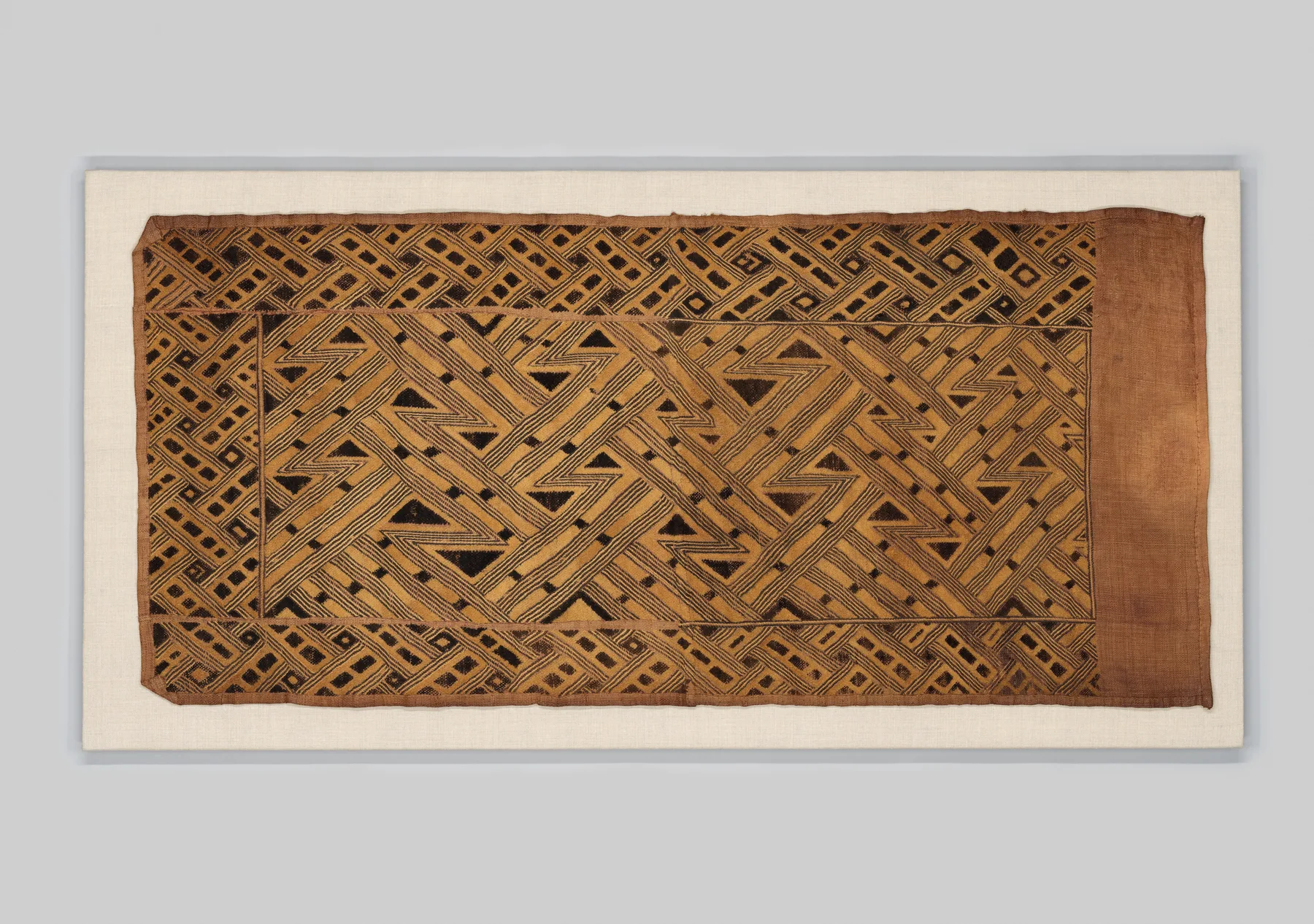
This skirt’s interlace changes direction without resolving into one repeating unit. Short natural and dyed raffia fibres were embroidered and then shaved into a velvet-like pile. The Met’s record attributes such work to female artists and describes the garment layered over an underskirt for elite women’s dances accompanying initiation, investiture, and reenactments of creation.
Other Kuba textiles could mark prestige, circulate as wealth, enter dowries, dress bodies for ceremonies, or accompany the dead. Production joined cultivation, weaving, dyeing, embroidery, cutting, assembly, commissioning, and performance across gendered and familial roles. “Pattern” names only one visible result of that intelligence.
Pattern did not wait for European abstraction
Modernist surveys often describe European artists as discovering that line, colour, and shape could become autonomous. Kuba textiles expose the provincial scale of that claim. Their makers cultivated abstraction through named motifs, memory, asymmetry, interruption, texture, bodily wrapping, and controlled variation without waiting for European painting to renounce illusion.
This does not mean Kuba artists pursued the same project as Matisse or geometric abstraction. Their objects operated through different materials, institutions, and uses. The point is sharper: non-representational complexity is not evidence of a universal march toward European modernism. It is evidence of multiple intellectual traditions whose histories should not be converted into a prehistory for someone else’s breakthrough.
Gendered categories made textile into background
Museum hierarchies long separated sculpture and painting from dress, fibre, ornament, and “women’s work.” That division helped African sculpture enter modernism’s story as powerful form while textile became decorative stimulus. It also concealed collaborative labour behind an anonymous cultural label.
Matisse’s engagement is well documented. Murrell notes that he owned several Kuba cloths, looked at textiles hanging across his studio, and connected their all-over patterning to his late paper cut-outs. The claim should remain exact: this reproduced skirt exemplifies Kuba women’s ceremonial textile practice; it is not identified as one of Matisse’s possessions. Keeping those statements separate respects both evidence and authorship.
Borrowing becomes a problem through power, not purity
Cultures are not sealed containers, and exchange is not automatically theft. A purity rule would misdescribe migration, trade, translation, apprenticeship, intermarriage, diplomacy, religious change, collaboration, and creative reuse. Appropriation becomes analytically useful when it directs attention to unequal conditions.
Ask who could consent or refuse; whether a sacred or restricted object was exposed; whether makers and communities were named accurately; who controlled mobility, archives, exhibition, and sale; who gained money or cultural prestige; whether stereotypes replaced living histories; and whether source communities can research, reinterpret, access, or reclaim what moved. These questions may produce different judgments in different cases. They are stronger than either “all borrowing is theft” or “art has always borrowed.”
Anti-colonial publics challenged the spectacle in 1931
Colonial display did not go uncontested. The vast Paris Colonial Exhibition of 1931 promoted the French and other European empires while hiding forced labour, violence, and resistance. Historian Pap Ndiaye’s Palais de la Porte Dorée account records both its mass spectacle and opposition.
Surrealists circulated the tract Ne visitez pas l’Exposition coloniale—“Do not visit the Colonial Exhibition”—and joined communists in a counter-exhibition, La vérité sur les colonies. The Bibliothèque nationale de France identifies the tract’s signatories and its demands for evacuation of the colonies and accountability for massacres. The counter-exhibition drew only thousands against the official exhibition’s millions and contained its own political contradictions. It nevertheless proves that colonial common sense was challenged in public at the time, not only judged retrospectively.
Counter-investigation changes what museum evidence can do
Between 1931 and 1933, the French Dakar–Djibouti mission crossed fourteen African countries, all but Ethiopia under colonial rule. The Musée du quai Branly’s current counter-investigation project records about 3,600 objects, 6,600 natural specimens, 370 manuscripts, 70 human skeletal remains, nearly 6,000 photographs, recordings, films, and more than 15,000 field cards.
Quantity once demonstrated scientific reach. Counter-investigation changes the unit of knowledge. Researchers and community interlocutors return to localities, identify makers and people, test acquisition accounts, and place African expertise inside the record. At Kita, research identified instrument maker Naba Bakari Diabaté; at Kéméni, records and interviews reconstruct objects requisitioned despite a ritual leader’s refusal. Provenance becomes a living inquiry into relationships and power rather than a list of European owners.
A comparison matrix
| Object or event | Prior or local relationship | Colonial or metropolitan transfer | Modernist or institutional transformation | What remains unresolved |
|---|---|---|---|---|
| Eyema byeri | Guardian joined to a relic container and relations with ancestors | Figure separated; later owned by Derain and Epstein | Collected as autonomous sculpture; exhibited in the 1984 MoMA show | Exact departure, separation, and consent are not established in the cited public record |
| 1906 exhibition poster | Depicted labour and cultural life are not identified | People and signs compressed into a purchasable Paris spectacle | Colonial hierarchy marketed as entertainment and access | Identities and terms of participation of the depicted or displayed people |
| Tehamana portrait | A named Tahitian sitter within family and colonial island life | Gauguin could travel, narrate, return, and exhibit in Paris | Person becomes portrait, symbol, desire, and modernist source | Tehamana’s direct account of the sitting and relationship is absent from the cited archive |
| Modigliani head | Multiple African sculptural traditions reduced in the broad source label | Trocadéro display concentrates objects in Paris | Hybrid carving receives individual European authorship | No single named African source object is securely demonstrated by the cited record |
| Kuba overskirt | Collaborative fibre work, elite dress, dance, rank, and ceremony | Related textiles entered European collections and artists’ studios | Pattern discussed in relation to modernist abstraction and Matisse’s cut-outs | This skirt is comparative; no encounter with Matisse is claimed |
What the modernist canon overrewards
The conventional canon rewards the final visible transformation: the painting that breaks pictorial space, the sculpture that elongates a face, the cut-out that makes colour mobile. It is less equipped to reward the systems that made encounter possible or the source makers whose objects were misclassified as specimens, craft, fetish, or anonymous tradition.
It also rewards durable ownership. Paintings with signed authors move through catalogues raisonnés and major sales; a danced textile, separated guardian, temporary exhibition, or person’s unrecorded testimony leaves a different archive. Correcting the imbalance does not require removing European modernists from history. It requires making the chain of labour, coercion, mediation, and credit visible enough that “genius” no longer functions as an eraser.
Common survey traps
- Do not call African, Oceanic, or Indigenous societies primitive, timeless, or closer to nature. Quote and explain the historical category when it is necessary.
- Do not use “tribal” as a universal cultural label. Name the community, polity, language, place, or documented uncertainty.
- Do not turn visual resemblance into a proven line of influence without a route of encounter.
- Do not assume an unnamed maker lacked individuality, innovation, or status.
- Do not describe a separated museum fragment as if its current autonomy were original.
- Do not make every source object valuable only because a European modernist saw something similar.
- Do not treat exchange as innocent merely because forms changed, or as theft merely because borrowing occurred. Test power and evidence.
- Do not imply that contemporary African or Pacific communities exist only as custodians of an unchanging past.
Questions for close looking
- In the eyema byeri, which forms suggest stillness and which suggest stored movement? How does knowing about the missing container alter your description?
- How does Bouisset’s poster direct attention between text, architecture, animals, labour, gender, and price? Who is granted a name or voice?
- In the portrait of Tehamana, which details belong to colonial daily life and which construct a synthetic spiritual past?
- What specific features in Modigliani’s head support a claim of multiple sources rather than one copied model?
- Where does the Kuba skirt interrupt repetition? How would wrapping, movement, pile, rank, and dance change a screen-based formal analysis?
- For any claimed influence, what evidence identifies encounter, and what remains only resemblance?
- Who gains authorship, value, and mobility at each link in the object’s chain?
Terms for appropriation, provenance, and colonial display
- Primitivism: a modern European discourse and set of practices that imagined selected peoples, objects, or mental states as an origin or opposite of modernity; not a neutral name for those peoples’ arts.
- Exoticism: representation that produces distance and desirability by selecting signs of cultural otherness for an audience.
- Cultural appropriation: use of cultural forms across a power difference; analysis should test consent, attribution, context, restriction, benefit, stereotype, and continuing claims rather than assume one automatic outcome.
- Influence: a historically argued relation in which encounter and transformation are supported by evidence; resemblance alone is insufficient.
- Provenance: the documented history of an object’s custody, movement, and changing status, including gaps and contested acquisition.
- Coloniality: structures of hierarchy and knowledge that outlast formal colonial rule and continue to shape categories, institutions, access, and value.
- Ethnographic display: presentation that classifies objects or people as evidence about cultures; its methods and power relations vary and require historical scrutiny.
- Counter-investigation: collaborative research that revisits a colonial archive’s methods, omissions, acquisitions, people, and places from additional—especially local and formerly marginalised—positions.
- Coevalness: recognition that societies described as traditional or Indigenous inhabit the same historical present and continue to change, debate, and create.
A working timeline, c. 1880–2025
- 1880: France annexes Tahiti; the colonial setting precedes Gauguin’s arrival.
- 1889: the Paris Exposition Universelle amplifies colonial and ethnographic display alongside industrial modernity.
- 1891–1893: Gauguin’s first stay in Tahiti; he paints Tehamana near its end.
- 1903–1906, approximately: African sculptures circulate among Vlaminck, Derain, Matisse, Picasso, dealers, and Paris collections; retrospective accounts disagree in detail.
- 1906: the Paris Colonial Exhibition at the Grand Palais advertises reconstructed access to colonised worlds.
- 1907: Picasso completes Les Demoiselles d’Avignon after a multi-source development that includes objects seen through Parisian colonial channels.
- c. 1911–1912: Modigliani carves Head of a Woman from Paris Métro limestone.
- 1931: the Paris Colonial Exhibition opens; Surrealist and communist opponents organise tracts and a counter-exhibition.
- 1931–1933: the Dakar–Djibouti mission accumulates objects, human remains, images, recordings, texts, and field records under colonial conditions.
- 1984–1985: MoMA’s “Primitivism” in 20th Century Art places modern works beside Indigenous objects and provokes sustained criticism of missing dates, functions, contexts, and intentions.
- 2021–2025: collaborative counter-investigations revisit Dakar–Djibouti collections in African localities and museum archives; the exhibition opens in Paris in 2025.
Source guide
Object records and image rights. The Met’s Eyema byeri record provides material, scale, ensemble history, modernist ownership, local expert audio, and Open Access status. Histoire par l’image and La Contemporaine document Bouisset’s CC0 poster. The Art Institute, National Gallery of Art, and Met Kuba record provide object data, interpretation, rights, and images for the remaining works. Each caption names its exact source; all local files preserve the full composition and intrinsic dimensions.
Institutional histories. Denise Murrell’s African Influences in Modern Art documents colonial circulation, Paris networks, and Matisse’s Kuba textiles. MoMA’s Demoiselles record names multiple sources and colonial channels; its retrospective on the 1984 “Primitivism” exhibition records the criticism. Pap Ndiaye’s 1931 exhibition history, the BnF tract, and Quai Branly counter-investigations provide institutional and anti-colonial evidence.
Named scholarship. The Art Institute’s online Gauguin catalogue distinguishes evidence, Gauguin’s semifictional account, and competing title translations. Elizabeth C. Childs’s Vanishing Paradise reconstructs exoticism in colonial Tahiti. Joshua I. Cohen’s The “Black Art” Renaissance follows African sculpture’s changing place across European, African American, and African modernisms. These works do not make all interpretations unanimous; they show why the problem is larger than a list of borrowed shapes.
Evidence boundary. This chapter does not identify one African object as the sole source for Les Demoiselles d’Avignon or Modigliani’s head. It does not claim that Matisse owned the reproduced Kuba skirt. It does not infer consent from a missing acquisition record or infer refusal without evidence. “GeMarkt Research Review” records an internal source-and-rights check, not independent academic peer review. Corrections can be submitted through the site’s editorial standards page.
Continue the Atlas route
The previous chapter followed European avant-gardes as competing organisations of manifesto, experiment, war, revolution, and mass print. This chapter widened their material geography and tested how empire structured encounter and credit. The next Atlas chapter moves through Latin American modernisms, asking how artists negotiated city, indigeneity, revolution, mural publics, abstraction, national institutions, and international networks without becoming a regional appendix to Europe.
Editorial record
About this article
- Author
- Publisher
- GeMarkt
- Published
- Updated
- Reviewed
- Internal source & rights check. Conducted by GeMarkt Research Review. This is an internal editorial check—not independent peer review.
- Source standard
- Art history source standardPrioritises object records and research sources, distinguishes evidence from interpretation, and states material uncertainty.
Found a claim that needs checking? Report a factual error.