Art History · Learning chapter
Atlas III — Early-modern worlds · 11 of 11
Rococo and global luxury, c. 1700–1789: court, interior, porcelain, extraction, and taste
A critical guide to Rococo rooms, patronage, porcelain, Indian cotton, Asian lacquer, sugar, skilled labour, and the colonial systems behind eighteenth-century taste.

What we’ll look at
How did Rococo elegance depend on global trade, skilled labour, and exploitation?
Venus sits in a room that is also a stage. A blue-green curtain opens behind her. Satin slides beneath her body; pearls, flowers, metal vessels, doves, and small winged attendants convert dressing into myth. François Boucher painted every surface as if touch could become light.
The picture can look like a complete definition of Rococo: pale flesh, asymmetry, erotic play, luxurious texture, and apparent effortlessness. Yet it was not made to float on a neutral museum wall. Madame de Pompadour commissioned it in 1751 for the carved and painted toilette cabinet of her Château de Bellevue. Furniture, wall panelling, candlelight, textiles, clothing, scent, conversation, servants, and the patron’s own body completed its effect.
Nor did that room begin at its walls. Porcelain referred to Chinese precedent and Saxon experiment. Cotton depended on South Asian knowledge. Lacquer crossed Asian and European markets before Parisian cabinetmakers cut it into new forms. Sugar arrived through plantation systems worked by enslaved people. Silver condensed mining, money, and craft into tableware.
The central question is therefore:
How did eighteenth-century rooms make global materials feel intimate and effortless—and which makers, routes, monopolies, mines, plantations, and coerced workers disappear when Rococo is treated only as a decorative style?
Rococo is a useful term with a narrow centre
Rococo is most useful for a cluster of ornamental practices that developed in early eighteenth-century France and travelled through prints, objects, patrons, and craftspeople. Shell-like rocaille, scrolling foliage, C- and S-curves, asymmetry, lightness, small-scale interiors, and animated surfaces recur across woodwork, metalwork, furniture, ceramics, textiles, and painting. They do not form a checklist that every object must satisfy.
The name is also historical evidence. Eighteenth-century French makers used terms such as rocaille, coquillage, goût nouveau, and style moderne. David Pullins’s research for the National Gallery of Art traces “rococo” as a later, politically charged label associated around 1797 with students of Jacques-Louis David. What had signified novelty could be recast after the Revolution as the decadent taste of the old regime.
That history warns against treating Rococo as what everyone in 1735 called their age. The term helps compare particular forms. It does not explain an entire century, every European region, or the Asian, African, and American societies connected to European luxury.
Scope: selected rooms and routes, not a global style
This chapter follows a deliberately selective route: a painting and a candlestick associated with elite French interiors; a Meissen vase made in Saxony; an Indian palampore made on the Coromandel Coast for a Sri Lankan market; Chinese lacquer remade as Parisian furniture; and a French silver sugar bowl. The route moves through Bellevue, Paris, Meissen, the Coromandel Coast, Sri Lanka, China, the Indian Ocean, and the Atlantic Caribbean.
“Global luxury” describes linked systems, not worldwide harmony. It does not mean that Chinese porcelain, Indian cotton, Caribbean sugar, and French gilt bronze belonged to one shared style or moved under equal conditions. Asian merchants and makers operated extensive markets before Europeans arrived. European chartered companies entered, redirected, and often coerced those systems. Atlantic plantation slavery converted human beings into property and labour into export profit.
An interior coordinated objects, bodies, and service
An eighteenth-century elite interior was not a container filled with independent masterpieces. Wall panels could be designed around paintings and mirrors. Upholstery related chairs, screens, curtains, and beds. Porcelain might sit on a mantel or enter a mounted clock. A commode shaped how a wall was read. Candles multiplied reflections in gilding, polished metal, glaze, mirror glass, silk, and lacquer.
The room changed through the day. Shutters, fires, candle placement, clothing, food, conversation, music, and ceremony altered colour and movement. Servants opened curtains, carried hot liquids, cleaned wax, tended fires, dressed bodies, moved furniture, and protected fragile surfaces. The apparent unity was repeatedly made, not permanently present.
That is why “interior decoration” is too weak if it means a superficial layer. The interior organised proximity, privacy, access, rank, and labour. It made social relations sensible as comfort, sparkle, fragrance, warmth, and controlled intimacy.
Boucher made Venus for Pompadour’s toilette room
In brief: François Boucher painted The Toilette of Venus in 1751 for Madame de Pompadour’s dressing room at Bellevue. It turns daily preparation into a scene of mythological, apparently effortless luxury.
The Met records The Toilette of Venus as one of two paintings made for Madame de Pompadour’s toilette cabinet at Bellevue. A toilette was both bodily preparation and a social event whose degree of access mattered. The mythological subject elevated grooming into the realm of Venus while remaining close to the patron’s own practices of dress, theatre, self-presentation, and controlled reception.
Boucher did not portrait Pompadour as Venus. The Met nevertheless notes a possible flattering allusion: in 1750 she performed the leading role in a court entertainment titled La Toilette de Vénus. The painting’s meaning therefore lies between myth, decoration, performance memory, and patronage. Turning it into a secret portrait would exceed the evidence; treating it as an interchangeable nude would erase its room.
Its surface coordinates materials that a real toilette might activate—fabric, pearls, metal, flowers, water, scent, and flesh—while putti remove ordinary labour from view. The work converts preparation into effortless self-completion.
Patronage was agency inside court power
Jeanne-Antoinette Poisson, marquise de Pompadour, was not merely a passive “mistress and muse.” She commissioned architecture, painting, sculpture, porcelain, prints, and furnishings; supported Boucher; cultivated theatre and printmaking; and helped make Vincennes-Sèvres porcelain politically and socially desirable. Alden Gordon describes her houses as carefully controlled constellations of art whose intimacy served personal, courtly, and diplomatic purposes.
Agency did not make the system equal. Her position depended on the favour of Louis XV, purchased estates, court access, finance, and a monarchy sustained by taxation and privilege. Other women at court worked within different constraints, while women who cleaned rooms, made lace, washed textiles, sold goods, or laboured in colonial economies appear far less often in named patronage histories.
The useful question is not whether Pompadour was powerful or constrained. She was both. Patronage names real choices exercised inside a hierarchy rather than freedom outside it.
Rocaille turned structure into movement
Rocaille often appears as ornament derived from rockwork, shells, water, foliage, and marine forms. Its force comes less from copying a shell than from making boundaries seem unstable. A support twists; a frame grows; a drawer front swells; a mount flows across a join. C- and S-curves redirect the eye before it can settle.
Asymmetry is not randomness. Makers balanced unequal masses, changed surface texture, and used recurring curves to sustain movement. Nor was the result “without rules” in the sense of being easy. Freehand carving, modelling, chasing, casting, joining, gilding, and polishing demanded disciplined control. The appearance of natural growth depended on exact workshop sequences.
This helps distinguish Rococo from a loose synonym for ornate. A symmetrical object can carry rocaille motifs, particularly outside France; a richly decorated object need not be Rococo. Look at how ornament relates to support, edge, weight, and bodily use.
A candlestick designed light and rank
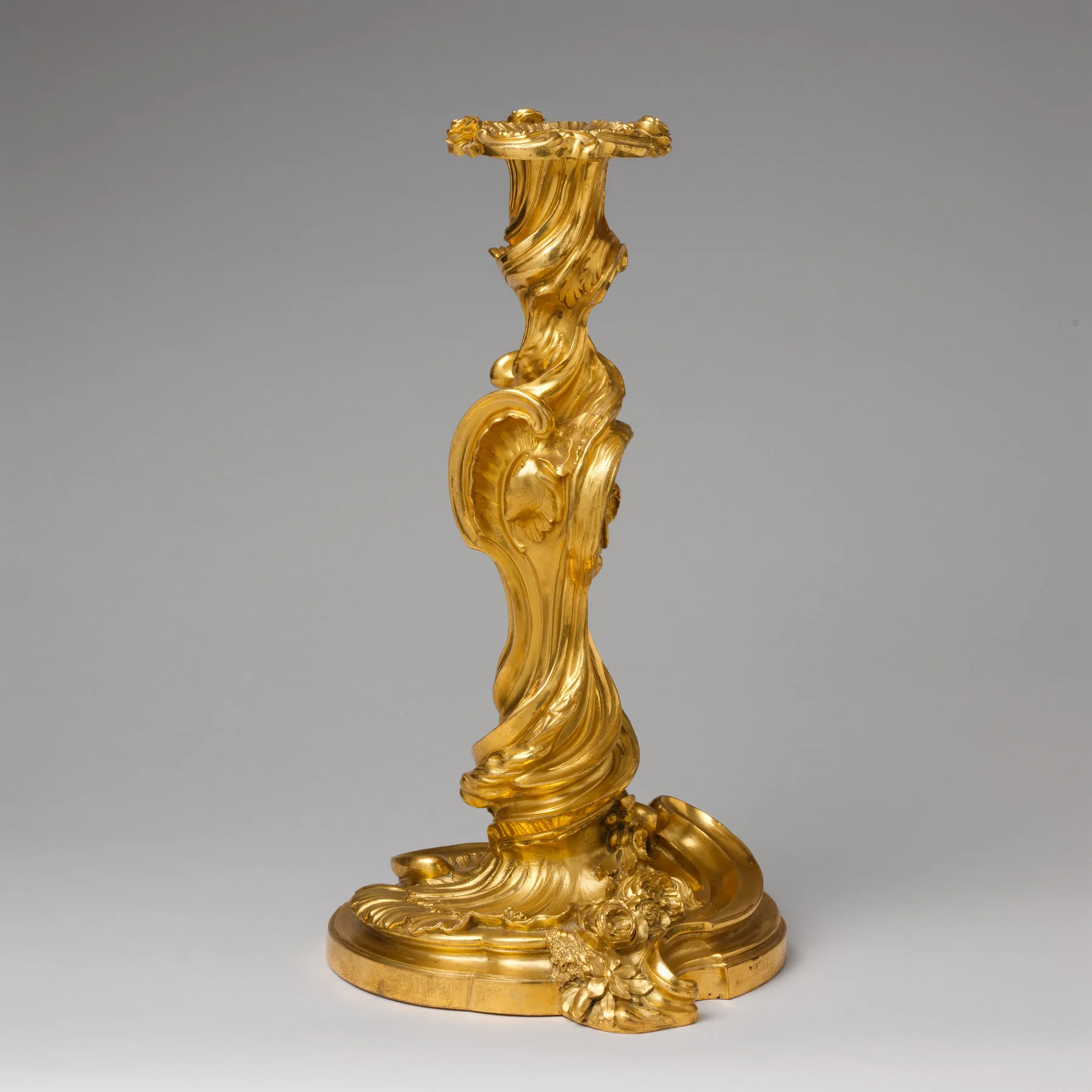
Meissonnier’s model makes a vertical support behave like a whirl of metal. Shell, leaf, spray, and butterfly are not attached to a stable column; they continually transform it. Chasing creates sharp and softened passages, while burnished and matte gilding would respond differently to flame.
The Met connects the object to the economics of light. Beeswax candles burned more cleanly and pleasantly than tallow, but were extremely expensive. The number of lights at an event could signal status. A candlestick therefore did more than hold a candle: it multiplied the visible cost of illumination.
In 1768, traveller Philip Thicknesse recalled a French dinner table lit by more than sixty wax candles. His remark is not a census of all interiors. It reveals that contemporaries noticed illumination as expenditure and spectacle.
Ornament prints moved forms between workshops
Meissonnier trained as a goldsmith and worked as a designer across media. Three drawings recorded the candlestick from multiple sides; Gabriel Huquier engraved and published them in 1734–35. Silver- and bronze-workers could use the prints without receiving one complete three-dimensional recipe. Translation still required modelling, casting, assembly, chasing, and finishing.
Pattern books made ornament mobile. They travelled beyond a named commission and beyond France, supplying forms that craftspeople selected, reversed, recombined, or disciplined into local conventions. The Rococo that reached Britain and British North America often appears more symmetrical than French examples. Imported objects, migrant craftspeople, and engraved designs worked together.
Porcelain did not begin at Meissen
European accounts once celebrated Johann Friedrich Böttger as if porcelain itself had been invented in Saxony. Porcelain had long histories in China, where makers developed changing bodies, glazes, kiln systems, painted vocabularies, and markets over centuries. Chinese and Japanese porcelains circulated widely across Asia, Africa, the Middle East, Europe, and the Americas before the Meissen manufactory opened in 1710.
What Meissen achieved was the first sustained European manufacture of hard-paste porcelain comparable in important properties to Chinese wares. That distinction matters. It recognises Saxon experiment without making Europe the origin of a technology it sought to reproduce.
A Meissen vase stages a European “China”
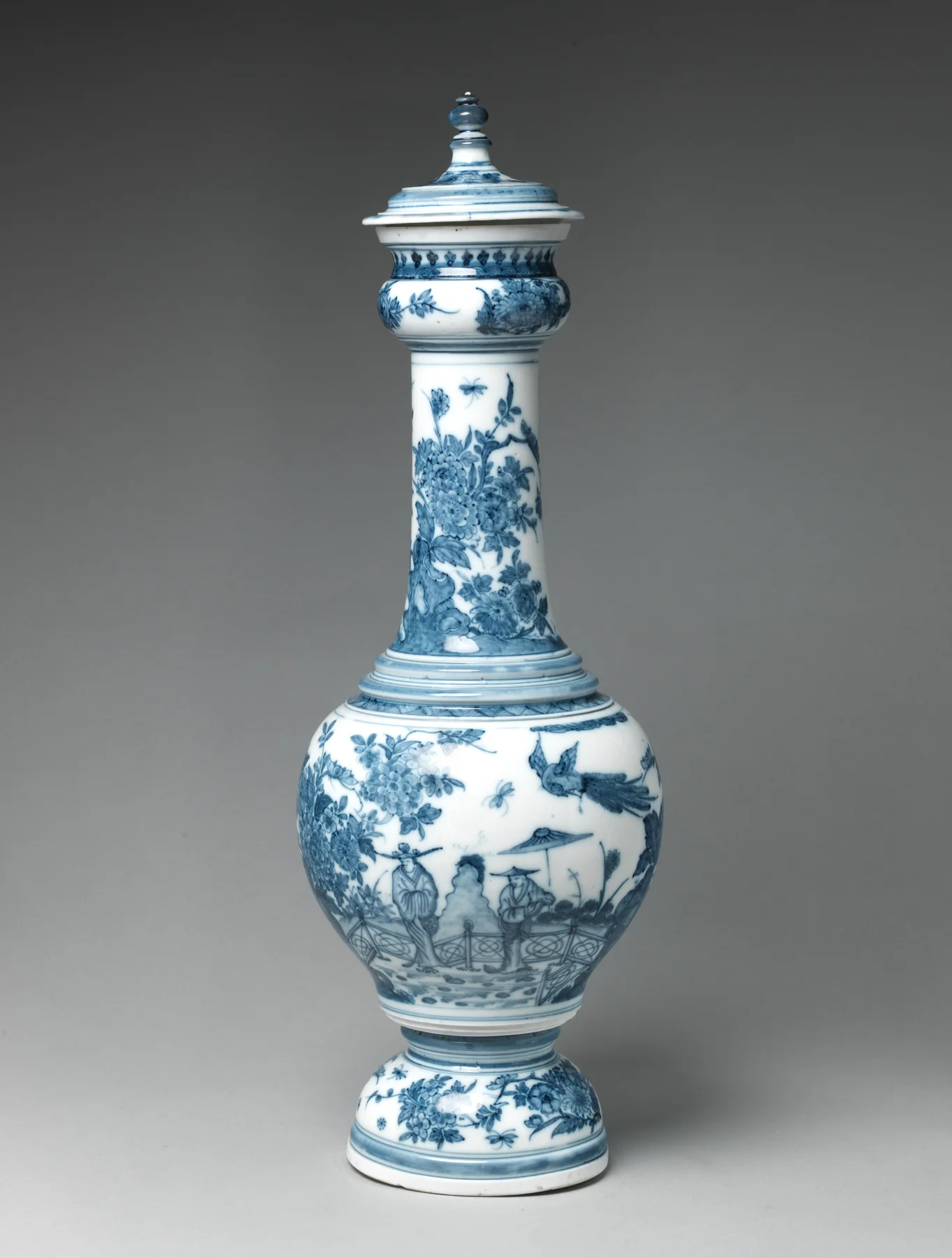
The vessel uses a palette that European consumers strongly associated with imported blue-and-white porcelain. Its narrow neck and swelling body provide several stages for figures, vegetation, buildings, and distant landscape. Yet the scenes do not document one Chinese place or social practice. They assemble a European fantasy of distant life.
The vase thus holds two forms of emulation at once. Its ceramic body announces technical competition with Chinese porcelain; its painted people announce chinoiserie. The first concerns material knowledge and manufacture, the second an imagined cultural geography. They overlap but are not the same.
Even the word “similar” needs care. Meissen’s recipe, local raw materials, firing behaviour, workshop organisation, and painted surface produced a Saxon object. Technical imitation generated new systems rather than an identical transfer.
Arcanum, court monopoly, and kiln labour
The porcelain “secret,” or arcanum, is often narrated through Böttger and scientist Ehrenfried Walther von Tschirnhaus. Their experiments matter, but a manufactory required more than a recipe. Clay and mineral deposits had to be identified, extracted, washed, ground, mixed, shaped, dried, glazed, fired, painted, gilded, fired again, sorted, transported, and sold. Kiln failure remained a material risk.
Augustus treated porcelain as court knowledge and economic strategy. The manufactory at Meissen operated under princely protection and control; its products entered collection, diplomacy, display, and sale. Secrecy protected investment and attempted to hold skilled workers in place. Rival European factories later competed through different bodies, colours, forms, and patronage systems.
Chinoiserie was desire and misrecognition
Chinoiserie names European designs that evoked an imagined China, often mixing Chinese, Japanese, Indian, and invented motifs. The V&A notes that many consumers did not distinguish among these origins. Pagodas, parasols, fantastic landscapes, asymmetrical plants, birds, and costumed figures became signs of pleasurable distance.
This was not simply admiration or simply hostility. European patrons valued Asian objects so intensely that they reorganised rooms around them, imitated them, mounted them in gold, and invested in substitute manufacture. At the same time, chinoiserie detached visual elements from specific people, places, practices, and histories. An imagined “China” could be playful, available, and possessable in ways Qing society was not.
Indian cotton reorganised eighteenth-century taste
Indian cottons did not become significant because Europe noticed them. South Asian makers supplied extensive domestic, Indian Ocean, African, Middle Eastern, and Southeast Asian markets long before European chartered companies. Different buyers wanted different dimensions, colours, motifs, weights, and prices. Makers and merchants developed knowledge of those distinctions.
European demand nevertheless changed dress and interiors. Washable, colourfast, light cottons could become wall hangings, bed furnishings, table covers, dresses, jackets, and informal garments. Their flowers entered European design while their technical superiority challenged wool, silk, and linen interests.
A Coromandel palampore maps an intra-Asian market
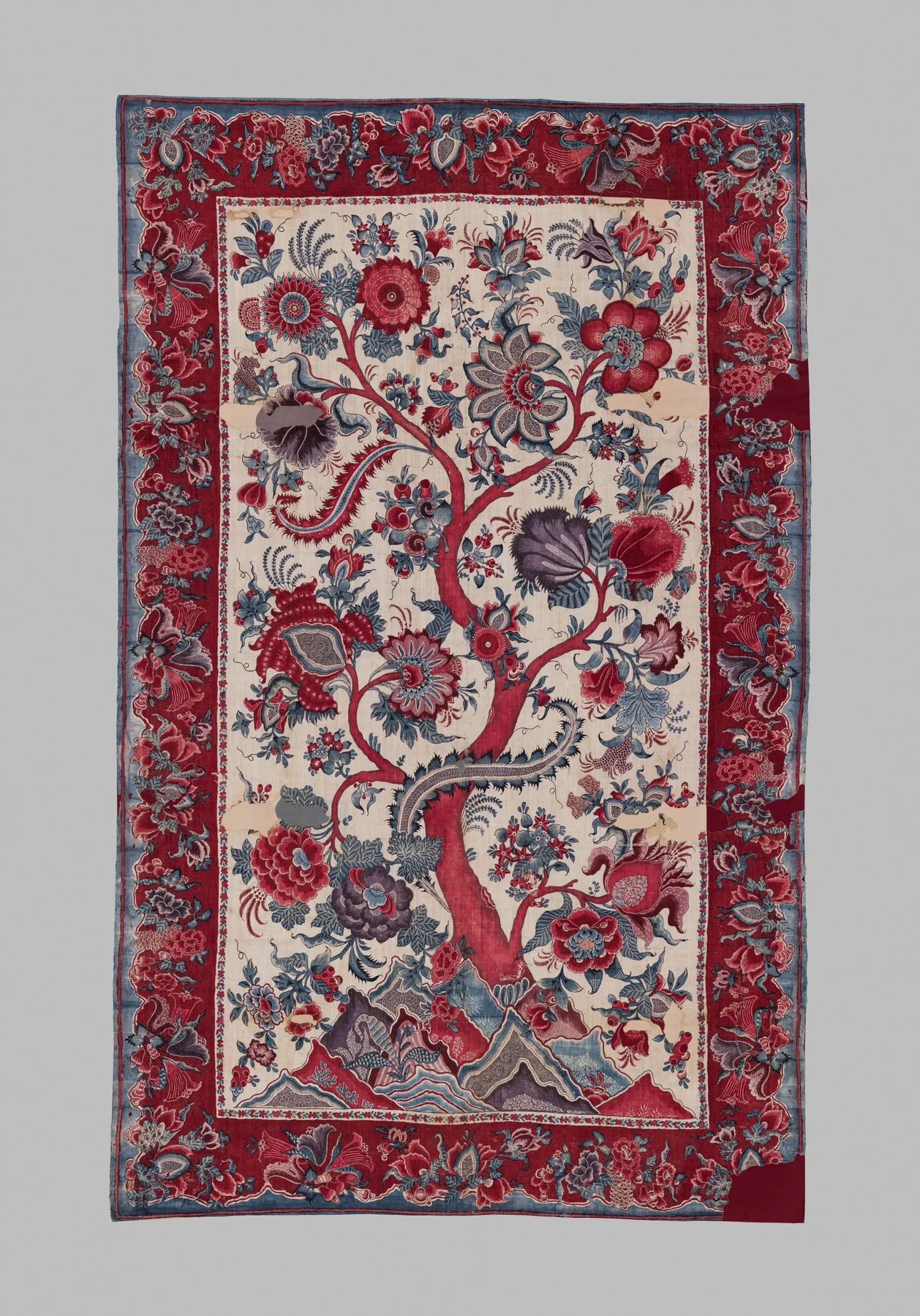
A flowering and fruiting tree rises from a stylised rocky base. Birds, animals, layered blossoms, and scrolling stems occupy the field, while dense borders regulate its edges. The design does not read like a repeating European printed fabric; it creates one large pictorial furnishing.
The Met attributes the work to the Coromandel Coast and a Sri Lankan market. Its relatively small scale belongs to a group made for intra-Asian trade. The museum suggests possible use among European communities in Batavia and Colombo or families of mixed European and Asian descent who engaged Western taste. “Likely” and “possible” must remain visible because the first owner and room are not documented.
This object prevents a Europe-only account. A South Asian textile moved within Asian routes and addressed socially mixed consumers. Global luxury had more than one destination.
Colourfast pattern was technical knowledge
The cotton’s colour required sequential chemistry and labour. A mordant helps bind particular dyes to fibre; a resist protects selected areas during dyeing. Indigo behaves differently from mordant dyes and requires specialist control of a vat. Red, blue, black, white, and intermediate tones emerge through repeated drawing, mordanting, resisting, dyeing, washing, bleaching, and correction—not one pass of coloured paint.
The V&A links brilliant Coromandel reds to chay root used with alum mordant and blues to indigo expertise. Contemporary chintz maker Renuka Reddy’s reconstruction research in Bengaluru, Machilipatnam, and Srikalahasti shows how difficult it is to recover historical fineness, wax-resist behaviour, washing, and dye sequences. Her account is not proof that every eighteenth-century workshop used one fixed recipe. It makes tacit skill visible.
“Decoration” can hide that knowledge. The pattern is the outcome of controlled reactions among cotton fibre, water, minerals, plant or insect dyes, tools, timing, climate, and many trained hands.
European bans reveal manufacturing competition
Indian cottons became targets of protection because consumers wanted them and European industries struggled to compete. Britain and France used prohibitions, duties, and restrictions in different sequences while local printers and manufacturers learned to imitate and adapt Asian colour systems.
A ban is therefore evidence of strength as well as exclusion. It shows that European textile interests considered imported cotton a material and economic threat. Smuggling, legal exceptions, re-export, and changing enforcement prevent one law from becoming a clean story of disappearance.
Lacquer entered Paris through dismantling and resale
East Asian lacquer was both surface and substance: layers built through botanical materials, preparation, drying, polishing, pigment, and metal decoration. European consumers admired its depth and resilience without possessing equivalent knowledge of its chemistry. Imitation finishes developed, but imported lacquer retained prestige.
By the eighteenth century, some seventeenth-century Asian cabinets and screens looked unfashionable as complete furniture in Europe while their lacquer surfaces remained valuable. Dealers acquired objects, dismantled them, and supplied panels to cabinetmakers. Getty conservation research confirms that much Asian lacquer on French Rococo furniture came from older export pieces cut into new European forms.
A commode remakes a Chinese screen
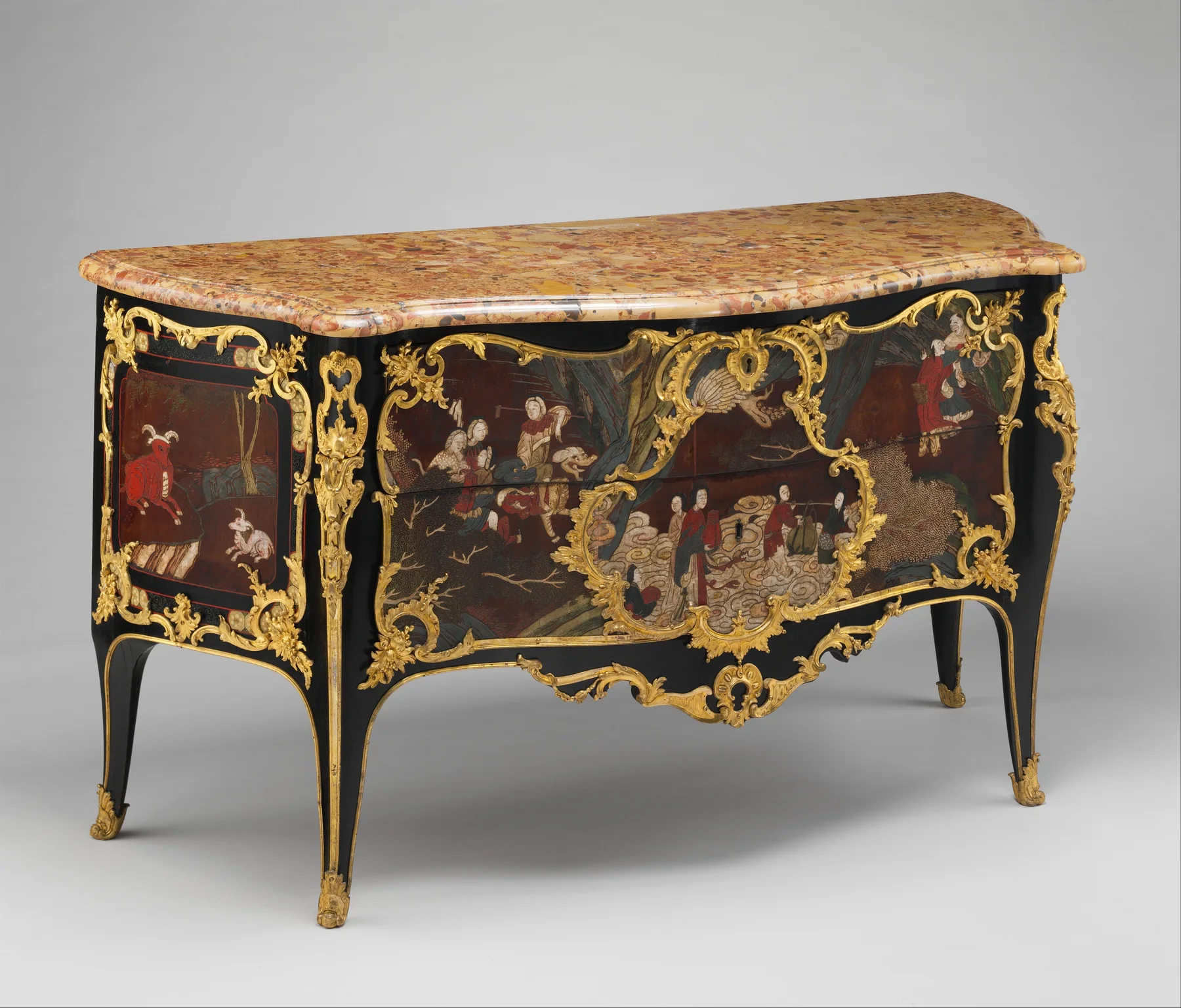
Van Risenburgh stamped this commode BVRB. The Met identifies its lacquer as Chinese, probably cut from a tall multi-leaf folding screen that reached Europe through the Coromandel Coast. Separate pictorial groups now occupy the drawers because the cabinetmaker had to select and recombine narrow sections. Painted framing completes areas the imported lacquer could not cover.
Gilt-bronze mounts do structural and visual work. Their curves define drawers and apron, protect edges, mask joins, and translate the lacquer into a rocaille façade. A marble slab adds another quarry and trade route. European black-lacquered veneer extends the imported surface through imitation.
The result is neither simply Chinese nor simply French. But “hybrid” alone explains too little. The object is an asymmetric assembly: Chinese makers created the costly surface; trade moved it; a dealer likely supplied it; a Parisian workshop cut and mounted it; an elite interior converted those operations into fashionable display.
The marchand-mercier assembled global luxury
Parisian marchands-merciers were dealers who could coordinate goods and specialists across guild boundaries. They supplied lacquer panels, commissioned gilt-bronze mounts, ordered porcelain, paired clocks with ceramic figures, advised clients, and promoted new combinations. They did not necessarily make the parts they sold, but they could shape what became desirable.
This intermediary role matters because a luxury object often exceeded one workshop. The cabinetmaker could not cast every bronze, quarry marble, import lacquer, or retail freely in every category. Dealers linked materials, credit, clients, auctions, and craftspeople while protecting their own commercial knowledge.
Sugar made refinement materially colonial
Sugar moved from rare medicine and spice toward wider consumption in eighteenth-century European societies. Sweetened tea, coffee, and chocolate connected distinct crops and routes inside one domestic ritual. Greater availability did not make production benign.
The Smithsonian’s National Museum of American History describes British and French Caribbean plantations as major producers by 1750 and identifies enslaved labour as the system’s core. Plantation owners and merchants pursued profit through land seizure, monoculture, mills, boiling houses, maritime transport, punishment, forced reproduction, and repeated trafficking of captive Africans.
No single bowl proves the biography of every grain it held. The historical connection operates at the commodity system level. Sugar vessels multiplied because sugar became available through those systems; table refinement and plantation violence were materially related even when a polished object concealed the relation.
A silver bowl makes extraction small and polished
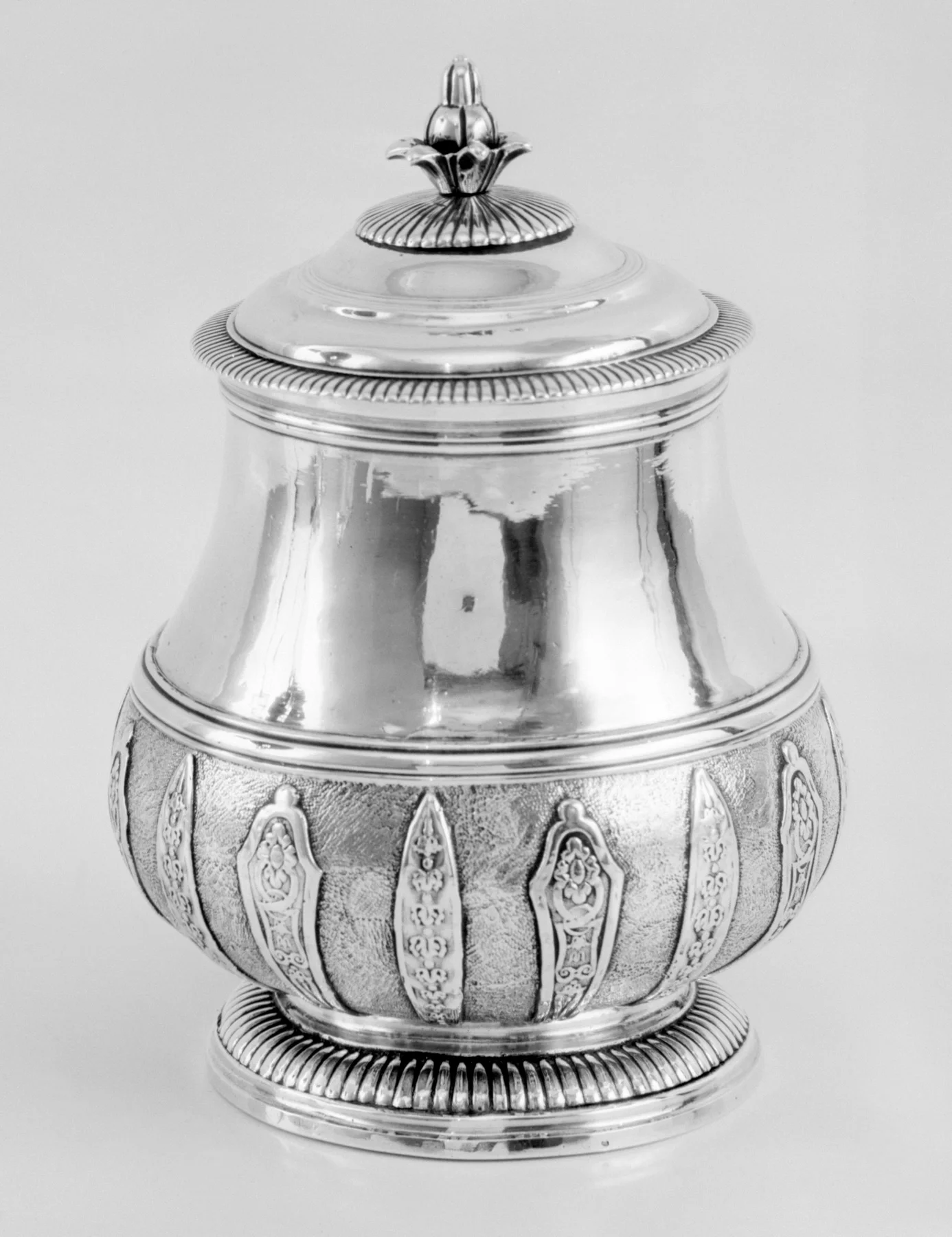
The lid promises protection and controlled access. A guest sees a reflective, rounded container, not cane fields or a boiling house. The Met explains that crystallised sugar arrived in hard cones to be cut into lumps, or was refined and powdered for sprinkling. Different forms of serving vessel organised those states.
This bowl is attributed to the unidentified mark P.S. and possibly to Avignon. Its catalogue uncertainty should not be filled with a convenient biography. The surviving mark gives a workshop trace; it does not restore every hammerer, polisher, refiner, porter, servant, merchant, or enslaved producer in the chain.
The object teaches a larger method. A commodity can be both materially absent and institutionally central. Sugar is not carved on the silver, yet it explains why the form existed.
Tea, coffee, and chocolate changed vessel systems
Hot drinks required coordinated things: pots, cups, saucers, trays, tongs, strainers, spoons, cream vessels, sugar bowls, chocolate frothers, tables, heat, and water. The forms distinguished liquids and choreographed pouring, mixing, offering, accepting, and refusing.
Their routes differed. Tea and porcelain strongly connected European consumption to China; coffee had African origins and major cultivation and commercial histories across Yemen, the Ottoman world, European colonies, and later plantations; cacao depended on Indigenous American cultivation and knowledge before colonial exploitation transformed it. Sugar frequently joined all three.
Enslavement belongs inside the history of taste
It is tempting to discuss slavery in one corrective paragraph after the beautiful objects. That reproduces the separation the chapter is trying to analyse. Sugar’s whiteness, price, availability, and service form were already aesthetic facts shaped by plantation production.
SlaveVoyages documents the forced transatlantic movement of millions of Africans through voyage and estimate databases. UCL’s Legacies of British Slavery project tracks later slave ownership, estates, compensation, and the movement of slavery-derived wealth into institutions, property, business, and culture. These sources do not turn every Rococo object into direct proceeds of one named plantation. They demonstrate that enslavement was not external to eighteenth-century European wealth.
Language matters. “Slave labour” can make a legal status sound like a labour category. “Enslaved people” keeps human beings visible as people whom institutions treated as property. Their lives also exceeded production: family, belief, skill, resistance, flight, negotiation, revolt, and survival belong to the history, even when elite object records omit them.
1789 is a political marker, not a style switch
The French Revolution makes 1789 a powerful boundary in histories of monarchy and citizenship. It did not cause every curved mount, workshop practice, taste, or object type to stop. Neoclassical forms were already competing with Rococo decades earlier, and Rococo ornament had travelled through Europe and the Americas under different chronologies.
Objects also outlived regimes. Furniture was sold, seized, altered, exported, inherited, restored, and reclassified. Nineteenth-century collectors helped create the museum category of the French Rococo and attached new fantasies of elegance or decadence to it. Revivals detached its curves from eighteenth-century court life.
A comparison matrix
| Object | Immediate setting | Material intelligence | Institution or intermediary | What the finished surface hides |
|---|---|---|---|---|
| Boucher, Toilette of Venus | Pompadour’s Bellevue toilette cabinet | Oil painting coordinated with carved room, textile, and theatrical display | Court patronage and controlled access | Service labour; broader finances of elite life |
| Meissonnier candlestick | Elite candlelit interior | Design, modelling, casting, chasing, gilding, differentiated reflection | Print circulation and specialist metal workshops | Costly wax, maintenance, unnamed production hands |
| Meissen covered vase | Court collection and luxury display | Hard-paste body, glaze, firing, underglaze blue, painted chinoiserie | Saxon court manufactory and monopoly | Chinese precedent; mining, fuel, kiln risk, workshop hierarchy |
| Coromandel palampore | Furnishing for a likely Sri Lankan/Indian Ocean market | Cotton, mordants, resists, dyes, repeated washing | South Asian workshops, merchants, intra-Asian trade | Individual makers and first household remain unrecorded |
| Van Risenburgh commode | Fashionable Parisian interior | Cabinetmaking, lacquer cutting, bronze mounts, imitation lacquer, marble | Marchand-mercier and guild-organised workshops | Dismantled Chinese screen; many material routes |
| French sugar bowl | Table service | Silver forming, joining, engraving, polishing | Silversmith, refiner, merchant, household service | Plantation, enslavement, refining, mining, maritime labour |
Common survey traps
- “Rococo means frivolous pastel painting.” It developed powerfully through interiors and decorative arts; later accusations of frivolity are part of its political afterlife.
- “Europe invented porcelain at Meissen.” Meissen established European hard-paste manufacture after sustained engagement with Chinese wares and knowledge.
- “Chinoiserie is Chinese art.” It is a European fantasy category; actual Chinese objects, makers, and histories require their own terms.
- “Asian goods merely influenced European taste.” Indian and Chinese manufactures organised global demand and forced European technical and economic responses.
- “Luxury proves social progress.” Wider consumption could coexist with guild restriction, colonial monopoly, extraction, and slavery.
- “A female patron makes an object liberating.” Patronage can be real agency within monarchy, class, gender, and household hierarchy.
- “1789 ended Rococo.” Revolution altered institutions and meanings; objects, workshops, overlaps, and revivals followed different chronologies.
Questions for close looking
- Where does the object make support look fluid, growing, or unstable?
- How would flame, movement, touch, scent, sound, or hot liquid change its appearance?
- Which materials were locally available, and which crossed long routes?
- Does the catalogue name a designer, maker, workshop, manufactory, patron, merchant, or only some of them?
- What technical sequence must occur before the final surface becomes possible?
- Which joins, cuts, repairs, seams, or replacements reveal assembly?
- Does an image represent a specific Asian place, or a European fantasy of one?
- What does the object organise a body to do—dress, sit, pour, light, look, serve, or wait?
- Which labour is pictured, and which labour is displaced into myth or omitted?
- What level of evidence connects this object to colonial extraction: direct provenance, commodity history, material probability, or broad context?
Terms for Rococo and global luxury
- Rocaille: rock- and shell-associated ornament whose curves helped animate eighteenth-century surfaces.
- Rococo: a later label used for selected ornamental practices centred in eighteenth-century Europe; not a universal period name.
- Chinoiserie: European production of an imagined “Chinese” visual world, often mixing diverse Asian and invented motifs.
- Hard-paste porcelain: high-fired ceramic using a porcelain body associated historically with Chinese production and, in Europe, first sustained at Meissen.
- Palampore: a large pictorial cotton furnishing, often organised around a flowering tree and made in South Asia for varied export markets.
- Mordant: a substance used to help selected dyes bind to fibre.
- Resist: a material or process that prevents dye from reaching selected areas.
- Lacquer: here, East Asian layered surface technology based on processed tree sap; not merely a shiny black colour.
- Ébéniste: a French specialist in veneered case furniture.
- Marchand-mercier: Parisian luxury dealer who coordinated objects, materials, craftspeople, credit, and clients.
- Chasing: refining and texturing metal from the front with tools after casting or forming.
- Gilding: applying gold or a gold-containing surface to another material.
- Taste: socially produced judgement shaped by institutions, markets, access, education, imitation, and distinction.
- Extraction: removal of material, labour, or value through systems whose costs and benefits are unequally distributed.
A working timeline, c. 1700–1789
| Date | Event or object | Why it matters |
|---|---|---|
| c. 1700 | Rocaille and newer interior practices develop in France | Later histories gather changing forms under “Rococo” |
| 1710 | Augustus the Strong establishes the Meissen porcelain manufactory | First sustained European hard-paste porcelain production |
| First quarter, eighteenth century | Coromandel palampore made for a Sri Lankan market | Intra-Asian demand and South Asian technical authority |
| c. 1725 | Meissen covered vase | European porcelain and chinoiserie operate together but remain distinct |
| 1734–35 | Huquier publishes Meissonnier’s candlestick designs | Print makes ornament mobile across workshops and media |
| 1735–50 | Meissonnier-model candlesticks produced | Light, metal, movement, and rank converge |
| c. 1740 | French silver sugar bowl | A specialised vessel materialises expanding sweet consumption |
| c. 1740–45 | Van Risenburgh commode | Chinese lacquer is cut and recomposed in Parisian furniture |
| 1751 | Boucher paints The Toilette of Venus for Bellevue | Painting acts inside a patron-designed intimate room |
| 1750s–70s | Rococo designs circulate while Neoclassical alternatives grow | Styles overlap rather than replace one another instantly |
| 1789 | French Revolution begins | Political rupture later reshapes the meaning of ancien-régime luxury |
| c. 1797 | “Rococo” appears in a hostile post-Revolutionary artistic context | The category’s later judgement becomes part of its history |
Source guide
Object facts, dimensions, image rights, and collection histories come from the Metropolitan Museum of Art records for Boucher’s The Toilette of Venus, the Meissonnier candlesticks, the Meissen covered vase, the Coromandel palampore, Van Risenburgh’s lacquer commode, and the French sugar bowl. Each supplied Open Access/Public Domain imagery; no object record has been treated as a complete social history.
For the category and its afterlife, see David Pullins, “Cut and Paste: The Mobile Image from Watteau to Robert”, in the National Gallery of Art’s CASVA report, and the V&A’s introduction to the Rococo style. For patronage and controlled intimacy, see Alden Gordon, “Madame de Pompadour: The Principle of Intimacy in Art Patronage”, and Alastair Laing and collaborators’ Met catalogue François Boucher, 1703–1770.
For porcelain, see Dresden’s Porzellansammlung on the Meissen foundation and court collection and its Böttger Hall research display. Maxine Berg’s work on Asian luxuries and Giorgio Riello’s research on import substitution inform the wider economic frame; Riello’s chapter “Failure and the Industrial Revolution” distinguishes Asian stimulus from an isolated European invention story. The V&A’s chinoiserie introduction helps separate imported Asian works from European fantasy.
For cotton, technique, and markets, see the V&A’s Indian textiles research guide, Rosemary Crill’s Chintz: Indian Textiles for the West, Renuka Reddy’s maker-led reconstruction account, Riello’s “Asian knowledge and the development of calico printing in Europe”, and the Met’s Interwoven Globe India timeline.
For lacquer and luxury assembly, see the Getty’s open technical study “The Analysis of East Asian and European Lacquer Surfaces on Rococo Furniture” and the Met’s overview of eighteenth-century French case furniture and marchands-merciers.
For sugar and enslavement, see the Smithsonian National Museum of American History’s Sugar Trade, the SlaveVoyages databases, and UCL’s named research team and datasets for the Legacies of British Slavery. These establish system-level relations; they are not used to invent a direct plantation provenance for an object whose record does not supply one.
Continue the Atlas route
Read the preceding chapter, Baroque worlds: Rome, Madrid, Antwerp, Amsterdam, and colonial circulation, to compare public spectacle and interior intimacy without forcing a clean stylistic succession. Ming and early Qing art restores Chinese porcelain, court, workshop, and export histories to their own setting; African kingdoms and Atlantic encounter and Indigenous and colonial American visual worlds expand the routes compressed by European luxury.
For method, use Provenance, attribution, and restitution to distinguish documented object history from system-level context. The next Atlas chapter follows revolution, citizenship, empire, and the public claim of Neoclassicism without pretending that Rococo disappeared overnight.
Editorial record
About this article
- Author
- Publisher
- GeMarkt
- Published
- Updated
- Reviewed
- Internal source & rights check. Conducted by GeMarkt Research Review. This is an internal editorial check—not independent peer review.
- Source standard
- Art history source standardPrioritises object records and research sources, distinguishes evidence from interpretation, and states material uncertainty.
Found a claim that needs checking? Report a factual error.