Art History · Learning chapter
Atlas I — Foundations and ancient worlds · 3 of 10
Ancient Egyptian art: image, ritual, labour, and eternal presence
A five-object guide to how Egyptian images sustained offerings, organised labour, enacted kingship, reformed worship, and prepared the dead.

What we’ll look at
What did images do inside ancient Egyptian tombs, temples, and rituals?
Hatshepsut kneels, but the pose is not submission.
At more than 2.6 metres high, her granite body once helped line the processional route through her temple at Deir el-Bahri. She wears the striped royal headcloth, false beard, and kilt of an Egyptian king. Across her palms she presents rounded vessels. The inscription identifies the offering as Maat—order, truth, and justice—given to Amun.
The sculpture does not preserve an ordinary instant in the ruler’s life. It makes a political and religious relationship durable: the king sustains divine order; the god authorises the king; the temple and its festivals make that exchange public.
This guide asks one question across five objects:
What was an Egyptian image expected to do?
The answers are practical as well as symbolic. A tomb chapel maintained a place where the living and dead could meet through offerings. A wooden granary supplied an afterlife through modelled labour and accounting. A royal statue enacted kingship inside a festival route. A small temple block joined architecture, sunlight, image, and a new religious programme. A papyrus prepared its owner to pass judgment after death.
Ancient Egyptian art becomes easier to read when function comes before familiarity. The profile face, frontal eye, ordered registers, changes of scale, and idealised body were not failed attempts at camera vision. They belonged to systems built for particular sites, rituals, patrons, materials, and durations.
A bounded history, not three thousand years in one style
“Ancient Egyptian art” can conceal an enormous span of time. This article is deliberately narrower. Its five objects were made between about 2446 and 1050 BCE in the Memphite region and at Thebes and Karnak. They cross the Old Kingdom, Middle Kingdom, New Kingdom, and the beginning of the Third Intermediate Period.
Those names are modern chronological tools. Their dates vary slightly between scholarly chronologies, and political reunification does not instantly reset every workshop or local practice. Predynastic visual cultures, First and Second Intermediate Periods, the Late and Ptolemaic Periods, Roman Egypt, and the distinct histories of Nubia all require studies of their own.
The surviving evidence is also uneven. Stone temples and elite tombs outlast mud-brick houses, textiles, wood, and many objects of daily life. What museums call Egyptian art is therefore weighted toward institutions that could command durable materials and organised labour. The Met’s Old Kingdom survey makes the limitation explicit: knowledge of the period’s material culture comes largely from funerary evidence.
That is a warning against turning tomb imagery into a transparent photograph of Egyptian society. It is also an opportunity. When the original setting is known, a tomb or temple can reveal how an image operated.
First ask where the image worked
Modern viewers often begin with style: why are shoulders frontal while faces turn sideways? Why are important figures larger? Why do poses repeat?
The better first question is location.
University College London’s Digital Egypt account of canonical art places its most formal use in temples of gods, temples of kings, and offering chapels for the dead. These were environments where a carefully ordered image could project an ideal reality beyond an individual moment.
Egyptologists sometimes call the system aspective. Rather than fixing every element to one optical viewpoint, a maker selected an informative view for each part and assembled the whole. A face might appear in profile while an eye and shoulders turn frontally. Objects could be opened, stacked, or rotated so that their defining features remained legible. Scale could express rank rather than distance.
This did not eliminate observation. The bird species, hand positions, tools, fabrics, and gestures in Egyptian images can be remarkably exact. Nor did a canon prevent change. The five works below differ sharply in material, scale, site, patronage, and visual language.
Convention was a working grammar, not a three-thousand-year freeze.
Raemkai: a chapel made presence maintainable
In brief: The first example is the Tomb Chapel of Raemkai, a group of carved stone walls made at Saqqara in Egypt around 2446–2389 BCE. Its name and offering scenes were meant to sustain Raemkai’s presence after death.
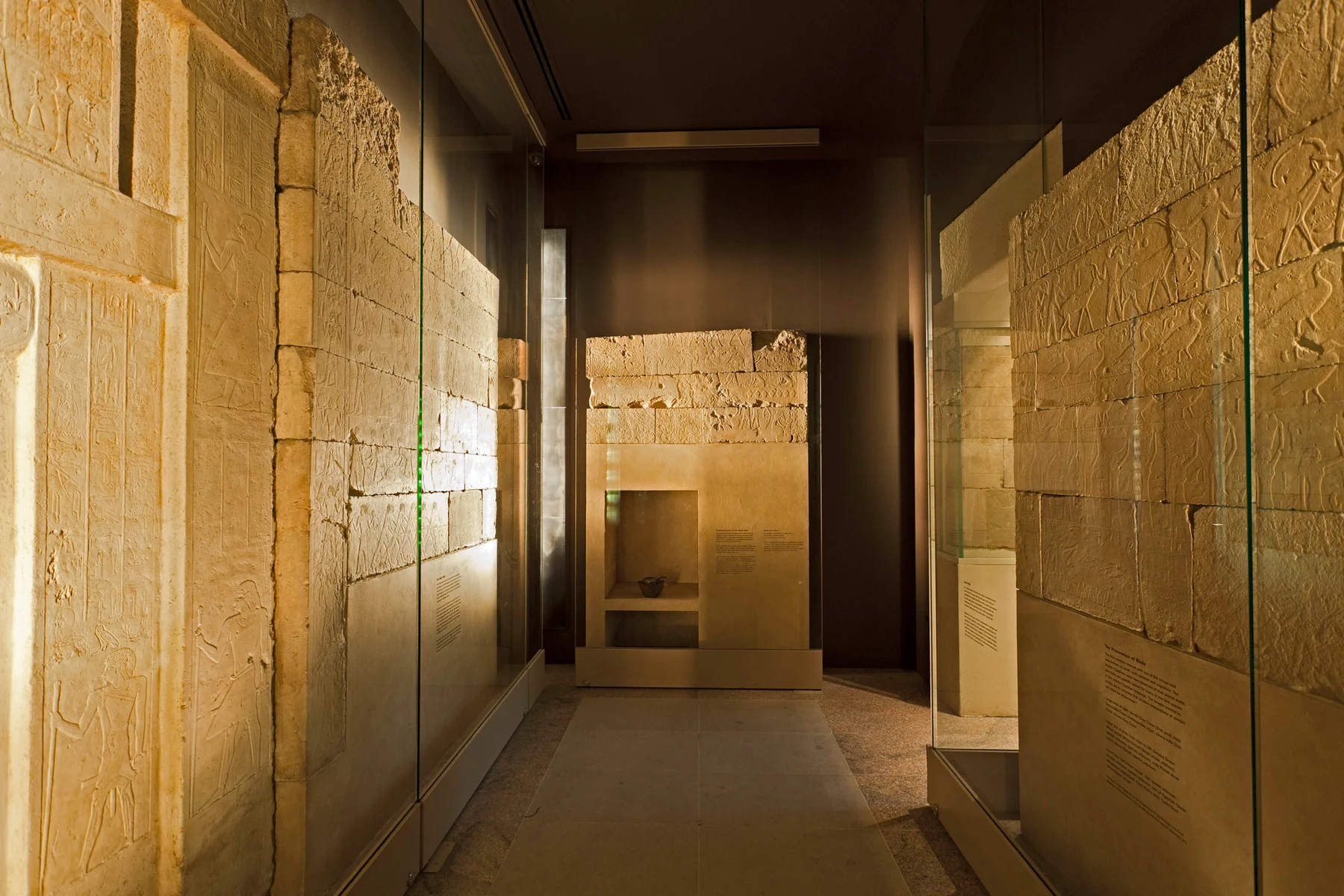
Walk into Raemkai’s chapel and the walls turn food, work, landscape, and ceremony into a structured flow. Offering bearers advance. Birds are trapped. Cattle are butchered. Bread and beer are prepared. On the west wall, a stylised false door marks a threshold where relatives and priests could deposit provisions and address the deceased.
The Met’s record for the false door explains that it was not an opening for a living body. It gave architectural form to contact between the dead and living. Raemkai appears seated before an offering table above the central niche, while inscriptions identify his titles and name.
That name exposes the chapel’s most revealing history. The monument was first made for an official called Neferiretnes. It was later reassigned to Raemkai. Carvers erased the first owner’s identity in important places and inserted the second, but many images remained. Traces of the earlier text still survive.
If the reliefs were merely decoration, changing the name would have been cosmetic. Within the chapel’s ritual logic, identity was operational. Images of provisions had to reach a named recipient. Text and figure worked together.
The scenes should therefore be handled carefully as social evidence. They preserve tools, gestures, animal forms, and divisions of work, but their primary task was not to document a neutral working day. They selected productive abundance for an elite man’s continued existence. Conflict, shortage, illness, and most named workers disappear from the ideal.
The modern installation creates another shift. A visitor can now enter an approximation of the chapel’s narrow space, yet its connection to the burial shaft, Saqqara landscape, offerings, speech, smell, and repeated family rites is gone. The museum room preserves an extraordinary material ensemble. It cannot preserve the complete action that made the chapel work.
Meketre: the afterlife required administration
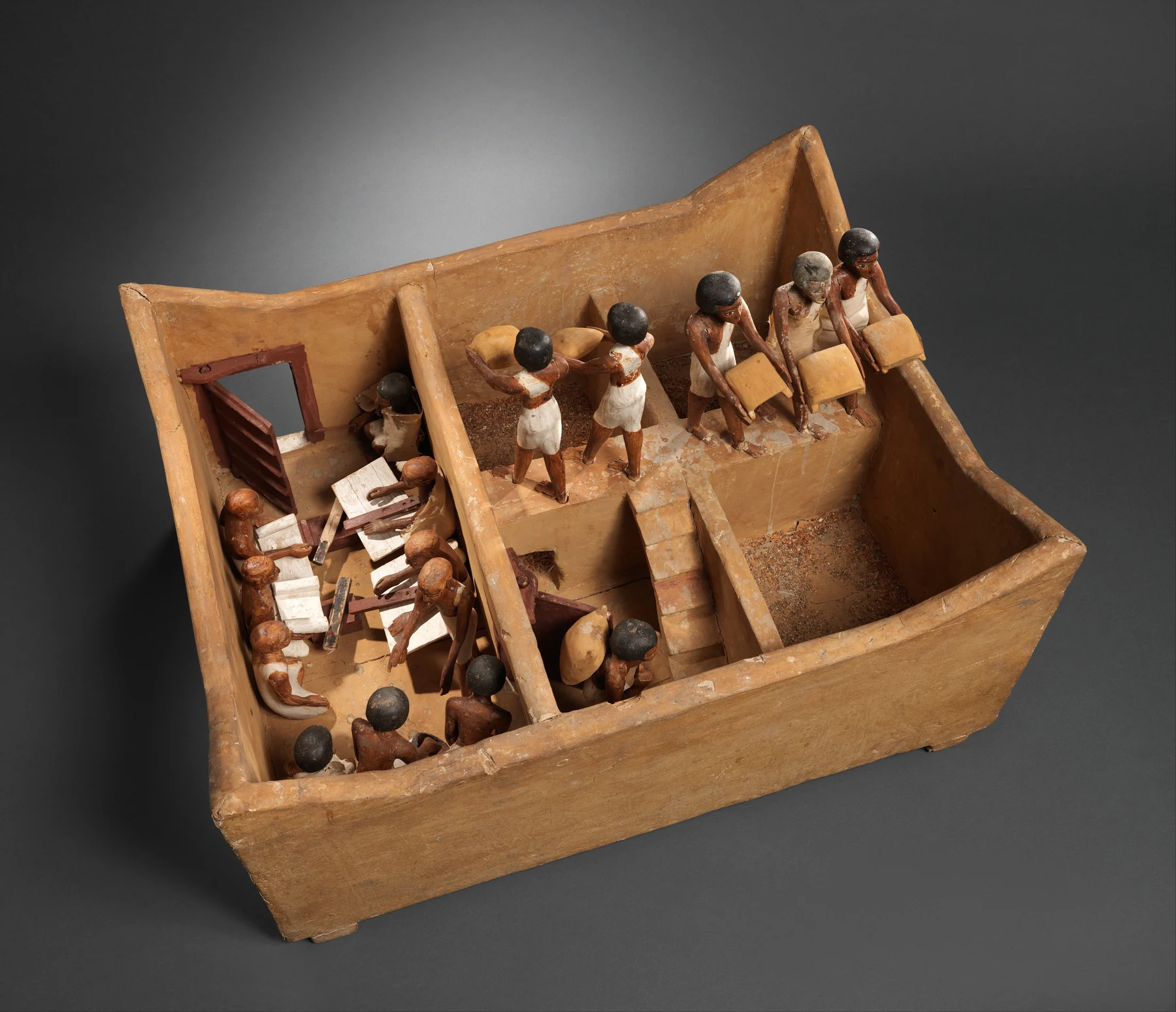
The granary looks almost inviting at first: a roofless building small enough to survey from above. Then its hierarchy becomes visible.
Six men carry sacks of grain. Nine others measure or account for it. Four scribes use papyrus rolls or wooden writing boards. Walls divide storage from administration, while peaked corners may have helped protect a full-size granary from thieves and rodents. Real grain survives among the model’s materials.
The Met dates the model to the beginning of Dynasty 12 and identifies it as funerary equipment for Meketre, a royal chief steward. It came from a hidden chamber beside the passage into his rock-cut tomb at Thebes. Twenty-four models were discovered there in 1920 after the accessible rooms had already been robbed in antiquity.
This is not a toy and not simply a scale diagram. The model converts an institution into a durable provision. Grain arrives, is measured, recorded, secured, and made available to Meketre after death. The miniature figures do not represent specific workers whose biographies we know. They make a labour system continuously present for their owner.
That function changes what close looking should notice. Counting figures matters. So does the split between physical carrying and scribal control. The model does not imagine abundance as a pile of grain alone; it imagines abundance as administration.
Its survival also records a twentieth-century system. The Met’s excavation team found the chamber, and the finds were divided: half went to the Egyptian Museum in Cairo and half to New York under the period’s partition of finds. The model’s ancient burial context and modern museum location belong to the same object biography, even though they answer different questions.
Hatshepsut: a body for the office of kingship
Hatshepsut’s large kneeling statue once stood among colossal figures along the middle terrace of her temple at Deir el-Bahri. During the Beautiful Feast of the Valley, Amun’s image travelled from Karnak across the Nile in a sacred barque and approached the temple along this ceremonial route.
The statue was therefore encountered through repetition, movement, architecture, and scale. A single kneeling body in a museum is imposing. A sequence of such bodies before a cliff-backed temple made kingship spatial.
Hatshepsut’s regalia are conventionally male because the office of king had been formulated as male. Yet describing the image as a woman merely “disguised as a man” misses the work being done. The sculpture joins Hatshepsut’s identity to an established visual grammar of rule: nemes headcloth, false beard, shendyt kilt, ideal youthful body, colossal stone, and an offering to Amun.
Other statues from the same temple represent her with feminine dress and titles. The programme could vary gendered signs according to pose, place, and ritual role. The Met’s publication Hatshepsut: From Queen to Pharaoh treats those variations as part of an evolving strategy of legitimacy rather than a single linear transformation.
The inscription names the rounded offering as Maat. In this setting, the gesture is more than piety. Order is shown passing through a reciprocal system: Hatshepsut offers Maat to Amun while the temple presents Hatshepsut as the ruler able to maintain it.
What we see now is also a reconstruction. The object record states that the museum’s Egyptian Expedition found fragments during its 1927–28 excavations. The most complete statues went to Cairo in the division of finds. Fragments allotted to the Met were attached to metal armatures in New York, and missing areas were filled with tinted plaster. The published photograph shows a coherent figure; the surface contains both ancient granite and modern completion.
Reconstruction does not make the sculpture false. It makes the museum’s interpretive work visible—if the label tells us where to look.
Nefertiti: reform rebuilt the wall
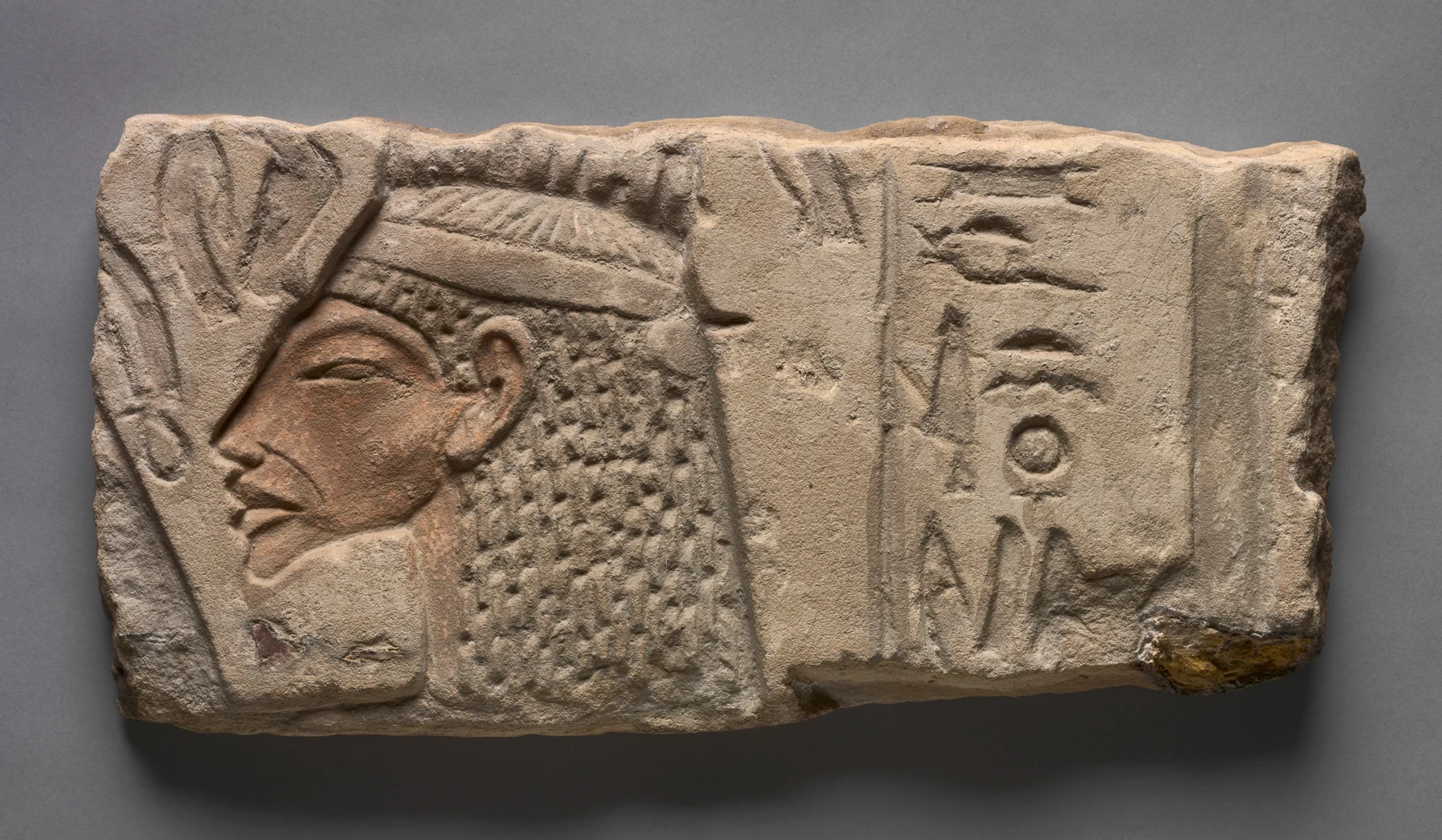
Only part of Nefertiti survives. Her profile fills the left half of a small sandstone block. At the upper edge, a ray from the Aten ends in a hand. An ankh—the sign of life—reaches her nostril. A vertical inscription occupies the field beside her.
The fragment belonged to a larger temple wall at Karnak, made early in the reign of Amenhotep IV, later called Akhenaten. His royal programme concentrated worship on the visible light of the sun disk and made the king and royal family the principal mediators of the Aten. Calling the change simply “monotheism” settles questions that remain debated; the material evidence is more specific.
Worship space changed. Open-air courts addressed the sun. Divine presence moved to the disk and its rays above the royal family. New subjects and altered body forms entered official art. Nefertiti took an unusually prominent ritual role.
Construction changed too. Builders used standardised sandstone blocks now called talatat. The Met’s study of Akhenaten’s architecture explains that the small blocks suited walls that no longer had to carry the massive roofing stones of traditional temple interiors. They could be moved by one worker and allowed a vast programme to rise quickly.
The Cleveland fragment therefore joins theology, image, architecture, and labour. The ray does not merely symbolise a new god. It belongs to an open, sun-oriented ritual environment and to a new way of assembling walls.
The system was short-lived. Aten temples at Karnak were dismantled after Akhenaten’s reign, and many talatat were reused as fill in later construction. That reuse helped fragments survive while destroying their original sequence. The block now asks viewers to reconstruct a wall from one face, one ray, and one line of text.
Its modern custody has a different gap. The Cleveland Museum’s published provenance begins with a Paris dealer before the museum purchased the relief in 1959. The catalogue assigns the object to Karnak, but the online ownership chain does not document its passage from Egypt to that dealer. Ancient site attribution and modern provenance should not be treated as the same claim.
Nauny: judgment made visible and repeatable
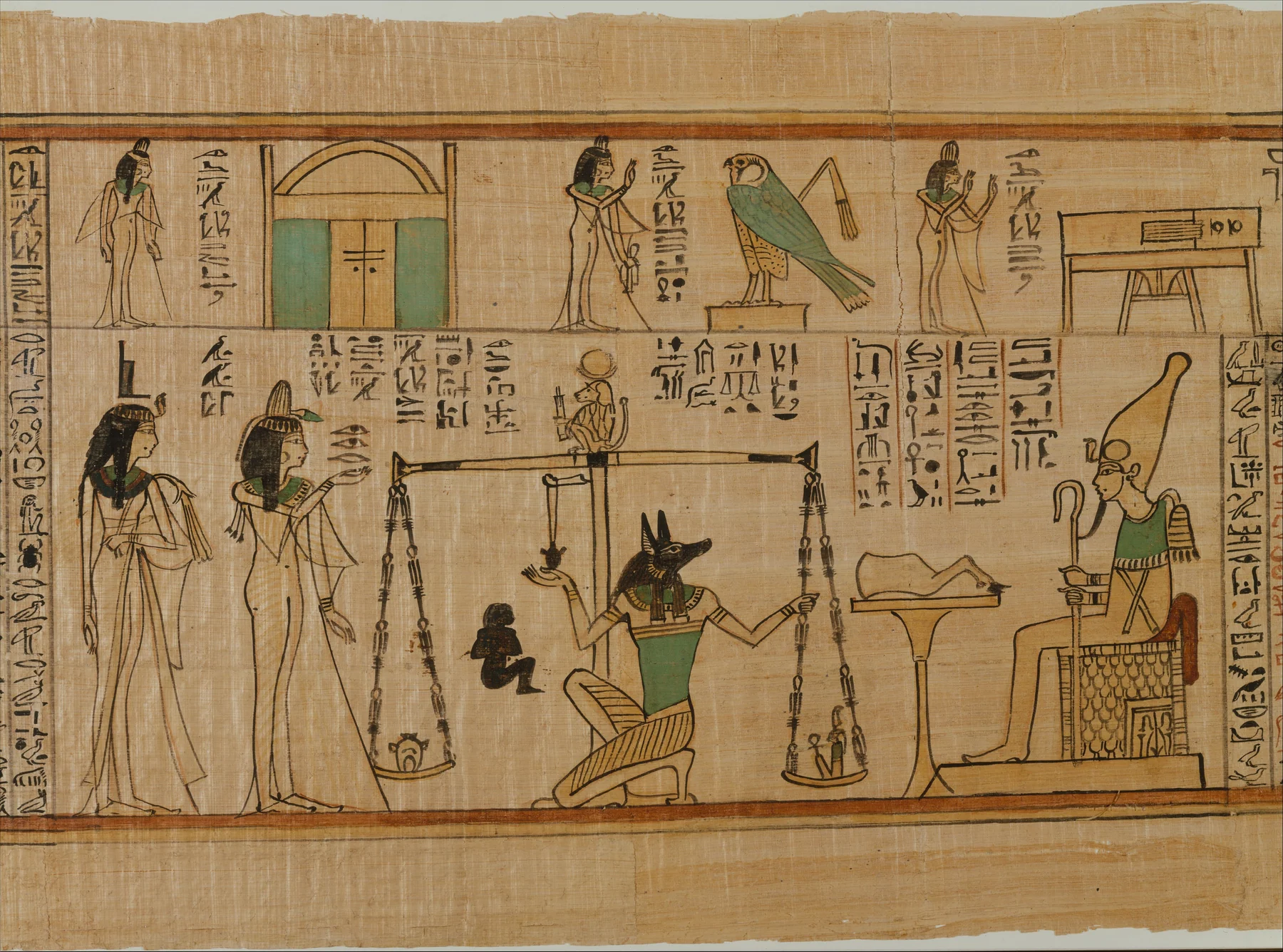
Nauny stands at the left of a balance. Isis accompanies her. Jackal-headed Anubis adjusts the beam. On one pan sits a small figure of Maat, while Nauny’s heart is weighed opposite. Osiris presides from a throne. The result written into the scene is favourable: her heart is found pure.
The image is part of a papyrus more than 5.2 metres long, conventionally called a Book of the Dead. That modern title describes a changing corpus of funerary spells rather than one fixed book. The Egyptian title is usually translated as the Book of Coming Forth by Day.
Text and image did not merely report what had happened to Nauny. They prepared a desired result. Names identify participants; gestures organise the procedure; the balanced scale makes moral judgment visible; spoken and written formulae guide the deceased through dangers and transformations.
The Met’s object account identifies Nauny as a chantress of Amun. The papyrus was found in her burial at Deir el-Bahri during the museum’s 1928–29 excavation. Its placement and refined vignettes joined personal identity to a larger ritual repertoire.
The scene should not be reduced to an illustrated ethical lesson. It is material equipment: papyrus fibres, black outlines, coloured fields, hieroglyphic speech, ordered episodes, and the owner’s name carried into a burial. Its effectiveness depended on being made, inscribed, placed, and activated within funerary belief.
The image used here is an official detail, not the complete roll. A wide digital rectangle makes the judgment scene easy to study but hides the physical act of reading along more than five metres. Digital access enlarges one kind of looking while compressing another.
Five objects, five kinds of work
| Object | What the image was designed to do | What close looking reveals |
|---|---|---|
| Raemkai’s tomb chapel | Maintain an offering place and named relationship between living and dead | Relief, inscription, architecture, and ritual access formed one system; reassignment from Neferiretnes shows why names mattered |
| Meketre’s granary | Provide durable agricultural abundance and administration for an elite afterlife | Carriers are outnumbered by measurers and scribes; provision is imagined as managed labour |
| Hatshepsut’s kneeling statue | Enact legitimate kingship and an offering of Maat along a processional route | Scale, repeated placement, royal regalia, inscription, and reconstructed surface all change the reading |
| Nefertiti talatat | Join royal mediation of the Aten to a rapidly built, sun-oriented temple programme | A ray, ankh, profile, text, standard block, dismantling, and incomplete provenance each preserve a different layer |
| Nauny’s papyrus | Equip a named deceased person for judgment and renewed existence | Text and image organise a favourable procedure; the digital detail is only one section of a 5.2-metre object |
The common thread is not “religion” as a vague explanation. It is designed action. Each object connects belief to a material procedure and an institution able to commission it.
Stability and change belonged together
Egyptian formal art is famous for continuity, but continuity was repeatedly made rather than passively inherited.
The Raemkai chapel uses a long-lived offering system while revealing adaptation and reuse inside one generation. Meketre’s model turns provision into a three-dimensional miniature with an unusually detailed administrative interior. Hatshepsut uses established royal signs to make a female ruler legible as king. Akhenaten’s programme changes temple space, divine iconography, wall construction, and royal bodies within less than two decades. Nauny’s papyrus draws on older afterlife traditions in a format and burial practice specific to her period.
Even idealisation was not one opposite of portraiture. Dimitri Laboury’s peer-reviewed Portrait versus Ideal Image shows why Egyptian representation cannot be divided neatly into either individual likeness or timeless type. Royal and nonroyal images could negotiate identity through both.
The useful question is not “Did Egyptians know how to draw realistically?” It is “Which reality did this image need to stabilise, and for whom?”
Labour, power, and neighbouring worlds
Objects made for eternity were produced under earthly conditions.
Quarry workers extracted stone. Haulers moved it. Draughtspeople laid out grids and inscriptions. Sculptors cut forms. Painters added colour. Scribes controlled names and texts. Carpenters, plasterers, papyrus makers, pigment processors, priests, administrators, and patrons shaped what could be made.
Individual makers are rarely named in the five records used here. That absence should not be mistaken for effortless or anonymous creation. The Met’s account of the Deir el-Medina artisans documents specialised quarrymen, scribes, draughtspeople, sculptors, painters, and carpenters working in an organised crew on royal tombs. UCL’s survey of the term hemut likewise places many makers within supervised, materially controlled sections rather than the modern category of the independent artist.
The five objects also represent people with exceptional access: a prince or high official, a chief steward, a king, a queen, and a chantress connected to Amun’s institution. Their images can illuminate social organisation, but they cannot stand for every Egyptian experience.
Nor was Egypt isolated. Wood, pigments, stone, metals, and luxury goods moved through the Mediterranean, Levant, deserts, and the Nile corridor. Relations with Nubian kingdoms included trade, migration, military service, warfare, extraction, fortification, and New Kingdom conquest. The Met’s introduction to Nubia is useful precisely because it treats Nubia as a region with its own political histories, not as a supplier at Egypt’s edge.
A complete atlas should therefore connect Egyptian objects to neighbouring worlds without absorbing those worlds into an Egyptian story.
A compact timeline
| Date | Object or development | Why it matters here |
|---|---|---|
| ca. 2446–2389 BCE | Tomb chapel first made for Neferiretnes and reassigned to Raemkai | Offering images, text, and a false door make identity and provision operative inside architecture |
| ca. 1981–1975 BCE | Granary model placed in Meketre’s tomb | A Middle Kingdom funerary object turns labour and record-keeping into lasting supply |
| ca. 1473–1458 BCE | Large kneeling statue made during the joint reign of Hatshepsut and Thutmose III | Established royal signs are used to enact Hatshepsut’s kingship in a temple procession |
| 1353–1347 BCE | Nefertiti talatat made for the early Aten programme at Karnak | Religious reform changes divine iconography, royal imagery, open-air space, and block size together |
| ca. 1050 BCE | Nauny’s Book of the Dead papyrus | Text and image prepare a named individual for judgment during Dynasty 21 |
| 1920 | Meketre model chamber found; objects divided between Cairo and New York | Excavation and partition create a modern chapter in the models’ biographies |
| 1927–29 | Met expeditions recover Hatshepsut fragments and Nauny’s burial objects | Museum display depends on excavation, division of finds, conservation, and reconstruction |
| 1959 | Cleveland Museum purchases the Nefertiti relief | The published modern provenance begins in Paris, leaving its earlier ownership route undocumented online |
Key terms
Canon: a shared set of representational rules, proportions, poses, and arrangements. A canon supports recognition and repeatable production; it does not mean that every period or workshop looked identical.
Aspective: a modern Egyptological term for assembling informative views of different parts rather than subordinating the whole image to one optical viewpoint.
Register: a horizontal band that organises figures, actions, or text within a composition.
False door: a stylised architectural threshold in a tomb chapel through which the deceased could symbolically receive offerings and meet the living.
Maat: a concept joining truth, justice, balance, and ordered existence; also personified as a goddess.
Talatat: the modern name for standardised small stone blocks associated especially with Akhenaten’s building programmes at Karnak and Akhetaten.
Book of the Dead: the modern collective name for a changing repertoire of funerary spells and images known to Egyptians as the Book of Coming Forth by Day.
Partage or division of finds: a historical system under which excavated objects were allocated between the country of origin and a foreign excavation institution. Its terms and power relations varied and must be studied case by case.
Provenance: the documented history of an object’s excavation, ownership, custody, sale, and transfer. A proposed ancient findspot does not fill gaps in modern provenance.
Questions for close looking
Choose an Egyptian object and delay the word “style” until you can answer these questions:
- Where was the object installed, carried, stored, buried, or handled?
- Who was meant to see it: a god, the dead, priests, relatives, a court, festival participants, or another audience?
- Which parts are image, writing, architecture, offering equipment, or later reconstruction?
- What does scale organise—rank, ritual visibility, physical distance, or all three?
- Which materials had to be extracted, transported, prepared, and maintained?
- Whose labour is depicted, whose labour made the object, and whose name survives?
- Does the museum show a complete object, an official detail, a reconstructed body, or fragments removed from a larger ensemble?
- Which claim comes from archaeological context, which from an inscription, which from visual comparison, and which remains interpretation?
Use the Observation → Effect → Context → Argument method to turn the answers into a thesis. To compare two Egyptian works, hold one question constant—such as “how does each object make provision durable?”—and use the relational structure in How to compare two artworks.
Five myths to retire
- “Egyptian art never changed.” Long-lived conventions were repeatedly adapted across periods, regions, media, and political programmes.
- “Profile heads prove that makers could not draw naturalistically.” Formal images combined selected views because legibility and ritual order mattered more than one camera-like viewpoint.
- “Tomb scenes are photographs of everyday life.” They contain close observation, but they select productive abundance for funerary purposes and elite patrons.
- “Hatshepsut’s statues hide her identity.” Their gendered signs vary by location and ritual role; kingly regalia made a claim about office, not a simple disguise.
- “A museum image shows the whole work.” The Hatshepsut is reconstructed, the Nefertiti is one reused wall block, the Nauny image is a detail, and every object has been separated from part of its original action.
Where to continue
Begin with the five primary object records: the Met’s Raemkai chapel, Meketre granary, large kneeling Hatshepsut, and Nauny papyrus, plus the Cleveland Museum’s Nefertiti talatat. Their object pages separate current catalogue facts from the interpretations developed here.
For period context, continue with the Met’s surveys of the Old Kingdom, Middle Kingdom, and New Kingdom, and its detailed study of Akhenaten’s art, architecture, and city.
Three substantial scholarly resources are available openly: the Met catalogues Egyptian Art in the Age of the Pyramids, Ancient Egypt Transformed: The Middle Kingdom, and Hatshepsut: From Queen to Pharaoh. UCL’s Digital Egypt introduction to art is especially useful for image–script relations and the limits of modern assumptions.
Stand before the next Egyptian figure and resist asking whether it looks alive. Ask what kind of life its makers were building—and what material, labour, institution, and ritual were required to keep that life present.
Editorial record
About this article
- Author
- Publisher
- GeMarkt
- Published
- Updated
- Reviewed
- Internal source & rights check. Conducted by GeMarkt Research Review. This is an internal editorial check—not independent peer review.
- Source standard
- Art history source standardPrioritises object records and research sources, distinguishes evidence from interpretation, and states material uncertainty.
Found a claim that needs checking? Report a factual error.