Art History · Learning chapter
Atlas III — Early-modern worlds · 9 of 11
Indigenous and colonial American visual worlds, c. 1492–1750: survival, translation, and rule
A critical guide to Indigenous featherwork, pictorial evidence, ceremonial vessels, new technologies, and survival amid conversion, forced labour, and colonial rule.

What we’ll look at
How did Indigenous communities preserve visual knowledge under colonial rule?
An open triptych sits on a neutral museum support. Saints Peter and Paul occupy the wings. The Last Supper fills the centre above Latin words used in the Mass. Its architecture, figures, gilded frame, and Christian function can make the object look like a small European altarpiece. Yet its luminous surface is neither paint nor tapestry. Indigenous Mexican specialists assembled feathers and coloured paper on wood.
The work is often called a product of “cultural encounter.” That phrase describes contact but explains almost nothing. Who controlled the commission? Who knew how to sort, cut, position, and bind the feathers? Which sacred system supplied the subject? Which political order made conversion compulsory or advantageous? Why did European collectors value the finished object while so many makers remained unnamed?
Those questions lead beyond a story in which European art arrived and Indigenous art disappeared. Invasion brought war, epidemic disease, land seizure, forced conversion, tribute, enslavement, and new institutions of law. It also produced conditions in which Indigenous makers redirected inherited knowledge, learned imported techniques, built Christian visual culture, submitted pictorial evidence, sustained political memory, and made objects whose meanings no single authority could fully control.
The central question is therefore:
How did Indigenous makers and communities preserve, translate, and redirect visual knowledge inside colonial systems designed to convert, extract, classify, and rule?
1492 is a marker, not a continent-wide beginning
The date 1492 names the first voyage of Christopher Columbus to the Caribbean under Castilian sponsorship. It does not mark a simultaneous event across two continents, and it does not begin American history. Mexica rule in central Mexico, Inca expansion in the Andes, Maya polities, Caribbean communities, Tupinambá territories, Pueblo towns, Haudenosaunee diplomacy, and thousands of other political and cultural worlds followed different chronologies.
Even Iberian invasion unfolded unevenly. The fall of Mexico-Tenochtitlan in 1521 depended on Spanish forces and tens of thousands of Indigenous allies with their own aims. Francisco Pizarro’s party captured the Inca Atahualpa in 1532 amid an Andean civil war and epidemic disruption, but Spanish control remained contested. Portuguese colonisation on the Brazilian coast developed through shifting alliances, mission settlements, war, enslavement, plantation agriculture, and rivalry with French and Dutch powers.
“Colonial America” is therefore not a style and “Indigenous” is not a visual category. The terms name changing relations among peoples, territories, and institutions. A chronology beginning in 1492 is useful only if it keeps that asymmetry visible.
Scope: selected routes, not a total map
This chapter follows five works along three selected routes: a Mexican Christian feather mosaic; a Nahua pictorial document from Huexotzinco; a Tupinambá feather mantle from eastern Brazil; and two early seventeenth-century vessels from Peru. Together they make it possible to compare mission, court, ritual, domestic, legal, and collecting contexts.
The route is deliberately incomplete. It cannot stand for Taíno and other Caribbean histories, Maya regions, northern Mexico, the North American Southeast, Pueblo and Plains worlds, Guaraní missions, Amazonia, Mapuche territories, the viceroyalties after 1750, or every African and Asian presence in the Americas. It concentrates on selected Spanish- and Portuguese-ruled settings without implying that British, French, Dutch, Danish, and Russian colonies were marginal.
The cutoff at 1750 is also practical, not terminal. Casta painting, Bourbon reforms, Indigenous rebellions, mission expansion, independence movements, and the transformation of colonial categories require later chapters. The living histories of the objects in this chapter extend to the present.
Conquest was material before it was stylistic
Colonisation changed how art was made before Indigenous and European motifs appeared in the same object. Armies destroyed or occupied ceremonial centres. Missionaries attacked sacred images while preserving some as records of beliefs they wanted to end. Epidemics killed makers, patrons, farmers, carriers, and knowledge holders. New towns reorganised settlement and labour, while tribute demands changed what communities had to produce and surrender.
Materials also moved through coercive systems. Silver from Potosí and other mines entered imperial finance and global trade. Dyestuffs, feathers, timber, cotton, wool, ceramics, and food travelled through tribute, markets, workshops, and forced labour. European paper, metal tools, lead glaze, oil paint, prints, and kiln practices reached Indigenous makers, while American pigments, fibres, and visual knowledge transformed colonial production.
Style is evidence within this history, not a substitute for it. Before asking whether a work looks “mixed,” ask who controlled land, time, materials, instruction, worship, and movement.
Survival does not mean remaining unchanged
An unchanged form is not the only proof that knowledge survived. Communities preserved knowledge by adapting it to new materials, shifting it into Christian settings, using it in colonial courts, concealing it, teaching it through new institutions, or rebuilding it after objects had been removed. Change may register experimentation, strategy, pressure, grief, or several at once.
Nor is every continuity resistance. An Indigenous elite might sustain Inca regalia to negotiate recognised status within colonial government. A Christian image made by Nahua hands could support sincere devotion, mission discipline, workshop opportunity, communal authority, or overlapping motives. Evidence rarely lets us assign one private intention to every maker and user.
The most useful definition is relational: survival is the continued capacity of people to make knowledge act, even when the conditions and forms of action have changed.
A feather mosaic makes Christian ritual through Nahua skill
The triptych dates to the middle of the sixteenth century and was made in Mexico. The central panel represents the Last Supper as the institution of the Eucharist; Saints Peter and Paul flank it. Latin text links the object to the words of consecration. The Met identifies it as an altar card and one of only a few surviving Christian feather mosaics of this kind.
Its Christian iconography is unmistakable. So is its dependence on Indigenous material expertise. Feathers create differences of tone, edge, shimmer, and texture that a photograph compresses. Minute pieces had to be selected and aligned so that barbs, colour, and reflected light behaved together. The surface changes as the viewer moves. A copied print could supply a composition without supplying this intelligence.
Calling the work “European in design, Indigenous in technique” divides what the object joins. Material decisions alter the image’s presence. The Eucharist has been made through a medium with deep histories in central Mexican dress, tribute, military insignia, divine imagery, and elite display.
Amanteca were specialists, not anonymous hands
Nahua sources use amanteca for featherworkers associated especially with the district of Amantla. Book 9 of the Florentine Codex records materials and working processes in Nahuatl text and images. The Getty’s Digital Florentine Codex now allows the manuscript’s Nahua and Spanish columns, paintings, and named collaborators to be studied together rather than treating Sahagún as its sole voice.
The triptych has no surviving personal signature, but “anonymous” should not mean unskilled or interchangeable. Featherwork depended on systems of acquisition, sorting, dye or colour knowledge, design, cutting, adhesion, and specialised assembly. Different tasks could involve several hands. Mission patronage did not invent those competencies.
Attribution should stay precise. “Indigenous Mexican featherworkers” is supported. A named individual, exact workshop, or unrecorded intention is not. Restoring social authorship is more honest than manufacturing a biography.
Christian subject does not establish European authorship
A saint, cross, or Mass scene cannot by itself identify the maker. Indigenous people painted, carved, built, sang, embroidered, and performed Christianity throughout colonial America. Over generations, Catholicism became part of Indigenous community life even as church institutions remained agents of conversion and rule.
The opposite shortcut also fails. Indigenous authorship does not make every Christian work covertly anti-colonial. Makers could be believers, coerced labourers, paid specialists, pupils, office holders, or several of these over a lifetime. Community commissions and confraternities could use Christian images to organise local authority and mutual obligation.
Authorship is best reconstructed from records, materials, workshop practice, language, and patronage—not inferred from whether the subject appears “European.”
Translation happened under unequal conditions
Translation is often celebrated as a meeting of cultures. In colonial settings it also answered to conquest. Missionaries required Indigenous languages to preach and confess. Colonial courts required interpreters to turn testimony into legally recognised forms. Makers learned imported conventions because commissions, survival, or advancement might depend on them.
Yet translation never moved in only one direction. Nahua writers gave alphabetic script new purposes. Indigenous painters placed local pictorial signs beside Spanish glosses. Christian concepts had to be expressed through American languages whose categories did not map neatly onto Latin theology. Quechua and Aymara speakers remade Catholic ritual within Andean social relations.
Unequal translation can still produce knowledge that exceeds the translator’s programme. The task is to identify both constraint and authorship without letting either erase the other.
Mission schools were workshops of conversion and invention
Franciscan, Dominican, Augustinian, Jesuit, and other mission institutions taught Christian doctrine while organising labour and image production. In central Mexico, schools and workshops trained Indigenous painters, sculptors, singers, scribes, and builders in selected European forms. Printed images circulated compositions more cheaply than imported paintings.
These institutions were not neutral academies. Images supported campaigns against practices missionaries called idolatry. Churches could be built near or over Indigenous sacred sites. Congregation policies moved dispersed populations into administratively legible settlements. Education opened forms of literacy while controlling what knowledge was authorised.
Still, a workshop was not a photocopier. Local makers altered scale, colour, material, spatial organisation, gesture, and use. The feather triptych is evidence of this active production—not proof that conversion produced harmony.
Images could enter a colonial court
Colonial law was an instrument of empire, but Indigenous communities also used it to pursue land, status, payment, and redress. Pictorial documents could identify people, places, tribute, boundaries, genealogies, and actions for judges who operated through Spanish legal procedure.
This did not mean that courts accepted every Indigenous category on equal terms. Evidence passed through scribes, interpreters, advocates, officials, paper formats, and jurisdictional rules. A community might have to translate a collective claim into the language of property or service recognised by a colonial tribunal.
The resulting page should be read as an action: not merely a picture of tribute, but an attempt to make an abuse visible to power.
The Huexotzinco Codex turns tribute into evidence
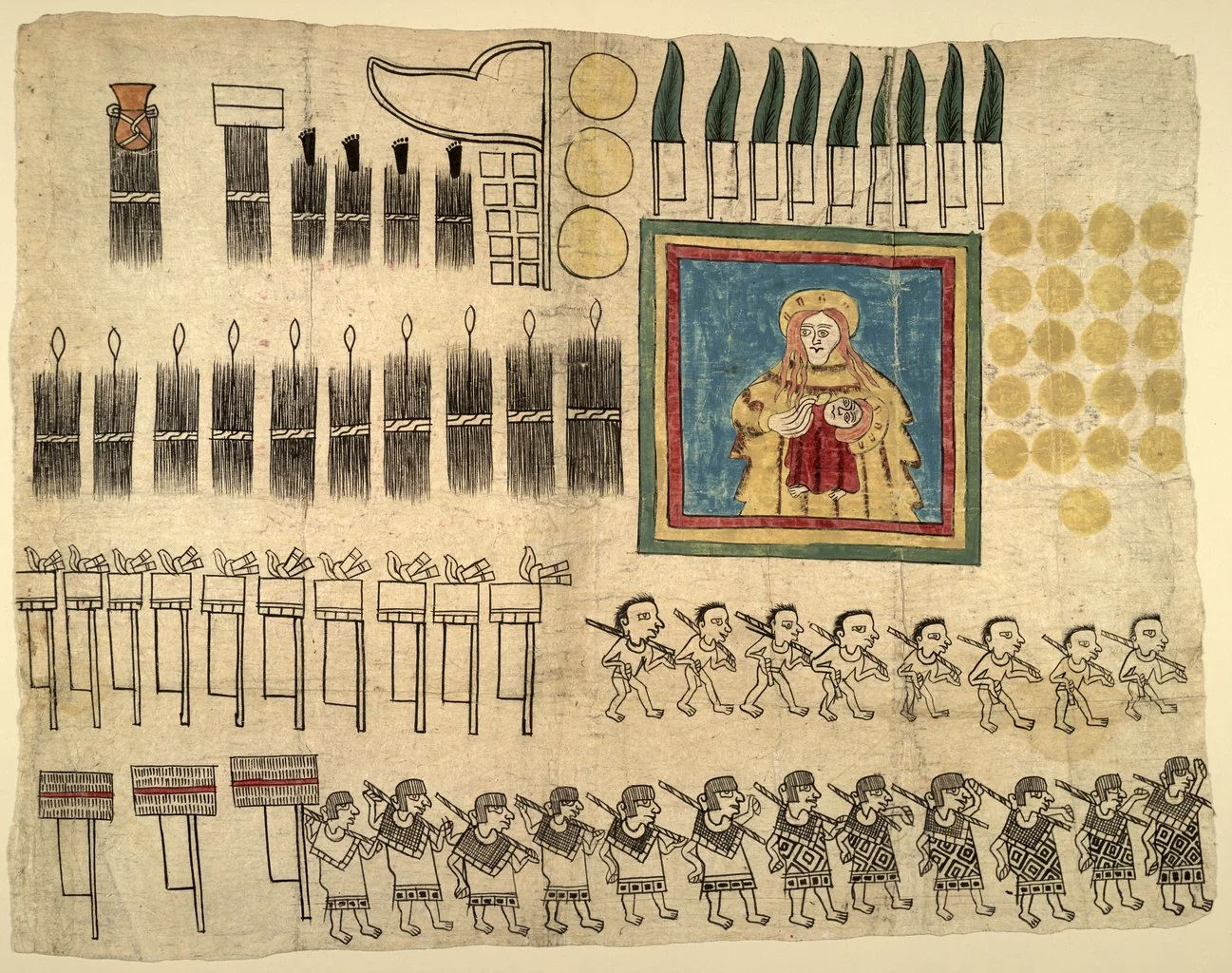

In 1531, Nahua people from Huexotzinco participated in a legal case concerning excessive demands made by Spanish administrators while Hernán Cortés was absent. Eight panels on amate, a bark-based paper with pre-invasion histories, enumerate goods and services. Rows, repeated signs, and numerical marks convert textiles, food, labour, and other exactions into a structured claim.
The case was not a simple contest between all Indigenous people and all Spaniards: Cortés was a co-plaintiff defending his own interests against rival administrators. That political alignment matters. Huexotzinco had also been an ally against Mexico-Tenochtitlan. Indigenous communities used colonial rivalries without thereby controlling the colonial system.
The codex survives because pictorial knowledge could do legal work. Its survival should not be mistaken for the survival of every claim, maker’s name, or panel in an untouched form.
A Madonna can be both sacred image and tax record
Near the centre of the first panel, the Virgin and Child appear inside a bordered rectangle. The image records a costly banner commissioned for a military campaign and charged to the people of Huexotzinco. Around it, counted disks, textiles, standards, food, and groups of figures build an accounting environment.
The Madonna is therefore not only devotional content. She is evidence of compelled expenditure. A Christian image could be revered while the demand that produced it was disputed. Sacred subject and fiscal violence occupy the same sheet.
This is why iconography alone is insufficient. Asking “Who is represented?” identifies Mary and Christ. Asking “What is this representation doing here?” reveals a legal argument about tribute.
Pictorial writing did not disappear when alphabetic writing arrived
The manuscript uses a visual system in which quantity, type, relation, and action can be read through placement and repeated forms. Alphabetic Spanish or Nahuatl could supplement such images, but did not instantly replace them. Colonial documents frequently brought pictorial and alphabetic practices into the same administrative field.
The Digital Florentine Codex offers a much larger example: Nahua text, Spanish interpretation, and almost 2,500 painted images form related but non-identical narratives. The Nahuatl column is not simply a rough draft for the Spanish one, and pictures do not merely decorate the words. Each mode addresses different knowledge and audiences.
“Writing” should therefore be treated as a family of practices. Alphabetic literacy expanded under colonial rule; pictorial literacy continued to organise claims, histories, maps, and memory.
Legal visibility had a price
To become evidence, community knowledge had to be portable, countable, and intelligible to officials. That process could preserve a claim while narrowing it. A map might fix a fluid boundary. A genealogy might privilege elite descent. An interpreter might choose one Spanish term among several imperfect equivalents.
Huexotzinco’s painters turned material obligations into a persuasive page, but we do not hear every labourer’s voice. Figures representing groups are not portraits of all individuals. The lawsuit documents an institutional claim rather than a complete social history.
Agency here is procedural and constrained. The community acted inside a court whose sovereignty it had not freely chosen.
The colonial archive records petitions and filters them
The so-called Códice Osuna of 1565 makes the filtering process especially visible. Research by María Isabel Vírseda Bravo at UNAM treats it not as a timeless “Aztec codex” but as pictorial and written testimony assembled within a larger investigation of colonial officials. Pictograms, Nahuatl statements, Spanish translation, scribal procedure, later binding, noble ownership, and modern facsimiles all shaped what researchers now encounter.
Felipe Guaman Poma de Ayala’s early seventeenth-century Nueva corónica y buen gobierno likewise addresses Spanish rule through hundreds of drawings and a long multilingual text. Its survival in the Royal Danish Library is extraordinary; it cannot substitute for the countless local records that disappeared or remain inaccessible.
An archive is not a transparent container. It is a history of who could submit, translate, collect, bind, remove, classify, digitise, and preserve.
A Tupinamba mantle was never just a curiosity
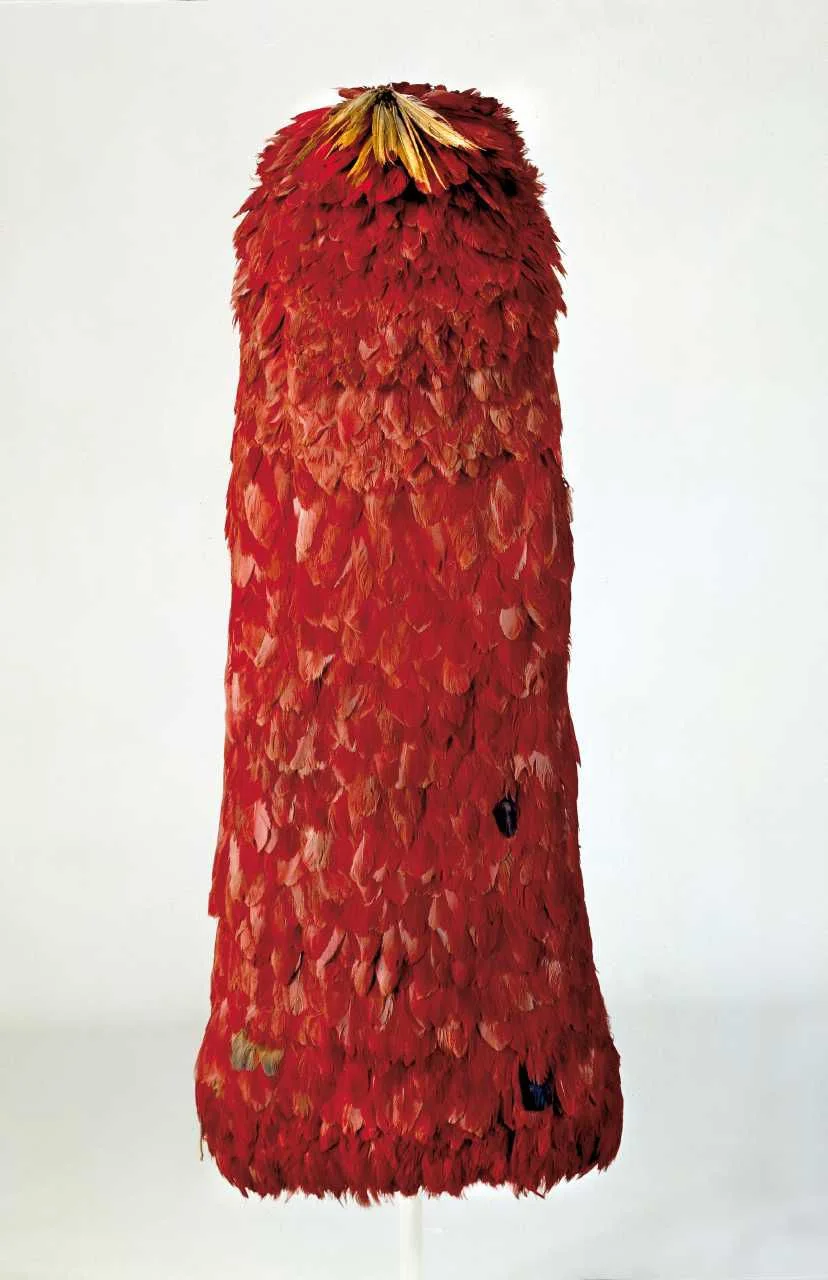
Hundreds of red ibis feathers overlap across a woven support, with contrasting feathers near the top. The form envelops rather than frames a body. European collection histories called such works capes, cloaks, or curiosities; Tupinambá leaders describe the returned mantle as sacred, ancestral, and living.
The National Museum of Denmark traditionally associates this example with a seventeenth-century royal Kunstkammer collection and says it was probably first mentioned in 1674. Its early route from eastern Brazil to Denmark is not completely documented in the public object record. The gap matters. “Collected” can hide trade, diplomatic gift, appropriation, displacement, or several transfers.
The object is not evidence of a vanished people. Tupinambá communities live in Brazil, sustain political and cultural claims, and make feather mantles in the present.
Featherwork joined body, movement, ecology, and ceremony
The mantle’s surface began in relationships among birds, coastal and wetland ecologies, hunters or gatherers, fibre workers, feather specialists, ceremonial knowledge, and bodies. Red colour is not an abstract pigment applied to a flat support. It is the accumulated structure of feathers whose direction, density, and movement change the garment.
Worn in ceremony, the mantle would have acted with posture, dance, sound, audience, and other forms of regalia. A museum photograph isolates it on a white support. That view is useful for studying construction and condition, but it should not be confused with the work’s full field of action.
The object also complicates the word “art.” Dress, sacred entity, ancestral presence, technical achievement, diplomatic object, museum collection, and political relation may all be relevant. A single modern category cannot exhaust it.
Collection transformed relation into possession
European Kunstkammern placed American featherwork among natural wonders, antiquities, scientific specimens, weapons, luxury goods, and trophies. Such collections preserved fragile materials while changing the terms of access. A work tied to community authority became an item possessed by a prince, catalogued by a museum, and interpreted for distant viewers.
Preservation and dispossession can be historically connected. It is too easy to say “the museum saved it” without asking why the museum had the object and why related communities did not. It is equally incomplete to pretend that centuries of conservation created no material responsibilities.
Provenance should trace more than addresses. It should ask which relations were cut, who requested access, whose account shaped cataloguing, and what forms of return are possible.
Return changes the present tense of the object
In 2023, the National Museum of Denmark announced that it would donate the mantle after requests from Tupinambá leaders and the Museu Nacional in Rio de Janeiro. In September 2024, a ceremony at UFRJ marked its return to Brazil with a large Tupinambá delegation. Cacica Jamopoty addressed the mantle as a living presence; earlier, leader Cacique Babau had described the donation as the return of an ancestor.
These statements are not decorative quotations added to a European object biography. They change the biography’s authority. The mantle now belongs to a museum rebuilding after the catastrophic 2018 fire, but its care is also a relationship with Tupinambá people.
Return does not restore the seventeenth century or end debate about land, access, conservation, and sovereignty. It does make one fact unavoidable: colonial collection history is still being negotiated by living communities.
A Quechua kero carried Inca social memory
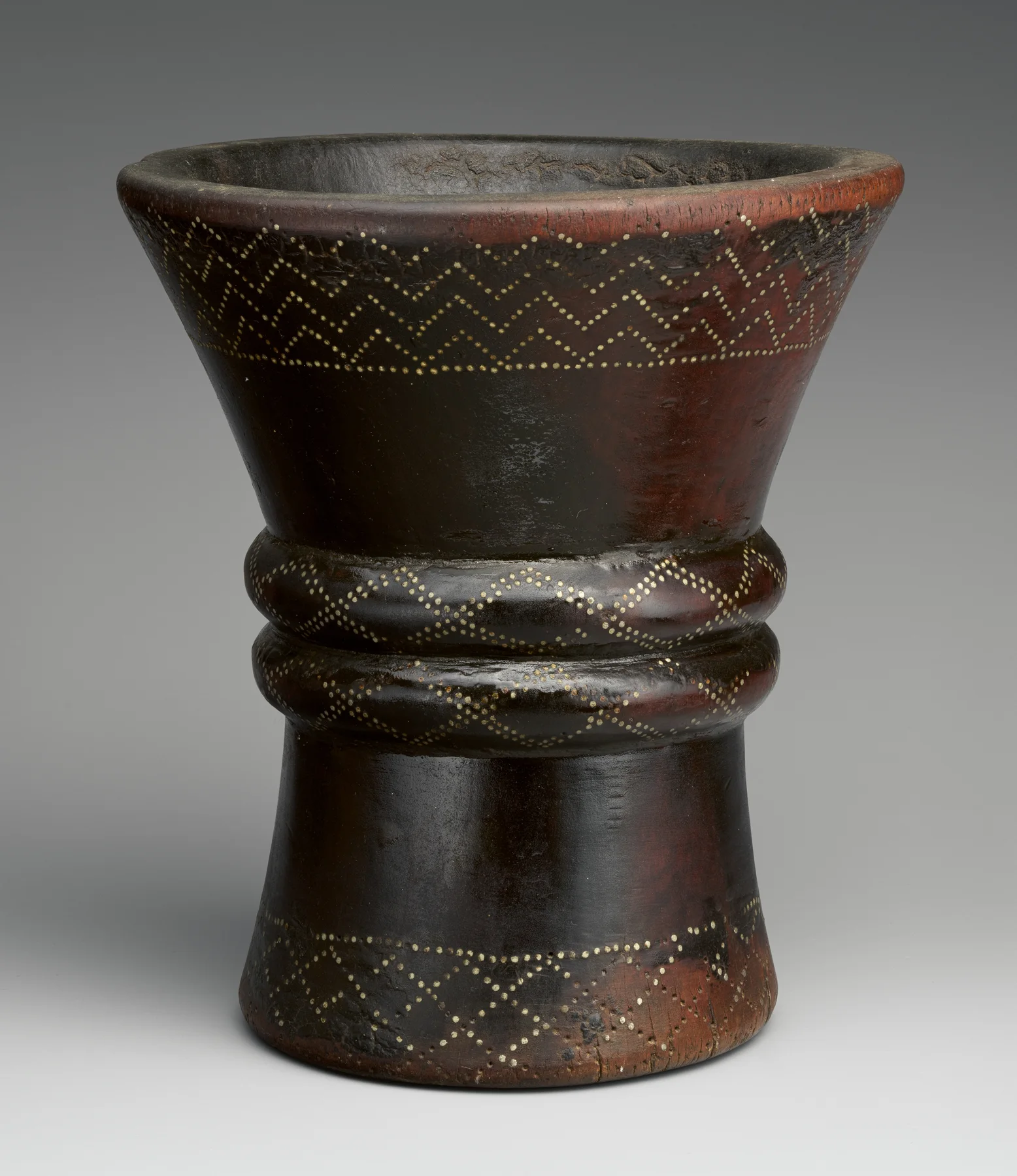
Keros were drinking vessels used in Andean libation, feasting, and political relationship. This early seventeenth-century example keeps a form associated with Inca practice: a wooden body narrowing at the centre and flaring toward the rim. Tin studs and raised bands create a geometric surface that the Met connects to colonial-period innovation.
Keros were often made and used in pairs. Filled with chicha, they helped establish relations among living participants, ancestors, sacred places, and political authorities. A single vessel in a display case is therefore one part of an originally social action.
The Spanish defeat of the Inca state did not end Inca signs. Quechua-speaking elites could claim descent, office, privilege, and communal responsibility through remembered forms. The kero carried that memory into colonial life.
Continuity could be strategic and public
Colonial authorities sometimes recognised Indigenous nobles and communities through adapted systems of office and descent. Public Inca identity could therefore support claims within the viceroyalty. This was not political independence, but neither was it merely private nostalgia.
Thomas Cummins’s research on qeros emphasises their role in Andean systems of reciprocity and colonial image making. Peruvian scholars including Ricardo Kusunoki, Cecilia Pardo, Julio Rucabado, Jorge Ochoa, Elizabeth Arce, and Roberto Argumedo place the vessels within longer histories of Inca and viceregal identity. Technical studies by Ellen Pearlstein and colleagues show that resin, pigment, wood, and metal carry evidence inaccessible to iconography alone.
“Persistence” should thus name an active reworking of social memory. It does not require every colonial kero to reproduce a pre-invasion prototype.
A double-chambered bottle makes technology audible
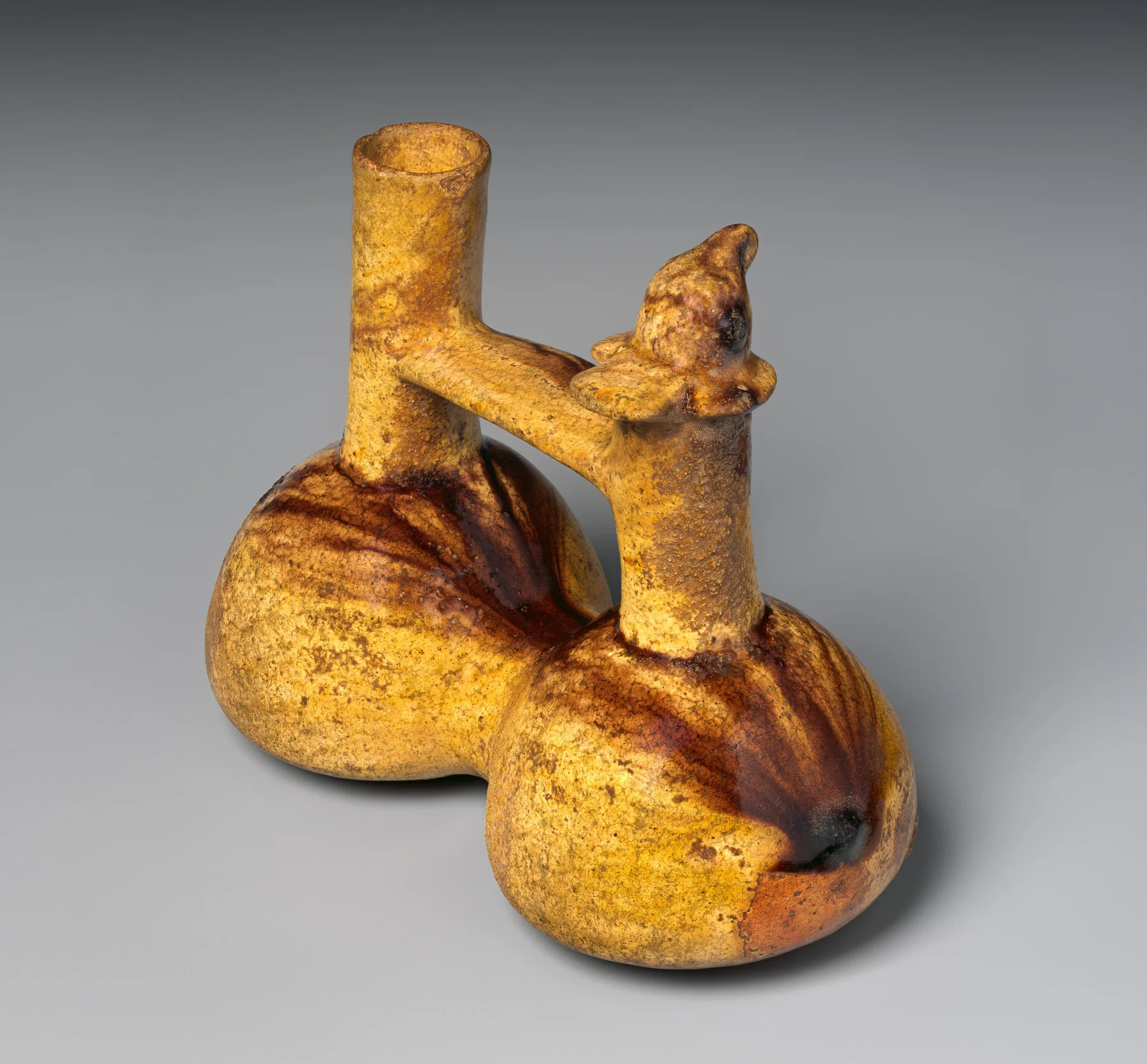
Two fruit-like chambers, perhaps lúcumas, are joined by a bridge and straight spouts. A bird-shaped whistle crowns one side. When liquid moves through the vessel, displaced air can activate the whistle. Shape, fluid, breath, and sound make the object more than a static container.
The bottle joins a long Andean history of double-chambered sounding vessels with a glossy lead-rich glaze associated with Iberian technology. Yet research led by Parker VanValkenburgh, Sarah Kelloway, Karen Privat, Bill Sillar, and Jeffrey Quilter complicates a simple transfer from European kiln to Indigenous workshop. Some early colonial green glazes could be completed with open firing practices familiar in the Andes.
Technological knowledge moved through experiment. Imported ingredients and forms entered a workshop where makers already understood ceramic bodies, airflow, liquid movement, and firing.
Hybridity is a question, not an explanation
The word hybrid can mark the presence of historically different conventions. Used too quickly, it turns explanation into a label. Saying that the bottle is a hybrid does not identify who selected the glaze, who controlled the workshop, which firing method was used, who bought the vessel, or why the whistle mattered.
The same problem affects “syncretism.” A Christian subject made in feathers may combine systems, but the term does not tell us whether an element was imposed, translated, strategically displayed, privately interpreted, or transformed over generations.
Replace the label with a sequence of questions: Which components can be traced? Through which people and institutions did they move? What technical decisions joined them? What did the object enable? Who had the power to accept, reject, or punish the result?
Mines, tribute, and forced labour financed colonial splendour
Colonial churches, silver objects, paintings, and urban monuments depended on economies of extraction. In the Andes, the Spanish adaptation of mita labour drafts compelled communities to send workers, especially to Potosí and Huancavelica. Mercury refining, dangerous shafts, transport, food supply, and textile production connected mine wealth to enormous human and environmental costs.
In New Spain and Peru, tribute and labour obligations varied by place and changed through law, evasion, negotiation, and abuse. The Huexotzinco Codex records one early dispute rather than a complete system. In Portuguese Brazil, settlers enslaved Indigenous people and developed plantation economies increasingly dependent on enslaved Africans transported across the Atlantic.
Splendour must not be detached from these infrastructures. A silver altarpiece is also a history of ore, mercury, fuel, labour, transport, taxation, and devotion.
Catholicism became Indigenous without ceasing to be colonial
Missionaries destroyed sacred objects, prosecuted ritual specialists, and used images to teach doctrine. These are facts of coercion. It is also true that Indigenous communities formed confraternities, sponsored feasts, cared for saints, composed music, built churches, and made Catholic practices locally meaningful.
Over time, the binary “European Christianity versus Indigenous religion” becomes historically inadequate. Christianity could be inherited within an Indigenous family and still operate through colonial institutions. A saint could belong to a community’s calendar, land, and reciprocal obligations while church authorities disputed local control.
Acknowledging Indigenous Catholicism does not vindicate conquest. It recognises that colonised people made religious histories rather than remaining passive recipients of an unchanging European faith.
Colonial categories tried to make people legible
Terms such as indio, español, mestizo, negro, mulato, and many more classified people for taxation, labour, honour, marriage, office, and law. Their meanings varied across regions and decades. They were not stable biological facts.
From the early eighteenth century, casta paintings arranged labelled family groups into series, especially in New Spain. These images did not simply document a population. They visualised an elite desire to order ancestry, occupation, dress, food, and status, often producing an apparent system more regular than everyday life.
Use such labels as historical evidence of classification, not as neutral identities applied retrospectively. When a named person used, contested, or changed a category, that act deserves more weight than a modern chart.
African presence belongs inside colonial American art history
Millions of Africans were forcibly transported to the Americas. Enslaved and free African-descended people mined, farmed, cooked, built, carried, traded, served in militias and confraternities, practised religions, formed families, and made visual and material culture. Their labour and knowledge were foundational, not an appendix to a meeting between “Europeans” and “Indians.”
African and Indigenous lives also intersected through alliance, kinship, flight, conflict, trade, and colonial classification. Andrés Sánchez Galque’s 1599 portrait of the Arobe family from Esmeraldas, discussed in the Baroque chapter, is one rare named work that makes Afro-Indigenous political negotiation visible within a colonial commission.
This chapter cannot supply the dedicated routes that Afro-Brazilian, Afro-Andean, maroon, Caribbean, and Black Catholic histories require. It can refuse a framework that makes them disappear.
Five works, five institutions of survival and rule
The feather triptych entered Christian ritual through Indigenous specialist labour. The Huexotzinco panels entered a lawsuit by turning tribute into pictorial evidence. The Tupinambá mantle activated ceremony and community relation before a European collection transformed it into royal property. The kero sustained Andean libation and public memory. The sounding bottle joined local form and acoustic knowledge to new glaze technologies.
None is a free-standing symbol of “cultural mixture.” Each belonged to an institution: mission and altar, community and court, ceremony and Kunstkammer, feast and Indigenous nobility, household and ceramic workshop. Institutions organised who could act with an object and how.
Comparison becomes historical when it moves from resemblance to these structures of action.
A comparison matrix
| Work | Knowledge carried | Colonial institution or pressure | Evidence of Indigenous action | Limit of the evidence |
|---|---|---|---|---|
| Mexican feather triptych | Feather selection, assembly, light, Christian image making | Mission, altar, conversion, European collection | Indigenous specialists remade a Christian format through a local medium | Maker, patron, and first place of use are not named |
| Huexotzinco Codex | Pictorial counting, amate paper, communal testimony | Tribute dispute and Spanish court | Nahua painters made obligations visible as legal evidence | The case passed through colonial allies and procedure |
| Tupinambá mantle | Feather and fibre work, ceremony, embodied relation | War, collecting, royal Kunstkammer, museum | Living communities maintained knowledge and secured return | Early transfer to Europe remains incompletely documented |
| Quechua kero | Libation, pairing, Inca social memory | Viceregal recognition and regulation of Indigenous elites | Form and ritual sustained relationships and claims | Museum isolation removes its partner, liquid, users, and setting |
| Peruvian sounding bottle | Andean vessel form, acoustics, firing | Imported glaze technology and colonial market | Makers experimentally joined technologies in local production | Excavated workshop and user are unknown |
The matrix is a study tool, not a verdict. Every cell could change with new technical, archival, or community research.
What the surviving archive overrepresents
Durable, valuable, portable, and collectable works survive unevenly. Stone, metal, elite manuscripts, church objects, and courtly vessels are more likely to enter museums than food, songs, temporary structures, everyday repairs, inexpensive cloth, or knowledge deliberately kept from outsiders.
Colonial institutions shaped the archive twice: first by deciding what could be made, seized, recorded, or condemned; later by deciding what entered libraries and museums. European collectors often preserved works that matched their idea of wonder while separating them from names and uses.
Digital access corrects some barriers and creates others. A high-resolution scan can reunite pages for study but cannot restore performance, touch, restricted knowledge, or community authority. Visibility is not the same as restitution.
Common survey traps
- “Indigenous art ended after conquest.” Indigenous people continued to make art and architecture, including within Christian and colonial institutions.
- “1492 changed the whole hemisphere at once.” Invasion, disease, settlement, and resistance followed distinct regional chronologies.
- “A Christian subject is European art.” Subject does not identify the maker, medium, patron, or use.
- “Hybrid” explains the object. It only opens questions about the agents and conditions of combination.
- “Agency means freedom.” People can act strategically inside coercive systems without controlling those systems.
- “Survival means purity.” Traditions can survive through deliberate change, translation, reconstruction, and return.
- “The archive preserves what mattered most.” It preserves what materials, power, collecting, chance, and conservation allowed to survive.
- “Repatriation closes the story.” Return changes authority and access while opening new responsibilities.
Questions for close looking
- What material knowledge would a photograph fail to show?
- Is the object made for a wall, body, table, altar, court, route, or several settings?
- Which part of its present title comes from makers, users, collectors, or modern scholars?
- What evidence supports the attribution to a people, place, workshop, or individual?
- Which institution commissioned, activated, judged, collected, or preserved it?
- How do scale, movement, sound, liquid, touch, or changing light matter?
- Does continuity reproduce an older form, redirect it, or make it legible to colonial power?
- Where do forced labour, tribute, enslavement, or land loss enter the material history?
- What can the object establish, and what intentions remain unknown?
- How have living communities changed its interpretation or custody?
Terms for colonial American visual worlds
- Amanteca: Nahua featherwork specialists; the word identifies skilled social practice, not every maker of every surviving feather object.
- Amate: paper made from inner bark, used in Mesoamerican pictorial and ritual traditions before and after invasion.
- Confraternity: a lay religious association that could organise devotion, mutual aid, festivals, finance, and community office.
- Encomienda: a Spanish grant entitling a holder to receive tribute or labour from specified Indigenous communities, formally paired with obligations of protection and Christian instruction.
- Kero or qero: an Andean drinking and libation vessel, often wooden and used in relational or paired practices.
- Mita: an Andean rotating labour obligation transformed under Spanish rule into a major instrument of colonial labour extraction.
- Pictorial manuscript: a document in which images, signs, spatial relations, and sometimes alphabetic glosses produce historical, legal, ritual, or administrative meaning.
- Provenance: the documented chain of custody and transfer; responsible provenance also attends to coercion, missing intervals, and community claims.
- Reducción: a colonial policy of concentrating dispersed Indigenous populations into planned settlements for administration, tribute, labour, and conversion.
- Translation: movement among languages, media, concepts, and institutions; in colonial conditions, both a creative practice and a relation shaped by unequal power.
A working timeline, c. 1492–1750
- 1492: Columbus’s first voyage reaches the Caribbean; it is not a continent-wide beginning.
- 1500: Pedro Álvares Cabral’s fleet reaches the coast of present-day Brazil; Portuguese claims develop unevenly through later settlement, alliance, war, mission, and enslavement.
- 1519–1521: Spanish and allied Indigenous armies campaign against Mexico-Tenochtitlan; the city falls in 1521.
- 1520s: Smallpox and other epidemics compound war and displacement in central Mexico; disease histories differ by region and cannot be reduced to one universal percentage.
- 1531: Nahua painters make the Huexotzinco Codex for a tribute dispute.
- 1532–1533: Spaniards capture and execute Atahualpa; war and resistance continue across the Andes.
- 1542: Spanish crown establishes the Viceroyalty of Peru and issues New Laws intended to restrict some abuses, with contested and uneven effects.
- Mid-sixteenth century: Indigenous Mexican specialists make Christian feather mosaics including the hero triptych.
- 1560s–1570s: Pictorial and alphabetic records including the Códice Osuna and Florentine Codex are assembled in New Spain.
- 1570s: Viceroy Francisco de Toledo reorganises Andean settlements, tribute, and labour, including the mining mita.
- About 1615: Felipe Guaman Poma de Ayala completes the Nueva corónica y buen gobierno.
- Early seventeenth century: The Quechua kero and glazed sounding bottle in this chapter are made in Peru.
- 1674: The featured Tupinambá mantle is probably first mentioned in connection with the Danish Royal Kunstkammer.
- Early eighteenth century: Casta painting develops as one visual technology of colonial classification, especially in New Spain.
- 1750: This chapter’s cutoff; Indigenous, African, European, Asian, and mixed colonial visual worlds continue and change.
- 2024: The featured Tupinambá mantle returns to Brazil after donation by the National Museum of Denmark and advocacy involving Tupinambá leaders and the Museu Nacional/UFRJ.
Source guide
Start with the objects and primary documents:
- The Met: Mexican Eucharist feather-mosaic triptych and Johanna Hecht’s Arts of the Mission Schools in Mexico establish medium, dimensions, use, and Open Access status.
- The Getty Research Institute’s Digital Florentine Codex reunites Nahuatl and Spanish texts with images. Kim N. Richter and Alicia Maria Houtrouw’s introduction to its three narratives explains collaborative authorship, audience, and Book 9’s featherwork evidence. Diana Magaloni Kerpel’s The Colors of the New World studies material and Indigenous authorship.
- The Library of Congress provides the Huexotzinco Codex with all eight panels, rights guidance, and collection history. The technical study by Mary Elizabeth Haude and Tana Elizabeth Villafana, “A Technical Study of the 1531 Huexotzinco Codex Using Macroscopic Examination and Multimodal Imaging”, examines amate, pigments, construction, and conservation.
- María Isabel Vírseda Bravo’s UNAM article “Pinturas de los de México”: una propuesta de análisis del Códice Osuna restores the document’s administrative and codicological context. The Digital Guaman Poma at the Royal Danish Library provides the complete Nueva corónica.
- The National Museum of Denmark records the Tupinambá mantle’s object, image, dimensions, photographer, and CC BY-SA licence, and its 2023 donation decision. UFRJ documents the 2024 return ceremony and statements by Tupinambá leadership. Research and contemporary mantle making by Glicéria Tupinambá are essential to interpreting these works as living heritage.
- The Met’s records for the Quechua kero and double-chambered bottle provide dimensions, materials, Open Access images, and bibliographies. Continue with Thomas Cummins, Toasts with the Inca; Ricardo Kusunoki, Cecilia Pardo, and Julio Rucabado, Los incas: más allá de un imperio; and Parker VanValkenburgh and colleagues, “Rethinking Cultural Hybridity and Technological Transfer”.
For wider interpretation, compare Alessandra Russo, Gerhard Wolf, and Diana Fane, eds., Images Take Flight; Barbara Mundy, The Death of Aztec Tenochtitlan, the Life of Mexico City; Joanne Rappaport and Tom Cummins, Beyond the Lettered City; Carolyn Dean, A Culture of Stone; and Ilona Katzew, Casta Painting. These studies disagree productively about translation, urban continuity, literacy, materiality, and classification.
The source rule for this chapter is simple: use museum labels for object facts, technical research for materials, community and local scholarship for living histories, and colonial documents as situated testimony—not as neutral descriptions of the people they attempted to rule.
Continue the Atlas route
Read this chapter beside Ancient Mesoamerican art and Ancient Andean art to see what colonial institutions inherited, damaged, and redirected. Pair it with African kingdoms and Atlantic encounter so that Atlantic slavery and diplomacy remain inside the same early modern world.
The immediate next Atlas chapter is Baroque worlds, which follows the seventeenth-century circulation of persuasion, portraiture, confession, finance, and empire. After Baroque, the planned route continues to Rococo and global luxury, where porcelain, lacquer, silver, textiles, sugar, and interior display make taste inseparable from extraction and long-distance labour.
Editorial record
About this article
- Author
- Publisher
- GeMarkt
- Published
- Updated
- Reviewed
- Internal source & rights check. Conducted by GeMarkt Research Review. This is an internal editorial check—not independent peer review.
- Source standard
- Art history source standardPrioritises object records and research sources, distinguishes evidence from interpretation, and states material uncertainty.
Found a claim that needs checking? Report a factual error.