Art History · Learning chapter
Atlas I — Foundations and ancient worlds · 2 of 10
Ancient Mesopotamian art: image, writing, ritual, and urban power
A five-object guide to how temples, seals, tablets, palace thresholds, and processional streets made authority visible across ancient Mesopotamia.

What we’ll look at
How did art support temples, governments, palaces, and rituals in Mesopotamia?
His hands are folded. His feet are planted. His eyes refuse to close.
The small gypsum figure from Eshnunna was made to remain attentive after the person it represented had left the temple. It could stand before a deity longer than any human body could. The image delegated presence.
That function opens a route through more than two thousand years of ancient Mesopotamian art. A carved seal carried its owner’s authority into wet clay. A tablet held animals and dates inside an accountable record. A colossal guardian turned a palace doorway into a controlled encounter. Rows of glazed lions directed a ritual procession through Babylon.
This guide asks one question across five objects:
How did images make institutions present?
The answer changes with every city and period. Temple, bureaucracy, court, empire, and urban festival each required a different scale of image. Yet all five works joined representation to action. They did something in a specific place: watched, authorised, counted, guarded, or guided.
Mesopotamia was a region, not one civilisation
The word Mesopotamia comes from Greek and means the land “between the rivers.” The British Museum’s scope note uses it for a broad region around the Tigris and Euphrates, corresponding mainly to modern Iraq and north-eastern Syria; related histories extend into south-eastern Turkey and neighbouring lands.
No ancient state ruled that entire geography for the whole span of this article. People did not share one political identity, one language, or one unchanging visual tradition. The five objects move through:
- Early Dynastic Eshnunna, one centre within a landscape of competing city-states;
- the Akkadian period, when rulers based at Agade conquered much of Mesopotamia;
- the Ur III state and its dense administrative systems;
- the Neo-Assyrian empire centred in northern Iraq;
- the Neo-Babylonian empire centred on Babylon in southern Iraq.
“Sumerian,” “Akkadian,” “Assyrian,” and “Babylonian” are useful historical terms, but they do different work. Some refer to languages, some to cities, dynasties, regions, or political traditions. Their boundaries overlap. Cuneiform was a script, not a language, and it was adapted to write Sumerian, Akkadian, and many other languages.
This article is therefore a route, not a complete survey. Its dates—about 2900 to 562 BCE—leave out millennia of settlement before the first object and centuries of Mesopotamian life after the last. It also leaves out major centres, media, and neighbouring cultures that deserve their own studies.
The question of institutional presence keeps the route honest. We will not search for one “Mesopotamian style.” We will watch images change as the structures around them change.
Cities made images work at new scales
Southern Mesopotamia’s early cities were not built by rivers alone. Irrigation channels, fields, storage, herds, workshops, temples, and households required coordinated labour. Agricultural surplus had to be gathered, distributed, measured, and remembered. Authority acquired rooms, archives, seals, monuments, and staff.
The Met’s study of the first cities describes temples and palaces as major economic and political institutions. The formulation needs a boundary: neither institution controlled every life in the same way at every date, and private households remained active economic agents. Still, institutional growth changed the demand for images.
A temple needed divine and human presences. An administrator needed durable signs. An official needed a portable mark. A king ruling distant populations needed controlled spaces in which power could be seen. A capital needed architecture that turned collective ritual into an urban event.
Art did not arrive after these systems as decoration. It helped give them form.
Eshnunna: a body that could keep praying
In brief: The first example is a small male statue made around 2900–2600 BCE and found in a temple at Eshnunna, in present-day Iraq. It was probably left there to keep praying on behalf of the person it represented.
The standing worshiper is only 29.5 centimetres high. Its proportions concentrate attention upward: narrow feet and a cylindrical skirt support a broad torso; clasped hands sit beneath a stepped beard; shell and dark stone enlarge the eyes.
The Met identifies the figure as a worshiper placed in the Square Temple at Eshnunna, modern Tell Asmar. Proper rituals were understood to make a cult statue a site of divine presence. A votive human image could likewise stand for the person it represented and pray continuously on that person’s behalf.
The eyes are often described as astonished or fearful. Those are modern emotional guesses. In a temple, their scale is better read through directed attention. The figure does not glance around a room. Its gaze, frontal body, and folded hands stabilise a permanent act of attendance.
Material makes that attendance vivid. Pale gypsum shapes the body. Shell forms the whites of the eyes; black limestone creates the pupils; bitumen fixes the inlay. The contrast remains legible across distance and dim light. What looks like an expressive face is also a carefully assembled surface.
This figure belonged to a group. In 1934, excavators found twelve statues buried together beneath the Square Temple. The Institute for the Study of Ancient Cultures records that the group is now divided among the Iraq Museum in Baghdad, the ISAC Museum in Chicago, and The Metropolitan Museum of Art. A museum photograph isolates one worshiper against grey. Its archaeological identity is collective.
Burial probably protected respected images when a sanctuary changed, although the precise history of the deposit remains interpreted through excavation evidence. The group warns against a familiar habit: treating repeated bodies as interchangeable examples of a “style.” Together, they formed a community of lasting human presences inside a divine house.
An Akkadian seal: authority in the pocket
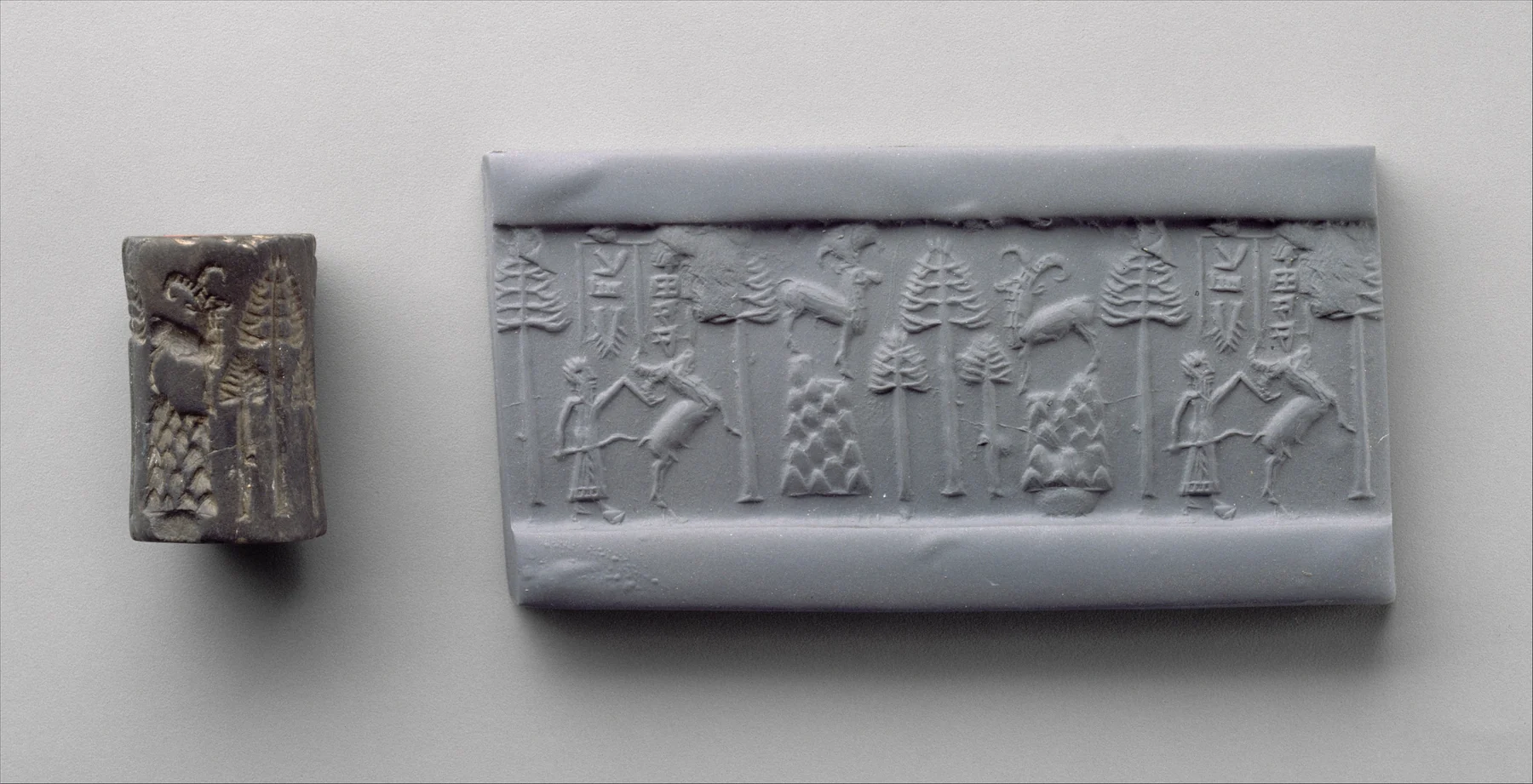
The carved cylinder is smaller than the first joint of a finger. Its impression can extend for as long as there is clay beneath it.
That transformation—from compact object to repeated image—is the seal’s intelligence. A carver cut figures below the stone’s surface in intaglio and in reverse. Rolling the cylinder across damp clay produced a raised, correctly oriented scene. The design could cross a tablet, close an envelope, or mark a lump of clay securing a container or door.
The Met’s object record compares the administrative use to a signature. The comparison is useful if kept narrow. A seal could identify the authority responsible for a document or sealing, but it was also an image, an inscribed possession, an ornament, and perhaps a protective object. Its central perforation allowed it to be worn or attached to clothing.
This seal names its owner: Balu-ili, a court official whose title was cupbearer. One group in the scene shows a hunter grasping an ibex between tall trees. Another places facing ibexes on mountains. Trees organise the rolling landscape, while the image begins again at the impression’s edges.
The relationship between Balu-ili’s title and the hunt is unknown. That gap matters. An inscription secures identity more firmly than it secures the meaning of every figure beside it.
The photograph also combines two different dates. The dark chert cylinder is ancient. The grey strip is a modern museum impression made so that viewers can see the complete design. Ancient users usually encountered the seal through partial or repeated rolls on practical objects. Modern display gives the miniature image a clarity its first viewers may not always have needed.
The owner could move; the mark could recur. Monumental authority was fixed to a site. Sealed authority travelled through bodies, storerooms, transactions, and clay.
Puzrish-Dagan: administration pressed into clay
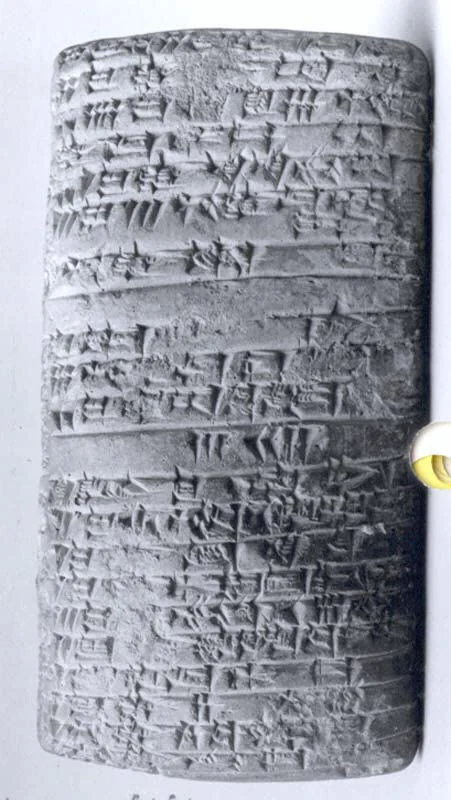
This tablet does not tell an epic. It balances an account.
Its cuneiform text lists transactions involving sheep, ewes, and goats. It identifies the account with Dugga and dates the record to year eight of King Amar-Suen, month one, day twenty-five—about 2039 BCE in the chronology used by the Met. A clay surface binds animals, responsibility, and time.
The object came from Puzrish-Dagan, modern Drehem, an administrative centre of the Ur III state. Thousands of surviving tablets from the site track livestock received and redistributed through state institutions. This one is not a picture of an animal economy; it is one operation inside it.
Writing in southern Mesopotamia was already more than a thousand years old when the tablet was made. The Met’s account of writing’s origins traces early proto-cuneiform records to the late fourth millennium BCE and stresses that research has complicated any single, tidy origin story. Early signs recorded quantities and commodities. Over time, scribes used wedge-shaped impressions and phonetic values to express languages and a far wider range of ideas.
So the Dugga tablet should not be exhibited as “the invention of writing.” Its importance lies in maturity: a script refined enough to make a bureaucratic system routine.
Close looking makes the labour visible. A scribe selected clay, shaped the tablet, calculated entries, held a stylus at changing angles, and organised signs into lines. Other people moved and counted the animals being recorded. Officials checked flows and obligations. The object compresses that work into a hand-sized surface, while preserving almost none of the workers’ individual voices.
The online museum record supplies a translated summary, ancient place, date, material, and a 1911 acquisition line. It does not provide a complete excavated context on the page. We can analyse what the text records without inventing the exact archive room, owner sequence, or route by which the tablet left Iraq.
Kalhu: the palace meets its visitor
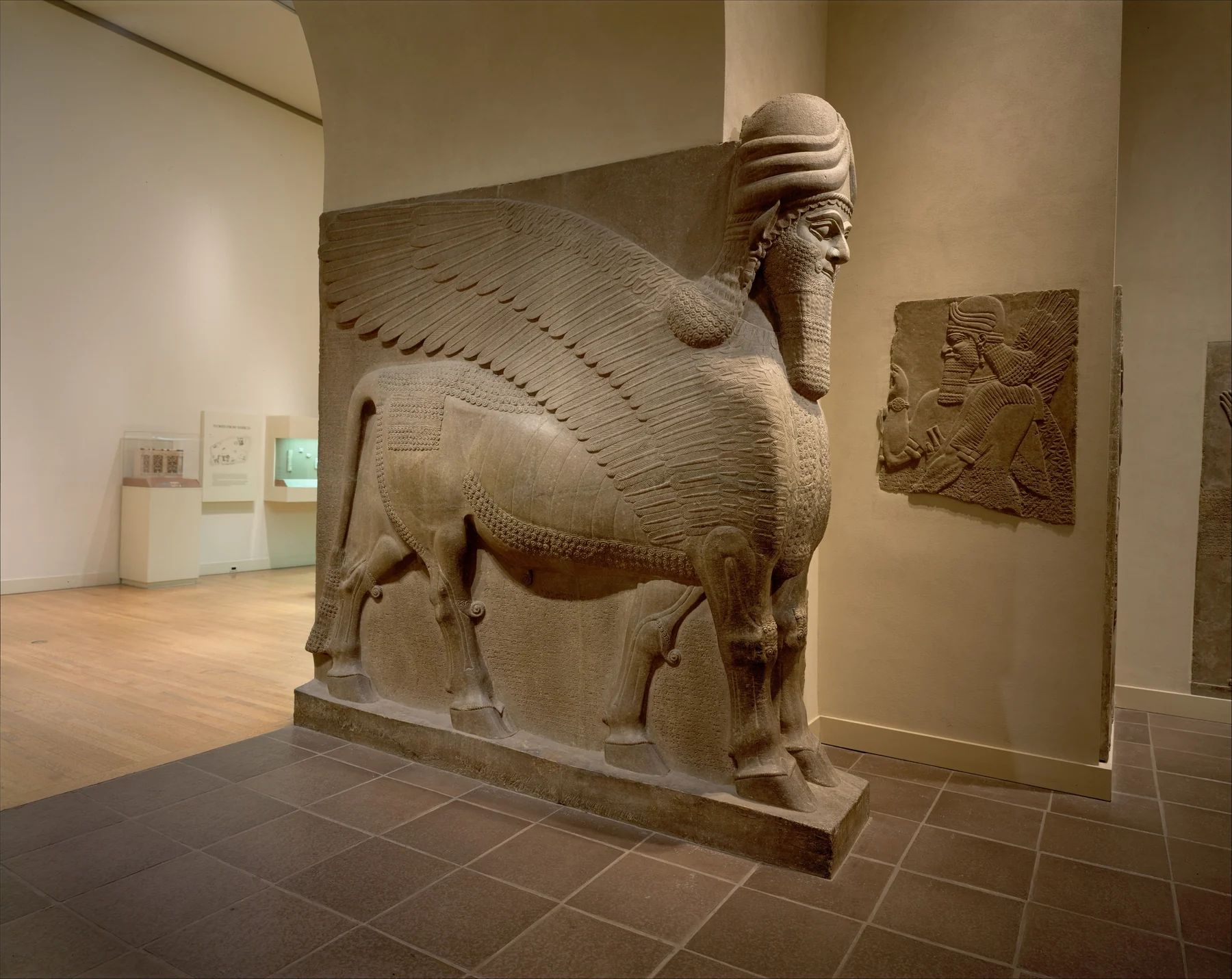
Walk toward the lamassu from the front and it stands still. Pass along its side and it strides.
The effect depends on an anatomical impossibility: five legs. Two forelegs make a stable frontal pair. Four visible legs form a walking bull in profile, with one leg shared between views. The sculpture was designed for a moving visitor, not one ideal photograph.
Ashurnasirpal II transformed Kalhu, modern Nimrud, into an Assyrian capital. His Northwest Palace joined reception rooms, courtyards, reliefs, inscriptions, colour, textiles, timber, and colossal guardians into an environment of rule. The Met’s Nimrud study explains that human-headed winged bulls and lions faced outward at important entrances, confronting approaching visitors while protecting the palace.
The composite body gathers capacities: human intelligence, the mass of a bull, the reach of a bird, and the horned crown of a divine being. Its scale—more than three metres high and over seven tonnes—turns those signs into architecture. Cuneiform inscriptions extend across its surface. Image, text, and doorway do not compete for attention; they reinforce the same threshold.
That threshold controlled more than fear. An envoy, courtier, labourer, tribute bearer, or subject approached through a sequence designed by the palace. The lamassu converted walking into political experience. It made imperial protection and royal command feel physically inseparable.
The palace’s beauty cannot be detached from empire. Assyrian kings celebrated conquest, tribute, forced movement, and the defeat of resisting cities in texts and reliefs. Skilled makers produced astonishingly precise surfaces within a state sustained by extraction from many populations. Admiring the carving does not require borrowing the king’s view of his power.
Nor is the museum installation a neutral afterlife. The Met’s history of early Assyrian excavations records that Austen Henry Layard’s nineteenth-century work removed large sculptures under Ottoman permissions, sometimes damaging slabs to reduce their weight. This lamassu travelled to Canford Manor in England, entered John D. Rockefeller Jr.’s collection, and reached the Met in 1932. The museum states plainly that such extraction and export would not be acceptable archaeological practice today.
The figure still guards a reconstructed doorway. Its original palace, colour, paired guardian, people, climate, and political setting are elsewhere.
Babylon: colour turns a street into ceremony
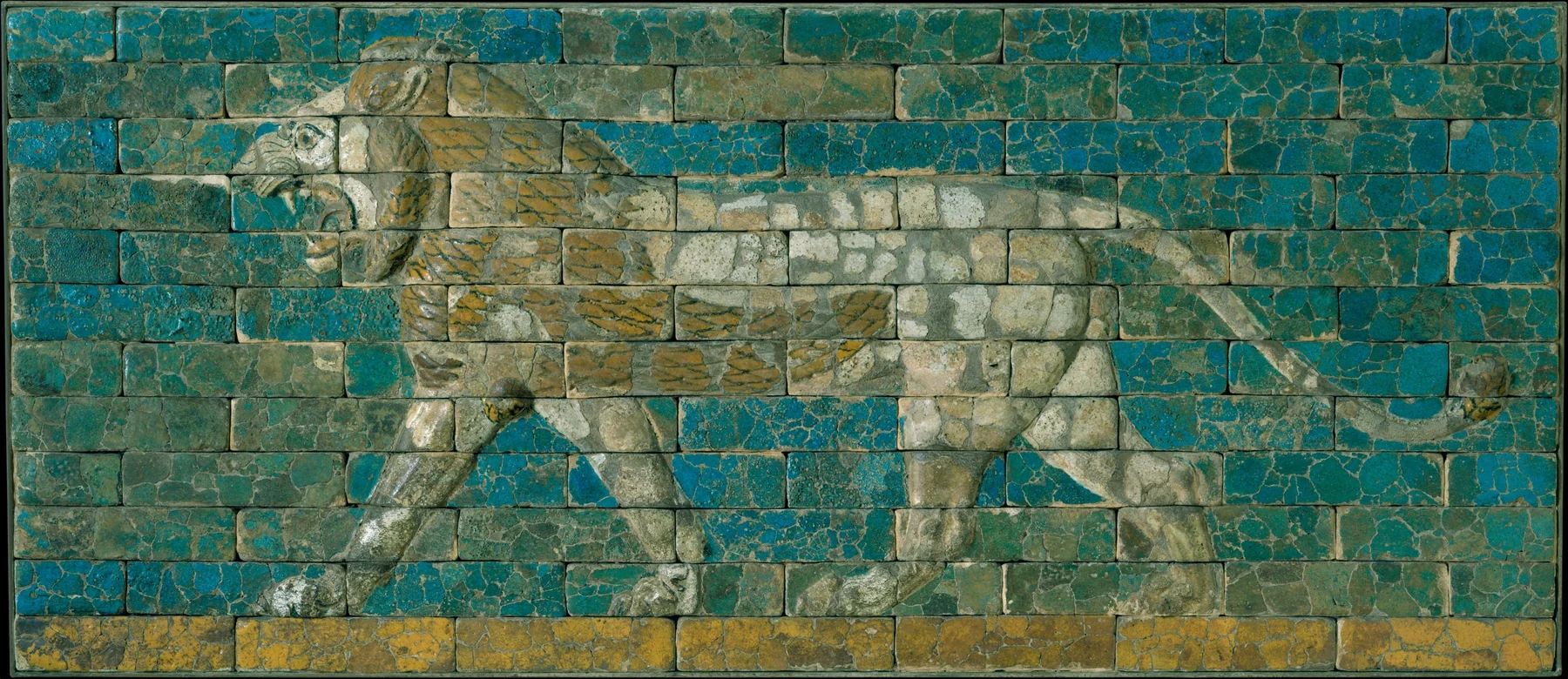
The lion is not painted on one flat tile. Its body crosses dozens of moulded, glazed bricks. Joints interrupt the muzzle, mane, belly, and legs; the animal survives because separate building units align.
Under Nebuchadnezzar II, Babylon became the centre of a large empire and an intensely constructed capital. Stone was scarce in the southern alluvial plain, but clay was abundant. Builders used moulded relief and coloured glaze to make architecture luminous, durable, and repeatable.
The Met’s record places rows of striding lions along the Processional Way north of the Ishtar Gate. The lions were associated with Ishtar, goddess of love and war. Their repeated bodies protected and guided the route used during the New Year festival toward the Bit Akitu, the festival house.
Repetition changes the animal. A single lion is an image. A long sequence establishes direction, rhythm, and controlled approach. Blue fields bind separate creatures into an architectural surface; alternating steps keep them moving beside the people in procession.
The panel also corrects a common label. Lions belonged to the Processional Way; bulls and dragons decorated the Ishtar Gate. Museum displays and popular photographs often merge gate, street, and later reconstruction into one blue monument. Their ancient programme was connected, but its parts had different animals and positions.
Babylon’s splendour was political. The Met’s revised history of the city describes a cosmopolitan imperial capital whose rulers moved populations to weaken opposition, supply labour, or both. The names and conditions of the workers who moulded, glazed, fired, transported, and set these bricks are not preserved by this panel. We should not convert missing evidence into a romantic story of anonymous civic unity.
The site remains Iraqi cultural heritage, not merely the ancient source of museum fragments. Babylon entered the UNESCO World Heritage List in 2019 and is protected under Iraqi law. Its conservation history includes excavation, reconstruction, political display, military damage, tourism, and continuing work by Iraqi institutions and international partners. The ancient city did not end when its bricks entered Berlin, New York, or an art-history textbook.
Five objects, five institutional actions
| Object | Institution and original setting | Action performed by the image | What the museum view compresses |
|---|---|---|---|
| Standing worshiper | Square Temple at Eshnunna | Maintained a person’s attentive presence before a deity | One figure is separated from an excavated group now divided among three museums |
| Balu-ili’s cylinder seal | Courtly and administrative movement through clay documents and sealings | Identified authority, secured access, carried imagery, and may have offered protection | A modern full impression replaces the partial and repeated rolls of ancient use |
| Dugga account | Ur III administration at Puzrish-Dagan | Made livestock transactions and a precise date accountable | Translation reveals content, but the online record does not reconstruct its complete archive or collecting history |
| Lamassu | Palace threshold at Kalhu | Protected the entrance and choreographed a visitor’s encounter with empire | A displaced guardian stands without its complete doorway, colour, pair, and palace population |
| Striding lion | Processional Way at Babylon | Protected and directed ritual movement through repeated glazed bodies | One assembled panel replaces a long urban sequence, festival, and living city |
Their scales range from 2.8 centimetres to more than three metres. Their reach does not follow size. The smallest object could reproduce its mark across many transactions; the largest concentrated power at one door.
Material connected cities to wider worlds
Clay dominates modern impressions of Mesopotamia because it survived in tablets, bricks, plaques, and sealings. It was abundant, versatile, and capable of holding writing, relief, colour, and architectural load. It was never the only material.
The worshiper’s gypsum, shell, black stone, and bitumen had to be selected and assembled. The seal’s chert required carving hard stone at miniature scale. The lamassu demanded quarrying, transporting, positioning, and finishing a block weighing tonnes. Babylon’s lion required controlled moulds, glazes, kilns, fuel, colour recipes, and brick-by-brick installation.
Mesopotamian cities also sought timber, metals, and prestigious stones beyond the alluvial plain. Trade, diplomacy, migration, raiding, tribute, and conquest moved materials and skills across West Asia. The Met’s account of the Akkadian period places art within expanding political and commercial horizons, but “exchange” should not be used as a gentle word for every movement. A merchant caravan, diplomatic gift, imperial levy, and deported craft worker did not participate on equal terms.
Material analysis must therefore ask two linked questions: where did a substance come from, and under what relations did it move?
Survival is part of the history
Every object in this guide is held by the same museum. That gives the article consistent open-access images and catalogue records, but it also gives one institution unusual power over the route. The primary records should be a beginning, not the final ownership of the past.
The Tell Asmar group is split among Baghdad, Chicago, and New York. The lamassu’s journey runs through nineteenth-century excavation and an English country house. The tablet’s online provenance is incomplete. The Babylon panel is one fragment of an Iraqi archaeological city whose most famous reconstruction stands in Berlin.
Modern destruction makes these histories more painful, not simpler. In 2015 and 2016, the Northwest Palace and other remains at Nimrud suffered deliberate, large-scale destruction. A UNESCO assessment mission documented damage and worked with Iraqi authorities on emergency measures.
It is tempting to conclude that removal “saved” dispersed sculptures. Some objects abroad did escape the damage. That survival does not retroactively justify extraction, loss of context, unequal divisions, or the treatment of Iraqi heritage as a resource for foreign collections. The more defensible conclusion is harder: preservation is now distributed, responsibility is shared, and Iraqi stewardship must remain central.
A compact timeline
| Date | Object or development | Why it matters here |
|---|---|---|
| late fourth millennium BCE | Proto-cuneiform records develop in southern Mesopotamia | Image, number, and administration begin a long transformation into cuneiform writing |
| ca. 2900–2600 BCE | Standing worshiper placed in the Square Temple at Eshnunna | A votive body maintains attention and presence beyond the duration of a visit |
| ca. 2350–2150 BCE | Akkadian rulers unite much of Mesopotamia by conquest | Courtly and imperial structures expand while seal imagery develops new narrative subjects |
| ca. 2250–2150 BCE | Balu-ili’s hunting seal is carved | A named official carries reproducible visual authority in a tiny stone object |
| ca. 2039 BCE | Dugga’s balanced account is written at Puzrish-Dagan | Ur III bureaucracy connects herds, persons, calculation, and calendar in clay |
| ca. 883–859 BCE | Lamassu made for Ashurnasirpal II’s Northwest Palace at Kalhu | Colossal image, inscription, and doorway choreograph an imperial encounter |
| ca. 604–562 BCE | Glazed lions line Babylon’s Processional Way | Repeated colour and animal bodies turn an urban route into ritual architecture |
| 1934 | Tell Asmar statue hoard excavated | A collective temple deposit is later divided among Baghdad, Chicago, and New York |
| 2015–16 | Nimrud suffers deliberate destruction | Ancient art remains part of Iraq’s living heritage and a present conservation responsibility |
| 2019 | Babylon inscribed on the UNESCO World Heritage List | Archaeological knowledge, Iraqi law, conservation, and public access meet at the living site |
Key terms
Mesopotamia: a Greek regional name for lands associated with the Tigris and Euphrates. It is a geographic and historical study term, not the name of one continuous ancient nation.
Cuneiform: a wedge-shaped writing technology, usually impressed into clay. It was a script adapted to multiple languages, not a language itself.
Votive figure: an object offered in a sacred setting. The Eshnunna worshiper represented a person in continuing attendance before a deity.
Cylinder seal: a carved cylinder rolled across soft material to create a repeated impression. It could identify authority, secure containers or doors, accompany documents, and be worn.
Intaglio: a technique in which forms are cut below a surface. On a cylinder seal, the recessed, reversed design becomes a raised impression in clay.
Seal impression: the image produced by rolling or pressing a seal. A museum’s modern impression is evidence of the carved design, not an ancient artefact from the object’s original use.
Lamassu: the conventional modern label used here for a monumental Assyrian human-headed winged guardian placed at an important threshold.
Glaze: a glass-like coating fused to ceramic through firing. Colour and relief allowed Babylonian builders to turn modular bricks into monumental animal processions.
Provenance: the documented history of excavation, ownership, transfer, and custody. An ancient findspot and a modern ownership history answer different questions.
Questions for close looking
Choose an ancient Mesopotamian object and follow its actions before naming its style:
- Was it fixed to a building, carried on a body, stored in an archive, buried, or repeatedly handled?
- Does the object show an image, produce an image, hold writing, shape movement, or combine these functions?
- Who could activate it: a worshiper, priest, scribe, official, ruler, builder, or procession?
- Which details make authority legible—scale, repetition, inscription, precious material, position, colour, or controlled access?
- What labour is visible in the surface, and what labour disappears behind the institution that commissioned it?
- Which statement comes from a translated text, archaeological findspot, visual observation, later analogy, or curatorial interpretation?
- Is the displayed form ancient, reconstructed, assembled, digitally isolated, or paired with a modern impression?
- Where is the object now, how did it arrive there, and which people or institutions care for the site from which it came?
Use the Observation → Effect → Context → Argument method to turn those answers into a thesis. For a comparison, keep one action constant: ask how two objects guard, authorise, record, or direct in different materials and spaces. The framework in How to compare two artworks will help keep the comparison relational.
Five myths to retire
- “Mesopotamian art belongs to one civilisation with one style.” The term covers changing cities, languages, kingdoms, and empires across a large region and long chronology.
- “Cuneiform is the Sumerian language.” Cuneiform is a script that was adapted to Sumerian, Akkadian, and many other languages.
- “Writing began as literature.” The earliest surviving proto-cuneiform evidence is closely tied to accounting; literary, legal, scholarly, diplomatic, and personal uses expanded over time.
- “The lamassu has five legs because the sculptor made a mistake.” Its legs resolve two planned views: standing from the front and striding from the side.
- “The Ishtar Gate was covered in lions.” Lions lined the Processional Way; bulls and dragons decorated the gate. The connected ensemble had differentiated parts.
Where to continue
Begin with the five primary object records: the Met’s standing worshiper, Akkadian hunting seal, Dugga tablet, lamassu, and Babylon lion. Each separates catalogue data from the broader arguments made here.
For the early city and writing, continue with the Met’s Art of the First Cities, The Origins of Writing, and Akkadian period. Its open educator resource on ancient West Asian art includes object studies, maps, techniques, and discussion questions.
To restore the objects’ modern histories, use ISAC’s Tell Asmar hoard record, the Met’s rediscovery of Assyria, its revised history of Babylon, and UNESCO’s records for Babylon and Nimrud’s damage assessment.
Then return to the small worshiper. Its eyes are memorable, but the deeper invention is temporal. Stone, shell, and bitumen were organised so that a human relationship with an institution could outlast the human body’s visit.
Across Mesopotamia, images repeatedly solved that problem. They gave authority a body, a mark, a record, a threshold, and a street.
Editorial record
About this article
- Author
- Publisher
- GeMarkt
- Published
- Updated
- Reviewed
- Internal source & rights check. Conducted by GeMarkt Research Review. This is an internal editorial check—not independent peer review.
- Source standard
- Art history source standardPrioritises object records and research sources, distinguishes evidence from interpretation, and states material uncertainty.
Found a claim that needs checking? Report a factual error.