Art History · Learning chapter
Atlas III — Early-modern worlds · 10 of 11
Baroque worlds: Rome, Madrid, Antwerp, Amsterdam, and colonial circulation
A grounded guide to Baroque art as five systems of persuasion shaped by chapel, court, church, guild, and colonial rule.


What we’ll look at
How did Baroque art persuade viewers on behalf of churches, courts, and empires?
The Baroque is easy to recognise until two Baroque works are placed beside each other.
Bernini makes marble levitate in a Roman chapel. Velázquez turns a room in Madrid into a puzzle about looking. Rubens pushes a cross through three towering panels in Antwerp. Rembrandt stages a quality-control meeting in Amsterdam. Across the Atlantic, an Indigenous painter in Quito portrays three Afro-Indigenous leaders for a picture sent to the king of Spain.
Swirling fabric, sharp light, diagonal movement, and theatrical address explain part of this world. They do not explain why these objects were made, who encountered them, or what kind of authority each one served.
This guide therefore asks one question across five places:
Who was the work trying to persuade, and whose authority did it ask the viewer to accept?
The answer is not “the Church,” “the monarch,” or “the market” in the abstract. It is a chapel patron turning family memory into sacred theatre; a court painter positioning art inside royal presence; a church commission confronting worshippers at monumental scale; a guild presenting inspection as civic competence; and a colonial official sending an image of negotiated submission across an empire.
Define the term before using it
Here, Baroque is a practical study label for selected artistic systems between about 1580 and 1750. It is not a universal clock, and it does not name one appearance shared by every object in the period.
Even within Europe, the map was politically fractured. Rome belonged to the Papal States. Madrid was the centre of the composite Habsburg monarchy. Antwerp remained in the Spanish Netherlands, while Amsterdam became a leading city of the Dutch Republic after decades of revolt and war. These places were connected by artists, prints, diplomacy, trade, armies, dynastic rule, and religious conflict. They were not variations of a single capital.
The Atlantic makes the label harder. The portrait from Quito discussed below dates to 1599 and is described by the Prado as chronologically Mannerist. It belongs here not because every feature is “Baroque,” but because it exposes a route that a Rome-to-Amsterdam story would otherwise hide. The same Spanish monarchy that structured court culture in Madrid also claimed authority in the Americas. A period label becomes more useful when it reveals its own limits.
Rome: a chapel directs religious experience
In brief: Cardinal Federico Cornaro commissioned Bernini and his workshop to build this family chapel in Rome between 1647 and 1652. Sculpture, architecture, and concealed light draw visitors into Saint Teresa’s religious experience.
Bernini’s Ecstasy of Saint Teresa is often reproduced as an isolated sculpture: an angel, a reclining saint, clouds, and gilded rays. In Santa Maria della Vittoria, it is only the centre of a larger machine.
Cardinal Federico Cornaro commissioned the family chapel, which Bernini and collaborators completed between 1647 and 1652. Coloured marbles frame the altar like a stage. Members of the Cornaro family appear in relief in boxes on the side walls, conversing and looking toward the event. Light enters through a concealed window behind the pediment and strikes the marble figures and metal rays. Architecture, sculpture, painting, stucco, bronze, and natural light operate together.
The Italian Interior Ministry’s record of the chapel restoration calls the structure a theatrical proscenium and identifies eight Cornaro family members as spectators. The Met’s account of Baroque Rome places this hidden light and integration of media within a broader Roman effort to heighten religious experience.
The scene represents the transverberation described by Teresa of Ávila: an angel pierces her heart with divine love. Bernini does not ask a chapel visitor to examine a neutral record of that vision. He controls distance, illumination, framing, and witnesses so that the visitor encounters an event already being seen. The Cornaro spectators model attention from privileged seats; the real worshipper occupies the chapel floor.
Calling the work “dramatic” is accurate but incomplete. Drama is the method. The chapel joins Catholic devotion, Teresa’s canonisation in 1622, the patron’s burial and family memory, and Bernini’s command of several arts. It persuades through an environment rather than through marble alone.
Madrid: royal power occupies the viewer’s position
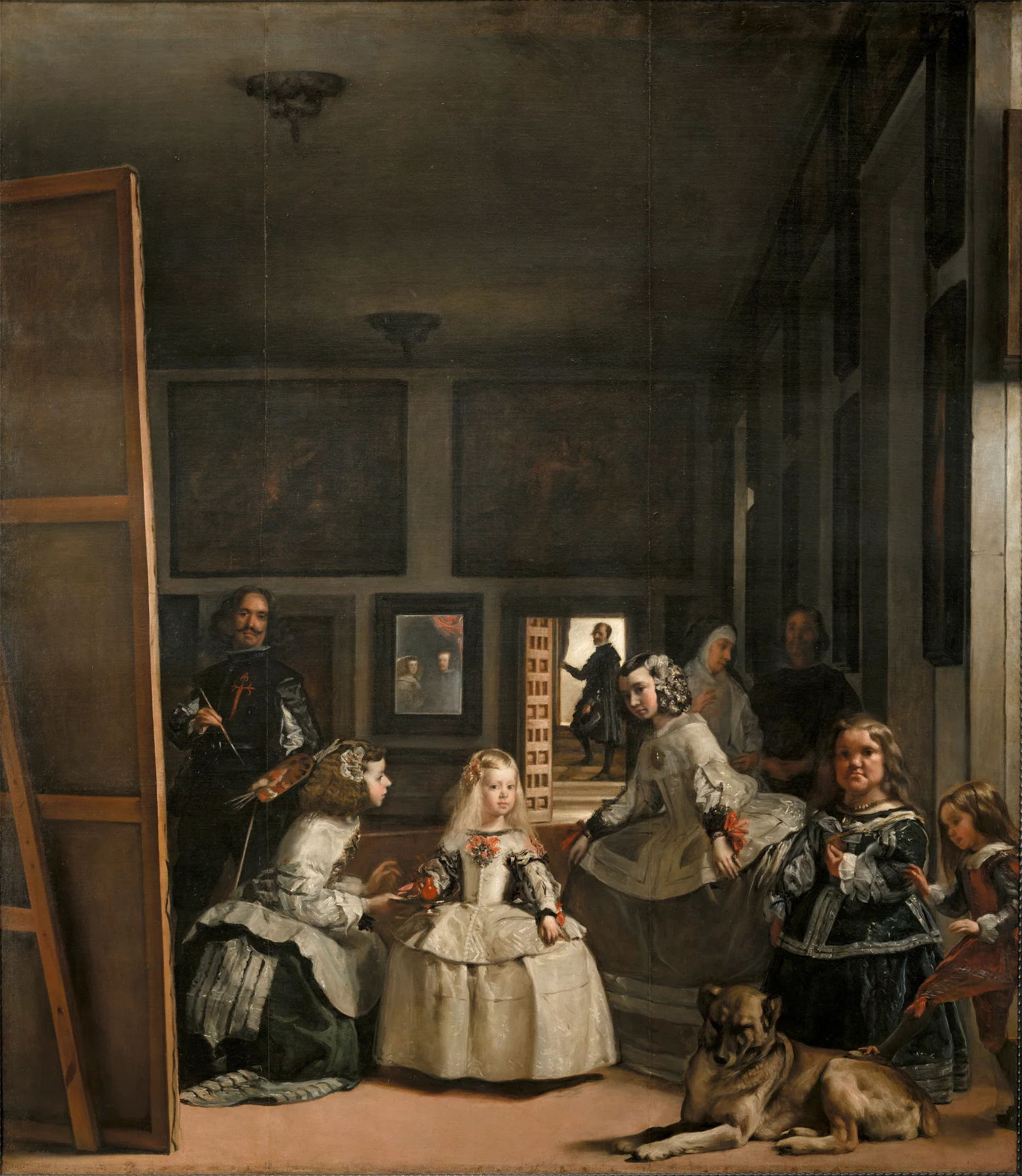

At first glance, Las Meninas looks less forceful than Bernini’s chapel. Nobody flies. Most figures have paused. Yet the painting organises royal authority with extraordinary precision.
The Prado records the work as a 1656 oil painting measuring more than three metres high. The scene takes place in the Prince’s Room of Madrid’s Alcázar, where Velázquez worked. At the centre stands the Infanta Margarita, attended by María Agustina Sarmiento and Isabel de Velasco. Mari Bárbola and Nicolasito Pertusato stand at the right beside a mastiff. Marcela de Ulloa and an attendant occupy the middle distance; José Nieto appears in the open doorway. Velázquez places himself at the left before the unseen front of a huge canvas.
On the rear wall, a mirror reflects Philip IV and Mariana of Austria. The royal couple may stand where the viewer stands, may be the subjects of Velázquez’s canvas, or may appear through another optical construction. The scholarship is extensive and no single solution empties the painting of its other possibilities. What matters here is structural: the king and queen are physically small inside the painted surface but organise nearly every gaze and interruption.
The viewer is offered a remarkable place, close to the position of royal vision, then reminded that the place belongs to someone else. We can look into the room because the painting lends us a privileged axis. The figures’ reactions make that axis socially charged.
Velázquez also makes painting itself part of the court’s hierarchy. He appears working and thinking, not merely supplying an image from outside the royal world. The rear-wall pictures refer to competitions between mortals and gods, while the painter’s scale and visibility press a claim for the intellectual status of his art. The Prado describes the mirror as a device that turns the work into a reflection on seeing, representation, and the viewer’s role.
Las Meninas is therefore not a code with one answer. It is a court portrait that makes access, rank, labour, and spectatorship unstable enough to be noticed. Royal power does not need to fill the canvas. It controls the position from which the canvas becomes intelligible.
Antwerp: a triptych recruits the worshipper’s body
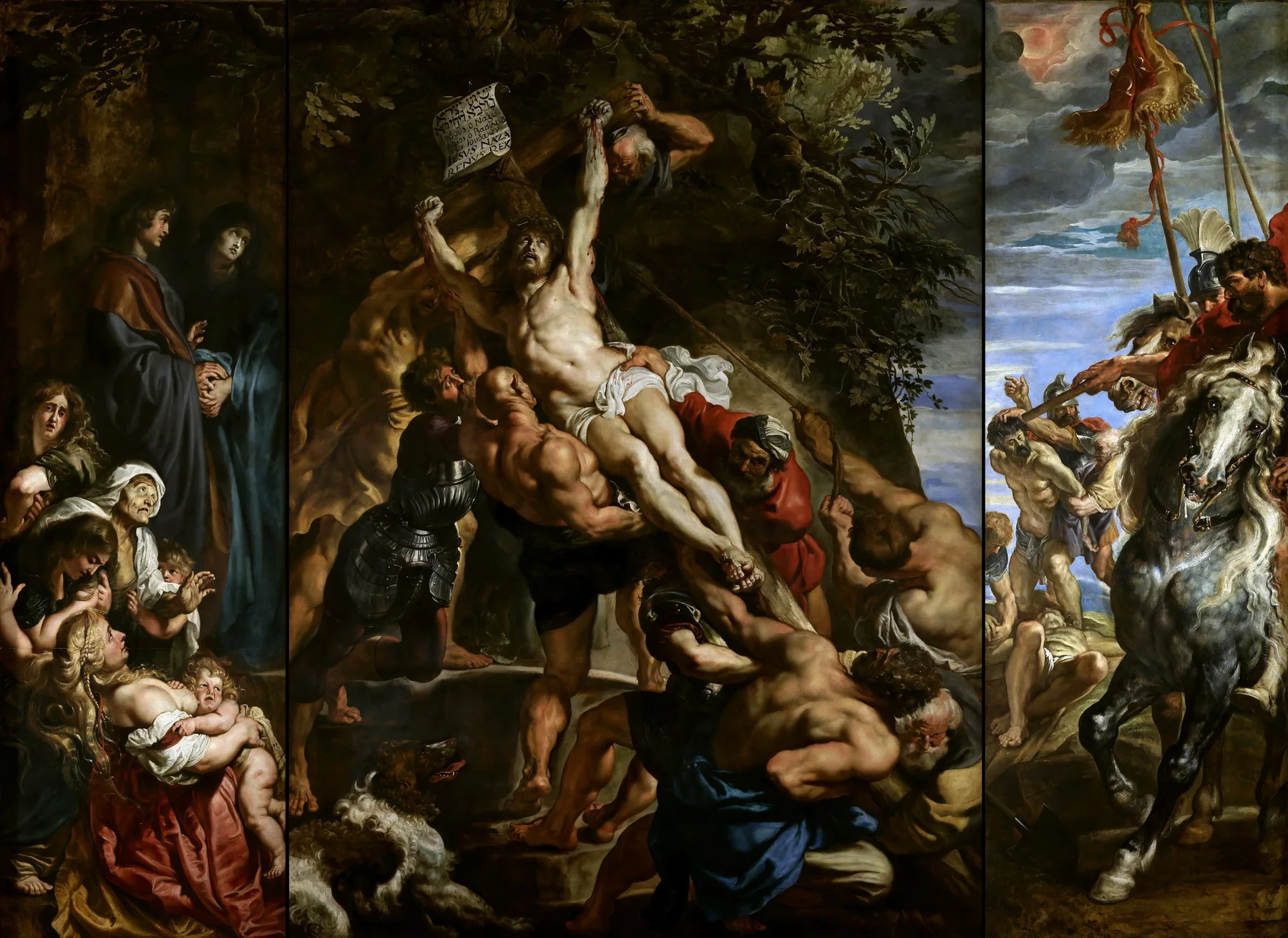

Rubens returned to Antwerp from Italy in 1608. Soon after, Cornelis van der Geest commissioned The Raising of the Cross for the high altar of Saint Walburga’s Church. The church later disappeared; the triptych is now in the Cathedral of Our Lady.
Scale changes the meaning of familiar formal terms. The Antwerp cathedral account gives the central panel as roughly 4.6 metres high and 3.4 metres wide, with each wing adding about 1.5 metres. A diagonal is not merely a line to mark in an essay. At this size, the cross becomes a weight hauled upward by bodies near or larger than the worshipper’s own.
The effort begins low at the right and drives toward Christ at the upper centre. Arms, backs, ropes, timber, and foreshortened limbs turn execution into collective physical labour. The wings do not politely illustrate events beside the main scene. Mourners, children, soldiers, horses, landscape, and changing light extend the event laterally, surrounding the central force with grief and command.
Italian experience is visible in the muscular anatomy, compressed action, and strong light, but “Italian influence” is only useful if the route is named. Rubens had spent years in Italy, studying works and working for patrons before bringing that knowledge back to Antwerp. He did not copy a finished Italian formula. He reorganised what he had learned for a northern triptych and a public Catholic altar in the Habsburg-ruled Southern Netherlands.
The work’s original setting matters as much as its style. On a high altar, the lifting of the cross answered the vertical structure of the church and the liturgy conducted below it. Its audience was not a private collector comparing brushwork at arm’s length. The triptych addressed a congregation through scale, bodily strain, and a narrative that crossed three panels.
Amsterdam: inspection becomes civic theatre
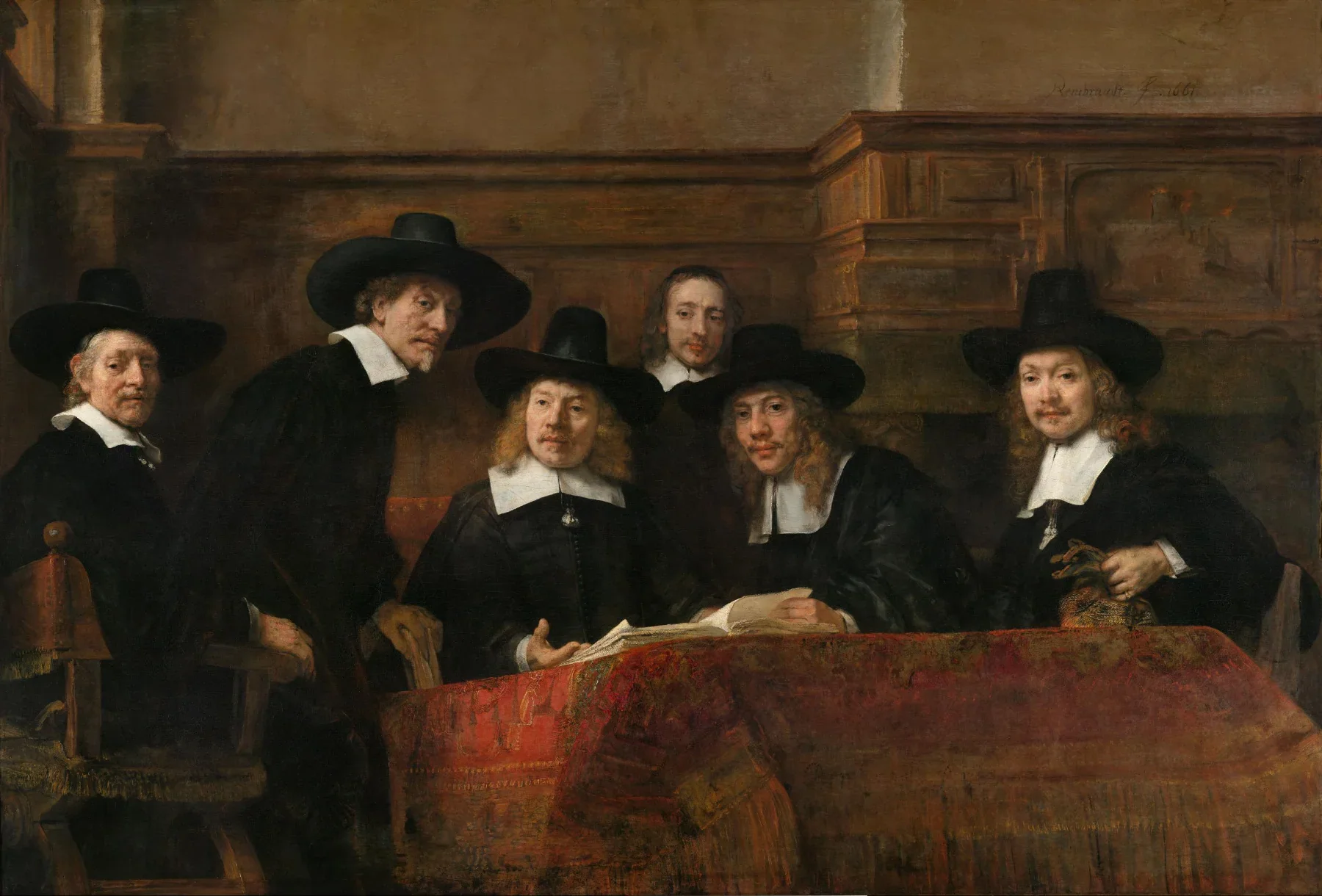
Amsterdam did have churches, religious art, wealthy collectors, and dramatic paintings. Antwerp had merchants and private houses. “Catholic spectacle versus Protestant restraint” cannot carry the comparison.
Rembrandt’s Sampling Officials reveals a more exact institutional difference. The Rijksmuseum object record identifies the men as officers trusted with quality control in the woollen-cloth industry. They commissioned the painting for the Drapers’ Guild hall, the Staalhof. Five wardens sit or rise behind the table; their servant, Frans Hendricksz Bel, stands behind them. An open sample book lies before the group.
The officials do not pose as disconnected faces. They look up together, as if someone has entered during their work. One man pushes against his chair or begins to rise. Another gestures near the book. The low viewpoint makes the table a barrier and the sitters an examining body. Rembrandt turns our arrival into the painting’s event.
Authority here is corporate rather than royal, but it is not informal. The guild regulated standards, and the portrait presents judgment as an organised, documented activity. Black clothes and dark hats create visual agreement; different expressions and postures preserve individual responsibility. The book anchors the group’s attention to procedure.
A so-called “free market” still depended on institutions. The Dutch Republic supported a competitive art market with many kinds of buyers, but this work was a specific commission for a regulatory organisation. Merchant wealth did not abolish patronage; it diversified the bodies that could commission images of themselves.
The Persian carpet on the table also interrupts any sealed national story. The museum record identifies it without claiming a complete trade history for this particular object. At minimum, its presence makes imported luxury material part of the guild’s public self-image. Amsterdam’s local authority was staged with goods and visual knowledge drawn from wider routes.
Quito to Madrid: a portrait travels inside colonial power
.jpg)
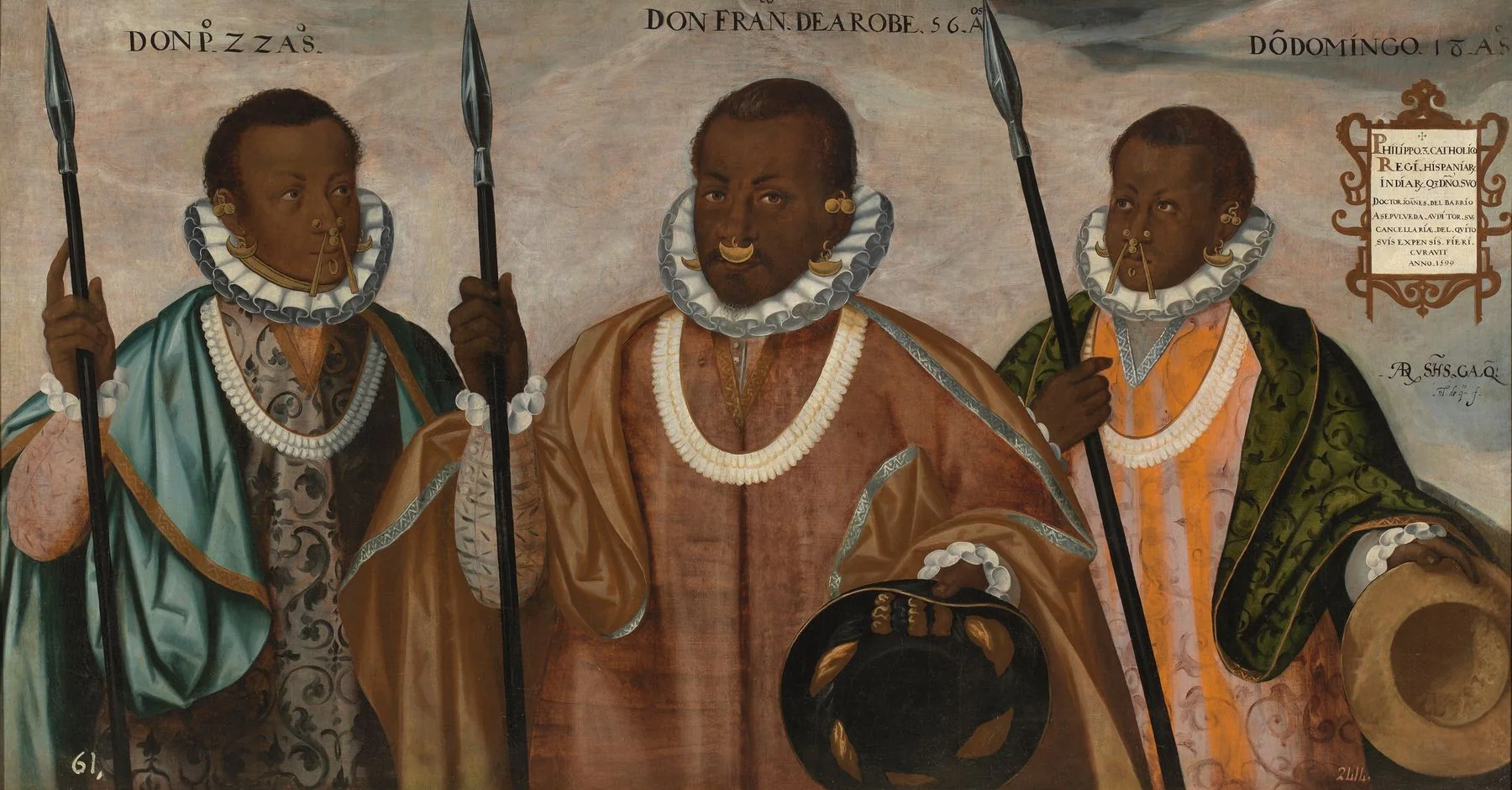
This portrait has often circulated under the title The Three Mulattoes of Esmeraldas. The Prado now titles it Don Francisco de Arobe and his Sons, Caciques of Esmeraldas, restoring names and political status that the older category suppresses.
The Prado’s object record identifies the sitters as Don Francisco, aged fifty-six, and his sons Don Pedro and Don Domingo, aged twenty-two and eighteen. Andrés Sánchez Galque, an Indigenous painter active in Quito, signed and dated the canvas in 1599. The Prado describes it as the oldest surviving signed and dated portrait from the Viceroyalty of Peru.
Juan del Barrio de Sepúlveda, a judge of the Audiencia of Quito, commissioned the picture as a gift for Philip III. It accompanied a report on the “pacification” of Esmeraldas. That administrative word should not be allowed to neutralise coercion. Spanish officials were trying to convert negotiated relationships with autonomous Afro-Indigenous leaders into royal vassalage and territorial control.
The picture participates in that project. Don Francisco and Don Domingo hold their hats rather than wear them, a gesture the Prado connects to respect and submission before the monarch. A Latin inscription names Philip III and the commissioning official. The canvas itself could travel from Quito toward the royal court, making distant subjects visible to a king who did not meet them.
Yet the men do not disappear into the commission’s political intention. They face outward, occupy almost the full height of the canvas, hold long spears, and wear carefully differentiated garments. European ruffs and hats meet Andean tunics and mantles, imported textiles, shell necklaces, and gold nose and ear ornaments. The Prado’s technical and historical research stresses that dress marked hierarchy and that some fabrics arrived through routes connecting China, Mexico, Europe, and the Andes.
The portrait therefore cannot be reduced to either colonial propaganda or uncomplicated self-representation. Its commissioner used it to report submission; the named sitters project rank, armed presence, family succession, and material distinction; an Indigenous painter gave that encounter durable form. These agencies were unequal, but they coexisted inside the object.
Including the painting also changes the geography of “Spanish Baroque.” Madrid was not only a court that produced and collected art. It was a destination within an imperial information system. Images, reports, people, silver, textiles, and commands travelled along routes created and enforced by colonial rule.
Five works, five systems of persuasion
| Place and object | Original commissioner or institutional frame | Primary audience and setting | How persuasion works | Authority made visible |
|---|---|---|---|---|
| Rome — Bernini, Ecstasy of Saint Teresa | Cardinal Federico Cornaro and a family burial chapel | Worshippers and visitors inside Santa Maria della Vittoria | Integrated marble, architecture, family witnesses, and concealed light | Catholic devotion, sainthood, patronal memory |
| Madrid — Velázquez, Las Meninas | Royal court; later documented in Philip IV’s palace office | A restricted palace audience organised around royal presence | Gazes, mirror, scale, interruption, and the painter’s self-placement | Monarchy, dynasty, access, and painting’s intellectual status |
| Antwerp — Rubens, Raising of the Cross | Cornelis van der Geest for Saint Walburga’s high altar | A congregation encountering a monumental triptych | Bodily strain, diagonal movement, changing light, and liturgical scale | Public Catholic worship and Habsburg-era urban patronage |
| Amsterdam — Rembrandt, The Syndics | Officers of the Drapers’ Guild | Visitors to the Staalhof and members of a regulated trade | A staged interruption, group coordination, book, table, and low viewpoint | Corporate competence and civic-economic regulation |
| Quito to Madrid — Sánchez Galque, Don Francisco de Arobe and his Sons | Juan del Barrio de Sepúlveda for Philip III | The Spanish court through a portable report-image | Named likeness, dress, weapons, inscription, protocol, and long-distance transmission | Colonial vassalage, negotiated status, and Afro-Indigenous leadership |
The table makes one thing clear: formal intensity is not an explanation by itself. Each work builds a relationship among maker, commissioner, site, audience, and institution. “Baroque” is most useful when it starts that comparison, not when it ends it.
A compact timeline
| Date | Event | Why it matters here |
|---|---|---|
| 1585–90 | Pope Sixtus V reshapes major routes through Rome | Baroque persuasion operates at the scale of streets and pilgrimage as well as individual objects. |
| 1599 | Sánchez Galque signs the Arobe portrait in Quito | A portable image joins named Afro-Indigenous leaders, an Indigenous painter, colonial administration, and the Spanish court. |
| 1608 | Rubens returns to Antwerp after years in Italy | Artistic travel becomes a traceable route rather than a vague claim of “influence.” |
| 1609–10 | Rubens paints The Raising of the Cross | Monumental action is designed for a specific high altar and congregation. |
| 1622 | Teresa of Ávila is canonised | Bernini’s later chapel gives a newly canonised saint’s vision an integrated public form. |
| 1647–52 | Bernini creates the Cornaro Chapel ensemble | Chapel, family monument, theatre, natural light, and sculpture become one environment. |
| 1648 | The Dutch Republic gains international recognition at the Peace of Westphalia | Amsterdam and Antwerp now sit within sharply different political and confessional structures. |
| 1656 | Velázquez paints Las Meninas | Court portraiture becomes an inquiry into royal presence, access, and representation. |
| 1662 | Rembrandt paints The Syndics | A trade body turns inspection and documentation into a civic group portrait. |
| c. 1750 | A practical endpoint for this study frame | Baroque practices continue unevenly; the date organises study rather than ending a global style. |
Key terms
Baroque: a later art-historical label applied to varied seventeenth- and early-eighteenth-century practices. It can describe formal qualities, but it should not erase local institutions and chronologies.
Confessional: shaped by an organised religious identity and its institutions. The term is more precise than assuming every work simply reflects private belief.
Triptych: a work composed of three panels. Wings may close, frame, or extend the central image depending on the object and its use.
Court painter: an artist serving a ruler or royal household. The role could combine portraiture, decoration, administration, collection care, and court office.
Group portrait: an image of several identifiable people, often commissioned by the sitters or the organisation they represented.
Cacique: a Spanish colonial term used for an Indigenous local leader or chief. Its meanings varied by region and administrative context.
Audiencia: a high royal court and governing institution in Spain’s American territories.
Vassalage: a political relation of declared submission and obligation to a ruler. In colonial settings, the term may conceal coercion and unequal negotiation.
Questions for close looking
Choose one object before reading its label and work through these questions.
- Where does the work place your body: below, outside, inside, interrupted, judged, or invited?
- Which figure or device controls the other gazes?
- What changes when you restore the original site, scale, or route?
- Which materials announce expense, distance, labour, or access?
- Who is named, who is present but socially separated, and who remains invisible?
- Does the work ask you to believe an event, recognise a rank, trust an institution, or accept a political relationship?
Then turn the observations into an argument using the Observation → Effect → Context → Argument method. For a comparison, organise the paragraph around one shared problem—such as viewpoint or institutional authority—using the method in How to compare two artworks.
Five myths to retire
- “Baroque means dramatic.” Drama is a technique; the historical question is what it was designed to make present or credible.
- “Catholic art is theatrical and Protestant art is restrained.” Confessional settings matter, but courts, guilds, markets, civic bodies, and individual patrons cross that binary.
- “Dutch art escaped patronage because it had a market.” Markets multiplied buyers; they did not remove commissions or institutions.
- “Court painting is only propaganda.” It can serve power while also examining representation, artistic labour, and the conditions of access.
- “Colonial art is a provincial copy of Europe.” The Arobe portrait joins Indigenous authorship, Afro-Indigenous political presence, imported and local materials, and a coercive imperial route that no European-centre model can explain alone.
Where to continue
Read this article beside Renaissance art: patronage, perspective, workshops, and competing centres. The Renaissance guide asks who shaped the work; this one asks how the finished work shaped a viewer’s relation to authority. Together they replace a parade of “great masters” with commissions, sites, routes, labour, and audiences.
Primary records used here include the Cornaro Chapel restoration account, the Prado records for Las Meninas and Don Francisco de Arobe and his Sons, the Antwerp cathedral account of Rubens’s triptych, and the Rijksmuseum record for The Syndics.
For wider context, continue with the Met’s essays on Baroque Rome, Bernini, and the competitive art market of the Dutch Republic, as well as its introduction to the arts of the Spanish Americas. These sources are starting points for research, not substitutes for returning to the individual object record.
Editorial record
About this article
- Author
- Publisher
- GeMarkt
- Published
- Updated
- Reviewed
- Internal source & rights check. Conducted by GeMarkt Research Review. This is an internal editorial check—not independent peer review.
- Source standard
- Art history source standardPrioritises object records and research sources, distinguishes evidence from interpretation, and states material uncertainty.
Found a claim that needs checking? Report a factual error.