Art History · Learning chapter
Atlas II — Connected worlds · 1 of 10
Late Antique art: remaking Roman, Christian, Jewish, and West Asian visual worlds
A five-object guide to how late antique makers remade imperial authority, worship, burial, clothing, and courtly power across connected worlds.

_Statue_of_the_four_tetrarchs_St._Mark%27s_Basilica.jpg)
What we’ll look at
How were Roman forms remade for new religions and governments?
Four rulers press together in two pairs. Their arms cross one another’s shoulders, but their free hands remain on their swords. They wear nearly the same armour, cloaks, caps, large eyes, and compact bodies. Age distinguishes one partner in each pair more clearly than individual likeness does.
The sculpture is usually dated to about 300 CE, when Diocletian’s Tetrarchy divided imperial rule among two senior emperors and two junior colleagues. Its red-purple porphyry came from Egypt and carried imperial associations. The embrace turns cooperation into a bodily fact; the weapons admit that concord required force.
Today the two porphyry blocks are fixed to a corner of St Mark’s Basilica in Venice. They were brought from Constantinople as plunder after the Fourth Crusade sacked the city in 1204. A monument made to stabilise Roman government later became evidence of Venetian conquest. One object has served two political stories separated by nine centuries.
That double history is a useful entrance to Late Antiquity. The period was not an empty corridor between a finished classical world and a not-yet-begun Middle Ages. Makers, patrons, worshippers, rulers, and later collectors repeatedly reassigned inherited materials and forms.
This guide asks one question across five objects:
How were Roman materials and visual formats remade for new imperial, Christian, Jewish, Egyptian, and West Asian authorities—and what does a story of simple decline fail to see?
The answer will not be one new style. An imperial portrait suppresses likeness to stage collective rule. A synagogue covers its walls with biblical narratives. A Roman workshop translates a Christian judgement scene through shepherd and philosopher imagery. An Egyptian tunic carries Dionysian figures across a living body. A Sasanian silver plate makes royal power circulate through hunting and precious metal.
Together, they show transformation, conflict, persistence, and loss. None is sufficient alone.
A period made from overlapping clocks
“Late Antiquity” is a modern study term, not a name used by everyone who lived within it. Its dates change with the question. The British Museum uses it broadly for parts of Europe, North Africa, West Asia, and neighbouring regions from about the third through seventh centuries; narrower categories within that span include Late Roman, Early Byzantine, Sasanian, Coptic, and Aksumite.
This article takes a smaller route from 244/45 to about 600 CE. It begins just before Diocletian’s political reorganisation because the Dura-Europos synagogue reveals a third-century religious and urban world that later imperial narratives often hide. It ends before the mature Byzantine icon debates and the formation of early Islamic empires, which require their own chapters.
Even this boundary is uneven. The western imperial office ended in 476, but Eastern Roman emperors governed from Constantinople for centuries afterward. The Sasanian Empire, founded in 224, remained a major West Asian power until the seventh century. Jewish communities did not enter or leave history on a Roman dynastic schedule. Egypt’s textile practices joined long local histories to Mediterranean dress, imperial administration, and changing religions.
The period therefore cannot be organised by one “fall.” Political authority contracted in some places and consolidated in others. Cities, tax systems, trade routes, workshops, languages, and religious institutions changed at different speeds. Warfare and epidemic caused real damage; older skills and texts also survived, moved, or acquired new uses.
Five objects cannot represent every late antique society. This route has no Aksumite work, Armenian church, North African mosaic, or ordinary rural house. Survival favours durable or unusually preserved materials and institutions able to collect and publish them. The route tests a historical claim; it does not stand in for a continent-sized period.
The Tetrarchs: likeness yields to a political system
The so-called Portraits of the Four Tetrarchs refuse the habits many viewers learn from earlier Roman portraiture. There are no softly shifted poses, carefully differentiated hairstyles, or convincing transitions between bone, muscle, and fabric. The figures are short in proportion, frontally alert, and built from repeated units. Their hands, eyes, sword hilts, belts, and pleated armour create a controlled rhythm across both pairs.
Calling this a decline in observation mistakes one visual aim for every possible aim.
Roman imperial portraits had never been neutral records of faces. Augustus appeared perpetually youthful; later emperors selected beards, hairstyles, or expressions that linked them with admired predecessors and political ideals. The Met’s history of the late Roman portrait cycle explains the Tetrarchic change as a move toward geometric symmetry and a communal image. Individual features were reduced to present four rulers as one authority.
The four-ruler system was formalised in 293. Diocletian and Maximian served as senior Augusti, while Galerius and Constantius Chlorus became junior Caesares. Division was meant to make rule over a large, pressured empire more governable while planning succession. It did not end rivalry; the system fractured after Diocletian and Maximian abdicated in 305. The image projects the unity government needed, not a documentary report that unity had been achieved.
Material strengthens the claim. Red porphyry was difficult to quarry and work, and its imperial use made colour itself part of authority. The Italian national heritage catalogue record for the relief describes smooth military cuirasses, jewelled belts, broad cloaks, and holes once prepared for metal diadems; it also notes evidence that armour surfaces were originally gilded. What now appears as one dark stone field once combined porphyry, metal, and reflected light.
The catalogue associates the group with Constantinople’s Philadelphion, although its earliest installation and the identities of each pair remain debated. That distinction matters. A date around 300 precedes Constantine’s formal dedication of Constantinople in 330, so “from Constantinople” cannot automatically mean designed there for the later city. The safest claim is that the sculpture expressed Tetrarchic rule and subsequently formed part of Constantinople’s monumental fabric.
Its Venetian setting is not a harmless frame. The St Mark’s research project records its removal during the sack of 1204. Set into the basilica’s exterior, imperial porphyry became spolia: older material reused in a new structure and political order. The embrace could now signify not only Roman concord but Venice’s possession of Constantinople’s prestige.
Read in both settings, the object makes a more precise claim than “art became abstract.” A Roman portrait format was compressed into an emblem of shared office; then a crusading maritime republic converted that emblem into a trophy. Style, material, placement, and seizure all changed what the bodies could mean.
Dura-Europos: a synagogue made scripture spatial
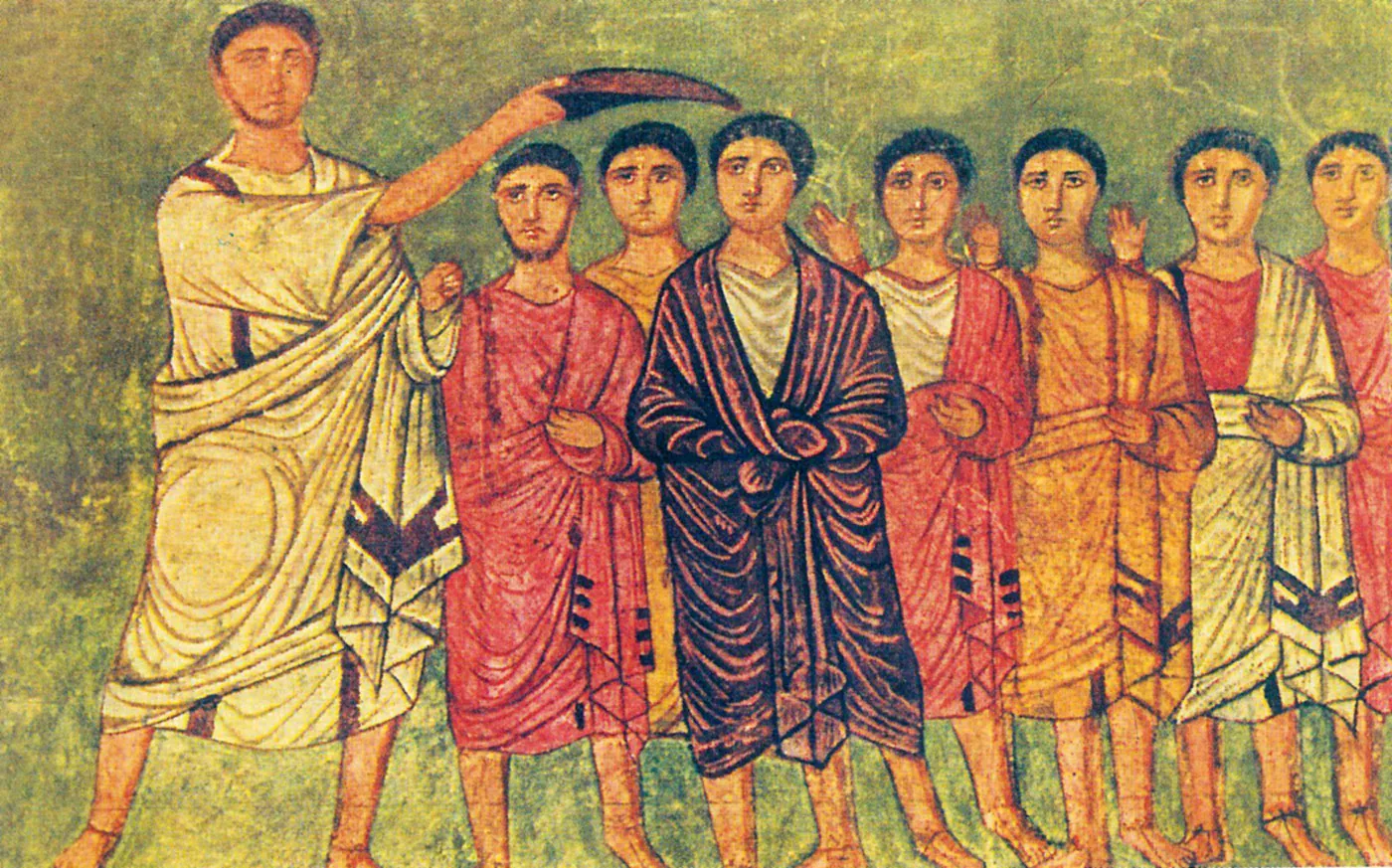

Samuel stands at the left and extends a horn above the selected young man. David is not isolated as a muscular hero. He stands among brothers whose frontal faces, patterned garments, and close spacing create a human register across the wall. The scene becomes legible through sequence, gesture, and its relation to neighbouring biblical episodes.
This painting belonged to a much larger room. The synagogue at Dura-Europos, on the Euphrates in present-day Syria, began as a house adapted for a Jewish congregation and was rebuilt on a larger scale. An Aramaic inscription dates the decorated phase to 244/45 CE. A Torah shrine occupied the west wall facing Jerusalem; painted biblical narratives rose around the room in horizontal registers, while ceiling tiles carried animals, plants, astrological signs, and protective designs.
The building disrupts a persistent shortcut: that ancient Jewish communities simply prohibited every figural image. The commandment against images generated interpretation and debate, not one practice applied identically across time and place. The Met’s survey of Jewish art in Late Antiquity situates Dura among the archaeological and literary evidence for more than 150 synagogues across the Roman Empire. Later synagogue mosaics also combine biblical figures, Jewish ritual objects, animals, zodiac imagery, and architectural forms.
The stronger question is not “Why did Jews break a rule?” It is: what distinctions did this congregation make among an idol, a cult statue, a narrative painting, ornament, and a sign used in communal worship?
Local workshop practice helps answer without pretending to recover every intention. Dura contained temples for several religious communities and an early Christian meeting house. Comparable painted surfaces, ceiling systems, gestures, clothing, and frontal figures appeared across buildings commissioned by different patrons. The synagogue’s makers did not need a sealed “Jewish style” to create a Jewish space. Arrangement, subject, inscriptions, direction, and congregational use made shared urban techniques particular.
Nor does architectural proximity prove an ideal city of tolerance. Communities could exchange labour and formats while living under unequal laws and political pressure. Dura was a Roman garrison city near the Sasanian frontier. Around the middle of the third century, Roman soldiers reinforced its western wall against attack by burying adjacent buildings beneath an earthen rampart. That emergency measure preserved much of the synagogue when the city was abandoned after Sasanian conquest.
The modern archive is another transformation. A Yale–French expedition uncovered the building in 1932–33. Herbert Gute made painted copies before Henry Pearson’s team detached the surviving murals. The originals went to the National Museum in Damascus; Gute’s copies went to Yale. The online reconstruction allows the room to be studied, but it joins originals, copies, excavation photographs, plans, and digital interfaces. These are related evidence, not interchangeable substitutes for standing inside the ancient assembly hall.
The panel carries four contexts: biblical episode, synagogue wall, frontier city, and twentieth-century archaeological division. It does not matter because it predicts later Christian art. It shows a Jewish community giving scripture monumental order in its own present.
A Roman sarcophagus: Christianity entered an existing workshop

A robed teacher sits near the centre of this long marble lid. Eight sheep approach from his right; five goats turn from his raised hand at the left. Trees divide the groups without making separate boxes. Scrolls beside the central figure identify learning and authority. The scene translates the Gospel of Matthew’s image of final judgement, when Christ separates people as a shepherd separates sheep from goats.
Yet almost none of its visual vocabulary had to be invented for Christianity.
The central figure wears the mantle of a philosopher. Shepherds, flocks, garden settings, scroll bundles, and seated teachers already belonged to Roman funerary and pastoral art. The Met’s object record notes that a workshop could arrange comparable figures differently for a non-Christian sarcophagus. The commission becomes Christian through the relation among figure, animals, gesture, text, and purchaser—not because marble carving suddenly acquired a religion.
This is why 313 is a poor on–off switch for Christian art. The agreement associated with Constantine and Licinius at Milan granted toleration and restored confiscated Christian property; it did not make Christianity the empire’s official religion or create its images overnight. Christians had already adapted houses, burial spaces, portable objects, and familiar visual types. Imperial patronage after Constantine changed the scale and public resources available to churches, but existing workshops, materials, and viewers made that expansion possible.
The uncertain date in the museum title—late third to early fourth century, followed by a question mark—keeps the object on both sides of the conventional political boundary. Rather than force it into “before legalisation” or “after triumph,” the range directs attention to a process. Patrons and stoneworkers were testing how much a familiar composition could carry.
That process was selective. A philosopher type gives Christ learned authority; a shepherding parable makes moral judgement visible without showing a courtroom or cosmic catastrophe. The carving asks the viewer to distinguish almost identical animals by their direction and relation to the central gesture. Difference is produced through placement rather than anatomy alone.
The funerary setting matters. A sarcophagus held or marked a dead body and addressed mourners who might know the text, the deceased, and the hope of salvation. The image turned judgement into consolation and warning at the site of death.
Calling this merely “borrowed pagan imagery” misses agency. Workshops did not hand Christianity a fixed box of symbols. Makers and patrons recombined a shared Roman repertoire, changing relationships until an inherited form performed different theological work. Translation was not passive survival; it was production.
An Egyptian tunic: the classical past was worn
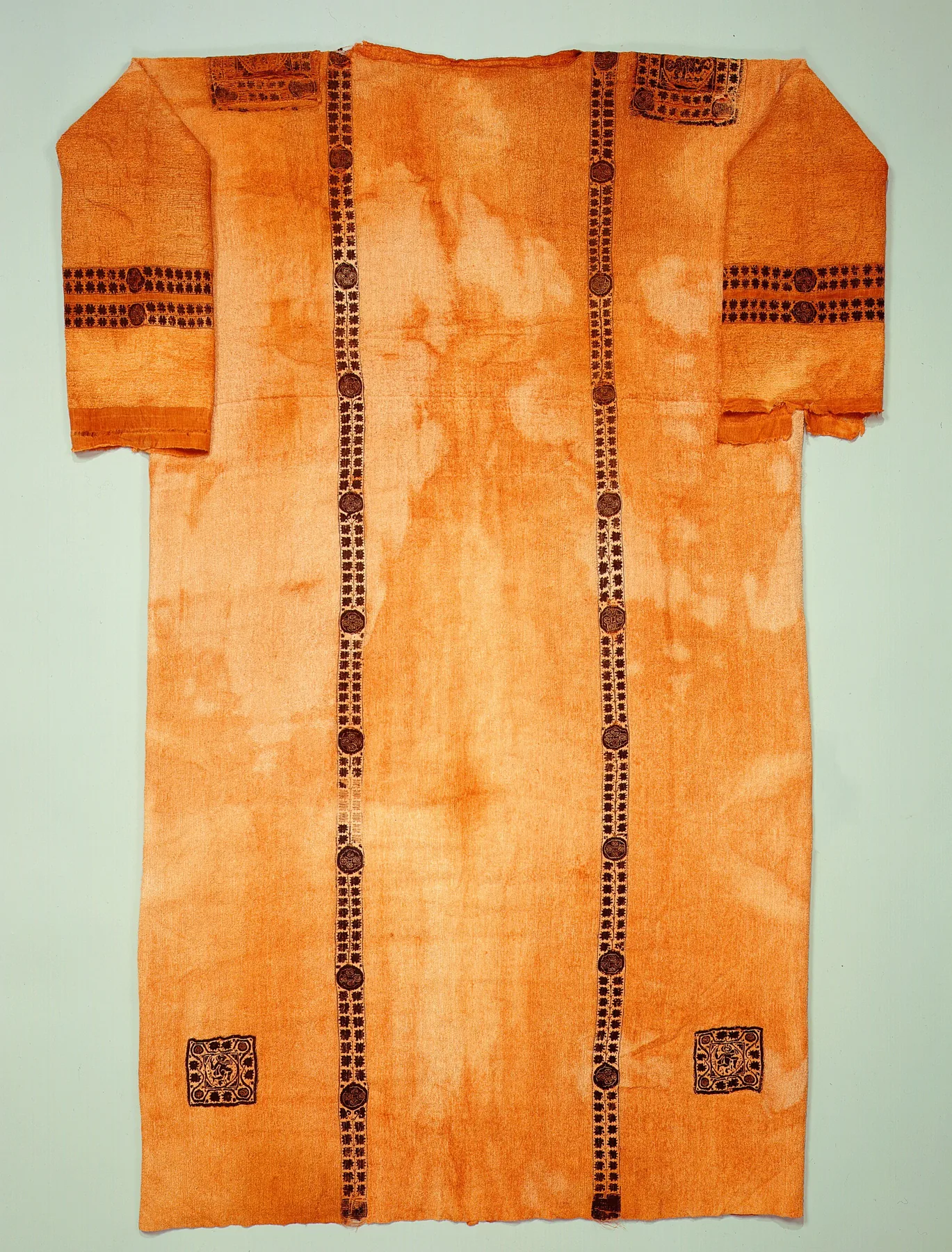
Two dark bands descend from the shoulders to the hem of this large tunic. Related bands cross the sleeves, while square panels occupy the shoulders and lower front. Within the narrow fields, small rosettes, interlace, medallions, vine leaves, and dancing warriors build a dense decorative system across a broad plain weave.
The bands are called clavi. They do more than edge a picture. On a worn garment they would have lengthened the torso, marked the shoulders, and moved with the arms and legs. The body completed the design.
The Met dates the tunic probably to the fifth century and records it as “said to be from” Akhmim, the ancient Panopolis, in Egypt. That wording is evidence about uncertainty. The museum has an attributed place, not a documented modern excavation context. The catalogue names linen and wool, but neither the wearer nor the workshop.
Tunics were standard Mediterranean dress. Scale, long sleeves, and elaborate woven ornament could distinguish a well-resourced wearer, though they cannot recover one person’s name or faith. The warriors may be associated with Dionysos, while vines and interlace organise the clavi. Nothing in the record licenses the easy conclusion that the owner was a practising worshipper of Dionysos—or, conversely, that every classical motif had become empty decoration under Christianity.
Fifth-century Egypt included Christian institutions, older cult memories, Jewish communities, Greek and Coptic languages, Roman administration, and local social differences. A classical figure could carry pleasure, education, prosperity, status, protection, religious reference, or several associations at once. Motifs remained available because viewers and workshops could continue to use them, not because history had forgotten to change.
This is also why the label “Coptic textile” needs care. Coptic can refer to Egypt’s late form of the Egyptian language and to Christian communities and institutions; museum catalogues have also used it broadly for textiles from Roman, Byzantine, and early Islamic Egypt. The British Museum’s terminology record acknowledges the overlap. The Met’s study of Byzantine textile motifs further notes that works often called Coptic share motifs across the Byzantine world.
“Late antique Egyptian tunic” is more precise here because the garment’s Christian ownership is not established. It preserves place and period without making religion from cloth alone.
Survival can mislead too. Egypt’s dry conditions preserved textiles that would disappear in wetter regions. Many were recovered from clothing and wrappings in burial grounds, and early collectors sometimes cut decorative panels from larger fabrics. This tunic remains unusually complete, allowing us to see ornament as a bodily system rather than a tray of detachable motifs. But its incomplete provenance prevents us from turning general burial history into this object’s biography.
The tunic widens the category of art. It required spinning, weaving, dyeing, designing repeats, joining cloth, and finishing a garment. These forms of labour rarely preserve named makers. A history centred on signed stone and monumental buildings would miss their skill and the mobile surfaces of daily identity.
A Sasanian plate: Rome was not the only imperial present
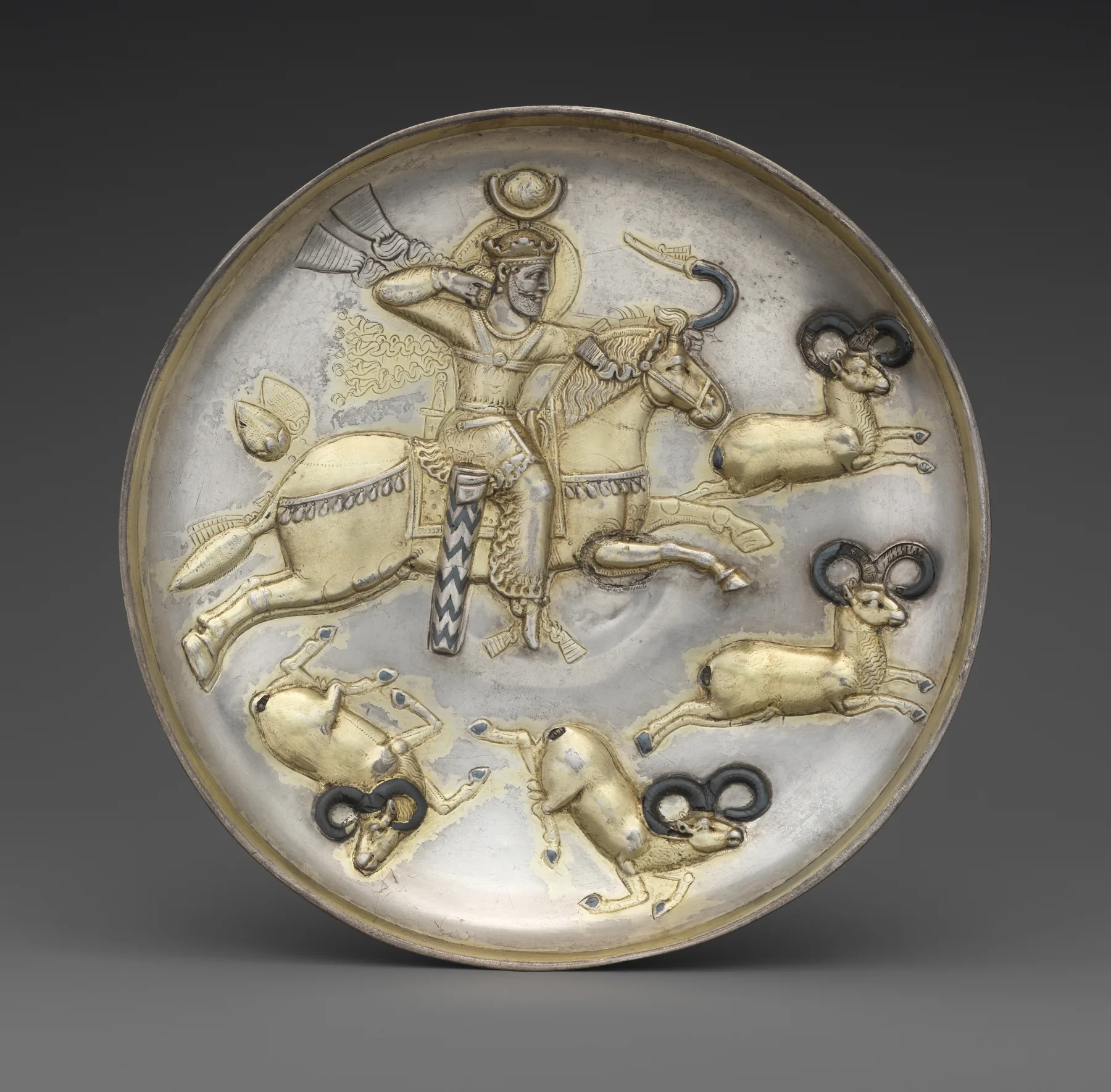
A crowned rider twists above a galloping horse and draws his bow toward four rams. One animal leaps at the right; others tumble below. Gold marks bodies, weapons, harness, clothing, and royal attributes against a silver field. Dark niello sharpens horns, hooves, bow, and wounds. The plate makes pursuit circle around a ruler who remains visually stable at its centre.
This is not a peripheral imitation of Rome. It belongs to the Sasanian Empire, founded in 224 and ruled from centres in Iran and Mesopotamia. Sasanians and Romans fought over frontier regions, negotiated treaties, exchanged envoys and captives, and addressed one another as imperial rivals. Their courts developed distinct institutions while sharing materials, diplomatic practices, and mobile motifs.
The Met dates the plate broadly from the mid-fifth to mid-sixth century. The king’s crown resembles those of Peroz or Kavad I, but the museum does not choose between them. “King” is secure; a personal name is not.
Royal hunting had become a standard Sasanian silver subject under Shapur II in the fourth century. The image converts physical mastery into political order: the ruler controls horse, weapon, wild animals, and the circular field. Such plates were probably official products and could travel as gifts to neighbouring courts. Precious metal made the message materially valuable before anyone interpreted the scene.
Production was as complex as the iconography. The bowl was hammered into shape. Separate silver pieces were inserted to raise parts of the design. A gold-and-mercury amalgam created gilded areas; niello, an alloy containing silver and sulphur, supplied dark inlay. What looks at first like drawing on metal is a built relief of changing height, colour, and reflectivity.
The acquisition history is less exact. The record says that, at the time of acquisition, the plate was “said to have been found in Qazvin.” That phrase does not equal an excavated findspot. Without a controlled archaeological context, its ancient route, owner, and deposit remain unknown.
The plate also prevents “Christian versus pagan Rome” from becoming the whole period. The Met’s Sasanian overview places royal silver beside rock reliefs, coins, seals, architecture, textiles, and exchange across West and Central Asia. Zoroastrianism received state support, while Jewish and Christian scholarly communities also lived within Sasanian lands. A single court object cannot describe that religious plurality, but it keeps the political map from ending at Rome’s frontier.
Compare the plate with the Tetrarchs. Both make authority repeatable through regulated bodies, rare materials, and controlled attributes. One joins four rulers into an embrace; the other centres one ruler within a mastered hunt. Similar imperial problems produced different visual solutions.
Five objects, five kinds of remaking
| Object | Existing resource | What was remade | Site of authority | Evidence limit |
|---|---|---|---|---|
| Four Tetrarchs | Roman imperial portrait, military dress, Egyptian porphyry | Individual likeness becomes a repeated image of shared office | Imperial monument; later Venetian façade and trophy | Original installation and exact identities remain debated |
| Dura synagogue painting | Urban wall-painting workshops, biblical narrative, local dress and gesture | Shared city techniques organise a specifically Jewish assembly room | Congregation, Torah-facing wall, frontier city | Images do not reveal a single Jewish position on representation or prove interreligious harmony |
| Last Judgement sarcophagus lid | Shepherd, philosopher, scroll, garden, Roman funerary carving | Familiar types are rearranged to make Christian judgement visible | Burial, workshop, mourning community | Date is uncertain and the surviving lid cannot recover its purchaser or full setting |
| Egyptian tunic | Mediterranean garment form, clavi, Dionysian and vegetal motifs | Classical imagery becomes a moving social surface | Worn body, household, textile economy | “Said to be from Akhmim” is not a documented excavation; wearer and religion are unknown |
| Sasanian royal hunt plate | Precious-metal vessel, courtly hunt, crown, diplomatic gift | Material and motion stage a distinct West Asian kingship | Court, banquet, treasury, gift exchange | King may be Peroz or Kavad I; reported Qazvin find lacks archaeological documentation |
The table does not arrange the objects from old to new or naturalistic to abstract. It asks what each maker inherited, which relation changed, and where the result acted.
That method replaces the vague word “influence” with operations. The sarcophagus rearranges. The tunic carries and repeats. The synagogue spatialises. The plate concentrates and circulates. The Tetrarchs standardise—and later become spolia. Each verb identifies work done by people and materials.
Christianisation changed access to power
Continuity can sound comforting if power is left out. Christian makers used existing Roman formats, but Christianisation was not only a free exchange of symbols.
Before Constantine, Christian communities sometimes faced state persecution; enforcement differed by ruler, place, and moment. The measures associated with Milan in 313 protected Christian worship and property. Constantine and later emperors financed churches, granted privileges to clergy, and brought Christian ritual into imperial display. In 380, Theodosius I promoted Nicene Christianity as imperial orthodoxy. Later fourth-century laws increasingly restricted sacrifice and older public cults.
These changes redistributed buildings, money, legal standing, and visibility. Temples could remain active, lose funds, be closed, dismantled, converted, or quarried. Bishops became civic patrons and political actors. Disputes among Christians over doctrine and images were not minor internal variations; councils, imperial backing, exile, and confiscation could give one position material force over another.
Jewish communities remained part of cities across the Roman and Sasanian worlds, built synagogues, commissioned images and inscriptions, and developed scholarship. They also experienced changing legal restrictions and Christian polemic. Dura’s third-century room should therefore not be used as timeless proof that every later community enjoyed the same options.
Nor did the rise of Christianity erase classical subjects in private life. The Egyptian tunic’s possible Dionysian imagery and the sarcophagus’s philosopher-shepherd vocabulary show different kinds of persistence. One may have displayed prosperity and cultured association on clothing; the other redirected a shared funerary repertoire toward salvation. Similar survival does not mean identical belief.
The useful question is not simply “Did pagan art become Christian?” Ask instead:
- Who controlled a building, workshop, burial plot, treasury, or public route?
- Which older materials remained available, and who could afford them?
- Was reuse practical, honorific, polemical, or several at once?
- What could still be shown privately when public sponsorship changed?
- Which communities are visible because their monuments survived, and which are known only through fragments or hostile texts?
Religious change becomes clearer when images are placed inside institutions.
Why “decline” is a poor visual test
The decline model usually begins with a comparison. Place a Tetrarch beside a second-century athletic nude; note the blockier body and repeated face; conclude that sculptors had forgotten anatomy. The conclusion assumes naturalistic anatomy is the universal measure of skill and that every patron wanted the same effect.
The Tetrarchs show why that fails. Repetition delivers a political argument about homogeneous office. Hard contours make eyes, hands, weapons, and embrace legible. Porphyry and lost gilding carry status. The sculpture’s priorities changed.
But replacing “decline” with “transformation” can become equally lazy. Western imperial administration did fragment. Some cities contracted, long-distance systems weakened, monuments were stripped, and workshop traditions disappeared. War destroyed Dura; an emergency fortification preserved the synagogue only by burying it. Survival often records catastrophe.
Formal change is not proof of lost ability, and continuity is not proof that no loss occurred.
Evidence must be local. Coin sequences, harbour deposits, building repairs, pollen, shipwrecks, inscriptions, legal texts, and workshop remains may show contraction or resilience more securely than a preference for frontal eyes. A fifth-century tunic from Egypt cannot prove economic conditions in Britain. A Sasanian silver court object cannot describe village life in Mesopotamia. The end of the western imperial office in 476 did not end Roman government in Constantinople or set every Mediterranean clock to zero.
Art history contributes by tracing choices: what was retained, compressed, translated, hidden, broken, or moved. It cannot turn one style into a civilisation’s medical diagnosis.
A compact timeline
| Date | Event or object | Why it matters here |
|---|---|---|
| 224 CE | Ardashir I establishes Sasanian rule | A major West Asian imperial system develops alongside Rome |
| 244/45 | Decorated phase of the Dura-Europos synagogue | An inscription anchors a monumental Jewish narrative environment |
| c. 256 | Sasanian forces take Dura after Roman defences bury buildings by the west wall | Conflict destroys the city while the embankment preserves parts of the synagogue |
| 293 | Diocletian formalises the first Tetrarchy | Four-person rule requires a new image of coordinated authority |
| c. 300 | Porphyry Tetrarch groups are made | Repetition, embrace, military dress, and imperial stone stage unity |
| late 3rd–early 4th century (?) | Sarcophagus Lid with Last Judgement | A Roman workshop makes Christian meaning from shepherd and philosopher types |
| 313 | Constantine and Licinius agree on toleration and restoration of Christian property | Christian public patronage expands; Christianity is not yet the official imperial religion |
| 330 | Constantinople is dedicated | The eastern Roman capital becomes a major centre of imperial and Christian patronage |
| 380 | Theodosius I promotes Nicene Christianity as imperial orthodoxy | Religious affiliation becomes more tightly joined to state authority |
| fifth century | The Egyptian tunic is probably made | Classical and Dionysian motifs remain active on clothing in a changing religious world |
| 476 | Romulus Augustulus is deposed in the West | A western office ends; the eastern Roman Empire and other regional histories continue |
| mid-5th–mid-6th century | Sasanian royal hunt plate | Courtly silver materialises kingship and may circulate diplomatically |
| 1204 | Crusaders sack Constantinople; the Tetrarchs are taken to Venice | Late antique material becomes medieval spolia and conquest display |
Key terms
- Late Antiquity: A modern, flexible period term generally covering parts of the third through seventh centuries across Europe, North Africa, West Asia, and neighbouring regions. Its useful dates depend on place and question.
- Tetrarchy: “Rule of four”; Diocletian’s system of two senior Augusti and two junior Caesares, formally established in 293.
- Porphyry: A hard purple-red igneous stone quarried in Egypt and closely associated with Roman imperial use.
- Spolia: Material removed from an older object or building and reused in a new setting. Reuse can involve economy, prestige, domination, memory, or several motives.
- Synagogue: A Jewish communal institution for assembly, prayer, teaching, and scripture; its architecture and imagery vary by place and period.
- Sarcophagus: A stone or other durable coffin, often carved or inscribed and displayed within a funerary setting.
- Iconography: The identification and interpretation of subjects, attributes, and visual relationships; resemblance is evidence to test, not a self-proving code.
- Clavi: Vertical ornamental bands on a tunic. Their scale, colour, and imagery helped structure a clothed body.
- Coptic: A term connected to the late Egyptian language and Egyptian Christianity, but also used inconsistently in museum histories for late antique and later Egyptian material.
- Sasanian: Relating to the empire that ruled much of Iran, Mesopotamia, and surrounding regions from 224 to the seventh century.
- Niello: A dark metallic inlay used to create contrast on silver and other metal surfaces.
- Spiritualisation: A label sometimes applied to frontal, enlarged-eyed, or less naturalistic late antique figures. It should not replace evidence about an object’s specific function and patron.
Ten questions for close looking
- Which features of the Tetrarchs repeat, and which small differences remain?
- How do the embrace and the swords qualify one another?
- What changes when the Dura panel is imagined within three registers around a Torah-facing room rather than as one framed picture?
- Which shared workshop conventions can cross religious commissions without making the commissions identical?
- How does the sarcophagus distinguish sheep from goats through direction, spacing, and gesture?
- What would the Egyptian tunic’s clavi and panels do when the wearer walked or raised an arm?
- Which claims about the tunic change when “said to be from Akhmim” replaces a documented findspot?
- How do silver, gilding, niello, relief, and circular composition organise the Sasanian hunt?
- Where does each object locate authority: face, material, text, ritual direction, body, or controlled motion?
- What later event—burial, fortification, excavation, removal, collection, or reuse—most strongly shapes how you can see each work now?
Five shortcuts to refuse
- “Late Antique art is decayed classical art.” Naturalism is not a neutral skill meter. Identify what a changed form makes possible before judging loss.
- “313 made the Roman Empire Christian.” It expanded legal protection; official orthodoxy, institutional power, and restrictions on other practices developed unevenly afterward.
- “Judaism prohibited images.” Jewish communities interpreted representation differently across objects, functions, places, and centuries.
- “A classical motif proves pagan belief.” Dionysian figures on clothing or pastoral forms on a sarcophagus require context, not automatic religious identity.
- “Late Antiquity was Rome’s story.” Roman histories intersected with Sasanian, Jewish, Egyptian, Armenian, Aksumite, Central Asian, and many other local chronologies.
Source guide
The article prioritises object records and institutional research that let a reader inspect both claims and limits:
- The Italian cultural-heritage record for the Tetrarch relief, the St Mark’s research record, and the Met’s Roman portraiture essay establish material, clothing, political image, Constantinopolitan history, and 1204 removal. The original setting remains a question rather than a certainty hidden by the caption.
- Yale’s Dura-Europos synagogue dossier documents the building phases, 244/45 inscription, wall programme, fortification, excavation, copies, and division of finds. The Met’s Jewish Art in Late Antiquity places the synagogue within a wider archaeological record.
- The Met’s sarcophagus lid, Egyptian tunic, and Sasanian plate records supply object-level date, material, dimensions, interpretation, and Open Access rights. Their question marks and “said to be from” language are retained.
- The Met exhibitions The Good Life: Collecting Late Antique Art and Design Motifs in Byzantine Art provide social and collection context for Egyptian textiles. The British Museum’s Coptic and Late Antique terminology records make the category boundaries explicit.
- The Met’s Sasanian Empire overview connects royal silver to courts, rock reliefs, coins, seals, religious plurality, diplomacy, and longer routes of exchange.
The five images are Public Domain/CC0 or openly licensed. Their local derivatives preserve the full composition without crop. Open image rights permit reproduction; they do not erase sacred use, burial history, excavation, plunder, or incomplete provenance.
Continue through the collections
Return to the Silk Roads guide to follow how Sasanian-derived motifs, Buddhist images, textiles, people, and vessel forms moved across later networks. Pair the Tetrarchs with Etruscan and Roman portrait, domestic, and imperial spaces to test what changed—and what Roman visual politics had always done.
The next chapter will remain with the eastern Roman world but change the question: how icons, mosaics, liturgy, court ceremony, and arguments over visibility made specifically Byzantine ways of seeing.
Editorial record
About this article
- Author
- Publisher
- GeMarkt
- Published
- Updated
- Reviewed
- Internal source & rights check. Conducted by GeMarkt Research Review. This is an internal editorial check—not independent peer review.
- Source standard
- Art history source standardPrioritises object records and research sources, distinguishes evidence from interpretation, and states material uncertainty.
Found a claim that needs checking? Report a factual error.